Cambridge A Level Media Studies 9607 — 2021 May/June Paper 4 · Variant 2
9607/42/M/J/21 · 4 questions · 60 marks · ≈68 min
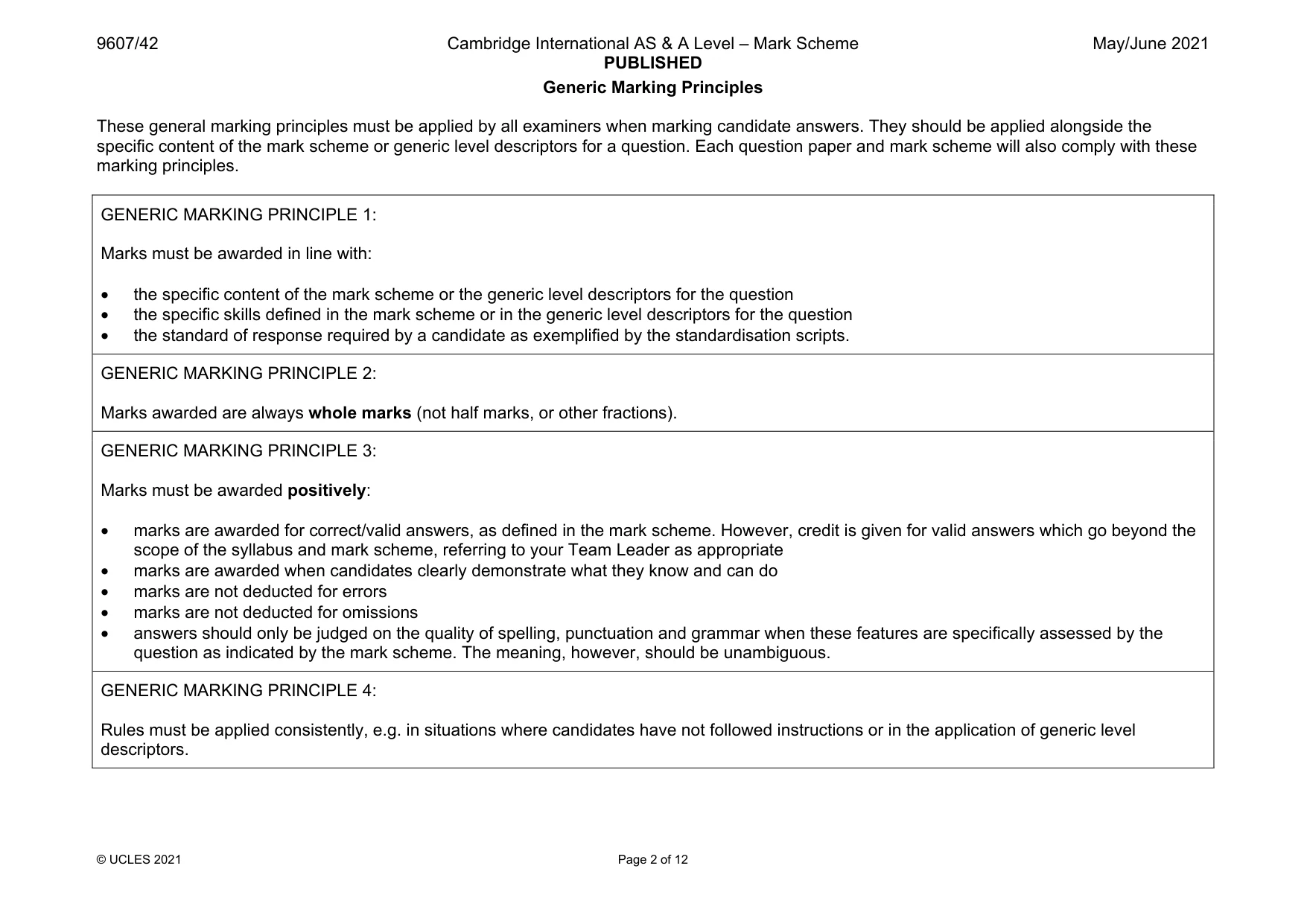
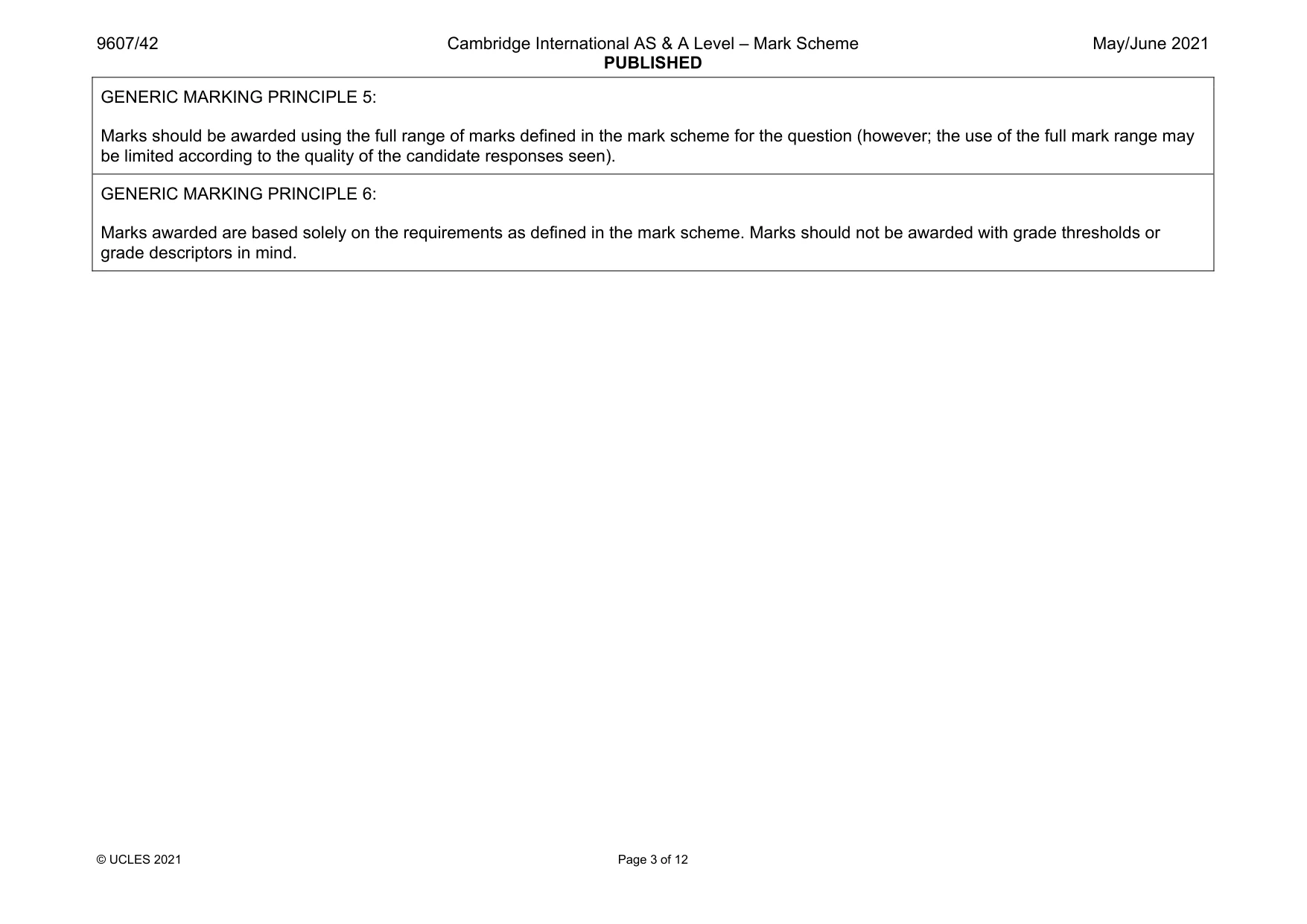
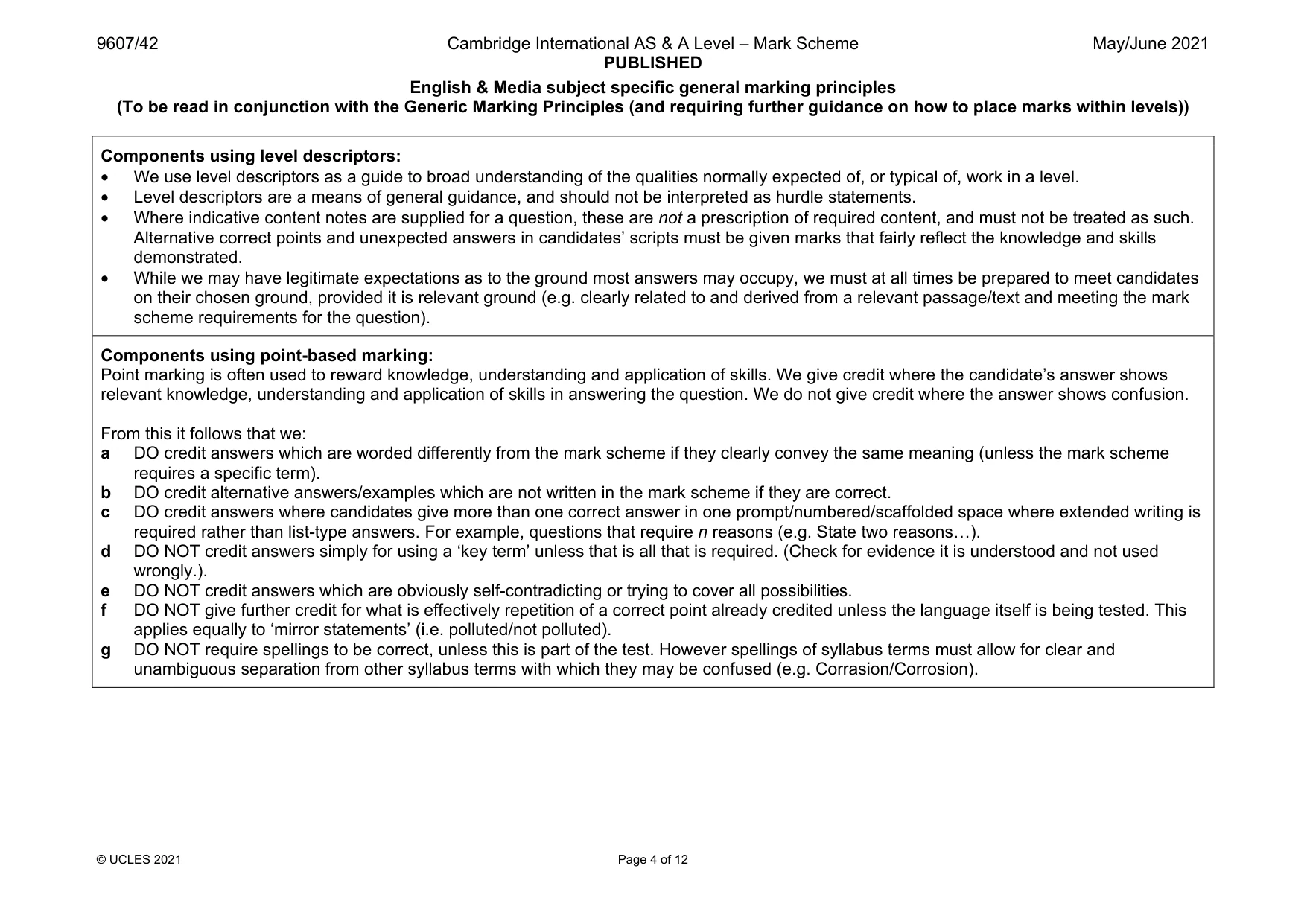
The question paper and its mark scheme, free to read here and free to download. This is Cambridge’s own paper, exactly as it was sat.
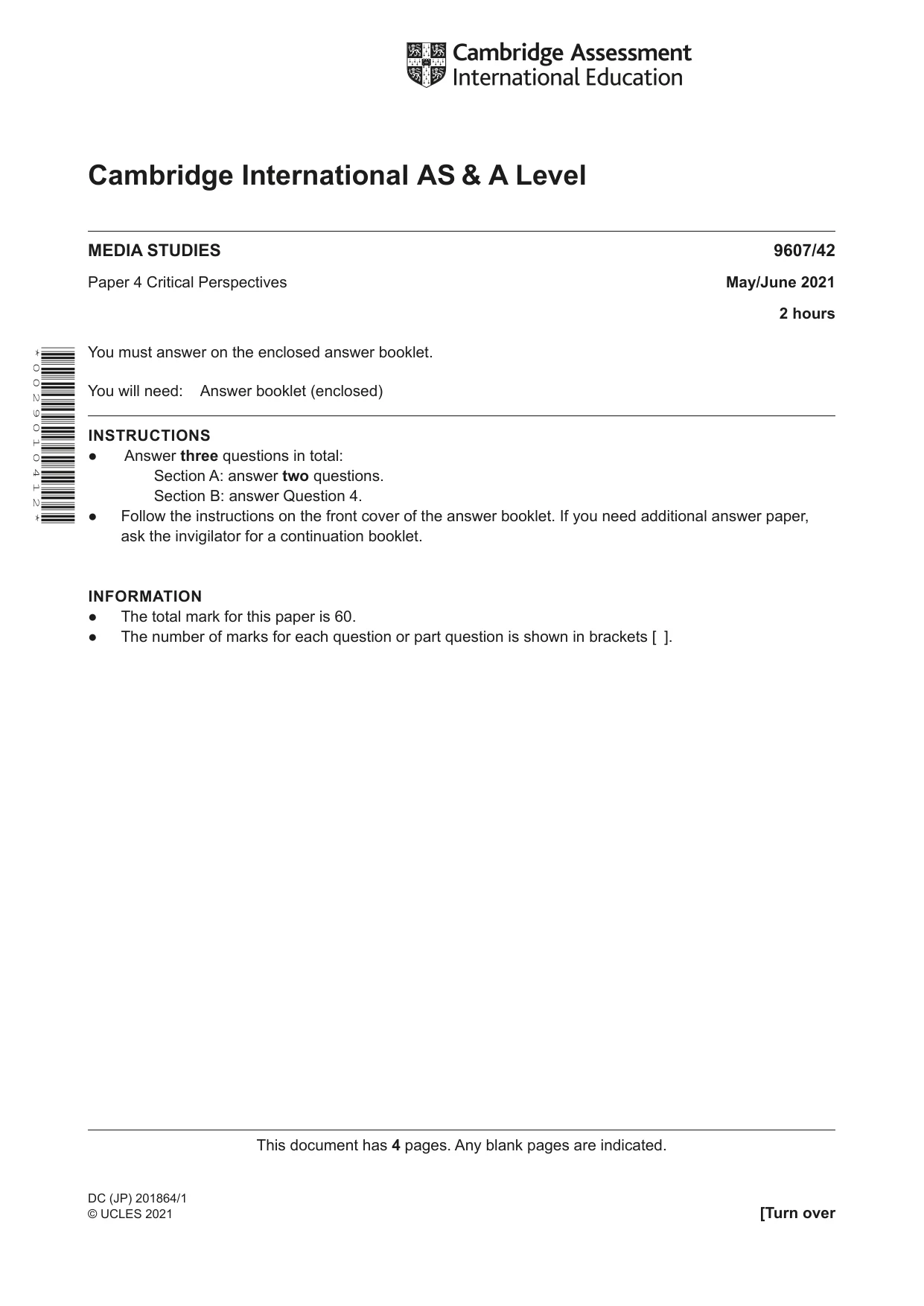
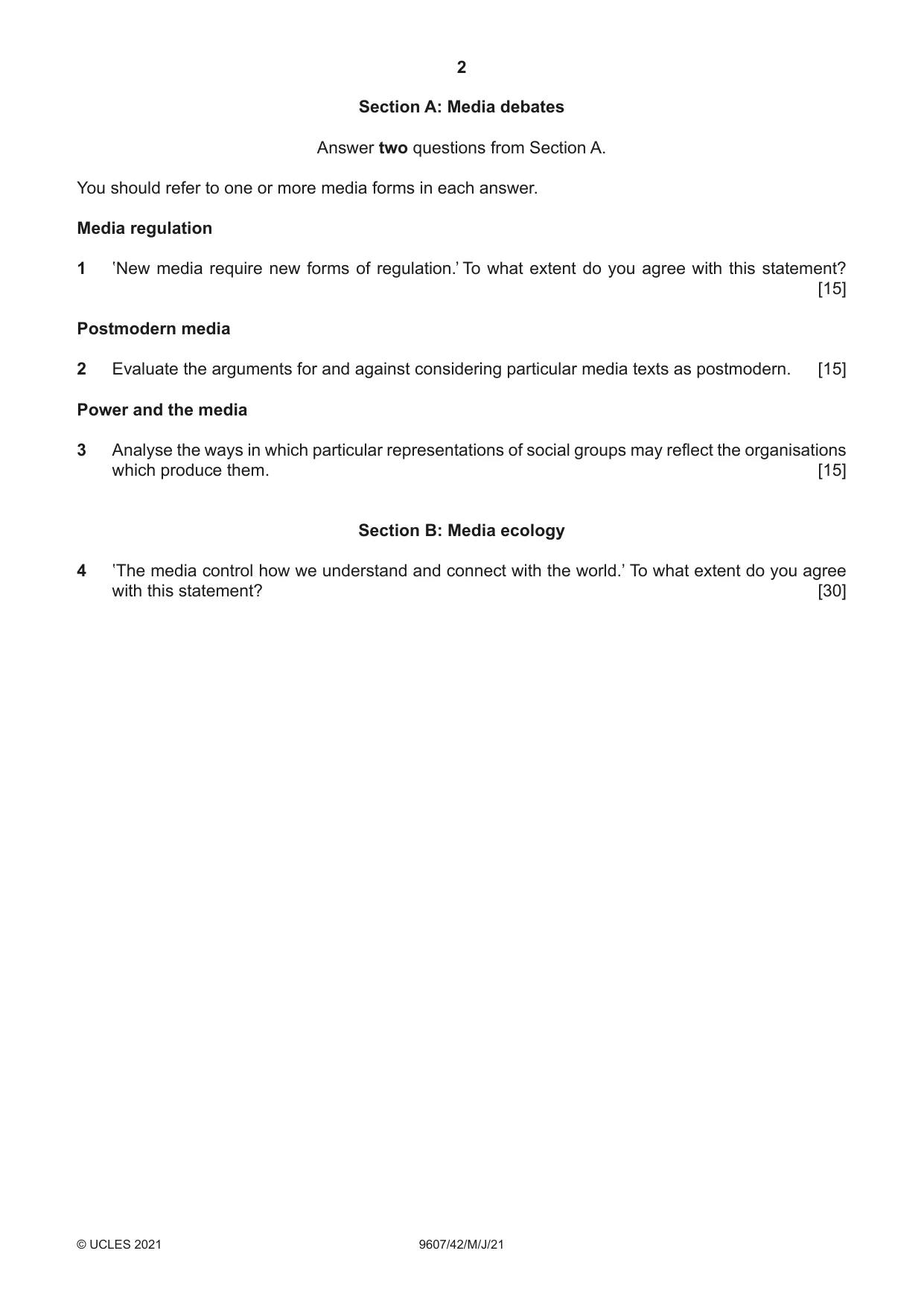
Question paper4 pages

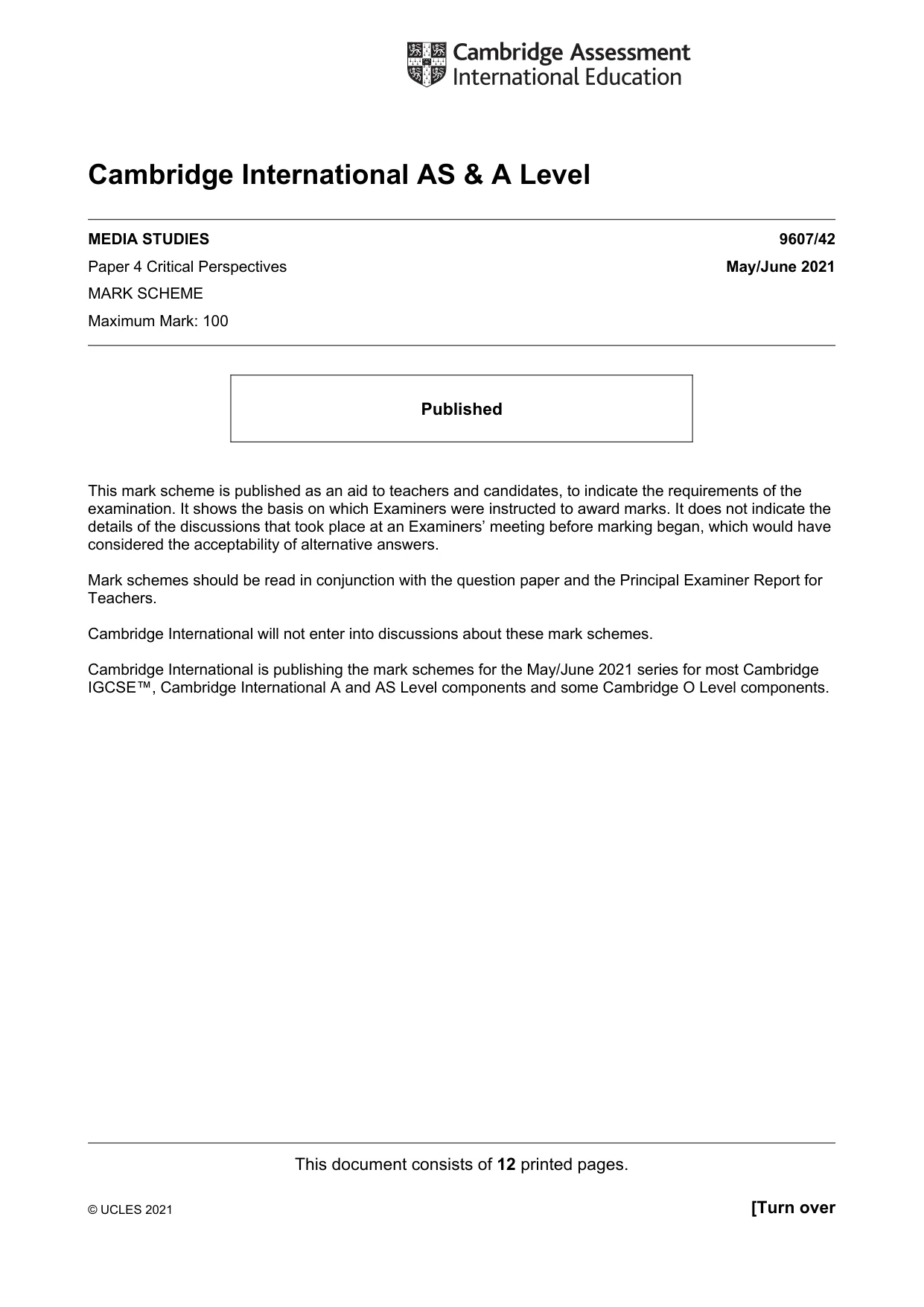
Mark scheme12 pages
Answers below. Sit the paper first if you are practising.
Questions as text
Q1 · ‛New media require new forms of regulation.̕ To what extent do you agree with this…
1 ‛New media require new forms of regulation.̕ To what extent do you agree with this statement? [15] Postmodern media
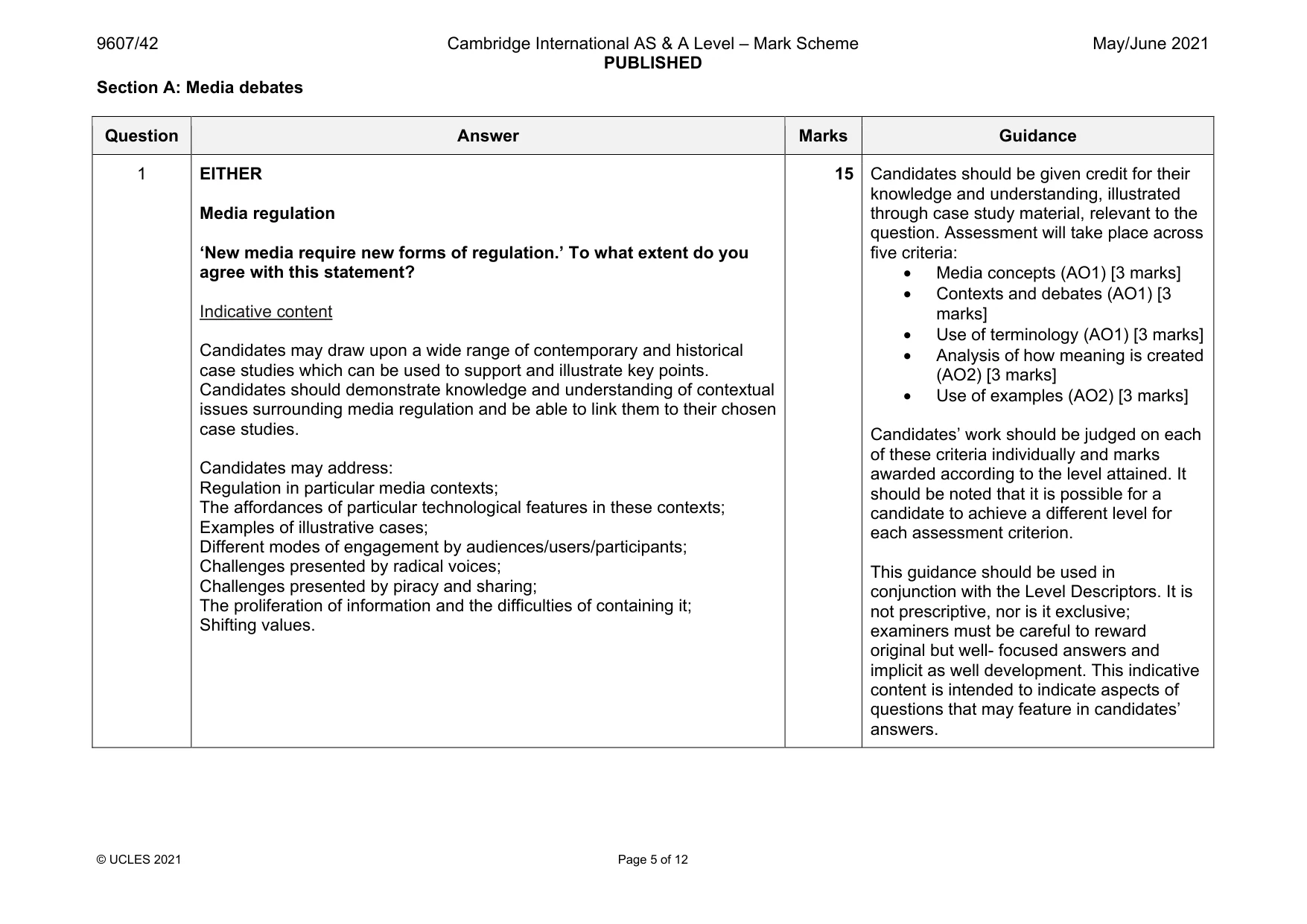
Mark scheme: 1 EITHER Media regulation ‘New media require new forms of regulation.’ To what extent do you agree with this statement? Indicative content Candidates may draw upon a wide range of contemporary and historical case studies which can be used to support and illustrate key points. Candidates should demonstrate knowledge and understanding of contextual issues surrounding media regulation and be able to link them to their chosen case studies. Candidates may address: Regulation in particular media contexts; The affordances of particular technological features in these contexts; Examples of illustrative cases; Different modes of engagement by audiences/users/participants; Challenges presented by radical voices; Challenges presented by piracy and sharing; The proliferation of information and the difficulties of containing it; Shifting values. knowledge and understanding, illustrated through case study material, relevant to the question. Assessment will take place across five criteria: • Media concepts (AO1) [3 marks] • Contexts and debates (AO1) [3 marks] • Use of terminology (AO1) [3 marks] • Analysis of how meaning is created (AO2) [3 marks] • Use of examples (AO2) [3 marks] Candidates’ work should be judged on each of these criteria individually and marks awarded according to the level attained. It should be noted that it is possible for a candidate to achieve a different level for each assessment criterion. This guidance should be used in conjunction with the Level Descriptors. It is not prescriptive, nor is it exclusive; examiners must be careful to reward original but well- focused answers and implicit as well development. This indicative content is intended to indicate aspects of questions that may feature in candidates’ answers.
Q2 · Evaluate the arguments for and against considering particular media texts as postmodern
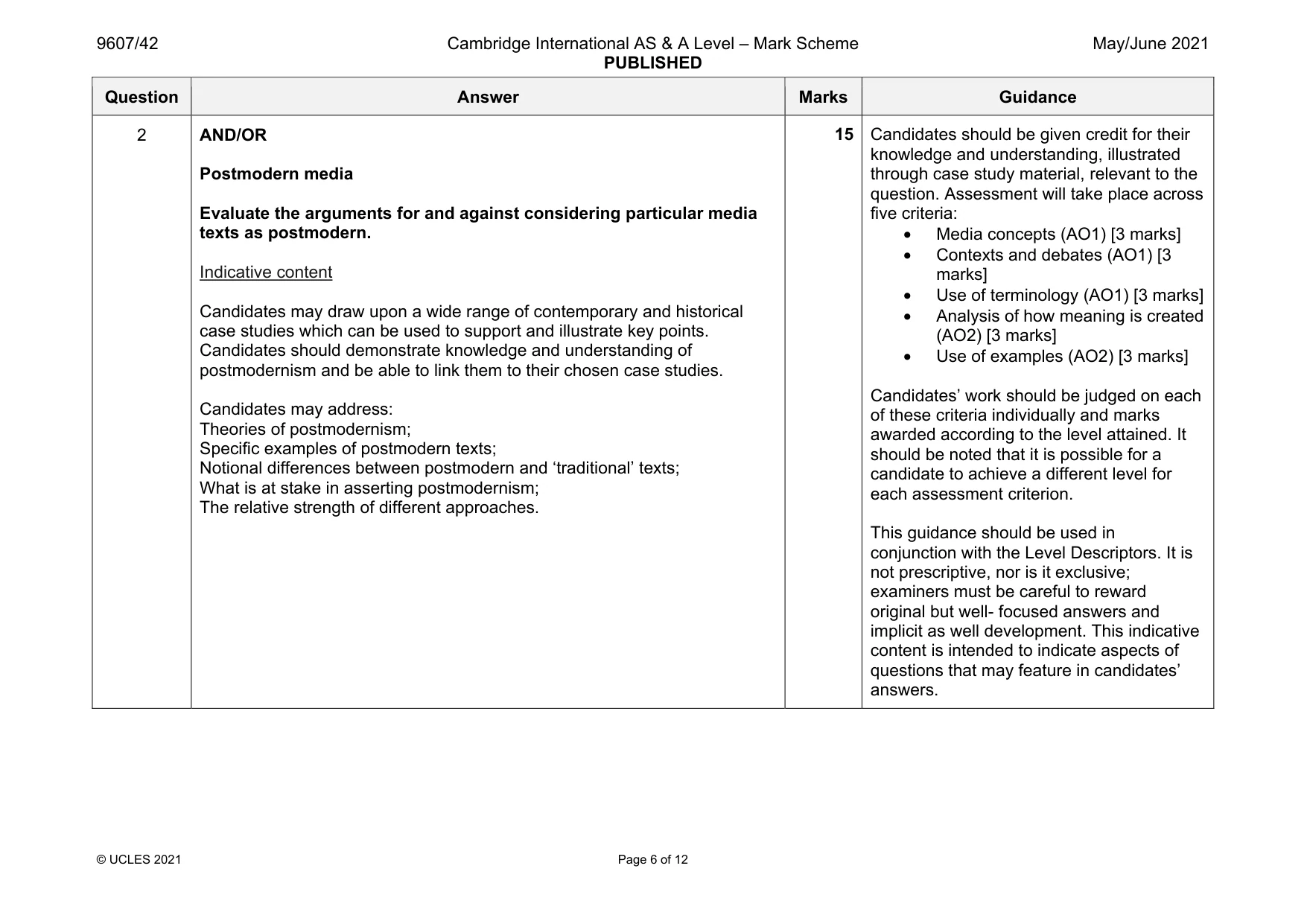
2 Evaluate the arguments for and against considering particular media texts as postmodern. [15] Power and the media
Mark scheme: 2 AND/OR Postmodern media Evaluate the arguments for and against considering particular media texts as postmodern. Indicative content Candidates may draw upon a wide range of contemporary and historical case studies which can be used to support and illustrate key points. Candidates should demonstrate knowledge and understanding of postmodernism and be able to link them to their chosen case studies. Candidates may address: Theories of postmodernism; Specific examples of postmodern texts; Notional differences between postmodern and ‘traditional’ texts; What is at stake in asserting postmodernism; The relative strength of different approaches. knowledge and understanding, illustrated through case study material, relevant to the question. Assessment will take place across five criteria: • Media concepts (AO1) [3 marks] • Contexts and debates (AO1) [3 marks] • Use of terminology (AO1) [3 marks] • Analysis of how meaning is created (AO2) [3 marks] • Use of examples (AO2) [3 marks] Candidates’ work should be judged on each of these criteria individually and marks awarded according to the level attained. It should be noted that it is possible for a candidate to achieve a different level for each assessment criterion. This guidance should be used in conjunction with the Level Descriptors. It is not prescriptive, nor is it exclusive; examiners must be careful to reward original but well- focused answers and implicit as well development. This indicative content is intended to indicate aspects of questions that may feature in candidates’ answers.
Q3 · Analyse the ways in which particular representations of social groups may reflect the…
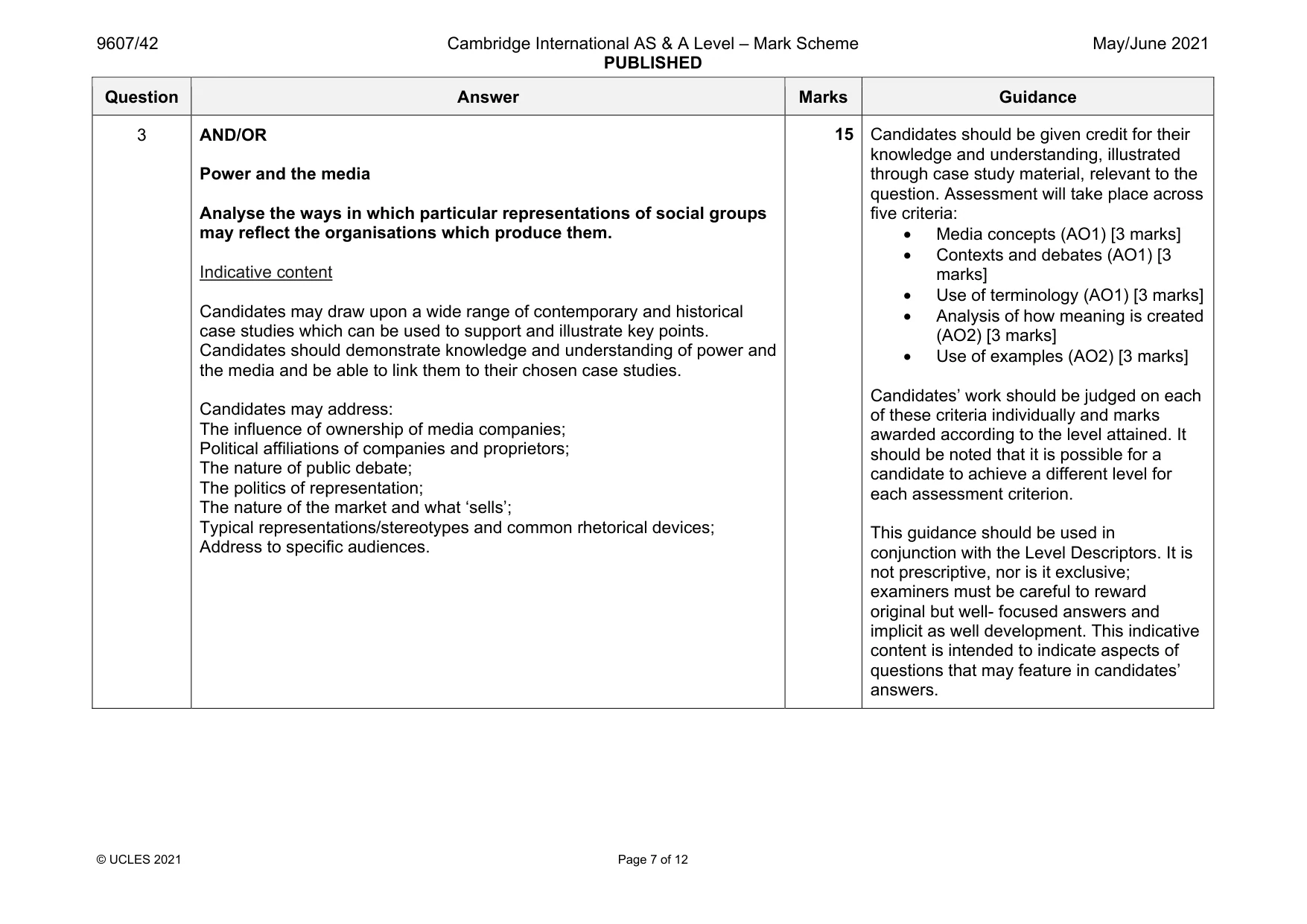
3 Analyse the ways in which particular representations of social groups may reflect the organisations which produce them. [15]
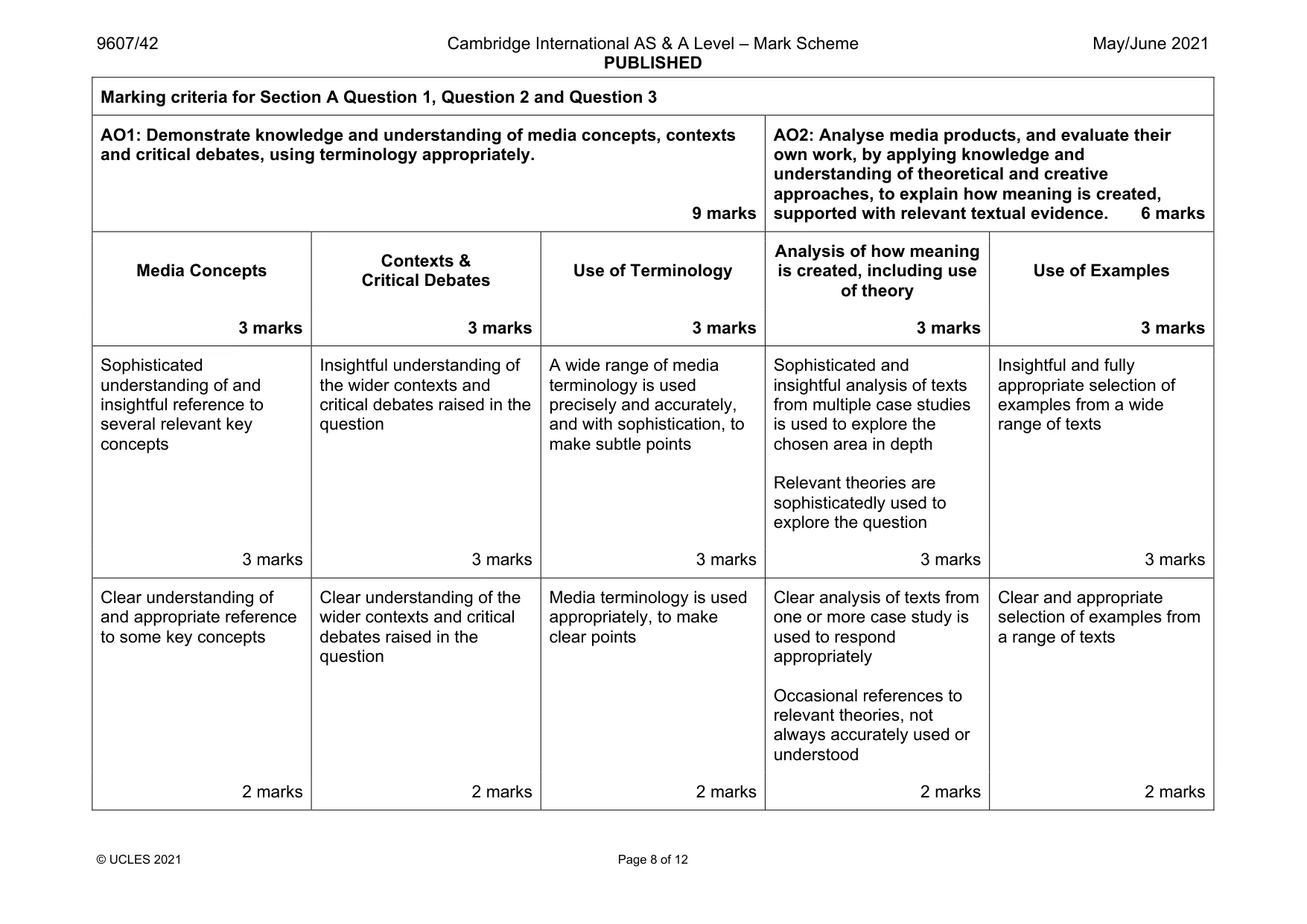
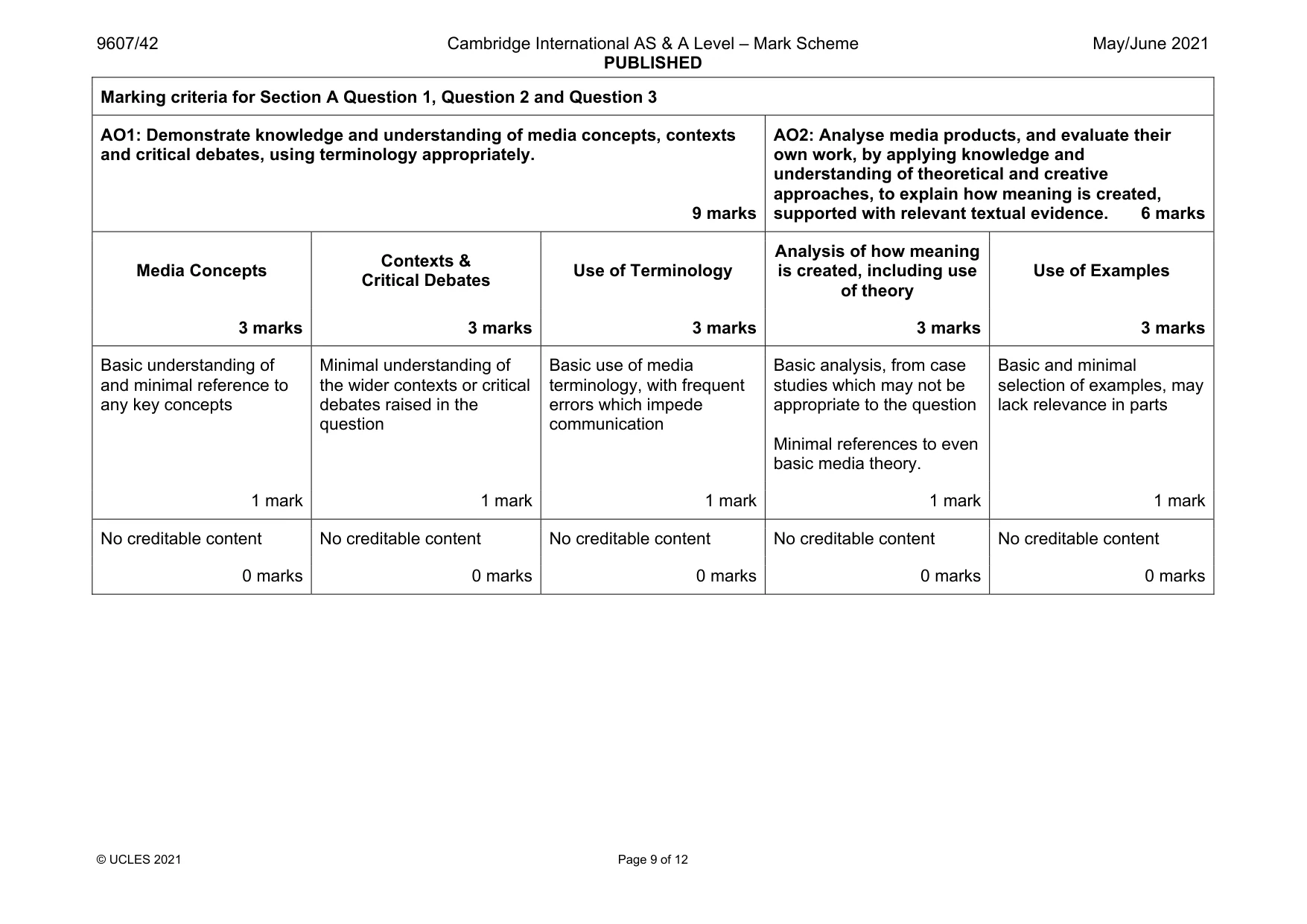
Mark scheme: 3 AND/OR Power and the media Analyse the ways in which particular representations of social groups may reflect the organisations which produce them. Indicative content Candidates may draw upon a wide range of contemporary and historical case studies which can be used to support and illustrate key points. Candidates should demonstrate knowledge and understanding of power and the media and be able to link them to their chosen case studies. Candidates may address: The influence of ownership of media companies; Political affiliations of companies and proprietors; The nature of public debate; The politics of representation; The nature of the market and what ‘sells’; Typical representations/stereotypes and common rhetorical devices; Address to specific audiences. knowledge and understanding, illustrated through case study material, relevant to the question. Assessment will take place across five criteria: • Media concepts (AO1) [3 marks] • Contexts and debates (AO1) [3 marks] • Use of terminology (AO1) [3 marks] • Analysis of how meaning is created (AO2) [3 marks] • Use of examples (AO2) [3 marks] Candidates’ work should be judged on each of these criteria individually and marks awarded according to the level attained. It should be noted that it is possible for a candidate to achieve a different level for each assessment criterion. This guidance should be used in conjunction with the Level Descriptors. It is not prescriptive, nor is it exclusive; examiners must be careful to reward original but well- focused answers and implicit as well development. This indicative content is intended to indicate aspects of questions that may feature in candidates’ answers. Marking criteria for Section A Question 1, Question 2 and Question 3 AO1: Demonstrate knowledge and understanding of media concepts, contexts and critical debates, using terminology appropriately. 9 marks AO2: Analyse media products, and evaluate their own work, by applying knowledge and understanding of theoretical and creative approaches, to explain how meaning is created, supported with relevant textual evidence. 6 marks Media Concepts Contexts & Critical Debates Use of Terminology Analysis of how meaning is created, including use of theory Use of Examples 3 marks 3 marks 3 marks 3 marks 3 marks Sophisticated understanding of and insightful reference to several relevant key concepts Insightful understanding of the wider contexts and critical debates raised in the question A wide range of media terminology is used precisely and accurately, and with sophistication, to make subtle points Sophisticated and insightful analysis of texts from multiple case studies is used to explore the chosen area in depth Relevant theories are sophisticatedly used to explore the question Insightful and fully appropriate selection of examples from a wide range of texts 3 marks 3 marks 3 marks 3 marks 3 marks Clear understanding of and appropriate reference to some key concepts Clear understanding of the wider contexts and critical debates raised in the question Media terminology is used appropriately, to make clear points Clear analysis of texts from one or more case study is used to respond appropriately Occasional references to relevant theories, not always accurately used or understood Clear and appropriate selection of examples from a range of texts 2 marks 2 marks 2 marks 2 marks 2 marks Marking criteria for Section A Question 1, Question 2 and Question 3 AO1: Demonstrate knowledge and understanding of media concepts, contexts and critical debates, using terminology appropriately. 9 marks AO2: Analyse media products, and evaluate their own work, by applying knowledge and understanding of theoretical and creative approaches, to explain how meaning is created, supported with relevant textual evidence. 6 marks Media Concepts Contexts & Critical Debates Use of Terminology Analysis of how meaning is created, including use of theory Use of Examples 3 marks 3 marks 3 marks 3 marks 3 marks Basic understanding of and minimal reference to any key concepts Minimal understanding of the wider contexts or critical debates raised in the question Basic use of media terminology, with frequent errors which impede communication Basic analysis, from case studies which may not be appropriate to the question Minimal references to even basic media theory. Basic and minimal selection of examples, may lack relevance in parts 1 mark 1 mark 1 mark 1 mark 1 mark No creditable content No creditable content No creditable content No creditable content No creditable content 0 marks 0 marks 0 marks 0 marks 0 marks
Q4 · ‛The media control how we understand and connect with the world.’ To what extent do you…
4 ‛The media control how we understand and connect with the world.’ To what extent do you agree with this statement? [30]
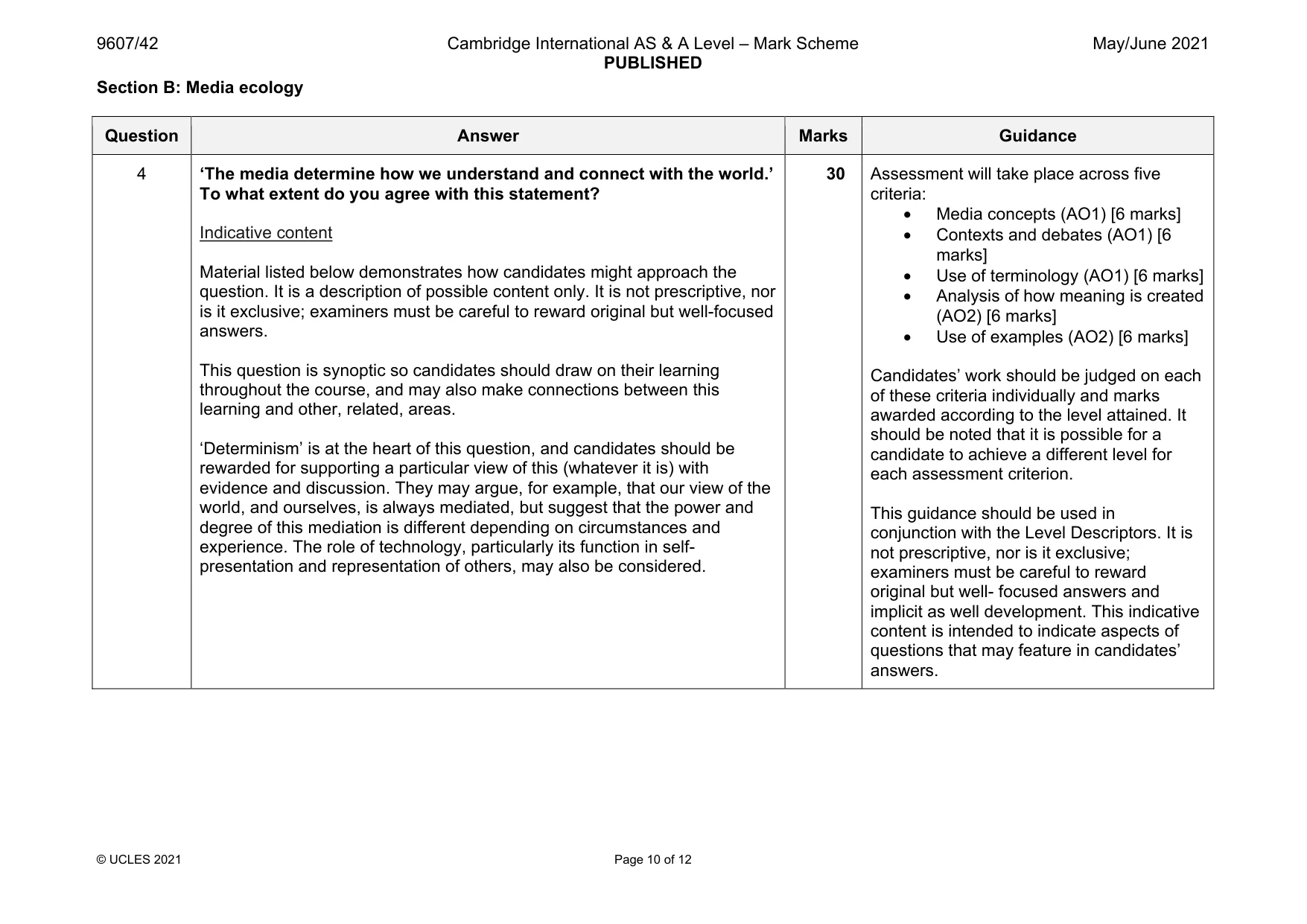
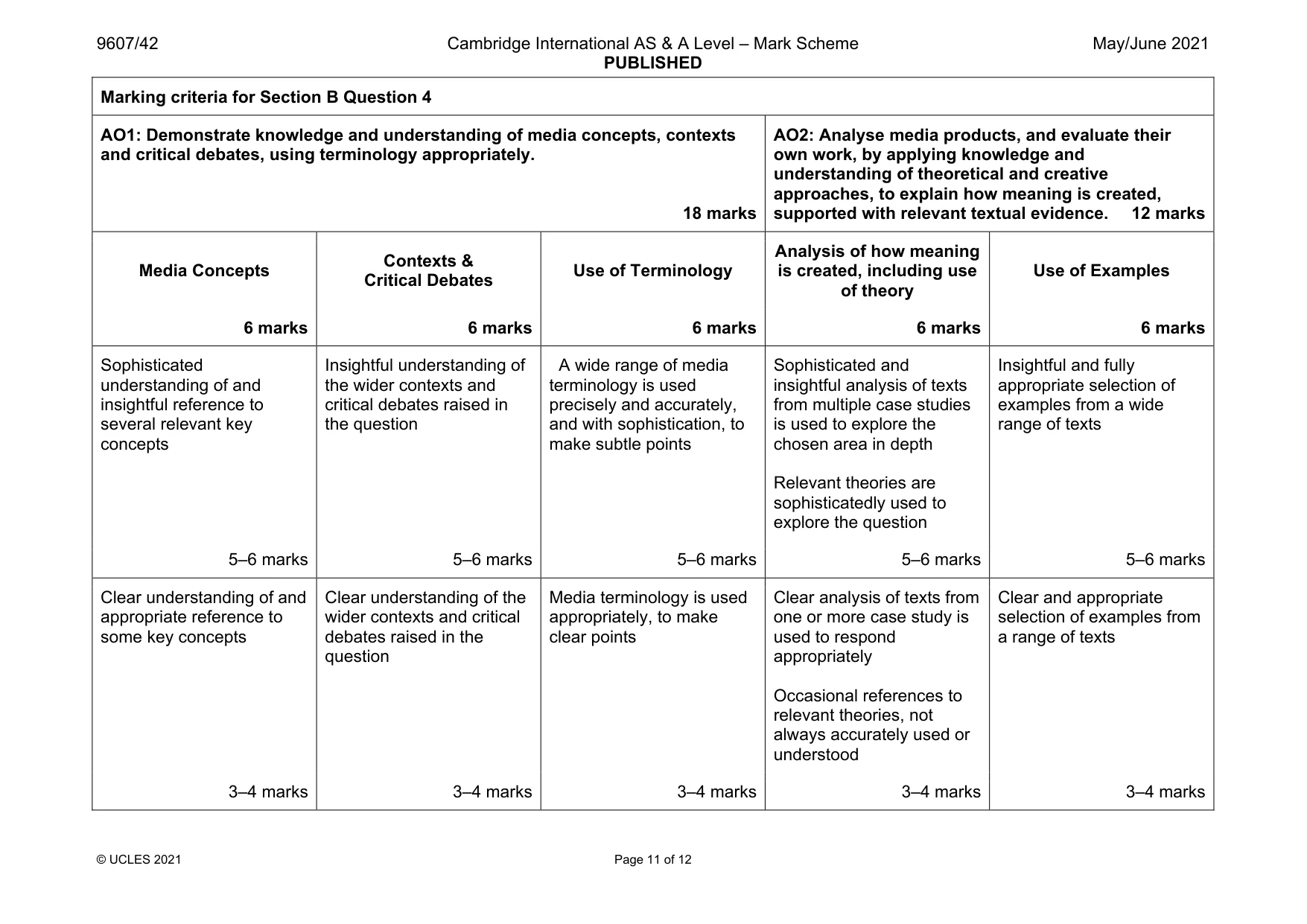
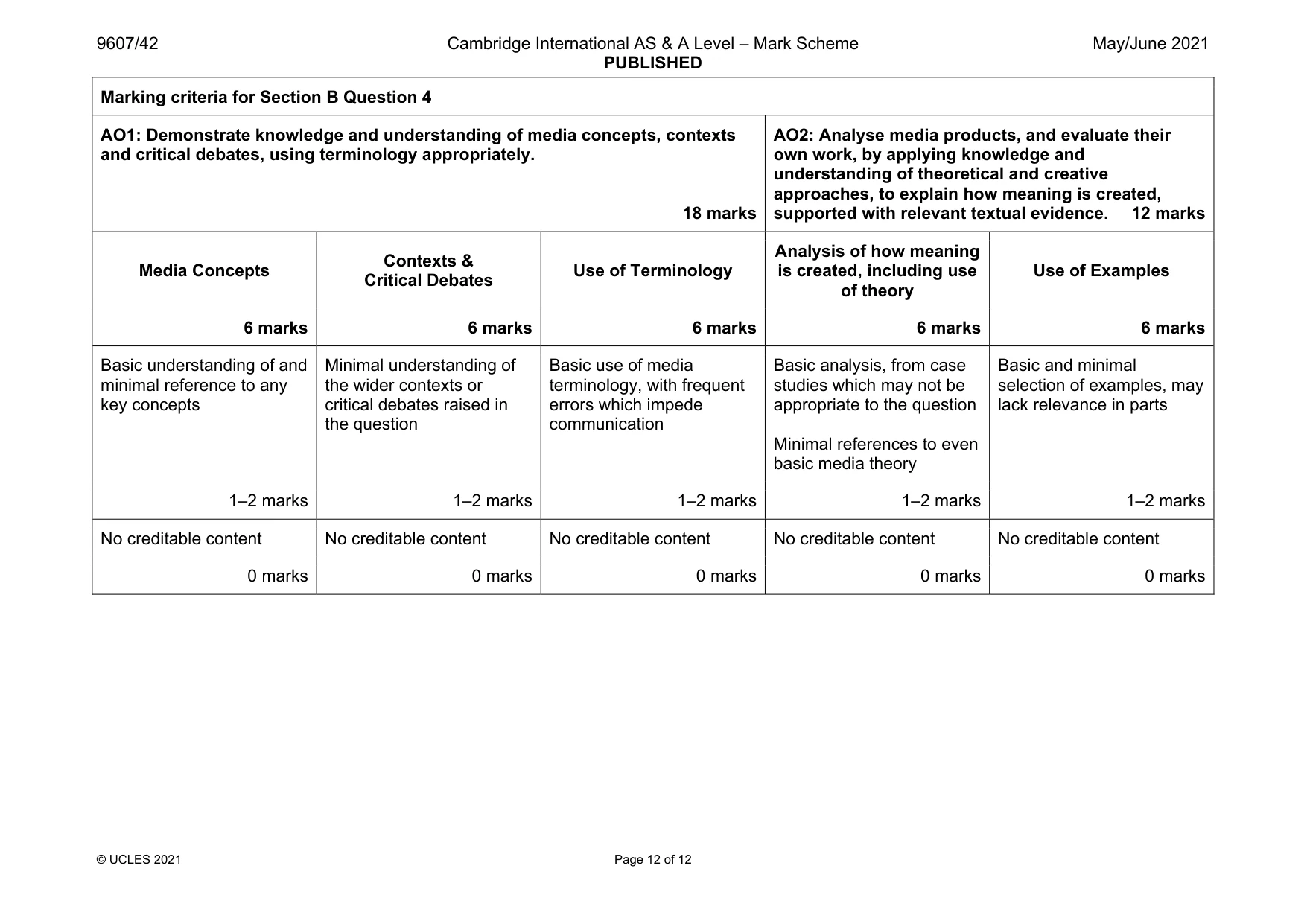
Mark scheme: 4 ‘The media determine how we understand and connect with the world.’ To what extent do you agree with this statement? Indicative content Material listed below demonstrates how candidates might approach the question. It is a description of possible content only. It is not prescriptive, nor is it exclusive; examiners must be careful to reward original but well-focused answers. This question is synoptic so candidates should draw on their learning throughout the course, and may also make connections between this learning and other, related, areas. ‘Determinism’ is at the heart of this question, and candidates should be rewarded for supporting a particular view of this (whatever it is) with evidence and discussion. They may argue, for example, that our view of the world, and ourselves, is always mediated, but suggest that the power and degree of this mediation is different depending on circumstances and experience. The role of technology, particularly its function in self- presentation and representation of others, may also be considered. criteria: • Media concepts (AO1) [6 marks] • Contexts and debates (AO1) [6 marks] • Use of terminology (AO1) [6 marks] • Analysis of how meaning is created (AO2) [6 marks] • Use of examples (AO2) [6 marks] Candidates’ work should be judged on each of these criteria individually and marks awarded according to the level attained. It should be noted that it is possible for a candidate to achieve a different level for each assessment criterion. This guidance should be used in conjunction with the Level Descriptors. It is not prescriptive, nor is it exclusive; examiners must be careful to reward original but well- focused answers and implicit as well development. This indicative content is intended to indicate aspects of questions that may feature in candidates’ answers. Marking criteria for Section B Question 4 AO1: Demonstrate knowledge and understanding of media concepts, contexts and critical debates, using terminology appropriately. 18 marks AO2: Analyse media products, and evaluate their own work, by applying knowledge and understanding of theoretical and creative approaches, to explain how meaning is created, supported with relevant textual evidence. 12 marks Media Concepts Contexts & Critical Debates Use of Terminology Analysis of how meaning is created, including use of theory Use of Examples 6 marks 6 marks 6 marks 6 marks 6 marks Sophisticated understanding of and insightful reference to several relevant key concepts Insightful understanding of the wider contexts and critical debates raised in the question A wide range of media terminology is used precisely and accurately, and with sophistication, to make subtle points Sophisticated and insightful analysis of texts from multiple case studies is used to explore the chosen area in depth Relevant theories are sophisticatedly used to explore the question Insightful and fully appropriate selection of examples from a wide range of texts 5–6 marks 5–6 marks 5–6 marks 5–6 marks 5–6 marks Clear understanding of and appropriate reference to some key concepts Clear understanding of the wider contexts and critical debates raised in the question Media terminology is used appropriately, to make clear points Clear analysis of texts from one or more case study is used to respond appropriately Occasional references to relevant theories, not always accurately used or understood Clear and appropriate selection of examples from a range of texts 3–4 marks 3–4 marks 3–4 marks 3–4 marks 3–4 marks Marking criteria for Section B Question 4 AO1: Demonstrate knowledge and understanding of media concepts, contexts and critical debates, using terminology appropriately. 18 marks AO2: Analyse media products, and evaluate their own work, by applying knowledge and understanding of theoretical and creative approaches, to explain how meaning is created, supported with relevant textual evidence. 12 marks Media Concepts Contexts & Critical Debates Use of Terminology Analysis of how meaning is created, including use of theory Use of Examples 6 marks 6 marks 6 marks 6 marks 6 marks Basic understanding of and minimal reference to any key concepts Minimal understanding of the wider contexts or critical debates raised in the question Basic use of media terminology, with frequent errors which impede communication Basic analysis, from case studies which may not be appropriate to the question Minimal references to even basic media theory Basic and minimal selection of examples, may lack relevance in parts 1–2 marks 1–2 marks 1–2 marks 1–2 marks 1–2 marks No creditable content No creditable content No creditable content No creditable content No creditable content 0 marks 0 marks 0 marks 0 marks 0 marks
What was in this paper
The subtopics covered by these 4 questions, and how many questions each got. Open one in a new tab to see every Cambridge question on it.
What you needed in this session
Cambridge’s own grade thresholds for 2021 May/June, Paper 4 · Variant 2. A higher threshold means an easier paper — the bar moves with how the cohort did.