Cambridge A Level Marine Science 9693 — 2015 May/June Paper 4 · Variant 1
9693/41/M/J/15 · 50 marks · ≈56 min
The question paper and its mark scheme, free to read here and free to download. This is Cambridge’s own paper, exactly as it was sat.
Question paper12 pages
Mark scheme7 pages
Answers below. Sit the paper first if you are practising.
Paper as text
Question paper, page 1
This document consists of 11 printed pages and 1 blank page. DC (SJF/CGW) 93486/3 © UCLES 2015 [Turn over Cambridge International Examinations Cambridge International Advanced Subsidiary and Advanced Level * 8 3 1 5 1 3 8 9 1 1 * MARINE SCIENCE 9693/04 Paper 4 A2 Data-Handling and Free-Response May/June 2015 1 hour 15 minutes Candidates answer on the Question Paper. No Additional Materials are required. READ THESE INSTRUCTIONS FIRST Write your Centre number, candidate number and name on all the work you hand in. Write in dark blue or black pen. You may use an HB pencil for any diagrams or graphs. Do not use staples, paper clips, glue or correction fluid. DO NOT WRITE IN ANY BARCODES. Section A Answer both questions in this section. Write your answers in the spaces provided on the Question Paper. Section B Answer both questions in this section. Write your answers in the spaces provided on the Question Paper. Electronic calculators may be used. You may lose marks if you do not show your working or if you do not use appropriate units. At the end of the examination, fasten all your work securely together. The number of marks is given in brackets [ ] at the end of each question or part question.
Question paper, page 2
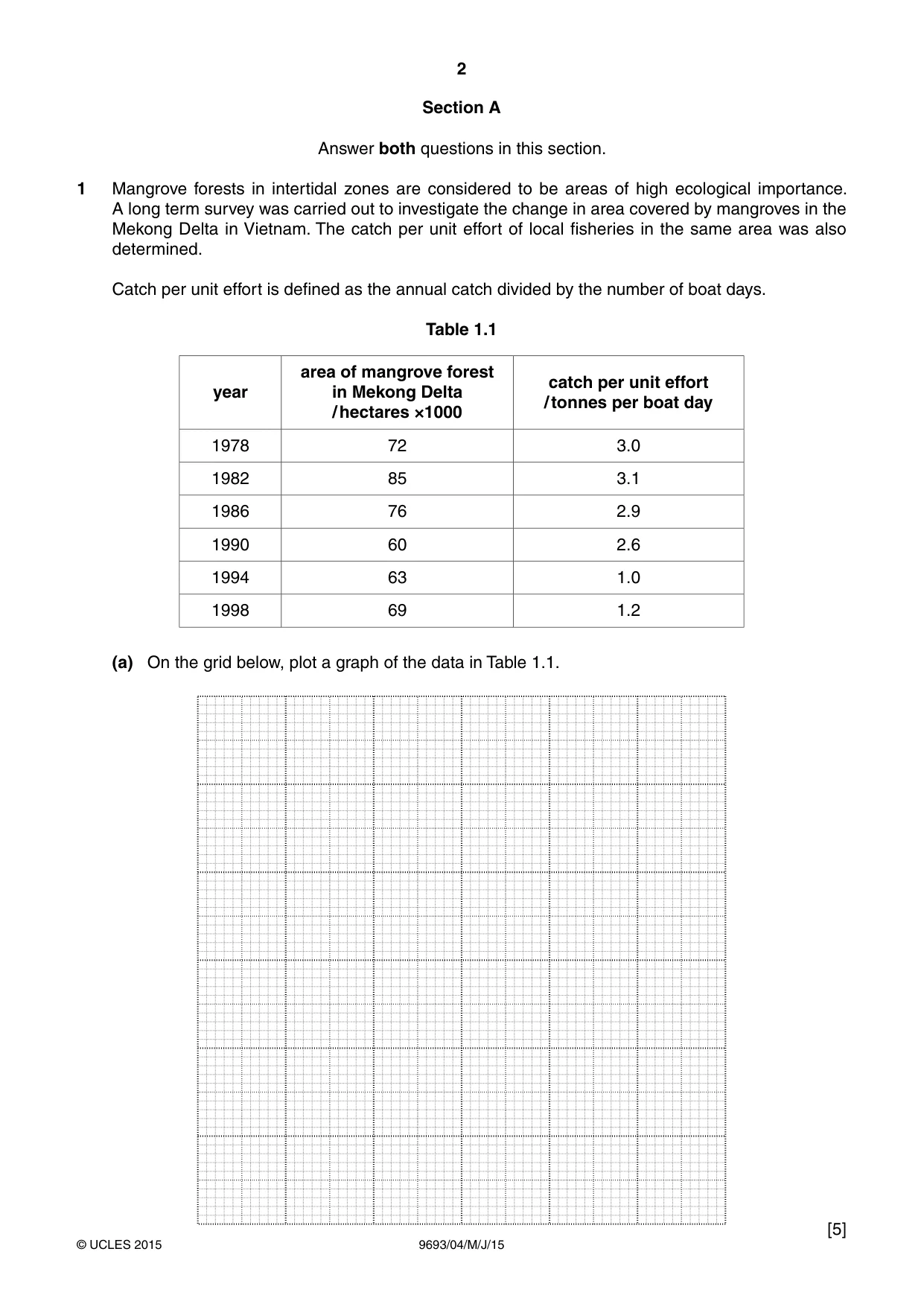
2 9693/04/M/J/15 © UCLES 2015 Section A Answer both questions in this section. 1 Mangrove forests in intertidal zones are considered to be areas of high ecological importance. A long term survey was carried out to investigate the change in area covered by mangroves in the Mekong Delta in Vietnam. The catch per unit effort of local fisheries in the same area was also determined. Catch per unit effort is defined as the annual catch divided by the number of boat days. Table 1.1 year area of mangrove forest in Mekong Delta / hectares ×1000 catch per unit effort / tonnes per boat day 1978 72 3.0 1982 85 3.1 1986 76 2.9 1990 60 2.6 1994 63 1.0 1998 69 1.2 (a) On the grid below, plot a graph of the data in Table 1.1. [5]
Question paper, page 3
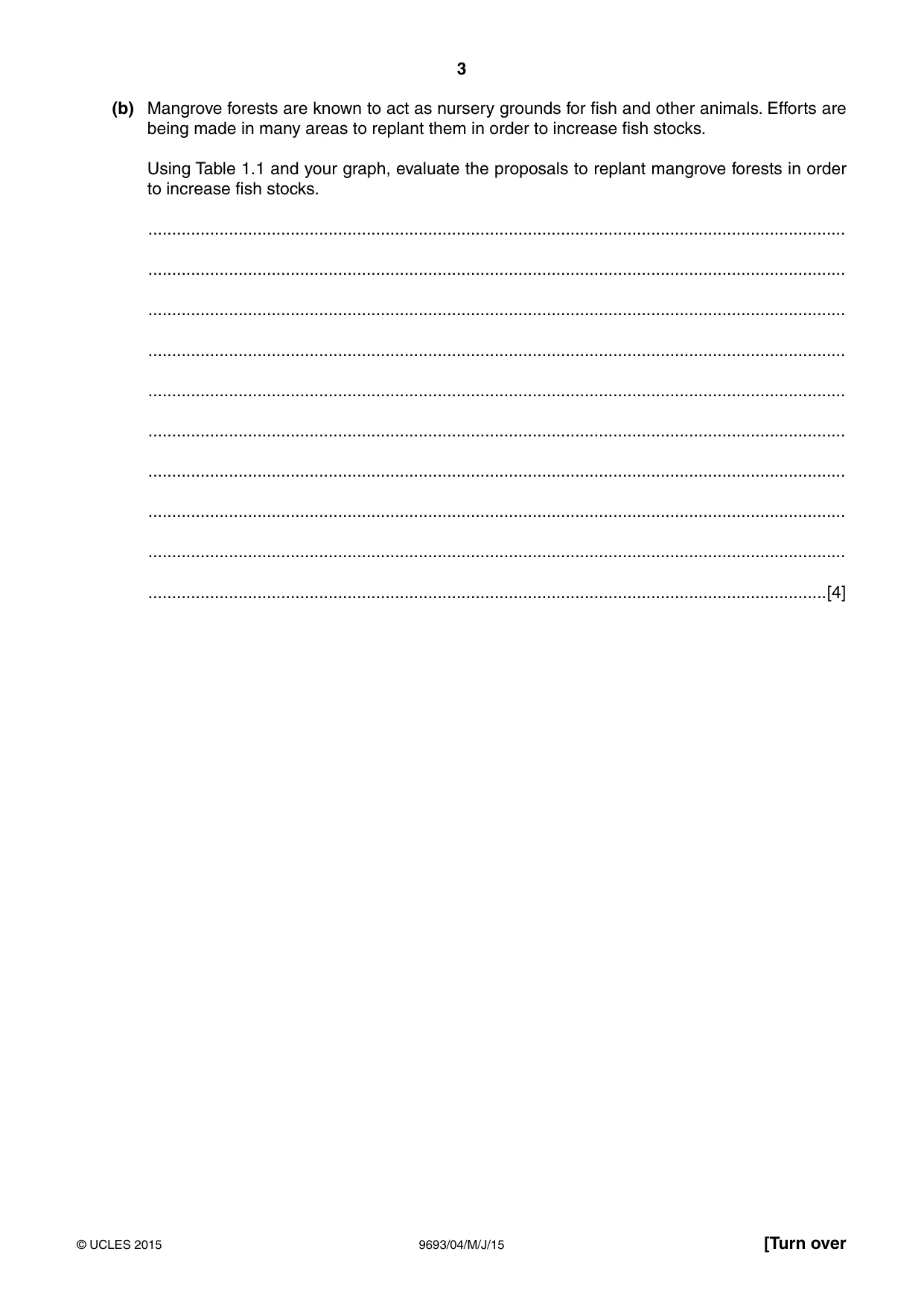
3 9693/04/M/J/15 © UCLES 2015 [Turn over (b) Mangrove forests are known to act as nursery grounds for fish and other animals. Efforts are being made in many areas to replant them in order to increase fish stocks. Using Table 1.1 and your graph, evaluate the proposals to replant mangrove forests in order to increase fish stocks. … … … … … … … … … …[4]
Question paper, page 4
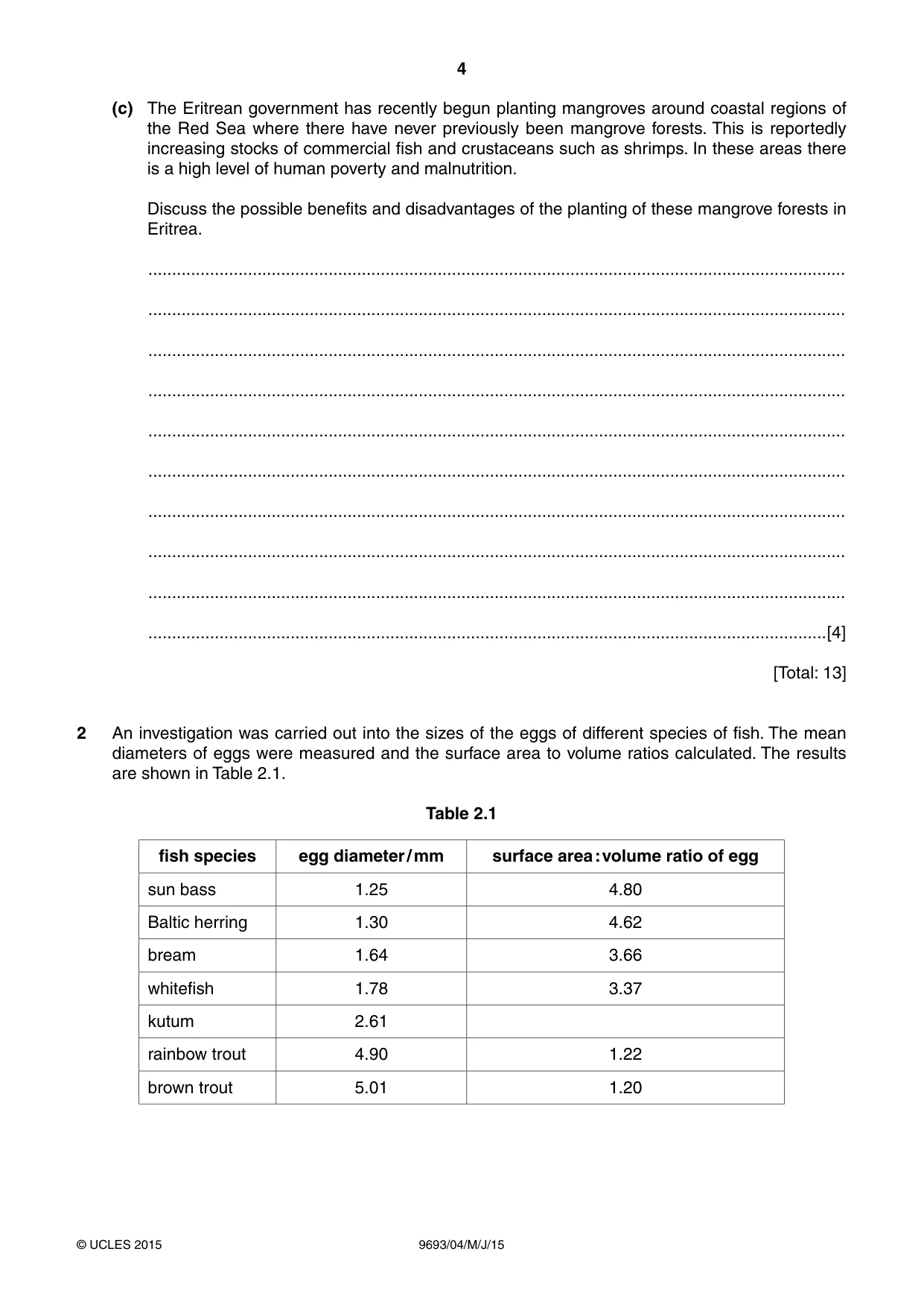
4 9693/04/M/J/15 © UCLES 2015 (c) The Eritrean government has recently begun planting mangroves around coastal regions of the Red Sea where there have never previously been mangrove forests. This is reportedly increasing stocks of commercial fish and crustaceans such as shrimps. In these areas there is a high level of human poverty and malnutrition. Discuss the possible benefits and disadvantages of the planting of these mangrove forests in Eritrea. … … … … … … … … … …[4] [Total: 13] 2 An investigation was carried out into the sizes of the eggs of different species of fish. The mean diameters of eggs were measured and the surface area to volume ratios calculated. The results are shown in Table 2.1. Table 2.1 fish species egg diameter / mm surface area : volume ratio of egg sun bass 1.25 4.80 Baltic herring 1.30 4.62 bream 1.64 3.66 whitefish 1.78 3.37 kutum 2.61 rainbow trout 4.90 1.22 brown trout 5.01 1.20
Question paper, page 5
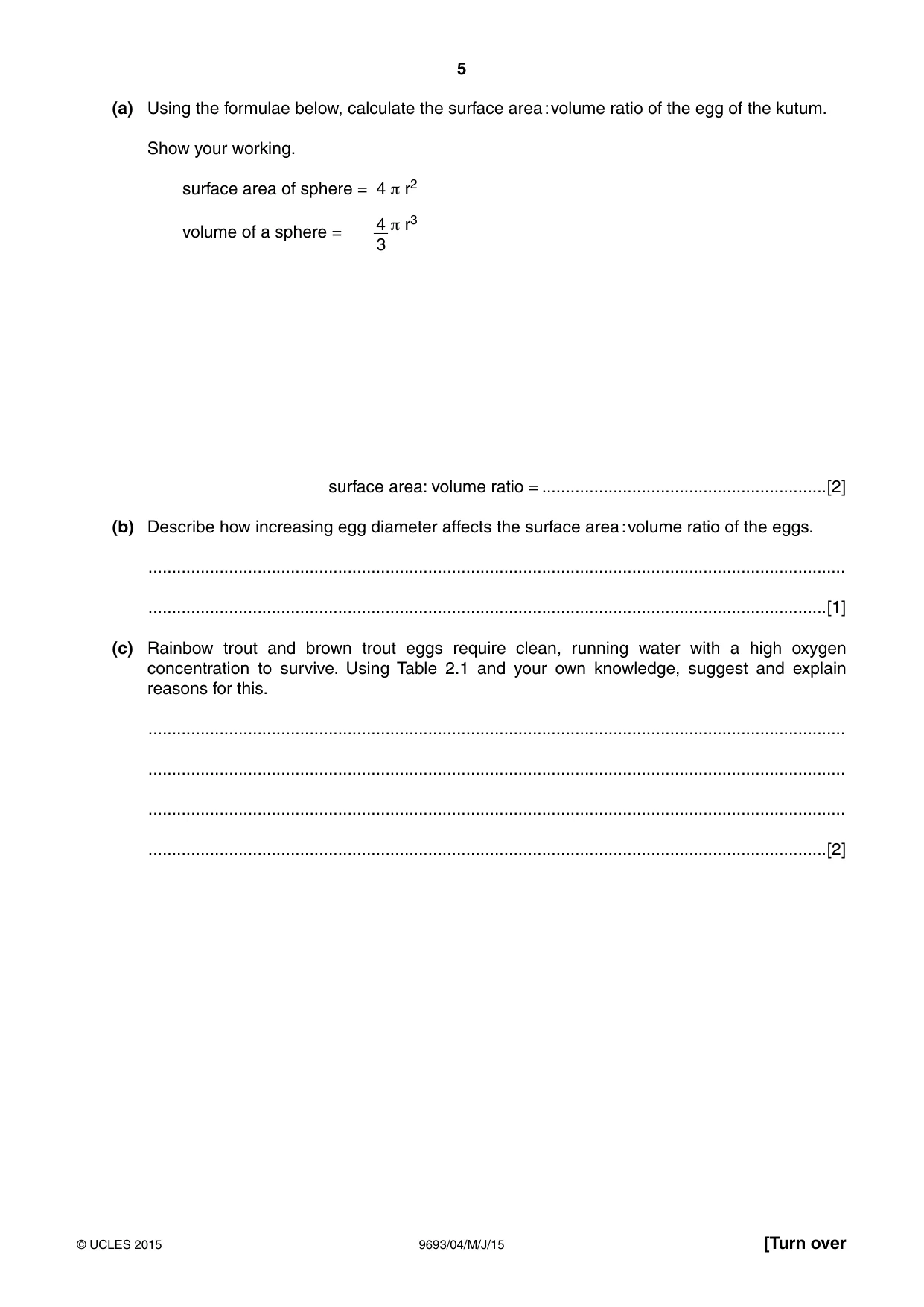
5 9693/04/M/J/15 © UCLES 2015 [Turn over (a) Using the formulae below, calculate the surface area : volume ratio of the egg of the kutum. Show your working. surface area of sphere = 4 π r2 volume of a sphere = 4 π r3 3 surface area: volume ratio = …[2] (b) Describe how increasing egg diameter affects the surface area : volume ratio of the eggs. … …[1] (c) Rainbow trout and brown trout eggs require clean, running water with a high oxygen concentration to survive. Using Table 2.1 and your own knowledge, suggest and explain reasons for this. … … … …[2]
Question paper, page 6
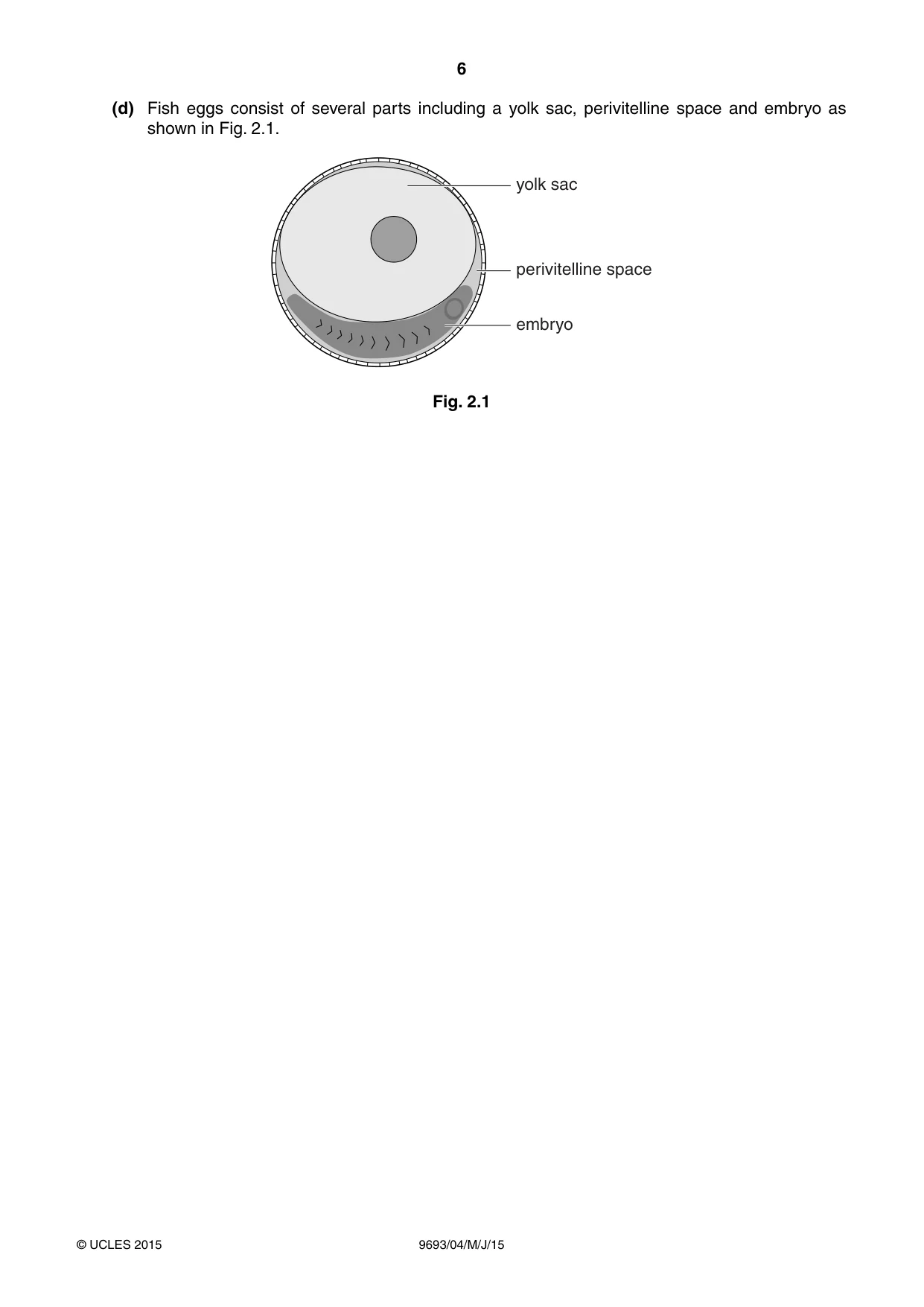
6 9693/04/M/J/15 © UCLES 2015 (d) Fish eggs consist of several parts including a yolk sac, perivitelline space and embryo as shown in Fig. 2.1. yolk sac perivitelline space embryo Fig. 2.1
Question paper, page 7
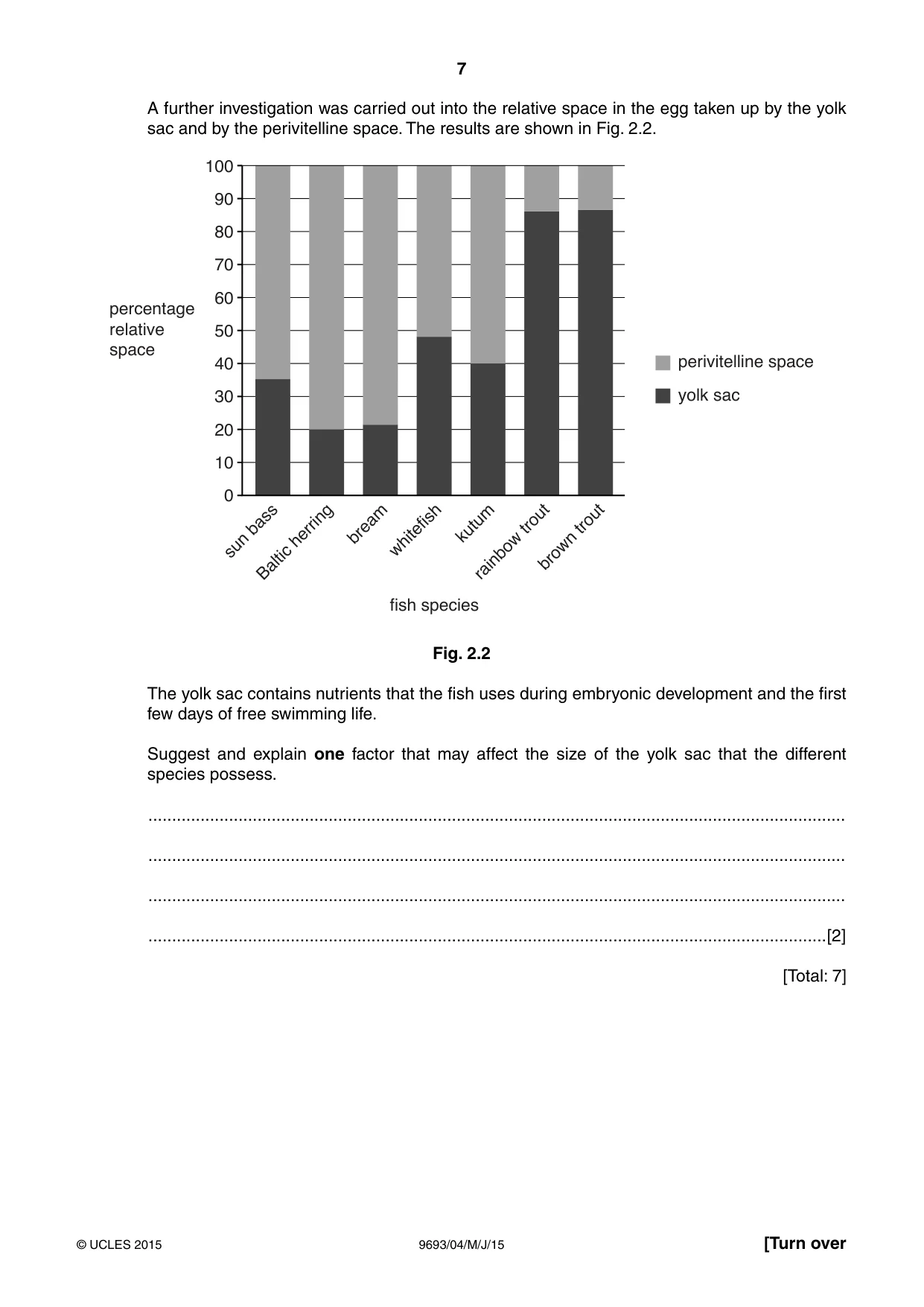
7 9693/04/M/J/15 © UCLES 2015 [Turn over A further investigation was carried out into the relative space in the egg taken up by the yolk sac and by the perivitelline space. The results are shown in Fig. 2.2. 100 90 80 70 60 50 percentage relative space 40 sun bass Baltic herring bream whitefish kutum rainbow trout brown trout 30 fish species perivitelline space yolk sac 20 10 0 Fig. 2.2 The yolk sac contains nutrients that the fish uses during embryonic development and the first few days of free swimming life. Suggest and explain one factor that may affect the size of the yolk sac that the different species possess. … … … …[2] [Total: 7]
Question paper, page 8
8 9693/04/M/J/15 © UCLES 2015 Section B Answer both questions in this section. 3 (a) (i) Describe how salmon can be genetically modified to grow faster. … … … … … … … … … … … …[5]
Question paper, page 9
9 9693/04/M/J/15 © UCLES 2015 [Turn over (ii) Discuss the advantages and disadvantages of farming these genetically modified salmon. … … … … … … … … … … … …[5] (b) Describe and explain the consequences of releasing untreated sewage into a marine environment. … … … … … … … … … … … …[5] [Total: 15]
Question paper, page 10
10 9693/04/M/J/15 © UCLES 2015 4 (a) Discuss the arguments for and against the desirability of conserving a marine species. … … … … … … … … … … … …[5]
Question paper, page 11
11 9693/04/M/J/15 © UCLES 2015 (b) Outline the methods that may be employed by fisheries ministries in order to achieve sustainable exploitation of fish stocks. … … … … … … … … … … … … … … … … … … … … … … … … … … [10] [Total: 15]
Question paper, page 12
12 9693/04/M/J/15 © UCLES 2015 BLANK PAGE Permission to reproduce items where third-party owned material protected by copyright is included has been sought and cleared where possible. Every reasonable effort has been made by the publisher (UCLES) to trace copyright holders, but if any items requiring clearance have unwittingly been included, the publisher will be pleased to make amends at the earliest possible opportunity. To avoid the issue of disclosure of answer-related information to candidates, all copyright acknowledgements are reproduced online in the Cambridge International Examinations Copyright Acknowledgements Booklet. This is produced for each series of examinations and is freely available to download at www.cie.org.uk after the live examination series. Cambridge International Examinations is part of the Cambridge Assessment Group. Cambridge Assessment is the brand name of University of Cambridge Local Examinations Syndicate (UCLES), which is itself a department of the University of Cambridge.
Mark scheme, page 1
® IGCSE is the registered trademark of Cambridge International Examinations. CAMBRIDGE INTERNATIONAL EXAMINATIONS Cambridge International Advanced Subsidiary and Advanced Level MARK SCHEME for the May/June 2015 series 9693 MARINE SCIENCE 9693/04 Paper 4 (A2 Data-Handling and Free-Response), maximum raw mark 50 This mark scheme is published as an aid to teachers and candidates, to indicate the requirements of the examination. It shows the basis on which Examiners were instructed to award marks. It does not indicate the details of the discussions that took place at an Examiners’ meeting before marking began, which would have considered the acceptability of alternative answers. Mark schemes should be read in conjunction with the question paper and the Principal Examiner Report for Teachers. Cambridge will not enter into discussions about these mark schemes. Cambridge is publishing the mark schemes for the May/June 2015 series for most Cambridge IGCSE®, Cambridge International A and AS Level components and some Cambridge O Level components.
Mark scheme, page 2
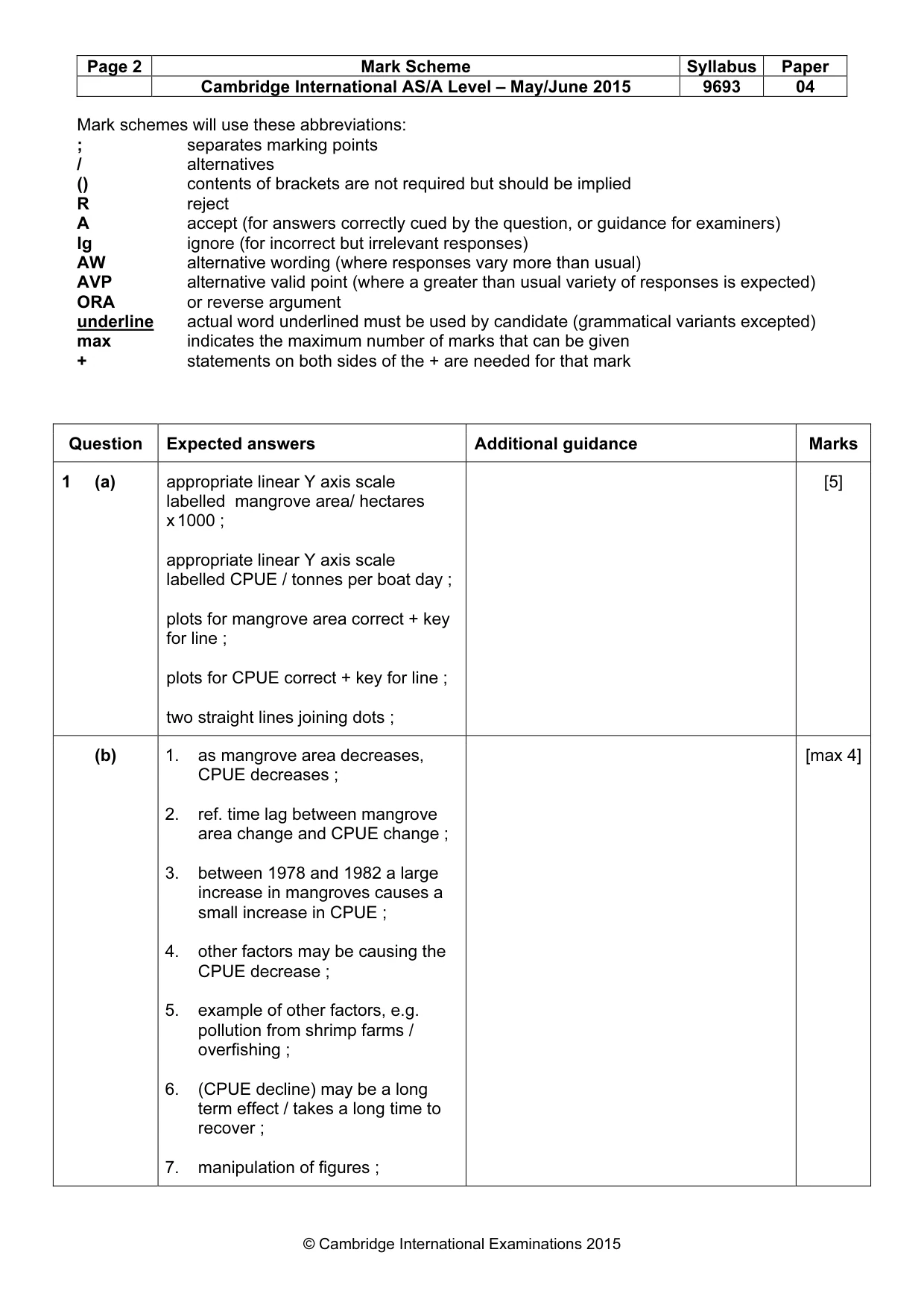
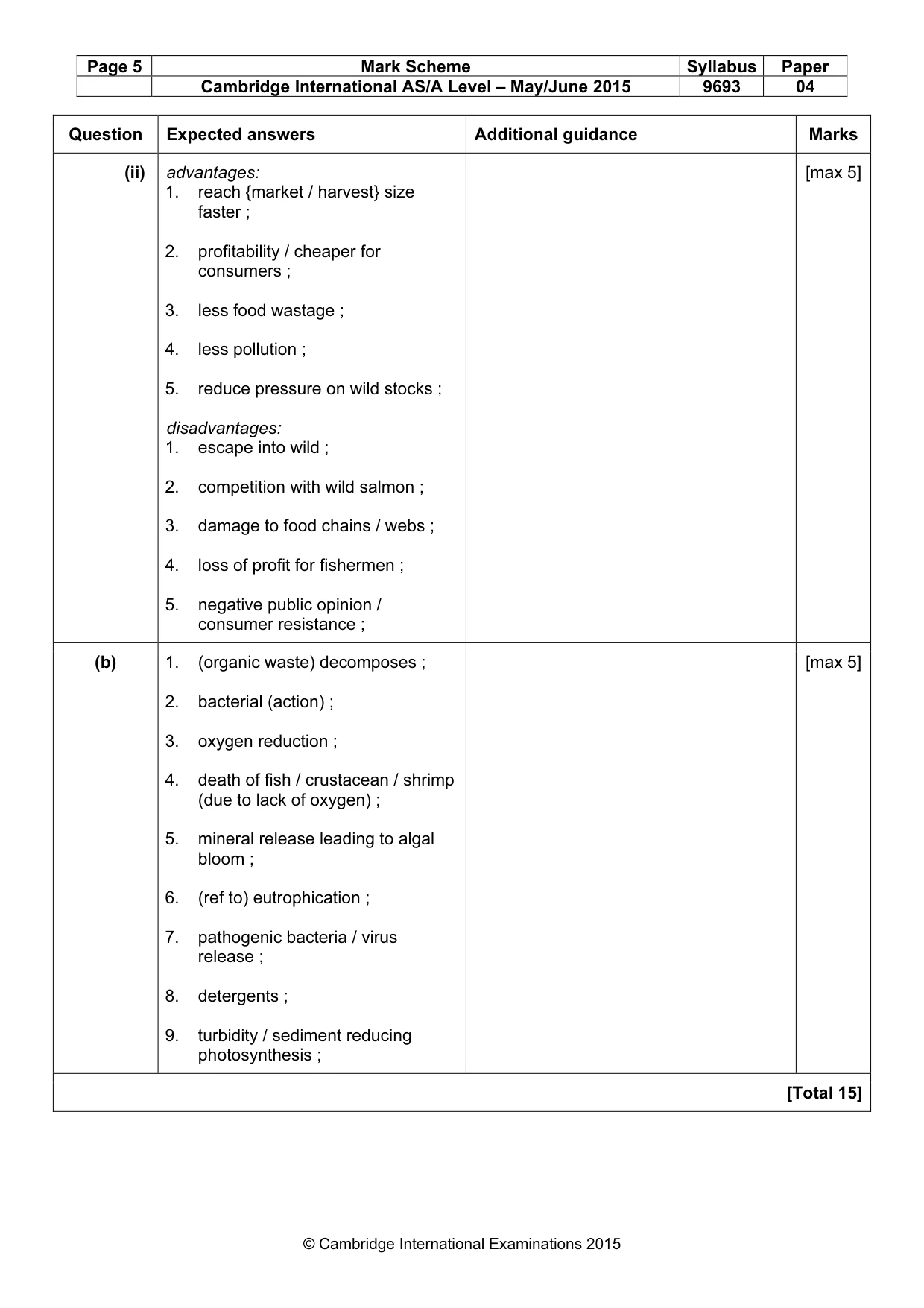
Page 2 Mark Scheme Syllabus Paper Cambridge International AS/A Level – May/June 2015 9693 04 © Cambridge International Examinations 2015 Mark schemes will use these abbreviations: ; separates marking points / alternatives () contents of brackets are not required but should be implied R reject A accept (for answers correctly cued by the question, or guidance for examiners) Ig ignore (for incorrect but irrelevant responses) AW alternative wording (where responses vary more than usual) AVP alternative valid point (where a greater than usual variety of responses is expected) ORA or reverse argument underline actual word underlined must be used by candidate (grammatical variants excepted) max indicates the maximum number of marks that can be given + statements on both sides of the + are needed for that mark Question Expected answers Additional guidance Marks 1 (a) appropriate linear Y axis scale labelled mangrove area/ hectares x 1000 ; appropriate linear Y axis scale labelled CPUE / tonnes per boat day ; plots for mangrove area correct + key for line ; plots for CPUE correct + key for line ; two straight lines joining dots ; [5] (b) 1. as mangrove area decreases, CPUE decreases ; 2. ref. time lag between mangrove area change and CPUE change ; 3. between 1978 and 1982 a large increase in mangroves causes a small increase in CPUE ; 4. other factors may be causing the CPUE decrease ; 5. example of other factors, e.g. pollution from shrimp farms / overfishing ; 6. (CPUE decline) may be a long term effect / takes a long time to recover ; 7. manipulation of figures ; [max 4]
Mark scheme, page 3
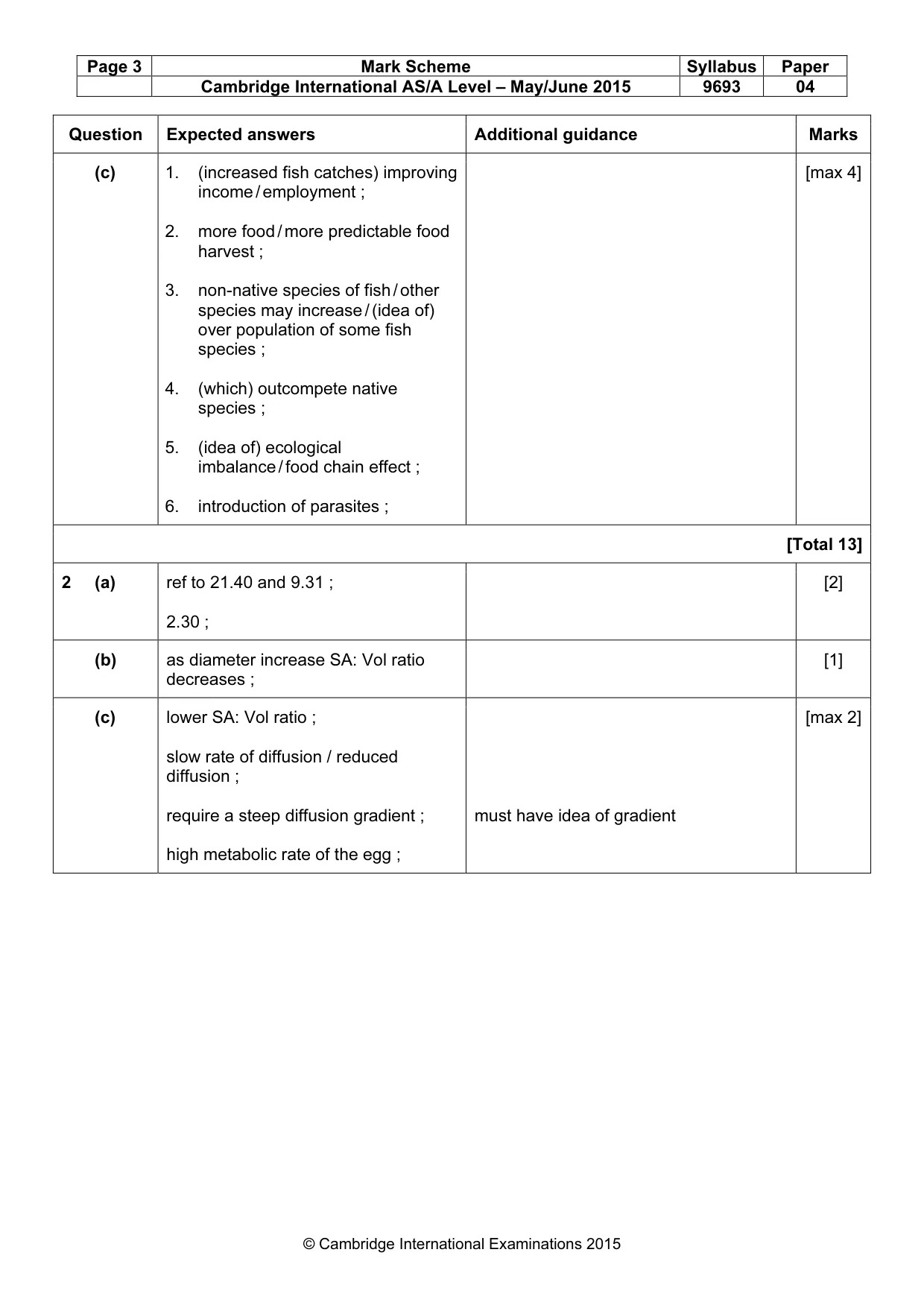
Page 3 Mark Scheme Syllabus Paper Cambridge International AS/A Level – May/June 2015 9693 04 © Cambridge International Examinations 2015 Question Expected answers Additional guidance Marks (c) 1. (increased fish catches) improving income / employment ; 2. more food / more predictable food harvest ; 3. non-native species of fish / other species may increase / (idea of) over population of some fish species ; 4. (which) outcompete native species ; 5. (idea of) ecological imbalance / food chain effect ; 6. introduction of parasites ; [max 4] [Total 13] 2 (a) ref to 21.40 and 9.31 ; 2.30 ; [2] (b) as diameter increase SA: Vol ratio decreases ; [1] (c) lower SA: Vol ratio ; slow rate of diffusion / reduced diffusion ; require a steep diffusion gradient ; high metabolic rate of the egg ; must have idea of gradient [max 2]
Mark scheme, page 4
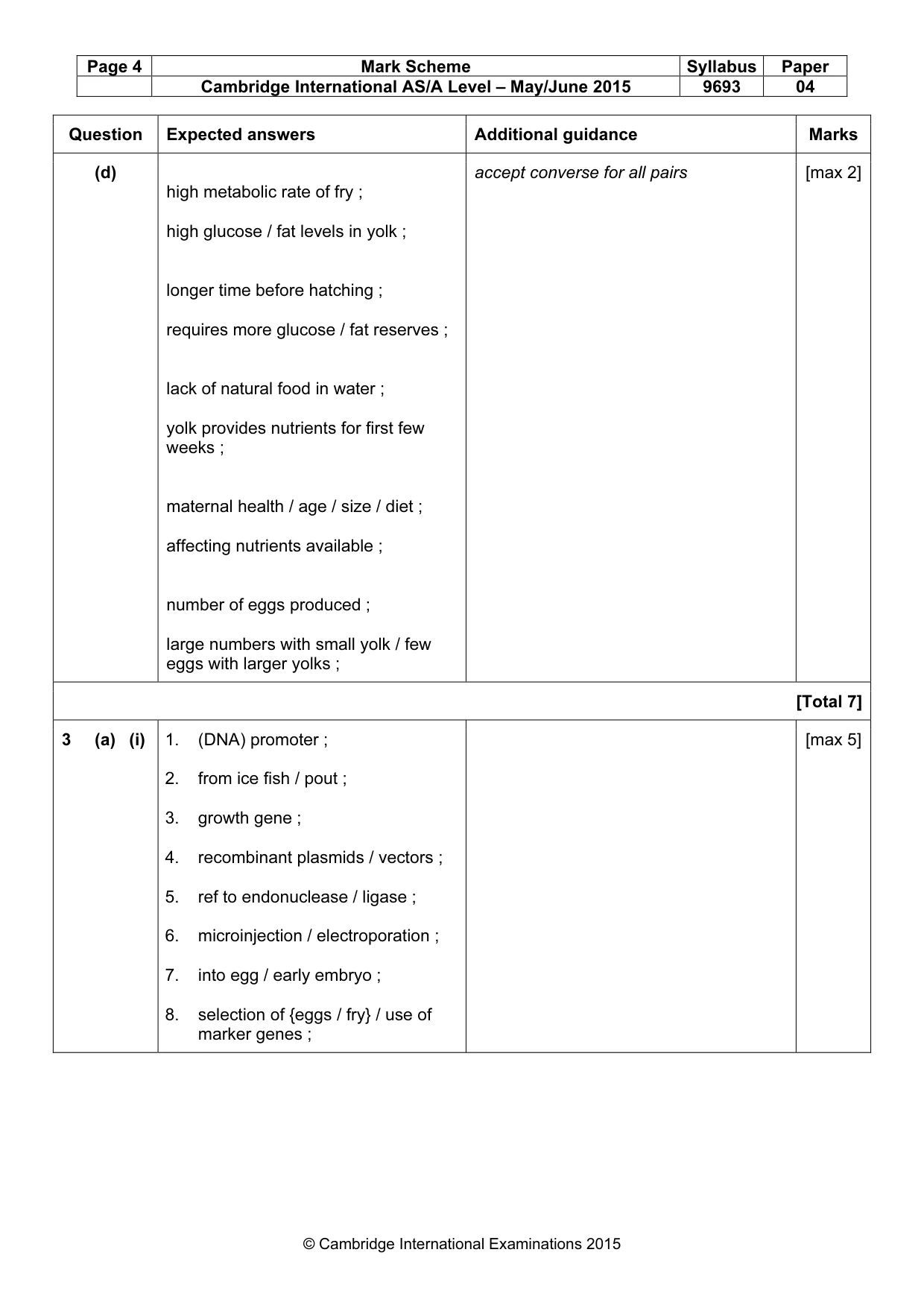
Page 4 Mark Scheme Syllabus Paper Cambridge International AS/A Level – May/June 2015 9693 04 © Cambridge International Examinations 2015 Question Expected answers Additional guidance Marks (d) high metabolic rate of fry ; high glucose / fat levels in yolk ; longer time before hatching ; requires more glucose / fat reserves ; lack of natural food in water ; yolk provides nutrients for first few weeks ; maternal health / age / size / diet ; affecting nutrients available ; number of eggs produced ; large numbers with small yolk / few eggs with larger yolks ; accept converse for all pairs [max 2] [Total 7] 3 (a) (i) 1. (DNA) promoter ; 2. from ice fish / pout ; 3. growth gene ; 4. recombinant plasmids / vectors ; 5. ref to endonuclease / ligase ; 6. microinjection / electroporation ; 7. into egg / early embryo ; 8. selection of {eggs / fry} / use of marker genes ; [max 5]
Mark scheme, page 5
Page 5 Mark Scheme Syllabus Paper Cambridge International AS/A Level – May/June 2015 9693 04 © Cambridge International Examinations 2015 Question Expected answers Additional guidance Marks (ii) advantages: 1. reach {market / harvest} size faster ; 2. profitability / cheaper for consumers ; 3. less food wastage ; 4. less pollution ; 5. reduce pressure on wild stocks ; disadvantages: 1. escape into wild ; 2. competition with wild salmon ; 3. damage to food chains / webs ; 4. loss of profit for fishermen ; 5. negative public opinion / consumer resistance ; [max 5] (b) 1. (organic waste) decomposes ; 2. bacterial (action) ; 3. oxygen reduction ; 4. death of fish / crustacean / shrimp (due to lack of oxygen) ; 5. mineral release leading to algal bloom ; 6. (ref to) eutrophication ; 7. pathogenic bacteria / virus release ; 8. detergents ; 9. turbidity / sediment reducing photosynthesis ; [max 5] [Total 15]
Mark scheme, page 6
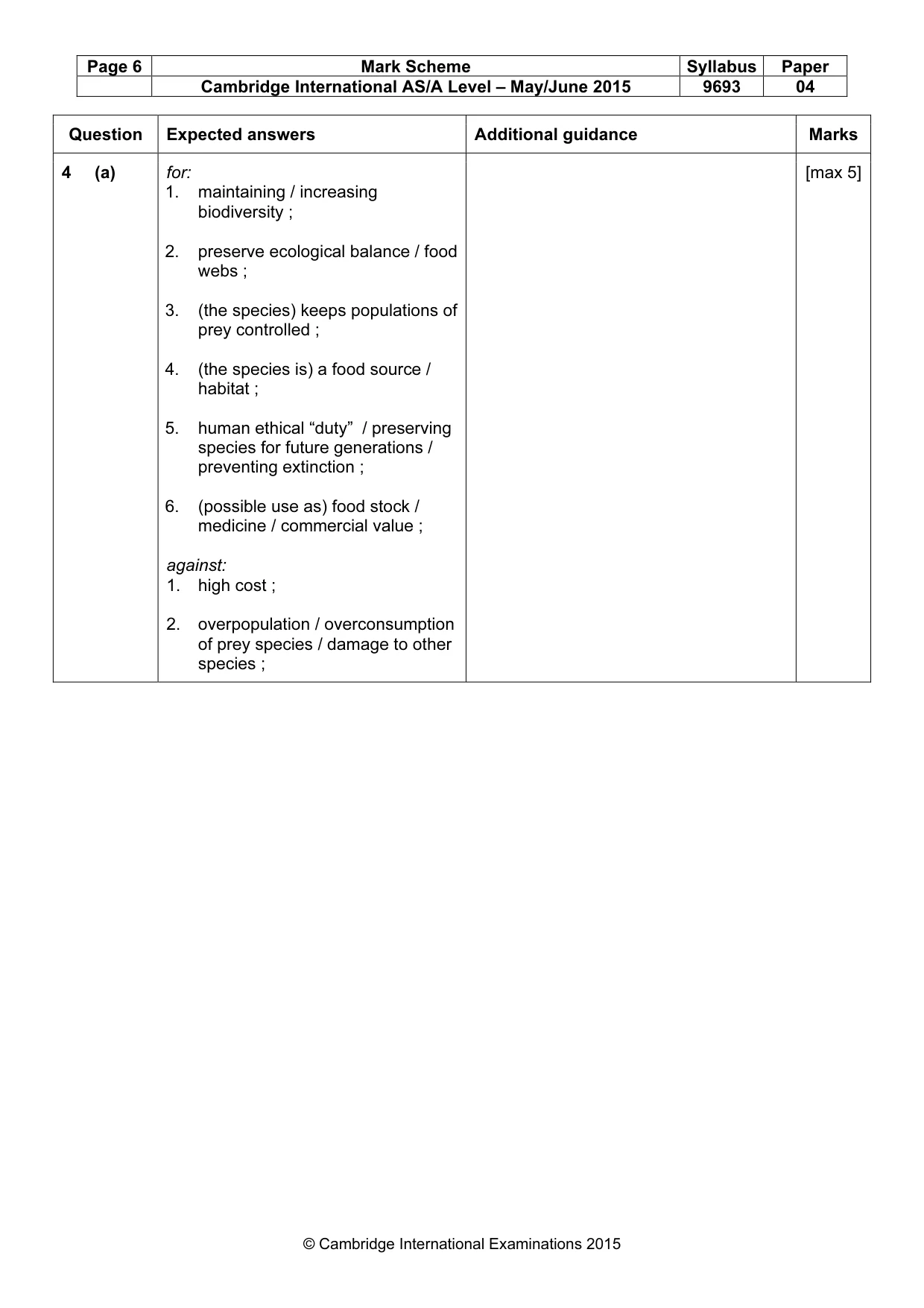
Page 6 Mark Scheme Syllabus Paper Cambridge International AS/A Level – May/June 2015 9693 04 © Cambridge International Examinations 2015 Question Expected answers Additional guidance Marks 4 (a) for: 1. maintaining / increasing biodiversity ; 2. preserve ecological balance / food webs ; 3. (the species) keeps populations of prey controlled ; 4. (the species is) a food source / habitat ; 5. human ethical “duty” / preserving species for future generations / preventing extinction ; 6. (possible use as) food stock / medicine / commercial value ; against: 1. high cost ; 2. overpopulation / overconsumption of prey species / damage to other species ; [max 5]
Mark scheme, page 7
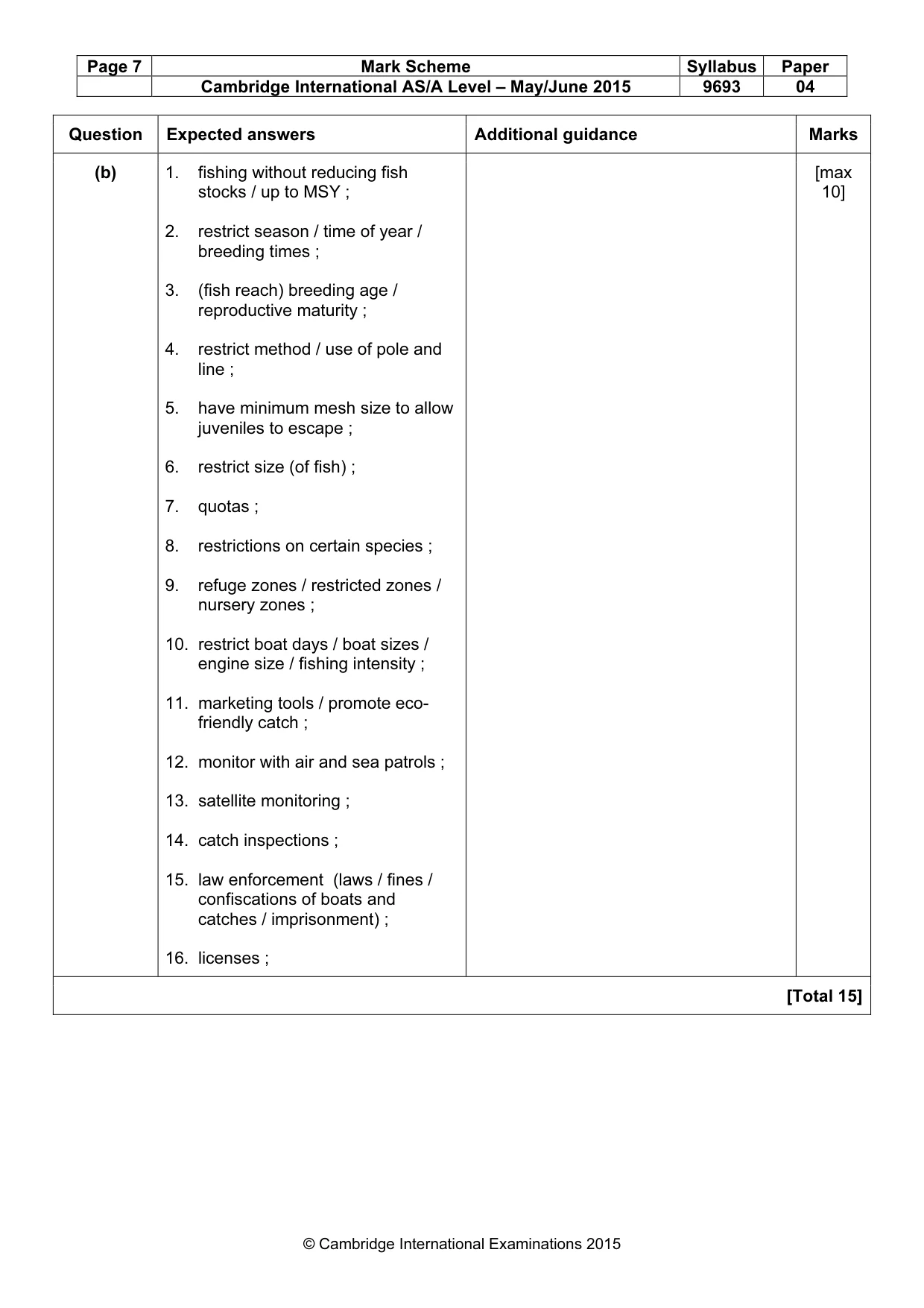
Page 7 Mark Scheme Syllabus Paper Cambridge International AS/A Level – May/June 2015 9693 04 © Cambridge International Examinations 2015 Question Expected answers Additional guidance Marks (b) 1. fishing without reducing fish stocks / up to MSY ; 2. restrict season / time of year / breeding times ; 3. (fish reach) breeding age / reproductive maturity ; 4. restrict method / use of pole and line ; 5. have minimum mesh size to allow juveniles to escape ; 6. restrict size (of fish) ; 7. quotas ; 8. restrictions on certain species ; 9. refuge zones / restricted zones / nursery zones ; 10. restrict boat days / boat sizes / engine size / fishing intensity ; 11. marketing tools / promote eco- friendly catch ; 12. monitor with air and sea patrols ; 13. satellite monitoring ; 14. catch inspections ; 15. law enforcement (laws / fines / confiscations of boats and catches / imprisonment) ; 16. licenses ; [max 10] [Total 15]
What you needed in this session
Cambridge’s own grade thresholds for 2015 May/June, Paper 4 · Variant 1. A higher threshold means an easier paper — the bar moves with how the cohort did.