Cambridge A Level Marine Science 9693 — 2014 Oct/Nov Paper 4 · Variant 1
9693/41/O/N/14 · 50 marks · ≈56 min
The question paper and its mark scheme, free to read here and free to download. This is Cambridge’s own paper, exactly as it was sat.
Question paper12 pages
Mark scheme7 pages
Answers below. Sit the paper first if you are practising.
Paper as text
Question paper, page 1
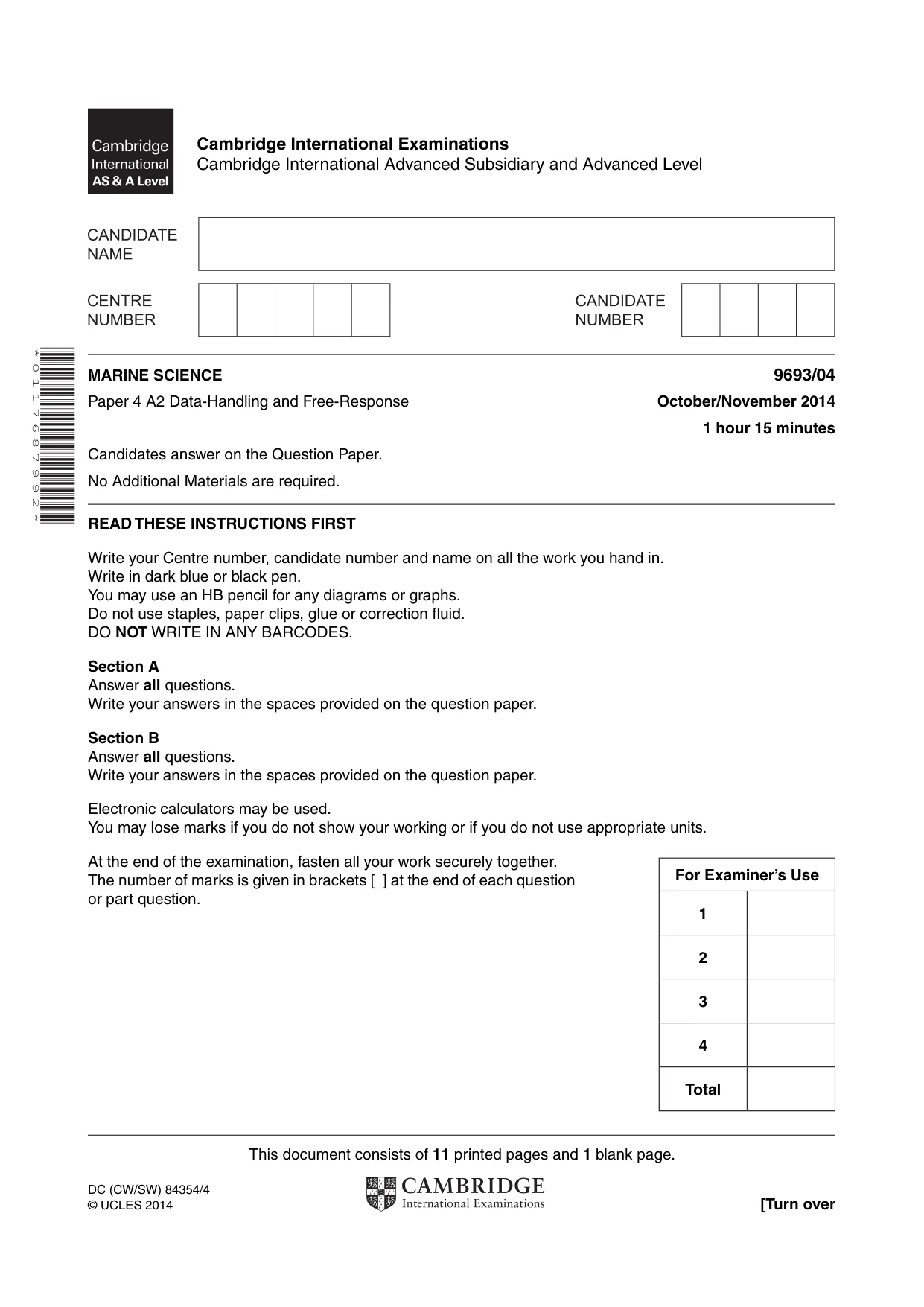
This document consists of 11 printed pages and 1 blank page. DC (CW/SW) 84354/4 © UCLES 2014 [Turn over Cambridge International Examinations Cambridge International Advanced Subsidiary and Advanced Level * 0 1 1 7 6 8 7 9 9 2 * MARINE SCIENCE 9693/04 Paper 4 A2 Data-Handling and Free-Response October/November 2014 1 hour 15 minutes Candidates answer on the Question Paper. No Additional Materials are required. READ THESE INSTRUCTIONS FIRST Write your Centre number, candidate number and name on all the work you hand in. Write in dark blue or black pen. You may use an HB pencil for any diagrams or graphs. Do not use staples, paper clips, glue or correction fluid. DO NOT WRITE IN ANY BARCODES. Section A Answer all questions. Write your answers in the spaces provided on the question paper. Section B Answer all questions. Write your answers in the spaces provided on the question paper. Electronic calculators may be used. You may lose marks if you do not show your working or if you do not use appropriate units. At the end of the examination, fasten all your work securely together. The number of marks is given in brackets [ ] at the end of each question or part question. For Examiner’s Use 1 2 3 4 Total
Question paper, page 2
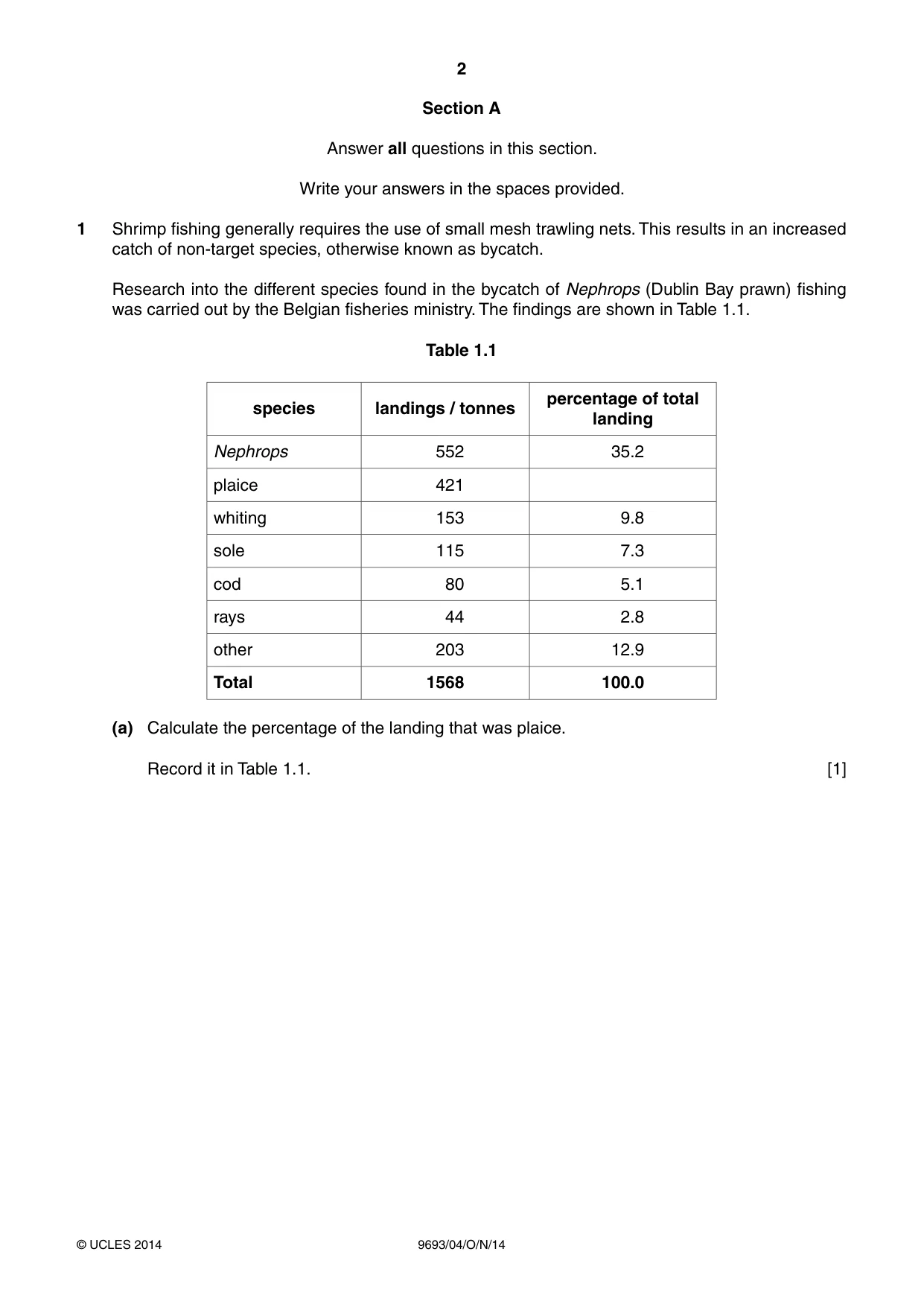
2 9693/04/O/N/14 © UCLES 2014 Section A Answer all questions in this section. Write your answers in the spaces provided. 1 Shrimp fishing generally requires the use of small mesh trawling nets. This results in an increased catch of non-target species, otherwise known as bycatch. Research into the different species found in the bycatch of Nephrops (Dublin Bay prawn) fishing was carried out by the Belgian fisheries ministry. The findings are shown in Table 1.1. Table 1.1 species landings / tonnes percentage of total landing Nephrops 552 35.2 plaice 421 whiting 153 9.8 sole 115 7.3 cod 80 5.1 rays 44 2.8 other 203 12.9 Total 1568 100.0 (a) Calculate the percentage of the landing that was plaice. Record it in Table 1.1. [1]
Question paper, page 3
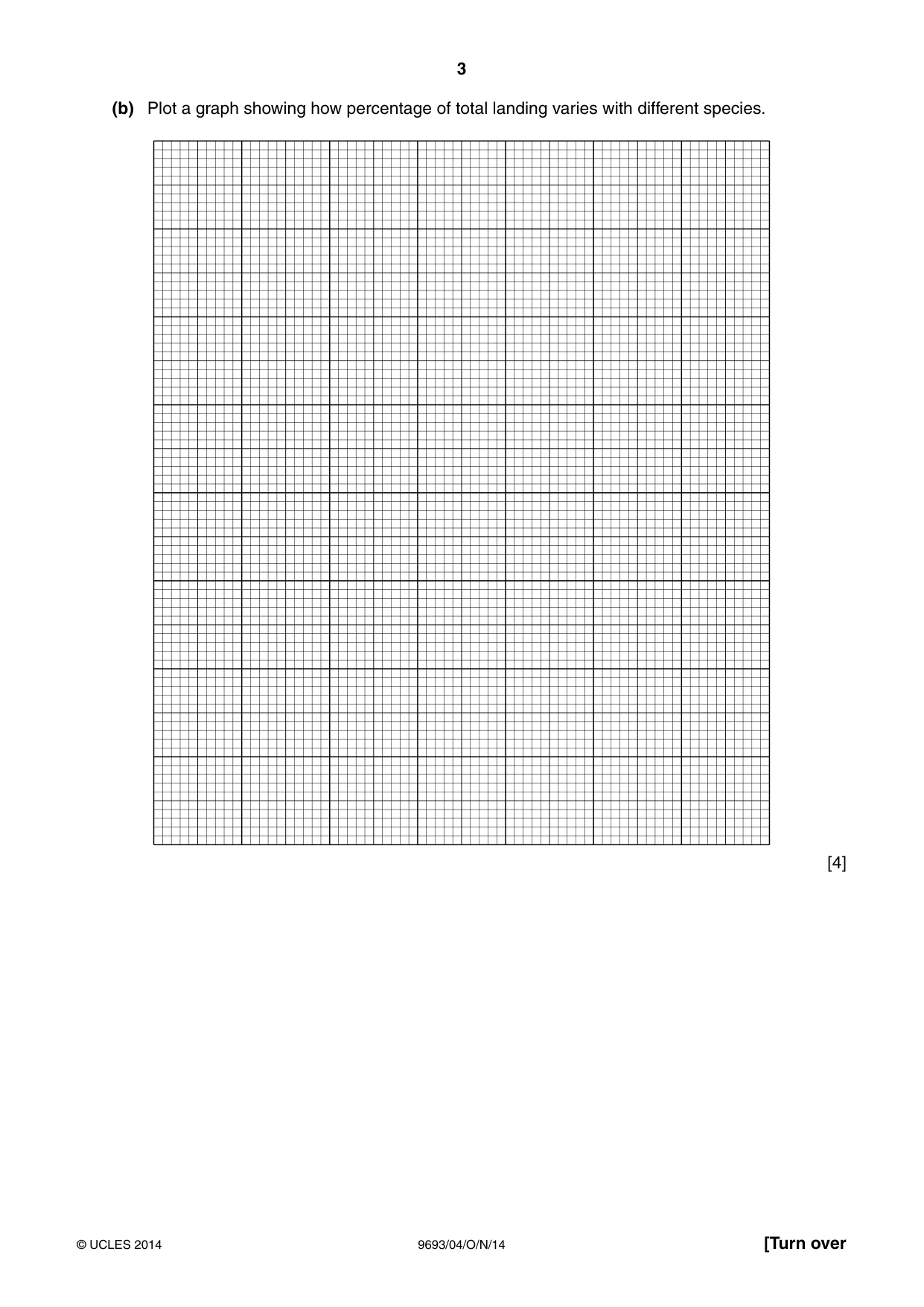
3 9693/04/O/N/14 © UCLES 2014 [Turn over (b) Plot a graph showing how percentage of total landing varies with different species. [4]
Question paper, page 4
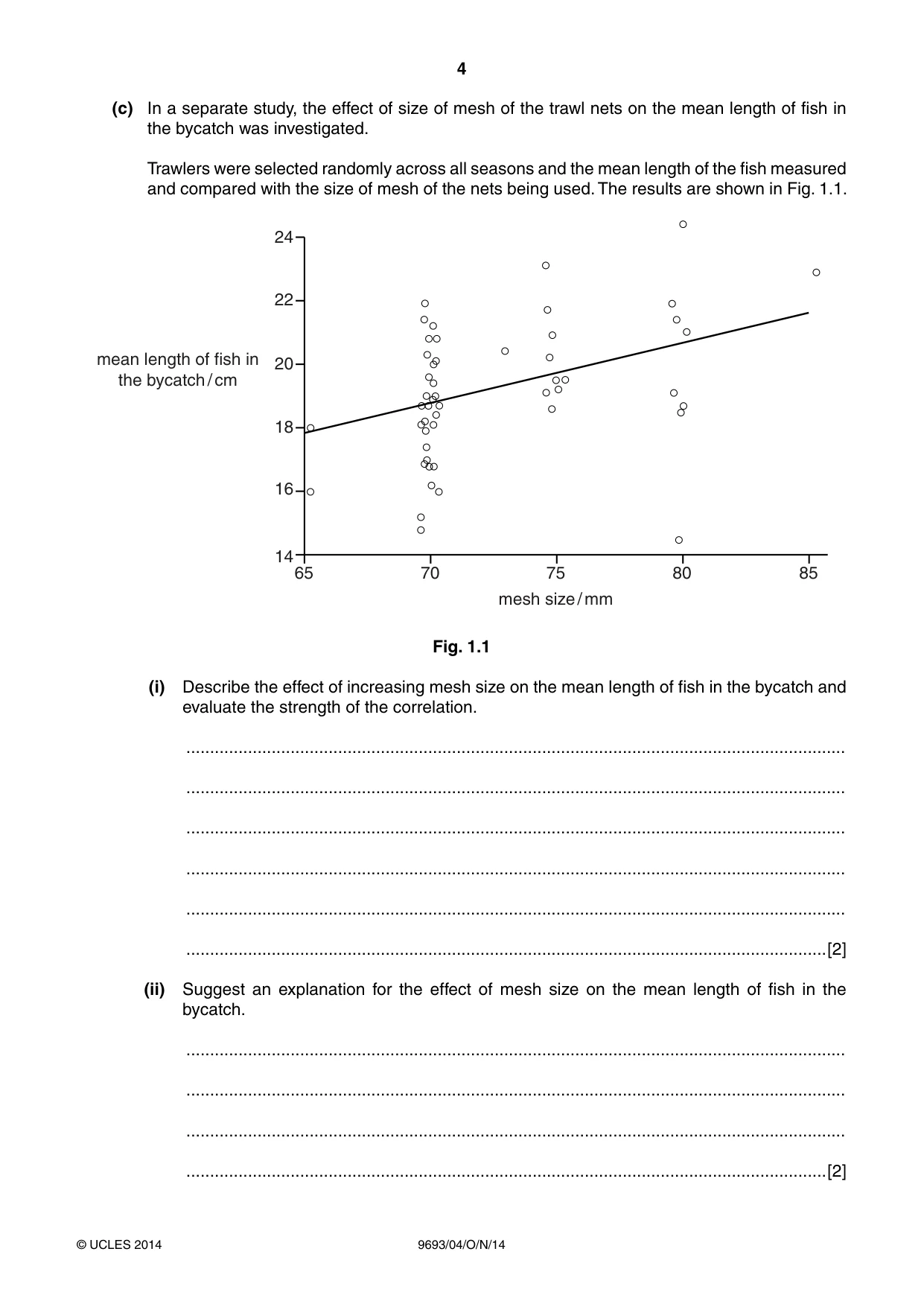
4 9693/04/O/N/14 © UCLES 2014 (c) In a separate study, the effect of size of mesh of the trawl nets on the mean length of fish in the bycatch was investigated. Trawlers were selected randomly across all seasons and the mean length of the fish measured and compared with the size of mesh of the nets being used. The results are shown in Fig. 1.1. 14 65 70 75 mesh size / mm mean length of fish in the bycatch / cm 80 85 16 18 20 22 24 Fig. 1.1 (i) Describe the effect of increasing mesh size on the mean length of fish in the bycatch and evaluate the strength of the correlation. … … … … … …[2] (ii) Suggest an explanation for the effect of mesh size on the mean length of fish in the bycatch. … … … …[2]
Question paper, page 5
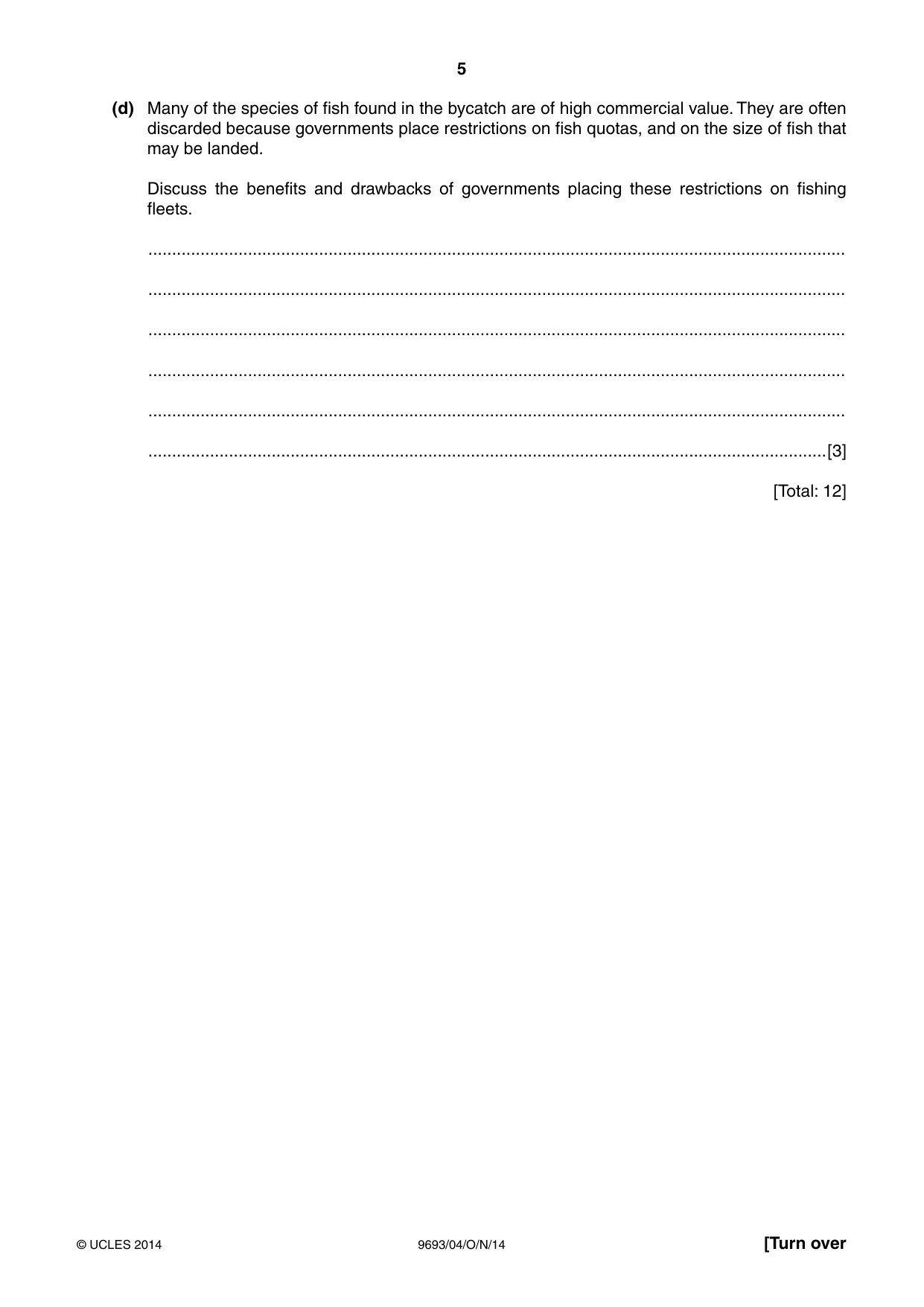
5 9693/04/O/N/14 © UCLES 2014 [Turn over (d) Many of the species of fish found in the bycatch are of high commercial value. They are often discarded because governments place restrictions on fish quotas, and on the size of fish that may be landed. Discuss the benefits and drawbacks of governments placing these restrictions on fishing fleets. … … … … … …[3] [Total: 12]
Question paper, page 6
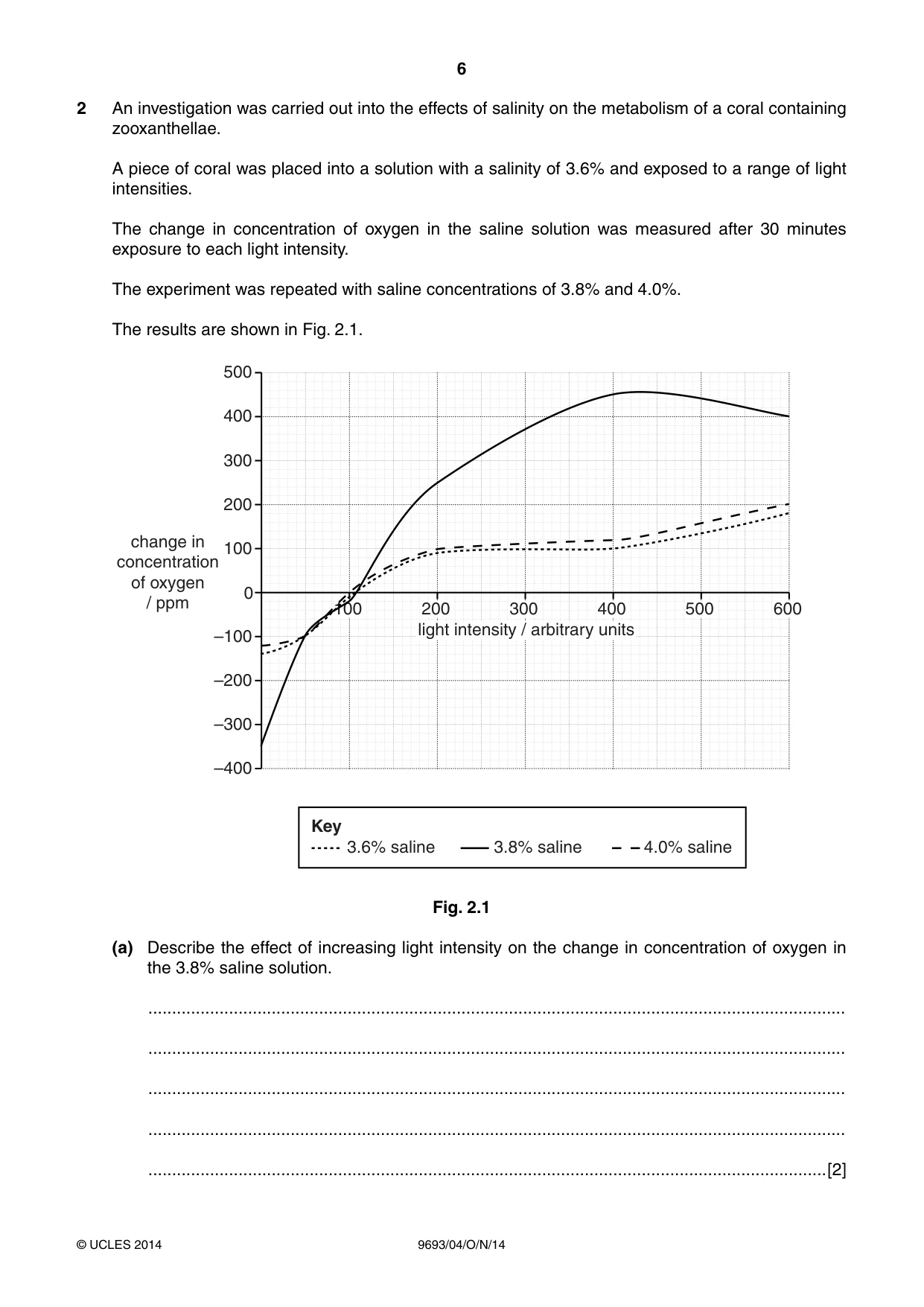
6 9693/04/O/N/14 © UCLES 2014 2 An investigation was carried out into the effects of salinity on the metabolism of a coral containing zooxanthellae. A piece of coral was placed into a solution with a salinity of 3.6% and exposed to a range of light intensities. The change in concentration of oxygen in the saline solution was measured after 30 minutes exposure to each light intensity. The experiment was repeated with saline concentrations of 3.8% and 4.0%. The results are shown in Fig. 2.1. –400 100 200 300 light intensity / arbitrary units change in concentration of oxygen / ppm 400 500 600 –300 –200 –100 0 100 200 300 400 500 3.6% saline 3.8% saline 4.0% saline Key Fig. 2.1 (a) Describe the effect of increasing light intensity on the change in concentration of oxygen in the 3.8% saline solution. … … … … …[2]
Question paper, page 7
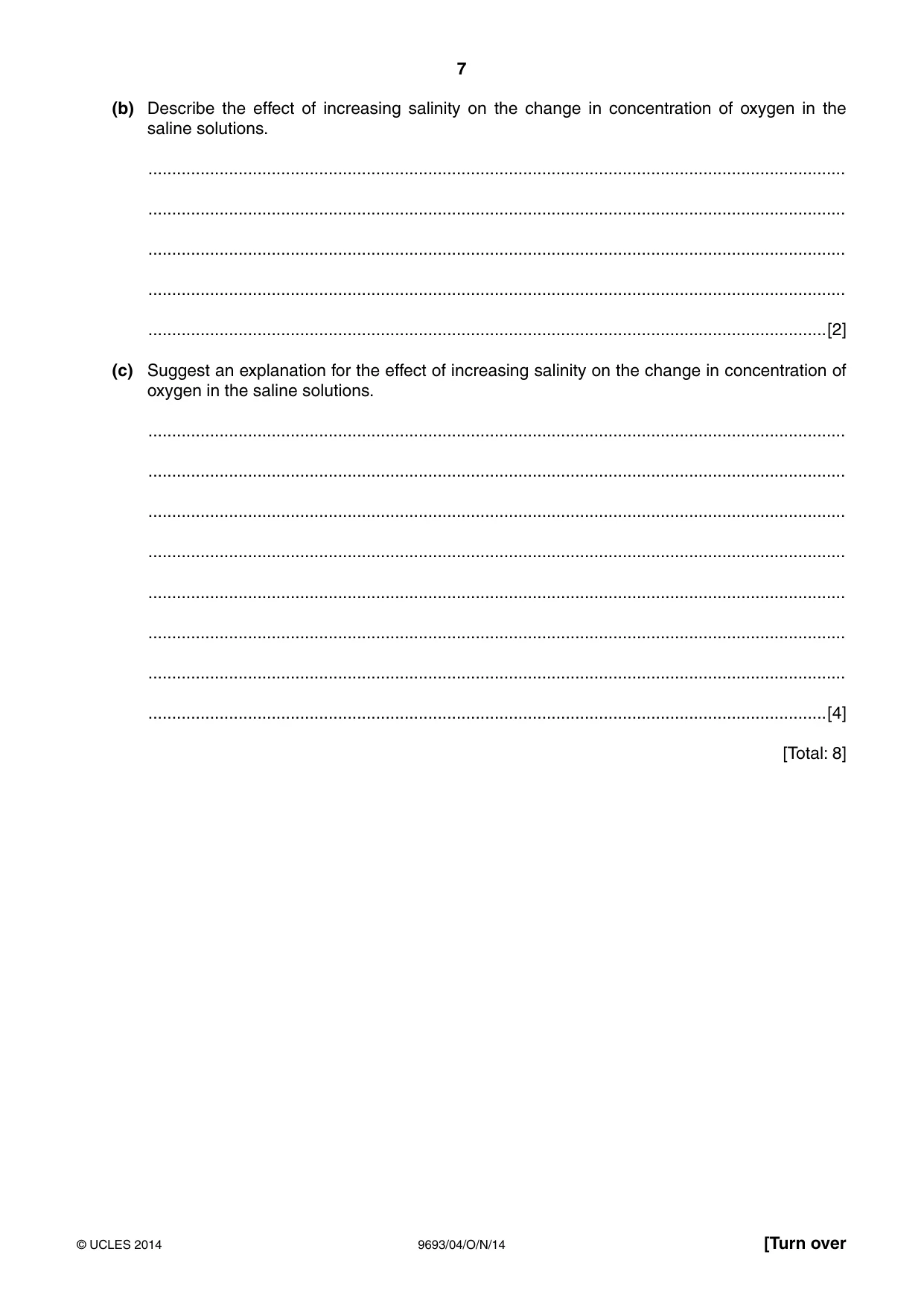
7 9693/04/O/N/14 © UCLES 2014 [Turn over (b) Describe the effect of increasing salinity on the change in concentration of oxygen in the saline solutions. … … … … …[2] (c) Suggest an explanation for the effect of increasing salinity on the change in concentration of oxygen in the saline solutions. … … … … … … … …[4] [Total: 8]
Question paper, page 8
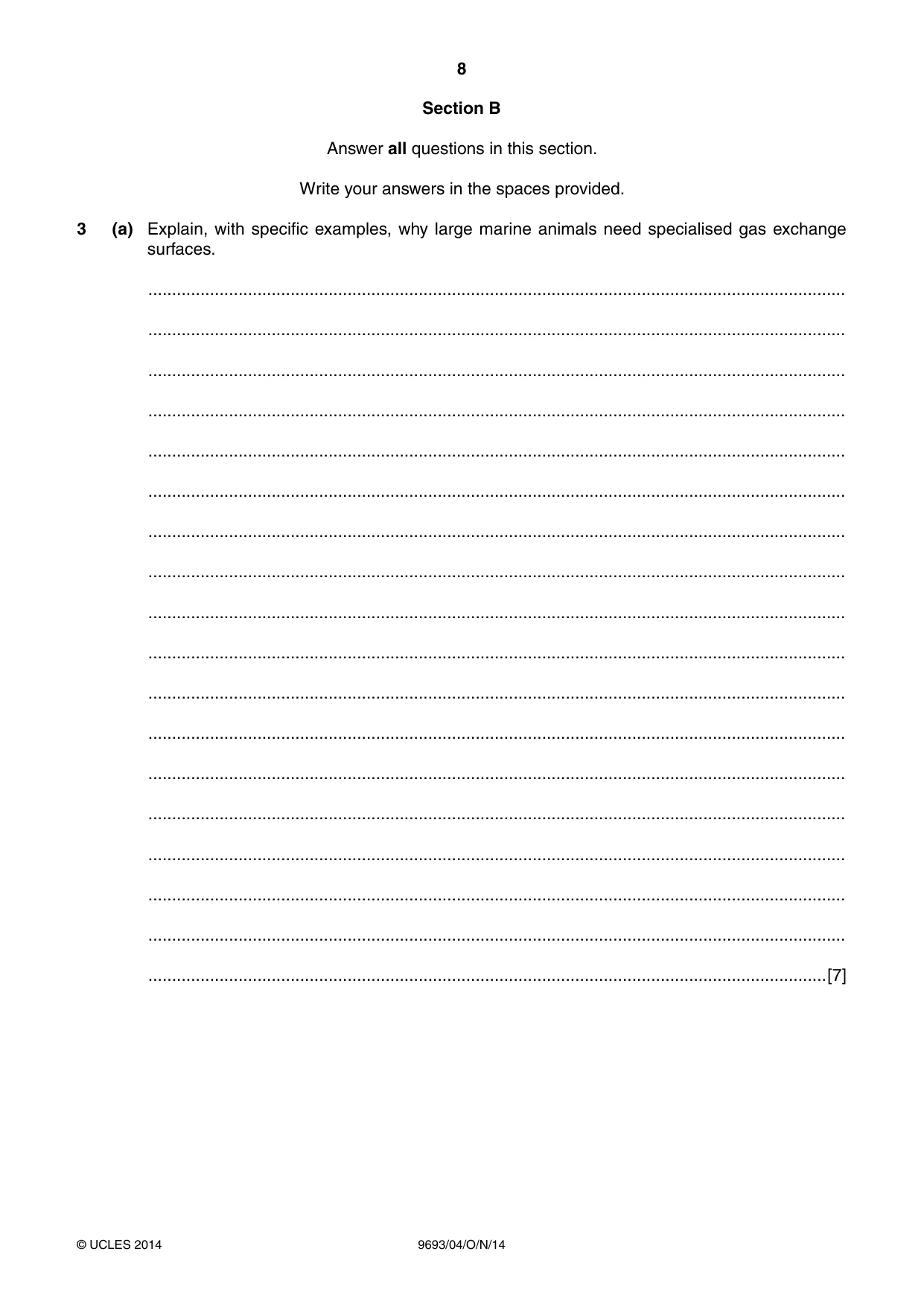
8 9693/04/O/N/14 © UCLES 2014 Section B Answer all questions in this section. Write your answers in the spaces provided. 3 (a) Explain, with specific examples, why large marine animals need specialised gas exchange surfaces. … … … … … … … … … … … … … … … … … …[7]
Question paper, page 9
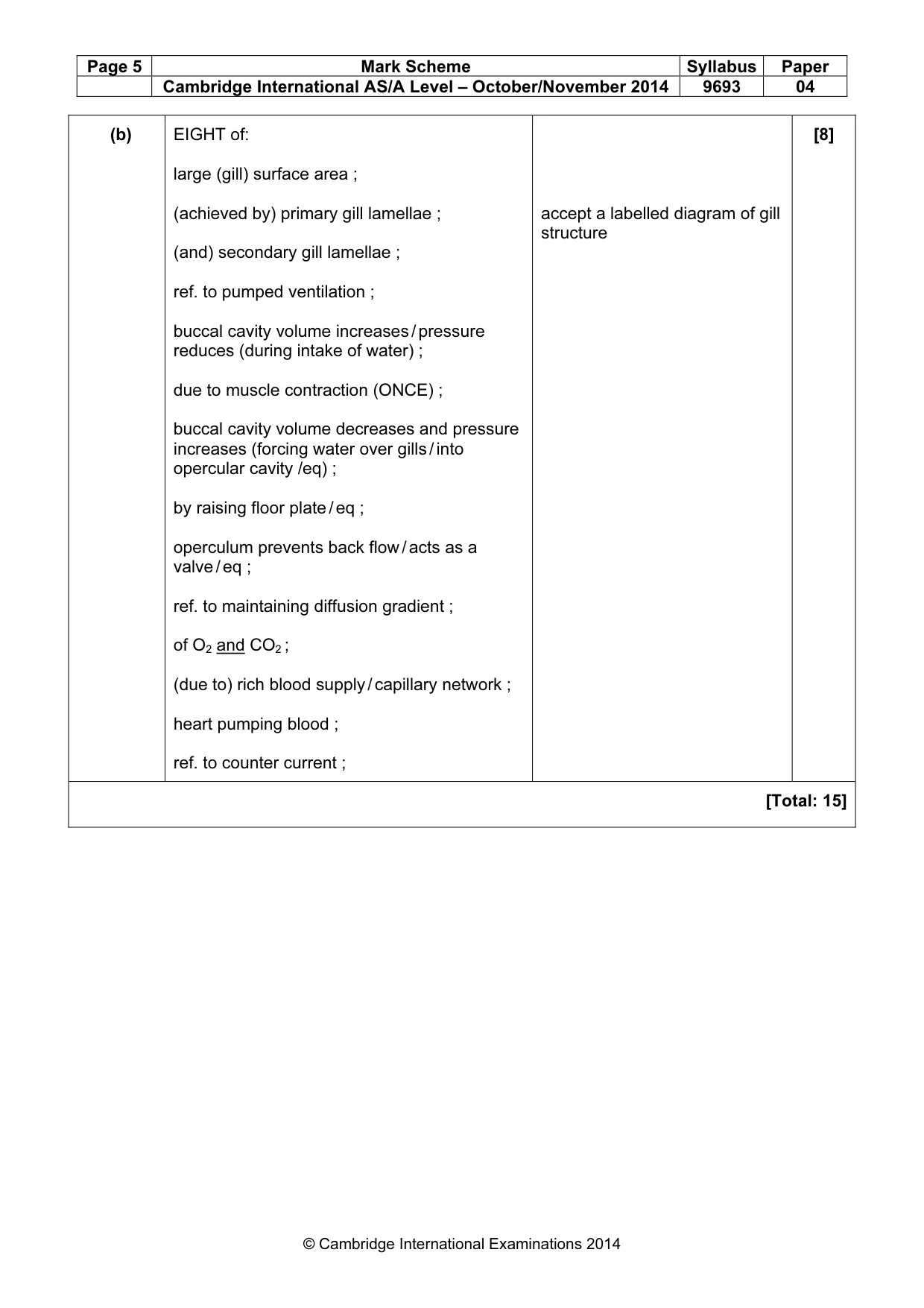
9 9693/04/O/N/14 © UCLES 2014 [Turn over (b) Describe how efficient gas exchange is achieved in the grouper. … … … … … … … … … … … … … … … … … … … … …[8] [Total: 15]
Question paper, page 10
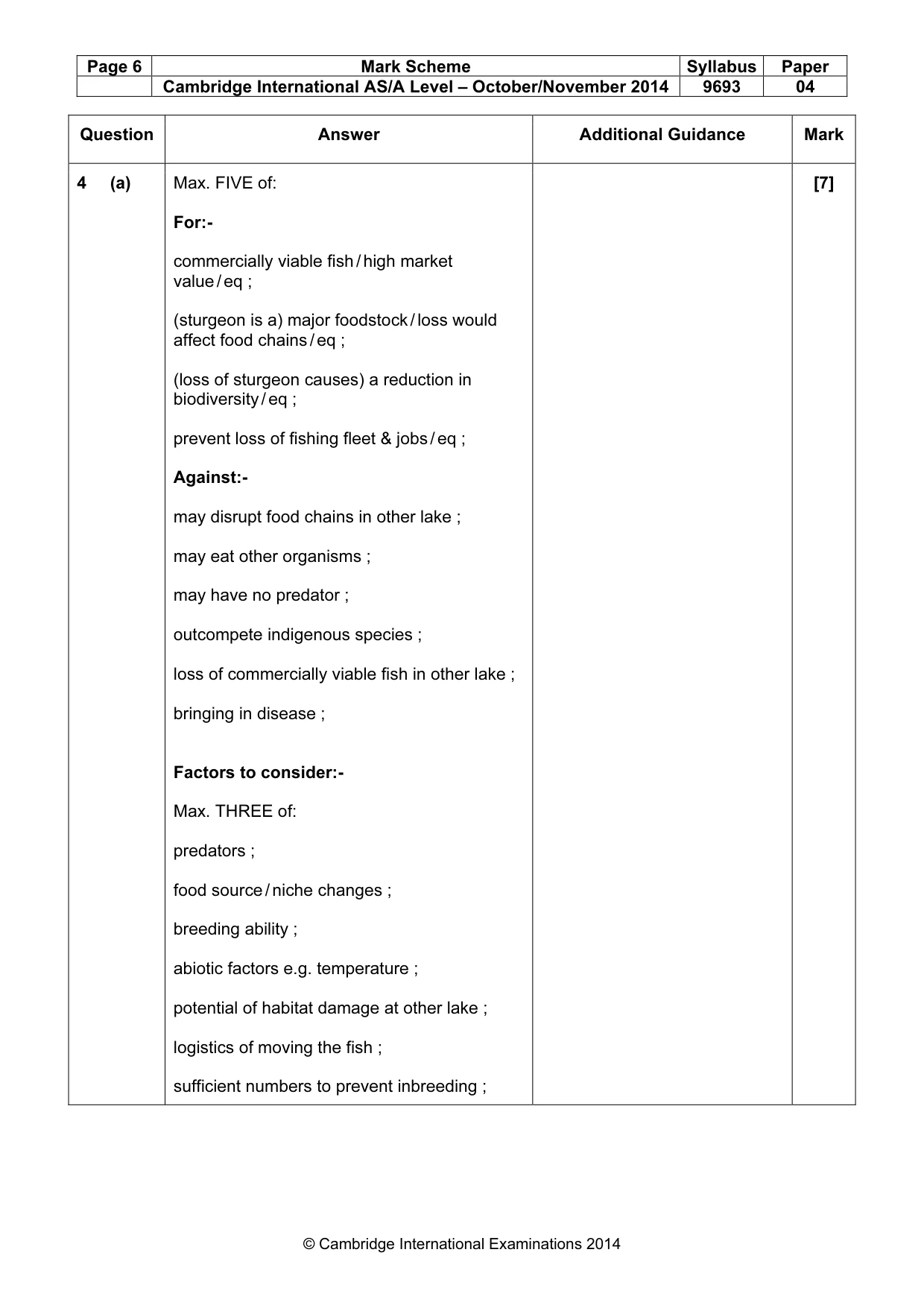
10 9693/04/O/N/14 © UCLES 2014 4 (a) The ship sturgeon is a species of sturgeon fish that until relatively recently was found in large numbers in the Aral Sea, a landlocked sea in central Asia. It was highly sought after by fishing industries that were abundant in the area. The Aral Sea has shrunk because of poor management of irrigation systems, and the salinity has risen dramatically. In order to prevent extinction of the ship sturgeon, fish were removed and placed into a nearby lake which did not previously contain the ship sturgeon. Eventually, it is planned to return the fish to the Aral Sea when conservation programmes have successfully restored the water levels. Outline the arguments for and against preventing the extinction of the ship sturgeon. Suggest what factors the conservationists must consider before commencing the project. … … … … … … … … … … … … … … … … … … … …[7]
Question paper, page 11
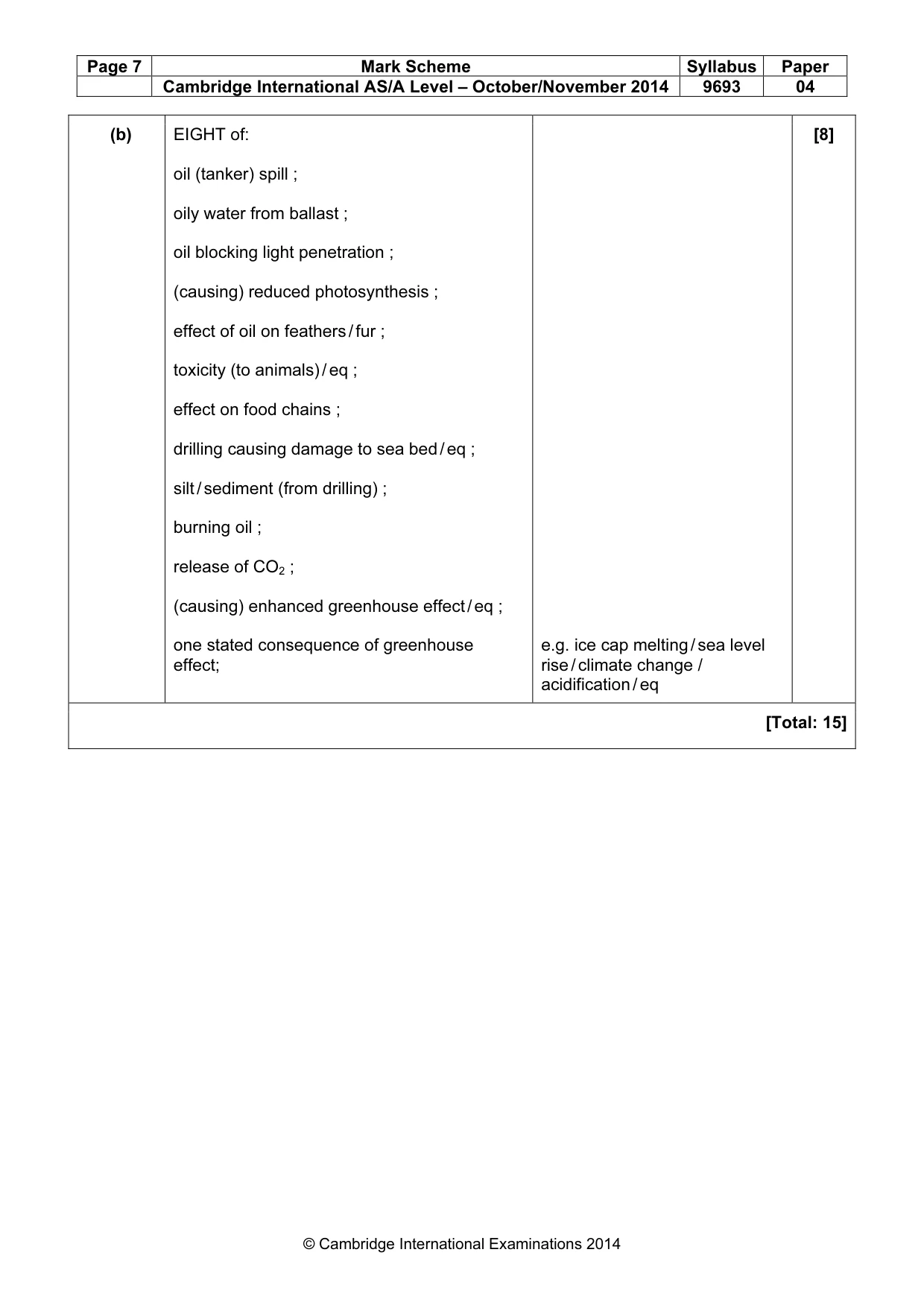
11 9693/04/O/N/14 © UCLES 2014 (b) Explain how the oil industry can have an impact on marine ecosystems. … … … … … … … … … … … … … … … … … … … … …[8] [Total: 15]
Question paper, page 12
12 9693/04/O/N/14 © UCLES 2014 BLANK PAGE Permission to reproduce items where third-party owned material protected by copyright is included has been sought and cleared where possible. Every reasonable effort has been made by the publisher (UCLES) to trace copyright holders, but if any items requiring clearance have unwittingly been included, the publisher will be pleased to make amends at the earliest possible opportunity. Cambridge International Examinations is part of the Cambridge Assessment Group. Cambridge Assessment is the brand name of University of Cambridge Local Examinations Syndicate (UCLES), which is itself a department of the University of Cambridge.
Mark scheme, page 1
® IGCSE is the registered trademark of Cambridge International Examinations. CAMBRIDGE INTERNATIONAL EXAMINATIONS Cambridge International Advanced Level MARK SCHEME for the October/November 2014 series 9693 MARINE SCIENCE 9693/04 Paper 4 (Data-Handling and Free-Response), maximum raw mark 50 This mark scheme is published as an aid to teachers and candidates, to indicate the requirements of the examination. It shows the basis on which Examiners were instructed to award marks. It does not indicate the details of the discussions that took place at an Examiners’ meeting before marking began, which would have considered the acceptability of alternative answers. Mark schemes should be read in conjunction with the question paper and the Principal Examiner Report for Teachers. Cambridge will not enter into discussions about these mark schemes. Cambridge is publishing the mark schemes for the October/November 2014 series for most Cambridge IGCSE®, Cambridge International A and AS Level components and some Cambridge O Level components.
Mark scheme, page 2
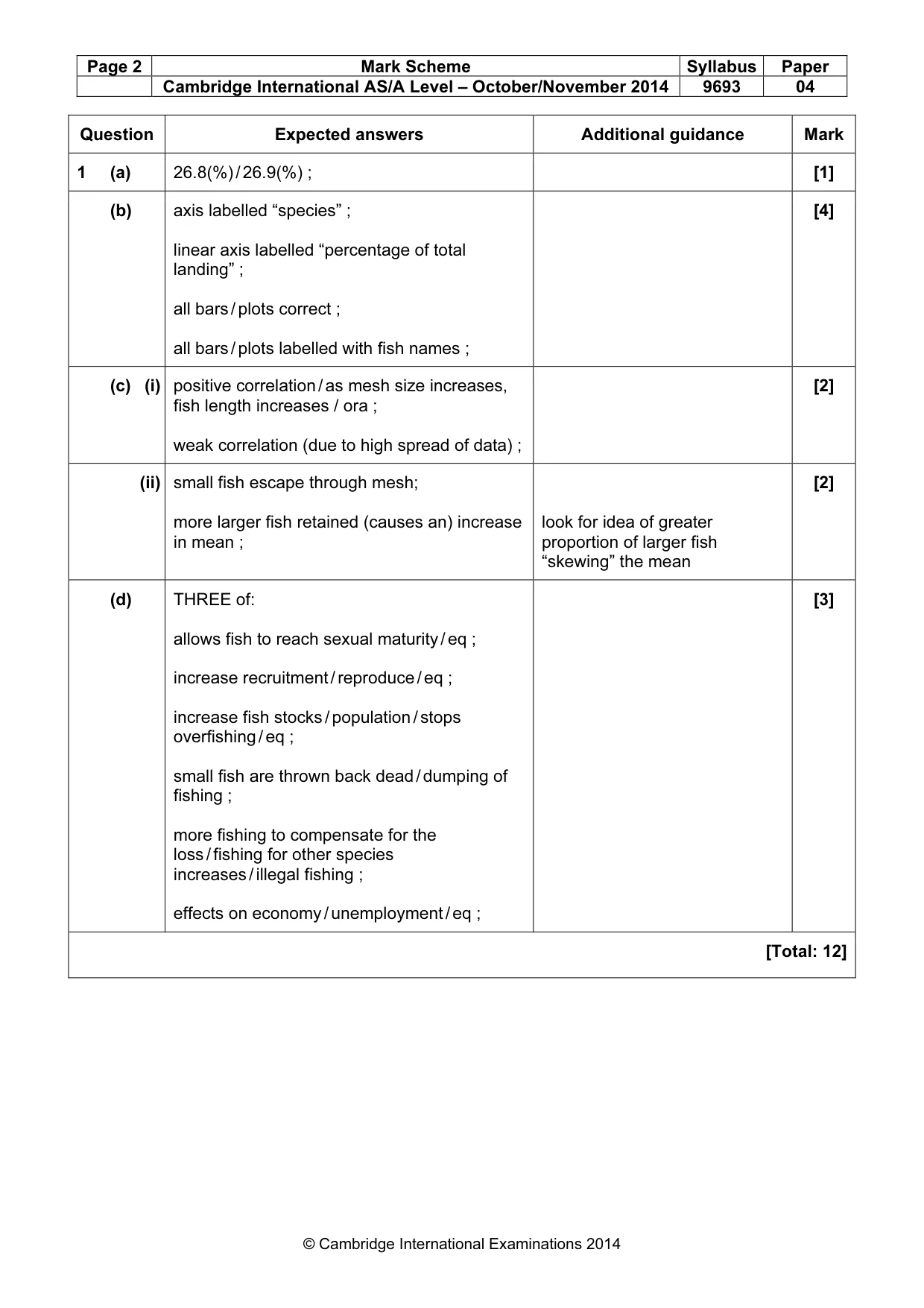
Page 2 Mark Scheme Syllabus Paper Cambridge International AS/A Level – October/November 2014 9693 04 © Cambridge International Examinations 2014 Question Expected answers Additional guidance Mark 1 (a) 26.8(%) / 26.9(%) ; [1] (b) axis labelled “species” ; linear axis labelled “percentage of total landing” ; all bars / plots correct ; all bars / plots labelled with fish names ; [4] (c) (i) positive correlation / as mesh size increases, fish length increases / ora ; weak correlation (due to high spread of data) ; [2] (ii) small fish escape through mesh; more larger fish retained (causes an) increase in mean ; look for idea of greater proportion of larger fish “skewing” the mean [2] (d) THREE of: allows fish to reach sexual maturity / eq ; increase recruitment / reproduce / eq ; increase fish stocks / population / stops overfishing / eq ; small fish are thrown back dead / dumping of fishing ; more fishing to compensate for the loss / fishing for other species increases / illegal fishing ; effects on economy / unemployment / eq ; [3] [Total: 12]
Mark scheme, page 3
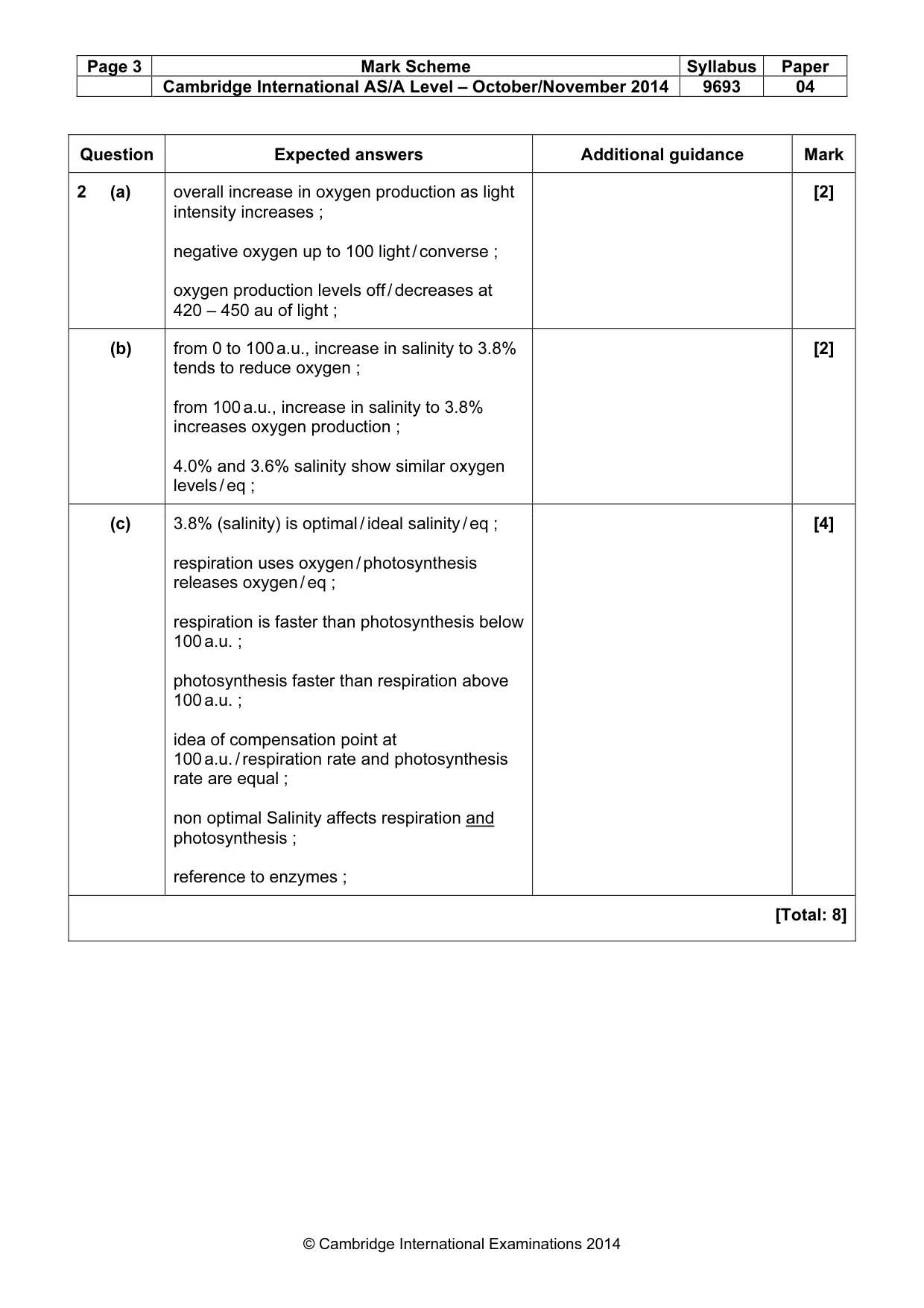
Page 3 Mark Scheme Syllabus Paper Cambridge International AS/A Level – October/November 2014 9693 04 © Cambridge International Examinations 2014 Question Expected answers Additional guidance Mark 2 (a) overall increase in oxygen production as light intensity increases ; negative oxygen up to 100 light / converse ; oxygen production levels off / decreases at 420 – 450 au of light ; [2] (b) from 0 to 100 a.u., increase in salinity to 3.8% tends to reduce oxygen ; from 100 a.u., increase in salinity to 3.8% increases oxygen production ; 4.0% and 3.6% salinity show similar oxygen levels / eq ; [2] (c) 3.8% (salinity) is optimal / ideal salinity / eq ; respiration uses oxygen / photosynthesis releases oxygen / eq ; respiration is faster than photosynthesis below 100 a.u. ; photosynthesis faster than respiration above 100 a.u. ; idea of compensation point at 100 a.u. / respiration rate and photosynthesis rate are equal ; non optimal Salinity affects respiration and photosynthesis ; reference to enzymes ; [4] [Total: 8]
Mark scheme, page 4
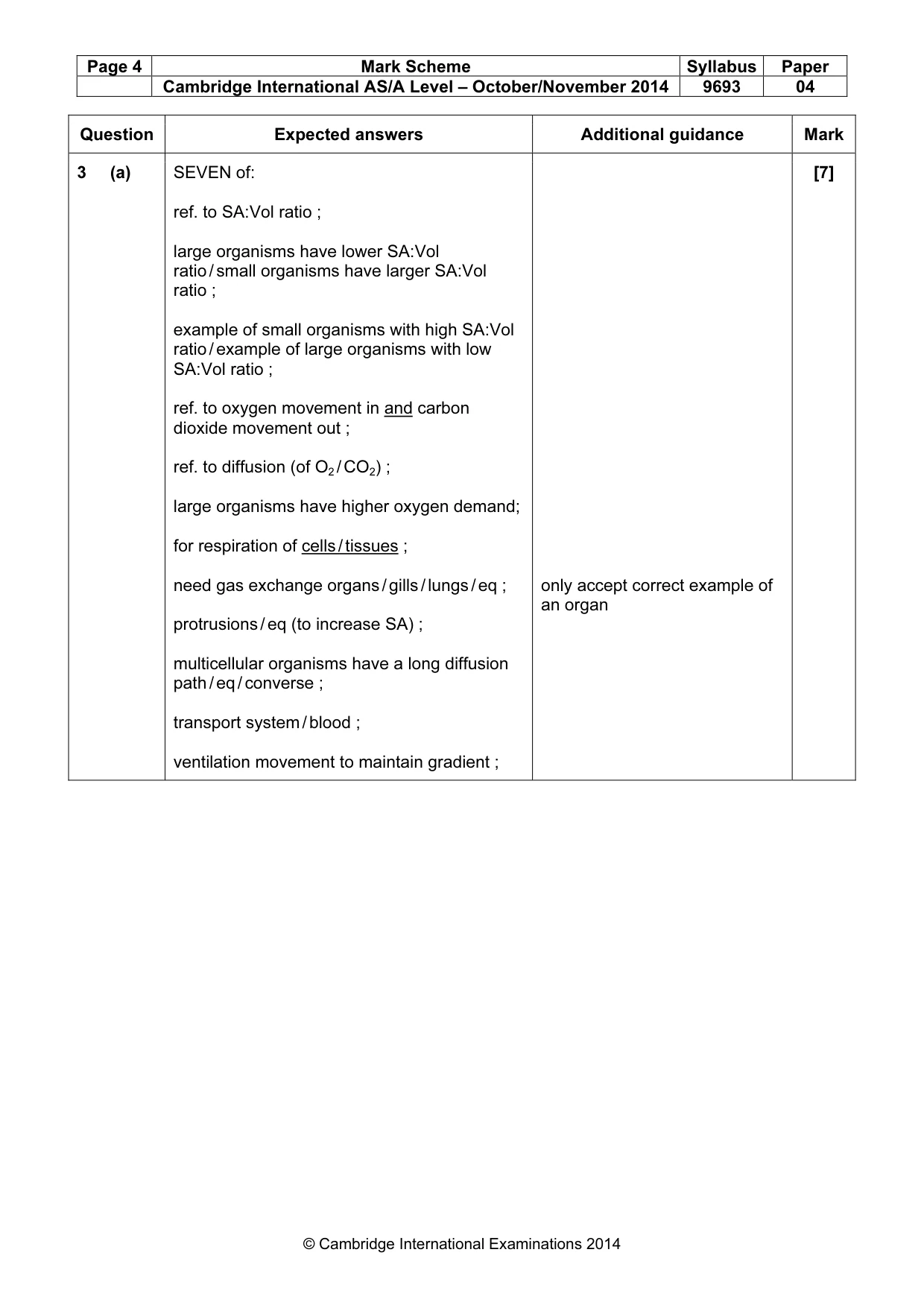
Page 4 Mark Scheme Syllabus Paper Cambridge International AS/A Level – October/November 2014 9693 04 © Cambridge International Examinations 2014 Question Expected answers Additional guidance Mark 3 (a) SEVEN of: ref. to SA:Vol ratio ; large organisms have lower SA:Vol ratio / small organisms have larger SA:Vol ratio ; example of small organisms with high SA:Vol ratio / example of large organisms with low SA:Vol ratio ; ref. to oxygen movement in and carbon dioxide movement out ; ref. to diffusion (of O2 / CO2) ; large organisms have higher oxygen demand; for respiration of cells / tissues ; need gas exchange organs / gills / lungs / eq ; protrusions / eq (to increase SA) ; multicellular organisms have a long diffusion path / eq / converse ; transport system / blood ; ventilation movement to maintain gradient ; only accept correct example of an organ [7]
Mark scheme, page 5
Page 5 Mark Scheme Syllabus Paper Cambridge International AS/A Level – October/November 2014 9693 04 © Cambridge International Examinations 2014 (b) EIGHT of: large (gill) surface area ; (achieved by) primary gill lamellae ; (and) secondary gill lamellae ; ref. to pumped ventilation ; buccal cavity volume increases / pressure reduces (during intake of water) ; due to muscle contraction (ONCE) ; buccal cavity volume decreases and pressure increases (forcing water over gills / into opercular cavity /eq) ; by raising floor plate / eq ; operculum prevents back flow / acts as a valve / eq ; ref. to maintaining diffusion gradient ; of O2 and CO2 ; (due to) rich blood supply / capillary network ; heart pumping blood ; ref. to counter current ; accept a labelled diagram of gill structure [8] [Total: 15]
Mark scheme, page 6
Page 6 Mark Scheme Syllabus Paper Cambridge International AS/A Level – October/November 2014 9693 04 © Cambridge International Examinations 2014 Question Answer Additional Guidance Mark 4 (a) Max. FIVE of: For:- commercially viable fish / high market value / eq ; (sturgeon is a) major foodstock / loss would affect food chains / eq ; (loss of sturgeon causes) a reduction in biodiversity / eq ; prevent loss of fishing fleet & jobs / eq ; Against:- may disrupt food chains in other lake ; may eat other organisms ; may have no predator ; outcompete indigenous species ; loss of commercially viable fish in other lake ; bringing in disease ; Factors to consider:- Max. THREE of: predators ; food source / niche changes ; breeding ability ; abiotic factors e.g. temperature ; potential of habitat damage at other lake ; logistics of moving the fish ; sufficient numbers to prevent inbreeding ; [7]
Mark scheme, page 7
Page 7 Mark Scheme Syllabus Paper Cambridge International AS/A Level – October/November 2014 9693 04 © Cambridge International Examinations 2014 (b) EIGHT of: oil (tanker) spill ; oily water from ballast ; oil blocking light penetration ; (causing) reduced photosynthesis ; effect of oil on feathers / fur ; toxicity (to animals) / eq ; effect on food chains ; drilling causing damage to sea bed / eq ; silt / sediment (from drilling) ; burning oil ; release of CO2 ; (causing) enhanced greenhouse effect / eq ; one stated consequence of greenhouse effect; e.g. ice cap melting / sea level rise / climate change / acidification / eq [8] [Total: 15]
What you needed in this session
Cambridge’s own grade thresholds for 2014 Oct/Nov, Paper 4 · Variant 1. A higher threshold means an easier paper — the bar moves with how the cohort did.