Cambridge A Level Law 9084 — 2021 May/June Paper 1 · Variant 3
9084/13/M/J/21 · 75 marks · ≈84 min
The question paper and its mark scheme, free to read here and free to download. This is Cambridge’s own paper, exactly as it was sat.
Question paper4 pages


Mark scheme11 pages
Answers below. Sit the paper first if you are practising.

Paper as text
Question paper, page 1
This document has 4 pages. Any blank pages are indicated. Cambridge International AS & A Level DC (DH) 207046/1 © UCLES 2021 [Turn over * 0 4 9 3 7 0 0 5 2 0 * LAW 9084/13 Paper 1 Structure and Operation of the English Legal System May/June 2021 1 hour 30 minutes You must answer on the enclosed answer booklet. You will need: Answer booklet (enclosed) INSTRUCTIONS ● Answer three questions. ● Follow the instructions on the front cover of the answer booklet. If you need additional answer paper, ask the invigilator for a continuation booklet. INFORMATION ● The total mark for this paper is 75. ● The number of marks for each question or part question is shown in brackets [ ].
Question paper, page 2
2 9084/13/M/J/21 © UCLES 2021 Answer three questions. 1 Leo has been convicted of assault in the Magistrates’ Court. He maintains his innocence and wishes to appeal. Describe the different ways in which Leo can appeal. Assess the problems which he might experience when making an appeal. [25] 2 Describe the function of the Crown Prosecution Service (CPS). Discuss the main criticisms of this service. [25] 3 The Common Law and Equity courts were combined by the Judicature Acts 1873–1875. Describe how Equity has developed since then. Assess the extent to which Equity is still a separate source of law. [25] 4 Describe how a jury in a criminal case is selected. Assess whether this process successfully removes potential jurors who may be unsuitable to fulfil the role. [25] 5 Juhena has been charged with the theft of expensive jewellery from a shop in London. She lives with her husband and their seven-year-old child in rented accommodation nearby. She also owns a property in France. She has complied with bail given to her for a previous conviction for fraud. Explain the factors that might be considered when deciding whether or not to grant bail to Juhena. Justify whether it is ever appropriate to grant bail to someone charged with an offence. [25] 6 Describe the rights protected by the Human Rights Act 1998, using examples from case law. Assess how effective the Act has been in protecting these rights. [25]
Question paper, page 3
3 9084/13/M/J/21 © UCLES 2021 BLANK PAGE
Question paper, page 4
4 9084/13/M/J/21 © UCLES 2021 Permission to reproduce items where third-party owned material protected by copyright is included has been sought and cleared where possible. Every reasonable effort has been made by the publisher (UCLES) to trace copyright holders, but if any items requiring clearance have unwittingly been included, the publisher will be pleased to make amends at the earliest possible opportunity. To avoid the issue of disclosure of answer-related information to candidates, all copyright acknowledgements are reproduced online in the Cambridge Assessment International Education Copyright Acknowledgements Booklet. This is produced for each series of examinations and is freely available to download at www.cambridgeinternational.org after the live examination series. Cambridge Assessment International Education is part of the Cambridge Assessment Group. Cambridge Assessment is the brand name of the University of Cambridge Local Examinations Syndicate (UCLES), which itself is a department of the University of Cambridge. BLANK PAGE
Mark scheme, page 1
This document consists of 11 printed pages. © UCLES 2021 [Turn over Cambridge IGCSE™ LAW 9084/13 Paper 1 May/June 2021 MARK SCHEME Maximum Mark: 75 Published This mark scheme is published as an aid to teachers and candidates, to indicate the requirements of the examination. It shows the basis on which Examiners were instructed to award marks. It does not indicate the details of the discussions that took place at an Examiners’ meeting before marking began, which would have considered the acceptability of alternative answers. Mark schemes should be read in conjunction with the question paper and the Principal Examiner Report for Teachers. Cambridge International will not enter into discussions about these mark schemes. Cambridge International is publishing the mark schemes for the May/June 2021 series for most Cambridge IGCSE™, Cambridge International A and AS Level components and some Cambridge O Level components.
Mark scheme, page 2
9084/13 Cambridge IGCSE – Mark Scheme PUBLISHED May/June 2021 © UCLES 2021 Page 2 of 11 Generic Marking Principles These general marking principles must be applied by all examiners when marking candidate answers. They should be applied alongside the specific content of the mark scheme or generic level descriptors for a question. Each question paper and mark scheme will also comply with these marking principles. GENERIC MARKING PRINCIPLE 1: Marks must be awarded in line with: • the specific content of the mark scheme or the generic level descriptors for the question • the specific skills defined in the mark scheme or in the generic level descriptors for the question • the standard of response required by a candidate as exemplified by the standardisation scripts. GENERIC MARKING PRINCIPLE 2: Marks awarded are always whole marks (not half marks, or other fractions). GENERIC MARKING PRINCIPLE 3: Marks must be awarded positively: • marks are awarded for correct/valid answers, as defined in the mark scheme. However, credit is given for valid answers which go beyond the scope of the syllabus and mark scheme, referring to your Team Leader as appropriate • marks are awarded when candidates clearly demonstrate what they know and can do • marks are not deducted for errors • marks are not deducted for omissions • answers should only be judged on the quality of spelling, punctuation and grammar when these features are specifically assessed by the question as indicated by the mark scheme. The meaning, however, should be unambiguous. GENERIC MARKING PRINCIPLE 4: Rules must be applied consistently, e.g. in situations where candidates have not followed instructions or in the application of generic level descriptors. GENERIC MARKING PRINCIPLE 5: Marks should be awarded using the full range of marks defined in the mark scheme for the question (however; the use of the full mark range may be limited according to the quality of the candidate responses seen). GENERIC MARKING PRINCIPLE 6: Marks awarded are based solely on the requirements as defined in the mark scheme. Marks should not be awarded with grade thresholds or grade descriptors in mind.
Mark scheme, page 3
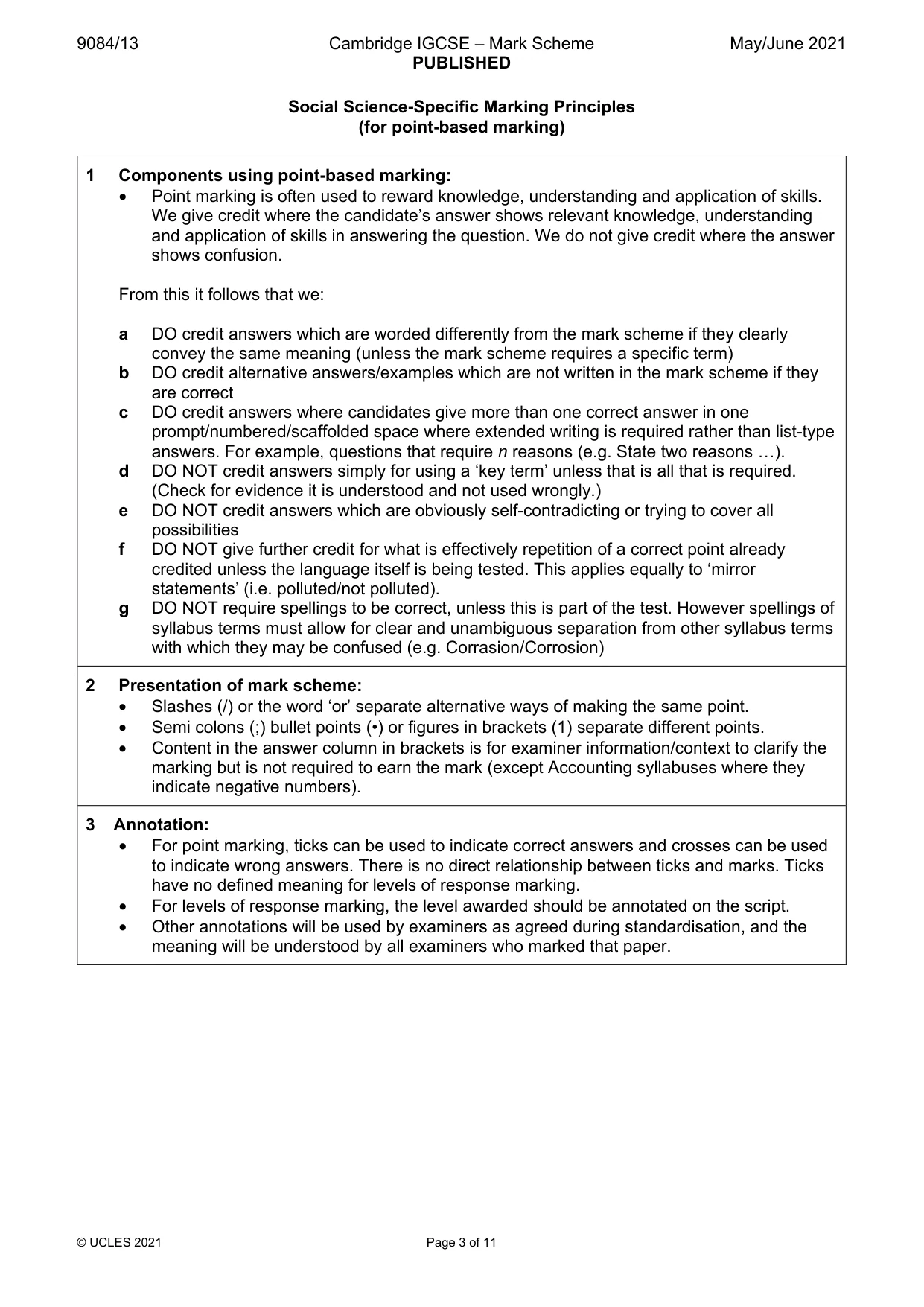
9084/13 Cambridge IGCSE – Mark Scheme PUBLISHED May/June 2021 © UCLES 2021 Page 3 of 11 Social Science-Specific Marking Principles (for point-based marking) 1 Components using point-based marking: • Point marking is often used to reward knowledge, understanding and application of skills. We give credit where the candidate’s answer shows relevant knowledge, understanding and application of skills in answering the question. We do not give credit where the answer shows confusion. From this it follows that we: a DO credit answers which are worded differently from the mark scheme if they clearly convey the same meaning (unless the mark scheme requires a specific term) b DO credit alternative answers/examples which are not written in the mark scheme if they are correct c DO credit answers where candidates give more than one correct answer in one prompt/numbered/scaffolded space where extended writing is required rather than list-type answers. For example, questions that require n reasons (e.g. State two reasons …). d DO NOT credit answers simply for using a ‘key term’ unless that is all that is required. (Check for evidence it is understood and not used wrongly.) e DO NOT credit answers which are obviously self-contradicting or trying to cover all possibilities f DO NOT give further credit for what is effectively repetition of a correct point already credited unless the language itself is being tested. This applies equally to ‘mirror statements’ (i.e. polluted/not polluted). g DO NOT require spellings to be correct, unless this is part of the test. However spellings of syllabus terms must allow for clear and unambiguous separation from other syllabus terms with which they may be confused (e.g. Corrasion/Corrosion) 2 Presentation of mark scheme: • Slashes (/) or the word ‘or’ separate alternative ways of making the same point. • Semi colons (;) bullet points (•) or figures in brackets (1) separate different points. • Content in the answer column in brackets is for examiner information/context to clarify the marking but is not required to earn the mark (except Accounting syllabuses where they indicate negative numbers). 3 Annotation: • For point marking, ticks can be used to indicate correct answers and crosses can be used to indicate wrong answers. There is no direct relationship between ticks and marks. Ticks have no defined meaning for levels of response marking. • For levels of response marking, the level awarded should be annotated on the script. • Other annotations will be used by examiners as agreed during standardisation, and the meaning will be understood by all examiners who marked that paper.
Mark scheme, page 4
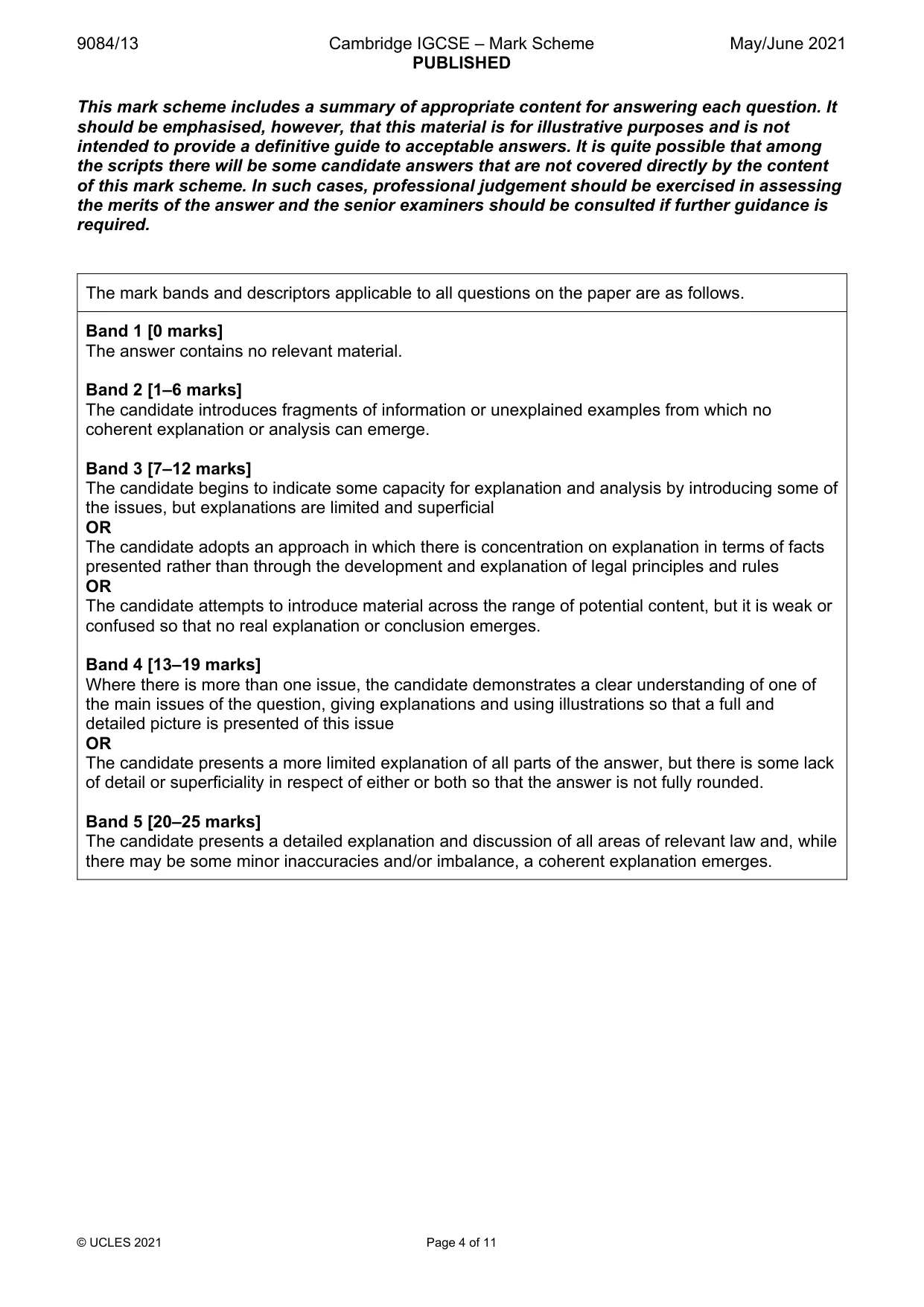
9084/13 Cambridge IGCSE – Mark Scheme PUBLISHED May/June 2021 © UCLES 2021 Page 4 of 11 This mark scheme includes a summary of appropriate content for answering each question. It should be emphasised, however, that this material is for illustrative purposes and is not intended to provide a definitive guide to acceptable answers. It is quite possible that among the scripts there will be some candidate answers that are not covered directly by the content of this mark scheme. In such cases, professional judgement should be exercised in assessing the merits of the answer and the senior examiners should be consulted if further guidance is required. The mark bands and descriptors applicable to all questions on the paper are as follows. Band 1 [0 marks] The answer contains no relevant material. Band 2 [1–6 marks] The candidate introduces fragments of information or unexplained examples from which no coherent explanation or analysis can emerge. Band 3 [7–12 marks] The candidate begins to indicate some capacity for explanation and analysis by introducing some of the issues, but explanations are limited and superficial OR The candidate adopts an approach in which there is concentration on explanation in terms of facts presented rather than through the development and explanation of legal principles and rules OR The candidate attempts to introduce material across the range of potential content, but it is weak or confused so that no real explanation or conclusion emerges. Band 4 [13–19 marks] Where there is more than one issue, the candidate demonstrates a clear understanding of one of the main issues of the question, giving explanations and using illustrations so that a full and detailed picture is presented of this issue OR The candidate presents a more limited explanation of all parts of the answer, but there is some lack of detail or superficiality in respect of either or both so that the answer is not fully rounded. Band 5 [20–25 marks] The candidate presents a detailed explanation and discussion of all areas of relevant law and, while there may be some minor inaccuracies and/or imbalance, a coherent explanation emerges.
Mark scheme, page 5
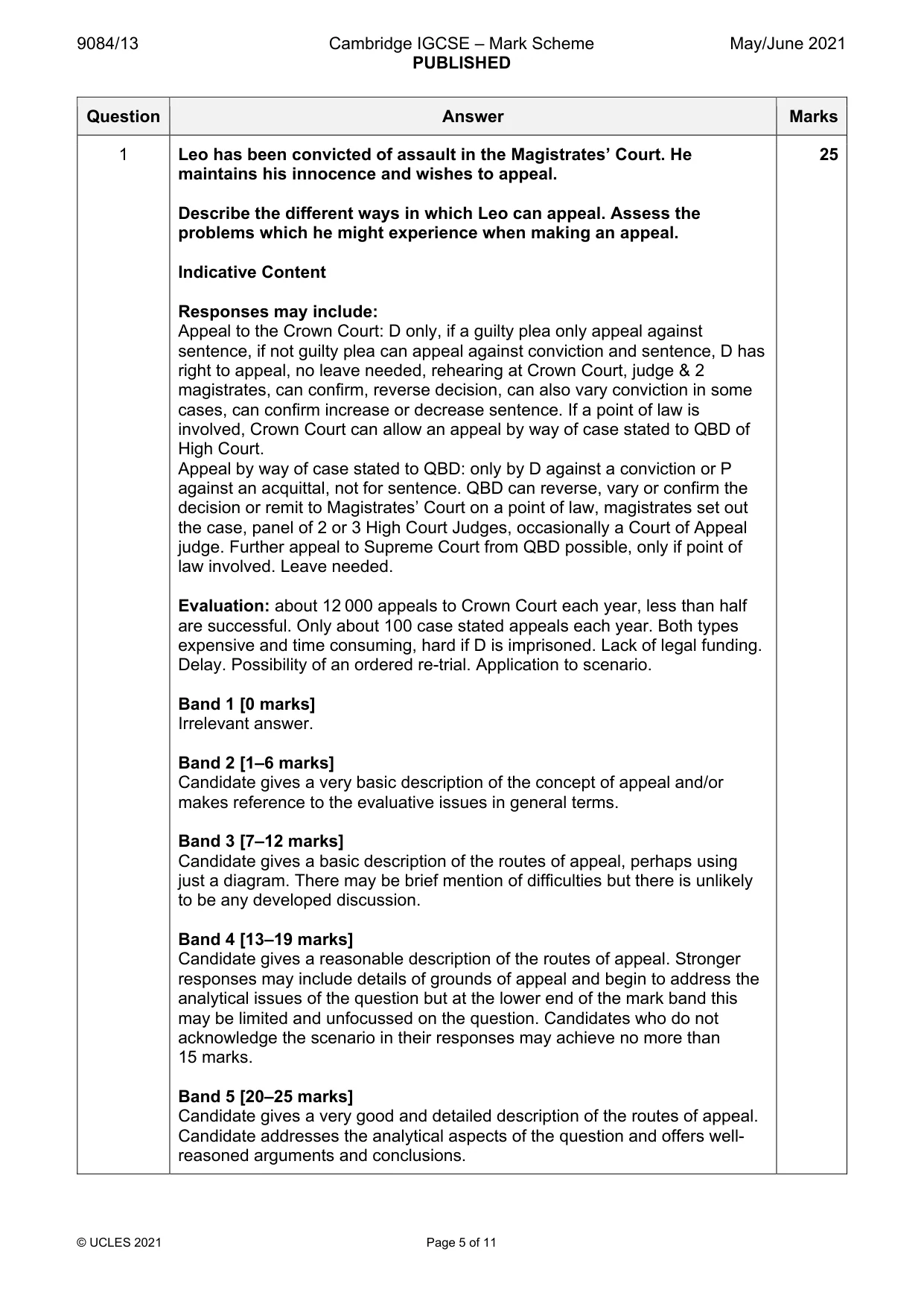
9084/13 Cambridge IGCSE – Mark Scheme PUBLISHED May/June 2021 © UCLES 2021 Page 5 of 11 Question Answer Marks 1 Leo has been convicted of assault in the Magistrates’ Court. He maintains his innocence and wishes to appeal. Describe the different ways in which Leo can appeal. Assess the problems which he might experience when making an appeal. Indicative Content Responses may include: Appeal to the Crown Court: D only, if a guilty plea only appeal against sentence, if not guilty plea can appeal against conviction and sentence, D has right to appeal, no leave needed, rehearing at Crown Court, judge & 2 magistrates, can confirm, reverse decision, can also vary conviction in some cases, can confirm increase or decrease sentence. If a point of law is involved, Crown Court can allow an appeal by way of case stated to QBD of High Court. Appeal by way of case stated to QBD: only by D against a conviction or P against an acquittal, not for sentence. QBD can reverse, vary or confirm the decision or remit to Magistrates’ Court on a point of law, magistrates set out the case, panel of 2 or 3 High Court Judges, occasionally a Court of Appeal judge. Further appeal to Supreme Court from QBD possible, only if point of law involved. Leave needed. Evaluation: about 12 000 appeals to Crown Court each year, less than half are successful. Only about 100 case stated appeals each year. Both types expensive and time consuming, hard if D is imprisoned. Lack of legal funding. Delay. Possibility of an ordered re-trial. Application to scenario. Band 1 [0 marks] Irrelevant answer. Band 2 [1–6 marks] Candidate gives a very basic description of the concept of appeal and/or makes reference to the evaluative issues in general terms. Band 3 [7–12 marks] Candidate gives a basic description of the routes of appeal, perhaps using just a diagram. There may be brief mention of difficulties but there is unlikely to be any developed discussion. Band 4 [13–19 marks] Candidate gives a reasonable description of the routes of appeal. Stronger responses may include details of grounds of appeal and begin to address the analytical issues of the question but at the lower end of the mark band this may be limited and unfocussed on the question. Candidates who do not acknowledge the scenario in their responses may achieve no more than 15 marks. Band 5 [20–25 marks] Candidate gives a very good and detailed description of the routes of appeal. Candidate addresses the analytical aspects of the question and offers well- reasoned arguments and conclusions. 25
Mark scheme, page 6
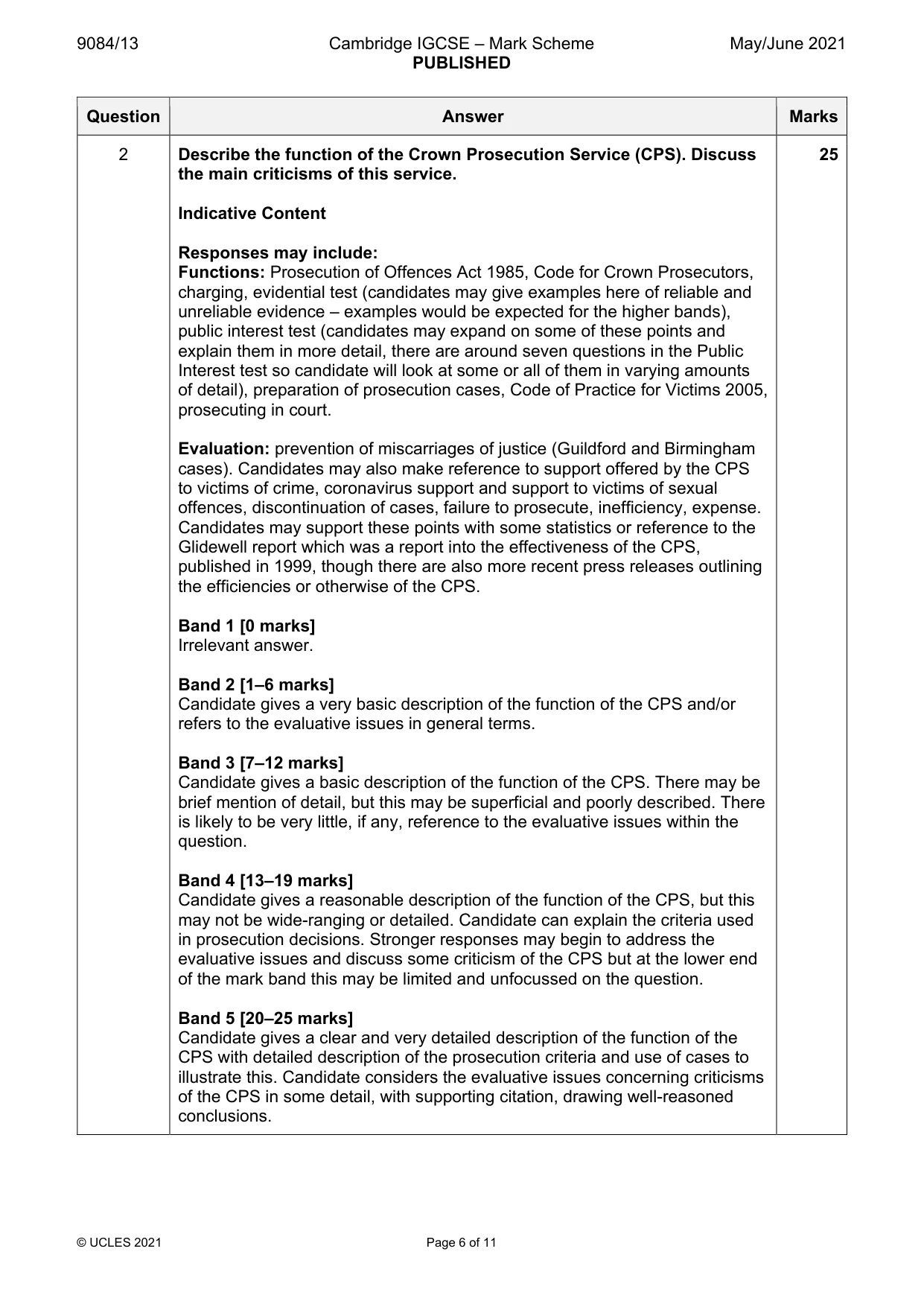
9084/13 Cambridge IGCSE – Mark Scheme PUBLISHED May/June 2021 © UCLES 2021 Page 6 of 11 Question Answer Marks 2 Describe the function of the Crown Prosecution Service (CPS). Discuss the main criticisms of this service. Indicative Content Responses may include: Functions: Prosecution of Offences Act 1985, Code for Crown Prosecutors, charging, evidential test (candidates may give examples here of reliable and unreliable evidence – examples would be expected for the higher bands), public interest test (candidates may expand on some of these points and explain them in more detail, there are around seven questions in the Public Interest test so candidate will look at some or all of them in varying amounts of detail), preparation of prosecution cases, Code of Practice for Victims 2005, prosecuting in court. Evaluation: prevention of miscarriages of justice (Guildford and Birmingham cases). Candidates may also make reference to support offered by the CPS to victims of crime, coronavirus support and support to victims of sexual offences, discontinuation of cases, failure to prosecute, inefficiency, expense. Candidates may support these points with some statistics or reference to the Glidewell report which was a report into the effectiveness of the CPS, published in 1999, though there are also more recent press releases outlining the efficiencies or otherwise of the CPS. Band 1 [0 marks] Irrelevant answer. Band 2 [1–6 marks] Candidate gives a very basic description of the function of the CPS and/or refers to the evaluative issues in general terms. Band 3 [7–12 marks] Candidate gives a basic description of the function of the CPS. There may be brief mention of detail, but this may be superficial and poorly described. There is likely to be very little, if any, reference to the evaluative issues within the question. Band 4 [13–19 marks] Candidate gives a reasonable description of the function of the CPS, but this may not be wide-ranging or detailed. Candidate can explain the criteria used in prosecution decisions. Stronger responses may begin to address the evaluative issues and discuss some criticism of the CPS but at the lower end of the mark band this may be limited and unfocussed on the question. Band 5 [20–25 marks] Candidate gives a clear and very detailed description of the function of the CPS with detailed description of the prosecution criteria and use of cases to illustrate this. Candidate considers the evaluative issues concerning criticisms of the CPS in some detail, with supporting citation, drawing well-reasoned conclusions. 25
Mark scheme, page 7
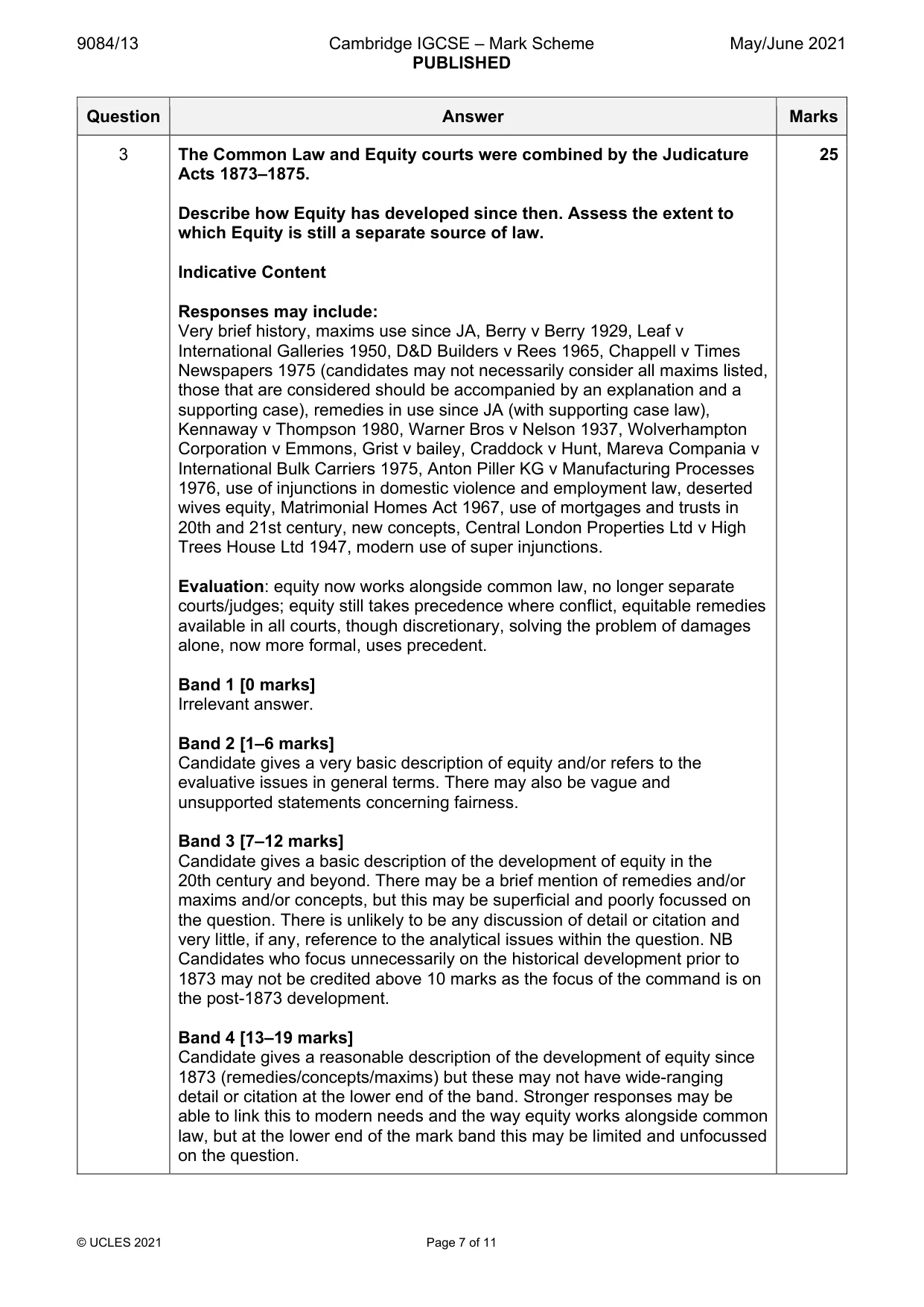
9084/13 Cambridge IGCSE – Mark Scheme PUBLISHED May/June 2021 © UCLES 2021 Page 7 of 11 Question Answer Marks 3 The Common Law and Equity courts were combined by the Judicature Acts 1873–1875. Describe how Equity has developed since then. Assess the extent to which Equity is still a separate source of law. Indicative Content Responses may include: Very brief history, maxims use since JA, Berry v Berry 1929, Leaf v International Galleries 1950, D&D Builders v Rees 1965, Chappell v Times Newspapers 1975 (candidates may not necessarily consider all maxims listed, those that are considered should be accompanied by an explanation and a supporting case), remedies in use since JA (with supporting case law), Kennaway v Thompson 1980, Warner Bros v Nelson 1937, Wolverhampton Corporation v Emmons, Grist v bailey, Craddock v Hunt, Mareva Compania v International Bulk Carriers 1975, Anton Piller KG v Manufacturing Processes 1976, use of injunctions in domestic violence and employment law, deserted wives equity, Matrimonial Homes Act 1967, use of mortgages and trusts in 20th and 21st century, new concepts, Central London Properties Ltd v High Trees House Ltd 1947, modern use of super injunctions. Evaluation: equity now works alongside common law, no longer separate courts/judges; equity still takes precedence where conflict, equitable remedies available in all courts, though discretionary, solving the problem of damages alone, now more formal, uses precedent. Band 1 [0 marks] Irrelevant answer. Band 2 [1–6 marks] Candidate gives a very basic description of equity and/or refers to the evaluative issues in general terms. There may also be vague and unsupported statements concerning fairness. Band 3 [7–12 marks] Candidate gives a basic description of the development of equity in the 20th century and beyond. There may be a brief mention of remedies and/or maxims and/or concepts, but this may be superficial and poorly focussed on the question. There is unlikely to be any discussion of detail or citation and very little, if any, reference to the analytical issues within the question. NB Candidates who focus unnecessarily on the historical development prior to 1873 may not be credited above 10 marks as the focus of the command is on the post-1873 development. Band 4 [13–19 marks] Candidate gives a reasonable description of the development of equity since 1873 (remedies/concepts/maxims) but these may not have wide-ranging detail or citation at the lower end of the band. Stronger responses may be able to link this to modern needs and the way equity works alongside common law, but at the lower end of the mark band this may be limited and unfocussed on the question. 25
Mark scheme, page 8
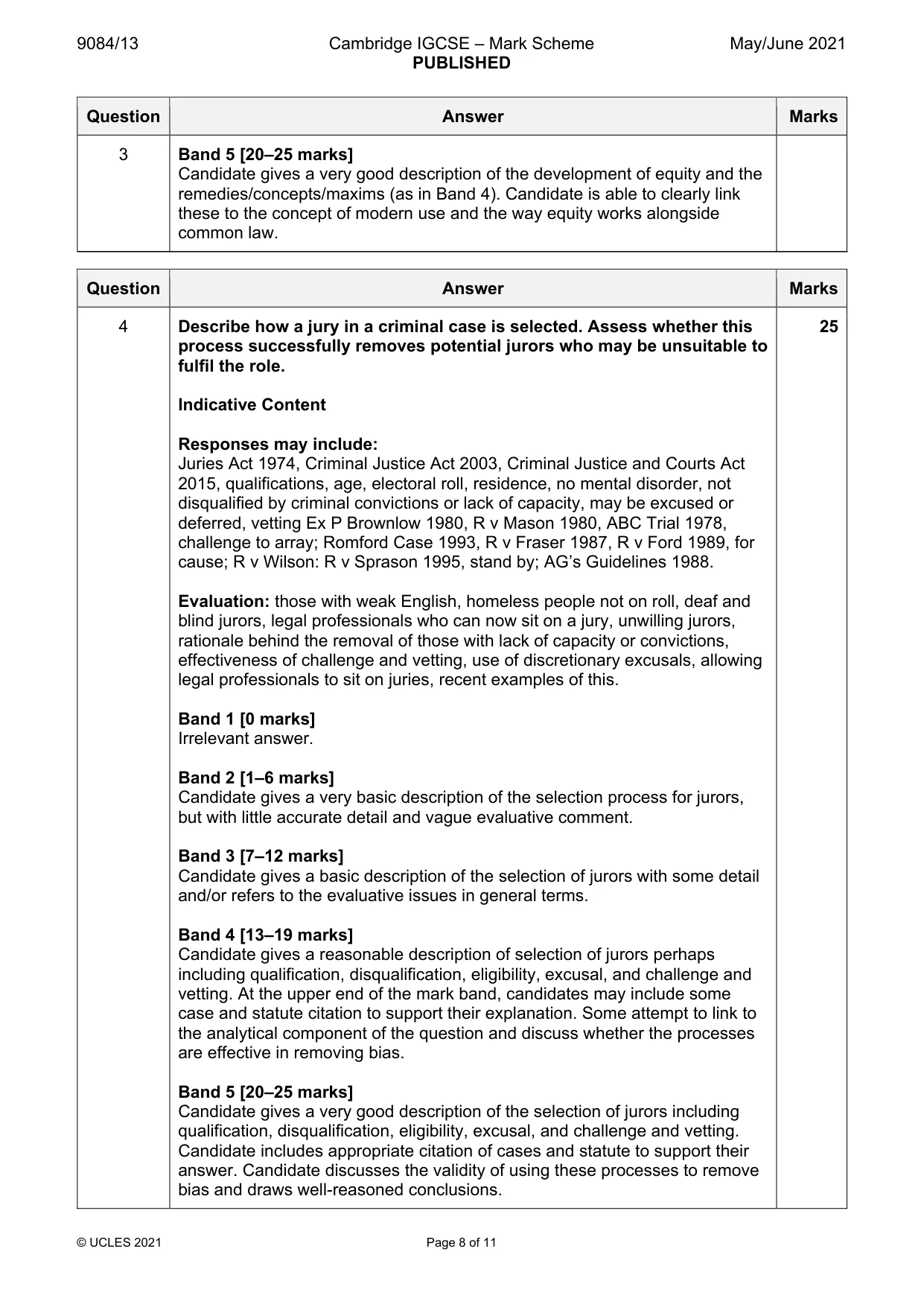
9084/13 Cambridge IGCSE – Mark Scheme PUBLISHED May/June 2021 © UCLES 2021 Page 8 of 11 Question Answer Marks 3 Band 5 [20–25 marks] Candidate gives a very good description of the development of equity and the remedies/concepts/maxims (as in Band 4). Candidate is able to clearly link these to the concept of modern use and the way equity works alongside common law. Question Answer Marks 4 Describe how a jury in a criminal case is selected. Assess whether this process successfully removes potential jurors who may be unsuitable to fulfil the role. Indicative Content Responses may include: Juries Act 1974, Criminal Justice Act 2003, Criminal Justice and Courts Act 2015, qualifications, age, electoral roll, residence, no mental disorder, not disqualified by criminal convictions or lack of capacity, may be excused or deferred, vetting Ex P Brownlow 1980, R v Mason 1980, ABC Trial 1978, challenge to array; Romford Case 1993, R v Fraser 1987, R v Ford 1989, for cause; R v Wilson: R v Sprason 1995, stand by; AG’s Guidelines 1988. Evaluation: those with weak English, homeless people not on roll, deaf and blind jurors, legal professionals who can now sit on a jury, unwilling jurors, rationale behind the removal of those with lack of capacity or convictions, effectiveness of challenge and vetting, use of discretionary excusals, allowing legal professionals to sit on juries, recent examples of this. Band 1 [0 marks] Irrelevant answer. Band 2 [1–6 marks] Candidate gives a very basic description of the selection process for jurors, but with little accurate detail and vague evaluative comment. Band 3 [7–12 marks] Candidate gives a basic description of the selection of jurors with some detail and/or refers to the evaluative issues in general terms. Band 4 [13–19 marks] Candidate gives a reasonable description of selection of jurors perhaps including qualification, disqualification, eligibility, excusal, and challenge and vetting. At the upper end of the mark band, candidates may include some case and statute citation to support their explanation. Some attempt to link to the analytical component of the question and discuss whether the processes are effective in removing bias. Band 5 [20–25 marks] Candidate gives a very good description of the selection of jurors including qualification, disqualification, eligibility, excusal, and challenge and vetting. Candidate includes appropriate citation of cases and statute to support their answer. Candidate discusses the validity of using these processes to remove bias and draws well-reasoned conclusions. 25
Mark scheme, page 9
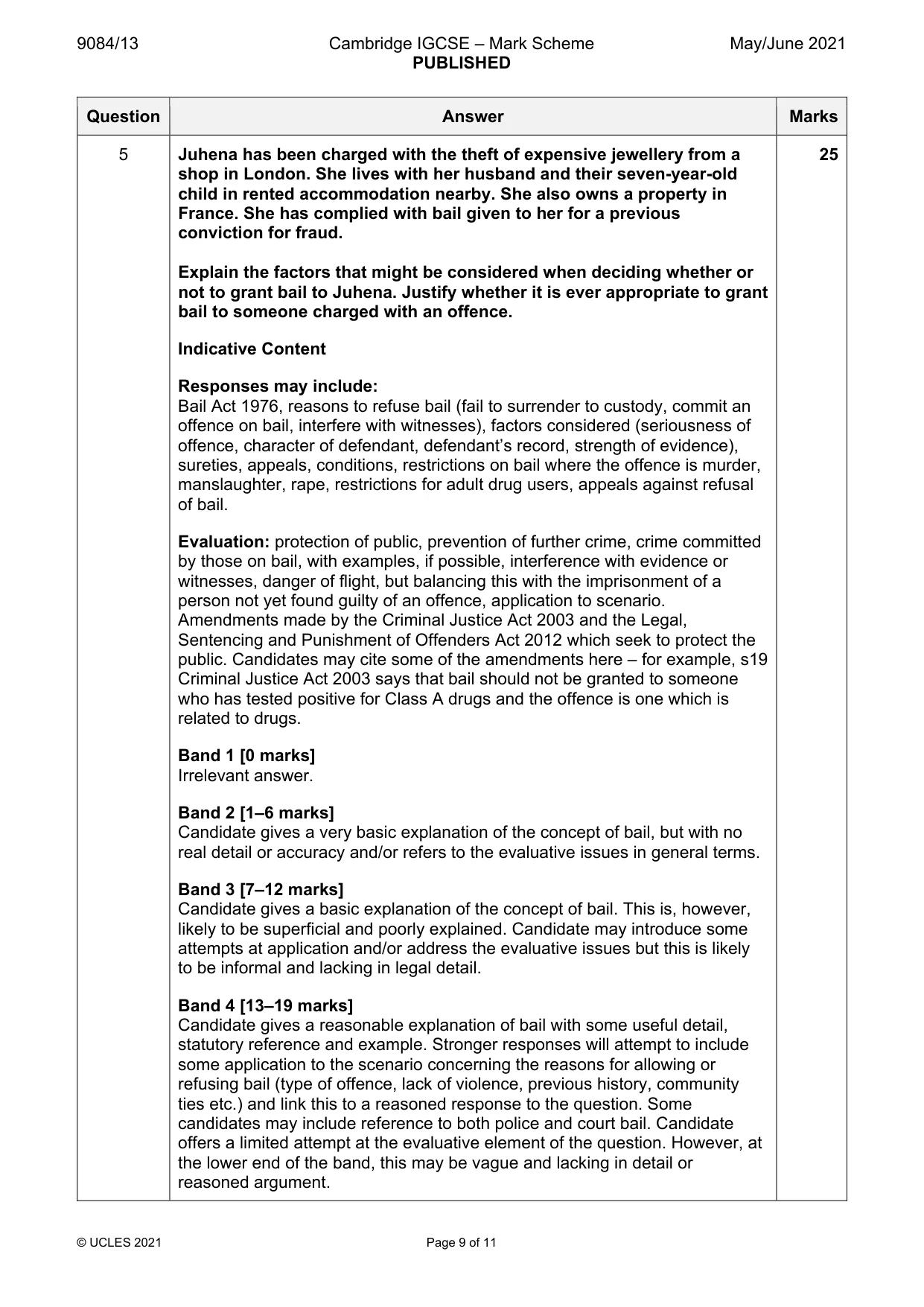
9084/13 Cambridge IGCSE – Mark Scheme PUBLISHED May/June 2021 © UCLES 2021 Page 9 of 11 Question Answer Marks 5 Juhena has been charged with the theft of expensive jewellery from a shop in London. She lives with her husband and their seven-year-old child in rented accommodation nearby. She also owns a property in France. She has complied with bail given to her for a previous conviction for fraud. Explain the factors that might be considered when deciding whether or not to grant bail to Juhena. Justify whether it is ever appropriate to grant bail to someone charged with an offence. Indicative Content Responses may include: Bail Act 1976, reasons to refuse bail (fail to surrender to custody, commit an offence on bail, interfere with witnesses), factors considered (seriousness of offence, character of defendant, defendant’s record, strength of evidence), sureties, appeals, conditions, restrictions on bail where the offence is murder, manslaughter, rape, restrictions for adult drug users, appeals against refusal of bail. Evaluation: protection of public, prevention of further crime, crime committed by those on bail, with examples, if possible, interference with evidence or witnesses, danger of flight, but balancing this with the imprisonment of a person not yet found guilty of an offence, application to scenario. Amendments made by the Criminal Justice Act 2003 and the Legal, Sentencing and Punishment of Offenders Act 2012 which seek to protect the public. Candidates may cite some of the amendments here – for example, s19 Criminal Justice Act 2003 says that bail should not be granted to someone who has tested positive for Class A drugs and the offence is one which is related to drugs. Band 1 [0 marks] Irrelevant answer. Band 2 [1–6 marks] Candidate gives a very basic explanation of the concept of bail, but with no real detail or accuracy and/or refers to the evaluative issues in general terms. Band 3 [7–12 marks] Candidate gives a basic explanation of the concept of bail. This is, however, likely to be superficial and poorly explained. Candidate may introduce some attempts at application and/or address the evaluative issues but this is likely to be informal and lacking in legal detail. Band 4 [13–19 marks] Candidate gives a reasonable explanation of bail with some useful detail, statutory reference and example. Stronger responses will attempt to include some application to the scenario concerning the reasons for allowing or refusing bail (type of offence, lack of violence, previous history, community ties etc.) and link this to a reasoned response to the question. Some candidates may include reference to both police and court bail. Candidate offers a limited attempt at the evaluative element of the question. However, at the lower end of the band, this may be vague and lacking in detail or reasoned argument. 25
Mark scheme, page 10
9084/13 Cambridge IGCSE – Mark Scheme PUBLISHED May/June 2021 © UCLES 2021 Page 10 of 11 Question Answer Marks 5 Band 5 [20–25 marks] Candidate gives a clear and very detailed explanation of bail, (as in Band 4) with good levels of illustration (including references to statutes and perhaps high-profile cases of reoffending on bail) and explanation. Stronger responses will address the application and evaluation issues and draw reasoned and logical conclusions.
Mark scheme, page 11
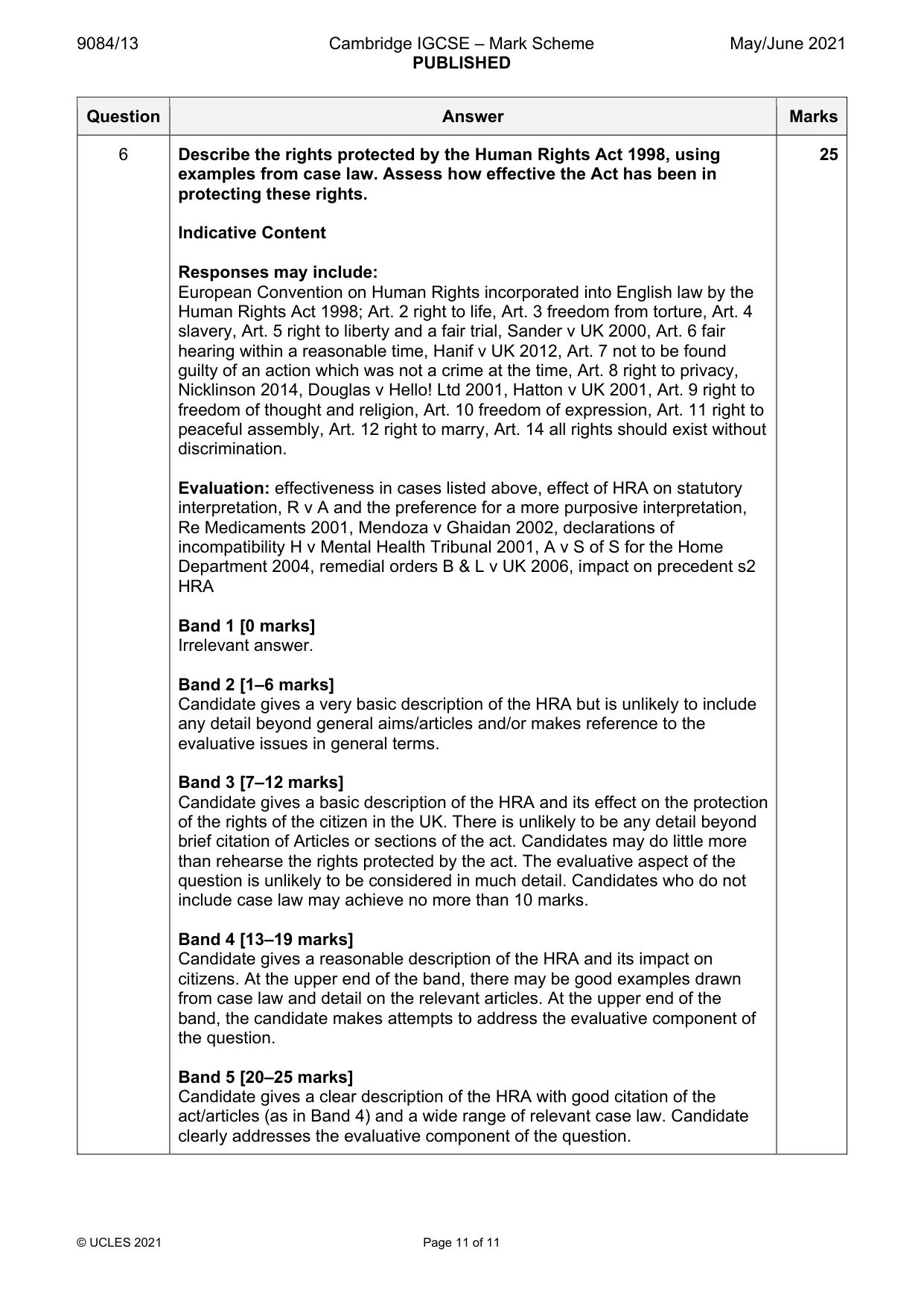
9084/13 Cambridge IGCSE – Mark Scheme PUBLISHED May/June 2021 © UCLES 2021 Page 11 of 11 Question Answer Marks 6 Describe the rights protected by the Human Rights Act 1998, using examples from case law. Assess how effective the Act has been in protecting these rights. Indicative Content Responses may include: European Convention on Human Rights incorporated into English law by the Human Rights Act 1998; Art. 2 right to life, Art. 3 freedom from torture, Art. 4 slavery, Art. 5 right to liberty and a fair trial, Sander v UK 2000, Art. 6 fair hearing within a reasonable time, Hanif v UK 2012, Art. 7 not to be found guilty of an action which was not a crime at the time, Art. 8 right to privacy, Nicklinson 2014, Douglas v Hello! Ltd 2001, Hatton v UK 2001, Art. 9 right to freedom of thought and religion, Art. 10 freedom of expression, Art. 11 right to peaceful assembly, Art. 12 right to marry, Art. 14 all rights should exist without discrimination. Evaluation: effectiveness in cases listed above, effect of HRA on statutory interpretation, R v A and the preference for a more purposive interpretation, Re Medicaments 2001, Mendoza v Ghaidan 2002, declarations of incompatibility H v Mental Health Tribunal 2001, A v S of S for the Home Department 2004, remedial orders B & L v UK 2006, impact on precedent s2 HRA Band 1 [0 marks] Irrelevant answer. Band 2 [1–6 marks] Candidate gives a very basic description of the HRA but is unlikely to include any detail beyond general aims/articles and/or makes reference to the evaluative issues in general terms. Band 3 [7–12 marks] Candidate gives a basic description of the HRA and its effect on the protection of the rights of the citizen in the UK. There is unlikely to be any detail beyond brief citation of Articles or sections of the act. Candidates may do little more than rehearse the rights protected by the act. The evaluative aspect of the question is unlikely to be considered in much detail. Candidates who do not include case law may achieve no more than 10 marks. Band 4 [13–19 marks] Candidate gives a reasonable description of the HRA and its impact on citizens. At the upper end of the band, there may be good examples drawn from case law and detail on the relevant articles. At the upper end of the band, the candidate makes attempts to address the evaluative component of the question. Band 5 [20–25 marks] Candidate gives a clear description of the HRA with good citation of the act/articles (as in Band 4) and a wide range of relevant case law. Candidate clearly addresses the evaluative component of the question. 25
What you needed in this session
Cambridge’s own grade thresholds for 2021 May/June, Paper 1 · Variant 3. A higher threshold means an easier paper — the bar moves with how the cohort did.