Cambridge A Level Law 9084 — 2017 May/June Paper 3 · Variant 2
9084/32/M/J/17
The question paper and its mark scheme, free to read here and free to download. This is Cambridge’s own paper, exactly as it was sat.
Question paper4 pages

Mark scheme9 pages
Answers below. Sit the paper first if you are practising.
Paper as text
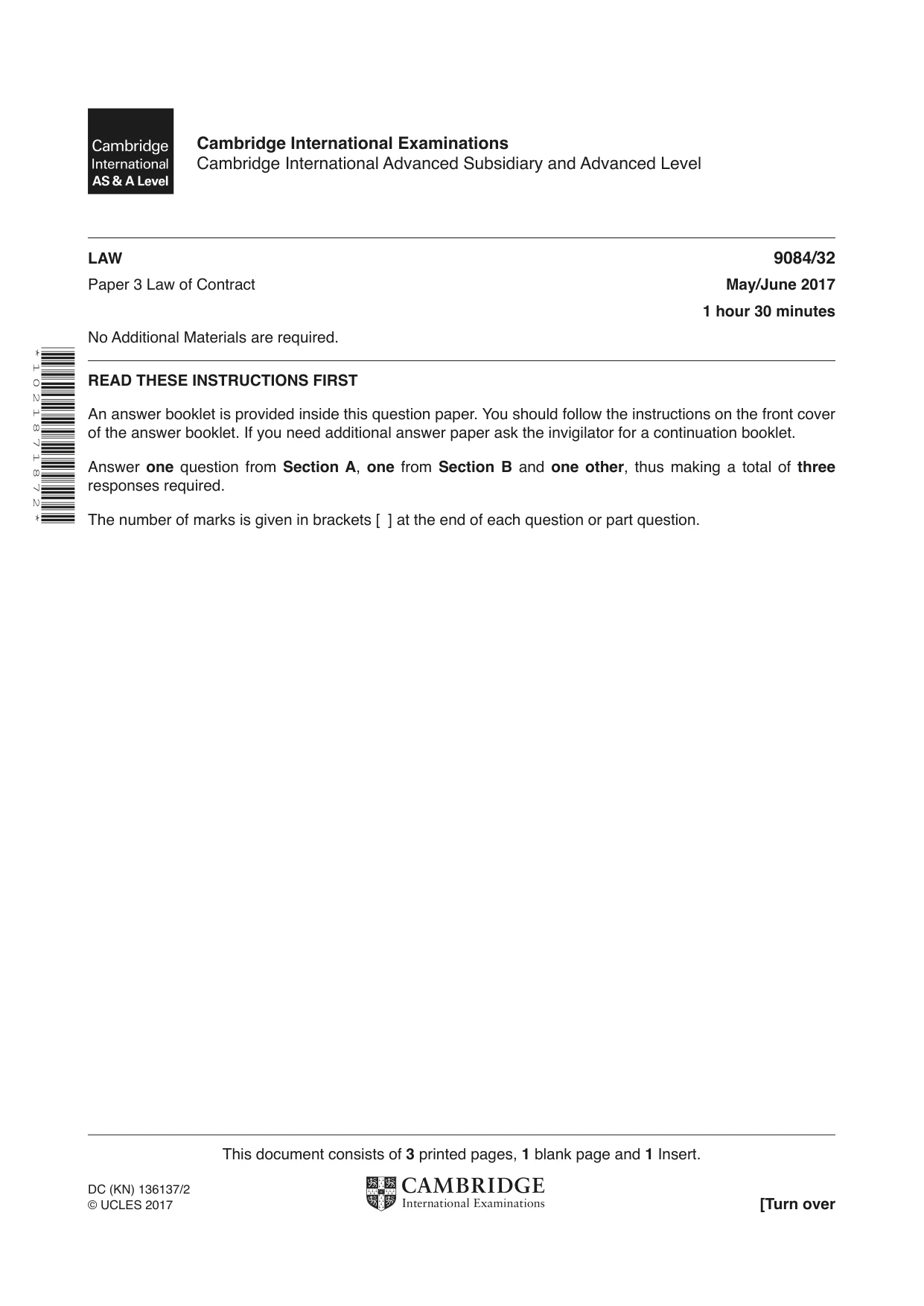
Question paper, page 1
* 1 0 2 1 8 7 1 8 7 2 * This document consists of 3 printed pages, 1 blank page and 1 Insert. DC (KN) 136137/2 © UCLES 2017 [Turn over Cambridge International Examinations Cambridge International Advanced Subsidiary and Advanced Level LAW 9084/32 Paper 3 Law of Contract May/June 2017 1 hour 30 minutes No Additional Materials are required. READ THESE INSTRUCTIONS FIRST An answer booklet is provided inside this question paper. You should follow the instructions on the front cover of the answer booklet. If you need additional answer paper ask the invigilator for a continuation booklet. Answer one question from Section A, one from Section B and one other, thus making a total of three responses required. The number of marks is given in brackets [ ] at the end of each question or part question.
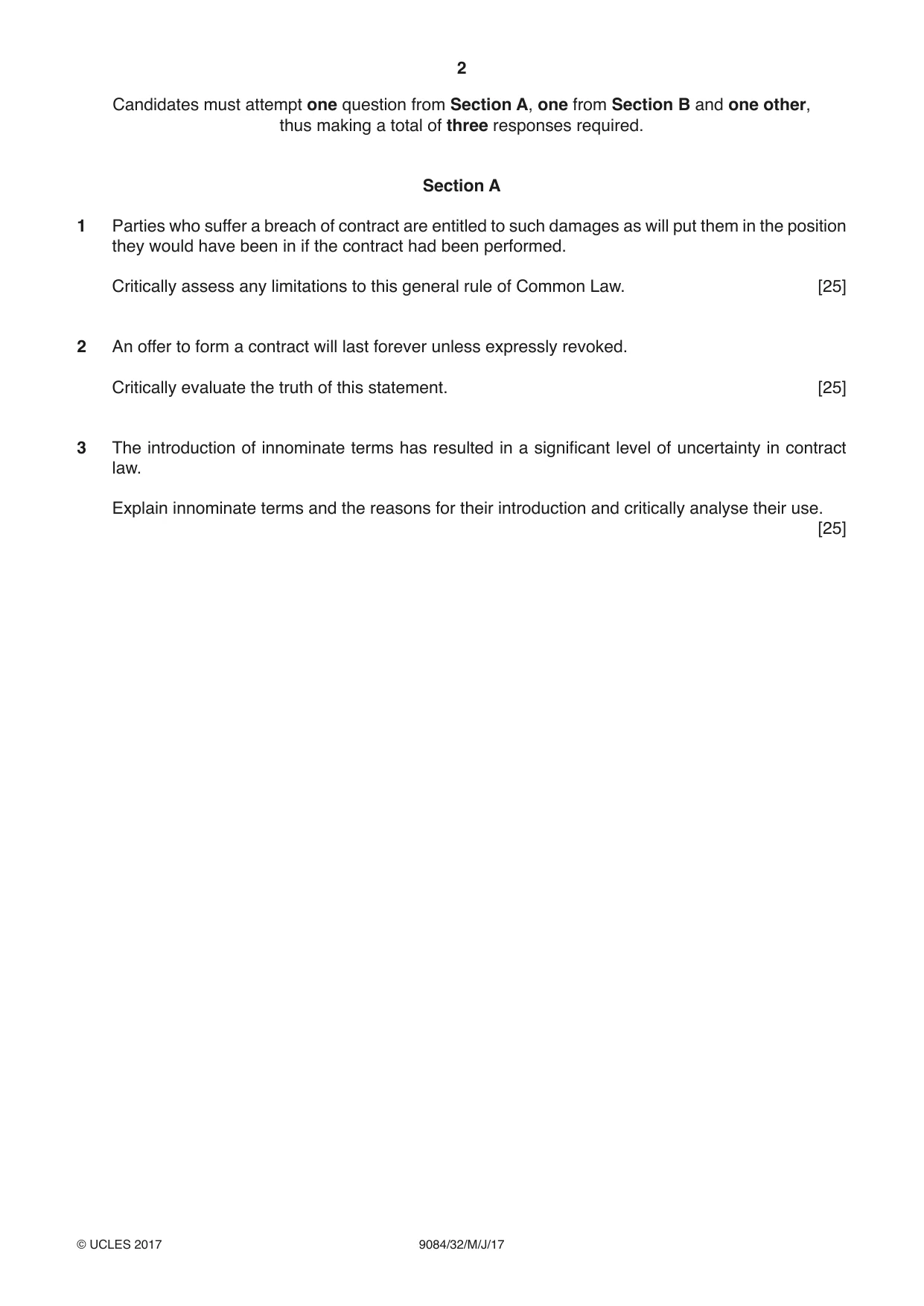
Question paper, page 2
2 9084/32/M/J/17 © UCLES 2017 Candidates must attempt one question from Section A, one from Section B and one other, thus making a total of three responses required. Section A 1 Parties who suffer a breach of contract are entitled to such damages as will put them in the position they would have been in if the contract had been performed. Critically assess any limitations to this general rule of Common Law. [25] 2 An offer to form a contract will last forever unless expressly revoked. Critically evaluate the truth of this statement. [25] 3 The introduction of innominate terms has resulted in a significant level of uncertainty in contract law. Explain innominate terms and the reasons for their introduction and critically analyse their use. [25]
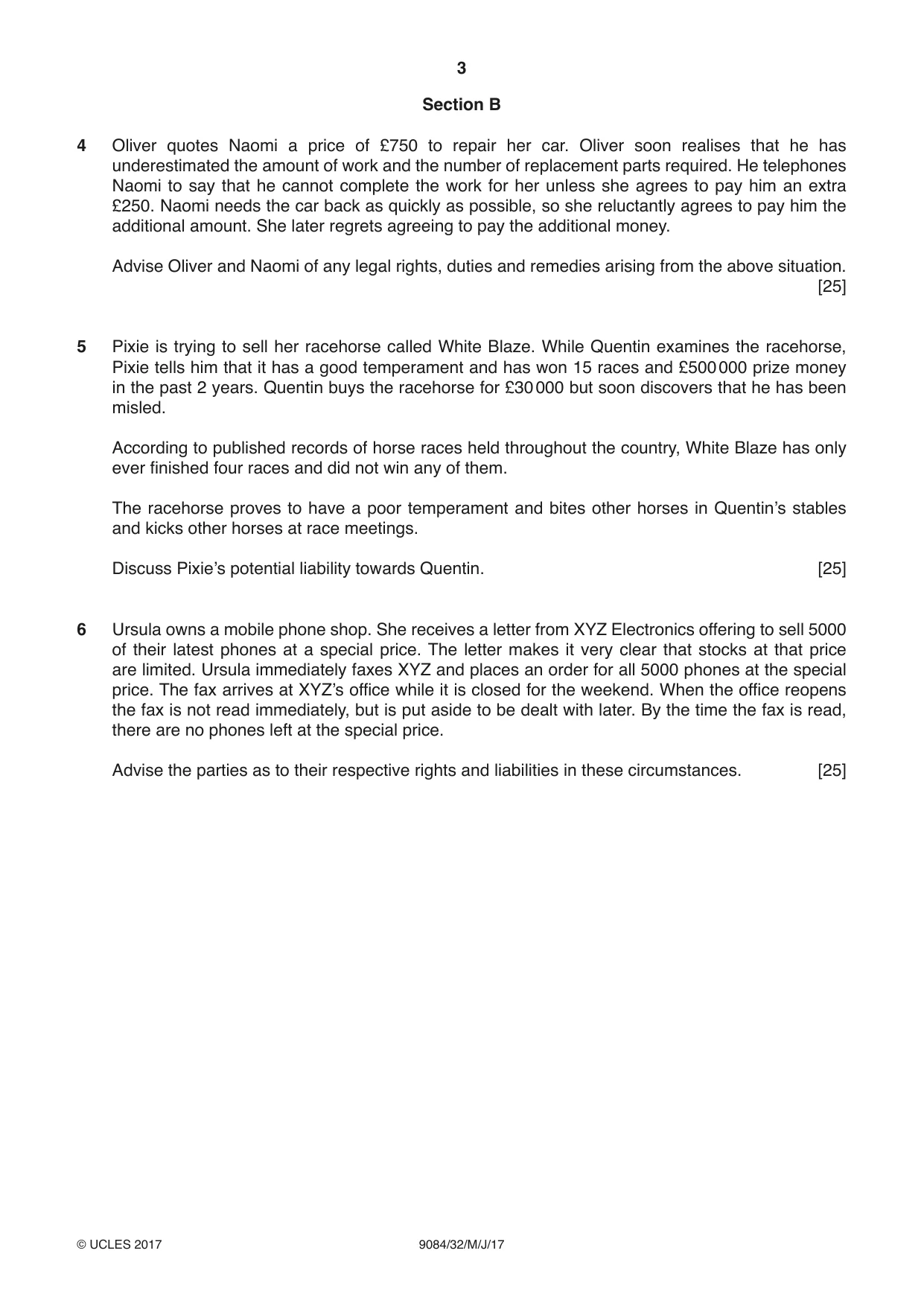
Question paper, page 3
3 9084/32/M/J/17 © UCLES 2017 Section B 4 Oliver quotes Naomi a price of £750 to repair her car. Oliver soon realises that he has underestimated the amount of work and the number of replacement parts required. He telephones Naomi to say that he cannot complete the work for her unless she agrees to pay him an extra £250. Naomi needs the car back as quickly as possible, so she reluctantly agrees to pay him the additional amount. She later regrets agreeing to pay the additional money. Advise Oliver and Naomi of any legal rights, duties and remedies arising from the above situation. [25] 5 Pixie is trying to sell her racehorse called White Blaze. While Quentin examines the racehorse, Pixie tells him that it has a good temperament and has won 15 races and £500 000 prize money in the past 2 years. Quentin buys the racehorse for £30 000 but soon discovers that he has been misled. According to published records of horse races held throughout the country, White Blaze has only ever finished four races and did not win any of them. The racehorse proves to have a poor temperament and bites other horses in Quentin’s stables and kicks other horses at race meetings. Discuss Pixie’s potential liability towards Quentin. [25] 6 Ursula owns a mobile phone shop. She receives a letter from XYZ Electronics offering to sell 5000 of their latest phones at a special price. The letter makes it very clear that stocks at that price are limited. Ursula immediately faxes XYZ and places an order for all 5000 phones at the special price. The fax arrives at XYZ’s office while it is closed for the weekend. When the office reopens the fax is not read immediately, but is put aside to be dealt with later. By the time the fax is read, there are no phones left at the special price. Advise the parties as to their respective rights and liabilities in these circumstances. [25]
Question paper, page 4
4 9084/32/M/J/17 © UCLES 2017 BLANK PAGE Permission to reproduce items where third-party owned material protected by copyright is included has been sought and cleared where possible. Every reasonable effort has been made by the publisher (UCLES) to trace copyright holders, but if any items requiring clearance have unwittingly been included, the publisher will be pleased to make amends at the earliest possible opportunity. To avoid the issue of disclosure of answer-related information to candidates, all copyright acknowledgements are reproduced online in the Cambridge International Examinations Copyright Acknowledgements Booklet. This is produced for each series of examinations and is freely available to download at www.cie.org.uk after the live examination series. Cambridge International Examinations is part of the Cambridge Assessment Group. Cambridge Assessment is the brand name of University of Cambridge Local Examinations Syndicate (UCLES), which is itself a department of the University of Cambridge.
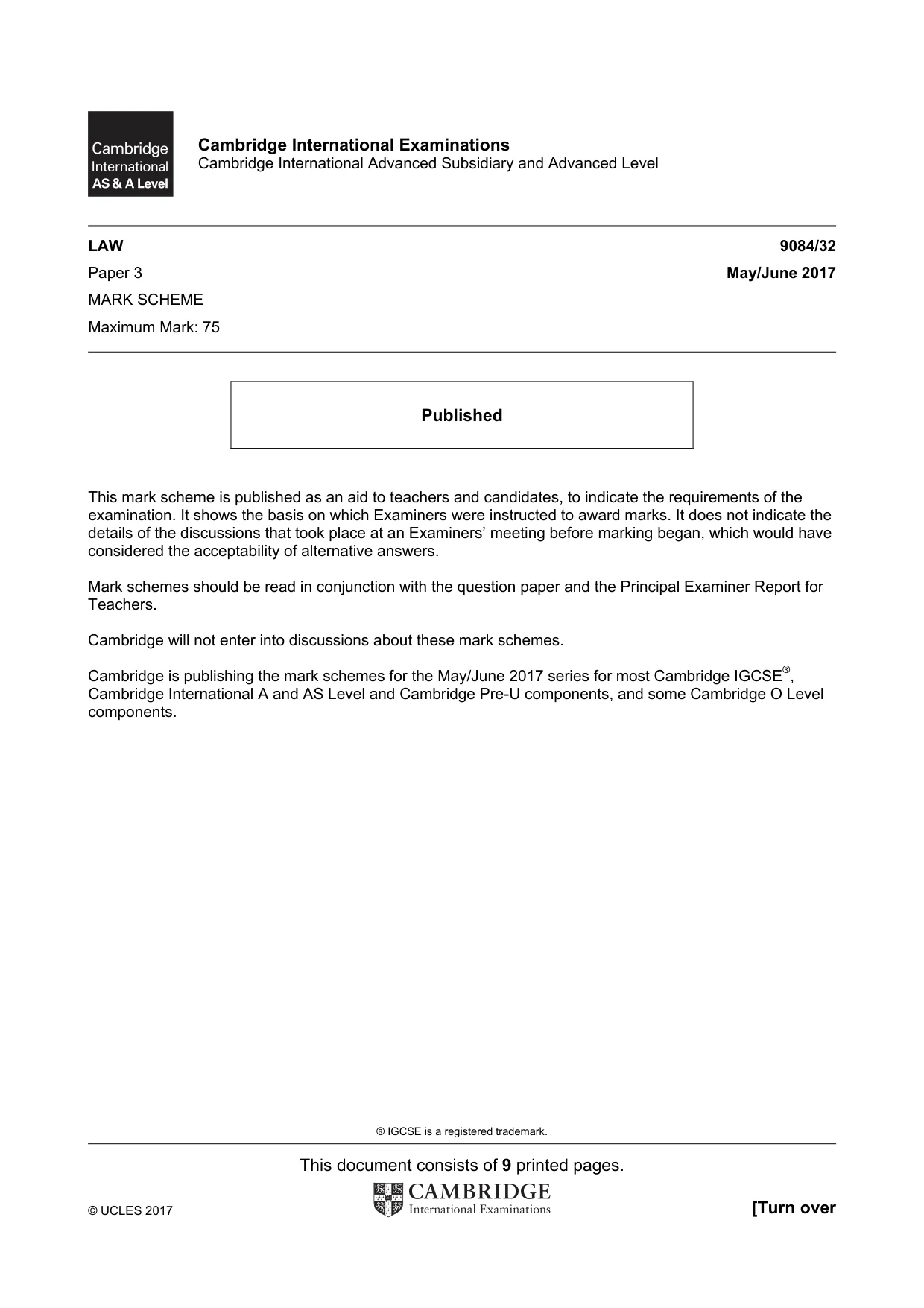
Mark scheme, page 1
® IGCSE is a registered trademark. This document consists of 9 printed pages. © UCLES 2017 [Turn over Cambridge International Examinations Cambridge International Advanced Subsidiary and Advanced Level LAW 9084/32 Paper 3 May/June 2017 MARK SCHEME Maximum Mark: 75 Published This mark scheme is published as an aid to teachers and candidates, to indicate the requirements of the examination. It shows the basis on which Examiners were instructed to award marks. It does not indicate the details of the discussions that took place at an Examiners’ meeting before marking began, which would have considered the acceptability of alternative answers. Mark schemes should be read in conjunction with the question paper and the Principal Examiner Report for Teachers. Cambridge will not enter into discussions about these mark schemes. Cambridge is publishing the mark schemes for the May/June 2017 series for most Cambridge IGCSE®, Cambridge International A and AS Level and Cambridge Pre-U components, and some Cambridge O Level components.
Mark scheme, page 2
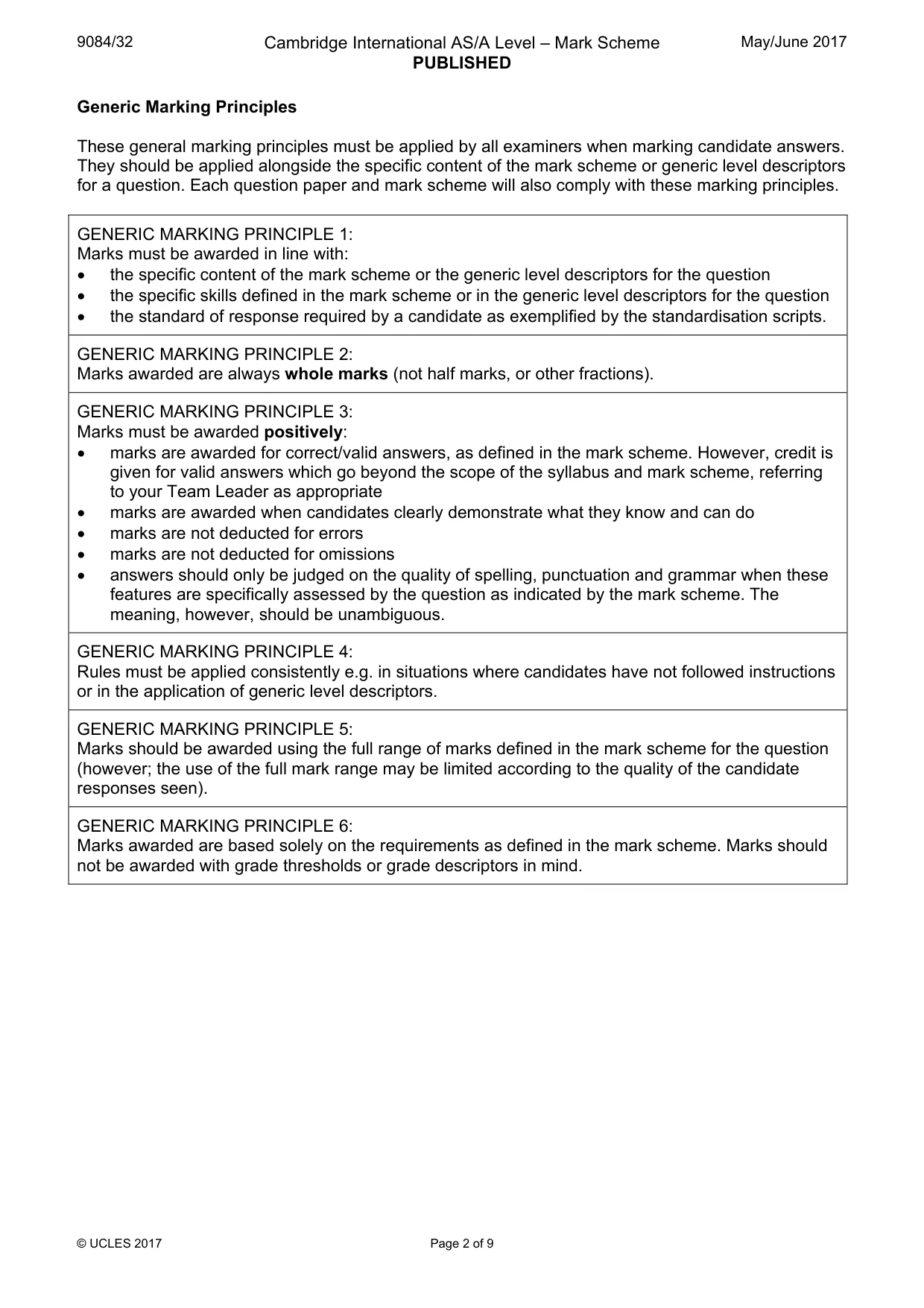
9084/32 Cambridge International AS/A Level – Mark Scheme PUBLISHED May/June 2017 © UCLES 2017 Page 2 of 9 Generic Marking Principles These general marking principles must be applied by all examiners when marking candidate answers. They should be applied alongside the specific content of the mark scheme or generic level descriptors for a question. Each question paper and mark scheme will also comply with these marking principles. GENERIC MARKING PRINCIPLE 1: Marks must be awarded in line with: • the specific content of the mark scheme or the generic level descriptors for the question • the specific skills defined in the mark scheme or in the generic level descriptors for the question • the standard of response required by a candidate as exemplified by the standardisation scripts. GENERIC MARKING PRINCIPLE 2: Marks awarded are always whole marks (not half marks, or other fractions). GENERIC MARKING PRINCIPLE 3: Marks must be awarded positively: • marks are awarded for correct/valid answers, as defined in the mark scheme. However, credit is given for valid answers which go beyond the scope of the syllabus and mark scheme, referring to your Team Leader as appropriate • marks are awarded when candidates clearly demonstrate what they know and can do • marks are not deducted for errors • marks are not deducted for omissions • answers should only be judged on the quality of spelling, punctuation and grammar when these features are specifically assessed by the question as indicated by the mark scheme. The meaning, however, should be unambiguous. GENERIC MARKING PRINCIPLE 4: Rules must be applied consistently e.g. in situations where candidates have not followed instructions or in the application of generic level descriptors. GENERIC MARKING PRINCIPLE 5: Marks should be awarded using the full range of marks defined in the mark scheme for the question (however; the use of the full mark range may be limited according to the quality of the candidate responses seen). GENERIC MARKING PRINCIPLE 6: Marks awarded are based solely on the requirements as defined in the mark scheme. Marks should not be awarded with grade thresholds or grade descriptors in mind.
Mark scheme, page 3
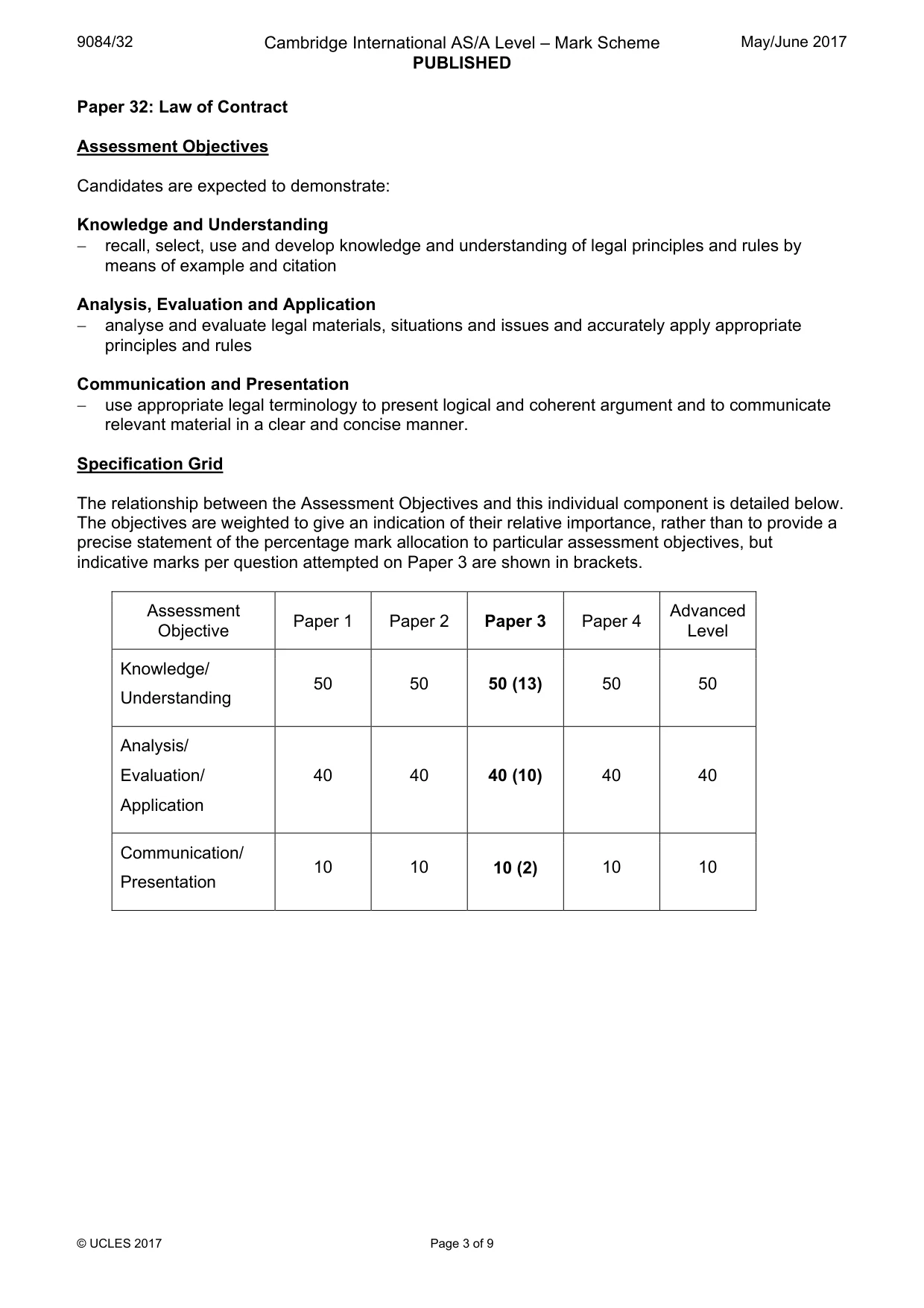
9084/32 Cambridge International AS/A Level – Mark Scheme PUBLISHED May/June 2017 © UCLES 2017 Page 3 of 9 Paper 32: Law of Contract Assessment Objectives Candidates are expected to demonstrate: Knowledge and Understanding − recall, select, use and develop knowledge and understanding of legal principles and rules by means of example and citation Analysis, Evaluation and Application − analyse and evaluate legal materials, situations and issues and accurately apply appropriate principles and rules Communication and Presentation − use appropriate legal terminology to present logical and coherent argument and to communicate relevant material in a clear and concise manner. Specification Grid The relationship between the Assessment Objectives and this individual component is detailed below. The objectives are weighted to give an indication of their relative importance, rather than to provide a precise statement of the percentage mark allocation to particular assessment objectives, but indicative marks per question attempted on Paper 3 are shown in brackets. Assessment Objective Paper 1 Paper 2 Paper 3 Paper 4 Advanced Level Knowledge/ Understanding 50 50 50 (13) 50 50 Analysis/ Evaluation/ Application 40 40 40 (10) 40 40 Communication/ Presentation 10 10 10 (2) 10 10
Mark scheme, page 4
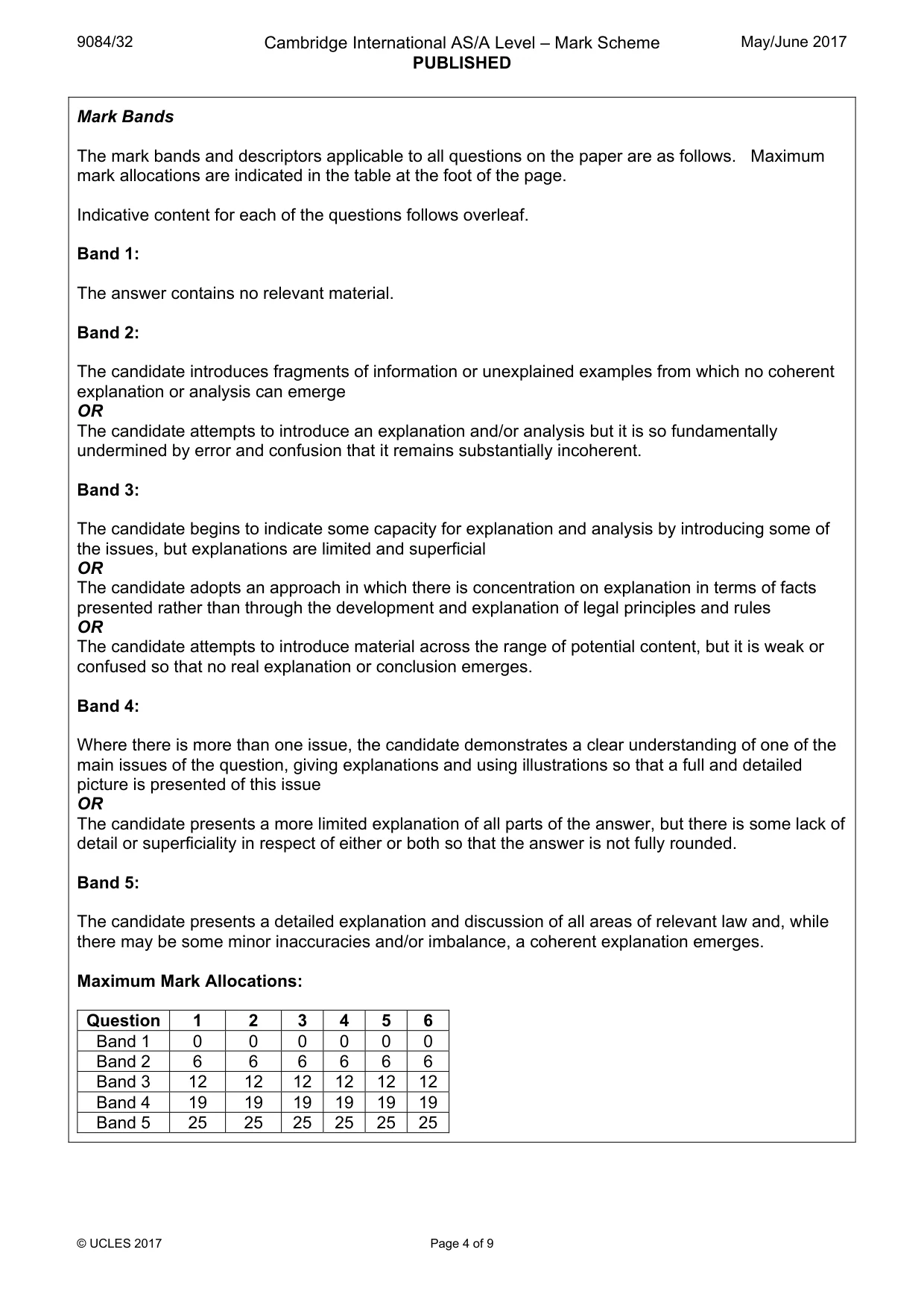
9084/32 Cambridge International AS/A Level – Mark Scheme PUBLISHED May/June 2017 © UCLES 2017 Page 4 of 9 Mark Bands The mark bands and descriptors applicable to all questions on the paper are as follows. Maximum mark allocations are indicated in the table at the foot of the page. Indicative content for each of the questions follows overleaf. Band 1: The answer contains no relevant material. Band 2: The candidate introduces fragments of information or unexplained examples from which no coherent explanation or analysis can emerge OR The candidate attempts to introduce an explanation and/or analysis but it is so fundamentally undermined by error and confusion that it remains substantially incoherent. Band 3: The candidate begins to indicate some capacity for explanation and analysis by introducing some of the issues, but explanations are limited and superficial OR The candidate adopts an approach in which there is concentration on explanation in terms of facts presented rather than through the development and explanation of legal principles and rules OR The candidate attempts to introduce material across the range of potential content, but it is weak or confused so that no real explanation or conclusion emerges. Band 4: Where there is more than one issue, the candidate demonstrates a clear understanding of one of the main issues of the question, giving explanations and using illustrations so that a full and detailed picture is presented of this issue OR The candidate presents a more limited explanation of all parts of the answer, but there is some lack of detail or superficiality in respect of either or both so that the answer is not fully rounded. Band 5: The candidate presents a detailed explanation and discussion of all areas of relevant law and, while there may be some minor inaccuracies and/or imbalance, a coherent explanation emerges. Maximum Mark Allocations: Question 1 2 3 4 5 6 Band 1 0 0 0 0 0 0 Band 2 6 6 6 6 6 6 Band 3 12 12 12 12 12 12 Band 4 19 19 19 19 19 19 Band 5 25 25 25 25 25 25
Mark scheme, page 5
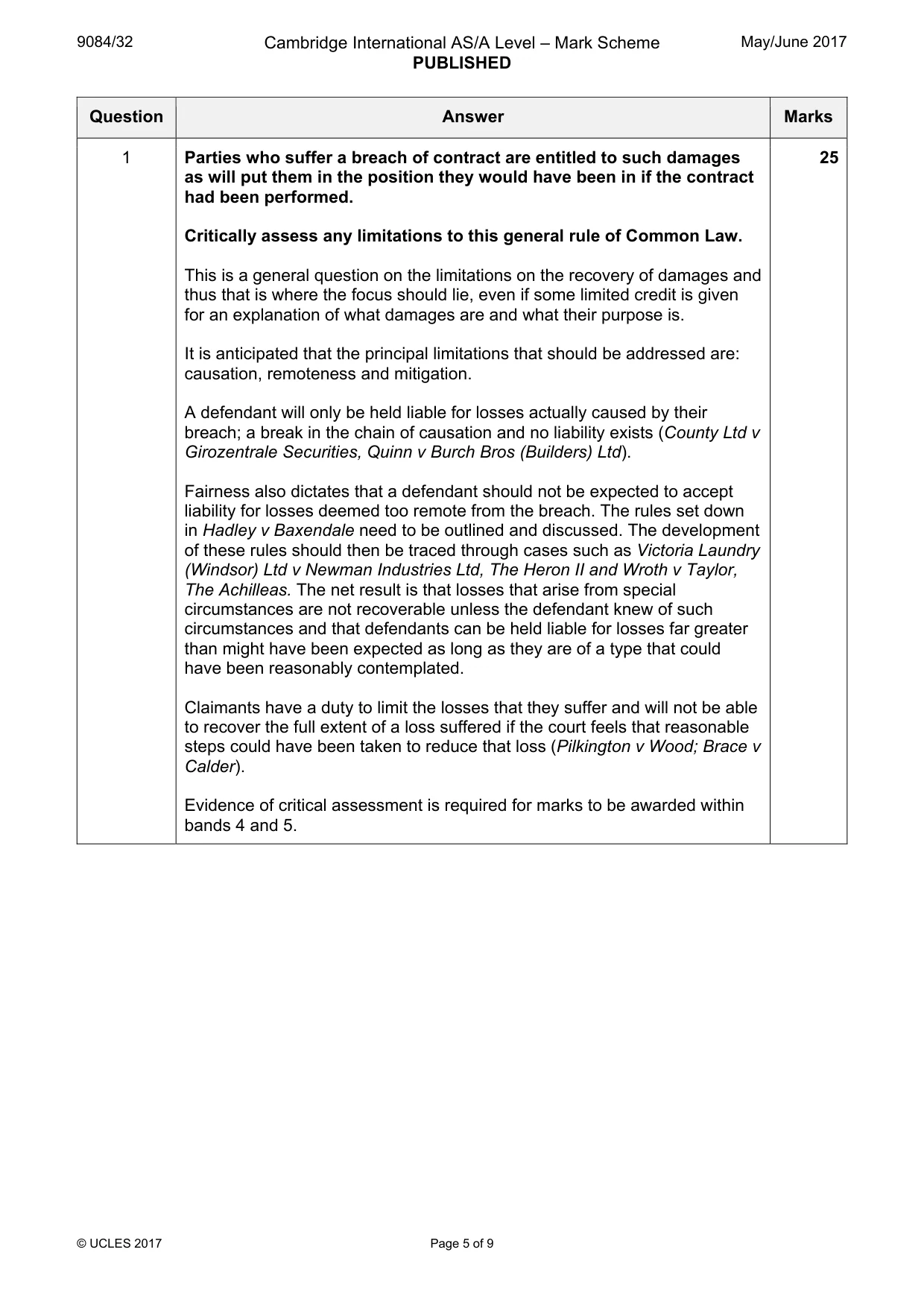
9084/32 Cambridge International AS/A Level – Mark Scheme PUBLISHED May/June 2017 © UCLES 2017 Page 5 of 9 Question Answer Marks 1 Parties who suffer a breach of contract are entitled to such damages as will put them in the position they would have been in if the contract had been performed. Critically assess any limitations to this general rule of Common Law. This is a general question on the limitations on the recovery of damages and thus that is where the focus should lie, even if some limited credit is given for an explanation of what damages are and what their purpose is. It is anticipated that the principal limitations that should be addressed are: causation, remoteness and mitigation. A defendant will only be held liable for losses actually caused by their breach; a break in the chain of causation and no liability exists (County Ltd v Girozentrale Securities, Quinn v Burch Bros (Builders) Ltd). Fairness also dictates that a defendant should not be expected to accept liability for losses deemed too remote from the breach. The rules set down in Hadley v Baxendale need to be outlined and discussed. The development of these rules should then be traced through cases such as Victoria Laundry (Windsor) Ltd v Newman Industries Ltd, The Heron II and Wroth v Taylor, The Achilleas. The net result is that losses that arise from special circumstances are not recoverable unless the defendant knew of such circumstances and that defendants can be held liable for losses far greater than might have been expected as long as they are of a type that could have been reasonably contemplated. Claimants have a duty to limit the losses that they suffer and will not be able to recover the full extent of a loss suffered if the court feels that reasonable steps could have been taken to reduce that loss (Pilkington v Wood; Brace v Calder). Evidence of critical assessment is required for marks to be awarded within bands 4 and 5. 25
Mark scheme, page 6
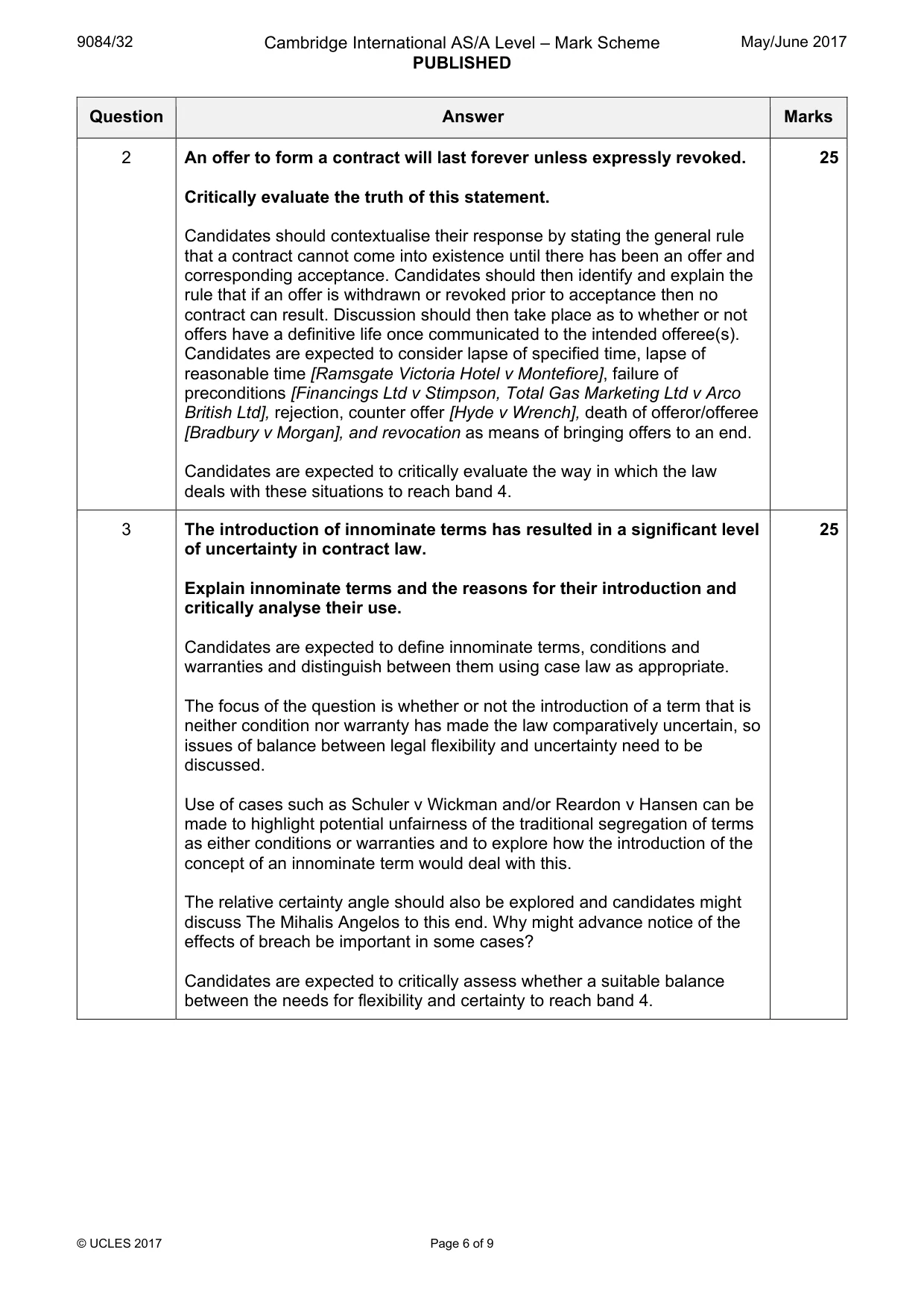
9084/32 Cambridge International AS/A Level – Mark Scheme PUBLISHED May/June 2017 © UCLES 2017 Page 6 of 9 Question Answer Marks 2 An offer to form a contract will last forever unless expressly revoked. Critically evaluate the truth of this statement. Candidates should contextualise their response by stating the general rule that a contract cannot come into existence until there has been an offer and corresponding acceptance. Candidates should then identify and explain the rule that if an offer is withdrawn or revoked prior to acceptance then no contract can result. Discussion should then take place as to whether or not offers have a definitive life once communicated to the intended offeree(s). Candidates are expected to consider lapse of specified time, lapse of reasonable time [Ramsgate Victoria Hotel v Montefiore], failure of preconditions [Financings Ltd v Stimpson, Total Gas Marketing Ltd v Arco British Ltd], rejection, counter offer [Hyde v Wrench], death of offeror/offeree [Bradbury v Morgan], and revocation as means of bringing offers to an end. Candidates are expected to critically evaluate the way in which the law deals with these situations to reach band 4. 25 3 The introduction of innominate terms has resulted in a significant level of uncertainty in contract law. Explain innominate terms and the reasons for their introduction and critically analyse their use. Candidates are expected to define innominate terms, conditions and warranties and distinguish between them using case law as appropriate. The focus of the question is whether or not the introduction of a term that is neither condition nor warranty has made the law comparatively uncertain, so issues of balance between legal flexibility and uncertainty need to be discussed. Use of cases such as Schuler v Wickman and/or Reardon v Hansen can be made to highlight potential unfairness of the traditional segregation of terms as either conditions or warranties and to explore how the introduction of the concept of an innominate term would deal with this. The relative certainty angle should also be explored and candidates might discuss The Mihalis Angelos to this end. Why might advance notice of the effects of breach be important in some cases? Candidates are expected to critically assess whether a suitable balance between the needs for flexibility and certainty to reach band 4. 25
Mark scheme, page 7
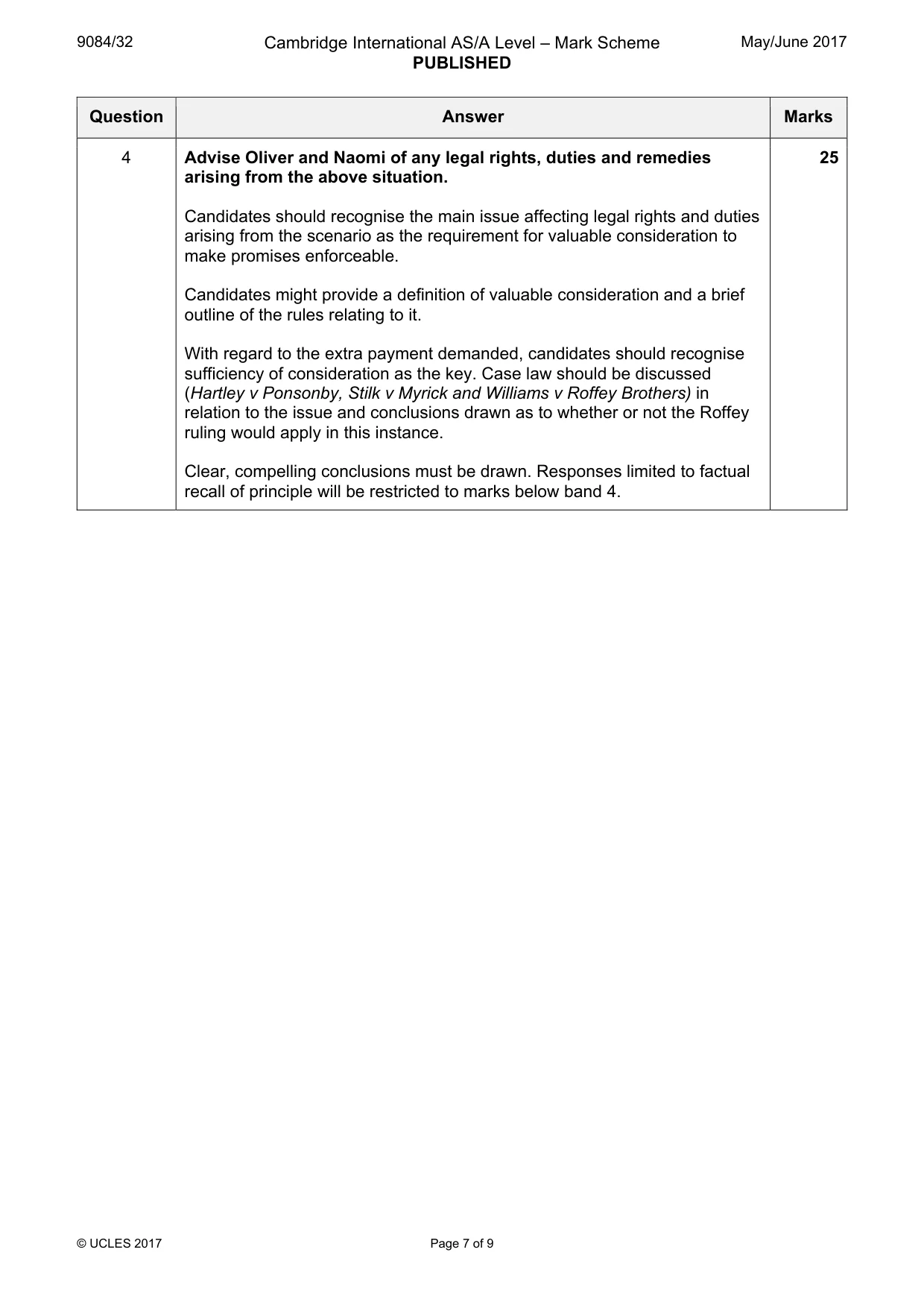
9084/32 Cambridge International AS/A Level – Mark Scheme PUBLISHED May/June 2017 © UCLES 2017 Page 7 of 9 Question Answer Marks 4 Advise Oliver and Naomi of any legal rights, duties and remedies arising from the above situation. Candidates should recognise the main issue affecting legal rights and duties arising from the scenario as the requirement for valuable consideration to make promises enforceable. Candidates might provide a definition of valuable consideration and a brief outline of the rules relating to it. With regard to the extra payment demanded, candidates should recognise sufficiency of consideration as the key. Case law should be discussed (Hartley v Ponsonby, Stilk v Myrick and Williams v Roffey Brothers) in relation to the issue and conclusions drawn as to whether or not the Roffey ruling would apply in this instance. Clear, compelling conclusions must be drawn. Responses limited to factual recall of principle will be restricted to marks below band 4. 25
Mark scheme, page 8
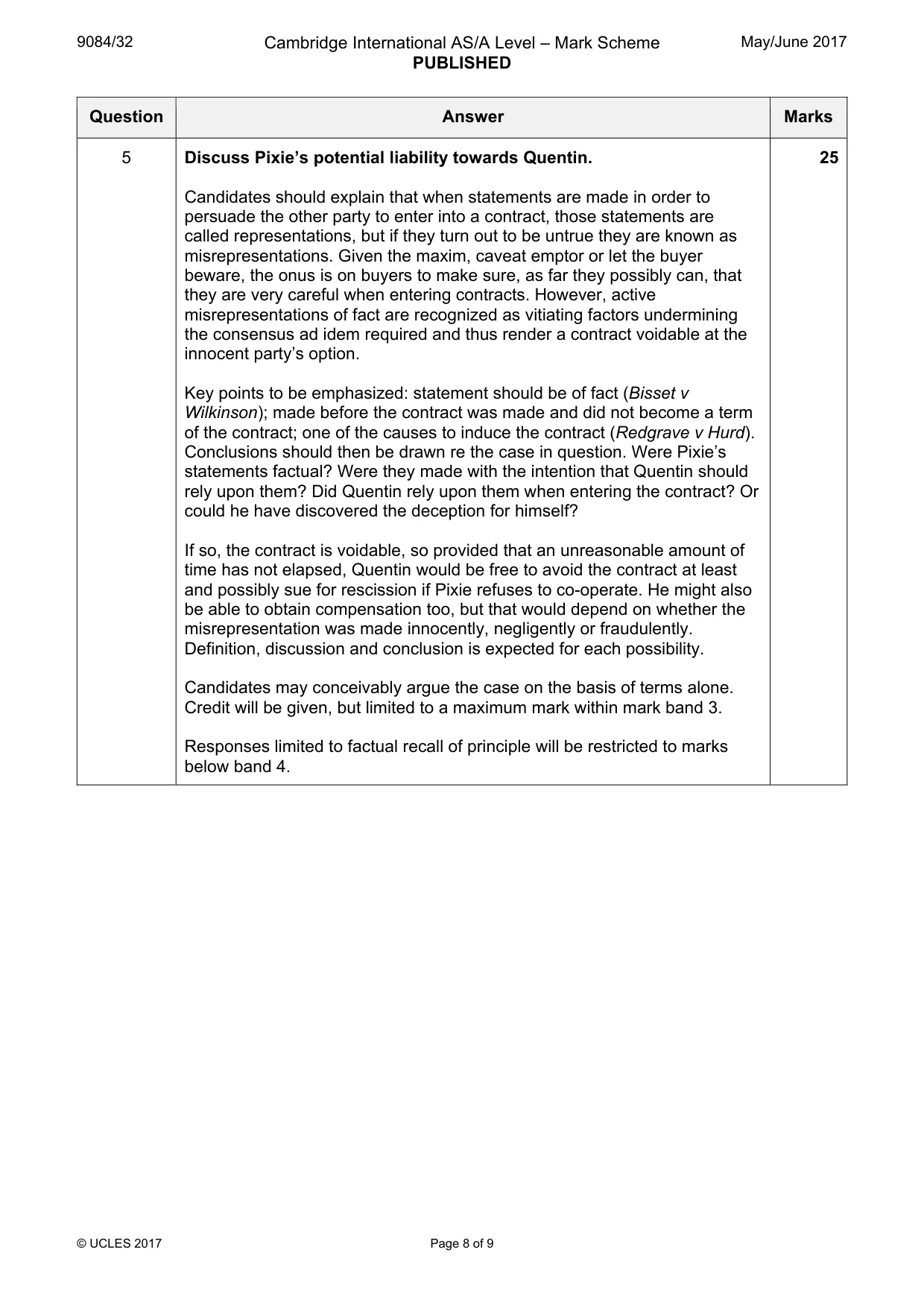
9084/32 Cambridge International AS/A Level – Mark Scheme PUBLISHED May/June 2017 © UCLES 2017 Page 8 of 9 Question Answer Marks 5 Discuss Pixie’s potential liability towards Quentin. Candidates should explain that when statements are made in order to persuade the other party to enter into a contract, those statements are called representations, but if they turn out to be untrue they are known as misrepresentations. Given the maxim, caveat emptor or let the buyer beware, the onus is on buyers to make sure, as far they possibly can, that they are very careful when entering contracts. However, active misrepresentations of fact are recognized as vitiating factors undermining the consensus ad idem required and thus render a contract voidable at the innocent party’s option. Key points to be emphasized: statement should be of fact (Bisset v Wilkinson); made before the contract was made and did not become a term of the contract; one of the causes to induce the contract (Redgrave v Hurd). Conclusions should then be drawn re the case in question. Were Pixie’s statements factual? Were they made with the intention that Quentin should rely upon them? Did Quentin rely upon them when entering the contract? Or could he have discovered the deception for himself? If so, the contract is voidable, so provided that an unreasonable amount of time has not elapsed, Quentin would be free to avoid the contract at least and possibly sue for rescission if Pixie refuses to co-operate. He might also be able to obtain compensation too, but that would depend on whether the misrepresentation was made innocently, negligently or fraudulently. Definition, discussion and conclusion is expected for each possibility. Candidates may conceivably argue the case on the basis of terms alone. Credit will be given, but limited to a maximum mark within mark band 3. Responses limited to factual recall of principle will be restricted to marks below band 4. 25
Mark scheme, page 9
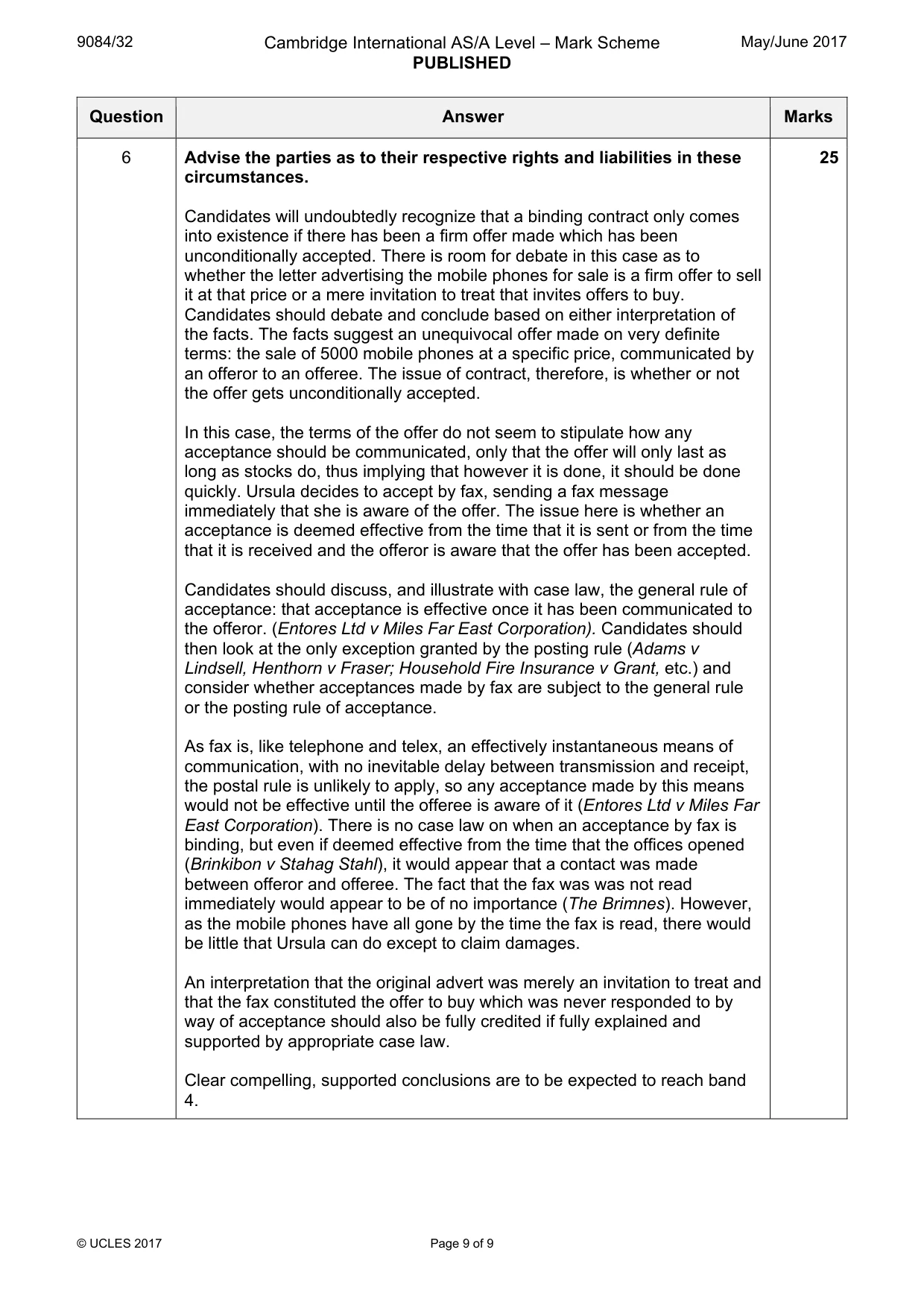
9084/32 Cambridge International AS/A Level – Mark Scheme PUBLISHED May/June 2017 © UCLES 2017 Page 9 of 9 Question Answer Marks 6 Advise the parties as to their respective rights and liabilities in these circumstances. Candidates will undoubtedly recognize that a binding contract only comes into existence if there has been a firm offer made which has been unconditionally accepted. There is room for debate in this case as to whether the letter advertising the mobile phones for sale is a firm offer to sell it at that price or a mere invitation to treat that invites offers to buy. Candidates should debate and conclude based on either interpretation of the facts. The facts suggest an unequivocal offer made on very definite terms: the sale of 5000 mobile phones at a specific price, communicated by an offeror to an offeree. The issue of contract, therefore, is whether or not the offer gets unconditionally accepted. In this case, the terms of the offer do not seem to stipulate how any acceptance should be communicated, only that the offer will only last as long as stocks do, thus implying that however it is done, it should be done quickly. Ursula decides to accept by fax, sending a fax message immediately that she is aware of the offer. The issue here is whether an acceptance is deemed effective from the time that it is sent or from the time that it is received and the offeror is aware that the offer has been accepted. Candidates should discuss, and illustrate with case law, the general rule of acceptance: that acceptance is effective once it has been communicated to the offeror. (Entores Ltd v Miles Far East Corporation). Candidates should then look at the only exception granted by the posting rule (Adams v Lindsell, Henthorn v Fraser; Household Fire Insurance v Grant, etc.) and consider whether acceptances made by fax are subject to the general rule or the posting rule of acceptance. As fax is, like telephone and telex, an effectively instantaneous means of communication, with no inevitable delay between transmission and receipt, the postal rule is unlikely to apply, so any acceptance made by this means would not be effective until the offeree is aware of it (Entores Ltd v Miles Far East Corporation). There is no case law on when an acceptance by fax is binding, but even if deemed effective from the time that the offices opened (Brinkibon v Stahag Stahl), it would appear that a contact was made between offeror and offeree. The fact that the fax was was not read immediately would appear to be of no importance (The Brimnes). However, as the mobile phones have all gone by the time the fax is read, there would be little that Ursula can do except to claim damages. An interpretation that the original advert was merely an invitation to treat and that the fax constituted the offer to buy which was never responded to by way of acceptance should also be fully credited if fully explained and supported by appropriate case law. Clear compelling, supported conclusions are to be expected to reach band 4. 25