Cambridge A Level Law 9084 — 2017 May/June Paper 3 · Variant 1
9084/31/M/J/17
The question paper and its mark scheme, free to read here and free to download. This is Cambridge’s own paper, exactly as it was sat.
Question paper4 pages

Mark scheme10 pages
Answers below. Sit the paper first if you are practising.
Paper as text
Question paper, page 1
* 1 1 3 3 0 8 8 5 6 0 * This document consists of 3 printed pages, 1 blank page and 1 Insert. DC (KN) 136136/1 © UCLES 2017 [Turn over LAW 9084/31 Paper 3 Law of Contract May/June 2017 1 hour 30 minutes No Additional Materials are required. READ THESE INSTRUCTIONS FIRST An answer booklet is provided inside this question paper. You should follow the instructions on the front cover of the answer booklet. If you need additional answer paper ask the invigilator for a continuation booklet. Answer one question from Section A, one from Section B and one other, thus making a total of three responses required. The number of marks is given in brackets [ ] at the end of each question or part question. Cambridge International Examinations Cambridge International Advanced Subsidiary and Advanced Level
Question paper, page 2
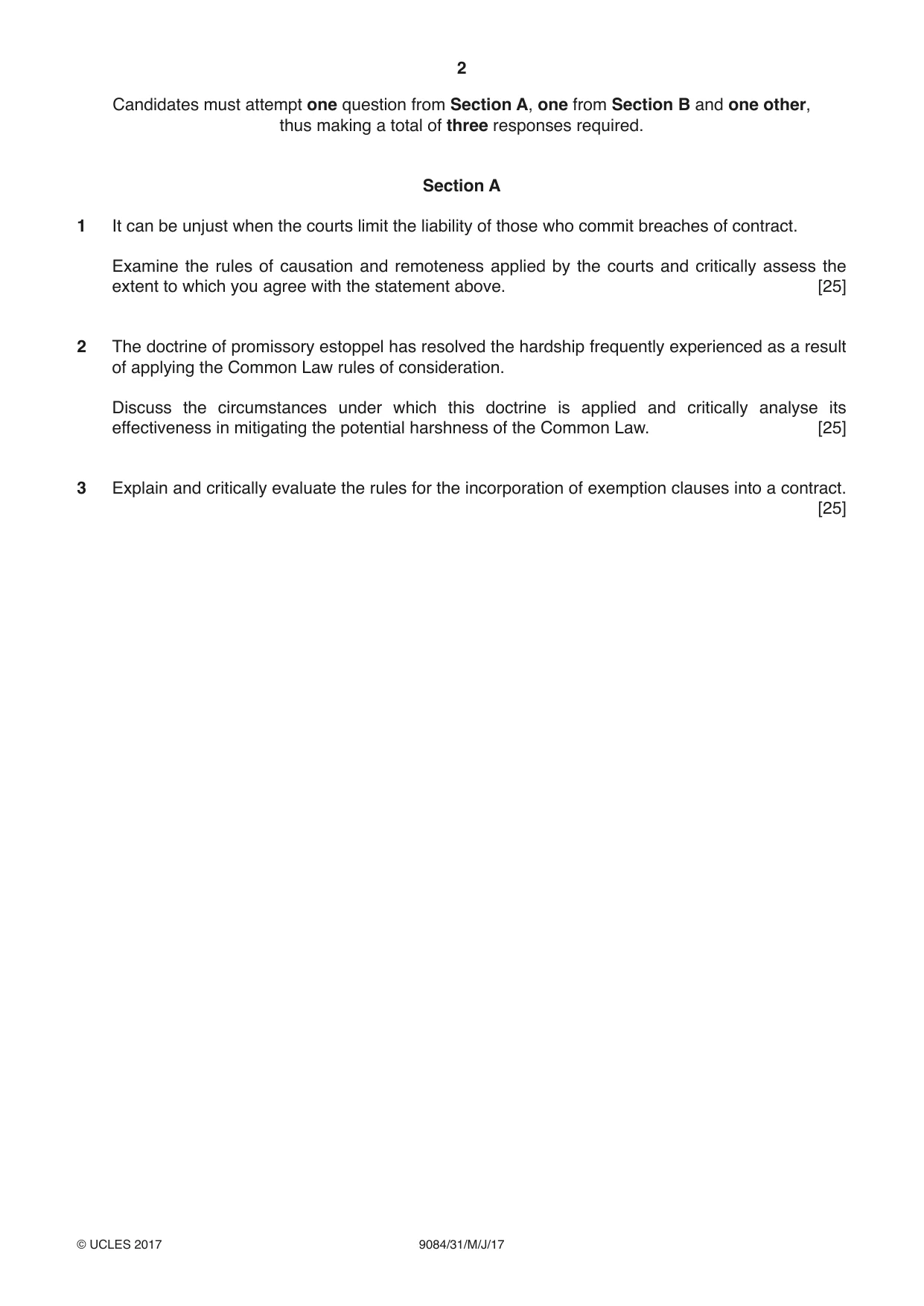
2 9084/31/M/J/17 © UCLES 2017 Candidates must attempt one question from Section A, one from Section B and one other, thus making a total of three responses required. Section A 1 It can be unjust when the courts limit the liability of those who commit breaches of contract. Examine the rules of causation and remoteness applied by the courts and critically assess the extent to which you agree with the statement above. [25] 2 The doctrine of promissory estoppel has resolved the hardship frequently experienced as a result of applying the Common Law rules of consideration. Discuss the circumstances under which this doctrine is applied and critically analyse its effectiveness in mitigating the potential harshness of the Common Law. [25] 3 Explain and critically evaluate the rules for the incorporation of exemption clauses into a contract. [25]
Question paper, page 3
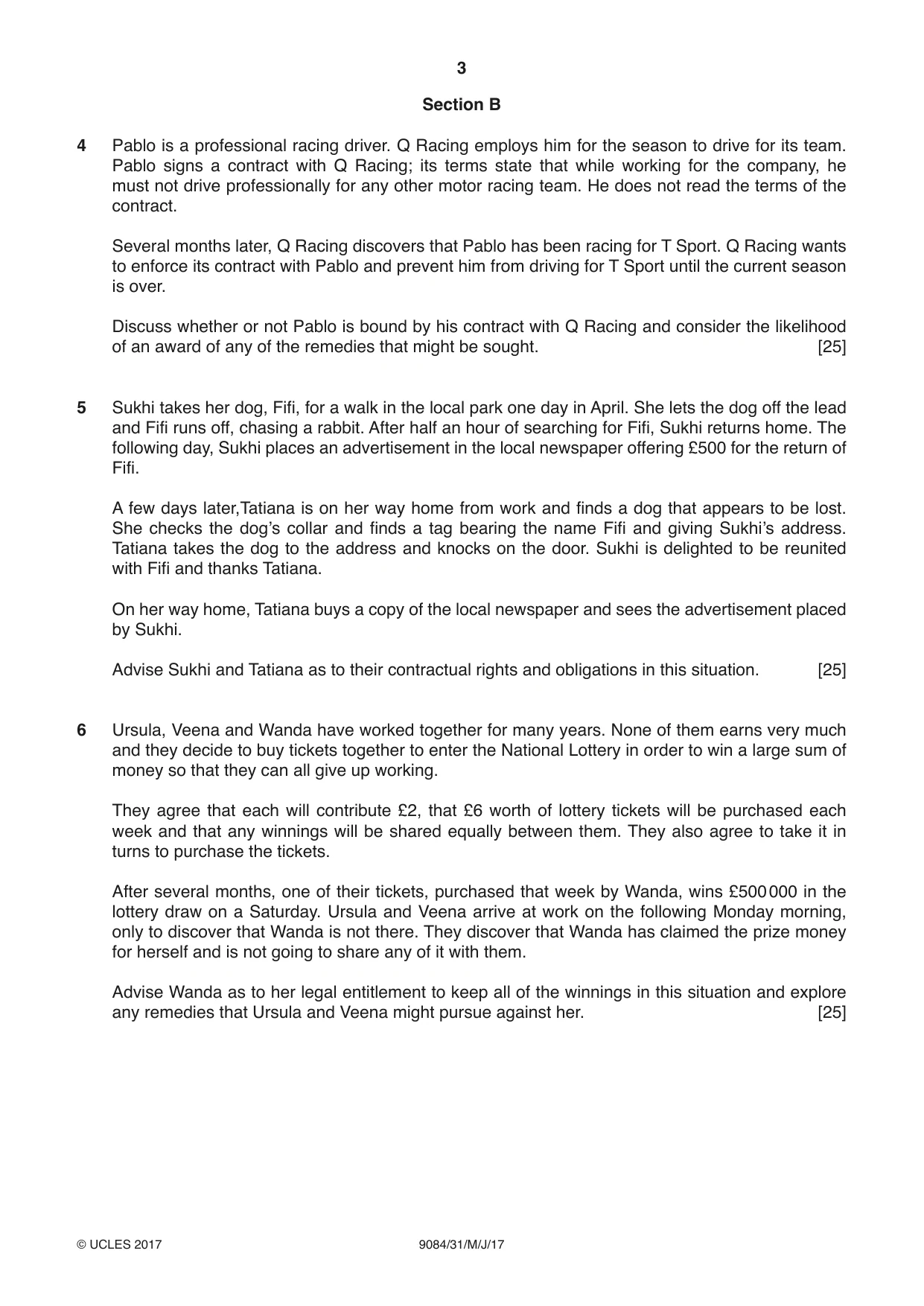
3 9084/31/M/J/17 © UCLES 2017 Section B 4 Pablo is a professional racing driver. Q Racing employs him for the season to drive for its team. Pablo signs a contract with Q Racing; its terms state that while working for the company, he must not drive professionally for any other motor racing team. He does not read the terms of the contract. Several months later, Q Racing discovers that Pablo has been racing for T Sport. Q Racing wants to enforce its contract with Pablo and prevent him from driving for T Sport until the current season is over. Discuss whether or not Pablo is bound by his contract with Q Racing and consider the likelihood of an award of any of the remedies that might be sought. [25] 5 Sukhi takes her dog, Fifi, for a walk in the local park one day in April. She lets the dog off the lead and Fifi runs off, chasing a rabbit. After half an hour of searching for Fifi, Sukhi returns home. The following day, Sukhi places an advertisement in the local newspaper offering £500 for the return of Fifi. A few days later,Tatiana is on her way home from work and finds a dog that appears to be lost. She checks the dog’s collar and finds a tag bearing the name Fifi and giving Sukhi’s address. Tatiana takes the dog to the address and knocks on the door. Sukhi is delighted to be reunited with Fifi and thanks Tatiana. On her way home, Tatiana buys a copy of the local newspaper and sees the advertisement placed by Sukhi. Advise Sukhi and Tatiana as to their contractual rights and obligations in this situation. [25] 6 Ursula, Veena and Wanda have worked together for many years. None of them earns very much and they decide to buy tickets together to enter the National Lottery in order to win a large sum of money so that they can all give up working. They agree that each will contribute £2, that £6 worth of lottery tickets will be purchased each week and that any winnings will be shared equally between them. They also agree to take it in turns to purchase the tickets. After several months, one of their tickets, purchased that week by Wanda, wins £500 000 in the lottery draw on a Saturday. Ursula and Veena arrive at work on the following Monday morning, only to discover that Wanda is not there. They discover that Wanda has claimed the prize money for herself and is not going to share any of it with them. Advise Wanda as to her legal entitlement to keep all of the winnings in this situation and explore any remedies that Ursula and Veena might pursue against her. [25]
Question paper, page 4
4 9084/31/M/J/17 © UCLES 2017 BLANK PAGE Permission to reproduce items where third-party owned material protected by copyright is included has been sought and cleared where possible. Every reasonable effort has been made by the publisher (UCLES) to trace copyright holders, but if any items requiring clearance have unwittingly been included, the publisher will be pleased to make amends at the earliest possible opportunity. To avoid the issue of disclosure of answer-related information to candidates, all copyright acknowledgements are reproduced online in the Cambridge International Examinations Copyright Acknowledgements Booklet. This is produced for each series of examinations and is freely available to download at www.cie.org.uk after the live examination series. Cambridge International Examinations is part of the Cambridge Assessment Group. Cambridge Assessment is the brand name of University of Cambridge Local Examinations Syndicate (UCLES), which is itself a department of the University of Cambridge.
Mark scheme, page 1
® IGCSE is a registered trademark. This document consists of 10 printed pages. © UCLES 2017 [Turn over Cambridge International Examinations Cambridge International Advanced Subsidiary and Advanced Level LAW 9084/31 Paper 3 May/June 2017 MARK SCHEME Maximum Mark: 75 Published This mark scheme is published as an aid to teachers and candidates, to indicate the requirements of the examination. It shows the basis on which Examiners were instructed to award marks. It does not indicate the details of the discussions that took place at an Examiners’ meeting before marking began, which would have considered the acceptability of alternative answers. Mark schemes should be read in conjunction with the question paper and the Principal Examiner Report for Teachers. Cambridge will not enter into discussions about these mark schemes. Cambridge is publishing the mark schemes for the May/June 2017 series for most Cambridge IGCSE®, Cambridge International A and AS Level and Cambridge Pre-U components, and some Cambridge O Level components.
Mark scheme, page 2
9084/31 Cambridge International AS/A Level – Mark Scheme PUBLISHED May/June 2017 © UCLES 2017 Page 2 of 10 Cambridge International Examinations – Generic Marking Principles These general marking principles must be applied by all examiners when marking candidate answers. They should be applied alongside the specific content of the mark scheme or generic level descriptors for a question. Each question paper and mark scheme will also comply with these marking principles. GENERIC MARKING PRINCIPLE 1: Marks must be awarded in line with: • the specific content of the mark scheme or the generic level descriptors for the question • the specific skills defined in the mark scheme or in the generic level descriptors for the question • the standard of response required by a candidate as exemplified by the standardisation scripts. GENERIC MARKING PRINCIPLE 2: Marks awarded are always whole marks (not half marks, or other fractions). GENERIC MARKING PRINCIPLE 3: Marks must be awarded positively: • marks are awarded for correct/valid answers, as defined in the mark scheme. However, credit is given for valid answers which go beyond the scope of the syllabus and mark scheme, referring to your Team Leader as appropriate • marks are awarded when candidates clearly demonstrate what they know and can do • marks are not deducted for errors • marks are not deducted for omissions • answers should only be judged on the quality of spelling, punctuation and grammar when these features are specifically assessed by the question as indicated by the mark scheme. The meaning, however, should be unambiguous. GENERIC MARKING PRINCIPLE 4: Rules must be applied consistently e.g. in situations where candidates have not followed instructions or in the application of generic level descriptors. GENERIC MARKING PRINCIPLE 5: Marks should be awarded using the full range of marks defined in the mark scheme for the question (however; the use of the full mark range may be limited according to the quality of the candidate responses seen). GENERIC MARKING PRINCIPLE 6: Marks awarded are based solely on the requirements as defined in the mark scheme. Marks should not be awarded with grade thresholds or grade descriptors in mind.
Mark scheme, page 3
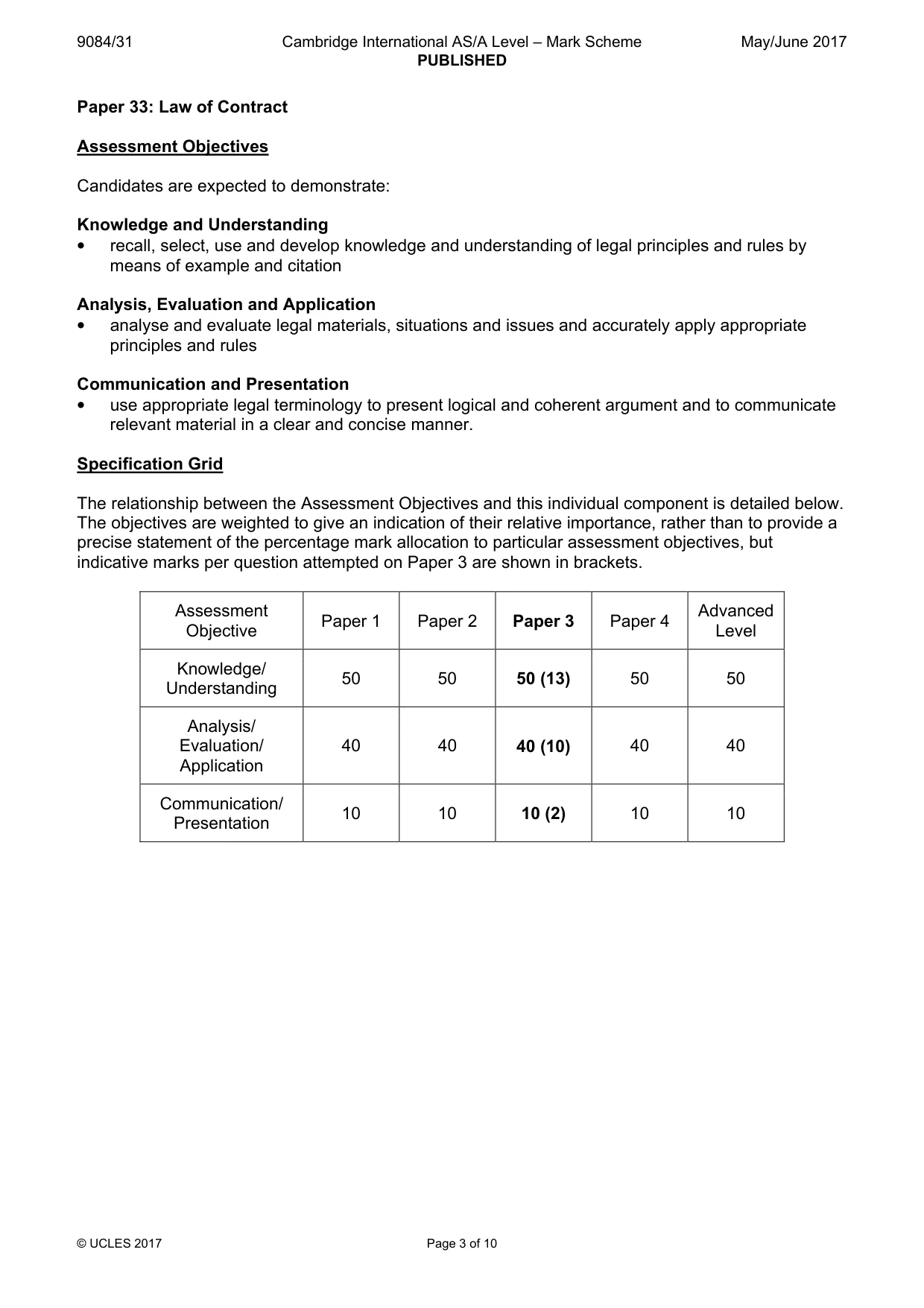
9084/31 Cambridge International AS/A Level – Mark Scheme PUBLISHED May/June 2017 © UCLES 2017 Page 3 of 10 Paper 33: Law of Contract Assessment Objectives Candidates are expected to demonstrate: Knowledge and Understanding • recall, select, use and develop knowledge and understanding of legal principles and rules by means of example and citation Analysis, Evaluation and Application • analyse and evaluate legal materials, situations and issues and accurately apply appropriate principles and rules Communication and Presentation • use appropriate legal terminology to present logical and coherent argument and to communicate relevant material in a clear and concise manner. Specification Grid The relationship between the Assessment Objectives and this individual component is detailed below. The objectives are weighted to give an indication of their relative importance, rather than to provide a precise statement of the percentage mark allocation to particular assessment objectives, but indicative marks per question attempted on Paper 3 are shown in brackets. Assessment Objective Paper 1 Paper 2 Paper 3 Paper 4 Advanced Level Knowledge/ Understanding 50 50 50 (13) 50 50 Analysis/ Evaluation/ Application 40 40 40 (10) 40 40 Communication/ Presentation 10 10 10 (2) 10 10
Mark scheme, page 4
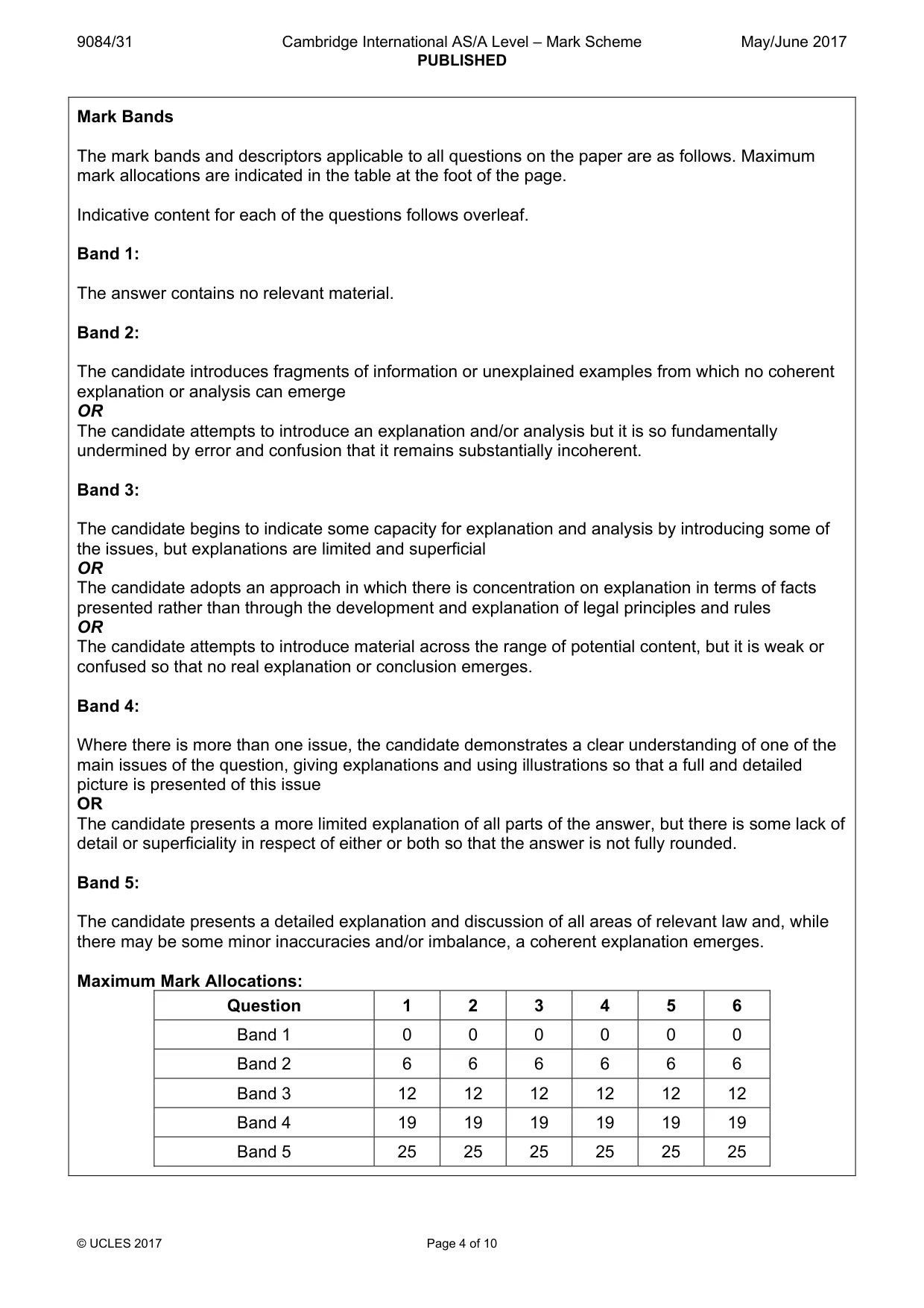
9084/31 Cambridge International AS/A Level – Mark Scheme PUBLISHED May/June 2017 © UCLES 2017 Page 4 of 10 Mark Bands The mark bands and descriptors applicable to all questions on the paper are as follows. Maximum mark allocations are indicated in the table at the foot of the page. Indicative content for each of the questions follows overleaf. Band 1: The answer contains no relevant material. Band 2: The candidate introduces fragments of information or unexplained examples from which no coherent explanation or analysis can emerge OR The candidate attempts to introduce an explanation and/or analysis but it is so fundamentally undermined by error and confusion that it remains substantially incoherent. Band 3: The candidate begins to indicate some capacity for explanation and analysis by introducing some of the issues, but explanations are limited and superficial OR The candidate adopts an approach in which there is concentration on explanation in terms of facts presented rather than through the development and explanation of legal principles and rules OR The candidate attempts to introduce material across the range of potential content, but it is weak or confused so that no real explanation or conclusion emerges. Band 4: Where there is more than one issue, the candidate demonstrates a clear understanding of one of the main issues of the question, giving explanations and using illustrations so that a full and detailed picture is presented of this issue OR The candidate presents a more limited explanation of all parts of the answer, but there is some lack of detail or superficiality in respect of either or both so that the answer is not fully rounded. Band 5: The candidate presents a detailed explanation and discussion of all areas of relevant law and, while there may be some minor inaccuracies and/or imbalance, a coherent explanation emerges. Maximum Mark Allocations: Question 1 2 3 4 5 6 Band 1 0 0 0 0 0 0 Band 2 6 6 6 6 6 6 Band 3 12 12 12 12 12 12 Band 4 19 19 19 19 19 19 Band 5 25 25 25 25 25 25
Mark scheme, page 5
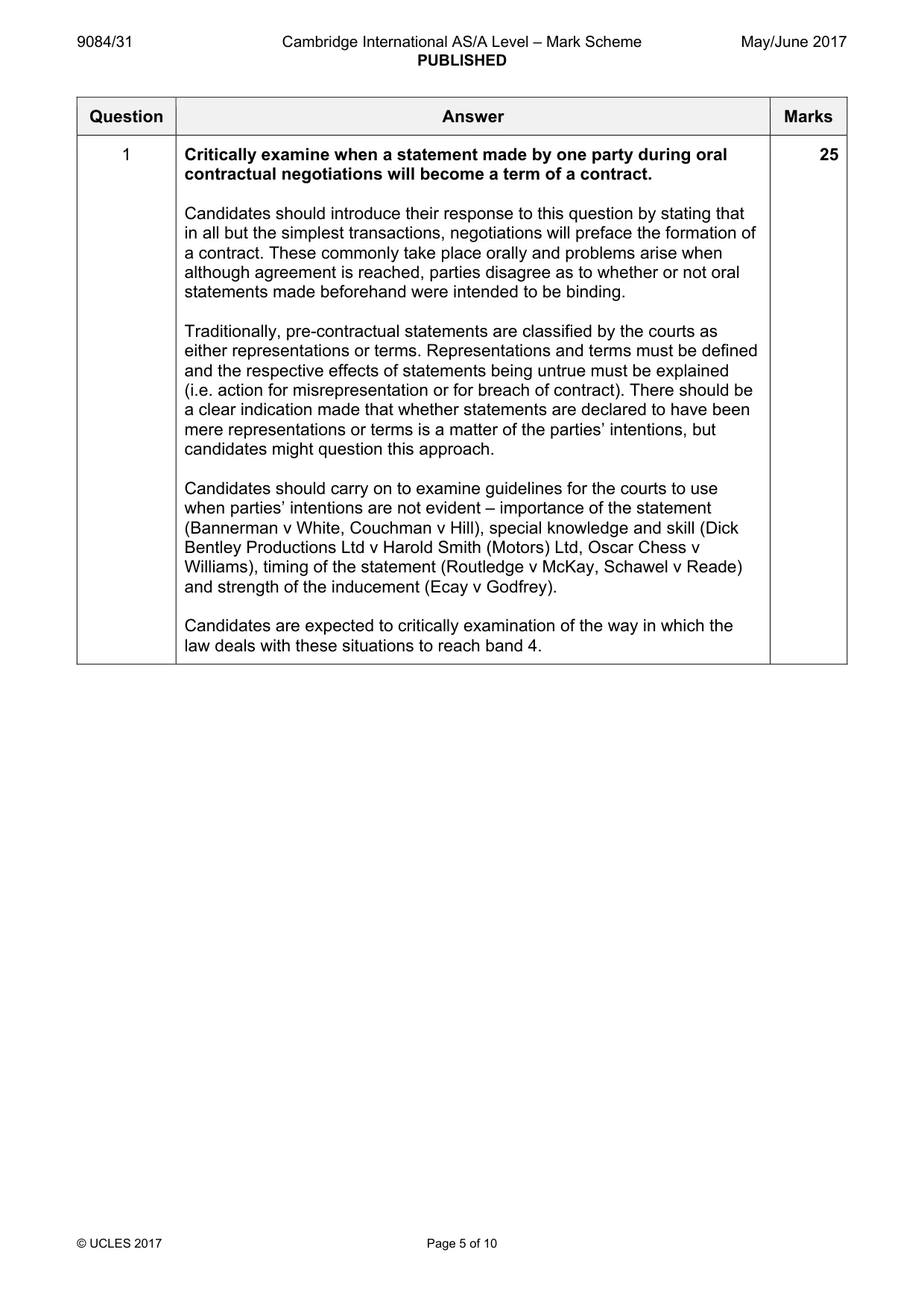
9084/31 Cambridge International AS/A Level – Mark Scheme PUBLISHED May/June 2017 © UCLES 2017 Page 5 of 10 Question Answer Marks 1 Critically examine when a statement made by one party during oral contractual negotiations will become a term of a contract. Candidates should introduce their response to this question by stating that in all but the simplest transactions, negotiations will preface the formation of a contract. These commonly take place orally and problems arise when although agreement is reached, parties disagree as to whether or not oral statements made beforehand were intended to be binding. Traditionally, pre-contractual statements are classified by the courts as either representations or terms. Representations and terms must be defined and the respective effects of statements being untrue must be explained (i.e. action for misrepresentation or for breach of contract). There should be a clear indication made that whether statements are declared to have been mere representations or terms is a matter of the parties’ intentions, but candidates might question this approach. Candidates should carry on to examine guidelines for the courts to use when parties’ intentions are not evident – importance of the statement (Bannerman v White, Couchman v Hill), special knowledge and skill (Dick Bentley Productions Ltd v Harold Smith (Motors) Ltd, Oscar Chess v Williams), timing of the statement (Routledge v McKay, Schawel v Reade) and strength of the inducement (Ecay v Godfrey). Candidates are expected to critically examination of the way in which the law deals with these situations to reach band 4. 25
Mark scheme, page 6
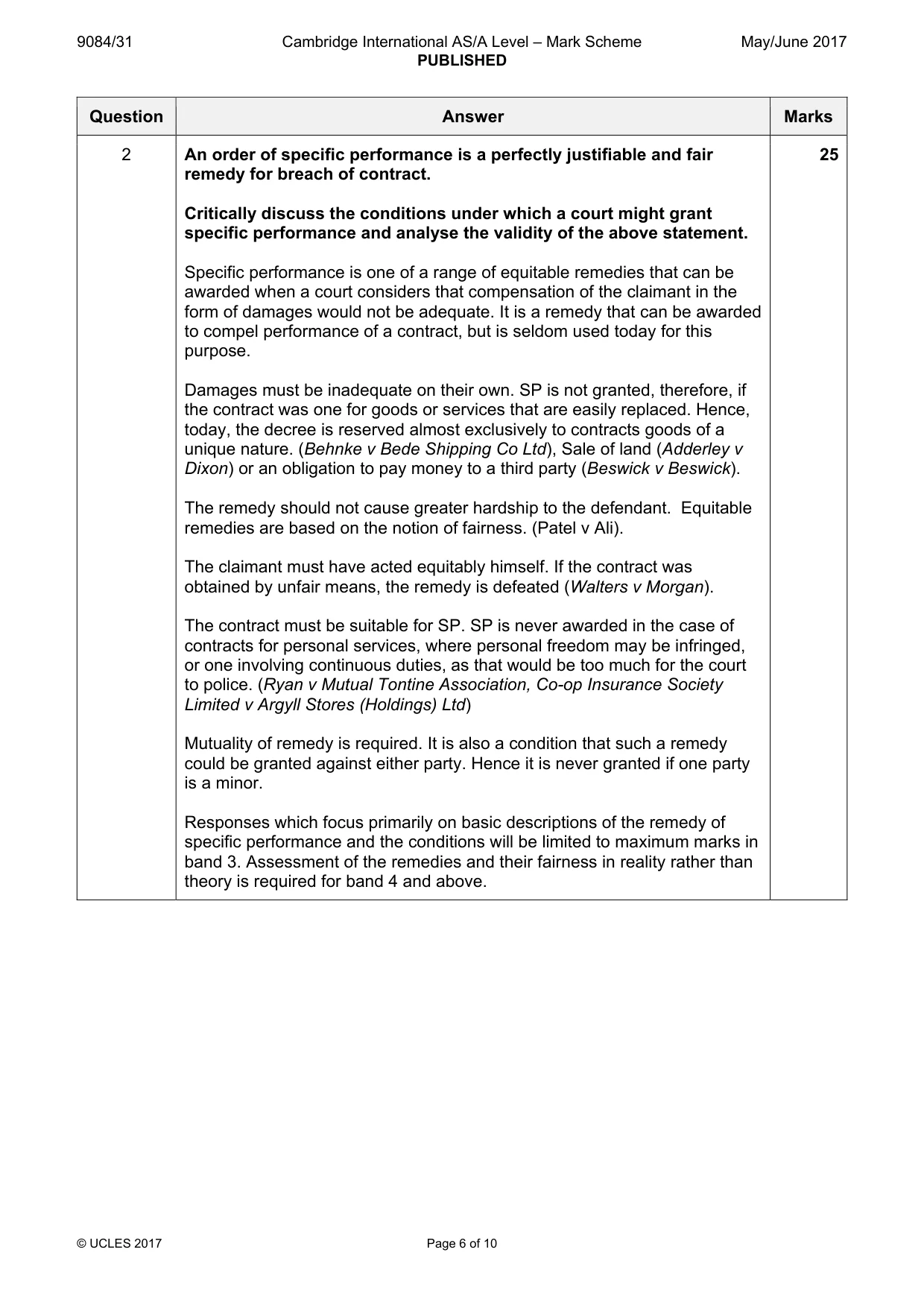
9084/31 Cambridge International AS/A Level – Mark Scheme PUBLISHED May/June 2017 © UCLES 2017 Page 6 of 10 Question Answer Marks 2 An order of specific performance is a perfectly justifiable and fair remedy for breach of contract. Critically discuss the conditions under which a court might grant specific performance and analyse the validity of the above statement. Specific performance is one of a range of equitable remedies that can be awarded when a court considers that compensation of the claimant in the form of damages would not be adequate. It is a remedy that can be awarded to compel performance of a contract, but is seldom used today for this purpose. Damages must be inadequate on their own. SP is not granted, therefore, if the contract was one for goods or services that are easily replaced. Hence, today, the decree is reserved almost exclusively to contracts goods of a unique nature. (Behnke v Bede Shipping Co Ltd), Sale of land (Adderley v Dixon) or an obligation to pay money to a third party (Beswick v Beswick). The remedy should not cause greater hardship to the defendant. Equitable remedies are based on the notion of fairness. (Patel v Ali). The claimant must have acted equitably himself. If the contract was obtained by unfair means, the remedy is defeated (Walters v Morgan). The contract must be suitable for SP. SP is never awarded in the case of contracts for personal services, where personal freedom may be infringed, or one involving continuous duties, as that would be too much for the court to police. (Ryan v Mutual Tontine Association, Co-op Insurance Society Limited v Argyll Stores (Holdings) Ltd) Mutuality of remedy is required. It is also a condition that such a remedy could be granted against either party. Hence it is never granted if one party is a minor. Responses which focus primarily on basic descriptions of the remedy of specific performance and the conditions will be limited to maximum marks in band 3. Assessment of the remedies and their fairness in reality rather than theory is required for band 4 and above. 25
Mark scheme, page 7
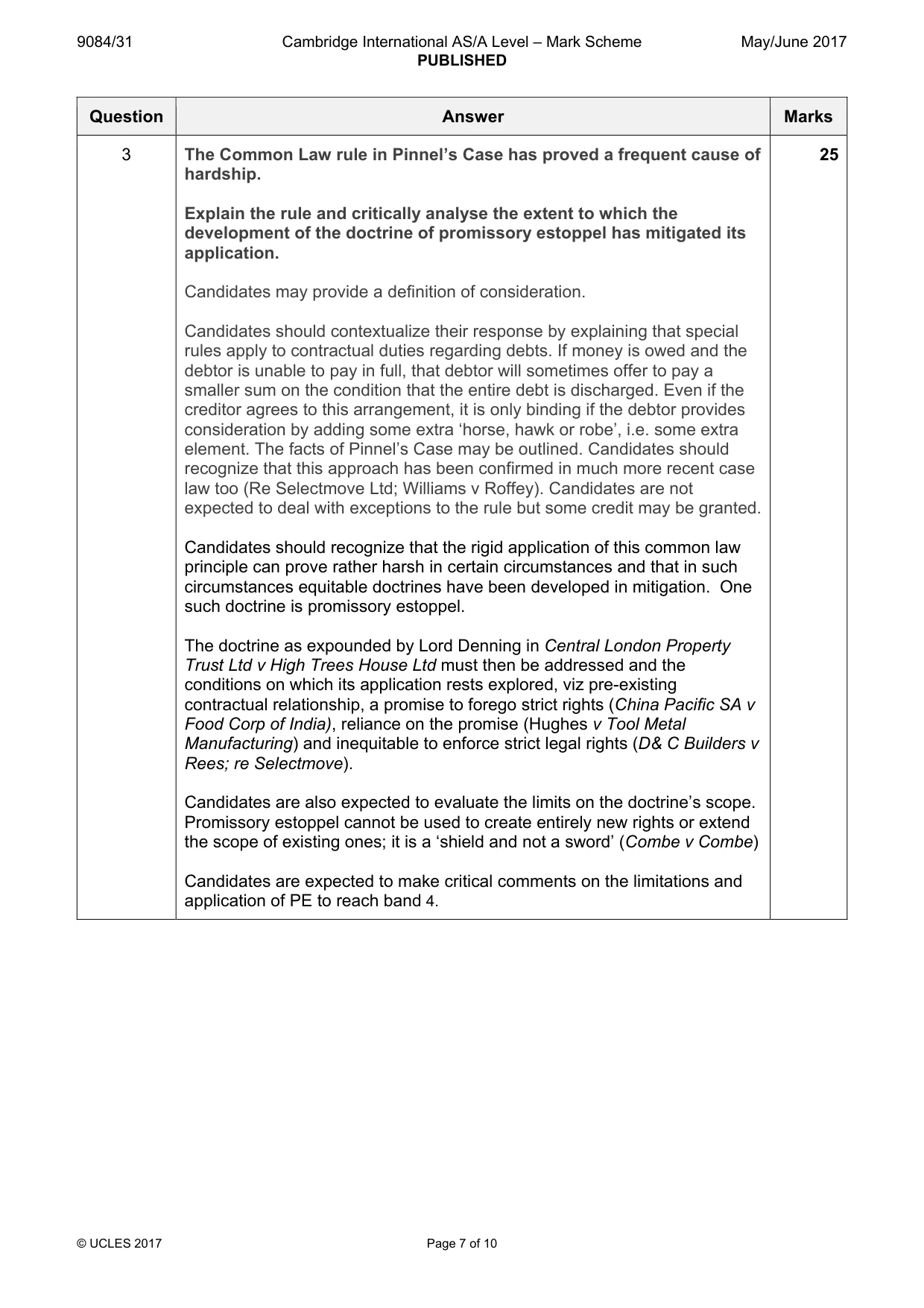
9084/31 Cambridge International AS/A Level – Mark Scheme PUBLISHED May/June 2017 © UCLES 2017 Page 7 of 10 Question Answer Marks 3 The Common Law rule in Pinnel’s Case has proved a frequent cause of hardship. Explain the rule and critically analyse the extent to which the development of the doctrine of promissory estoppel has mitigated its application. Candidates may provide a definition of consideration. Candidates should contextualize their response by explaining that special rules apply to contractual duties regarding debts. If money is owed and the debtor is unable to pay in full, that debtor will sometimes offer to pay a smaller sum on the condition that the entire debt is discharged. Even if the creditor agrees to this arrangement, it is only binding if the debtor provides consideration by adding some extra ‘horse, hawk or robe’, i.e. some extra element. The facts of Pinnel’s Case may be outlined. Candidates should recognize that this approach has been confirmed in much more recent case law too (Re Selectmove Ltd; Williams v Roffey). Candidates are not expected to deal with exceptions to the rule but some credit may be granted. Candidates should recognize that the rigid application of this common law principle can prove rather harsh in certain circumstances and that in such circumstances equitable doctrines have been developed in mitigation. One such doctrine is promissory estoppel. The doctrine as expounded by Lord Denning in Central London Property Trust Ltd v High Trees House Ltd must then be addressed and the conditions on which its application rests explored, viz pre-existing contractual relationship, a promise to forego strict rights (China Pacific SA v Food Corp of India), reliance on the promise (Hughes v Tool Metal Manufacturing) and inequitable to enforce strict legal rights (D& C Builders v Rees; re Selectmove). Candidates are also expected to evaluate the limits on the doctrine’s scope. Promissory estoppel cannot be used to create entirely new rights or extend the scope of existing ones; it is a ‘shield and not a sword’ (Combe v Combe) Candidates are expected to make critical comments on the limitations and application of PE to reach band 4. 25
Mark scheme, page 8
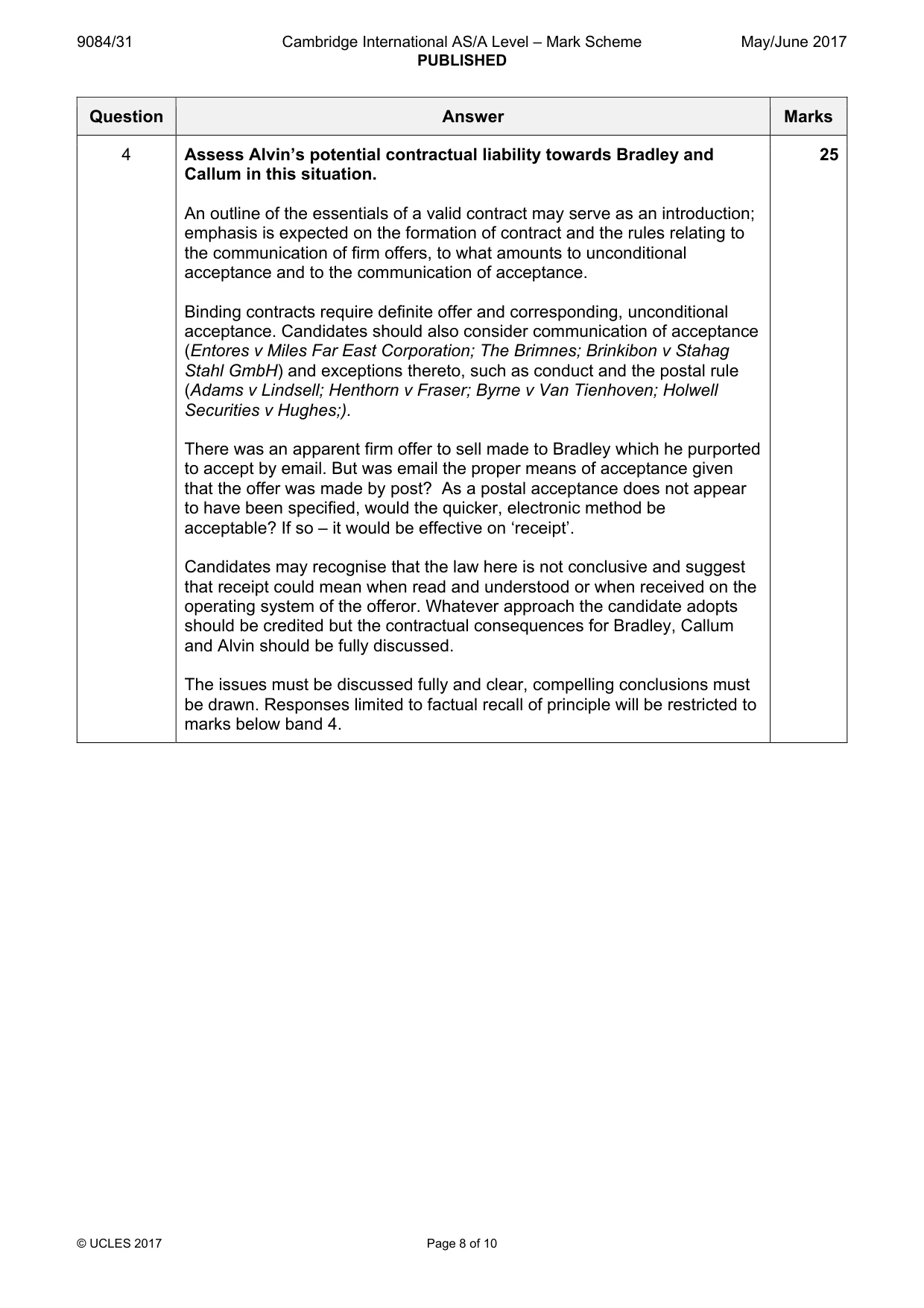
9084/31 Cambridge International AS/A Level – Mark Scheme PUBLISHED May/June 2017 © UCLES 2017 Page 8 of 10 Question Answer Marks 4 Assess Alvin’s potential contractual liability towards Bradley and Callum in this situation. An outline of the essentials of a valid contract may serve as an introduction; emphasis is expected on the formation of contract and the rules relating to the communication of firm offers, to what amounts to unconditional acceptance and to the communication of acceptance. Binding contracts require definite offer and corresponding, unconditional acceptance. Candidates should also consider communication of acceptance (Entores v Miles Far East Corporation; The Brimnes; Brinkibon v Stahag Stahl GmbH) and exceptions thereto, such as conduct and the postal rule (Adams v Lindsell; Henthorn v Fraser; Byrne v Van Tienhoven; Holwell Securities v Hughes;). There was an apparent firm offer to sell made to Bradley which he purported to accept by email. But was email the proper means of acceptance given that the offer was made by post? As a postal acceptance does not appear to have been specified, would the quicker, electronic method be acceptable? If so – it would be effective on ‘receipt’. Candidates may recognise that the law here is not conclusive and suggest that receipt could mean when read and understood or when received on the operating system of the offeror. Whatever approach the candidate adopts should be credited but the contractual consequences for Bradley, Callum and Alvin should be fully discussed. The issues must be discussed fully and clear, compelling conclusions must be drawn. Responses limited to factual recall of principle will be restricted to marks below band 4. 25
Mark scheme, page 9
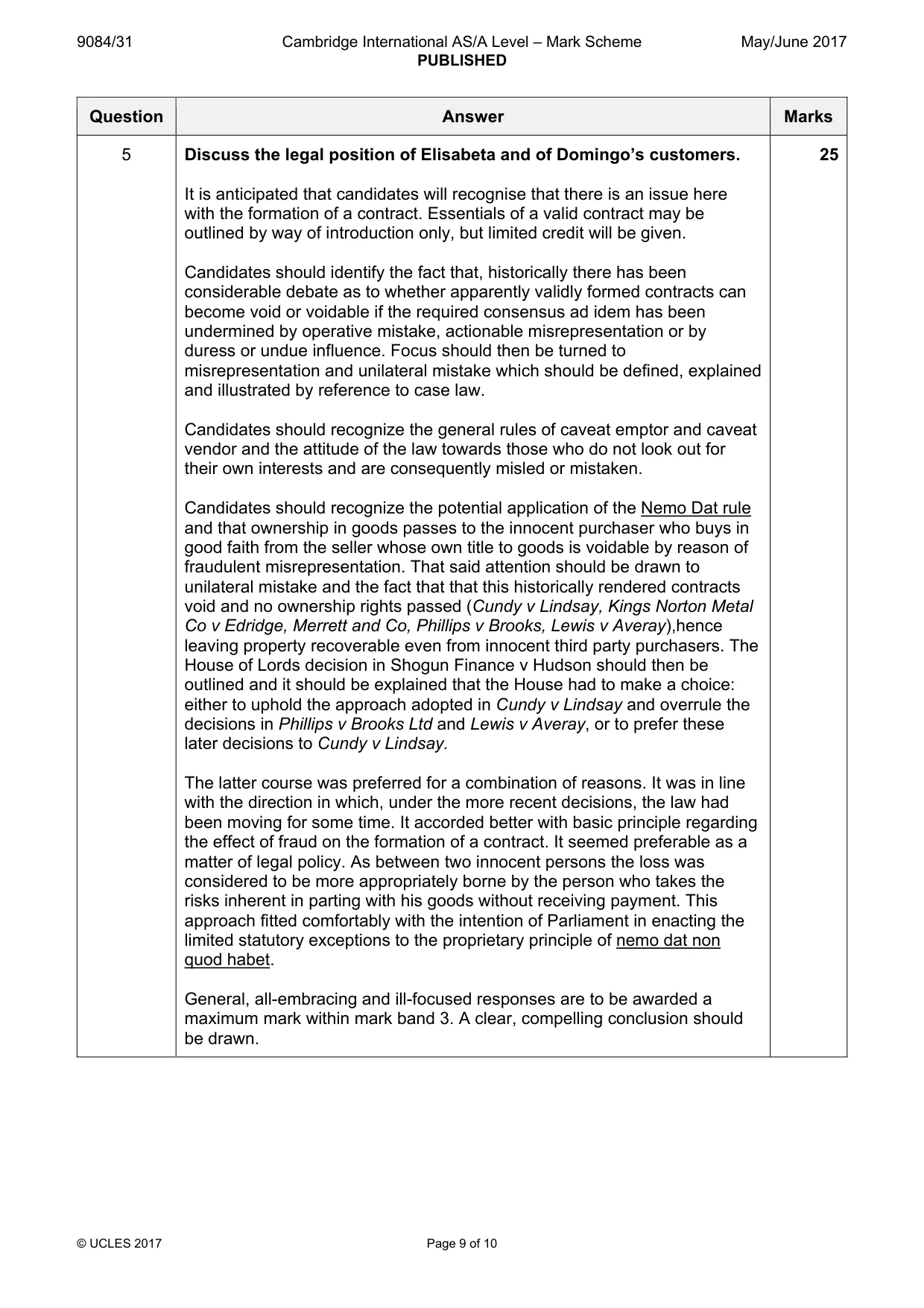
9084/31 Cambridge International AS/A Level – Mark Scheme PUBLISHED May/June 2017 © UCLES 2017 Page 9 of 10 Question Answer Marks 5 Discuss the legal position of Elisabeta and of Domingo’s customers. It is anticipated that candidates will recognise that there is an issue here with the formation of a contract. Essentials of a valid contract may be outlined by way of introduction only, but limited credit will be given. Candidates should identify the fact that, historically there has been considerable debate as to whether apparently validly formed contracts can become void or voidable if the required consensus ad idem has been undermined by operative mistake, actionable misrepresentation or by duress or undue influence. Focus should then be turned to misrepresentation and unilateral mistake which should be defined, explained and illustrated by reference to case law. Candidates should recognize the general rules of caveat emptor and caveat vendor and the attitude of the law towards those who do not look out for their own interests and are consequently misled or mistaken. Candidates should recognize the potential application of the Nemo Dat rule and that ownership in goods passes to the innocent purchaser who buys in good faith from the seller whose own title to goods is voidable by reason of fraudulent misrepresentation. That said attention should be drawn to unilateral mistake and the fact that that this historically rendered contracts void and no ownership rights passed (Cundy v Lindsay, Kings Norton Metal Co v Edridge, Merrett and Co, Phillips v Brooks, Lewis v Averay),hence leaving property recoverable even from innocent third party purchasers. The House of Lords decision in Shogun Finance v Hudson should then be outlined and it should be explained that the House had to make a choice: either to uphold the approach adopted in Cundy v Lindsay and overrule the decisions in Phillips v Brooks Ltd and Lewis v Averay, or to prefer these later decisions to Cundy v Lindsay. The latter course was preferred for a combination of reasons. It was in line with the direction in which, under the more recent decisions, the law had been moving for some time. It accorded better with basic principle regarding the effect of fraud on the formation of a contract. It seemed preferable as a matter of legal policy. As between two innocent persons the loss was considered to be more appropriately borne by the person who takes the risks inherent in parting with his goods without receiving payment. This approach fitted comfortably with the intention of Parliament in enacting the limited statutory exceptions to the proprietary principle of nemo dat non quod habet. General, all-embracing and ill-focused responses are to be awarded a maximum mark within mark band 3. A clear, compelling conclusion should be drawn. 25
Mark scheme, page 10
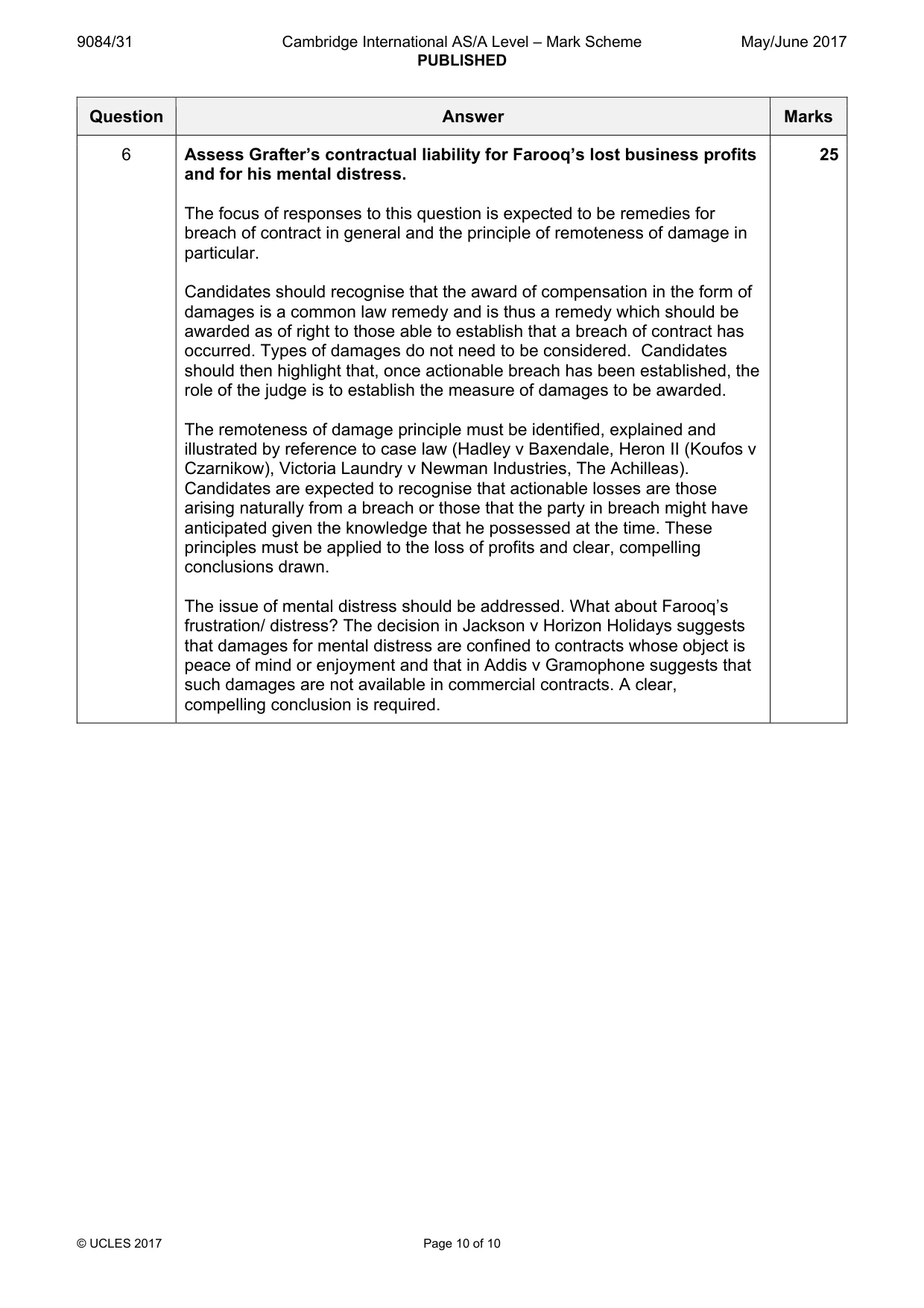
9084/31 Cambridge International AS/A Level – Mark Scheme PUBLISHED May/June 2017 © UCLES 2017 Page 10 of 10 Question Answer Marks 6 Assess Grafter’s contractual liability for Farooq’s lost business profits and for his mental distress. The focus of responses to this question is expected to be remedies for breach of contract in general and the principle of remoteness of damage in particular. Candidates should recognise that the award of compensation in the form of damages is a common law remedy and is thus a remedy which should be awarded as of right to those able to establish that a breach of contract has occurred. Types of damages do not need to be considered. Candidates should then highlight that, once actionable breach has been established, the role of the judge is to establish the measure of damages to be awarded. The remoteness of damage principle must be identified, explained and illustrated by reference to case law (Hadley v Baxendale, Heron II (Koufos v Czarnikow), Victoria Laundry v Newman Industries, The Achilleas). Candidates are expected to recognise that actionable losses are those arising naturally from a breach or those that the party in breach might have anticipated given the knowledge that he possessed at the time. These principles must be applied to the loss of profits and clear, compelling conclusions drawn. The issue of mental distress should be addressed. What about Farooq’s frustration/ distress? The decision in Jackson v Horizon Holidays suggests that damages for mental distress are confined to contracts whose object is peace of mind or enjoyment and that in Addis v Gramophone suggests that such damages are not available in commercial contracts. A clear, compelling conclusion is required. 25