Cambridge A Level Law 9084 — 2016 Oct/Nov Paper 1 · Variant 3
9084/13/O/N/16
The question paper and its mark scheme, free to read here and free to download. This is Cambridge’s own paper, exactly as it was sat.
Question paper4 pages


Mark scheme8 pages
Answers below. Sit the paper first if you are practising.
Paper as text
Question paper, page 1
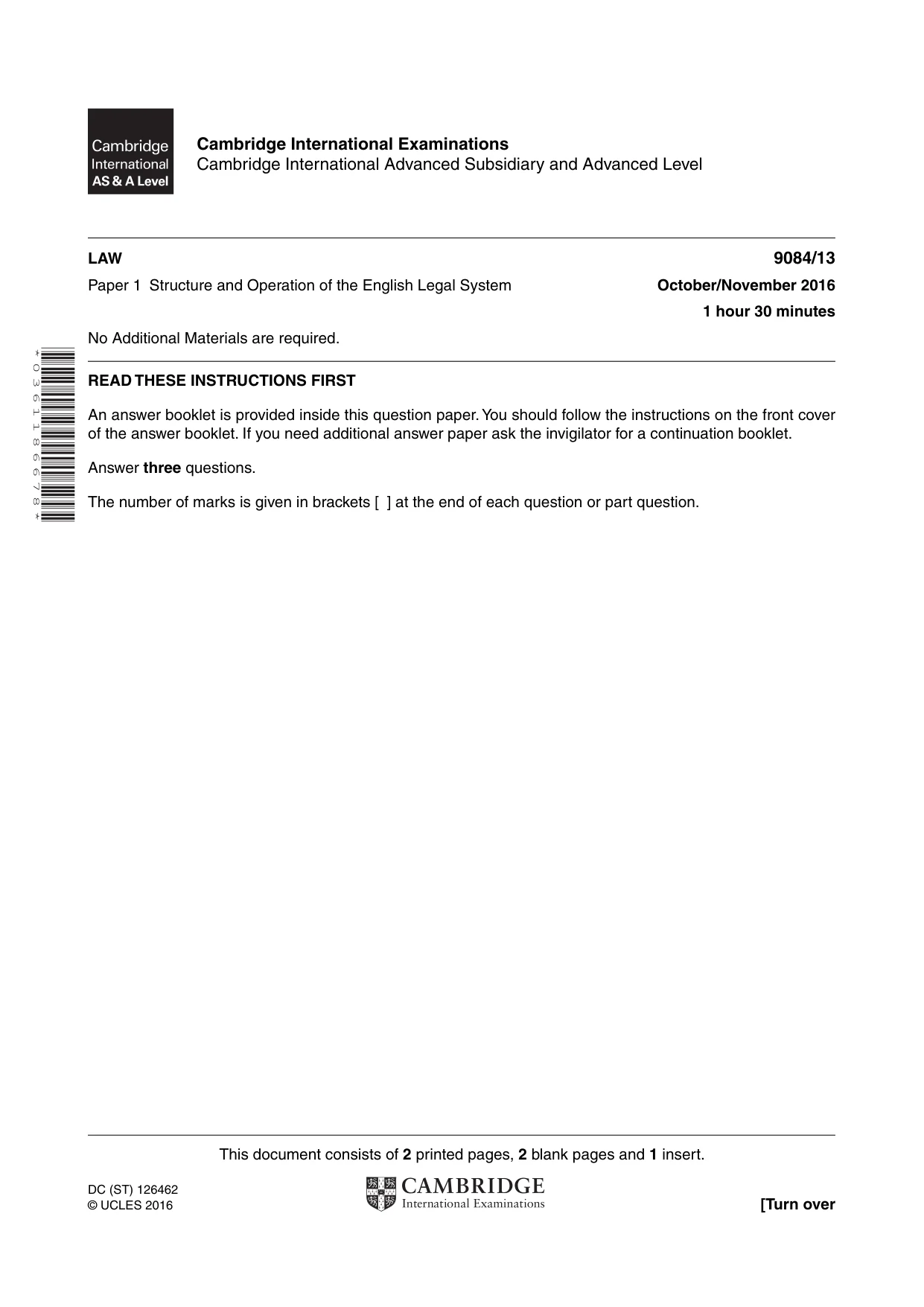
This document consists of 2 printed pages, 2 blank pages and 1 insert. DC (ST) 126462 © UCLES 2016 [Turn over Cambridge International Examinations Cambridge International Advanced Subsidiary and Advanced Level * 0 3 6 1 1 8 6 6 7 8 * LAW 9084/13 Paper 1 Structure and Operation of the English Legal System October/November 2016 1 hour 30 minutes No Additional Materials are required. READ THESE INSTRUCTIONS FIRST An answer booklet is provided inside this question paper. You should follow the instructions on the front cover of the answer booklet. If you need additional answer paper ask the invigilator for a continuation booklet. Answer three questions. The number of marks is given in brackets [ ] at the end of each question or part question.
Question paper, page 2
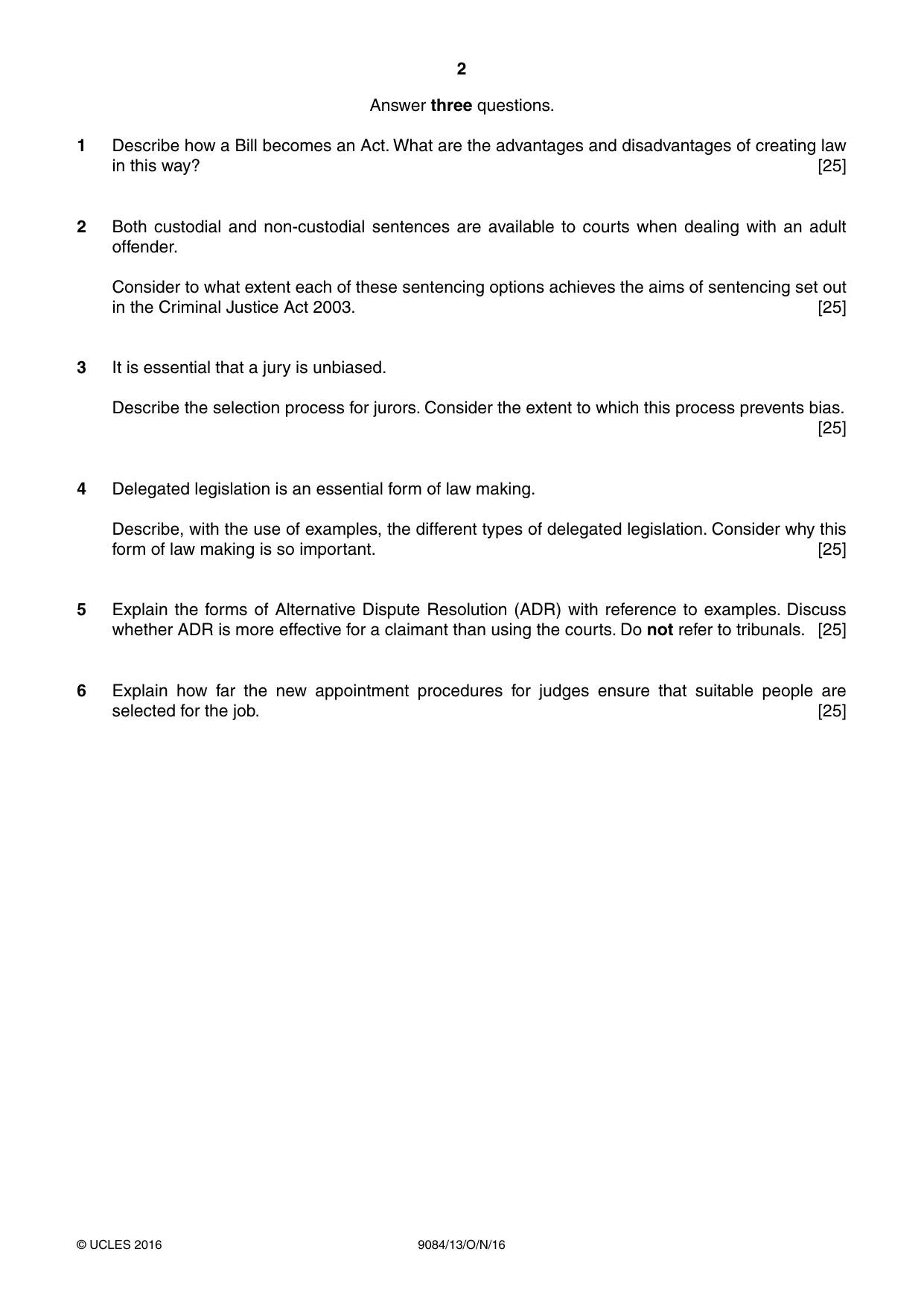
2 9084/13/O/N/16 © UCLES 2016 Answer three questions. 1 Describe how a Bill becomes an Act. What are the advantages and disadvantages of creating law in this way? [25] 2 Both custodial and non-custodial sentences are available to courts when dealing with an adult offender. Consider to what extent each of these sentencing options achieves the aims of sentencing set out in the Criminal Justice Act 2003. [25] 3 It is essential that a jury is unbiased. Describe the selection process for jurors. Consider the extent to which this process prevents bias. [25] 4 Delegated legislation is an essential form of law making. Describe, with the use of examples, the different types of delegated legislation. Consider why this form of law making is so important. [25] 5 Explain the forms of Alternative Dispute Resolution (ADR) with reference to examples. Discuss whether ADR is more effective for a claimant than using the courts. Do not refer to tribunals. [25] 6 Explain how far the new appointment procedures for judges ensure that suitable people are selected for the job. [25]
Question paper, page 3
3 9084/13/O/N/16 © UCLES 2016 BLANK PAGE
Question paper, page 4
4 9084/13/O/N/16 © UCLES 2016 Permission to reproduce items where third-party owned material protected by copyright is included has been sought and cleared where possible. Every reasonable effort has been made by the publisher (UCLES) to trace copyright holders, but if any items requiring clearance have unwittingly been included, the publisher will be pleased to make amends at the earliest possible opportunity. To avoid the issue of disclosure of answer-related information to candidates, all copyright acknowledgements are reproduced online in the Cambridge International Examinations Copyright Acknowledgements Booklet. This is produced for each series of examinations and is freely available to download at www.cie.org.uk after the live examination series. Cambridge International Examinations is part of the Cambridge Assessment Group. Cambridge Assessment is the brand name of University of Cambridge Local Examinations Syndicate (UCLES), which is itself a department of the University of Cambridge. BLANK PAGE
Mark scheme, page 1
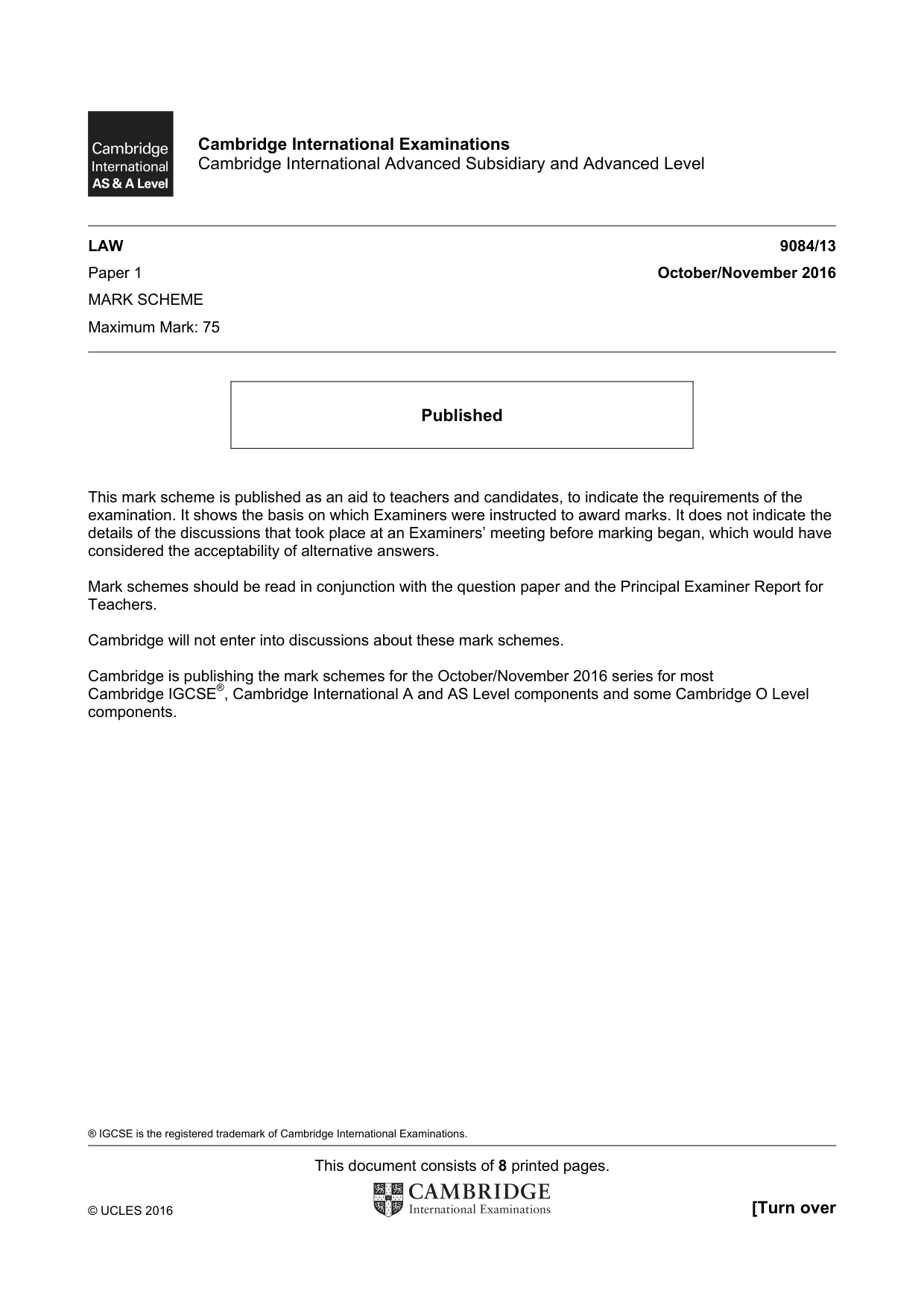
® IGCSE is the registered trademark of Cambridge International Examinations. This document consists of 8 printed pages. © UCLES 2016 [Turn over Cambridge International Examinations Cambridge International Advanced Subsidiary and Advanced Level LAW 9084/13 Paper 1 October/November 2016 MARK SCHEME Maximum Mark: 75 Published This mark scheme is published as an aid to teachers and candidates, to indicate the requirements of the examination. It shows the basis on which Examiners were instructed to award marks. It does not indicate the details of the discussions that took place at an Examiners’ meeting before marking began, which would have considered the acceptability of alternative answers. Mark schemes should be read in conjunction with the question paper and the Principal Examiner Report for Teachers. Cambridge will not enter into discussions about these mark schemes. Cambridge is publishing the mark schemes for the October/November 2016 series for most Cambridge IGCSE®, Cambridge International A and AS Level components and some Cambridge O Level components.
Mark scheme, page 2
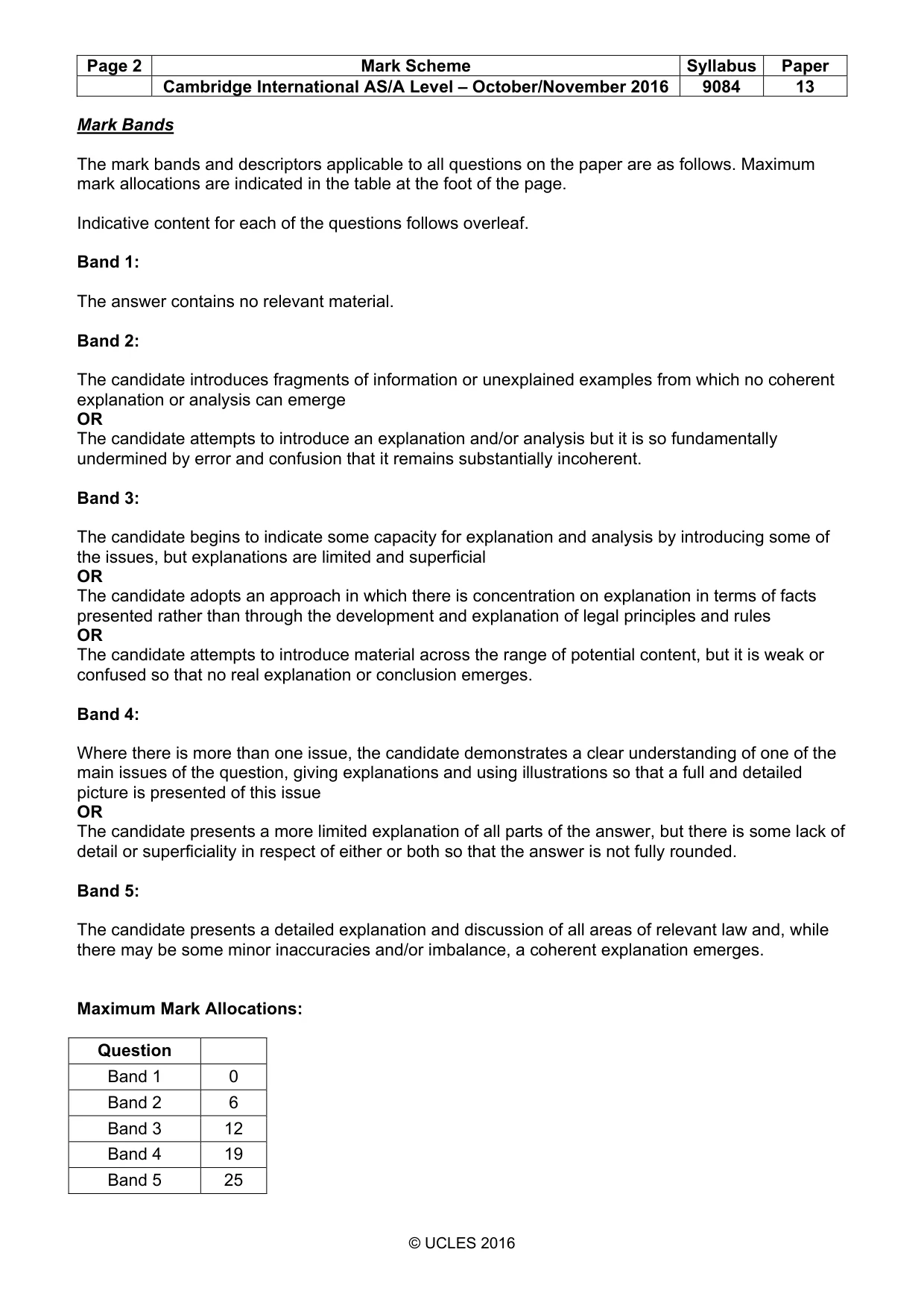
Page 2 Mark Scheme Syllabus Paper Cambridge International AS/A Level – October/November 2016 9084 13 © UCLES 2016 Mark Bands The mark bands and descriptors applicable to all questions on the paper are as follows. Maximum mark allocations are indicated in the table at the foot of the page. Indicative content for each of the questions follows overleaf. Band 1: The answer contains no relevant material. Band 2: The candidate introduces fragments of information or unexplained examples from which no coherent explanation or analysis can emerge OR The candidate attempts to introduce an explanation and/or analysis but it is so fundamentally undermined by error and confusion that it remains substantially incoherent. Band 3: The candidate begins to indicate some capacity for explanation and analysis by introducing some of the issues, but explanations are limited and superficial OR The candidate adopts an approach in which there is concentration on explanation in terms of facts presented rather than through the development and explanation of legal principles and rules OR The candidate attempts to introduce material across the range of potential content, but it is weak or confused so that no real explanation or conclusion emerges. Band 4: Where there is more than one issue, the candidate demonstrates a clear understanding of one of the main issues of the question, giving explanations and using illustrations so that a full and detailed picture is presented of this issue OR The candidate presents a more limited explanation of all parts of the answer, but there is some lack of detail or superficiality in respect of either or both so that the answer is not fully rounded. Band 5: The candidate presents a detailed explanation and discussion of all areas of relevant law and, while there may be some minor inaccuracies and/or imbalance, a coherent explanation emerges. Maximum Mark Allocations: Question Band 1 0 Band 2 6 Band 3 12 Band 4 19 Band 5 25
Mark scheme, page 3
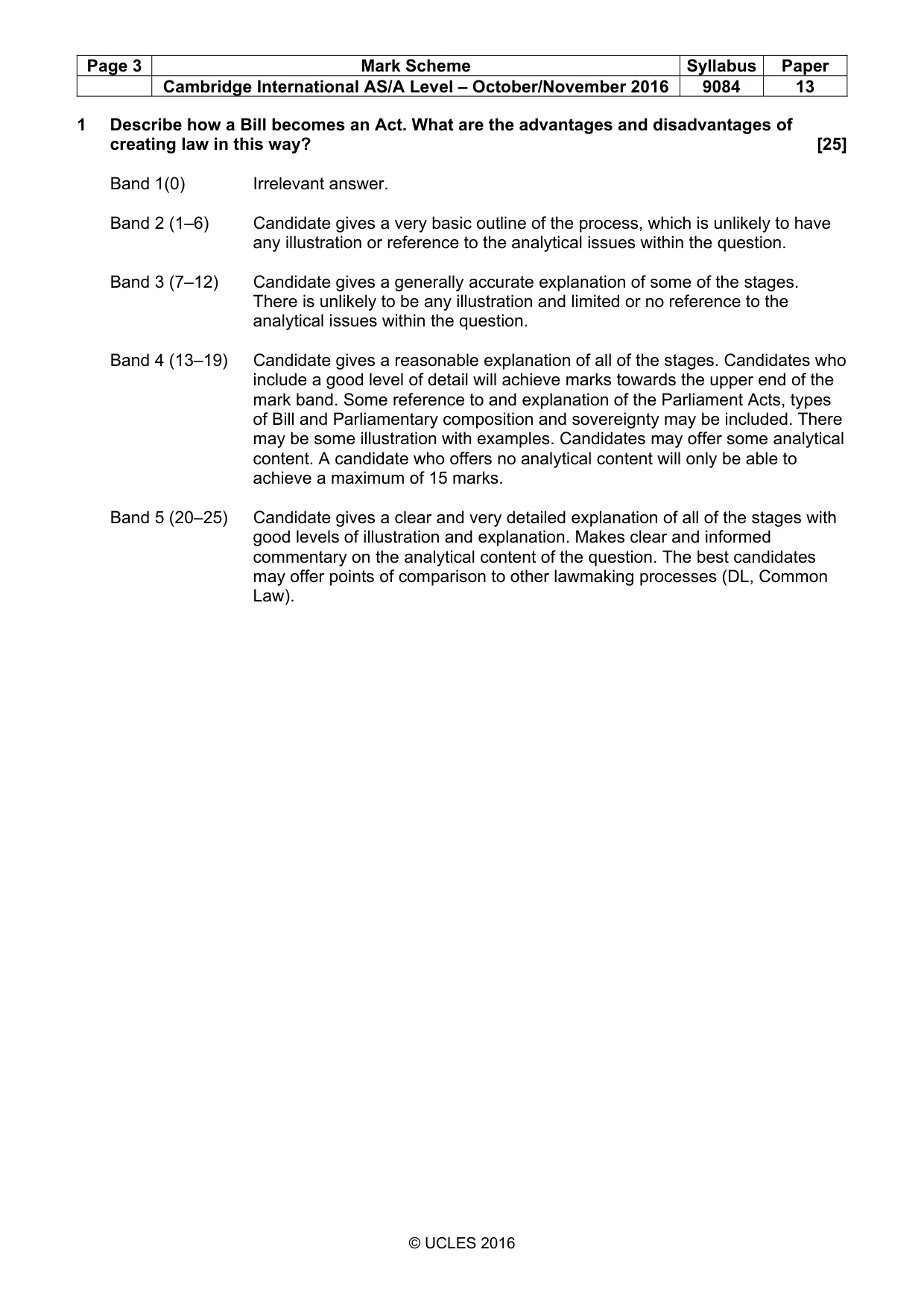
Page 3 Mark Scheme Syllabus Paper Cambridge International AS/A Level – October/November 2016 9084 13 © UCLES 2016 1 Describe how a Bill becomes an Act. What are the advantages and disadvantages of creating law in this way? [25] Band 1(0) Irrelevant answer. Band 2 (1–6) Candidate gives a very basic outline of the process, which is unlikely to have any illustration or reference to the analytical issues within the question. Band 3 (7–12) Candidate gives a generally accurate explanation of some of the stages. There is unlikely to be any illustration and limited or no reference to the analytical issues within the question. Band 4 (13–19) Candidate gives a reasonable explanation of all of the stages. Candidates who include a good level of detail will achieve marks towards the upper end of the mark band. Some reference to and explanation of the Parliament Acts, types of Bill and Parliamentary composition and sovereignty may be included. There may be some illustration with examples. Candidates may offer some analytical content. A candidate who offers no analytical content will only be able to achieve a maximum of 15 marks. Band 5 (20–25) Candidate gives a clear and very detailed explanation of all of the stages with good levels of illustration and explanation. Makes clear and informed commentary on the analytical content of the question. The best candidates may offer points of comparison to other lawmaking processes (DL, Common Law).
Mark scheme, page 4
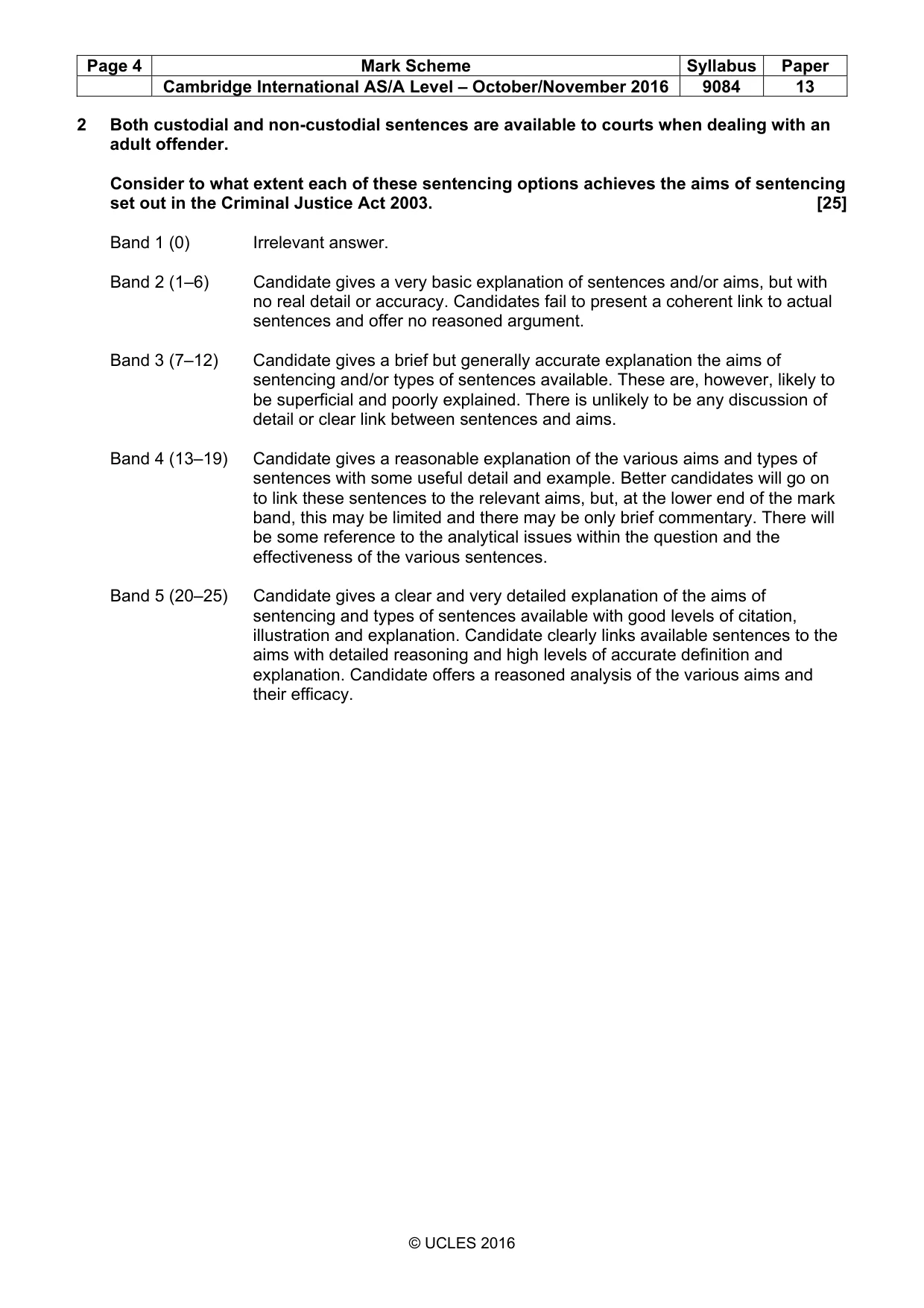
Page 4 Mark Scheme Syllabus Paper Cambridge International AS/A Level – October/November 2016 9084 13 © UCLES 2016 2 Both custodial and non-custodial sentences are available to courts when dealing with an adult offender. Consider to what extent each of these sentencing options achieves the aims of sentencing set out in the Criminal Justice Act 2003. [25] Band 1 (0) Irrelevant answer. Band 2 (1–6) Candidate gives a very basic explanation of sentences and/or aims, but with no real detail or accuracy. Candidates fail to present a coherent link to actual sentences and offer no reasoned argument. Band 3 (7–12) Candidate gives a brief but generally accurate explanation the aims of sentencing and/or types of sentences available. These are, however, likely to be superficial and poorly explained. There is unlikely to be any discussion of detail or clear link between sentences and aims. Band 4 (13–19) Candidate gives a reasonable explanation of the various aims and types of sentences with some useful detail and example. Better candidates will go on to link these sentences to the relevant aims, but, at the lower end of the mark band, this may be limited and there may be only brief commentary. There will be some reference to the analytical issues within the question and the effectiveness of the various sentences. Band 5 (20–25) Candidate gives a clear and very detailed explanation of the aims of sentencing and types of sentences available with good levels of citation, illustration and explanation. Candidate clearly links available sentences to the aims with detailed reasoning and high levels of accurate definition and explanation. Candidate offers a reasoned analysis of the various aims and their efficacy.
Mark scheme, page 5
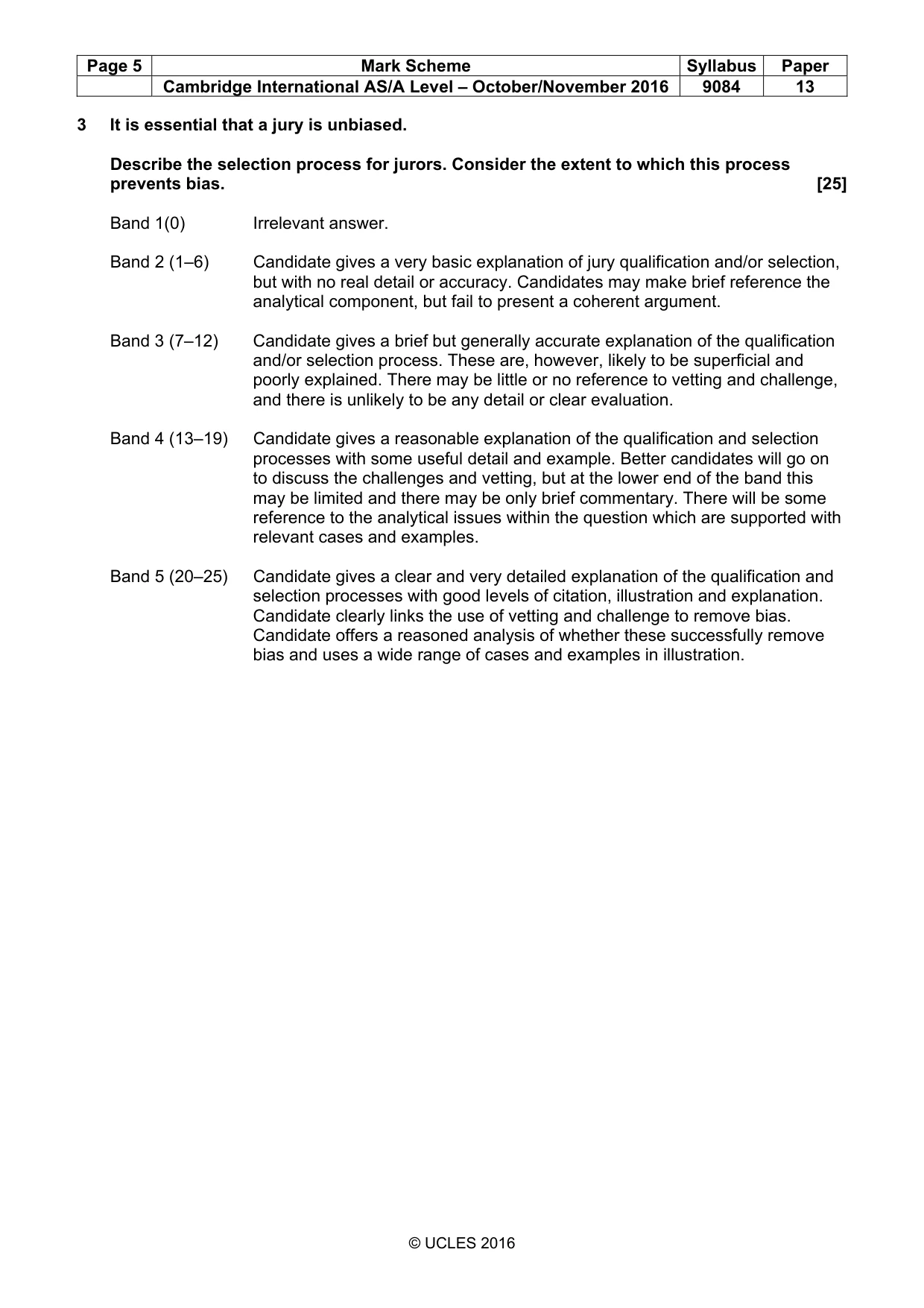
Page 5 Mark Scheme Syllabus Paper Cambridge International AS/A Level – October/November 2016 9084 13 © UCLES 2016 3 It is essential that a jury is unbiased. Describe the selection process for jurors. Consider the extent to which this process prevents bias. [25] Band 1(0) Irrelevant answer. Band 2 (1–6) Candidate gives a very basic explanation of jury qualification and/or selection, but with no real detail or accuracy. Candidates may make brief reference the analytical component, but fail to present a coherent argument. Band 3 (7–12) Candidate gives a brief but generally accurate explanation of the qualification and/or selection process. These are, however, likely to be superficial and poorly explained. There may be little or no reference to vetting and challenge, and there is unlikely to be any detail or clear evaluation. Band 4 (13–19) Candidate gives a reasonable explanation of the qualification and selection processes with some useful detail and example. Better candidates will go on to discuss the challenges and vetting, but at the lower end of the band this may be limited and there may be only brief commentary. There will be some reference to the analytical issues within the question which are supported with relevant cases and examples. Band 5 (20–25) Candidate gives a clear and very detailed explanation of the qualification and selection processes with good levels of citation, illustration and explanation. Candidate clearly links the use of vetting and challenge to remove bias. Candidate offers a reasoned analysis of whether these successfully remove bias and uses a wide range of cases and examples in illustration.
Mark scheme, page 6
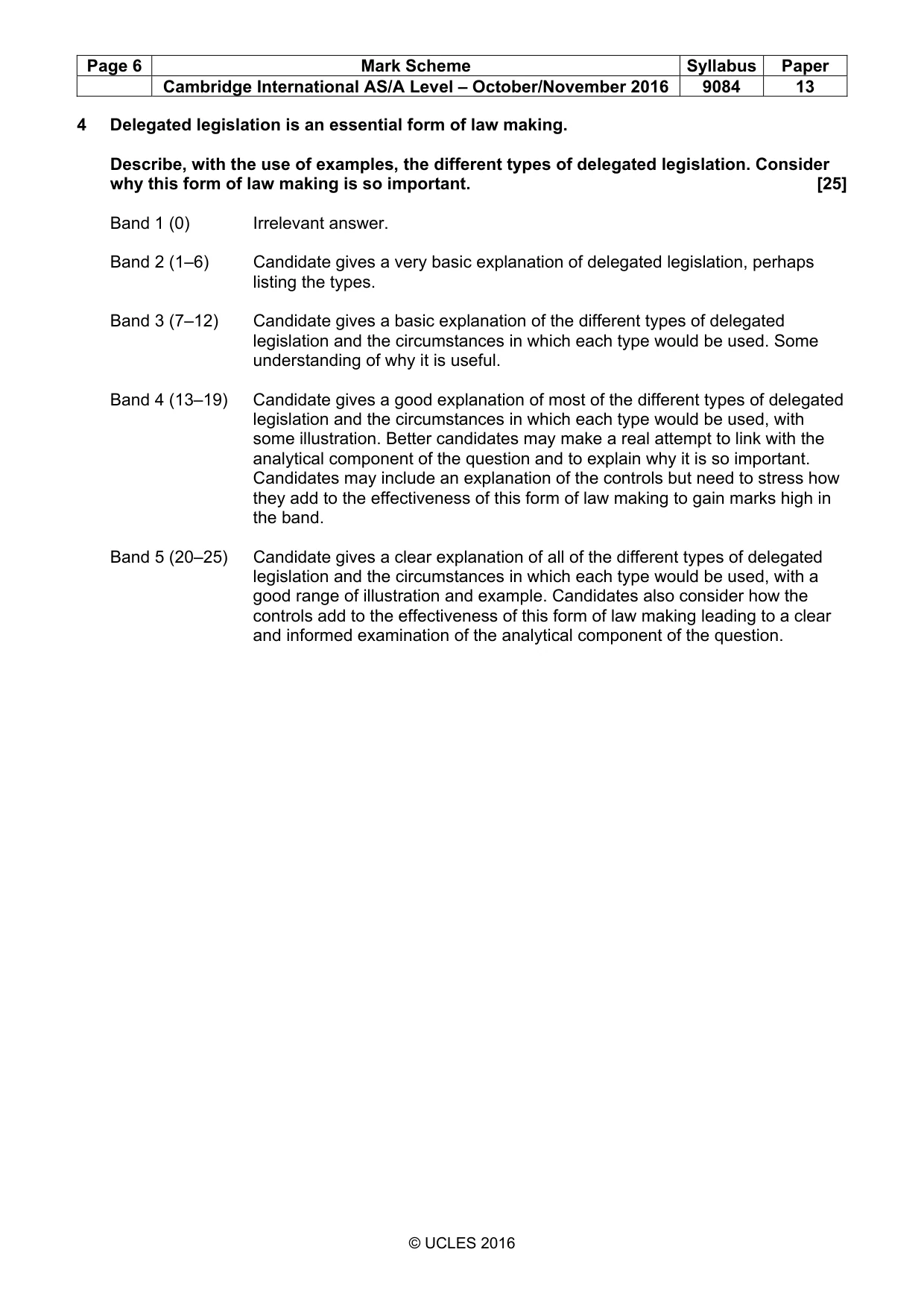
Page 6 Mark Scheme Syllabus Paper Cambridge International AS/A Level – October/November 2016 9084 13 © UCLES 2016 4 Delegated legislation is an essential form of law making. Describe, with the use of examples, the different types of delegated legislation. Consider why this form of law making is so important. [25] Band 1 (0) Irrelevant answer. Band 2 (1–6) Candidate gives a very basic explanation of delegated legislation, perhaps listing the types. Band 3 (7–12) Candidate gives a basic explanation of the different types of delegated legislation and the circumstances in which each type would be used. Some understanding of why it is useful. Band 4 (13–19) Candidate gives a good explanation of most of the different types of delegated legislation and the circumstances in which each type would be used, with some illustration. Better candidates may make a real attempt to link with the analytical component of the question and to explain why it is so important. Candidates may include an explanation of the controls but need to stress how they add to the effectiveness of this form of law making to gain marks high in the band. Band 5 (20–25) Candidate gives a clear explanation of all of the different types of delegated legislation and the circumstances in which each type would be used, with a good range of illustration and example. Candidates also consider how the controls add to the effectiveness of this form of law making leading to a clear and informed examination of the analytical component of the question.
Mark scheme, page 7
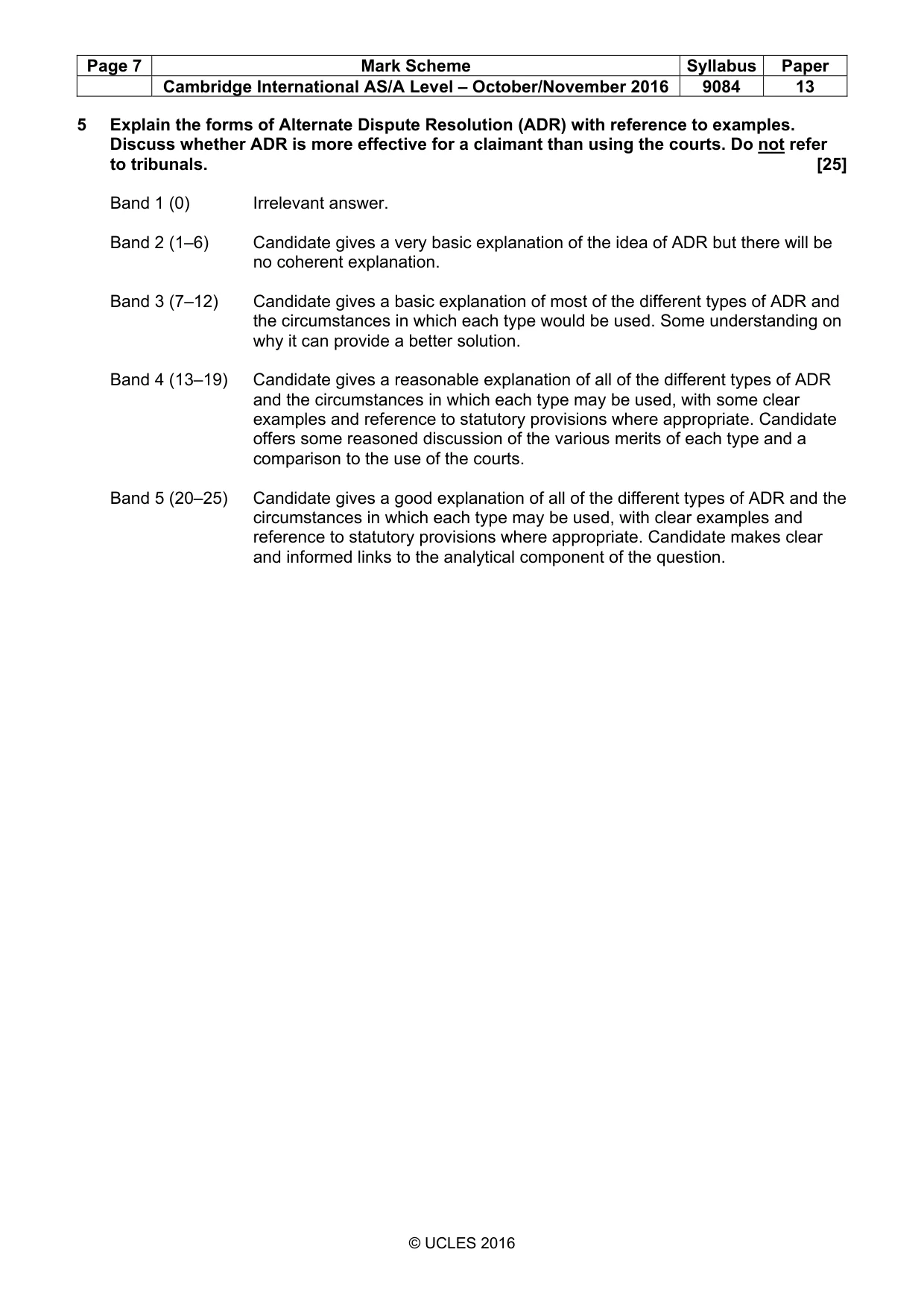
Page 7 Mark Scheme Syllabus Paper Cambridge International AS/A Level – October/November 2016 9084 13 © UCLES 2016 5 Explain the forms of Alternate Dispute Resolution (ADR) with reference to examples. Discuss whether ADR is more effective for a claimant than using the courts. Do not refer to tribunals. [25] Band 1 (0) Irrelevant answer. Band 2 (1–6) Candidate gives a very basic explanation of the idea of ADR but there will be no coherent explanation. Band 3 (7–12) Candidate gives a basic explanation of most of the different types of ADR and the circumstances in which each type would be used. Some understanding on why it can provide a better solution. Band 4 (13–19) Candidate gives a reasonable explanation of all of the different types of ADR and the circumstances in which each type may be used, with some clear examples and reference to statutory provisions where appropriate. Candidate offers some reasoned discussion of the various merits of each type and a comparison to the use of the courts. Band 5 (20–25) Candidate gives a good explanation of all of the different types of ADR and the circumstances in which each type may be used, with clear examples and reference to statutory provisions where appropriate. Candidate makes clear and informed links to the analytical component of the question.
Mark scheme, page 8
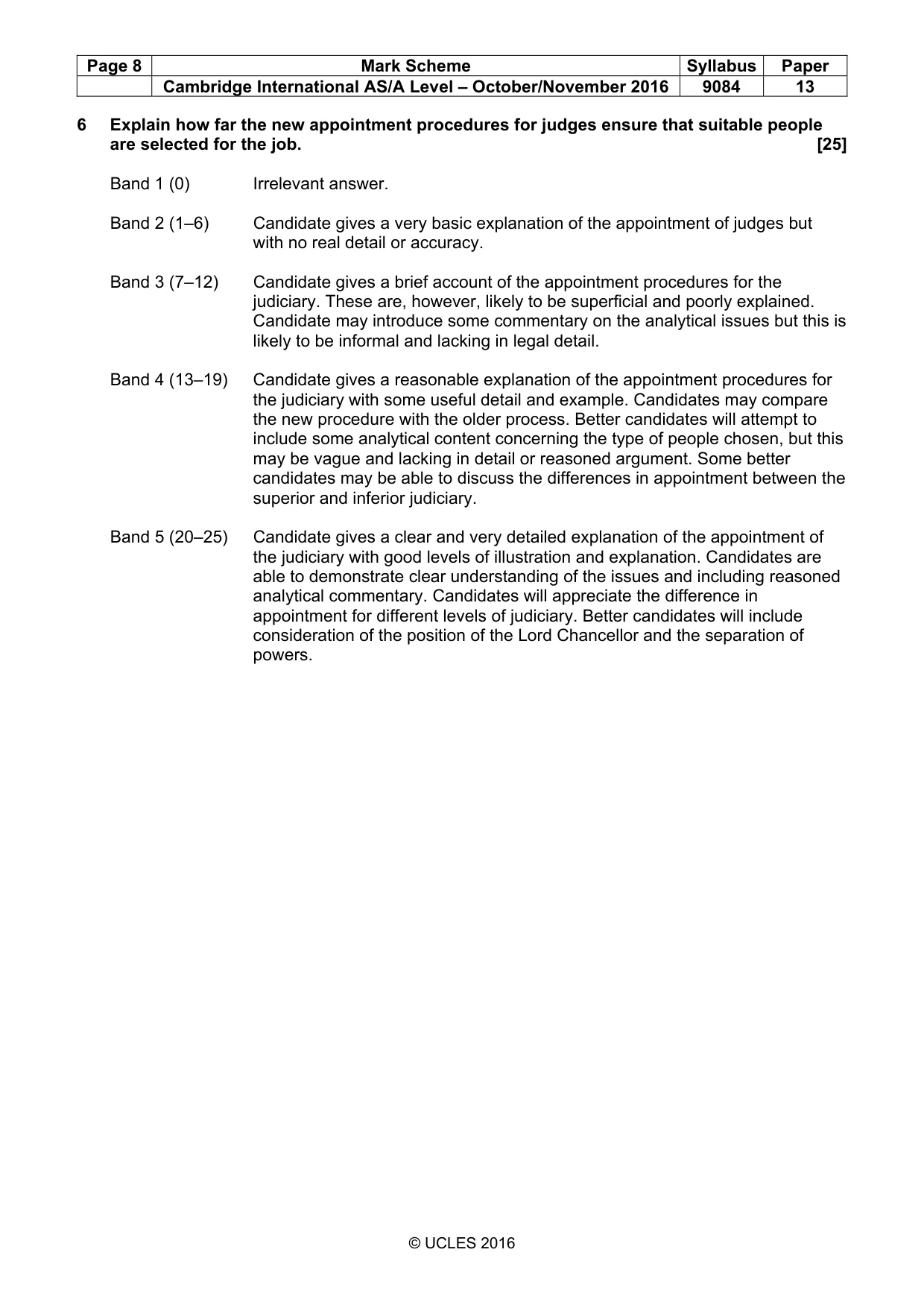
Page 8 Mark Scheme Syllabus Paper Cambridge International AS/A Level – October/November 2016 9084 13 © UCLES 2016 6 Explain how far the new appointment procedures for judges ensure that suitable people are selected for the job. [25] Band 1 (0) Irrelevant answer. Band 2 (1–6) Candidate gives a very basic explanation of the appointment of judges but with no real detail or accuracy. Band 3 (7–12) Candidate gives a brief account of the appointment procedures for the judiciary. These are, however, likely to be superficial and poorly explained. Candidate may introduce some commentary on the analytical issues but this is likely to be informal and lacking in legal detail. Band 4 (13–19) Candidate gives a reasonable explanation of the appointment procedures for the judiciary with some useful detail and example. Candidates may compare the new procedure with the older process. Better candidates will attempt to include some analytical content concerning the type of people chosen, but this may be vague and lacking in detail or reasoned argument. Some better candidates may be able to discuss the differences in appointment between the superior and inferior judiciary. Band 5 (20–25) Candidate gives a clear and very detailed explanation of the appointment of the judiciary with good levels of illustration and explanation. Candidates are able to demonstrate clear understanding of the issues and including reasoned analytical commentary. Candidates will appreciate the difference in appointment for different levels of judiciary. Better candidates will include consideration of the position of the Lord Chancellor and the separation of powers.