Cambridge A Level Law 9084 — 2015 May/June Paper 4 · Variant 1
9084/41/M/J/15 · 75 marks · ≈84 min
The question paper and its mark scheme, free to read here and free to download. This is Cambridge’s own paper, exactly as it was sat.
Question paper4 pages
Mark scheme5 pages
Answers below. Sit the paper first if you are practising.
Paper as text
Question paper, page 1
This document consists of 3 printed pages and 1 blank page. DC (CW) 101020/1 © UCLES 2015 [Turn over * 7 0 2 8 8 2 4 2 2 3 * LAW 9084/41 Paper 4 Law of Tort May/June 2015 1 hour 30 minutes Additional Materials: Answer Booklet/Paper READ THESE INSTRUCTIONS FIRST If you have been given an Answer Booklet, follow the instructions on the front cover of the Booklet. Write your Centre number, candidate number and name on all the work you hand in. Write in dark blue or black pen. Do not use staples, paper clips, glue or correction fluid. Answer one question from Section A, one from Section B and one other, thus making a total of three responses required. At the end of the examination, fasten all your work securely together. The number of marks is given in brackets [ ] at the end of each question or part question. Cambridge International Examinations Cambridge International Advanced Subsidiary and Advanced Level
Question paper, page 2
2 9084/41/M/J/15 © UCLES 2015 Candidates must attempt one question from Section A, one from Section B and one other, thus making a total of three responses required. Section A 1 In cases involving nervous shock, special rules exist to restrict the number of potential claims. Critically assess the extent to which you agree with this statement. [25] 2 With reference to decided case law, critically analyse the operation of the defence of volenti non fit injuria (consent) in relation to trespass to the person. [25] 3 The aim of the compensation award in tort is expressed in the maxim restitutio in integrum (restitution in full). Critically examine the extent to which this aim is achieved. [25]
Question paper, page 3
3 9084/41/M/J/15 © UCLES 2015 Section B 4 Pierre drives to work and stops at a shop in order to buy some food. As he is in a hurry he leaves the key in the ignition and runs inside. While he is in the shop someone gets into his car and drives off at speed. The car is then involved in a collision in which Yves is knocked down whilst using a pedestrian crossing. The person who took the car runs from the scene and cannot be traced. Yves is taken to the emergency department of the local hospital, where he is examined by Henri, a junior doctor. Henri tells Yves that he is suffering from bruising and sends him home with medication for his pain. Yves’ pain gets worse and he returns to the hospital the following day where another doctor diagnoses a serious neck injury. Advise Yves as to the liability in negligence of Pierre, Henri and the hospital. [25] 5 Adam buys two cars with which to operate a taxi business from his home. He hires a number of drivers to operate the taxis which are collected from Adam’s home and returned late at night. This causes some disturbance to Adam’s neighbour Frank as he is frequently awoken by noise when the cars are returned. Adam also stores fuel for the cars in his garden shed. Frank complains to Adam about the strong smell of the fuel and the fact that it has leaked into his garden, killing his vegetables and flowers. Advise Frank as to the likely success of any actions brought against Adam and the remedies which might be granted by the court. [25] 6 Anil owns and runs a small hotel. During a storm a number of roof tiles fall, causing injury to Pravin, a guest at the hotel. Anil hires David, a roofing contractor, to carry out repairs. When the work is finished, Anil looks at the roof and the job appears to have been well done. However David had used the wrong type of nails to secure the tiles. A month later, tiles fall from the roof repaired by David. Nadia, a member of the hotel staff, is injured and her car is also damaged. Assess Anil’s liability as the occupier of the hotel to Pravin and Nadia. [25]
Question paper, page 4
4 9084/41/M/J/15 © UCLES 2015 BLANK PAGE Permission to reproduce items where third-party owned material protected by copyright is included has been sought and cleared where possible. Every reasonable effort has been made by the publisher (UCLES) to trace copyright holders, but if any items requiring clearance have unwittingly been included, the publisher will be pleased to make amends at the earliest possible opportunity. To avoid the issue of disclosure of answer-related information to candidates, all copyright acknowledgements are reproduced online in the Cambridge International Examinations Copyright Acknowledgements Booklet. This is produced for each series of examinations and is freely available to download at www.cie.org.uk after the live examination series. Cambridge International Examinations is part of the Cambridge Assessment Group. Cambridge Assessment is the brand name of University of Cambridge Local Examinations Syndicate (UCLES), which is itself a department of the University of Cambridge.
Mark scheme, page 1
® IGCSE is the registered trademark of Cambridge International Examinations. CAMBRIDGE INTERNATIONAL EXAMINATIONS Cambridge International Advanced Level MARK SCHEME for the May/June 2015 series 9084 LAW 9084/41 Paper 4 , maximum raw mark 75 This mark scheme is published as an aid to teachers and candidates, to indicate the requirements of the examination. It shows the basis on which Examiners were instructed to award marks. It does not indicate the details of the discussions that took place at an Examiners’ meeting before marking began, which would have considered the acceptability of alternative answers. Mark schemes should be read in conjunction with the question paper and the Principal Examiner Report for Teachers. Cambridge will not enter into discussions about these mark schemes. Cambridge is publishing the mark schemes for the May/June 2015 series for most Cambridge IGCSE®, Cambridge International A and AS Level components and some Cambridge O Level components.
Mark scheme, page 2
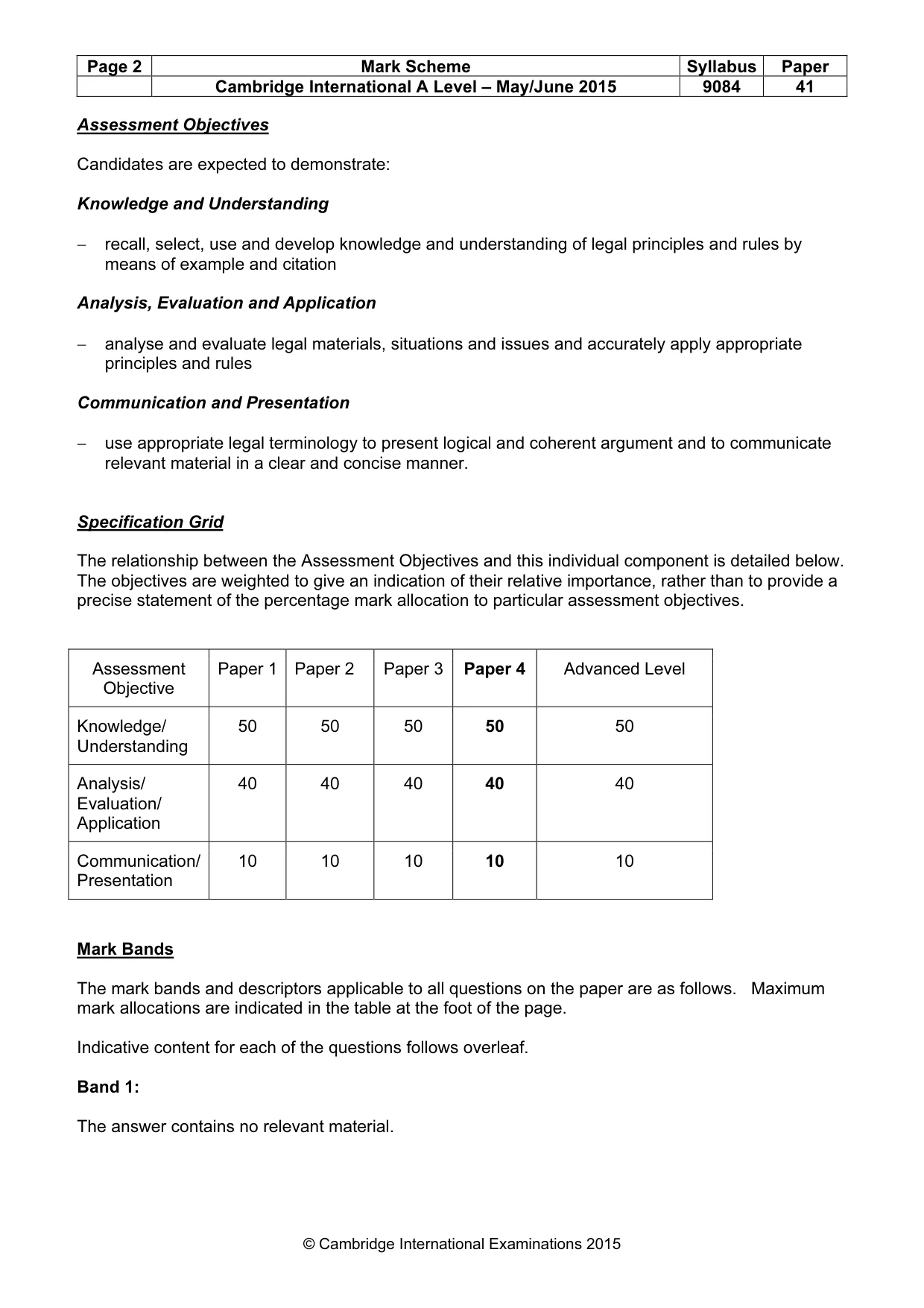
Page 2 Mark Scheme Syllabus Paper Cambridge International A Level – May/June 2015 9084 41 © Cambridge International Examinations 2015 Assessment Objectives Candidates are expected to demonstrate: Knowledge and Understanding − recall, select, use and develop knowledge and understanding of legal principles and rules by means of example and citation Analysis, Evaluation and Application − analyse and evaluate legal materials, situations and issues and accurately apply appropriate principles and rules Communication and Presentation − use appropriate legal terminology to present logical and coherent argument and to communicate relevant material in a clear and concise manner. Specification Grid The relationship between the Assessment Objectives and this individual component is detailed below. The objectives are weighted to give an indication of their relative importance, rather than to provide a precise statement of the percentage mark allocation to particular assessment objectives. Assessment Objective Paper 1 Paper 2 Paper 3 Paper 4 Advanced Level Knowledge/ Understanding 50 50 50 50 50 Analysis/ Evaluation/ Application 40 40 40 40 40 Communication/ Presentation 10 10 10 10 10 Mark Bands The mark bands and descriptors applicable to all questions on the paper are as follows. Maximum mark allocations are indicated in the table at the foot of the page. Indicative content for each of the questions follows overleaf. Band 1: The answer contains no relevant material.
Mark scheme, page 3
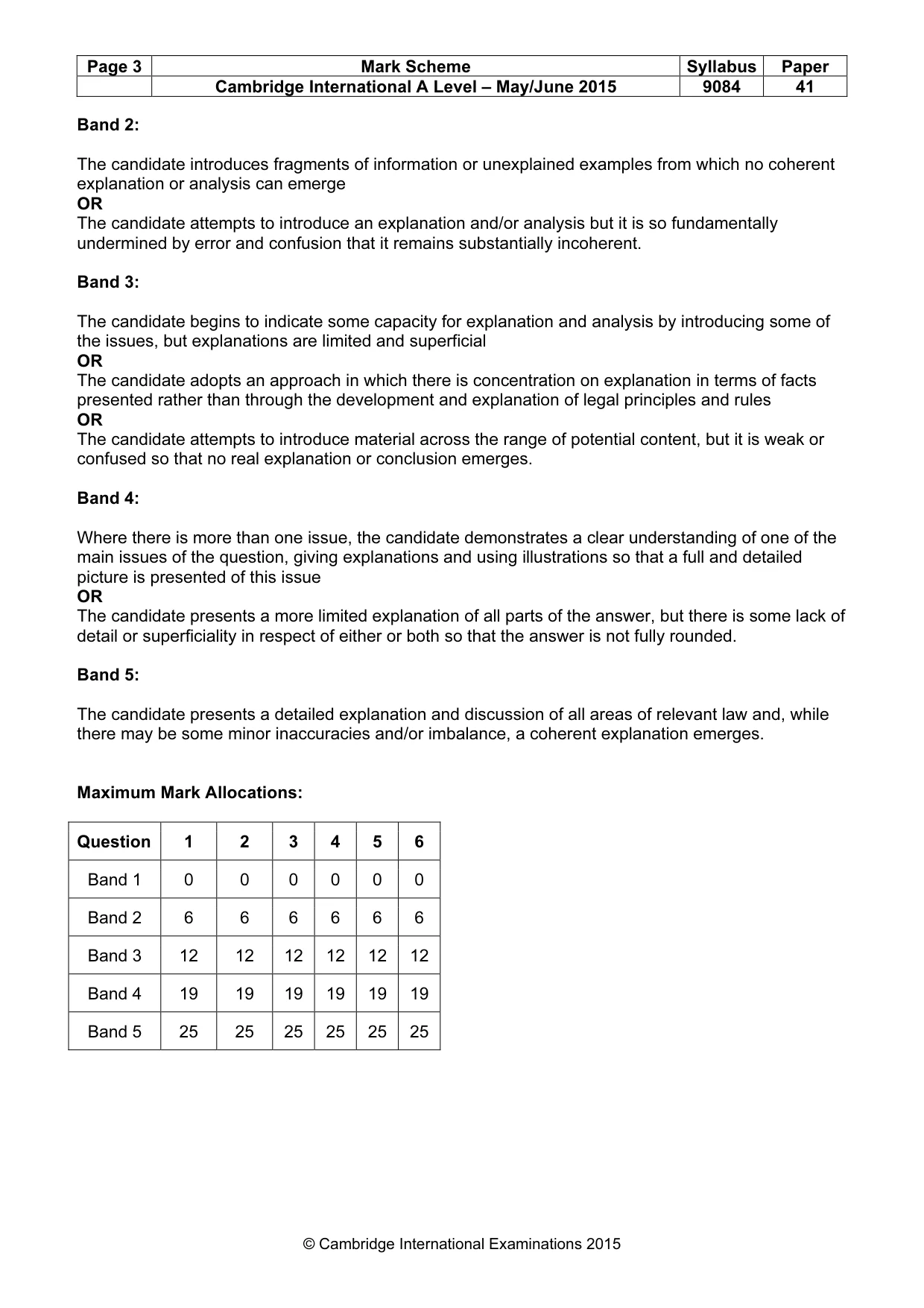
Page 3 Mark Scheme Syllabus Paper Cambridge International A Level – May/June 2015 9084 41 © Cambridge International Examinations 2015 Band 2: The candidate introduces fragments of information or unexplained examples from which no coherent explanation or analysis can emerge OR The candidate attempts to introduce an explanation and/or analysis but it is so fundamentally undermined by error and confusion that it remains substantially incoherent. Band 3: The candidate begins to indicate some capacity for explanation and analysis by introducing some of the issues, but explanations are limited and superficial OR The candidate adopts an approach in which there is concentration on explanation in terms of facts presented rather than through the development and explanation of legal principles and rules OR The candidate attempts to introduce material across the range of potential content, but it is weak or confused so that no real explanation or conclusion emerges. Band 4: Where there is more than one issue, the candidate demonstrates a clear understanding of one of the main issues of the question, giving explanations and using illustrations so that a full and detailed picture is presented of this issue OR The candidate presents a more limited explanation of all parts of the answer, but there is some lack of detail or superficiality in respect of either or both so that the answer is not fully rounded. Band 5: The candidate presents a detailed explanation and discussion of all areas of relevant law and, while there may be some minor inaccuracies and/or imbalance, a coherent explanation emerges. Maximum Mark Allocations: Question 1 2 3 4 5 6 Band 1 0 0 0 0 0 0 Band 2 6 6 6 6 6 6 Band 3 12 12 12 12 12 12 Band 4 19 19 19 19 19 19 Band 5 25 25 25 25 25 25
Mark scheme, page 4
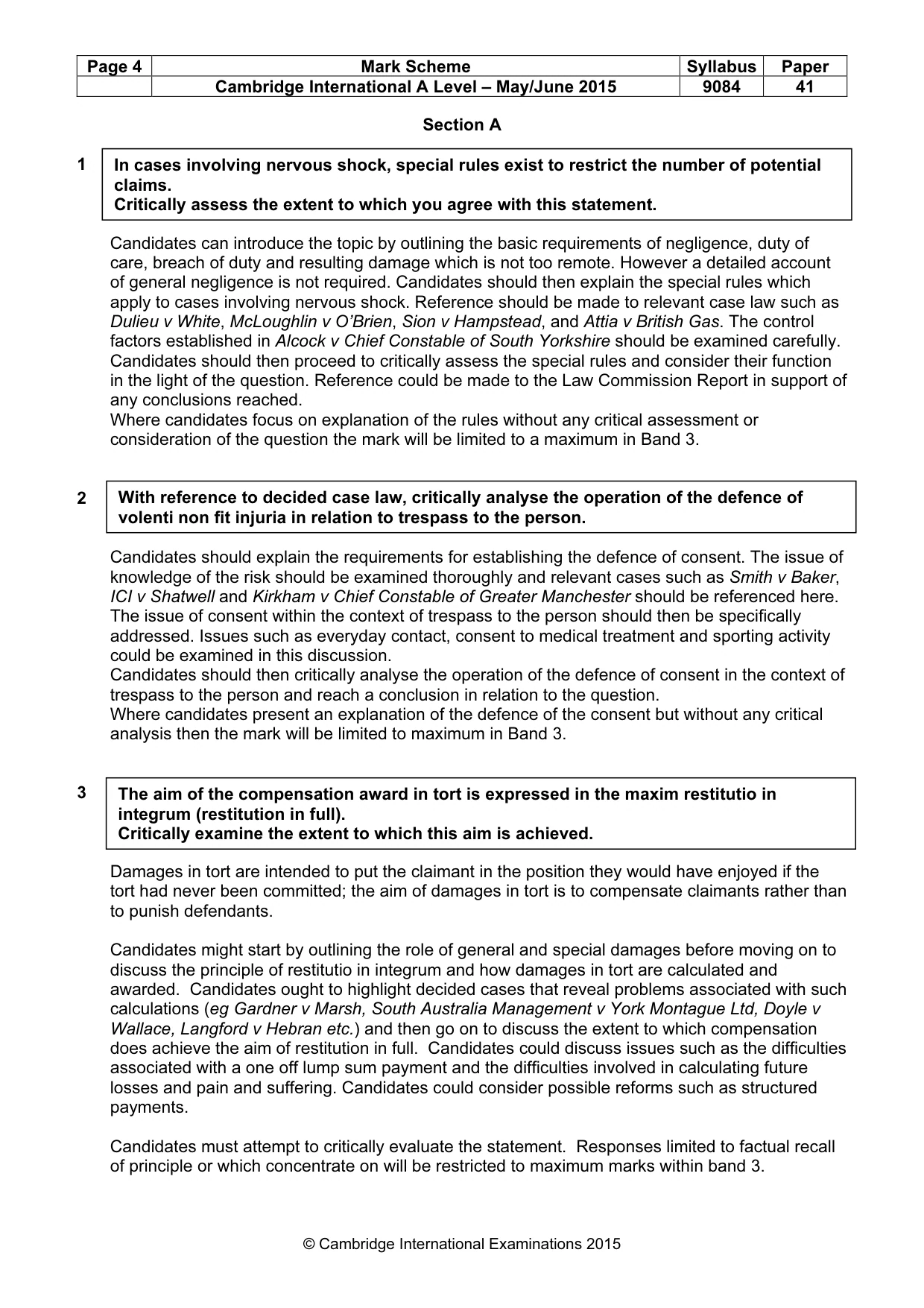
Page 4 Mark Scheme Syllabus Paper Cambridge International A Level – May/June 2015 9084 41 © Cambridge International Examinations 2015 Section A 1 Candidates can introduce the topic by outlining the basic requirements of negligence, duty of care, breach of duty and resulting damage which is not too remote. However a detailed account of general negligence is not required. Candidates should then explain the special rules which apply to cases involving nervous shock. Reference should be made to relevant case law such as Dulieu v White, McLoughlin v O’Brien, Sion v Hampstead, and Attia v British Gas. The control factors established in Alcock v Chief Constable of South Yorkshire should be examined carefully. Candidates should then proceed to critically assess the special rules and consider their function in the light of the question. Reference could be made to the Law Commission Report in support of any conclusions reached. Where candidates focus on explanation of the rules without any critical assessment or consideration of the question the mark will be limited to a maximum in Band 3. 2 Candidates should explain the requirements for establishing the defence of consent. The issue of knowledge of the risk should be examined thoroughly and relevant cases such as Smith v Baker, ICI v Shatwell and Kirkham v Chief Constable of Greater Manchester should be referenced here. The issue of consent within the context of trespass to the person should then be specifically addressed. Issues such as everyday contact, consent to medical treatment and sporting activity could be examined in this discussion. Candidates should then critically analyse the operation of the defence of consent in the context of trespass to the person and reach a conclusion in relation to the question. Where candidates present an explanation of the defence of the consent but without any critical analysis then the mark will be limited to maximum in Band 3. 3 Damages in tort are intended to put the claimant in the position they would have enjoyed if the tort had never been committed; the aim of damages in tort is to compensate claimants rather than to punish defendants. Candidates might start by outlining the role of general and special damages before moving on to discuss the principle of restitutio in integrum and how damages in tort are calculated and awarded. Candidates ought to highlight decided cases that reveal problems associated with such calculations (eg Gardner v Marsh, South Australia Management v York Montague Ltd, Doyle v Wallace, Langford v Hebran etc.) and then go on to discuss the extent to which compensation does achieve the aim of restitution in full. Candidates could discuss issues such as the difficulties associated with a one off lump sum payment and the difficulties involved in calculating future losses and pain and suffering. Candidates could consider possible reforms such as structured payments. Candidates must attempt to critically evaluate the statement. Responses limited to factual recall of principle or which concentrate on will be restricted to maximum marks within band 3. In cases involving nervous shock, special rules exist to restrict the number of potential claims. Critically assess the extent to which you agree with this statement. With reference to decided case law, critically analyse the operation of the defence of volenti non fit injuria in relation to trespass to the person. The aim of the compensation award in tort is expressed in the maxim restitutio in integrum (restitution in full). Critically examine the extent to which this aim is achieved.
Mark scheme, page 5
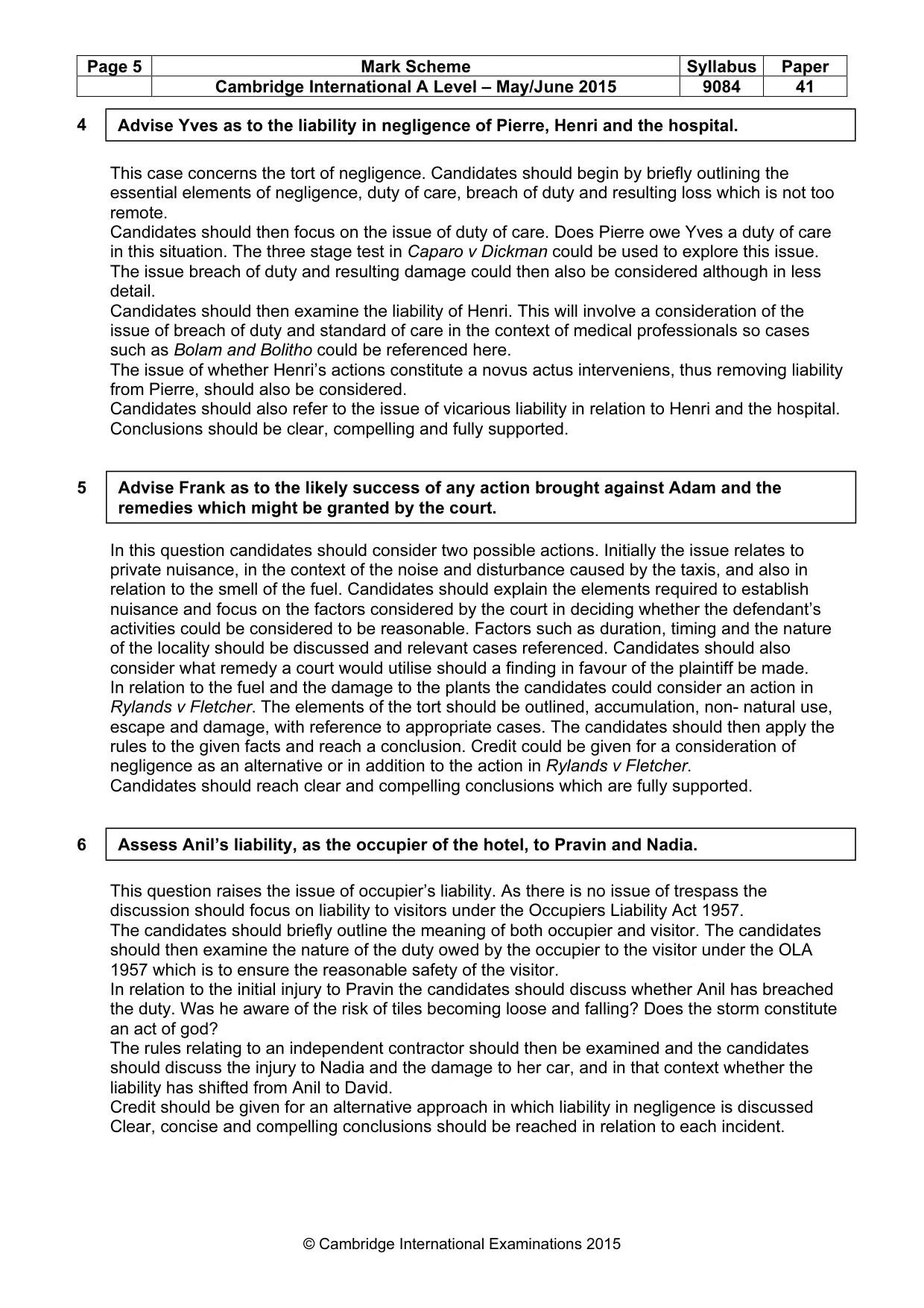
Page 5 Mark Scheme Syllabus Paper Cambridge International A Level – May/June 2015 9084 41 © Cambridge International Examinations 2015 4 This case concerns the tort of negligence. Candidates should begin by briefly outlining the essential elements of negligence, duty of care, breach of duty and resulting loss which is not too remote. Candidates should then focus on the issue of duty of care. Does Pierre owe Yves a duty of care in this situation. The three stage test in Caparo v Dickman could be used to explore this issue. The issue breach of duty and resulting damage could then also be considered although in less detail. Candidates should then examine the liability of Henri. This will involve a consideration of the issue of breach of duty and standard of care in the context of medical professionals so cases such as Bolam and Bolitho could be referenced here. The issue of whether Henri’s actions constitute a novus actus interveniens, thus removing liability from Pierre, should also be considered. Candidates should also refer to the issue of vicarious liability in relation to Henri and the hospital. Conclusions should be clear, compelling and fully supported. 5 In this question candidates should consider two possible actions. Initially the issue relates to private nuisance, in the context of the noise and disturbance caused by the taxis, and also in relation to the smell of the fuel. Candidates should explain the elements required to establish nuisance and focus on the factors considered by the court in deciding whether the defendant’s activities could be considered to be reasonable. Factors such as duration, timing and the nature of the locality should be discussed and relevant cases referenced. Candidates should also consider what remedy a court would utilise should a finding in favour of the plaintiff be made. In relation to the fuel and the damage to the plants the candidates could consider an action in Rylands v Fletcher. The elements of the tort should be outlined, accumulation, non- natural use, escape and damage, with reference to appropriate cases. The candidates should then apply the rules to the given facts and reach a conclusion. Credit could be given for a consideration of negligence as an alternative or in addition to the action in Rylands v Fletcher. Candidates should reach clear and compelling conclusions which are fully supported. 6 This question raises the issue of occupier’s liability. As there is no issue of trespass the discussion should focus on liability to visitors under the Occupiers Liability Act 1957. The candidates should briefly outline the meaning of both occupier and visitor. The candidates should then examine the nature of the duty owed by the occupier to the visitor under the OLA 1957 which is to ensure the reasonable safety of the visitor. In relation to the initial injury to Pravin the candidates should discuss whether Anil has breached the duty. Was he aware of the risk of tiles becoming loose and falling? Does the storm constitute an act of god? The rules relating to an independent contractor should then be examined and the candidates should discuss the injury to Nadia and the damage to her car, and in that context whether the liability has shifted from Anil to David. Credit should be given for an alternative approach in which liability in negligence is discussed Clear, concise and compelling conclusions should be reached in relation to each incident. Advise Yves as to the liability in negligence of Pierre, Henri and the hospital. Advise Frank as to the likely success of any action brought against Adam and the remedies which might be granted by the court. Assess Anil’s liability, as the occupier of the hotel, to Pravin and Nadia.
What you needed in this session
Cambridge’s own grade thresholds for 2015 May/June, Paper 4 · Variant 1. A higher threshold means an easier paper — the bar moves with how the cohort did.