Cambridge A Level Law 9084 — 2023 May/June Paper 4 · Variant 1
9084/41/M/J/23 · 75 marks · ≈84 min
The question paper and its mark scheme, free to read here and free to download. This is Cambridge’s own paper, exactly as it was sat.
Question paper4 pages

Mark scheme13 pages
Answers below. Sit the paper first if you are practising.
Paper as text
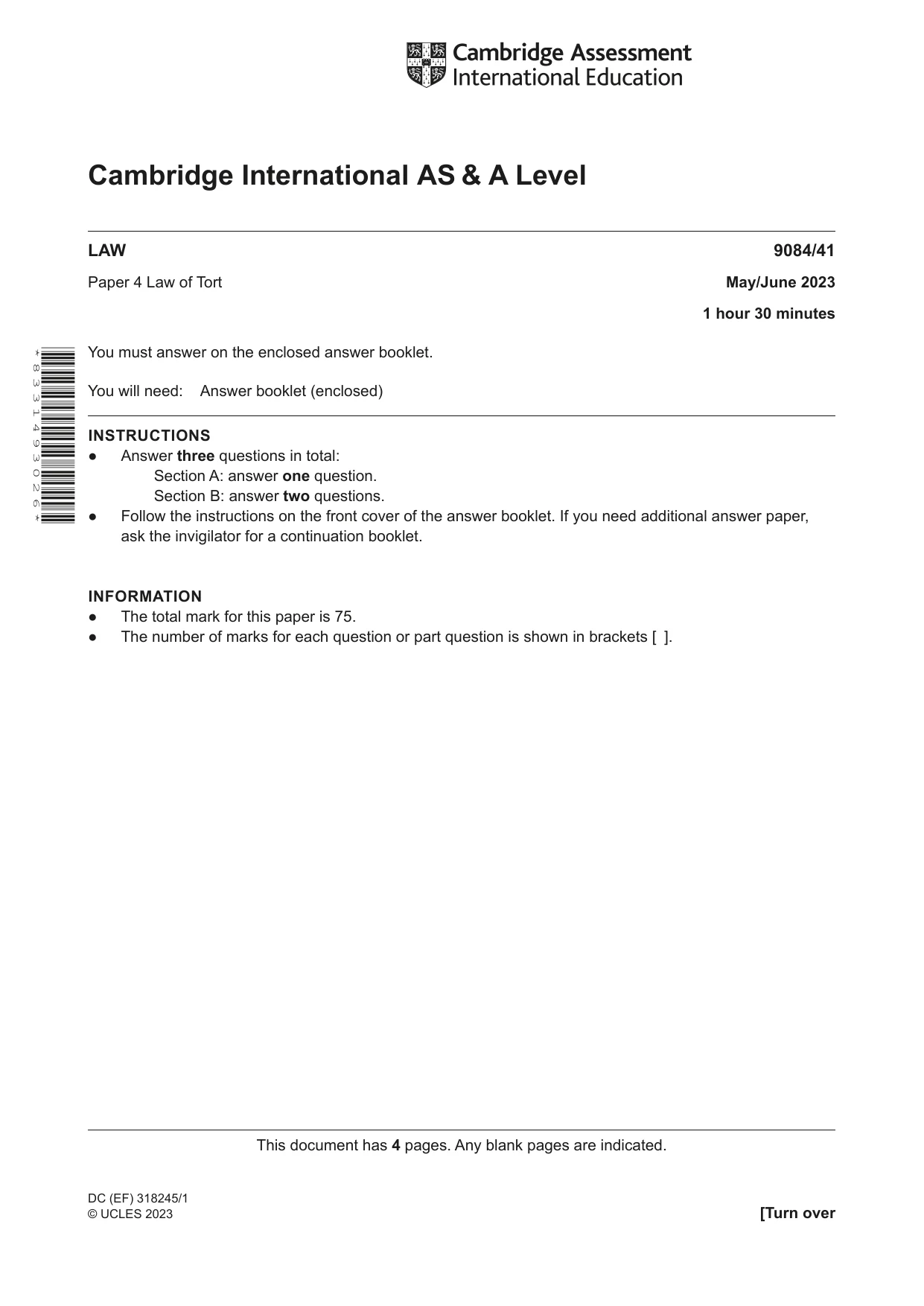
Question paper, page 1
This document has 4 pages. Any blank pages are indicated. [Turn over Cambridge International AS & A Level DC (EF) 318245/1 © UCLES 2023 * 8 3 3 1 4 9 3 0 2 6 * LAW 9084/41 Paper 4 Law of Tort May/June 2023 1 hour 30 minutes You must answer on the enclosed answer booklet. You will need: Answer booklet (enclosed) INSTRUCTIONS ● Answer three questions in total: Section A: answer one question. Section B: answer two questions. ● Follow the instructions on the front cover of the answer booklet. If you need additional answer paper, ask the invigilator for a continuation booklet. INFORMATION ● The total mark for this paper is 75. ● The number of marks for each question or part question is shown in brackets [ ].
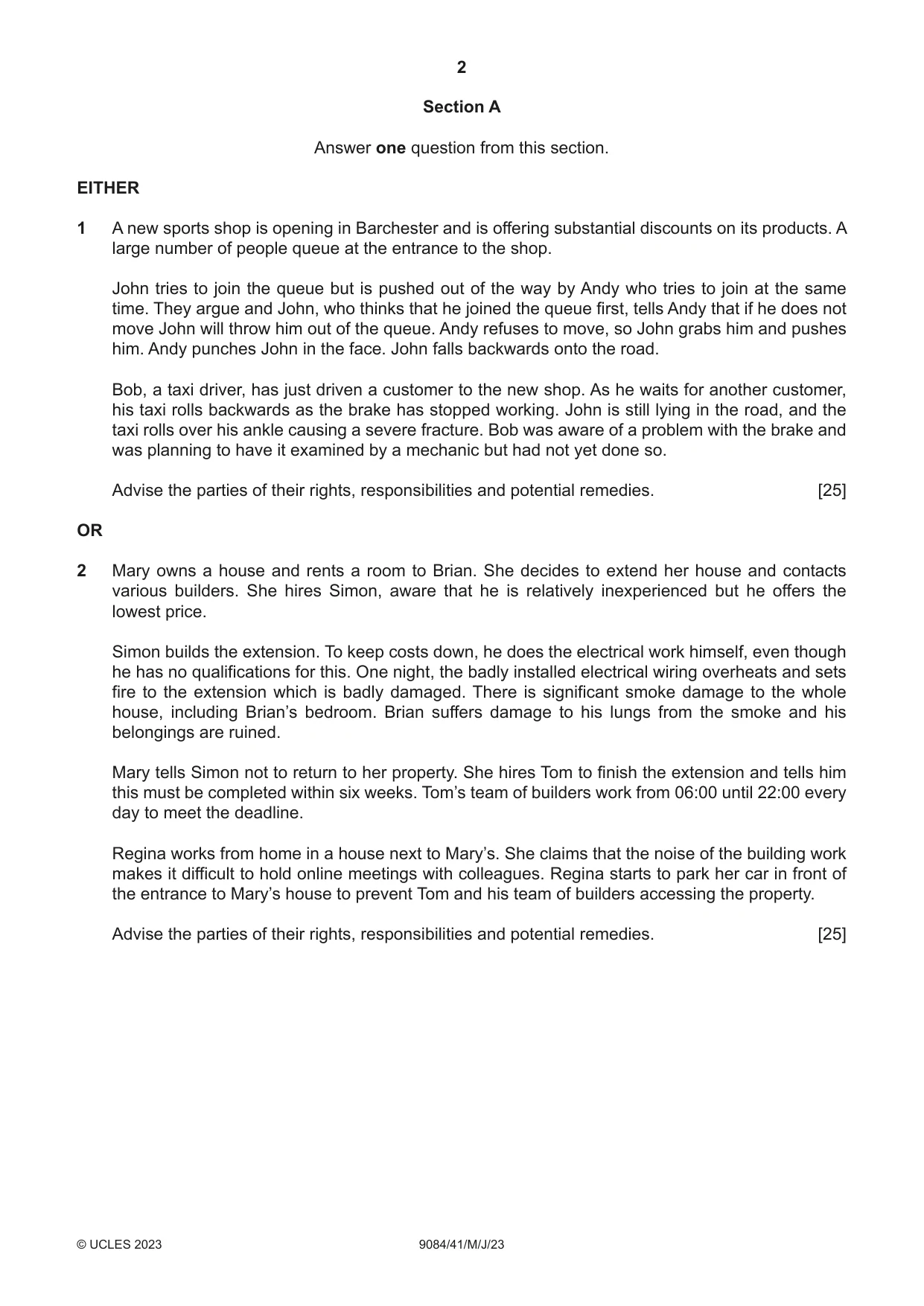
Question paper, page 2
2 9084/41/M/J/23 © UCLES 2023 Section A Answer one question from this section. EITHER 1 A new sports shop is opening in Barchester and is offering substantial discounts on its products. A large number of people queue at the entrance to the shop. John tries to join the queue but is pushed out of the way by Andy who tries to join at the same time. They argue and John, who thinks that he joined the queue first, tells Andy that if he does not move John will throw him out of the queue. Andy refuses to move, so John grabs him and pushes him. Andy punches John in the face. John falls backwards onto the road. Bob, a taxi driver, has just driven a customer to the new shop. As he waits for another customer, his taxi rolls backwards as the brake has stopped working. John is still lying in the road, and the taxi rolls over his ankle causing a severe fracture. Bob was aware of a problem with the brake and was planning to have it examined by a mechanic but had not yet done so. Advise the parties of their rights, responsibilities and potential remedies. [25] OR 2 Mary owns a house and rents a room to Brian. She decides to extend her house and contacts various builders. She hires Simon, aware that he is relatively inexperienced but he offers the lowest price. Simon builds the extension. To keep costs down, he does the electrical work himself, even though he has no qualifications for this. One night, the badly installed electrical wiring overheats and sets fire to the extension which is badly damaged. There is significant smoke damage to the whole house, including Brian’s bedroom. Brian suffers damage to his lungs from the smoke and his belongings are ruined. Mary tells Simon not to return to her property. She hires Tom to finish the extension and tells him this must be completed within six weeks. Tom’s team of builders work from 06:00 until 22:00 every day to meet the deadline. Regina works from home in a house next to Mary’s. She claims that the noise of the building work makes it difficult to hold online meetings with colleagues. Regina starts to park her car in front of the entrance to Mary’s house to prevent Tom and his team of builders accessing the property. Advise the parties of their rights, responsibilities and potential remedies. [25]
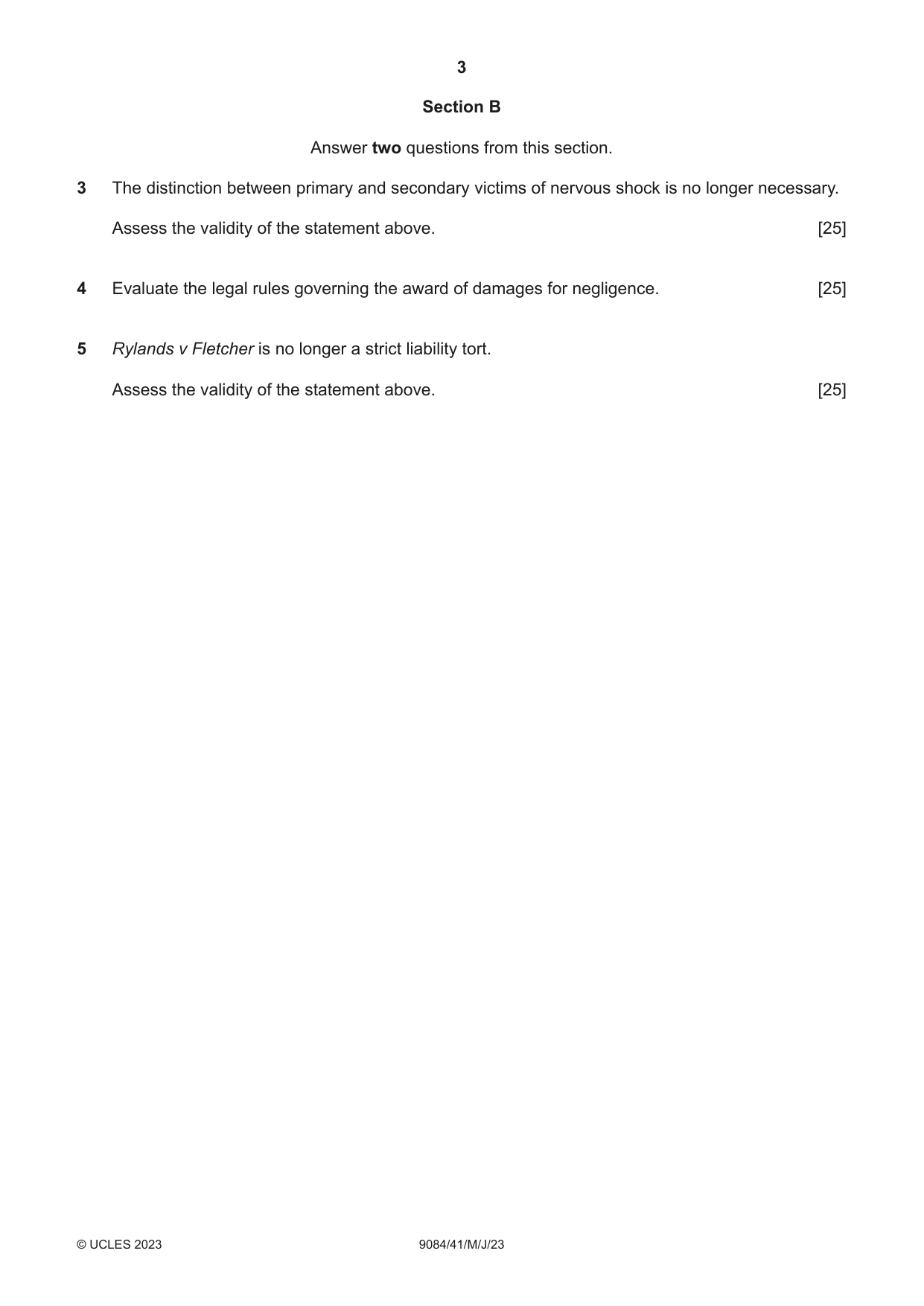
Question paper, page 3
3 9084/41/M/J/23 © UCLES 2023 Section B Answer two questions from this section. 3 The distinction between primary and secondary victims of nervous shock is no longer necessary. Assess the validity of the statement above. [25] 4 Evaluate the legal rules governing the award of damages for negligence. [25] 5 Rylands v Fletcher is no longer a strict liability tort. Assess the validity of the statement above. [25]
Question paper, page 4
4 9084/41/M/J/23 © UCLES 2023 Permission to reproduce items where third-party owned material protected by copyright is included has been sought and cleared where possible. Every reasonable effort has been made by the publisher (UCLES) to trace copyright holders, but if any items requiring clearance have unwittingly been included, the publisher will be pleased to make amends at the earliest possible opportunity. To avoid the issue of disclosure of answer-related information to candidates, all copyright acknowledgements are reproduced online in the Cambridge Assessment International Education Copyright Acknowledgements Booklet. This is produced for each series of examinations and is freely available to download at www.cambridgeinternational.org after the live examination series. Cambridge Assessment International Education is part of Cambridge Assessment. Cambridge Assessment is the brand name of the University of Cambridge Local Examinations Syndicate (UCLES), which is a department of the University of Cambridge. BLANK PAGE
Mark scheme, page 1
This document consists of 13 printed pages. © UCLES 2023 [Turn over Cambridge International AS & A Level LAW 9084/41 Paper 4 May/June 2023 MARK SCHEME Maximum Mark: 75 Published This mark scheme is published as an aid to teachers and candidates, to indicate the requirements of the examination. It shows the basis on which Examiners were instructed to award marks. It does not indicate the details of the discussions that took place at an Examiners’ meeting before marking began, which would have considered the acceptability of alternative answers. Mark schemes should be read in conjunction with the question paper and the Principal Examiner Report for Teachers. Cambridge International will not enter into discussions about these mark schemes. Cambridge International is publishing the mark schemes for the May/June 2023 series for most Cambridge IGCSE, Cambridge International A and AS Level and Cambridge Pre-U components, and some Cambridge O Level components.
Mark scheme, page 2
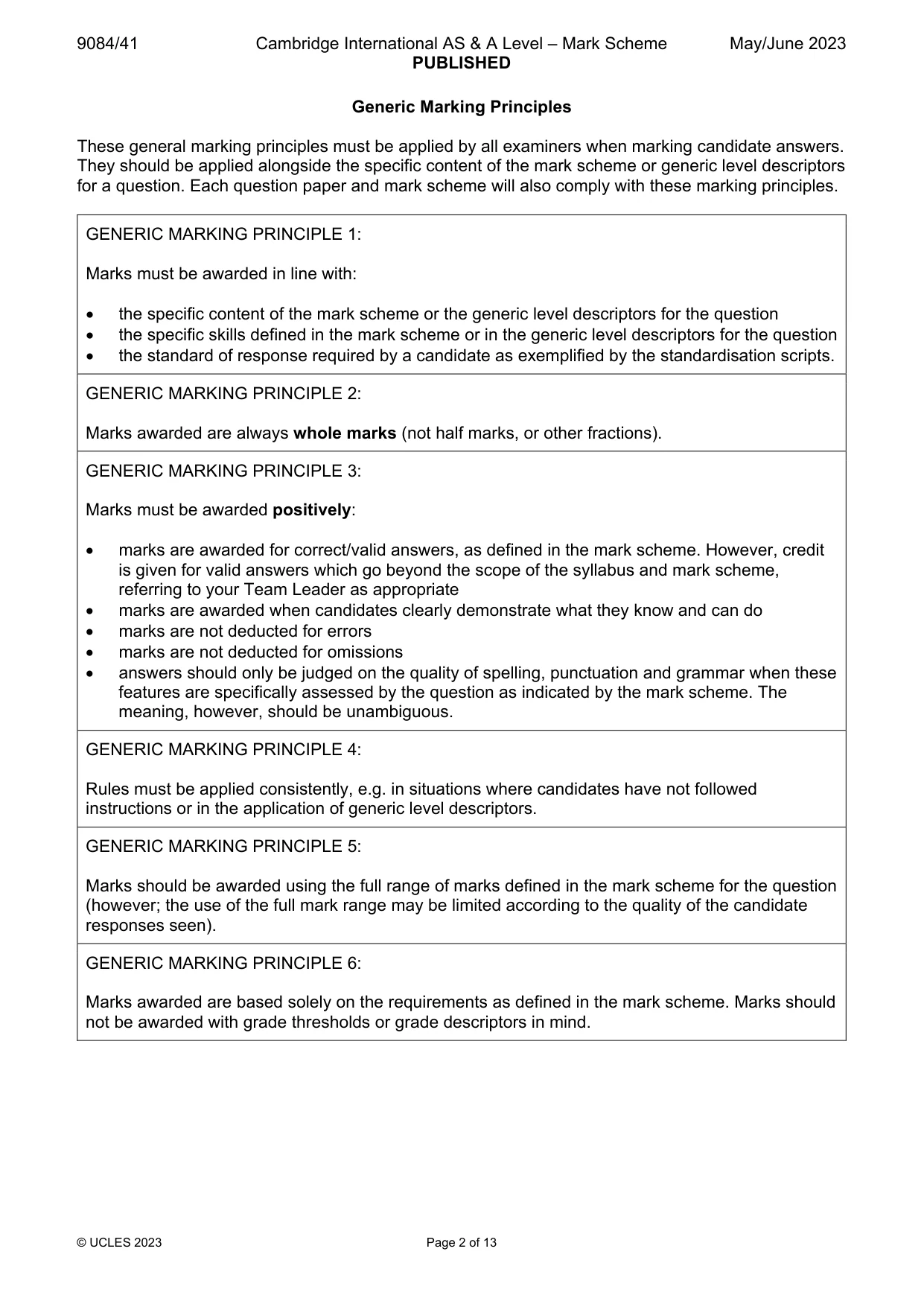
9084/41 Cambridge International AS & A Level – Mark Scheme PUBLISHED May/June 2023 © UCLES 2023 Page 2 of 13 Generic Marking Principles These general marking principles must be applied by all examiners when marking candidate answers. They should be applied alongside the specific content of the mark scheme or generic level descriptors for a question. Each question paper and mark scheme will also comply with these marking principles. GENERIC MARKING PRINCIPLE 1: Marks must be awarded in line with: the specific content of the mark scheme or the generic level descriptors for the question the specific skills defined in the mark scheme or in the generic level descriptors for the question the standard of response required by a candidate as exemplified by the standardisation scripts. GENERIC MARKING PRINCIPLE 2: Marks awarded are always whole marks (not half marks, or other fractions). GENERIC MARKING PRINCIPLE 3: Marks must be awarded positively: marks are awarded for correct/valid answers, as defined in the mark scheme. However, credit is given for valid answers which go beyond the scope of the syllabus and mark scheme, referring to your Team Leader as appropriate marks are awarded when candidates clearly demonstrate what they know and can do marks are not deducted for errors marks are not deducted for omissions answers should only be judged on the quality of spelling, punctuation and grammar when these features are specifically assessed by the question as indicated by the mark scheme. The meaning, however, should be unambiguous. GENERIC MARKING PRINCIPLE 4: Rules must be applied consistently, e.g. in situations where candidates have not followed instructions or in the application of generic level descriptors. GENERIC MARKING PRINCIPLE 5: Marks should be awarded using the full range of marks defined in the mark scheme for the question (however; the use of the full mark range may be limited according to the quality of the candidate responses seen). GENERIC MARKING PRINCIPLE 6: Marks awarded are based solely on the requirements as defined in the mark scheme. Marks should not be awarded with grade thresholds or grade descriptors in mind.
Mark scheme, page 3
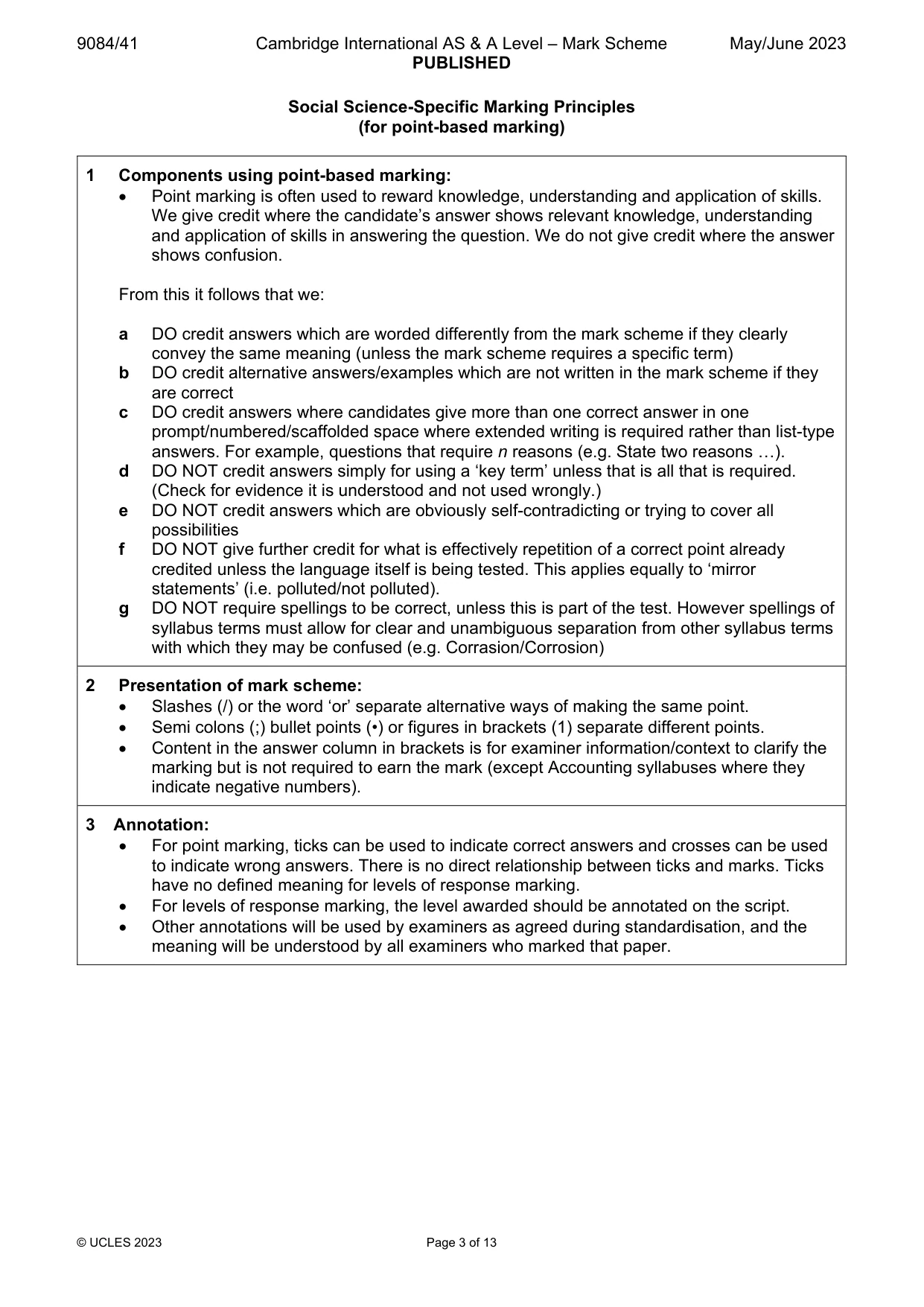
9084/41 Cambridge International AS & A Level – Mark Scheme PUBLISHED May/June 2023 © UCLES 2023 Page 3 of 13 Social Science-Specific Marking Principles (for point-based marking) 1 Components using point-based marking: Point marking is often used to reward knowledge, understanding and application of skills. We give credit where the candidate’s answer shows relevant knowledge, understanding and application of skills in answering the question. We do not give credit where the answer shows confusion. From this it follows that we: a DO credit answers which are worded differently from the mark scheme if they clearly convey the same meaning (unless the mark scheme requires a specific term) b DO credit alternative answers/examples which are not written in the mark scheme if they are correct c DO credit answers where candidates give more than one correct answer in one prompt/numbered/scaffolded space where extended writing is required rather than list-type answers. For example, questions that require n reasons (e.g. State two reasons …). d DO NOT credit answers simply for using a ‘key term’ unless that is all that is required. (Check for evidence it is understood and not used wrongly.) e DO NOT credit answers which are obviously self-contradicting or trying to cover all possibilities f DO NOT give further credit for what is effectively repetition of a correct point already credited unless the language itself is being tested. This applies equally to ‘mirror statements’ (i.e. polluted/not polluted). g DO NOT require spellings to be correct, unless this is part of the test. However spellings of syllabus terms must allow for clear and unambiguous separation from other syllabus terms with which they may be confused (e.g. Corrasion/Corrosion) 2 Presentation of mark scheme: Slashes (/) or the word ‘or’ separate alternative ways of making the same point. Semi colons (;) bullet points (•) or figures in brackets (1) separate different points. Content in the answer column in brackets is for examiner information/context to clarify the marking but is not required to earn the mark (except Accounting syllabuses where they indicate negative numbers). 3 Annotation: For point marking, ticks can be used to indicate correct answers and crosses can be used to indicate wrong answers. There is no direct relationship between ticks and marks. Ticks have no defined meaning for levels of response marking. For levels of response marking, the level awarded should be annotated on the script. Other annotations will be used by examiners as agreed during standardisation, and the meaning will be understood by all examiners who marked that paper.
Mark scheme, page 4
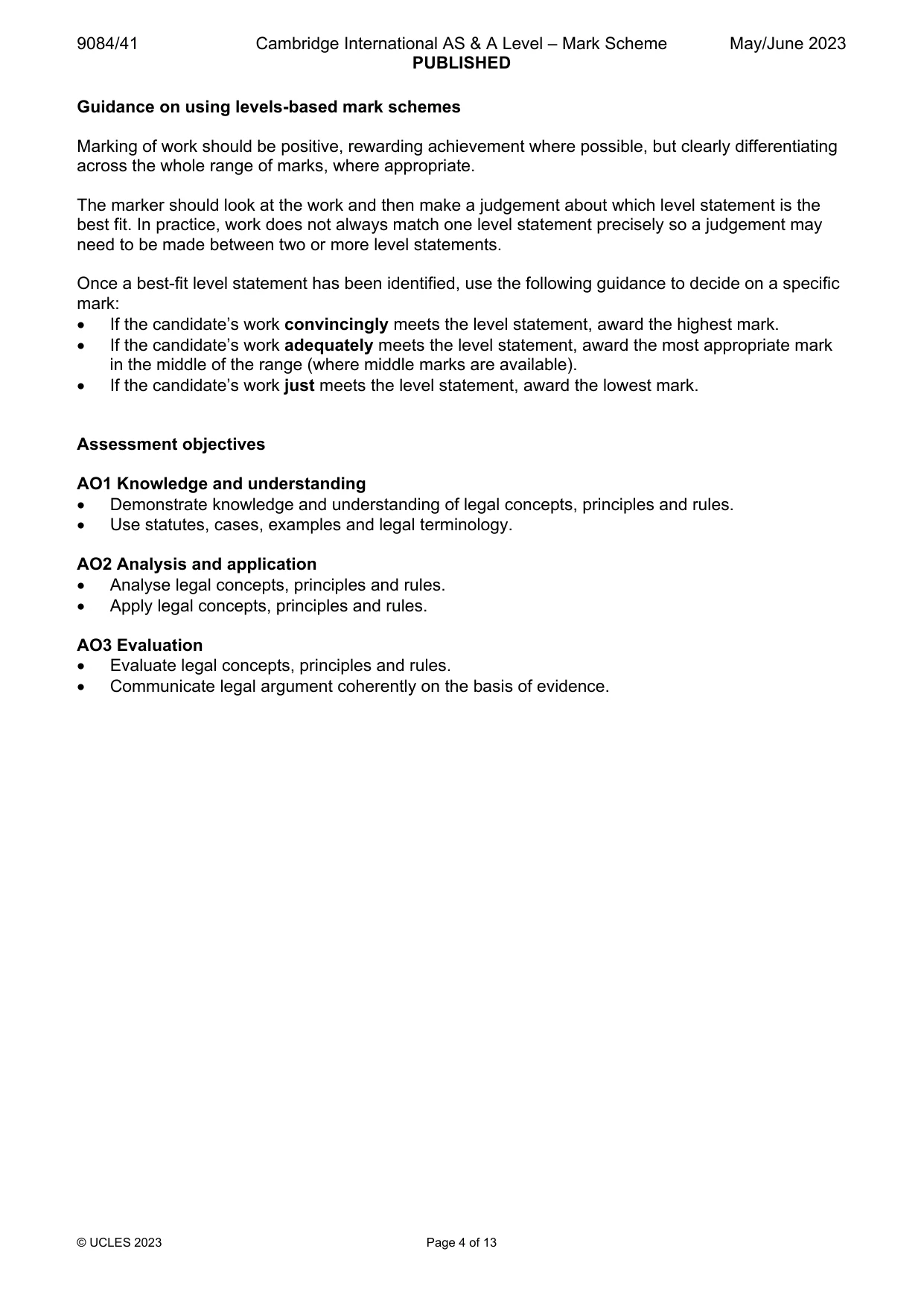
9084/41 Cambridge International AS & A Level – Mark Scheme PUBLISHED May/June 2023 © UCLES 2023 Page 4 of 13 Guidance on using levels-based mark schemes Marking of work should be positive, rewarding achievement where possible, but clearly differentiating across the whole range of marks, where appropriate. The marker should look at the work and then make a judgement about which level statement is the best fit. In practice, work does not always match one level statement precisely so a judgement may need to be made between two or more level statements. Once a best-fit level statement has been identified, use the following guidance to decide on a specific mark: If the candidate’s work convincingly meets the level statement, award the highest mark. If the candidate’s work adequately meets the level statement, award the most appropriate mark in the middle of the range (where middle marks are available). If the candidate’s work just meets the level statement, award the lowest mark. Assessment objectives AO1 Knowledge and understanding Demonstrate knowledge and understanding of legal concepts, principles and rules. Use statutes, cases, examples and legal terminology. AO2 Analysis and application Analyse legal concepts, principles and rules. Apply legal concepts, principles and rules. AO3 Evaluation Evaluate legal concepts, principles and rules. Communicate legal argument coherently on the basis of evidence.
Mark scheme, page 5
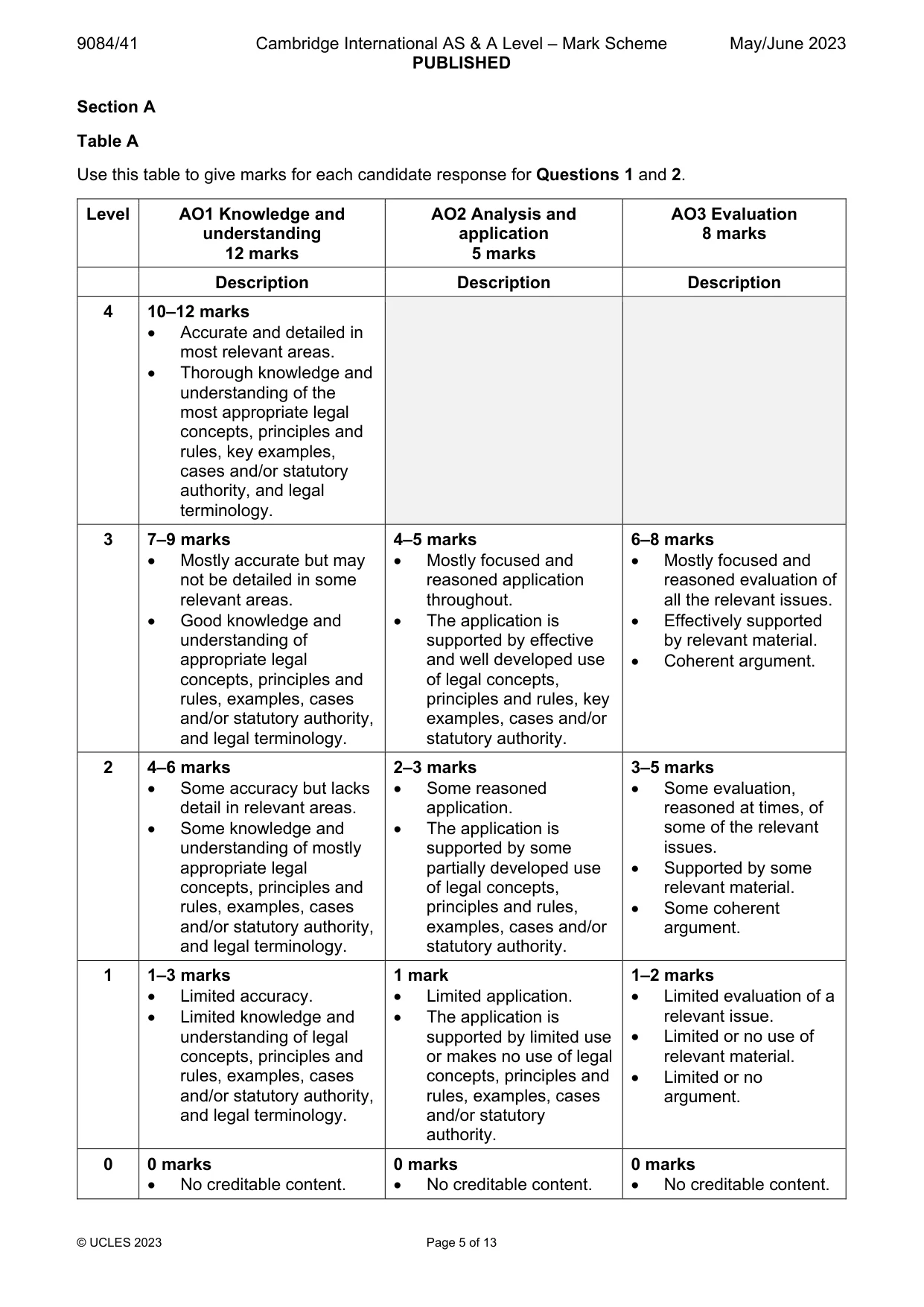
9084/41 Cambridge International AS & A Level – Mark Scheme PUBLISHED May/June 2023 © UCLES 2023 Page 5 of 13 Section A Table A Use this table to give marks for each candidate response for Questions 1 and 2. Level AO1 Knowledge and understanding 12 marks AO2 Analysis and application 5 marks AO3 Evaluation 8 marks Description Description Description 4 10–12 marks Accurate and detailed in most relevant areas. Thorough knowledge and understanding of the most appropriate legal concepts, principles and rules, key examples, cases and/or statutory authority, and legal terminology. 3 7–9 marks Mostly accurate but may not be detailed in some relevant areas. Good knowledge and understanding of appropriate legal concepts, principles and rules, examples, cases and/or statutory authority, and legal terminology. 4–5 marks Mostly focused and reasoned application throughout. The application is supported by effective and well developed use of legal concepts, principles and rules, key examples, cases and/or statutory authority. 6–8 marks Mostly focused and reasoned evaluation of all the relevant issues. Effectively supported by relevant material. Coherent argument. 2 4–6 marks Some accuracy but lacks detail in relevant areas. Some knowledge and understanding of mostly appropriate legal concepts, principles and rules, examples, cases and/or statutory authority, and legal terminology. 2–3 marks Some reasoned application. The application is supported by some partially developed use of legal concepts, principles and rules, examples, cases and/or statutory authority. 3–5 marks Some evaluation, reasoned at times, of some of the relevant issues. Supported by some relevant material. Some coherent argument. 1 1–3 marks Limited accuracy. Limited knowledge and understanding of legal concepts, principles and rules, examples, cases and/or statutory authority, and legal terminology. 1 mark Limited application. The application is supported by limited use or makes no use of legal concepts, principles and rules, examples, cases and/or statutory authority. 1–2 marks Limited evaluation of a relevant issue. Limited or no use of relevant material. Limited or no argument. 0 0 marks No creditable content. 0 marks No creditable content. 0 marks No creditable content.
Mark scheme, page 6
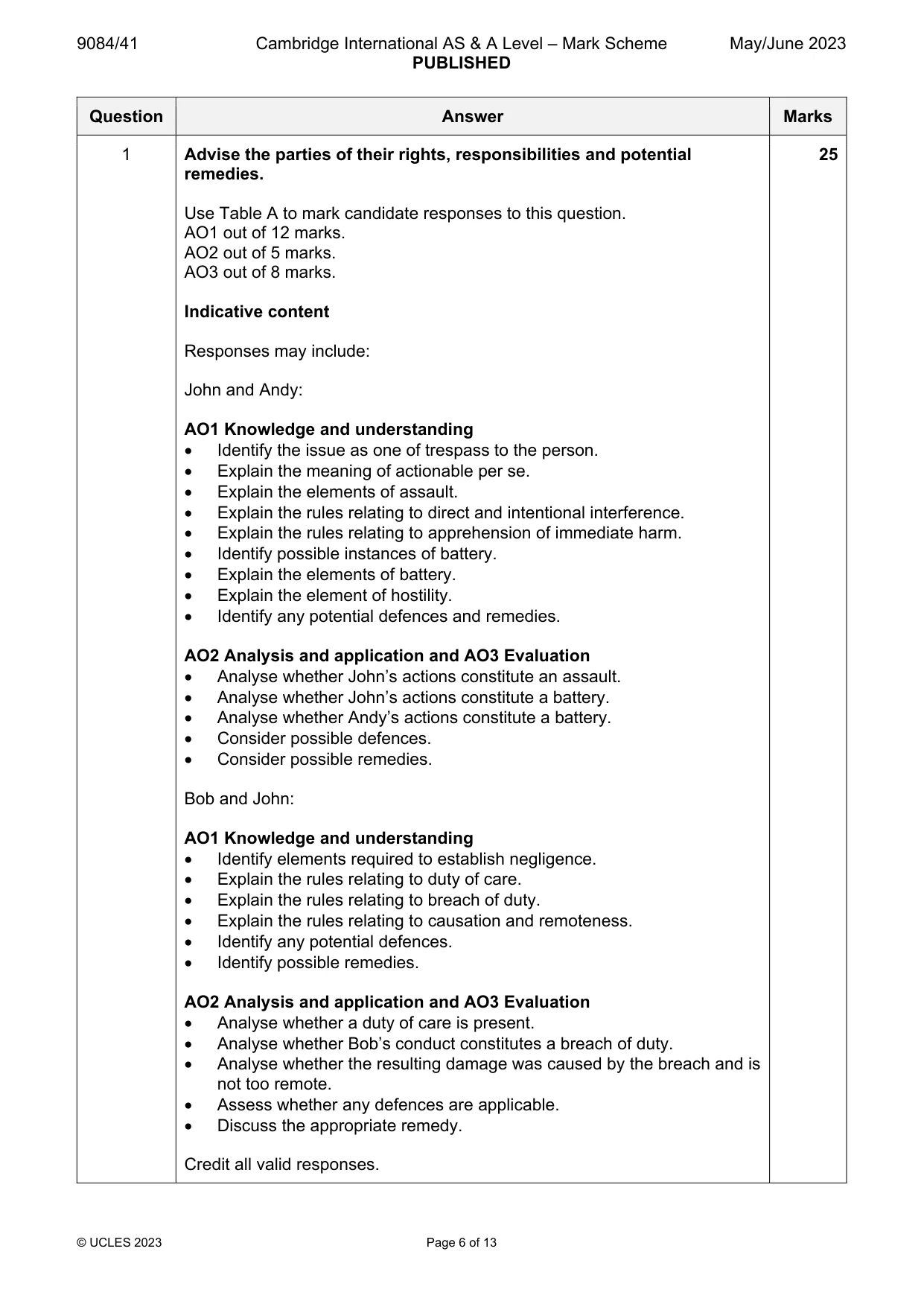
9084/41 Cambridge International AS & A Level – Mark Scheme PUBLISHED May/June 2023 © UCLES 2023 Page 6 of 13 Question Answer Marks 1 Advise the parties of their rights, responsibilities and potential remedies. Use Table A to mark candidate responses to this question. AO1 out of 12 marks. AO2 out of 5 marks. AO3 out of 8 marks. Indicative content Responses may include: John and Andy: AO1 Knowledge and understanding Identify the issue as one of trespass to the person. Explain the meaning of actionable per se. Explain the elements of assault. Explain the rules relating to direct and intentional interference. Explain the rules relating to apprehension of immediate harm. Identify possible instances of battery. Explain the elements of battery. Explain the element of hostility. Identify any potential defences and remedies. AO2 Analysis and application and AO3 Evaluation Analyse whether John’s actions constitute an assault. Analyse whether John’s actions constitute a battery. Analyse whether Andy’s actions constitute a battery. Consider possible defences. Consider possible remedies. Bob and John: AO1 Knowledge and understanding Identify elements required to establish negligence. Explain the rules relating to duty of care. Explain the rules relating to breach of duty. Explain the rules relating to causation and remoteness. Identify any potential defences. Identify possible remedies. AO2 Analysis and application and AO3 Evaluation Analyse whether a duty of care is present. Analyse whether Bob’s conduct constitutes a breach of duty. Analyse whether the resulting damage was caused by the breach and is not too remote. Assess whether any defences are applicable. Discuss the appropriate remedy. Credit all valid responses. 25
Mark scheme, page 7
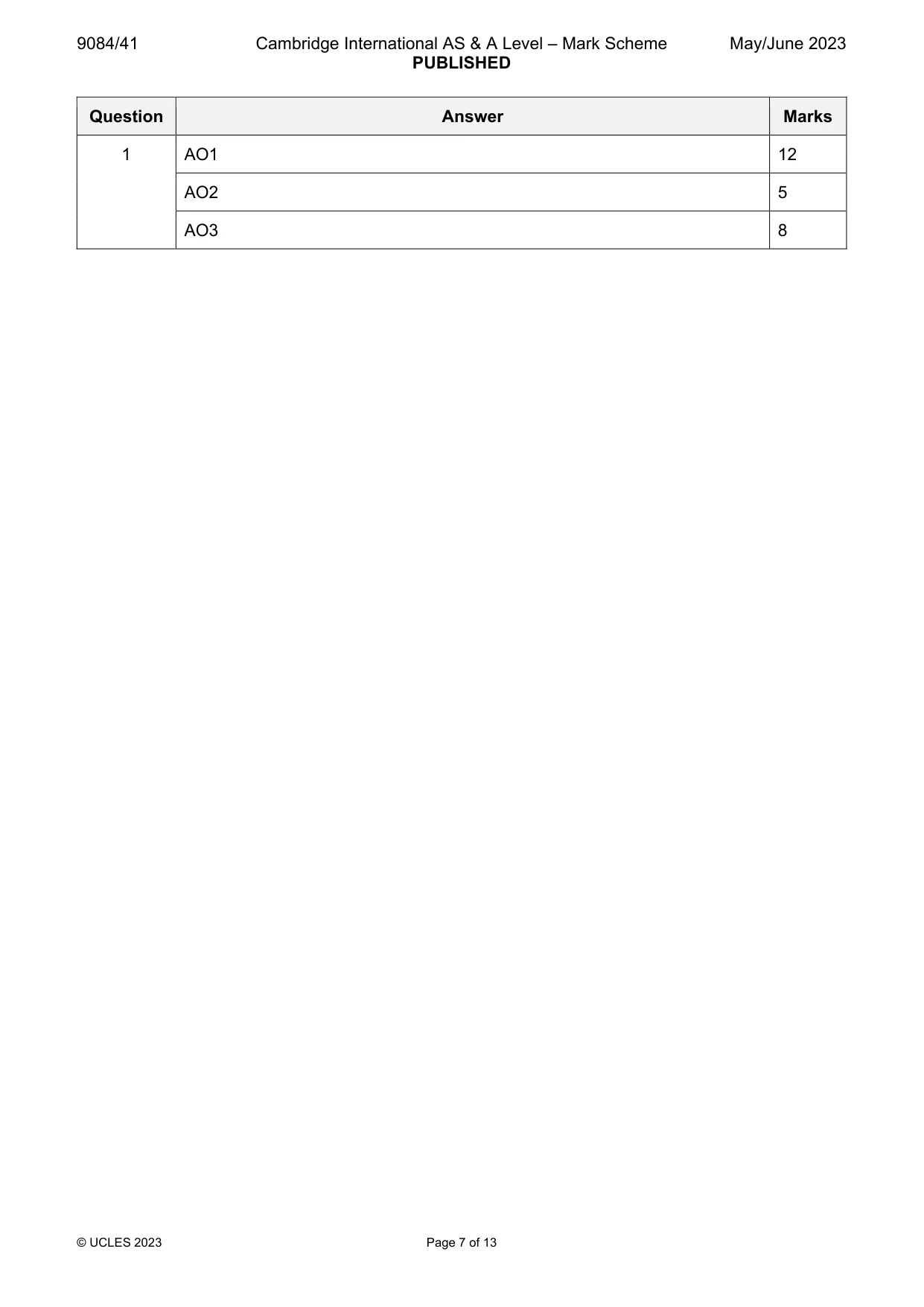
9084/41 Cambridge International AS & A Level – Mark Scheme PUBLISHED May/June 2023 © UCLES 2023 Page 7 of 13 Question Answer Marks 1 AO1 12 AO2 5 AO3 8
Mark scheme, page 8
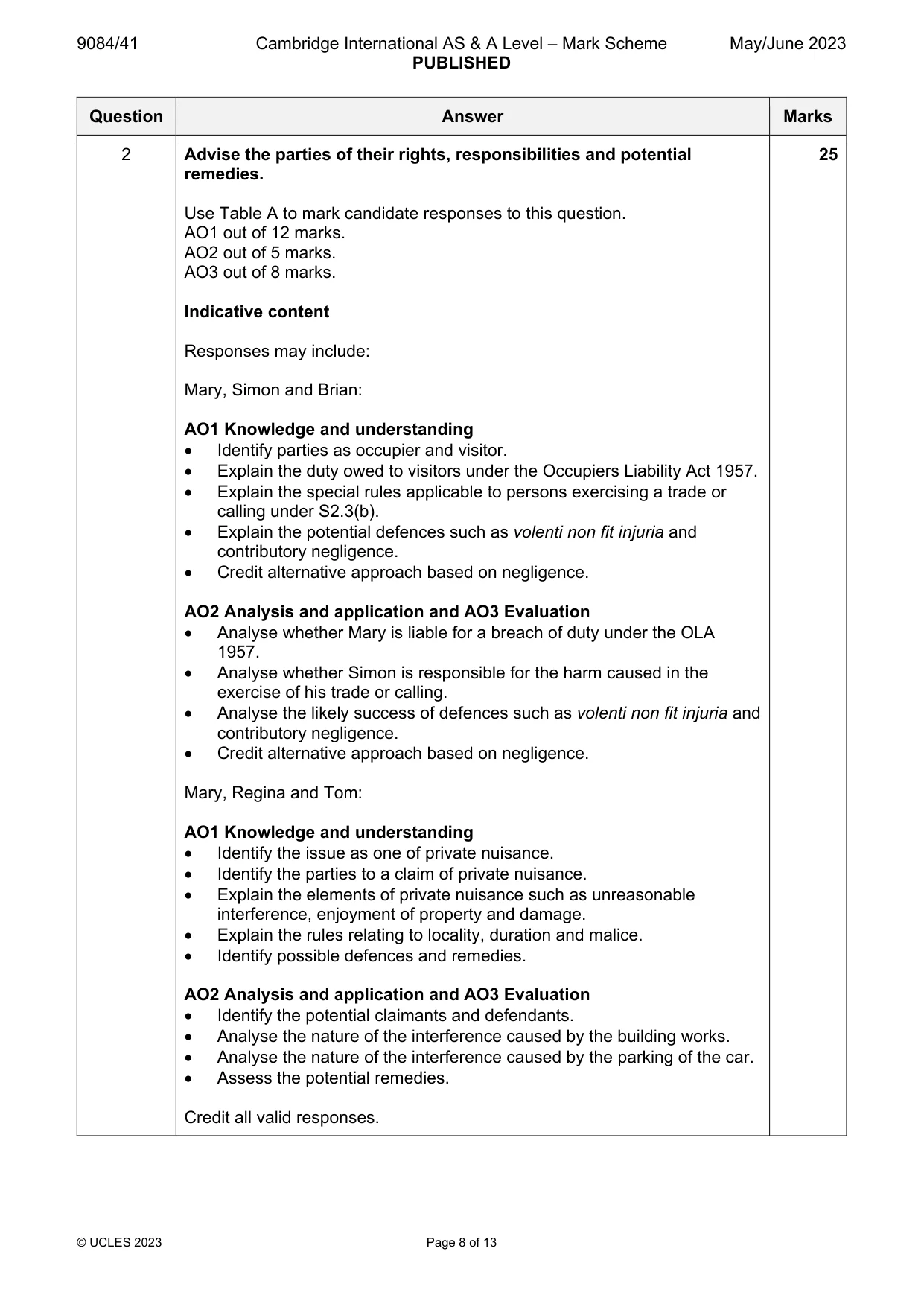
9084/41 Cambridge International AS & A Level – Mark Scheme PUBLISHED May/June 2023 © UCLES 2023 Page 8 of 13 Question Answer Marks 2 Advise the parties of their rights, responsibilities and potential remedies. Use Table A to mark candidate responses to this question. AO1 out of 12 marks. AO2 out of 5 marks. AO3 out of 8 marks. Indicative content Responses may include: Mary, Simon and Brian: AO1 Knowledge and understanding Identify parties as occupier and visitor. Explain the duty owed to visitors under the Occupiers Liability Act 1957. Explain the special rules applicable to persons exercising a trade or calling under S2.3(b). Explain the potential defences such as volenti non fit injuria and contributory negligence. Credit alternative approach based on negligence. AO2 Analysis and application and AO3 Evaluation Analyse whether Mary is liable for a breach of duty under the OLA 1957. Analyse whether Simon is responsible for the harm caused in the exercise of his trade or calling. Analyse the likely success of defences such as volenti non fit injuria and contributory negligence. Credit alternative approach based on negligence. Mary, Regina and Tom: AO1 Knowledge and understanding Identify the issue as one of private nuisance. Identify the parties to a claim of private nuisance. Explain the elements of private nuisance such as unreasonable interference, enjoyment of property and damage. Explain the rules relating to locality, duration and malice. Identify possible defences and remedies. AO2 Analysis and application and AO3 Evaluation Identify the potential claimants and defendants. Analyse the nature of the interference caused by the building works. Analyse the nature of the interference caused by the parking of the car. Assess the potential remedies. Credit all valid responses. 25
Mark scheme, page 9
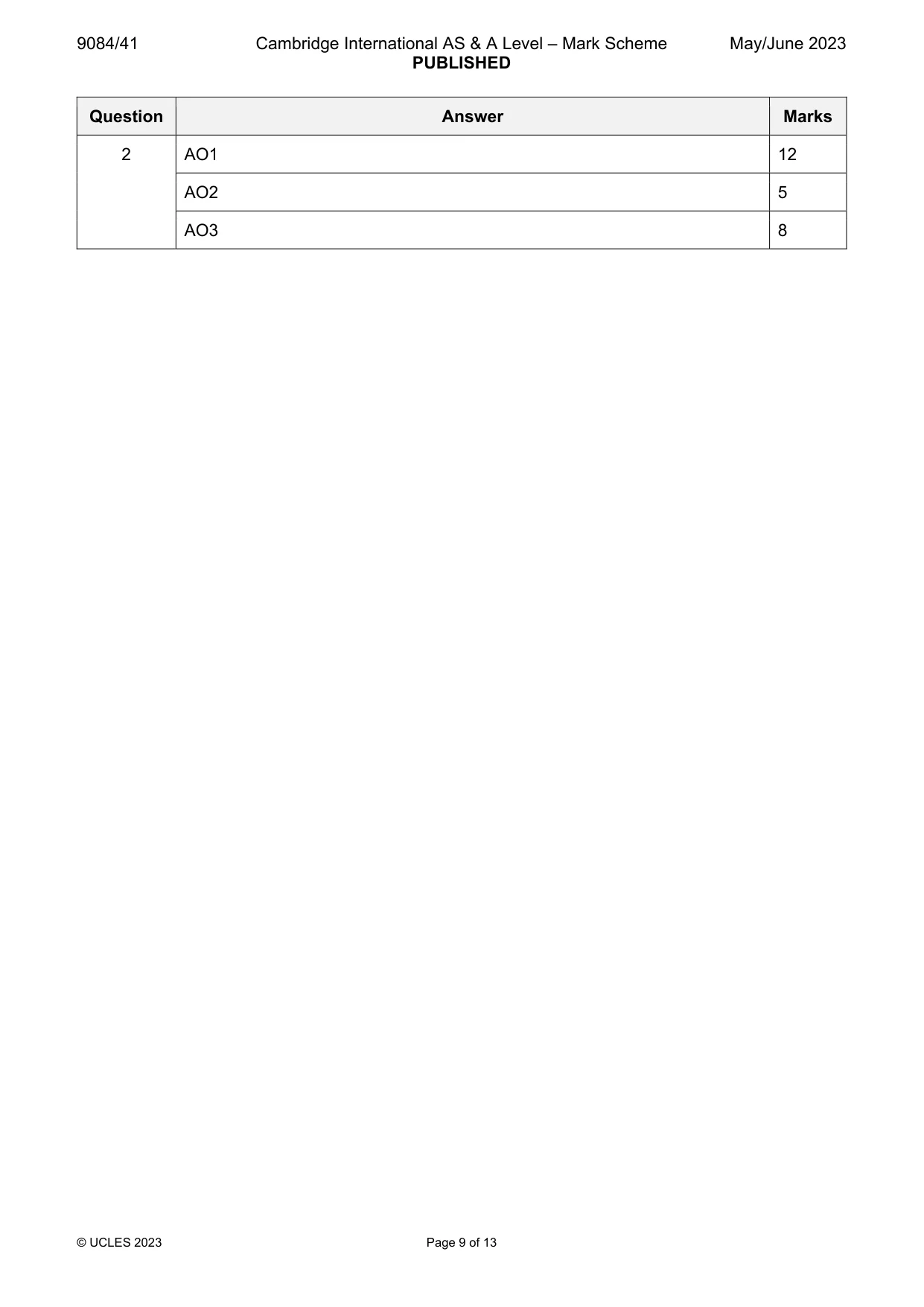
9084/41 Cambridge International AS & A Level – Mark Scheme PUBLISHED May/June 2023 © UCLES 2023 Page 9 of 13 Question Answer Marks 2 AO1 12 AO2 5 AO3 8
Mark scheme, page 10
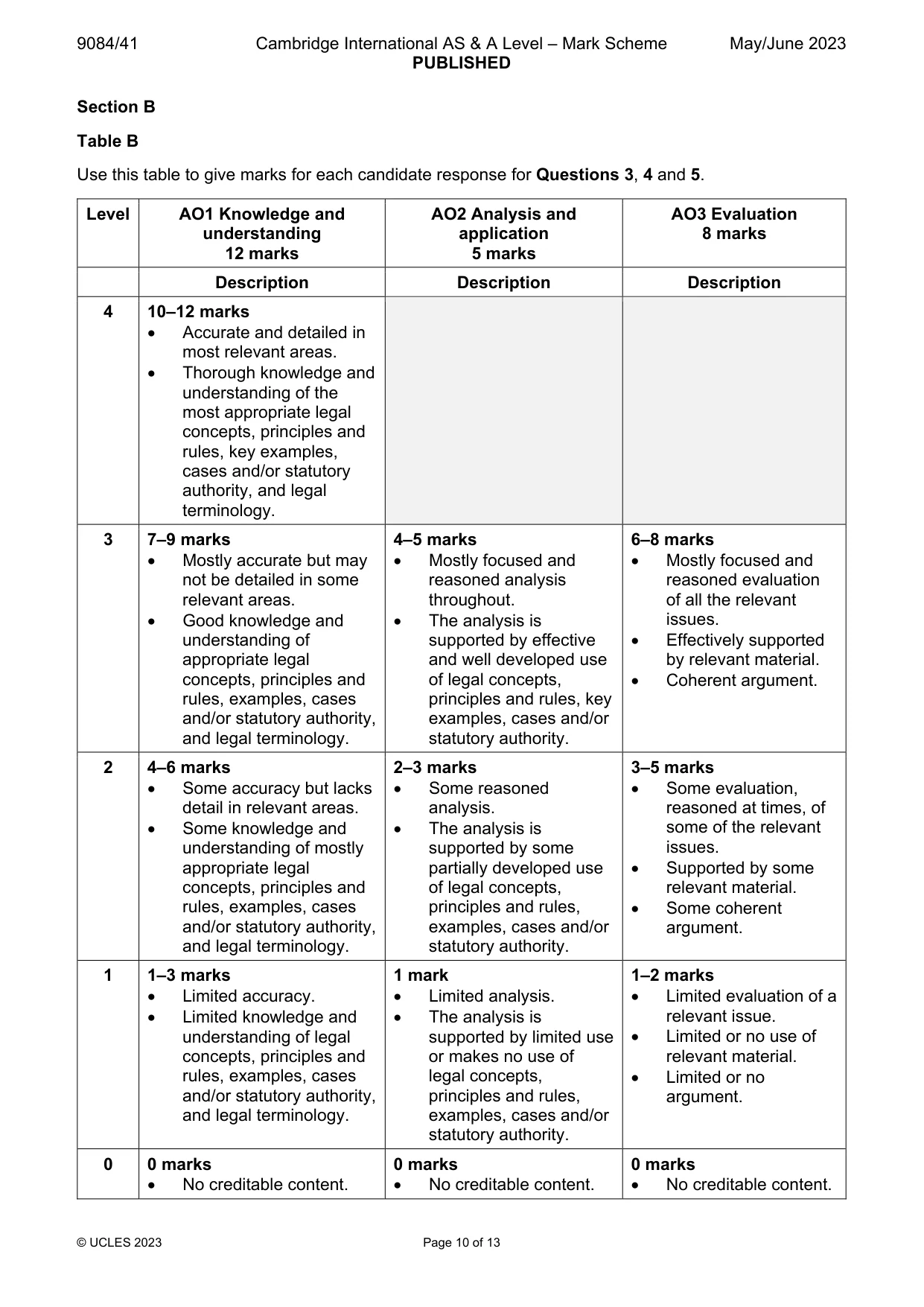
9084/41 Cambridge International AS & A Level – Mark Scheme PUBLISHED May/June 2023 © UCLES 2023 Page 10 of 13 Section B Table B Use this table to give marks for each candidate response for Questions 3, 4 and 5. Level AO1 Knowledge and understanding 12 marks AO2 Analysis and application 5 marks AO3 Evaluation 8 marks Description Description Description 4 10–12 marks Accurate and detailed in most relevant areas. Thorough knowledge and understanding of the most appropriate legal concepts, principles and rules, key examples, cases and/or statutory authority, and legal terminology. 3 7–9 marks Mostly accurate but may not be detailed in some relevant areas. Good knowledge and understanding of appropriate legal concepts, principles and rules, examples, cases and/or statutory authority, and legal terminology. 4–5 marks Mostly focused and reasoned analysis throughout. The analysis is supported by effective and well developed use of legal concepts, principles and rules, key examples, cases and/or statutory authority. 6–8 marks Mostly focused and reasoned evaluation of all the relevant issues. Effectively supported by relevant material. Coherent argument. 2 4–6 marks Some accuracy but lacks detail in relevant areas. Some knowledge and understanding of mostly appropriate legal concepts, principles and rules, examples, cases and/or statutory authority, and legal terminology. 2–3 marks Some reasoned analysis. The analysis is supported by some partially developed use of legal concepts, principles and rules, examples, cases and/or statutory authority. 3–5 marks Some evaluation, reasoned at times, of some of the relevant issues. Supported by some relevant material. Some coherent argument. 1 1–3 marks Limited accuracy. Limited knowledge and understanding of legal concepts, principles and rules, examples, cases and/or statutory authority, and legal terminology. 1 mark Limited analysis. The analysis is supported by limited use or makes no use of legal concepts, principles and rules, examples, cases and/or statutory authority. 1–2 marks Limited evaluation of a relevant issue. Limited or no use of relevant material. Limited or no argument. 0 0 marks No creditable content. 0 marks No creditable content. 0 marks No creditable content.
Mark scheme, page 11
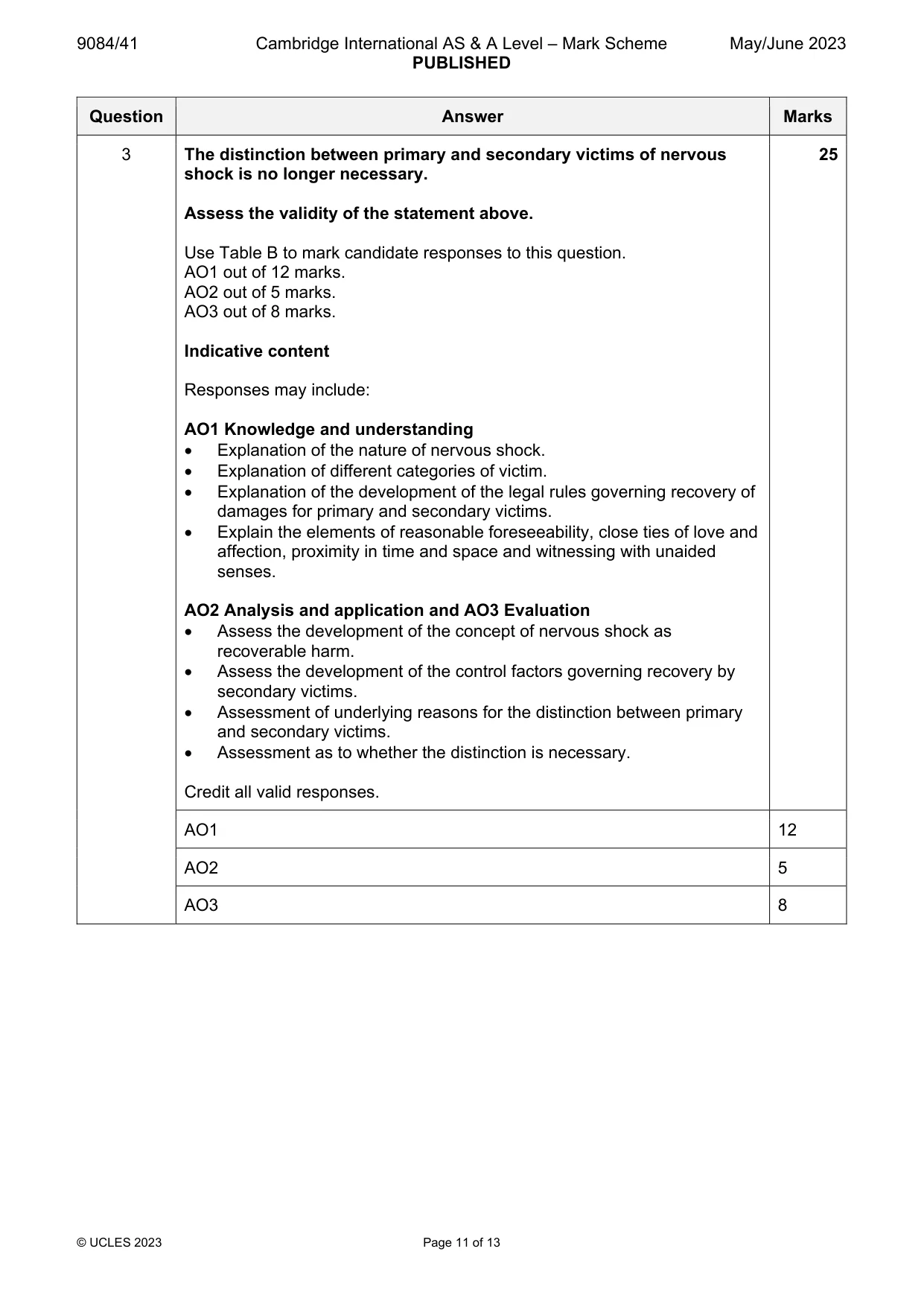
9084/41 Cambridge International AS & A Level – Mark Scheme PUBLISHED May/June 2023 © UCLES 2023 Page 11 of 13 Question Answer Marks 3 The distinction between primary and secondary victims of nervous shock is no longer necessary. Assess the validity of the statement above. Use Table B to mark candidate responses to this question. AO1 out of 12 marks. AO2 out of 5 marks. AO3 out of 8 marks. Indicative content Responses may include: AO1 Knowledge and understanding Explanation of the nature of nervous shock. Explanation of different categories of victim. Explanation of the development of the legal rules governing recovery of damages for primary and secondary victims. Explain the elements of reasonable foreseeability, close ties of love and affection, proximity in time and space and witnessing with unaided senses. AO2 Analysis and application and AO3 Evaluation Assess the development of the concept of nervous shock as recoverable harm. Assess the development of the control factors governing recovery by secondary victims. Assessment of underlying reasons for the distinction between primary and secondary victims. Assessment as to whether the distinction is necessary. Credit all valid responses. 25 AO1 12 AO2 5 AO3 8
Mark scheme, page 12
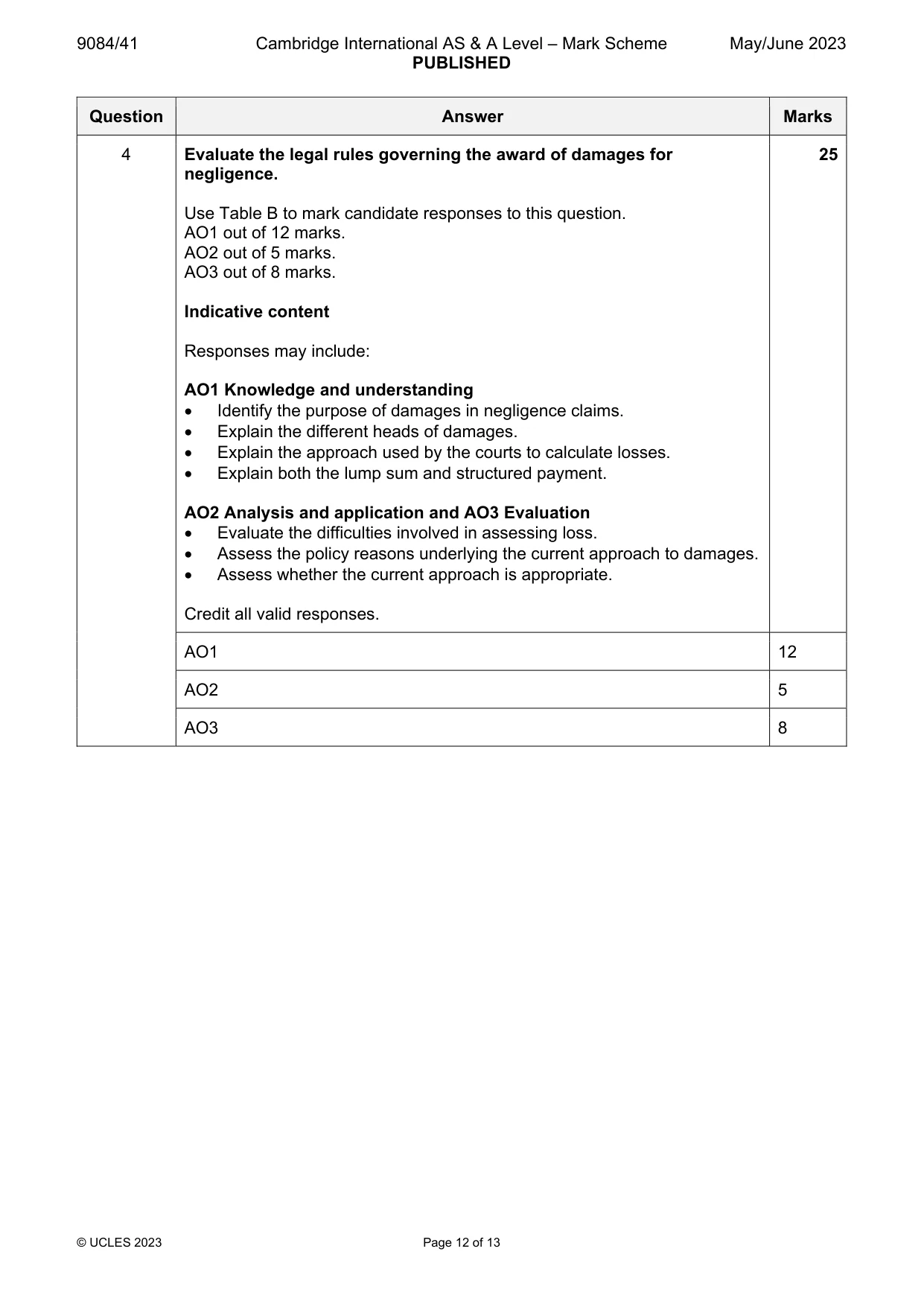
9084/41 Cambridge International AS & A Level – Mark Scheme PUBLISHED May/June 2023 © UCLES 2023 Page 12 of 13 Question Answer Marks 4 Evaluate the legal rules governing the award of damages for negligence. Use Table B to mark candidate responses to this question. AO1 out of 12 marks. AO2 out of 5 marks. AO3 out of 8 marks. Indicative content Responses may include: AO1 Knowledge and understanding Identify the purpose of damages in negligence claims. Explain the different heads of damages. Explain the approach used by the courts to calculate losses. Explain both the lump sum and structured payment. AO2 Analysis and application and AO3 Evaluation Evaluate the difficulties involved in assessing loss. Assess the policy reasons underlying the current approach to damages. Assess whether the current approach is appropriate. Credit all valid responses. 25 AO1 12 AO2 5 AO3 8
Mark scheme, page 13
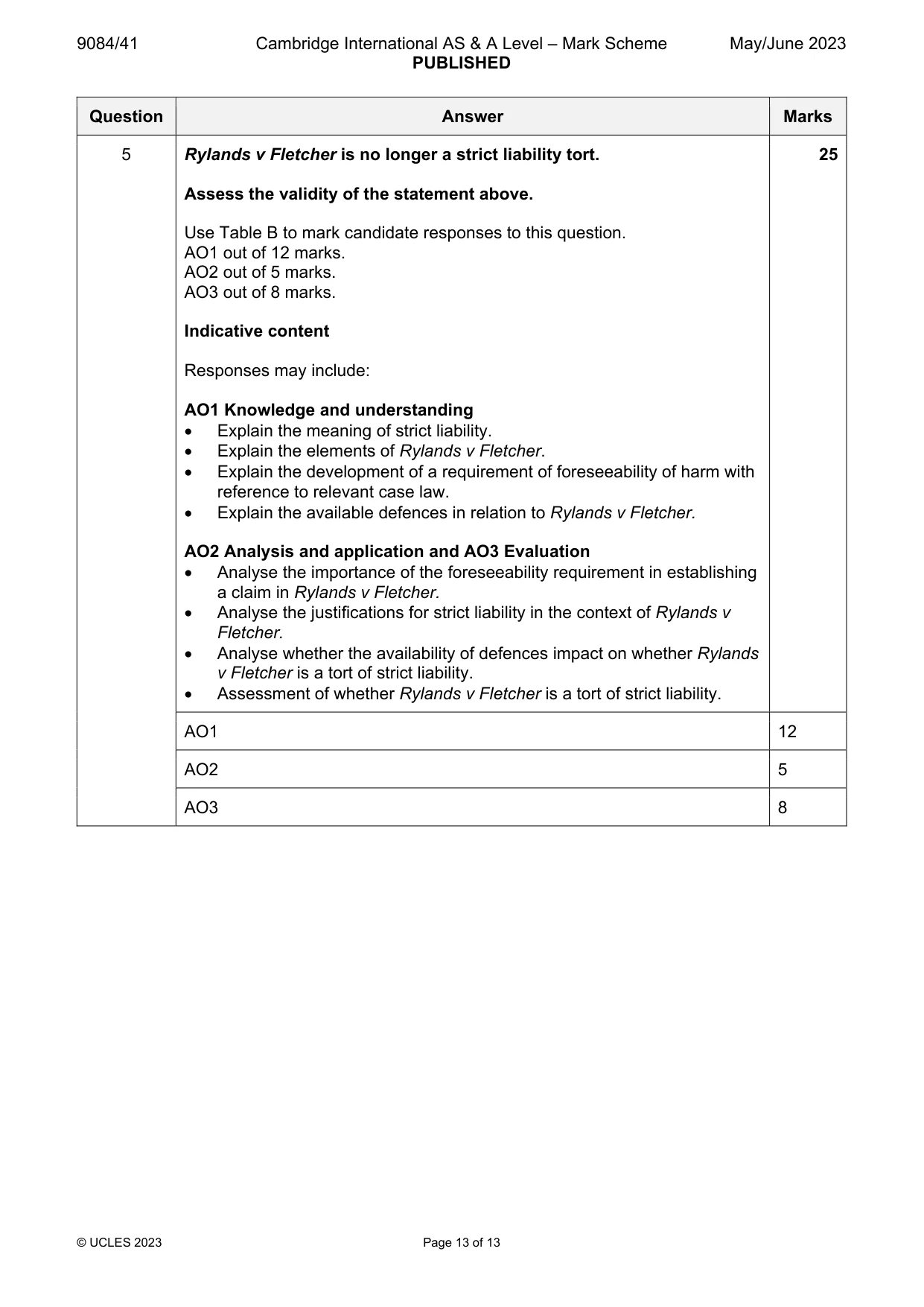
9084/41 Cambridge International AS & A Level – Mark Scheme PUBLISHED May/June 2023 © UCLES 2023 Page 13 of 13 Question Answer Marks 5 Rylands v Fletcher is no longer a strict liability tort. Assess the validity of the statement above. Use Table B to mark candidate responses to this question. AO1 out of 12 marks. AO2 out of 5 marks. AO3 out of 8 marks. Indicative content Responses may include: AO1 Knowledge and understanding Explain the meaning of strict liability. Explain the elements of Rylands v Fletcher. Explain the development of a requirement of foreseeability of harm with reference to relevant case law. Explain the available defences in relation to Rylands v Fletcher. AO2 Analysis and application and AO3 Evaluation Analyse the importance of the foreseeability requirement in establishing a claim in Rylands v Fletcher. Analyse the justifications for strict liability in the context of Rylands v Fletcher. Analyse whether the availability of defences impact on whether Rylands v Fletcher is a tort of strict liability. Assessment of whether Rylands v Fletcher is a tort of strict liability. 25 AO1 12 AO2 5 AO3 8
What you needed in this session
Cambridge’s own grade thresholds for 2023 May/June, Paper 4 · Variant 1. A higher threshold means an easier paper — the bar moves with how the cohort did.