Cambridge A Level Law 9084 — 2015 May/June Paper 4 · Variant 2
9084/42/M/J/15 · 75 marks · ≈84 min
The question paper and its mark scheme, free to read here and free to download. This is Cambridge’s own paper, exactly as it was sat.
Question paper4 pages

Mark scheme7 pages
Answers below. Sit the paper first if you are practising.
Paper as text
Question paper, page 1
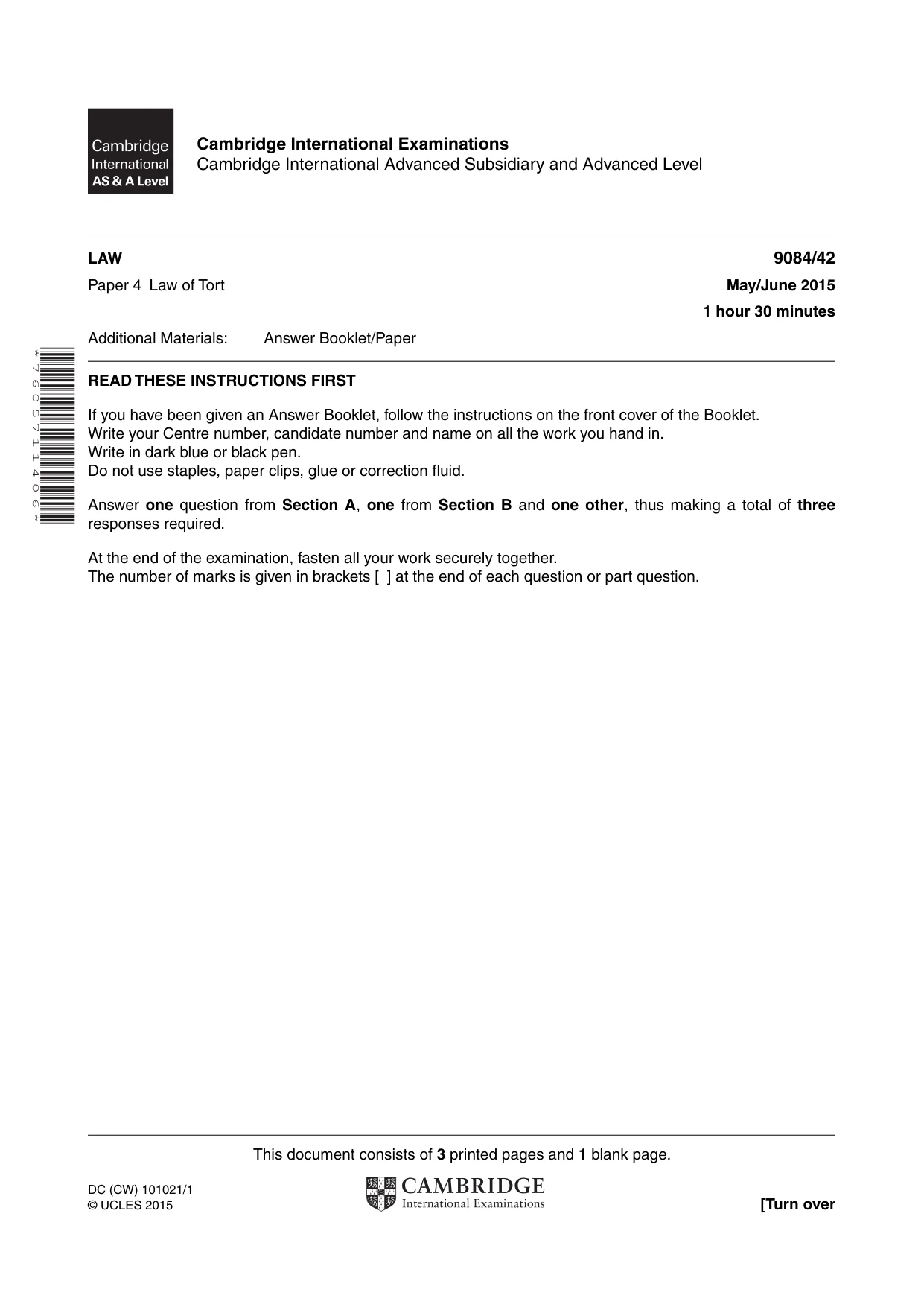
This document consists of 3 printed pages and 1 blank page. DC (CW) 101021/1 © UCLES 2015 [Turn over * 7 6 0 5 7 1 1 4 0 6 * LAW 9084/42 Paper 4 Law of Tort May/June 2015 1 hour 30 minutes Additional Materials: Answer Booklet/Paper READ THESE INSTRUCTIONS FIRST If you have been given an Answer Booklet, follow the instructions on the front cover of the Booklet. Write your Centre number, candidate number and name on all the work you hand in. Write in dark blue or black pen. Do not use staples, paper clips, glue or correction fluid. Answer one question from Section A, one from Section B and one other, thus making a total of three responses required. At the end of the examination, fasten all your work securely together. The number of marks is given in brackets [ ] at the end of each question or part question. Cambridge International Examinations Cambridge International Advanced Subsidiary and Advanced Level
Question paper, page 2
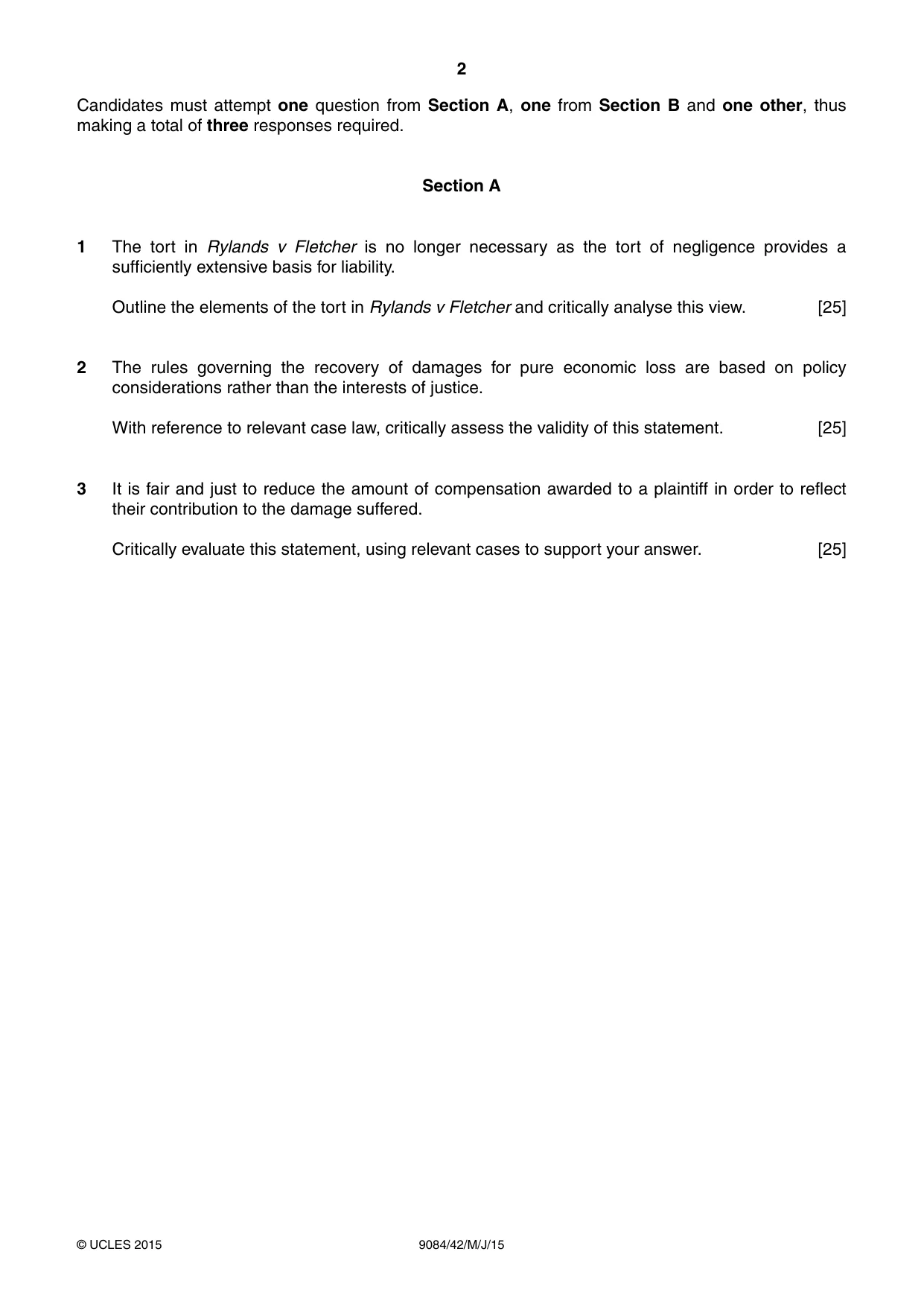
2 9084/42/M/J/15 © UCLES 2015 Candidates must attempt one question from Section A, one from Section B and one other, thus making a total of three responses required. Section A 1 The tort in Rylands v Fletcher is no longer necessary as the tort of negligence provides a sufficiently extensive basis for liability. Outline the elements of the tort in Rylands v Fletcher and critically analyse this view. [25] 2 The rules governing the recovery of damages for pure economic loss are based on policy considerations rather than the interests of justice. With reference to relevant case law, critically assess the validity of this statement. [25] 3 It is fair and just to reduce the amount of compensation awarded to a plaintiff in order to reflect their contribution to the damage suffered. Critically evaluate this statement, using relevant cases to support your answer. [25]
Question paper, page 3
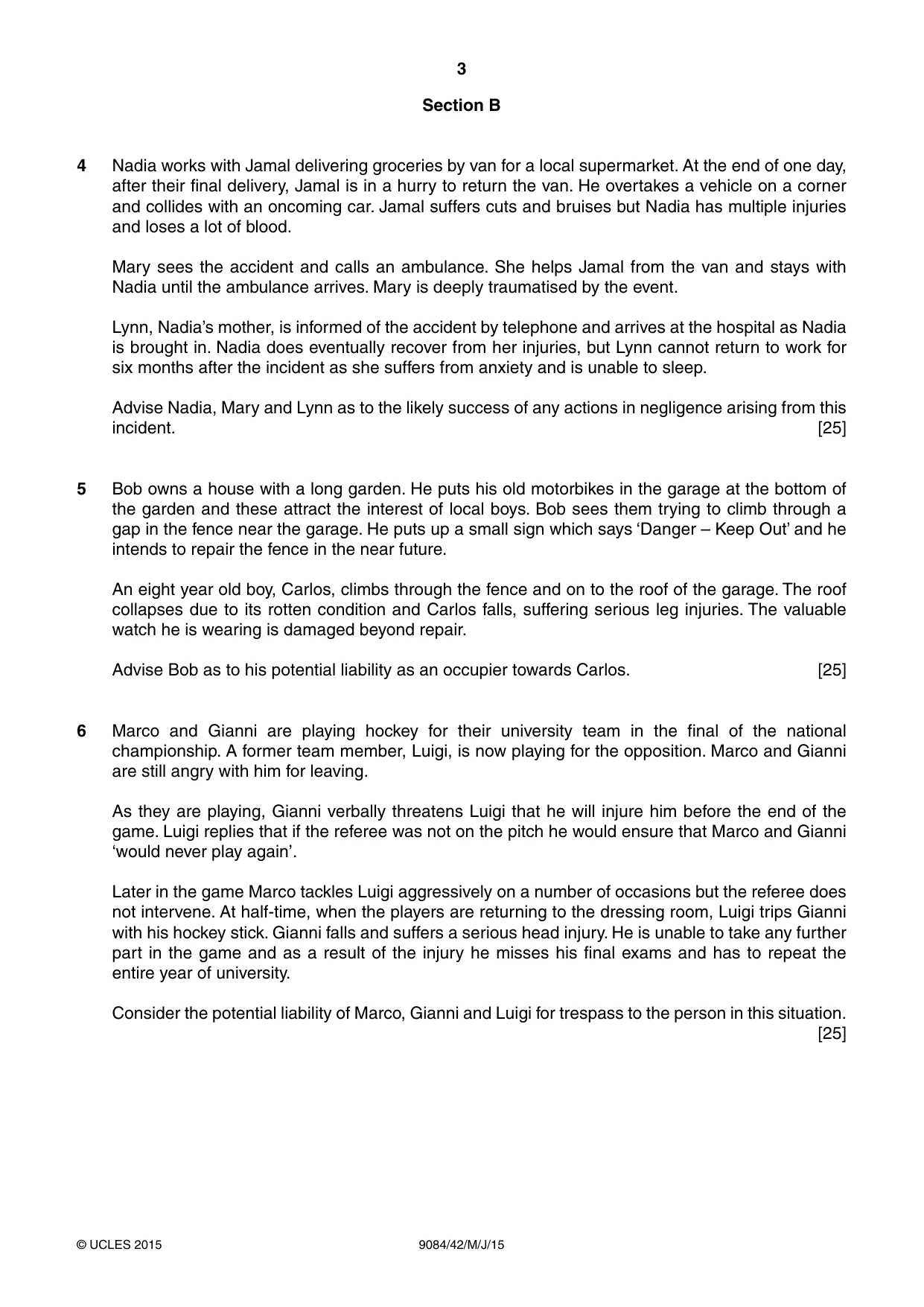
3 9084/42/M/J/15 © UCLES 2015 Section B 4 Nadia works with Jamal delivering groceries by van for a local supermarket. At the end of one day, after their final delivery, Jamal is in a hurry to return the van. He overtakes a vehicle on a corner and collides with an oncoming car. Jamal suffers cuts and bruises but Nadia has multiple injuries and loses a lot of blood. Mary sees the accident and calls an ambulance. She helps Jamal from the van and stays with Nadia until the ambulance arrives. Mary is deeply traumatised by the event. Lynn, Nadia’s mother, is informed of the accident by telephone and arrives at the hospital as Nadia is brought in. Nadia does eventually recover from her injuries, but Lynn cannot return to work for six months after the incident as she suffers from anxiety and is unable to sleep. Advise Nadia, Mary and Lynn as to the likely success of any actions in negligence arising from this incident. [25] 5 Bob owns a house with a long garden. He puts his old motorbikes in the garage at the bottom of the garden and these attract the interest of local boys. Bob sees them trying to climb through a gap in the fence near the garage. He puts up a small sign which says ‘Danger – Keep Out’ and he intends to repair the fence in the near future. An eight year old boy, Carlos, climbs through the fence and on to the roof of the garage. The roof collapses due to its rotten condition and Carlos falls, suffering serious leg injuries. The valuable watch he is wearing is damaged beyond repair. Advise Bob as to his potential liability as an occupier towards Carlos. [25] 6 Marco and Gianni are playing hockey for their university team in the final of the national championship. A former team member, Luigi, is now playing for the opposition. Marco and Gianni are still angry with him for leaving. As they are playing, Gianni verbally threatens Luigi that he will injure him before the end of the game. Luigi replies that if the referee was not on the pitch he would ensure that Marco and Gianni ‘would never play again’. Later in the game Marco tackles Luigi aggressively on a number of occasions but the referee does not intervene. At half-time, when the players are returning to the dressing room, Luigi trips Gianni with his hockey stick. Gianni falls and suffers a serious head injury. He is unable to take any further part in the game and as a result of the injury he misses his final exams and has to repeat the entire year of university. Consider the potential liability of Marco, Gianni and Luigi for trespass to the person in this situation. [25]
Question paper, page 4
4 9084/42/M/J/15 © UCLES 2015 BLANK PAGE Permission to reproduce items where third-party owned material protected by copyright is included has been sought and cleared where possible. Every reasonable effort has been made by the publisher (UCLES) to trace copyright holders, but if any items requiring clearance have unwittingly been included, the publisher will be pleased to make amends at the earliest possible opportunity. To avoid the issue of disclosure of answer-related information to candidates, all copyright acknowledgements are reproduced online in the Cambridge International Examinations Copyright Acknowledgements Booklet. This is produced for each series of examinations and is freely available to download at www.cie.org.uk after the live examination series. Cambridge International Examinations is part of the Cambridge Assessment Group. Cambridge Assessment is the brand name of University of Cambridge Local Examinations Syndicate (UCLES), which is itself a department of the University of Cambridge.
Mark scheme, page 1
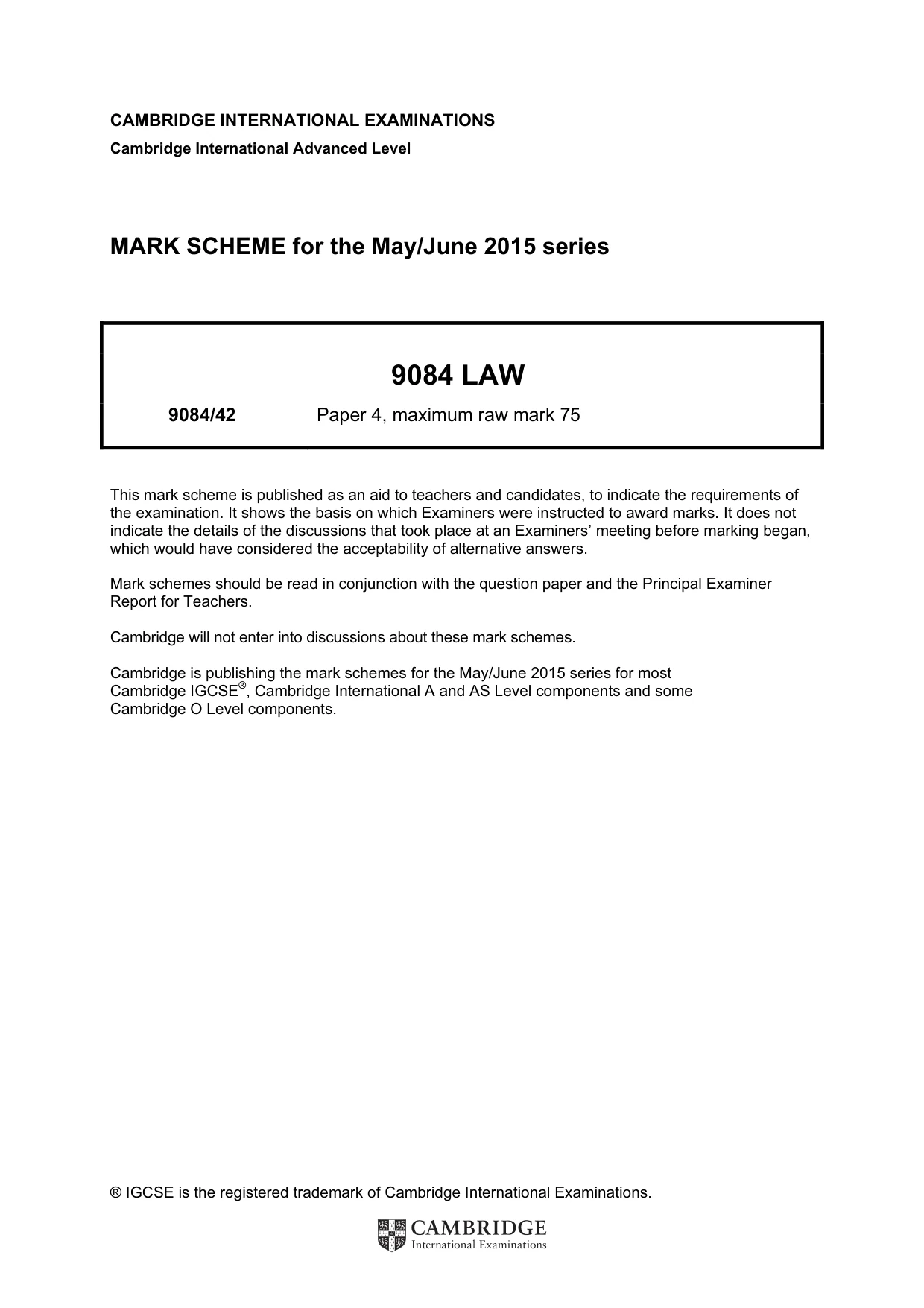
® IGCSE is the registered trademark of Cambridge International Examinations. CAMBRIDGE INTERNATIONAL EXAMINATIONS Cambridge International Advanced Level MARK SCHEME for the May/June 2015 series 9084 LAW 9084/42 Paper 4, maximum raw mark 75 This mark scheme is published as an aid to teachers and candidates, to indicate the requirements of the examination. It shows the basis on which Examiners were instructed to award marks. It does not indicate the details of the discussions that took place at an Examiners’ meeting before marking began, which would have considered the acceptability of alternative answers. Mark schemes should be read in conjunction with the question paper and the Principal Examiner Report for Teachers. Cambridge will not enter into discussions about these mark schemes. Cambridge is publishing the mark schemes for the May/June 2015 series for most Cambridge IGCSE®, Cambridge International A and AS Level components and some Cambridge O Level components.
Mark scheme, page 2
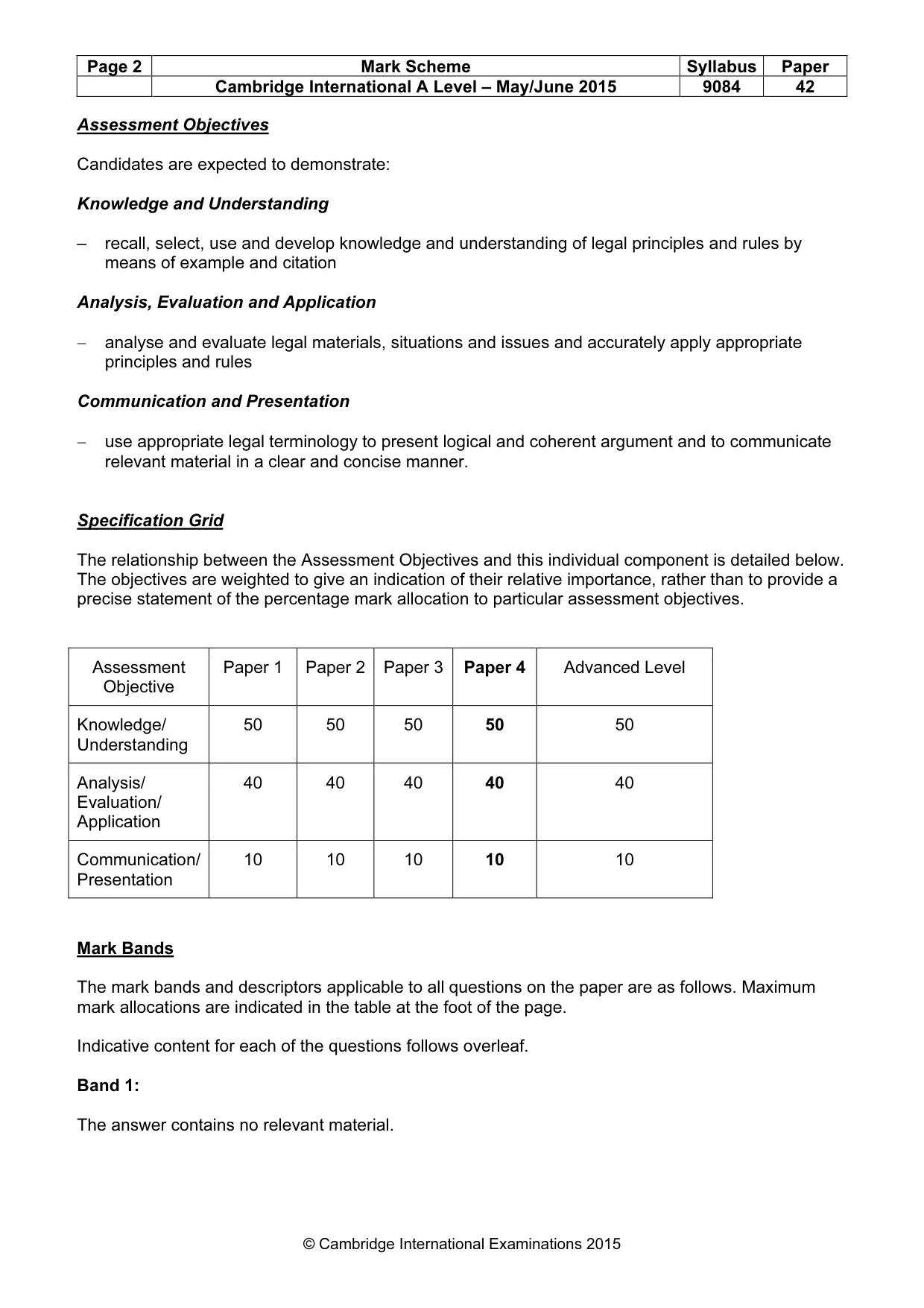
Page 2 Mark Scheme Syllabus Paper Cambridge International A Level – May/June 2015 9084 42 © Cambridge International Examinations 2015 Assessment Objectives Candidates are expected to demonstrate: Knowledge and Understanding – recall, select, use and develop knowledge and understanding of legal principles and rules by means of example and citation Analysis, Evaluation and Application − analyse and evaluate legal materials, situations and issues and accurately apply appropriate principles and rules Communication and Presentation − use appropriate legal terminology to present logical and coherent argument and to communicate relevant material in a clear and concise manner. Specification Grid The relationship between the Assessment Objectives and this individual component is detailed below. The objectives are weighted to give an indication of their relative importance, rather than to provide a precise statement of the percentage mark allocation to particular assessment objectives. Assessment Objective Paper 1 Paper 2 Paper 3 Paper 4 Advanced Level Knowledge/ Understanding 50 50 50 50 50 Analysis/ Evaluation/ Application 40 40 40 40 40 Communication/ Presentation 10 10 10 10 10 Mark Bands The mark bands and descriptors applicable to all questions on the paper are as follows. Maximum mark allocations are indicated in the table at the foot of the page. Indicative content for each of the questions follows overleaf. Band 1: The answer contains no relevant material.
Mark scheme, page 3
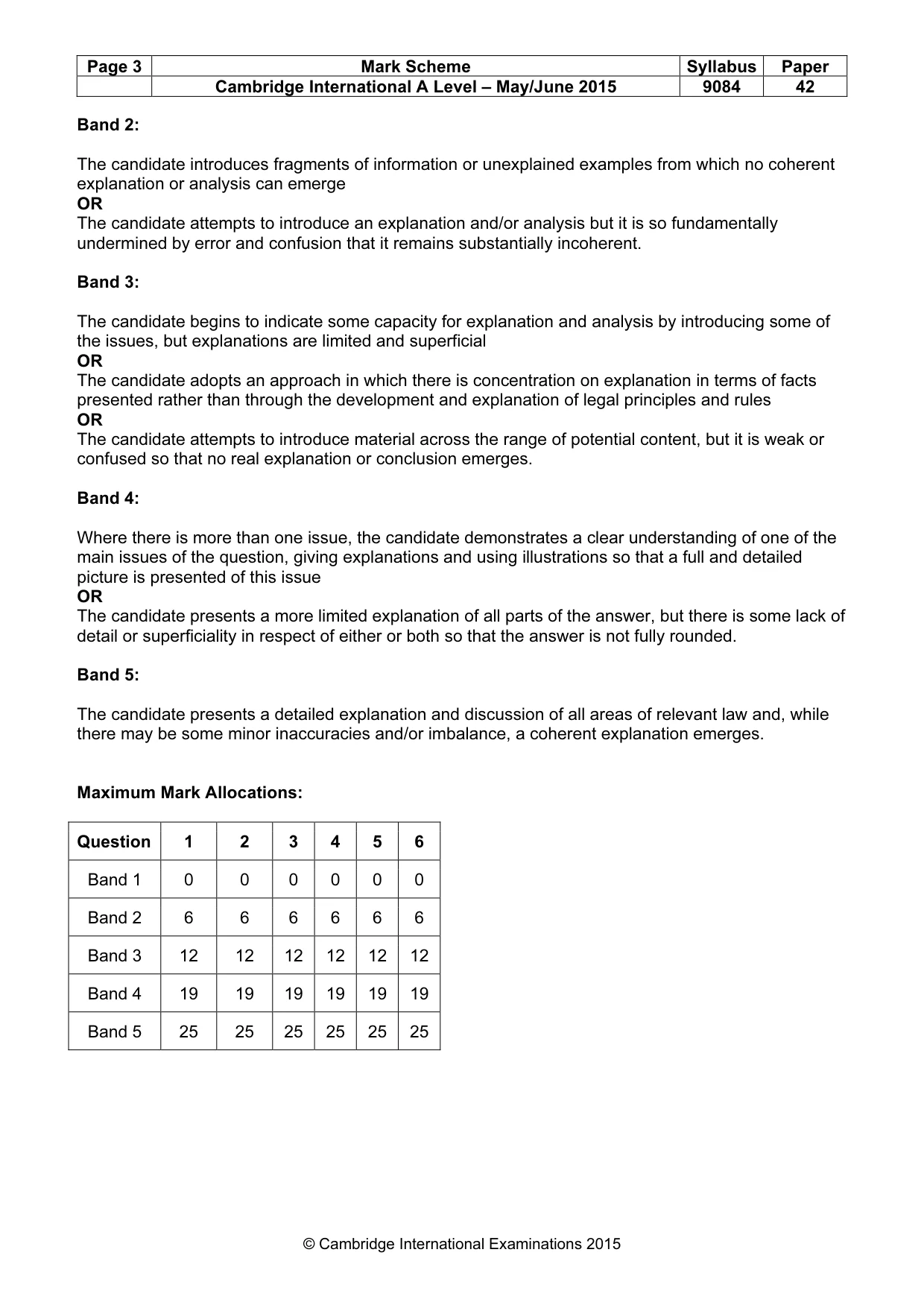
Page 3 Mark Scheme Syllabus Paper Cambridge International A Level – May/June 2015 9084 42 © Cambridge International Examinations 2015 Band 2: The candidate introduces fragments of information or unexplained examples from which no coherent explanation or analysis can emerge OR The candidate attempts to introduce an explanation and/or analysis but it is so fundamentally undermined by error and confusion that it remains substantially incoherent. Band 3: The candidate begins to indicate some capacity for explanation and analysis by introducing some of the issues, but explanations are limited and superficial OR The candidate adopts an approach in which there is concentration on explanation in terms of facts presented rather than through the development and explanation of legal principles and rules OR The candidate attempts to introduce material across the range of potential content, but it is weak or confused so that no real explanation or conclusion emerges. Band 4: Where there is more than one issue, the candidate demonstrates a clear understanding of one of the main issues of the question, giving explanations and using illustrations so that a full and detailed picture is presented of this issue OR The candidate presents a more limited explanation of all parts of the answer, but there is some lack of detail or superficiality in respect of either or both so that the answer is not fully rounded. Band 5: The candidate presents a detailed explanation and discussion of all areas of relevant law and, while there may be some minor inaccuracies and/or imbalance, a coherent explanation emerges. Maximum Mark Allocations: Question 1 2 3 4 5 6 Band 1 0 0 0 0 0 0 Band 2 6 6 6 6 6 6 Band 3 12 12 12 12 12 12 Band 4 19 19 19 19 19 19 Band 5 25 25 25 25 25 25
Mark scheme, page 4
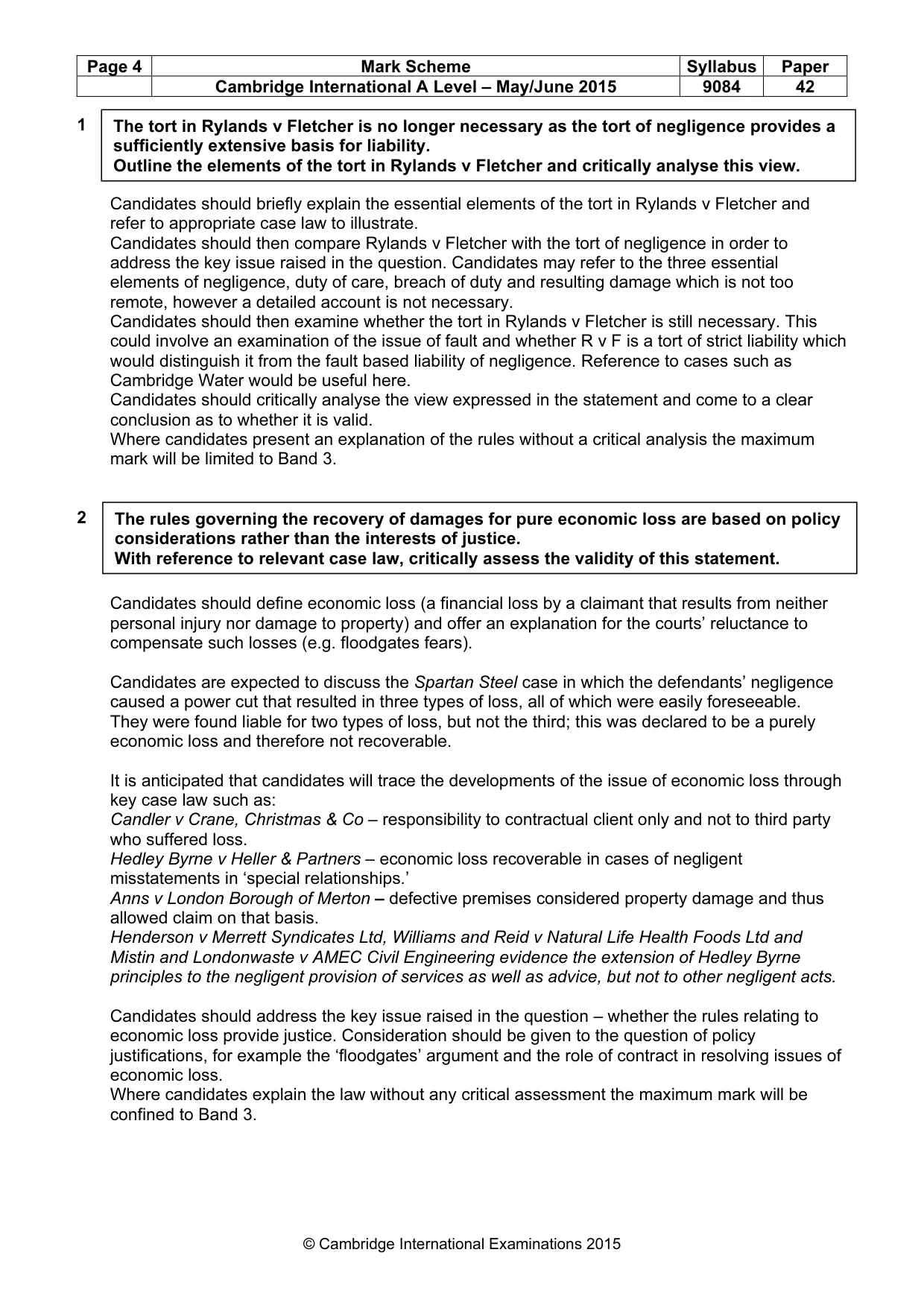
Page 4 Mark Scheme Syllabus Paper Cambridge International A Level – May/June 2015 9084 42 © Cambridge International Examinations 2015 1 Candidates should briefly explain the essential elements of the tort in Rylands v Fletcher and refer to appropriate case law to illustrate. Candidates should then compare Rylands v Fletcher with the tort of negligence in order to address the key issue raised in the question. Candidates may refer to the three essential elements of negligence, duty of care, breach of duty and resulting damage which is not too remote, however a detailed account is not necessary. Candidates should then examine whether the tort in Rylands v Fletcher is still necessary. This could involve an examination of the issue of fault and whether R v F is a tort of strict liability which would distinguish it from the fault based liability of negligence. Reference to cases such as Cambridge Water would be useful here. Candidates should critically analyse the view expressed in the statement and come to a clear conclusion as to whether it is valid. Where candidates present an explanation of the rules without a critical analysis the maximum mark will be limited to Band 3. 2 Candidates should define economic loss (a financial loss by a claimant that results from neither personal injury nor damage to property) and offer an explanation for the courts’ reluctance to compensate such losses (e.g. floodgates fears). Candidates are expected to discuss the Spartan Steel case in which the defendants’ negligence caused a power cut that resulted in three types of loss, all of which were easily foreseeable. They were found liable for two types of loss, but not the third; this was declared to be a purely economic loss and therefore not recoverable. It is anticipated that candidates will trace the developments of the issue of economic loss through key case law such as: Candler v Crane, Christmas & Co – responsibility to contractual client only and not to third party who suffered loss. Hedley Byrne v Heller & Partners – economic loss recoverable in cases of negligent misstatements in ‘special relationships.’ Anns v London Borough of Merton – defective premises considered property damage and thus allowed claim on that basis. Henderson v Merrett Syndicates Ltd, Williams and Reid v Natural Life Health Foods Ltd and Mistin and Londonwaste v AMEC Civil Engineering evidence the extension of Hedley Byrne principles to the negligent provision of services as well as advice, but not to other negligent acts. Candidates should address the key issue raised in the question – whether the rules relating to economic loss provide justice. Consideration should be given to the question of policy justifications, for example the ‘floodgates’ argument and the role of contract in resolving issues of economic loss. Where candidates explain the law without any critical assessment the maximum mark will be confined to Band 3. The tort in Rylands v Fletcher is no longer necessary as the tort of negligence provides a sufficiently extensive basis for liability. Outline the elements of the tort in Rylands v Fletcher and critically analyse this view. The rules governing the recovery of damages for pure economic loss are based on policy considerations rather than the interests of justice. With reference to relevant case law, critically assess the validity of this statement.
Mark scheme, page 5
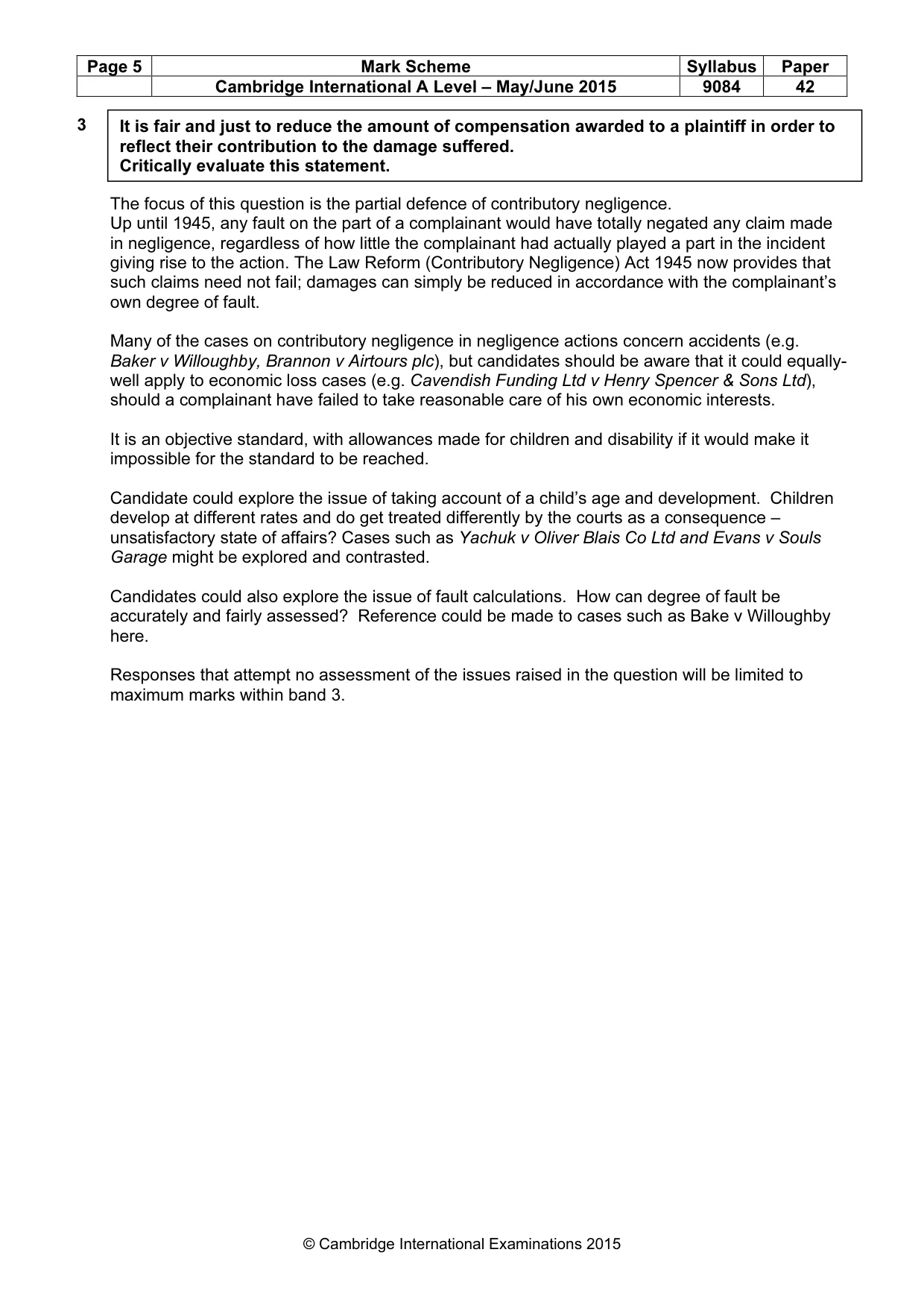
Page 5 Mark Scheme Syllabus Paper Cambridge International A Level – May/June 2015 9084 42 © Cambridge International Examinations 2015 3 The focus of this question is the partial defence of contributory negligence. Up until 1945, any fault on the part of a complainant would have totally negated any claim made in negligence, regardless of how little the complainant had actually played a part in the incident giving rise to the action. The Law Reform (Contributory Negligence) Act 1945 now provides that such claims need not fail; damages can simply be reduced in accordance with the complainant’s own degree of fault. Many of the cases on contributory negligence in negligence actions concern accidents (e.g. Baker v Willoughby, Brannon v Airtours plc), but candidates should be aware that it could equally- well apply to economic loss cases (e.g. Cavendish Funding Ltd v Henry Spencer & Sons Ltd), should a complainant have failed to take reasonable care of his own economic interests. It is an objective standard, with allowances made for children and disability if it would make it impossible for the standard to be reached. Candidate could explore the issue of taking account of a child’s age and development. Children develop at different rates and do get treated differently by the courts as a consequence – unsatisfactory state of affairs? Cases such as Yachuk v Oliver Blais Co Ltd and Evans v Souls Garage might be explored and contrasted. Candidates could also explore the issue of fault calculations. How can degree of fault be accurately and fairly assessed? Reference could be made to cases such as Bake v Willoughby here. Responses that attempt no assessment of the issues raised in the question will be limited to maximum marks within band 3. It is fair and just to reduce the amount of compensation awarded to a plaintiff in order to reflect their contribution to the damage suffered. Critically evaluate this statement.
Mark scheme, page 6
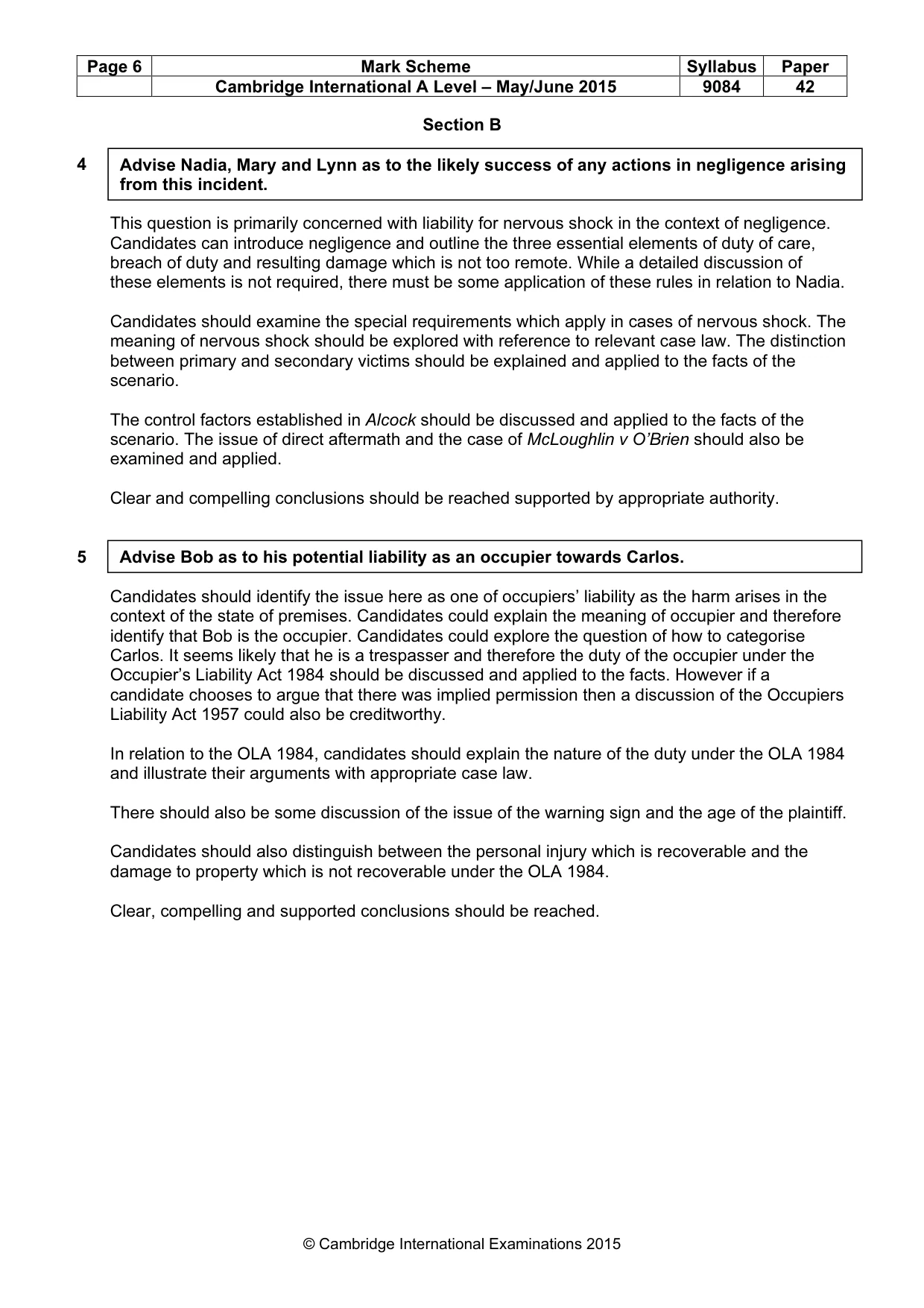
Page 6 Mark Scheme Syllabus Paper Cambridge International A Level – May/June 2015 9084 42 © Cambridge International Examinations 2015 Section B 4 This question is primarily concerned with liability for nervous shock in the context of negligence. Candidates can introduce negligence and outline the three essential elements of duty of care, breach of duty and resulting damage which is not too remote. While a detailed discussion of these elements is not required, there must be some application of these rules in relation to Nadia. Candidates should examine the special requirements which apply in cases of nervous shock. The meaning of nervous shock should be explored with reference to relevant case law. The distinction between primary and secondary victims should be explained and applied to the facts of the scenario. The control factors established in Alcock should be discussed and applied to the facts of the scenario. The issue of direct aftermath and the case of McLoughlin v O’Brien should also be examined and applied. Clear and compelling conclusions should be reached supported by appropriate authority. 5 Candidates should identify the issue here as one of occupiers’ liability as the harm arises in the context of the state of premises. Candidates could explain the meaning of occupier and therefore identify that Bob is the occupier. Candidates could explore the question of how to categorise Carlos. It seems likely that he is a trespasser and therefore the duty of the occupier under the Occupier’s Liability Act 1984 should be discussed and applied to the facts. However if a candidate chooses to argue that there was implied permission then a discussion of the Occupiers Liability Act 1957 could also be creditworthy. In relation to the OLA 1984, candidates should explain the nature of the duty under the OLA 1984 and illustrate their arguments with appropriate case law. There should also be some discussion of the issue of the warning sign and the age of the plaintiff. Candidates should also distinguish between the personal injury which is recoverable and the damage to property which is not recoverable under the OLA 1984. Clear, compelling and supported conclusions should be reached. Advise Nadia, Mary and Lynn as to the likely success of any actions in negligence arising from this incident. Advise Bob as to his potential liability as an occupier towards Carlos.
Mark scheme, page 7
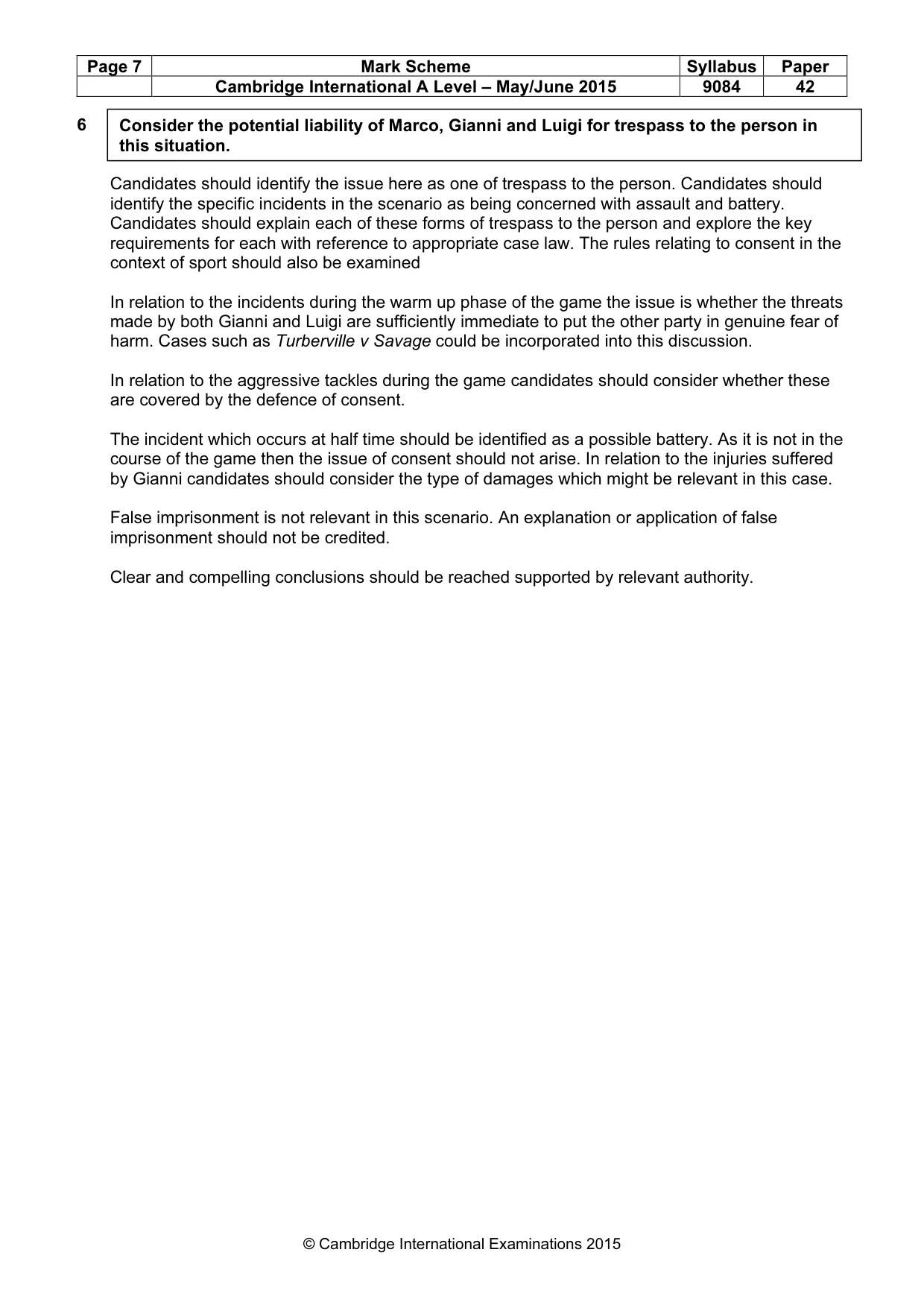
Page 7 Mark Scheme Syllabus Paper Cambridge International A Level – May/June 2015 9084 42 © Cambridge International Examinations 2015 6 Candidates should identify the issue here as one of trespass to the person. Candidates should identify the specific incidents in the scenario as being concerned with assault and battery. Candidates should explain each of these forms of trespass to the person and explore the key requirements for each with reference to appropriate case law. The rules relating to consent in the context of sport should also be examined In relation to the incidents during the warm up phase of the game the issue is whether the threats made by both Gianni and Luigi are sufficiently immediate to put the other party in genuine fear of harm. Cases such as Turberville v Savage could be incorporated into this discussion. In relation to the aggressive tackles during the game candidates should consider whether these are covered by the defence of consent. The incident which occurs at half time should be identified as a possible battery. As it is not in the course of the game then the issue of consent should not arise. In relation to the injuries suffered by Gianni candidates should consider the type of damages which might be relevant in this case. False imprisonment is not relevant in this scenario. An explanation or application of false imprisonment should not be credited. Clear and compelling conclusions should be reached supported by relevant authority. Consider the potential liability of Marco, Gianni and Luigi for trespass to the person in this situation.
What you needed in this session
Cambridge’s own grade thresholds for 2015 May/June, Paper 4 · Variant 2. A higher threshold means an easier paper — the bar moves with how the cohort did.