Cambridge A Level Law 9084 — 2023 Oct/Nov Paper 4 · Variant 1
9084/41/O/N/23 · 75 marks · ≈84 min
The question paper and its mark scheme, free to read here and free to download. This is Cambridge’s own paper, exactly as it was sat.
Question paper4 pages

Mark scheme14 pages
Answers below. Sit the paper first if you are practising.
Paper as text
Question paper, page 1
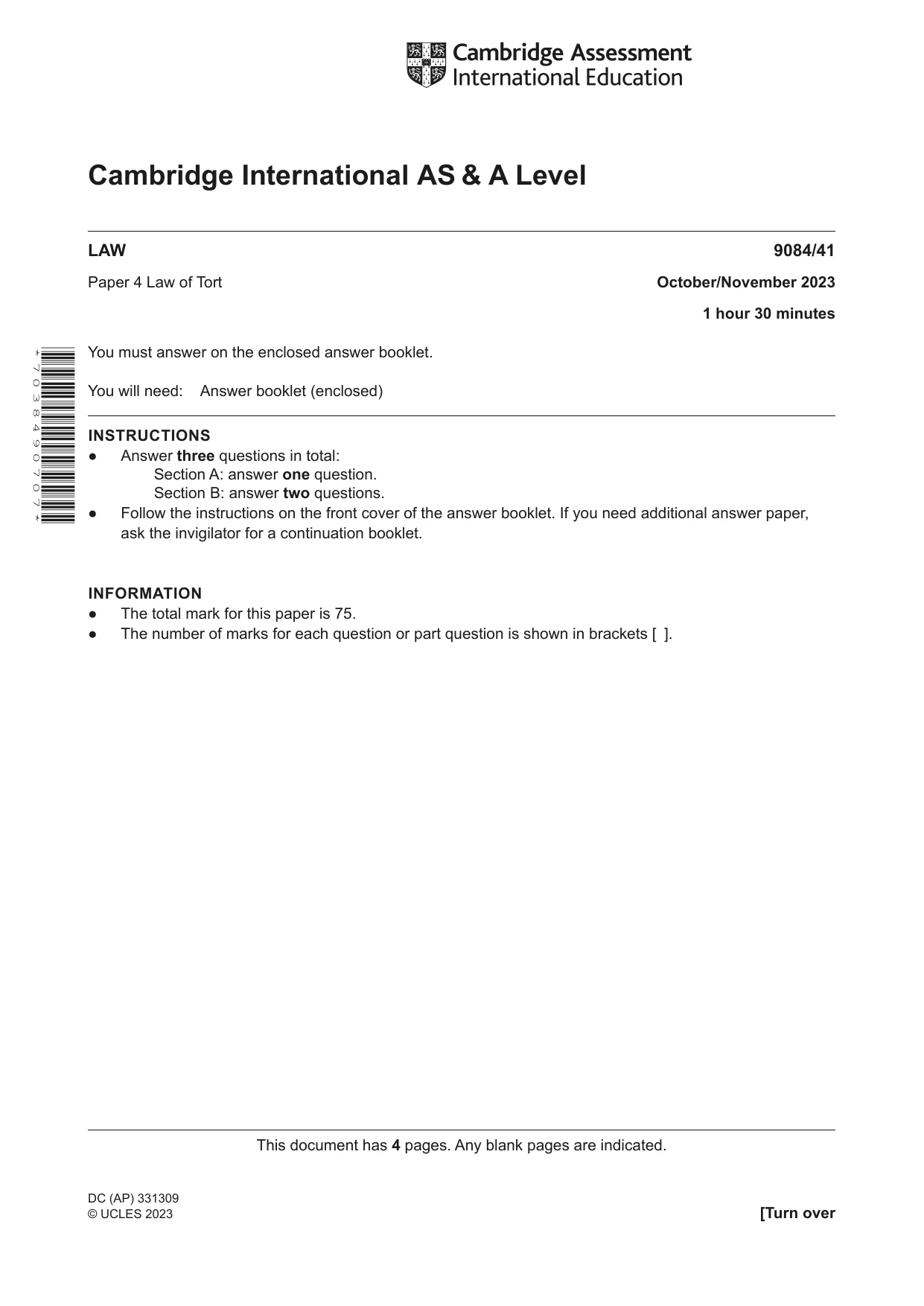
This document has 4 pages. Any blank pages are indicated. [Turn over Cambridge International AS & A Level DC (AP) 331309 © UCLES 2023 LAW 9084/41 Paper 4 Law of Tort October/November 2023 1 hour 30 minutes You must answer on the enclosed answer booklet. You will need: Answer booklet (enclosed) INSTRUCTIONS ● Answer three questions in total: Section A: answer one question. Section B: answer two questions. ● Follow the instructions on the front cover of the answer booklet. If you need additional answer paper, ask the invigilator for a continuation booklet. INFORMATION ● The total mark for this paper is 75. ● The number of marks for each question or part question is shown in brackets [ ]. * 7 0 3 8 4 9 0 7 0 7 *
Question paper, page 2
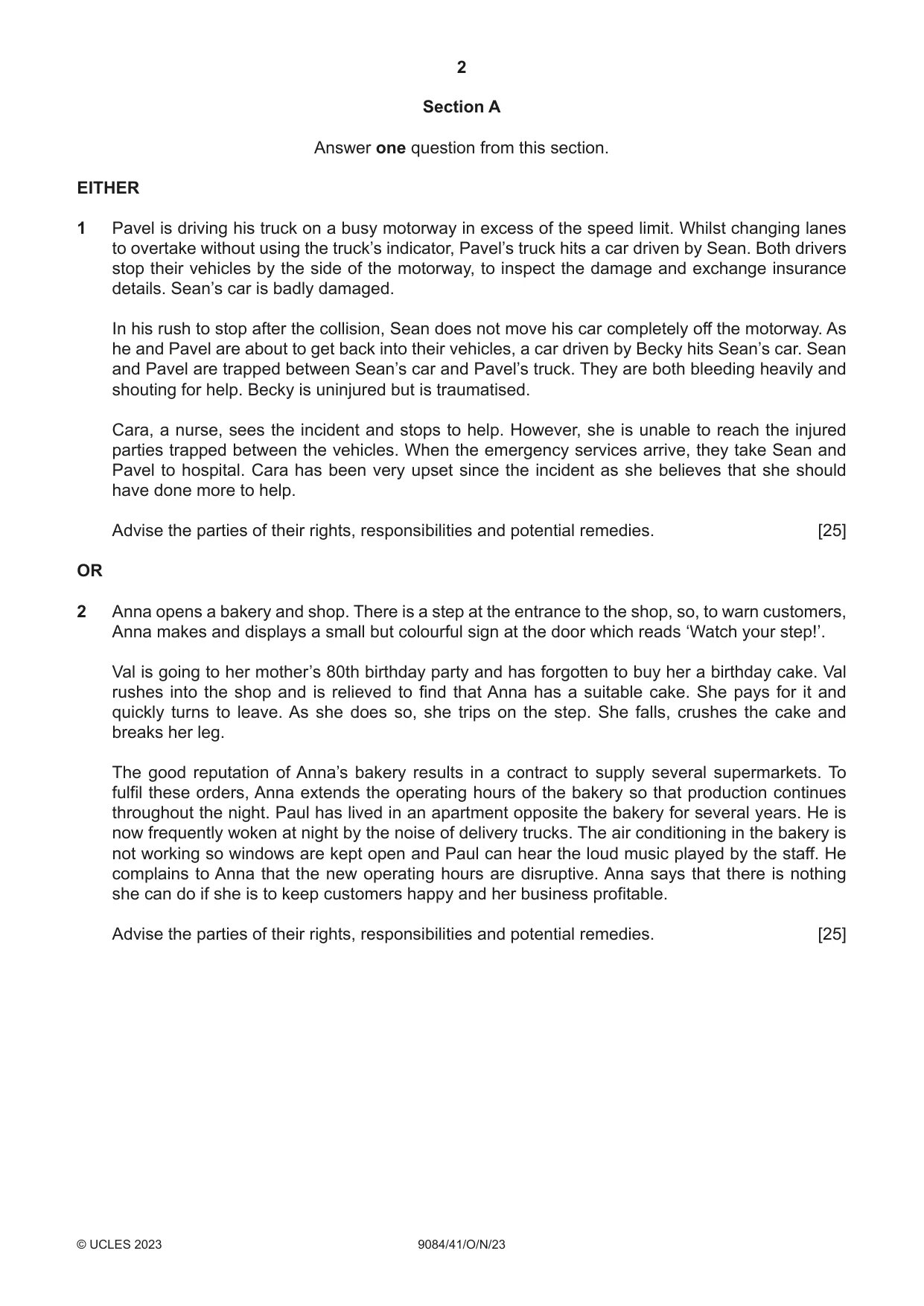
2 9084/41/O/N/23 © UCLES 2023 Section A Answer one question from this section. EITHER 1 Pavel is driving his truck on a busy motorway in excess of the speed limit. Whilst changing lanes to overtake without using the truck’s indicator, Pavel’s truck hits a car driven by Sean. Both drivers stop their vehicles by the side of the motorway, to inspect the damage and exchange insurance details. Sean’s car is badly damaged. In his rush to stop after the collision, Sean does not move his car completely off the motorway. As he and Pavel are about to get back into their vehicles, a car driven by Becky hits Sean’s car. Sean and Pavel are trapped between Sean’s car and Pavel’s truck. They are both bleeding heavily and shouting for help. Becky is uninjured but is traumatised. Cara, a nurse, sees the incident and stops to help. However, she is unable to reach the injured parties trapped between the vehicles. When the emergency services arrive, they take Sean and Pavel to hospital. Cara has been very upset since the incident as she believes that she should have done more to help. Advise the parties of their rights, responsibilities and potential remedies. [25] OR 2 Anna opens a bakery and shop. There is a step at the entrance to the shop, so, to warn customers, Anna makes and displays a small but colourful sign at the door which reads ‘Watch your step!’. Val is going to her mother’s 80th birthday party and has forgotten to buy her a birthday cake. Val rushes into the shop and is relieved to find that Anna has a suitable cake. She pays for it and quickly turns to leave. As she does so, she trips on the step. She falls, crushes the cake and breaks her leg. The good reputation of Anna’s bakery results in a contract to supply several supermarkets. To fulfil these orders, Anna extends the operating hours of the bakery so that production continues throughout the night. Paul has lived in an apartment opposite the bakery for several years. He is now frequently woken at night by the noise of delivery trucks. The air conditioning in the bakery is not working so windows are kept open and Paul can hear the loud music played by the staff. He complains to Anna that the new operating hours are disruptive. Anna says that there is nothing she can do if she is to keep customers happy and her business profitable. Advise the parties of their rights, responsibilities and potential remedies. [25]
Question paper, page 3
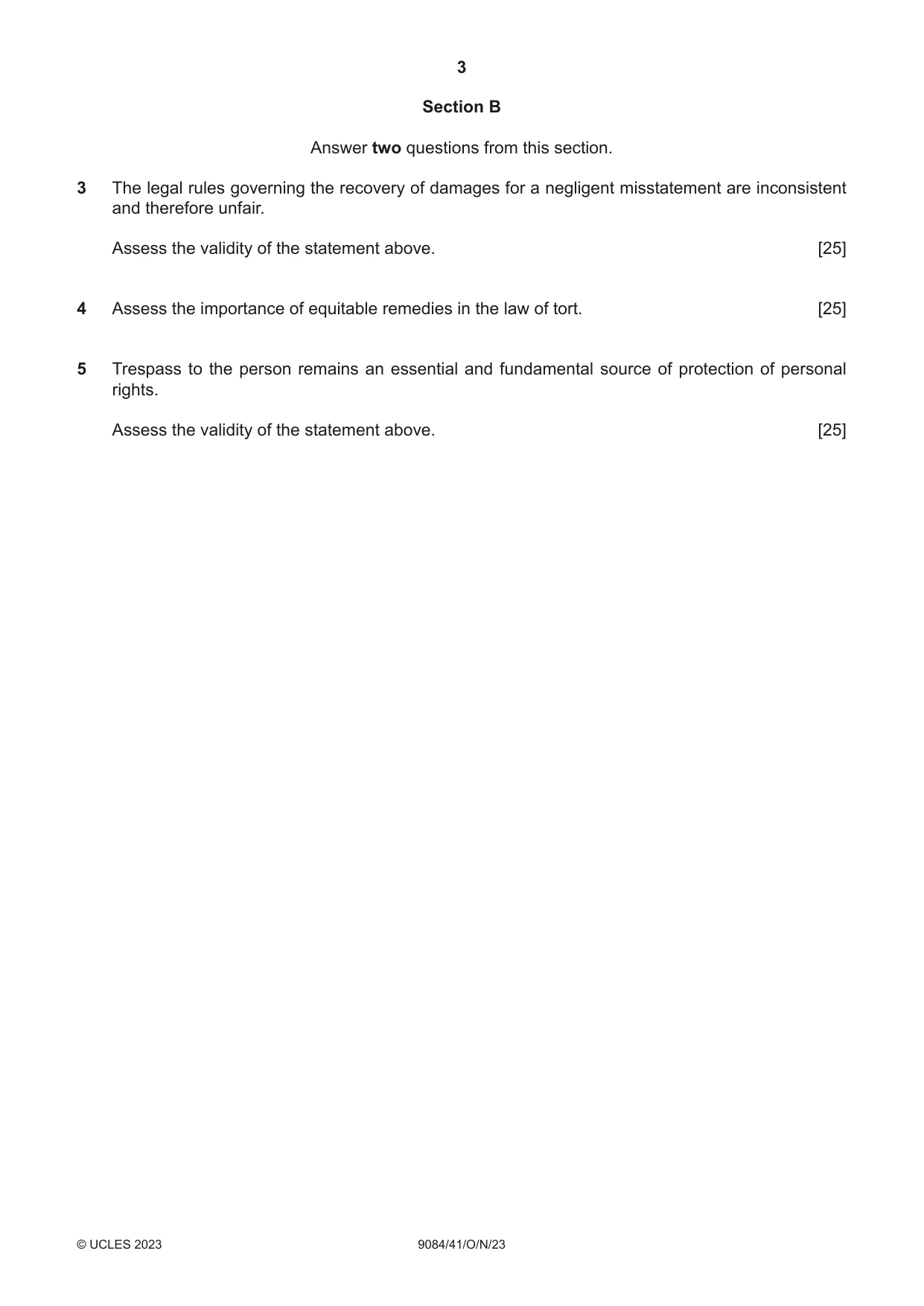
3 9084/41/O/N/23 © UCLES 2023 Section B Answer two questions from this section. 3 The legal rules governing the recovery of damages for a negligent misstatement are inconsistent and therefore unfair. Assess the validity of the statement above. [25] 4 Assess the importance of equitable remedies in the law of tort. [25] 5 Trespass to the person remains an essential and fundamental source of protection of personal rights. Assess the validity of the statement above. [25]
Question paper, page 4
4 9084/41/O/N/23 © UCLES 2023 Permission to reproduce items where third-party owned material protected by copyright is included has been sought and cleared where possible. Every reasonable effort has been made by the publisher (UCLES) to trace copyright holders, but if any items requiring clearance have unwittingly been included, the publisher will be pleased to make amends at the earliest possible opportunity. To avoid the issue of disclosure of answer-related information to candidates, all copyright acknowledgements are reproduced online in the Cambridge Assessment International Education Copyright Acknowledgements Booklet. This is produced for each series of examinations and is freely available to download at www.cambridgeinternational.org after the live examination series. Cambridge Assessment International Education is part of Cambridge Assessment. Cambridge Assessment is the brand name of the University of Cambridge Local Examinations Syndicate (UCLES), which is a department of the University of Cambridge. BLANK PAGE
Mark scheme, page 1
This document consists of 14 printed pages. © UCLES 2023 [Turn over Cambridge International AS & A Level LAW 9084/41 Paper 4 October/November 2023 MARK SCHEME Maximum Mark: 75 Published This mark scheme is published as an aid to teachers and candidates, to indicate the requirements of the examination. It shows the basis on which Examiners were instructed to award marks. It does not indicate the details of the discussions that took place at an Examiners’ meeting before marking began, which would have considered the acceptability of alternative answers. Mark schemes should be read in conjunction with the question paper and the Principal Examiner Report for Teachers. Cambridge International will not enter into discussions about these mark schemes. Cambridge International is publishing the mark schemes for the October/November 2023 series for most Cambridge IGCSE, Cambridge International A and AS Level components, and some Cambridge O Level components.
Mark scheme, page 2
9084/41 Cambridge International AS & A Level – Mark Scheme PUBLISHED October/November 2023 © UCLES 2023 Page 2 of 14 Generic Marking Principles These general marking principles must be applied by all examiners when marking candidate answers. They should be applied alongside the specific content of the mark scheme or generic level descriptors for a question. Each question paper and mark scheme will also comply with these marking principles. GENERIC MARKING PRINCIPLE 1: Marks must be awarded in line with: • the specific content of the mark scheme or the generic level descriptors for the question • the specific skills defined in the mark scheme or in the generic level descriptors for the question • the standard of response required by a candidate as exemplified by the standardisation scripts. GENERIC MARKING PRINCIPLE 2: Marks awarded are always whole marks (not half marks, or other fractions). GENERIC MARKING PRINCIPLE 3: Marks must be awarded positively: • marks are awarded for correct/valid answers, as defined in the mark scheme. However, credit is given for valid answers which go beyond the scope of the syllabus and mark scheme, referring to your Team Leader as appropriate • marks are awarded when candidates clearly demonstrate what they know and can do • marks are not deducted for errors • marks are not deducted for omissions • answers should only be judged on the quality of spelling, punctuation and grammar when these features are specifically assessed by the question as indicated by the mark scheme. The meaning, however, should be unambiguous. GENERIC MARKING PRINCIPLE 4: Rules must be applied consistently, e.g. in situations where candidates have not followed instructions or in the application of generic level descriptors. GENERIC MARKING PRINCIPLE 5: Marks should be awarded using the full range of marks defined in the mark scheme for the question (however; the use of the full mark range may be limited according to the quality of the candidate responses seen). GENERIC MARKING PRINCIPLE 6: Marks awarded are based solely on the requirements as defined in the mark scheme. Marks should not be awarded with grade thresholds or grade descriptors in mind.
Mark scheme, page 3
9084/41 Cambridge International AS & A Level – Mark Scheme PUBLISHED October/November 2023 © UCLES 2023 Page 3 of 14 Social Science-Specific Marking Principles (for point-based marking) 1 Components using point-based marking: • Point marking is often used to reward knowledge, understanding and application of skills. We give credit where the candidate’s answer shows relevant knowledge, understanding and application of skills in answering the question. We do not give credit where the answer shows confusion. From this it follows that we: a DO credit answers which are worded differently from the mark scheme if they clearly convey the same meaning (unless the mark scheme requires a specific term) b DO credit alternative answers/examples which are not written in the mark scheme if they are correct c DO credit answers where candidates give more than one correct answer in one prompt/numbered/scaffolded space where extended writing is required rather than list-type answers. For example, questions that require n reasons (e.g. State two reasons …). d DO NOT credit answers simply for using a ‘key term’ unless that is all that is required. (Check for evidence it is understood and not used wrongly.) e DO NOT credit answers which are obviously self-contradicting or trying to cover all possibilities f DO NOT give further credit for what is effectively repetition of a correct point already credited unless the language itself is being tested. This applies equally to ‘mirror statements’ (i.e. polluted/not polluted). g DO NOT require spellings to be correct, unless this is part of the test. However spellings of syllabus terms must allow for clear and unambiguous separation from other syllabus terms with which they may be confused (e.g. Corrasion/Corrosion) 2 Presentation of mark scheme: • Slashes (/) or the word ‘or’ separate alternative ways of making the same point. • Semi colons (;) bullet points (•) or figures in brackets (1) separate different points. • Content in the answer column in brackets is for examiner information/context to clarify the marking but is not required to earn the mark (except Accounting syllabuses where they indicate negative numbers). 3 Annotation: • For point marking, ticks can be used to indicate correct answers and crosses can be used to indicate wrong answers. There is no direct relationship between ticks and marks. Ticks have no defined meaning for levels of response marking. • For levels of response marking, the level awarded should be annotated on the script. • Other annotations will be used by examiners as agreed during standardisation, and the meaning will be understood by all examiners who marked that paper.
Mark scheme, page 4
9084/41 Cambridge International AS & A Level – Mark Scheme PUBLISHED October/November 2023 © UCLES 2023 Page 4 of 14 Guidance on using levels-based mark schemes Marking of work should be positive, rewarding achievement where possible, but clearly differentiating across the whole range of marks, where appropriate. The marker should look at the work and then make a judgement about which level statement is the best fit. In practice, work does not always match one level statement precisely so a judgement may need to be made between two or more level statements. Once a best-fit level statement has been identified, use the following guidance to decide on a specific mark: • If the candidate’s work convincingly meets the level statement, award the highest mark. • If the candidate’s work adequately meets the level statement, award the most appropriate mark in the middle of the range (where middle marks are available). • If the candidate’s work just meets the level statement, award the lowest mark. Assessment objectives AO1 Knowledge and understanding • Demonstrate knowledge and understanding of legal concepts, principles and rules. • Use statutes, cases, examples and legal terminology. AO2 Analysis and application • Analyse legal concepts, principles and rules. • Apply legal concepts, principles and rules. AO3 Evaluation • Evaluate legal concepts, principles and rules. • Communicate legal argument coherently on the basis of evidence.
Mark scheme, page 5
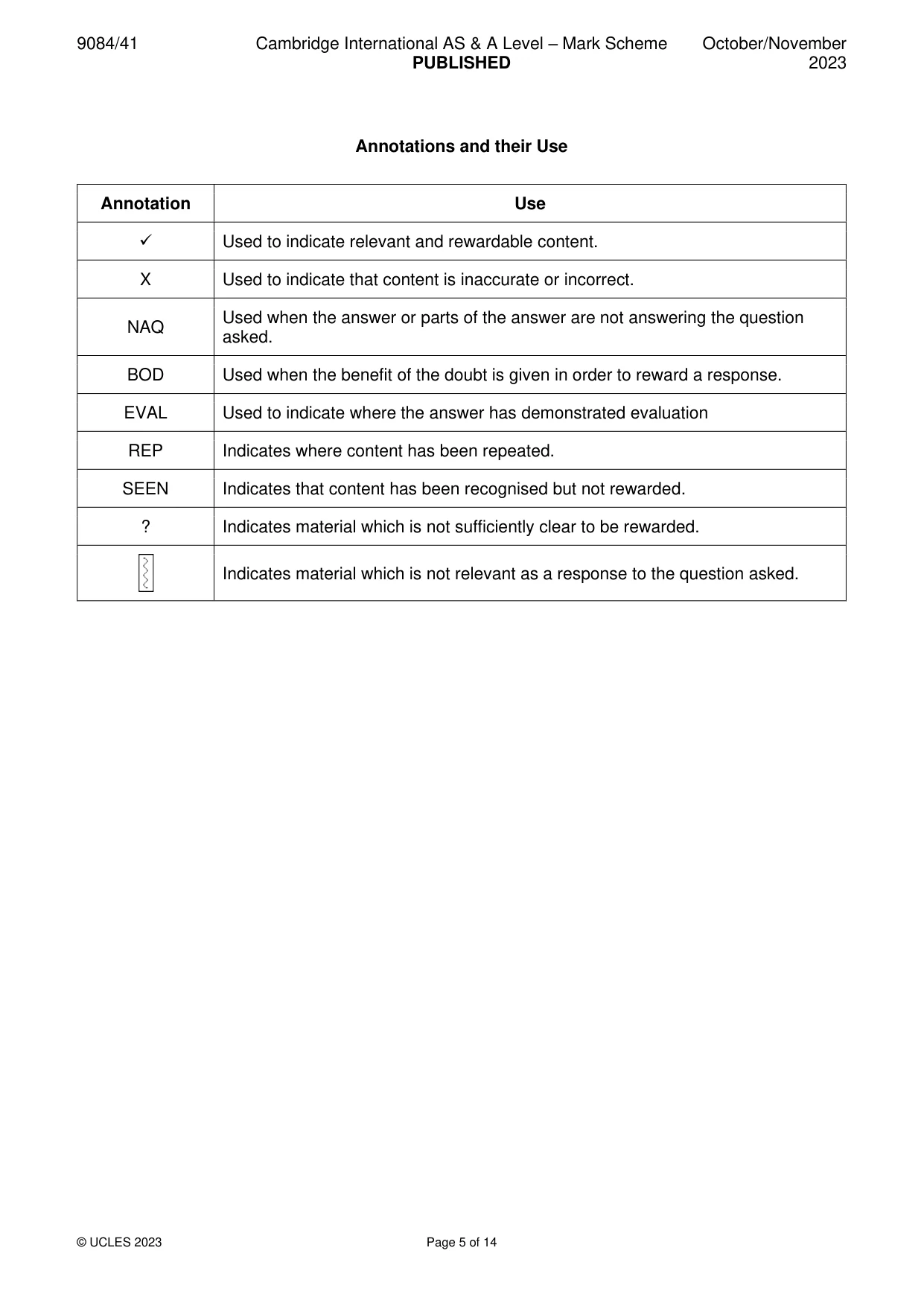
9084/41 Cambridge International AS & A Level – Mark Scheme PUBLISHED October/November 2023 © UCLES 2023 Page 5 of 14 Annotations and their Use Annotation Use ✓ Used to indicate relevant and rewardable content. X Used to indicate that content is inaccurate or incorrect. NAQ Used when the answer or parts of the answer are not answering the question asked. BOD Used when the benefit of the doubt is given in order to reward a response. EVAL Used to indicate where the answer has demonstrated evaluation REP Indicates where content has been repeated. SEEN Indicates that content has been recognised but not rewarded. ? Indicates material which is not sufficiently clear to be rewarded. Indicates material which is not relevant as a response to the question asked.
Mark scheme, page 6
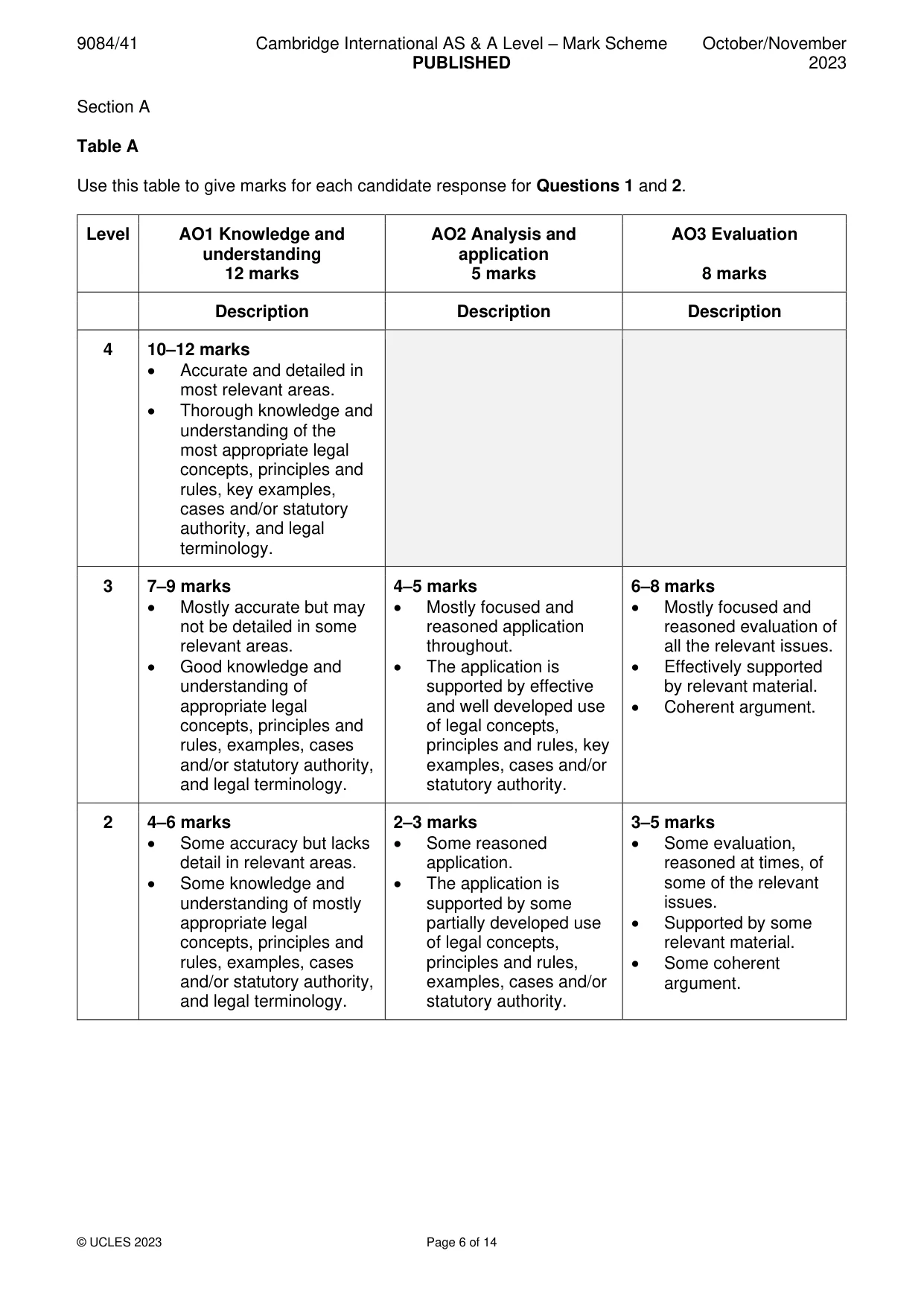
9084/41 Cambridge International AS & A Level – Mark Scheme PUBLISHED October/November 2023 © UCLES 2023 Page 6 of 14 Section A Table A Use this table to give marks for each candidate response for Questions 1 and 2. Level AO1 Knowledge and understanding 12 marks AO2 Analysis and application 5 marks AO3 Evaluation 8 marks Description Description Description 4 10–12 marks • Accurate and detailed in most relevant areas. • Thorough knowledge and understanding of the most appropriate legal concepts, principles and rules, key examples, cases and/or statutory authority, and legal terminology. 3 7–9 marks • Mostly accurate but may not be detailed in some relevant areas. • Good knowledge and understanding of appropriate legal concepts, principles and rules, examples, cases and/or statutory authority, and legal terminology. 4–5 marks • Mostly focused and reasoned application throughout. • The application is supported by effective and well developed use of legal concepts, principles and rules, key examples, cases and/or statutory authority. 6–8 marks • Mostly focused and reasoned evaluation of all the relevant issues. • Effectively supported by relevant material. • Coherent argument. 2 4–6 marks • Some accuracy but lacks detail in relevant areas. • Some knowledge and understanding of mostly appropriate legal concepts, principles and rules, examples, cases and/or statutory authority, and legal terminology. 2–3 marks • Some reasoned application. • The application is supported by some partially developed use of legal concepts, principles and rules, examples, cases and/or statutory authority. 3–5 marks • Some evaluation, reasoned at times, of some of the relevant issues. • Supported by some relevant material. • Some coherent argument.
Mark scheme, page 7
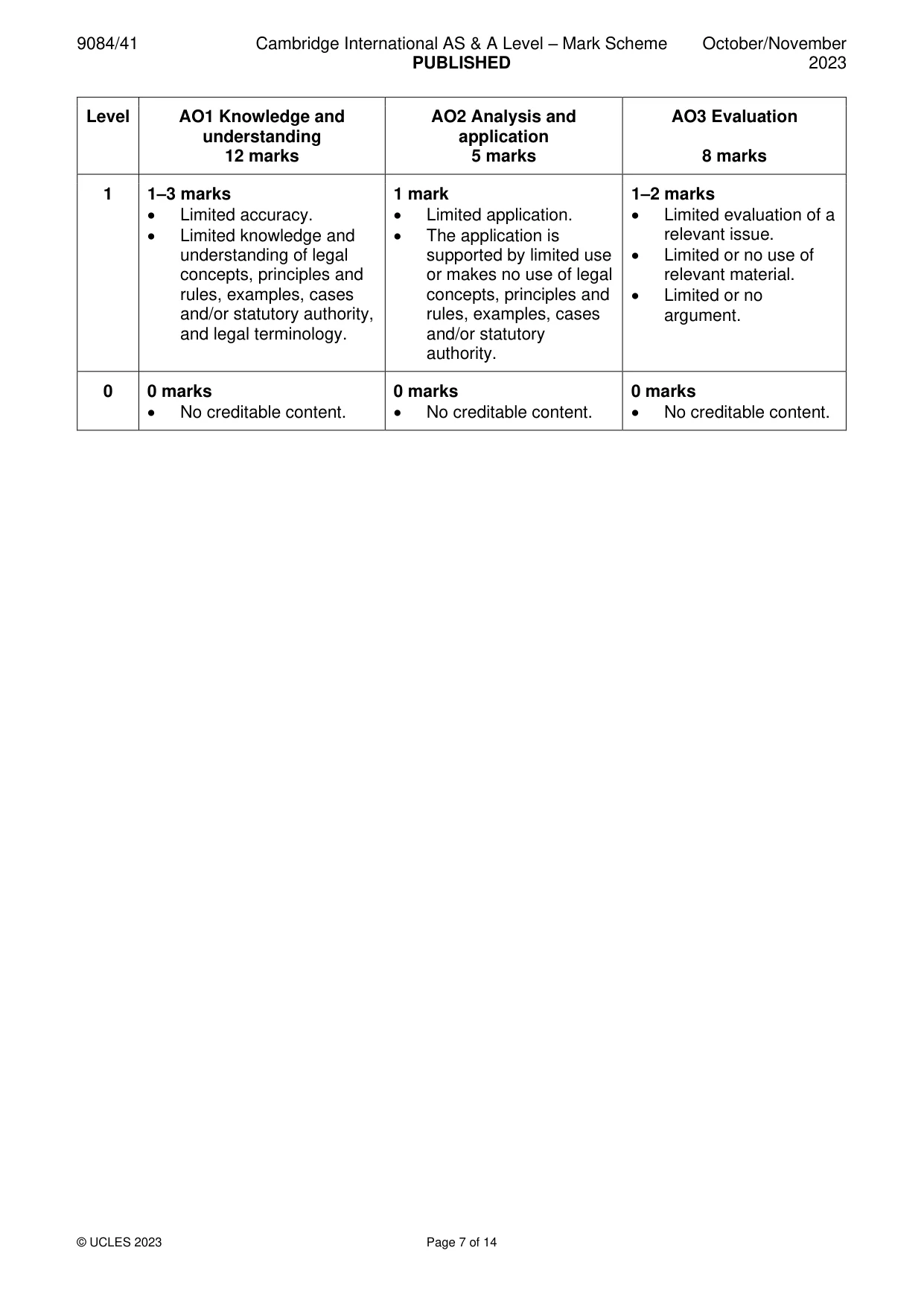
9084/41 Cambridge International AS & A Level – Mark Scheme PUBLISHED October/November 2023 © UCLES 2023 Page 7 of 14 Level AO1 Knowledge and understanding 12 marks AO2 Analysis and application 5 marks AO3 Evaluation 8 marks 1 1–3 marks • Limited accuracy. • Limited knowledge and understanding of legal concepts, principles and rules, examples, cases and/or statutory authority, and legal terminology. 1 mark • Limited application. • The application is supported by limited use or makes no use of legal concepts, principles and rules, examples, cases and/or statutory authority. 1–2 marks • Limited evaluation of a relevant issue. • Limited or no use of relevant material. • Limited or no argument. 0 0 marks • No creditable content. 0 marks • No creditable content. 0 marks • No creditable content.
Mark scheme, page 8
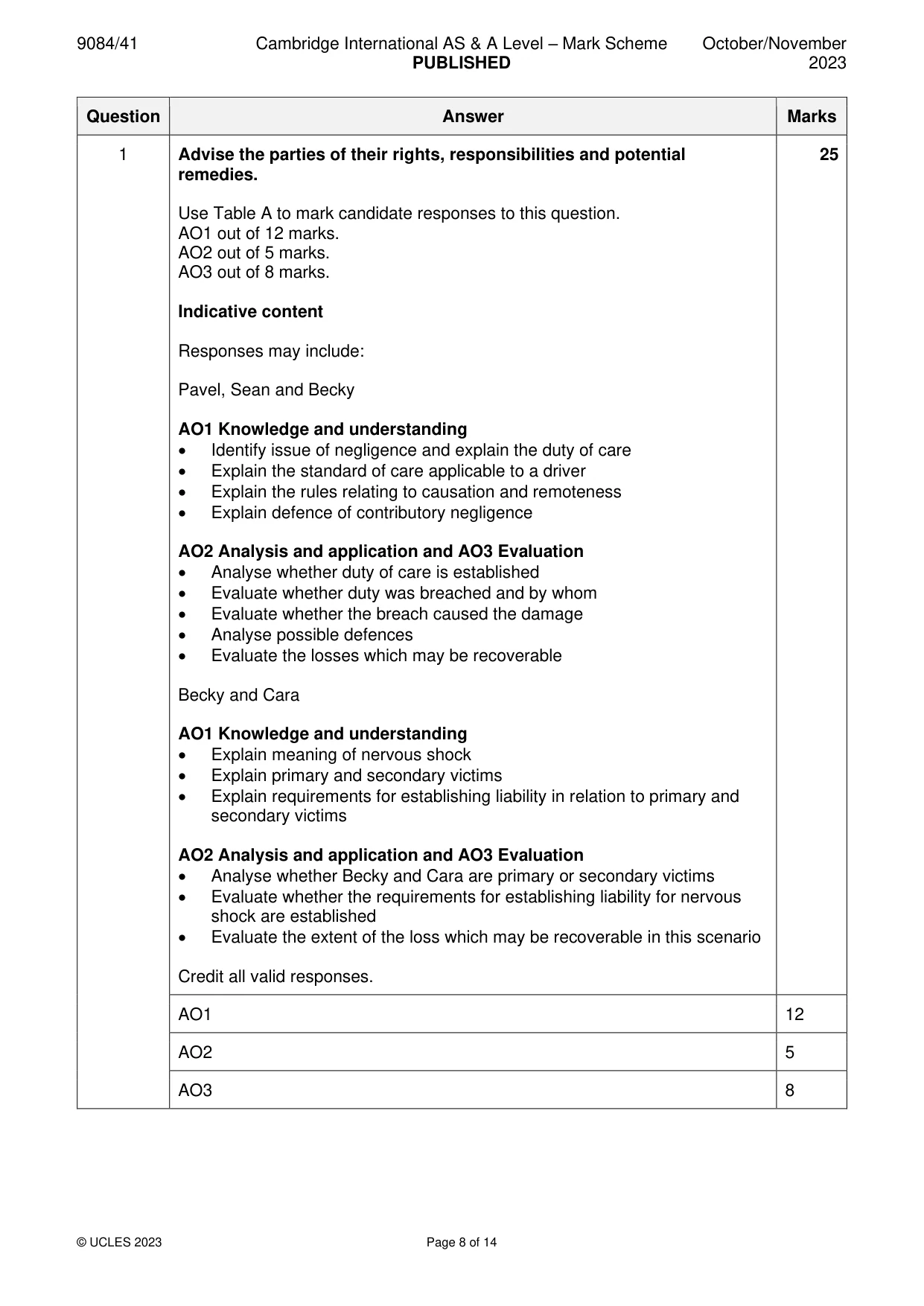
9084/41 Cambridge International AS & A Level – Mark Scheme PUBLISHED October/November 2023 © UCLES 2023 Page 8 of 14 Question Answer Marks 1 Advise the parties of their rights, responsibilities and potential remedies. Use Table A to mark candidate responses to this question. AO1 out of 12 marks. AO2 out of 5 marks. AO3 out of 8 marks. Indicative content Responses may include: Pavel, Sean and Becky AO1 Knowledge and understanding • Identify issue of negligence and explain the duty of care • Explain the standard of care applicable to a driver • Explain the rules relating to causation and remoteness • Explain defence of contributory negligence AO2 Analysis and application and AO3 Evaluation • Analyse whether duty of care is established • Evaluate whether duty was breached and by whom • Evaluate whether the breach caused the damage • Analyse possible defences • Evaluate the losses which may be recoverable Becky and Cara AO1 Knowledge and understanding • Explain meaning of nervous shock • Explain primary and secondary victims • Explain requirements for establishing liability in relation to primary and secondary victims AO2 Analysis and application and AO3 Evaluation • Analyse whether Becky and Cara are primary or secondary victims • Evaluate whether the requirements for establishing liability for nervous shock are established • Evaluate the extent of the loss which may be recoverable in this scenario Credit all valid responses. 25 AO1 12 AO2 5 AO3 8
Mark scheme, page 9
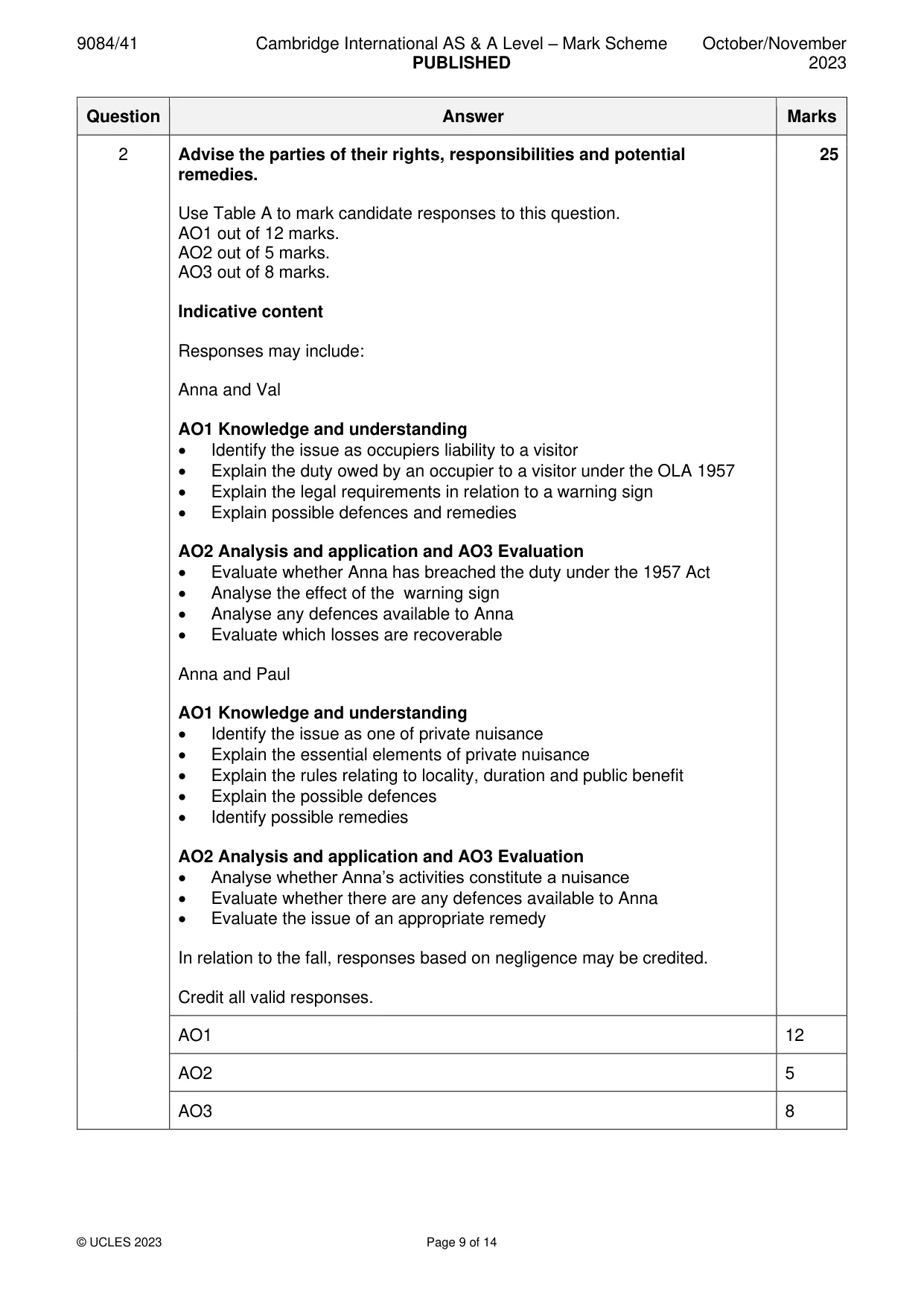
9084/41 Cambridge International AS & A Level – Mark Scheme PUBLISHED October/November 2023 © UCLES 2023 Page 9 of 14 Question Answer Marks 2 Advise the parties of their rights, responsibilities and potential remedies. Use Table A to mark candidate responses to this question. AO1 out of 12 marks. AO2 out of 5 marks. AO3 out of 8 marks. Indicative content Responses may include: Anna and Val AO1 Knowledge and understanding • Identify the issue as occupiers liability to a visitor • Explain the duty owed by an occupier to a visitor under the OLA 1957 • Explain the legal requirements in relation to a warning sign • Explain possible defences and remedies AO2 Analysis and application and AO3 Evaluation • Evaluate whether Anna has breached the duty under the 1957 Act • Analyse the effect of the warning sign • Analyse any defences available to Anna • Evaluate which losses are recoverable Anna and Paul AO1 Knowledge and understanding • Identify the issue as one of private nuisance • Explain the essential elements of private nuisance • Explain the rules relating to locality, duration and public benefit • Explain the possible defences • Identify possible remedies AO2 Analysis and application and AO3 Evaluation • Analyse whether Anna’s activities constitute a nuisance • Evaluate whether there are any defences available to Anna • Evaluate the issue of an appropriate remedy In relation to the fall, responses based on negligence may be credited. Credit all valid responses. 25 AO1 12 AO2 5 AO3 8
Mark scheme, page 10
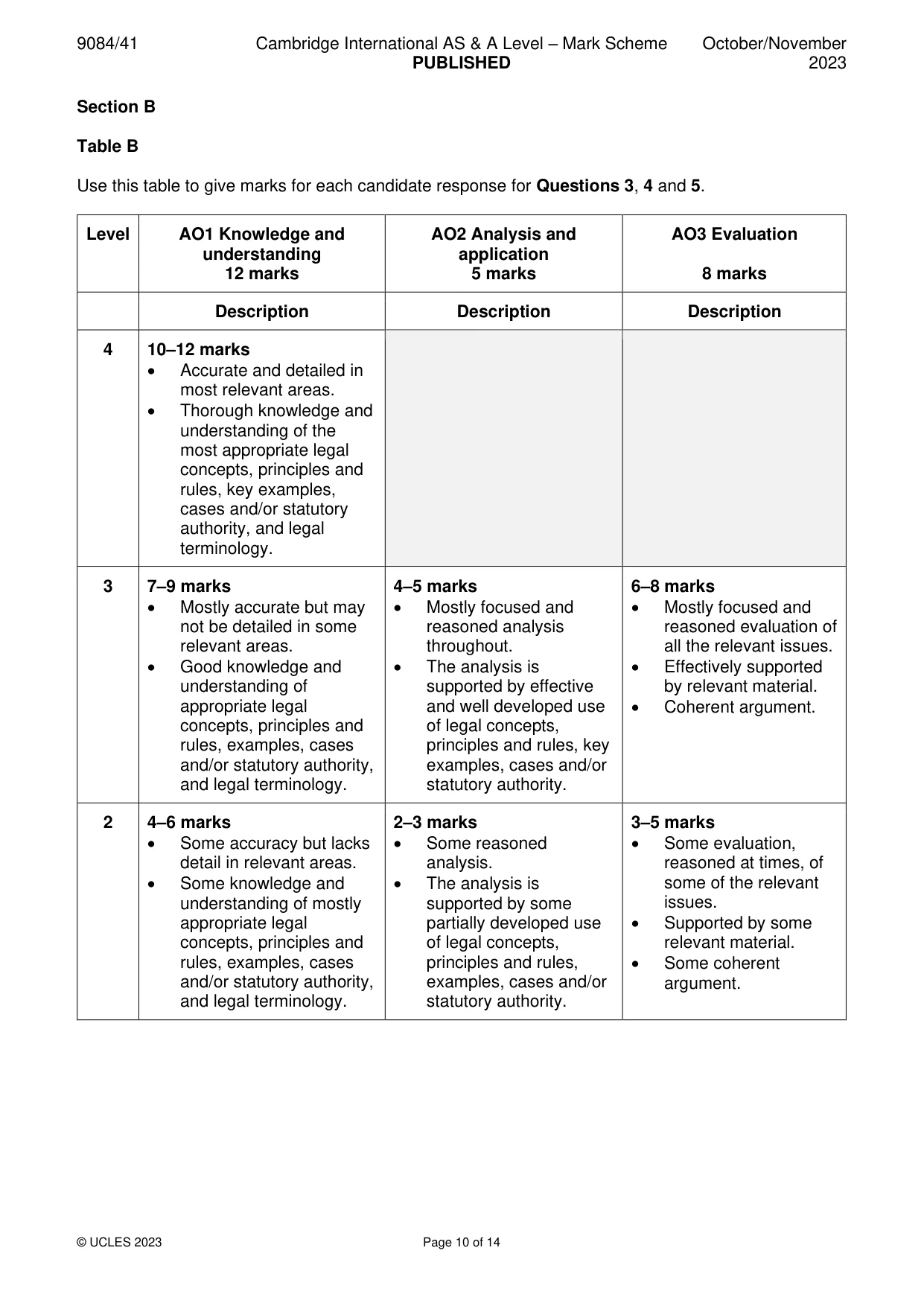
9084/41 Cambridge International AS & A Level – Mark Scheme PUBLISHED October/November 2023 © UCLES 2023 Page 10 of 14 Section B Table B Use this table to give marks for each candidate response for Questions 3, 4 and 5. Level AO1 Knowledge and understanding 12 marks AO2 Analysis and application 5 marks AO3 Evaluation 8 marks Description Description Description 4 10–12 marks • Accurate and detailed in most relevant areas. • Thorough knowledge and understanding of the most appropriate legal concepts, principles and rules, key examples, cases and/or statutory authority, and legal terminology. 3 7–9 marks • Mostly accurate but may not be detailed in some relevant areas. • Good knowledge and understanding of appropriate legal concepts, principles and rules, examples, cases and/or statutory authority, and legal terminology. 4–5 marks • Mostly focused and reasoned analysis throughout. • The analysis is supported by effective and well developed use of legal concepts, principles and rules, key examples, cases and/or statutory authority. 6–8 marks • Mostly focused and reasoned evaluation of all the relevant issues. • Effectively supported by relevant material. • Coherent argument. 2 4–6 marks • Some accuracy but lacks detail in relevant areas. • Some knowledge and understanding of mostly appropriate legal concepts, principles and rules, examples, cases and/or statutory authority, and legal terminology. 2–3 marks • Some reasoned analysis. • The analysis is supported by some partially developed use of legal concepts, principles and rules, examples, cases and/or statutory authority. 3–5 marks • Some evaluation, reasoned at times, of some of the relevant issues. • Supported by some relevant material. • Some coherent argument.
Mark scheme, page 11
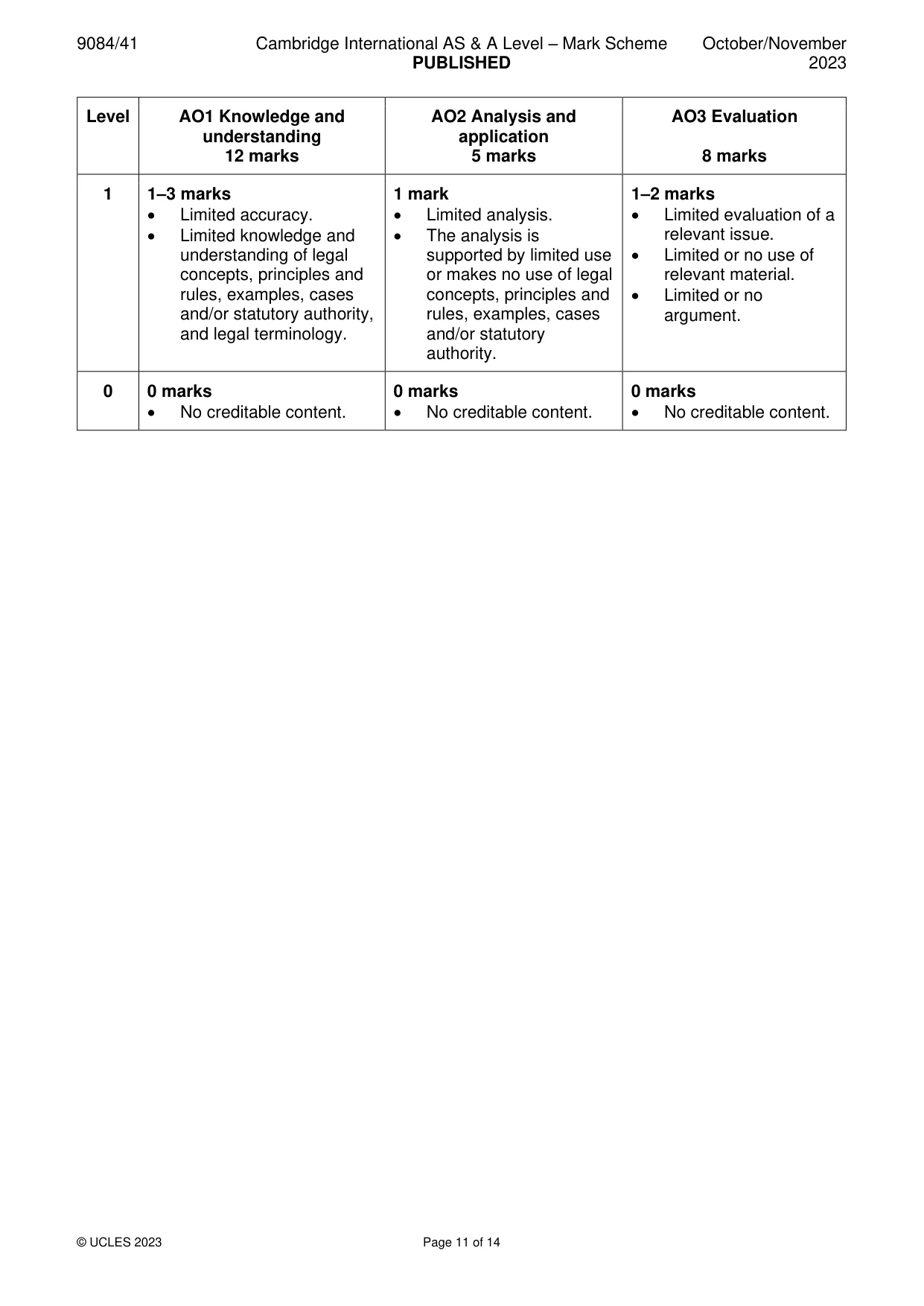
9084/41 Cambridge International AS & A Level – Mark Scheme PUBLISHED October/November 2023 © UCLES 2023 Page 11 of 14 Level AO1 Knowledge and understanding 12 marks AO2 Analysis and application 5 marks AO3 Evaluation 8 marks 1 1–3 marks • Limited accuracy. • Limited knowledge and understanding of legal concepts, principles and rules, examples, cases and/or statutory authority, and legal terminology. 1 mark • Limited analysis. • The analysis is supported by limited use or makes no use of legal concepts, principles and rules, examples, cases and/or statutory authority. 1–2 marks • Limited evaluation of a relevant issue. • Limited or no use of relevant material. • Limited or no argument. 0 0 marks • No creditable content. 0 marks • No creditable content. 0 marks • No creditable content.
Mark scheme, page 12
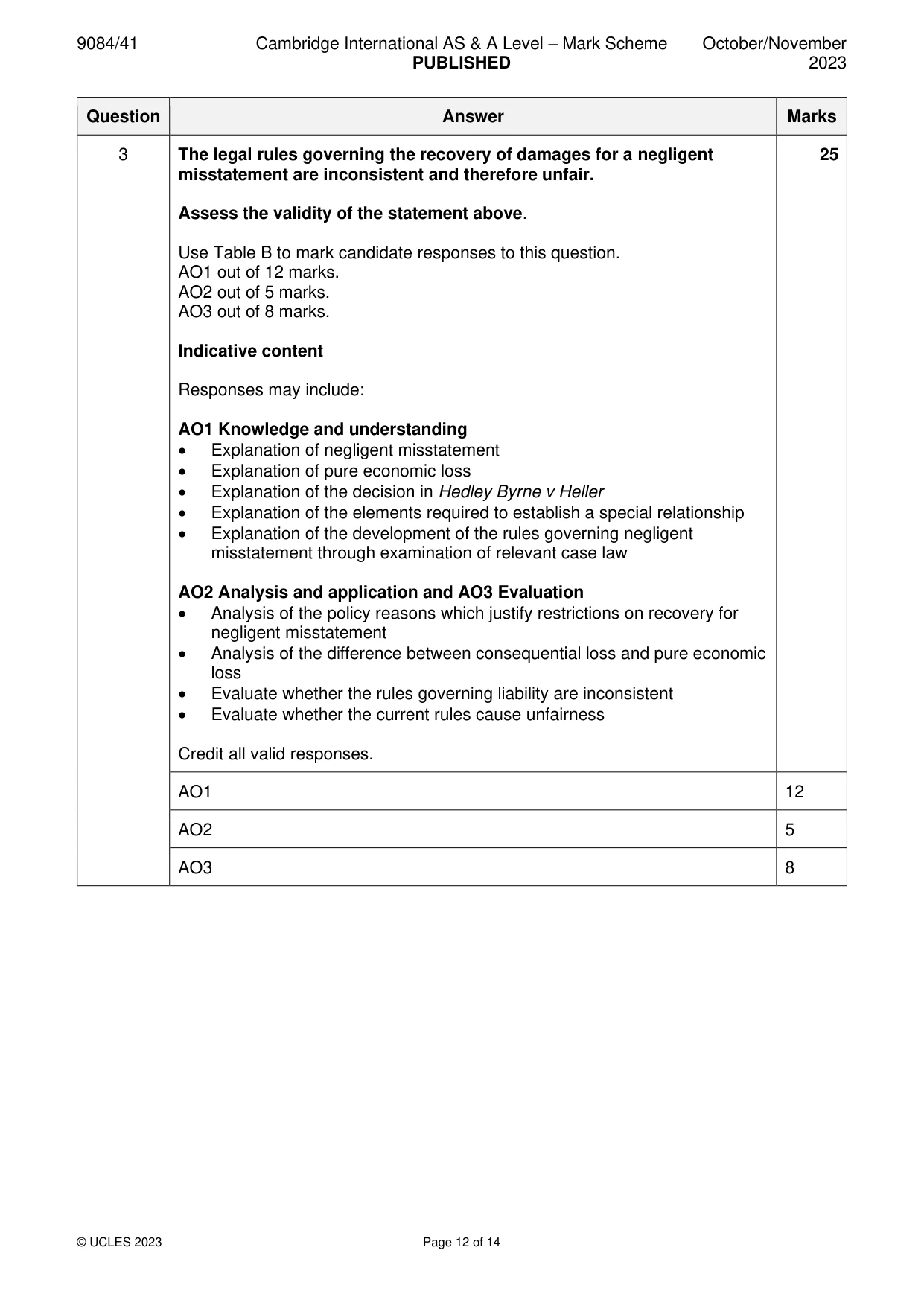
9084/41 Cambridge International AS & A Level – Mark Scheme PUBLISHED October/November 2023 © UCLES 2023 Page 12 of 14 Question Answer Marks 3 The legal rules governing the recovery of damages for a negligent misstatement are inconsistent and therefore unfair. Assess the validity of the statement above. Use Table B to mark candidate responses to this question. AO1 out of 12 marks. AO2 out of 5 marks. AO3 out of 8 marks. Indicative content Responses may include: AO1 Knowledge and understanding • Explanation of negligent misstatement • Explanation of pure economic loss • Explanation of the decision in Hedley Byrne v Heller • Explanation of the elements required to establish a special relationship • Explanation of the development of the rules governing negligent misstatement through examination of relevant case law AO2 Analysis and application and AO3 Evaluation • Analysis of the policy reasons which justify restrictions on recovery for negligent misstatement • Analysis of the difference between consequential loss and pure economic loss • Evaluate whether the rules governing liability are inconsistent • Evaluate whether the current rules cause unfairness Credit all valid responses. 25 AO1 12 AO2 5 AO3 8
Mark scheme, page 13
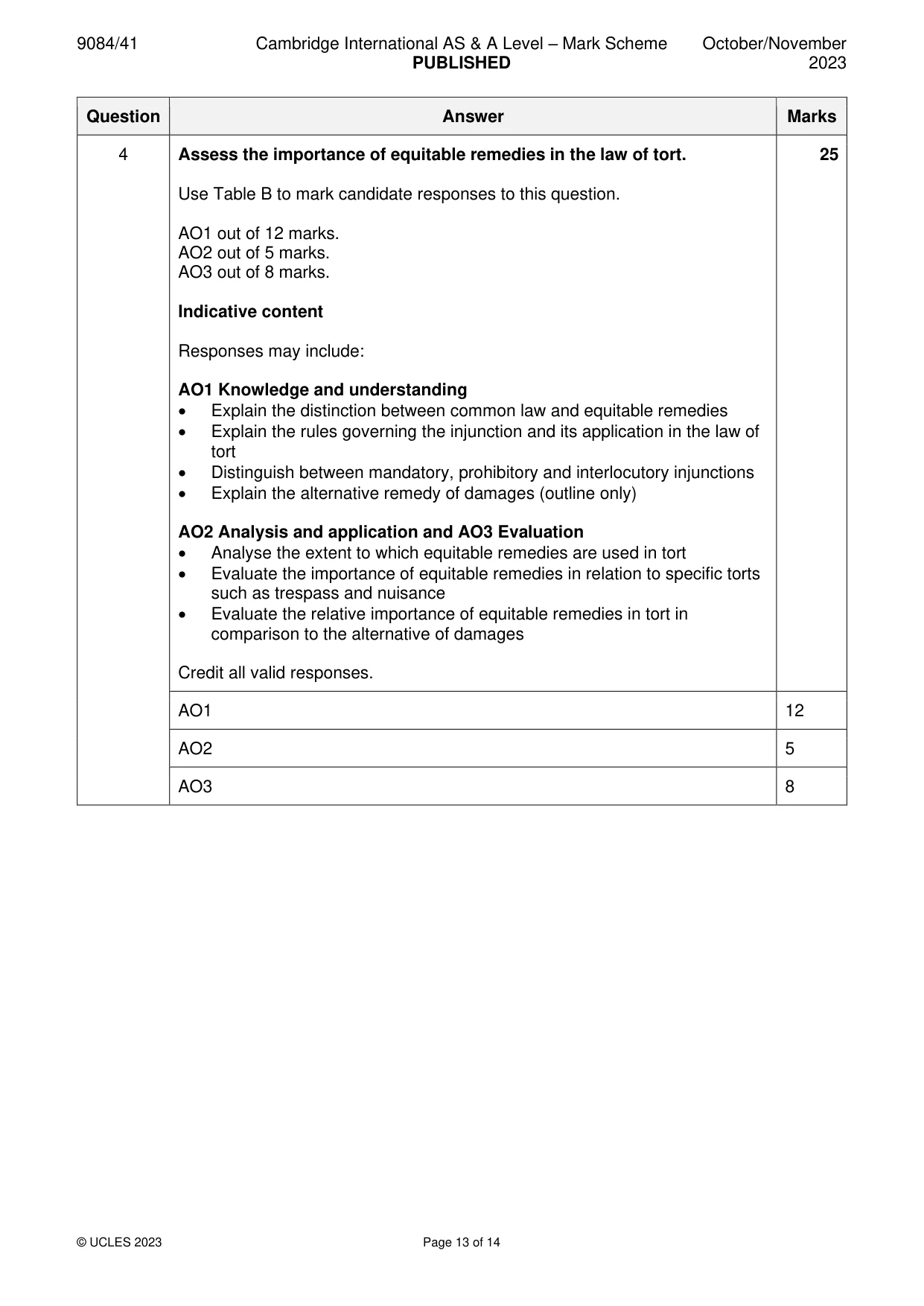
9084/41 Cambridge International AS & A Level – Mark Scheme PUBLISHED October/November 2023 © UCLES 2023 Page 13 of 14 Question Answer Marks 4 Assess the importance of equitable remedies in the law of tort. Use Table B to mark candidate responses to this question. AO1 out of 12 marks. AO2 out of 5 marks. AO3 out of 8 marks. Indicative content Responses may include: AO1 Knowledge and understanding • Explain the distinction between common law and equitable remedies • Explain the rules governing the injunction and its application in the law of tort • Distinguish between mandatory, prohibitory and interlocutory injunctions • Explain the alternative remedy of damages (outline only) AO2 Analysis and application and AO3 Evaluation • Analyse the extent to which equitable remedies are used in tort • Evaluate the importance of equitable remedies in relation to specific torts such as trespass and nuisance • Evaluate the relative importance of equitable remedies in tort in comparison to the alternative of damages Credit all valid responses. 25 AO1 12 AO2 5 AO3 8
Mark scheme, page 14
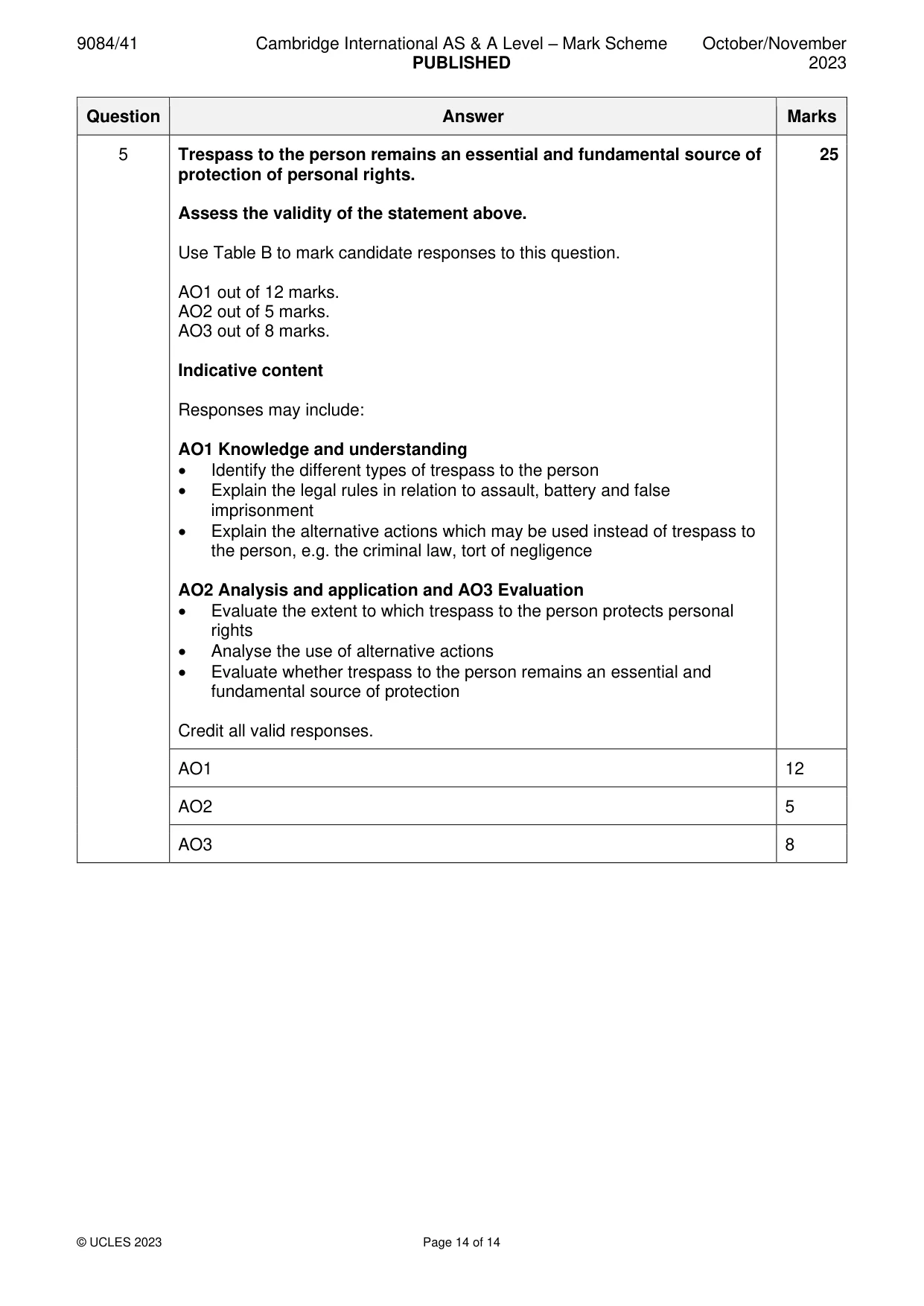
9084/41 Cambridge International AS & A Level – Mark Scheme PUBLISHED October/November 2023 © UCLES 2023 Page 14 of 14 Question Answer Marks 5 Trespass to the person remains an essential and fundamental source of protection of personal rights. Assess the validity of the statement above. Use Table B to mark candidate responses to this question. AO1 out of 12 marks. AO2 out of 5 marks. AO3 out of 8 marks. Indicative content Responses may include: AO1 Knowledge and understanding • Identify the different types of trespass to the person • Explain the legal rules in relation to assault, battery and false imprisonment • Explain the alternative actions which may be used instead of trespass to the person, e.g. the criminal law, tort of negligence AO2 Analysis and application and AO3 Evaluation • Evaluate the extent to which trespass to the person protects personal rights • Analyse the use of alternative actions • Evaluate whether trespass to the person remains an essential and fundamental source of protection Credit all valid responses. 25 AO1 12 AO2 5 AO3 8
What you needed in this session
Cambridge’s own grade thresholds for 2023 Oct/Nov, Paper 4 · Variant 1. A higher threshold means an easier paper — the bar moves with how the cohort did.