Cambridge A Level Law 9084 — 2015 May/June Paper 4 · Variant 3
9084/43/M/J/15 · 75 marks · ≈84 min
The question paper and its mark scheme, free to read here and free to download. This is Cambridge’s own paper, exactly as it was sat.
Question paper4 pages

Mark scheme7 pages
Answers below. Sit the paper first if you are practising.
Paper as text
Question paper, page 1
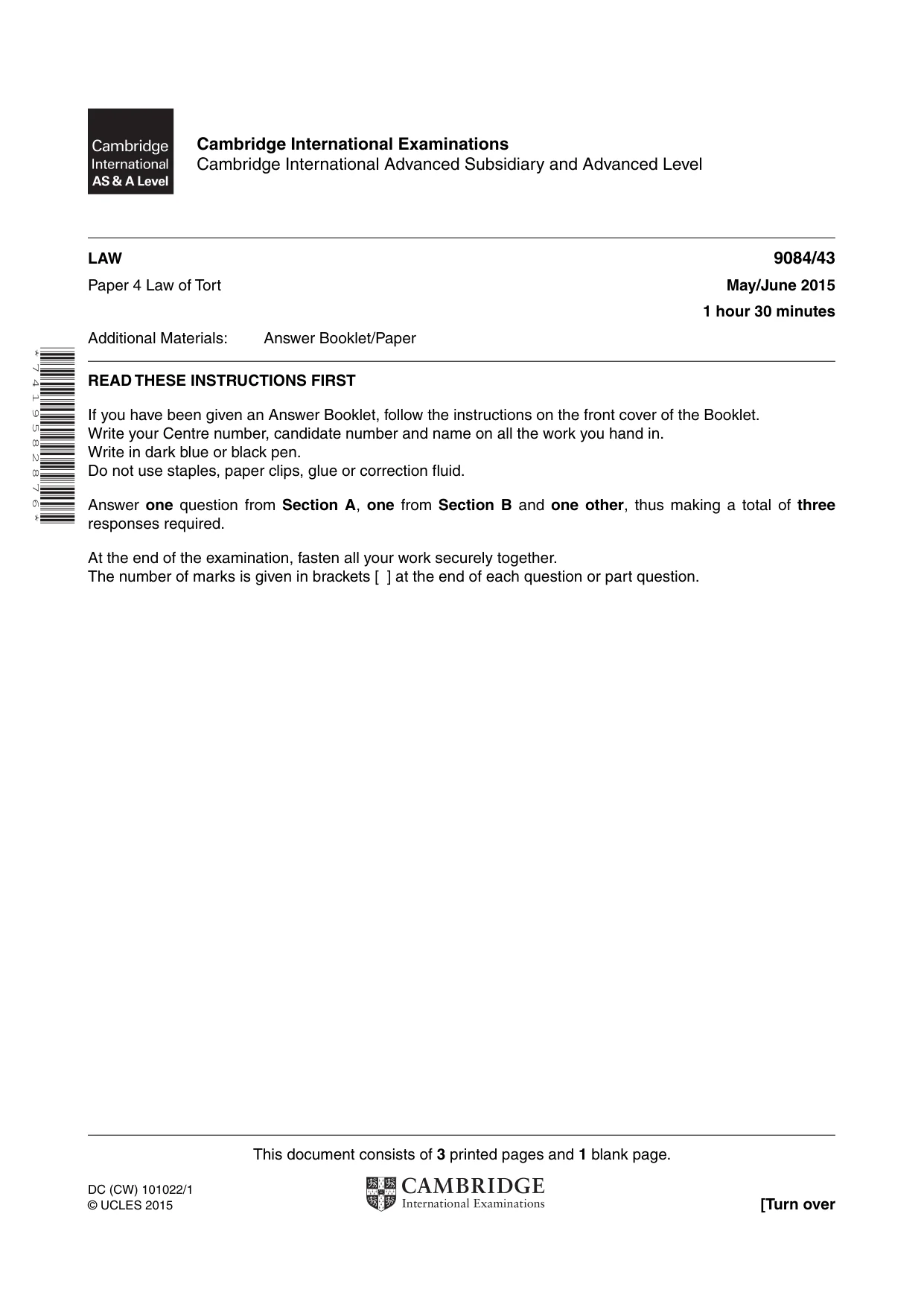
This document consists of 3 printed pages and 1 blank page. DC (CW) 101022/1 © UCLES 2015 [Turn over * 7 4 1 9 5 8 2 8 7 6 * LAW 9084/43 Paper 4 Law of Tort May/June 2015 1 hour 30 minutes Additional Materials: Answer Booklet/Paper READ THESE INSTRUCTIONS FIRST If you have been given an Answer Booklet, follow the instructions on the front cover of the Booklet. Write your Centre number, candidate number and name on all the work you hand in. Write in dark blue or black pen. Do not use staples, paper clips, glue or correction fluid. Answer one question from Section A, one from Section B and one other, thus making a total of three responses required. At the end of the examination, fasten all your work securely together. The number of marks is given in brackets [ ] at the end of each question or part question. Cambridge International Examinations Cambridge International Advanced Subsidiary and Advanced Level
Question paper, page 2
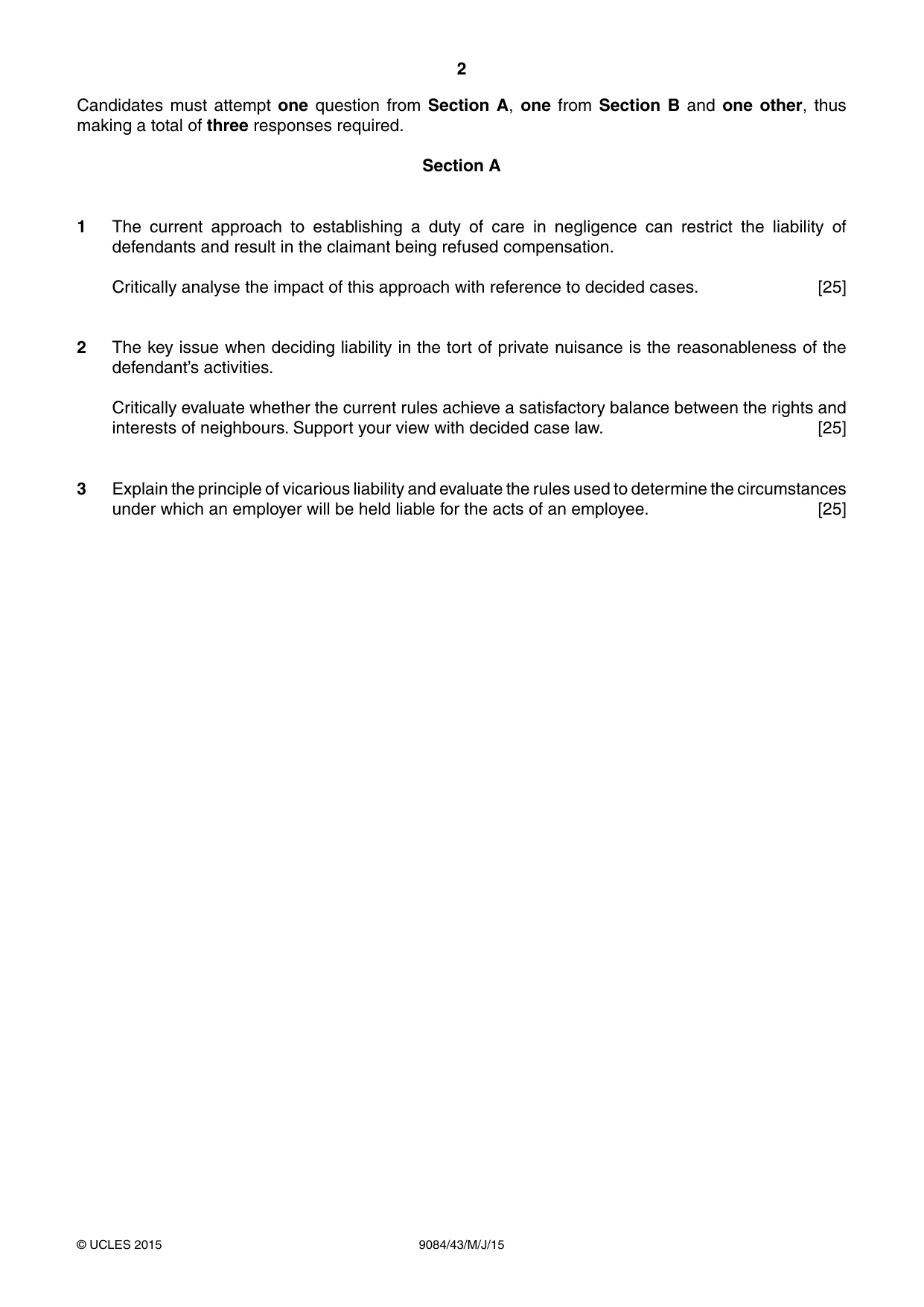
2 9084/43/M/J/15 © UCLES 2015 Candidates must attempt one question from Section A, one from Section B and one other, thus making a total of three responses required. Section A 1 The current approach to establishing a duty of care in negligence can restrict the liability of defendants and result in the claimant being refused compensation. Critically analyse the impact of this approach with reference to decided cases. [25] 2 The key issue when deciding liability in the tort of private nuisance is the reasonableness of the defendant’s activities. Critically evaluate whether the current rules achieve a satisfactory balance between the rights and interests of neighbours. Support your view with decided case law. [25] 3 Explain the principle of vicarious liability and evaluate the rules used to determine the circumstances under which an employer will be held liable for the acts of an employee. [25]
Question paper, page 3
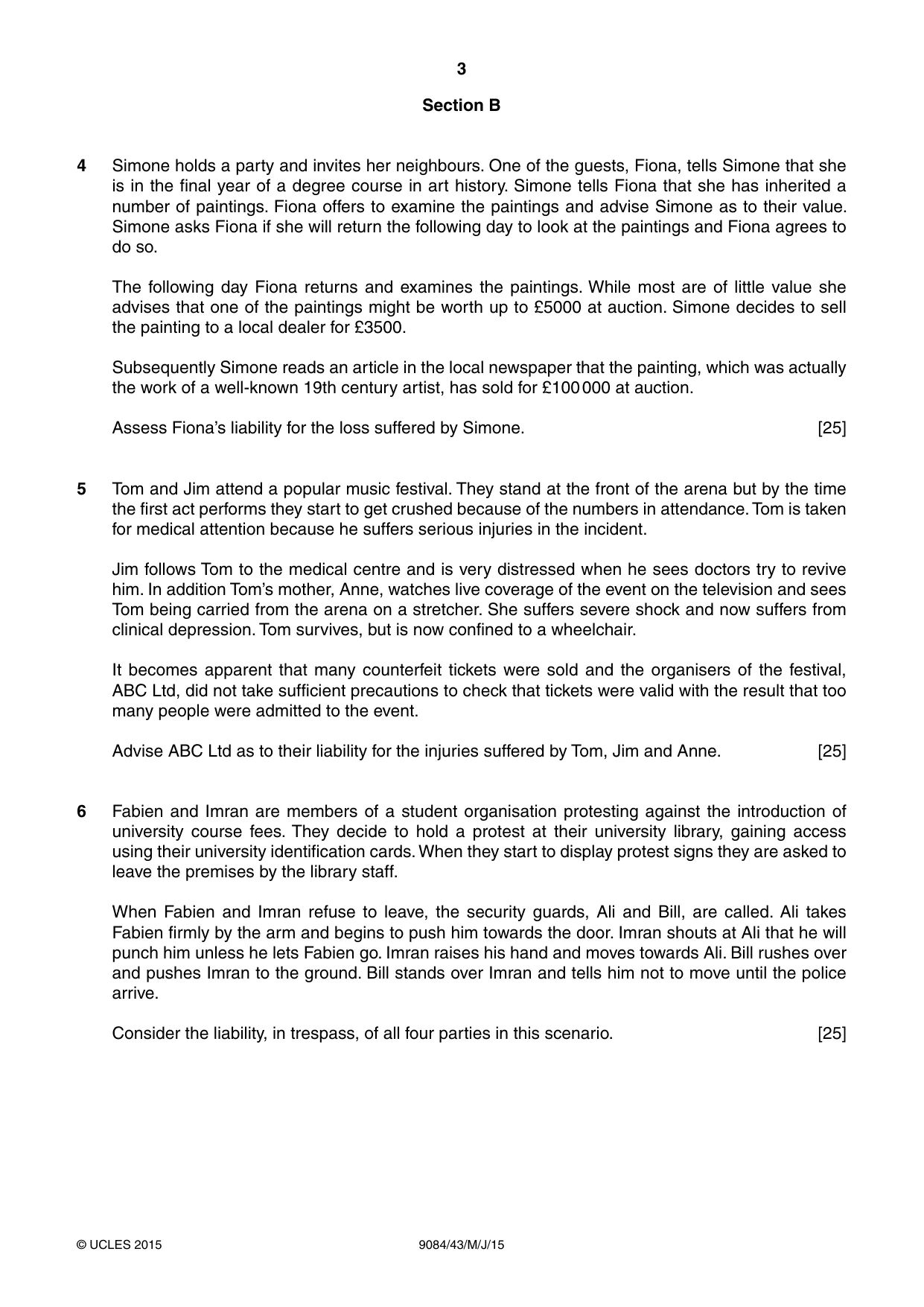
3 9084/43/M/J/15 © UCLES 2015 Section B 4 Simone holds a party and invites her neighbours. One of the guests, Fiona, tells Simone that she is in the final year of a degree course in art history. Simone tells Fiona that she has inherited a number of paintings. Fiona offers to examine the paintings and advise Simone as to their value. Simone asks Fiona if she will return the following day to look at the paintings and Fiona agrees to do so. The following day Fiona returns and examines the paintings. While most are of little value she advises that one of the paintings might be worth up to £5000 at auction. Simone decides to sell the painting to a local dealer for £3500. Subsequently Simone reads an article in the local newspaper that the painting, which was actually the work of a well-known 19th century artist, has sold for £100 000 at auction. Assess Fiona’s liability for the loss suffered by Simone. [25] 5 Tom and Jim attend a popular music festival. They stand at the front of the arena but by the time the first act performs they start to get crushed because of the numbers in attendance. Tom is taken for medical attention because he suffers serious injuries in the incident. Jim follows Tom to the medical centre and is very distressed when he sees doctors try to revive him. In addition Tom’s mother, Anne, watches live coverage of the event on the television and sees Tom being carried from the arena on a stretcher. She suffers severe shock and now suffers from clinical depression. Tom survives, but is now confined to a wheelchair. It becomes apparent that many counterfeit tickets were sold and the organisers of the festival, ABC Ltd, did not take sufficient precautions to check that tickets were valid with the result that too many people were admitted to the event. Advise ABC Ltd as to their liability for the injuries suffered by Tom, Jim and Anne. [25] 6 Fabien and Imran are members of a student organisation protesting against the introduction of university course fees. They decide to hold a protest at their university library, gaining access using their university identification cards. When they start to display protest signs they are asked to leave the premises by the library staff. When Fabien and Imran refuse to leave, the security guards, Ali and Bill, are called. Ali takes Fabien firmly by the arm and begins to push him towards the door. Imran shouts at Ali that he will punch him unless he lets Fabien go. Imran raises his hand and moves towards Ali. Bill rushes over and pushes Imran to the ground. Bill stands over Imran and tells him not to move until the police arrive. Consider the liability, in trespass, of all four parties in this scenario. [25]
Question paper, page 4
4 9084/43/M/J/15 © UCLES 2015 BLANK PAGE Permission to reproduce items where third-party owned material protected by copyright is included has been sought and cleared where possible. Every reasonable effort has been made by the publisher (UCLES) to trace copyright holders, but if any items requiring clearance have unwittingly been included, the publisher will be pleased to make amends at the earliest possible opportunity. To avoid the issue of disclosure of answer-related information to candidates, all copyright acknowledgements are reproduced online in the Cambridge International Examinations Copyright Acknowledgements Booklet. This is produced for each series of examinations and is freely available to download at www.cie.org.uk after the live examination series. Cambridge International Examinations is part of the Cambridge Assessment Group. Cambridge Assessment is the brand name of University of Cambridge Local Examinations Syndicate (UCLES), which is itself a department of the University of Cambridge.
Mark scheme, page 1
® IGCSE is the registered trademark of Cambridge International Examinations. CAMBRIDGE INTERNATIONAL EXAMINATIONS Cambridge International Advanced Level MARK SCHEME for the May/June 2015 series 9084 LAW 9084/43 Paper 4, maximum raw mark 75 This mark scheme is published as an aid to teachers and candidates, to indicate the requirements of the examination. It shows the basis on which Examiners were instructed to award marks. It does not indicate the details of the discussions that took place at an Examiners’ meeting before marking began, which would have considered the acceptability of alternative answers. Mark schemes should be read in conjunction with the question paper and the Principal Examiner Report for Teachers. Cambridge will not enter into discussions about these mark schemes. Cambridge is publishing the mark schemes for the May/June 2015 series for most Cambridge IGCSE®, Cambridge International A and AS Level components and some Cambridge O Level components.
Mark scheme, page 2
Page 2 Mark Scheme Syllabus Paper Cambridge International A Level – May/June 2015 9084 43 © Cambridge International Examinations 2015 Assessment Objectives Candidates are expected to demonstrate: Knowledge and Understanding − recall, select, use and develop knowledge and understanding of legal principles and rules by means of example and citation Analysis, Evaluation and Application − analyse and evaluate legal materials, situations and issues and accurately apply appropriate principles and rules Communication and Presentation − use appropriate legal terminology to present logical and coherent argument and to communicate relevant material in a clear and concise manner. Specification Grid The relationship between the Assessment Objectives and this individual component is detailed below. The objectives are weighted to give an indication of their relative importance, rather than to provide a precise statement of the percentage mark allocation to particular assessment objectives. Assessment Objective Paper 1 Paper 2 Paper 3 Paper 4 Advanced Level Knowledge/ Understanding 50 50 50 50 50 Analysis/ Evaluation/ Application 40 40 40 40 40 Communication/ Presentation 10 10 10 10 10 Mark Bands The mark bands and descriptors applicable to all questions on the paper are as follows. Maximum mark allocations are indicated in the table at the foot of the page. Indicative content for each of the questions follows overleaf. Band 1: The answer contains no relevant material.
Mark scheme, page 3
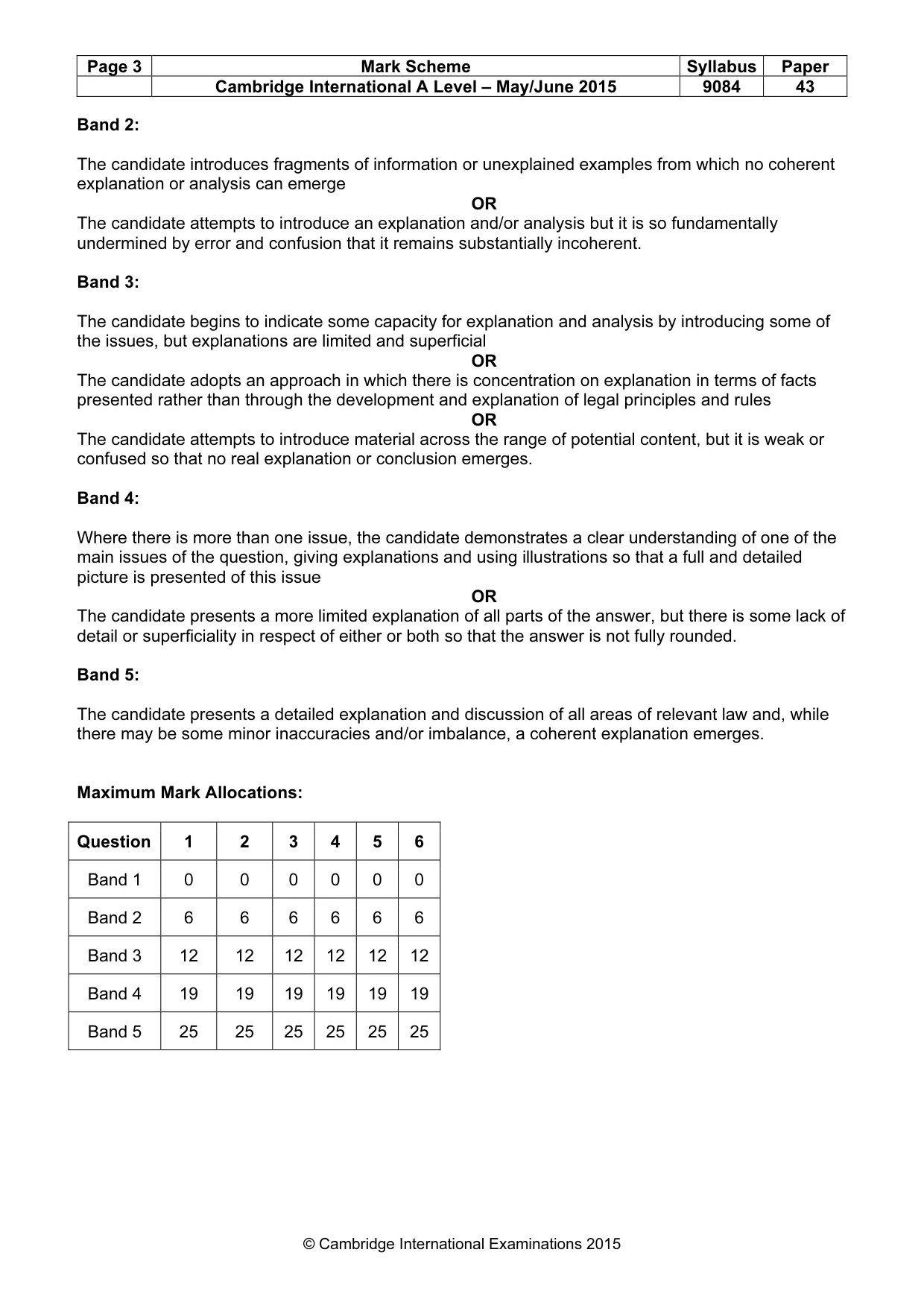
Page 3 Mark Scheme Syllabus Paper Cambridge International A Level – May/June 2015 9084 43 © Cambridge International Examinations 2015 Band 2: The candidate introduces fragments of information or unexplained examples from which no coherent explanation or analysis can emerge OR The candidate attempts to introduce an explanation and/or analysis but it is so fundamentally undermined by error and confusion that it remains substantially incoherent. Band 3: The candidate begins to indicate some capacity for explanation and analysis by introducing some of the issues, but explanations are limited and superficial OR The candidate adopts an approach in which there is concentration on explanation in terms of facts presented rather than through the development and explanation of legal principles and rules OR The candidate attempts to introduce material across the range of potential content, but it is weak or confused so that no real explanation or conclusion emerges. Band 4: Where there is more than one issue, the candidate demonstrates a clear understanding of one of the main issues of the question, giving explanations and using illustrations so that a full and detailed picture is presented of this issue OR The candidate presents a more limited explanation of all parts of the answer, but there is some lack of detail or superficiality in respect of either or both so that the answer is not fully rounded. Band 5: The candidate presents a detailed explanation and discussion of all areas of relevant law and, while there may be some minor inaccuracies and/or imbalance, a coherent explanation emerges. Maximum Mark Allocations: Question 1 2 3 4 5 6 Band 1 0 0 0 0 0 0 Band 2 6 6 6 6 6 6 Band 3 12 12 12 12 12 12 Band 4 19 19 19 19 19 19 Band 5 25 25 25 25 25 25
Mark scheme, page 4
Page 4 Mark Scheme Syllabus Paper Cambridge International A Level – May/June 2015 9084 43 © Cambridge International Examinations 2015 Section A 1 The current approach to establishing a duty of care can restrict the liability of defendants and result in the claimant being refused compensation. Critically analyse the impact of this approach with reference to decided cases. This question requires candidates to undertake a critical analysis of the current rules governing the duty of care in negligence. Candidates may introduce the issue by outlining the three essential requirements for a successful action in negligence, duty of care, breach of duty and resulting damage which is not too remote. However a detailed account of all three elements is not required. Candidates should focus on the requirements for establishing the duty of care, from the neighbour test in Donoghue v Stevenson to the three stage test in Caparo v Dickman. Each part of the three stage test should be examined and appropriate case law referenced. Candidates should then address the key issue raised in the question. Does the current approach to the duty of care allow defendants to escape liability? This requires a critical analysis of the three stage test in Caparo. Reference to relevant case law, which demonstrates the application of the Caparo test, is important here. Where candidates focus on explanation of the rules only and do not address the critical analysis aspect of the question, the mark will be confined to a maximum in Band 3. 2 The key issue when deciding liability in the tort of private nuisance is the reasonableness of the defendant’s activities. Critically evaluate whether the current rules achieve a satisfactory balance between the rights and interests of neighbours. Support your view with decided case law. The tort of private nuisance arises from the fact that wherever we live work or play, we have neighbours and the way that we behave on our land may affect them when using theirs and vice versa. Candidates should explain the key elements of the tort of nuisance, such as indirect interference, reasonableness of actions and the extent to which interests are balanced by taking into account the complainant’s sensitivity, locality and duration of the alleged tort, and the extent to which some sort of damage needs to be caused. Reference to relevant case law is vital here. Candidates should analyse the approach taken by the courts when dealing with the issue of reasonableness and examine relevant case law as part of this discussion. Candidates might also consider the extent to which available defences (such as prescription and consent) and remedies (such as damages, injunction and abatement) enable the aim of balance to be achieved. Candidates should address the question and form a conclusion as to whether the issue of reasonableness is the key issue in a nuisance action or whether it is simply one of the factors to be taken into account. Candidate responses that are limited to factual recall, however detailed, will be restricted to band 3.
Mark scheme, page 5
Page 5 Mark Scheme Syllabus Paper Cambridge International A Level – May/June 2015 9084 43 © Cambridge International Examinations 2015 3 Explain the principle of vicarious liability and evaluate the rules used to determine the circumstances under which an employer will be held liable for the acts of an employee. Candidates should define vicarious liability – liability for torts committed by others. It should then be explained that liability is not removed from the tortfeasor, but rather that liability becomes joint and that the claimant is free to sue either party. It is a situation which most commonly arises during the course of employment: employers can be held vicariously liable for the action of their employees whilst at work. One reason for imposing such liability is that employers control the acts of employees and should be liable for them. This may have been true in the past, but to what extent is this true today? For example, what actual control can hospitals exercise in respect of highly skilled, specialist surgeons? However, if targets and work-loads are set, such that even specialist work cannot be done properly is the imposition of vicarious liability justifiable? Candidates should examine the tests which are used to establish whether an employer – employee relationship exists. Candidates could distinguish between the contract of service and the contract for services in the context of vicarious liability. Tests such as control, integration and economic reality should be explained and also evaluated. Candidates could also identify areas of particular difficulty here such as agency and casual workers. Candidates should also examine the issue of the scope of employment and discuss how the courts determine whether an employee is operating within the scope of their employment or not. Relevant case law should be credited here. Candidates should be given some credit for identifying the reasons why vicarious liability is imposed although this is not the main focus of the question. Candidates must approach this issue with a critical eye if marks in band 4 and 5 are to be awarded. 4 Advise Simone as to whether she should bring an action in negligence against Fiona. This question focuses on liability for the results of negligent misstatements. Candidate will need to set the scenario in context by outlining the elements of negligence: duty of care, breach of duty and resulting loss which is not too remote. The principles on which such cases are decided were established in the case of Hedley Byrne v Heller & Partners, and further developed in cases such as Caparo v Dickman. In order to establish a duty of care there must be a special relationship between the parties, a voluntary assumption of responsibility by the party giving advice and reliance by the other party on that advice or information and such reliance must be reasonable. Candidates need to examine whether there was a special relationship in this instance, as the outcome would seem to hinge very much on this. It was suggested by Lord Reid in Hedley Byrne v Heller & Partners that special relationships only cover situations where advice is given in a business context. The issue here therefore would seem to be whether the statements made by Fiona to Simone were made in a business or social context. The decision in Chaudry v Prabhakar ought to be considered in this context. If it is concluded that either set of circumstances imposed a duty of care on Fiona, then candidates need to go on to consider the extent that reliance was placed on her statement and whether such reliance was reasonable. The decisions in Esso Petroleum Co Ltd v Mardon and the wills cases could be explored, applied and appropriate conclusions drawn. Candidates should also be credited for a discussion of the standard of care in this context – given that Fiona is in the final year of a degree course, should there be any adjustment made to the standard of care? Cases such as Nettleship v Weston could be cited in this context.
Mark scheme, page 6
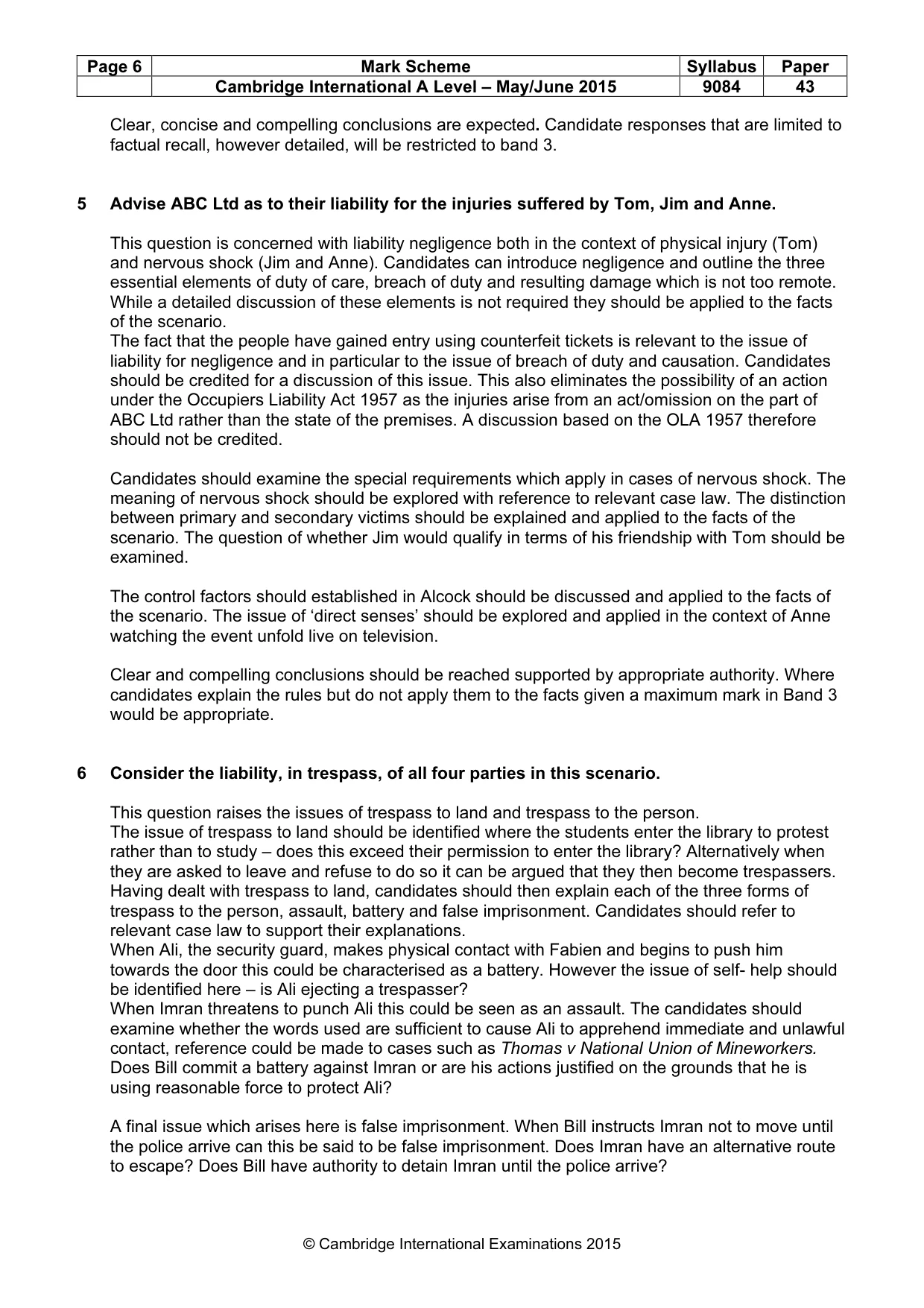
Page 6 Mark Scheme Syllabus Paper Cambridge International A Level – May/June 2015 9084 43 © Cambridge International Examinations 2015 Clear, concise and compelling conclusions are expected. Candidate responses that are limited to factual recall, however detailed, will be restricted to band 3. 5 Advise ABC Ltd as to their liability for the injuries suffered by Tom, Jim and Anne. This question is concerned with liability negligence both in the context of physical injury (Tom) and nervous shock (Jim and Anne). Candidates can introduce negligence and outline the three essential elements of duty of care, breach of duty and resulting damage which is not too remote. While a detailed discussion of these elements is not required they should be applied to the facts of the scenario. The fact that the people have gained entry using counterfeit tickets is relevant to the issue of liability for negligence and in particular to the issue of breach of duty and causation. Candidates should be credited for a discussion of this issue. This also eliminates the possibility of an action under the Occupiers Liability Act 1957 as the injuries arise from an act/omission on the part of ABC Ltd rather than the state of the premises. A discussion based on the OLA 1957 therefore should not be credited. Candidates should examine the special requirements which apply in cases of nervous shock. The meaning of nervous shock should be explored with reference to relevant case law. The distinction between primary and secondary victims should be explained and applied to the facts of the scenario. The question of whether Jim would qualify in terms of his friendship with Tom should be examined. The control factors should established in Alcock should be discussed and applied to the facts of the scenario. The issue of ‘direct senses’ should be explored and applied in the context of Anne watching the event unfold live on television. Clear and compelling conclusions should be reached supported by appropriate authority. Where candidates explain the rules but do not apply them to the facts given a maximum mark in Band 3 would be appropriate. 6 Consider the liability, in trespass, of all four parties in this scenario. This question raises the issues of trespass to land and trespass to the person. The issue of trespass to land should be identified where the students enter the library to protest rather than to study – does this exceed their permission to enter the library? Alternatively when they are asked to leave and refuse to do so it can be argued that they then become trespassers. Having dealt with trespass to land, candidates should then explain each of the three forms of trespass to the person, assault, battery and false imprisonment. Candidates should refer to relevant case law to support their explanations. When Ali, the security guard, makes physical contact with Fabien and begins to push him towards the door this could be characterised as a battery. However the issue of self- help should be identified here – is Ali ejecting a trespasser? When Imran threatens to punch Ali this could be seen as an assault. The candidates should examine whether the words used are sufficient to cause Ali to apprehend immediate and unlawful contact, reference could be made to cases such as Thomas v National Union of Mineworkers. Does Bill commit a battery against Imran or are his actions justified on the grounds that he is using reasonable force to protect Ali? A final issue which arises here is false imprisonment. When Bill instructs Imran not to move until the police arrive can this be said to be false imprisonment. Does Imran have an alternative route to escape? Does Bill have authority to detain Imran until the police arrive?
Mark scheme, page 7
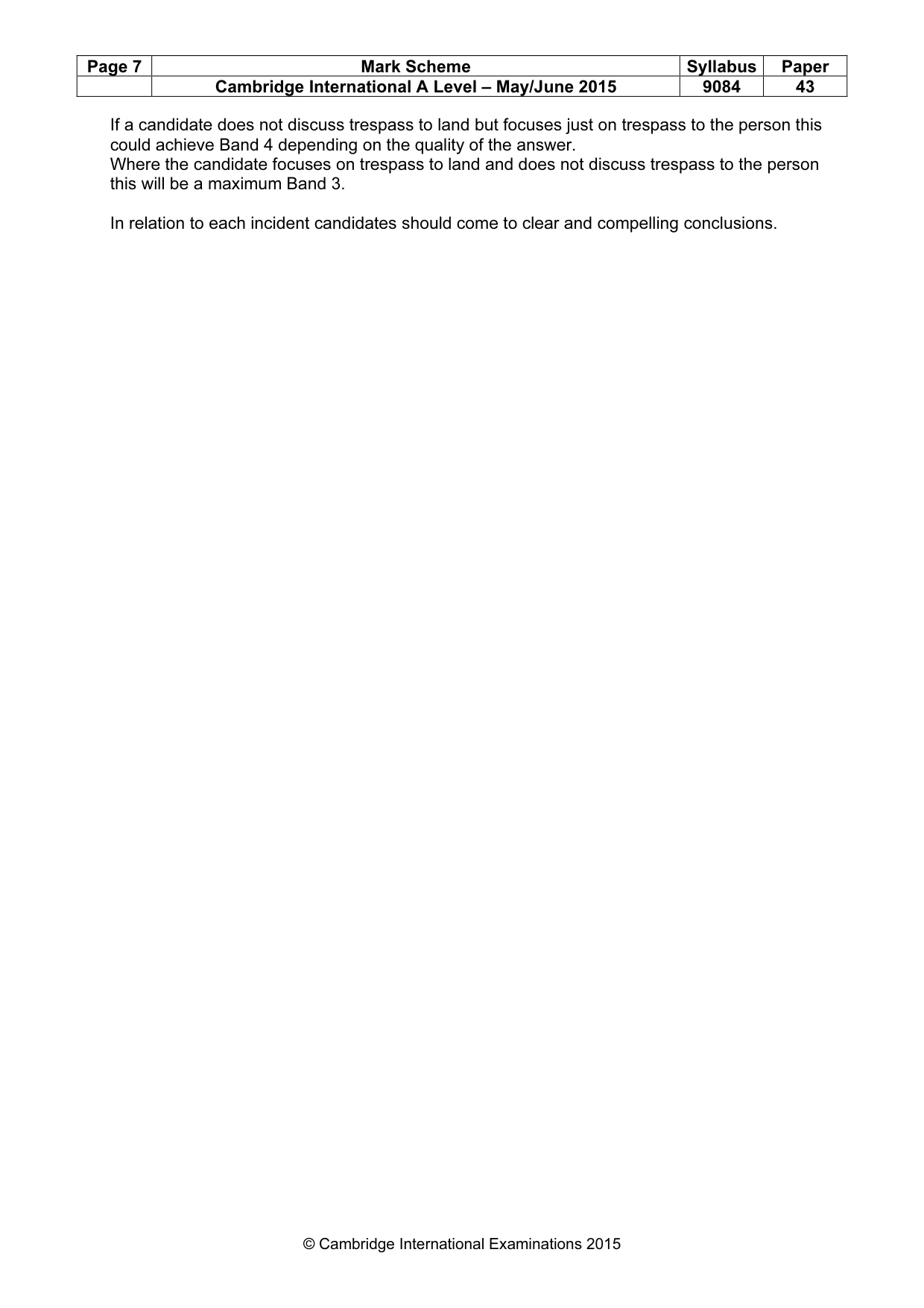
Page 7 Mark Scheme Syllabus Paper Cambridge International A Level – May/June 2015 9084 43 © Cambridge International Examinations 2015 If a candidate does not discuss trespass to land but focuses just on trespass to the person this could achieve Band 4 depending on the quality of the answer. Where the candidate focuses on trespass to land and does not discuss trespass to the person this will be a maximum Band 3. In relation to each incident candidates should come to clear and compelling conclusions.
What you needed in this session
Cambridge’s own grade thresholds for 2015 May/June, Paper 4 · Variant 3. A higher threshold means an easier paper — the bar moves with how the cohort did.