Cambridge A Level Law 9084 — 2012 Oct/Nov Paper 3 · Variant 2
9084/32/O/N/12 · 75 marks · ≈84 min
The question paper and its mark scheme, free to read here and free to download. This is Cambridge’s own paper, exactly as it was sat.
Question paper4 pages

Mark scheme7 pages
Answers below. Sit the paper first if you are practising.
Paper as text
Question paper, page 1
This document consists of 3 printed pages and 1 blank page. DC (SJF) 49849/1 © UCLES 2012 [Turn over UNIVERSITY OF CAMBRIDGE INTERNATIONAL EXAMINATIONS General Certificate of Education Advanced Level * 8 9 1 6 8 3 5 6 5 5 * LAW 9084/32 Paper 3 Law of Contract October/November 2012 1 hour 30 minutes Additional Materials: Answer Booklet/Paper READ THESE INSTRUCTIONS FIRST If you have been given an Answer Booklet, follow the instructions on the front cover of the Booklet. Write your Centre number, candidate number and name on all the work you hand in. Write in dark blue or black pen. Do not use staples, paper clips, highlighters, glue or correction fluid. Answer one question from Section A, one from Section B and one other, thus making a total of three responses required. At the end of the examination, fasten all your work securely together. The number of marks is given in brackets [ ] at the end of each question or part question.
Question paper, page 2
2 9084/32/O/N/12 © UCLES 2012 Candidates must attempt one question from Section A, one from Section B and one other, thus making a total of three responses required. Section A 1 In Hong Kong Fir Shipping Co Ltd v Kawasaki Ltd [1962], the Court of Appeal stated that some contract terms do not lend themselves to the traditional form of legal analysis. Explain the traditional approach adopted by the courts to determine the effect of a breach of contractual term and critically assess the extent to which continued analysis based on this approach fails to provide justice to claimants and defendants. [25] 2 Many more 16 and 17 year olds are in full-time employment and are far less naïve than fifty years ago. Consequently it has been suggested that the age at which people acquire the capacity to make valid contracts should be reduced to 16. Critically analyse the current rules relating to the formation of valid contracts made by minors and discuss the reasons why you believe the above change has never been incorporated in the law. [25] 3 Once an offer has been accepted, the contract is binding. Assess the extent to which you believe this statement continues to be true, now that there is a high volume of distance selling that takes place on the Internet. [25]
Question paper, page 3
3 9084/32/O/N/12 © UCLES 2012 Section B 4 Mansfield, a car dealer, tells Newton that he has just bought a 1964 Aston Martin DB4 car for a bargain price. Newton, a collector of old cars, asks about the price and the car’s condition. Mansfield tells him that it is in exceptionally good condition and that the asking price is £20 000. Newton makes an appointment to see the car. Newton has to cancel the appointment. He telephones Mansfield and tells him that he is prepared to accept his word about the car’s condition and agrees to pay the asking price. Newton pays Mansfield for the car the following day in return for a sales invoice and the car’s ownership papers and drives it home. Everything is fine for several weeks until the gearbox suddenly stops working. Newton asks Peters, a car mechanic, to look at the problem and is informed that the engine and gearbox need to be replaced. He estimates the repair cost to be over £10 000. When Newton calls Mansfield to demand his money back for the car, which is not in the condition he was led to believe, Mansfield draws Newton’s attention to the terms on the sales invoice for the car which clearly state that no guarantee is given on vehicles over three years old. Consider Mansfield’s potential contractual liability towards Newton. [25] 5 Kalib is a portrait photographer and Saeed contracts to build him a new studio. The written and signed terms of the contract provide that Saeed must complete the building by 28 February in return for a contract price of £75 000 and that Saeed is to pay Kalib the sum of £10 000 by way of compensation for any delay in completion after that date. Saeed fails to complete the studio until the end of March. As a consequence of the delay, Kalib loses several regular contracts for photographic work and a very valuable special contract to take photographs at a local celebrity’s wedding. The £10 000 compensation allowed under the terms of the contract does not cover the actual losses suffered by Kalib. Consider Saeed’s liability for his breach of contract and the measure of any remedies that Kalib could legally pursue. [25] 6 Charlton is a dealer who buys and sells soccer memorabilia. One day he attends a collectors’ fair to see what he can buy. Amongst items that Best has for sale, he notices a very rare European Cup Winners’ medal marked with a price of £750. Charlton picks up the medal and, showing it to Best, asks what the lowest price would be for it. Best has poor eyesight and tries to read the price ticket on the medal. He tells Charlton that the price is on the ticket and that it is £7.50. Charlton immediately pays Best £7.50 for the medal and, leaving his business card, he asks Best to contact him if he gets any more soccer medals to sell. Charlton immediately sells the medal for £1000 to a collector called Stiles. Best discovers what has happened and contacts Charlton. He explains his eyesight problem to Charlton and demands the medal back in return for a refund of the money Charlton paid him for it. Charlton explains that it is impossible as he has already sold it to Stiles. Applying the rules of contract law, explain whether or not Best has any legal right to the return of the medal from Stiles or to any compensation from Charlton. [25]
Question paper, page 4
4 9084/32/O/N/12 © UCLES 2012 Permission to reproduce items where third-party owned material protected by copyright is included has been sought and cleared where possible. Every reasonable effort has been made by the publisher (UCLES) to trace copyright holders, but if any items requiring clearance have unwittingly been included, the publisher will be pleased to make amends at the earliest possible opportunity. University of Cambridge International Examinations is part of the Cambridge Assessment Group. Cambridge Assessment is the brand name of University of Cambridge Local Examinations Syndicate (UCLES), which is itself a department of the University of Cambridge. BLANK PAGE
Mark scheme, page 1
CAMBRIDGE INTERNATIONAL EXAMINATIONS GCE Advanced Level MARK SCHEME for the October/November 2012 series 9084 LAW 9084/32 Paper 3, maximum raw mark 75 This mark scheme is published as an aid to teachers and candidates, to indicate the requirements of the examination. It shows the basis on which Examiners were instructed to award marks. It does not indicate the details of the discussions that took place at an Examiners’ meeting before marking began, which would have considered the acceptability of alternative answers. Mark schemes should be read in conjunction with the question paper and the Principal Examiner Report for Teachers. Cambridge will not enter into discussions about these mark schemes. Cambridge is publishing the mark schemes for the October/November 2012 series for most IGCSE, GCE Advanced Level and Advanced Subsidiary Level components and some Ordinary Level components.
Mark scheme, page 2
Page 2 Mark Scheme Syllabus Paper GCE A LEVEL – October/November 2012 9084 32 © Cambridge International Examinations 2012 Assessment Objectives Candidates are expected to demonstrate: Knowledge and Understanding − recall, select, use and develop knowledge and understanding of legal principles and rules by means of example and citation Analysis, Evaluation and Application − analyse and evaluate legal materials, situations and issues and accurately apply appropriate principles and rules Communication and Presentation − use appropriate legal terminology to present logical and coherent argument and to communicate relevant material in a clear and concise manner. Specification Grid The relationship between the Assessment Objectives and this individual component is detailed below. The objectives are weighted to give an indication of their relative importance, rather than to provide a precise statement of the percentage mark allocation to particular assessment objectives. Assessment Objective Paper 1 Paper 2 Paper 3 Paper 4 Advanced Level Knowledge/ Understanding 50 50 50 50 50 Analysis/Evaluation/ Application 40 40 40 40 40 Communication/ Presentation 10 10 10 10 10
Mark scheme, page 3
Page 3 Mark Scheme Syllabus Paper GCE A LEVEL – October/November 2012 9084 32 © Cambridge International Examinations 2012 Mark Bands The mark bands and descriptors applicable to all questions on the paper are as follows. Maximum mark allocations are indicated in the table at the foot of the page. Indicative content for each of the questions follows overleaf. Band 1: The answer contains no relevant material. Band 2: The candidate introduces fragments of information or unexplained examples from which no coherent explanation or analysis can emerge. OR The candidate attempts to introduce an explanation and/or analysis but it is so fundamentally undermined by error and confusion that it remains substantially incoherent. Band 3: The candidate begins to indicate some capacity for explanation and analysis by introducing some of the issues, but explanations are limited and superficial. OR The candidate adopts an approach in which there is concentration on explanation in terms of facts presented rather than through the development and explanation of legal principles and rules. OR The candidate attempts to introduce material across the range of potential content, but it is weak or confused so that no real explanation or conclusion emerges. Band 4: Where there is more than one issue, the candidate demonstrates a clear understanding of one of the main issues of the question, giving explanations and using illustrations so that a full and detailed picture is presented of this issue. OR The candidate presents a more limited explanation of all parts of the answer, but there is some lack of detail or superficiality in respect of either or both so that the answer is not fully rounded. Band 5: The candidate presents a detailed explanation and discussion of all areas of relevant law and, while there may be some minor inaccuracies and/or imbalance, a coherent explanation emerges. Maximum Mark Allocations: Question 1 2 3 4 5 6 Band 1 0 0 0 0 0 0 Band 2 6 6 6 6 6 6 Band 3 12 12 12 12 12 12 Band 4 19 19 19 19 19 19 Band 5 25 25 25 25 25 25
Mark scheme, page 4
Page 4 Mark Scheme Syllabus Paper GCE A LEVEL – October/November 2012 9084 32 © Cambridge International Examinations 2012 Section A 1 In Hong Kong Fir Shipping Co Ltd v Kawasaki Ltd [1962], the Court of Appeal stated that some contract terms do not lend themselves to the traditional form of legal analysis. Explain the traditional approach adopted by the courts to determine the effect of a breach of contractual term and critically assess the extent to which continued analysis based on this approach fails to provide justice to claimants and defendants. Traditionally, the law has sought to classify terms according to their importance and the effects of breach have varied accordingly. Our courts have classified terms according to the intentions of the parties to the contract at the time that the contract was made, as in different situations the same term can have very different significance. The traditional view has been to classify terms as conditions (very important terms) and warranties (collateral to the main purpose of the contract: S.61 SOGA 1979). Breaches of condition have been traditionally perceived as so significant as to enable the innocent party to repudiate the contract and claim damages; breaches of warranty give rise to actions in damages only. It was in the Hong Kong Fir case (a brief outline can be credited) in 1962 that the expression ‘intermediate’ or ‘innominate’ term was used for the first time, thus challenging the traditional approach to the terms of a contract. The Court of Appeal suggested that all terms do not lend themselves to the traditional form of legal analysis in that they could not be clearly defined as either conditions or warranties at the time of contract formation: the effect of the breach should depend on the importance of the breach. In Schuler AG v Wickman Machine Tool Sales Ltd the House of Lords held that the use of the word ‘condition’ was only an indication of intention and that it was important to look at the contract as a whole and whether a strict interpretation of the meaning of the term would create a very unreasonable result. Candidates are expected to critically assess whether a change in approach was really necessary to reach band 4.
Mark scheme, page 5
Page 5 Mark Scheme Syllabus Paper GCE A LEVEL – October/November 2012 9084 32 © Cambridge International Examinations 2012 2 Many more 16 and 17 year olds are in full-time employment and are far less naïve than fifty years ago. Consequently it has been suggested that the age at which people acquire the capacity to make valid contracts should be reduced to 16. Critically analyse the current rules relating to the formation of valid contracts made by minors and discuss the reasons why you believe the above change has never been incorporated in the law. Candidates should detail the rules which provide that only executed contracts for necessary goods and services can be enforced against minors at common law (and even then only actions for a reasonable price can be entertained) and that all other contracts are voidable at the minor’s option. Candidates might point out that case law is commonly a century or more old and involves 18–21 year olds who would be considered adults today. Candidates should reflect on whether or not the law as it relates to minors and contracts is out of step with today’s society. The age of majority has indeed been reduced and reflected by the law, but does the law need to be updated now that many 16 and 17 year olds are in full-time employment, that 16 and 17 year olds are far from naïve in the world of modern education and communication and that society’s expectations of young people have changed. Candidates should reflect on the Law Commission’s proposal in 1982 that all contracts should be binding on the over-16s and explore why they have not actually been enacted. Candidates are expected to critically analyse existing rules and make reasonable suggestions as to the reasons why proposals haven’t been enacted to achieve band 4 marks. 3 Once an offer has been accepted, the contract is binding. Assess the extent to which you believe this statement continues to be true, now that there is a high volume of distance selling that takes place on the Internet. Candidates should contextualise their response by stating the rule that binding contracts come into existence when there has been a firm offer which has been unconditionally accepted, given that other essentials are in place. They are then expected to point out that technological developments and globalisation of markets has resulted in many consumers entering contracts by the internet, digital television, mail order, phone or fax at ever increasing distance from sellers. Candidates should identify that, but for certain exceptions, these transactions are now governed by the Consumer Protection (Distance Selling) Regulations 2000. Candidates should be given credit for giving brief details of the principal ingredients of the legislation, i.e. that consumers must be given clear information in writing before they buy (including details of the goods or services offered, delivery arrangements and payment, the supplier's details and the consumer's cancellation right) and that the consumer has a cooling-off period of seven working days in which to cancel the contract. Candidates should explain that the rationale for giving consumers special protection in such deals is that the consumer does not have the benefit of meeting face-to-face with the supplier and inspecting the goods or services offered for sale. Candidates should at least list some of the distance contracts which are exempt from some or all of the provisions of the Regulations, such as most contracts for the sale or transfer of land, contracts for the supply of financial services, contracts concluded by means of an automated vending machine, contracts by telephone through the use of public pay-phones and contracts concluded at genuine auctions. Given the ambit of the Act, candidates must then assess the proposition and draw clear conclusions in order to achieve marks in band 4.
Mark scheme, page 6
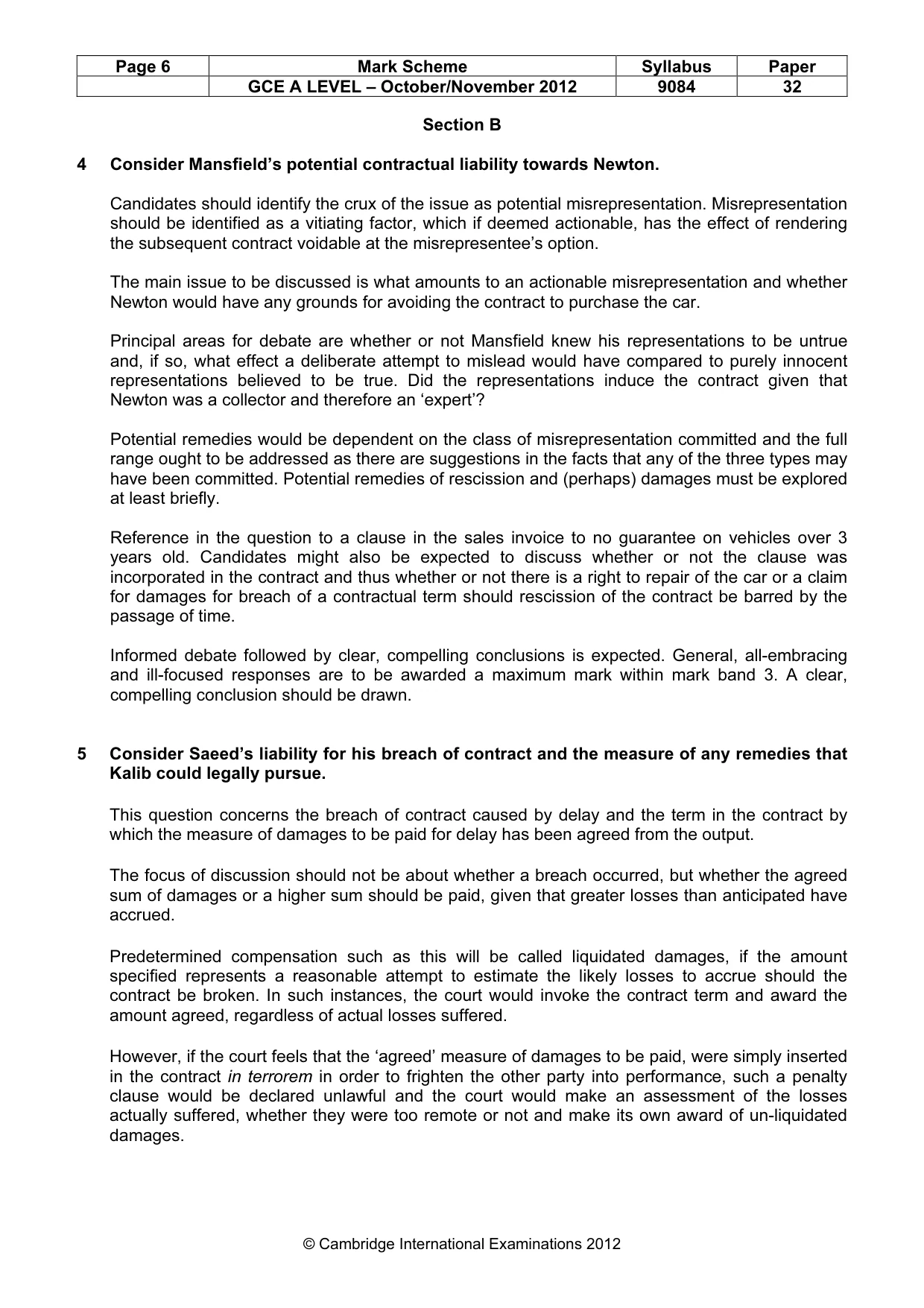
Page 6 Mark Scheme Syllabus Paper GCE A LEVEL – October/November 2012 9084 32 © Cambridge International Examinations 2012 Section B 4 Consider Mansfield’s potential contractual liability towards Newton. Candidates should identify the crux of the issue as potential misrepresentation. Misrepresentation should be identified as a vitiating factor, which if deemed actionable, has the effect of rendering the subsequent contract voidable at the misrepresentee’s option. The main issue to be discussed is what amounts to an actionable misrepresentation and whether Newton would have any grounds for avoiding the contract to purchase the car. Principal areas for debate are whether or not Mansfield knew his representations to be untrue and, if so, what effect a deliberate attempt to mislead would have compared to purely innocent representations believed to be true. Did the representations induce the contract given that Newton was a collector and therefore an ‘expert’? Potential remedies would be dependent on the class of misrepresentation committed and the full range ought to be addressed as there are suggestions in the facts that any of the three types may have been committed. Potential remedies of rescission and (perhaps) damages must be explored at least briefly. Reference in the question to a clause in the sales invoice to no guarantee on vehicles over 3 years old. Candidates might also be expected to discuss whether or not the clause was incorporated in the contract and thus whether or not there is a right to repair of the car or a claim for damages for breach of a contractual term should rescission of the contract be barred by the passage of time. Informed debate followed by clear, compelling conclusions is expected. General, all-embracing and ill-focused responses are to be awarded a maximum mark within mark band 3. A clear, compelling conclusion should be drawn. 5 Consider Saeed’s liability for his breach of contract and the measure of any remedies that Kalib could legally pursue. This question concerns the breach of contract caused by delay and the term in the contract by which the measure of damages to be paid for delay has been agreed from the output. The focus of discussion should not be about whether a breach occurred, but whether the agreed sum of damages or a higher sum should be paid, given that greater losses than anticipated have accrued. Predetermined compensation such as this will be called liquidated damages, if the amount specified represents a reasonable attempt to estimate the likely losses to accrue should the contract be broken. In such instances, the court would invoke the contract term and award the amount agreed, regardless of actual losses suffered. However, if the court feels that the ‘agreed’ measure of damages to be paid, were simply inserted in the contract in terrorem in order to frighten the other party into performance, such a penalty clause would be declared unlawful and the court would make an assessment of the losses actually suffered, whether they were too remote or not and make its own award of un-liquidated damages.
Mark scheme, page 7
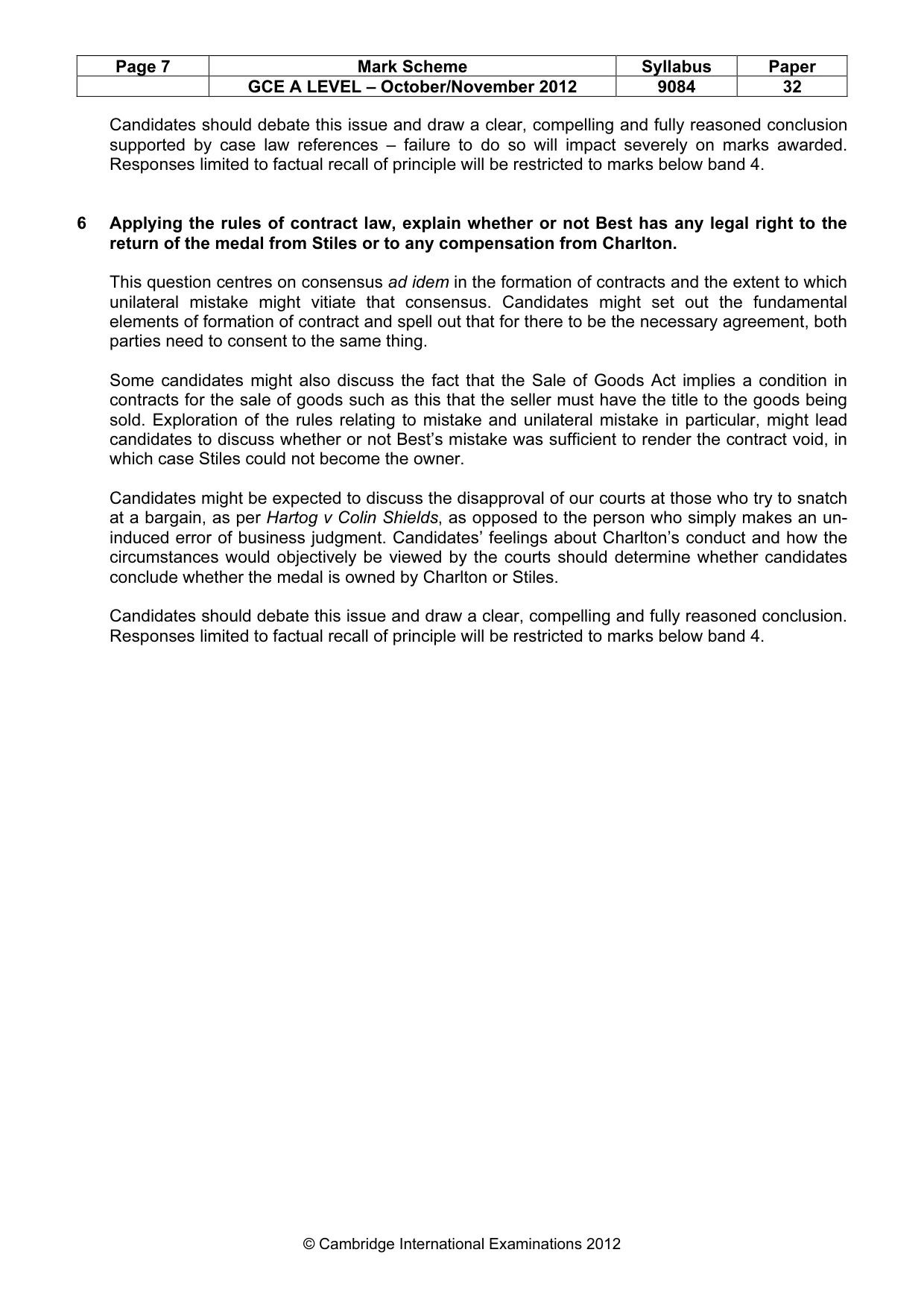
Page 7 Mark Scheme Syllabus Paper GCE A LEVEL – October/November 2012 9084 32 © Cambridge International Examinations 2012 Candidates should debate this issue and draw a clear, compelling and fully reasoned conclusion supported by case law references – failure to do so will impact severely on marks awarded. Responses limited to factual recall of principle will be restricted to marks below band 4. 6 Applying the rules of contract law, explain whether or not Best has any legal right to the return of the medal from Stiles or to any compensation from Charlton. This question centres on consensus ad idem in the formation of contracts and the extent to which unilateral mistake might vitiate that consensus. Candidates might set out the fundamental elements of formation of contract and spell out that for there to be the necessary agreement, both parties need to consent to the same thing. Some candidates might also discuss the fact that the Sale of Goods Act implies a condition in contracts for the sale of goods such as this that the seller must have the title to the goods being sold. Exploration of the rules relating to mistake and unilateral mistake in particular, might lead candidates to discuss whether or not Best’s mistake was sufficient to render the contract void, in which case Stiles could not become the owner. Candidates might be expected to discuss the disapproval of our courts at those who try to snatch at a bargain, as per Hartog v Colin Shields, as opposed to the person who simply makes an un- induced error of business judgment. Candidates’ feelings about Charlton’s conduct and how the circumstances would objectively be viewed by the courts should determine whether candidates conclude whether the medal is owned by Charlton or Stiles. Candidates should debate this issue and draw a clear, compelling and fully reasoned conclusion. Responses limited to factual recall of principle will be restricted to marks below band 4.
What you needed in this session
Cambridge’s own grade thresholds for 2012 Oct/Nov, Paper 3 · Variant 2. A higher threshold means an easier paper — the bar moves with how the cohort did.