Cambridge A Level Law 9084 — 2012 Oct/Nov Paper 3 · Variant 1
9084/31/O/N/12 · 75 marks · ≈84 min
The question paper and its mark scheme, free to read here and free to download. This is Cambridge’s own paper, exactly as it was sat.
Question paper4 pages
Mark scheme7 pages
Answers below. Sit the paper first if you are practising.
Paper as text
Question paper, page 1
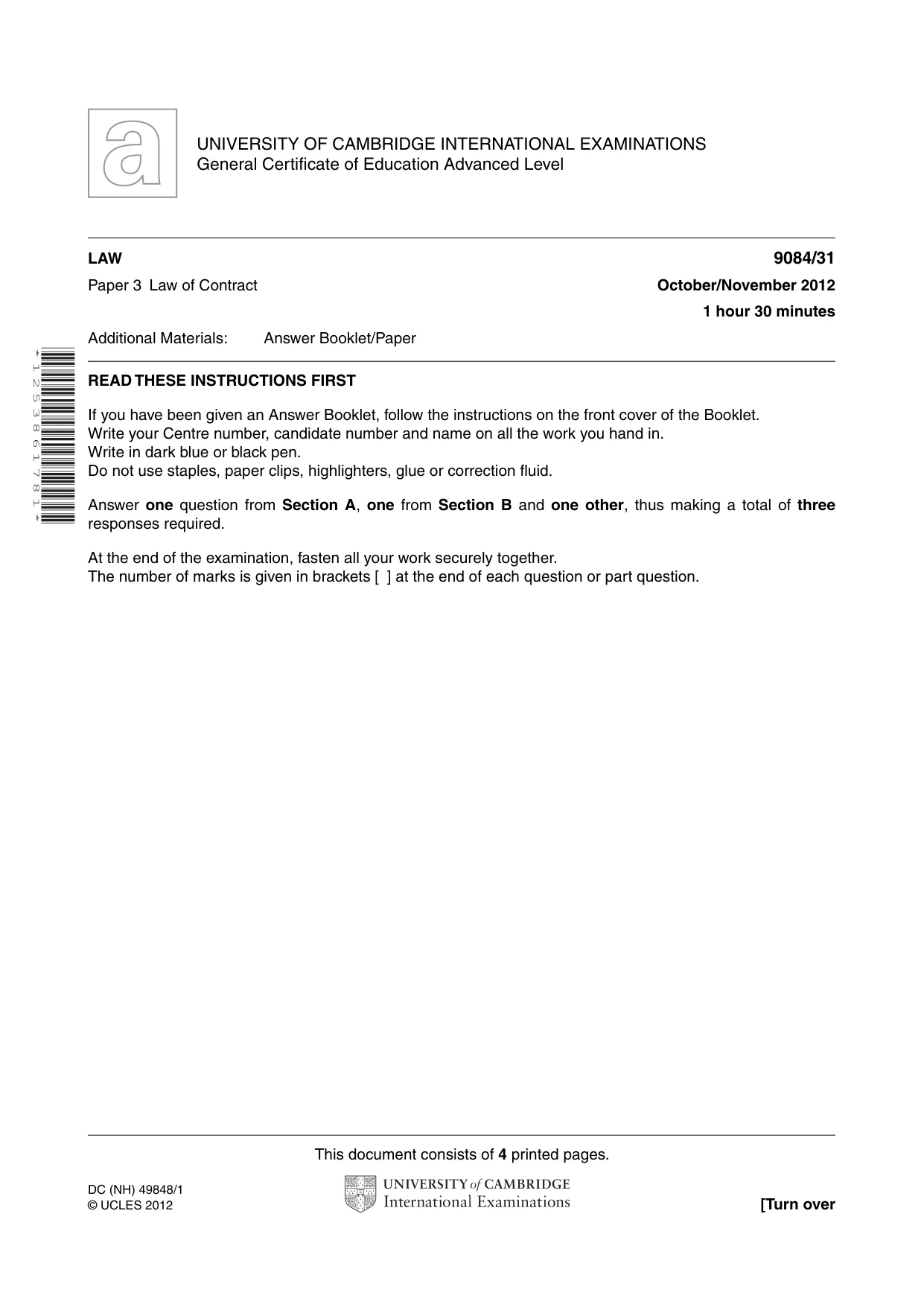
This document consists of 4 printed pages. DC (NH) 49848/1 © UCLES 2012 [Turn over UNIVERSITY OF CAMBRIDGE INTERNATIONAL EXAMINATIONS General Certificate of Education Advanced Level * 1 2 5 3 8 6 1 7 8 1 * LAW 9084/31 Paper 3 Law of Contract October/November 2012 1 hour 30 minutes Additional Materials: Answer Booklet/Paper READ THESE INSTRUCTIONS FIRST If you have been given an Answer Booklet, follow the instructions on the front cover of the Booklet. Write your Centre number, candidate number and name on all the work you hand in. Write in dark blue or black pen. Do not use staples, paper clips, highlighters, glue or correction fluid. Answer one question from Section A, one from Section B and one other, thus making a total of three responses required. At the end of the examination, fasten all your work securely together. The number of marks is given in brackets [ ] at the end of each question or part question.
Question paper, page 2
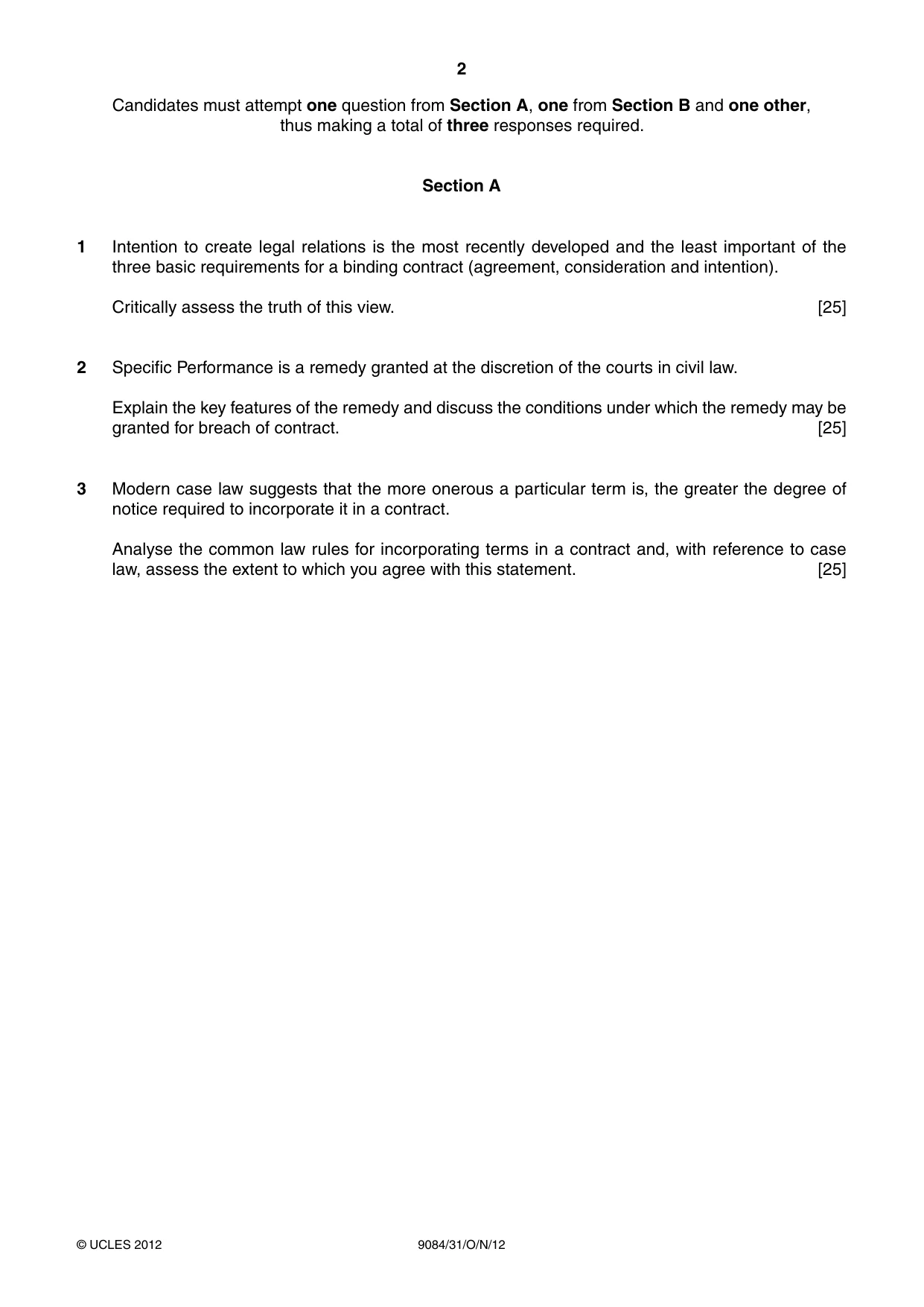
2 9084/31/O/N/12 © UCLES 2012 Candidates must attempt one question from Section A, one from Section B and one other, thus making a total of three responses required. Section A 1 Intention to create legal relations is the most recently developed and the least important of the three basic requirements for a binding contract (agreement, consideration and intention). Critically assess the truth of this view. [25] 2 Specific Performance is a remedy granted at the discretion of the courts in civil law. Explain the key features of the remedy and discuss the conditions under which the remedy may be granted for breach of contract. [25] 3 Modern case law suggests that the more onerous a particular term is, the greater the degree of notice required to incorporate it in a contract. Analyse the common law rules for incorporating terms in a contract and, with reference to case law, assess the extent to which you agree with this statement. [25]
Question paper, page 3
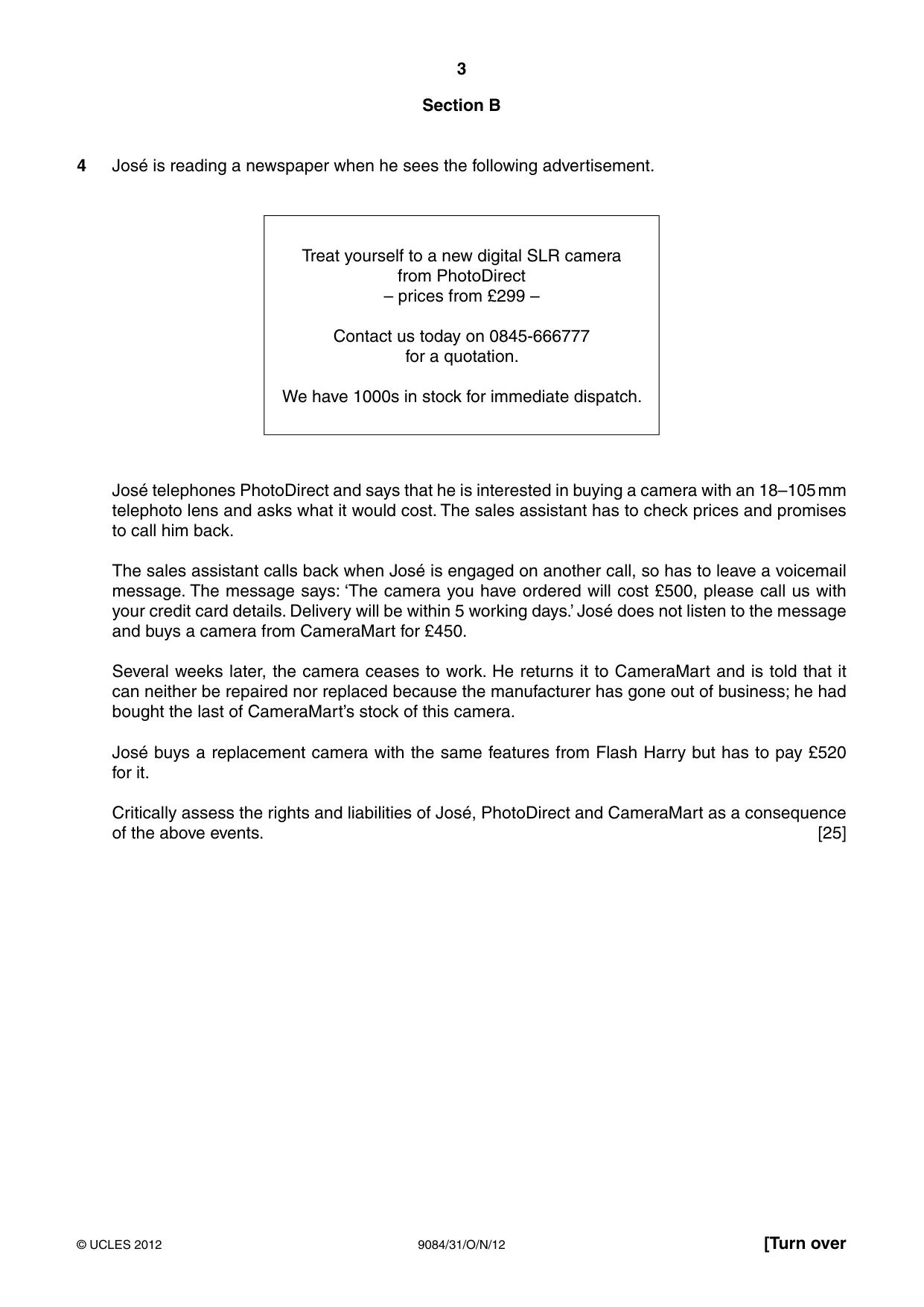
3 9084/31/O/N/12 © UCLES 2012 [Turn over Section B 4 José is reading a newspaper when he sees the following advertisement. Treat yourself to a new digital SLR camera from PhotoDirect – prices from £299 – Contact us today on 0845-666777 for a quotation. We have 1000s in stock for immediate dispatch. José telephones PhotoDirect and says that he is interested in buying a camera with an 18–105 mm telephoto lens and asks what it would cost. The sales assistant has to check prices and promises to call him back. The sales assistant calls back when José is engaged on another call, so has to leave a voicemail message. The message says: ‘The camera you have ordered will cost £500, please call us with your credit card details. Delivery will be within 5 working days.’ José does not listen to the message and buys a camera from CameraMart for £450. Several weeks later, the camera ceases to work. He returns it to CameraMart and is told that it can neither be repaired nor replaced because the manufacturer has gone out of business; he had bought the last of CameraMart’s stock of this camera. José buys a replacement camera with the same features from Flash Harry but has to pay £520 for it. Critically assess the rights and liabilities of José, PhotoDirect and CameraMart as a consequence of the above events. [25]
Question paper, page 4
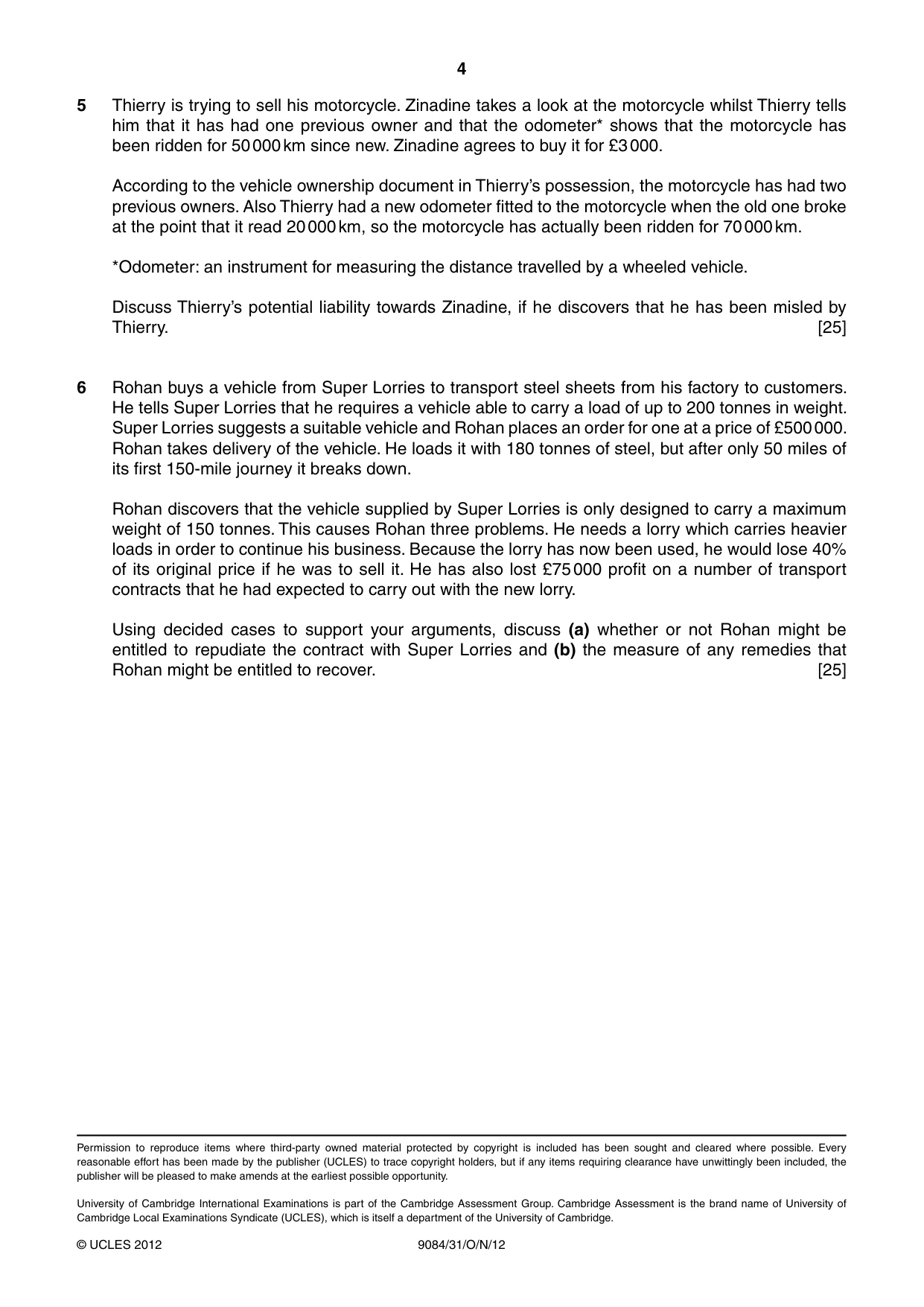
4 9084/31/O/N/12 © UCLES 2012 Permission to reproduce items where third-party owned material protected by copyright is included has been sought and cleared where possible. Every reasonable effort has been made by the publisher (UCLES) to trace copyright holders, but if any items requiring clearance have unwittingly been included, the publisher will be pleased to make amends at the earliest possible opportunity. University of Cambridge International Examinations is part of the Cambridge Assessment Group. Cambridge Assessment is the brand name of University of Cambridge Local Examinations Syndicate (UCLES), which is itself a department of the University of Cambridge. 5 Thierry is trying to sell his motorcycle. Zinadine takes a look at the motorcycle whilst Thierry tells him that it has had one previous owner and that the odometer* shows that the motorcycle has been ridden for 50 000 km since new. Zinadine agrees to buy it for £3 000. According to the vehicle ownership document in Thierry’s possession, the motorcycle has had two previous owners. Also Thierry had a new odometer fitted to the motorcycle when the old one broke at the point that it read 20 000 km, so the motorcycle has actually been ridden for 70 000 km. *Odometer: an instrument for measuring the distance travelled by a wheeled vehicle. Discuss Thierry’s potential liability towards Zinadine, if he discovers that he has been misled by Thierry. [25] 6 Rohan buys a vehicle from Super Lorries to transport steel sheets from his factory to customers. He tells Super Lorries that he requires a vehicle able to carry a load of up to 200 tonnes in weight. Super Lorries suggests a suitable vehicle and Rohan places an order for one at a price of £500 000. Rohan takes delivery of the vehicle. He loads it with 180 tonnes of steel, but after only 50 miles of its first 150-mile journey it breaks down. Rohan discovers that the vehicle supplied by Super Lorries is only designed to carry a maximum weight of 150 tonnes. This causes Rohan three problems. He needs a lorry which carries heavier loads in order to continue his business. Because the lorry has now been used, he would lose 40% of its original price if he was to sell it. He has also lost £75 000 profit on a number of transport contracts that he had expected to carry out with the new lorry. Using decided cases to support your arguments, discuss (a) whether or not Rohan might be entitled to repudiate the contract with Super Lorries and (b) the measure of any remedies that Rohan might be entitled to recover. [25]
Mark scheme, page 1
CAMBRIDGE INTERNATIONAL EXAMINATIONS GCE Advanced Level MARK SCHEME for the October/November 2012 series 9084 LAW 9084/31 Paper 3, maximum raw mark 75 This mark scheme is published as an aid to teachers and candidates, to indicate the requirements of the examination. It shows the basis on which Examiners were instructed to award marks. It does not indicate the details of the discussions that took place at an Examiners’ meeting before marking began, which would have considered the acceptability of alternative answers. Mark schemes should be read in conjunction with the question paper and the Principal Examiner Report for Teachers. Cambridge will not enter into discussions about these mark schemes. Cambridge is publishing the mark schemes for the October/November 2012 series for most IGCSE, GCE Advanced Level and Advanced Subsidiary Level components and some Ordinary Level components.
Mark scheme, page 2
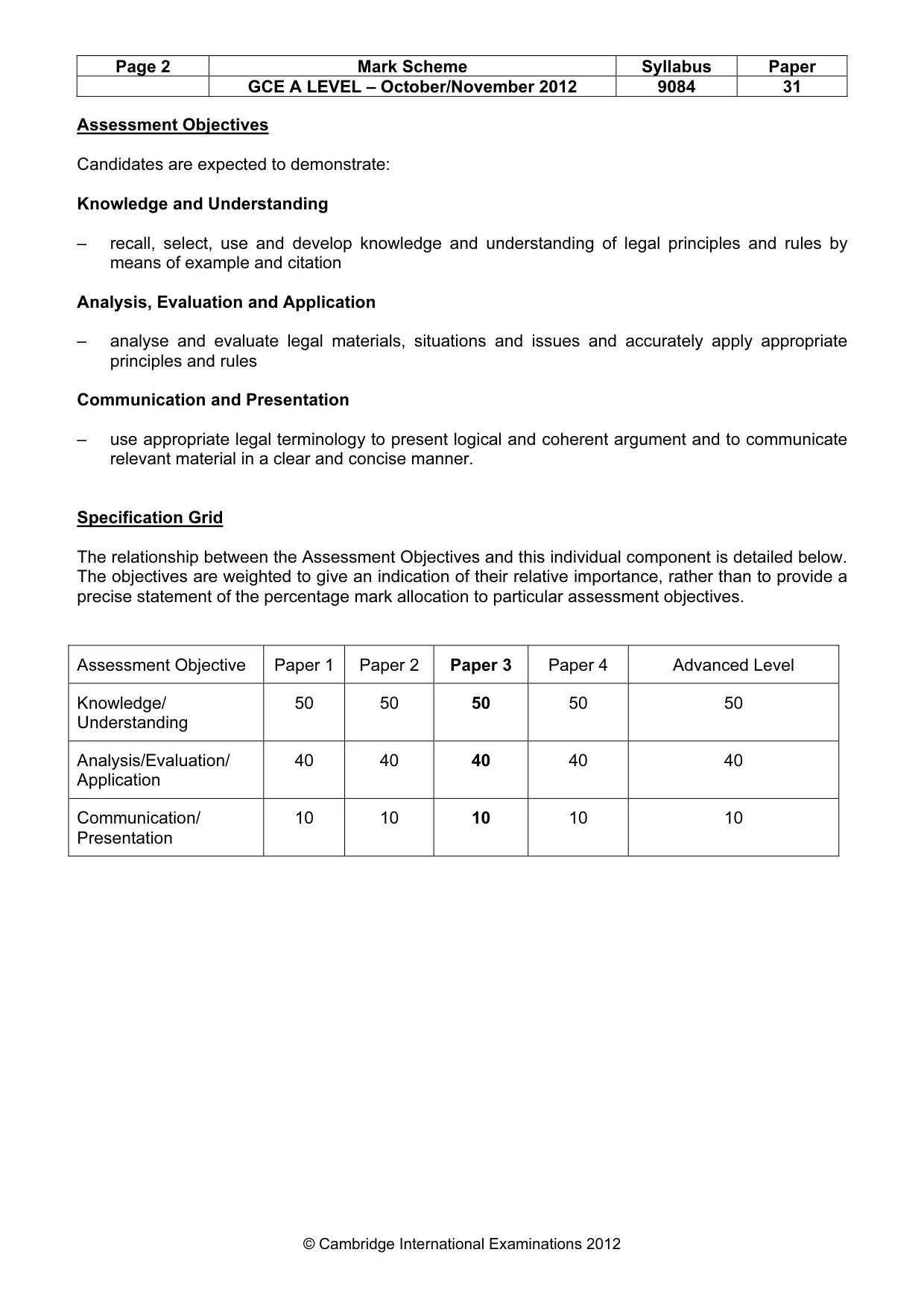
Page 2 Mark Scheme Syllabus Paper GCE A LEVEL – October/November 2012 9084 31 © Cambridge International Examinations 2012 Assessment Objectives Candidates are expected to demonstrate: Knowledge and Understanding – recall, select, use and develop knowledge and understanding of legal principles and rules by means of example and citation Analysis, Evaluation and Application – analyse and evaluate legal materials, situations and issues and accurately apply appropriate principles and rules Communication and Presentation – use appropriate legal terminology to present logical and coherent argument and to communicate relevant material in a clear and concise manner. Specification Grid The relationship between the Assessment Objectives and this individual component is detailed below. The objectives are weighted to give an indication of their relative importance, rather than to provide a precise statement of the percentage mark allocation to particular assessment objectives. Assessment Objective Paper 1 Paper 2 Paper 3 Paper 4 Advanced Level Knowledge/ Understanding 50 50 50 50 50 Analysis/Evaluation/ Application 40 40 40 40 40 Communication/ Presentation 10 10 10 10 10
Mark scheme, page 3
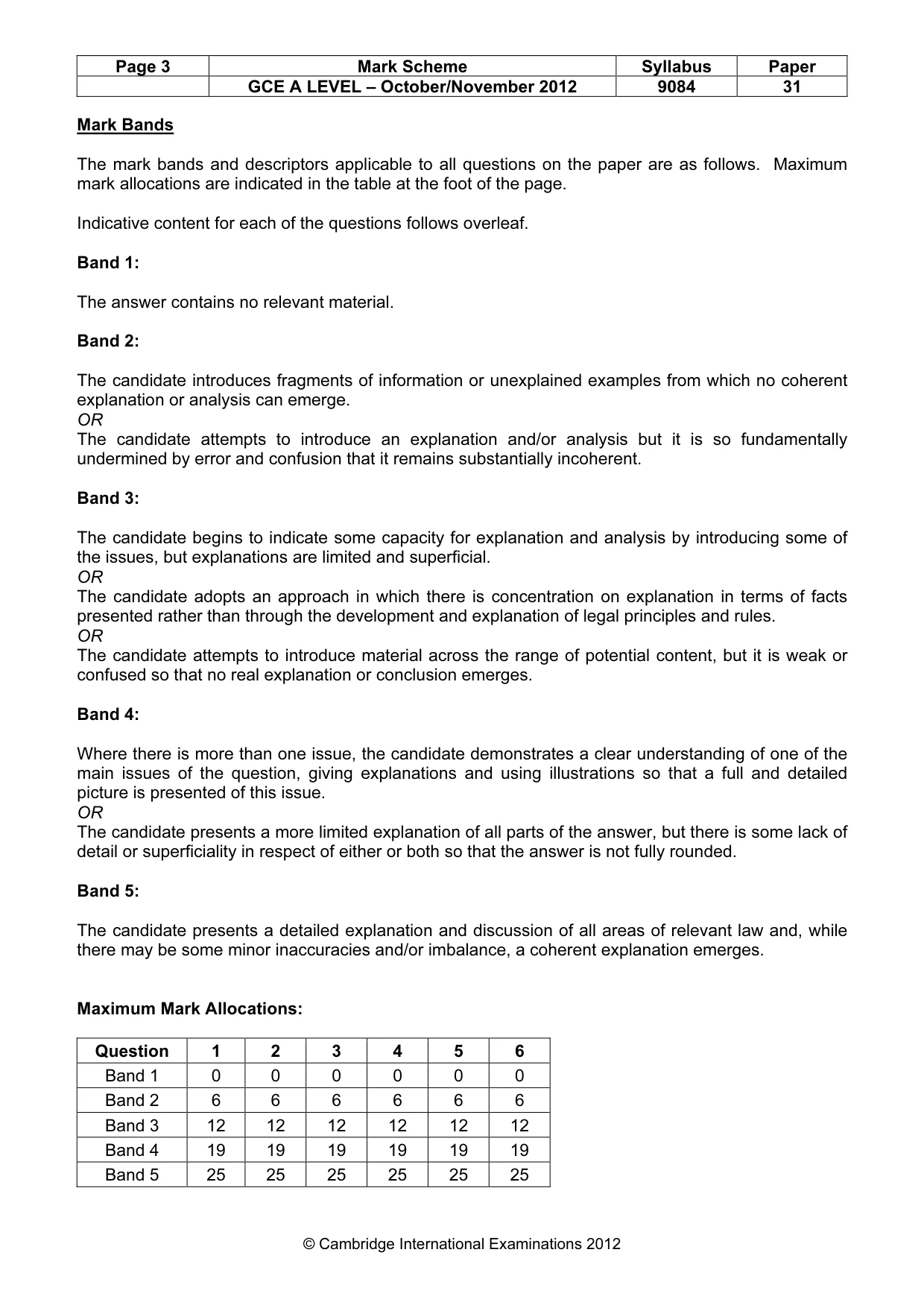
Page 3 Mark Scheme Syllabus Paper GCE A LEVEL – October/November 2012 9084 31 © Cambridge International Examinations 2012 Mark Bands The mark bands and descriptors applicable to all questions on the paper are as follows. Maximum mark allocations are indicated in the table at the foot of the page. Indicative content for each of the questions follows overleaf. Band 1: The answer contains no relevant material. Band 2: The candidate introduces fragments of information or unexplained examples from which no coherent explanation or analysis can emerge. OR The candidate attempts to introduce an explanation and/or analysis but it is so fundamentally undermined by error and confusion that it remains substantially incoherent. Band 3: The candidate begins to indicate some capacity for explanation and analysis by introducing some of the issues, but explanations are limited and superficial. OR The candidate adopts an approach in which there is concentration on explanation in terms of facts presented rather than through the development and explanation of legal principles and rules. OR The candidate attempts to introduce material across the range of potential content, but it is weak or confused so that no real explanation or conclusion emerges. Band 4: Where there is more than one issue, the candidate demonstrates a clear understanding of one of the main issues of the question, giving explanations and using illustrations so that a full and detailed picture is presented of this issue. OR The candidate presents a more limited explanation of all parts of the answer, but there is some lack of detail or superficiality in respect of either or both so that the answer is not fully rounded. Band 5: The candidate presents a detailed explanation and discussion of all areas of relevant law and, while there may be some minor inaccuracies and/or imbalance, a coherent explanation emerges. Maximum Mark Allocations: Question 1 2 3 4 5 6 Band 1 0 0 0 0 0 0 Band 2 6 6 6 6 6 6 Band 3 12 12 12 12 12 12 Band 4 19 19 19 19 19 19 Band 5 25 25 25 25 25 25
Mark scheme, page 4
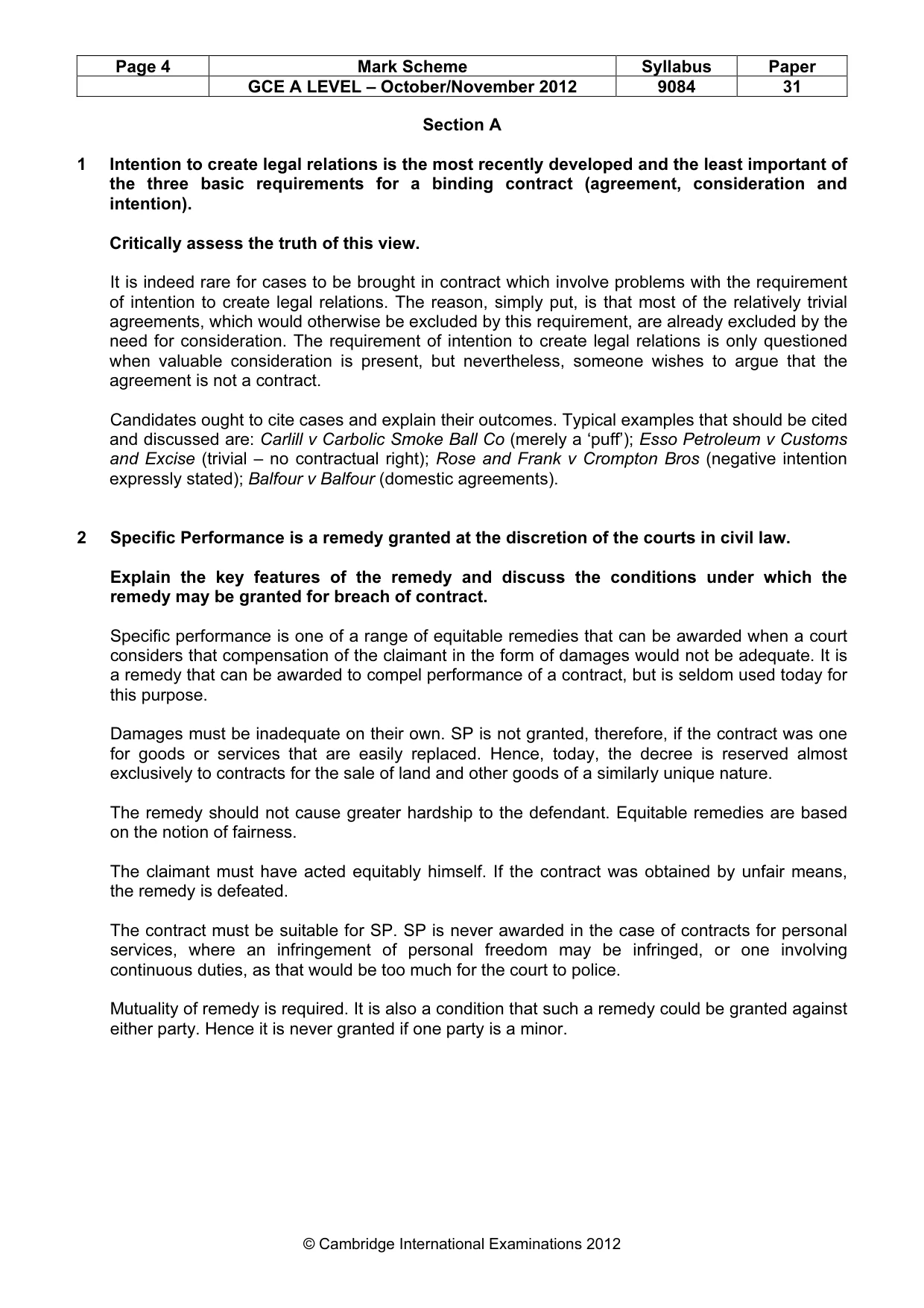
Page 4 Mark Scheme Syllabus Paper GCE A LEVEL – October/November 2012 9084 31 © Cambridge International Examinations 2012 Section A 1 Intention to create legal relations is the most recently developed and the least important of the three basic requirements for a binding contract (agreement, consideration and intention). Critically assess the truth of this view. It is indeed rare for cases to be brought in contract which involve problems with the requirement of intention to create legal relations. The reason, simply put, is that most of the relatively trivial agreements, which would otherwise be excluded by this requirement, are already excluded by the need for consideration. The requirement of intention to create legal relations is only questioned when valuable consideration is present, but nevertheless, someone wishes to argue that the agreement is not a contract. Candidates ought to cite cases and explain their outcomes. Typical examples that should be cited and discussed are: Carlill v Carbolic Smoke Ball Co (merely a ‘puff’); Esso Petroleum v Customs and Excise (trivial – no contractual right); Rose and Frank v Crompton Bros (negative intention expressly stated); Balfour v Balfour (domestic agreements). 2 Specific Performance is a remedy granted at the discretion of the courts in civil law. Explain the key features of the remedy and discuss the conditions under which the remedy may be granted for breach of contract. Specific performance is one of a range of equitable remedies that can be awarded when a court considers that compensation of the claimant in the form of damages would not be adequate. It is a remedy that can be awarded to compel performance of a contract, but is seldom used today for this purpose. Damages must be inadequate on their own. SP is not granted, therefore, if the contract was one for goods or services that are easily replaced. Hence, today, the decree is reserved almost exclusively to contracts for the sale of land and other goods of a similarly unique nature. The remedy should not cause greater hardship to the defendant. Equitable remedies are based on the notion of fairness. The claimant must have acted equitably himself. If the contract was obtained by unfair means, the remedy is defeated. The contract must be suitable for SP. SP is never awarded in the case of contracts for personal services, where an infringement of personal freedom may be infringed, or one involving continuous duties, as that would be too much for the court to police. Mutuality of remedy is required. It is also a condition that such a remedy could be granted against either party. Hence it is never granted if one party is a minor.
Mark scheme, page 5
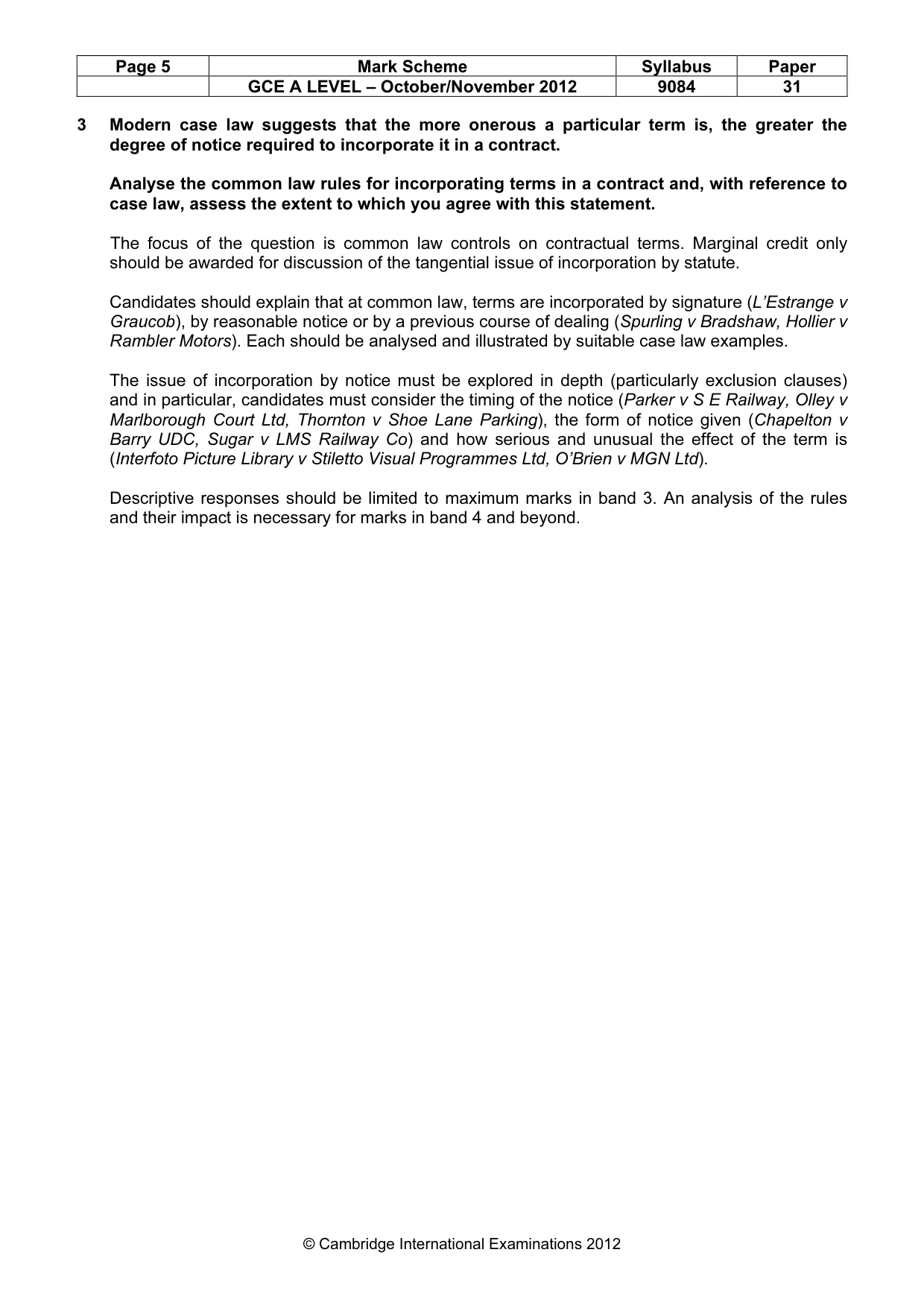
Page 5 Mark Scheme Syllabus Paper GCE A LEVEL – October/November 2012 9084 31 © Cambridge International Examinations 2012 3 Modern case law suggests that the more onerous a particular term is, the greater the degree of notice required to incorporate it in a contract. Analyse the common law rules for incorporating terms in a contract and, with reference to case law, assess the extent to which you agree with this statement. The focus of the question is common law controls on contractual terms. Marginal credit only should be awarded for discussion of the tangential issue of incorporation by statute. Candidates should explain that at common law, terms are incorporated by signature (L’Estrange v Graucob), by reasonable notice or by a previous course of dealing (Spurling v Bradshaw, Hollier v Rambler Motors). Each should be analysed and illustrated by suitable case law examples. The issue of incorporation by notice must be explored in depth (particularly exclusion clauses) and in particular, candidates must consider the timing of the notice (Parker v S E Railway, Olley v Marlborough Court Ltd, Thornton v Shoe Lane Parking), the form of notice given (Chapelton v Barry UDC, Sugar v LMS Railway Co) and how serious and unusual the effect of the term is (Interfoto Picture Library v Stiletto Visual Programmes Ltd, O’Brien v MGN Ltd). Descriptive responses should be limited to maximum marks in band 3. An analysis of the rules and their impact is necessary for marks in band 4 and beyond.
Mark scheme, page 6
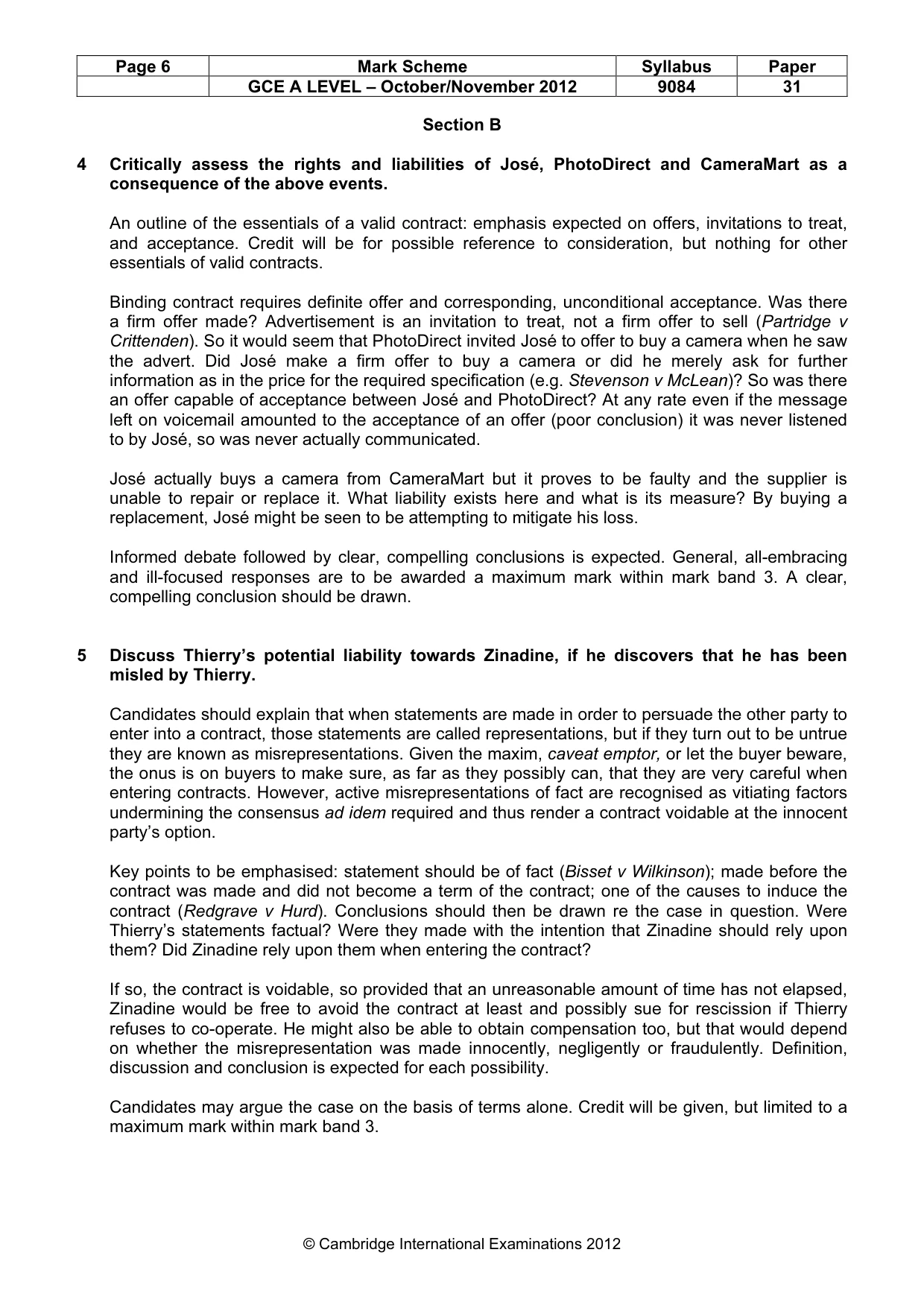
Page 6 Mark Scheme Syllabus Paper GCE A LEVEL – October/November 2012 9084 31 © Cambridge International Examinations 2012 Section B 4 Critically assess the rights and liabilities of José, PhotoDirect and CameraMart as a consequence of the above events. An outline of the essentials of a valid contract: emphasis expected on offers, invitations to treat, and acceptance. Credit will be for possible reference to consideration, but nothing for other essentials of valid contracts. Binding contract requires definite offer and corresponding, unconditional acceptance. Was there a firm offer made? Advertisement is an invitation to treat, not a firm offer to sell (Partridge v Crittenden). So it would seem that PhotoDirect invited José to offer to buy a camera when he saw the advert. Did José make a firm offer to buy a camera or did he merely ask for further information as in the price for the required specification (e.g. Stevenson v McLean)? So was there an offer capable of acceptance between José and PhotoDirect? At any rate even if the message left on voicemail amounted to the acceptance of an offer (poor conclusion) it was never listened to by José, so was never actually communicated. José actually buys a camera from CameraMart but it proves to be faulty and the supplier is unable to repair or replace it. What liability exists here and what is its measure? By buying a replacement, José might be seen to be attempting to mitigate his loss. Informed debate followed by clear, compelling conclusions is expected. General, all-embracing and ill-focused responses are to be awarded a maximum mark within mark band 3. A clear, compelling conclusion should be drawn. 5 Discuss Thierry’s potential liability towards Zinadine, if he discovers that he has been misled by Thierry. Candidates should explain that when statements are made in order to persuade the other party to enter into a contract, those statements are called representations, but if they turn out to be untrue they are known as misrepresentations. Given the maxim, caveat emptor, or let the buyer beware, the onus is on buyers to make sure, as far as they possibly can, that they are very careful when entering contracts. However, active misrepresentations of fact are recognised as vitiating factors undermining the consensus ad idem required and thus render a contract voidable at the innocent party’s option. Key points to be emphasised: statement should be of fact (Bisset v Wilkinson); made before the contract was made and did not become a term of the contract; one of the causes to induce the contract (Redgrave v Hurd). Conclusions should then be drawn re the case in question. Were Thierry’s statements factual? Were they made with the intention that Zinadine should rely upon them? Did Zinadine rely upon them when entering the contract? If so, the contract is voidable, so provided that an unreasonable amount of time has not elapsed, Zinadine would be free to avoid the contract at least and possibly sue for rescission if Thierry refuses to co-operate. He might also be able to obtain compensation too, but that would depend on whether the misrepresentation was made innocently, negligently or fraudulently. Definition, discussion and conclusion is expected for each possibility. Candidates may argue the case on the basis of terms alone. Credit will be given, but limited to a maximum mark within mark band 3.
Mark scheme, page 7
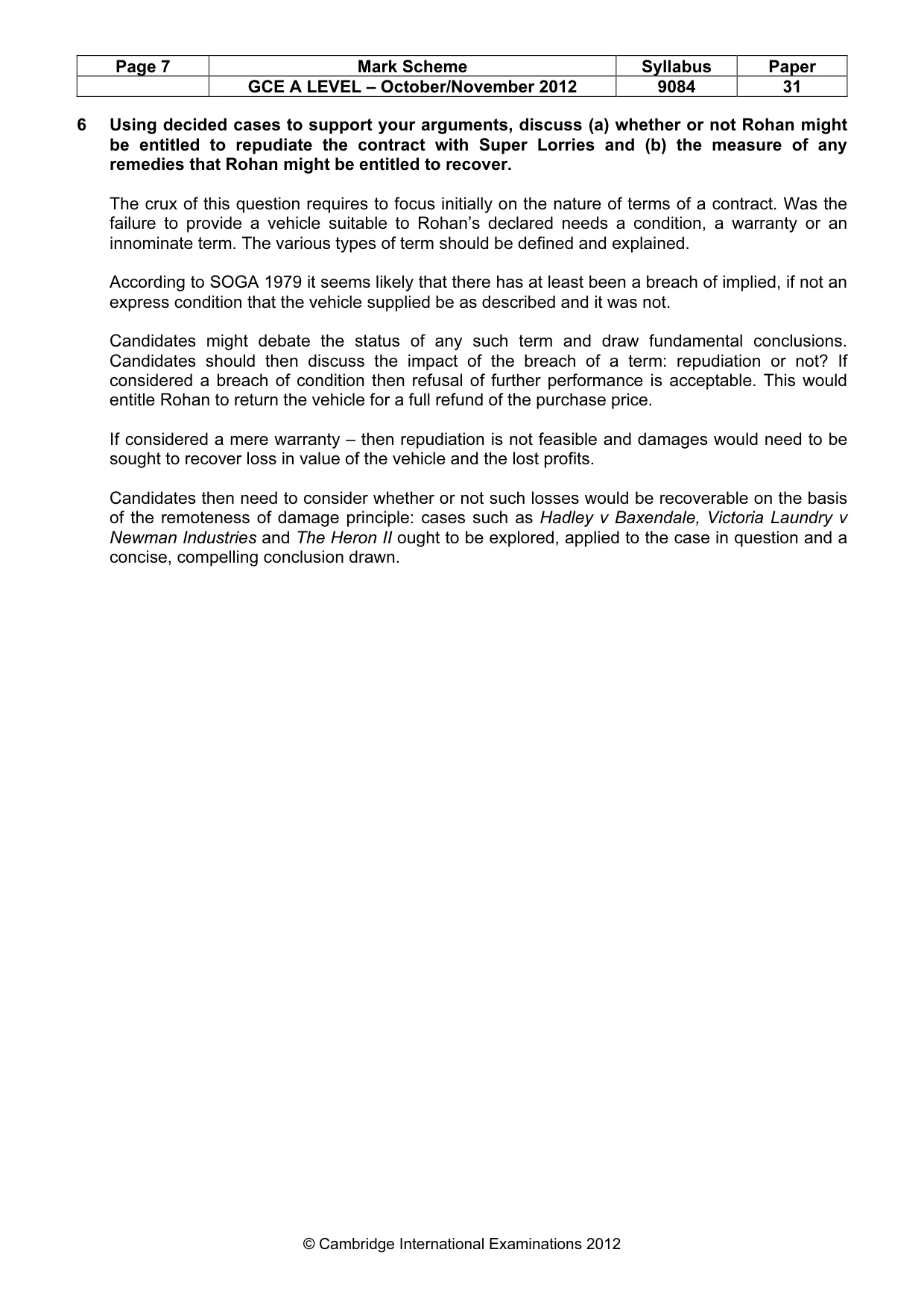
Page 7 Mark Scheme Syllabus Paper GCE A LEVEL – October/November 2012 9084 31 © Cambridge International Examinations 2012 6 Using decided cases to support your arguments, discuss (a) whether or not Rohan might be entitled to repudiate the contract with Super Lorries and (b) the measure of any remedies that Rohan might be entitled to recover. The crux of this question requires to focus initially on the nature of terms of a contract. Was the failure to provide a vehicle suitable to Rohan’s declared needs a condition, a warranty or an innominate term. The various types of term should be defined and explained. According to SOGA 1979 it seems likely that there has at least been a breach of implied, if not an express condition that the vehicle supplied be as described and it was not. Candidates might debate the status of any such term and draw fundamental conclusions. Candidates should then discuss the impact of the breach of a term: repudiation or not? If considered a breach of condition then refusal of further performance is acceptable. This would entitle Rohan to return the vehicle for a full refund of the purchase price. If considered a mere warranty – then repudiation is not feasible and damages would need to be sought to recover loss in value of the vehicle and the lost profits. Candidates then need to consider whether or not such losses would be recoverable on the basis of the remoteness of damage principle: cases such as Hadley v Baxendale, Victoria Laundry v Newman Industries and The Heron II ought to be explored, applied to the case in question and a concise, compelling conclusion drawn.
What you needed in this session
Cambridge’s own grade thresholds for 2012 Oct/Nov, Paper 3 · Variant 1. A higher threshold means an easier paper — the bar moves with how the cohort did.