Cambridge A Level Law 9084 — 2025 Oct/Nov Paper 1 · Variant 2
9084/12/O/N/25 · 75 marks · ≈84 min
The question paper and its mark scheme, free to read here and free to download. This is Cambridge’s own paper, exactly as it was sat.
Question paper4 pages


Mark scheme16 pages
Answers below. Sit the paper first if you are practising.

Paper as text
Question paper, page 1
[Turn over Cambridge International AS & A Level DC (WW) 345370/1 © UCLES 2025 This document has 4 pages. Any blank pages are indicated. * 2 6 0 3 4 1 7 2 1 2 * LAW 9084/12 Paper 1 English Legal System October/November 2025 1 hour 30 minutes You must answer on the enclosed answer booklet. You will need: Answer booklet (enclosed) INSTRUCTIONS ● Answer seven questions in total: Section A: answer all questions. Section B: answer two questions. ● Follow the instructions on the front cover of the answer booklet. If you need additional answer paper, ask the invigilator for a continuation booklet. INFORMATION ● The total mark for this paper is 75. ● The number of marks for each question or part question is shown in brackets [ ].
Question paper, page 2
2 9084/12/O/N/25 © UCLES 2025 Section A Answer all questions. 1 Identify one qualification required to become a judge in the Supreme Court. [1] 2 Identify two types of delegated legislation. [2] 3 Describe two aspects of parliamentary supremacy. [6] 4 Describe two stages in the qualification and training of solicitors. [6] 5 Discuss the advantages of using a jury in the criminal justice system. [10] Section B Answer two questions. 6 (a) Describe the pre-trial processes for summary, triable either way and indictable criminal offences. [10] (b) Discuss the factors which a defendant should consider when deciding the trial venue for a triable either way offence. [15] 7 (a) Describe the types of alternative dispute resolution (ADR) available to claimants. [10] (b) Discuss which types of ADR would be suitable for a consumer complaint. [15] 8 (a) Describe the techniques used by the inferior courts to avoid a binding precedent. [10] (b) Assess whether judicial precedent limits the courts in developing the law to ensure justice. [15]
Question paper, page 3
3 9084/12/O/N/25 © UCLES 2025 BLANK PAGE
Question paper, page 4
4 9084/12/O/N/25 © UCLES 2025 Permission to reproduce items where third-party owned material protected by copyright is included has been sought and cleared where possible. Every reasonable effort has been made by the publisher (UCLES) to trace copyright holders, but if any items requiring clearance have unwittingly been included, the publisher will be pleased to make amends at the earliest possible opportunity. To avoid the issue of disclosure of answer-related information to candidates, all copyright acknowledgements are reproduced online in the Cambridge Assessment International Education Copyright Acknowledgements Booklet. This is produced for each series of examinations and is freely available to download at www.cambridgeinternational.org after the live examination series. Cambridge Assessment International Education is part of Cambridge Assessment. Cambridge Assessment is the brand name of the University of Cambridge Local Examinations Syndicate (UCLES), which is a department of the University of Cambridge. BLANK PAGE
Mark scheme, page 1
This document consists of 16 printed pages. © Cambridge University Press & Assessment 2025 [Turn over Cambridge International AS & A Level LAW 9084/12 Paper 1 English Legal System October/November 2025 MARK SCHEME Maximum Mark: 75 Published This mark scheme is published as an aid to teachers and candidates, to indicate the requirements of the examination. It shows the basis on which Examiners were instructed to award marks. It does not indicate the details of the discussions that took place at an Examiners’ meeting before marking began, which would have considered the acceptability of alternative answers. Mark schemes should be read in conjunction with the question paper and the Principal Examiner Report for Teachers. Cambridge International will not enter into discussions about these mark schemes. Cambridge International is publishing the mark schemes for the October/November 2025 series for most Cambridge IGCSE, Cambridge International A and AS Level components, and some Cambridge O Level components.
Mark scheme, page 2
9084/12 Cambridge International AS & A Level – Mark Scheme PUBLISHED October/November 2025 © Cambridge University Press & Assessment 2025 Page 2 of 16 Generic Marking Principles These general marking principles must be applied by all examiners when marking candidate answers. They should be applied alongside the specific content of the mark scheme or generic level descriptions for a question. Each question paper and mark scheme will also comply with these marking principles. GENERIC MARKING PRINCIPLE 1: Marks must be awarded in line with: • the specific content of the mark scheme or the generic level descriptors for the question • the specific skills defined in the mark scheme or in the generic level descriptors for the question • the standard of response required by a candidate as exemplified by the standardisation scripts. GENERIC MARKING PRINCIPLE 2: Marks awarded are always whole marks (not half marks, or other fractions). GENERIC MARKING PRINCIPLE 3: Marks must be awarded positively: • marks are awarded for correct/valid answers, as defined in the mark scheme. However, credit is given for valid answers which go beyond the scope of the syllabus and mark scheme, referring to your Team Leader as appropriate • marks are awarded when candidates clearly demonstrate what they know and can do • marks are not deducted for errors • marks are not deducted for omissions • answers should only be judged on the quality of spelling, punctuation and grammar when these features are specifically assessed by the question as indicated by the mark scheme. The meaning, however, should be unambiguous. GENERIC MARKING PRINCIPLE 4: Rules must be applied consistently, e.g. in situations where candidates have not followed instructions or in the application of generic level descriptors. GENERIC MARKING PRINCIPLE 5: Marks should be awarded using the full range of marks defined in the mark scheme for the question (however; the use of the full mark range may be limited according to the quality of the candidate responses seen). GENERIC MARKING PRINCIPLE 6: Marks awarded are based solely on the requirements as defined in the mark scheme. Marks should not be awarded with grade thresholds or grade descriptors in mind.
Mark scheme, page 3
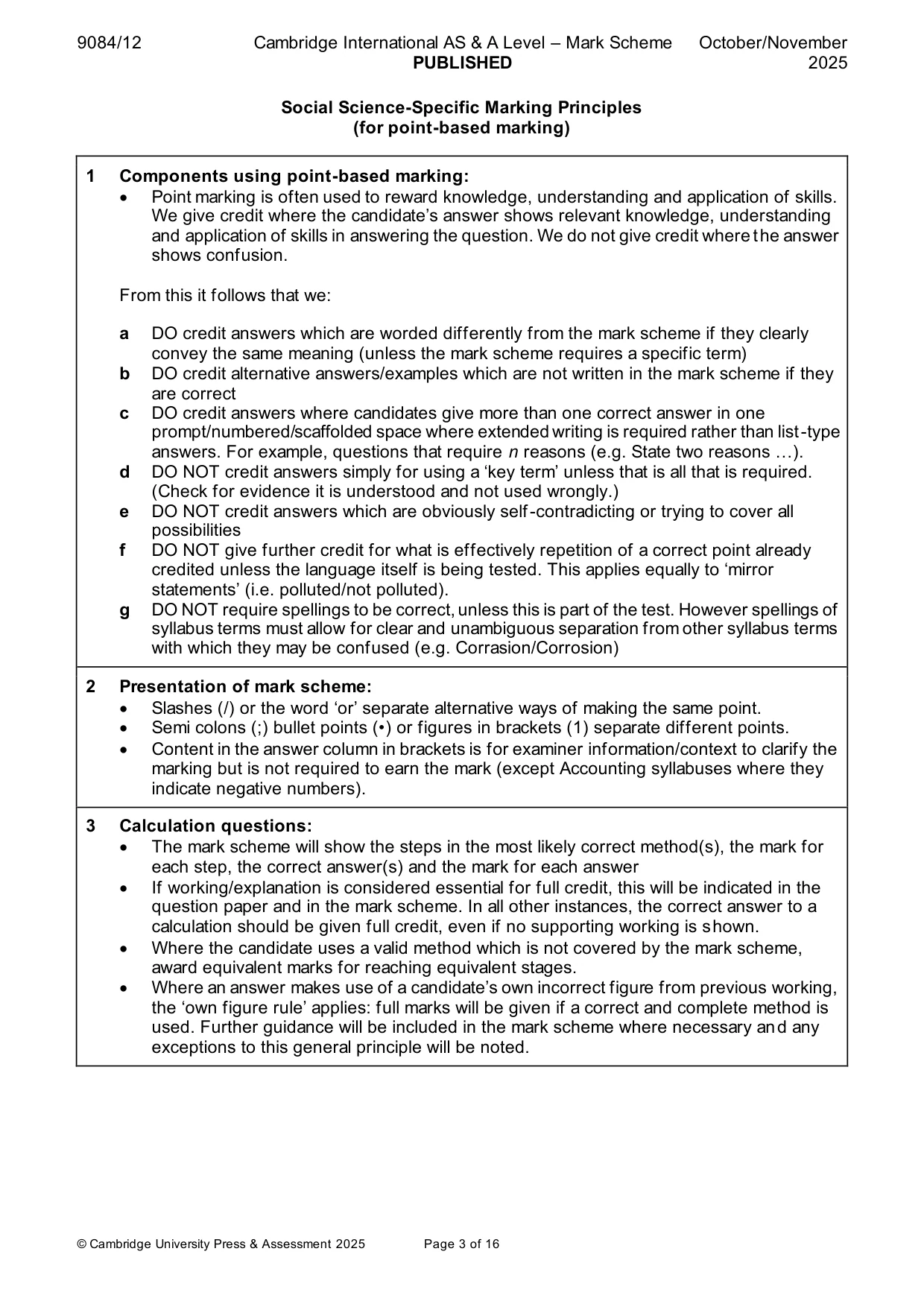
9084/12 Cambridge International AS & A Level – Mark Scheme PUBLISHED October/November 2025 © Cambridge University Press & Assessment 2025 Page 3 of 16 Social Science-Specific Marking Principles (for point-based marking) 1 Components using point-based marking: • Point marking is often used to reward knowledge, understanding and application of skills. We give credit where the candidate’s answer shows relevant knowledge, understanding and application of skills in answering the question. We do not give credit where the answer shows confusion. From this it follows that we: a DO credit answers which are worded differently from the mark scheme if they clearly convey the same meaning (unless the mark scheme requires a specific term) b DO credit alternative answers/examples which are not written in the mark scheme if they are correct c DO credit answers where candidates give more than one correct answer in one prompt/numbered/scaffolded space where extended writing is required rather than list-type answers. For example, questions that require n reasons (e.g. State two reasons …). d DO NOT credit answers simply for using a ‘key term’ unless that is all that is required. (Check for evidence it is understood and not used wrongly.) e DO NOT credit answers which are obviously self-contradicting or trying to cover all possibilities f DO NOT give further credit for what is effectively repetition of a correct point already credited unless the language itself is being tested. This applies equally to ‘mirror statements’ (i.e. polluted/not polluted). g DO NOT require spellings to be correct, unless this is part of the test. However spellings of syllabus terms must allow for clear and unambiguous separation from other syllabus terms with which they may be confused (e.g. Corrasion/Corrosion) 2 Presentation of mark scheme: • Slashes (/) or the word ‘or’ separate alternative ways of making the same point. • Semi colons (;) bullet points (•) or figures in brackets (1) separate different points. • Content in the answer column in brackets is for examiner information/context to clarify the marking but is not required to earn the mark (except Accounting syllabuses where they indicate negative numbers). 3 Calculation questions: • The mark scheme will show the steps in the most likely correct method(s), the mark for each step, the correct answer(s) and the mark for each answer • If working/explanation is considered essential for full credit, this will be indicated in the question paper and in the mark scheme. In all other instances, the correct answer to a calculation should be given full credit, even if no supporting working is shown. • Where the candidate uses a valid method which is not covered by the mark scheme, award equivalent marks for reaching equivalent stages. • Where an answer makes use of a candidate’s own incorrect figure from previous working, the ‘own figure rule’ applies: full marks will be given if a correct and complete method is used. Further guidance will be included in the mark scheme where necessary and any exceptions to this general principle will be noted.
Mark scheme, page 4
9084/12 Cambridge International AS & A Level – Mark Scheme PUBLISHED October/November 2025 © Cambridge University Press & Assessment 2025 Page 4 of 16 4 Annotation: • For point marking, ticks can be used to indicate correct answers and crosses can be used to indicate wrong answers. There is no direct relationship between ticks and marks. Ticks have no defined meaning for levels of response marking. • For levels of response marking, the level awarded should be annotated on the script. • Other annotations will be used by examiners as agreed during standardisation, and the meaning will be understood by all examiners who marked that paper.
Mark scheme, page 5
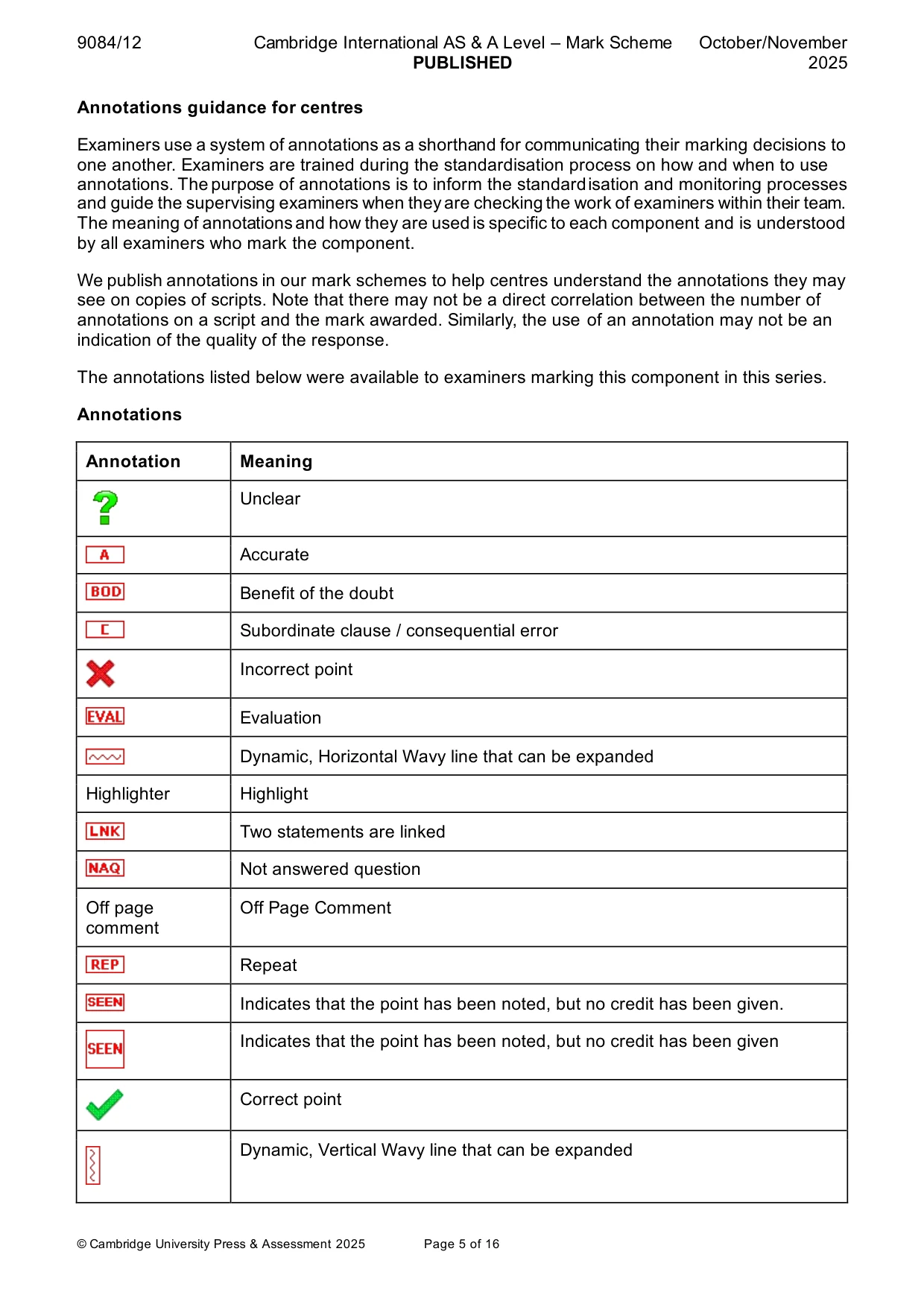
9084/12 Cambridge International AS & A Level – Mark Scheme PUBLISHED October/November 2025 © Cambridge University Press & Assessment 2025 Page 5 of 16 Annotations guidance for centres Examiners use a system of annotations as a shorthand for communicating their marking decisions to one another. Examiners are trained during the standardisation process on how and when to use annotations. The purpose of annotations is to inform the standardisation and monitoring processes and guide the supervising examiners when they are checking the work of examiners within their team. The meaning of annotations and how they are used is specific to each component and is understood by all examiners who mark the component. We publish annotations in our mark schemes to help centres understand the annotations they may see on copies of scripts. Note that there may not be a direct correlation between the number of annotations on a script and the mark awarded. Similarly, the use of an annotation may not be an indication of the quality of the response. The annotations listed below were available to examiners marking this component in this series. Annotations Annotation Meaning Unclear Accurate Benefit of the doubt Subordinate clause / consequential error Incorrect point Evaluation Dynamic, Horizontal Wavy line that can be expanded Highlighter Highlight Two statements are linked Not answered question Off page comment Off Page Comment Repeat Indicates that the point has been noted, but no credit has been given. Indicates that the point has been noted, but no credit has been given Correct point Dynamic, Vertical Wavy line that can be expanded
Mark scheme, page 6
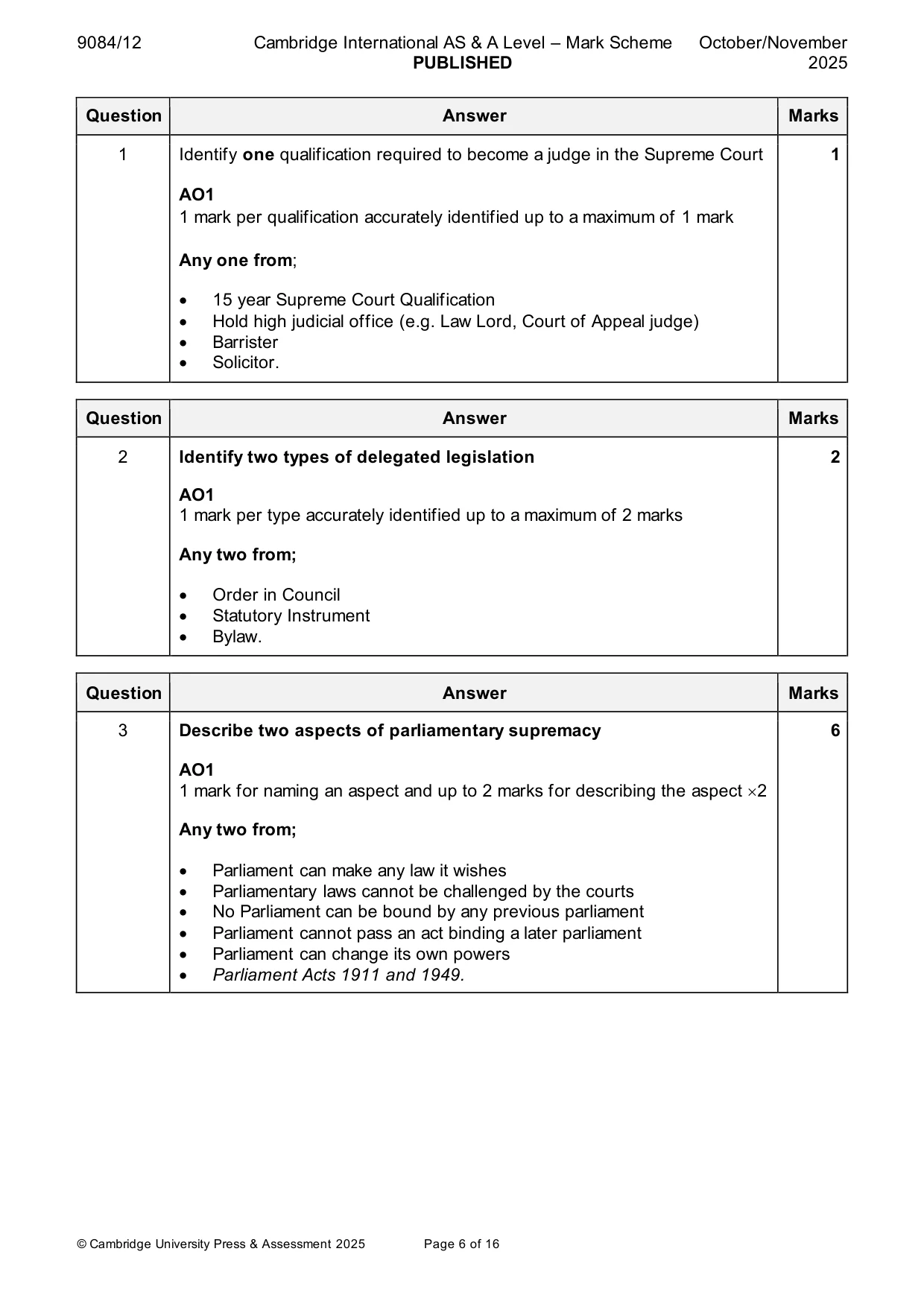
9084/12 Cambridge International AS & A Level – Mark Scheme PUBLISHED October/November 2025 © Cambridge University Press & Assessment 2025 Page 6 of 16 Question Answer Marks 1 Identify one qualification required to become a judge in the Supreme Court AO1 1 mark per qualification accurately identified up to a maximum of 1 mark Any one from; • 15 year Supreme Court Qualification • Hold high judicial office (e.g. Law Lord, Court of Appeal judge) • Barrister • Solicitor. 1 Question Answer Marks 2 Identify two types of delegated legislation AO1 1 mark per type accurately identified up to a maximum of 2 marks Any two from; • Order in Council • Statutory Instrument • Bylaw. 2 Question Answer Marks 3 Describe two aspects of parliamentary supremacy AO1 1 mark for naming an aspect and up to 2 marks for describing the aspect 2 Any two from; • Parliament can make any law it wishes • Parliamentary laws cannot be challenged by the courts • No Parliament can be bound by any previous parliament • Parliament cannot pass an act binding a later parliament • Parliament can change its own powers • Parliament Acts 1911 and 1949. 6
Mark scheme, page 7
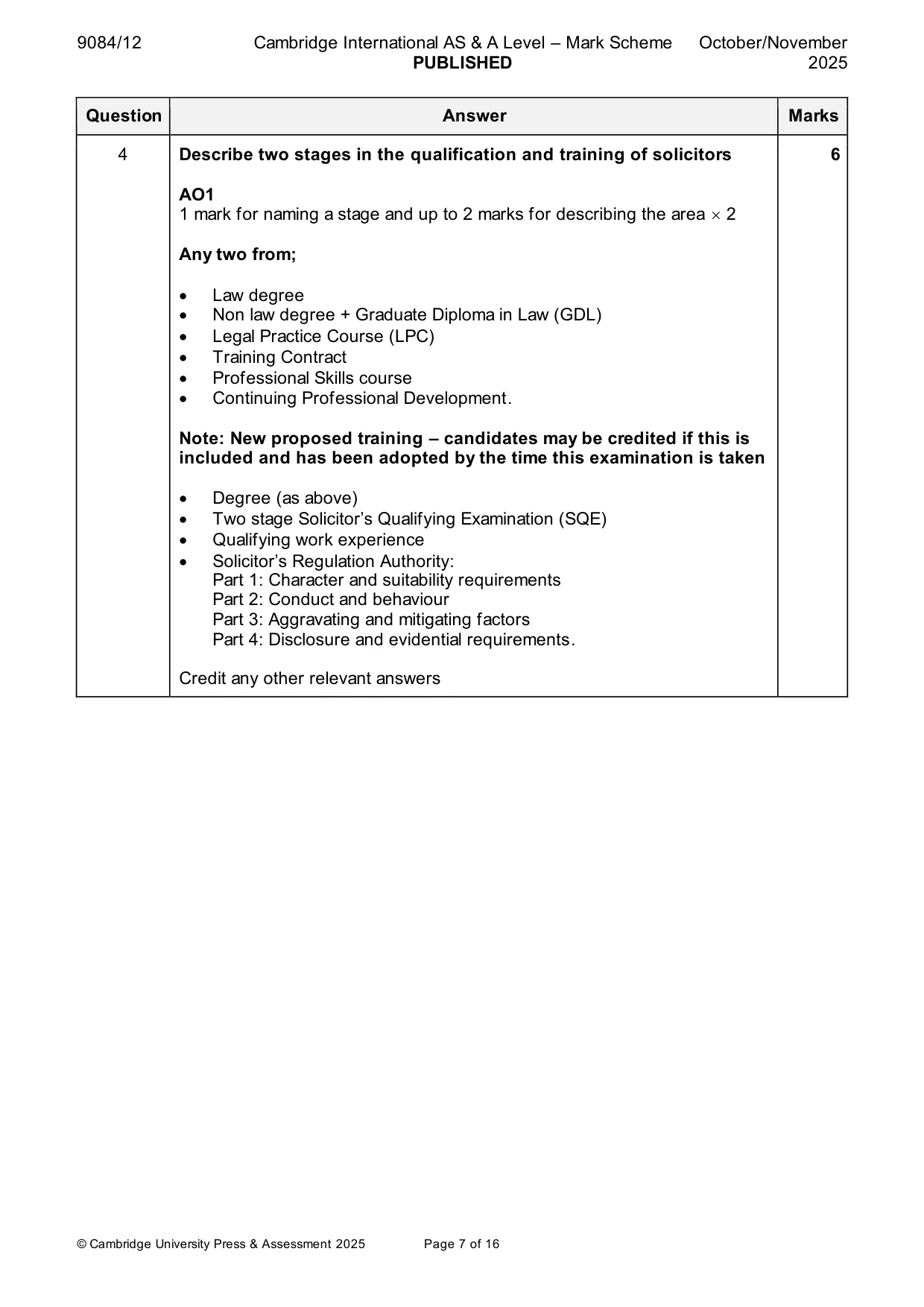
9084/12 Cambridge International AS & A Level – Mark Scheme PUBLISHED October/November 2025 © Cambridge University Press & Assessment 2025 Page 7 of 16 Question Answer Marks 4 Describe two stages in the qualification and training of solicitors AO1 1 mark for naming a stage and up to 2 marks for describing the area 2 Any two from; • Law degree • Non law degree + Graduate Diploma in Law (GDL) • Legal Practice Course (LPC) • Training Contract • Professional Skills course • Continuing Professional Development. Note: New proposed training – candidates may be credited if this is included and has been adopted by the time this examination is taken • Degree (as above) • Two stage Solicitor’s Qualifying Examination (SQE) • Qualifying work experience • Solicitor’s Regulation Authority: Part 1: Character and suitability requirements Part 2: Conduct and behaviour Part 3: Aggravating and mitigating factors Part 4: Disclosure and evidential requirements. Credit any other relevant answers 6
Mark scheme, page 8
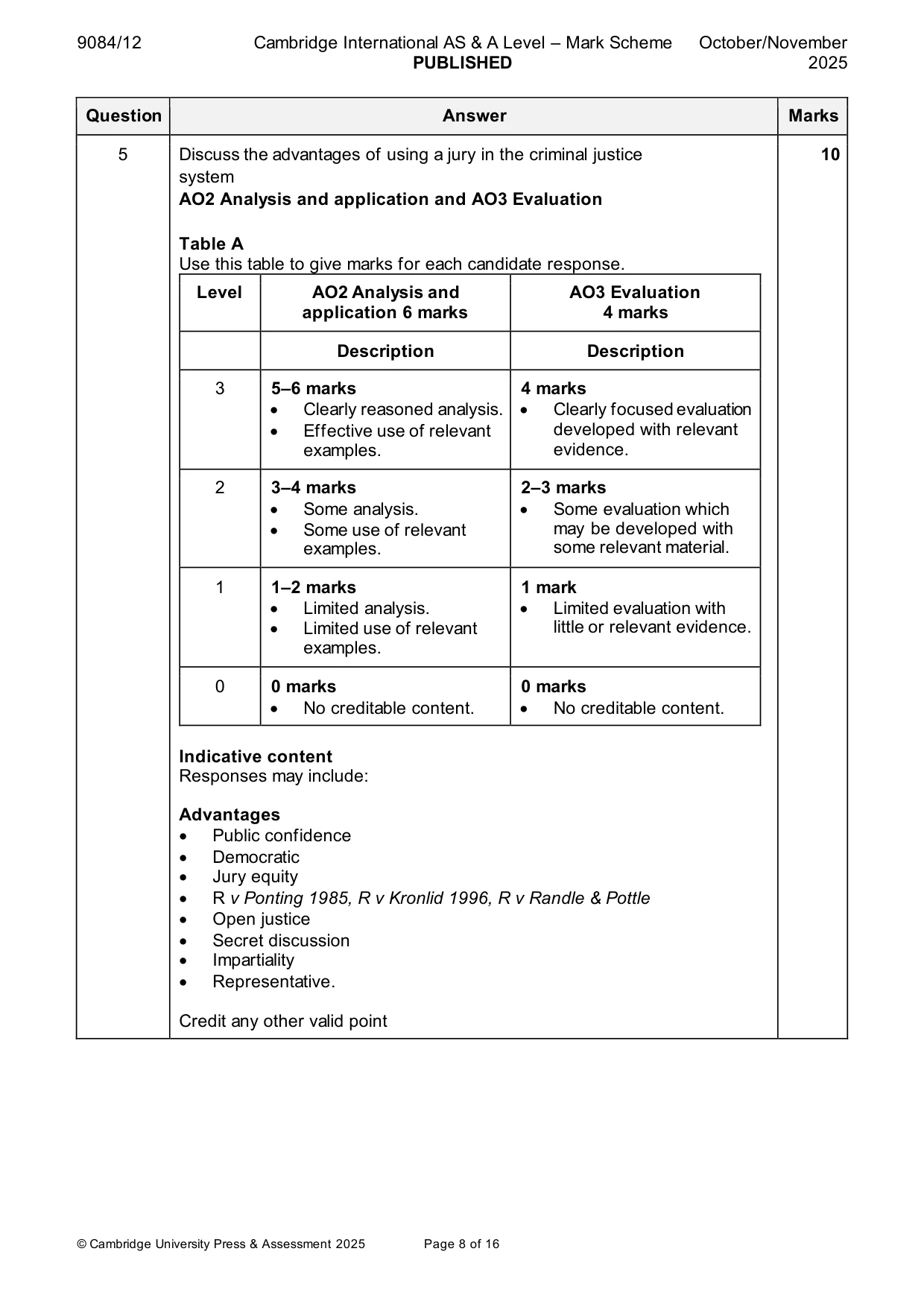
9084/12 Cambridge International AS & A Level – Mark Scheme PUBLISHED October/November 2025 © Cambridge University Press & Assessment 2025 Page 8 of 16 Question Answer Marks 5 Discuss the advantages of using a jury in the criminal justice system AO2 Analysis and application and AO3 Evaluation Table A Use this table to give marks for each candidate response. Level AO2 Analysis and application 6 marks AO3 Evaluation 4 marks Description Description 3 5–6 marks • Clearly reasoned analysis. • Effective use of relevant examples. 4 marks • Clearly focused evaluation developed with relevant evidence. 2 3–4 marks • Some analysis. • Some use of relevant examples. 2–3 marks • Some evaluation which may be developed with some relevant material. 1 1–2 marks • Limited analysis. • Limited use of relevant examples. 1 mark • Limited evaluation with little or relevant evidence. 0 0 marks • No creditable content. 0 marks • No creditable content. Indicative content Responses may include: Advantages • Public confidence • Democratic • Jury equity • R v Ponting 1985, R v Kronlid 1996, R v Randle & Pottle • Open justice • Secret discussion • Impartiality • Representative. Credit any other valid point 10
Mark scheme, page 9
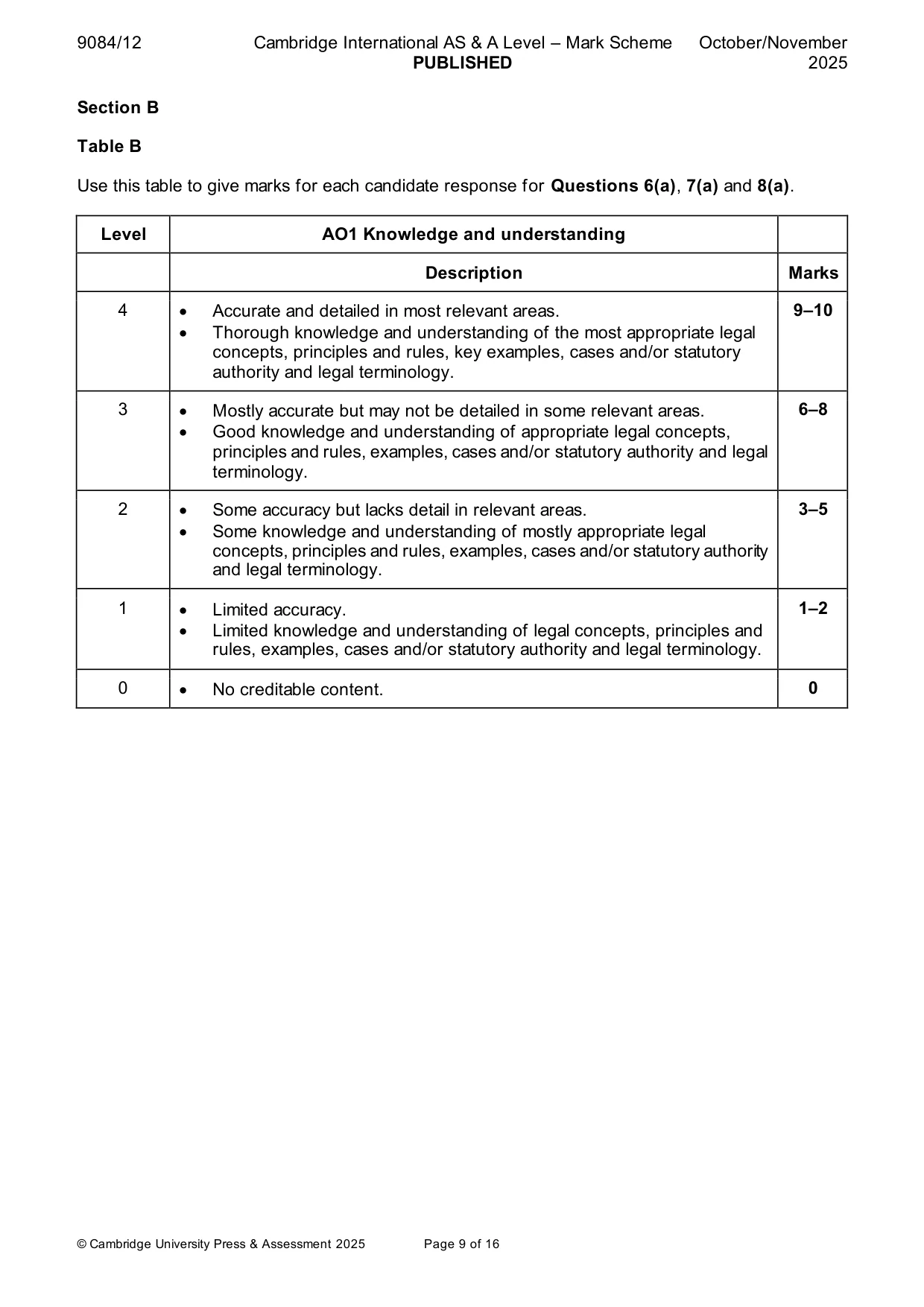
9084/12 Cambridge International AS & A Level – Mark Scheme PUBLISHED October/November 2025 © Cambridge University Press & Assessment 2025 Page 9 of 16 Section B Table B Use this table to give marks for each candidate response for Questions 6(a), 7(a) and 8(a). Level AO1 Knowledge and understanding Description Marks 4 • Accurate and detailed in most relevant areas. • Thorough knowledge and understanding of the most appropriate legal concepts, principles and rules, key examples, cases and/or statutory authority and legal terminology. 9–10 3 • Mostly accurate but may not be detailed in some relevant areas. • Good knowledge and understanding of appropriate legal concepts, principles and rules, examples, cases and/or statutory authority and legal terminology. 6–8 2 • Some accuracy but lacks detail in relevant areas. • Some knowledge and understanding of mostly appropriate legal concepts, principles and rules, examples, cases and/or statutory authority and legal terminology. 3–5 1 • Limited accuracy. • Limited knowledge and understanding of legal concepts, principles and rules, examples, cases and/or statutory authority and legal terminology. 1–2 0 • No creditable content. 0
Mark scheme, page 10
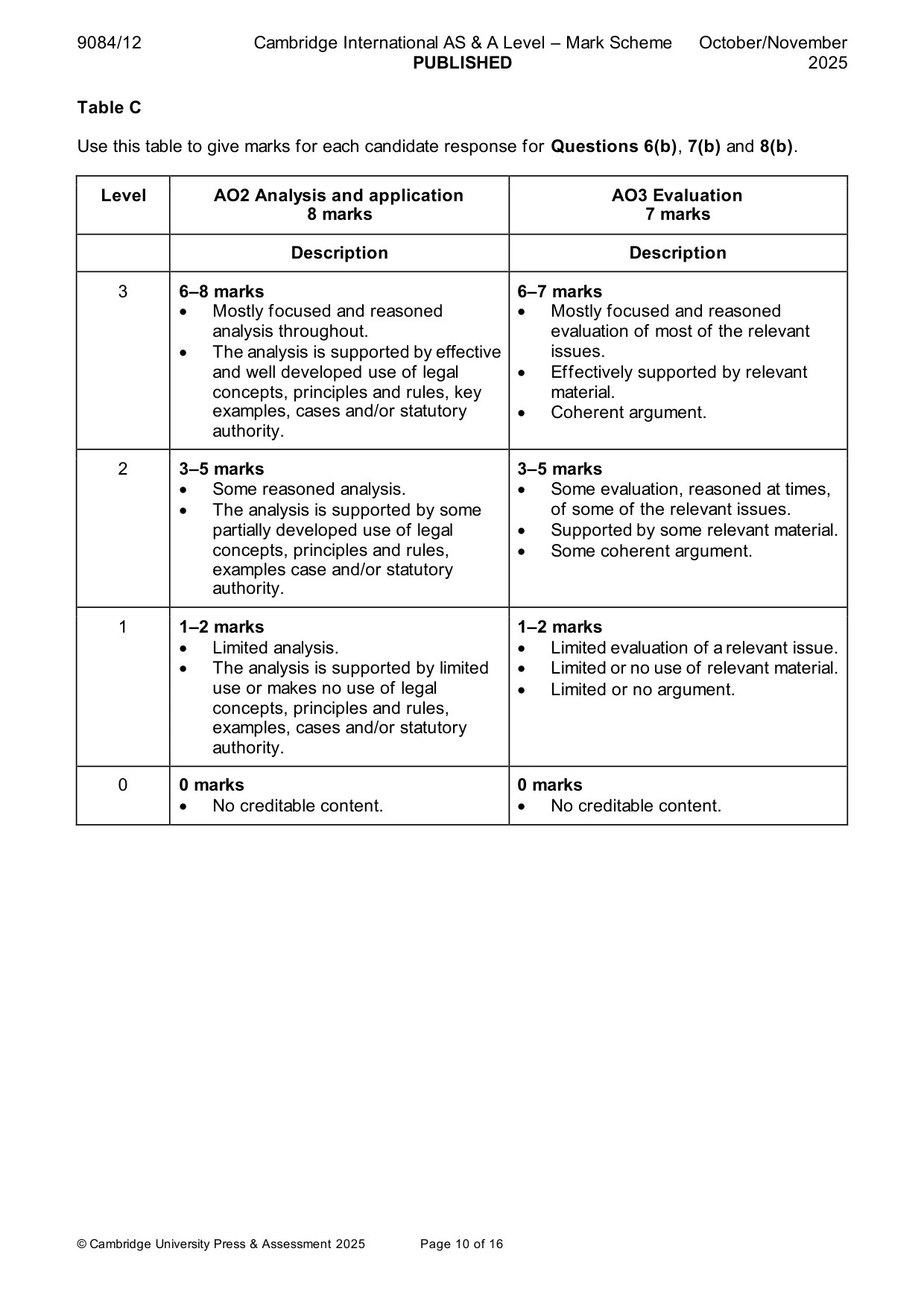
9084/12 Cambridge International AS & A Level – Mark Scheme PUBLISHED October/November 2025 © Cambridge University Press & Assessment 2025 Page 10 of 16 Table C Use this table to give marks for each candidate response for Questions 6(b), 7(b) and 8(b). Level AO2 Analysis and application 8 marks AO3 Evaluation 7 marks Description Description 3 6–8 marks • Mostly focused and reasoned analysis throughout. • The analysis is supported by effective and well developed use of legal concepts, principles and rules, key examples, cases and/or statutory authority. 6–7 marks • Mostly focused and reasoned evaluation of most of the relevant issues. • Effectively supported by relevant material. • Coherent argument. 2 3–5 marks • Some reasoned analysis. • The analysis is supported by some partially developed use of legal concepts, principles and rules, examples case and/or statutory authority. 3–5 marks • Some evaluation, reasoned at times, of some of the relevant issues. • Supported by some relevant material. • Some coherent argument. 1 1–2 marks • Limited analysis. • The analysis is supported by limited use or makes no use of legal concepts, principles and rules, examples, cases and/or statutory authority. 1–2 marks • Limited evaluation of a relevant issue. • Limited or no use of relevant material. • Limited or no argument. 0 0 marks • No creditable content. 0 marks • No creditable content.
Mark scheme, page 11
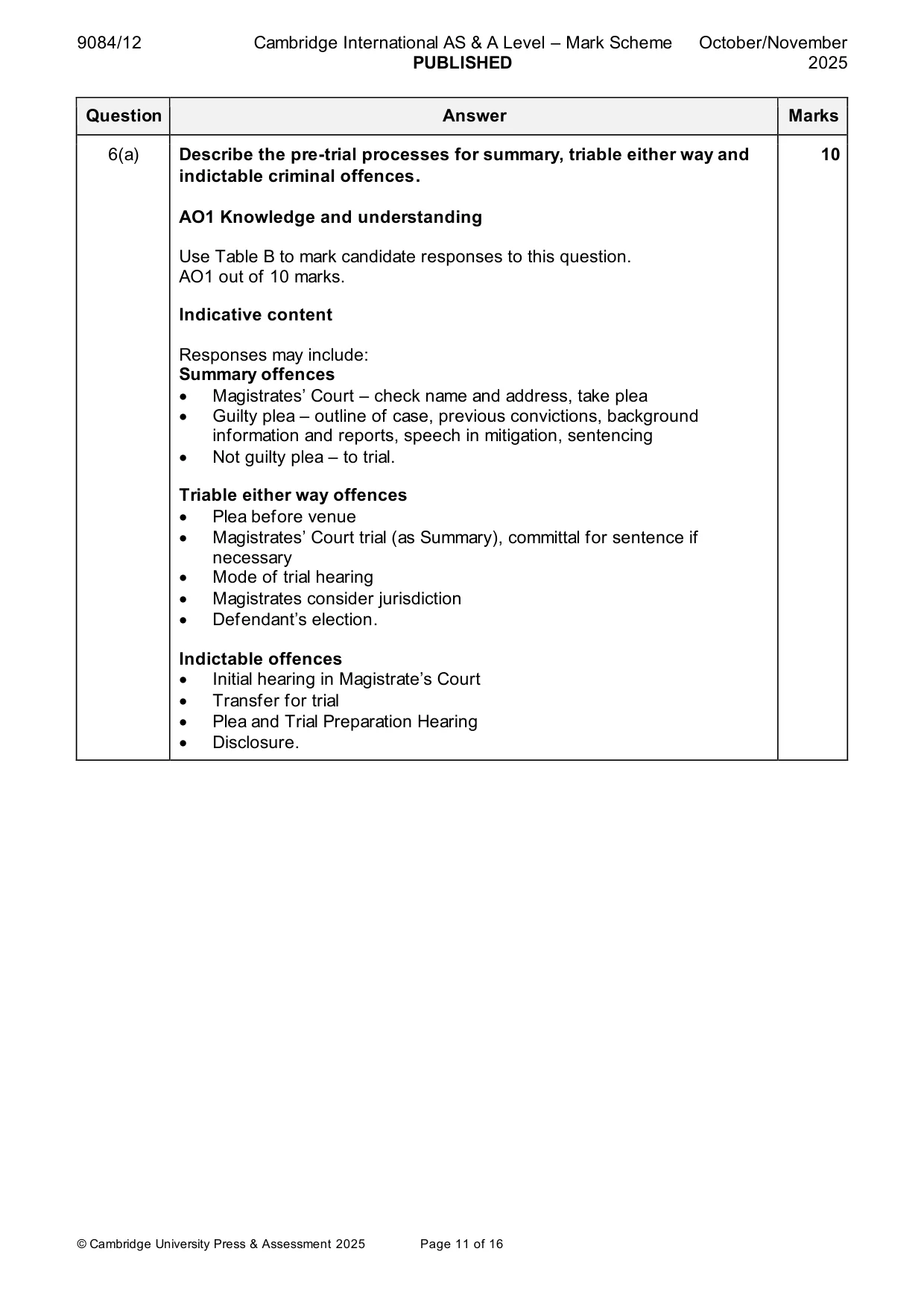
9084/12 Cambridge International AS & A Level – Mark Scheme PUBLISHED October/November 2025 © Cambridge University Press & Assessment 2025 Page 11 of 16 Question Answer Marks 6(a) Describe the pre-trial processes for summary, triable either way and indictable criminal offences. AO1 Knowledge and understanding Use Table B to mark candidate responses to this question. AO1 out of 10 marks. Indicative content Responses may include: Summary offences • Magistrates’ Court – check name and address, take plea • Guilty plea – outline of case, previous convictions, background information and reports, speech in mitigation, sentencing • Not guilty plea – to trial. Triable either way offences • Plea before venue • Magistrates’ Court trial (as Summary), committal for sentence if necessary • Mode of trial hearing • Magistrates consider jurisdiction • Defendant’s election. Indictable offences • Initial hearing in Magistrate’s Court • Transfer for trial • Plea and Trial Preparation Hearing • Disclosure. 10
Mark scheme, page 12
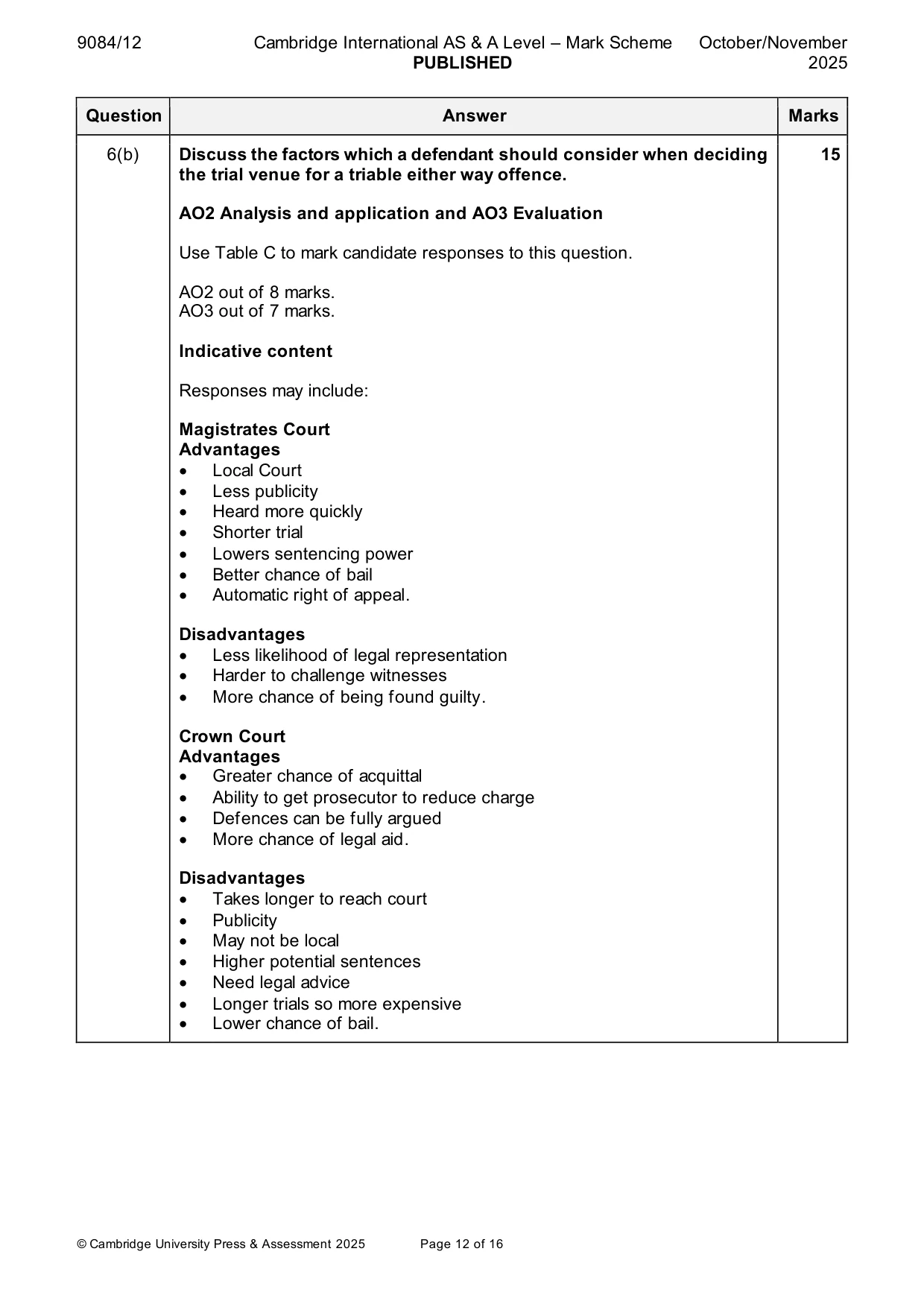
9084/12 Cambridge International AS & A Level – Mark Scheme PUBLISHED October/November 2025 © Cambridge University Press & Assessment 2025 Page 12 of 16 Question Answer Marks 6(b) Discuss the factors which a defendant should consider when deciding the trial venue for a triable either way offence. AO2 Analysis and application and AO3 Evaluation Use Table C to mark candidate responses to this question. AO2 out of 8 marks. AO3 out of 7 marks. Indicative content Responses may include: Magistrates Court Advantages • Local Court • Less publicity • Heard more quickly • Shorter trial • Lowers sentencing power • Better chance of bail • Automatic right of appeal. Disadvantages • Less likelihood of legal representation • Harder to challenge witnesses • More chance of being found guilty. Crown Court Advantages • Greater chance of acquittal • Ability to get prosecutor to reduce charge • Defences can be fully argued • More chance of legal aid. Disadvantages • Takes longer to reach court • Publicity • May not be local • Higher potential sentences • Need legal advice • Longer trials so more expensive • Lower chance of bail. 15
Mark scheme, page 13
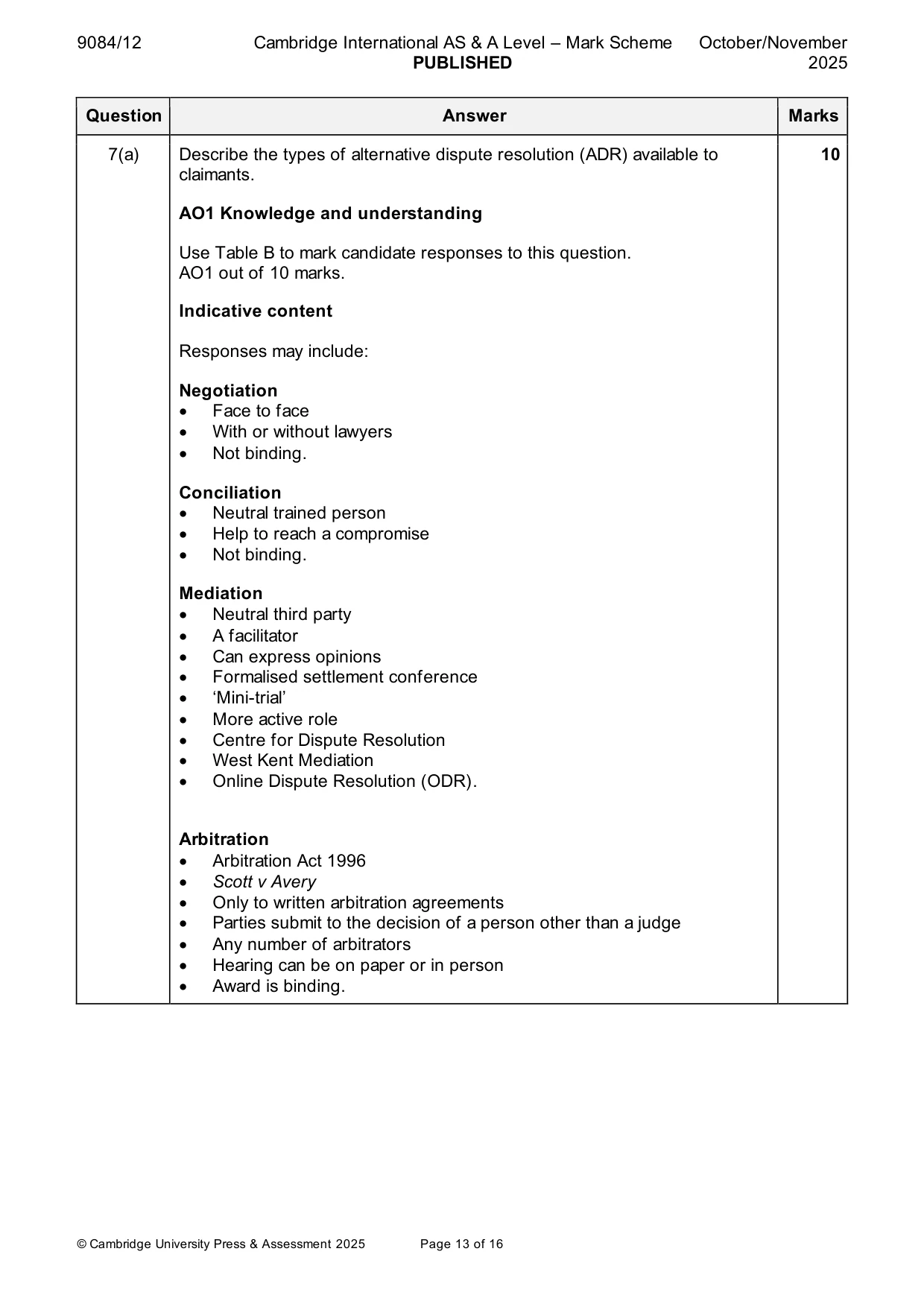
9084/12 Cambridge International AS & A Level – Mark Scheme PUBLISHED October/November 2025 © Cambridge University Press & Assessment 2025 Page 13 of 16 Question Answer Marks 7(a) Describe the types of alternative dispute resolution (ADR) available to claimants. AO1 Knowledge and understanding Use Table B to mark candidate responses to this question. AO1 out of 10 marks. Indicative content Responses may include: Negotiation • Face to face • With or without lawyers • Not binding. Conciliation • Neutral trained person • Help to reach a compromise • Not binding. Mediation • Neutral third party • A facilitator • Can express opinions • Formalised settlement conference • ‘Mini-trial’ • More active role • Centre for Dispute Resolution • West Kent Mediation • Online Dispute Resolution (ODR). Arbitration • Arbitration Act 1996 • Scott v Avery • Only to written arbitration agreements • Parties submit to the decision of a person other than a judge • Any number of arbitrators • Hearing can be on paper or in person • Award is binding. 10
Mark scheme, page 14
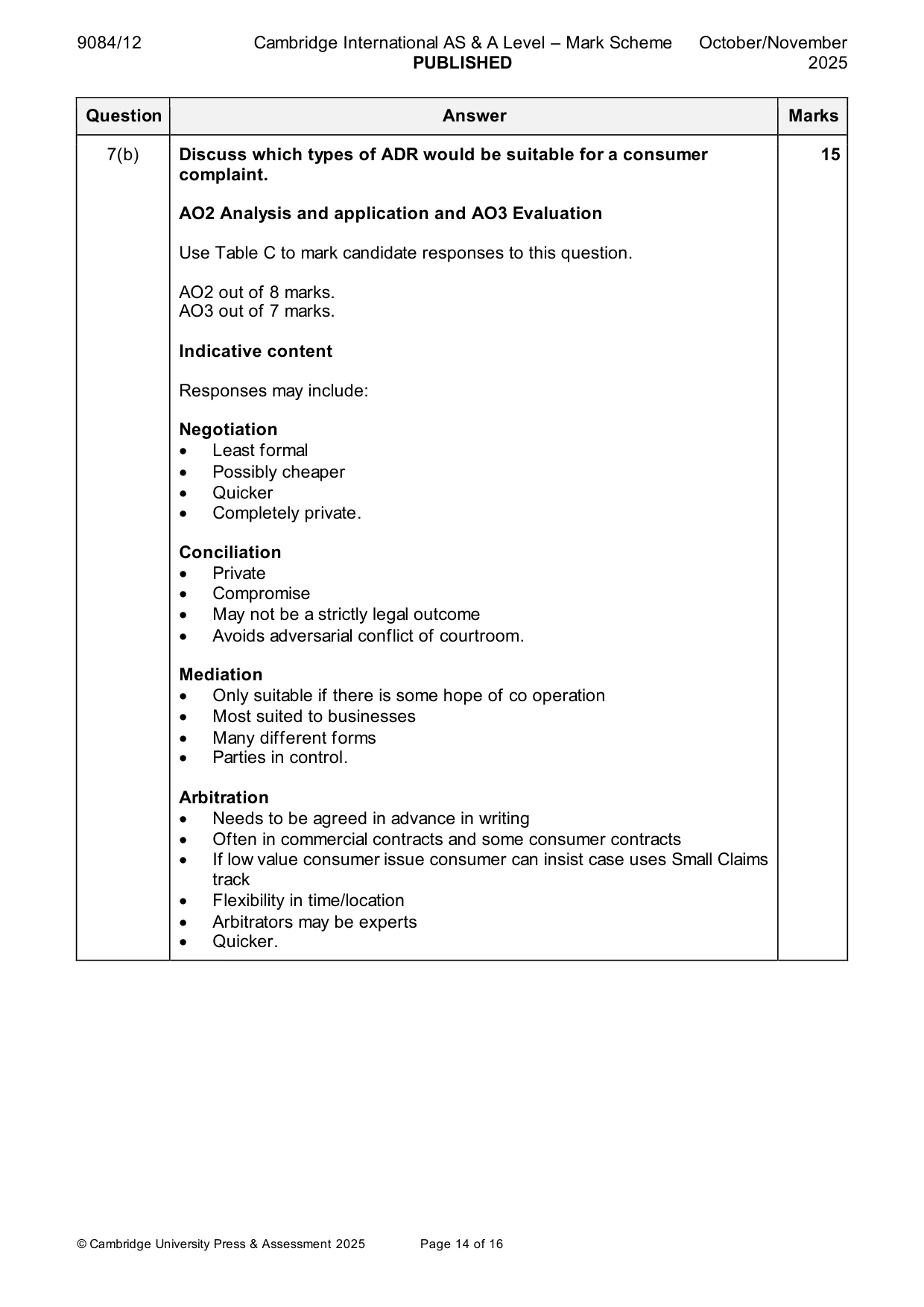
9084/12 Cambridge International AS & A Level – Mark Scheme PUBLISHED October/November 2025 © Cambridge University Press & Assessment 2025 Page 14 of 16 Question Answer Marks 7(b) Discuss which types of ADR would be suitable for a consumer complaint. AO2 Analysis and application and AO3 Evaluation Use Table C to mark candidate responses to this question. AO2 out of 8 marks. AO3 out of 7 marks. Indicative content Responses may include: Negotiation • Least formal • Possibly cheaper • Quicker • Completely private. Conciliation • Private • Compromise • May not be a strictly legal outcome • Avoids adversarial conflict of courtroom. Mediation • Only suitable if there is some hope of co operation • Most suited to businesses • Many different forms • Parties in control. Arbitration • Needs to be agreed in advance in writing • Often in commercial contracts and some consumer contracts • If low value consumer issue consumer can insist case uses Small Claims track • Flexibility in time/location • Arbitrators may be experts • Quicker. 15
Mark scheme, page 15
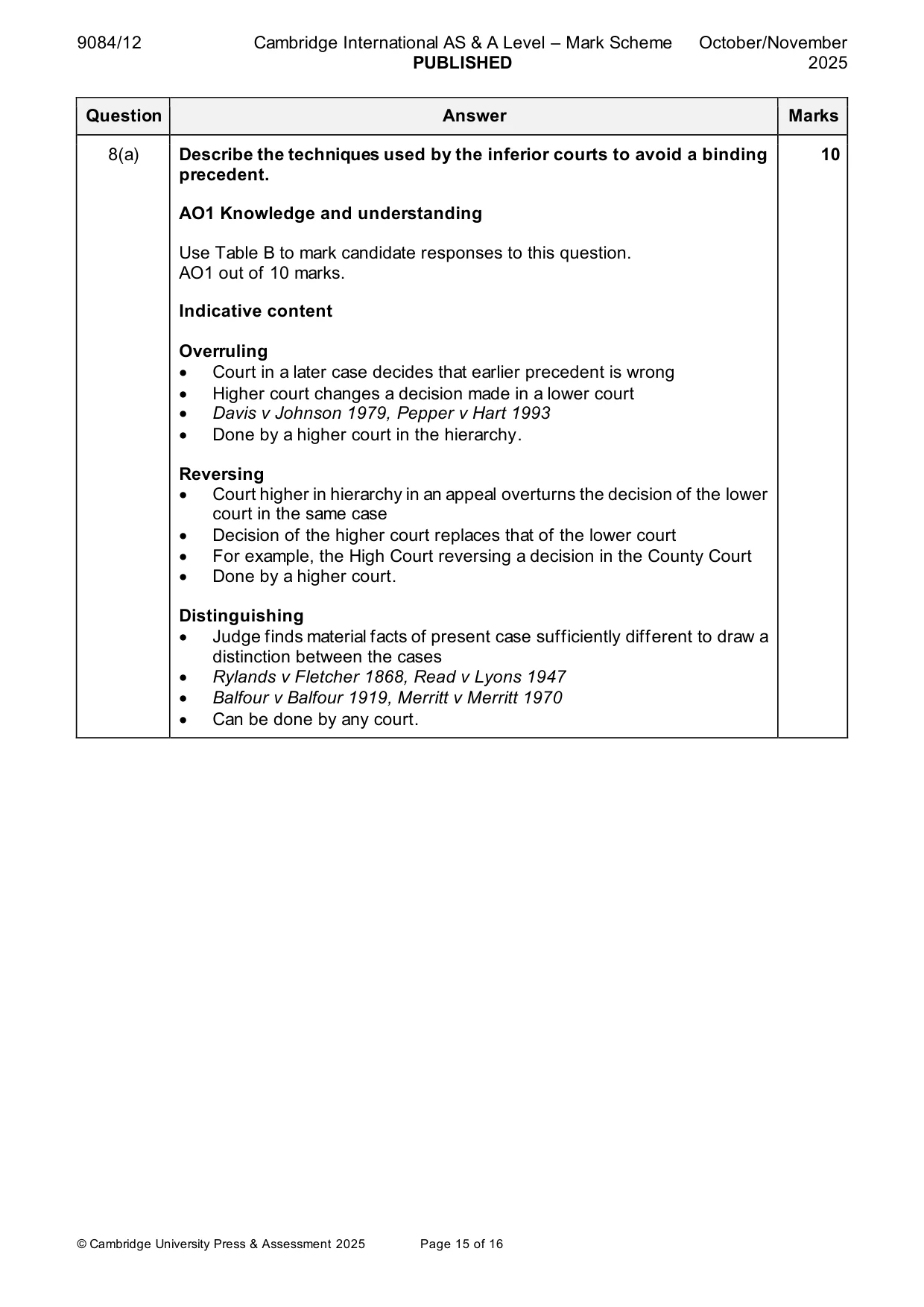
9084/12 Cambridge International AS & A Level – Mark Scheme PUBLISHED October/November 2025 © Cambridge University Press & Assessment 2025 Page 15 of 16 Question Answer Marks 8(a) Describe the techniques used by the inferior courts to avoid a binding precedent. AO1 Knowledge and understanding Use Table B to mark candidate responses to this question. AO1 out of 10 marks. Indicative content Overruling • Court in a later case decides that earlier precedent is wrong • Higher court changes a decision made in a lower court • Davis v Johnson 1979, Pepper v Hart 1993 • Done by a higher court in the hierarchy. Reversing • Court higher in hierarchy in an appeal overturns the decision of the lower court in the same case • Decision of the higher court replaces that of the lower court • For example, the High Court reversing a decision in the County Court • Done by a higher court. Distinguishing • Judge finds material facts of present case sufficiently different to draw a distinction between the cases • Rylands v Fletcher 1868, Read v Lyons 1947 • Balfour v Balfour 1919, Merritt v Merritt 1970 • Can be done by any court. 10
Mark scheme, page 16
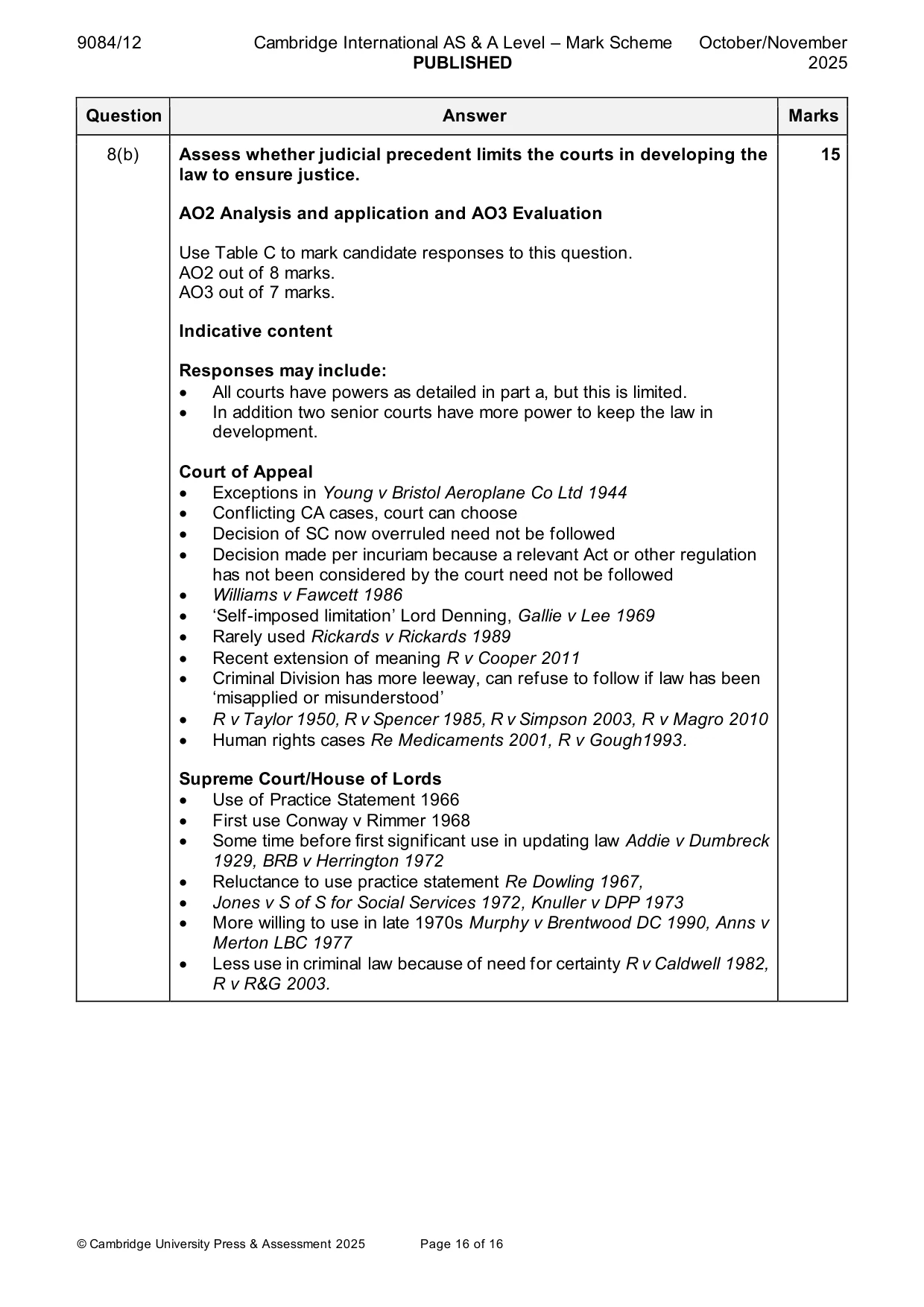
9084/12 Cambridge International AS & A Level – Mark Scheme PUBLISHED October/November 2025 © Cambridge University Press & Assessment 2025 Page 16 of 16 Question Answer Marks 8(b) Assess whether judicial precedent limits the courts in developing the law to ensure justice. AO2 Analysis and application and AO3 Evaluation Use Table C to mark candidate responses to this question. AO2 out of 8 marks. AO3 out of 7 marks. Indicative content Responses may include: • All courts have powers as detailed in part a, but this is limited. • In addition two senior courts have more power to keep the law in development. Court of Appeal • Exceptions in Young v Bristol Aeroplane Co Ltd 1944 • Conflicting CA cases, court can choose • Decision of SC now overruled need not be followed • Decision made per incuriam because a relevant Act or other regulation has not been considered by the court need not be followed • Williams v Fawcett 1986 • ‘Self-imposed limitation’ Lord Denning, Gallie v Lee 1969 • Rarely used Rickards v Rickards 1989 • Recent extension of meaning R v Cooper 2011 • Criminal Division has more leeway, can refuse to follow if law has been ‘misapplied or misunderstood’ • R v Taylor 1950, R v Spencer 1985, R v Simpson 2003, R v Magro 2010 • Human rights cases Re Medicaments 2001, R v Gough1993. Supreme Court/House of Lords • Use of Practice Statement 1966 • First use Conway v Rimmer 1968 • Some time before first significant use in updating law Addie v Dumbreck 1929, BRB v Herrington 1972 • Reluctance to use practice statement Re Dowling 1967, • Jones v S of S for Social Services 1972, Knuller v DPP 1973 • More willing to use in late 1970s Murphy v Brentwood DC 1990, Anns v Merton LBC 1977 • Less use in criminal law because of need for certainty R v Caldwell 1982, R v R&G 2003. 15
What you needed in this session
Cambridge’s own grade thresholds for 2025 Oct/Nov, Paper 1 · Variant 2. A higher threshold means an easier paper — the bar moves with how the cohort did.