Cambridge A Level Law 9084 — 2010 Oct/Nov Paper 2 · Variant 1
9084/21/O/N/10 · 50 marks · ≈56 min
The question paper and its mark scheme, free to read here and free to download. This is Cambridge’s own paper, exactly as it was sat.
Question paper4 pages


Mark scheme2 pages
Answers below. Sit the paper first if you are practising.
Paper as text
Question paper, page 1
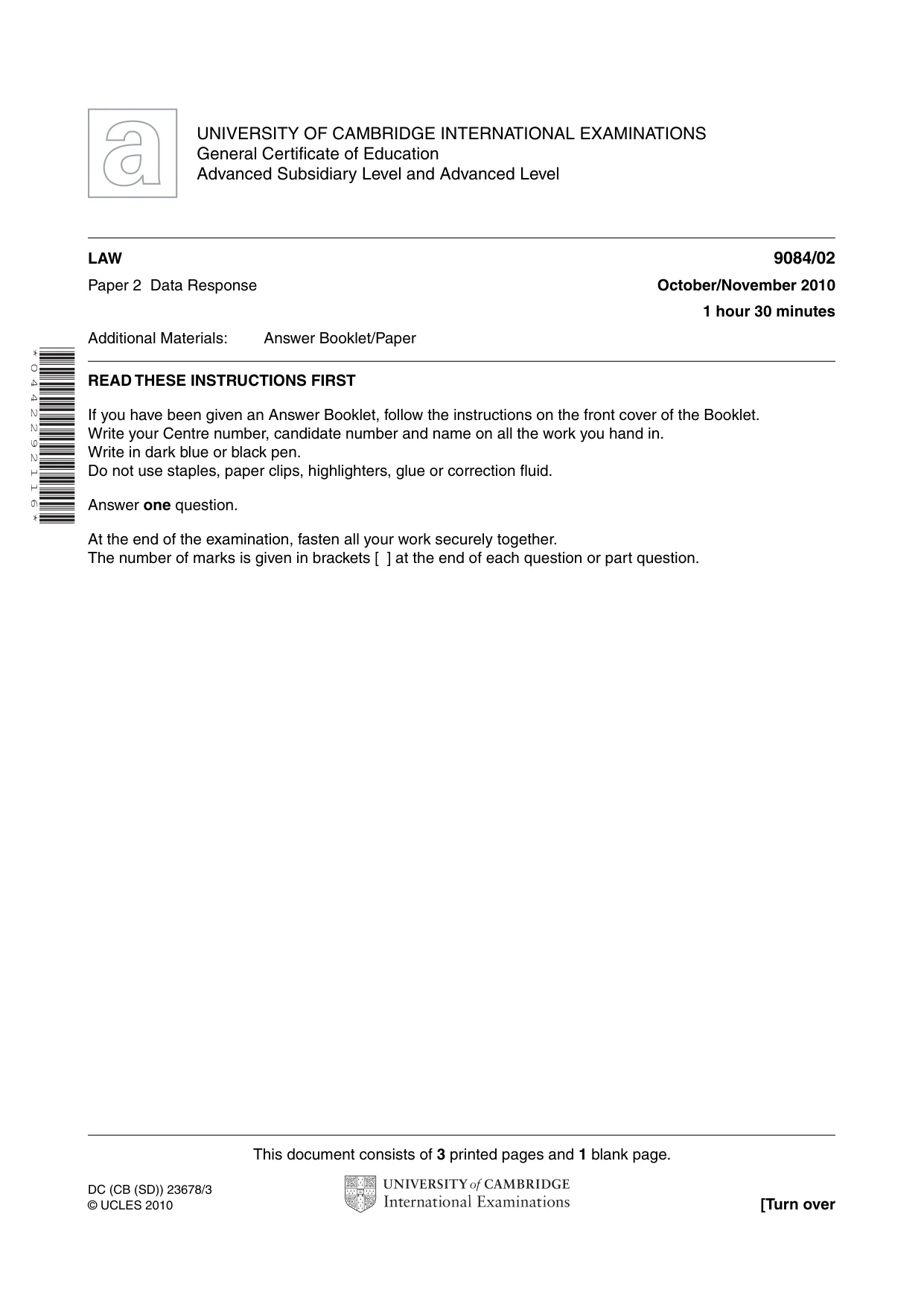
This document consists of 3 printed pages and 1 blank page. DC (CB (SD)) 23678/3 © UCLES 2010 [Turn over UNIVERSITY OF CAMBRIDGE INTERNATIONAL EXAMINATIONS General Certificate of Education Advanced Subsidiary Level and Advanced Level * 0 4 4 2 2 9 2 1 1 6 * LAW 9084/02 Paper 2 Data Response October/November 2010 1 hour 30 minutes Additional Materials: Answer Booklet/Paper READ THESE INSTRUCTIONS FIRST If you have been given an Answer Booklet, follow the instructions on the front cover of the Booklet. Write your Centre number, candidate number and name on all the work you hand in. Write in dark blue or black pen. Do not use staples, paper clips, highlighters, glue or correction fluid. Answer one question. At the end of the examination, fasten all your work securely together. The number of marks is given in brackets [ ] at the end of each question or part question.
Question paper, page 2
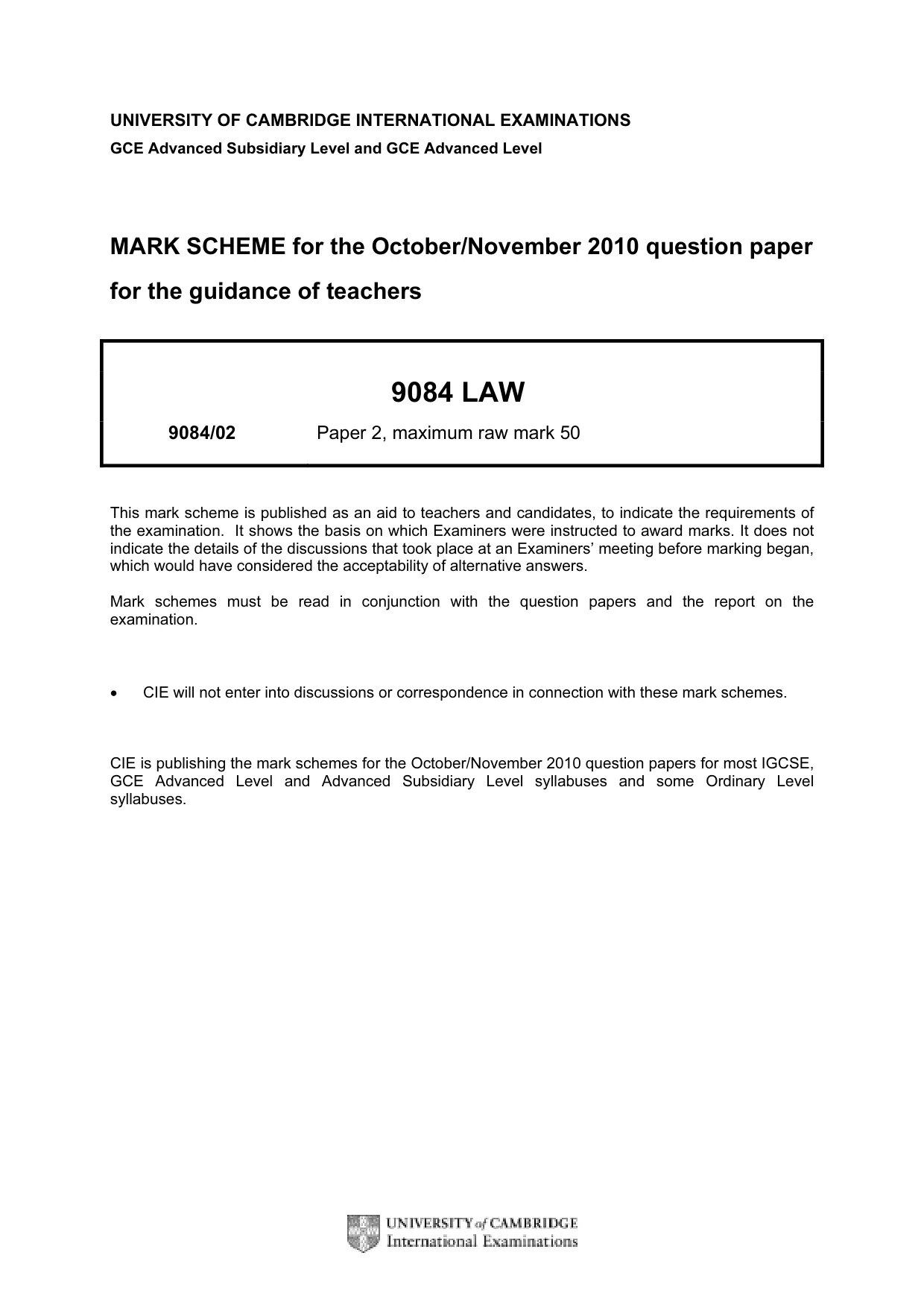
2 9084/02/O/N/10 © UCLES 2010 Answer either Question 1 or Question 2. You should make appropriate reference to the source material supplied for each question. 1 Gasper, Rasper and Jasper go down to the local bar. Later in the evening the police raid the bar looking for illegal drugs. They find Gasper sitting inside about to light a cigarette. Rasper is sitting on the terrace outside the bar smoking a cigarette. Jasper is sitting in the lounge bar with a lighted cigarette in his hand. All three are charged with the offence of smoking in a smoke-free place. The landlord has failed to put up any notices in the bar prohibiting smoking. (a) Consider whether each of the following has committed an offence under the Health Act 2006 and whether any of them has a defence: (i) Gasper (ii) Rasper (iii) Jasper. [20] (b) Which court would they be prosecuted in? What steps can each take to appeal against any conviction or sentence? [10] (c) Consider the value of the purposive rule in statutory interpretation and whether it has advantages over other rules of interpretation used by judges when applying legislation. [20] Source material Health Act 2006 c.28 s.1 (1) This Chapter makes provision for the prohibition of smoking in certain premises. (2) In this Chapter (b) smoking includes being in possession of lit tobacco or of anything lit which contains tobacco, or being in possession of any other lit substance … s.2 (1) Premises are smoke-free if they are open to the public. (4) In any case, premises are smoke-free only in those areas which are enclosed or substantially enclosed. s.7 (2) A person who smokes in a smoke-free place commits an offence. (4) It is a defence for a person charged with an offence under subsection 2 to show that he did not know, and could not reasonably have been expected to know, that it was a smoke-free place. (6) A person guilty of an offence under this section is liable on summary conviction to a fine.
Question paper, page 3
3 9084/02/O/N/10 © UCLES 2010 2 Toad is tried at Barchester Crown Court charged with dangerous driving. The jury is about to be empanelled. Juror A has a conviction for dangerous driving 12 years ago when he was sentenced to a fine, Juror B has a conviction for burglary 8 years ago when he received a community punishment order, Juror C is currently undergoing treatment under a drug treatment and testing order. (a) Consider the position of Juror A, Juror B and Juror C and decide whether the judge should allow each of them to sit on the jury for Toad’s trial. [20] (b) During the trial two jurors inform the Jury Bailiff that they have been approached outside the court and offered bribes to find the defendant not guilty. The Judge speaks to the jury and the two jurors inform him that they have told all the other members of the jury what has happened. The judge wants to discharge the jury. What courses are now open to him and what steps should he take? [10] (c) What are the merits of continuing to use juries in criminal cases? [20] Source material Juries Act 1974 Schedule 1 Part 2 Persons disqualified from Jury Service s.7 A person who has at any time in the last ten years in the United Kingdom: i. served any part of a sentence of imprisonment or ii. had passed on him a suspended sentence of imprisonment or iii. in England and Wales had made in respect of him a community order or rehabilitation order or drug treatment and testing order is disqualified from serving on a jury. Criminal Justice Act 2003 c. 44 s.46 Discharge of jury because of jury tampering (1) This section applies where – (a) a judge is minded during a trial on indictment to discharge the jury, and (b) he is so minded because jury tampering appears to have taken place. (2) Before taking any steps to discharge the jury, the judge must – (a) inform the parties that he is minded to discharge the jury, (b) inform the parties of the grounds on which he is so minded, and (c) allow the parties an opportunity to make representations. (3) Where the judge, after considering such representations, discharges the jury, he may make an order that the trial is to continue without a jury if, but only if, he is satisfied – (a) that jury tampering has taken place, and (b) that to continue the trial without a jury would be fair to the defendants.
Question paper, page 4
4 9084/02/O/N/10 © UCLES 2010 Permission to reproduce items where third-party owned material protected by copyright is included has been sought and cleared where possible. Every reasonable effort has been made by the publisher (UCLES) to trace copyright holders, but if any items requiring clearance have unwittingly been included, the publisher will be pleased to make amends at the earliest possible opportunity. University of Cambridge International Examinations is part of the Cambridge Assessment Group. Cambridge Assessment is the brand name of University of Cambridge Local Examinations Syndicate (UCLES), which is itself a department of the University of Cambridge. BLANK PAGE
Mark scheme, page 1
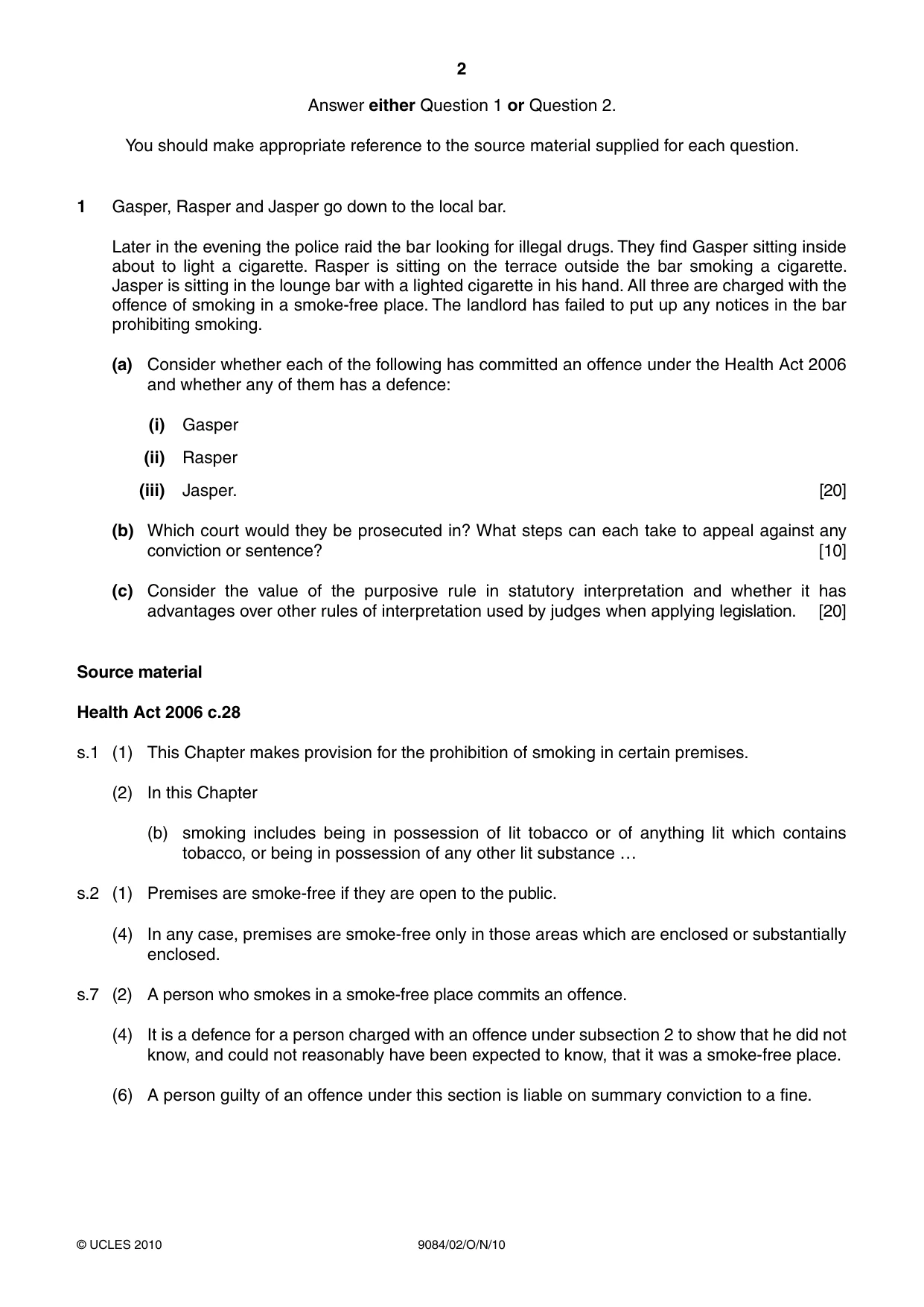
UNIVERSITY OF CAMBRIDGE INTERNATIONAL EXAMINATIONS GCE Advanced Subsidiary Level and GCE Advanced Level MARK SCHEME for the October/November 2010 question paper for the guidance of teachers 9084 LAW 9084/02 Paper 2, maximum raw mark 50 This mark scheme is published as an aid to teachers and candidates, to indicate the requirements of the examination. It shows the basis on which Examiners were instructed to award marks. It does not indicate the details of the discussions that took place at an Examiners’ meeting before marking began, which would have considered the acceptability of alternative answers. Mark schemes must be read in conjunction with the question papers and the report on the examination. • CIE will not enter into discussions or correspondence in connection with these mark schemes. CIE is publishing the mark schemes for the October/November 2010 question papers for most IGCSE, GCE Advanced Level and Advanced Subsidiary Level syllabuses and some Ordinary Level syllabuses.
Mark scheme, page 2
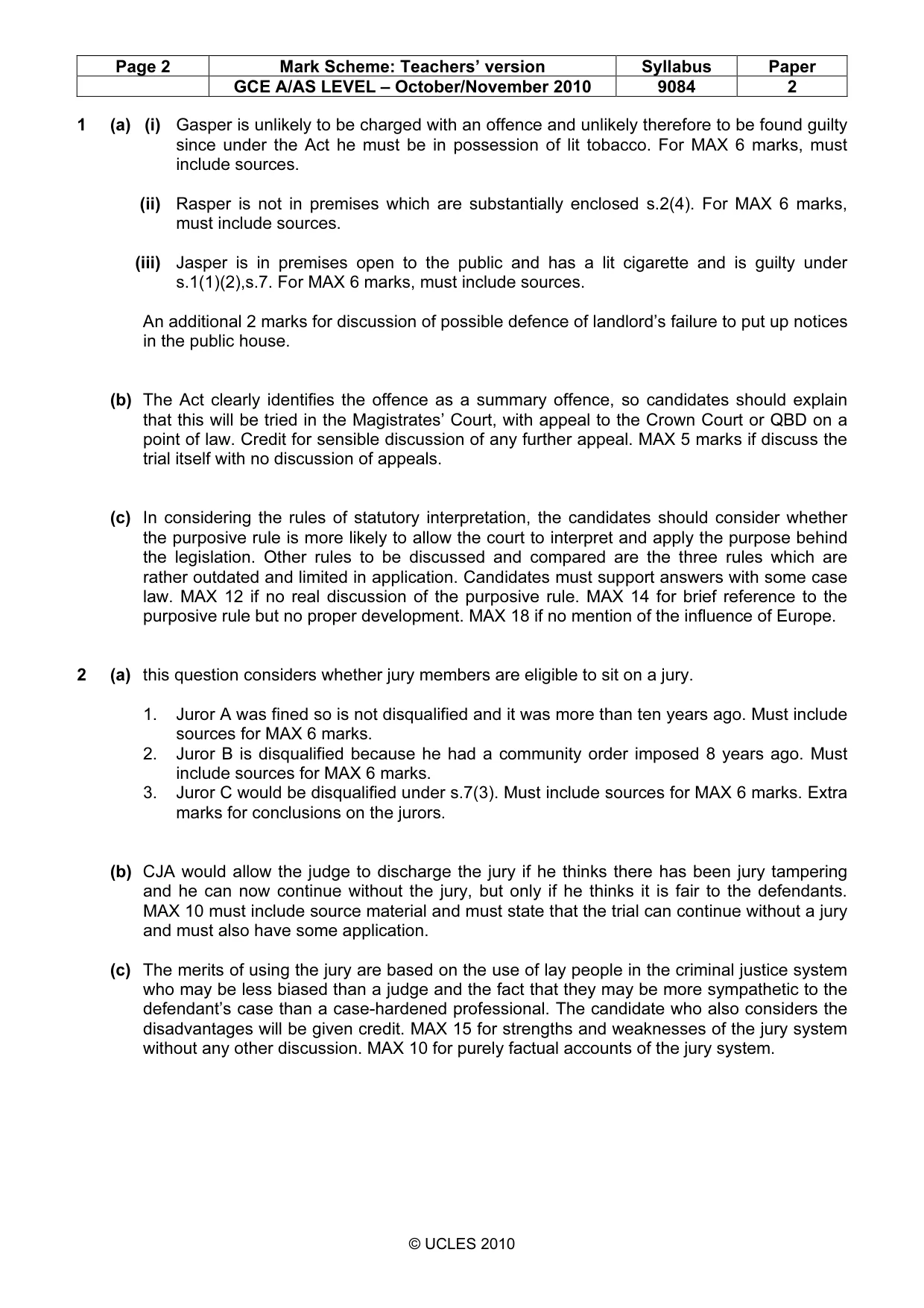
Page 2 Mark Scheme: Teachers’ version Syllabus Paper GCE A/AS LEVEL – October/November 2010 9084 2 © UCLES 2010 1 (a) (i) Gasper is unlikely to be charged with an offence and unlikely therefore to be found guilty since under the Act he must be in possession of lit tobacco. For MAX 6 marks, must include sources. (ii) Rasper is not in premises which are substantially enclosed s.2(4). For MAX 6 marks, must include sources. (iii) Jasper is in premises open to the public and has a lit cigarette and is guilty under s.1(1)(2),s.7. For MAX 6 marks, must include sources. An additional 2 marks for discussion of possible defence of landlord’s failure to put up notices in the public house. (b) The Act clearly identifies the offence as a summary offence, so candidates should explain that this will be tried in the Magistrates’ Court, with appeal to the Crown Court or QBD on a point of law. Credit for sensible discussion of any further appeal. MAX 5 marks if discuss the trial itself with no discussion of appeals. (c) In considering the rules of statutory interpretation, the candidates should consider whether the purposive rule is more likely to allow the court to interpret and apply the purpose behind the legislation. Other rules to be discussed and compared are the three rules which are rather outdated and limited in application. Candidates must support answers with some case law. MAX 12 if no real discussion of the purposive rule. MAX 14 for brief reference to the purposive rule but no proper development. MAX 18 if no mention of the influence of Europe. 2 (a) this question considers whether jury members are eligible to sit on a jury. 1. Juror A was fined so is not disqualified and it was more than ten years ago. Must include sources for MAX 6 marks. 2. Juror B is disqualified because he had a community order imposed 8 years ago. Must include sources for MAX 6 marks. 3. Juror C would be disqualified under s.7(3). Must include sources for MAX 6 marks. Extra marks for conclusions on the jurors. (b) CJA would allow the judge to discharge the jury if he thinks there has been jury tampering and he can now continue without the jury, but only if he thinks it is fair to the defendants. MAX 10 must include source material and must state that the trial can continue without a jury and must also have some application. (c) The merits of using the jury are based on the use of lay people in the criminal justice system who may be less biased than a judge and the fact that they may be more sympathetic to the defendant’s case than a case-hardened professional. The candidate who also considers the disadvantages will be given credit. MAX 15 for strengths and weaknesses of the jury system without any other discussion. MAX 10 for purely factual accounts of the jury system.
What you needed in this session
Cambridge’s own grade thresholds for 2010 Oct/Nov, Paper 2 · Variant 1. A higher threshold means an easier paper — the bar moves with how the cohort did.