Cambridge A Level Information Technology (from 2017) 9626 — 2023 Oct/Nov Paper 1 · Variant 3
9626/13/O/N/23 · 70 marks · ≈79 min
The question paper and its mark scheme, free to read here and free to download. This is Cambridge’s own paper, exactly as it was sat.
Question paper12 pages
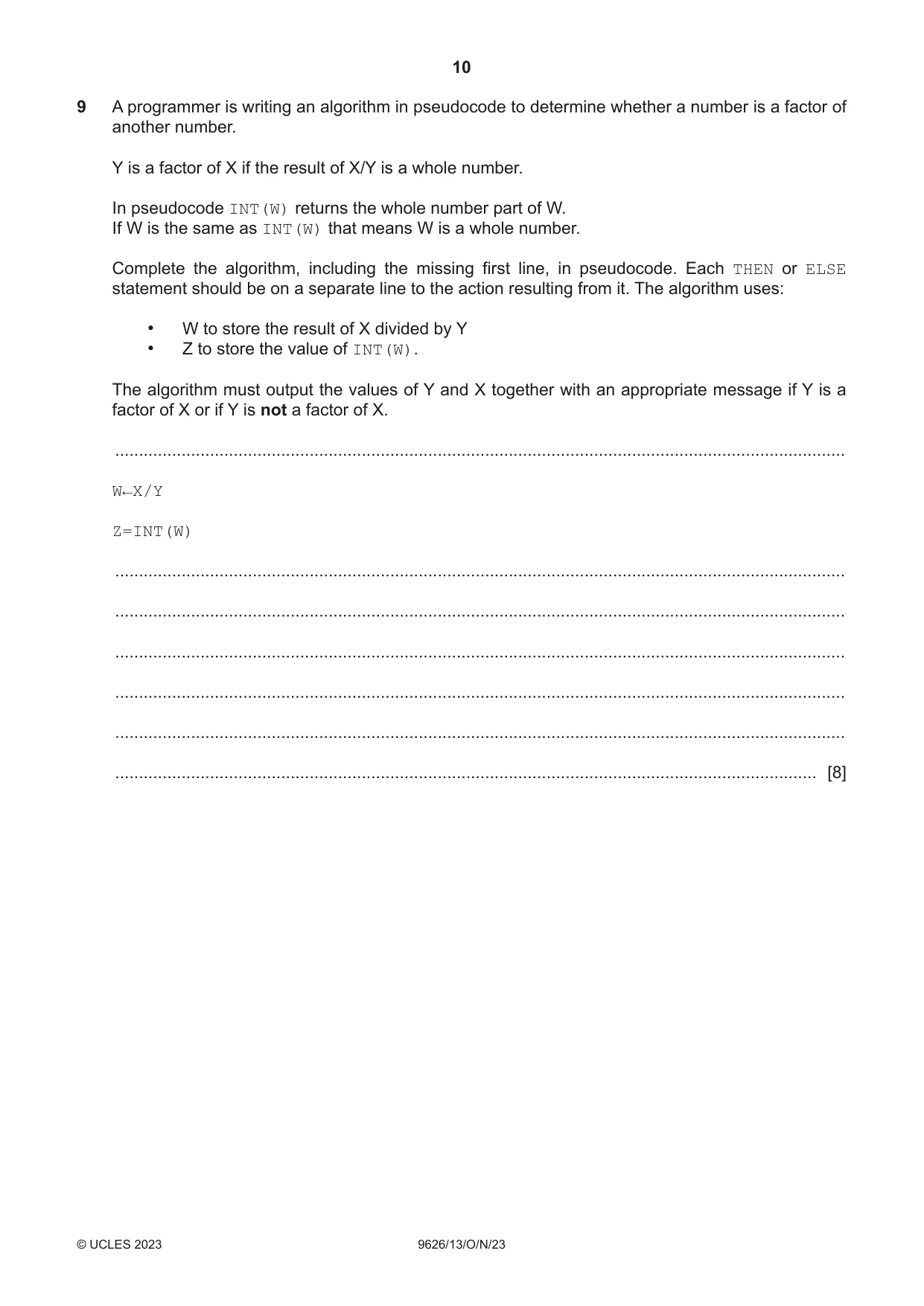

Mark scheme9 pages
Answers below. Sit the paper first if you are practising.
Paper as text
Question paper, page 1
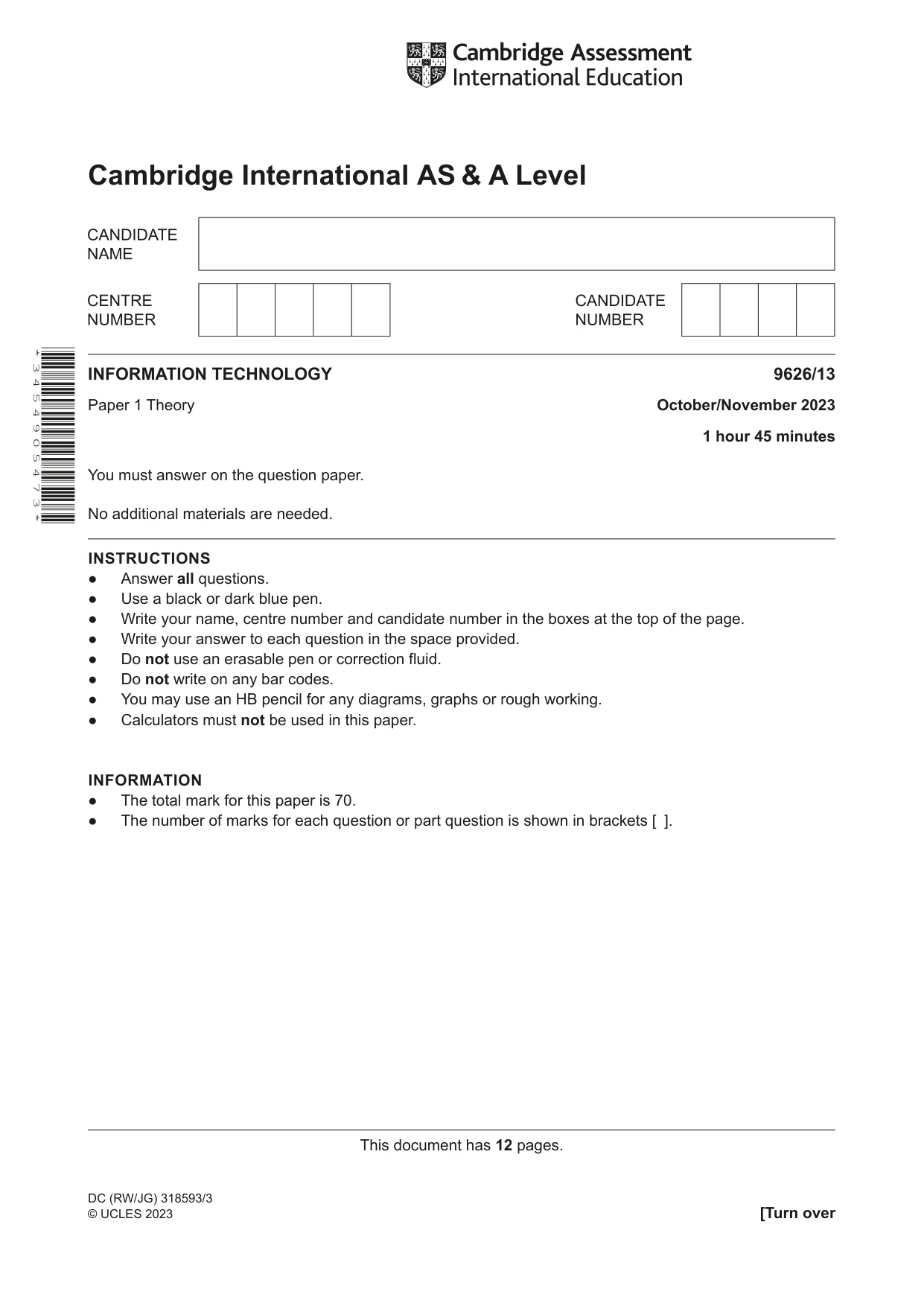
This document has 12 pages. [Turn over Cambridge International AS & A Level INFORMATION TECHNOLOGY 9626/13 Paper 1 Theory October/November 2023 1 hour 45 minutes You must answer on the question paper. No additional materials are needed. INSTRUCTIONS ● Answer all questions. ● Use a black or dark blue pen. ● Write your name, centre number and candidate number in the boxes at the top of the page. ● Write your answer to each question in the space provided. ● Do not use an erasable pen or correction fluid. ● Do not write on any bar codes. ● You may use an HB pencil for any diagrams, graphs or rough working. ● Calculators must not be used in this paper. INFORMATION ● The total mark for this paper is 70. ● The number of marks for each question or part question is shown in brackets [ ]. DC (RW/JG) 318593/3 © UCLES 2023 * 3 4 5 4 9 0 5 4 7 3 *
Question paper, page 2
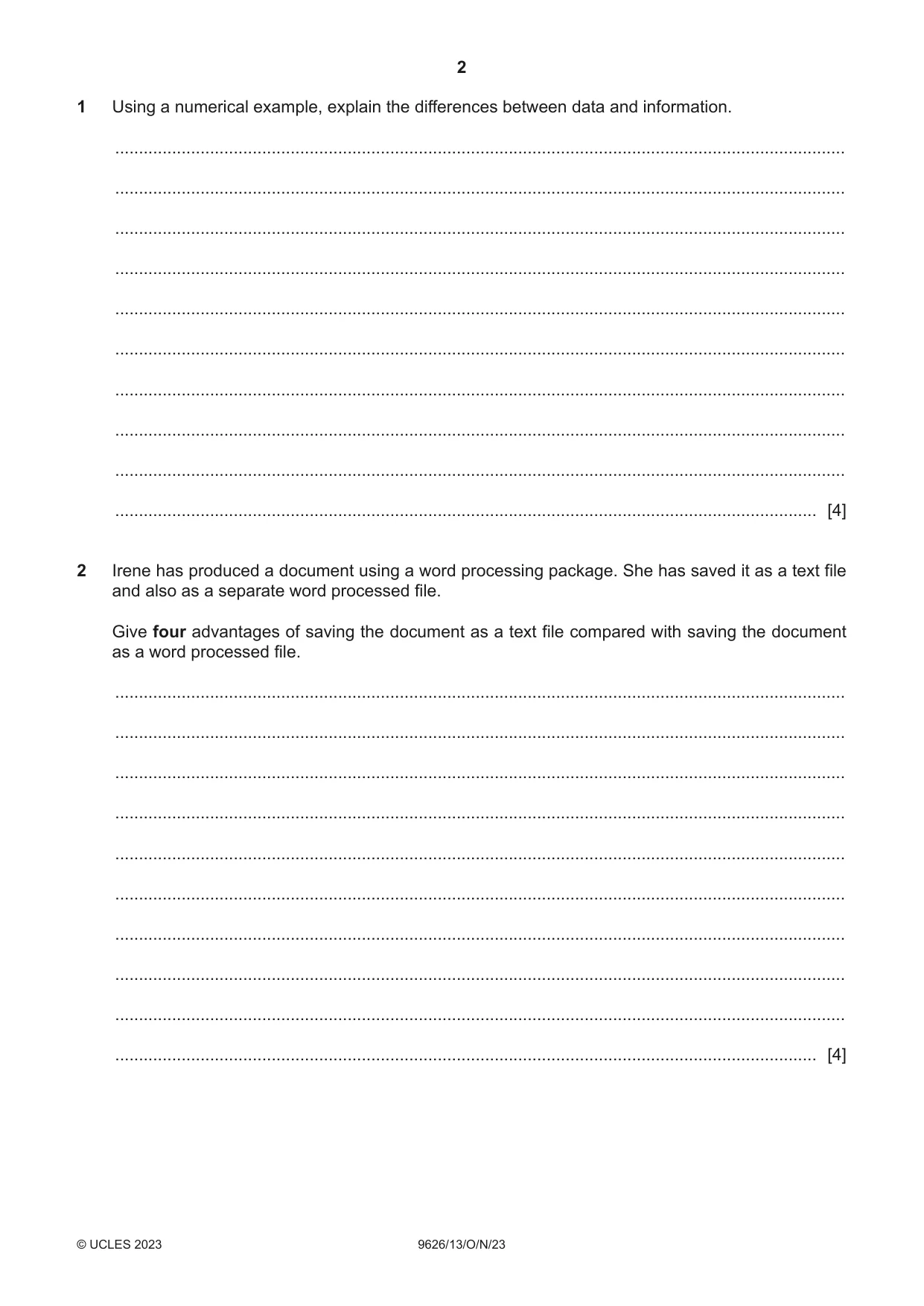
2 9626/13/O/N/23 © UCLES 2023 1 Using a numerical example, explain the differences between data and information. … … … … … … … … … … [4] 2 Irene has produced a document using a word processing package. She has saved it as a text file and also as a separate word processed file. Give four advantages of saving the document as a text file compared with saving the document as a word processed file. … … … … … … … … … … [4]
Question paper, page 3
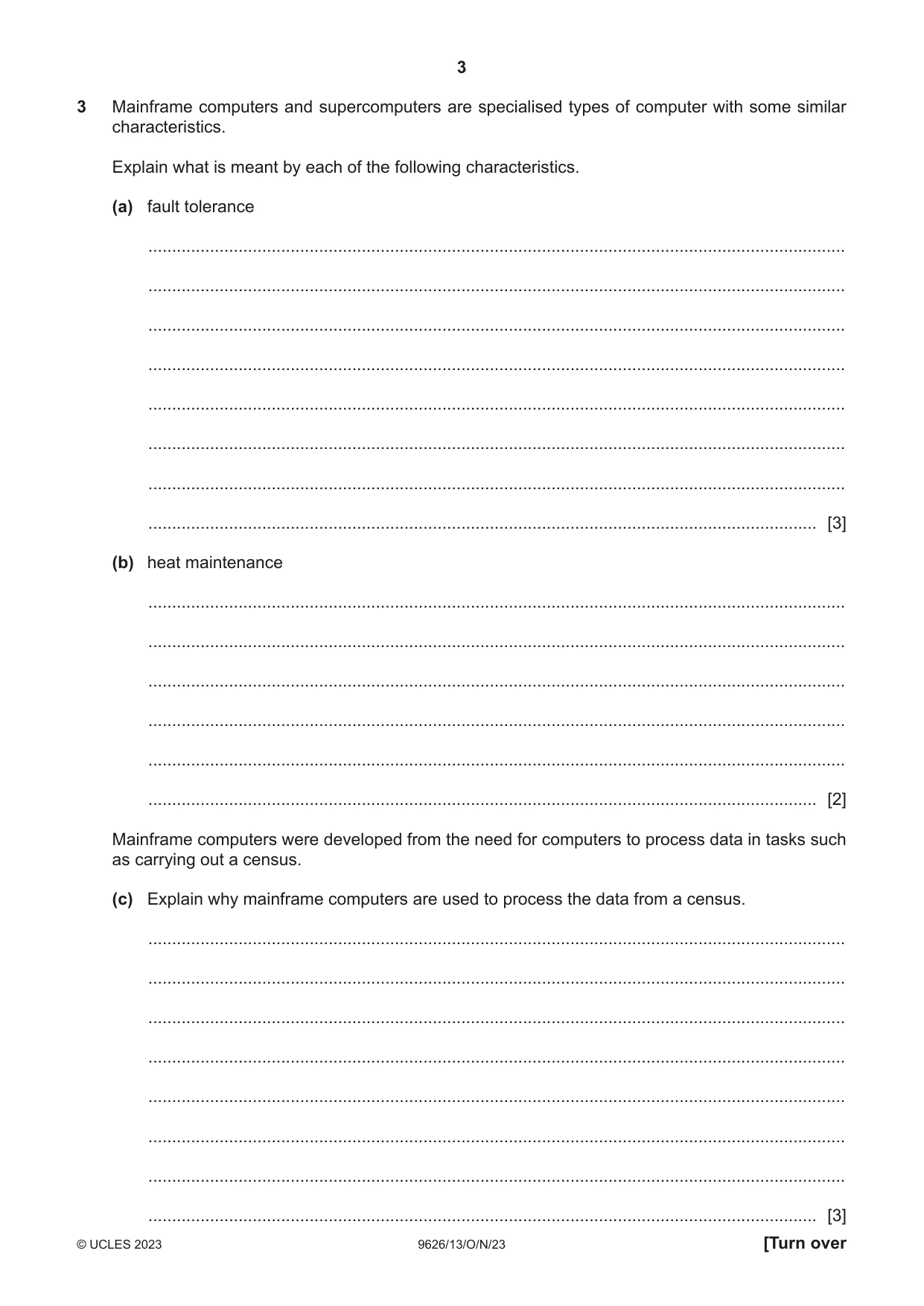
3 9626/13/O/N/23 © UCLES 2023 [Turn over 3 Mainframe computers and supercomputers are specialised types of computer with some similar characteristics. Explain what is meant by each of the following characteristics. (a) fault tolerance … … … … … … … … [3] (b) heat maintenance … … … … … … [2] Mainframe computers were developed from the need for computers to process data in tasks such as carrying out a census. (c) Explain why mainframe computers are used to process the data from a census. … … … … … … … … [3]
Question paper, page 4
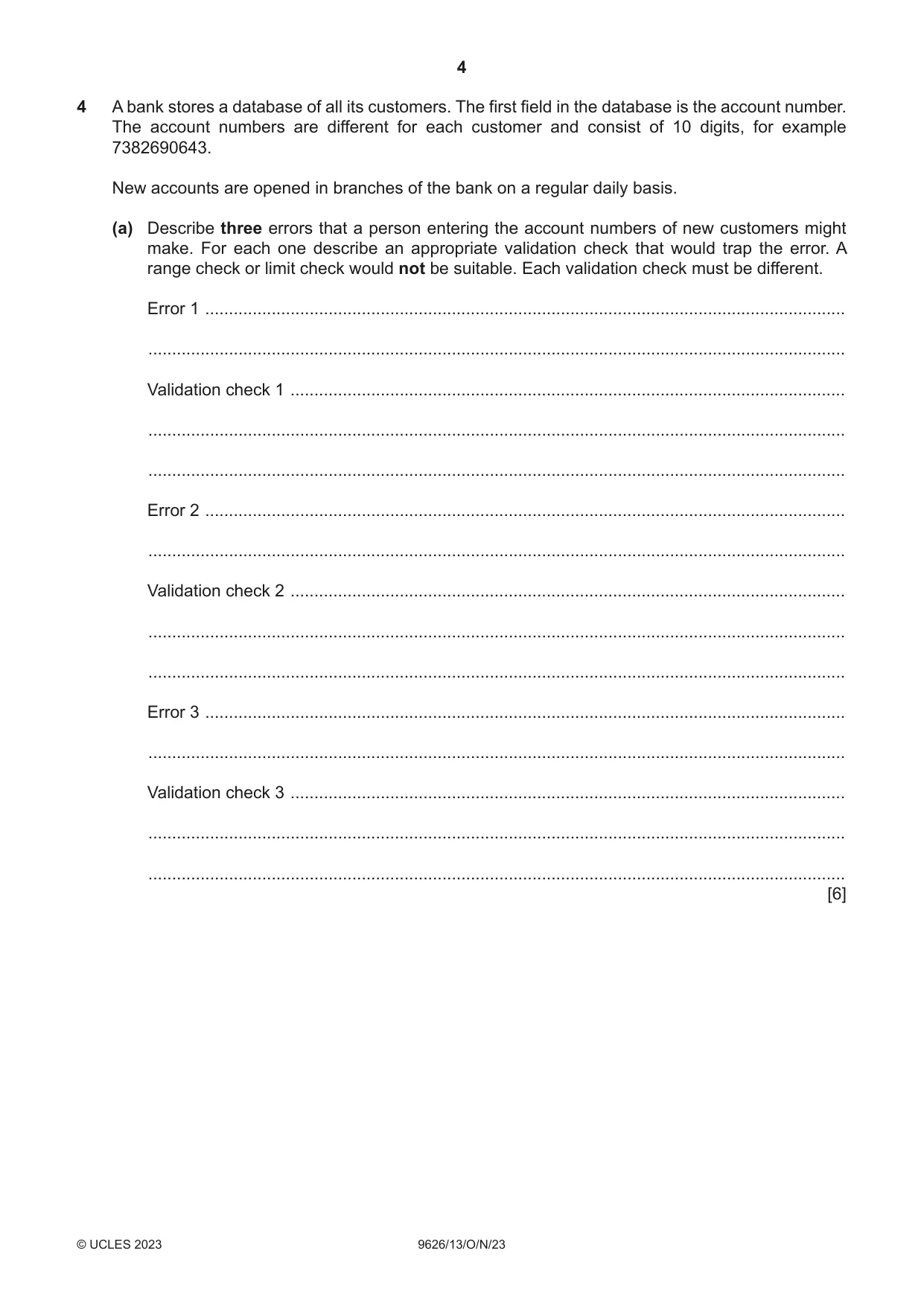
4 9626/13/O/N/23 © UCLES 2023 4 A bank stores a database of all its customers. The first field in the database is the account number. The account numbers are different for each customer and consist of 10 digits, for example 7382690643. New accounts are opened in branches of the bank on a regular daily basis. (a) Describe three errors that a person entering the account numbers of new customers might make. For each one describe an appropriate validation check that would trap the error. A range check or limit check would not be suitable. Each validation check must be different. Error 1 … … Validation check 1 … … … Error 2 … … Validation check 2 … … … Error 3 … … Validation check 3 … … … [6]
Question paper, page 5
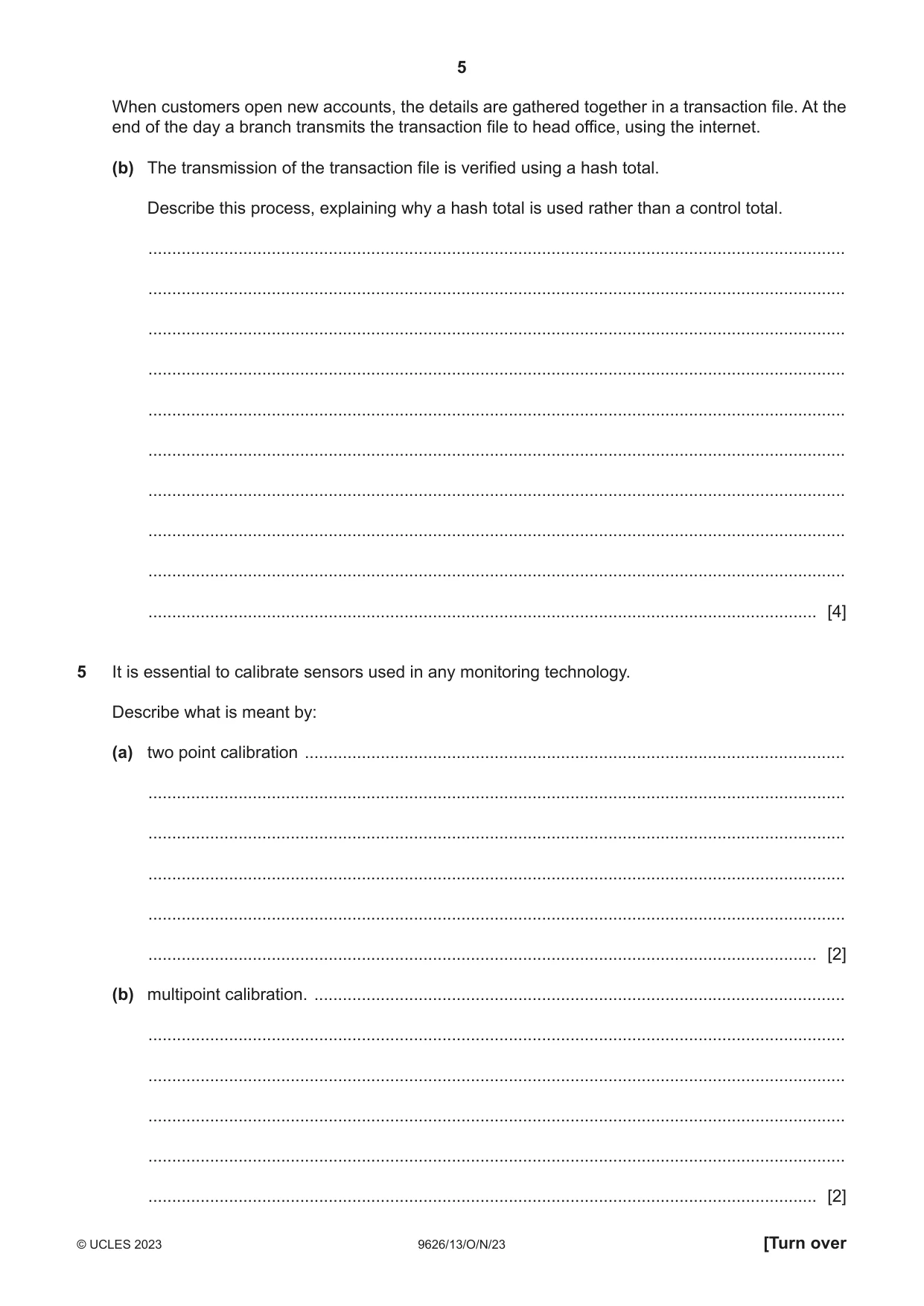
5 9626/13/O/N/23 © UCLES 2023 [Turn over When customers open new accounts, the details are gathered together in a transaction file. At the end of the day a branch transmits the transaction file to head office, using the internet. (b) The transmission of the transaction file is verified using a hash total. Describe this process, explaining why a hash total is used rather than a control total. … … … … … … … … … … [4] 5 It is essential to calibrate sensors used in any monitoring technology. Describe what is meant by: (a) two point calibration … … … … … … [2] (b) multipoint calibration. … … … … … … [2]
Question paper, page 6
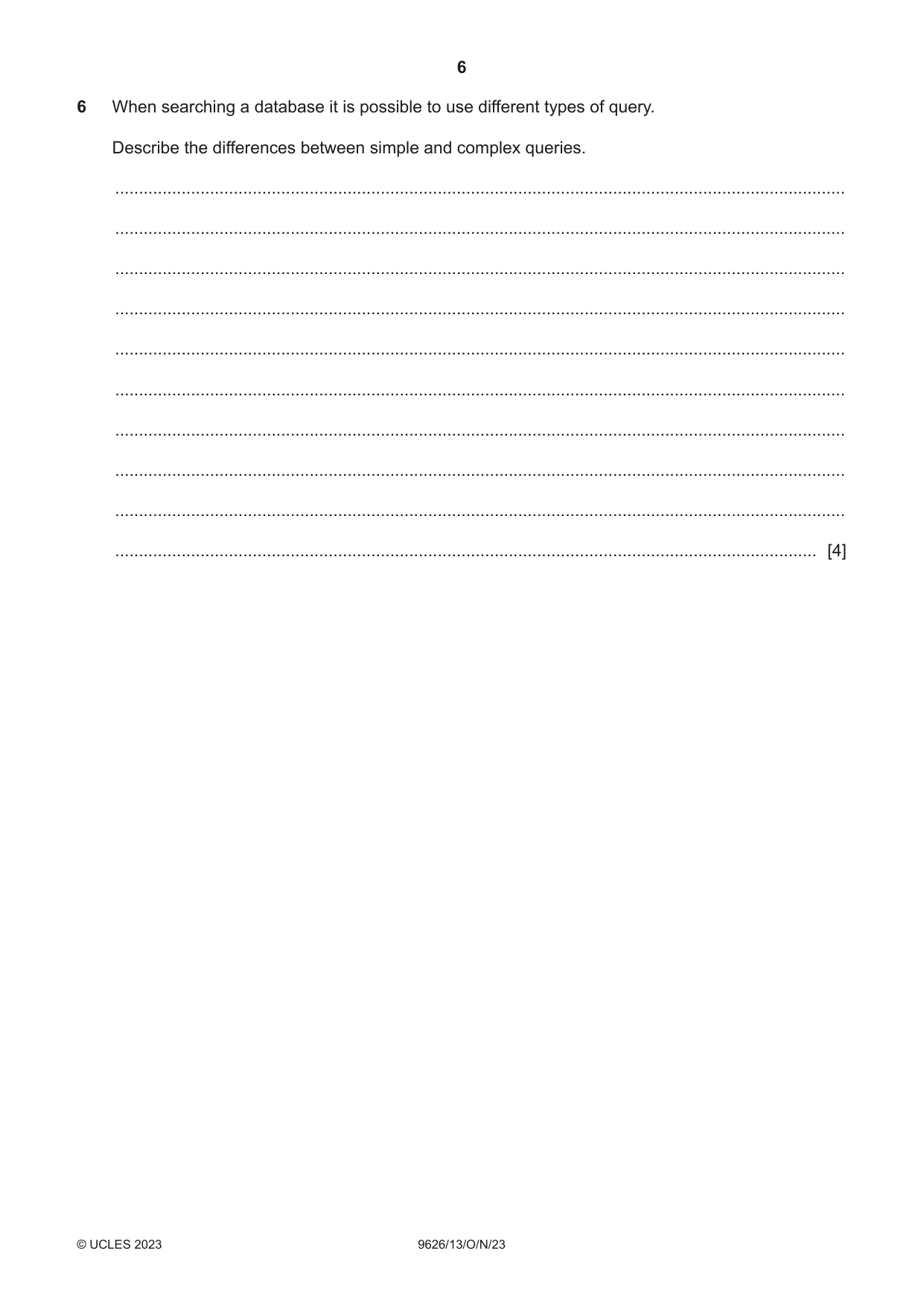
6 9626/13/O/N/23 © UCLES 2023 6 When searching a database it is possible to use different types of query. Describe the differences between simple and complex queries. … … … … … … … … … … [4]
Question paper, page 7
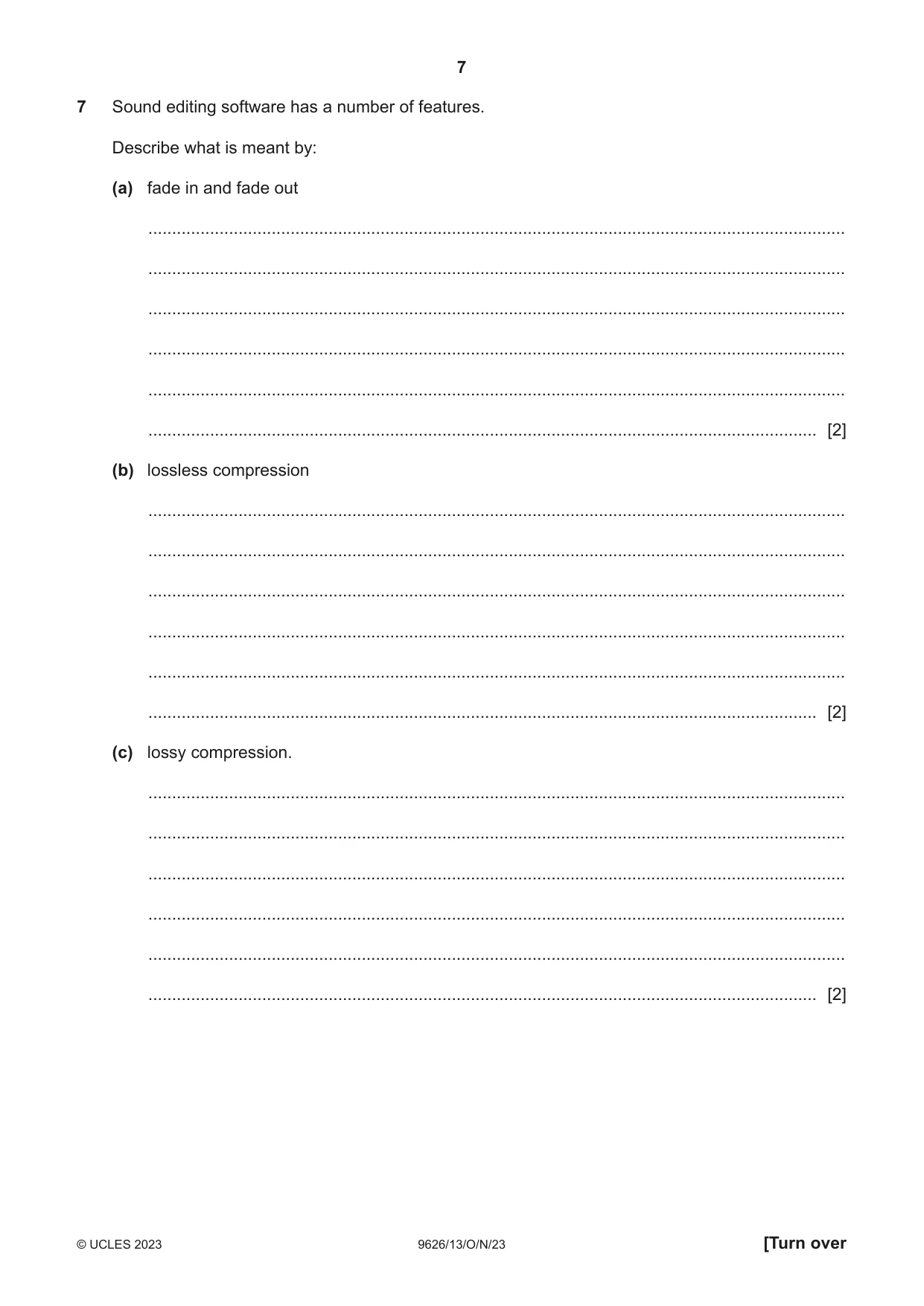
7 9626/13/O/N/23 © UCLES 2023 [Turn over 7 Sound editing software has a number of features. Describe what is meant by: (a) fade in and fade out … … … … … … [2] (b) lossless compression … … … … … … [2] (c) lossy compression. … … … … … … [2]
Question paper, page 8
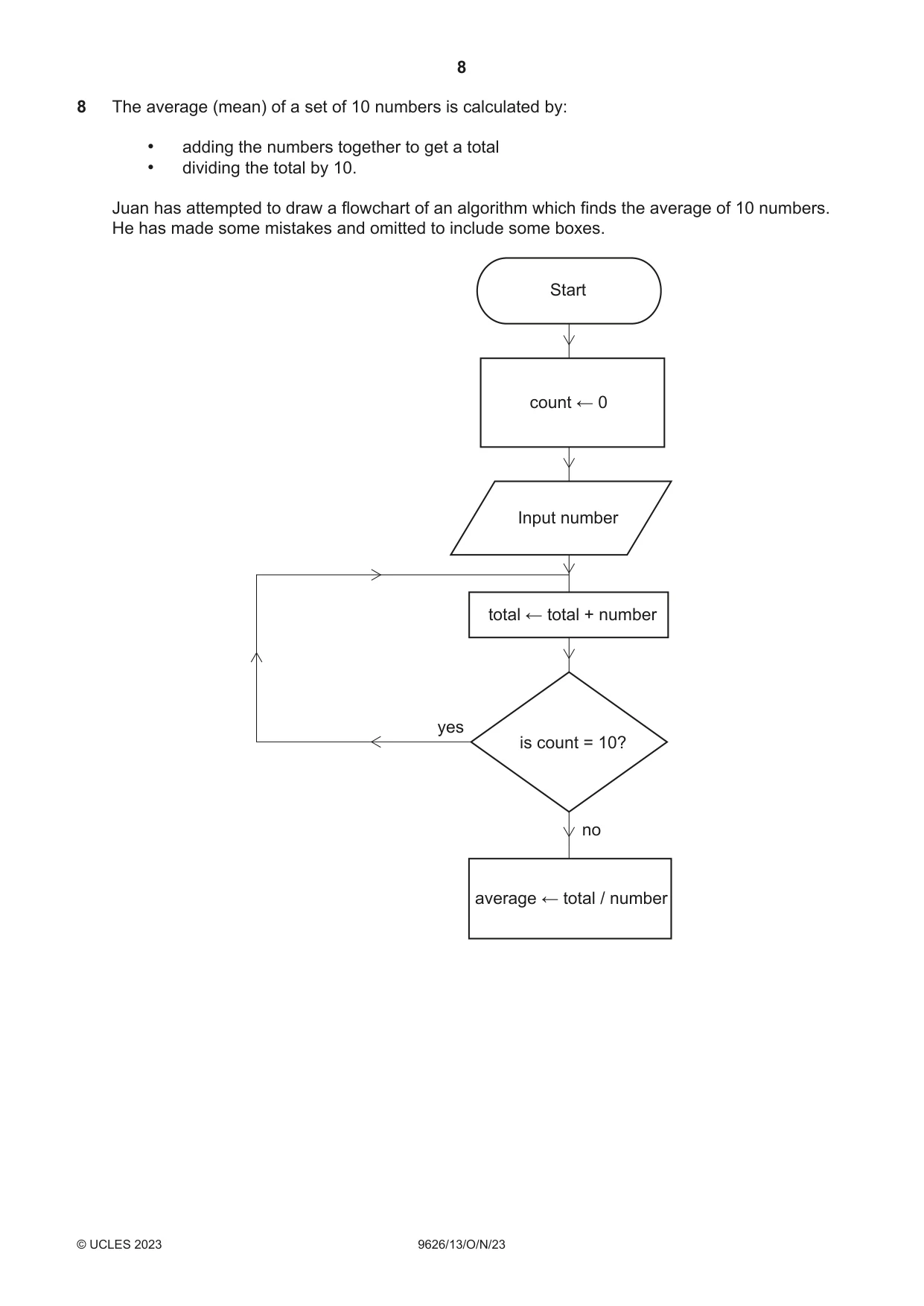
8 9626/13/O/N/23 © UCLES 2023 8 The average (mean) of a set of 10 numbers is calculated by: • adding the numbers together to get a total • dividing the total by 10. Juan has attempted to draw a flowchart of an algorithm which finds the average of 10 numbers. He has made some mistakes and omitted to include some boxes. Start count ← 0 total ← total + number average ← total / number Input number is count = 10? yes no
Question paper, page 9
9 9626/13/O/N/23 © UCLES 2023 [Turn over Suggest six improvements he should make to his flowchart. 1 … … 2 … … 3 … … 4 … … 5 … … 6 … … [6]
Question paper, page 10
10 9626/13/O/N/23 © UCLES 2023 9 A programmer is writing an algorithm in pseudocode to determine whether a number is a factor of another number. Y is a factor of X if the result of X/Y is a whole number. In pseudocode INT(W) returns the whole number part of W. If W is the same as INT(W) that means W is a whole number. Complete the algorithm, including the missing first line, in pseudocode. Each THEN or ELSE statement should be on a separate line to the action resulting from it. The algorithm uses: • W to store the result of X divided by Y • Z to store the value of INT(W). The algorithm must output the values of Y and X together with an appropriate message if Y is a factor of X or if Y is not a factor of X. … W←X/Y Z=INT(W) … … … … … … [8]
Question paper, page 11
11 9626/13/O/N/23 © UCLES 2023 [Turn over 10 The manager of the payroll department within a company has commissioned a computer programmer to write software to run the payroll. Justify this decision to use custom written software. … … … … … … … … … … … … … … … … … … … … [8] Please turn over for Question 11.
Question paper, page 12
12 9626/13/O/N/23 © UCLES 2023 11 Weather forecasting makes use of computer models. Analyse the effectiveness of computer models for producing weather forecasts. … … … … … … … … … … … … … … … … … … … … [8] Permission to reproduce items where third-party owned material protected by copyright is included has been sought and cleared where possible. Every reasonable effort has been made by the publisher (UCLES) to trace copyright holders, but if any items requiring clearance have unwittingly been included, the publisher will be pleased to make amends at the earliest possible opportunity. To avoid the issue of disclosure of answer-related information to candidates, all copyright acknowledgements are reproduced online in the Cambridge Assessment International Education Copyright Acknowledgements Booklet. This is produced for each series of examinations and is freely available to download at www.cambridgeinternational.org after the live examination series. Cambridge Assessment International Education is part of Cambridge Assessment. Cambridge Assessment is the brand name of the University of Cambridge Local Examinations Syndicate (UCLES), which is a department of the University of Cambridge.
Mark scheme, page 1
This document consists of 9 printed pages. © UCLES 2023 [Turn over Cambridge International AS & A Level INFORMATION TECHNOLOGY 9626/13 Paper 1 Theory October/November 2023 MARK SCHEME Maximum Mark: 70 Published This mark scheme is published as an aid to teachers and candidates, to indicate the requirements of the examination. It shows the basis on which Examiners were instructed to award marks. It does not indicate the details of the discussions that took place at an Examiners’ meeting before marking began, which would have considered the acceptability of alternative answers. Mark schemes should be read in conjunction with the question paper and the Principal Examiner Report for Teachers. Cambridge International will not enter into discussions about these mark schemes. Cambridge International is publishing the mark schemes for the October/November 2023 series for most Cambridge IGCSE, Cambridge International A and AS Level components, and some Cambridge O Level components.
Mark scheme, page 2
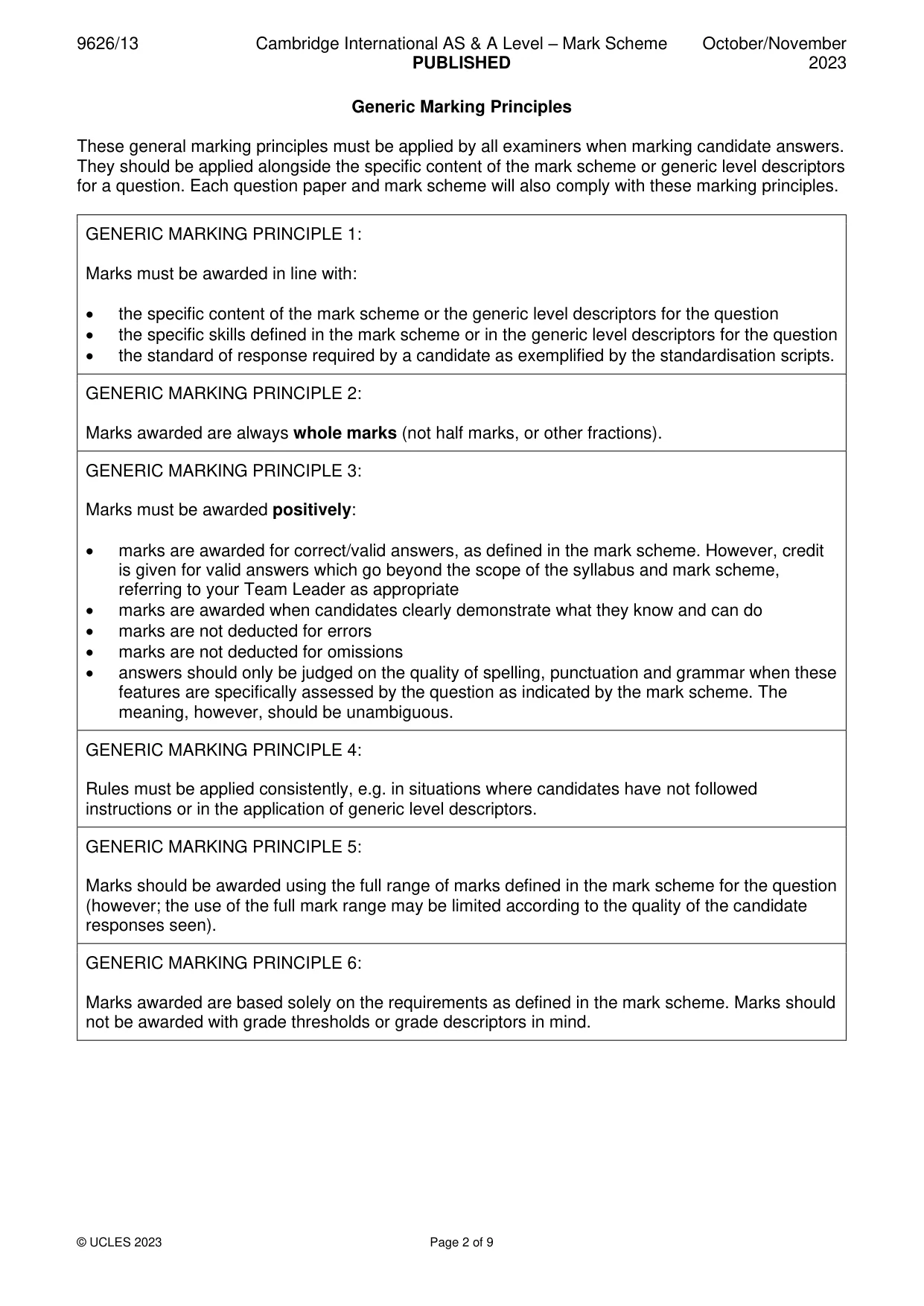
9626/13 Cambridge International AS & A Level – Mark Scheme PUBLISHED October/November 2023 © UCLES 2023 Page 2 of 9 Generic Marking Principles These general marking principles must be applied by all examiners when marking candidate answers. They should be applied alongside the specific content of the mark scheme or generic level descriptors for a question. Each question paper and mark scheme will also comply with these marking principles. GENERIC MARKING PRINCIPLE 1: Marks must be awarded in line with: • the specific content of the mark scheme or the generic level descriptors for the question • the specific skills defined in the mark scheme or in the generic level descriptors for the question • the standard of response required by a candidate as exemplified by the standardisation scripts. GENERIC MARKING PRINCIPLE 2: Marks awarded are always whole marks (not half marks, or other fractions). GENERIC MARKING PRINCIPLE 3: Marks must be awarded positively: • marks are awarded for correct/valid answers, as defined in the mark scheme. However, credit is given for valid answers which go beyond the scope of the syllabus and mark scheme, referring to your Team Leader as appropriate • marks are awarded when candidates clearly demonstrate what they know and can do • marks are not deducted for errors • marks are not deducted for omissions • answers should only be judged on the quality of spelling, punctuation and grammar when these features are specifically assessed by the question as indicated by the mark scheme. The meaning, however, should be unambiguous. GENERIC MARKING PRINCIPLE 4: Rules must be applied consistently, e.g. in situations where candidates have not followed instructions or in the application of generic level descriptors. GENERIC MARKING PRINCIPLE 5: Marks should be awarded using the full range of marks defined in the mark scheme for the question (however; the use of the full mark range may be limited according to the quality of the candidate responses seen). GENERIC MARKING PRINCIPLE 6: Marks awarded are based solely on the requirements as defined in the mark scheme. Marks should not be awarded with grade thresholds or grade descriptors in mind.
Mark scheme, page 3
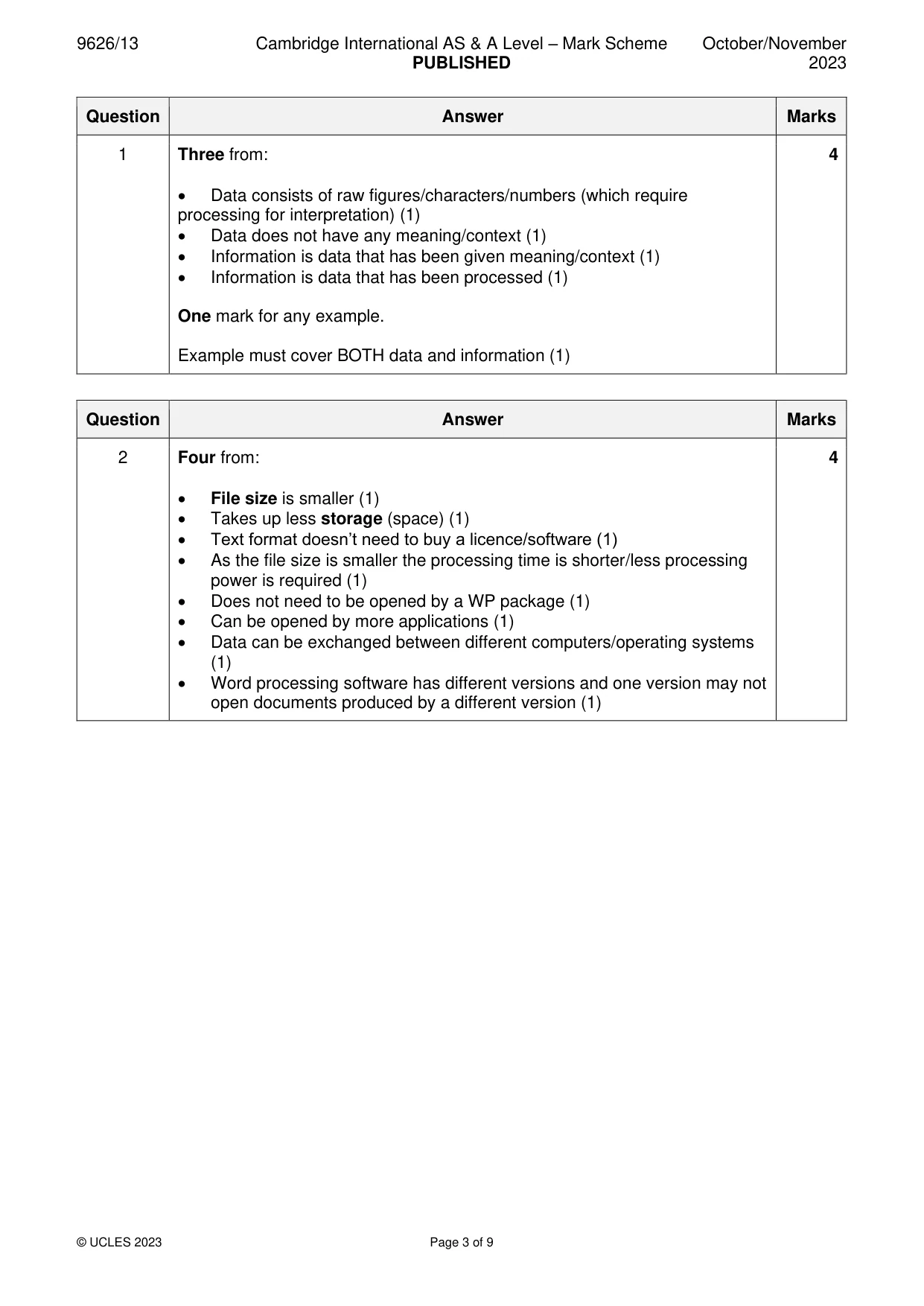
9626/13 Cambridge International AS & A Level – Mark Scheme PUBLISHED October/November 2023 © UCLES 2023 Page 3 of 9 Question Answer Marks 1 Three from: • Data consists of raw figures/characters/numbers (which require processing for interpretation) (1) • Data does not have any meaning/context (1) • Information is data that has been given meaning/context (1) • Information is data that has been processed (1) One mark for any example. Example must cover BOTH data and information (1) 4 Question Answer Marks 2 Four from: • File size is smaller (1) • Takes up less storage (space) (1) • Text format doesn’t need to buy a licence/software (1) • As the file size is smaller the processing time is shorter/less processing power is required (1) • Does not need to be opened by a WP package (1) • Can be opened by more applications (1) • Data can be exchanged between different computers/operating systems (1) • Word processing software has different versions and one version may not open documents produced by a different version (1) 4
Mark scheme, page 4
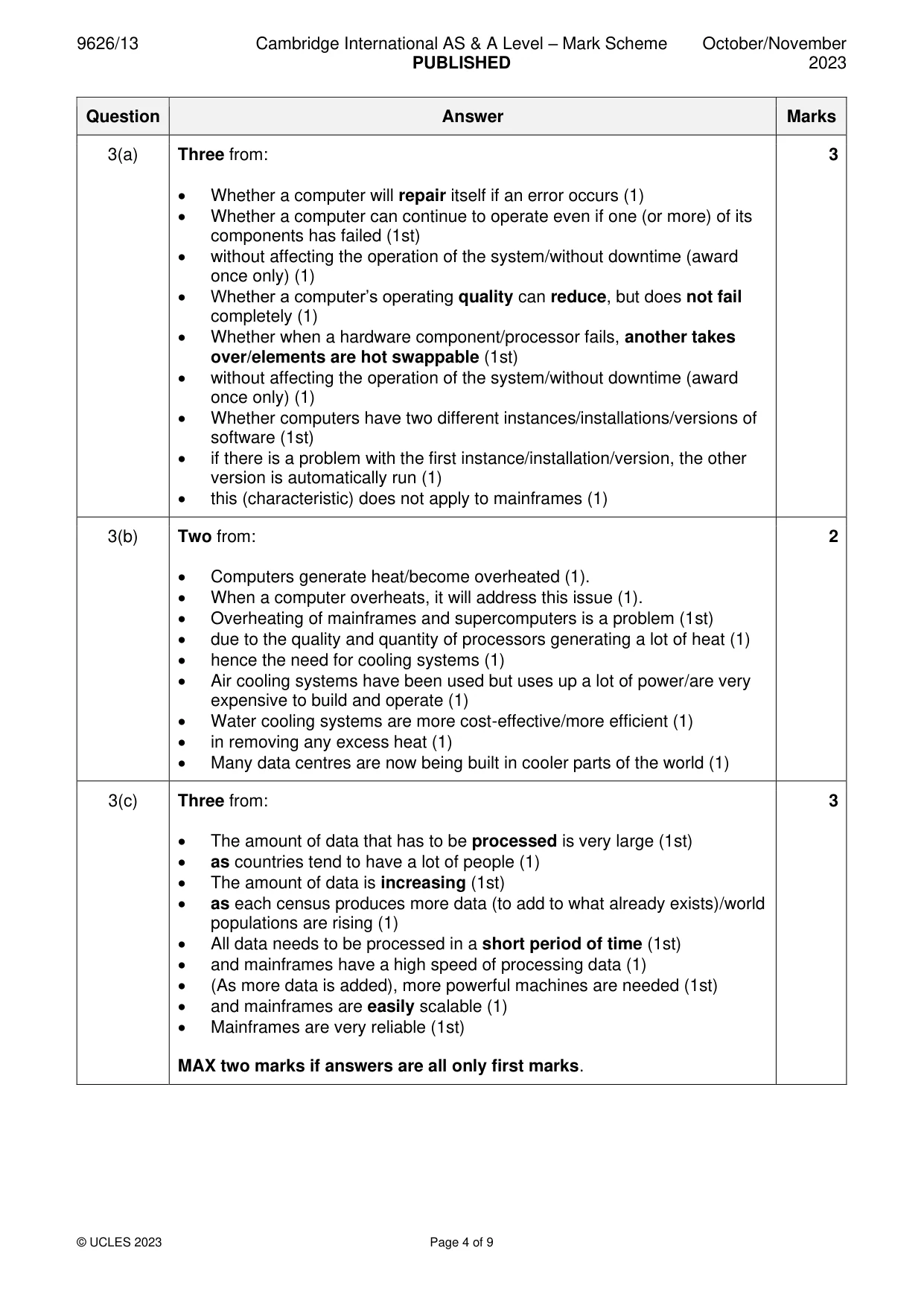
9626/13 Cambridge International AS & A Level – Mark Scheme PUBLISHED October/November 2023 © UCLES 2023 Page 4 of 9 Question Answer Marks 3(a) Three from: • Whether a computer will repair itself if an error occurs (1) • Whether a computer can continue to operate even if one (or more) of its components has failed (1st) • without affecting the operation of the system/without downtime (award once only) (1) • Whether a computer’s operating quality can reduce, but does not fail completely (1) • Whether when a hardware component/processor fails, another takes over/elements are hot swappable (1st) • without affecting the operation of the system/without downtime (award once only) (1) • Whether computers have two different instances/installations/versions of software (1st) • if there is a problem with the first instance/installation/version, the other version is automatically run (1) • this (characteristic) does not apply to mainframes (1) 3 3(b) Two from: • Computers generate heat/become overheated (1). • When a computer overheats, it will address this issue (1). • Overheating of mainframes and supercomputers is a problem (1st) • due to the quality and quantity of processors generating a lot of heat (1) • hence the need for cooling systems (1) • Air cooling systems have been used but uses up a lot of power/are very expensive to build and operate (1) • Water cooling systems are more cost-effective/more efficient (1) • in removing any excess heat (1) • Many data centres are now being built in cooler parts of the world (1) 2 3(c) Three from: • The amount of data that has to be processed is very large (1st) • as countries tend to have a lot of people (1) • The amount of data is increasing (1st) • as each census produces more data (to add to what already exists)/world populations are rising (1) • All data needs to be processed in a short period of time (1st) • and mainframes have a high speed of processing data (1) • (As more data is added), more powerful machines are needed (1st) • and mainframes are easily scalable (1) • Mainframes are very reliable (1st) MAX two marks if answers are all only first marks. 3
Mark scheme, page 5
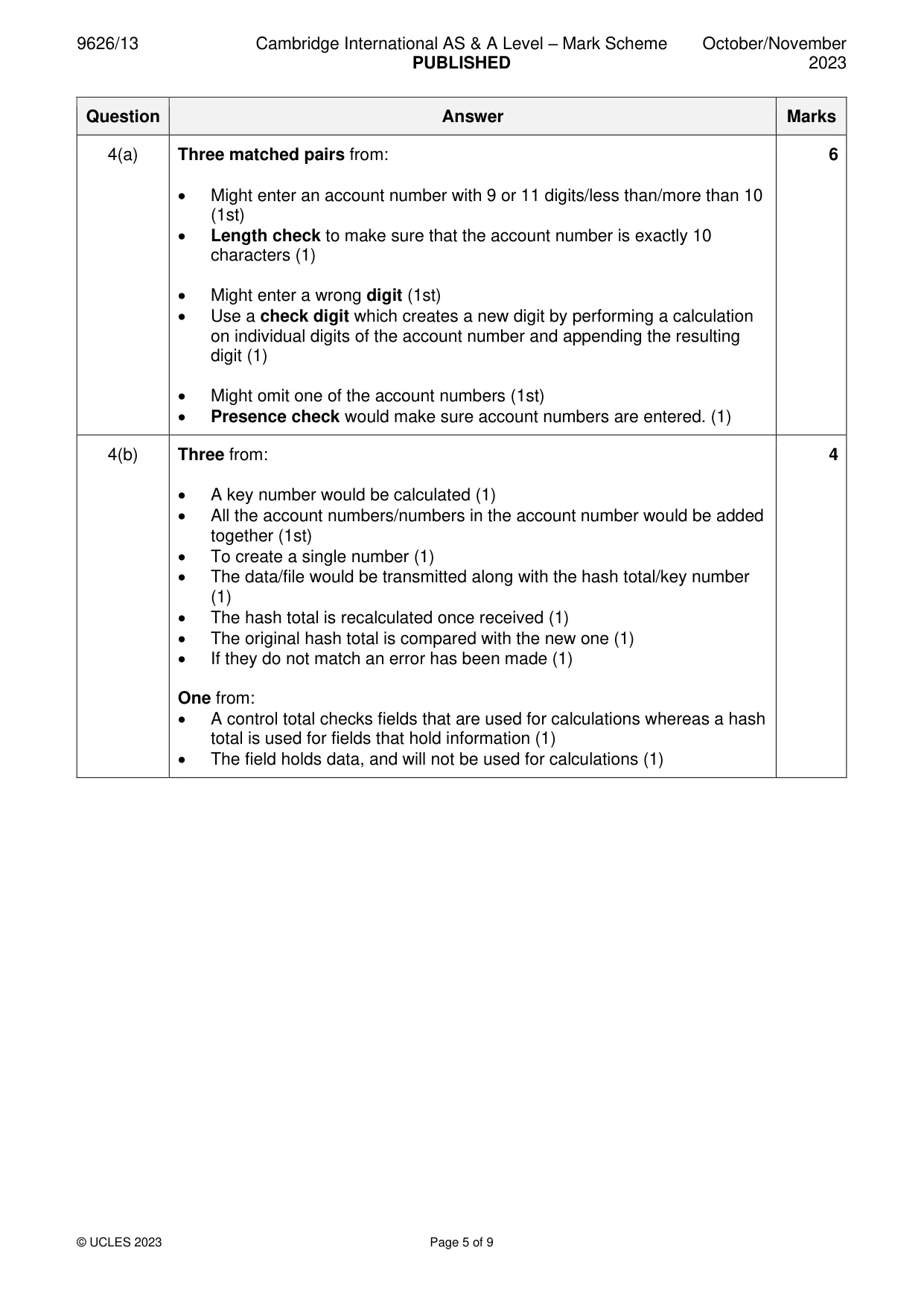
9626/13 Cambridge International AS & A Level – Mark Scheme PUBLISHED October/November 2023 © UCLES 2023 Page 5 of 9 Question Answer Marks 4(a) Three matched pairs from: • Might enter an account number with 9 or 11 digits/less than/more than 10 (1st) • Length check to make sure that the account number is exactly 10 characters (1) • Might enter a wrong digit (1st) • Use a check digit which creates a new digit by performing a calculation on individual digits of the account number and appending the resulting digit (1) • Might omit one of the account numbers (1st) • Presence check would make sure account numbers are entered. (1) 6 4(b) Three from: • A key number would be calculated (1) • All the account numbers/numbers in the account number would be added together (1st) • To create a single number (1) • The data/file would be transmitted along with the hash total/key number (1) • The hash total is recalculated once received (1) • The original hash total is compared with the new one (1) • If they do not match an error has been made (1) One from: • A control total checks fields that are used for calculations whereas a hash total is used for fields that hold information (1) • The field holds data, and will not be used for calculations (1) 4
Mark scheme, page 6
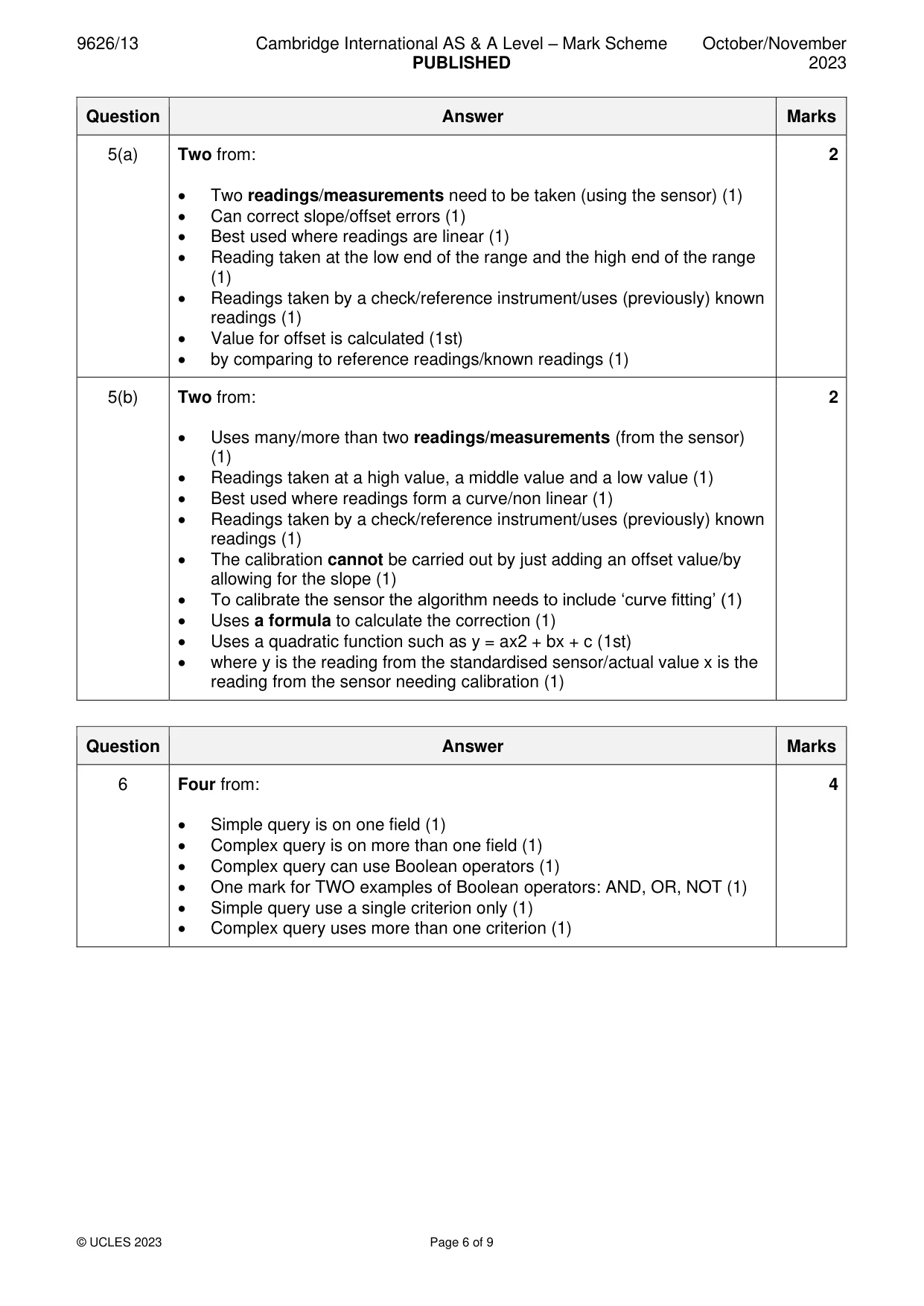
9626/13 Cambridge International AS & A Level – Mark Scheme PUBLISHED October/November 2023 © UCLES 2023 Page 6 of 9 Question Answer Marks 5(a) Two from: • Two readings/measurements need to be taken (using the sensor) (1) • Can correct slope/offset errors (1) • Best used where readings are linear (1) • Reading taken at the low end of the range and the high end of the range (1) • Readings taken by a check/reference instrument/uses (previously) known readings (1) • Value for offset is calculated (1st) • by comparing to reference readings/known readings (1) 2 5(b) Two from: • Uses many/more than two readings/measurements (from the sensor) (1) • Readings taken at a high value, a middle value and a low value (1) • Best used where readings form a curve/non linear (1) • Readings taken by a check/reference instrument/uses (previously) known readings (1) • The calibration cannot be carried out by just adding an offset value/by allowing for the slope (1) • To calibrate the sensor the algorithm needs to include ‘curve fitting’ (1) • Uses a formula to calculate the correction (1) • Uses a quadratic function such as y = ax2 + bx + c (1st) • where y is the reading from the standardised sensor/actual value x is the reading from the sensor needing calibration (1) 2 Question Answer Marks 6 Four from: • Simple query is on one field (1) • Complex query is on more than one field (1) • Complex query can use Boolean operators (1) • One mark for TWO examples of Boolean operators: AND, OR, NOT (1) • Simple query use a single criterion only (1) • Complex query uses more than one criterion (1) 4
Mark scheme, page 7
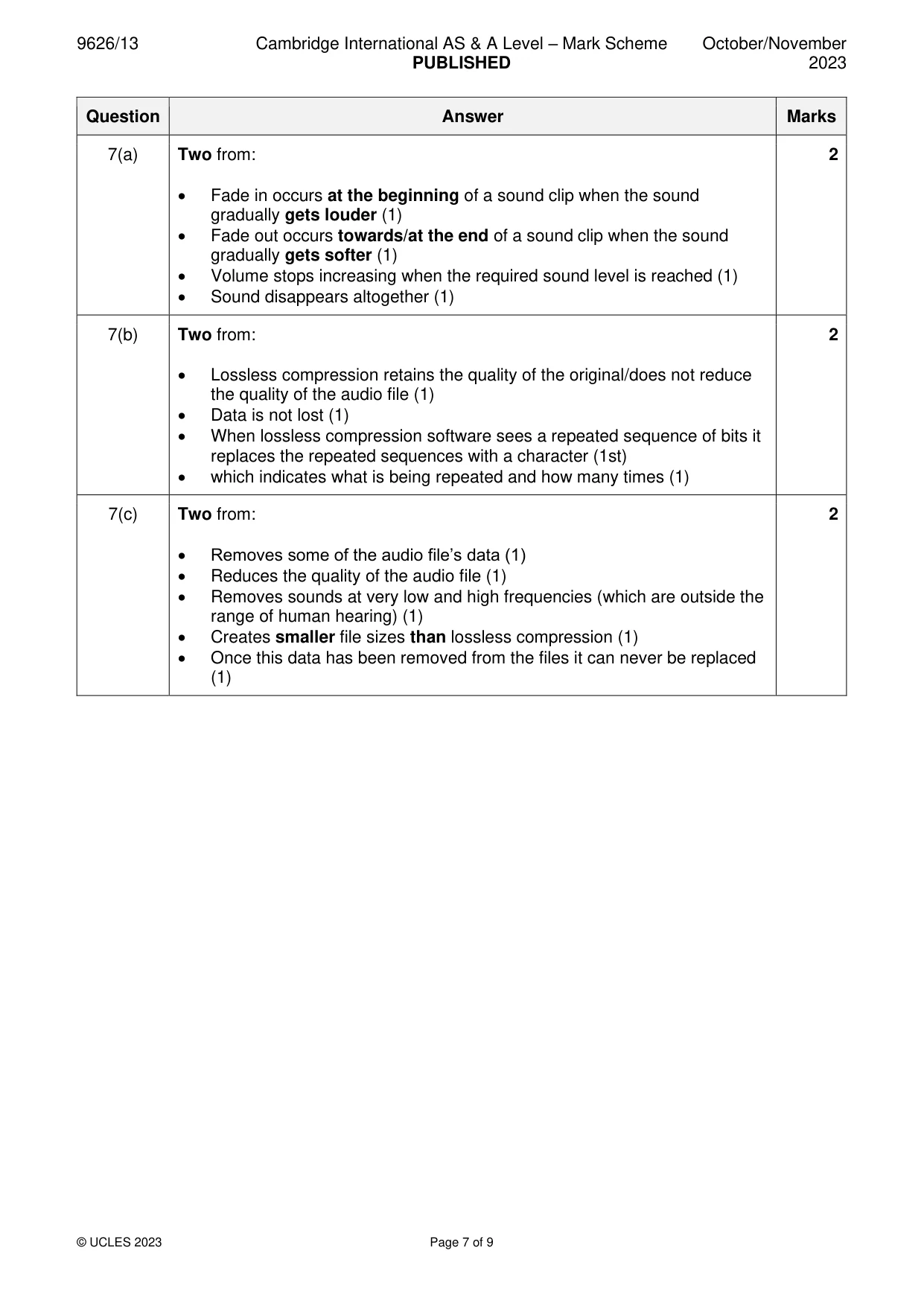
9626/13 Cambridge International AS & A Level – Mark Scheme PUBLISHED October/November 2023 © UCLES 2023 Page 7 of 9 Question Answer Marks 7(a) Two from: • Fade in occurs at the beginning of a sound clip when the sound gradually gets louder (1) • Fade out occurs towards/at the end of a sound clip when the sound gradually gets softer (1) • Volume stops increasing when the required sound level is reached (1) • Sound disappears altogether (1) 2 7(b) Two from: • Lossless compression retains the quality of the original/does not reduce the quality of the audio file (1) • Data is not lost (1) • When lossless compression software sees a repeated sequence of bits it replaces the repeated sequences with a character (1st) • which indicates what is being repeated and how many times (1) 2 7(c) Two from: • Removes some of the audio file’s data (1) • Reduces the quality of the audio file (1) • Removes sounds at very low and high frequencies (which are outside the range of human hearing) (1) • Creates smaller file sizes than lossless compression (1) • Once this data has been removed from the files it can never be replaced (1) 2
Mark scheme, page 8
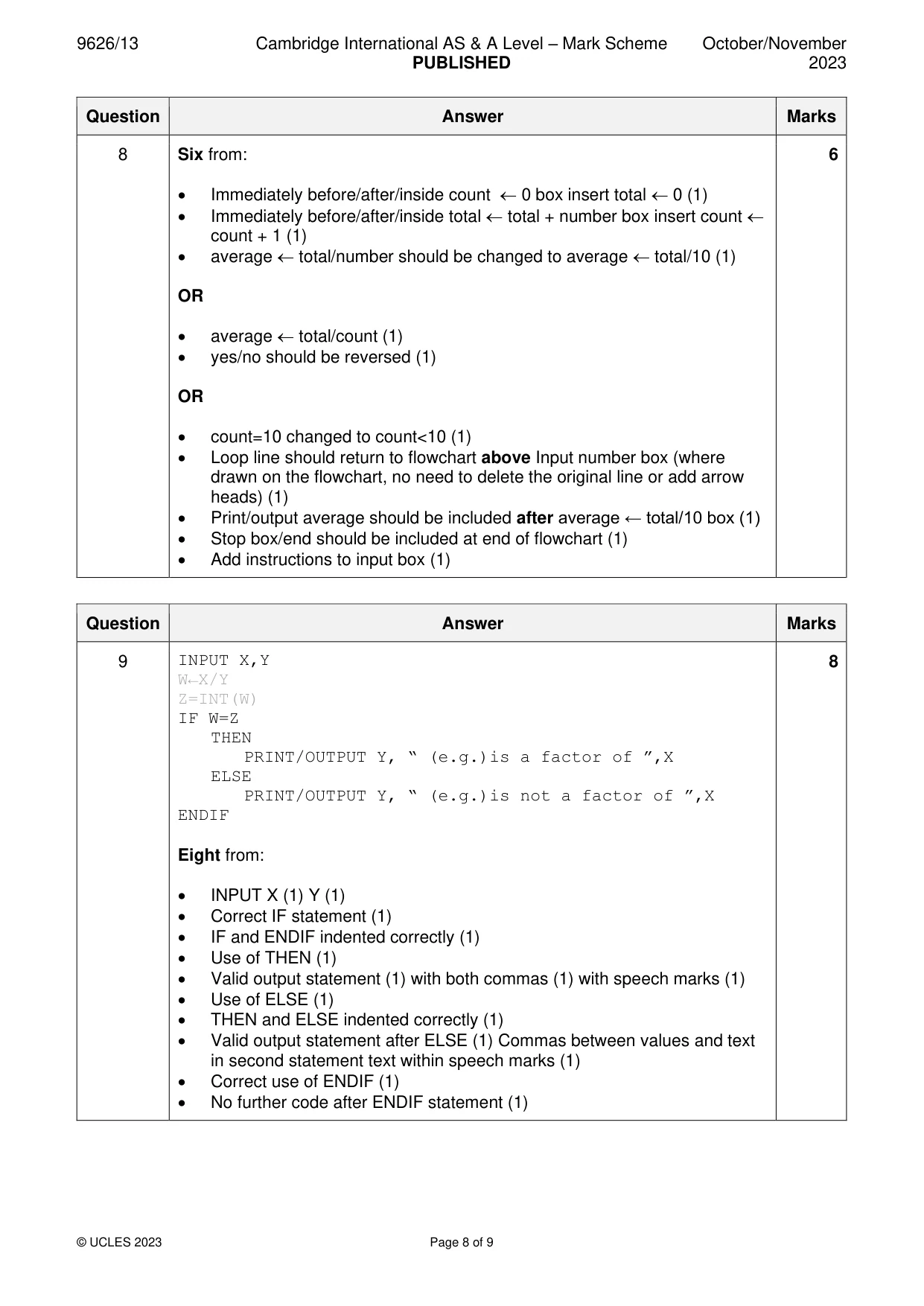
9626/13 Cambridge International AS & A Level – Mark Scheme PUBLISHED October/November 2023 © UCLES 2023 Page 8 of 9 Question Answer Marks 8 Six from: • Immediately before/after/inside count 0 box insert total 0 (1) • Immediately before/after/inside total total + number box insert count count + 1 (1) • average total/number should be changed to average total/10 (1) OR • average total/count (1) • yes/no should be reversed (1) OR • count=10 changed to count<10 (1) • Loop line should return to flowchart above Input number box (where drawn on the flowchart, no need to delete the original line or add arrow heads) (1) • Print/output average should be included after average ← total/10 box (1) • Stop box/end should be included at end of flowchart (1) • Add instructions to input box (1) 6 Question Answer Marks 9 INPUT X,Y W←X/Y Z=INT(W) IF W=Z THEN PRINT/OUTPUT Y, “ (e.g.)is a factor of ”,X ELSE PRINT/OUTPUT Y, “ (e.g.)is not a factor of ”,X ENDIF Eight from: • INPUT X (1) Y (1) • Correct IF statement (1) • IF and ENDIF indented correctly (1) • Use of THEN (1) • Valid output statement (1) with both commas (1) with speech marks (1) • Use of ELSE (1) • THEN and ELSE indented correctly (1) • Valid output statement after ELSE (1) Commas between values and text in second statement text within speech marks (1) • Correct use of ENDIF (1) • No further code after ENDIF statement (1) 8
Mark scheme, page 9
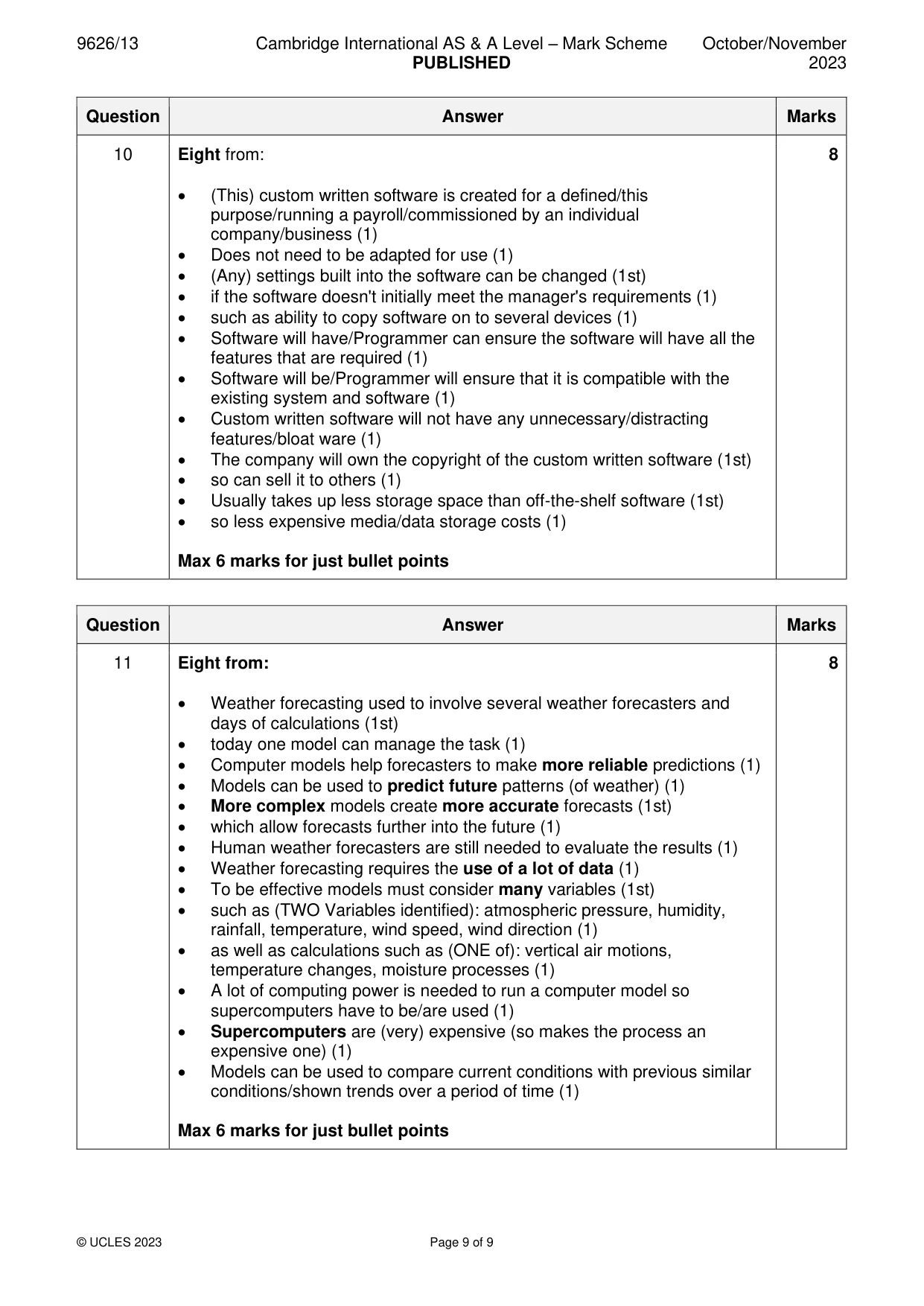
9626/13 Cambridge International AS & A Level – Mark Scheme PUBLISHED October/November 2023 © UCLES 2023 Page 9 of 9 Question Answer Marks 10 Eight from: • (This) custom written software is created for a defined/this purpose/running a payroll/commissioned by an individual company/business (1) • Does not need to be adapted for use (1) • (Any) settings built into the software can be changed (1st) • if the software doesn't initially meet the manager's requirements (1) • such as ability to copy software on to several devices (1) • Software will have/Programmer can ensure the software will have all the features that are required (1) • Software will be/Programmer will ensure that it is compatible with the existing system and software (1) • Custom written software will not have any unnecessary/distracting features/bloat ware (1) • The company will own the copyright of the custom written software (1st) • so can sell it to others (1) • Usually takes up less storage space than off-the-shelf software (1st) • so less expensive media/data storage costs (1) Max 6 marks for just bullet points 8 Question Answer Marks 11 Eight from: • Weather forecasting used to involve several weather forecasters and days of calculations (1st) • today one model can manage the task (1) • Computer models help forecasters to make more reliable predictions (1) • Models can be used to predict future patterns (of weather) (1) • More complex models create more accurate forecasts (1st) • which allow forecasts further into the future (1) • Human weather forecasters are still needed to evaluate the results (1) • Weather forecasting requires the use of a lot of data (1) • To be effective models must consider many variables (1st) • such as (TWO Variables identified): atmospheric pressure, humidity, rainfall, temperature, wind speed, wind direction (1) • as well as calculations such as (ONE of): vertical air motions, temperature changes, moisture processes (1) • A lot of computing power is needed to run a computer model so supercomputers have to be/are used (1) • Supercomputers are (very) expensive (so makes the process an expensive one) (1) • Models can be used to compare current conditions with previous similar conditions/shown trends over a period of time (1) Max 6 marks for just bullet points 8
What you needed in this session
Cambridge’s own grade thresholds for 2023 Oct/Nov, Paper 1 · Variant 3. A higher threshold means an easier paper — the bar moves with how the cohort did.