Cambridge A Level Information Technology (from 2017) 9626 — 2022 May/June Paper 1 · Variant 3
9626/13/M/J/22 · 70 marks · ≈79 min
The question paper and its mark scheme, free to read here and free to download. This is Cambridge’s own paper, exactly as it was sat.
Question paper12 pages






Mark scheme11 pages
Answers below. Sit the paper first if you are practising.
Paper as text
Question paper, page 1
This document has 12 pages. Any blank pages are indicated. [Turn over Cambridge International AS & A Level DC (CE/FC) 303898/3 © UCLES 2022 * 6 5 2 2 0 9 4 9 0 0 * INFORMATION TECHNOLOGY 9626/13 Paper 1 Theory May/June 2022 1 hour 45 minutes You must answer on the question paper. No additional materials are needed. INSTRUCTIONS ● Answer all questions. ● Use a black or dark blue pen. ● Write your name, centre number and candidate number in the boxes at the top of the page. ● Write your answer to each question in the space provided. ● Do not use an erasable pen or correction fluid. ● Do not write on any bar codes. ● You may use an HB pencil for any diagrams, graphs or rough working. ● Calculators must not be used in this paper. INFORMATION ● The total mark for this paper is 70. ● The number of marks for each question or part question is shown in brackets [ ].
Question paper, page 2
2 9626/13/M/J/22 © UCLES 2022 1 Paulo is carrying out a study on the level of noise caused by traffic in the streets around his home. He will need data for his study. (a) Describe what is meant by direct data. … … [1] (b) Describe how Paulo could use direct data sources for his study. … … … … … … … … … … [4]
Question paper, page 3
3 9626/13/M/J/22 © UCLES 2022 [Turn over 2 Explain how high level language programs can be translated to run on different computer systems, including any difficulties which may result from this. … … … … … … … … … … [4] 3 Wei is trying to minimise the effects of malware on her computer system. Describe the types of software Wei would need and how she could use them to help prevent malware affecting her computer system. … … … … … … … … … … [4]
Question paper, page 4
4 9626/13/M/J/22 © UCLES 2022 4 The directors of a company wish to create a database of customers. They are not sure whether they should ask a computer programmer to produce custom written software or they should purchase off-the-shelf software. (a) Describe the features of custom written software. … … … … … … … … … … [4] (b) Describe the features of off-the-shelf software. … … … … … … … … … … [4]
Question paper, page 5
5 9626/13/M/J/22 © UCLES 2022 [Turn over 5 A doctor drives to work. While at work and while travelling, the doctor uses a number of IT-based devices. She uses a dialogue interface to control these devices. Discuss the advantages and disadvantages of the doctor using a dialogue interface rather than a graphical user interface (GUI). … … … … … … … … … … … … … … … … … … … … [8]
Question paper, page 6
6 9626/13/M/J/22 © UCLES 2022 6 Describe how the SSL/TLS protocol is used in client-server networks. … … … … … … … … … … … … … … [6]
Question paper, page 7
7 9626/13/M/J/22 © UCLES 2022 [Turn over 7 A company has been asked by a government to construct a nuclear reactor. A computer model will be created before the reactor is built. Explain why a computer model is needed in this scenario. … … … … … … … … … … … … [5]
Question paper, page 8
8 9626/13/M/J/22 © UCLES 2022 8 A microprocessor-controlled car park barrier is used to allow cars to enter a car park. When a car approaches the barrier, the barrier automatically rises to allow the car to enter. It does not lower until the car is safely clear of the barrier system. There is a light sensor and light beam source immediately before the barrier. No tickets are issued by the system. The system operates continuously while it is switched on. Complete this pseudocode algorithm to describe the processing involved. Your pseudocode algorithm should include IF…THEN statements. REPEAT INPUT reading from induction loop … … … … … … … … … … … … … … [7]
Question paper, page 9
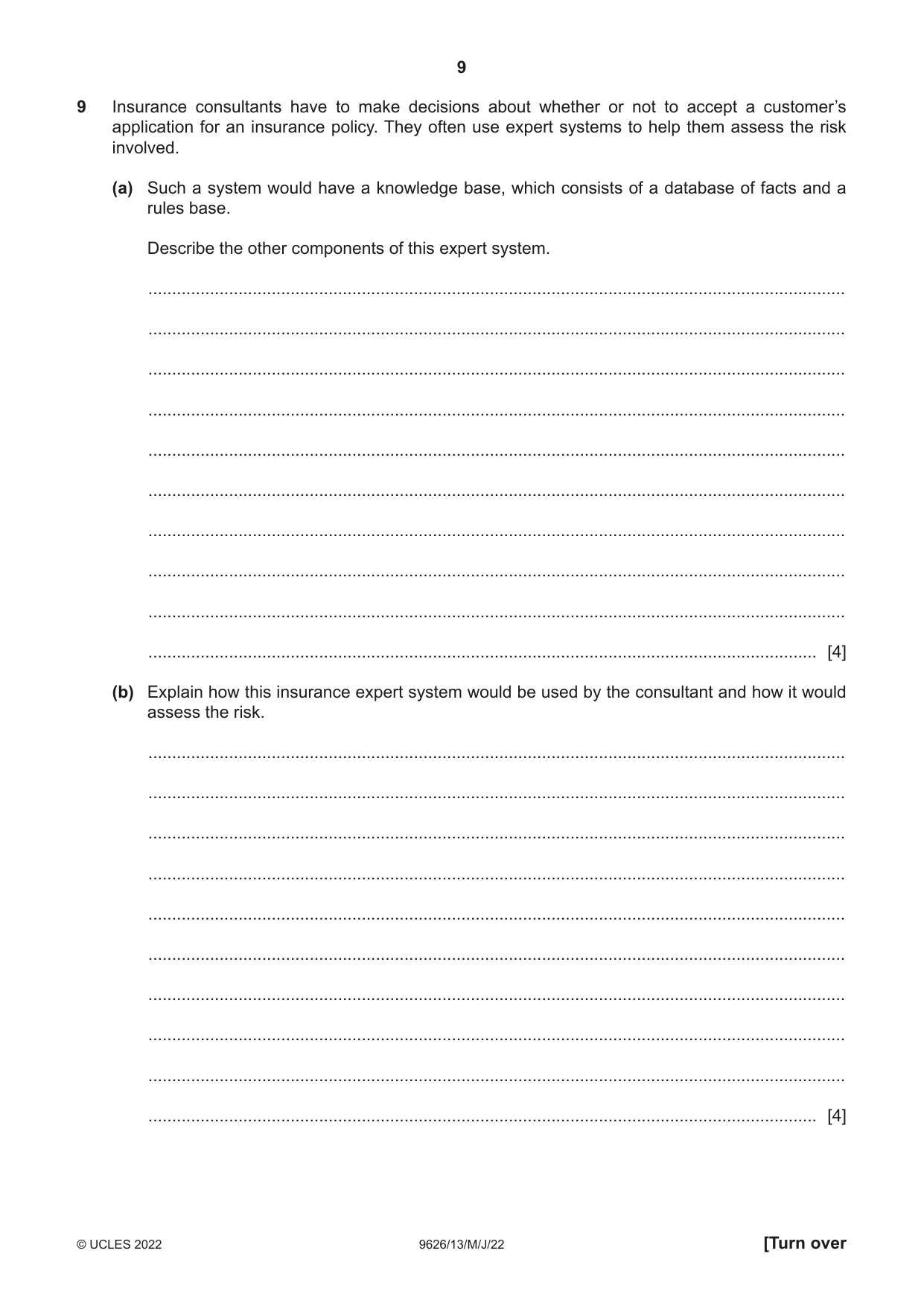
9 9626/13/M/J/22 © UCLES 2022 [Turn over 9 Insurance consultants have to make decisions about whether or not to accept a customer’s application for an insurance policy. They often use expert systems to help them assess the risk involved. (a) Such a system would have a knowledge base, which consists of a database of facts and a rules base. Describe the other components of this expert system. … … … … … … … … … … [4] (b) Explain how this insurance expert system would be used by the consultant and how it would assess the risk. … … … … … … … … … … [4]
Question paper, page 10
10 9626/13/M/J/22 © UCLES 2022 10 Normalisation is used when designing relational databases. Discuss the advantages and disadvantages of normalisation. … … … … … … … … … … … … … … … … … … … … [8]
Question paper, page 11
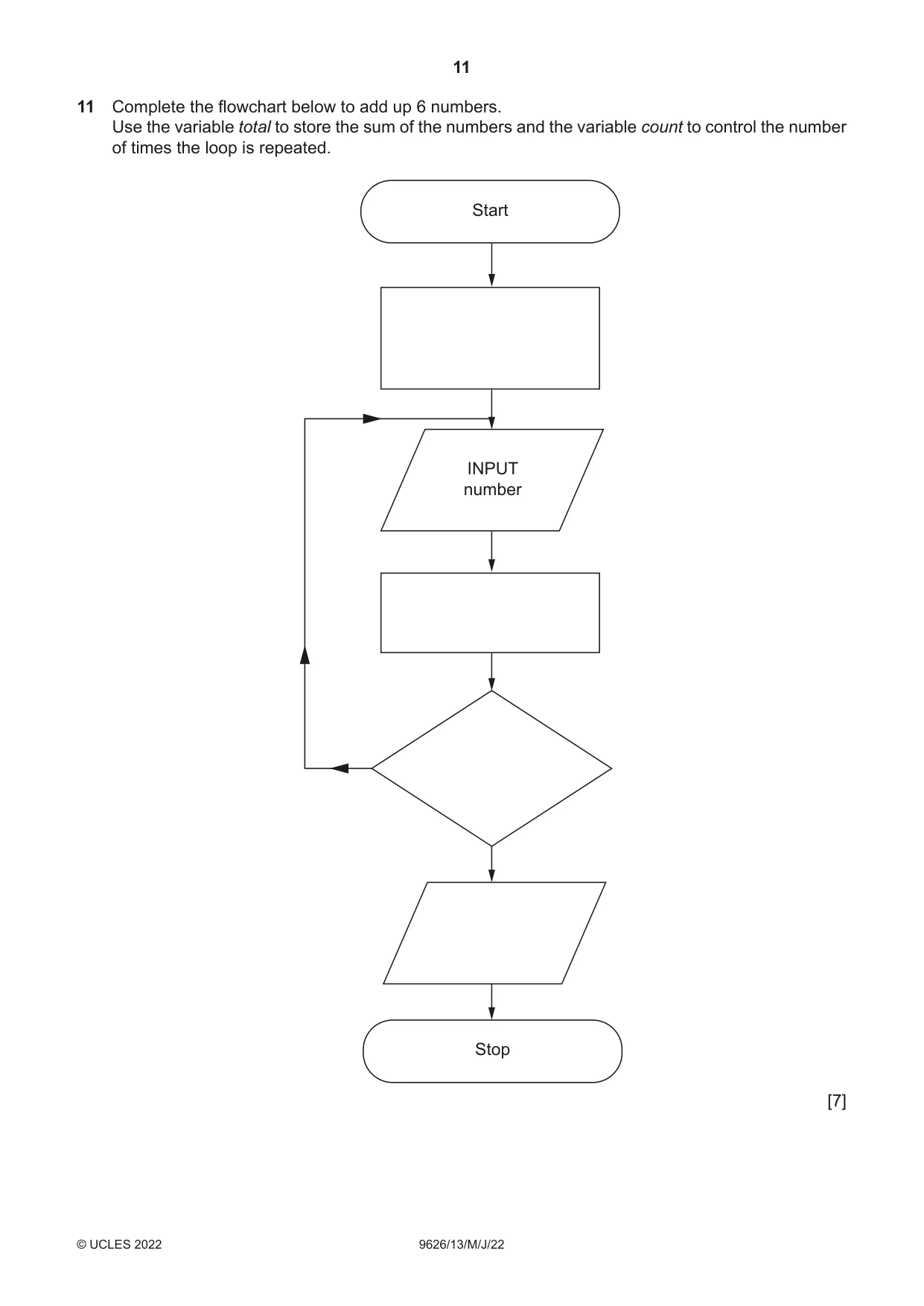
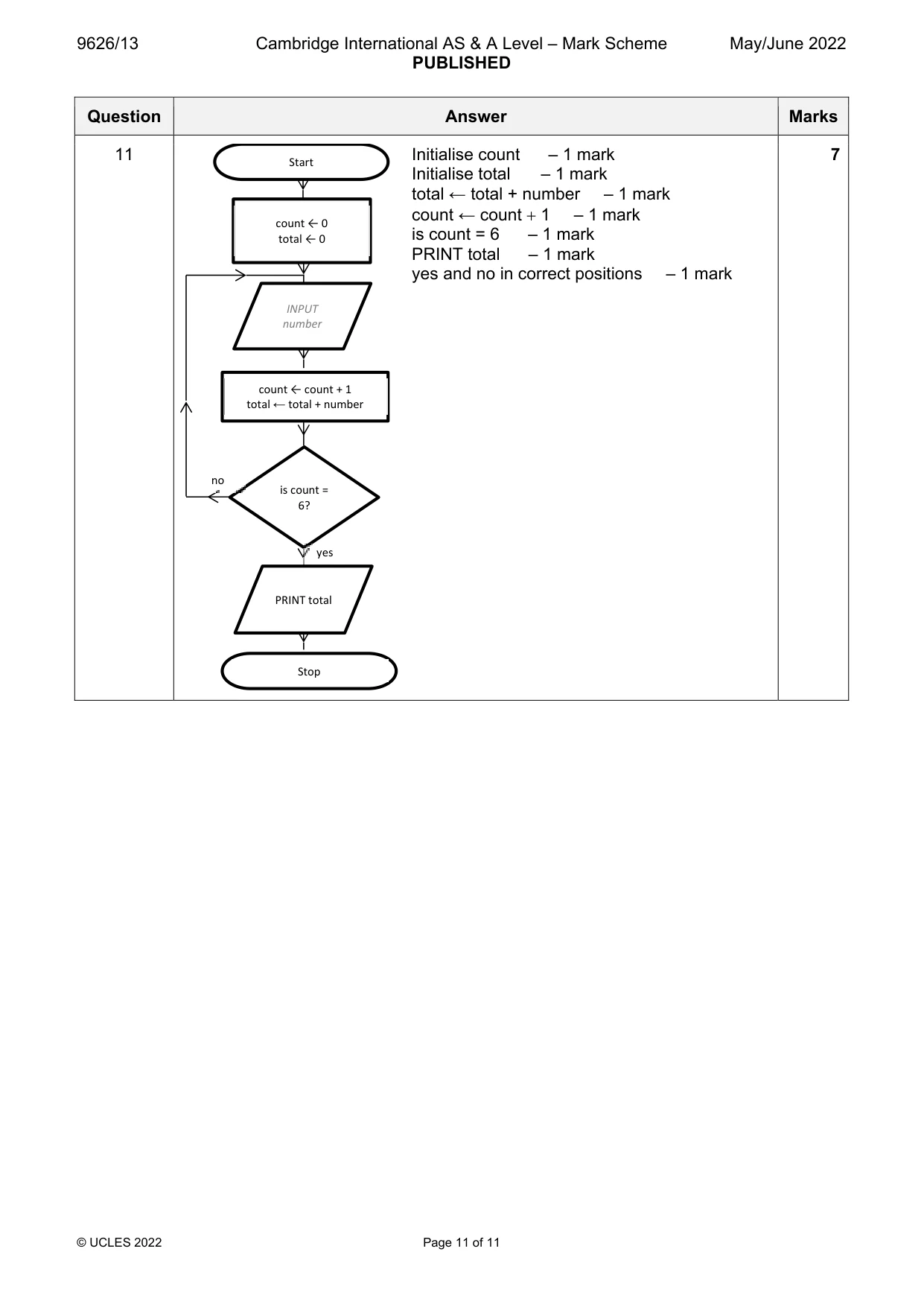
11 9626/13/M/J/22 © UCLES 2022 11 Complete the flowchart below to add up 6 numbers. Use the variable total to store the sum of the numbers and the variable count to control the number of times the loop is repeated. Start Stop INPUT number [7]
Question paper, page 12
12 9626/13/M/J/22 © UCLES 2022 Permission to reproduce items where third-party owned material protected by copyright is included has been sought and cleared where possible. Every reasonable effort has been made by the publisher (UCLES) to trace copyright holders, but if any items requiring clearance have unwittingly been included, the publisher will be pleased to make amends at the earliest possible opportunity. To avoid the issue of disclosure of answer-related information to candidates, all copyright acknowledgements are reproduced online in the Cambridge Assessment International Education Copyright Acknowledgements Booklet. This is produced for each series of examinations and is freely available to download at www.cambridgeinternational.org after the live examination series. Cambridge Assessment International Education is part of Cambridge Assessment. Cambridge Assessment is the brand name of the University of Cambridge Local Examinations Syndicate (UCLES), which is a department of the University of Cambridge. BLANK PAGE
Mark scheme, page 1
This document consists of 11 printed pages. © UCLES 2022 [Turn over Cambridge International AS & A Level INFORMATION TECHNOLOGY 9626/13 Paper 1 Theory May/June 2022 MARK SCHEME Maximum Mark: 70 Published This mark scheme is published as an aid to teachers and candidates, to indicate the requirements of the examination. It shows the basis on which Examiners were instructed to award marks. It does not indicate the details of the discussions that took place at an Examiners’ meeting before marking began, which would have considered the acceptability of alternative answers. Mark schemes should be read in conjunction with the question paper and the Principal Examiner Report for Teachers. Cambridge International will not enter into discussions about these mark schemes. Cambridge International is publishing the mark schemes for the May/June 2022 series for most Cambridge IGCSE, Cambridge International A and AS Level and Cambridge Pre-U components, and some Cambridge O Level components.
Mark scheme, page 2
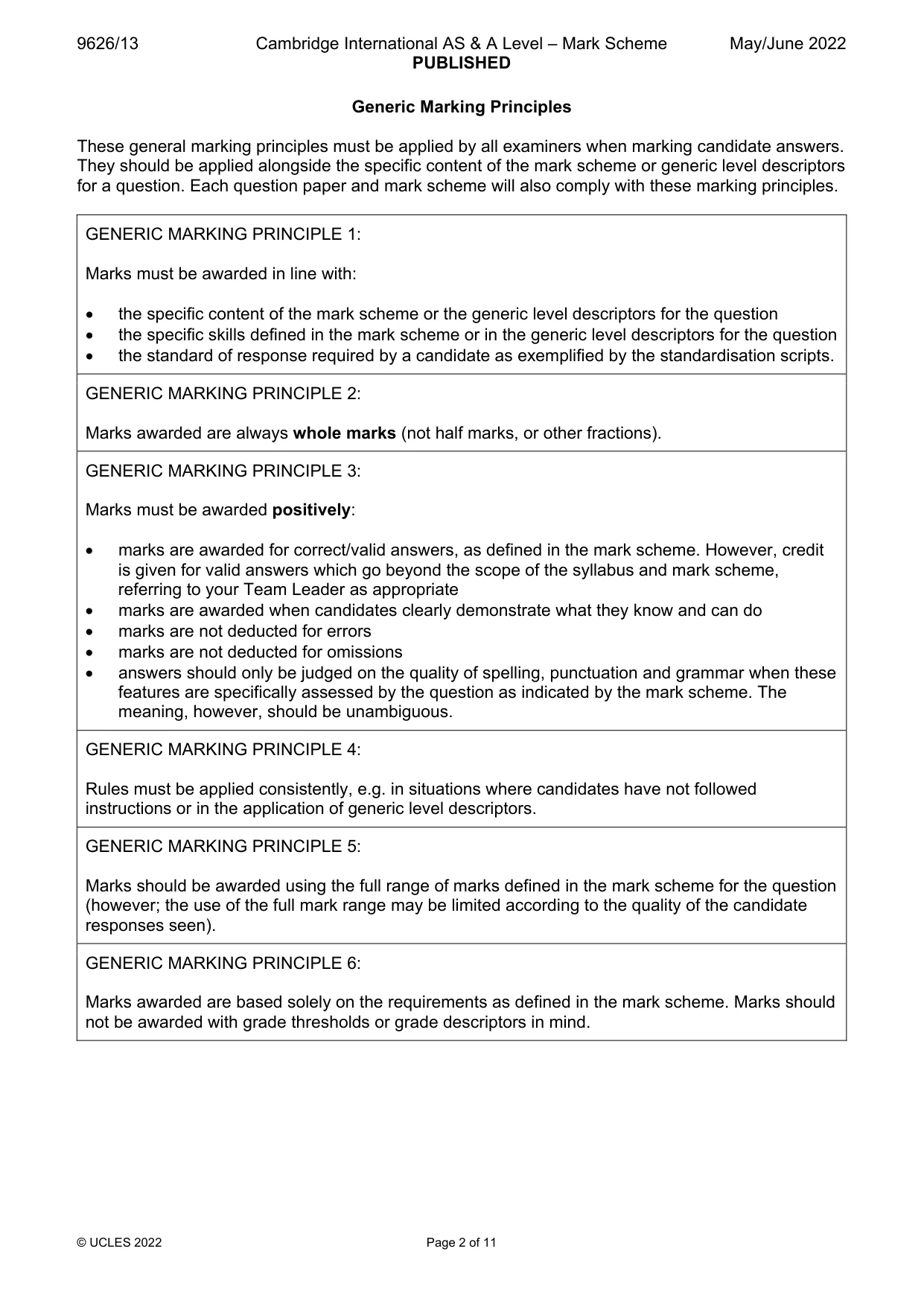
9626/13 Cambridge International AS & A Level – Mark Scheme PUBLISHED May/June 2022 © UCLES 2022 Page 2 of 11 Generic Marking Principles These general marking principles must be applied by all examiners when marking candidate answers. They should be applied alongside the specific content of the mark scheme or generic level descriptors for a question. Each question paper and mark scheme will also comply with these marking principles. GENERIC MARKING PRINCIPLE 1: Marks must be awarded in line with: the specific content of the mark scheme or the generic level descriptors for the question the specific skills defined in the mark scheme or in the generic level descriptors for the question the standard of response required by a candidate as exemplified by the standardisation scripts. GENERIC MARKING PRINCIPLE 2: Marks awarded are always whole marks (not half marks, or other fractions). GENERIC MARKING PRINCIPLE 3: Marks must be awarded positively: marks are awarded for correct/valid answers, as defined in the mark scheme. However, credit is given for valid answers which go beyond the scope of the syllabus and mark scheme, referring to your Team Leader as appropriate marks are awarded when candidates clearly demonstrate what they know and can do marks are not deducted for errors marks are not deducted for omissions answers should only be judged on the quality of spelling, punctuation and grammar when these features are specifically assessed by the question as indicated by the mark scheme. The meaning, however, should be unambiguous. GENERIC MARKING PRINCIPLE 4: Rules must be applied consistently, e.g. in situations where candidates have not followed instructions or in the application of generic level descriptors. GENERIC MARKING PRINCIPLE 5: Marks should be awarded using the full range of marks defined in the mark scheme for the question (however; the use of the full mark range may be limited according to the quality of the candidate responses seen). GENERIC MARKING PRINCIPLE 6: Marks awarded are based solely on the requirements as defined in the mark scheme. Marks should not be awarded with grade thresholds or grade descriptors in mind.
Mark scheme, page 3
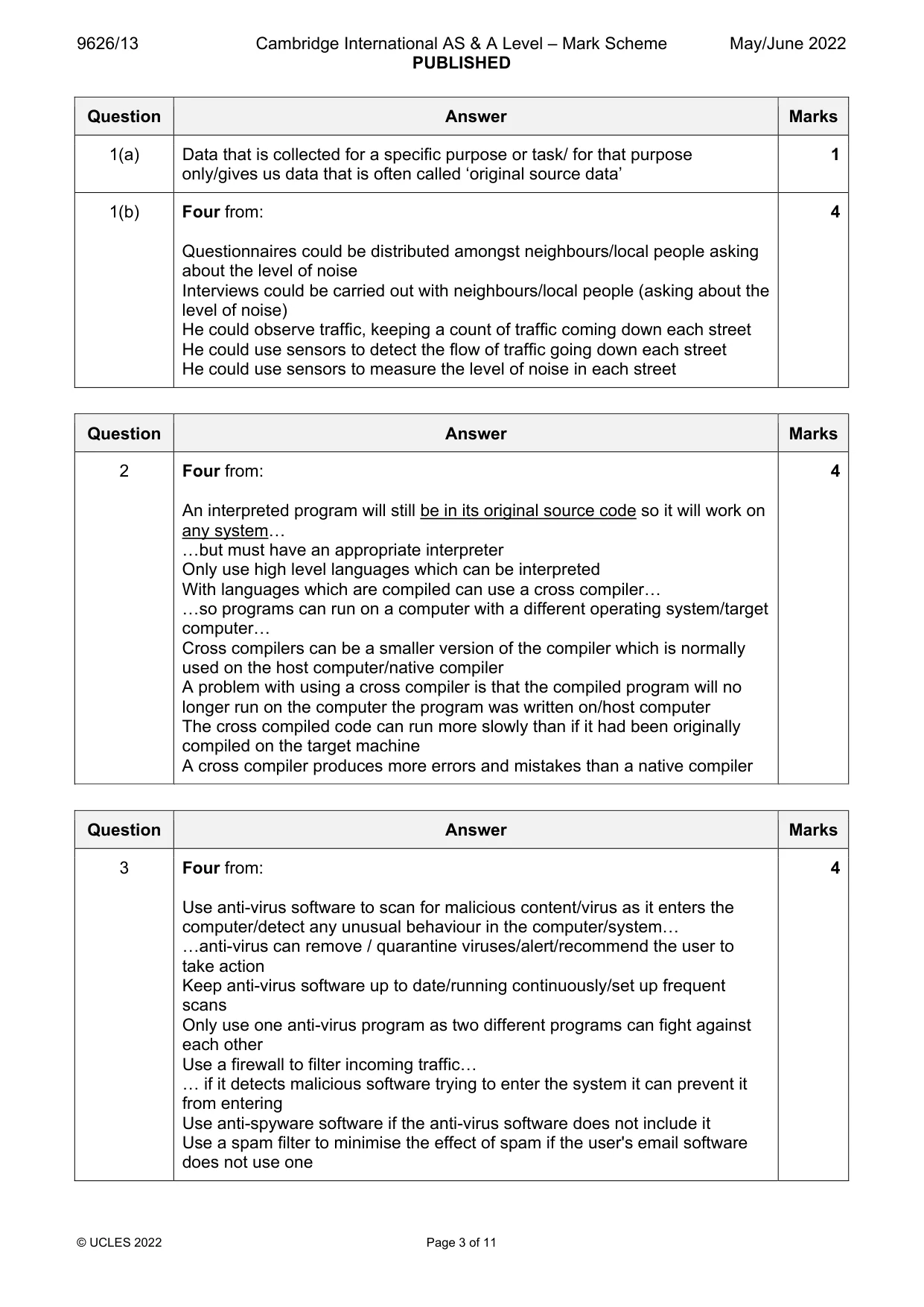
9626/13 Cambridge International AS & A Level – Mark Scheme PUBLISHED May/June 2022 © UCLES 2022 Page 3 of 11 Question Answer Marks 1(a) Data that is collected for a specific purpose or task/ for that purpose only/gives us data that is often called ‘original source data’ 1 1(b) Four from: Questionnaires could be distributed amongst neighbours/local people asking about the level of noise Interviews could be carried out with neighbours/local people (asking about the level of noise) He could observe traffic, keeping a count of traffic coming down each street He could use sensors to detect the flow of traffic going down each street He could use sensors to measure the level of noise in each street 4 Question Answer Marks 2 Four from: An interpreted program will still be in its original source code so it will work on any system… …but must have an appropriate interpreter Only use high level languages which can be interpreted With languages which are compiled can use a cross compiler… …so programs can run on a computer with a different operating system/target computer… Cross compilers can be a smaller version of the compiler which is normally used on the host computer/native compiler A problem with using a cross compiler is that the compiled program will no longer run on the computer the program was written on/host computer The cross compiled code can run more slowly than if it had been originally compiled on the target machine A cross compiler produces more errors and mistakes than a native compiler 4 Question Answer Marks 3 Four from: Use anti-virus software to scan for malicious content/virus as it enters the computer/detect any unusual behaviour in the computer/system… …anti-virus can remove / quarantine viruses/alert/recommend the user to take action Keep anti-virus software up to date/running continuously/set up frequent scans Only use one anti-virus program as two different programs can fight against each other Use a firewall to filter incoming traffic… … if it detects malicious software trying to enter the system it can prevent it from entering Use anti-spyware software if the anti-virus software does not include it Use a spam filter to minimise the effect of spam if the user's email software does not use one 4
Mark scheme, page 4
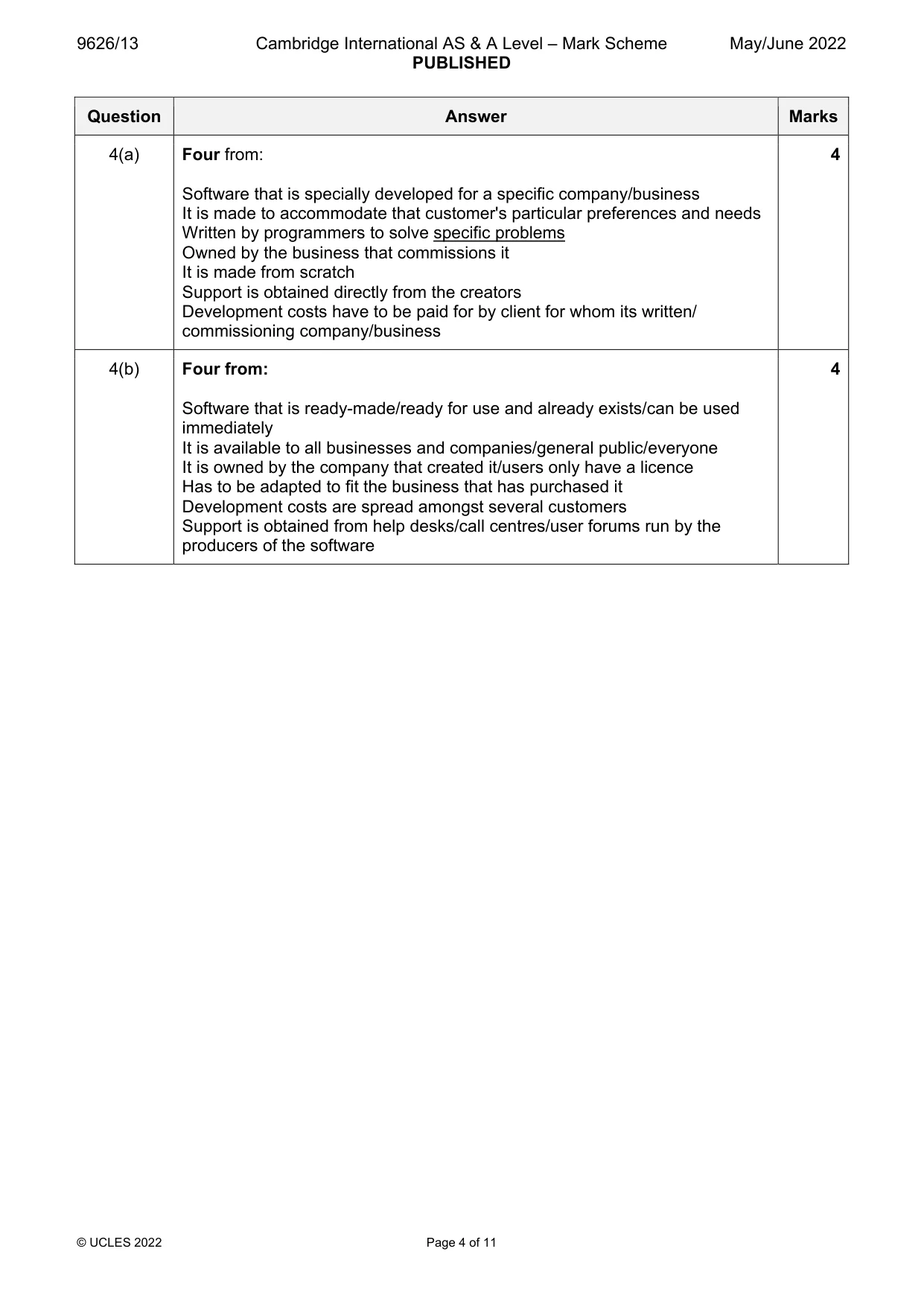
9626/13 Cambridge International AS & A Level – Mark Scheme PUBLISHED May/June 2022 © UCLES 2022 Page 4 of 11 Question Answer Marks 4(a) Four from: Software that is specially developed for a specific company/business It is made to accommodate that customer's particular preferences and needs Written by programmers to solve specific problems Owned by the business that commissions it It is made from scratch Support is obtained directly from the creators Development costs have to be paid for by client for whom its written/ commissioning company/business 4 4(b) Four from: Software that is ready-made/ready for use and already exists/can be used immediately It is available to all businesses and companies/general public/everyone It is owned by the company that created it/users only have a licence Has to be adapted to fit the business that has purchased it Development costs are spread amongst several customers Support is obtained from help desks/call centres/user forums run by the producers of the software 4
Mark scheme, page 5
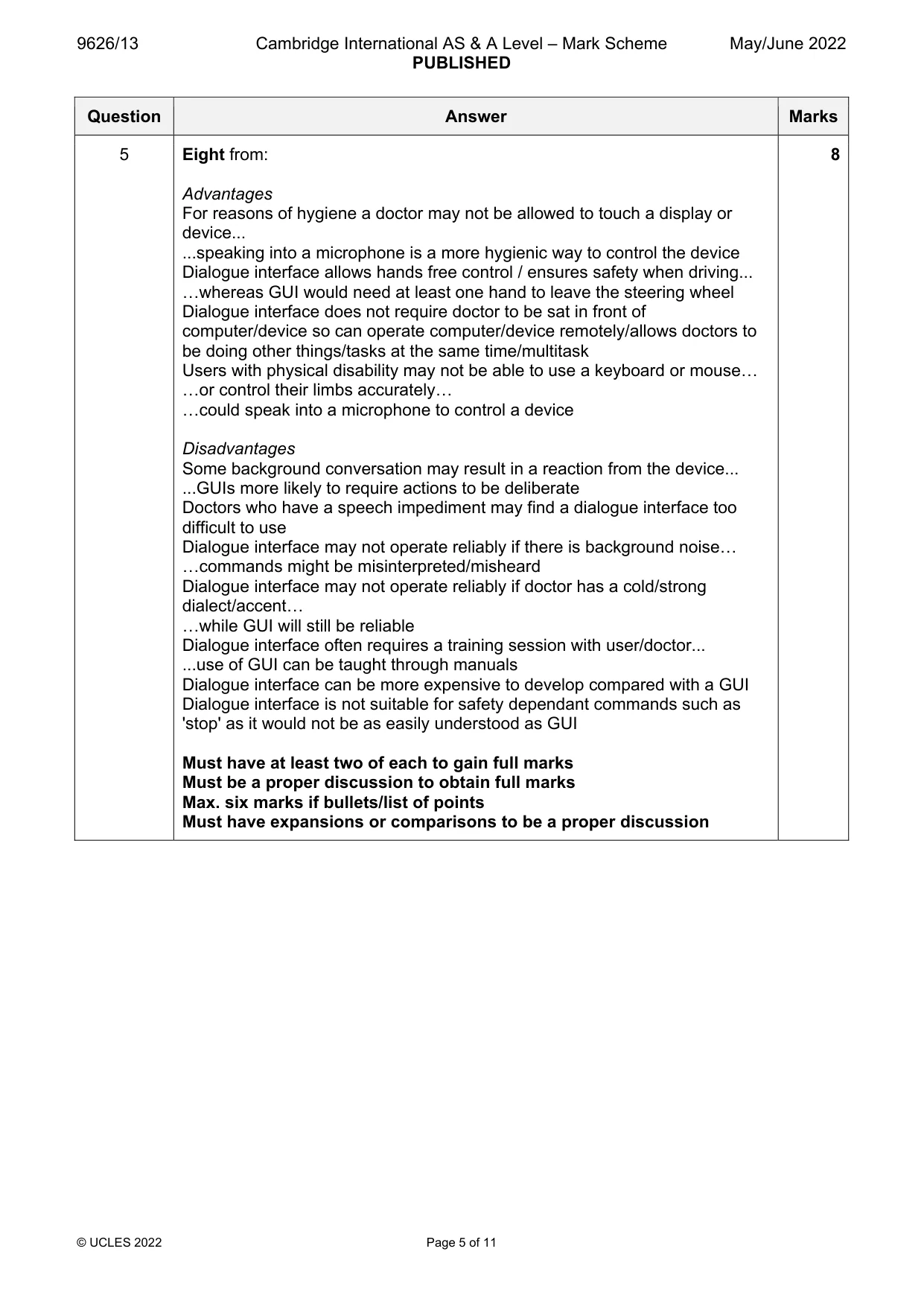
9626/13 Cambridge International AS & A Level – Mark Scheme PUBLISHED May/June 2022 © UCLES 2022 Page 5 of 11 Question Answer Marks 5 Eight from: Advantages For reasons of hygiene a doctor may not be allowed to touch a display or device... ...speaking into a microphone is a more hygienic way to control the device Dialogue interface allows hands free control / ensures safety when driving... …whereas GUI would need at least one hand to leave the steering wheel Dialogue interface does not require doctor to be sat in front of computer/device so can operate computer/device remotely/allows doctors to be doing other things/tasks at the same time/multitask Users with physical disability may not be able to use a keyboard or mouse… …or control their limbs accurately… …could speak into a microphone to control a device Disadvantages Some background conversation may result in a reaction from the device... ...GUIs more likely to require actions to be deliberate Doctors who have a speech impediment may find a dialogue interface too difficult to use Dialogue interface may not operate reliably if there is background noise… …commands might be misinterpreted/misheard Dialogue interface may not operate reliably if doctor has a cold/strong dialect/accent… …while GUI will still be reliable Dialogue interface often requires a training session with user/doctor... ...use of GUI can be taught through manuals Dialogue interface can be more expensive to develop compared with a GUI Dialogue interface is not suitable for safety dependant commands such as 'stop' as it would not be as easily understood as GUI Must have at least two of each to gain full marks Must be a proper discussion to obtain full marks Max. six marks if bullets/list of points Must have expansions or comparisons to be a proper discussion 8
Mark scheme, page 6
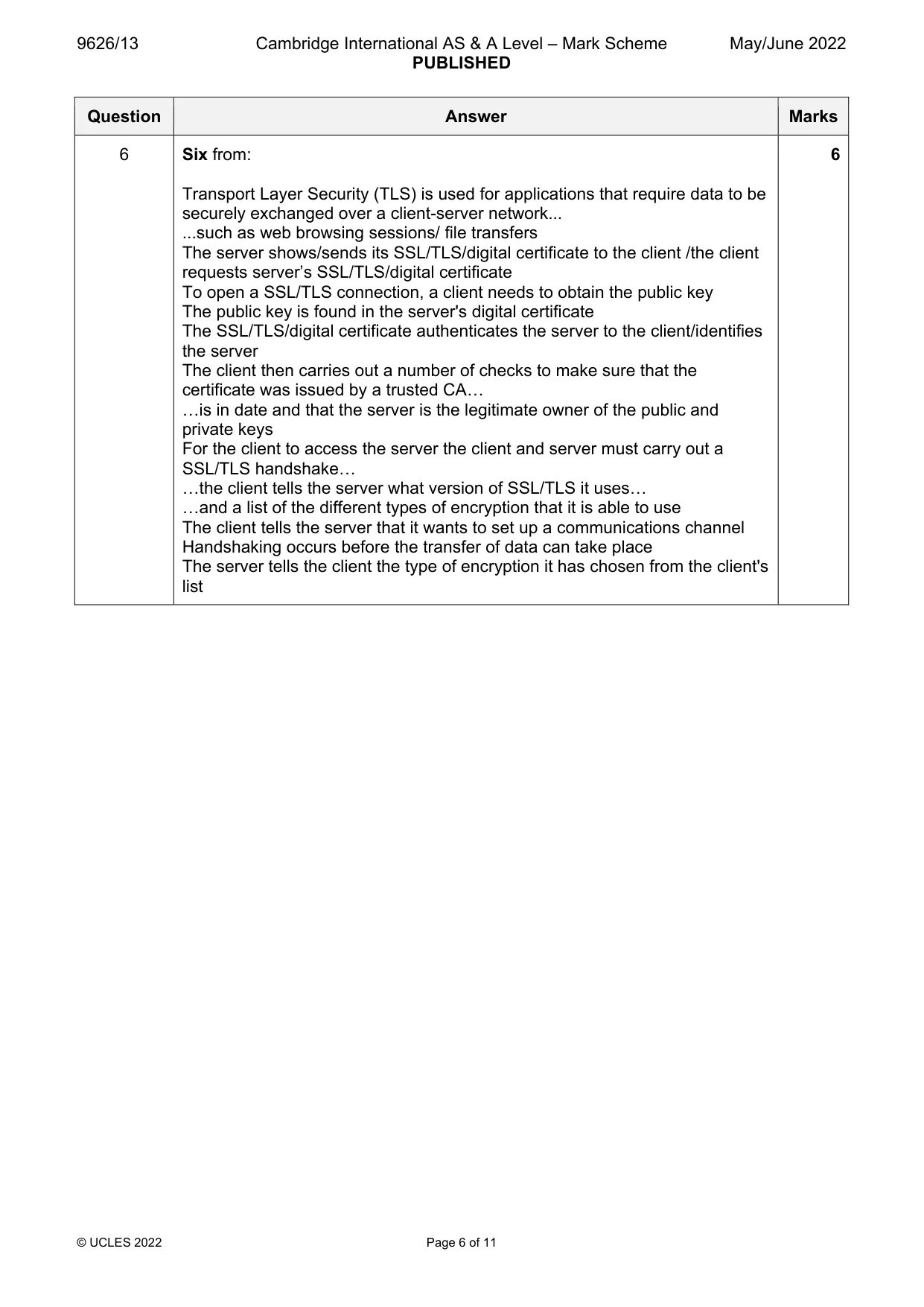
9626/13 Cambridge International AS & A Level – Mark Scheme PUBLISHED May/June 2022 © UCLES 2022 Page 6 of 11 Question Answer Marks 6 Six from: Transport Layer Security (TLS) is used for applications that require data to be securely exchanged over a client-server network... ...such as web browsing sessions/ file transfers The server shows/sends its SSL/TLS/digital certificate to the client /the client requests server’s SSL/TLS/digital certificate To open a SSL/TLS connection, a client needs to obtain the public key The public key is found in the server's digital certificate The SSL/TLS/digital certificate authenticates the server to the client/identifies the server The client then carries out a number of checks to make sure that the certificate was issued by a trusted CA… …is in date and that the server is the legitimate owner of the public and private keys For the client to access the server the client and server must carry out a SSL/TLS handshake… …the client tells the server what version of SSL/TLS it uses… …and a list of the different types of encryption that it is able to use The client tells the server that it wants to set up a communications channel Handshaking occurs before the transfer of data can take place The server tells the client the type of encryption it has chosen from the client's list 6
Mark scheme, page 7
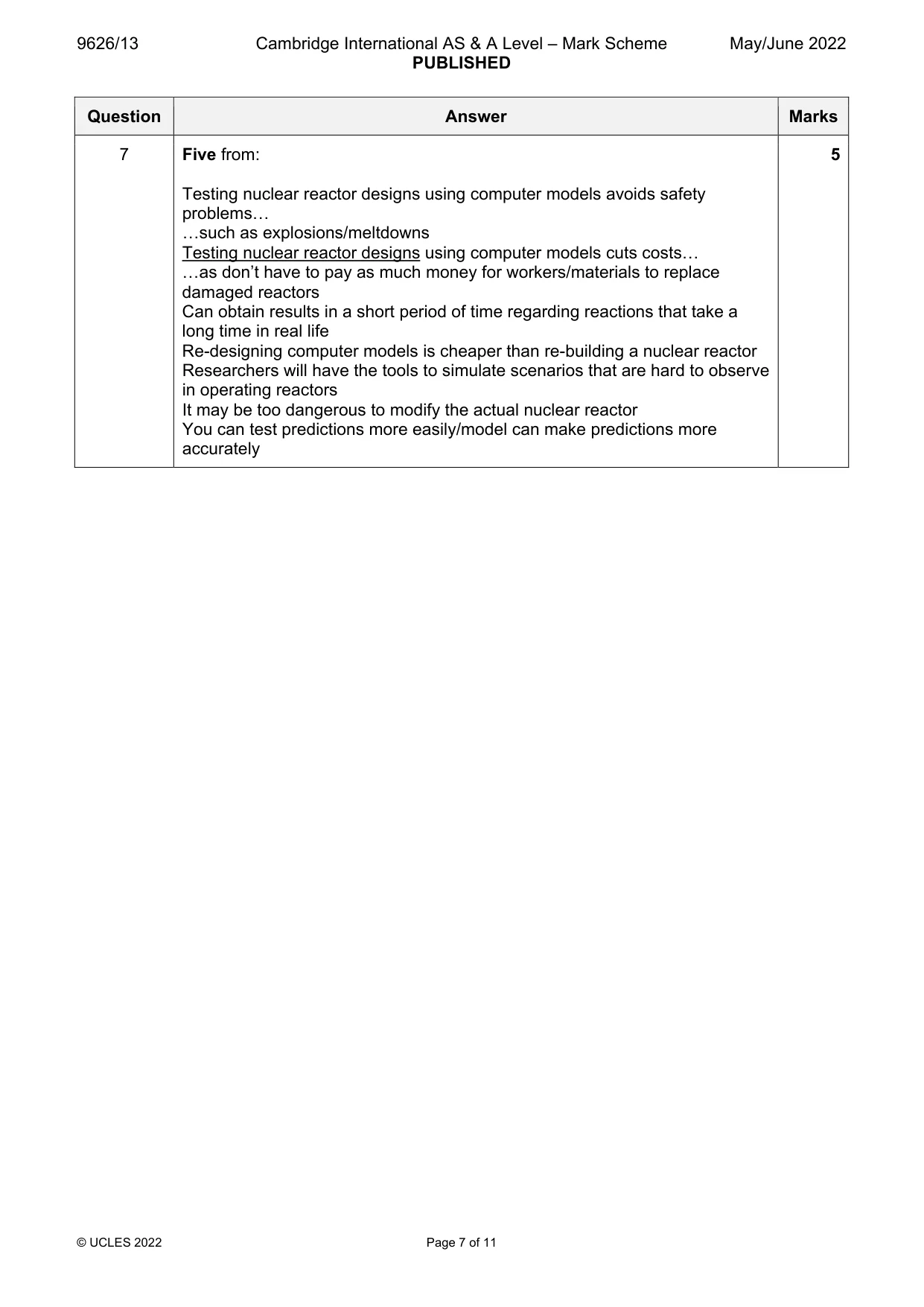
9626/13 Cambridge International AS & A Level – Mark Scheme PUBLISHED May/June 2022 © UCLES 2022 Page 7 of 11 Question Answer Marks 7 Five from: Testing nuclear reactor designs using computer models avoids safety problems… …such as explosions/meltdowns Testing nuclear reactor designs using computer models cuts costs… …as don’t have to pay as much money for workers/materials to replace damaged reactors Can obtain results in a short period of time regarding reactions that take a long time in real life Re-designing computer models is cheaper than re-building a nuclear reactor Researchers will have the tools to simulate scenarios that are hard to observe in operating reactors It may be too dangerous to modify the actual nuclear reactor You can test predictions more easily/model can make predictions more accurately 5
Mark scheme, page 8
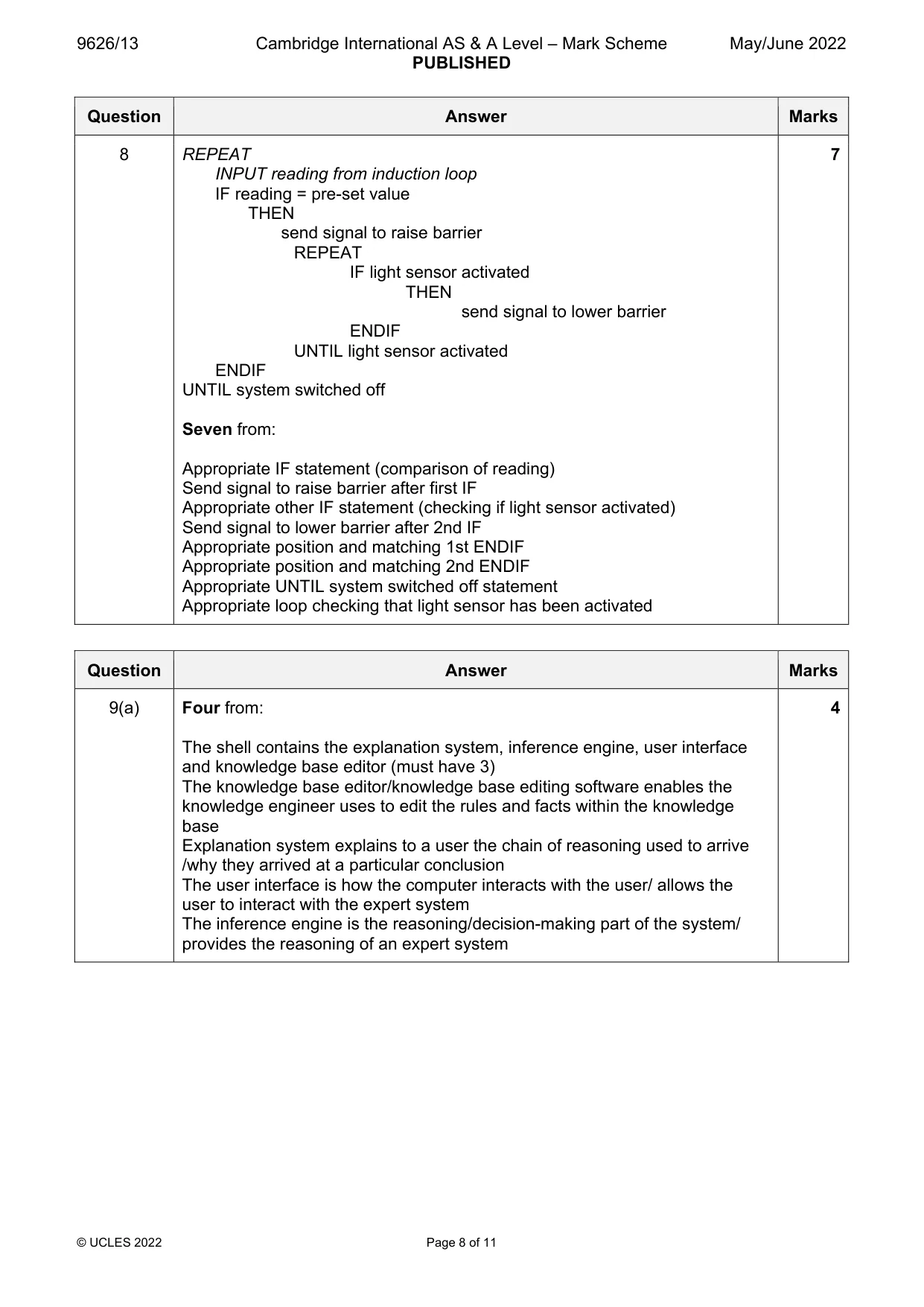
9626/13 Cambridge International AS & A Level – Mark Scheme PUBLISHED May/June 2022 © UCLES 2022 Page 8 of 11 Question Answer Marks 8 REPEAT INPUT reading from induction loop IF reading = pre-set value THEN send signal to raise barrier REPEAT IF light sensor activated THEN send signal to lower barrier ENDIF UNTIL light sensor activated ENDIF UNTIL system switched off Seven from: Appropriate IF statement (comparison of reading) Send signal to raise barrier after first IF Appropriate other IF statement (checking if light sensor activated) Send signal to lower barrier after 2nd IF Appropriate position and matching 1st ENDIF Appropriate position and matching 2nd ENDIF Appropriate UNTIL system switched off statement Appropriate loop checking that light sensor has been activated 7 Question Answer Marks 9(a) Four from: The shell contains the explanation system, inference engine, user interface and knowledge base editor (must have 3) The knowledge base editor/knowledge base editing software enables the knowledge engineer uses to edit the rules and facts within the knowledge base Explanation system explains to a user the chain of reasoning used to arrive /why they arrived at a particular conclusion The user interface is how the computer interacts with the user/ allows the user to interact with the expert system The inference engine is the reasoning/decision-making part of the system/ provides the reasoning of an expert system 4
Mark scheme, page 9
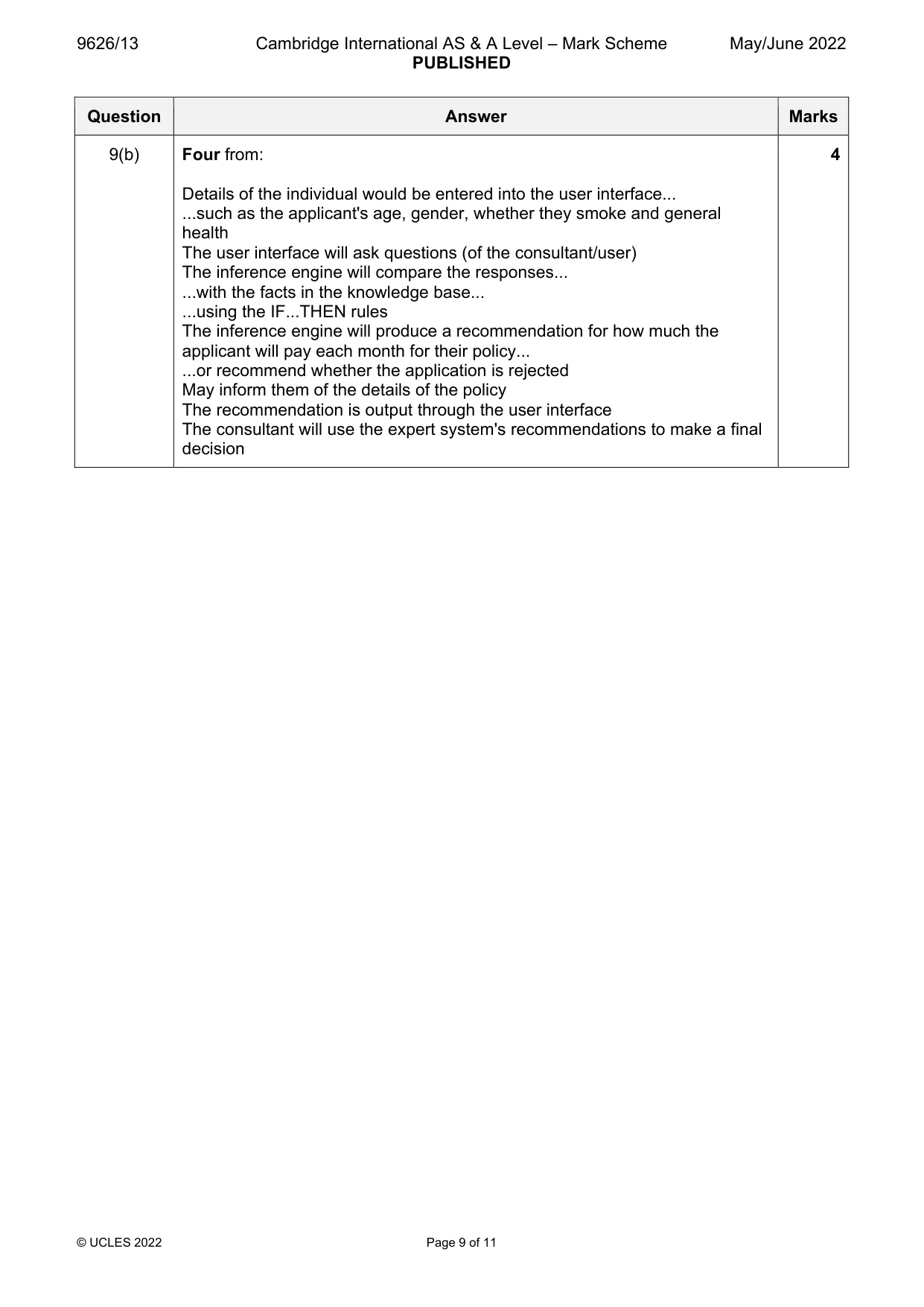
9626/13 Cambridge International AS & A Level – Mark Scheme PUBLISHED May/June 2022 © UCLES 2022 Page 9 of 11 Question Answer Marks 9(b) Four from: Details of the individual would be entered into the user interface... ...such as the applicant's age, gender, whether they smoke and general health The user interface will ask questions (of the consultant/user) The inference engine will compare the responses... ...with the facts in the knowledge base... ...using the IF...THEN rules The inference engine will produce a recommendation for how much the applicant will pay each month for their policy... ...or recommend whether the application is rejected May inform them of the details of the policy The recommendation is output through the user interface The consultant will use the expert system's recommendations to make a final decision 4
Mark scheme, page 10
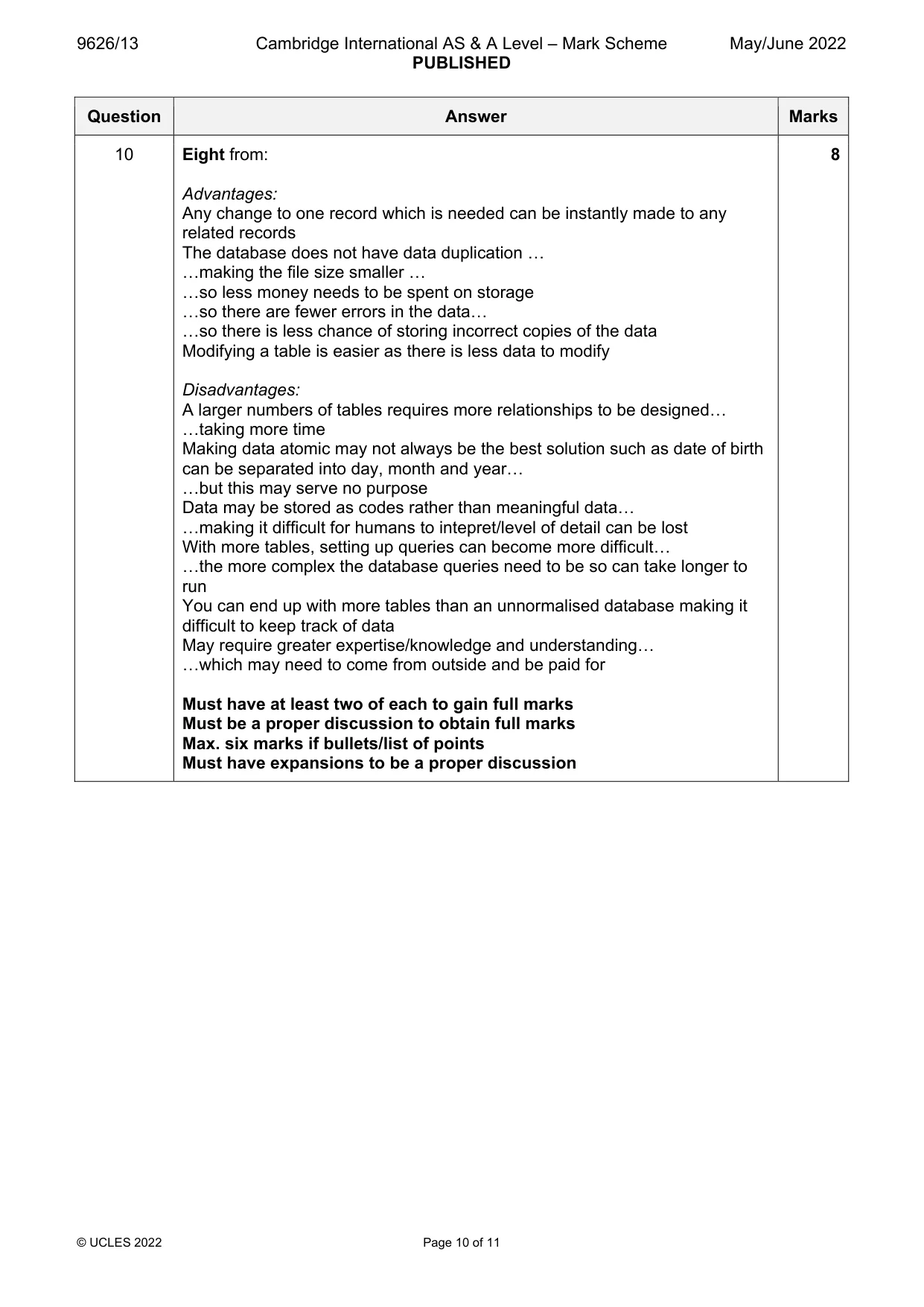
9626/13 Cambridge International AS & A Level – Mark Scheme PUBLISHED May/June 2022 © UCLES 2022 Page 10 of 11 Question Answer Marks 10 Eight from: Advantages: Any change to one record which is needed can be instantly made to any related records The database does not have data duplication … …making the file size smaller … …so less money needs to be spent on storage …so there are fewer errors in the data… …so there is less chance of storing incorrect copies of the data Modifying a table is easier as there is less data to modify Disadvantages: A larger numbers of tables requires more relationships to be designed… …taking more time Making data atomic may not always be the best solution such as date of birth can be separated into day, month and year… …but this may serve no purpose Data may be stored as codes rather than meaningful data… …making it difficult for humans to intepret/level of detail can be lost With more tables, setting up queries can become more difficult… …the more complex the database queries need to be so can take longer to run You can end up with more tables than an unnormalised database making it difficult to keep track of data May require greater expertise/knowledge and understanding… …which may need to come from outside and be paid for Must have at least two of each to gain full marks Must be a proper discussion to obtain full marks Max. six marks if bullets/list of points Must have expansions to be a proper discussion 8
Mark scheme, page 11
9626/13 Cambridge International AS & A Level – Mark Scheme PUBLISHED May/June 2022 © UCLES 2022 Page 11 of 11 Question Answer Marks 11 Initialise count – 1 mark Initialise total – 1 mark total ← total + number – 1 mark count ← count 1 – 1 mark is count = 6 – 1 mark PRINT total – 1 mark yes and no in correct positions – 1 mark 7 Start count ← 0 total ← 0 INPUT number count ← count + 1 total ← total + number is count = 6? no yes PRINT total Stop
What you needed in this session
Cambridge’s own grade thresholds for 2022 May/June, Paper 1 · Variant 3. A higher threshold means an easier paper — the bar moves with how the cohort did.