Cambridge A Level Information Technology (from 2017) 9626 — 2023 May/June Paper 1 · Variant 3
9626/13/M/J/23 · 70 marks · ≈79 min
The question paper and its mark scheme, free to read here and free to download. This is Cambridge’s own paper, exactly as it was sat.
Question paper12 pages







Mark scheme9 pages
Answers below. Sit the paper first if you are practising.

Paper as text
Question paper, page 1
This document has 12 pages. Any blank pages are indicated. [Turn over Cambridge International AS & A Level DC (CE/FC) 314580/2 © UCLES 2023 INFORMATION TECHNOLOGY 9626/13 Paper 1 Theory May/June 2023 1 hour 45 minutes You must answer on the question paper. No additional materials are needed. INSTRUCTIONS ● Answer all questions. ● Use a black or dark blue pen. ● Write your name, centre number and candidate number in the boxes at the top of the page. ● Write your answer to each question in the space provided. ● Do not use an erasable pen or correction fluid. ● Do not write on any bar codes. ● You may use an HB pencil for any diagrams, graphs or rough working. ● Calculators must not be used in this paper. INFORMATION ● The total mark for this paper is 70. ● The number of marks for each question or part question is shown in brackets [ ]. * 2 6 0 0 2 0 2 2 1 2 *
Question paper, page 2
2 9626/13/M/J/23 © UCLES 2023 1 Describe what is involved in data logging. … … … … … … … … … … [4] 2 Explain the purpose of the SSL/TLS protocol. … … … … … … … … … … … … [5]
Question paper, page 3
3 9626/13/M/J/23 © UCLES 2023 [Turn over 3 There are different types of processing including batch processing and real-time processing. (a) Without referring to master files and transaction files, describe what is meant by batch processing. … … … … … … … … [3] (b) Rocket guidance systems are used in space exploration. Explain why a rocket guidance system is an example of the use of real-time processing. … … … … … … … … [3]
Question paper, page 4
4 9626/13/M/J/23 © UCLES 2023 4 One of the functions of an operating system is to maintain the security of a computer system. Describe the other functions of an operating system. … … … … … … … … … … … … … … … … … … … … [8]
Question paper, page 5
5 9626/13/M/J/23 © UCLES 2023 [Turn over 5 Justify the use of Information Technology for monitoring the environment. … … … … … … … … … … … … … … … … … … … … [8]
Question paper, page 6
6 9626/13/M/J/23 © UCLES 2023 6 A computer-controlled traffic light system controls the flow of motor vehicles and pedestrians. Describe the inputs, processing and outputs involved in this system. … … … … … … … … … … … … … … … … … … … … [8]
Question paper, page 7
7 9626/13/M/J/23 © UCLES 2023 [Turn over 7 Explain the reasons for the digital divide between the old and the young. … … … … … … … … … … … … … … [6] 8 Spyware is a type of malware. Describe the consequences to the individual of the use of spyware on their computer. … … … … … … … … … … [4]
Question paper, page 8
8 9626/13/M/J/23 © UCLES 2023 9 Discuss the advantages and disadvantages of using a gesture-based user interface rather than a graphical user interface to control devices. … … … … … … … … … … … … … … … … … … … … [8]
Question paper, page 9
9 9626/13/M/J/23 © UCLES 2023 [Turn over 10 An expert system is being trialled for use as part of a study on animal identification. It has been set the following task. The goal is to decide the colour of a bird named Hortense. Two facts are provided: • she sings • she is 15 cm tall. The rule base contains the following three rules: • IF X is an ostrich – THEN X has a long neck • IF X sings and X is 15 cm tall – THEN X is a canary • IF X is a canary – THEN X is yellow The inference engine has concluded that Hortense is yellow. It has taken the facts as data and used the rules base to decide: 1 Hortense is a canary 2 Hortense is yellow (a) Identify which type of chaining the inference engine used. … … [1] (b) Explain the reasoning the inference engine used. … … … … … … … … … … [4]
Question paper, page 10
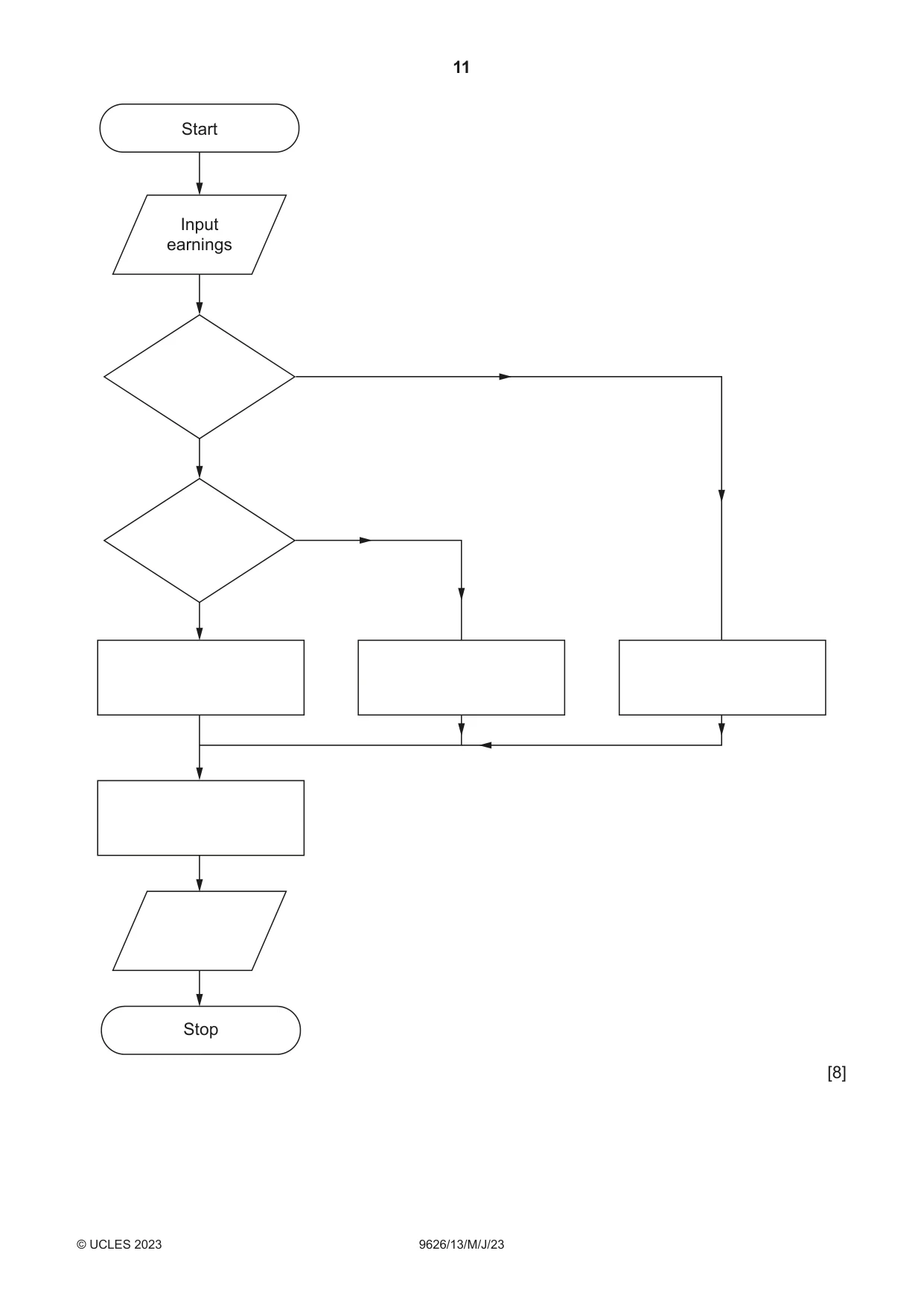
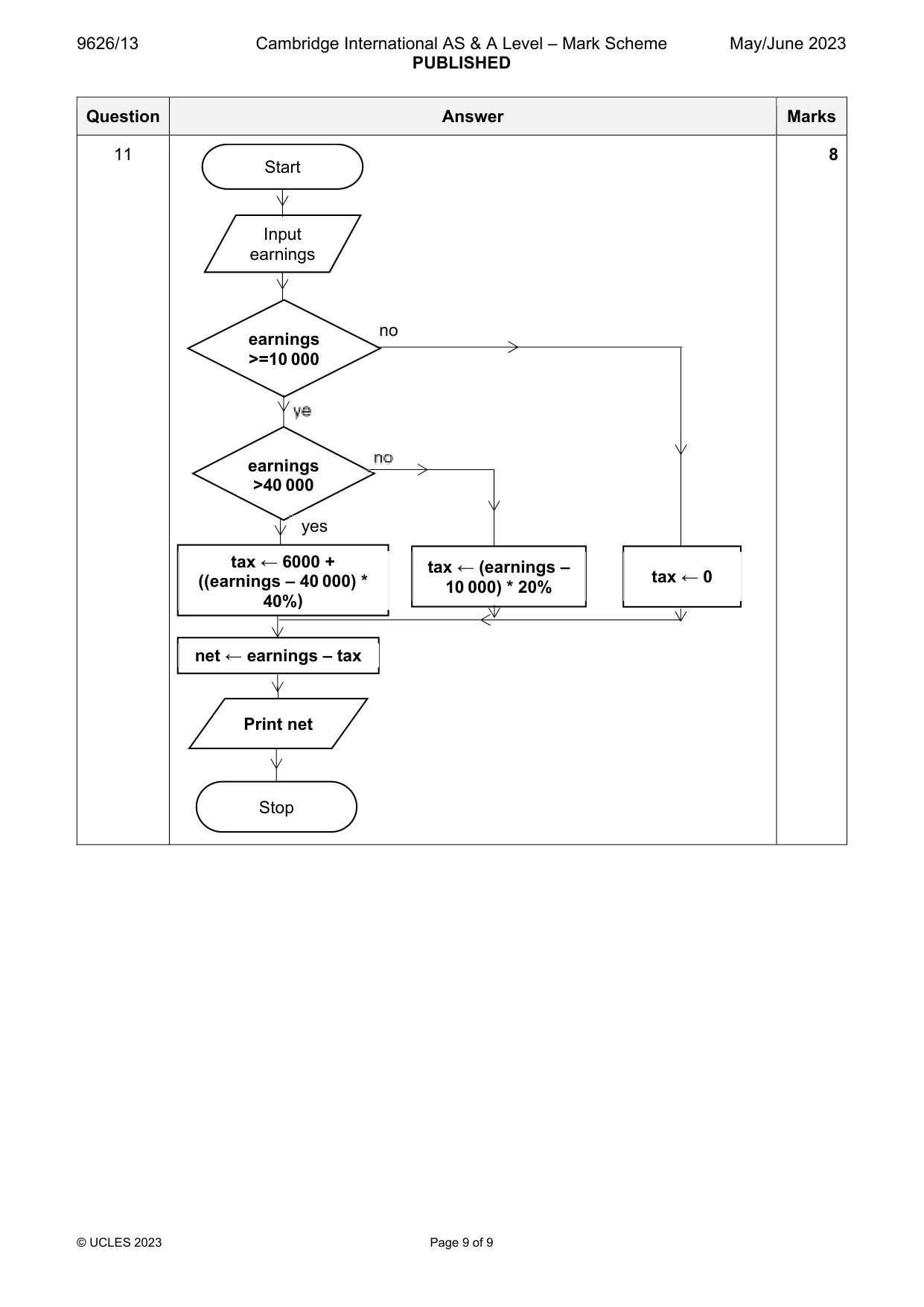
10 9626/13/M/J/23 © UCLES 2023 11 In Ruritania these are the tax rules. • People who earn up to $10 000 pay no tax. • People who earn between $10 000 and $40 000 pay 20% tax on their earnings above $10 000. • People who earn more than $40 000: pay $6 000 ($30 000 × 20%) and pay 40% tax on their earnings above $40 000. Complete this flowchart which shows how the net wage (the money earned after tax is paid) is calculated and is output for an individual in Ruritania.
Question paper, page 11
11 9626/13/M/J/23 © UCLES 2023 Start Stop Input earnings [8]
Question paper, page 12
12 9626/13/M/J/23 © UCLES 2023 Permission to reproduce items where third-party owned material protected by copyright is included has been sought and cleared where possible. Every reasonable effort has been made by the publisher (UCLES) to trace copyright holders, but if any items requiring clearance have unwittingly been included, the publisher will be pleased to make amends at the earliest possible opportunity. To avoid the issue of disclosure of answer-related information to candidates, all copyright acknowledgements are reproduced online in the Cambridge Assessment International Education Copyright Acknowledgements Booklet. This is produced for each series of examinations and is freely available to download at www.cambridgeinternational.org after the live examination series. Cambridge Assessment International Education is part of Cambridge Assessment. Cambridge Assessment is the brand name of the University of Cambridge Local Examinations Syndicate (UCLES), which is a department of the University of Cambridge. BLANK PAGE
Mark scheme, page 1
This document consists of 9 printed pages. © UCLES 2023 [Turn over Cambridge International AS & A Level INFORMATION TECHNOLOGY 9626/13 Paper 1 Theory May/June 2023 MARK SCHEME Maximum Mark: 70 Published This mark scheme is published as an aid to teachers and candidates, to indicate the requirements of the examination. It shows the basis on which Examiners were instructed to award marks. It does not indicate the details of the discussions that took place at an Examiners’ meeting before marking began, which would have considered the acceptability of alternative answers. Mark schemes should be read in conjunction with the question paper and the Principal Examiner Report for Teachers. Cambridge International will not enter into discussions about these mark schemes. Cambridge International is publishing the mark schemes for the May/June 2023 series for most Cambridge IGCSE, Cambridge International A and AS Level and Cambridge Pre-U components, and some Cambridge O Level components.
Mark scheme, page 2
9626/13 Cambridge International AS & A Level – Mark Scheme PUBLISHED May/June 2023 © UCLES 2023 Page 2 of 9 Generic Marking Principles These general marking principles must be applied by all examiners when marking candidate answers. They should be applied alongside the specific content of the mark scheme or generic level descriptors for a question. Each question paper and mark scheme will also comply with these marking principles. GENERIC MARKING PRINCIPLE 1: Marks must be awarded in line with: the specific content of the mark scheme or the generic level descriptors for the question the specific skills defined in the mark scheme or in the generic level descriptors for the question the standard of response required by a candidate as exemplified by the standardisation scripts. GENERIC MARKING PRINCIPLE 2: Marks awarded are always whole marks (not half marks, or other fractions). GENERIC MARKING PRINCIPLE 3: Marks must be awarded positively: marks are awarded for correct/valid answers, as defined in the mark scheme. However, credit is given for valid answers which go beyond the scope of the syllabus and mark scheme, referring to your Team Leader as appropriate marks are awarded when candidates clearly demonstrate what they know and can do marks are not deducted for errors marks are not deducted for omissions answers should only be judged on the quality of spelling, punctuation and grammar when these features are specifically assessed by the question as indicated by the mark scheme. The meaning, however, should be unambiguous. GENERIC MARKING PRINCIPLE 4: Rules must be applied consistently, e.g. in situations where candidates have not followed instructions or in the application of generic level descriptors. GENERIC MARKING PRINCIPLE 5: Marks should be awarded using the full range of marks defined in the mark scheme for the question (however; the use of the full mark range may be limited according to the quality of the candidate responses seen). GENERIC MARKING PRINCIPLE 6: Marks awarded are based solely on the requirements as defined in the mark scheme. Marks should not be awarded with grade thresholds or grade descriptors in mind.
Mark scheme, page 3
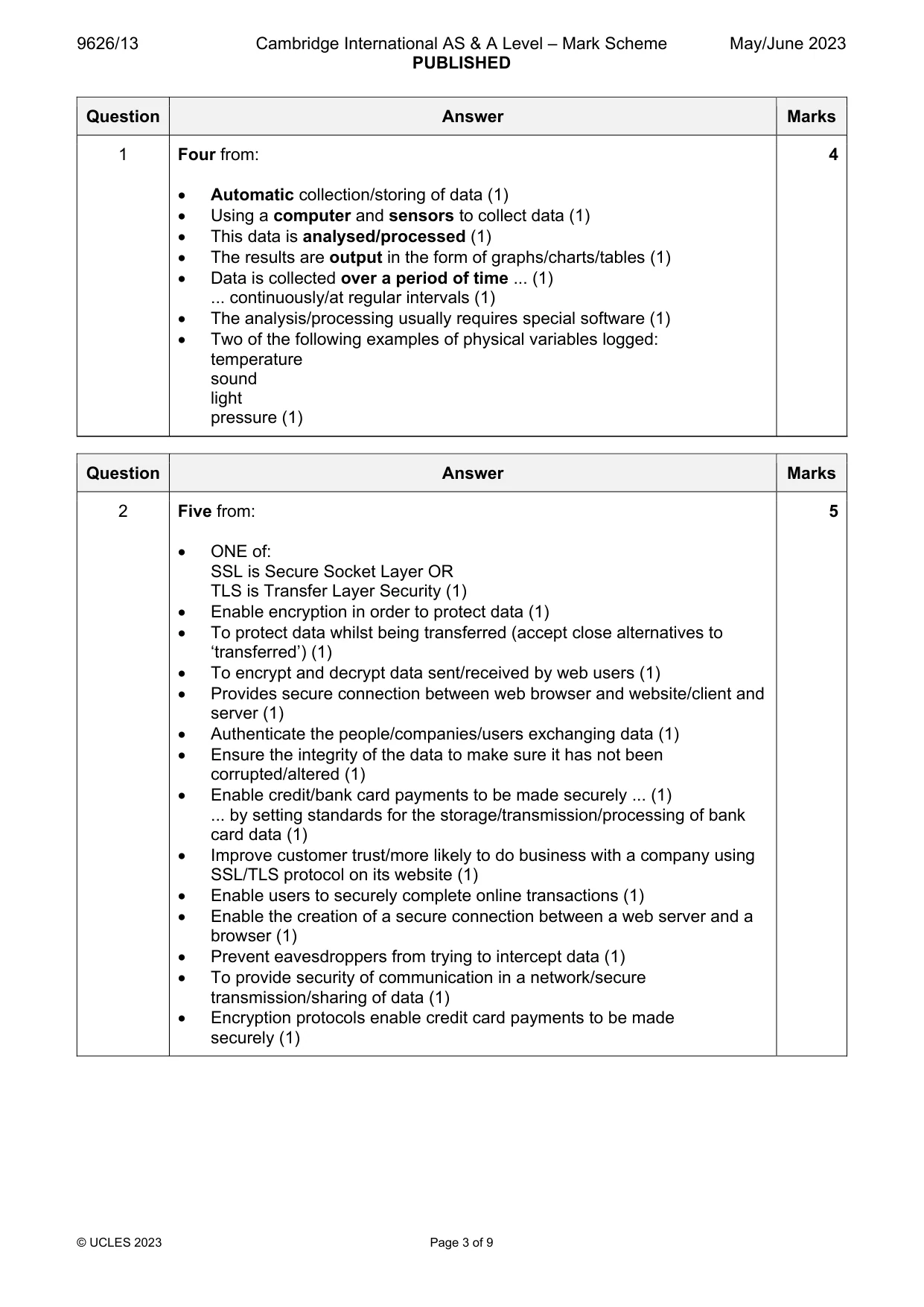
9626/13 Cambridge International AS & A Level – Mark Scheme PUBLISHED May/June 2023 © UCLES 2023 Page 3 of 9 Question Answer Marks 1 Four from: Automatic collection/storing of data (1) Using a computer and sensors to collect data (1) This data is analysed/processed (1) The results are output in the form of graphs/charts/tables (1) Data is collected over a period of time ... (1) ... continuously/at regular intervals (1) The analysis/processing usually requires special software (1) Two of the following examples of physical variables logged: temperature sound light pressure (1) 4 Question Answer Marks 2 Five from: ONE of: SSL is Secure Socket Layer OR TLS is Transfer Layer Security (1) Enable encryption in order to protect data (1) To protect data whilst being transferred (accept close alternatives to ‘transferred’) (1) To encrypt and decrypt data sent/received by web users (1) Provides secure connection between web browser and website/client and server (1) Authenticate the people/companies/users exchanging data (1) Ensure the integrity of the data to make sure it has not been corrupted/altered (1) Enable credit/bank card payments to be made securely ... (1) ... by setting standards for the storage/transmission/processing of bank card data (1) Improve customer trust/more likely to do business with a company using SSL/TLS protocol on its website (1) Enable users to securely complete online transactions (1) Enable the creation of a secure connection between a web server and a browser (1) Prevent eavesdroppers from trying to intercept data (1) To provide security of communication in a network/secure transmission/sharing of data (1) Encryption protocols enable credit card payments to be made securely (1) 5
Mark scheme, page 4
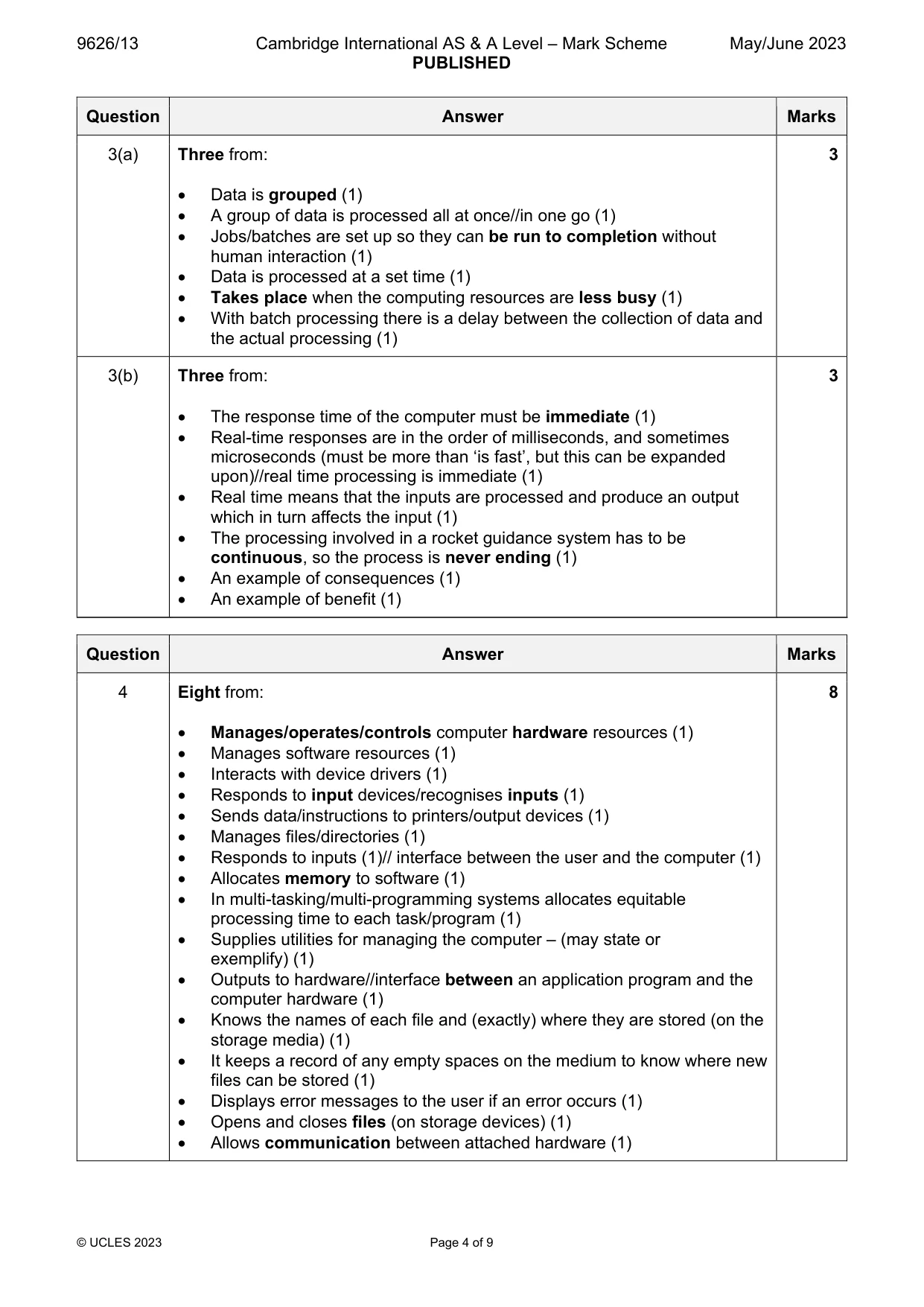
9626/13 Cambridge International AS & A Level – Mark Scheme PUBLISHED May/June 2023 © UCLES 2023 Page 4 of 9 Question Answer Marks 3(a) Three from: Data is grouped (1) A group of data is processed all at once//in one go (1) Jobs/batches are set up so they can be run to completion without human interaction (1) Data is processed at a set time (1) Takes place when the computing resources are less busy (1) With batch processing there is a delay between the collection of data and the actual processing (1) 3 3(b) Three from: The response time of the computer must be immediate (1) Real-time responses are in the order of milliseconds, and sometimes microseconds (must be more than ‘is fast’, but this can be expanded upon)//real time processing is immediate (1) Real time means that the inputs are processed and produce an output which in turn affects the input (1) The processing involved in a rocket guidance system has to be continuous, so the process is never ending (1) An example of consequences (1) An example of benefit (1) 3 Question Answer Marks 4 Eight from: Manages/operates/controls computer hardware resources (1) Manages software resources (1) Interacts with device drivers (1) Responds to input devices/recognises inputs (1) Sends data/instructions to printers/output devices (1) Manages files/directories (1) Responds to inputs (1)// interface between the user and the computer (1) Allocates memory to software (1) In multi-tasking/multi-programming systems allocates equitable processing time to each task/program (1) Supplies utilities for managing the computer – (may state or exemplify) (1) Outputs to hardware//interface between an application program and the computer hardware (1) Knows the names of each file and (exactly) where they are stored (on the storage media) (1) It keeps a record of any empty spaces on the medium to know where new files can be stored (1) Displays error messages to the user if an error occurs (1) Opens and closes files (on storage devices) (1) Allows communication between attached hardware (1) 8
Mark scheme, page 5
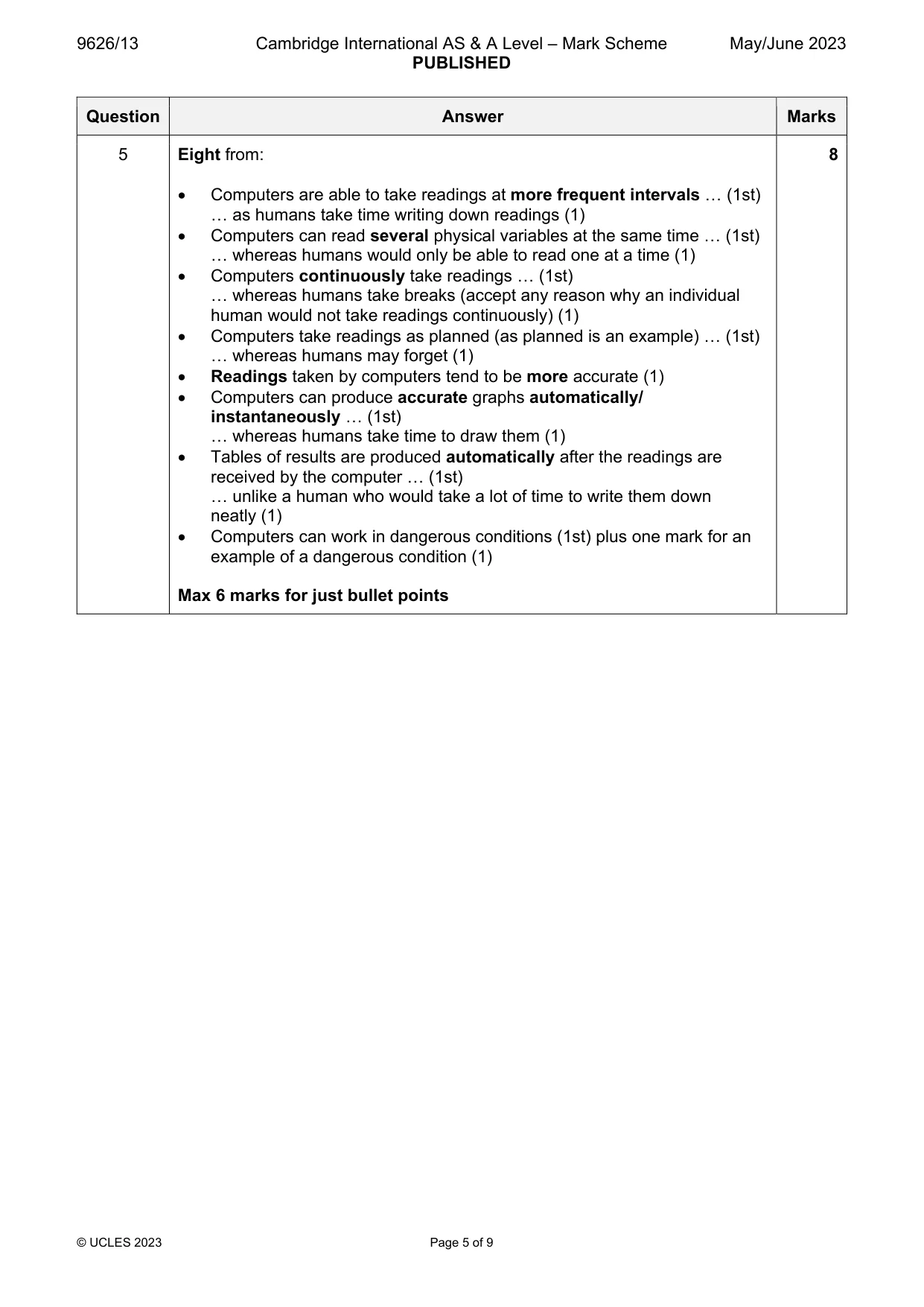
9626/13 Cambridge International AS & A Level – Mark Scheme PUBLISHED May/June 2023 © UCLES 2023 Page 5 of 9 Question Answer Marks 5 Eight from: Computers are able to take readings at more frequent intervals … (1st) … as humans take time writing down readings (1) Computers can read several physical variables at the same time … (1st) … whereas humans would only be able to read one at a time (1) Computers continuously take readings … (1st) … whereas humans take breaks (accept any reason why an individual human would not take readings continuously) (1) Computers take readings as planned (as planned is an example) … (1st) … whereas humans may forget (1) Readings taken by computers tend to be more accurate (1) Computers can produce accurate graphs automatically/ instantaneously … (1st) … whereas humans take time to draw them (1) Tables of results are produced automatically after the readings are received by the computer … (1st) … unlike a human who would take a lot of time to write them down neatly (1) Computers can work in dangerous conditions (1st) plus one mark for an example of a dangerous condition (1) Max 6 marks for just bullet points 8
Mark scheme, page 6
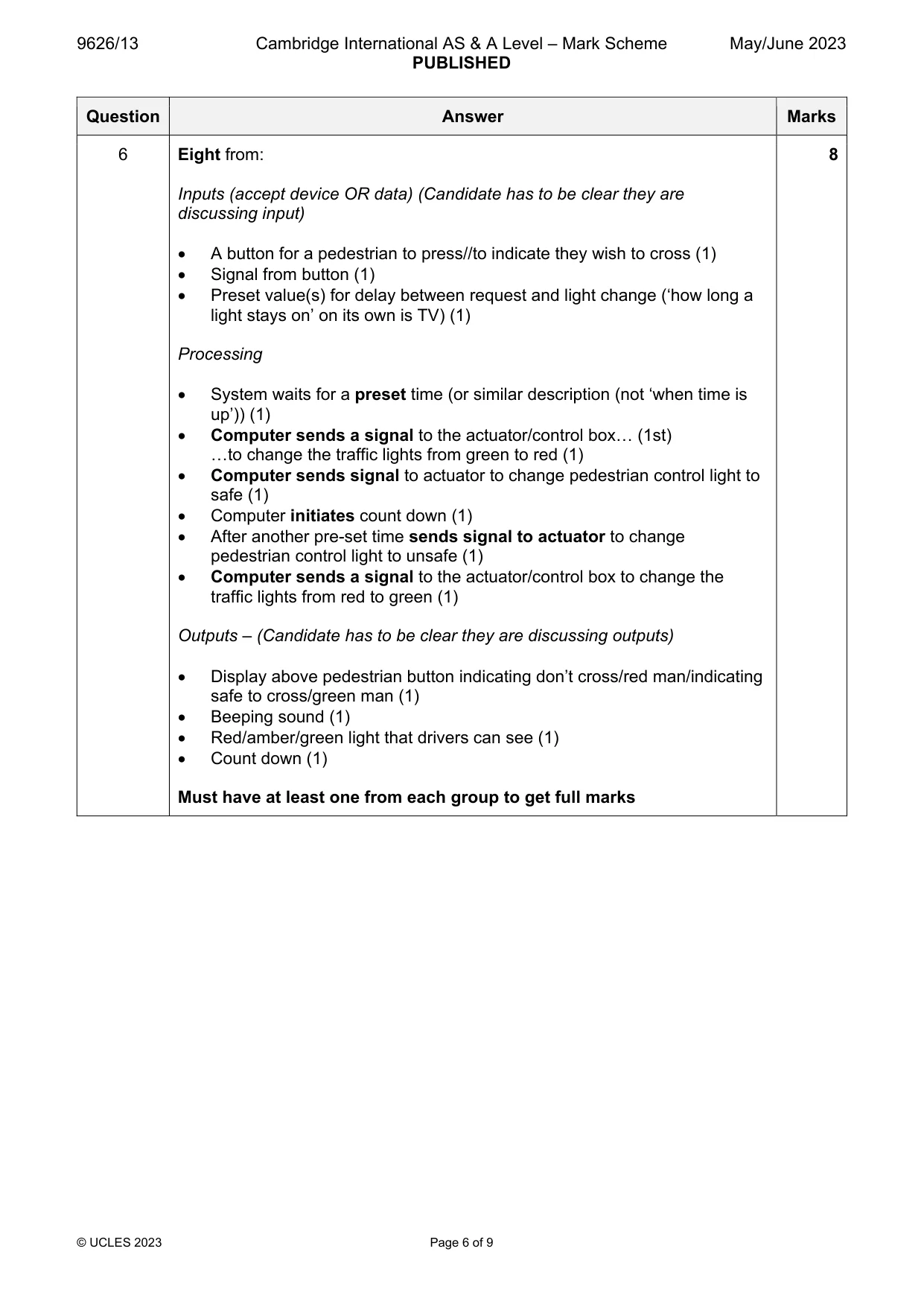
9626/13 Cambridge International AS & A Level – Mark Scheme PUBLISHED May/June 2023 © UCLES 2023 Page 6 of 9 Question Answer Marks 6 Eight from: Inputs (accept device OR data) (Candidate has to be clear they are discussing input) A button for a pedestrian to press//to indicate they wish to cross (1) Signal from button (1) Preset value(s) for delay between request and light change (‘how long a light stays on’ on its own is TV) (1) Processing System waits for a preset time (or similar description (not ‘when time is up’)) (1) Computer sends a signal to the actuator/control box… (1st) …to change the traffic lights from green to red (1) Computer sends signal to actuator to change pedestrian control light to safe (1) Computer initiates count down (1) After another pre-set time sends signal to actuator to change pedestrian control light to unsafe (1) Computer sends a signal to the actuator/control box to change the traffic lights from red to green (1) Outputs – (Candidate has to be clear they are discussing outputs) Display above pedestrian button indicating don’t cross/red man/indicating safe to cross/green man (1) Beeping sound (1) Red/amber/green light that drivers can see (1) Count down (1) Must have at least one from each group to get full marks 8
Mark scheme, page 7
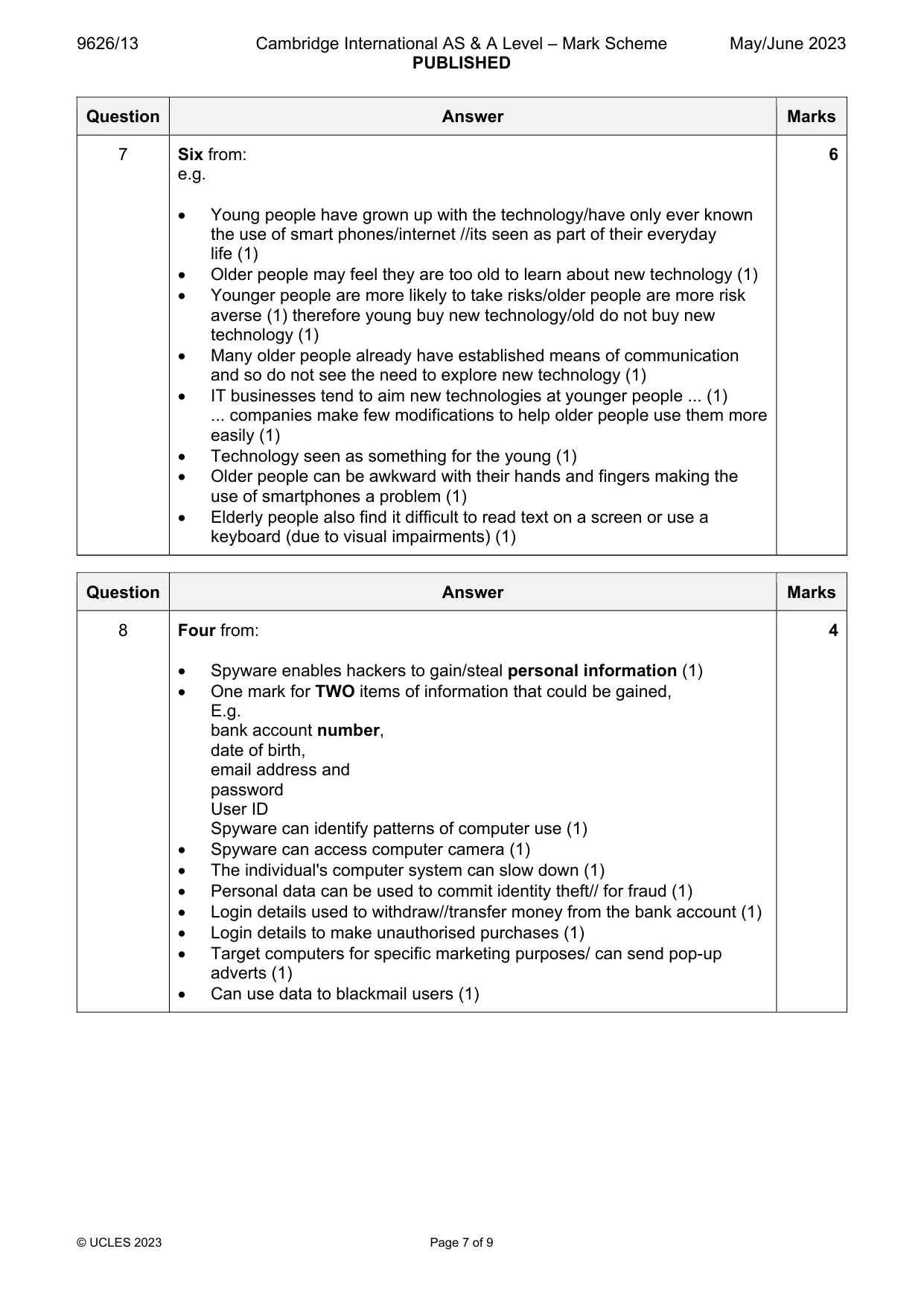
9626/13 Cambridge International AS & A Level – Mark Scheme PUBLISHED May/June 2023 © UCLES 2023 Page 7 of 9 Question Answer Marks 7 Six from: e.g. Young people have grown up with the technology/have only ever known the use of smart phones/internet //its seen as part of their everyday life (1) Older people may feel they are too old to learn about new technology (1) Younger people are more likely to take risks/older people are more risk averse (1) therefore young buy new technology/old do not buy new technology (1) Many older people already have established means of communication and so do not see the need to explore new technology (1) IT businesses tend to aim new technologies at younger people ... (1) ... companies make few modifications to help older people use them more easily (1) Technology seen as something for the young (1) Older people can be awkward with their hands and fingers making the use of smartphones a problem (1) Elderly people also find it difficult to read text on a screen or use a keyboard (due to visual impairments) (1) 6 Question Answer Marks 8 Four from: Spyware enables hackers to gain/steal personal information (1) One mark for TWO items of information that could be gained, E.g. bank account number, date of birth, email address and password User ID Spyware can identify patterns of computer use (1) Spyware can access computer camera (1) The individual's computer system can slow down (1) Personal data can be used to commit identity theft// for fraud (1) Login details used to withdraw//transfer money from the bank account (1) Login details to make unauthorised purchases (1) Target computers for specific marketing purposes/ can send pop-up adverts (1) Can use data to blackmail users (1) 4
Mark scheme, page 8
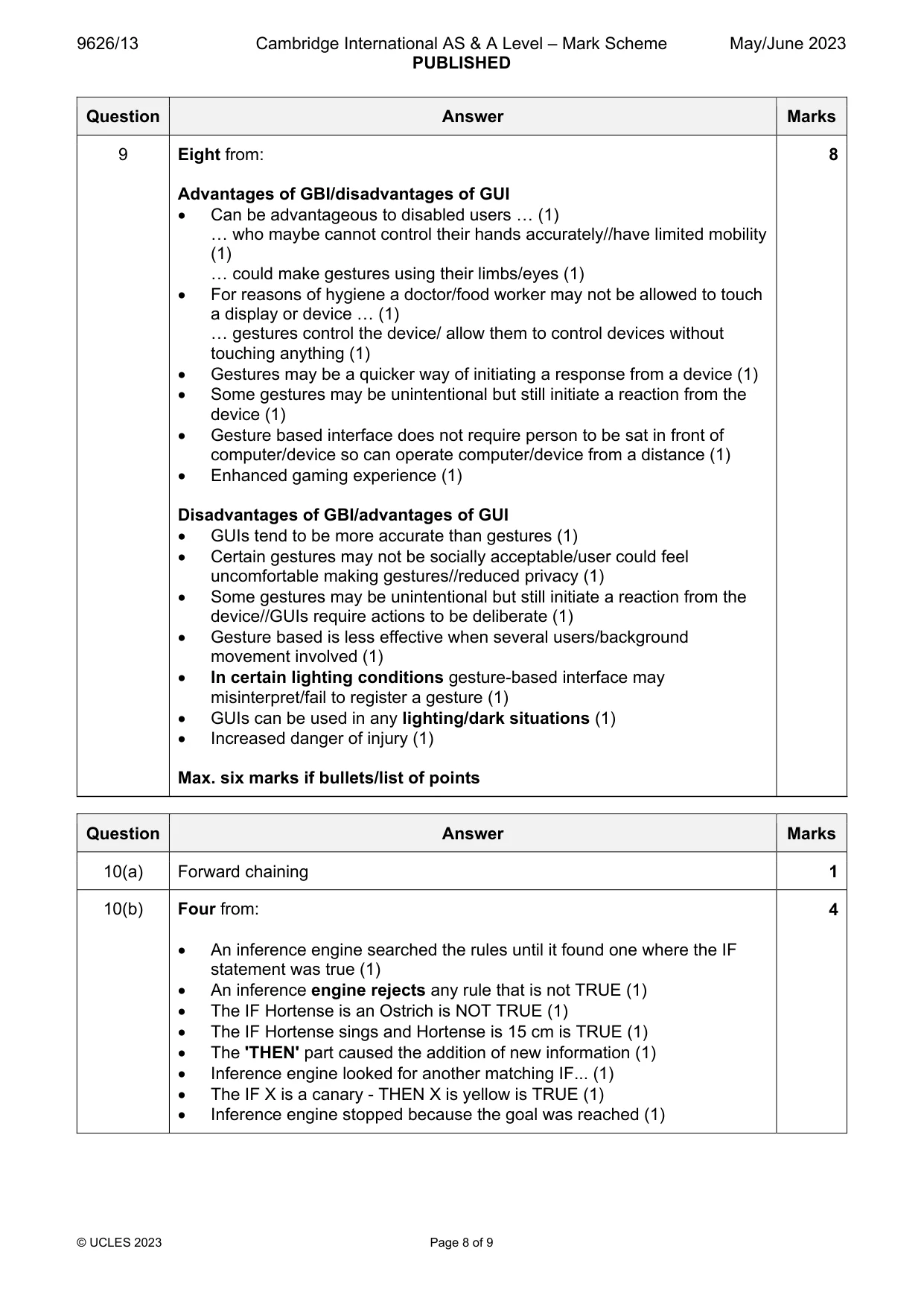
9626/13 Cambridge International AS & A Level – Mark Scheme PUBLISHED May/June 2023 © UCLES 2023 Page 8 of 9 Question Answer Marks 9 Eight from: Advantages of GBI/disadvantages of GUI Can be advantageous to disabled users … (1) … who maybe cannot control their hands accurately//have limited mobility (1) … could make gestures using their limbs/eyes (1) For reasons of hygiene a doctor/food worker may not be allowed to touch a display or device … (1) … gestures control the device/ allow them to control devices without touching anything (1) Gestures may be a quicker way of initiating a response from a device (1) Some gestures may be unintentional but still initiate a reaction from the device (1) Gesture based interface does not require person to be sat in front of computer/device so can operate computer/device from a distance (1) Enhanced gaming experience (1) Disadvantages of GBI/advantages of GUI GUIs tend to be more accurate than gestures (1) Certain gestures may not be socially acceptable/user could feel uncomfortable making gestures//reduced privacy (1) Some gestures may be unintentional but still initiate a reaction from the device//GUIs require actions to be deliberate (1) Gesture based is less effective when several users/background movement involved (1) In certain lighting conditions gesture-based interface may misinterpret/fail to register a gesture (1) GUIs can be used in any lighting/dark situations (1) Increased danger of injury (1) Max. six marks if bullets/list of points 8 Question Answer Marks 10(a) Forward chaining 1 10(b) Four from: An inference engine searched the rules until it found one where the IF statement was true (1) An inference engine rejects any rule that is not TRUE (1) The IF Hortense is an Ostrich is NOT TRUE (1) The IF Hortense sings and Hortense is 15 cm is TRUE (1) The 'THEN' part caused the addition of new information (1) Inference engine looked for another matching IF... (1) The IF X is a canary - THEN X is yellow is TRUE (1) Inference engine stopped because the goal was reached (1) 4
Mark scheme, page 9
9626/13 Cambridge International AS & A Level – Mark Scheme PUBLISHED May/June 2023 © UCLES 2023 Page 9 of 9 Question Answer Marks 11 8 ye no no Print net earnings >40 000 Input earnings earnings >=10 000 Start yes tax ← (earnings – 10 000) * 20% tax ← 6000 + ((earnings – 40 000) * 40%) Stop tax ← 0 net ← earnings – tax
What you needed in this session
Cambridge’s own grade thresholds for 2023 May/June, Paper 1 · Variant 3. A higher threshold means an easier paper — the bar moves with how the cohort did.