Cambridge A Level Information Technology (from 2017) 9626 — 2023 Oct/Nov Paper 1 · Variant 1
9626/11/O/N/23 · 70 marks · ≈79 min
The question paper and its mark scheme, free to read here and free to download. This is Cambridge’s own paper, exactly as it was sat.
Question paper12 pages




Mark scheme10 pages
Answers below. Sit the paper first if you are practising.
Paper as text
Question paper, page 1
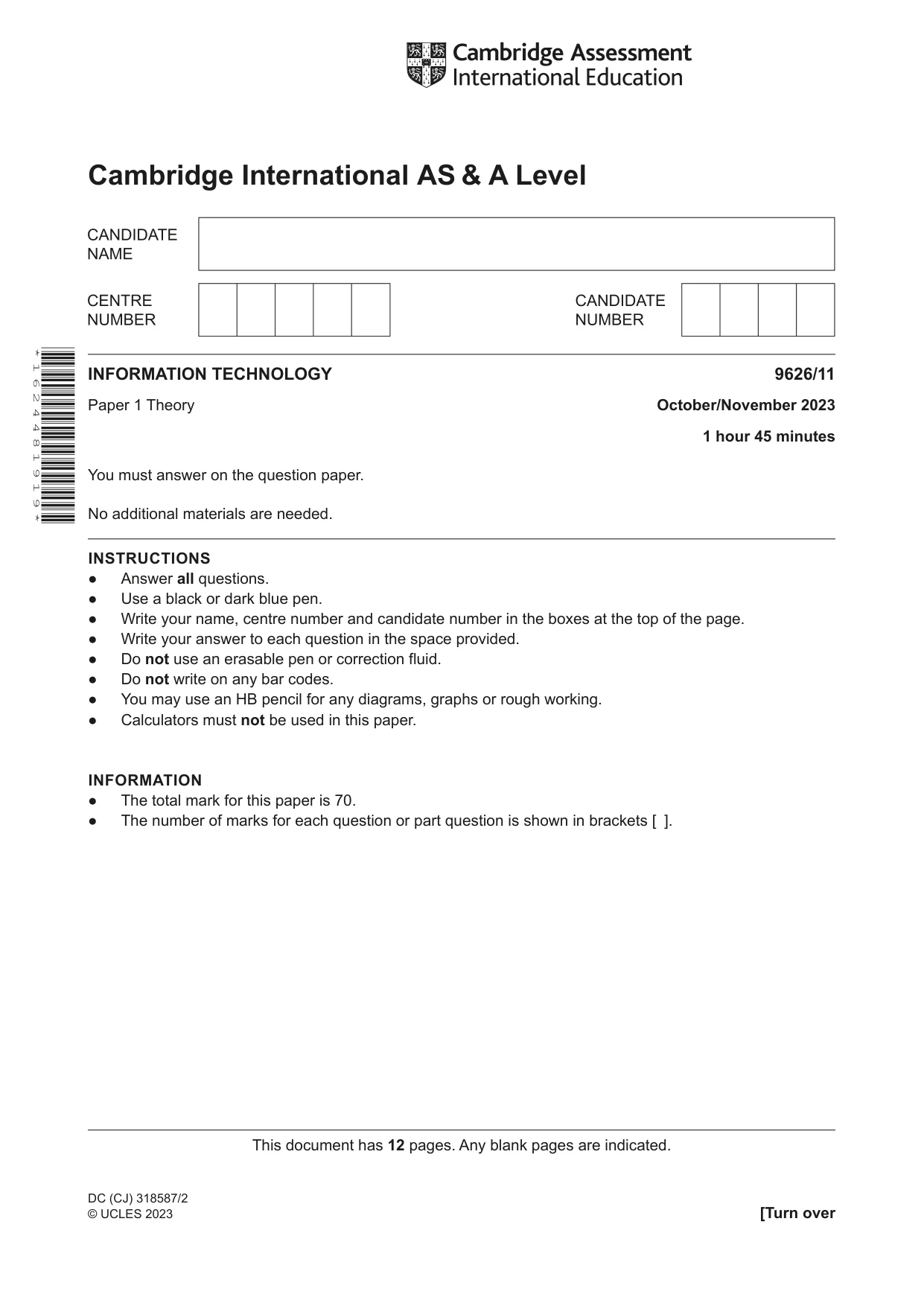
This document has 12 pages. Any blank pages are indicated. [Turn over Cambridge International AS & A Level INFORMATION TECHNOLOGY 9626/11 Paper 1 Theory October/November 2023 1 hour 45 minutes You must answer on the question paper. No additional materials are needed. INSTRUCTIONS ● Answer all questions. ● Use a black or dark blue pen. ● Write your name, centre number and candidate number in the boxes at the top of the page. ● Write your answer to each question in the space provided. ● Do not use an erasable pen or correction fluid. ● Do not write on any bar codes. ● You may use an HB pencil for any diagrams, graphs or rough working. ● Calculators must not be used in this paper. INFORMATION ● The total mark for this paper is 70. ● The number of marks for each question or part question is shown in brackets [ ]. * 1 6 2 4 4 8 1 9 1 9 * DC (CJ) 318587/2 © UCLES 2023
Question paper, page 2
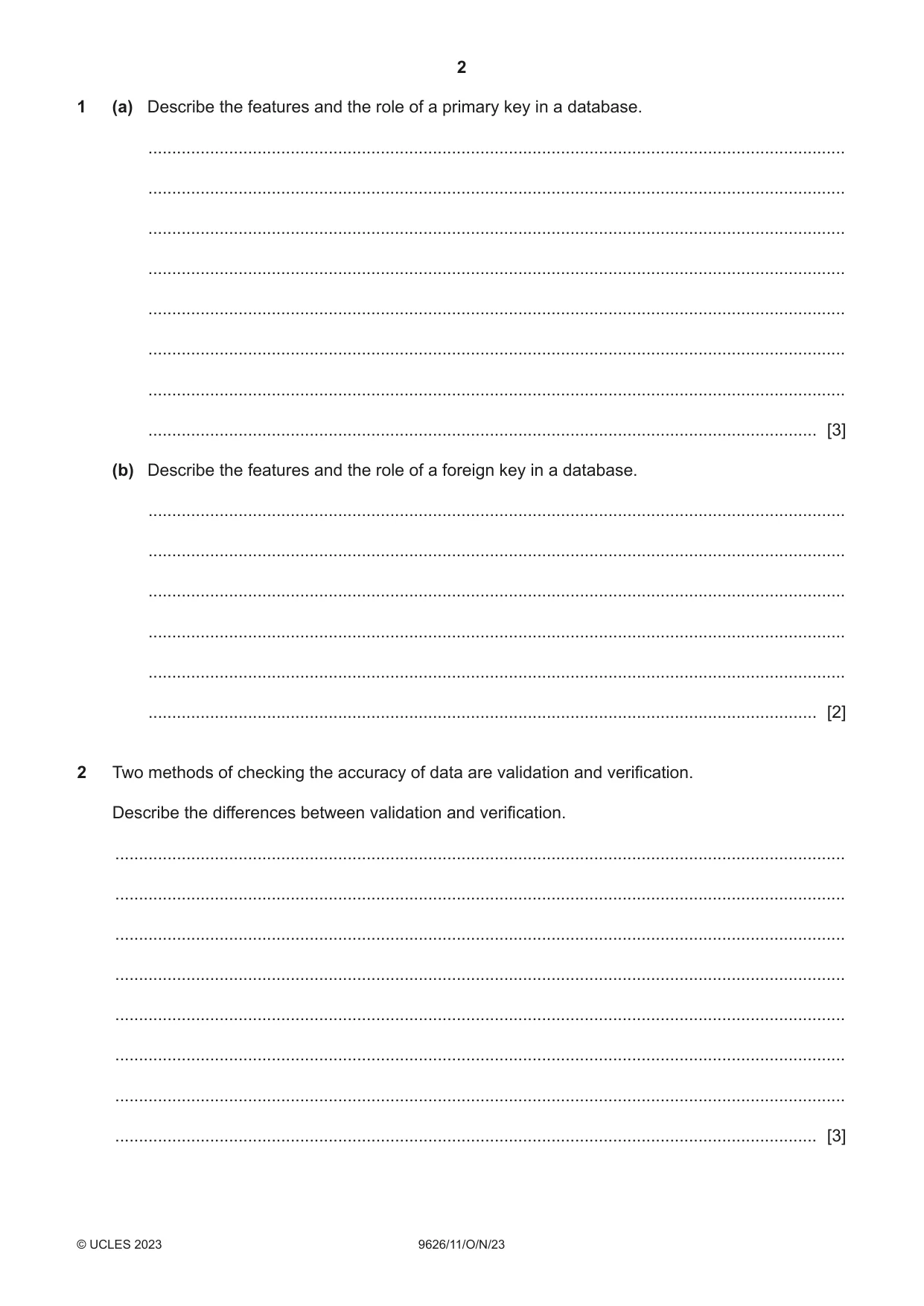
2 9626/11/O/N/23 © UCLES 2023 1 (a) Describe the features and the role of a primary key in a database. … … … … … … … … [3] (b) Describe the features and the role of a foreign key in a database. … … … … … … [2] 2 Two methods of checking the accuracy of data are validation and verification. Describe the differences between validation and verification. … … … … … … … … [3]
Question paper, page 3
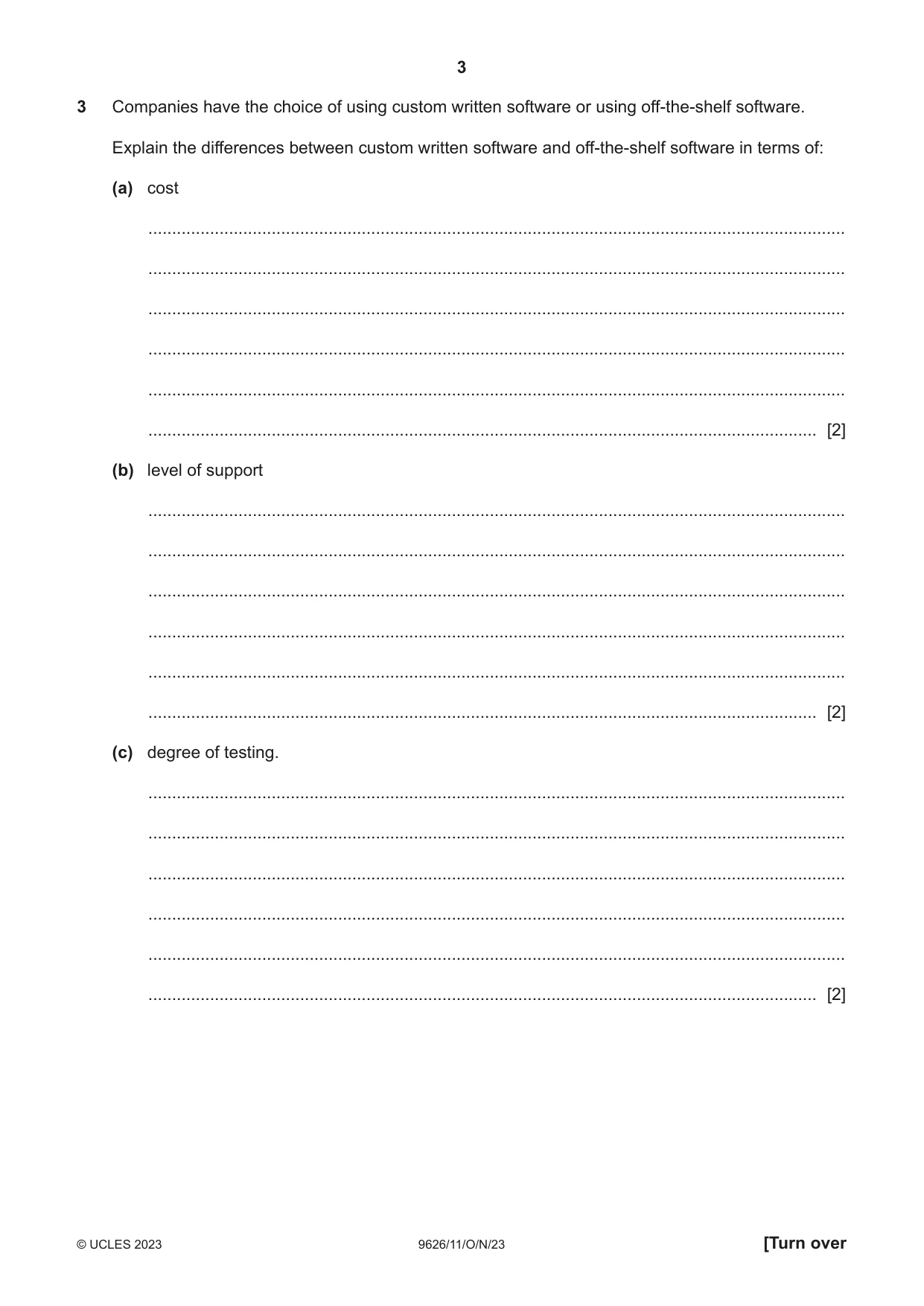
3 9626/11/O/N/23 © UCLES 2023 [Turn over 3 Companies have the choice of using custom written software or using off-the-shelf software. Explain the differences between custom written software and off-the-shelf software in terms of: (a) cost … … … … … … [2] (b) level of support … … … … … … [2] (c) degree of testing. … … … … … … [2]
Question paper, page 4
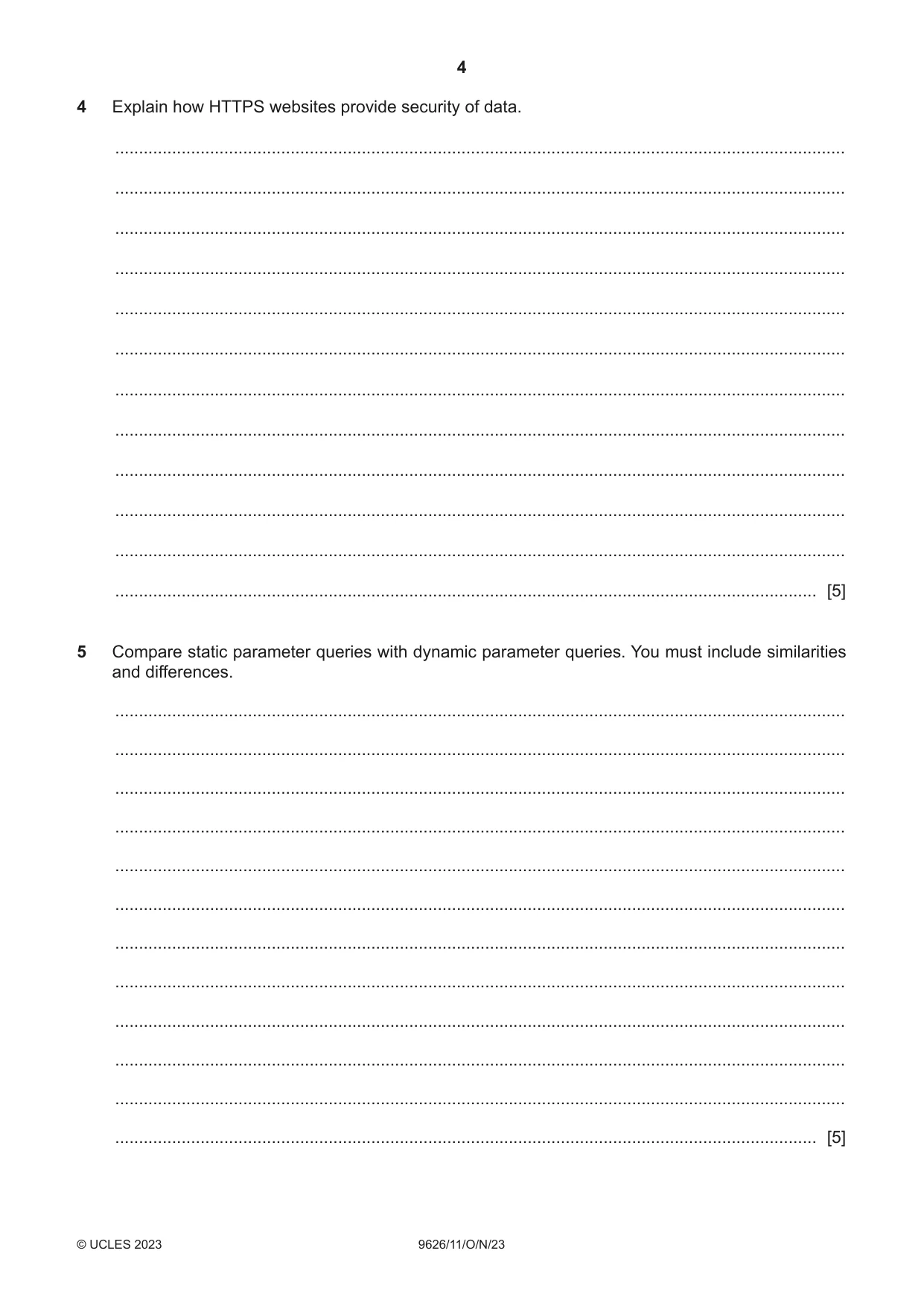
4 9626/11/O/N/23 © UCLES 2023 4 Explain how HTTPS websites provide security of data. … … … … … … … … … … … … [5] 5 Compare static parameter queries with dynamic parameter queries. You must include similarities and differences. … … … … … … … … … … … … [5]
Question paper, page 5
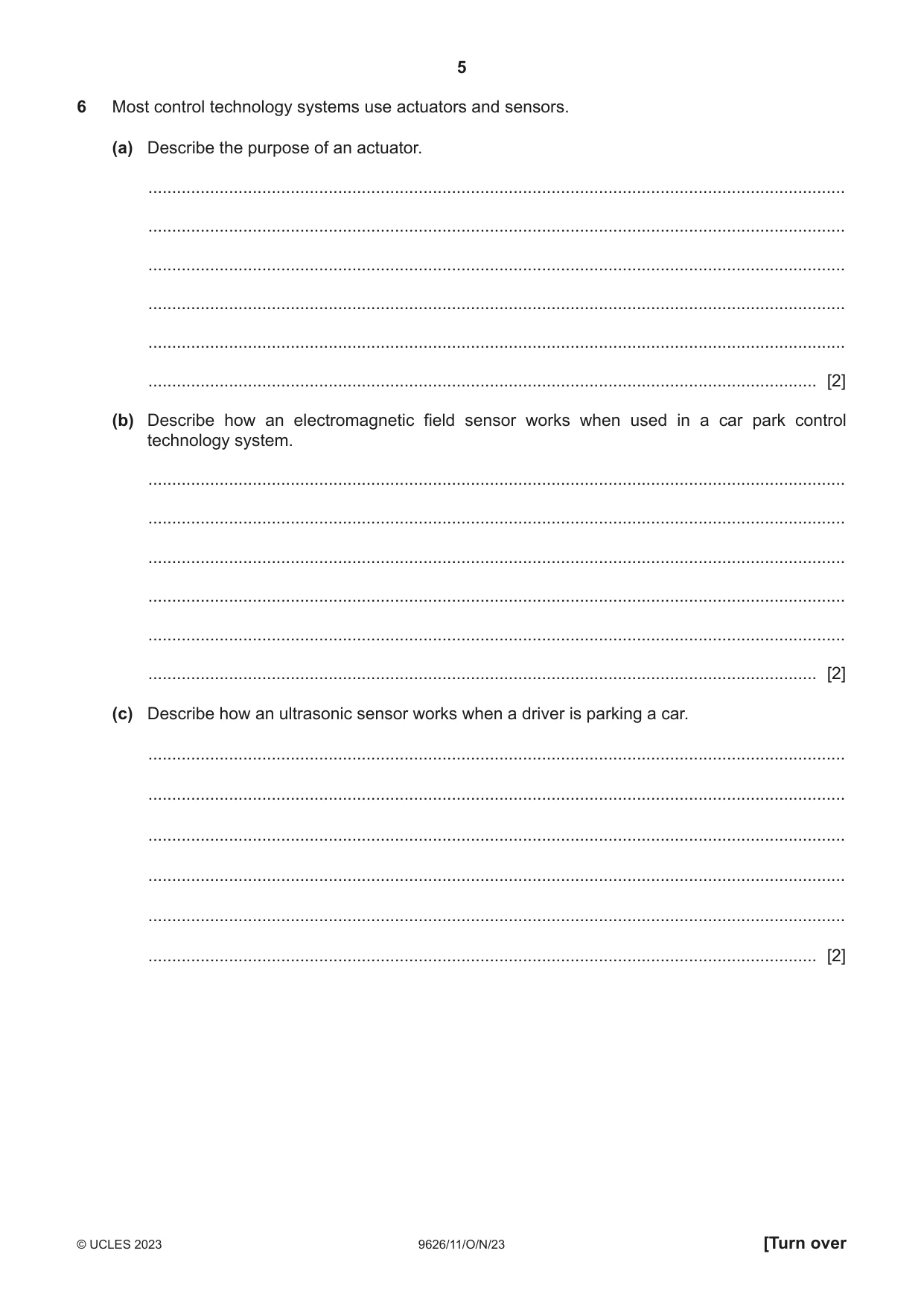
5 9626/11/O/N/23 © UCLES 2023 [Turn over 6 Most control technology systems use actuators and sensors. (a) Describe the purpose of an actuator. … … … … … … [2] (b) Describe how an electromagnetic field sensor works when used in a car park control technology system. … … … … … … [2] (c) Describe how an ultrasonic sensor works when a driver is parking a car. … … … … … … [2]
Question paper, page 6
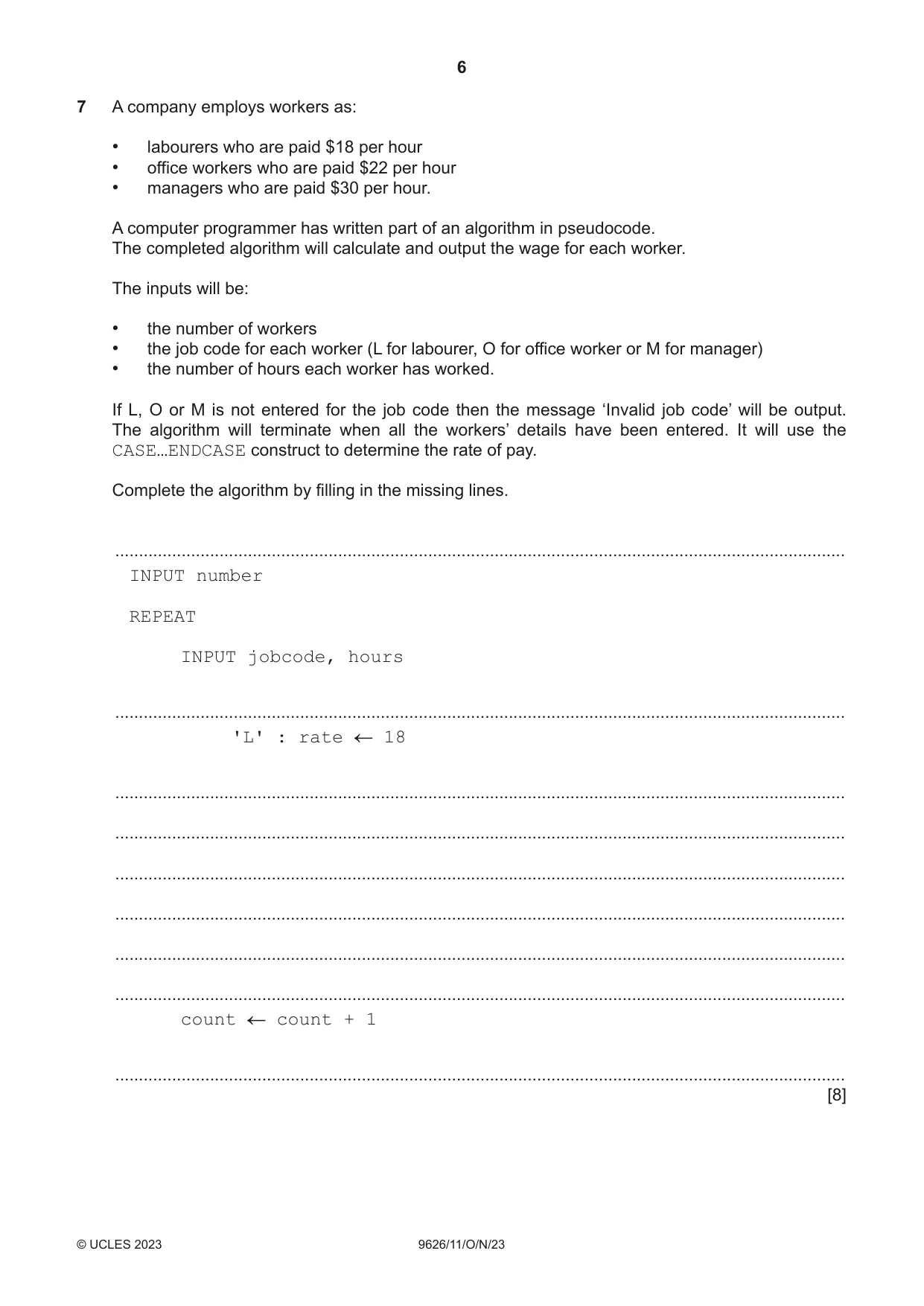
6 9626/11/O/N/23 © UCLES 2023 7 A company employs workers as: • labourers who are paid $18 per hour • office workers who are paid $22 per hour • managers who are paid $30 per hour. A computer programmer has written part of an algorithm in pseudocode. The completed algorithm will calculate and output the wage for each worker. The inputs will be: • the number of workers • the job code for each worker (L for labourer, O for office worker or M for manager) • the number of hours each worker has worked. If L, O or M is not entered for the job code then the message ‘Invalid job code’ will be output. The algorithm will terminate when all the workers’ details have been entered. It will use the CASE…ENDCASE construct to determine the rate of pay. Complete the algorithm by filling in the missing lines. … INPUT number REPEAT INPUT jobcode, hours … 'L' : rate 18 … … … … … … count count + 1 … [8]
Question paper, page 7
7 9626/11/O/N/23 © UCLES 2023 [Turn over 8 Explain what is meant by the term ‘data driven’ within the context of expert systems. … … … … … … … … … … [4]
Question paper, page 8
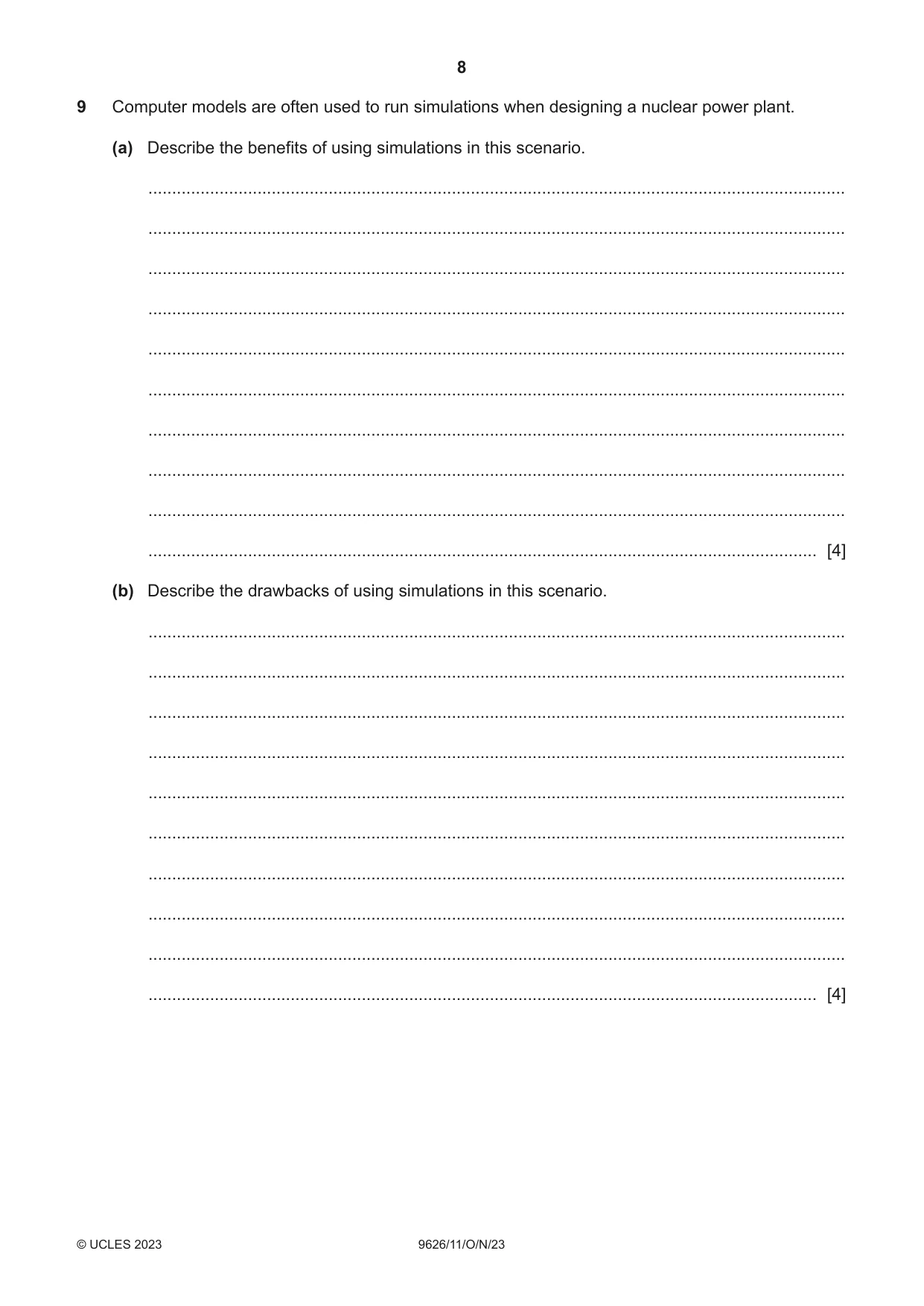
8 9626/11/O/N/23 © UCLES 2023 9 Computer models are often used to run simulations when designing a nuclear power plant. (a) Describe the benefits of using simulations in this scenario. … … … … … … … … … … [4] (b) Describe the drawbacks of using simulations in this scenario. … … … … … … … … … … [4]
Question paper, page 9
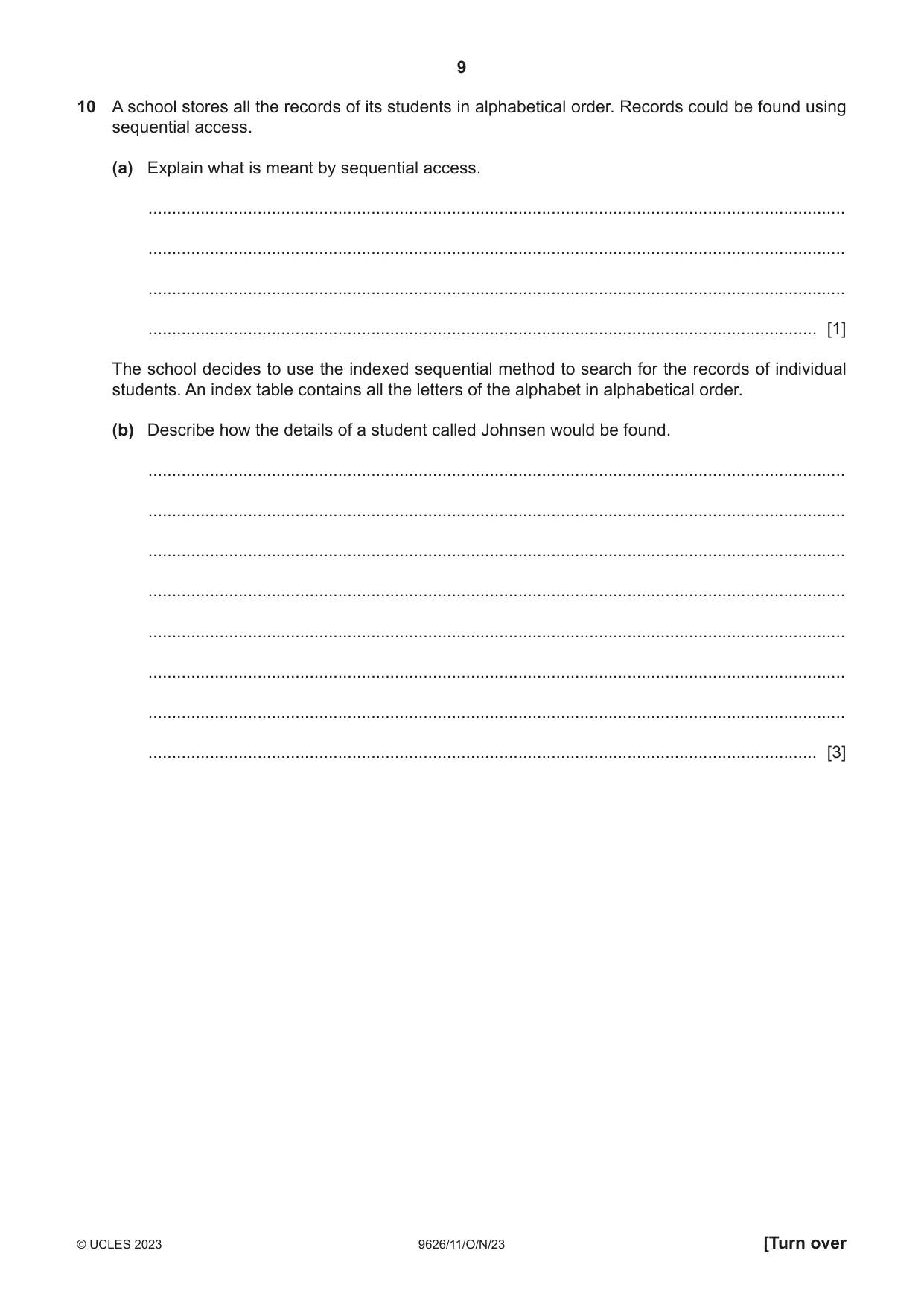
9 9626/11/O/N/23 © UCLES 2023 [Turn over 10 A school stores all the records of its students in alphabetical order. Records could be found using sequential access. (a) Explain what is meant by sequential access. … … … … [1] The school decides to use the indexed sequential method to search for the records of individual students. An index table contains all the letters of the alphabet in alphabetical order. (b) Describe how the details of a student called Johnsen would be found. … … … … … … … … [3]
Question paper, page 10
10 9626/11/O/N/23 © UCLES 2023 11 A company receives orders which are entered into a computer system. The company has decided to use online processing to process these orders so employees enter orders as they are received. Discuss the advantages and disadvantages of using online processing compared to using batch processing in this scenario. … … … … … … … … … … … … … … … … … … … … [8]
Question paper, page 11
11 9626/11/O/N/23 © UCLES 2023 12 Analyse the effectiveness of supercomputers. … … … … … … … … … … … … … … … … … … … … [8]
Question paper, page 12
12 9626/11/O/N/23 © UCLES 2023 Permission to reproduce items where third-party owned material protected by copyright is included has been sought and cleared where possible. Every reasonable effort has been made by the publisher (UCLES) to trace copyright holders, but if any items requiring clearance have unwittingly been included, the publisher will be pleased to make amends at the earliest possible opportunity. To avoid the issue of disclosure of answer-related information to candidates, all copyright acknowledgements are reproduced online in the Cambridge Assessment International Education Copyright Acknowledgements Booklet. This is produced for each series of examinations and is freely available to download at www.cambridgeinternational.org after the live examination series. Cambridge Assessment International Education is part of Cambridge Assessment. Cambridge Assessment is the brand name of the University of Cambridge Local Examinations Syndicate (UCLES), which is a department of the University of Cambridge. BLANK PAGE
Mark scheme, page 1
This document consists of 10 printed pages. © UCLES 2023 [Turn over Cambridge International AS & A Level INFORMATION TECHNOLOGY 9626/11 Paper 1 Theory October/November 2023 MARK SCHEME Maximum Mark: 70 Published This mark scheme is published as an aid to teachers and candidates, to indicate the requirements of the examination. It shows the basis on which Examiners were instructed to award marks. It does not indicate the details of the discussions that took place at an Examiners’ meeting before marking began, which would have considered the acceptability of alternative answers. Mark schemes should be read in conjunction with the question paper and the Principal Examiner Report for Teachers. Cambridge International will not enter into discussions about these mark schemes. Cambridge International is publishing the mark schemes for the October/November 2023 series for most Cambridge IGCSE, Cambridge International A and AS Level components, and some Cambridge O Level components.
Mark scheme, page 2
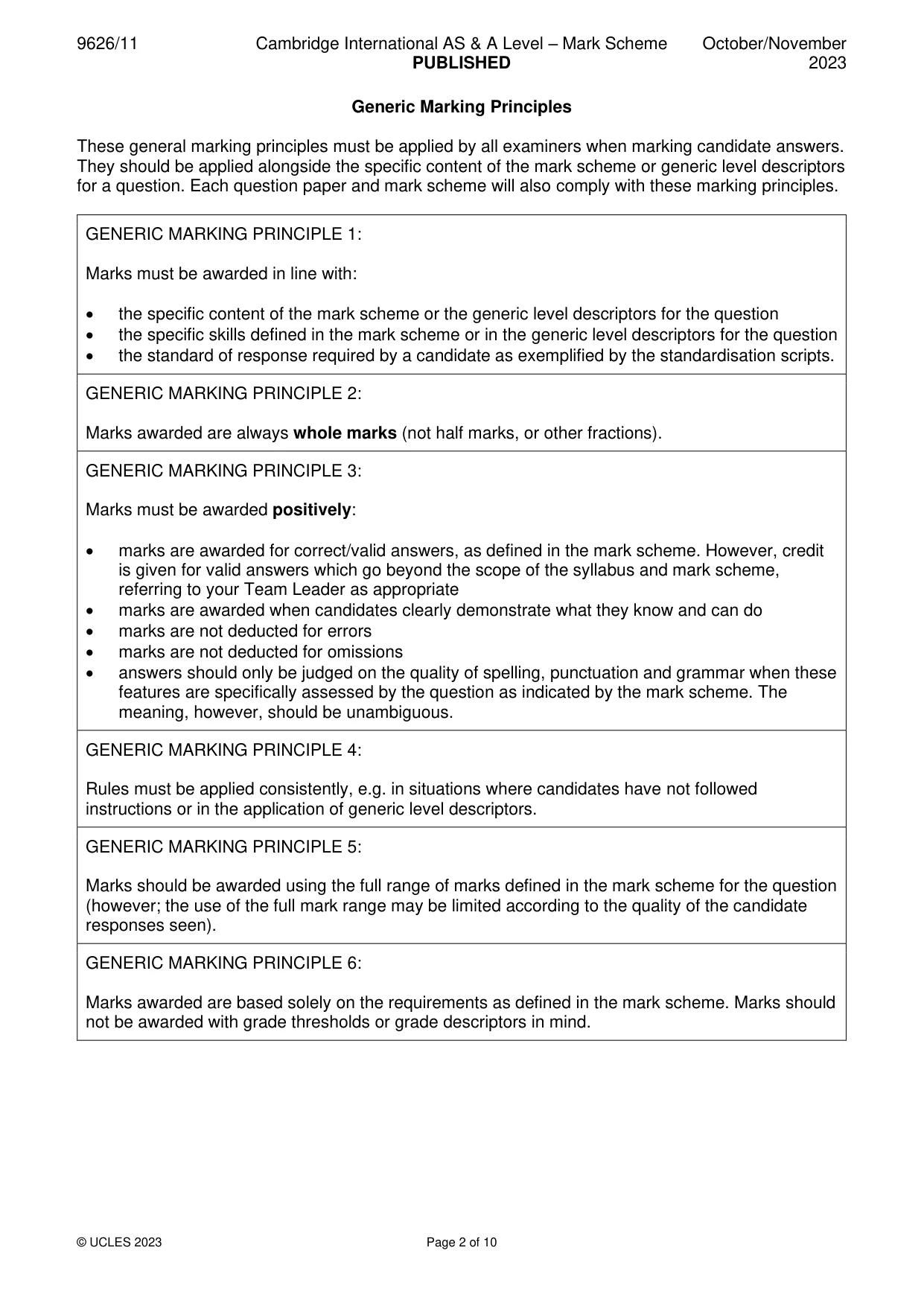
9626/11 Cambridge International AS & A Level – Mark Scheme PUBLISHED October/November 2023 © UCLES 2023 Page 2 of 10 Generic Marking Principles These general marking principles must be applied by all examiners when marking candidate answers. They should be applied alongside the specific content of the mark scheme or generic level descriptors for a question. Each question paper and mark scheme will also comply with these marking principles. GENERIC MARKING PRINCIPLE 1: Marks must be awarded in line with: • the specific content of the mark scheme or the generic level descriptors for the question • the specific skills defined in the mark scheme or in the generic level descriptors for the question • the standard of response required by a candidate as exemplified by the standardisation scripts. GENERIC MARKING PRINCIPLE 2: Marks awarded are always whole marks (not half marks, or other fractions). GENERIC MARKING PRINCIPLE 3: Marks must be awarded positively: • marks are awarded for correct/valid answers, as defined in the mark scheme. However, credit is given for valid answers which go beyond the scope of the syllabus and mark scheme, referring to your Team Leader as appropriate • marks are awarded when candidates clearly demonstrate what they know and can do • marks are not deducted for errors • marks are not deducted for omissions • answers should only be judged on the quality of spelling, punctuation and grammar when these features are specifically assessed by the question as indicated by the mark scheme. The meaning, however, should be unambiguous. GENERIC MARKING PRINCIPLE 4: Rules must be applied consistently, e.g. in situations where candidates have not followed instructions or in the application of generic level descriptors. GENERIC MARKING PRINCIPLE 5: Marks should be awarded using the full range of marks defined in the mark scheme for the question (however; the use of the full mark range may be limited according to the quality of the candidate responses seen). GENERIC MARKING PRINCIPLE 6: Marks awarded are based solely on the requirements as defined in the mark scheme. Marks should not be awarded with grade thresholds or grade descriptors in mind.
Mark scheme, page 3
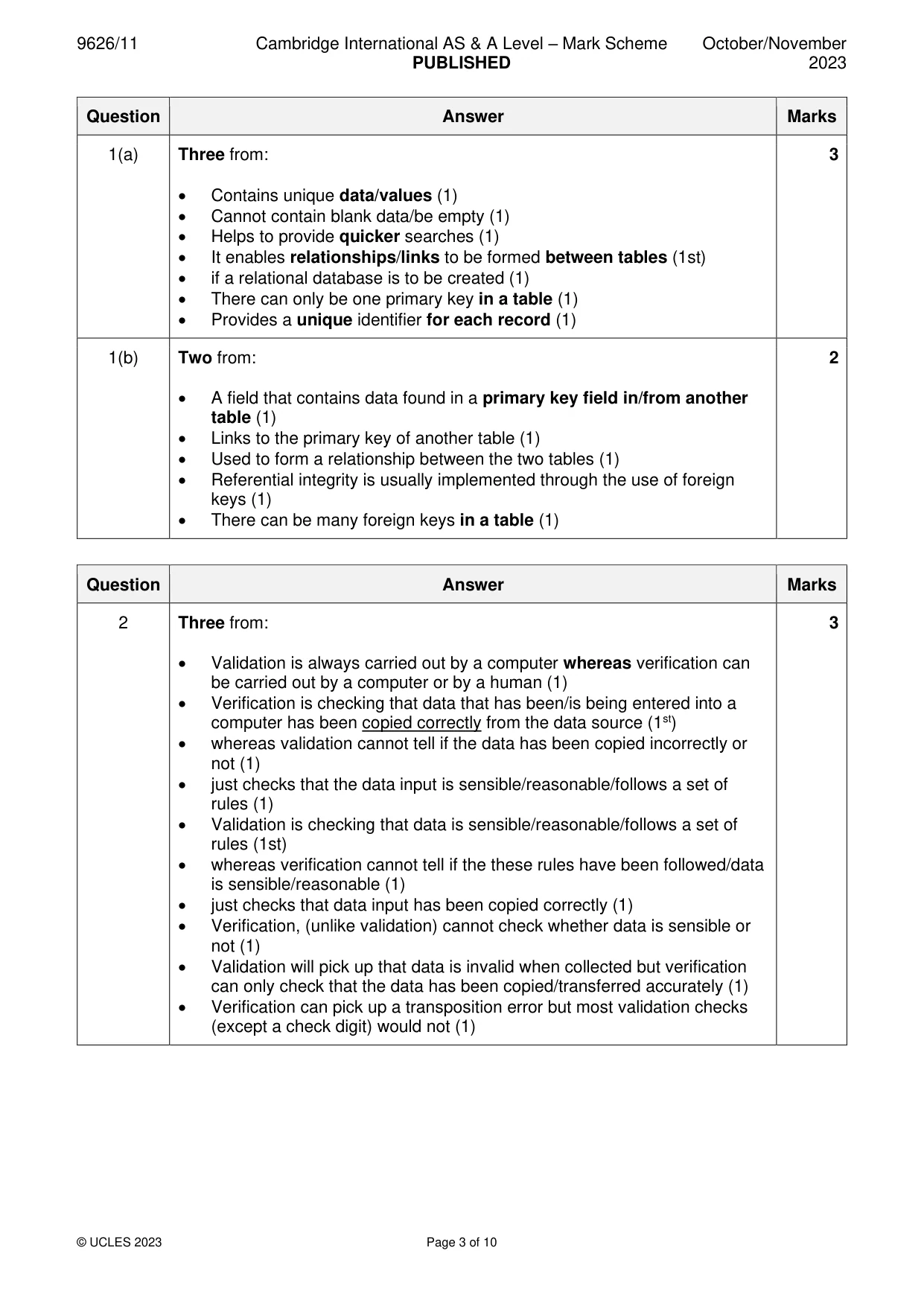
9626/11 Cambridge International AS & A Level – Mark Scheme PUBLISHED October/November 2023 © UCLES 2023 Page 3 of 10 Question Answer Marks 1(a) Three from: • Contains unique data/values (1) • Cannot contain blank data/be empty (1) • Helps to provide quicker searches (1) • It enables relationships/links to be formed between tables (1st) • if a relational database is to be created (1) • There can only be one primary key in a table (1) • Provides a unique identifier for each record (1) 3 1(b) Two from: • A field that contains data found in a primary key field in/from another table (1) • Links to the primary key of another table (1) • Used to form a relationship between the two tables (1) • Referential integrity is usually implemented through the use of foreign keys (1) • There can be many foreign keys in a table (1) 2 Question Answer Marks 2 Three from: • Validation is always carried out by a computer whereas verification can be carried out by a computer or by a human (1) • Verification is checking that data that has been/is being entered into a computer has been copied correctly from the data source (1st) • whereas validation cannot tell if the data has been copied incorrectly or not (1) • just checks that the data input is sensible/reasonable/follows a set of rules (1) • Validation is checking that data is sensible/reasonable/follows a set of rules (1st) • whereas verification cannot tell if the these rules have been followed/data is sensible/reasonable (1) • just checks that data input has been copied correctly (1) • Verification, (unlike validation) cannot check whether data is sensible or not (1) • Validation will pick up that data is invalid when collected but verification can only check that the data has been copied/transferred accurately (1) • Verification can pick up a transposition error but most validation checks (except a check digit) would not (1) 3
Mark scheme, page 4
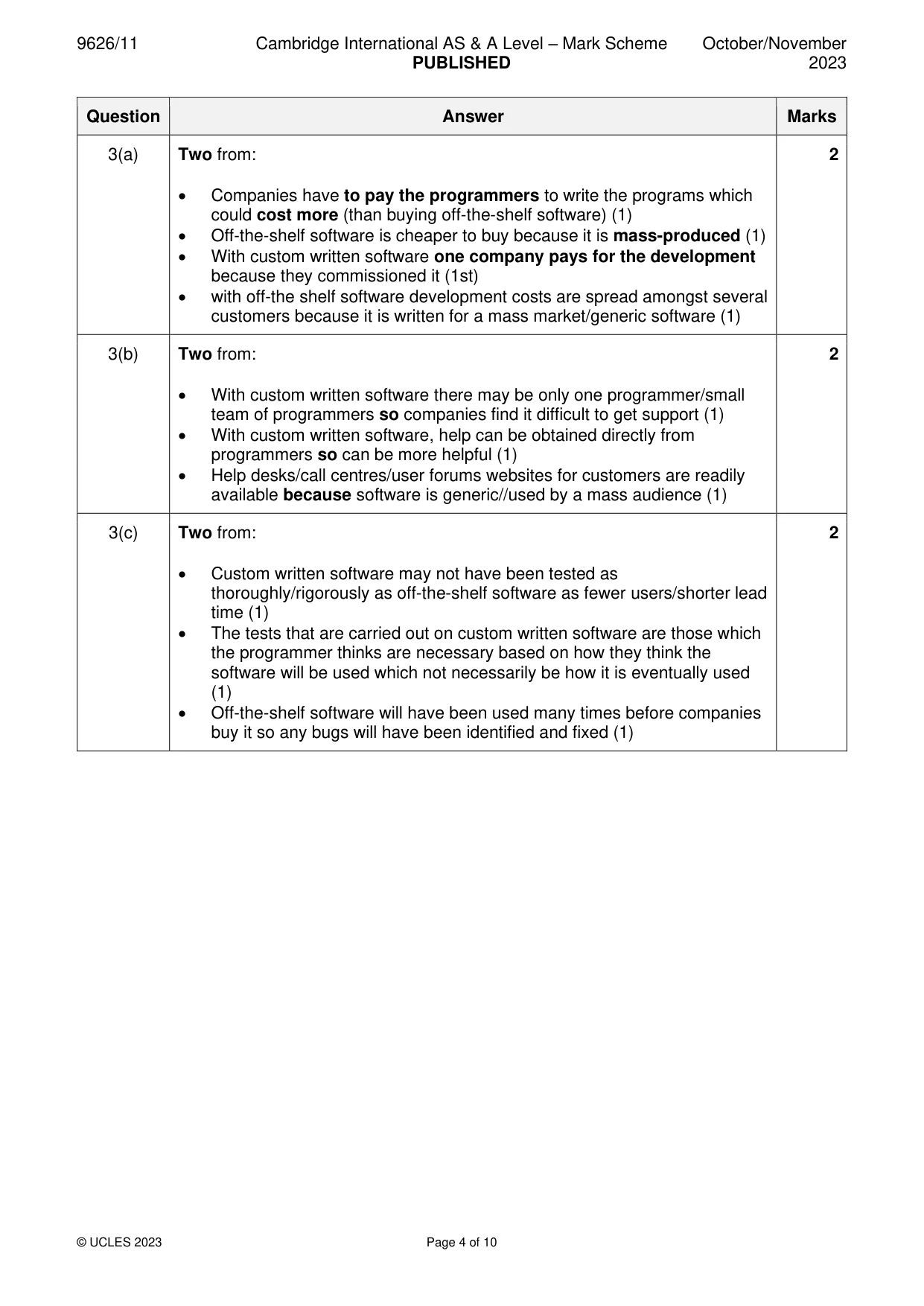
9626/11 Cambridge International AS & A Level – Mark Scheme PUBLISHED October/November 2023 © UCLES 2023 Page 4 of 10 Question Answer Marks 3(a) Two from: • Companies have to pay the programmers to write the programs which could cost more (than buying off-the-shelf software) (1) • Off-the-shelf software is cheaper to buy because it is mass-produced (1) • With custom written software one company pays for the development because they commissioned it (1st) • with off-the shelf software development costs are spread amongst several customers because it is written for a mass market/generic software (1) 2 3(b) Two from: • With custom written software there may be only one programmer/small team of programmers so companies find it difficult to get support (1) • With custom written software, help can be obtained directly from programmers so can be more helpful (1) • Help desks/call centres/user forums websites for customers are readily available because software is generic//used by a mass audience (1) 2 3(c) Two from: • Custom written software may not have been tested as thoroughly/rigorously as off-the-shelf software as fewer users/shorter lead time (1) • The tests that are carried out on custom written software are those which the programmer thinks are necessary based on how they think the software will be used which not necessarily be how it is eventually used (1) • Off-the-shelf software will have been used many times before companies buy it so any bugs will have been identified and fixed (1) 2
Mark scheme, page 5
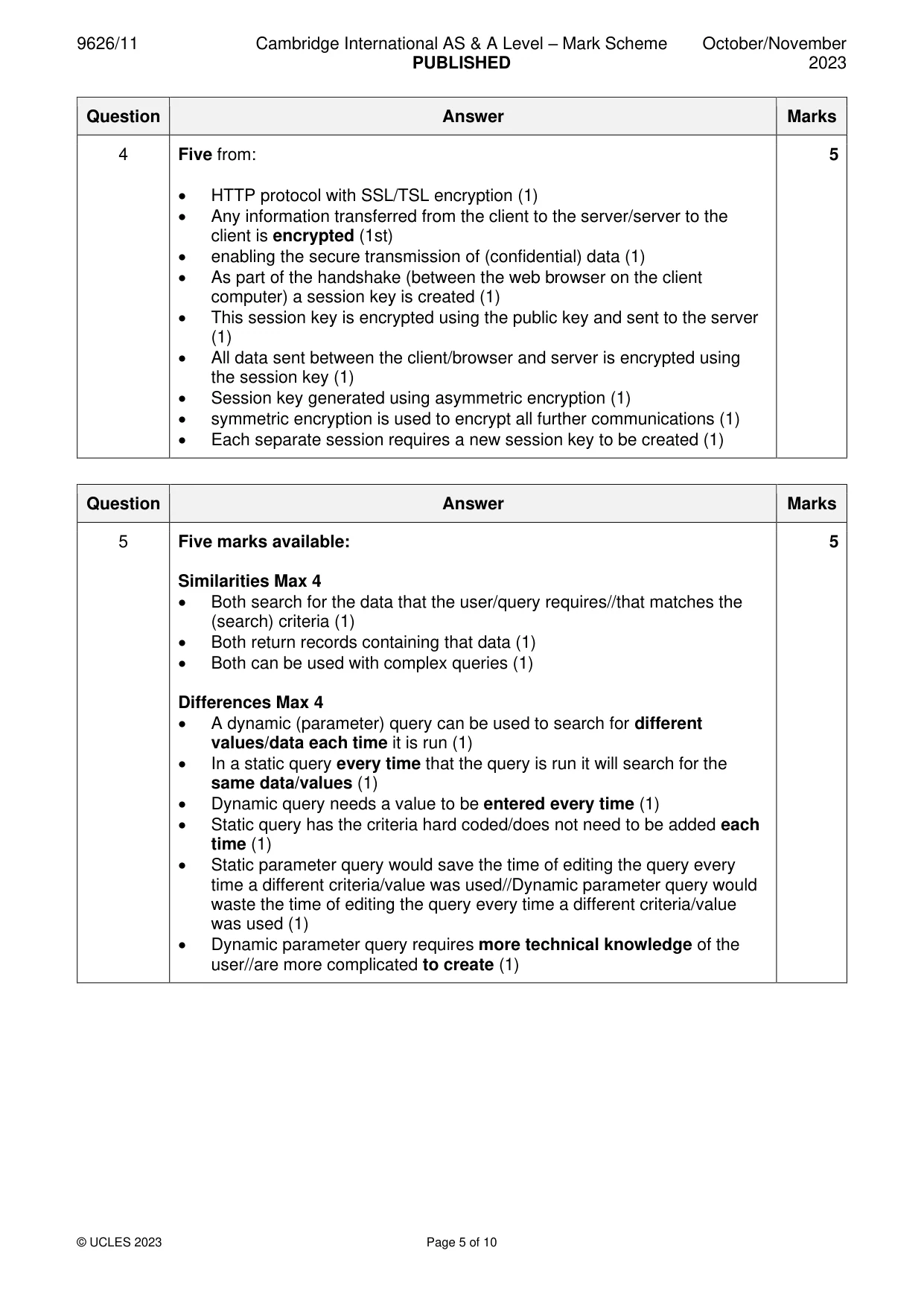
9626/11 Cambridge International AS & A Level – Mark Scheme PUBLISHED October/November 2023 © UCLES 2023 Page 5 of 10 Question Answer Marks 4 Five from: • HTTP protocol with SSL/TSL encryption (1) • Any information transferred from the client to the server/server to the client is encrypted (1st) • enabling the secure transmission of (confidential) data (1) • As part of the handshake (between the web browser on the client computer) a session key is created (1) • This session key is encrypted using the public key and sent to the server (1) • All data sent between the client/browser and server is encrypted using the session key (1) • Session key generated using asymmetric encryption (1) • symmetric encryption is used to encrypt all further communications (1) • Each separate session requires a new session key to be created (1) 5 Question Answer Marks 5 Five marks available: Similarities Max 4 • Both search for the data that the user/query requires//that matches the (search) criteria (1) • Both return records containing that data (1) • Both can be used with complex queries (1) Differences Max 4 • A dynamic (parameter) query can be used to search for different values/data each time it is run (1) • In a static query every time that the query is run it will search for the same data/values (1) • Dynamic query needs a value to be entered every time (1) • Static query has the criteria hard coded/does not need to be added each time (1) • Static parameter query would save the time of editing the query every time a different criteria/value was used//Dynamic parameter query would waste the time of editing the query every time a different criteria/value was used (1) • Dynamic parameter query requires more technical knowledge of the user//are more complicated to create (1) 5
Mark scheme, page 6
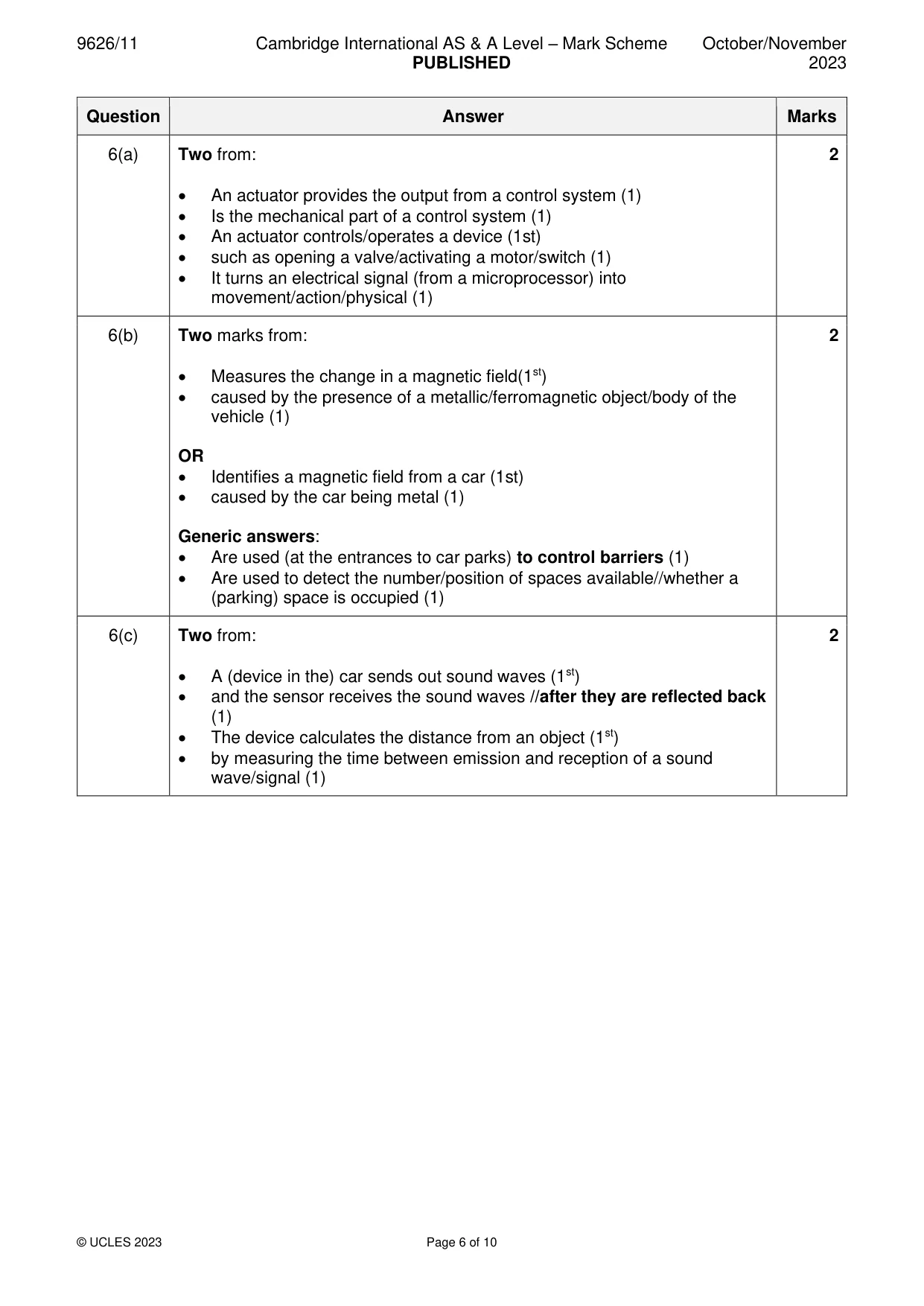
9626/11 Cambridge International AS & A Level – Mark Scheme PUBLISHED October/November 2023 © UCLES 2023 Page 6 of 10 Question Answer Marks 6(a) Two from: • An actuator provides the output from a control system (1) • Is the mechanical part of a control system (1) • An actuator controls/operates a device (1st) • such as opening a valve/activating a motor/switch (1) • It turns an electrical signal (from a microprocessor) into movement/action/physical (1) 2 6(b) Two marks from: • Measures the change in a magnetic field(1st) • caused by the presence of a metallic/ferromagnetic object/body of the vehicle (1) OR • Identifies a magnetic field from a car (1st) • caused by the car being metal (1) Generic answers: • Are used (at the entrances to car parks) to control barriers (1) • Are used to detect the number/position of spaces available//whether a (parking) space is occupied (1) 2 6(c) Two from: • A (device in the) car sends out sound waves (1st) • and the sensor receives the sound waves //after they are reflected back (1) • The device calculates the distance from an object (1st) • by measuring the time between emission and reception of a sound wave/signal (1) 2
Mark scheme, page 7
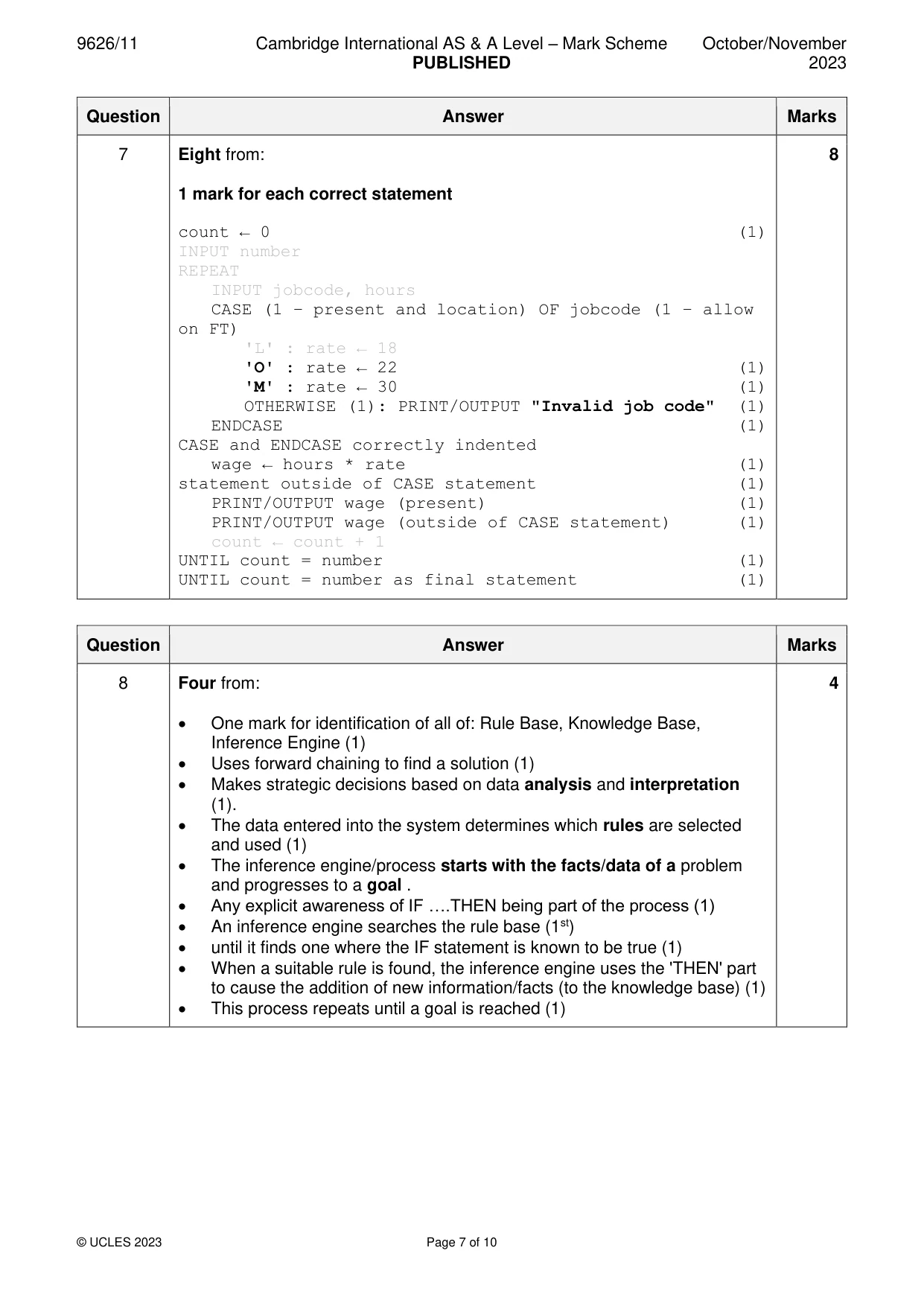
9626/11 Cambridge International AS & A Level – Mark Scheme PUBLISHED October/November 2023 © UCLES 2023 Page 7 of 10 Question Answer Marks 7 Eight from: 1 mark for each correct statement count ← 0 (1) INPUT number REPEAT INPUT jobcode, hours CASE (1 – present and location) OF jobcode (1 – allow on FT) 'L' : rate ← 18 'O' : rate ← 22 (1) 'M' : rate ← 30 (1) OTHERWISE (1): PRINT/OUTPUT "Invalid job code" (1) ENDCASE (1) CASE and ENDCASE correctly indented wage ← hours * rate (1) statement outside of CASE statement (1) PRINT/OUTPUT wage (present) (1) PRINT/OUTPUT wage (outside of CASE statement) (1) count ← count + 1 UNTIL count = number (1) UNTIL count = number as final statement (1) 8 Question Answer Marks 8 Four from: • One mark for identification of all of: Rule Base, Knowledge Base, Inference Engine (1) • Uses forward chaining to find a solution (1) • Makes strategic decisions based on data analysis and interpretation (1). • The data entered into the system determines which rules are selected and used (1) • The inference engine/process starts with the facts/data of a problem and progresses to a goal . • Any explicit awareness of IF ….THEN being part of the process (1) • An inference engine searches the rule base (1st) • until it finds one where the IF statement is known to be true (1) • When a suitable rule is found, the inference engine uses the 'THEN' part to cause the addition of new information/facts (to the knowledge base) (1) • This process repeats until a goal is reached (1) 4
Mark scheme, page 8
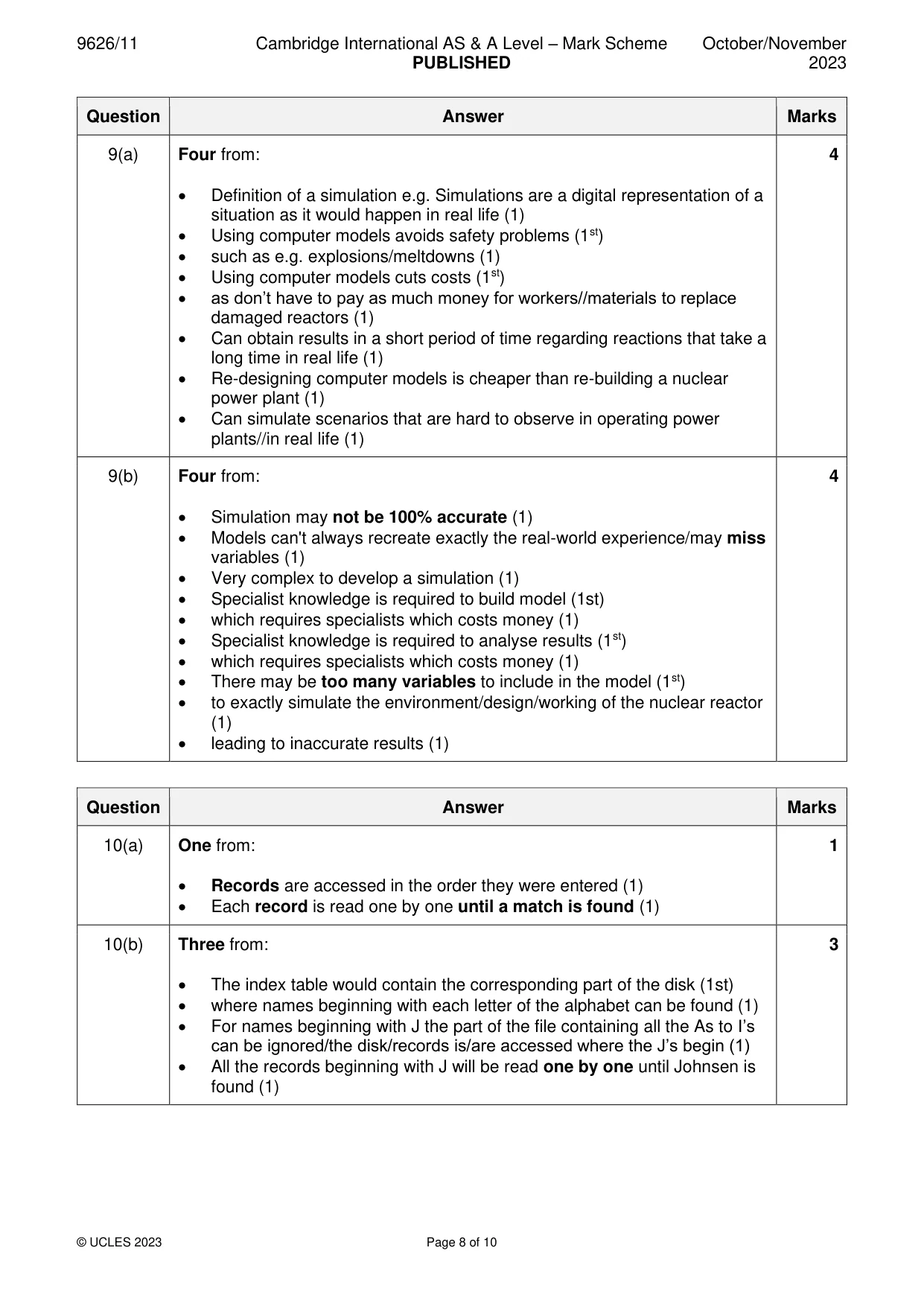
9626/11 Cambridge International AS & A Level – Mark Scheme PUBLISHED October/November 2023 © UCLES 2023 Page 8 of 10 Question Answer Marks 9(a) Four from: • Definition of a simulation e.g. Simulations are a digital representation of a situation as it would happen in real life (1) • Using computer models avoids safety problems (1st) • such as e.g. explosions/meltdowns (1) • Using computer models cuts costs (1st) • as don’t have to pay as much money for workers//materials to replace damaged reactors (1) • Can obtain results in a short period of time regarding reactions that take a long time in real life (1) • Re-designing computer models is cheaper than re-building a nuclear power plant (1) • Can simulate scenarios that are hard to observe in operating power plants//in real life (1) 4 9(b) Four from: • Simulation may not be 100% accurate (1) • Models can't always recreate exactly the real-world experience/may miss variables (1) • Very complex to develop a simulation (1) • Specialist knowledge is required to build model (1st) • which requires specialists which costs money (1) • Specialist knowledge is required to analyse results (1st) • which requires specialists which costs money (1) • There may be too many variables to include in the model (1st) • to exactly simulate the environment/design/working of the nuclear reactor (1) • leading to inaccurate results (1) 4 Question Answer Marks 10(a) One from: • Records are accessed in the order they were entered (1) • Each record is read one by one until a match is found (1) 1 10(b) Three from: • The index table would contain the corresponding part of the disk (1st) • where names beginning with each letter of the alphabet can be found (1) • For names beginning with J the part of the file containing all the As to I’s can be ignored/the disk/records is/are accessed where the J’s begin (1) • All the records beginning with J will be read one by one until Johnsen is found (1) 3
Mark scheme, page 9
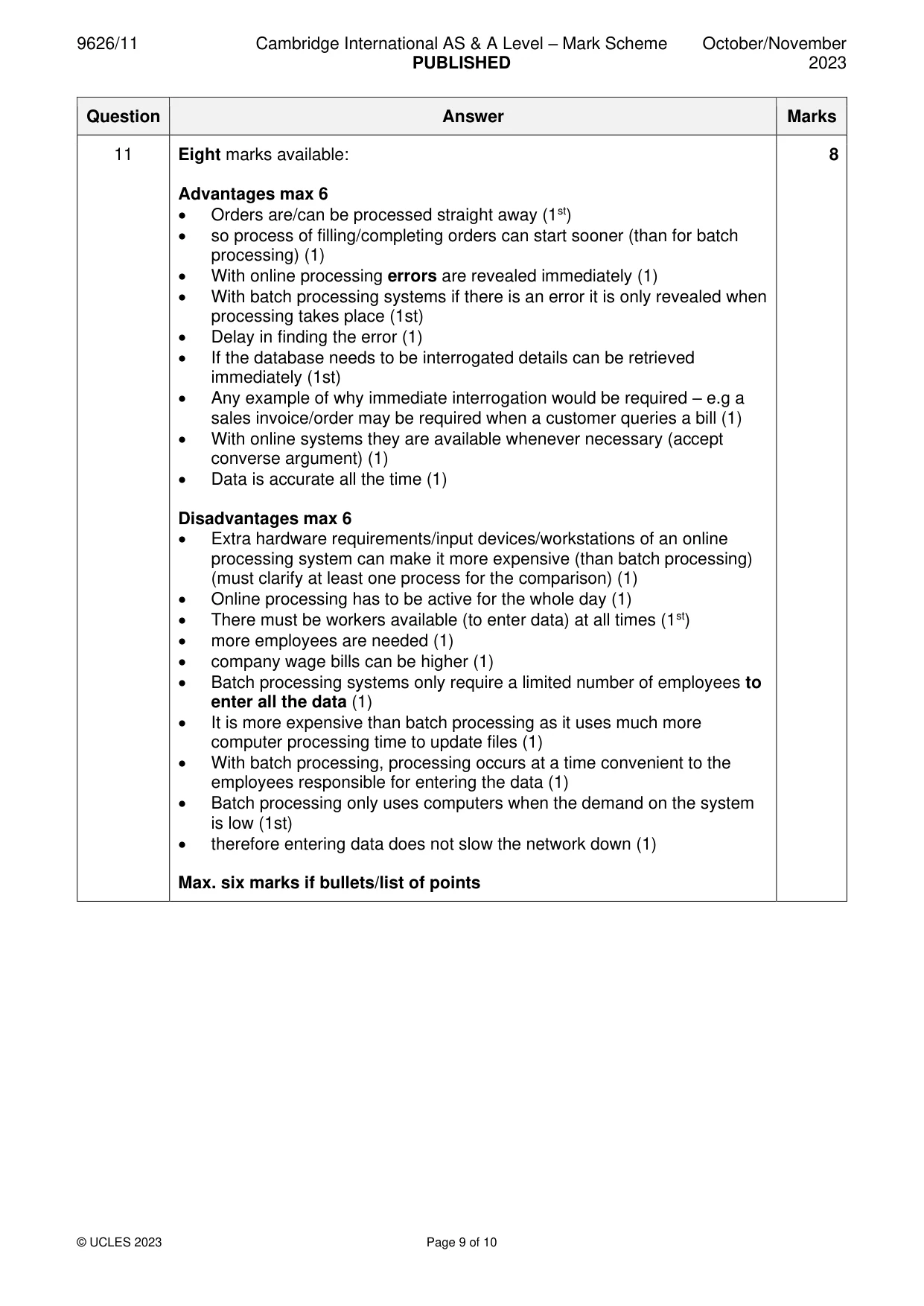
9626/11 Cambridge International AS & A Level – Mark Scheme PUBLISHED October/November 2023 © UCLES 2023 Page 9 of 10 Question Answer Marks 11 Eight marks available: Advantages max 6 • Orders are/can be processed straight away (1st) • so process of filling/completing orders can start sooner (than for batch processing) (1) • With online processing errors are revealed immediately (1) • With batch processing systems if there is an error it is only revealed when processing takes place (1st) • Delay in finding the error (1) • If the database needs to be interrogated details can be retrieved immediately (1st) • Any example of why immediate interrogation would be required – e.g a sales invoice/order may be required when a customer queries a bill (1) • With online systems they are available whenever necessary (accept converse argument) (1) • Data is accurate all the time (1) Disadvantages max 6 • Extra hardware requirements/input devices/workstations of an online processing system can make it more expensive (than batch processing) (must clarify at least one process for the comparison) (1) • Online processing has to be active for the whole day (1) • There must be workers available (to enter data) at all times (1st) • more employees are needed (1) • company wage bills can be higher (1) • Batch processing systems only require a limited number of employees to enter all the data (1) • It is more expensive than batch processing as it uses much more computer processing time to update files (1) • With batch processing, processing occurs at a time convenient to the employees responsible for entering the data (1) • Batch processing only uses computers when the demand on the system is low (1st) • therefore entering data does not slow the network down (1) Max. six marks if bullets/list of points 8
Mark scheme, page 10
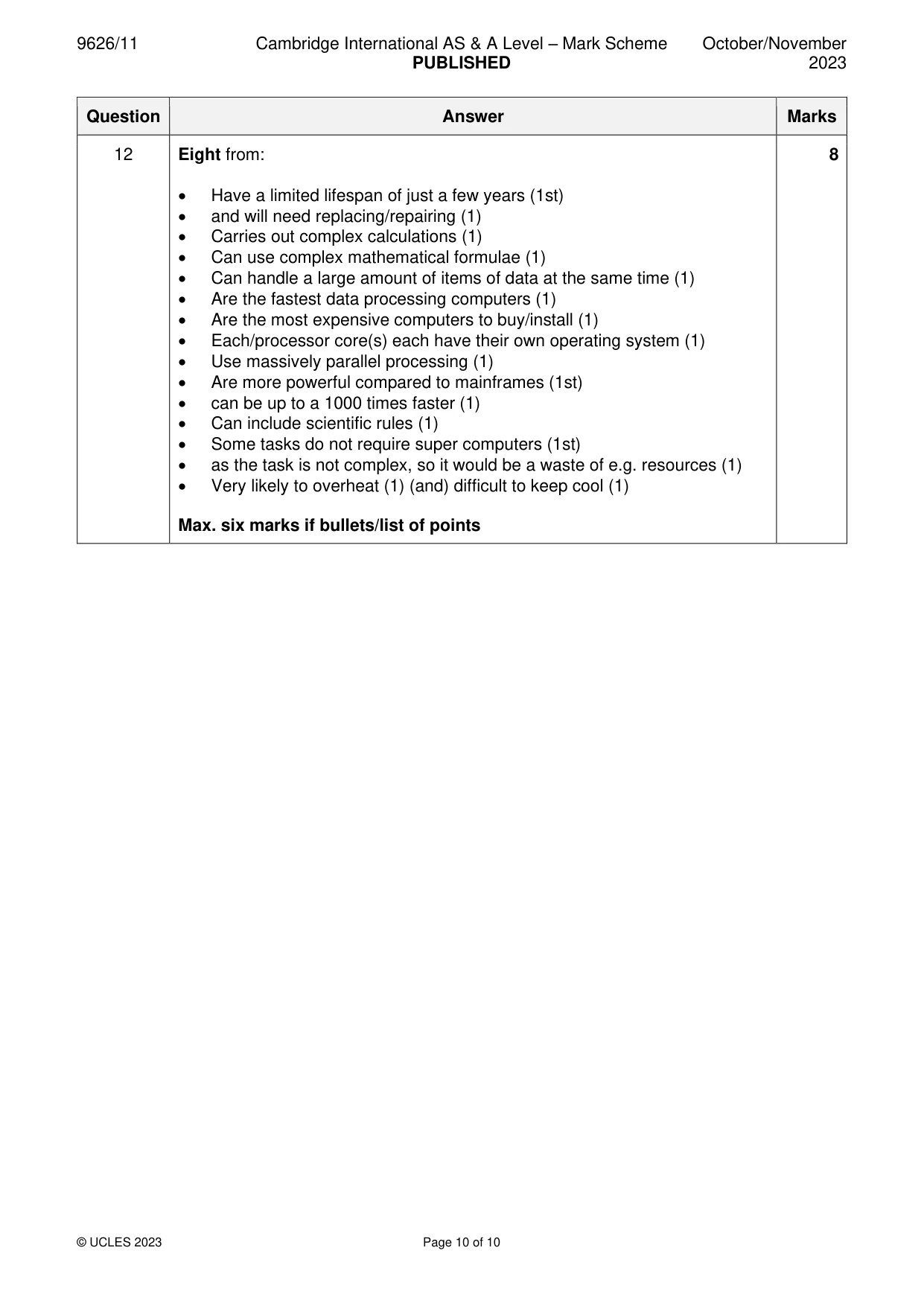
9626/11 Cambridge International AS & A Level – Mark Scheme PUBLISHED October/November 2023 © UCLES 2023 Page 10 of 10 Question Answer Marks 12 Eight from: • Have a limited lifespan of just a few years (1st) • and will need replacing/repairing (1) • Carries out complex calculations (1) • Can use complex mathematical formulae (1) • Can handle a large amount of items of data at the same time (1) • Are the fastest data processing computers (1) • Are the most expensive computers to buy/install (1) • Each/processor core(s) each have their own operating system (1) • Use massively parallel processing (1) • Are more powerful compared to mainframes (1st) • can be up to a 1000 times faster (1) • Can include scientific rules (1) • Some tasks do not require super computers (1st) • as the task is not complex, so it would be a waste of e.g. resources (1) • Very likely to overheat (1) (and) difficult to keep cool (1) Max. six marks if bullets/list of points 8
What you needed in this session
Cambridge’s own grade thresholds for 2023 Oct/Nov, Paper 1 · Variant 1. A higher threshold means an easier paper — the bar moves with how the cohort did.