Cambridge A Level Information Technology (from 2017) 9626 — 2023 Oct/Nov Paper 1 · Variant 2
9626/12/O/N/23 · 70 marks · ≈79 min
The question paper and its mark scheme, free to read here and free to download. This is Cambridge’s own paper, exactly as it was sat.
Question paper12 pages





Mark scheme10 pages
Answers below. Sit the paper first if you are practising.
Paper as text
Question paper, page 1
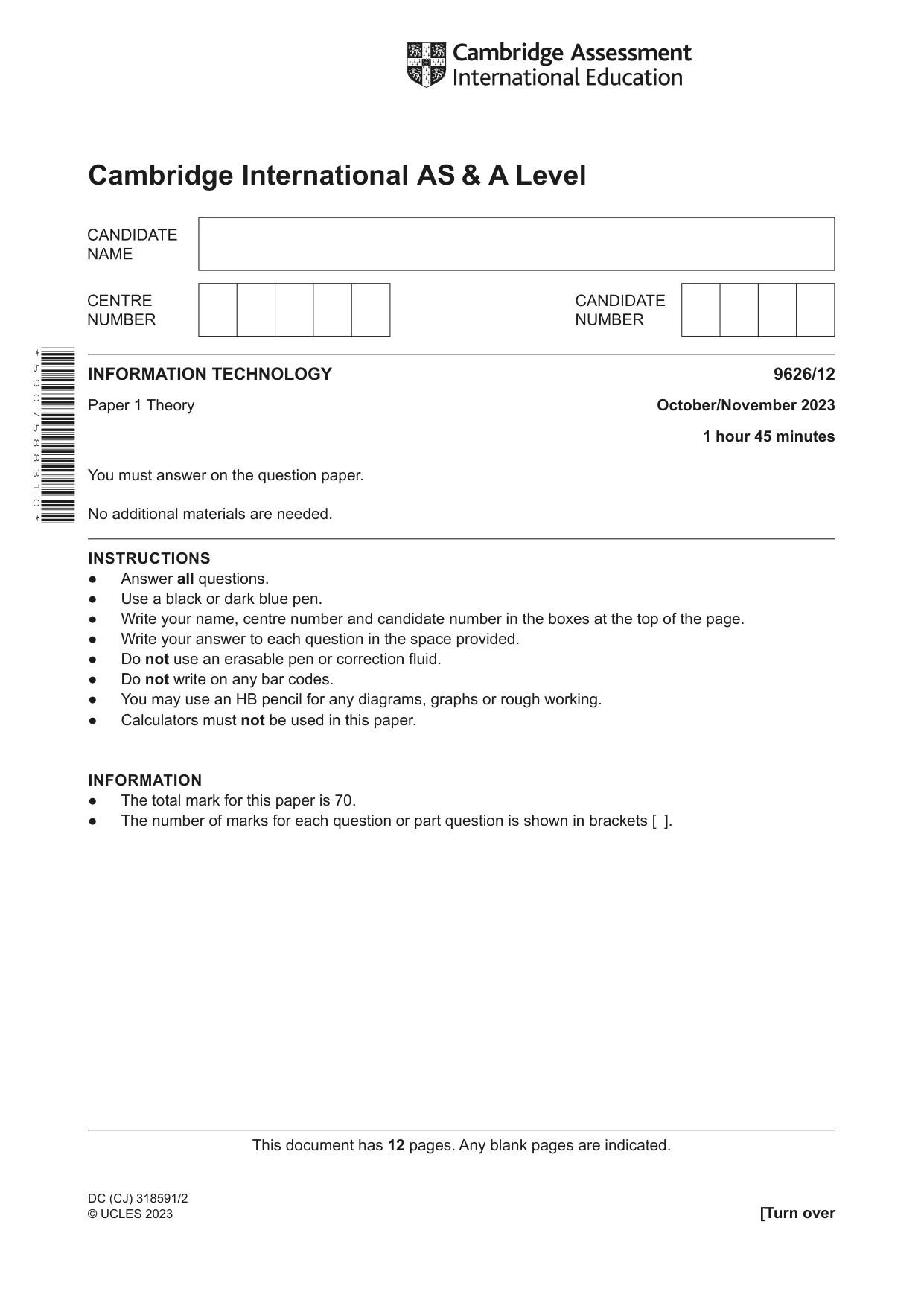
This document has 12 pages. Any blank pages are indicated. [Turn over Cambridge International AS & A Level INFORMATION TECHNOLOGY 9626/12 Paper 1 Theory October/November 2023 1 hour 45 minutes You must answer on the question paper. No additional materials are needed. INSTRUCTIONS ● Answer all questions. ● Use a black or dark blue pen. ● Write your name, centre number and candidate number in the boxes at the top of the page. ● Write your answer to each question in the space provided. ● Do not use an erasable pen or correction fluid. ● Do not write on any bar codes. ● You may use an HB pencil for any diagrams, graphs or rough working. ● Calculators must not be used in this paper. INFORMATION ● The total mark for this paper is 70. ● The number of marks for each question or part question is shown in brackets [ ]. * 5 9 0 7 5 8 8 3 1 0 * DC (CJ) 318591/2 © UCLES 2023
Question paper, page 2
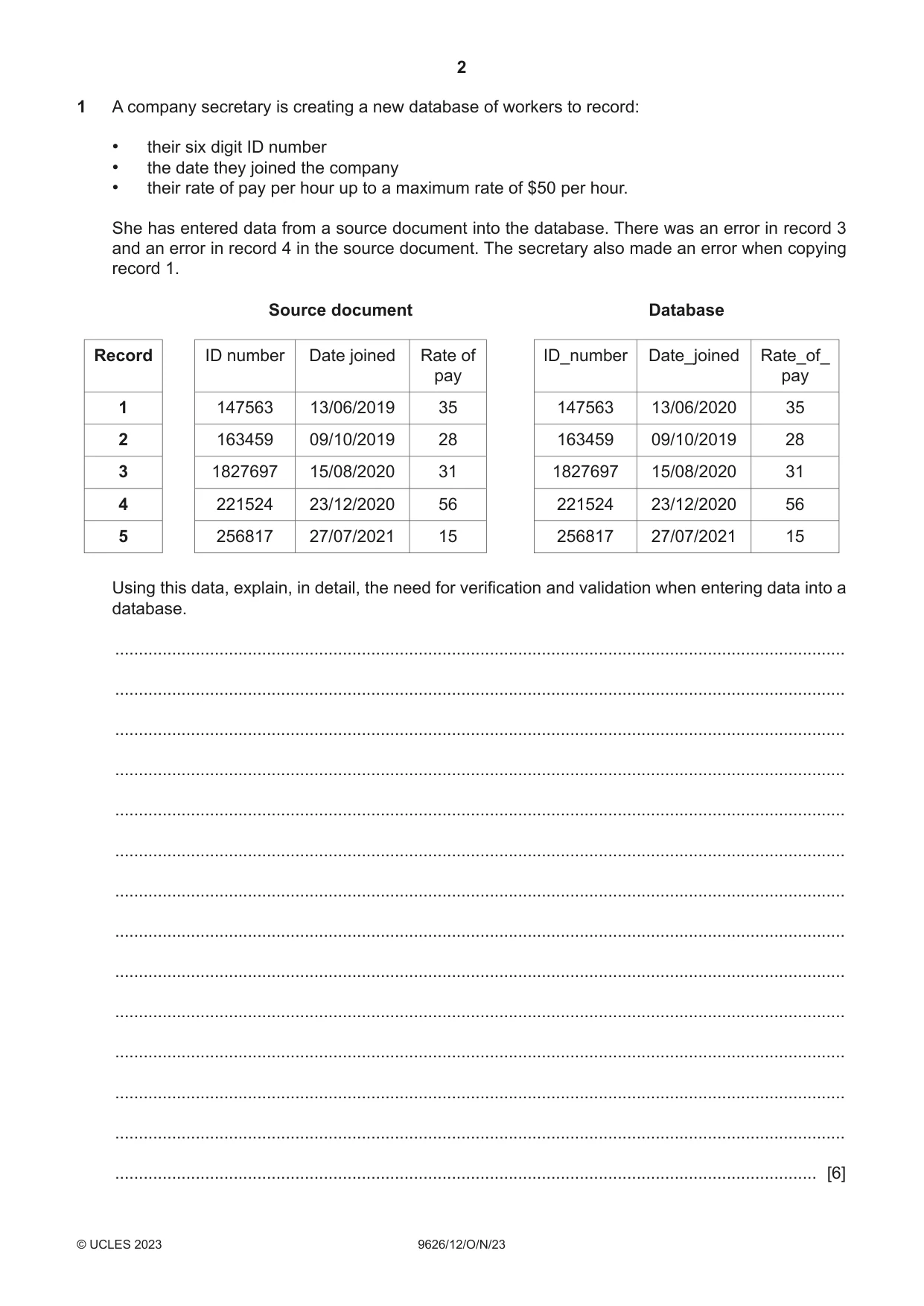
2 9626/12/O/N/23 © UCLES 2023 1 A company secretary is creating a new database of workers to record: • their six digit ID number • the date they joined the company • their rate of pay per hour up to a maximum rate of $50 per hour. She has entered data from a source document into the database. There was an error in record 3 and an error in record 4 in the source document. The secretary also made an error when copying record 1. Source document Database Record ID number Date joined Rate of pay ID_number Date_joined Rate_of_ pay 1 147563 13/06/2019 35 147563 13/06/2020 35 2 163459 09/10/2019 28 163459 09/10/2019 28 3 1827697 15/08/2020 31 1827697 15/08/2020 31 4 221524 23/12/2020 56 221524 23/12/2020 56 5 256817 27/07/2021 15 256817 27/07/2021 15 Using this data, explain, in detail, the need for verification and validation when entering data into a database. … … … … … … … … … … … … … … [6]
Question paper, page 3
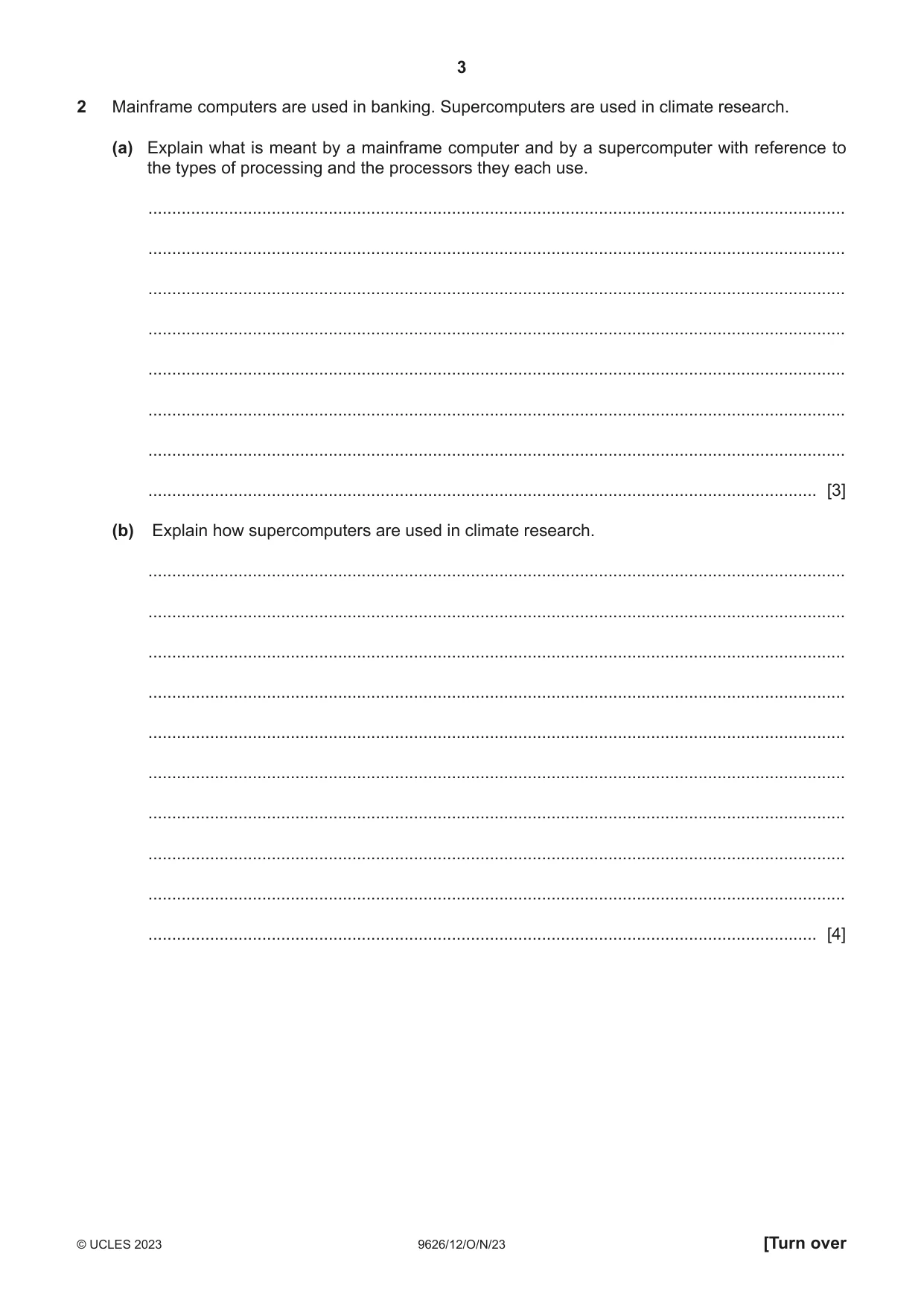
3 9626/12/O/N/23 © UCLES 2023 [Turn over 2 Mainframe computers are used in banking. Supercomputers are used in climate research. (a) Explain what is meant by a mainframe computer and by a supercomputer with reference to the types of processing and the processors they each use. … … … … … … … … [3] (b) Explain how supercomputers are used in climate research. … … … … … … … … … … [4]
Question paper, page 4
4 9626/12/O/N/23 © UCLES 2023 3 Give brief descriptions of the following types of user interface. (a) command line interface … … … … … … [2] (b) gesture based interface … … … … … … [2] (c) dialogue interface … … … … … … [2]
Question paper, page 5
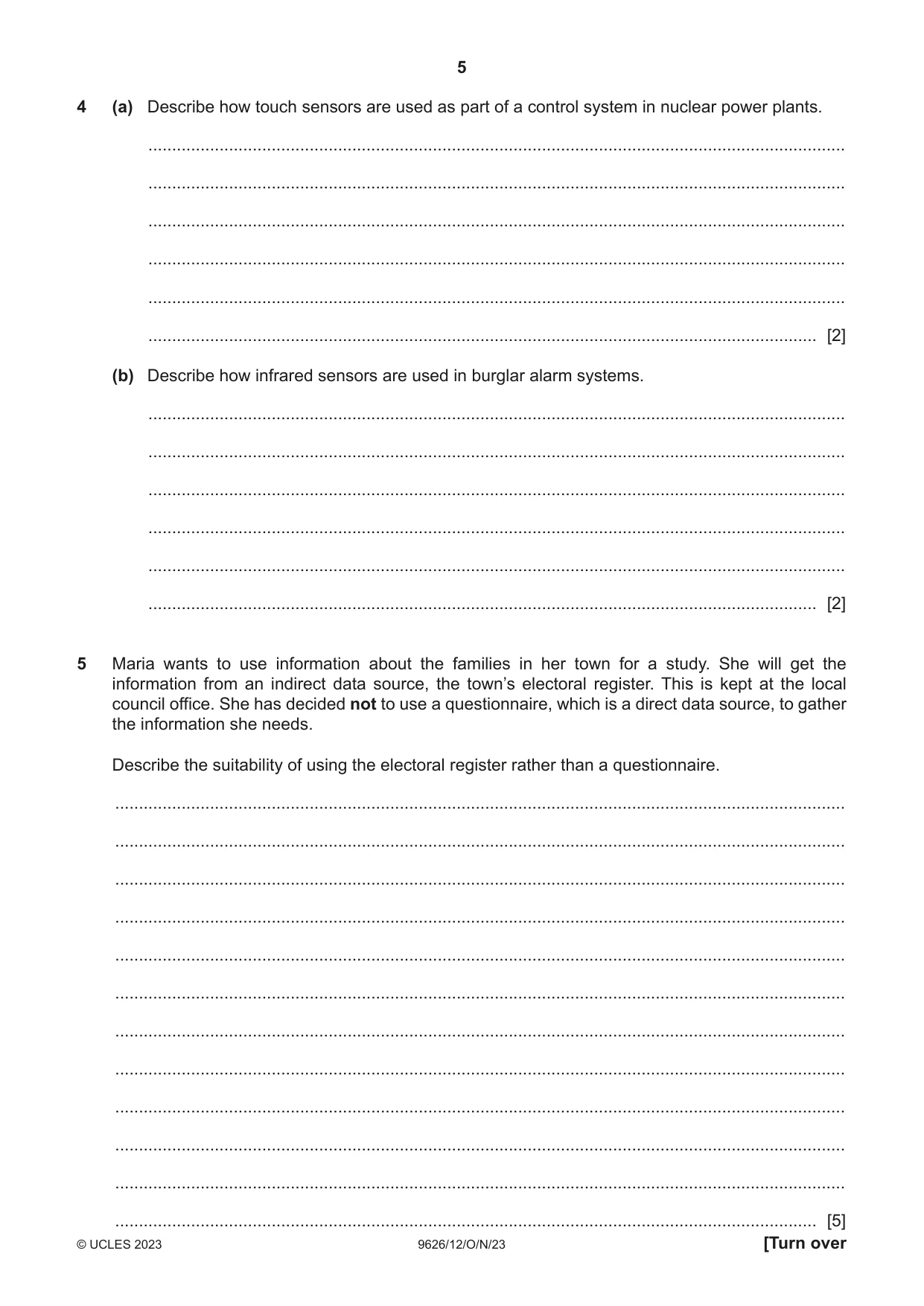
5 9626/12/O/N/23 © UCLES 2023 [Turn over 4 (a) Describe how touch sensors are used as part of a control system in nuclear power plants. … … … … … … [2] (b) Describe how infrared sensors are used in burglar alarm systems. … … … … … … [2] 5 Maria wants to use information about the families in her town for a study. She will get the information from an indirect data source, the town’s electoral register. This is kept at the local council office. She has decided not to use a questionnaire, which is a direct data source, to gather the information she needs. Describe the suitability of using the electoral register rather than a questionnaire. … … … … … … … … … … … … [5]
Question paper, page 6
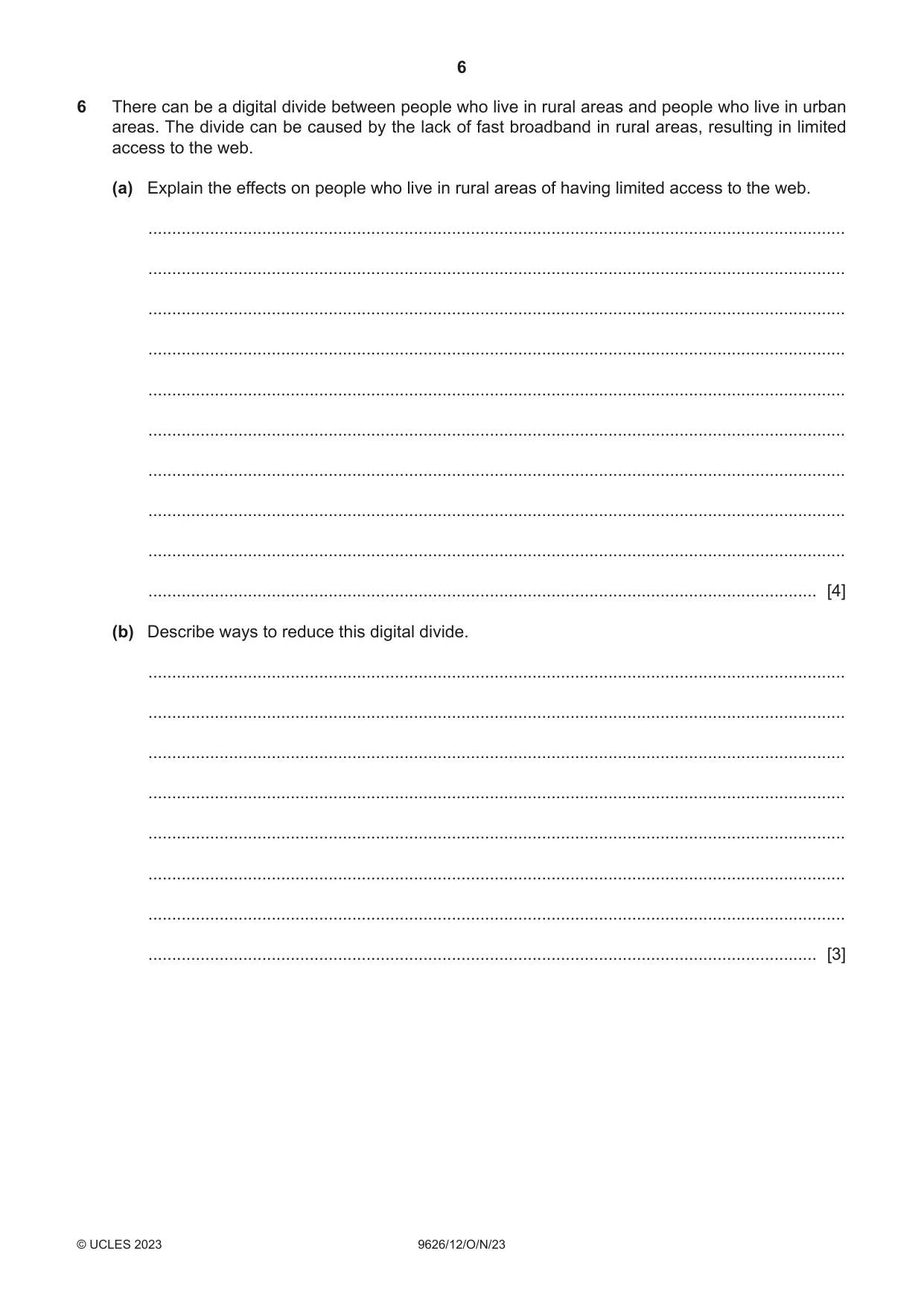
6 9626/12/O/N/23 © UCLES 2023 6 There can be a digital divide between people who live in rural areas and people who live in urban areas. The divide can be caused by the lack of fast broadband in rural areas, resulting in limited access to the web. (a) Explain the effects on people who live in rural areas of having limited access to the web. … … … … … … … … … … [4] (b) Describe ways to reduce this digital divide. … … … … … … … … [3]
Question paper, page 7
7 9626/12/O/N/23 © UCLES 2023 [Turn over 7 Louisa, a teacher with limited IT knowledge, has created a simple database of her students. The database contains the names of her students and the results of their latest test. She prints out the names of the students who have passed the latest test by gaining a mark of 40 or more. When she created the database, she considered creating a dynamic parameter query to produce her printout. However, she decided to create a static parameter query. Explain why this was a good decision. … … … … … … … … … … … … [5]
Question paper, page 8
8 9626/12/O/N/23 © UCLES 2023 8 Students often transfer files between different word processing and database packages. Justify the need for generic file formats for the transfer of files between different packages. … … … … … … … … … … … … … … … … … … … … [8]
Question paper, page 9
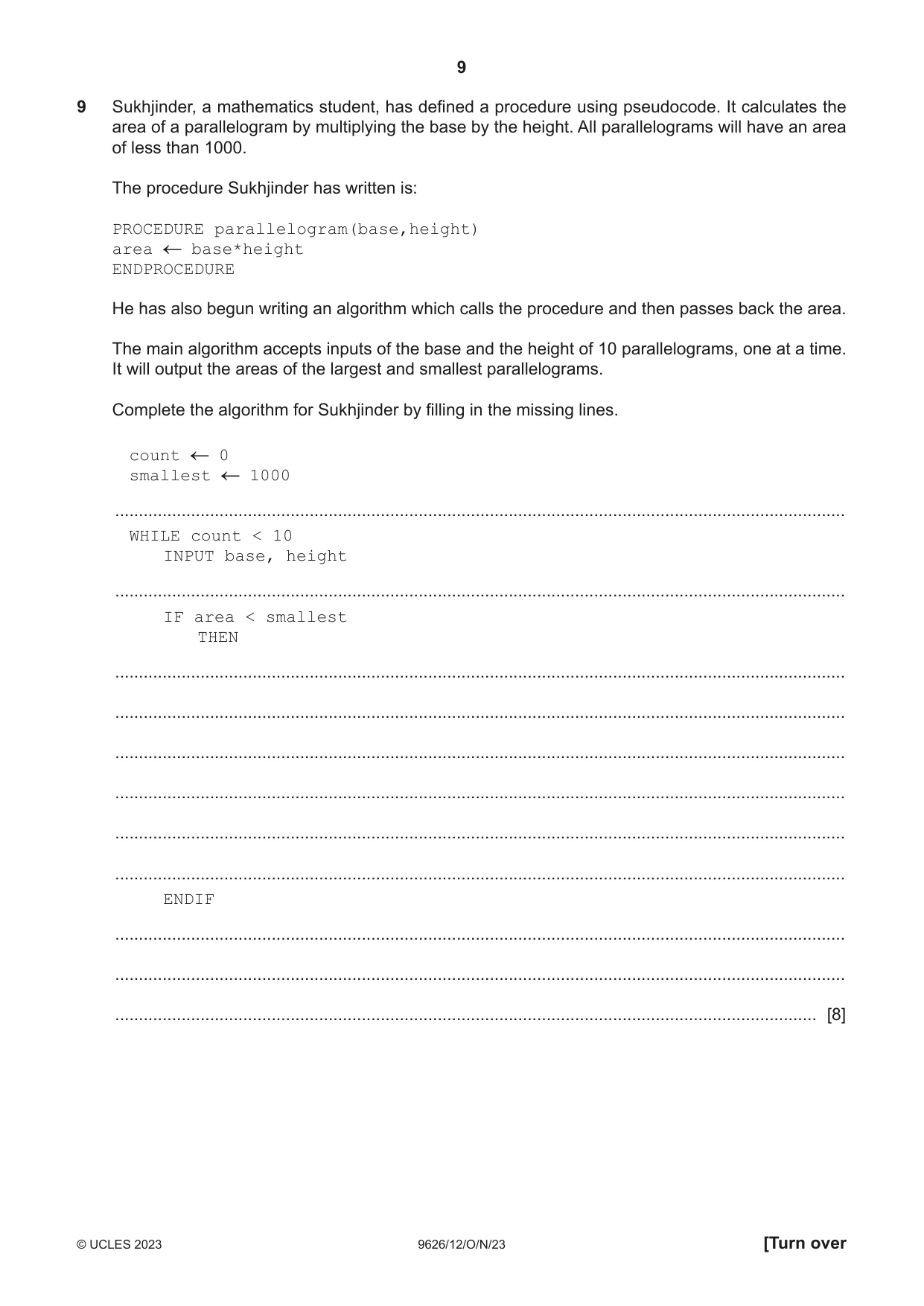
9 9626/12/O/N/23 © UCLES 2023 [Turn over 9 Sukhjinder, a mathematics student, has defined a procedure using pseudocode. It calculates the area of a parallelogram by multiplying the base by the height. All parallelograms will have an area of less than 1000. The procedure Sukhjinder has written is: PROCEDURE parallelogram(base,height) area base*height ENDPROCEDURE He has also begun writing an algorithm which calls the procedure and then passes back the area. The main algorithm accepts inputs of the base and the height of 10 parallelograms, one at a time. It will output the areas of the largest and smallest parallelograms. Complete the algorithm for Sukhjinder by filling in the missing lines. count 0 smallest 1000 … WHILE count < 10 INPUT base, height … IF area < smallest THEN … … … … … … ENDIF … … … [8]
Question paper, page 10
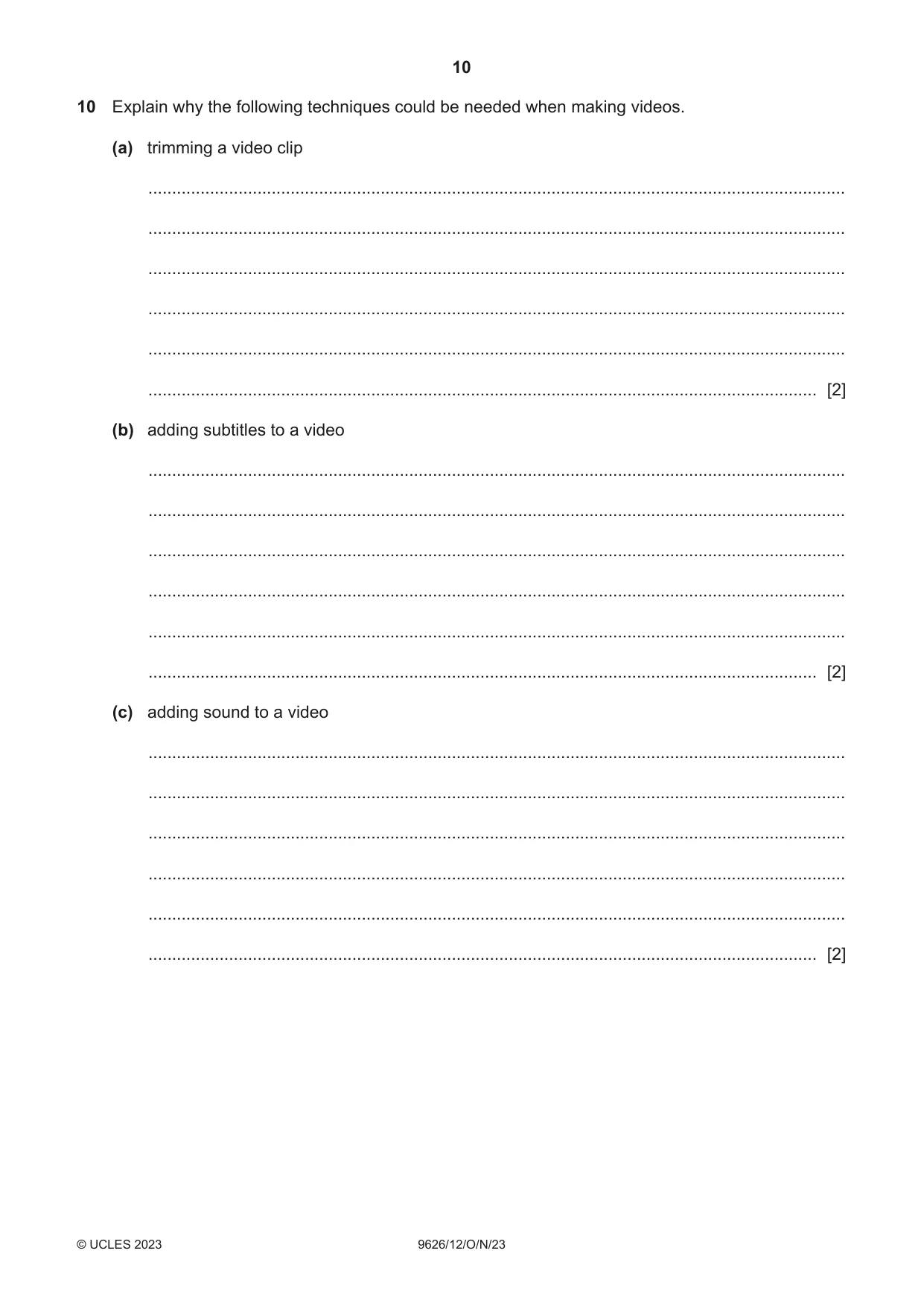
10 9626/12/O/N/23 © UCLES 2023 10 Explain why the following techniques could be needed when making videos. (a) trimming a video clip … … … … … … [2] (b) adding subtitles to a video … … … … … … [2] (c) adding sound to a video … … … … … … [2]
Question paper, page 11
11 9626/12/O/N/23 © UCLES 2023 11 When data is sent across the internet, it is usually encrypted. Discuss the benefits and drawbacks of encrypting data which is transmitted over the internet. … … … … … … … … … … … … … … … … … … … … [8]
Question paper, page 12
12 9626/12/O/N/23 © UCLES 2023 Permission to reproduce items where third-party owned material protected by copyright is included has been sought and cleared where possible. Every reasonable effort has been made by the publisher (UCLES) to trace copyright holders, but if any items requiring clearance have unwittingly been included, the publisher will be pleased to make amends at the earliest possible opportunity. To avoid the issue of disclosure of answer-related information to candidates, all copyright acknowledgements are reproduced online in the Cambridge Assessment International Education Copyright Acknowledgements Booklet. This is produced for each series of examinations and is freely available to download at www.cambridgeinternational.org after the live examination series. Cambridge Assessment International Education is part of Cambridge Assessment. Cambridge Assessment is the brand name of the University of Cambridge Local Examinations Syndicate (UCLES), which is a department of the University of Cambridge. BLANK PAGE
Mark scheme, page 1
This document consists of 10 printed pages. © UCLES 2023 [Turn over Cambridge International AS & A Level INFORMATION TECHNOLOGY 9626/12 Paper 1 Theory October/November 2023 MARK SCHEME Maximum Mark: 70 Published This mark scheme is published as an aid to teachers and candidates, to indicate the requirements of the examination. It shows the basis on which Examiners were instructed to award marks. It does not indicate the details of the discussions that took place at an Examiners’ meeting before marking began, which would have considered the acceptability of alternative answers. Mark schemes should be read in conjunction with the question paper and the Principal Examiner Report for Teachers. Cambridge International will not enter into discussions about these mark schemes. Cambridge International is publishing the mark schemes for the October/November 2023 series for most Cambridge IGCSE, Cambridge International A and AS Level components, and some Cambridge O Level components.
Mark scheme, page 2
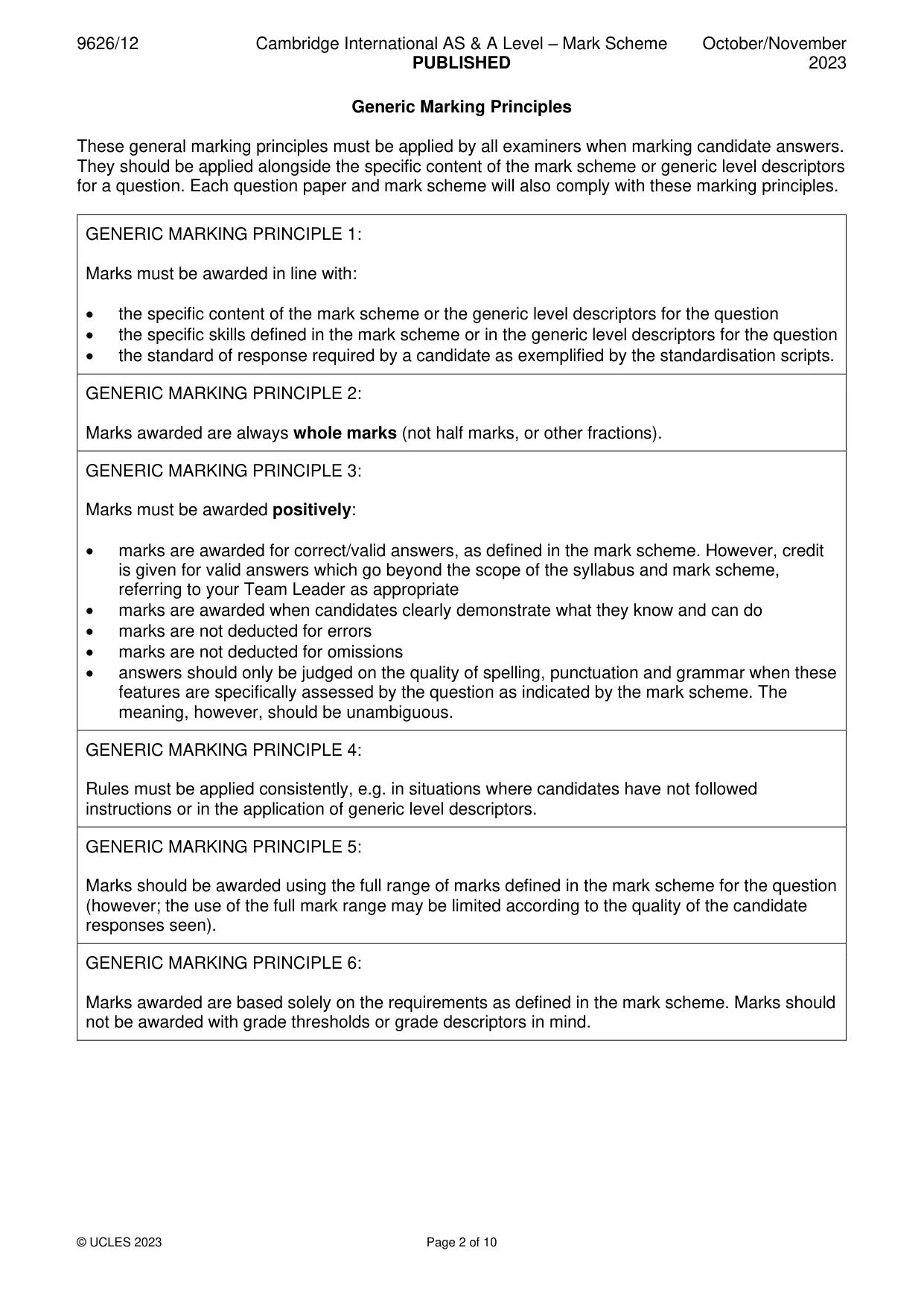
9626/12 Cambridge International AS & A Level – Mark Scheme PUBLISHED October/November 2023 © UCLES 2023 Page 2 of 10 Generic Marking Principles These general marking principles must be applied by all examiners when marking candidate answers. They should be applied alongside the specific content of the mark scheme or generic level descriptors for a question. Each question paper and mark scheme will also comply with these marking principles. GENERIC MARKING PRINCIPLE 1: Marks must be awarded in line with: • the specific content of the mark scheme or the generic level descriptors for the question • the specific skills defined in the mark scheme or in the generic level descriptors for the question • the standard of response required by a candidate as exemplified by the standardisation scripts. GENERIC MARKING PRINCIPLE 2: Marks awarded are always whole marks (not half marks, or other fractions). GENERIC MARKING PRINCIPLE 3: Marks must be awarded positively: • marks are awarded for correct/valid answers, as defined in the mark scheme. However, credit is given for valid answers which go beyond the scope of the syllabus and mark scheme, referring to your Team Leader as appropriate • marks are awarded when candidates clearly demonstrate what they know and can do • marks are not deducted for errors • marks are not deducted for omissions • answers should only be judged on the quality of spelling, punctuation and grammar when these features are specifically assessed by the question as indicated by the mark scheme. The meaning, however, should be unambiguous. GENERIC MARKING PRINCIPLE 4: Rules must be applied consistently, e.g. in situations where candidates have not followed instructions or in the application of generic level descriptors. GENERIC MARKING PRINCIPLE 5: Marks should be awarded using the full range of marks defined in the mark scheme for the question (however; the use of the full mark range may be limited according to the quality of the candidate responses seen). GENERIC MARKING PRINCIPLE 6: Marks awarded are based solely on the requirements as defined in the mark scheme. Marks should not be awarded with grade thresholds or grade descriptors in mind.
Mark scheme, page 3
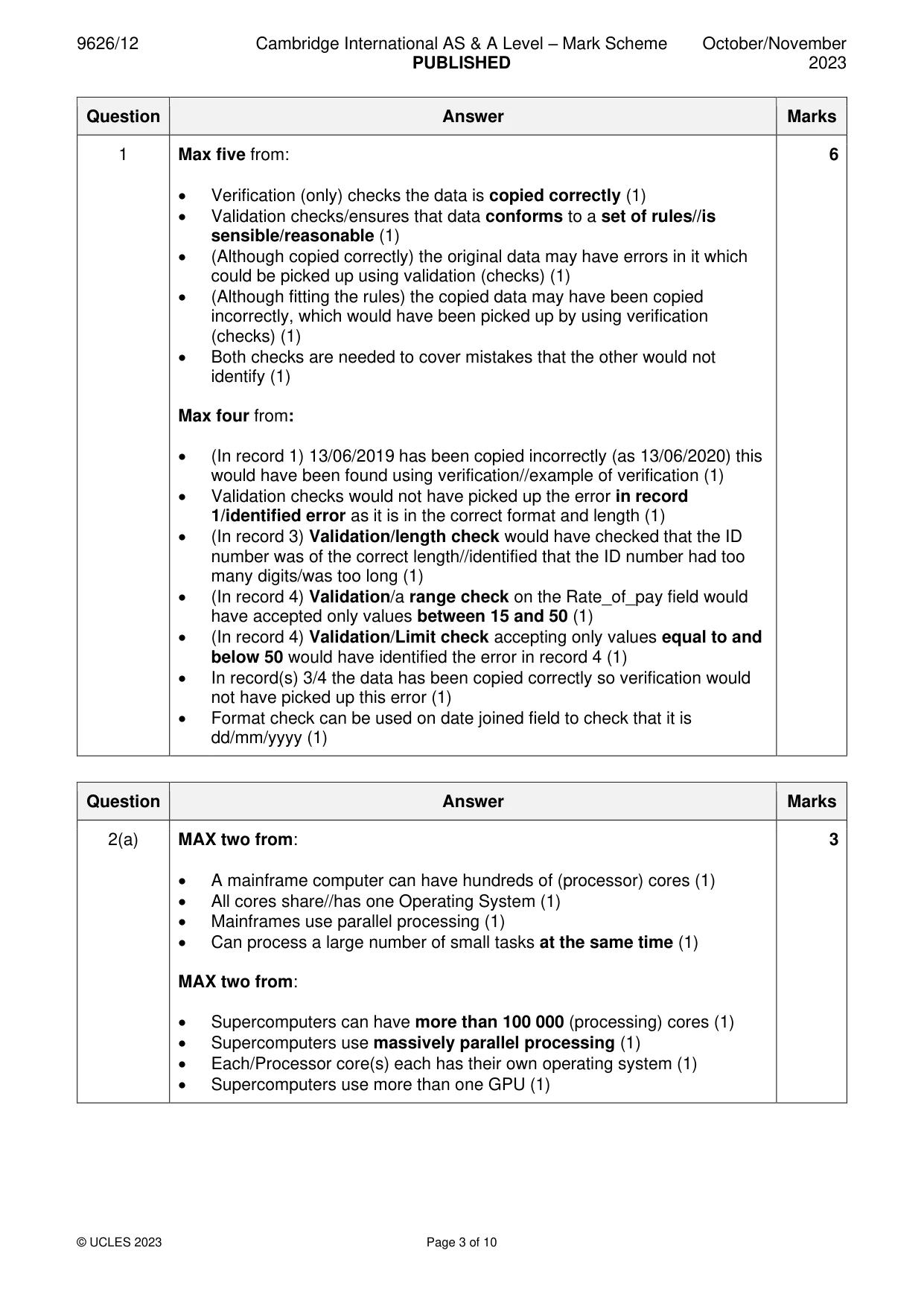
9626/12 Cambridge International AS & A Level – Mark Scheme PUBLISHED October/November 2023 © UCLES 2023 Page 3 of 10 Question Answer Marks 1 Max five from: • Verification (only) checks the data is copied correctly (1) • Validation checks/ensures that data conforms to a set of rules//is sensible/reasonable (1) • (Although copied correctly) the original data may have errors in it which could be picked up using validation (checks) (1) • (Although fitting the rules) the copied data may have been copied incorrectly, which would have been picked up by using verification (checks) (1) • Both checks are needed to cover mistakes that the other would not identify (1) Max four from: • (In record 1) 13/06/2019 has been copied incorrectly (as 13/06/2020) this would have been found using verification//example of verification (1) • Validation checks would not have picked up the error in record 1/identified error as it is in the correct format and length (1) • (In record 3) Validation/length check would have checked that the ID number was of the correct length//identified that the ID number had too many digits/was too long (1) • (In record 4) Validation/a range check on the Rate_of_pay field would have accepted only values between 15 and 50 (1) • (In record 4) Validation/Limit check accepting only values equal to and below 50 would have identified the error in record 4 (1) • In record(s) 3/4 the data has been copied correctly so verification would not have picked up this error (1) • Format check can be used on date joined field to check that it is dd/mm/yyyy (1) 6 Question Answer Marks 2(a) MAX two from: • A mainframe computer can have hundreds of (processor) cores (1) • All cores share//has one Operating System (1) • Mainframes use parallel processing (1) • Can process a large number of small tasks at the same time (1) MAX two from: • Supercomputers can have more than 100 000 (processing) cores (1) • Supercomputers use massively parallel processing (1) • Each/Processor core(s) each has their own operating system (1) • Supercomputers use more than one GPU (1) 3
Mark scheme, page 4
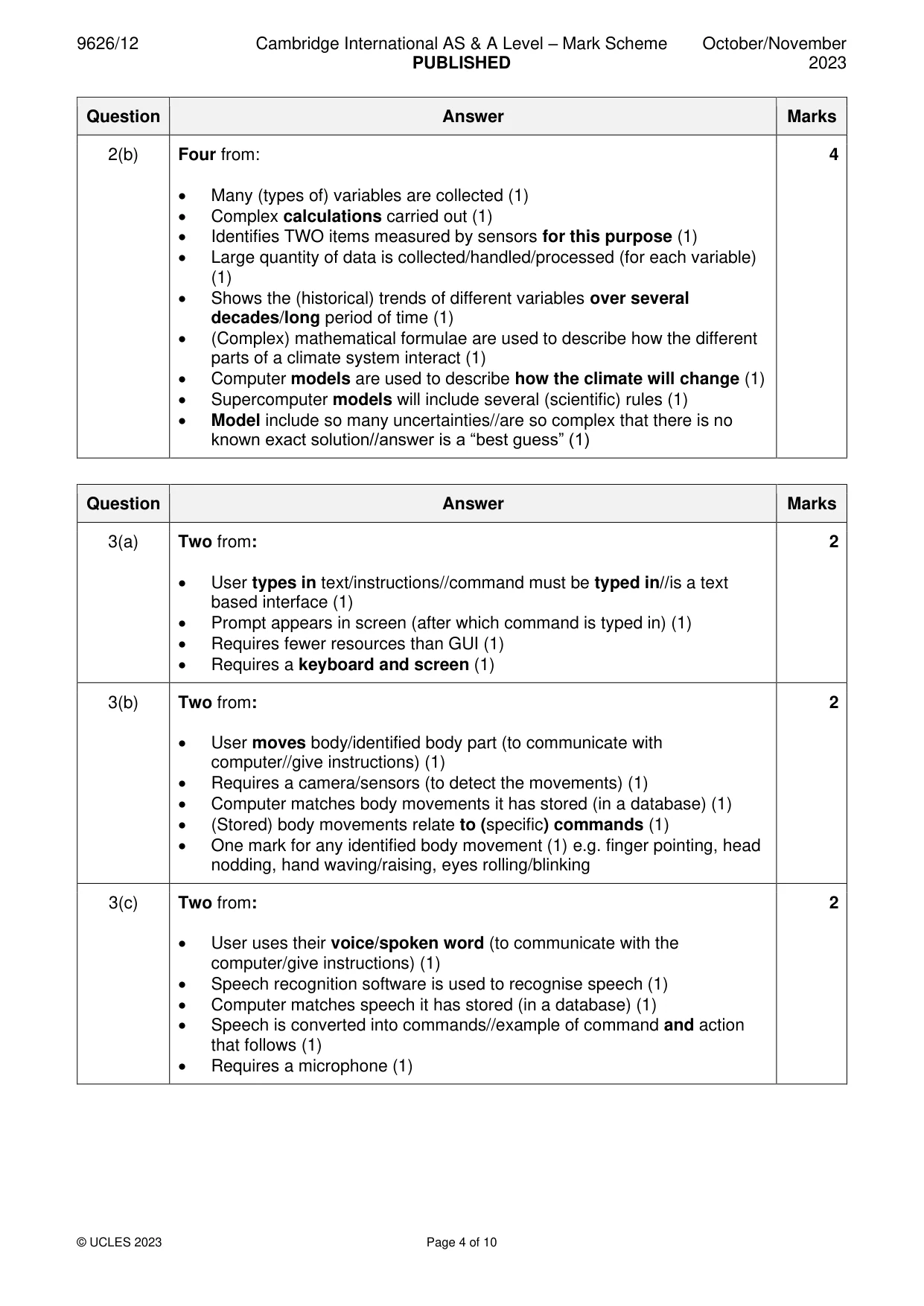
9626/12 Cambridge International AS & A Level – Mark Scheme PUBLISHED October/November 2023 © UCLES 2023 Page 4 of 10 Question Answer Marks 2(b) Four from: • Many (types of) variables are collected (1) • Complex calculations carried out (1) • Identifies TWO items measured by sensors for this purpose (1) • Large quantity of data is collected/handled/processed (for each variable) (1) • Shows the (historical) trends of different variables over several decades/long period of time (1) • (Complex) mathematical formulae are used to describe how the different parts of a climate system interact (1) • Computer models are used to describe how the climate will change (1) • Supercomputer models will include several (scientific) rules (1) • Model include so many uncertainties//are so complex that there is no known exact solution//answer is a “best guess” (1) 4 Question Answer Marks 3(a) Two from: • User types in text/instructions//command must be typed in//is a text based interface (1) • Prompt appears in screen (after which command is typed in) (1) • Requires fewer resources than GUI (1) • Requires a keyboard and screen (1) 2 3(b) Two from: • User moves body/identified body part (to communicate with computer//give instructions) (1) • Requires a camera/sensors (to detect the movements) (1) • Computer matches body movements it has stored (in a database) (1) • (Stored) body movements relate to (specific) commands (1) • One mark for any identified body movement (1) e.g. finger pointing, head nodding, hand waving/raising, eyes rolling/blinking 2 3(c) Two from: • User uses their voice/spoken word (to communicate with the computer/give instructions) (1) • Speech recognition software is used to recognise speech (1) • Computer matches speech it has stored (in a database) (1) • Speech is converted into commands//example of command and action that follows (1) • Requires a microphone (1) 2
Mark scheme, page 5
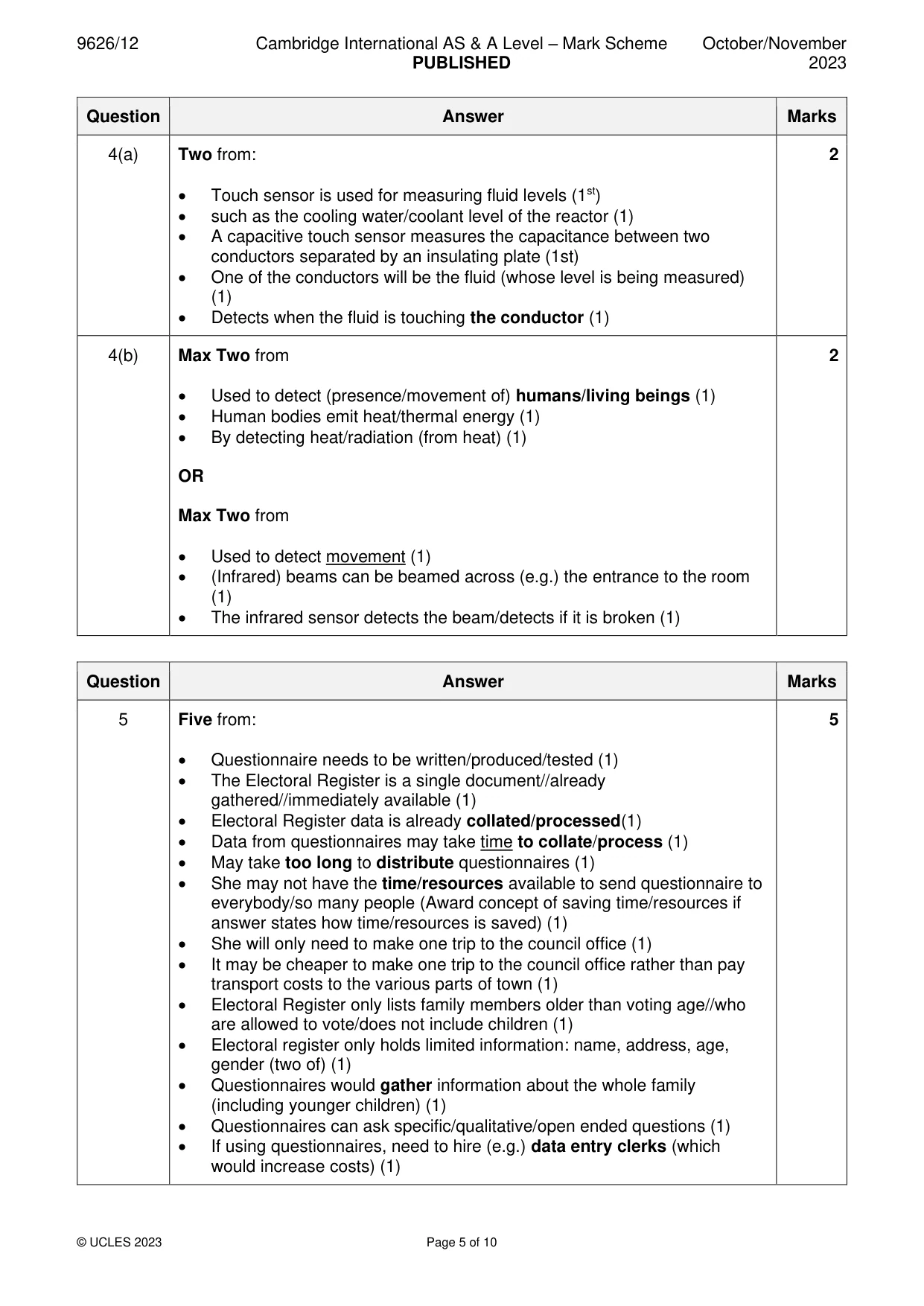
9626/12 Cambridge International AS & A Level – Mark Scheme PUBLISHED October/November 2023 © UCLES 2023 Page 5 of 10 Question Answer Marks 4(a) Two from: • Touch sensor is used for measuring fluid levels (1st) • such as the cooling water/coolant level of the reactor (1) • A capacitive touch sensor measures the capacitance between two conductors separated by an insulating plate (1st) • One of the conductors will be the fluid (whose level is being measured) (1) • Detects when the fluid is touching the conductor (1) 2 4(b) Max Two from • Used to detect (presence/movement of) humans/living beings (1) • Human bodies emit heat/thermal energy (1) • By detecting heat/radiation (from heat) (1) OR Max Two from • Used to detect movement (1) • (Infrared) beams can be beamed across (e.g.) the entrance to the room (1) • The infrared sensor detects the beam/detects if it is broken (1) 2 Question Answer Marks 5 Five from: • Questionnaire needs to be written/produced/tested (1) • The Electoral Register is a single document//already gathered//immediately available (1) • Electoral Register data is already collated/processed(1) • Data from questionnaires may take time to collate/process (1) • May take too long to distribute questionnaires (1) • She may not have the time/resources available to send questionnaire to everybody/so many people (Award concept of saving time/resources if answer states how time/resources is saved) (1) • She will only need to make one trip to the council office (1) • It may be cheaper to make one trip to the council office rather than pay transport costs to the various parts of town (1) • Electoral Register only lists family members older than voting age//who are allowed to vote/does not include children (1) • Electoral register only holds limited information: name, address, age, gender (two of) (1) • Questionnaires would gather information about the whole family (including younger children) (1) • Questionnaires can ask specific/qualitative/open ended questions (1) • If using questionnaires, need to hire (e.g.) data entry clerks (which would increase costs) (1) 5
Mark scheme, page 6
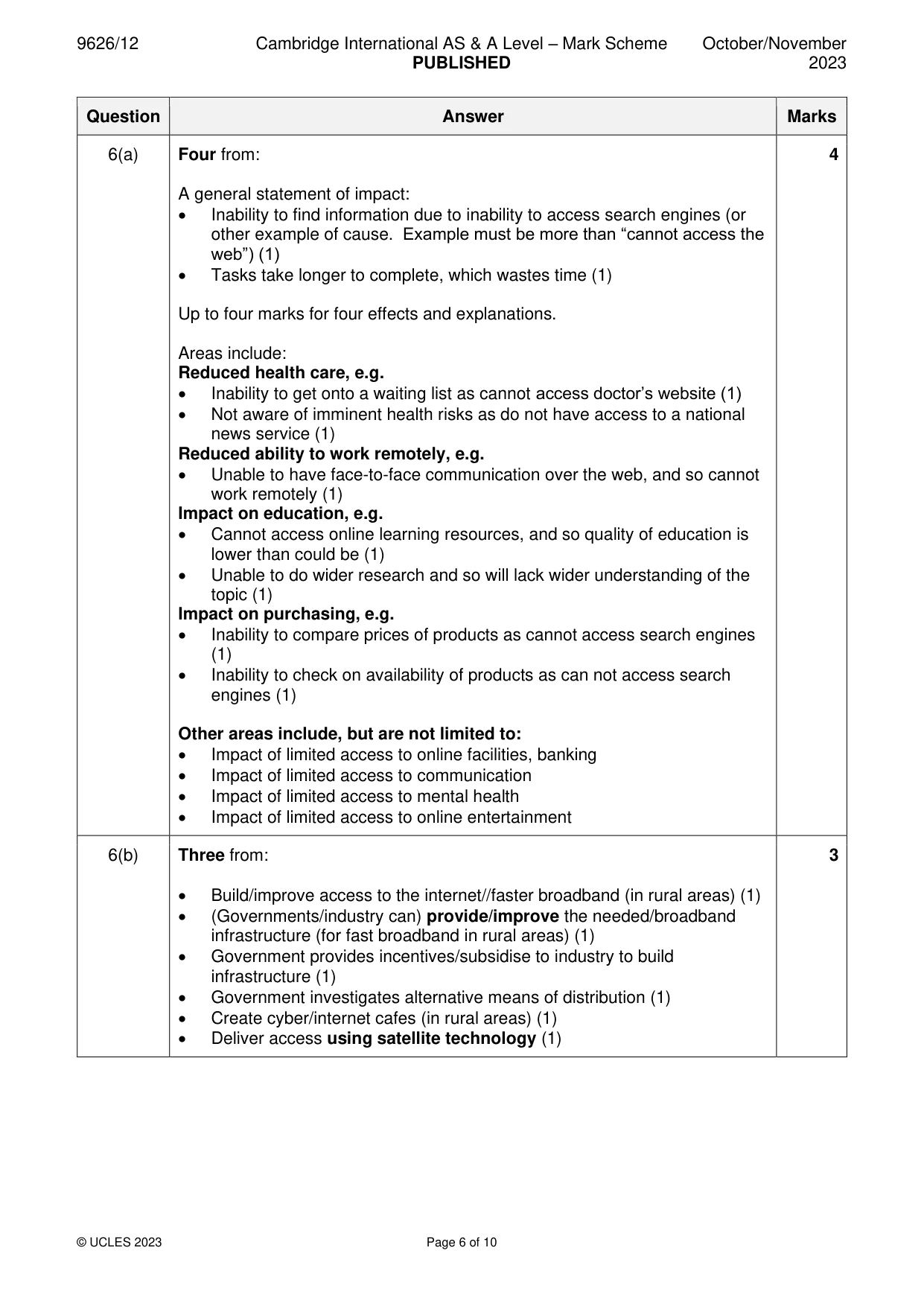
9626/12 Cambridge International AS & A Level – Mark Scheme PUBLISHED October/November 2023 © UCLES 2023 Page 6 of 10 Question Answer Marks 6(a) Four from: A general statement of impact: • Inability to find information due to inability to access search engines (or other example of cause. Example must be more than “cannot access the web”) (1) • Tasks take longer to complete, which wastes time (1) Up to four marks for four effects and explanations. Areas include: Reduced health care, e.g. • Inability to get onto a waiting list as cannot access doctor’s website (1) • Not aware of imminent health risks as do not have access to a national news service (1) Reduced ability to work remotely, e.g. • Unable to have face-to-face communication over the web, and so cannot work remotely (1) Impact on education, e.g. • Cannot access online learning resources, and so quality of education is lower than could be (1) • Unable to do wider research and so will lack wider understanding of the topic (1) Impact on purchasing, e.g. • Inability to compare prices of products as cannot access search engines (1) • Inability to check on availability of products as can not access search engines (1) Other areas include, but are not limited to: • Impact of limited access to online facilities, banking • Impact of limited access to communication • Impact of limited access to mental health • Impact of limited access to online entertainment 4 6(b) Three from: • Build/improve access to the internet//faster broadband (in rural areas) (1) • (Governments/industry can) provide/improve the needed/broadband infrastructure (for fast broadband in rural areas) (1) • Government provides incentives/subsidise to industry to build infrastructure (1) • Government investigates alternative means of distribution (1) • Create cyber/internet cafes (in rural areas) (1) • Deliver access using satellite technology (1) 3
Mark scheme, page 7
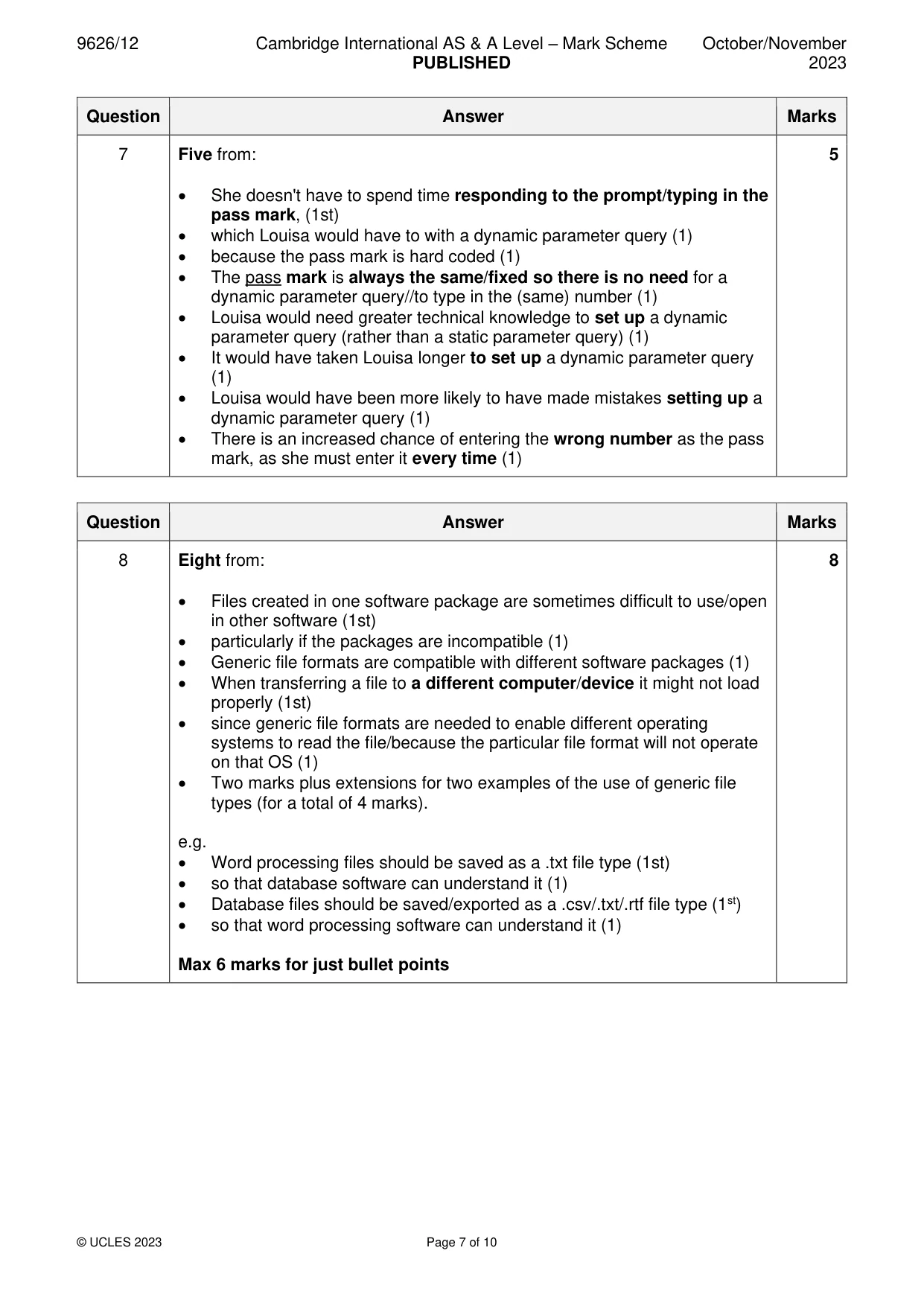
9626/12 Cambridge International AS & A Level – Mark Scheme PUBLISHED October/November 2023 © UCLES 2023 Page 7 of 10 Question Answer Marks 7 Five from: • She doesn't have to spend time responding to the prompt/typing in the pass mark, (1st) • which Louisa would have to with a dynamic parameter query (1) • because the pass mark is hard coded (1) • The pass mark is always the same/fixed so there is no need for a dynamic parameter query//to type in the (same) number (1) • Louisa would need greater technical knowledge to set up a dynamic parameter query (rather than a static parameter query) (1) • It would have taken Louisa longer to set up a dynamic parameter query (1) • Louisa would have been more likely to have made mistakes setting up a dynamic parameter query (1) • There is an increased chance of entering the wrong number as the pass mark, as she must enter it every time (1) 5 Question Answer Marks 8 Eight from: • Files created in one software package are sometimes difficult to use/open in other software (1st) • particularly if the packages are incompatible (1) • Generic file formats are compatible with different software packages (1) • When transferring a file to a different computer/device it might not load properly (1st) • since generic file formats are needed to enable different operating systems to read the file/because the particular file format will not operate on that OS (1) • Two marks plus extensions for two examples of the use of generic file types (for a total of 4 marks). e.g. • Word processing files should be saved as a .txt file type (1st) • so that database software can understand it (1) • Database files should be saved/exported as a .csv/.txt/.rtf file type (1st) • so that word processing software can understand it (1) Max 6 marks for just bullet points 8
Mark scheme, page 8
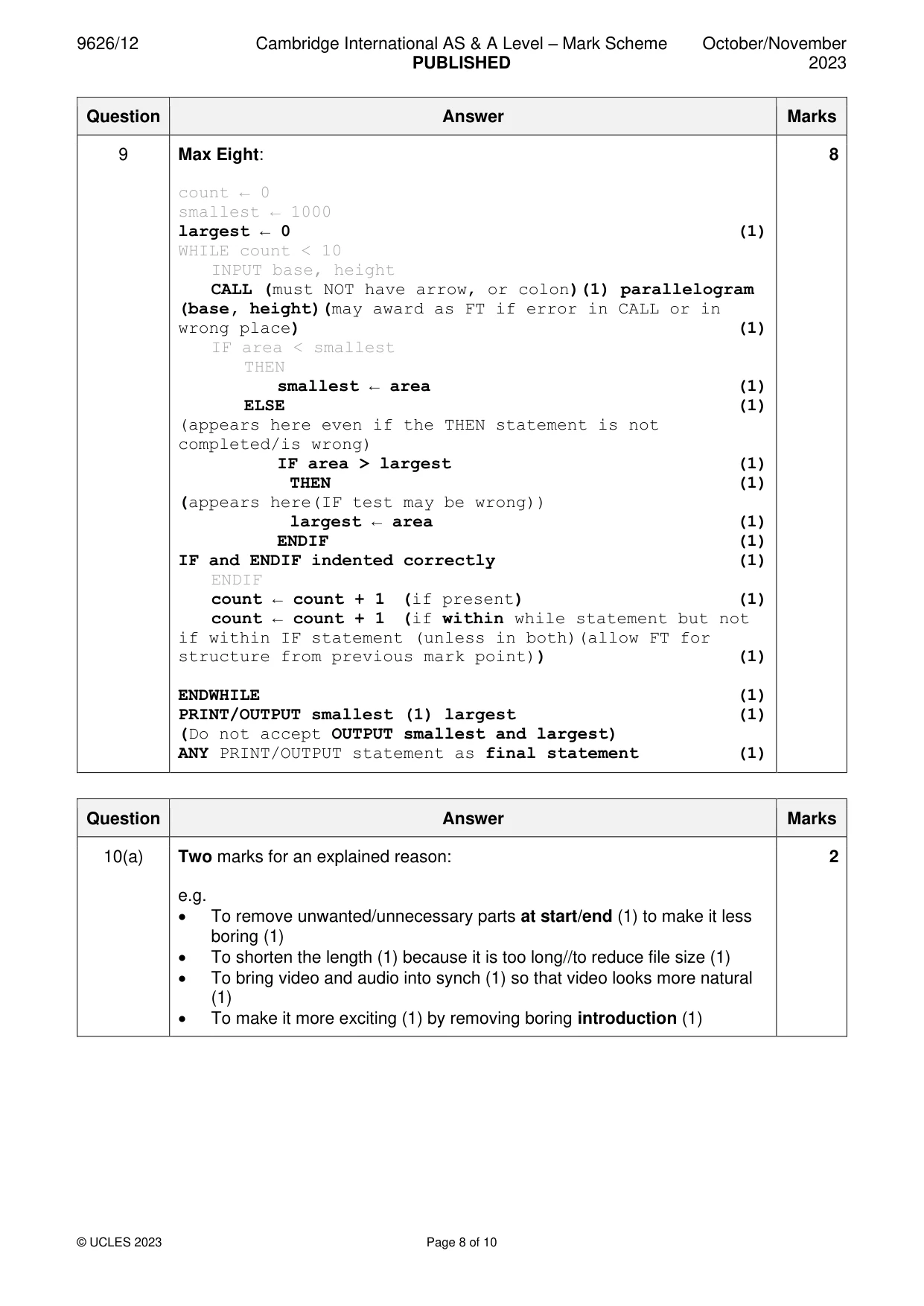
9626/12 Cambridge International AS & A Level – Mark Scheme PUBLISHED October/November 2023 © UCLES 2023 Page 8 of 10 Question Answer Marks 9 Max Eight: count ← 0 smallest ← 1000 largest ← 0 (1) WHILE count < 10 INPUT base, height CALL (must NOT have arrow, or colon)(1) parallelogram (base, height)(may award as FT if error in CALL or in wrong place) (1) IF area < smallest THEN smallest ← area (1) ELSE (1) (appears here even if the THEN statement is not completed/is wrong) IF area > largest (1) THEN (1) (appears here(IF test may be wrong)) largest ← area (1) ENDIF (1) IF and ENDIF indented correctly (1) ENDIF count ← count + 1 (if present) (1) count ← count + 1 (if within while statement but not if within IF statement (unless in both)(allow FT for structure from previous mark point)) (1) ENDWHILE (1) PRINT/OUTPUT smallest (1) largest (1) (Do not accept OUTPUT smallest and largest) ANY PRINT/OUTPUT statement as final statement (1) 8 Question Answer Marks 10(a) Two marks for an explained reason: e.g. • To remove unwanted/unnecessary parts at start/end (1) to make it less boring (1) • To shorten the length (1) because it is too long//to reduce file size (1) • To bring video and audio into synch (1) so that video looks more natural (1) • To make it more exciting (1) by removing boring introduction (1) 2
Mark scheme, page 9
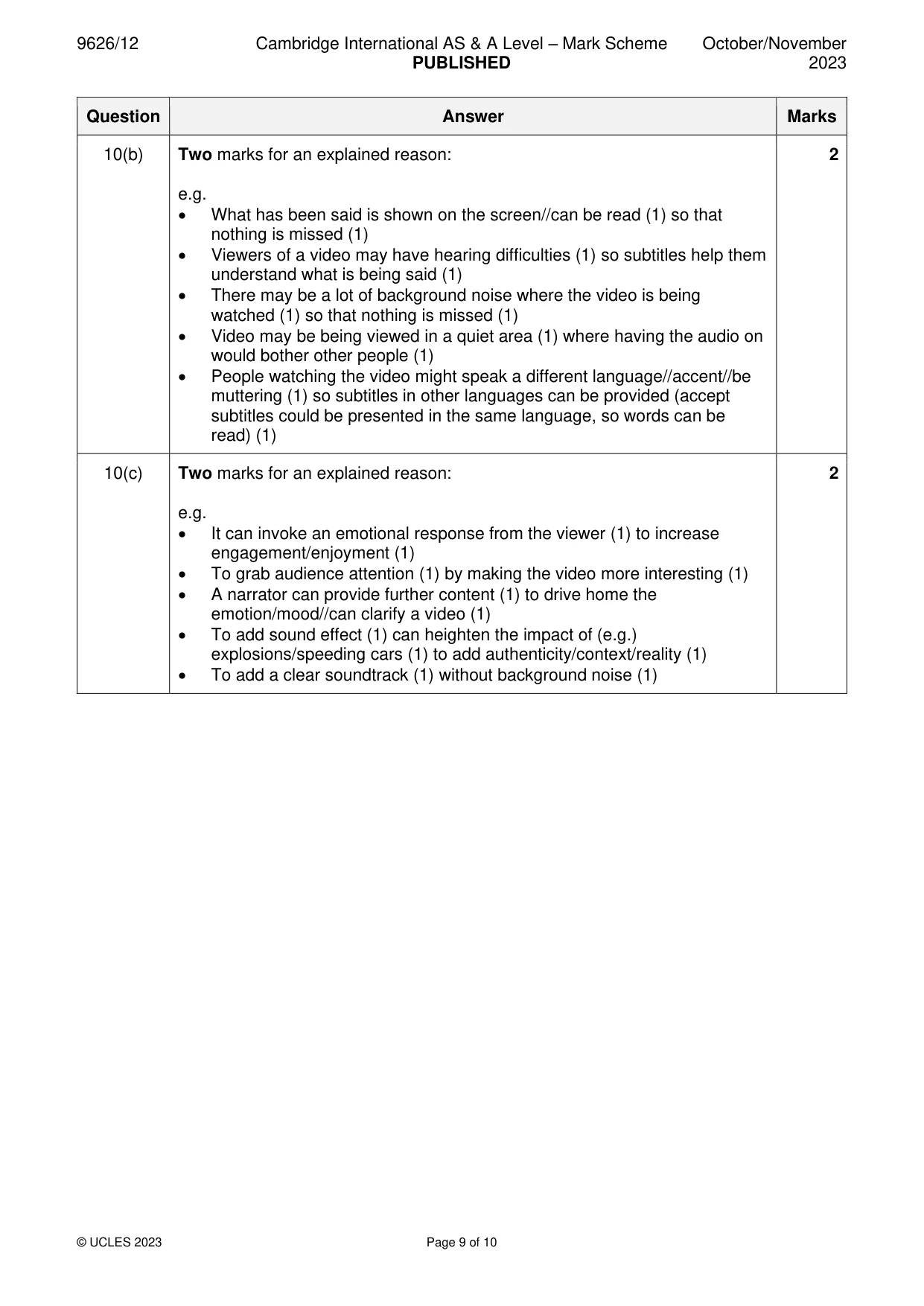
9626/12 Cambridge International AS & A Level – Mark Scheme PUBLISHED October/November 2023 © UCLES 2023 Page 9 of 10 Question Answer Marks 10(b) Two marks for an explained reason: e.g. • What has been said is shown on the screen//can be read (1) so that nothing is missed (1) • Viewers of a video may have hearing difficulties (1) so subtitles help them understand what is being said (1) • There may be a lot of background noise where the video is being watched (1) so that nothing is missed (1) • Video may be being viewed in a quiet area (1) where having the audio on would bother other people (1) • People watching the video might speak a different language//accent//be muttering (1) so subtitles in other languages can be provided (accept subtitles could be presented in the same language, so words can be read) (1) 2 10(c) Two marks for an explained reason: e.g. • It can invoke an emotional response from the viewer (1) to increase engagement/enjoyment (1) • To grab audience attention (1) by making the video more interesting (1) • A narrator can provide further content (1) to drive home the emotion/mood//can clarify a video (1) • To add sound effect (1) can heighten the impact of (e.g.) explosions/speeding cars (1) to add authenticity/context/reality (1) • To add a clear soundtrack (1) without background noise (1) 2
Mark scheme, page 10
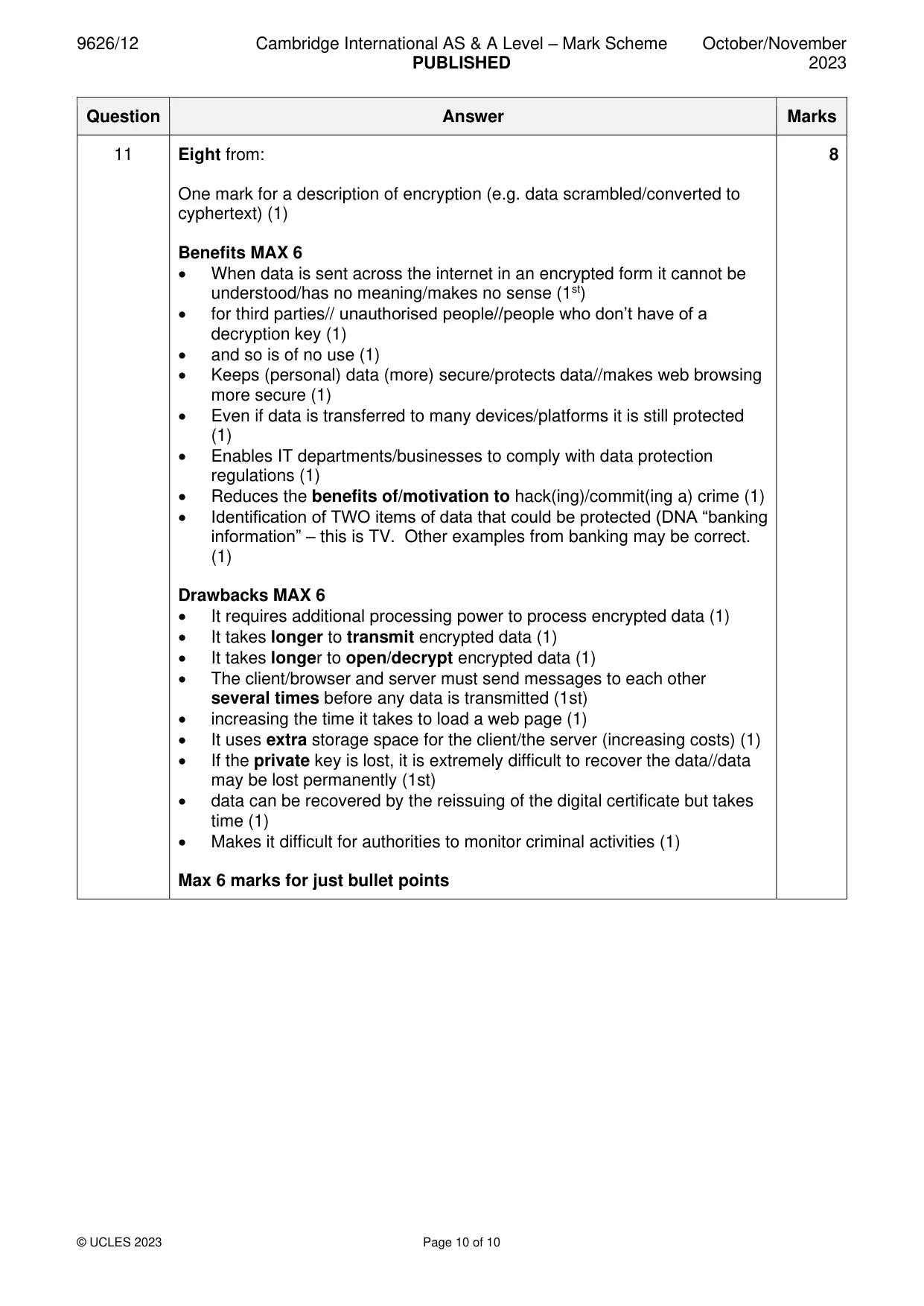
9626/12 Cambridge International AS & A Level – Mark Scheme PUBLISHED October/November 2023 © UCLES 2023 Page 10 of 10 Question Answer Marks 11 Eight from: One mark for a description of encryption (e.g. data scrambled/converted to cyphertext) (1) Benefits MAX 6 • When data is sent across the internet in an encrypted form it cannot be understood/has no meaning/makes no sense (1st) • for third parties// unauthorised people//people who don’t have of a decryption key (1) • and so is of no use (1) • Keeps (personal) data (more) secure/protects data//makes web browsing more secure (1) • Even if data is transferred to many devices/platforms it is still protected (1) • Enables IT departments/businesses to comply with data protection regulations (1) • Reduces the benefits of/motivation to hack(ing)/commit(ing a) crime (1) • Identification of TWO items of data that could be protected (DNA “banking information” – this is TV. Other examples from banking may be correct. (1) Drawbacks MAX 6 • It requires additional processing power to process encrypted data (1) • It takes longer to transmit encrypted data (1) • It takes longer to open/decrypt encrypted data (1) • The client/browser and server must send messages to each other several times before any data is transmitted (1st) • increasing the time it takes to load a web page (1) • It uses extra storage space for the client/the server (increasing costs) (1) • If the private key is lost, it is extremely difficult to recover the data//data may be lost permanently (1st) • data can be recovered by the reissuing of the digital certificate but takes time (1) • Makes it difficult for authorities to monitor criminal activities (1) Max 6 marks for just bullet points 8
What you needed in this session
Cambridge’s own grade thresholds for 2023 Oct/Nov, Paper 1 · Variant 2. A higher threshold means an easier paper — the bar moves with how the cohort did.