Cambridge A Level Information Technology (from 2017) 9626 — 2024 May/June Paper 1 · Variant 2
9626/12/M/J/24 · 70 marks · ≈79 min
The question paper and its mark scheme, free to read here and free to download. This is Cambridge’s own paper, exactly as it was sat.
Question paper12 pages



Mark scheme9 pages
Answers below. Sit the paper first if you are practising.
Paper as text
Question paper, page 1
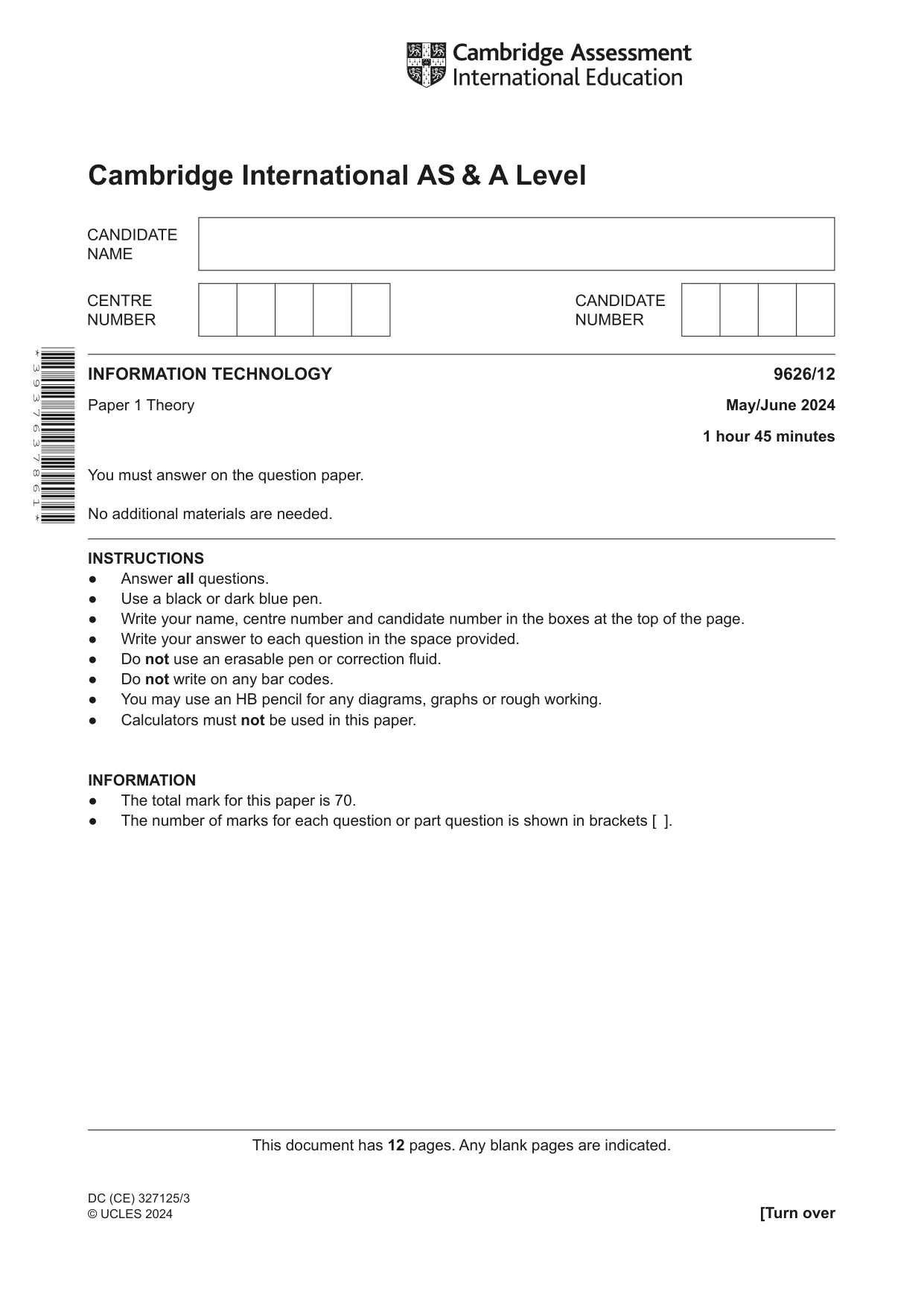
This document has 12 pages. Any blank pages are indicated. [Turn over Cambridge International AS & A Level DC (CE) 327125/3 © UCLES 2024 INFORMATION TECHNOLOGY 9626/12 Paper 1 Theory May/June 2024 1 hour 45 minutes You must answer on the question paper. No additional materials are needed. INSTRUCTIONS ● Answer all questions. ● Use a black or dark blue pen. ● Write your name, centre number and candidate number in the boxes at the top of the page. ● Write your answer to each question in the space provided. ● Do not use an erasable pen or correction fluid. ● Do not write on any bar codes. ● You may use an HB pencil for any diagrams, graphs or rough working. ● Calculators must not be used in this paper. INFORMATION ● The total mark for this paper is 70. ● The number of marks for each question or part question is shown in brackets [ ]. * 3 9 3 7 6 3 7 8 6 1 *
Question paper, page 2
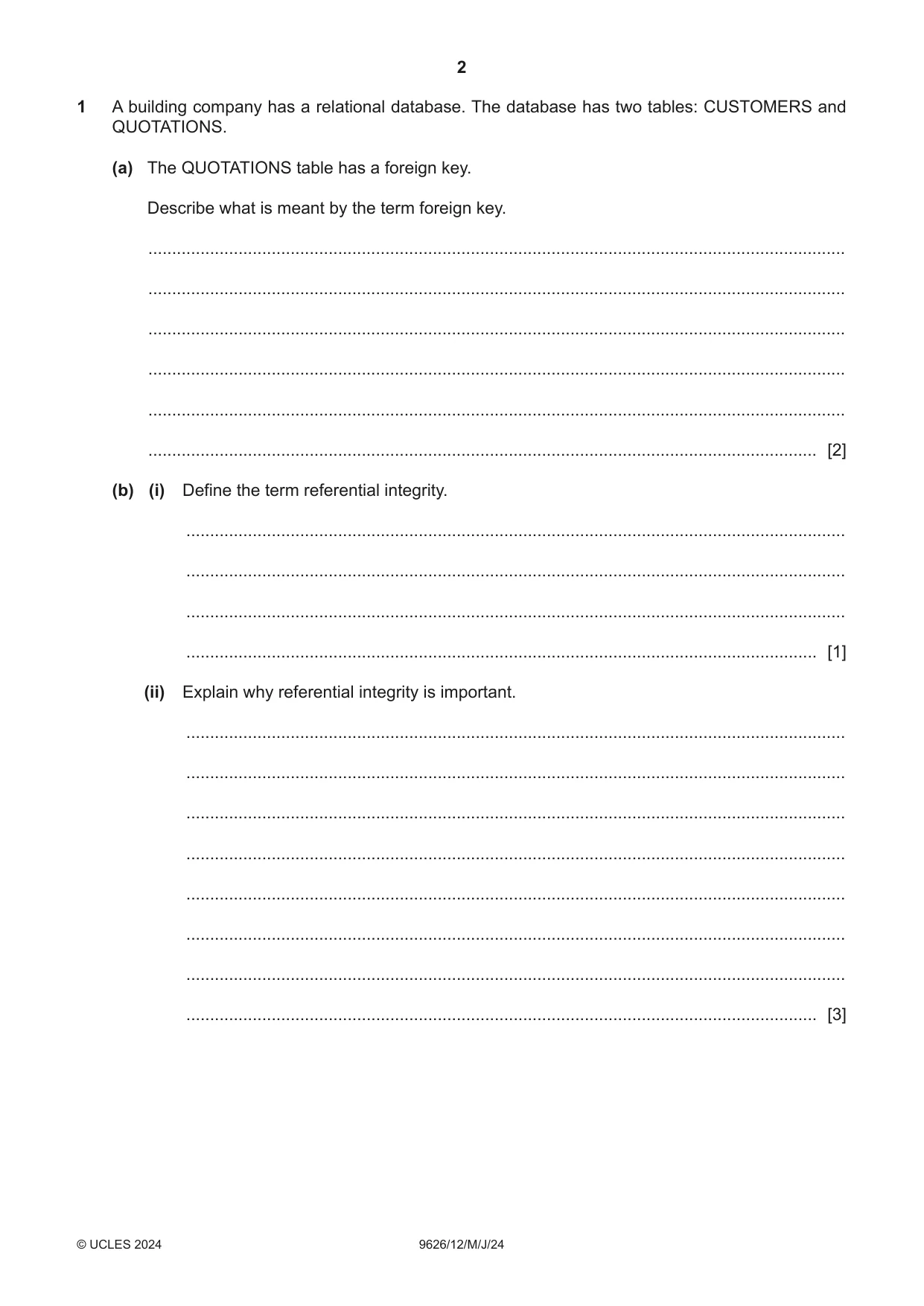
2 9626/12/M/J/24 © UCLES 2024 1 A building company has a relational database. The database has two tables: CUSTOMERS and QUOTATIONS. (a) The QUOTATIONS table has a foreign key. Describe what is meant by the term foreign key. … … … … … … [2] (b) (i) Define the term referential integrity. … … … … [1] (ii) Explain why referential integrity is important. … … … … … … … … [3]
Question paper, page 3
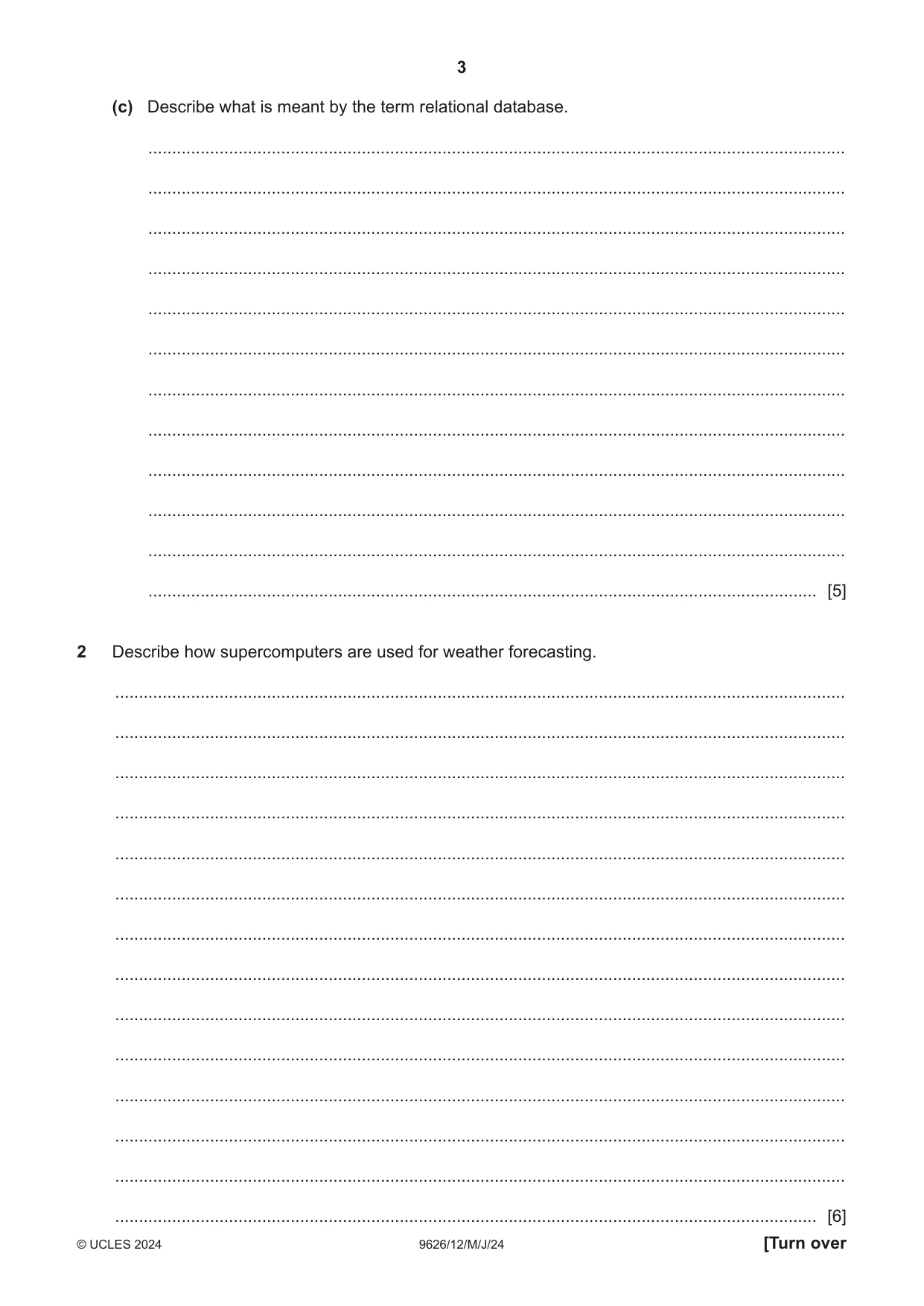
3 9626/12/M/J/24 © UCLES 2024 [Turn over (c) Describe what is meant by the term relational database. … … … … … … … … … … … … [5] 2 Describe how supercomputers are used for weather forecasting. … … … … … … … … … … … … … … [6]
Question paper, page 4
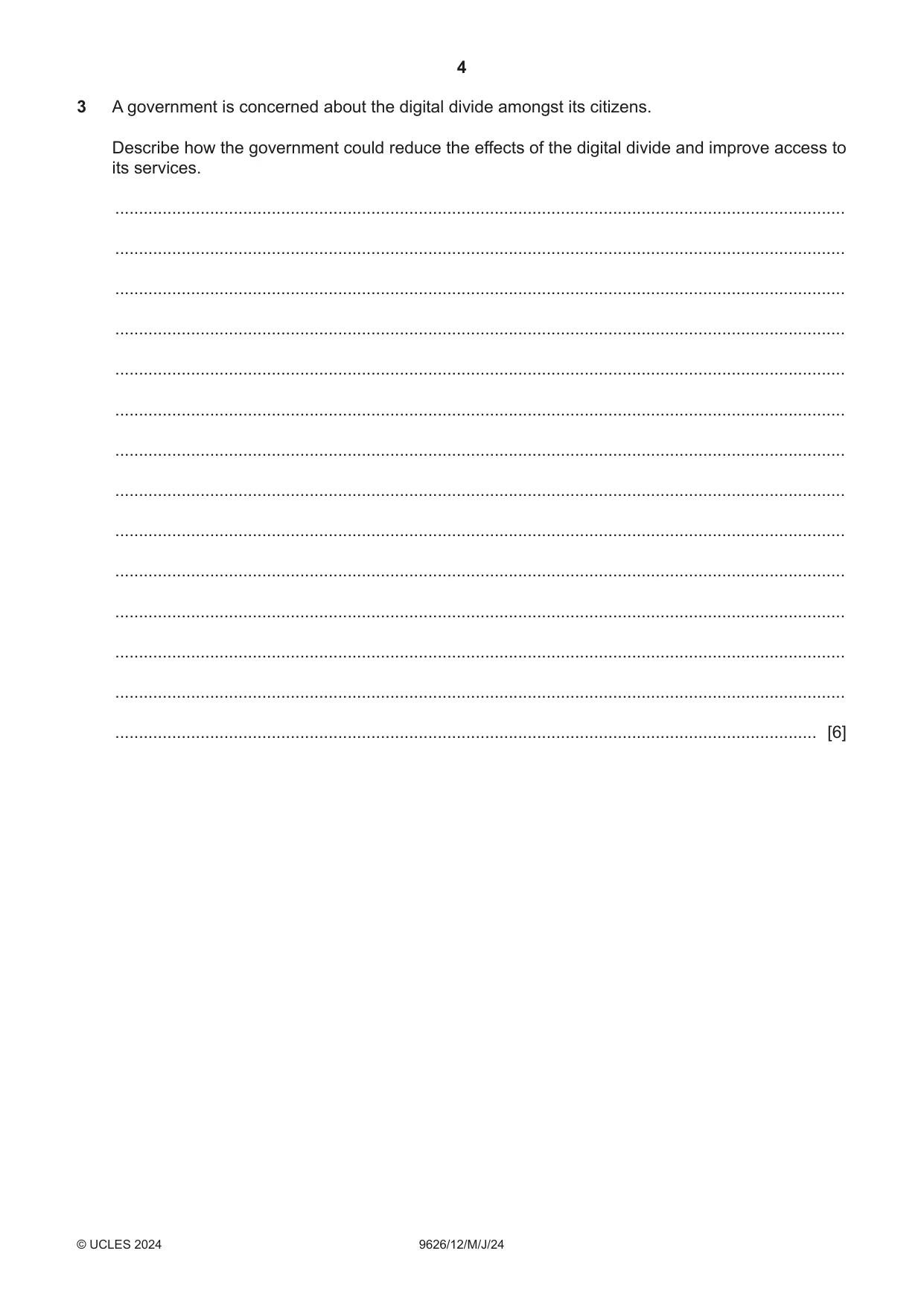
4 9626/12/M/J/24 © UCLES 2024 3 A government is concerned about the digital divide amongst its citizens. Describe how the government could reduce the effects of the digital divide and improve access to its services. … … … … … … … … … … … … … … [6]
Question paper, page 5
5 9626/12/M/J/24 © UCLES 2024 [Turn over 4 Data can be kept secure by using the Secure Socket Layer (SSL) / Transport Layer Security (TLS) protocols when it is transmitted over the internet. Describe the use of SSL/TLS to ensure data is kept secure. … … … … … … … … … … … … … … … … … … [8]
Question paper, page 6
6 9626/12/M/J/24 © UCLES 2024 5 There are various methods of verification. (a) Describe why checksum verification is used. … … … … … … [2] (b) Describe a method of calculating a checksum. … … … … … … … … [3] 6 Describe these types of malware. (a) Malicious bots … … … … … … … … … … [4]
Question paper, page 7
7 9626/12/M/J/24 © UCLES 2024 [Turn over (b) Rootkit … … … … … … … … … … [4] (c) Virus … … … … … … … … … … [4]
Question paper, page 8
8 9626/12/M/J/24 © UCLES 2024 7 Data can be collected by using a direct or an indirect data source. Discuss the advantages and disadvantages of using direct data compared to indirect data. … … … … … … … … … … … … … … … … … … … … [8]
Question paper, page 9
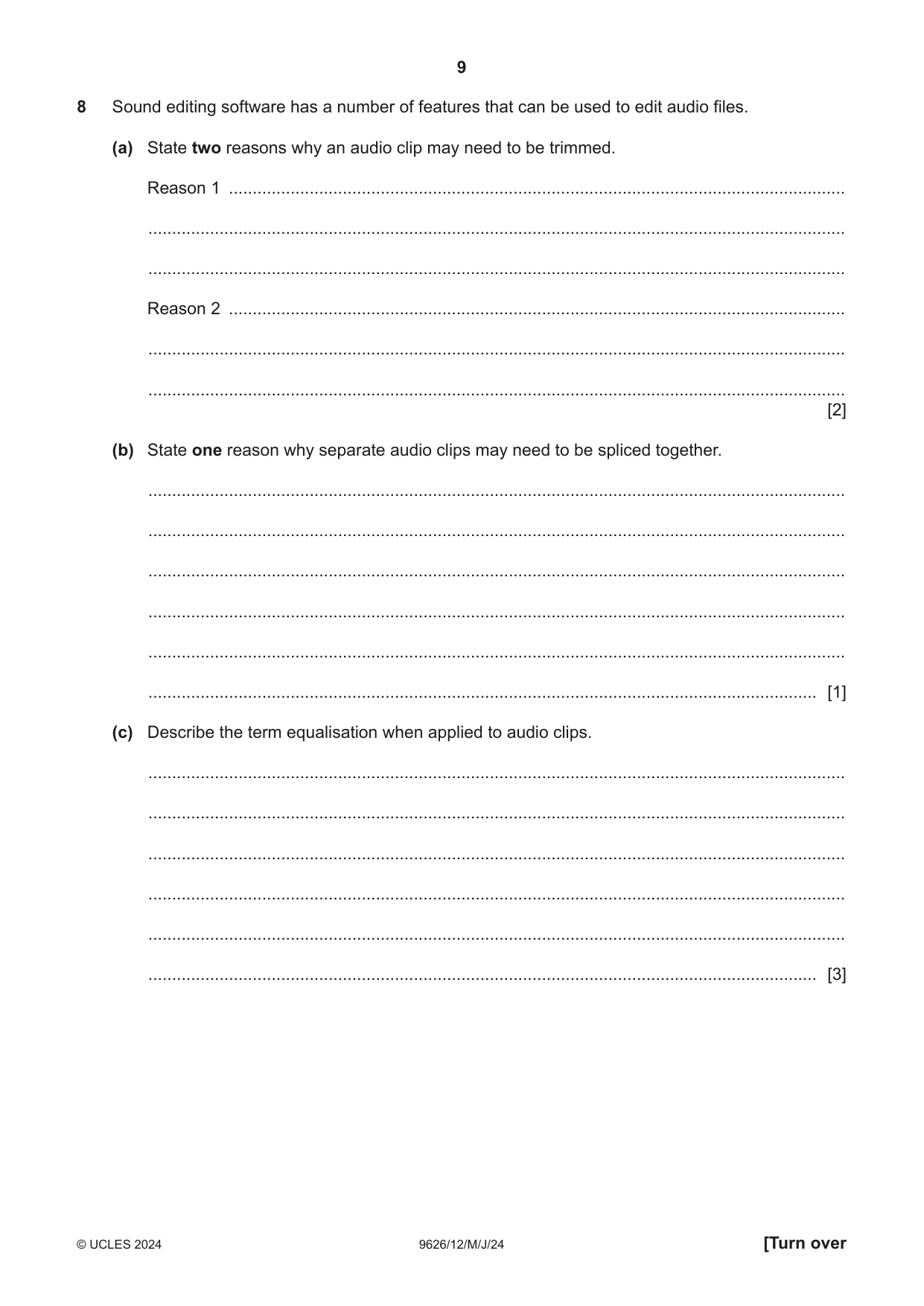
9 9626/12/M/J/24 © UCLES 2024 [Turn over 8 Sound editing software has a number of features that can be used to edit audio files. (a) State two reasons why an audio clip may need to be trimmed. Reason 1 … … … Reason 2 … … … [2] (b) State one reason why separate audio clips may need to be spliced together. … … … … … … [1] (c) Describe the term equalisation when applied to audio clips. … … … … … … [3]
Question paper, page 10
10 9626/12/M/J/24 © UCLES 2024 9 Discuss the advantages and disadvantages of using a dialogue interface rather than a gesture‑based interface. … … … … … … … … … … … … … … … … … … … … [8]
Question paper, page 11
11 9626/12/M/J/24 © UCLES 2024 BLANK PAGE
Question paper, page 12
12 9626/12/M/J/24 © UCLES 2024 Permission to reproduce items where third‑party owned material protected by copyright is included has been sought and cleared where possible. Every reasonable effort has been made by the publisher (UCLES) to trace copyright holders, but if any items requiring clearance have unwittingly been included, the publisher will be pleased to make amends at the earliest possible opportunity. To avoid the issue of disclosure of answer‑related information to candidates, all copyright acknowledgements are reproduced online in the Cambridge Assessment International Education Copyright Acknowledgements Booklet. This is produced for each series of examinations and is freely available to download at www.cambridgeinternational.org after the live examination series. Cambridge Assessment International Education is part of Cambridge Assessment. Cambridge Assessment is the brand name of the University of Cambridge Local Examinations Syndicate (UCLES), which is a department of the University of Cambridge. BLANK PAGE
Mark scheme, page 1
This document consists of 9 printed pages. © Cambridge University Press & Assessment 2024 [Turn over Cambridge International AS & A Level INFORMATION TECHNOLOGY 9626/12 Paper 1 Theory May/June 2024 MARK SCHEME Maximum Mark: 70 Published This mark scheme is published as an aid to teachers and candidates, to indicate the requirements of the examination. It shows the basis on which Examiners were instructed to award marks. It does not indicate the details of the discussions that took place at an Examiners’ meeting before marking began, which would have considered the acceptability of alternative answers. Mark schemes should be read in conjunction with the question paper and the Principal Examiner Report for Teachers. Cambridge International will not enter into discussions about these mark schemes. Cambridge International is publishing the mark schemes for the May/June 2024 series for most Cambridge IGCSE, Cambridge International A and AS Level and Cambridge Pre-U components, and some Cambridge O Level components.
Mark scheme, page 2
9626/12 Cambridge International AS & A Level – Mark Scheme PUBLISHED May/June 2024 © Cambridge University Press & Assessment 2024 Page 2 of 9 Generic Marking Principles These general marking principles must be applied by all examiners when marking candidate answers. They should be applied alongside the specific content of the mark scheme or generic level descriptions for a question. Each question paper and mark scheme will also comply with these marking principles. GENERIC MARKING PRINCIPLE 1: Marks must be awarded in line with: the specific content of the mark scheme or the generic level descriptors for the question the specific skills defined in the mark scheme or in the generic level descriptors for the question the standard of response required by a candidate as exemplified by the standardisation scripts. GENERIC MARKING PRINCIPLE 2: Marks awarded are always whole marks (not half marks, or other fractions). GENERIC MARKING PRINCIPLE 3: Marks must be awarded positively: marks are awarded for correct/valid answers, as defined in the mark scheme. However, credit is given for valid answers which go beyond the scope of the syllabus and mark scheme, referring to your Team Leader as appropriate marks are awarded when candidates clearly demonstrate what they know and can do marks are not deducted for errors marks are not deducted for omissions answers should only be judged on the quality of spelling, punctuation and grammar when these features are specifically assessed by the question as indicated by the mark scheme. The meaning, however, should be unambiguous. GENERIC MARKING PRINCIPLE 4: Rules must be applied consistently, e.g. in situations where candidates have not followed instructions or in the application of generic level descriptors. GENERIC MARKING PRINCIPLE 5: Marks should be awarded using the full range of marks defined in the mark scheme for the question (however; the use of the full mark range may be limited according to the quality of the candidate responses seen). GENERIC MARKING PRINCIPLE 6: Marks awarded are based solely on the requirements as defined in the mark scheme. Marks should not be awarded with grade thresholds or grade descriptors in mind.
Mark scheme, page 3
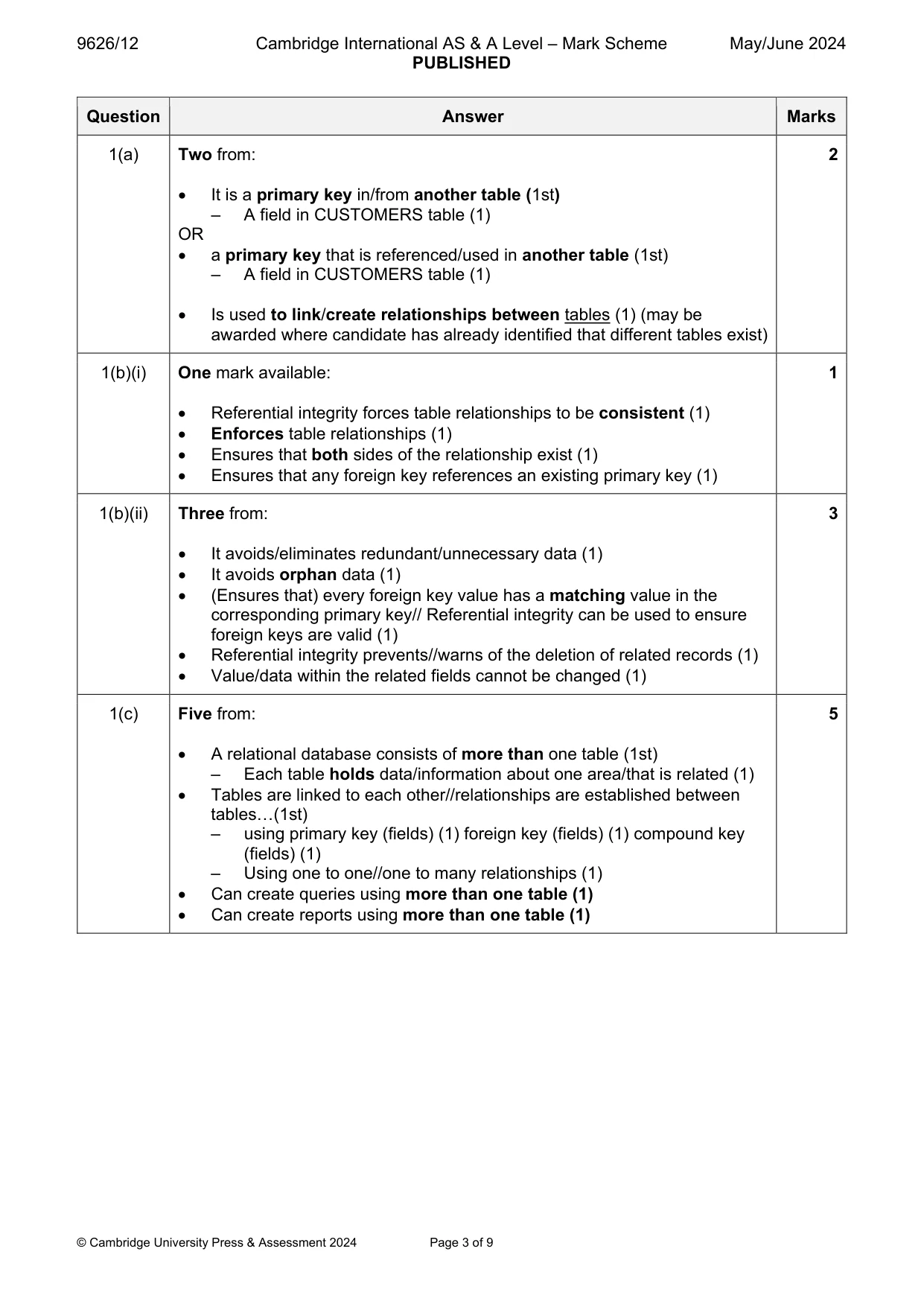
9626/12 Cambridge International AS & A Level – Mark Scheme PUBLISHED May/June 2024 © Cambridge University Press & Assessment 2024 Page 3 of 9 Question Answer Marks 1(a) Two from: It is a primary key in/from another table (1st) – A field in CUSTOMERS table (1) OR a primary key that is referenced/used in another table (1st) – A field in CUSTOMERS table (1) Is used to link/create relationships between tables (1) (may be awarded where candidate has already identified that different tables exist) 2 1(b)(i) One mark available: Referential integrity forces table relationships to be consistent (1) Enforces table relationships (1) Ensures that both sides of the relationship exist (1) Ensures that any foreign key references an existing primary key (1) 1 1(b)(ii) Three from: It avoids/eliminates redundant/unnecessary data (1) It avoids orphan data (1) (Ensures that) every foreign key value has a matching value in the corresponding primary key// Referential integrity can be used to ensure foreign keys are valid (1) Referential integrity prevents//warns of the deletion of related records (1) Value/data within the related fields cannot be changed (1) 3 1(c) Five from: A relational database consists of more than one table (1st) – Each table holds data/information about one area/that is related (1) Tables are linked to each other//relationships are established between tables…(1st) – using primary key (fields) (1) foreign key (fields) (1) compound key (fields) (1) – Using one to one//one to many relationships (1) Can create queries using more than one table (1) Can create reports using more than one table (1) 5
Mark scheme, page 4
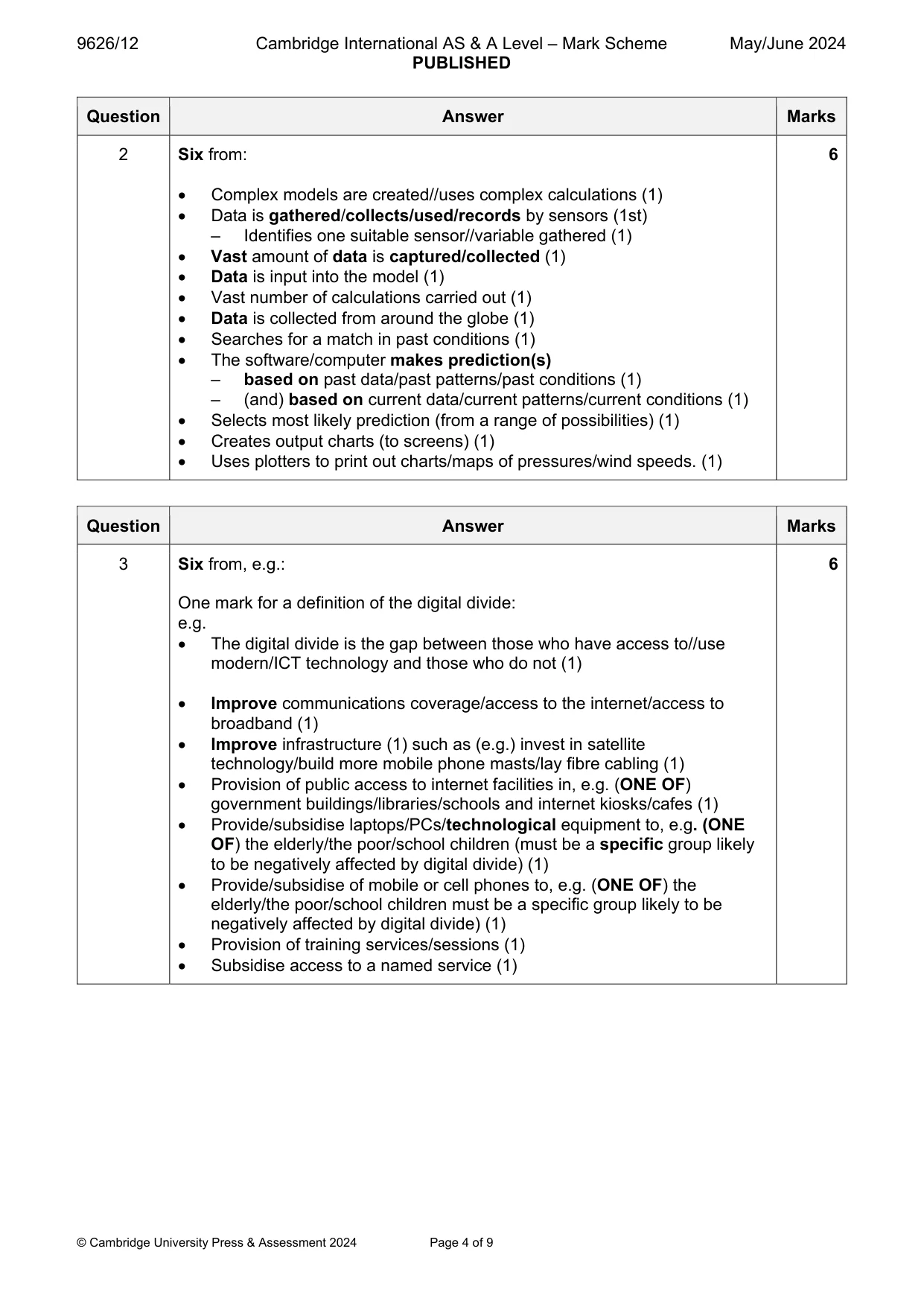
9626/12 Cambridge International AS & A Level – Mark Scheme PUBLISHED May/June 2024 © Cambridge University Press & Assessment 2024 Page 4 of 9 Question Answer Marks 2 Six from: Complex models are created//uses complex calculations (1) Data is gathered/collects/used/records by sensors (1st) – Identifies one suitable sensor//variable gathered (1) Vast amount of data is captured/collected (1) Data is input into the model (1) Vast number of calculations carried out (1) Data is collected from around the globe (1) Searches for a match in past conditions (1) The software/computer makes prediction(s) – based on past data/past patterns/past conditions (1) – (and) based on current data/current patterns/current conditions (1) Selects most likely prediction (from a range of possibilities) (1) Creates output charts (to screens) (1) Uses plotters to print out charts/maps of pressures/wind speeds. (1) 6 Question Answer Marks 3 Six from, e.g.: One mark for a definition of the digital divide: e.g. The digital divide is the gap between those who have access to//use modern/ICT technology and those who do not (1) Improve communications coverage/access to the internet/access to broadband (1) Improve infrastructure (1) such as (e.g.) invest in satellite technology/build more mobile phone masts/lay fibre cabling (1) Provision of public access to internet facilities in, e.g. (ONE OF) government buildings/libraries/schools and internet kiosks/cafes (1) Provide/subsidise laptops/PCs/technological equipment to, e.g. (ONE OF) the elderly/the poor/school children (must be a specific group likely to be negatively affected by digital divide) (1) Provide/subsidise of mobile or cell phones to, e.g. (ONE OF) the elderly/the poor/school children must be a specific group likely to be negatively affected by digital divide) (1) Provision of training services/sessions (1) Subsidise access to a named service (1) 6
Mark scheme, page 5
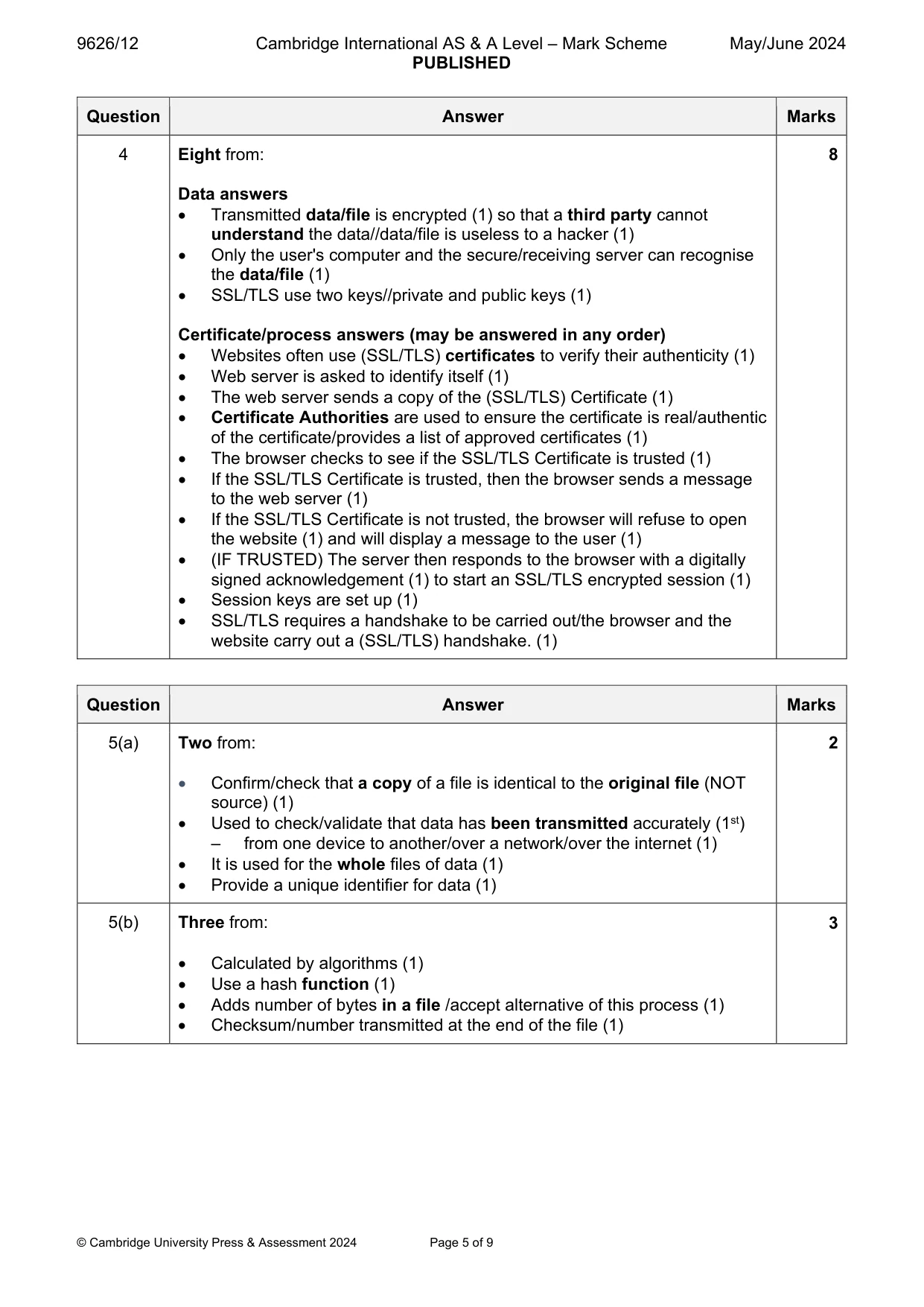
9626/12 Cambridge International AS & A Level – Mark Scheme PUBLISHED May/June 2024 © Cambridge University Press & Assessment 2024 Page 5 of 9 Question Answer Marks 4 Eight from: Data answers Transmitted data/file is encrypted (1) so that a third party cannot understand the data//data/file is useless to a hacker (1) Only the user's computer and the secure/receiving server can recognise the data/file (1) SSL/TLS use two keys//private and public keys (1) Certificate/process answers (may be answered in any order) Websites often use (SSL/TLS) certificates to verify their authenticity (1) Web server is asked to identify itself (1) The web server sends a copy of the (SSL/TLS) Certificate (1) Certificate Authorities are used to ensure the certificate is real/authentic of the certificate/provides a list of approved certificates (1) The browser checks to see if the SSL/TLS Certificate is trusted (1) If the SSL/TLS Certificate is trusted, then the browser sends a message to the web server (1) If the SSL/TLS Certificate is not trusted, the browser will refuse to open the website (1) and will display a message to the user (1) (IF TRUSTED) The server then responds to the browser with a digitally signed acknowledgement (1) to start an SSL/TLS encrypted session (1) Session keys are set up (1) SSL/TLS requires a handshake to be carried out/the browser and the website carry out a (SSL/TLS) handshake. (1) 8 Question Answer Marks 5(a) Two from: Confirm/check that a copy of a file is identical to the original file (NOT source) (1) Used to check/validate that data has been transmitted accurately (1st) – from one device to another/over a network/over the internet (1) It is used for the whole files of data (1) Provide a unique identifier for data (1) 2 5(b) Three from: Calculated by algorithms (1) Use a hash function (1) Adds number of bytes in a file /accept alternative of this process (1) Checksum/number transmitted at the end of the file (1) 3
Mark scheme, page 6
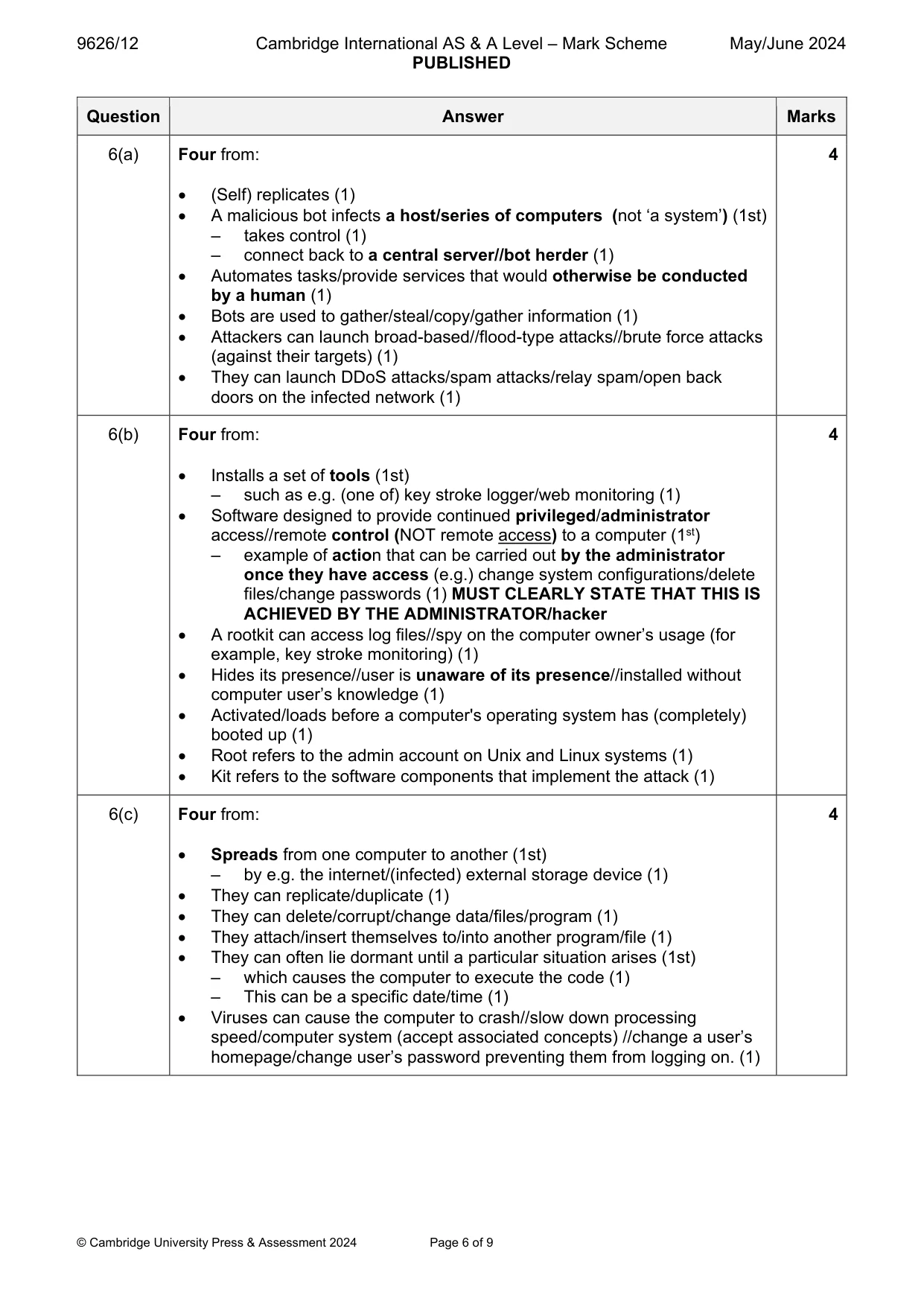
9626/12 Cambridge International AS & A Level – Mark Scheme PUBLISHED May/June 2024 © Cambridge University Press & Assessment 2024 Page 6 of 9 Question Answer Marks 6(a) Four from: (Self) replicates (1) A malicious bot infects a host/series of computers (not ‘a system’) (1st) – takes control (1) – connect back to a central server//bot herder (1) Automates tasks/provide services that would otherwise be conducted by a human (1) Bots are used to gather/steal/copy/gather information (1) Attackers can launch broad-based//flood-type attacks//brute force attacks (against their targets) (1) They can launch DDoS attacks/spam attacks/relay spam/open back doors on the infected network (1) 4 6(b) Four from: Installs a set of tools (1st) – such as e.g. (one of) key stroke logger/web monitoring (1) Software designed to provide continued privileged/administrator access//remote control (NOT remote access) to a computer (1st) – example of action that can be carried out by the administrator once they have access (e.g.) change system configurations/delete files/change passwords (1) MUST CLEARLY STATE THAT THIS IS ACHIEVED BY THE ADMINISTRATOR/hacker A rootkit can access log files//spy on the computer owner’s usage (for example, key stroke monitoring) (1) Hides its presence//user is unaware of its presence//installed without computer user’s knowledge (1) Activated/loads before a computer's operating system has (completely) booted up (1) Root refers to the admin account on Unix and Linux systems (1) Kit refers to the software components that implement the attack (1) 4 6(c) Four from: Spreads from one computer to another (1st) – by e.g. the internet/(infected) external storage device (1) They can replicate/duplicate (1) They can delete/corrupt/change data/files/program (1) They attach/insert themselves to/into another program/file (1) They can often lie dormant until a particular situation arises (1st) – which causes the computer to execute the code (1) – This can be a specific date/time (1) Viruses can cause the computer to crash//slow down processing speed/computer system (accept associated concepts) //change a user’s homepage/change user’s password preventing them from logging on. (1) 4
Mark scheme, page 7
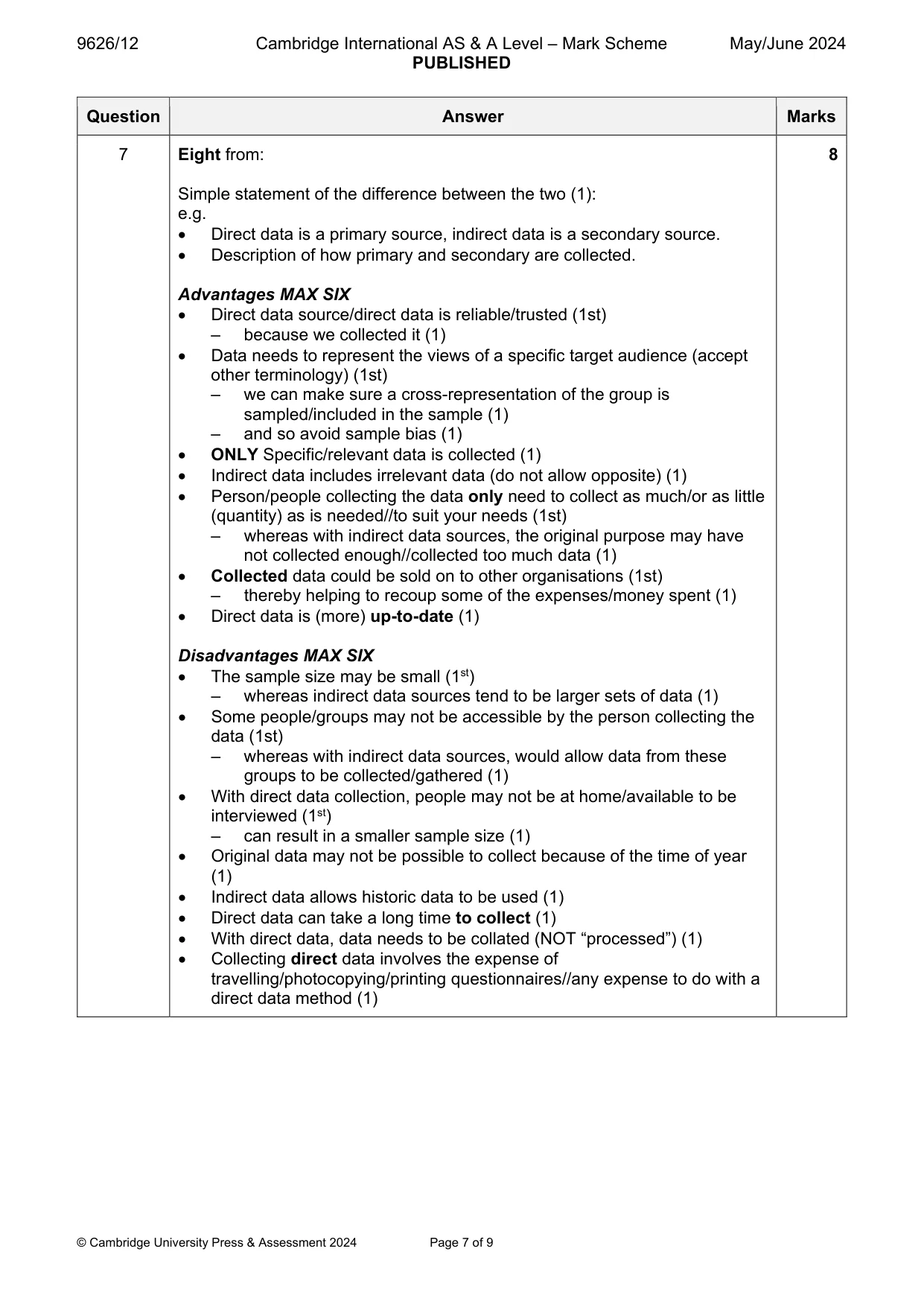
9626/12 Cambridge International AS & A Level – Mark Scheme PUBLISHED May/June 2024 © Cambridge University Press & Assessment 2024 Page 7 of 9 Question Answer Marks 7 Eight from: Simple statement of the difference between the two (1): e.g. Direct data is a primary source, indirect data is a secondary source. Description of how primary and secondary are collected. Advantages MAX SIX Direct data source/direct data is reliable/trusted (1st) – because we collected it (1) Data needs to represent the views of a specific target audience (accept other terminology) (1st) – we can make sure a cross-representation of the group is sampled/included in the sample (1) – and so avoid sample bias (1) ONLY Specific/relevant data is collected (1) Indirect data includes irrelevant data (do not allow opposite) (1) Person/people collecting the data only need to collect as much/or as little (quantity) as is needed//to suit your needs (1st) – whereas with indirect data sources, the original purpose may have not collected enough//collected too much data (1) Collected data could be sold on to other organisations (1st) – thereby helping to recoup some of the expenses/money spent (1) Direct data is (more) up-to-date (1) Disadvantages MAX SIX The sample size may be small (1st) – whereas indirect data sources tend to be larger sets of data (1) Some people/groups may not be accessible by the person collecting the data (1st) – whereas with indirect data sources, would allow data from these groups to be collected/gathered (1) With direct data collection, people may not be at home/available to be interviewed (1st) – can result in a smaller sample size (1) Original data may not be possible to collect because of the time of year (1) Indirect data allows historic data to be used (1) Direct data can take a long time to collect (1) With direct data, data needs to be collated (NOT “processed”) (1) Collecting direct data involves the expense of travelling/photocopying/printing questionnaires//any expense to do with a direct data method (1) 8
Mark scheme, page 8
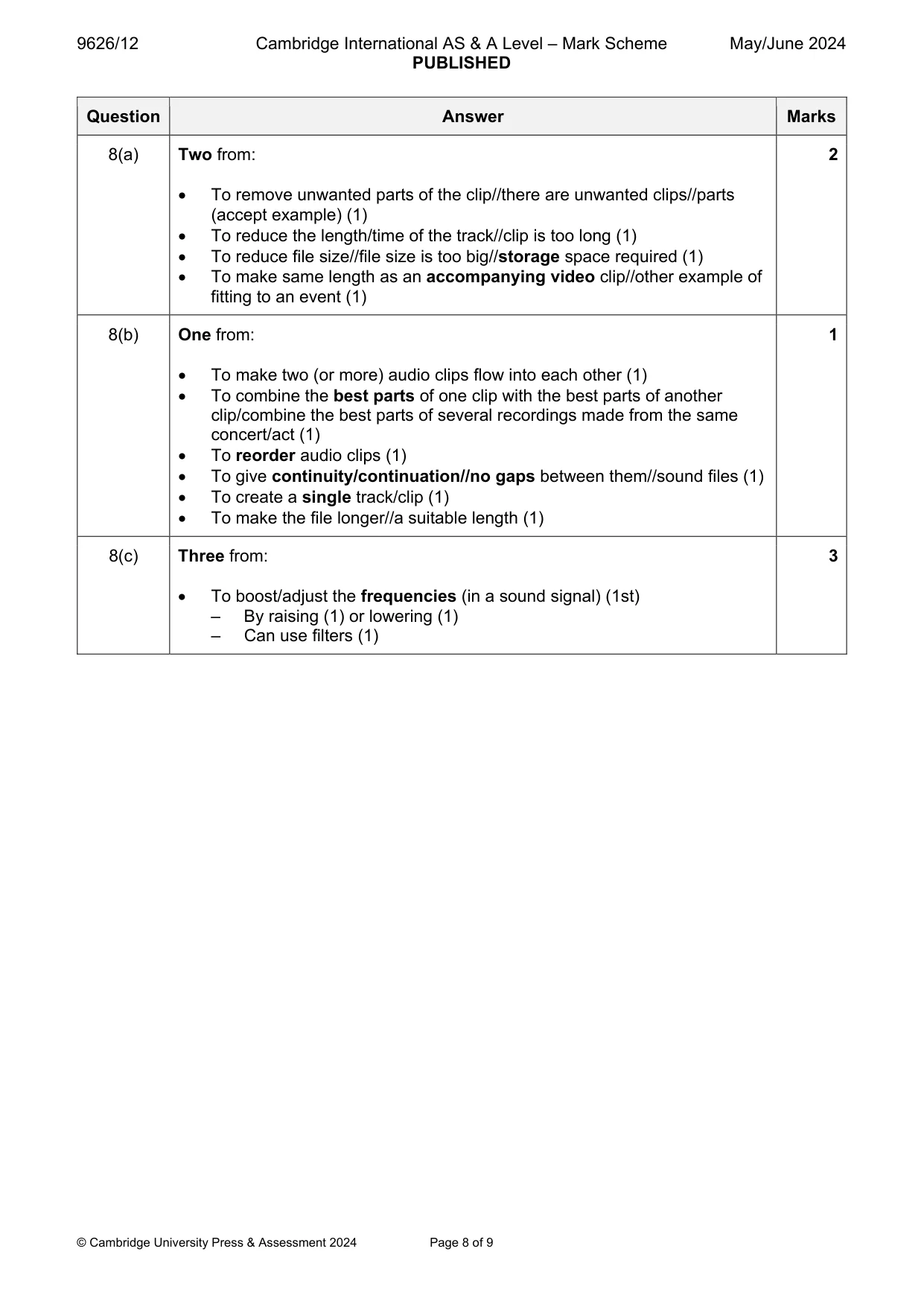
9626/12 Cambridge International AS & A Level – Mark Scheme PUBLISHED May/June 2024 © Cambridge University Press & Assessment 2024 Page 8 of 9 Question Answer Marks 8(a) Two from: To remove unwanted parts of the clip//there are unwanted clips//parts (accept example) (1) To reduce the length/time of the track//clip is too long (1) To reduce file size//file size is too big//storage space required (1) To make same length as an accompanying video clip//other example of fitting to an event (1) 2 8(b) One from: To make two (or more) audio clips flow into each other (1) To combine the best parts of one clip with the best parts of another clip/combine the best parts of several recordings made from the same concert/act (1) To reorder audio clips (1) To give continuity/continuation//no gaps between them//sound files (1) To create a single track/clip (1) To make the file longer//a suitable length (1) 1 8(c) Three from: To boost/adjust the frequencies (in a sound signal) (1st) – By raising (1) or lowering (1) – Can use filters (1) 3
Mark scheme, page 9
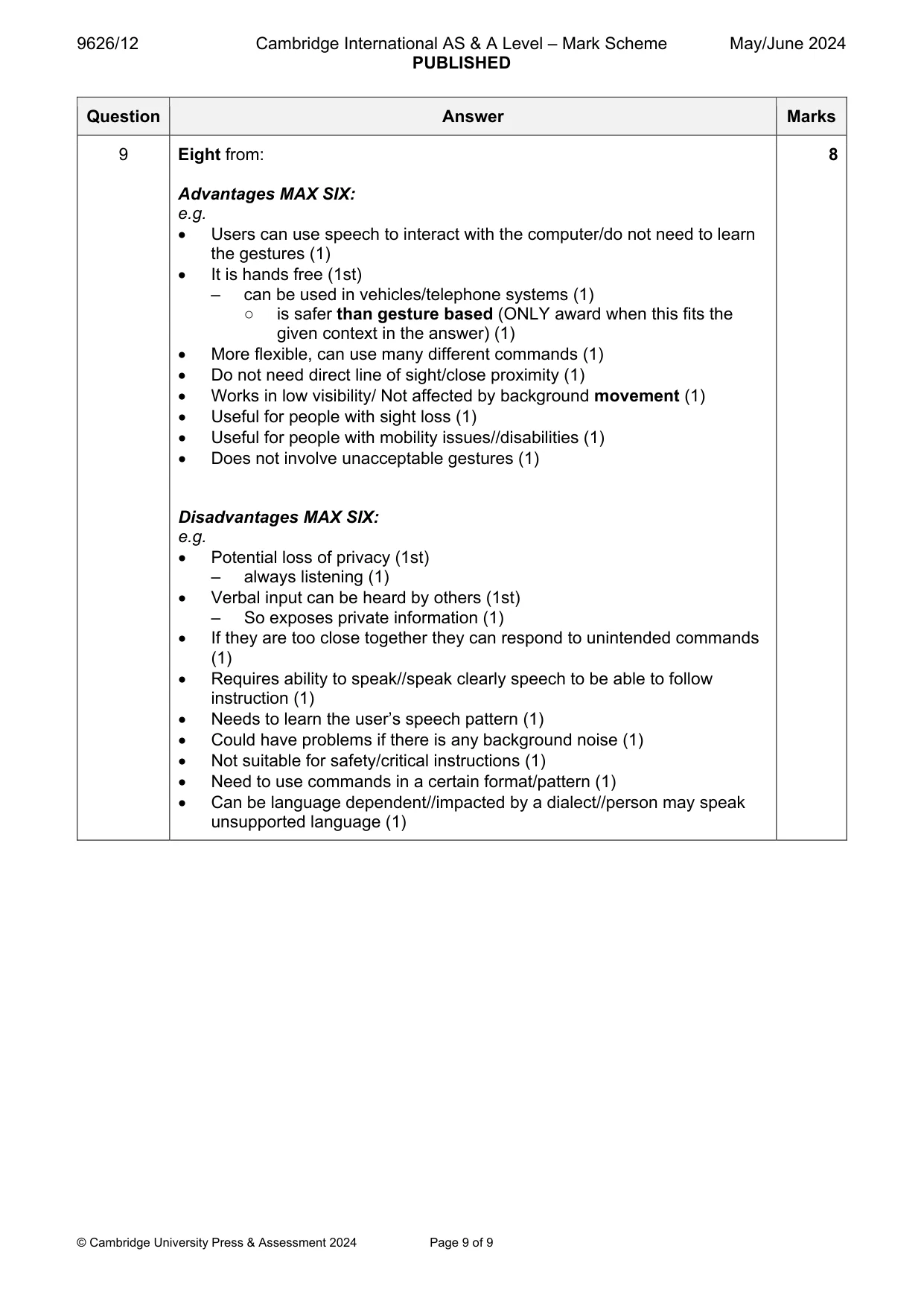
9626/12 Cambridge International AS & A Level – Mark Scheme PUBLISHED May/June 2024 © Cambridge University Press & Assessment 2024 Page 9 of 9 Question Answer Marks 9 Eight from: Advantages MAX SIX: e.g. Users can use speech to interact with the computer/do not need to learn the gestures (1) It is hands free (1st) – can be used in vehicles/telephone systems (1) ○ is safer than gesture based (ONLY award when this fits the given context in the answer) (1) More flexible, can use many different commands (1) Do not need direct line of sight/close proximity (1) Works in low visibility/ Not affected by background movement (1) Useful for people with sight loss (1) Useful for people with mobility issues//disabilities (1) Does not involve unacceptable gestures (1) Disadvantages MAX SIX: e.g. Potential loss of privacy (1st) – always listening (1) Verbal input can be heard by others (1st) – So exposes private information (1) If they are too close together they can respond to unintended commands (1) Requires ability to speak//speak clearly speech to be able to follow instruction (1) Needs to learn the user’s speech pattern (1) Could have problems if there is any background noise (1) Not suitable for safety/critical instructions (1) Need to use commands in a certain format/pattern (1) Can be language dependent//impacted by a dialect//person may speak unsupported language (1) 8
What you needed in this session
Cambridge’s own grade thresholds for 2024 May/June, Paper 1 · Variant 2. A higher threshold means an easier paper — the bar moves with how the cohort did.