Cambridge A Level Information Technology (from 2017) 9626 — 2024 Feb/March Paper 1 · Variant 2
9626/12/F/M/24 · 70 marks · ≈79 min
The question paper and its mark scheme, free to read here and free to download. This is Cambridge’s own paper, exactly as it was sat.
Question paper12 pages


Mark scheme10 pages
Answers below. Sit the paper first if you are practising.
Paper as text
Question paper, page 1
This document has 12 pages. [Turn over DC (JP) 327692/4 © UCLES 2024 * 6 9 9 1 3 0 0 7 5 7 * INFORMATION TECHNOLOGY 9626/12 Paper 1 Theory February/March 2024 1 hour 45 minutes You must answer on the question paper. No additional materials are needed. INSTRUCTIONS ● Answer all questions. ● Use a black or dark blue pen. ● Write your name, centre number and candidate number in the boxes at the top of the page. ● Write your answer to each question in the space provided. ● Do not use an erasable pen or correction fluid. ● Do not write on any bar codes. ● You may use an HB pencil for any diagrams, graphs or rough working. ● Calculators must not be used in this paper. INFORMATION ● The total mark for this paper is 70. ● The number of marks for each question or part question is shown in brackets [ ]. Cambridge International AS & A Level
Question paper, page 2
2 9626/12/F/M/24 © UCLES 2024 1 Spreadsheet software can be used for computer modelling. Describe the characteristics that make spreadsheet software suitable for computer modelling. … … … … … … … … … … … … … … [6]
Question paper, page 3
3 9626/12/F/M/24 © UCLES 2024 [Turn over 2 A data dictionary is required when creating a relational database. Identify and describe four components that should be included in a data dictionary. 1 … … … … 2 … … … … 3 … … … … 4 … … … … [8]
Question paper, page 4
4 9626/12/F/M/24 © UCLES 2024 3 Keith wishes to ensure that his computer is at its optimum performance. Identify and describe three different types of utility software he should use. Utility 1 … … … … … … Utility 2 … … … … … … Utility 3 … … … … … … [6]
Question paper, page 5
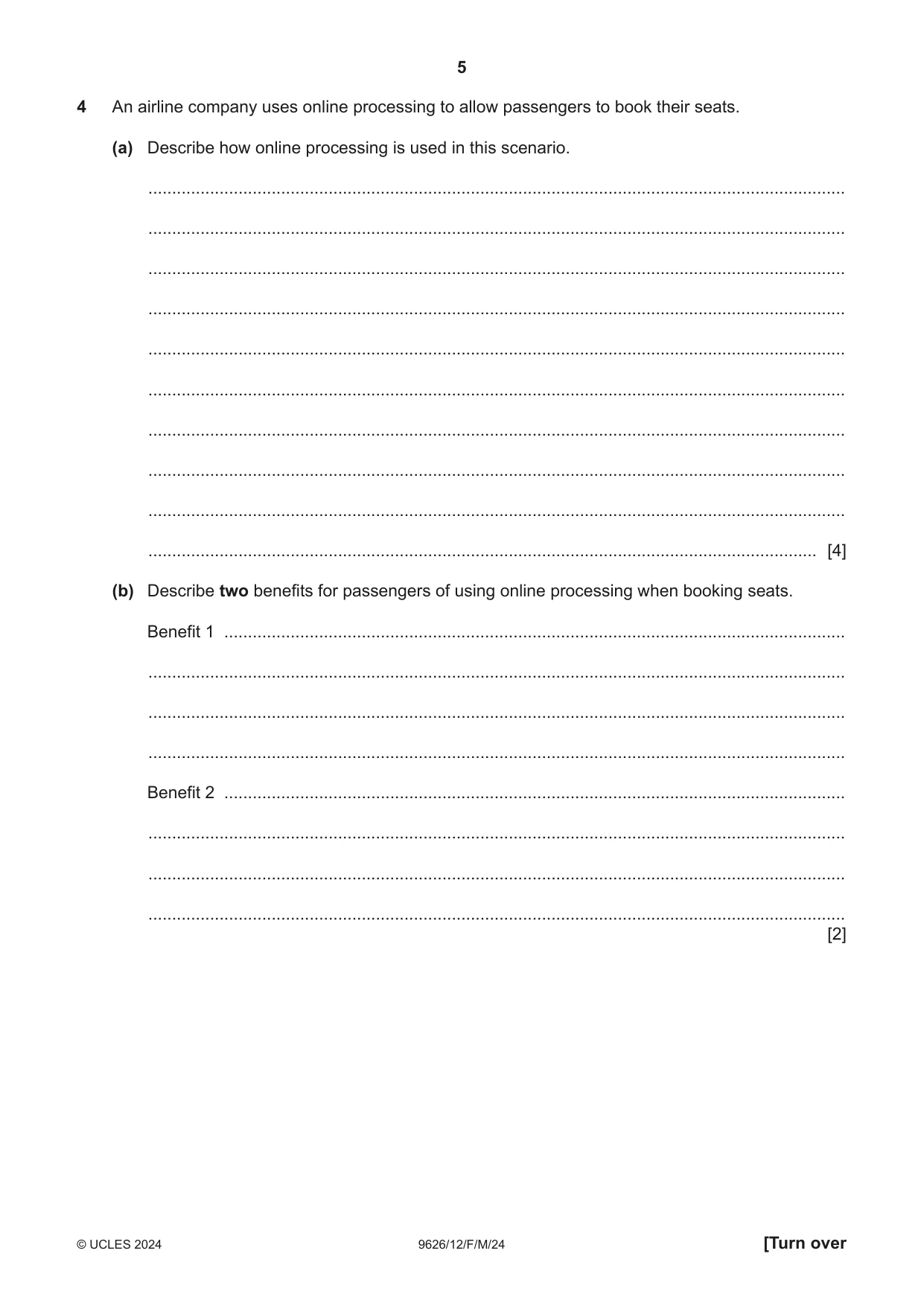
5 9626/12/F/M/24 © UCLES 2024 [Turn over 4 An airline company uses online processing to allow passengers to book their seats. (a) Describe how online processing is used in this scenario. … … … … … … … … … … [4] (b) Describe two benefits for passengers of using online processing when booking seats. Benefit 1 … … … … Benefit 2 … … … … [2]
Question paper, page 6
6 9626/12/F/M/24 © UCLES 2024 5 An apartment has a controlled central heating system. This system includes a microprocessor. Explain how the temperature in the apartment is controlled by the system. … … … … … … … … … … … … … … [6]
Question paper, page 7
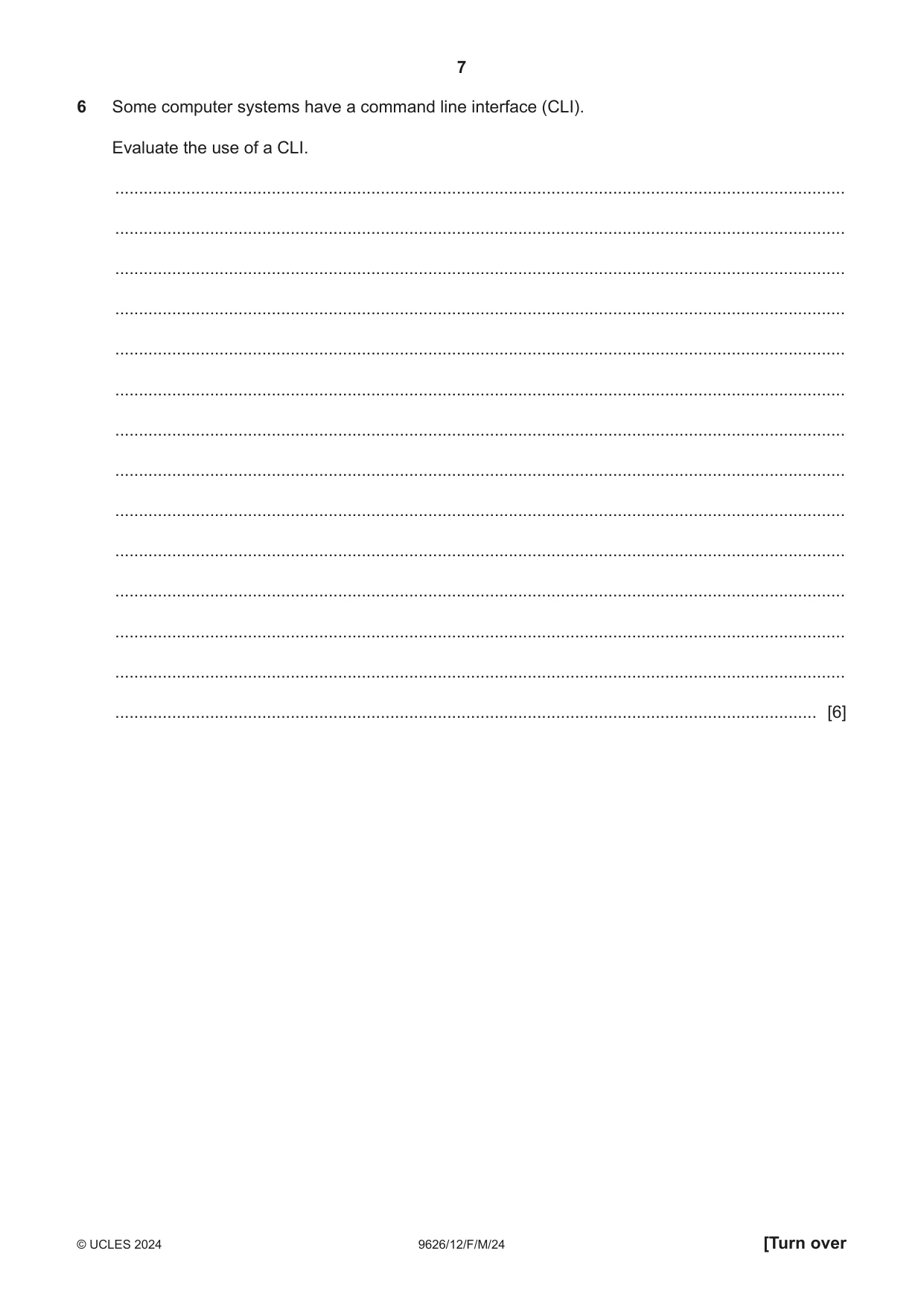
7 9626/12/F/M/24 © UCLES 2024 [Turn over 6 Some computer systems have a command line interface (CLI). Evaluate the use of a CLI. … … … … … … … … … … … … … … [6]
Question paper, page 8
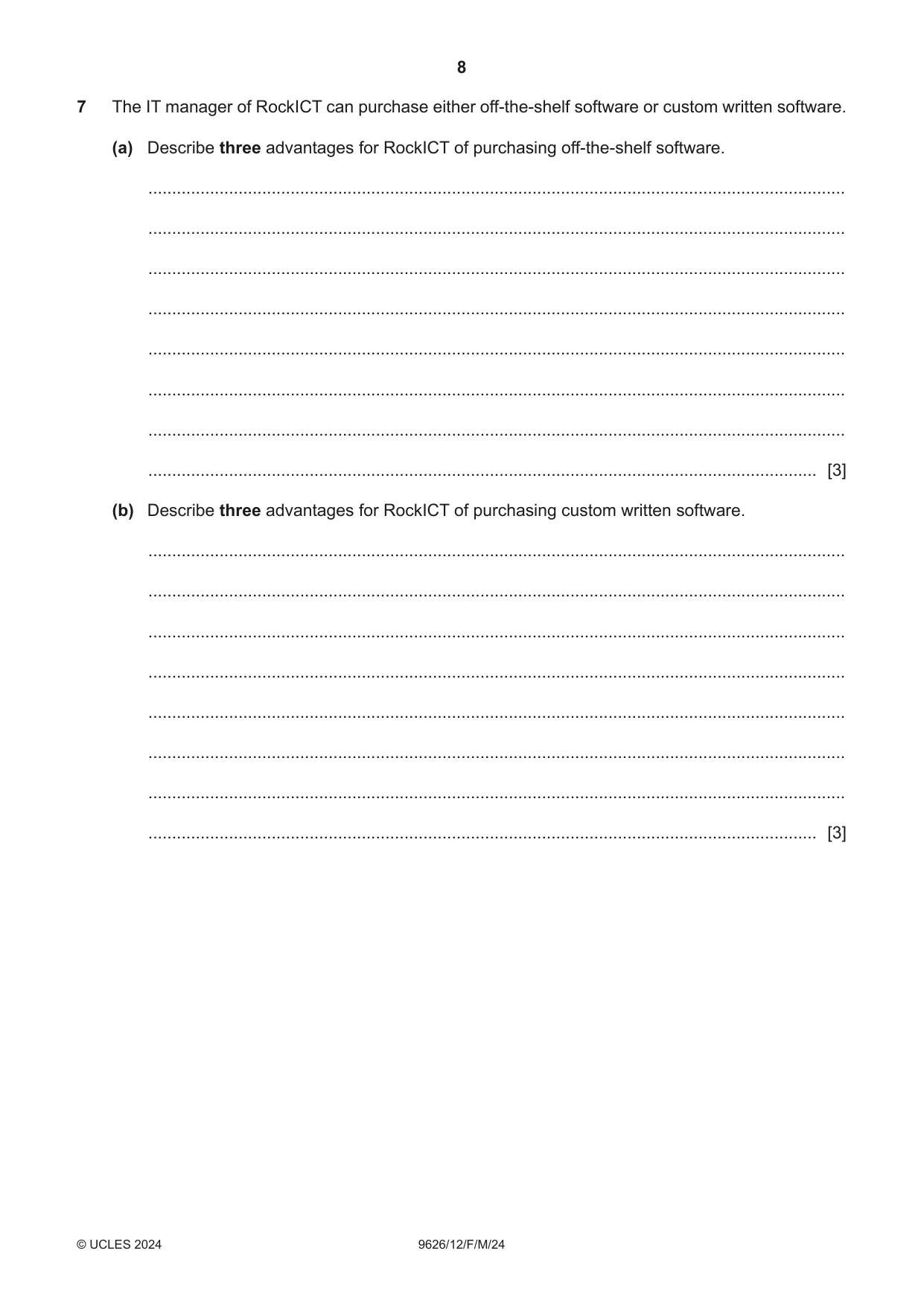
8 9626/12/F/M/24 © UCLES 2024 7 The IT manager of RockICT can purchase either off-the-shelf software or custom written software. (a) Describe three advantages for RockICT of purchasing off-the-shelf software. … … … … … … … … [3] (b) Describe three advantages for RockICT of purchasing custom written software. … … … … … … … … [3]
Question paper, page 9
9 9626/12/F/M/24 © UCLES 2024 [Turn over 8 A secretary of a company has been asked to transfer all the staff records from the current paper-based system to a computer database. The secretary will use validation and verification to check the data. Explain why both validation and verification are needed in this scenario. … … … … … … … … … … … … … … [6]
Question paper, page 10
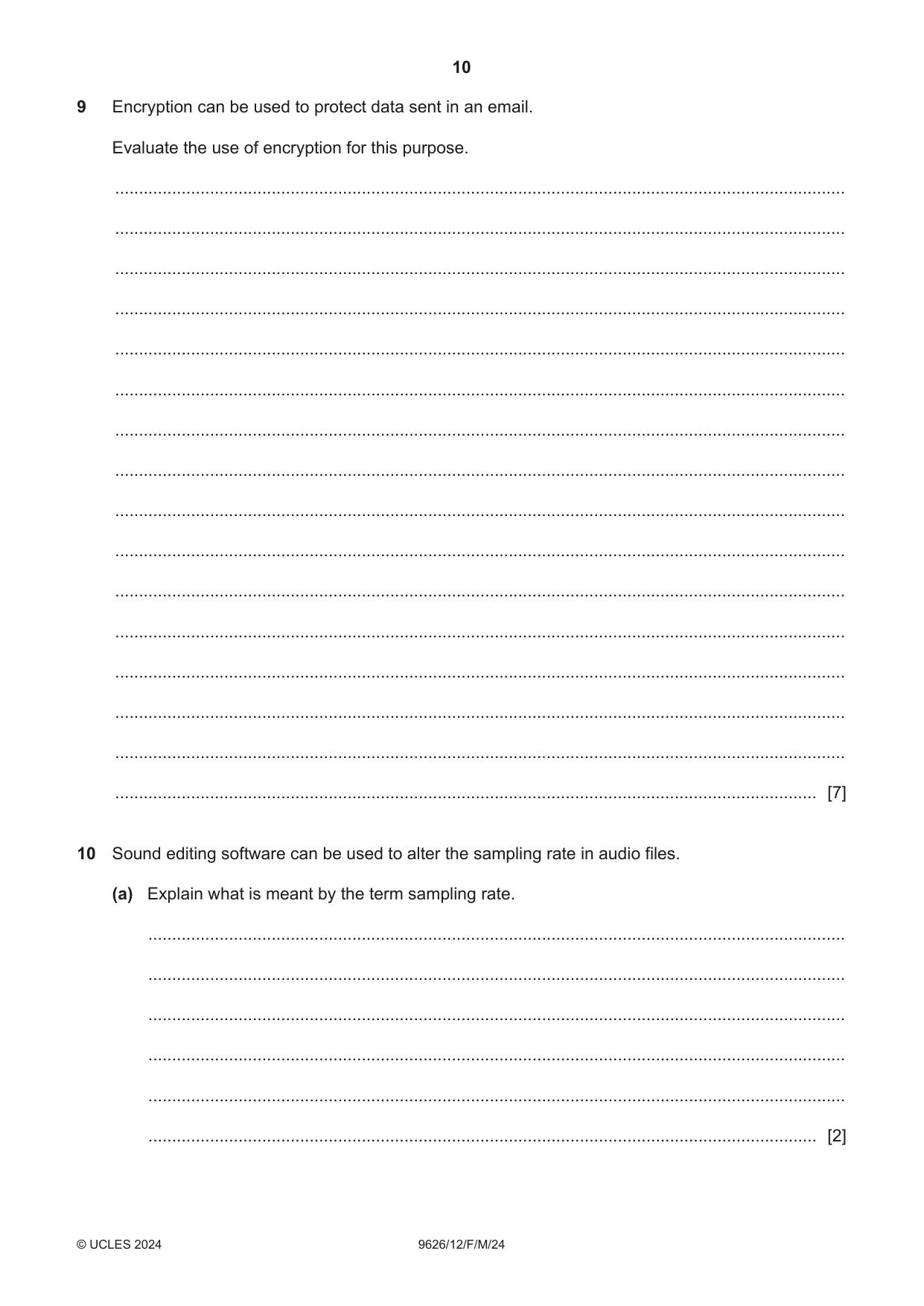
10 9626/12/F/M/24 © UCLES 2024 9 Encryption can be used to protect data sent in an email. Evaluate the use of encryption for this purpose. … … … … … … … … … … … … … … … … [7] 10 Sound editing software can be used to alter the sampling rate in audio files. (a) Explain what is meant by the term sampling rate. … … … … … … [2]
Question paper, page 11
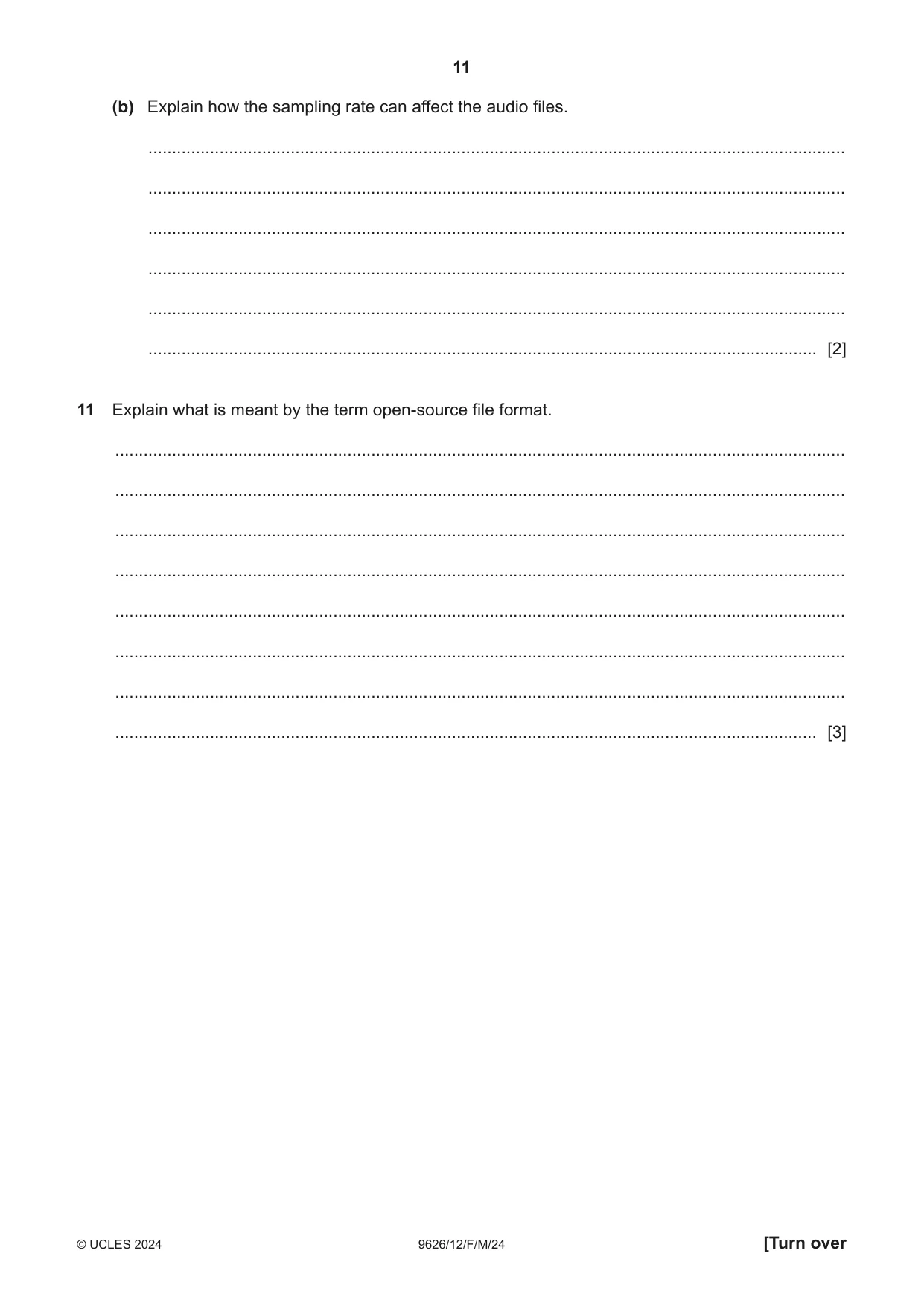
11 9626/12/F/M/24 © UCLES 2024 [Turn over (b) Explain how the sampling rate can affect the audio files. … … … … … … [2] 11 Explain what is meant by the term open-source file format. … … … … … … … … [3]
Question paper, page 12
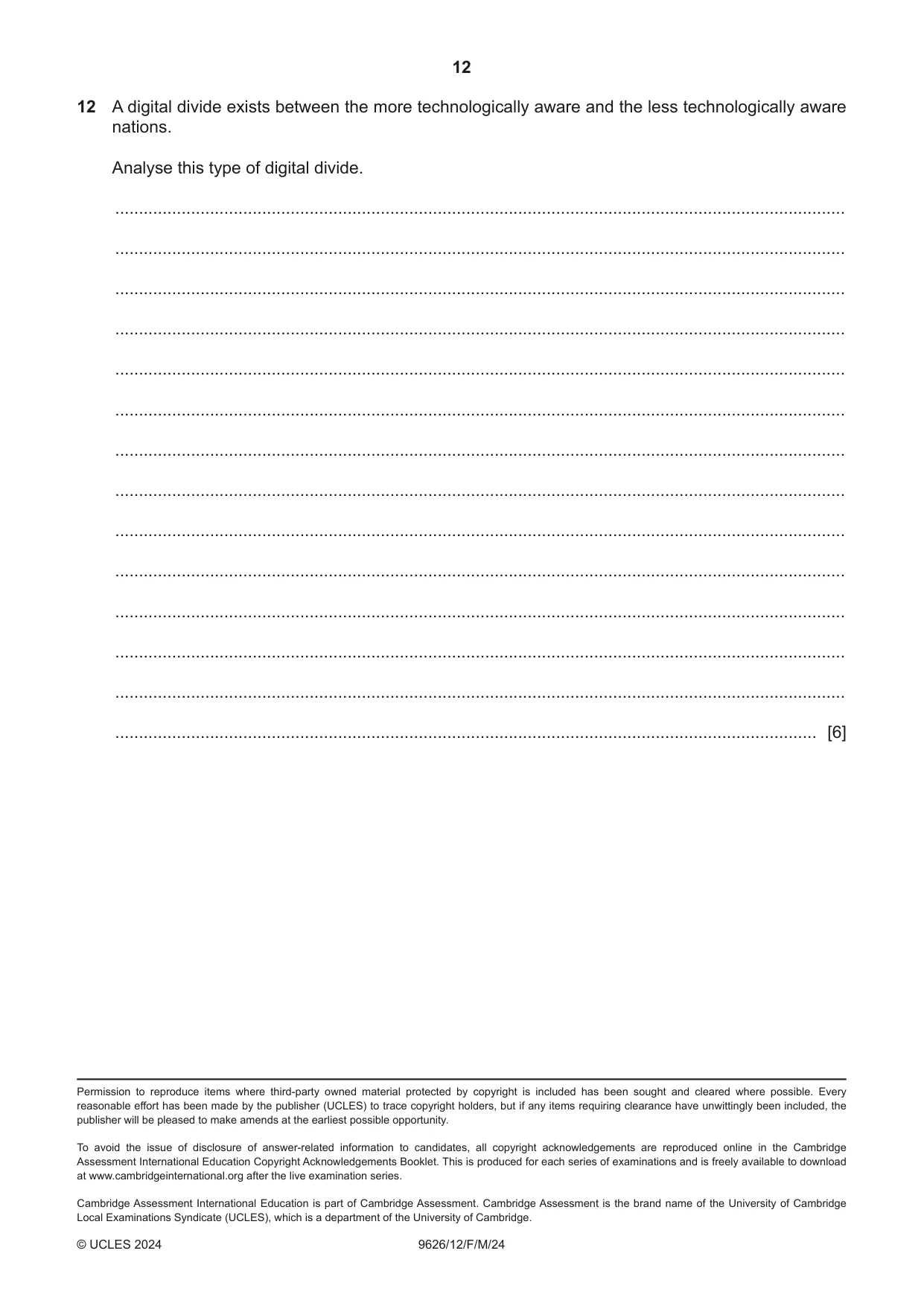
12 9626/12/F/M/24 © UCLES 2024 Permission to reproduce items where third-party owned material protected by copyright is included has been sought and cleared where possible. Every reasonable effort has been made by the publisher (UCLES) to trace copyright holders, but if any items requiring clearance have unwittingly been included, the publisher will be pleased to make amends at the earliest possible opportunity. To avoid the issue of disclosure of answer-related information to candidates, all copyright acknowledgements are reproduced online in the Cambridge Assessment International Education Copyright Acknowledgements Booklet. This is produced for each series of examinations and is freely available to download at www.cambridgeinternational.org after the live examination series. Cambridge Assessment International Education is part of Cambridge Assessment. Cambridge Assessment is the brand name of the University of Cambridge Local Examinations Syndicate (UCLES), which is a department of the University of Cambridge. 12 A digital divide exists between the more technologically aware and the less technologically aware nations. Analyse this type of digital divide. … … … … … … … … … … … … … … [6]
Mark scheme, page 1
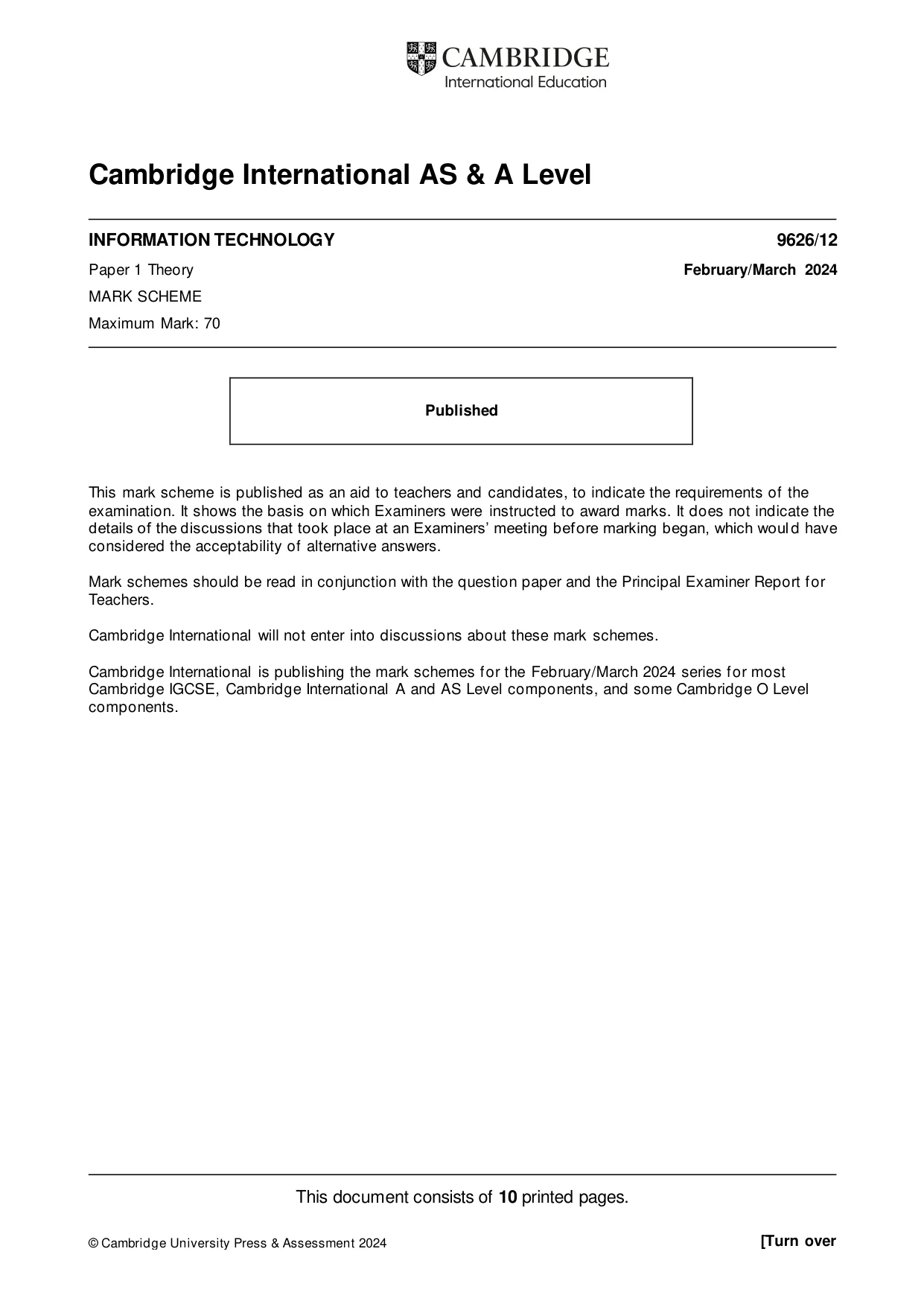
This document consists of 10 printed pages. © Cambridge University Press & Assessment 2024 [Turn over Cambridge International AS & A Level INFORMATION TECHNOLOGY 9626/12 Paper 1 Theory February/March 2024 MARK SCHEME Maximum Mark: 70 Published This mark scheme is published as an aid to teachers and candidates, to indicate the requirements of the examination. It shows the basis on which Examiners were instructed to award marks. It does not indicate the details of the discussions that took place at an Examiners’ meeting before marking began, which would have considered the acceptability of alternative answers. Mark schemes should be read in conjunction with the question paper and the Principal Examiner Report for Teachers. Cambridge International will not enter into discussions about these mark schemes. Cambridge International is publishing the mark schemes for the February/March 2024 series for most Cambridge IGCSE, Cambridge International A and AS Level components, and some Cambridge O Level components.
Mark scheme, page 2
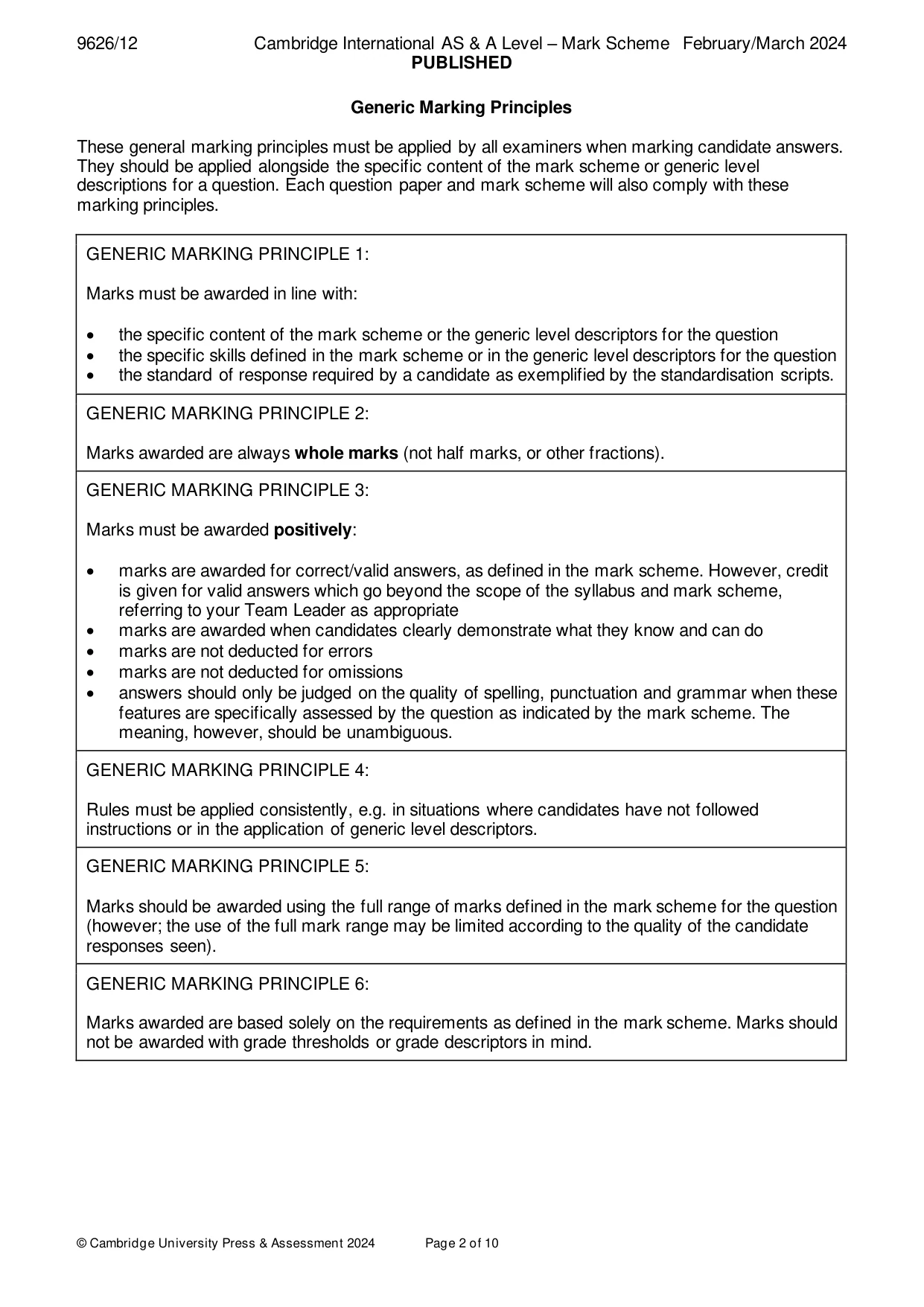
9626/12 Cambridge International AS & A Level – Mark Scheme PUBLISHED February/March 2024 © Cambridge University Press & Assessment 2024 Page 2 of 10 Generic Marking Principles These general marking principles must be applied by all examiners when marking candidate answers. They should be applied alongside the specific content of the mark scheme or generic level descriptions for a question. Each question paper and mark scheme will also comply with these marking principles. GENERIC MARKING PRINCIPLE 1: Marks must be awarded in line with: • the specific content of the mark scheme or the generic level descriptors for the question • the specific skills defined in the mark scheme or in the generic level descriptors for the question • the standard of response required by a candidate as exemplified by the standardisation scripts. GENERIC MARKING PRINCIPLE 2: Marks awarded are always whole marks (not half marks, or other fractions). GENERIC MARKING PRINCIPLE 3: Marks must be awarded positively: • marks are awarded for correct/valid answers, as defined in the mark scheme. However, credit is given for valid answers which go beyond the scope of the syllabus and mark scheme, referring to your Team Leader as appropriate • marks are awarded when candidates clearly demonstrate what they know and can do • marks are not deducted for errors • marks are not deducted for omissions • answers should only be judged on the quality of spelling, punctuation and grammar when these features are specifically assessed by the question as indicated by the mark scheme. The meaning, however, should be unambiguous. GENERIC MARKING PRINCIPLE 4: Rules must be applied consistently, e.g. in situations where candidates have not followed instructions or in the application of generic level descriptors. GENERIC MARKING PRINCIPLE 5: Marks should be awarded using the full range of marks defined in the mark scheme for the question (however; the use of the full mark range may be limited according to the quality of the candidate responses seen). GENERIC MARKING PRINCIPLE 6: Marks awarded are based solely on the requirements as defined in the mark scheme. Marks should not be awarded with grade thresholds or grade descriptors in mind.
Mark scheme, page 3
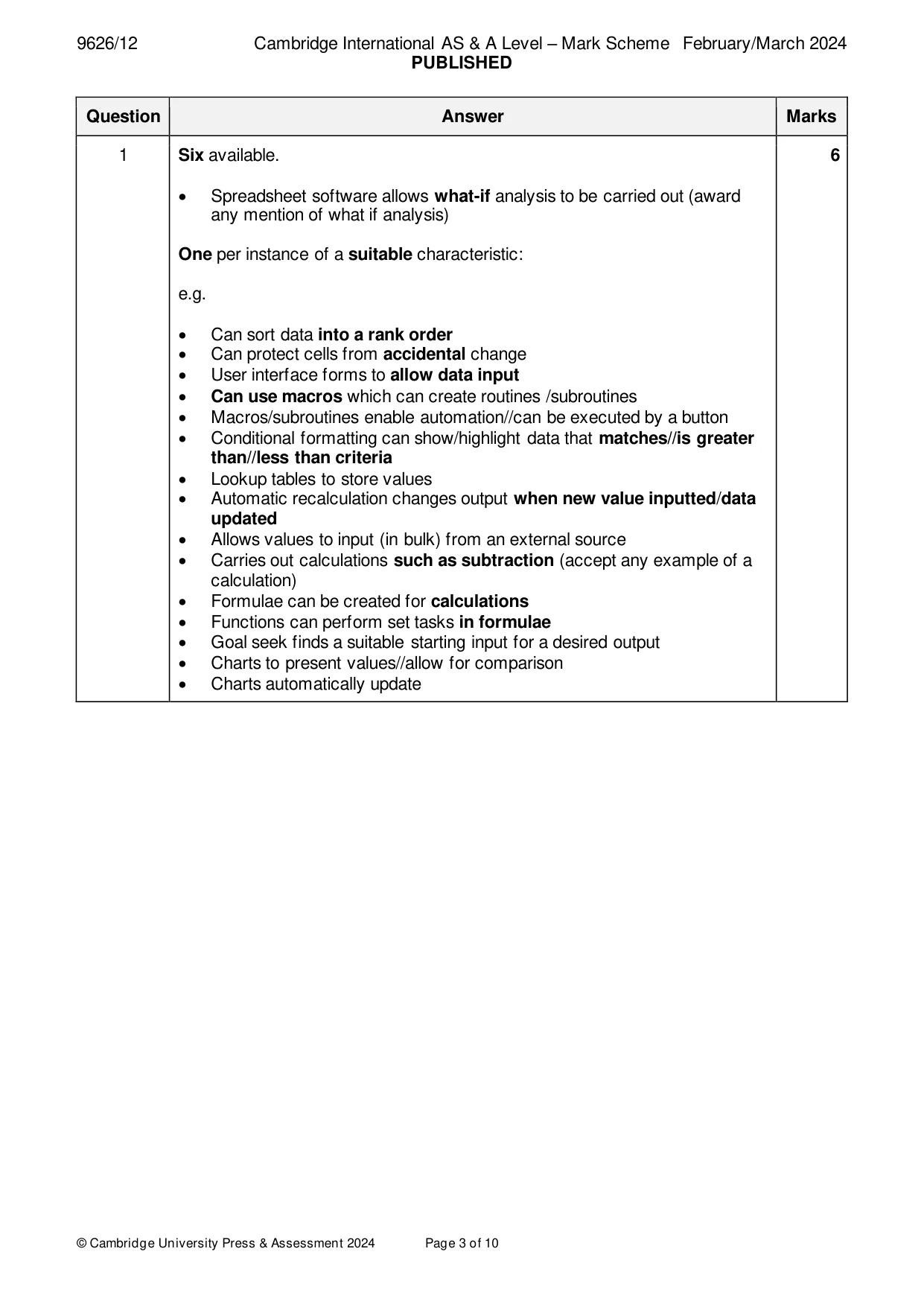
9626/12 Cambridge International AS & A Level – Mark Scheme PUBLISHED February/March 2024 © Cambridge University Press & Assessment 2024 Page 3 of 10 Question Answer Marks 1 Six available. • Spreadsheet software allows what-if analysis to be carried out (award any mention of what if analysis) One per instance of a suitable characteristic: e.g. • Can sort data into a rank order • Can protect cells from accidental change • User interface forms to allow data input • Can use macros which can create routines /subroutines • Macros/subroutines enable automation//can be executed by a button • Conditional formatting can show/highlight data that matches//is greater than//less than criteria • Lookup tables to store values • Automatic recalculation changes output when new value inputted/data updated • Allows values to input (in bulk) from an external source • Carries out calculations such as subtraction (accept any example of a calculation) • Formulae can be created for calculations • Functions can perform set tasks in formulae • Goal seek finds a suitable starting input for a desired output • Charts to present values//allow for comparison • Charts automatically update 6
Mark scheme, page 4
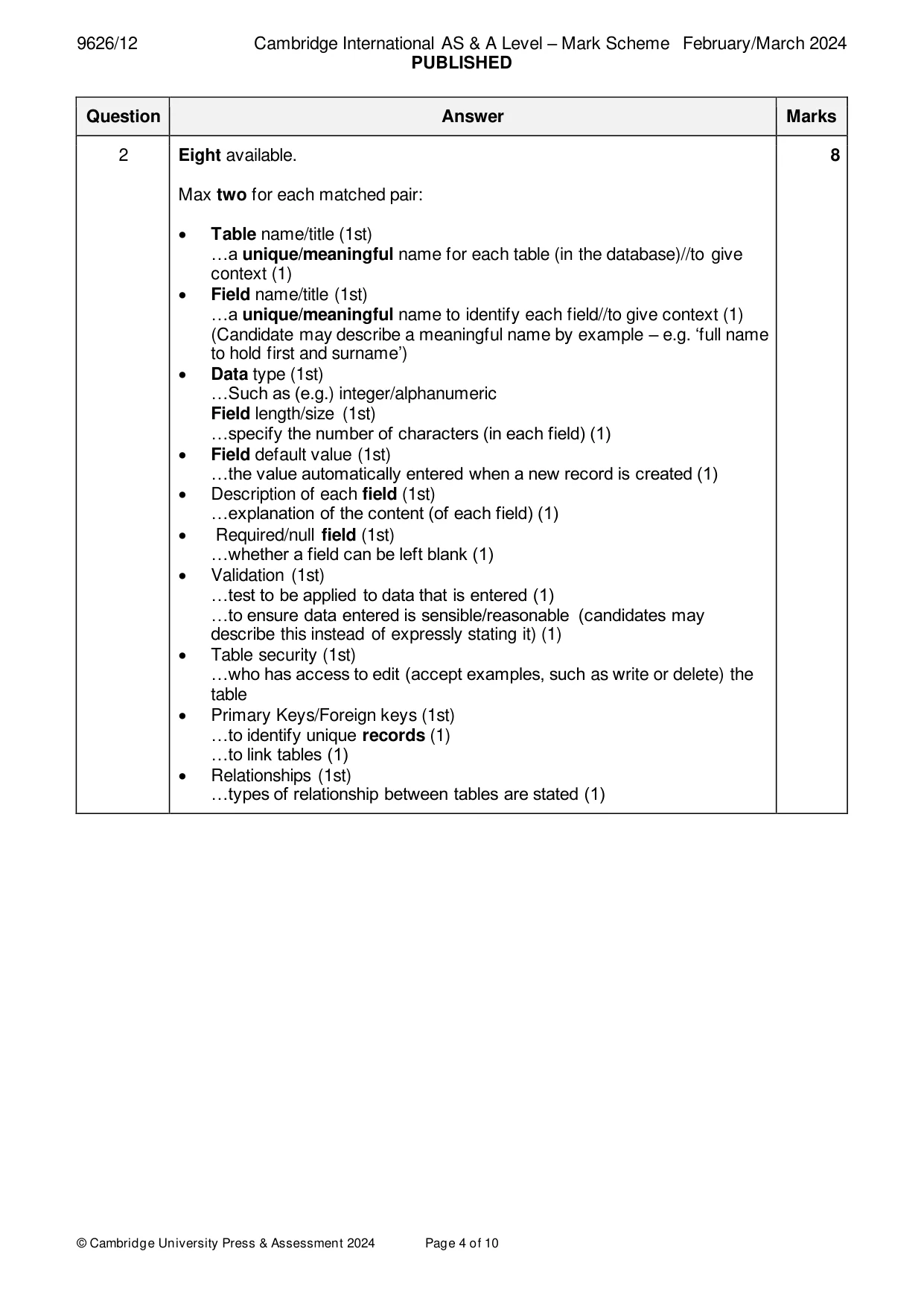
9626/12 Cambridge International AS & A Level – Mark Scheme PUBLISHED February/March 2024 © Cambridge University Press & Assessment 2024 Page 4 of 10 Question Answer Marks 2 Eight available. Max two for each matched pair: • Table name/title (1st) …a unique/meaningful name for each table (in the database)//to give context (1) • Field name/title (1st) …a unique/meaningful name to identify each field//to give context (1) (Candidate may describe a meaningful name by example – e.g. ‘full name to hold first and surname’) • Data type (1st) …Such as (e.g.) integer/alphanumeric Field length/size (1st) …specify the number of characters (in each field) (1) • Field default value (1st) …the value automatically entered when a new record is created (1) • Description of each field (1st) …explanation of the content (of each field) (1) • Required/null field (1st) …whether a field can be left blank (1) • Validation (1st) …test to be applied to data that is entered (1) …to ensure data entered is sensible/reasonable (candidates may describe this instead of expressly stating it) (1) • Table security (1st) …who has access to edit (accept examples, such as write or delete) the table • Primary Keys/Foreign keys (1st) …to identify unique records (1) …to link tables (1) • Relationships (1st) …types of relationship between tables are stated (1) 8
Mark scheme, page 5
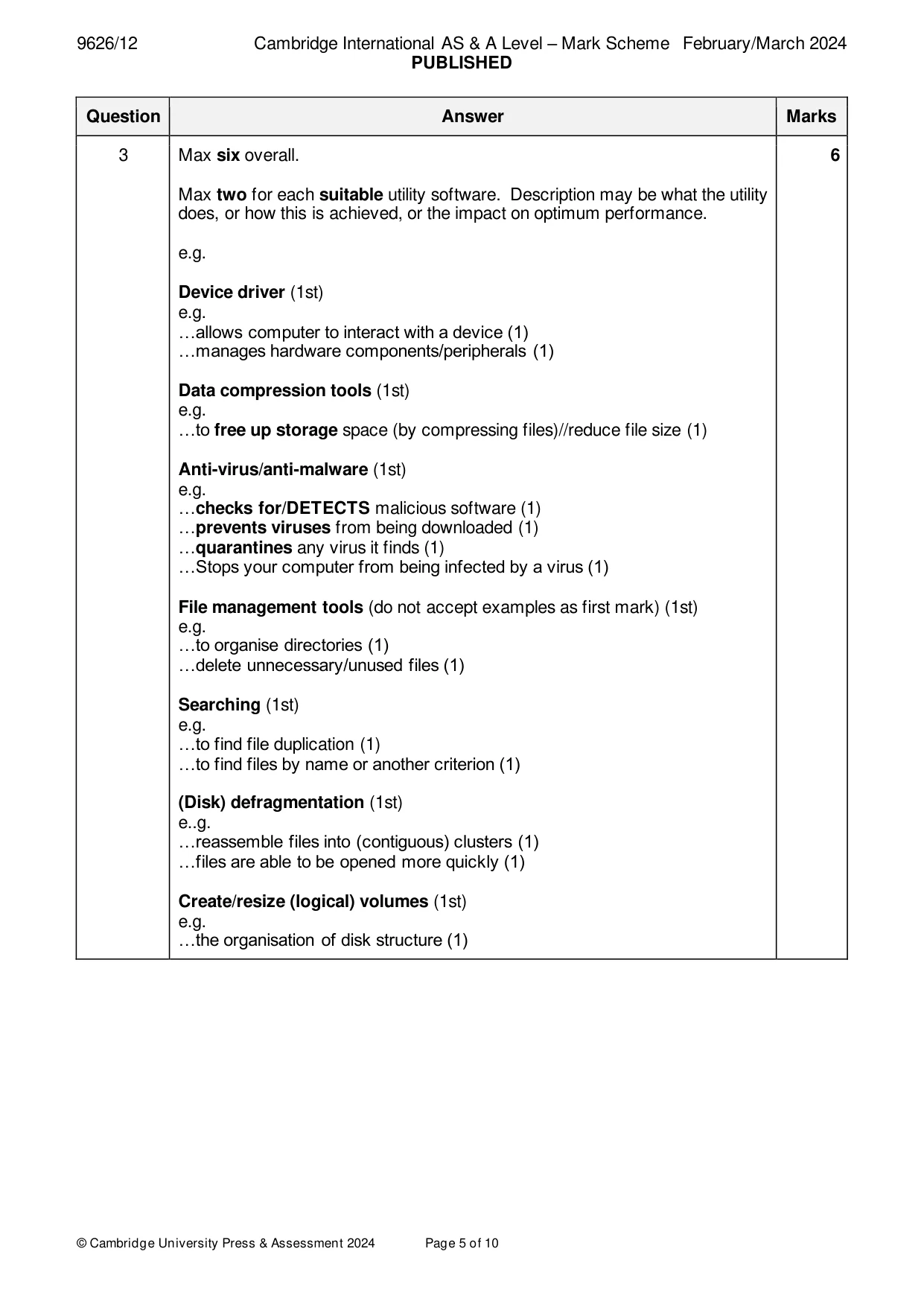
9626/12 Cambridge International AS & A Level – Mark Scheme PUBLISHED February/March 2024 © Cambridge University Press & Assessment 2024 Page 5 of 10 Question Answer Marks 3 Max six overall. Max two for each suitable utility software. Description may be what the utility does, or how this is achieved, or the impact on optimum performance. e.g. Device driver (1st) e.g. …allows computer to interact with a device (1) …manages hardware components/peripherals (1) Data compression tools (1st) e.g. …to free up storage space (by compressing files)//reduce file size (1) Anti-virus/anti-malware (1st) e.g. …checks for/DETECTS malicious software (1) …prevents viruses from being downloaded (1) …quarantines any virus it finds (1) …Stops your computer from being infected by a virus (1) File management tools (do not accept examples as first mark) (1st) e.g. …to organise directories (1) …delete unnecessary/unused files (1) Searching (1st) e.g. …to find file duplication (1) …to find files by name or another criterion (1) (Disk) defragmentation (1st) e..g. …reassemble files into (contiguous) clusters (1) …files are able to be opened more quickly (1) Create/resize (logical) volumes (1st) e.g. …the organisation of disk structure (1) 6
Mark scheme, page 6
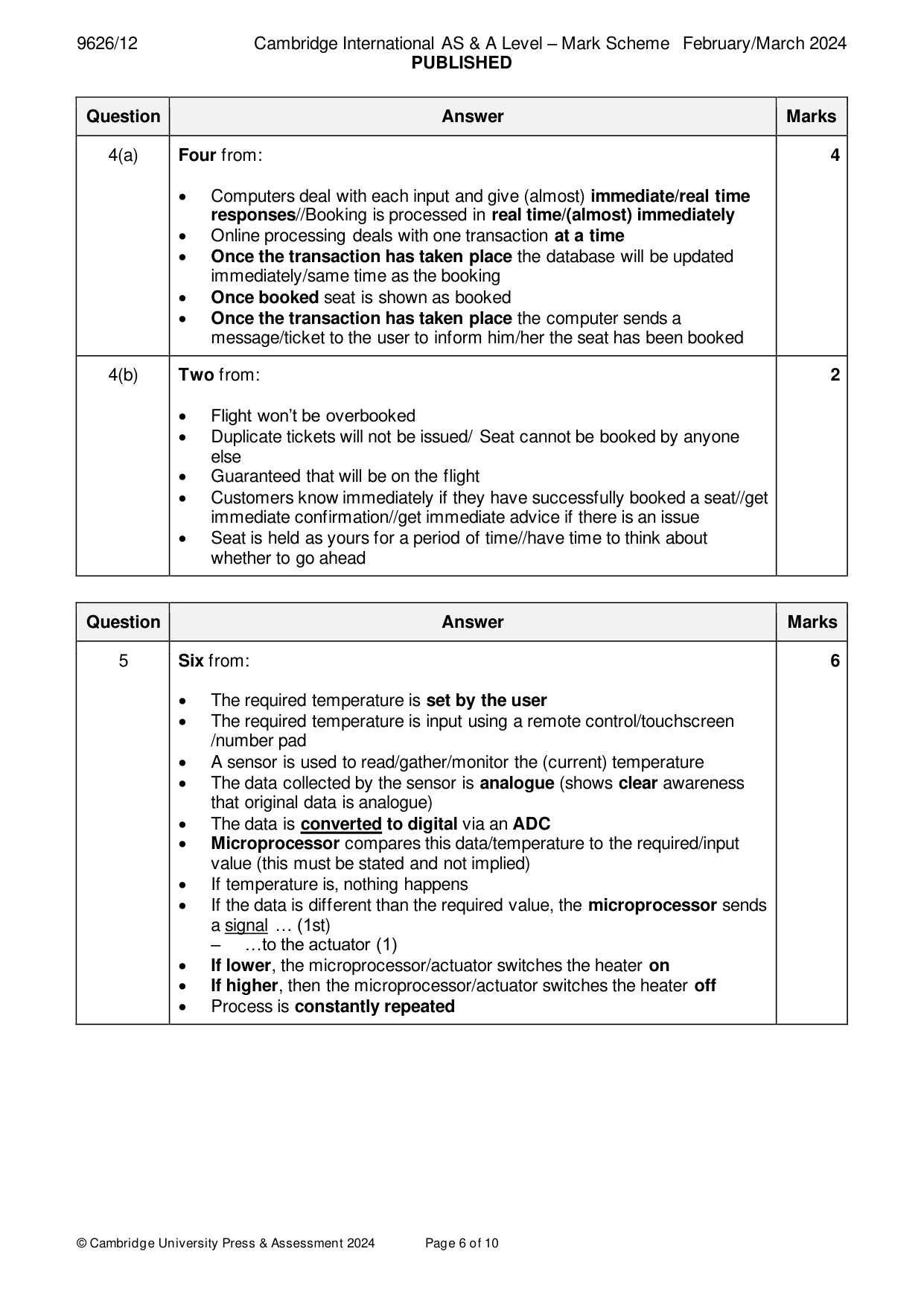
9626/12 Cambridge International AS & A Level – Mark Scheme PUBLISHED February/March 2024 © Cambridge University Press & Assessment 2024 Page 6 of 10 Question Answer Marks 4(a) Four from: • Computers deal with each input and give (almost) immediate/real time responses//Booking is processed in real time/(almost) immediately • Online processing deals with one transaction at a time • Once the transaction has taken place the database will be updated immediately/same time as the booking • Once booked seat is shown as booked • Once the transaction has taken place the computer sends a message/ticket to the user to inform him/her the seat has been booked 4 4(b) Two from: • Flight won’t be overbooked • Duplicate tickets will not be issued/ Seat cannot be booked by anyone else • Guaranteed that will be on the flight • Customers know immediately if they have successfully booked a seat//get immediate confirmation//get immediate advice if there is an issue • Seat is held as yours for a period of time//have time to think about whether to go ahead 2 Question Answer Marks 5 Six from: • The required temperature is set by the user • The required temperature is input using a remote control/touchscreen /number pad • A sensor is used to read/gather/monitor the (current) temperature • The data collected by the sensor is analogue (shows clear awareness that original data is analogue) • The data is converted to digital via an ADC • Microprocessor compares this data/temperature to the required/input value (this must be stated and not implied) • If temperature is, nothing happens • If the data is different than the required value, the microprocessor sends a signal … (1st) – …to the actuator (1) • If lower, the microprocessor/actuator switches the heater on • If higher, then the microprocessor/actuator switches the heater off • Process is constantly repeated 6
Mark scheme, page 7
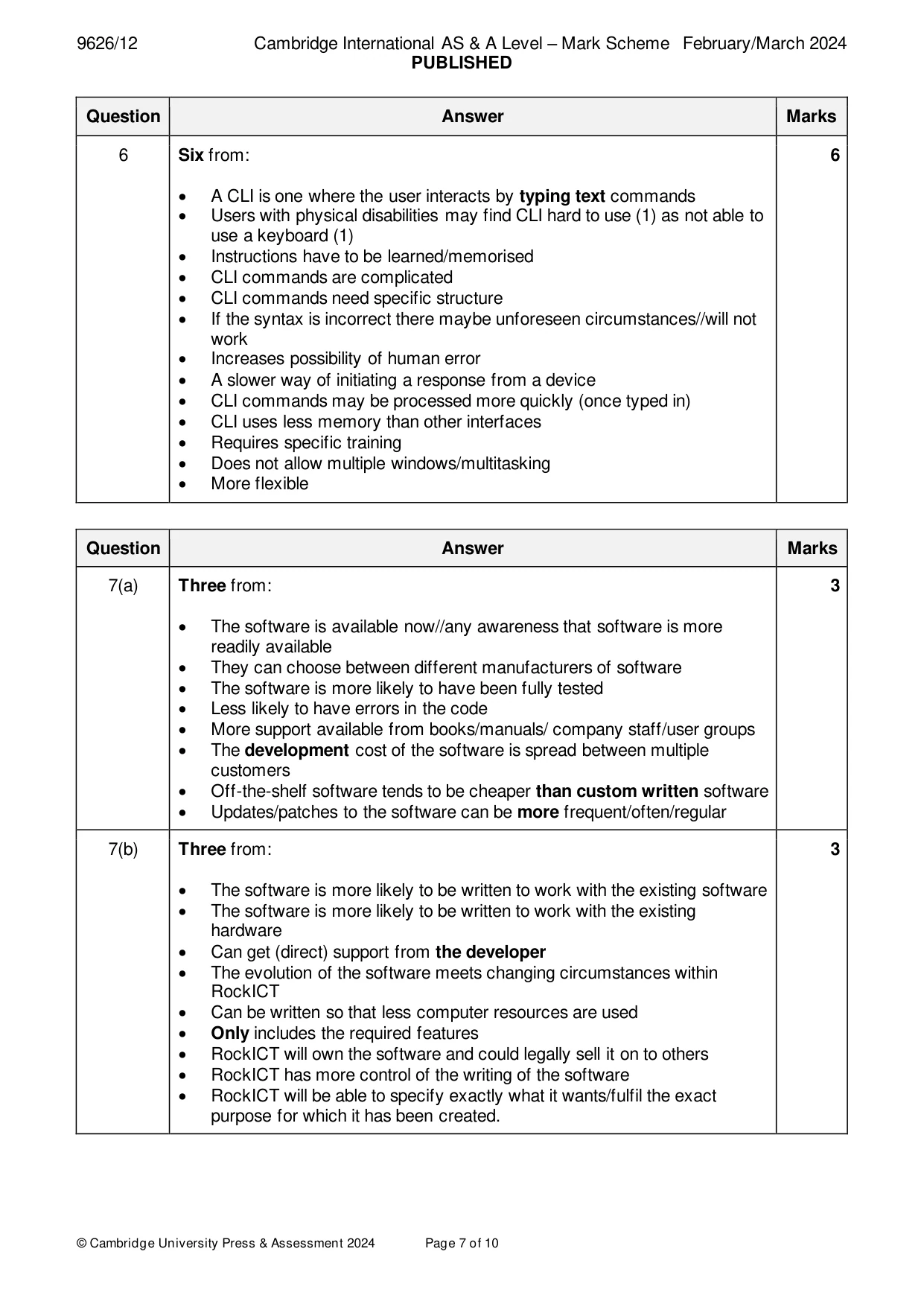
9626/12 Cambridge International AS & A Level – Mark Scheme PUBLISHED February/March 2024 © Cambridge University Press & Assessment 2024 Page 7 of 10 Question Answer Marks 6 Six from: • A CLI is one where the user interacts by typing text commands • Users with physical disabilities may find CLI hard to use (1) as not able to use a keyboard (1) • Instructions have to be learned/memorised • CLI commands are complicated • CLI commands need specific structure • If the syntax is incorrect there maybe unforeseen circumstances//will not work • Increases possibility of human error • A slower way of initiating a response from a device • CLI commands may be processed more quickly (once typed in) • CLI uses less memory than other interfaces • Requires specific training • Does not allow multiple windows/multitasking • More flexible 6 Question Answer Marks 7(a) Three from: • The software is available now//any awareness that software is more readily available • They can choose between different manufacturers of software • The software is more likely to have been fully tested • Less likely to have errors in the code • More support available from books/manuals/ company staff/user groups • The development cost of the software is spread between multiple customers • Off-the-shelf software tends to be cheaper than custom written software • Updates/patches to the software can be more frequent/often/regular 3 7(b) Three from: • The software is more likely to be written to work with the existing software • The software is more likely to be written to work with the existing hardware • Can get (direct) support from the developer • The evolution of the software meets changing circumstances within RockICT • Can be written so that less computer resources are used • Only includes the required features • RockICT will own the software and could legally sell it on to others • RockICT has more control of the writing of the software • RockICT will be able to specify exactly what it wants/fulfil the exact purpose for which it has been created. 3
Mark scheme, page 8
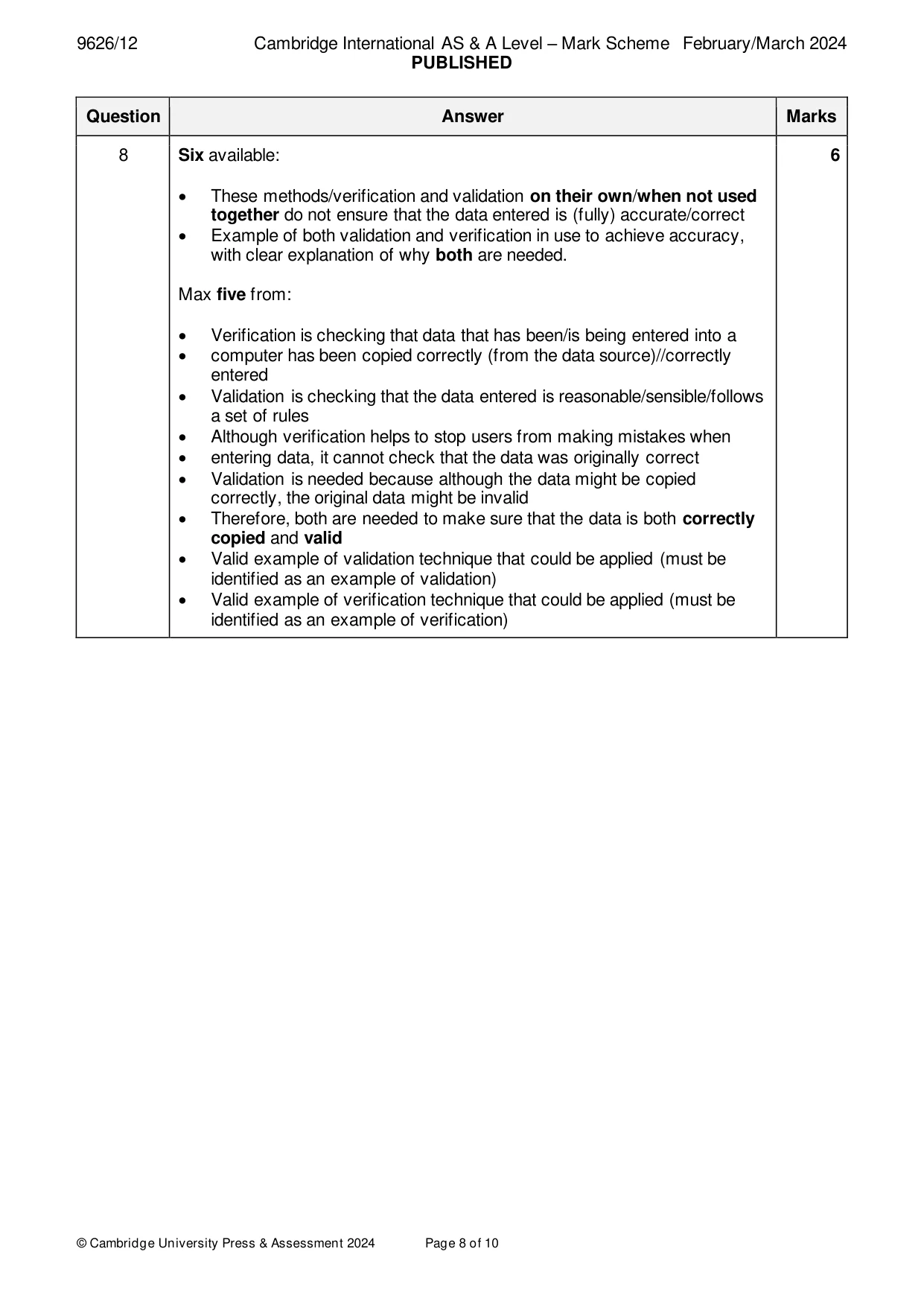
9626/12 Cambridge International AS & A Level – Mark Scheme PUBLISHED February/March 2024 © Cambridge University Press & Assessment 2024 Page 8 of 10 Question Answer Marks 8 Six available: • These methods/verification and validation on their own/when not used together do not ensure that the data entered is (fully) accurate/correct • Example of both validation and verification in use to achieve accuracy, with clear explanation of why both are needed. Max five from: • Verification is checking that data that has been/is being entered into a • computer has been copied correctly (from the data source)//correctly entered • Validation is checking that the data entered is reasonable/sensible/follows a set of rules • Although verification helps to stop users from making mistakes when • entering data, it cannot check that the data was originally correct • Validation is needed because although the data might be copied correctly, the original data might be invalid • Therefore, both are needed to make sure that the data is both correctly copied and valid • Valid example of validation technique that could be applied (must be identified as an example of validation) • Valid example of verification technique that could be applied (must be identified as an example of verification) 6
Mark scheme, page 9
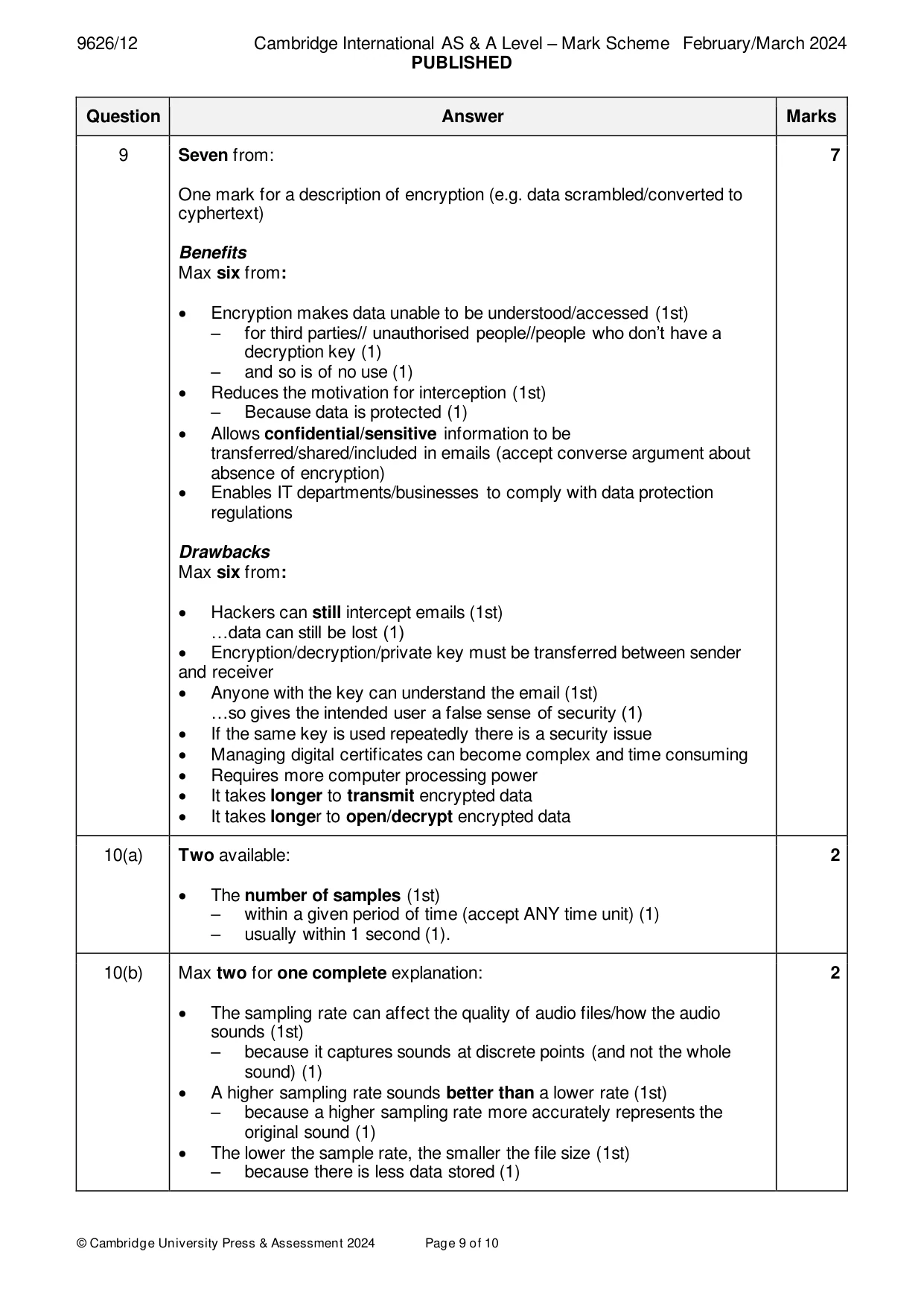
9626/12 Cambridge International AS & A Level – Mark Scheme PUBLISHED February/March 2024 © Cambridge University Press & Assessment 2024 Page 9 of 10 Question Answer Marks 9 Seven from: One mark for a description of encryption (e.g. data scrambled/converted to cyphertext) Benefits Max six from: • Encryption makes data unable to be understood/accessed (1st) – for third parties// unauthorised people//people who don’t have a decryption key (1) – and so is of no use (1) • Reduces the motivation for interception (1st) – Because data is protected (1) • Allows confidential/sensitive information to be transferred/shared/included in emails (accept converse argument about absence of encryption) • Enables IT departments/businesses to comply with data protection regulations Drawbacks Max six from: • Hackers can still intercept emails (1st) …data can still be lost (1) • Encryption/decryption/private key must be transferred between sender and receiver • Anyone with the key can understand the email (1st) …so gives the intended user a false sense of security (1) • If the same key is used repeatedly there is a security issue • Managing digital certificates can become complex and time consuming • Requires more computer processing power • It takes longer to transmit encrypted data • It takes longer to open/decrypt encrypted data 7 10(a) Two available: • The number of samples (1st) – within a given period of time (accept ANY time unit) (1) – usually within 1 second (1). 2 10(b) Max two for one complete explanation: • The sampling rate can affect the quality of audio files/how the audio sounds (1st) – because it captures sounds at discrete points (and not the whole sound) (1) • A higher sampling rate sounds better than a lower rate (1st) – because a higher sampling rate more accurately represents the original sound (1) • The lower the sample rate, the smaller the file size (1st) – because there is less data stored (1) 2
Mark scheme, page 10
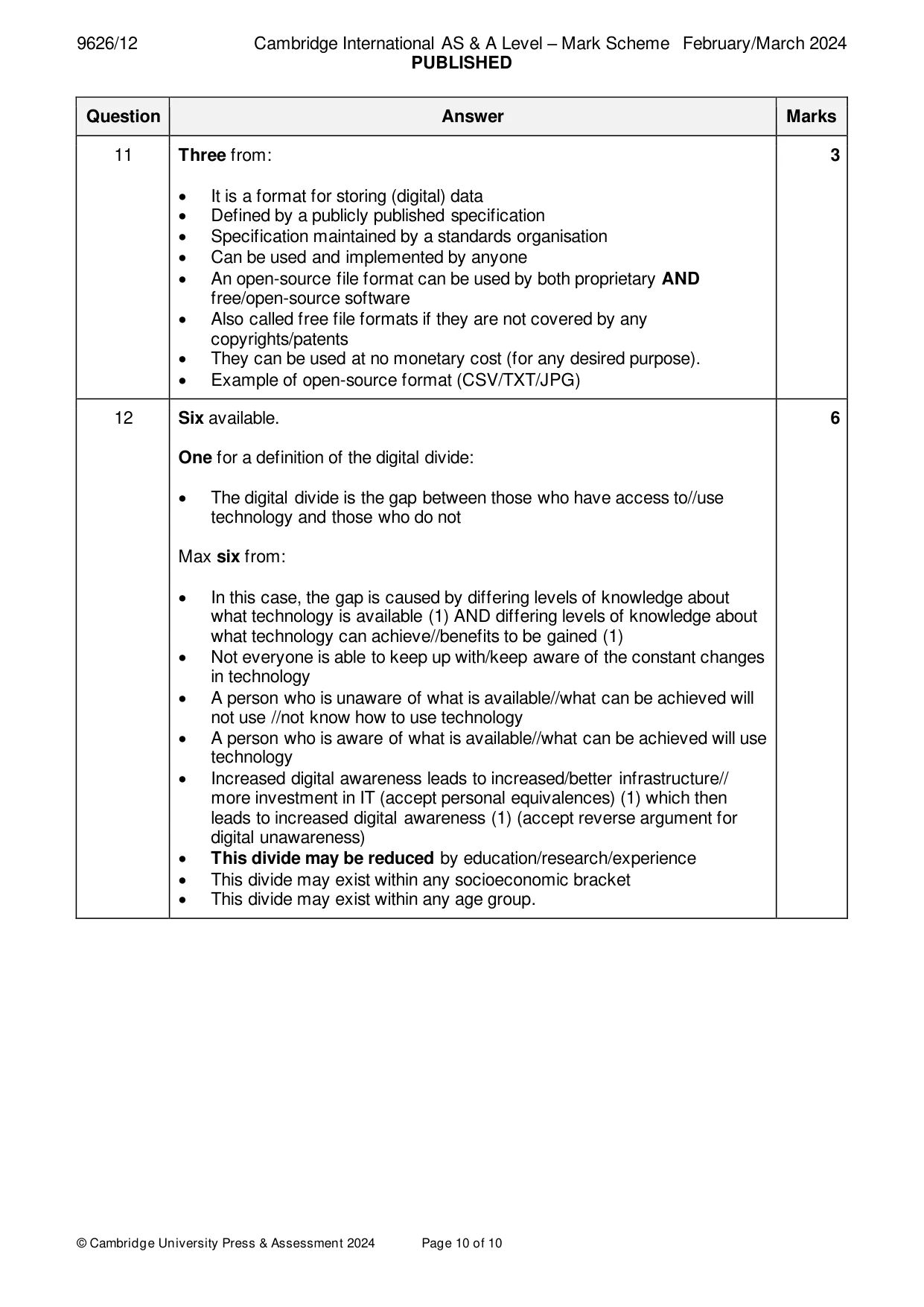
9626/12 Cambridge International AS & A Level – Mark Scheme PUBLISHED February/March 2024 © Cambridge University Press & Assessment 2024 Page 10 of 10 Question Answer Marks 11 Three from: • It is a format for storing (digital) data • Defined by a publicly published specification • Specification maintained by a standards organisation • Can be used and implemented by anyone • An open-source file format can be used by both proprietary AND free/open-source software • Also called free file formats if they are not covered by any copyrights/patents • They can be used at no monetary cost (for any desired purpose). • Example of open-source format (CSV/TXT/JPG) 3 12 Six available. One for a definition of the digital divide: • The digital divide is the gap between those who have access to//use technology and those who do not Max six from: • In this case, the gap is caused by differing levels of knowledge about what technology is available (1) AND differing levels of knowledge about what technology can achieve//benefits to be gained (1) • Not everyone is able to keep up with/keep aware of the constant changes in technology • A person who is unaware of what is available//what can be achieved will not use //not know how to use technology • A person who is aware of what is available//what can be achieved will use technology • Increased digital awareness leads to increased/better infrastructure// more investment in IT (accept personal equivalences) (1) which then leads to increased digital awareness (1) (accept reverse argument for digital unawareness) • This divide may be reduced by education/research/experience • This divide may exist within any socioeconomic bracket • This divide may exist within any age group. 6
What you needed in this session
Cambridge’s own grade thresholds for 2024 Feb/March, Paper 1 · Variant 2. A higher threshold means an easier paper — the bar moves with how the cohort did.