Cambridge A Level Information Technology (from 2017) 9626 — 2024 May/June Paper 1 · Variant 1
9626/11/M/J/24 · 70 marks · ≈79 min
The question paper and its mark scheme, free to read here and free to download. This is Cambridge’s own paper, exactly as it was sat.
Question paper12 pages





Mark scheme9 pages
Answers below. Sit the paper first if you are practising.
Paper as text
Question paper, page 1
This document has 12 pages. Any blank pages are indicated. [Turn over Cambridge International AS & A Level * 7 0 3 0 5 3 7 2 8 4 * INFORMATION TECHNOLOGY 9626/11 Paper 1 Theory May/June 2024 1 hour 45 minutes You must answer on the question paper. No additional materials are needed. INSTRUCTIONS ● Answer all questions. ● Use a black or dark blue pen. ● Write your name, centre number and candidate number in the boxes at the top of the page. ● Write your answer to each question in the space provided. ● Do not use an erasable pen or correction fluid. ● Do not write on any bar codes. ● You may use an HB pencil for any diagrams, graphs or rough working. ● Calculators must not be used in this paper. INFORMATION ● The total mark for this paper is 70. ● The number of marks for each question or part question is shown in brackets [ ]. DC (KS) 327124/4 © UCLES 2024
Question paper, page 2
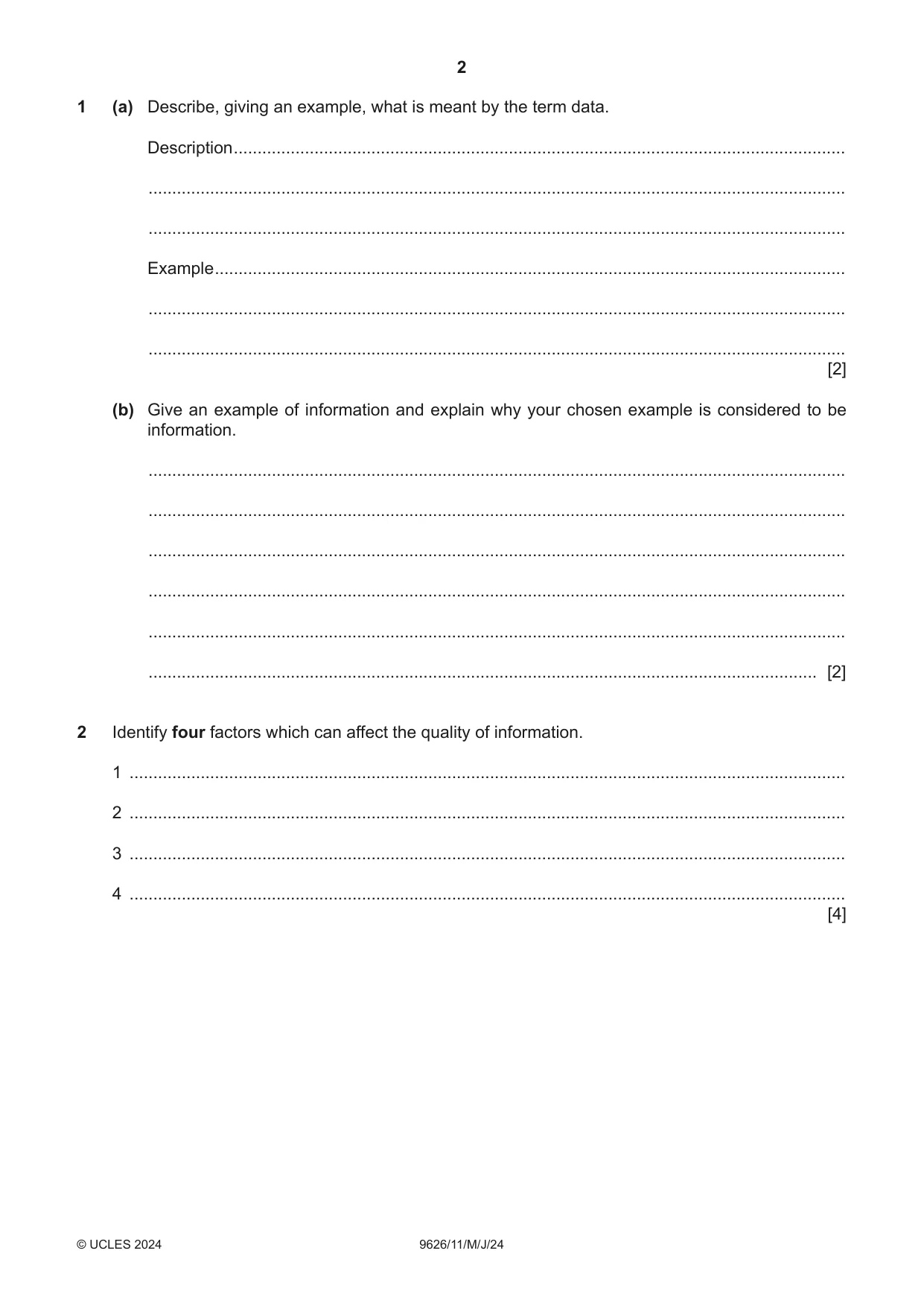
2 9626/11/M/J/24 © UCLES 2024 1 (a) Describe, giving an example, what is meant by the term data. Description … … … Example … … … [2] (b) Give an example of information and explain why your chosen example is considered to be information. … … … … … … [2] 2 Identify four factors which can affect the quality of information. 1 … 2 … 3 … 4 … [4]
Question paper, page 3
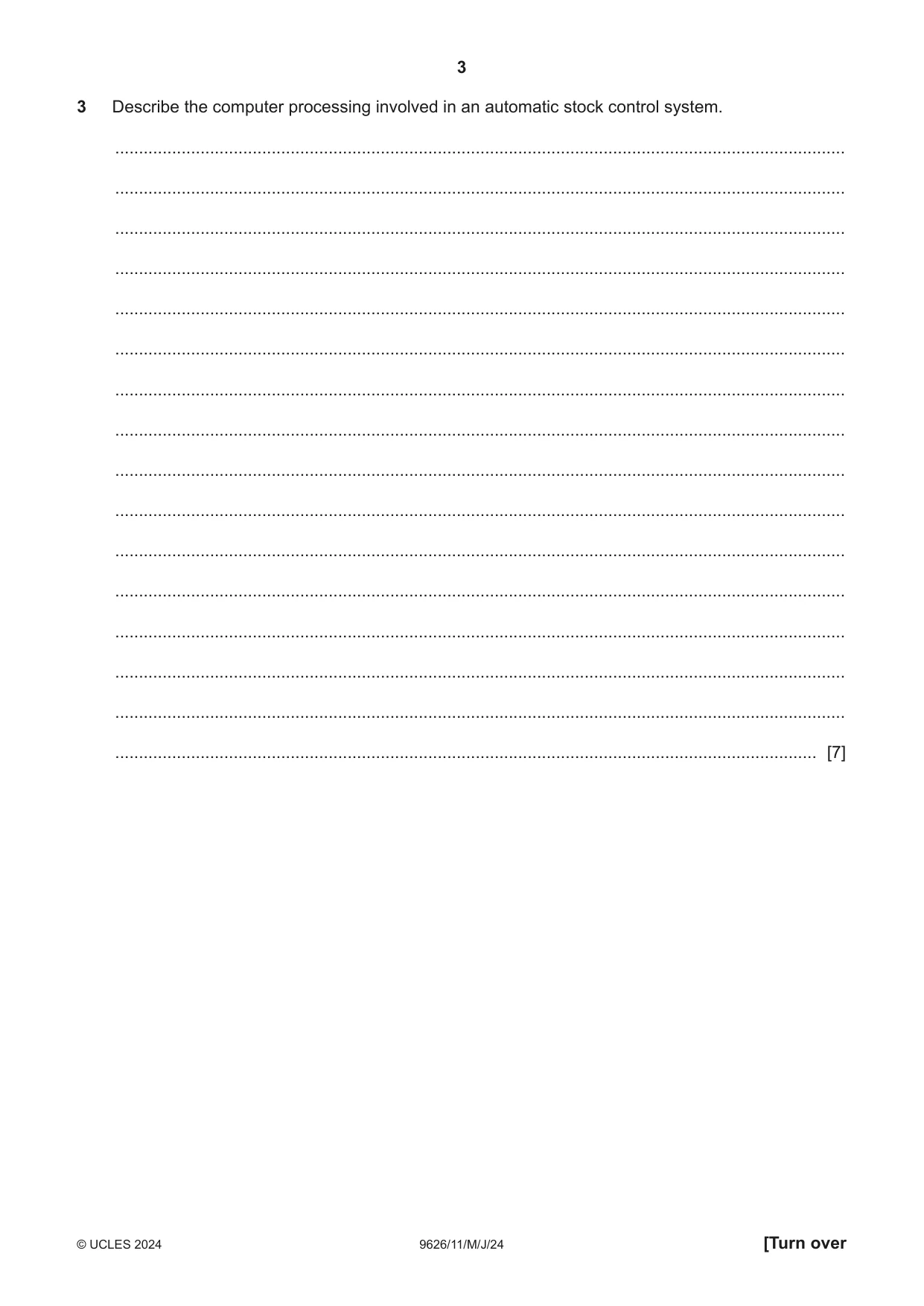
3 9626/11/M/J/24 © UCLES 2024 [Turn over 3 Describe the computer processing involved in an automatic stock control system. … … … … … … … … … … … … … … … … [7]
Question paper, page 4
4 9626/11/M/J/24 © UCLES 2024 4 Describe the term indexed sequential access. … … … … … … … … … … … … … … … … … … … … [8]
Question paper, page 5
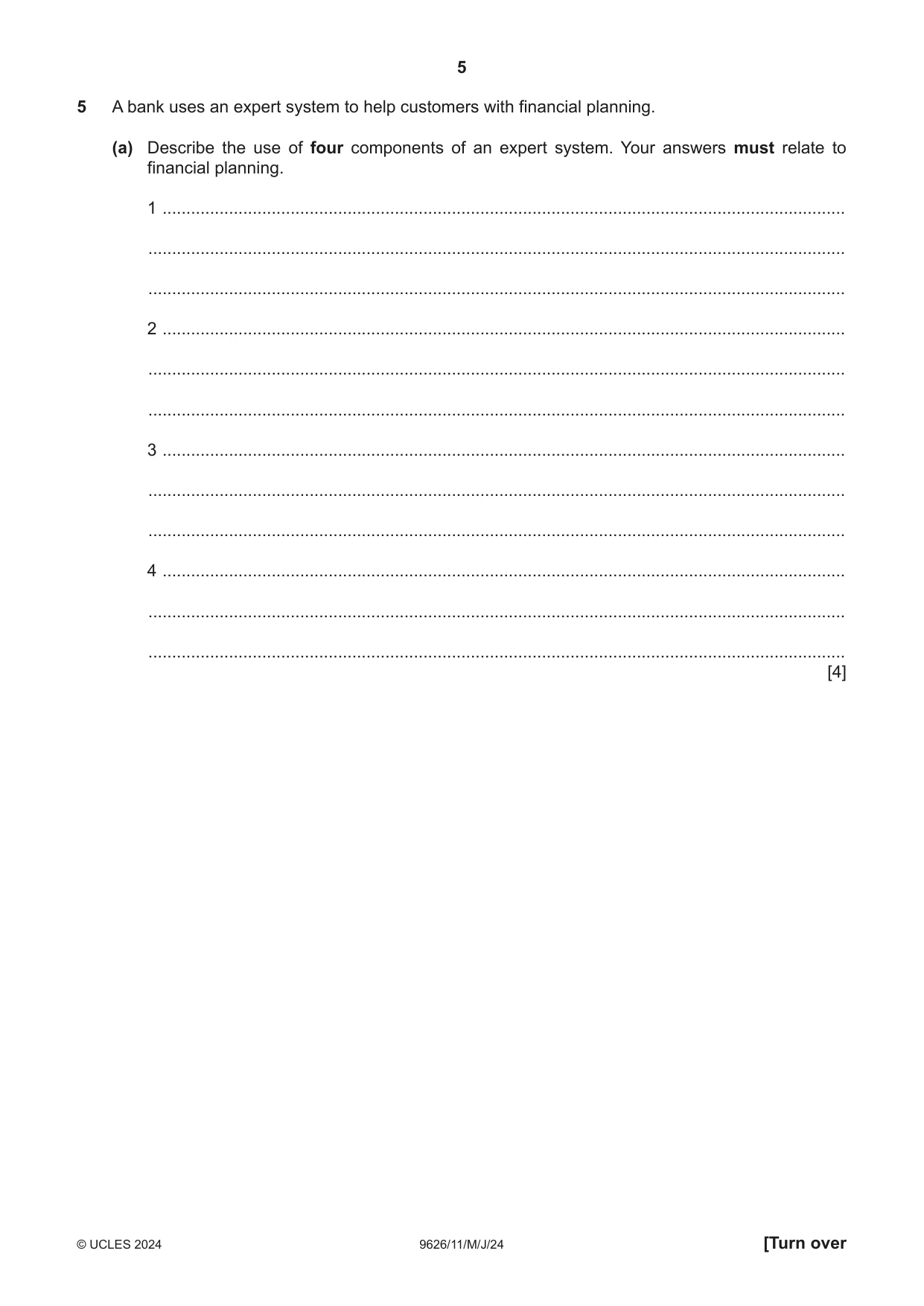
5 9626/11/M/J/24 © UCLES 2024 [Turn over 5 A bank uses an expert system to help customers with financial planning. (a) Describe the use of four components of an expert system. Your answers must relate to financial planning. 1 … … … 2 … … … 3 … … … 4 … … … [4]
Question paper, page 6
6 9626/11/M/J/24 © UCLES 2024 (b) Describe the benefits, to the bank, of using an expert system. … … … … … … … … … … … … … … [6] (c) State three drawbacks, to the bank, of using an expert system. 1 … … … 2 … … … 3 … … … [3]
Question paper, page 7
7 9626/11/M/J/24 © UCLES 2024 [Turn over 6 An airline company uses a flight simulator to train its pilots. Discuss the advantages and disadvantages of using a flight simulator in this scenario. … … … … … … … … … … … … … … … … … … … … [8]
Question paper, page 8
8 9626/11/M/J/24 © UCLES 2024 7 Compilers and linkers are types of system software. (a) Describe the role of a compiler. … … … … … … … … [3] (b) Describe the role of a linker. … … … … … … … … [3]
Question paper, page 9
9 9626/11/M/J/24 © UCLES 2024 [Turn over 8 Create a pseudocode algorithm to allow a number to be entered and to output a result when the number is: • divided by 4 if it is less than 8 • divided by 8 if it is between 8 and 12 inclusive • divided by 12 if it is any other number. Write the pseudocode algorithm using CASE...ENDCASE. … … … … … … … … … … … … … … [6]
Question paper, page 10
10 9626/11/M/J/24 © UCLES 2024 9 A company in Nairobi, Kenya, uses a database to store all its customer details. Evaluate the use of static and dynamic parameters in a query to search the database for customers in Nairobi, Kenya. … … … … … … … … … … … … … … … … … … … … [8]
Question paper, page 11
11 9626/11/M/J/24 © UCLES 2024 10 Explain how each of these methods keeps data safe from unauthorised users. (a) encryption … … … … … … … … [3] (b) a firewall on a network … … … … … … … … [3]
Question paper, page 12
12 9626/11/M/J/24 © UCLES 2024 Permission to reproduce items where third-party owned material protected by copyright is included has been sought and cleared where possible. Every reasonable effort has been made by the publisher (UCLES) to trace copyright holders, but if any items requiring clearance have unwittingly been included, the publisher will be pleased to make amends at the earliest possible opportunity. To avoid the issue of disclosure of answer-related information to candidates, all copyright acknowledgements are reproduced online in the Cambridge Assessment International Education Copyright Acknowledgements Booklet. This is produced for each series of examinations and is freely available to download at www.cambridgeinternational.org after the live examination series. Cambridge Assessment International Education is part of Cambridge Assessment. Cambridge Assessment is the brand name of the University of Cambridge Local Examinations Syndicate (UCLES), which is a department of the University of Cambridge. BLANK PAGE
Mark scheme, page 1
This document consists of 9 printed pages. © Cambridge University Press & Assessment 2024 [Turn over Cambridge International AS & A Level INFORMATION TECHNOLOGY 9626/11 Paper 1 Theory May/June 2024 MARK SCHEME Maximum Mark: 70 Published This mark scheme is published as an aid to teachers and candidates, to indicate the requirements of the examination. It shows the basis on which Examiners were instructed to award marks. It does not indicate the details of the discussions that took place at an Examiners’ meeting before marking began, which would have considered the acceptability of alternative answers. Mark schemes should be read in conjunction with the question paper and the Principal Examiner Report for Teachers. Cambridge International will not enter into discussions about these mark schemes. Cambridge International is publishing the mark schemes for the May/June 2024 series for most Cambridge IGCSE, Cambridge International A and AS Level and Cambridge Pre-U components, and some Cambridge O Level components.
Mark scheme, page 2
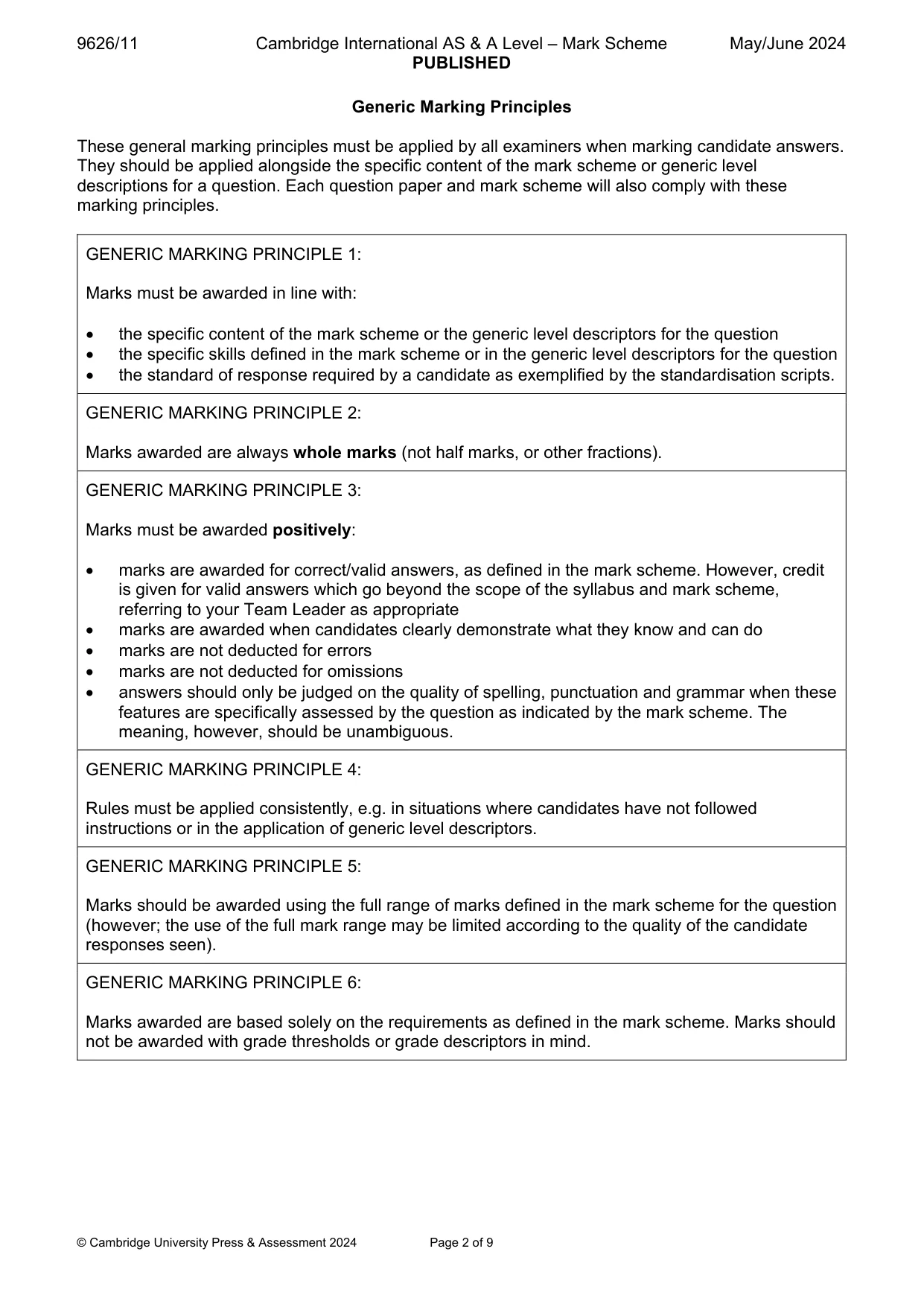
9626/11 Cambridge International AS & A Level – Mark Scheme PUBLISHED May/June 2024 © Cambridge University Press & Assessment 2024 Page 2 of 9 Generic Marking Principles These general marking principles must be applied by all examiners when marking candidate answers. They should be applied alongside the specific content of the mark scheme or generic level descriptions for a question. Each question paper and mark scheme will also comply with these marking principles. GENERIC MARKING PRINCIPLE 1: Marks must be awarded in line with: the specific content of the mark scheme or the generic level descriptors for the question the specific skills defined in the mark scheme or in the generic level descriptors for the question the standard of response required by a candidate as exemplified by the standardisation scripts. GENERIC MARKING PRINCIPLE 2: Marks awarded are always whole marks (not half marks, or other fractions). GENERIC MARKING PRINCIPLE 3: Marks must be awarded positively: marks are awarded for correct/valid answers, as defined in the mark scheme. However, credit is given for valid answers which go beyond the scope of the syllabus and mark scheme, referring to your Team Leader as appropriate marks are awarded when candidates clearly demonstrate what they know and can do marks are not deducted for errors marks are not deducted for omissions answers should only be judged on the quality of spelling, punctuation and grammar when these features are specifically assessed by the question as indicated by the mark scheme. The meaning, however, should be unambiguous. GENERIC MARKING PRINCIPLE 4: Rules must be applied consistently, e.g. in situations where candidates have not followed instructions or in the application of generic level descriptors. GENERIC MARKING PRINCIPLE 5: Marks should be awarded using the full range of marks defined in the mark scheme for the question (however; the use of the full mark range may be limited according to the quality of the candidate responses seen). GENERIC MARKING PRINCIPLE 6: Marks awarded are based solely on the requirements as defined in the mark scheme. Marks should not be awarded with grade thresholds or grade descriptors in mind.
Mark scheme, page 3
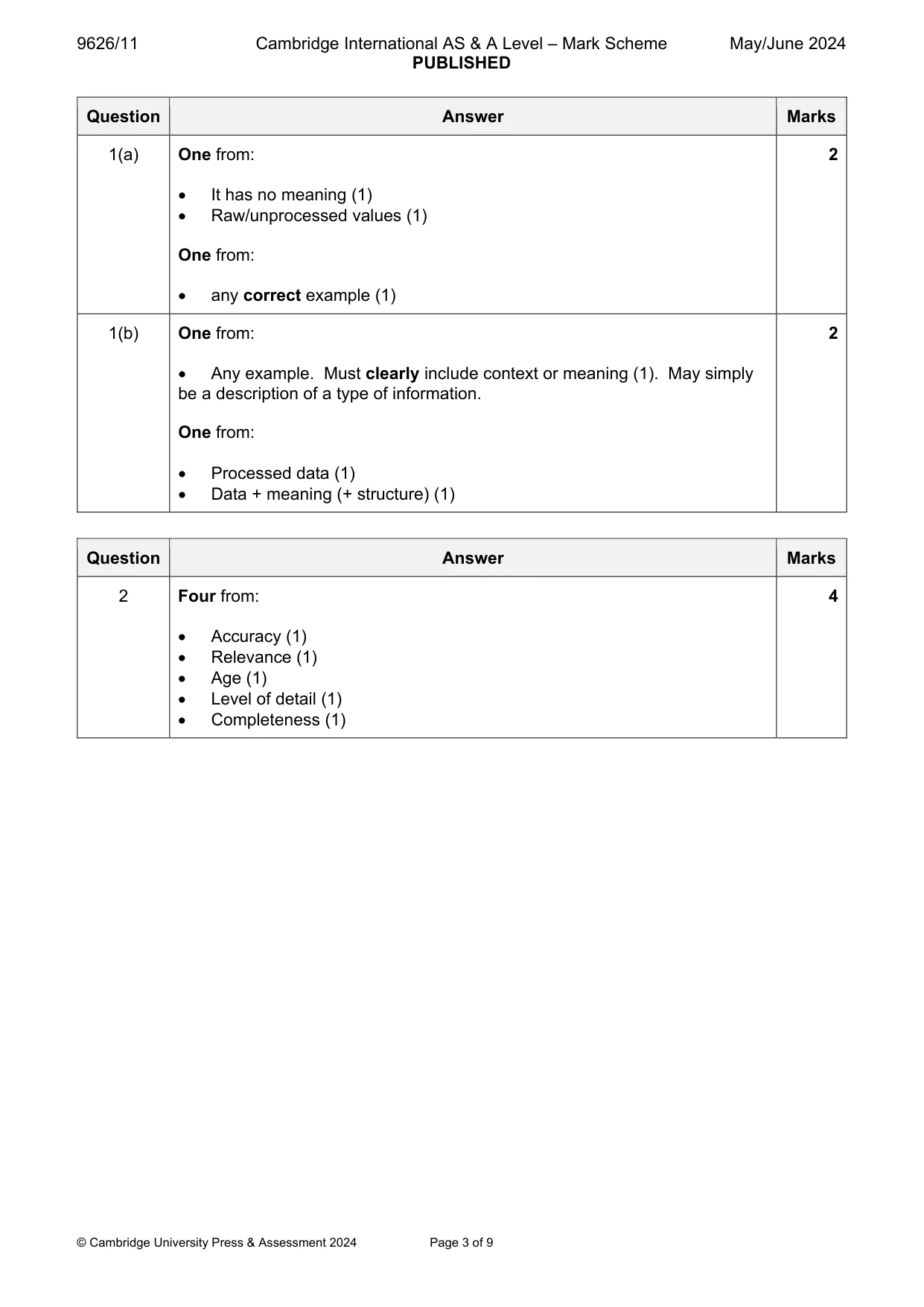
9626/11 Cambridge International AS & A Level – Mark Scheme PUBLISHED May/June 2024 © Cambridge University Press & Assessment 2024 Page 3 of 9 Question Answer Marks 1(a) One from: It has no meaning (1) Raw/unprocessed values (1) One from: any correct example (1) 2 1(b) One from: Any example. Must clearly include context or meaning (1). May simply be a description of a type of information. One from: Processed data (1) Data + meaning (+ structure) (1) 2 Question Answer Marks 2 Four from: Accuracy (1) Relevance (1) Age (1) Level of detail (1) Completeness (1) 4
Mark scheme, page 4
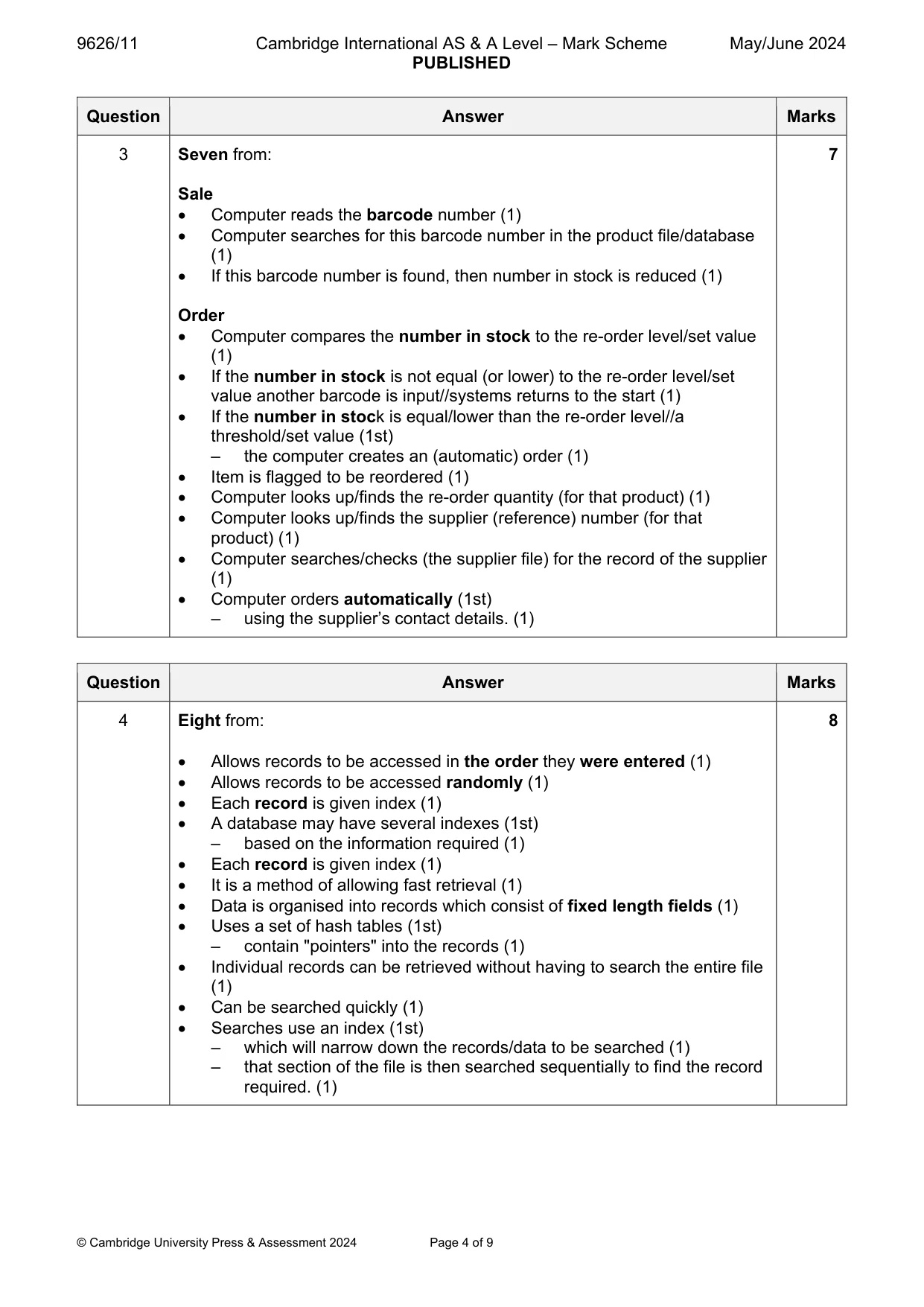
9626/11 Cambridge International AS & A Level – Mark Scheme PUBLISHED May/June 2024 © Cambridge University Press & Assessment 2024 Page 4 of 9 Question Answer Marks 3 Seven from: Sale Computer reads the barcode number (1) Computer searches for this barcode number in the product file/database (1) If this barcode number is found, then number in stock is reduced (1) Order Computer compares the number in stock to the re-order level/set value (1) If the number in stock is not equal (or lower) to the re-order level/set value another barcode is input//systems returns to the start (1) If the number in stock is equal/lower than the re-order level//a threshold/set value (1st) – the computer creates an (automatic) order (1) Item is flagged to be reordered (1) Computer looks up/finds the re-order quantity (for that product) (1) Computer looks up/finds the supplier (reference) number (for that product) (1) Computer searches/checks (the supplier file) for the record of the supplier (1) Computer orders automatically (1st) – using the supplier’s contact details. (1) 7 Question Answer Marks 4 Eight from: Allows records to be accessed in the order they were entered (1) Allows records to be accessed randomly (1) Each record is given index (1) A database may have several indexes (1st) – based on the information required (1) Each record is given index (1) It is a method of allowing fast retrieval (1) Data is organised into records which consist of fixed length fields (1) Uses a set of hash tables (1st) – contain "pointers" into the records (1) Individual records can be retrieved without having to search the entire file (1) Can be searched quickly (1) Searches use an index (1st) – which will narrow down the records/data to be searched (1) – that section of the file is then searched sequentially to find the record required. (1) 8
Mark scheme, page 5
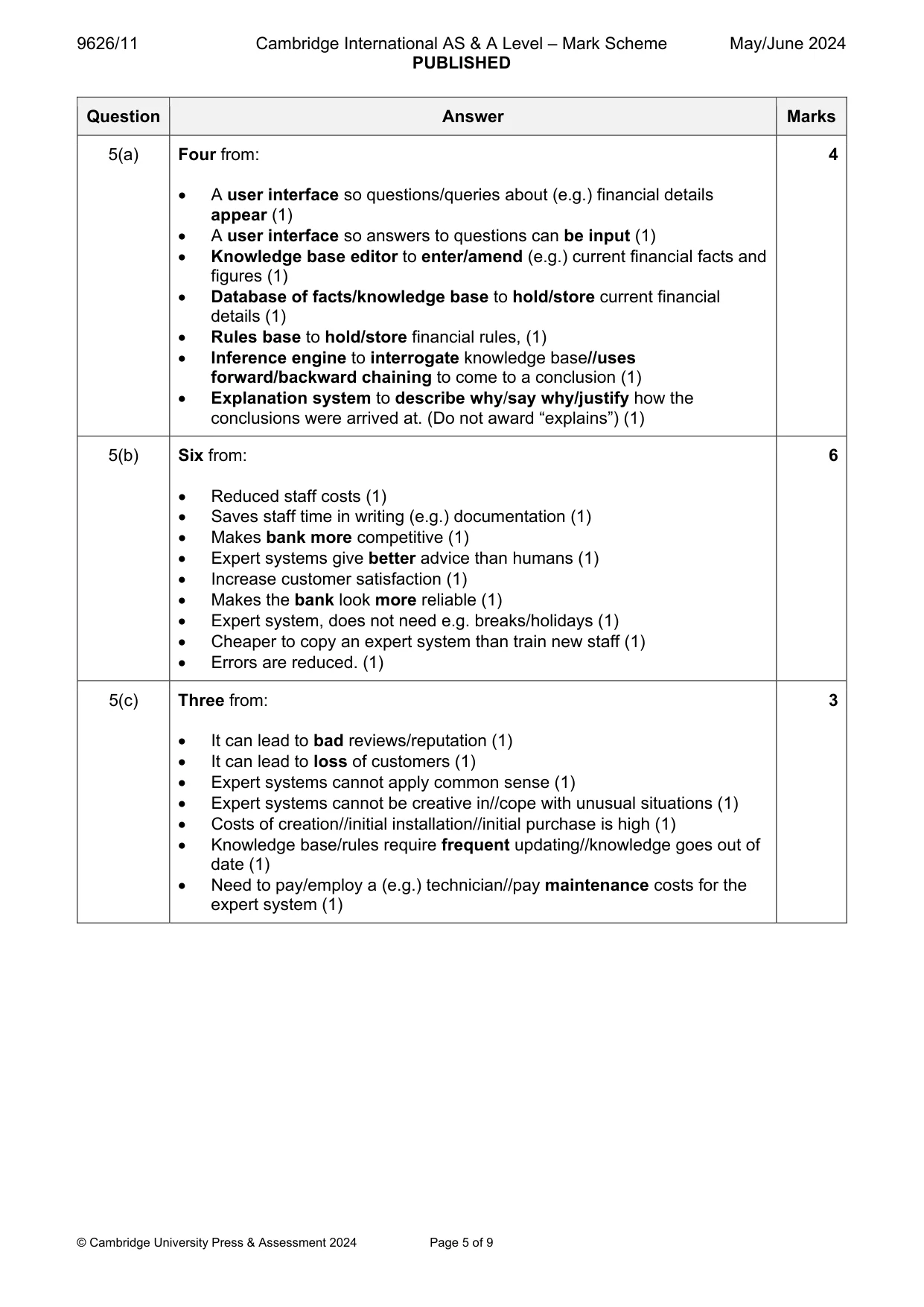
9626/11 Cambridge International AS & A Level – Mark Scheme PUBLISHED May/June 2024 © Cambridge University Press & Assessment 2024 Page 5 of 9 Question Answer Marks 5(a) Four from: A user interface so questions/queries about (e.g.) financial details appear (1) A user interface so answers to questions can be input (1) Knowledge base editor to enter/amend (e.g.) current financial facts and figures (1) Database of facts/knowledge base to hold/store current financial details (1) Rules base to hold/store financial rules, (1) Inference engine to interrogate knowledge base//uses forward/backward chaining to come to a conclusion (1) Explanation system to describe why/say why/justify how the conclusions were arrived at. (Do not award “explains”) (1) 4 5(b) Six from: Reduced staff costs (1) Saves staff time in writing (e.g.) documentation (1) Makes bank more competitive (1) Expert systems give better advice than humans (1) Increase customer satisfaction (1) Makes the bank look more reliable (1) Expert system, does not need e.g. breaks/holidays (1) Cheaper to copy an expert system than train new staff (1) Errors are reduced. (1) 6 5(c) Three from: It can lead to bad reviews/reputation (1) It can lead to loss of customers (1) Expert systems cannot apply common sense (1) Expert systems cannot be creative in//cope with unusual situations (1) Costs of creation//initial installation//initial purchase is high (1) Knowledge base/rules require frequent updating//knowledge goes out of date (1) Need to pay/employ a (e.g.) technician//pay maintenance costs for the expert system (1) 3
Mark scheme, page 6
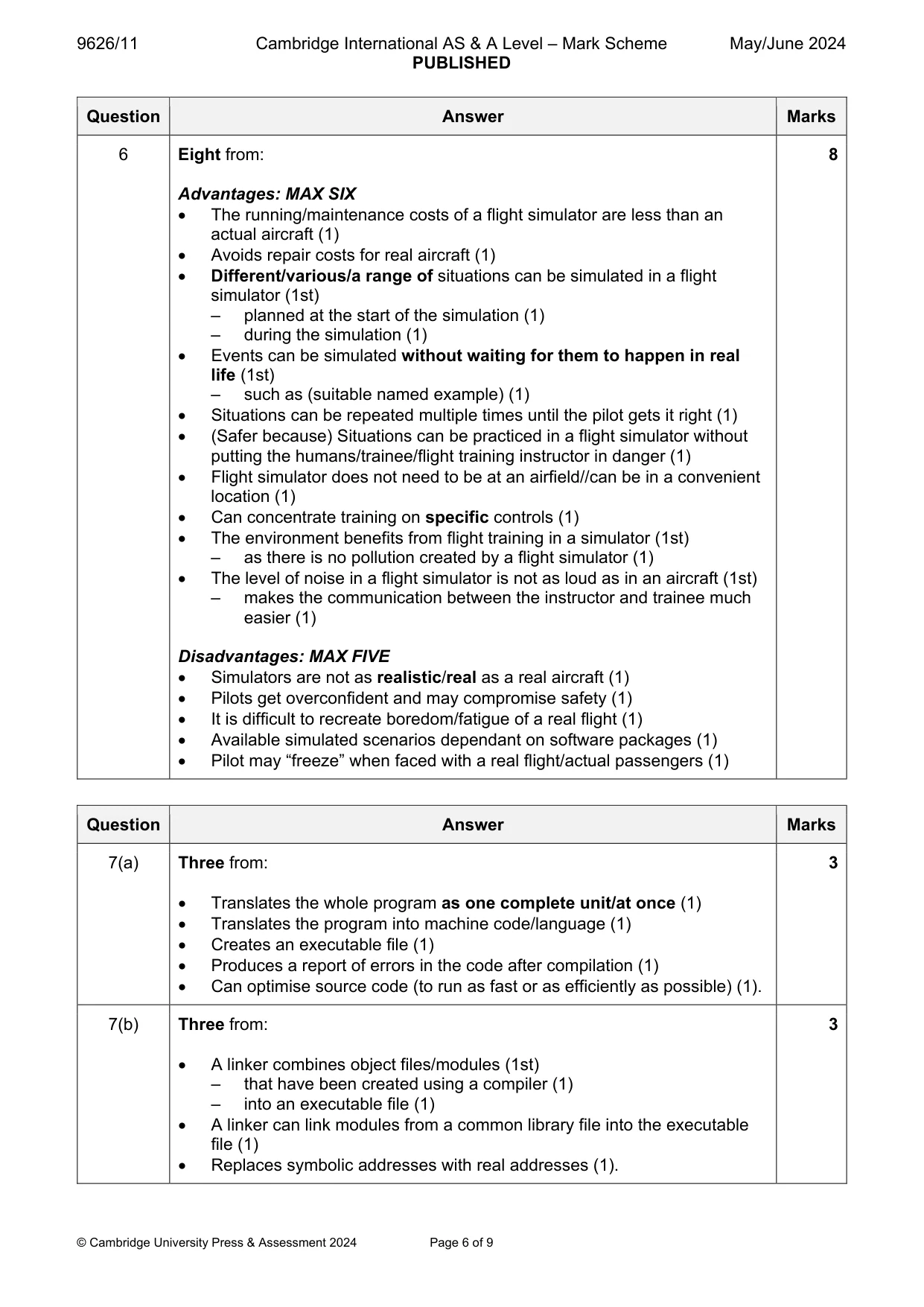
9626/11 Cambridge International AS & A Level – Mark Scheme PUBLISHED May/June 2024 © Cambridge University Press & Assessment 2024 Page 6 of 9 Question Answer Marks 6 Eight from: Advantages: MAX SIX The running/maintenance costs of a flight simulator are less than an actual aircraft (1) Avoids repair costs for real aircraft (1) Different/various/a range of situations can be simulated in a flight simulator (1st) – planned at the start of the simulation (1) – during the simulation (1) Events can be simulated without waiting for them to happen in real life (1st) – such as (suitable named example) (1) Situations can be repeated multiple times until the pilot gets it right (1) (Safer because) Situations can be practiced in a flight simulator without putting the humans/trainee/flight training instructor in danger (1) Flight simulator does not need to be at an airfield//can be in a convenient location (1) Can concentrate training on specific controls (1) The environment benefits from flight training in a simulator (1st) – as there is no pollution created by a flight simulator (1) The level of noise in a flight simulator is not as loud as in an aircraft (1st) – makes the communication between the instructor and trainee much easier (1) Disadvantages: MAX FIVE Simulators are not as realistic/real as a real aircraft (1) Pilots get overconfident and may compromise safety (1) It is difficult to recreate boredom/fatigue of a real flight (1) Available simulated scenarios dependant on software packages (1) Pilot may “freeze” when faced with a real flight/actual passengers (1) 8 Question Answer Marks 7(a) Three from: Translates the whole program as one complete unit/at once (1) Translates the program into machine code/language (1) Creates an executable file (1) Produces a report of errors in the code after compilation (1) Can optimise source code (to run as fast or as efficiently as possible) (1). 3 7(b) Three from: A linker combines object files/modules (1st) – that have been created using a compiler (1) – into an executable file (1) A linker can link modules from a common library file into the executable file (1) Replaces symbolic addresses with real addresses (1). 3
Mark scheme, page 7
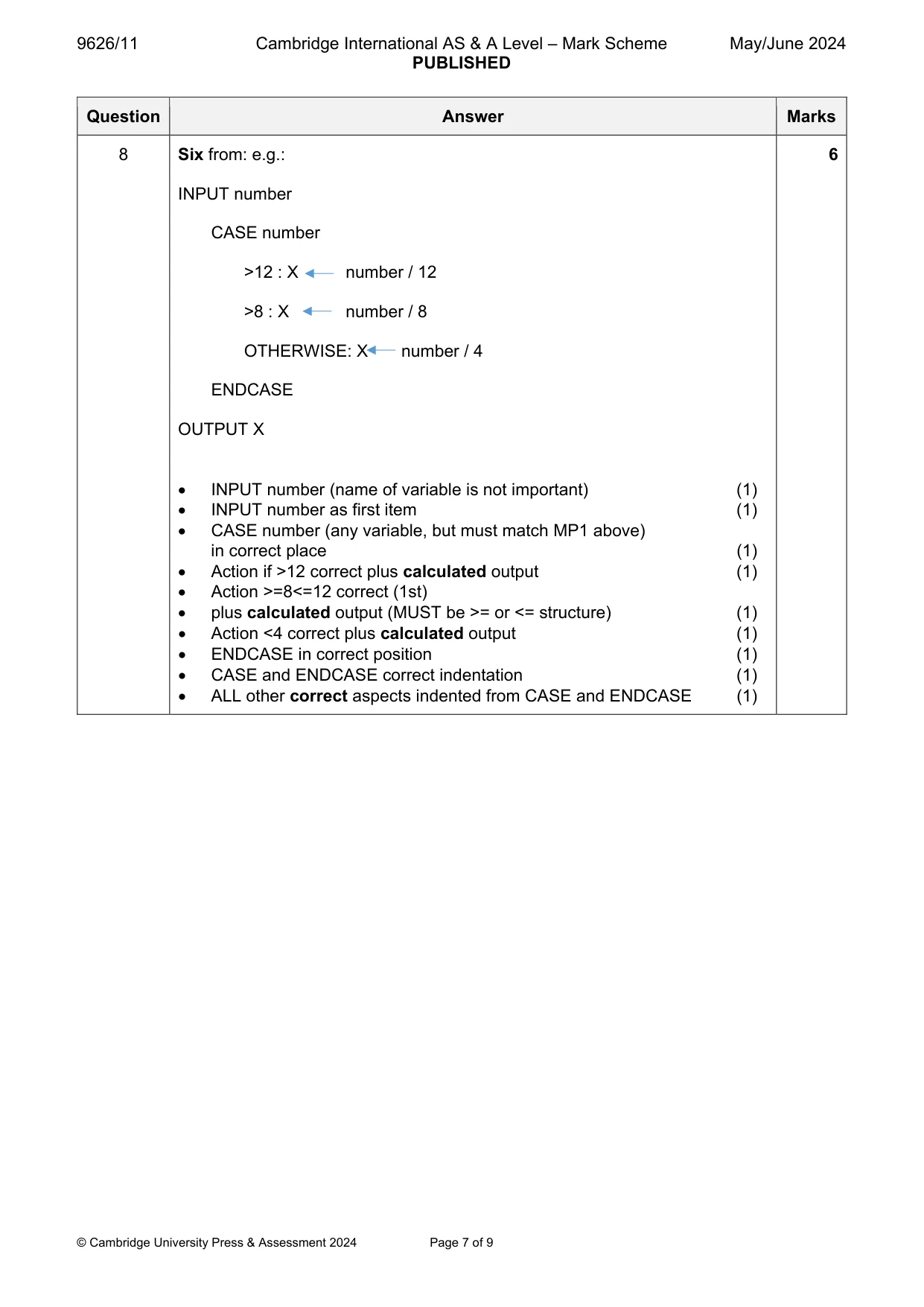
9626/11 Cambridge International AS & A Level – Mark Scheme PUBLISHED May/June 2024 © Cambridge University Press & Assessment 2024 Page 7 of 9 Question Answer Marks 8 Six from: e.g.: INPUT number CASE number >12 : X number / 12 >8 : X number / 8 OTHERWISE: X number / 4 ENDCASE OUTPUT X INPUT number (name of variable is not important) (1) INPUT number as first item (1) CASE number (any variable, but must match MP1 above) in correct place (1) Action if >12 correct plus calculated output (1) Action >=8<=12 correct (1st) plus calculated output (MUST be >= or <= structure) (1) Action <4 correct plus calculated output (1) ENDCASE in correct position (1) CASE and ENDCASE correct indentation (1) ALL other correct aspects indented from CASE and ENDCASE (1) 6
Mark scheme, page 8
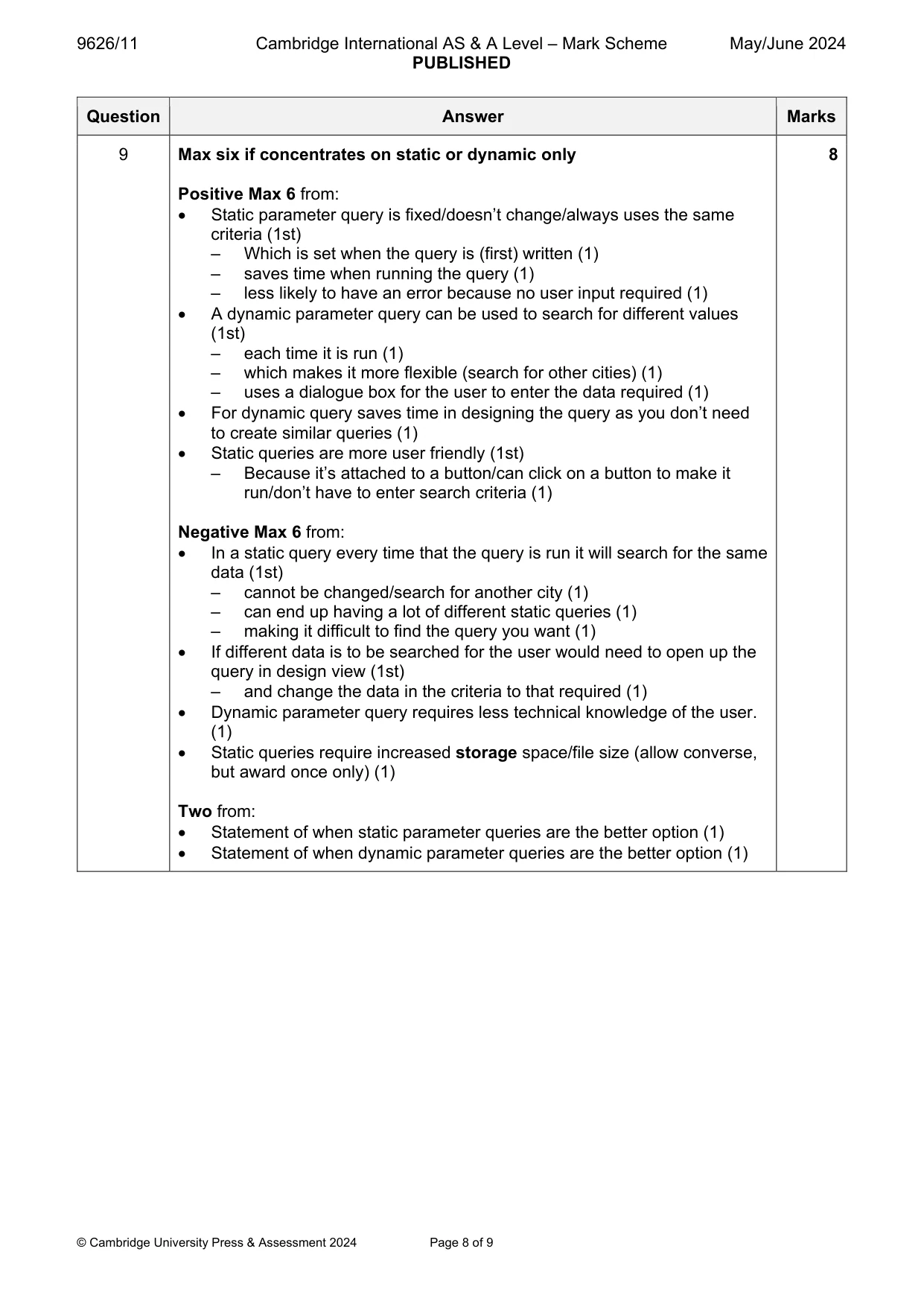
9626/11 Cambridge International AS & A Level – Mark Scheme PUBLISHED May/June 2024 © Cambridge University Press & Assessment 2024 Page 8 of 9 Question Answer Marks 9 Max six if concentrates on static or dynamic only Positive Max 6 from: Static parameter query is fixed/doesn’t change/always uses the same criteria (1st) – Which is set when the query is (first) written (1) – saves time when running the query (1) – less likely to have an error because no user input required (1) A dynamic parameter query can be used to search for different values (1st) – each time it is run (1) – which makes it more flexible (search for other cities) (1) – uses a dialogue box for the user to enter the data required (1) For dynamic query saves time in designing the query as you don’t need to create similar queries (1) Static queries are more user friendly (1st) – Because it’s attached to a button/can click on a button to make it run/don’t have to enter search criteria (1) Negative Max 6 from: In a static query every time that the query is run it will search for the same data (1st) – cannot be changed/search for another city (1) – can end up having a lot of different static queries (1) – making it difficult to find the query you want (1) If different data is to be searched for the user would need to open up the query in design view (1st) – and change the data in the criteria to that required (1) Dynamic parameter query requires less technical knowledge of the user. (1) Static queries require increased storage space/file size (allow converse, but award once only) (1) Two from: Statement of when static parameter queries are the better option (1) Statement of when dynamic parameter queries are the better option (1) 8
Mark scheme, page 9
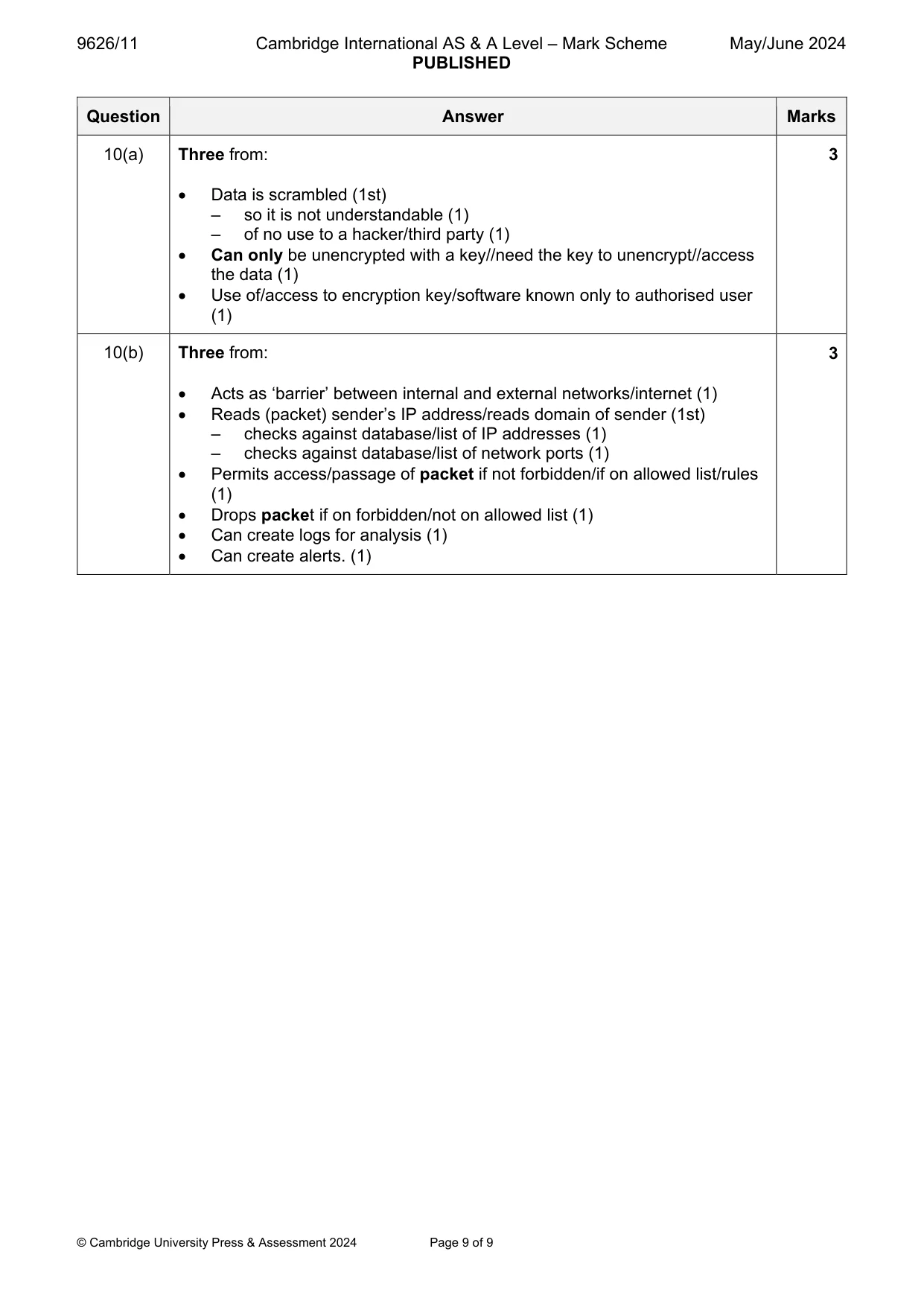
9626/11 Cambridge International AS & A Level – Mark Scheme PUBLISHED May/June 2024 © Cambridge University Press & Assessment 2024 Page 9 of 9 Question Answer Marks 10(a) Three from: Data is scrambled (1st) – so it is not understandable (1) – of no use to a hacker/third party (1) Can only be unencrypted with a key//need the key to unencrypt//access the data (1) Use of/access to encryption key/software known only to authorised user (1) 3 10(b) Three from: Acts as ‘barrier’ between internal and external networks/internet (1) Reads (packet) sender’s IP address/reads domain of sender (1st) – checks against database/list of IP addresses (1) – checks against database/list of network ports (1) Permits access/passage of packet if not forbidden/if on allowed list/rules (1) Drops packet if on forbidden/not on allowed list (1) Can create logs for analysis (1) Can create alerts. (1) 3
What you needed in this session
Cambridge’s own grade thresholds for 2024 May/June, Paper 1 · Variant 1. A higher threshold means an easier paper — the bar moves with how the cohort did.