Cambridge A Level Information Technology (from 2017) 9626 — 2022 Oct/Nov Paper 1 · Variant 3
9626/13/O/N/22 · 70 marks · ≈79 min
The question paper and its mark scheme, free to read here and free to download. This is Cambridge’s own paper, exactly as it was sat.
Question paper12 pages
Mark scheme11 pages
Answers below. Sit the paper first if you are practising.
Paper as text
Question paper, page 1
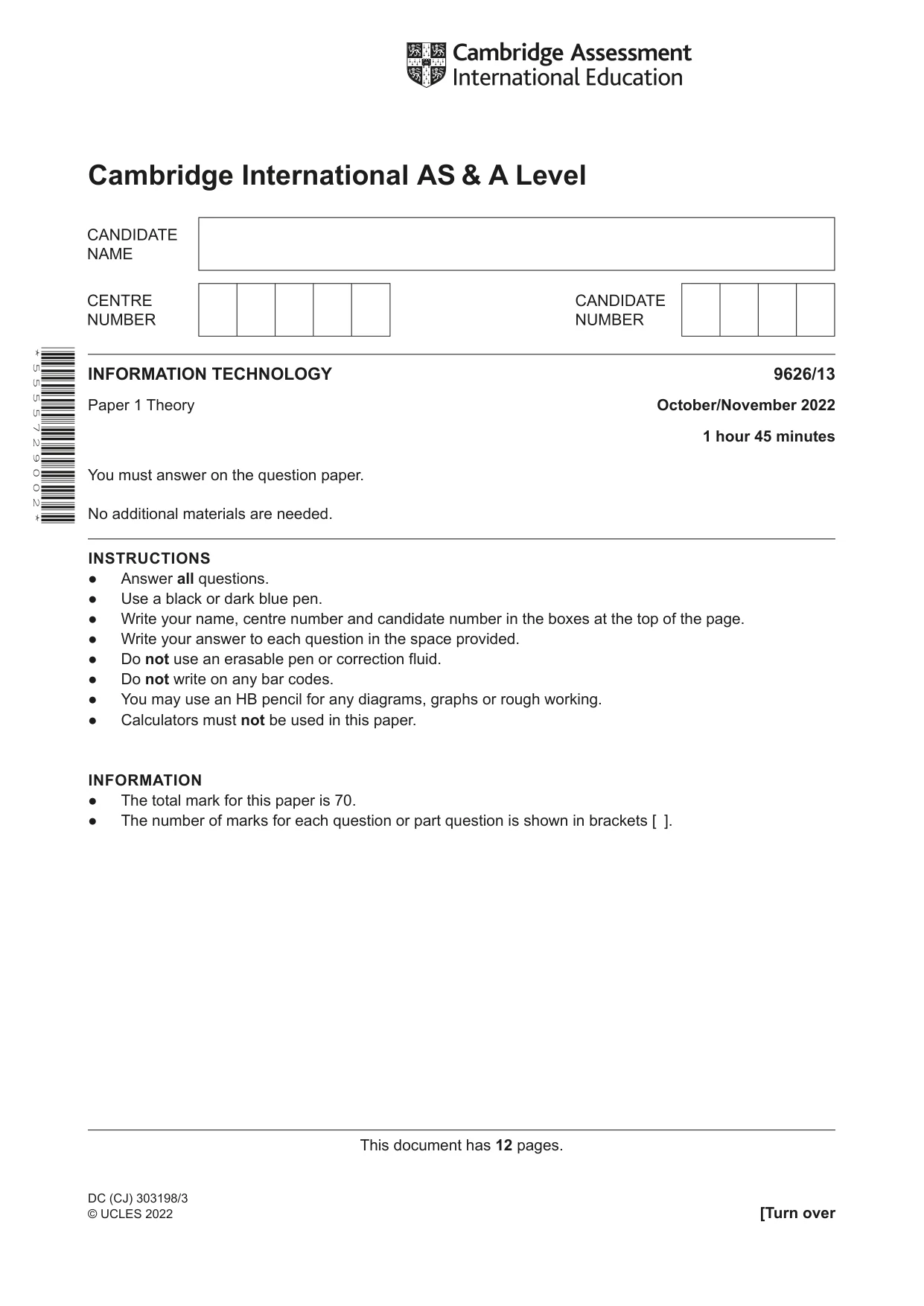
This document has 12 pages. [Turn over Cambridge International AS & A Level INFORMATION TECHNOLOGY 9626/13 Paper 1 Theory October/November 2022 1 hour 45 minutes You must answer on the question paper. No additional materials are needed. INSTRUCTIONS ● Answer all questions. ● Use a black or dark blue pen. ● Write your name, centre number and candidate number in the boxes at the top of the page. ● Write your answer to each question in the space provided. ● Do not use an erasable pen or correction fluid. ● Do not write on any bar codes. ● You may use an HB pencil for any diagrams, graphs or rough working. ● Calculators must not be used in this paper. INFORMATION ● The total mark for this paper is 70. ● The number of marks for each question or part question is shown in brackets [ ]. * 5 5 5 5 7 2 9 0 0 2 * DC (CJ) 303198/3 © UCLES 2022
Question paper, page 2
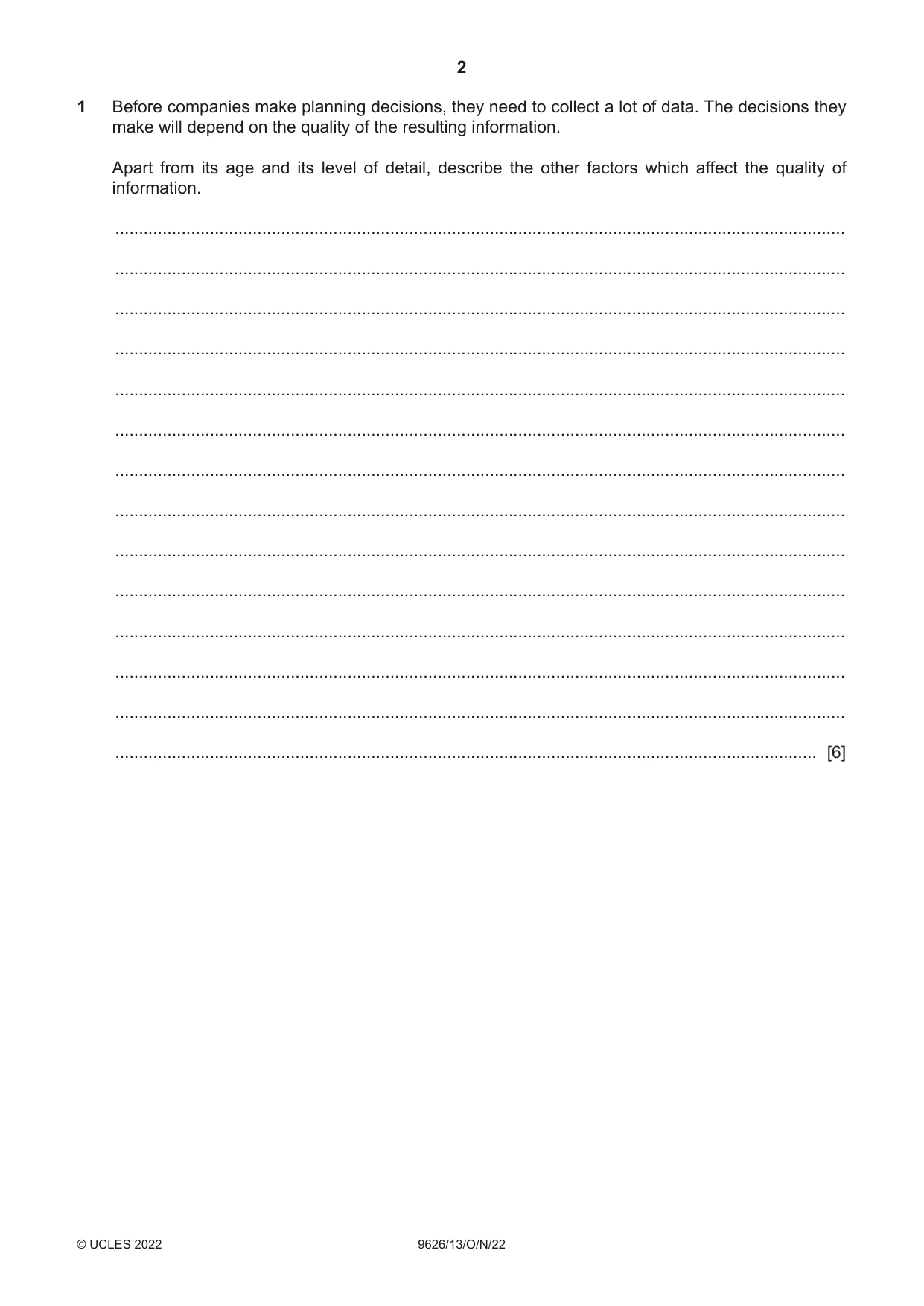
2 9626/13/O/N/22 © UCLES 2022 1 Before companies make planning decisions, they need to collect a lot of data. The decisions they make will depend on the quality of the resulting information. Apart from its age and its level of detail, describe the other factors which affect the quality of information. … … … … … … … … … … … … … … [6]
Question paper, page 3
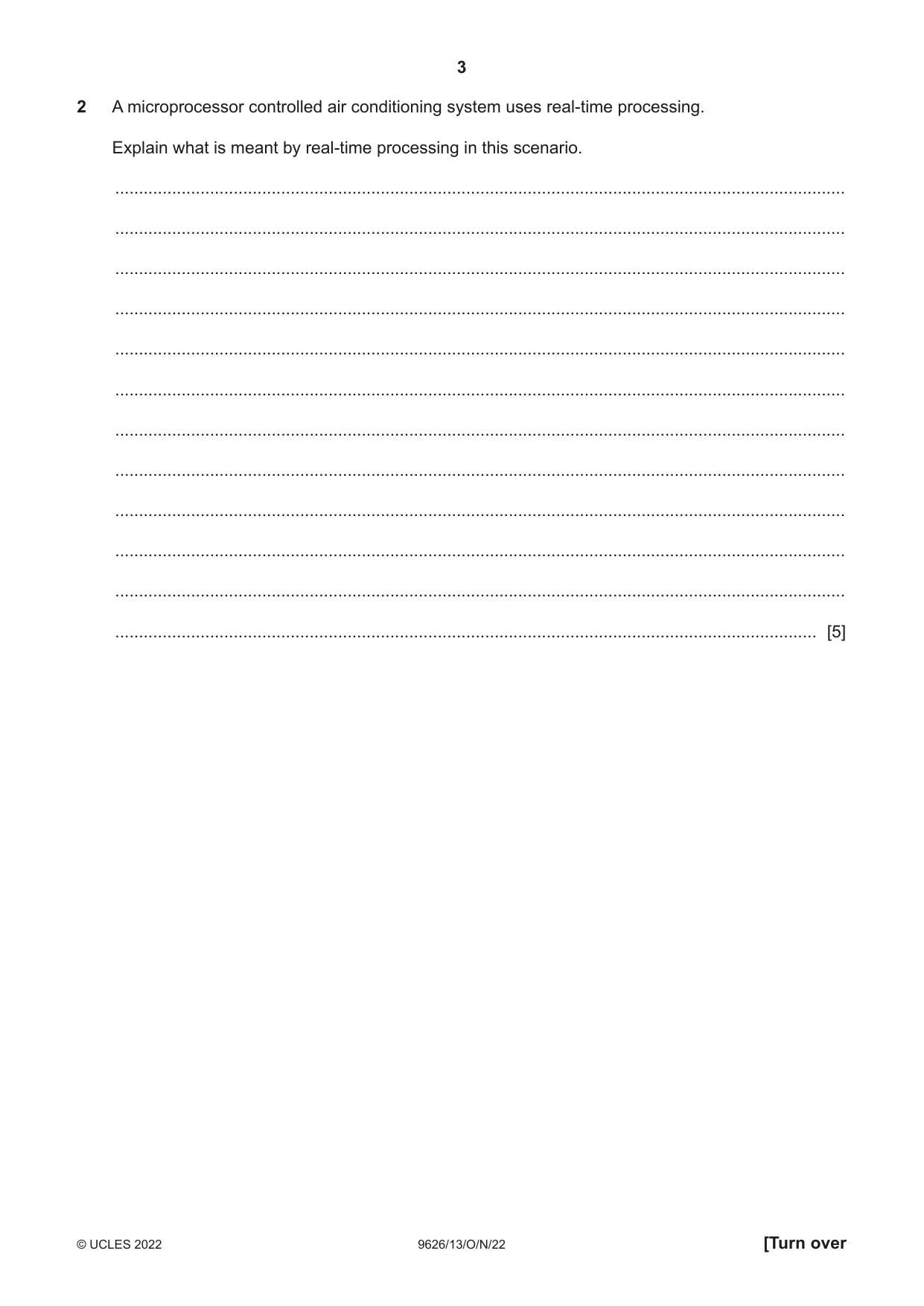
3 9626/13/O/N/22 © UCLES 2022 [Turn over 2 A microprocessor controlled air conditioning system uses real-time processing. Explain what is meant by real-time processing in this scenario. … … … … … … … … … … … … [5]
Question paper, page 4
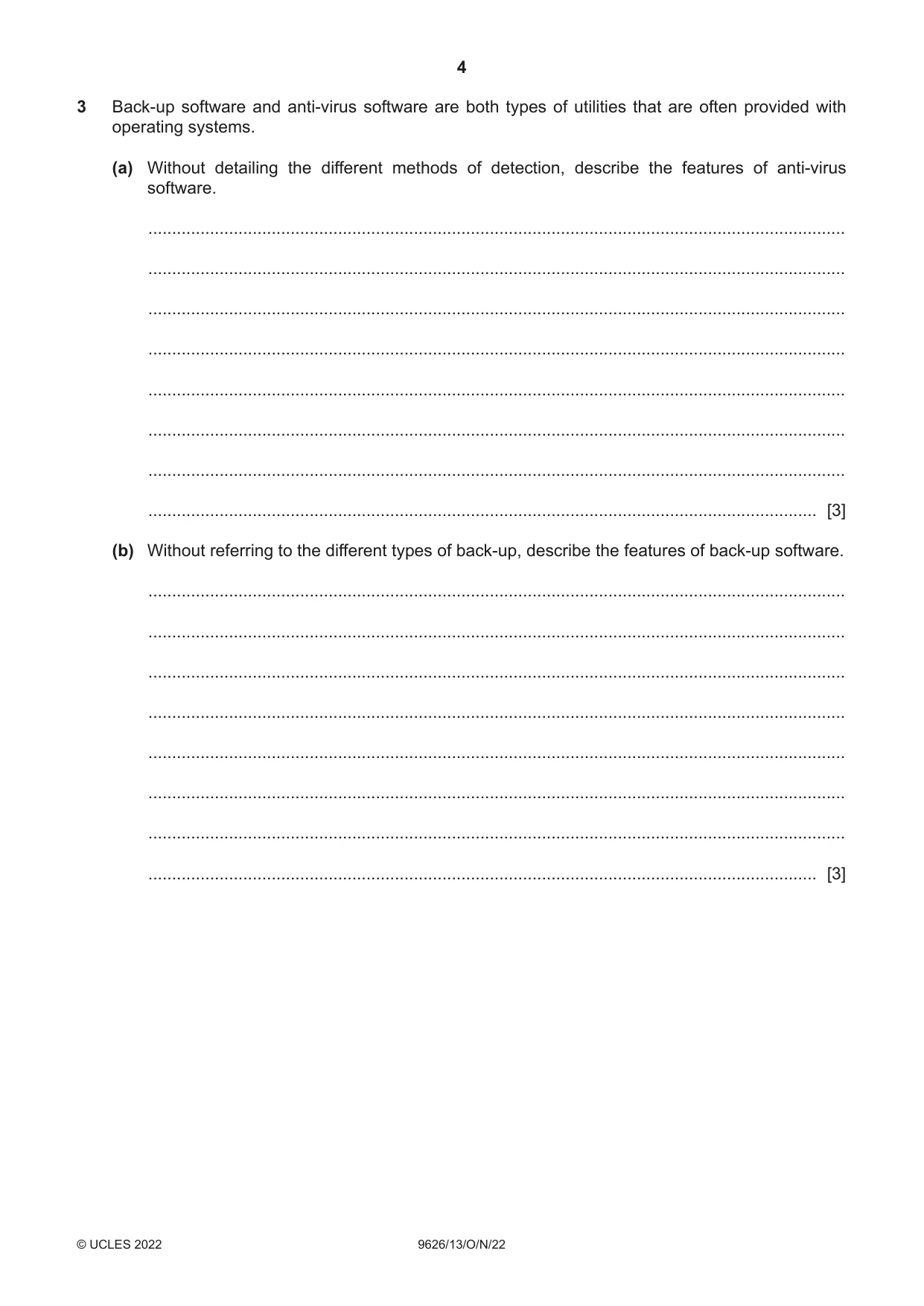
4 9626/13/O/N/22 © UCLES 2022 3 Back-up software and anti-virus software are both types of utilities that are often provided with operating systems. (a) Without detailing the different methods of detection, describe the features of anti-virus software. … … … … … … … … [3] (b) Without referring to the different types of back-up, describe the features of back-up software. … … … … … … … … [3]
Question paper, page 5
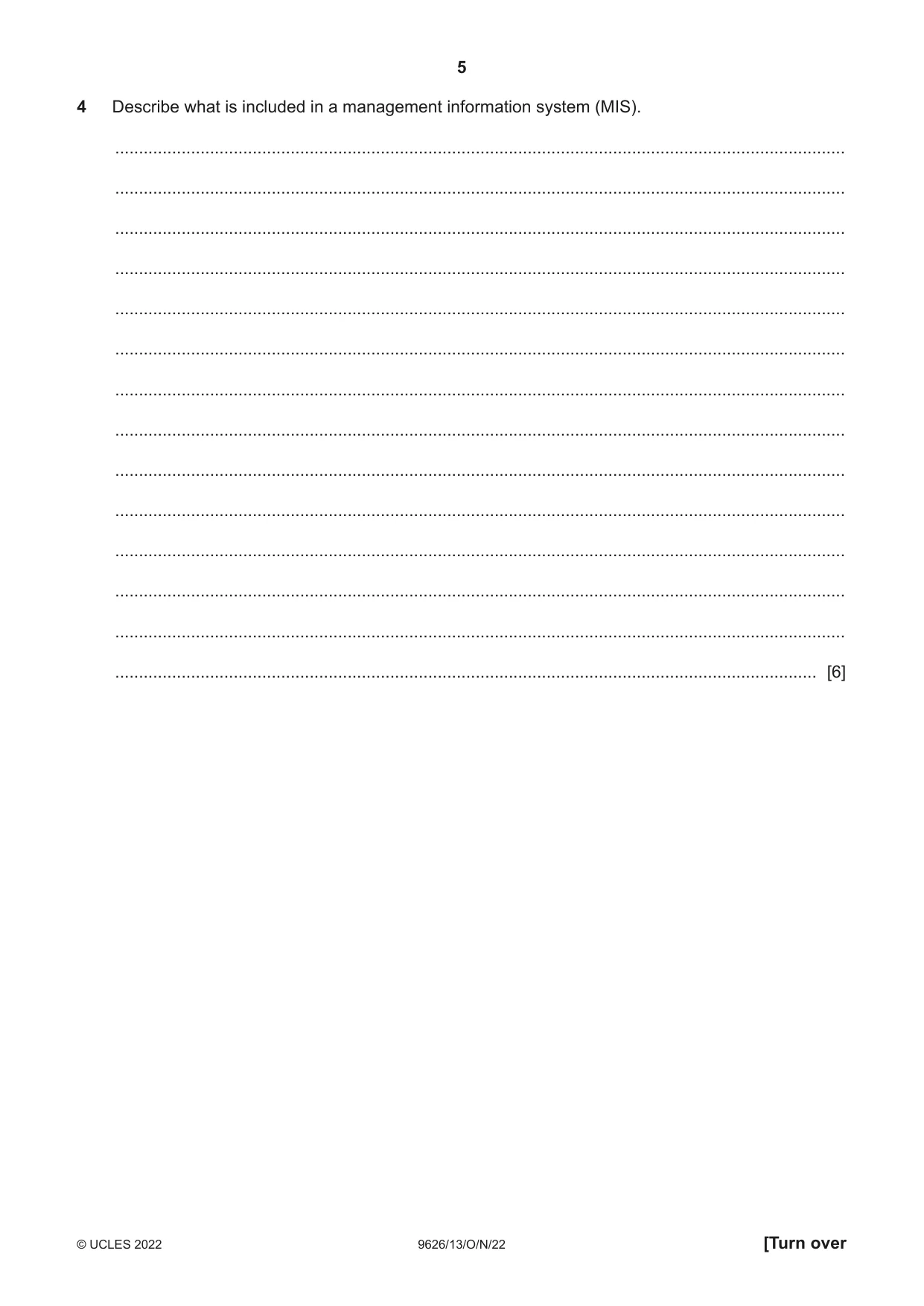
5 9626/13/O/N/22 © UCLES 2022 [Turn over 4 Describe what is included in a management information system (MIS). … … … … … … … … … … … … … … [6]
Question paper, page 6
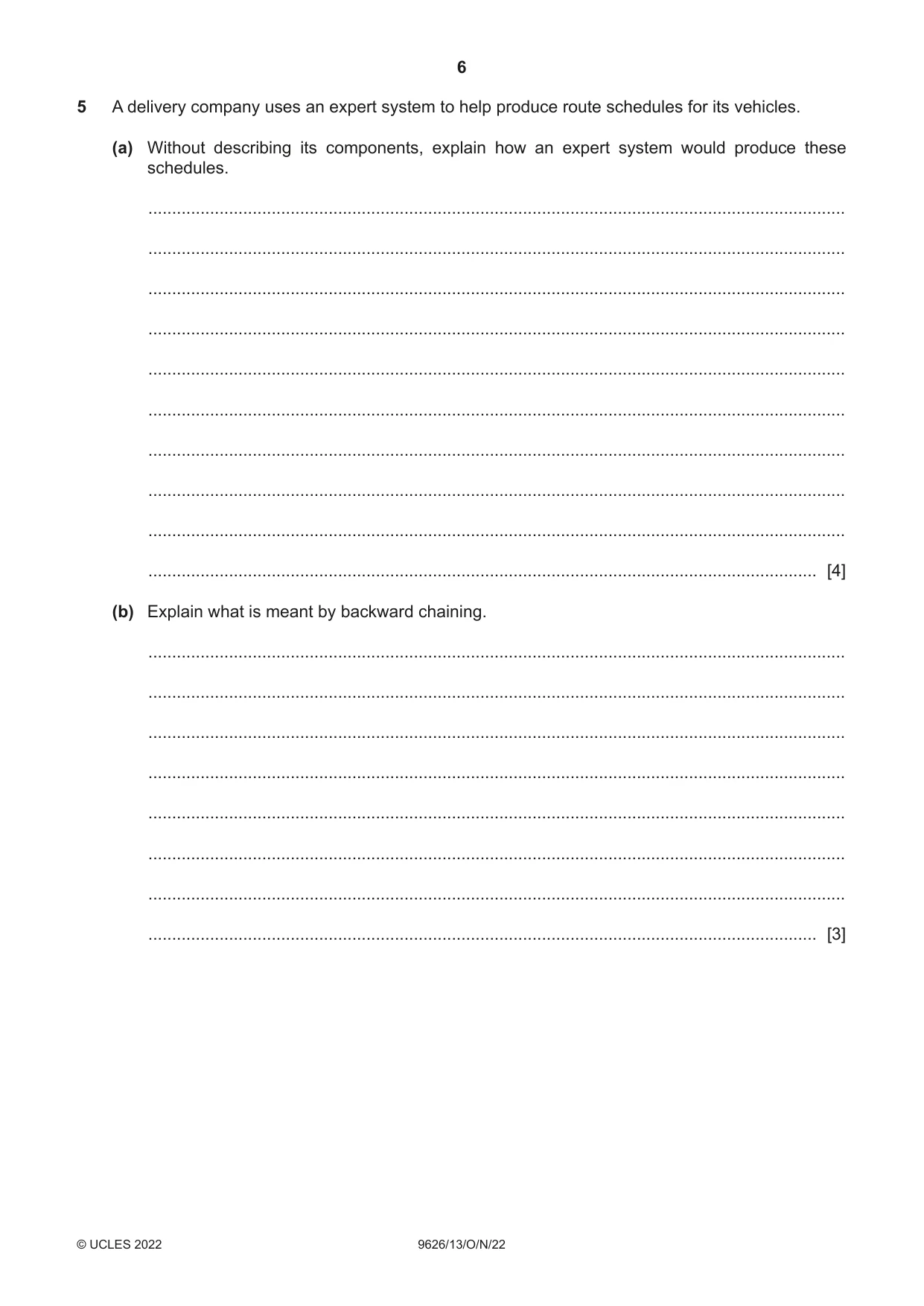
6 9626/13/O/N/22 © UCLES 2022 5 A delivery company uses an expert system to help produce route schedules for its vehicles. (a) Without describing its components, explain how an expert system would produce these schedules. … … … … … … … … … … [4] (b) Explain what is meant by backward chaining. … … … … … … … … [3]
Question paper, page 7
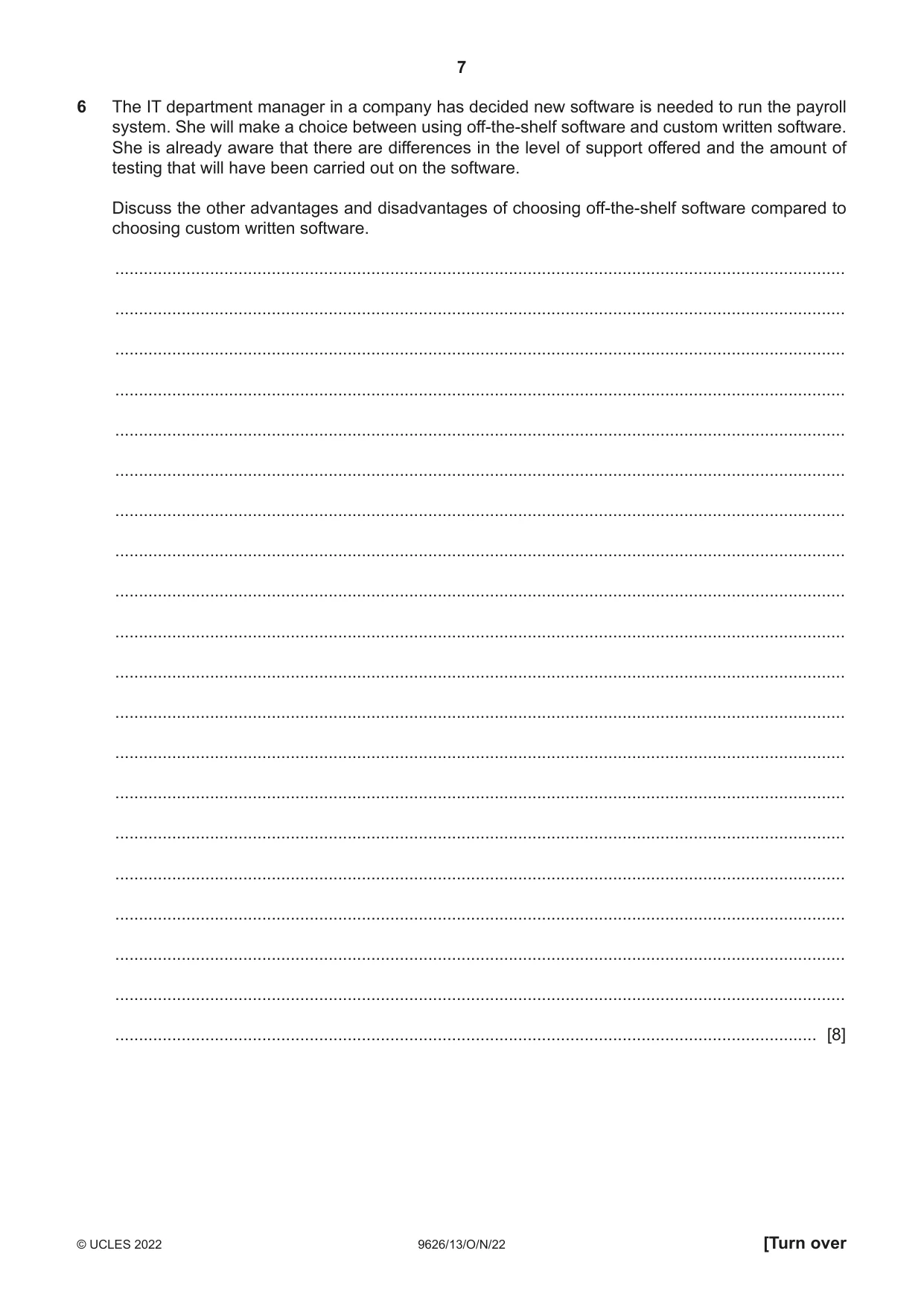
7 9626/13/O/N/22 © UCLES 2022 [Turn over 6 The IT department manager in a company has decided new software is needed to run the payroll system. She will make a choice between using off-the-shelf software and custom written software. She is already aware that there are differences in the level of support offered and the amount of testing that will have been carried out on the software. Discuss the other advantages and disadvantages of choosing off-the-shelf software compared to choosing custom written software. … … … … … … … … … … … … … … … … … … … … [8]
Question paper, page 8
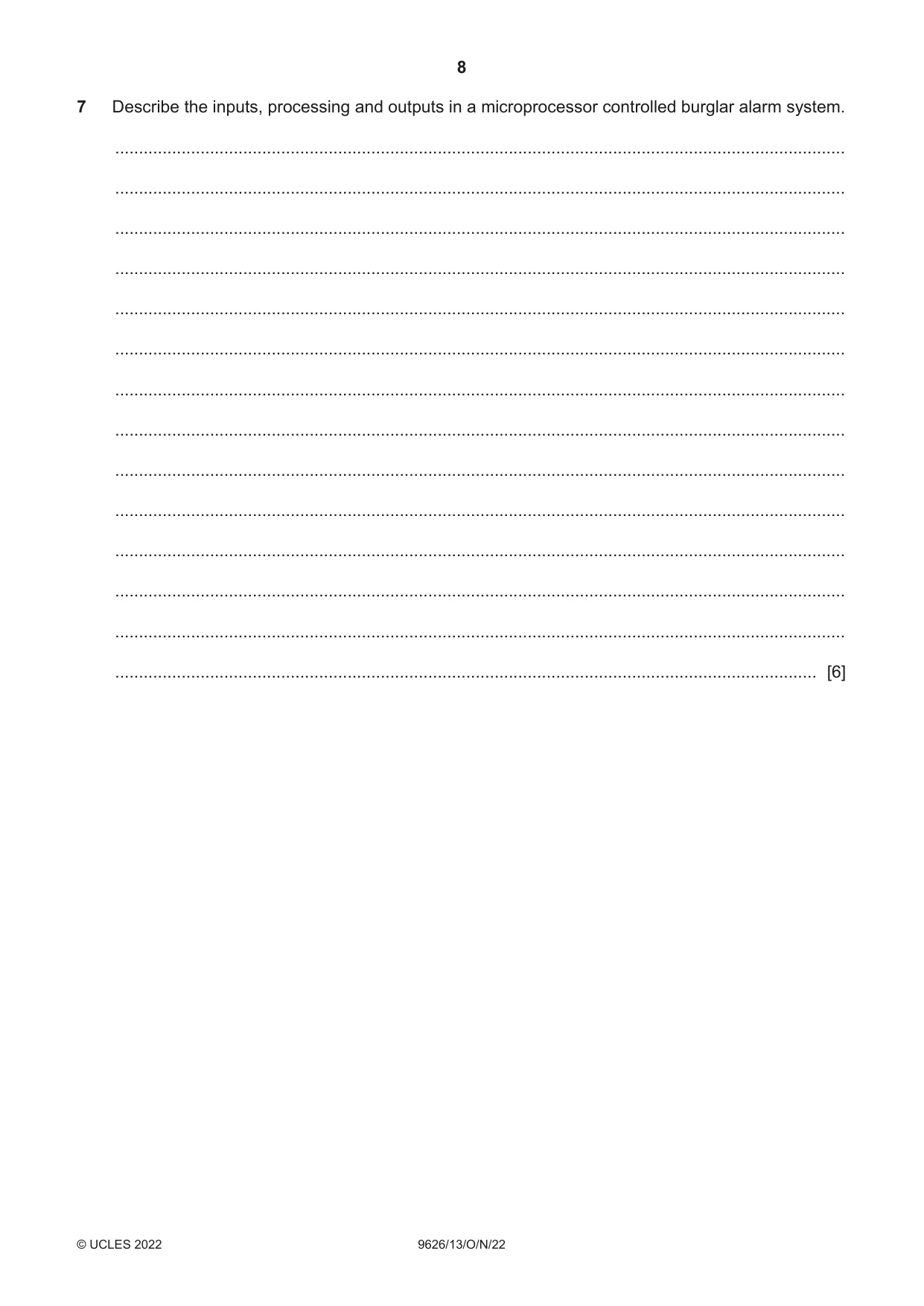
8 9626/13/O/N/22 © UCLES 2022 7 Describe the inputs, processing and outputs in a microprocessor controlled burglar alarm system. … … … … … … … … … … … … … … [6]
Question paper, page 9
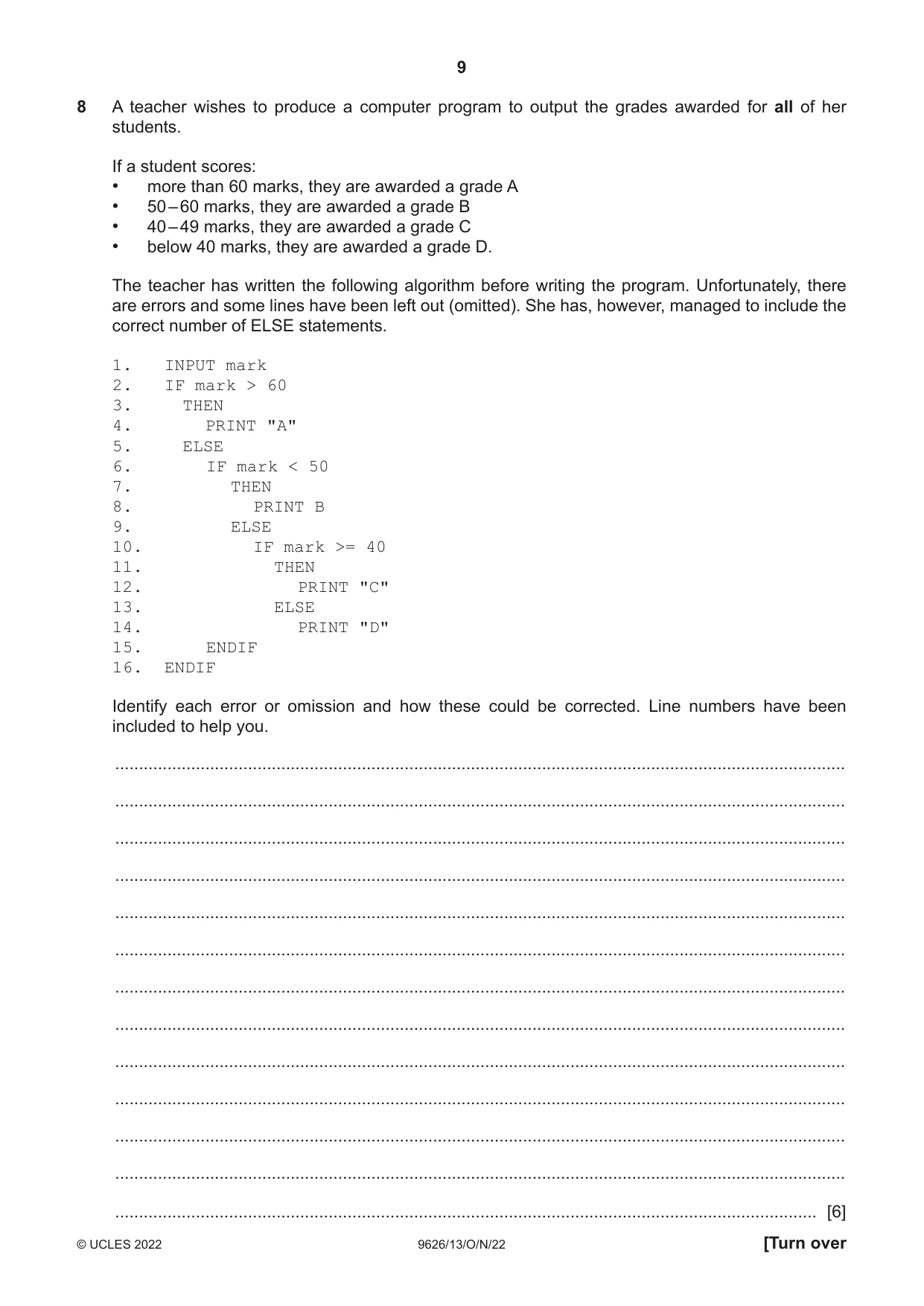
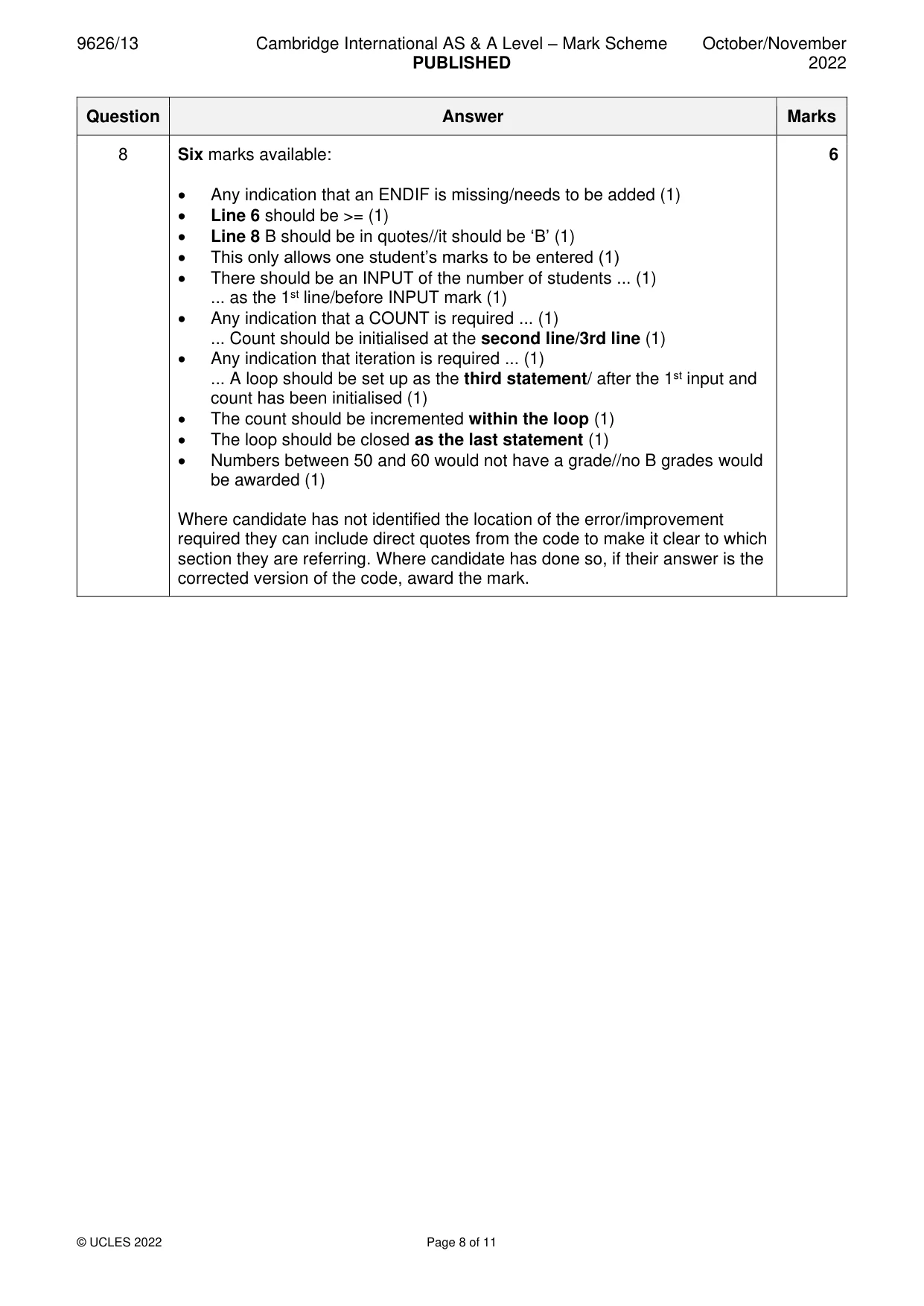
9 9626/13/O/N/22 © UCLES 2022 [Turn over 8 A teacher wishes to produce a computer program to output the grades awarded for all of her students. If a student scores: • more than 60 marks, they are awarded a grade A • 50 – 60 marks, they are awarded a grade B • 40 – 49 marks, they are awarded a grade C • below 40 marks, they are awarded a grade D. The teacher has written the following algorithm before writing the program. Unfortunately, there are errors and some lines have been left out (omitted). She has, however, managed to include the correct number of ELSE statements. 1. INPUT mark 2. IF mark > 60 3. THEN 4. PRINT "A" 5. ELSE 6. IF mark < 50 7. THEN 8. PRINT B 9. ELSE 10. IF mark >= 40 11. THEN 12. PRINT "C" 13. ELSE 14. PRINT "D" 15. ENDIF 16. ENDIF Identify each error or omission and how these could be corrected. Line numbers have been included to help you. … … … … … … … … … … … … … [6]
Question paper, page 10
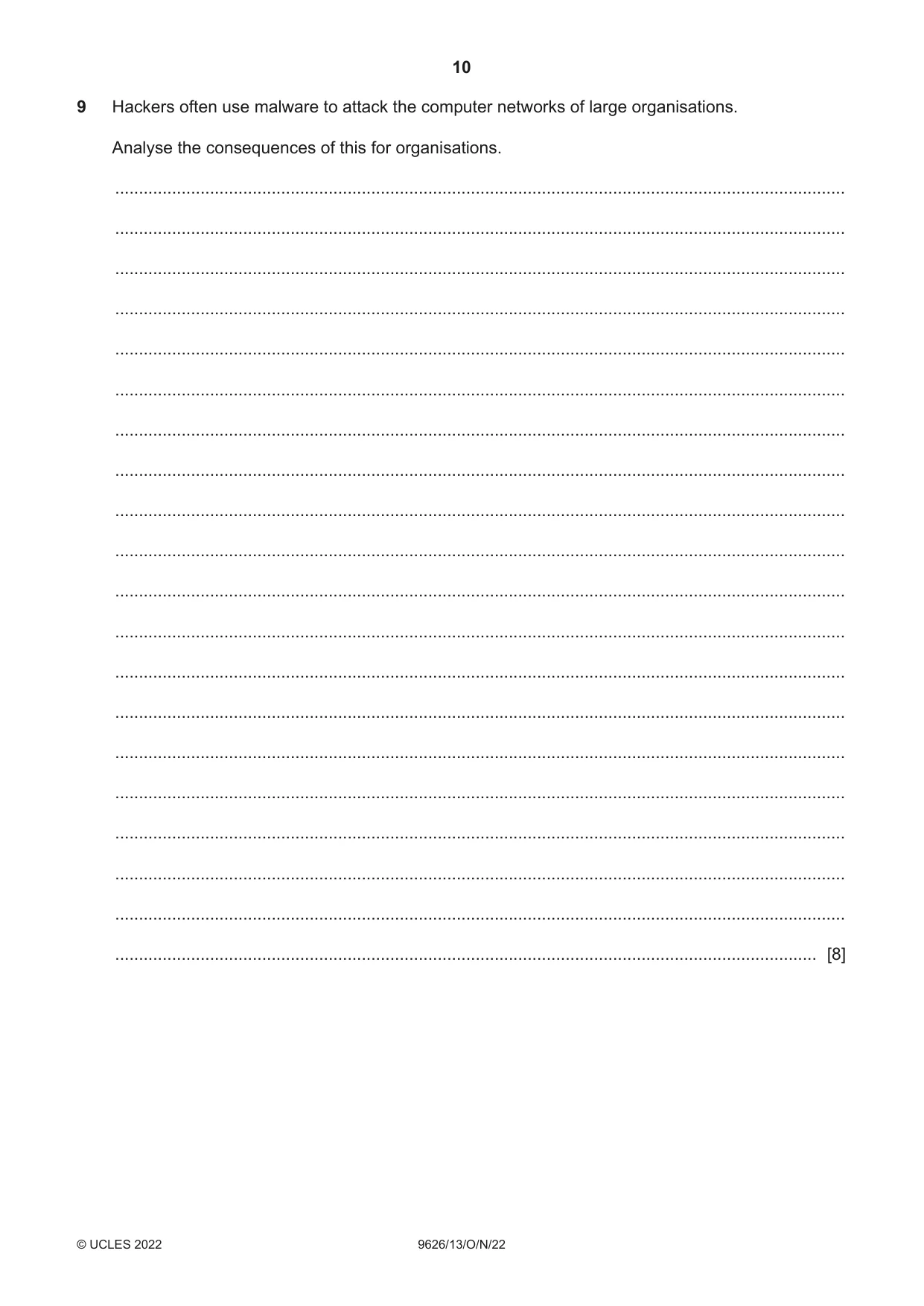
10 9626/13/O/N/22 © UCLES 2022 9 Hackers often use malware to attack the computer networks of large organisations. Analyse the consequences of this for organisations. … … … … … … … … … … … … … … … … … … … … [8]
Question paper, page 11
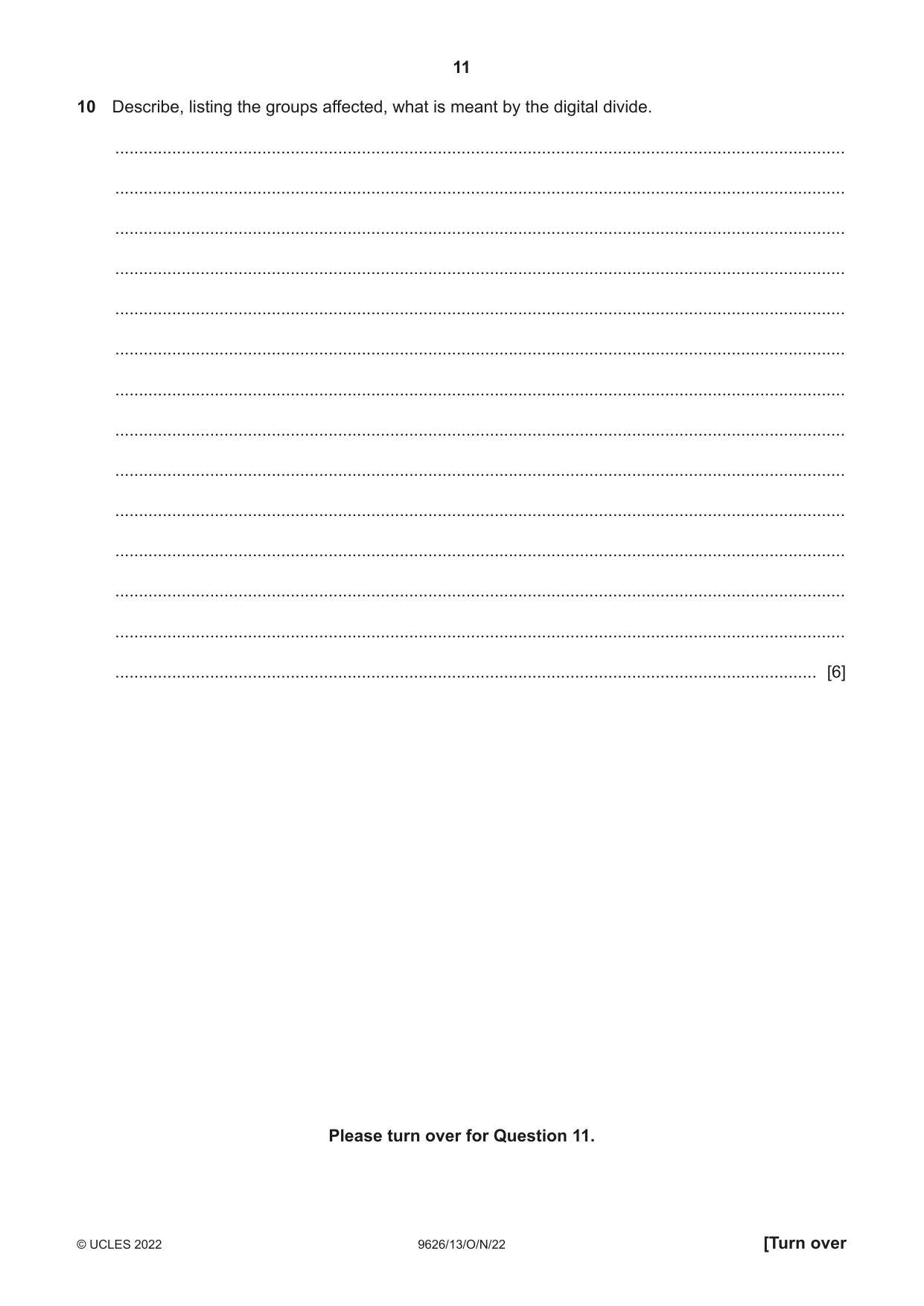
11 9626/13/O/N/22 © UCLES 2022 [Turn over 10 Describe, listing the groups affected, what is meant by the digital divide. … … … … … … … … … … … … … … [6] Please turn over for Question 11.
Question paper, page 12
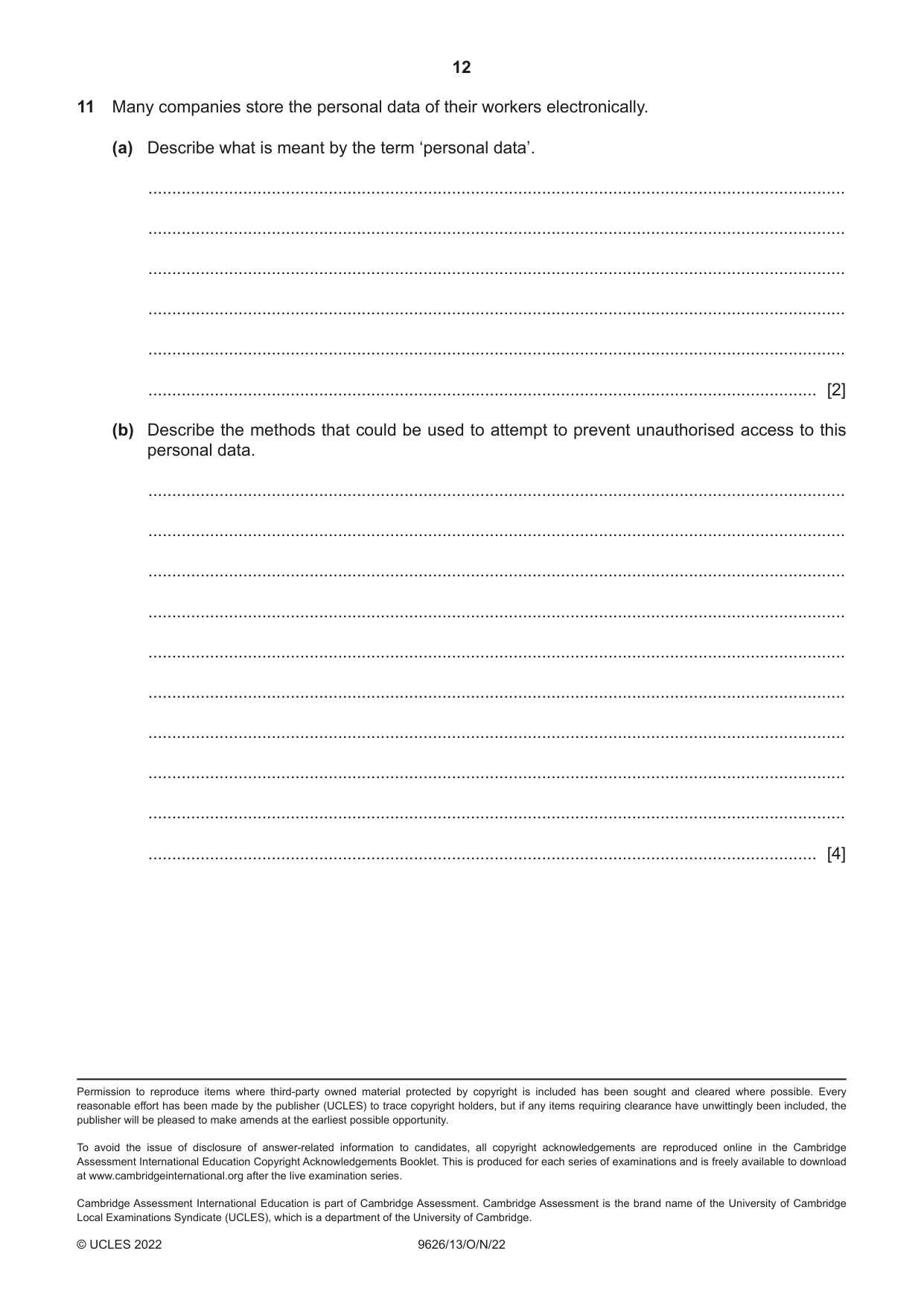
12 9626/13/O/N/22 © UCLES 2022 Permission to reproduce items where third-party owned material protected by copyright is included has been sought and cleared where possible. Every reasonable effort has been made by the publisher (UCLES) to trace copyright holders, but if any items requiring clearance have unwittingly been included, the publisher will be pleased to make amends at the earliest possible opportunity. To avoid the issue of disclosure of answer-related information to candidates, all copyright acknowledgements are reproduced online in the Cambridge Assessment International Education Copyright Acknowledgements Booklet. This is produced for each series of examinations and is freely available to download at www.cambridgeinternational.org after the live examination series. Cambridge Assessment International Education is part of Cambridge Assessment. Cambridge Assessment is the brand name of the University of Cambridge Local Examinations Syndicate (UCLES), which is a department of the University of Cambridge. 11 Many companies store the personal data of their workers electronically. (a) Describe what is meant by the term ‘personal data’. … … … … … … [2] (b) Describe the methods that could be used to attempt to prevent unauthorised access to this personal data. … … … … … … … … … … [4]
Mark scheme, page 1
This document consists of 11 printed pages. © UCLES 2022 [Turn over Cambridge International AS & A Level INFORMATION TECHNOLOGY 9626/13 Paper 1 Theory October/November 2022 MARK SCHEME Maximum Mark: 70 Published This mark scheme is published as an aid to teachers and candidates, to indicate the requirements of the examination. It shows the basis on which Examiners were instructed to award marks. It does not indicate the details of the discussions that took place at an Examiners’ meeting before marking began, which would have considered the acceptability of alternative answers. Mark schemes should be read in conjunction with the question paper and the Principal Examiner Report for Teachers. Cambridge International will not enter into discussions about these mark schemes. Cambridge International is publishing the mark schemes for the October/November 2022 series for most Cambridge IGCSE™, Cambridge International A and AS Level components and some Cambridge O Level components.
Mark scheme, page 2
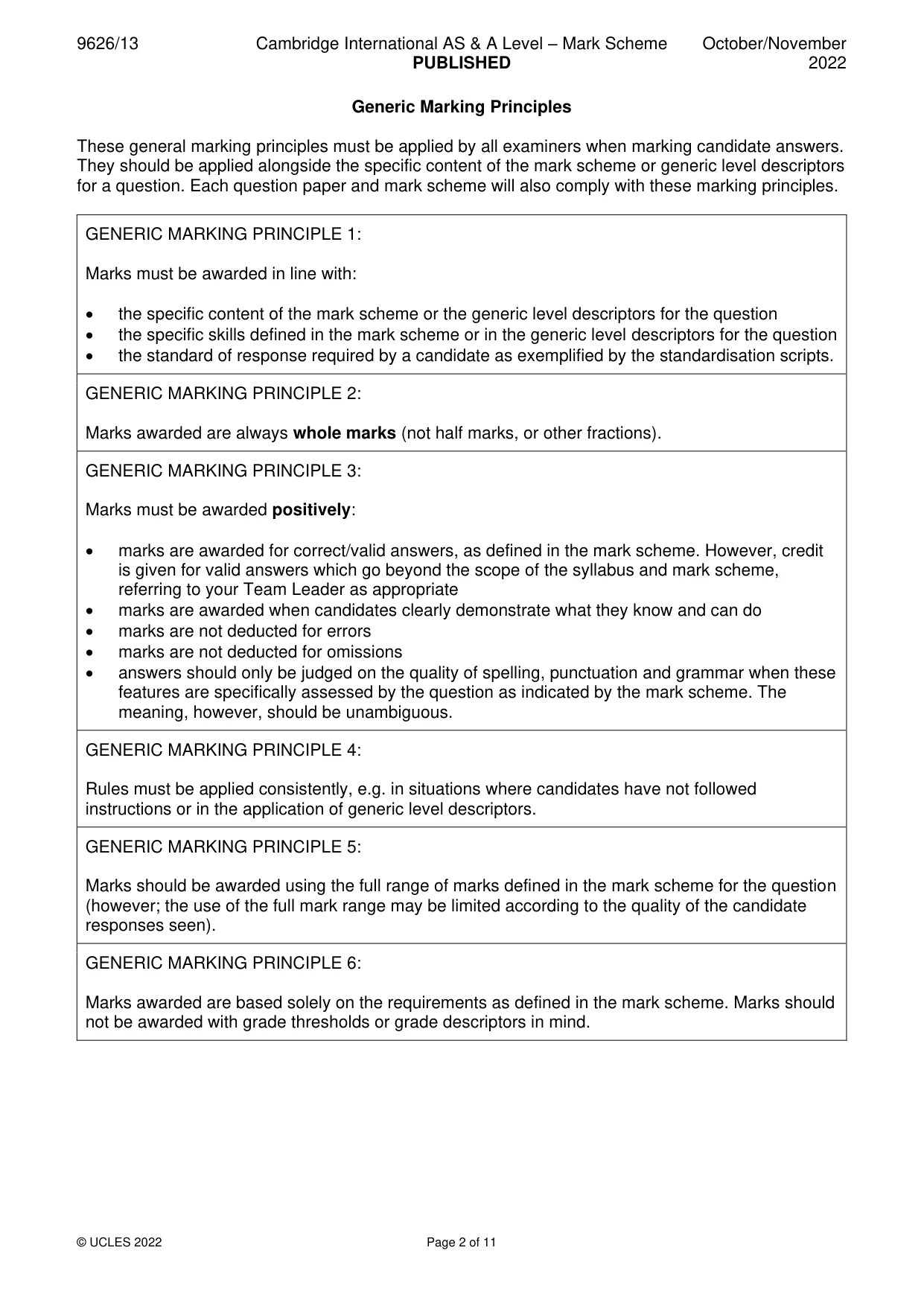
9626/13 Cambridge International AS & A Level – Mark Scheme PUBLISHED October/November 2022 © UCLES 2022 Page 2 of 11 Generic Marking Principles These general marking principles must be applied by all examiners when marking candidate answers. They should be applied alongside the specific content of the mark scheme or generic level descriptors for a question. Each question paper and mark scheme will also comply with these marking principles. GENERIC MARKING PRINCIPLE 1: Marks must be awarded in line with: • the specific content of the mark scheme or the generic level descriptors for the question • the specific skills defined in the mark scheme or in the generic level descriptors for the question • the standard of response required by a candidate as exemplified by the standardisation scripts. GENERIC MARKING PRINCIPLE 2: Marks awarded are always whole marks (not half marks, or other fractions). GENERIC MARKING PRINCIPLE 3: Marks must be awarded positively: • marks are awarded for correct/valid answers, as defined in the mark scheme. However, credit is given for valid answers which go beyond the scope of the syllabus and mark scheme, referring to your Team Leader as appropriate • marks are awarded when candidates clearly demonstrate what they know and can do • marks are not deducted for errors • marks are not deducted for omissions • answers should only be judged on the quality of spelling, punctuation and grammar when these features are specifically assessed by the question as indicated by the mark scheme. The meaning, however, should be unambiguous. GENERIC MARKING PRINCIPLE 4: Rules must be applied consistently, e.g. in situations where candidates have not followed instructions or in the application of generic level descriptors. GENERIC MARKING PRINCIPLE 5: Marks should be awarded using the full range of marks defined in the mark scheme for the question (however; the use of the full mark range may be limited according to the quality of the candidate responses seen). GENERIC MARKING PRINCIPLE 6: Marks awarded are based solely on the requirements as defined in the mark scheme. Marks should not be awarded with grade thresholds or grade descriptors in mind.
Mark scheme, page 3
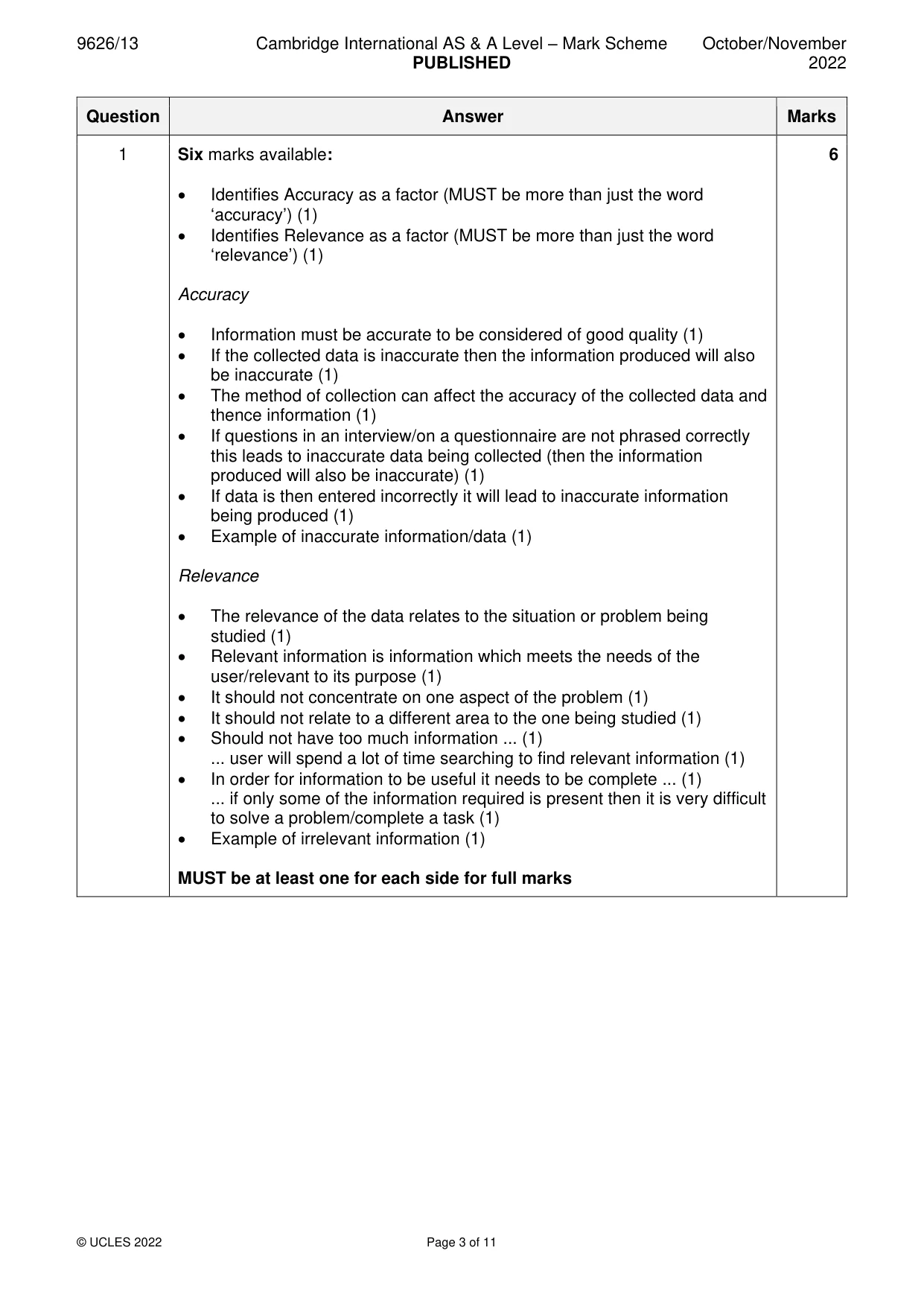
9626/13 Cambridge International AS & A Level – Mark Scheme PUBLISHED October/November 2022 © UCLES 2022 Page 3 of 11 Question Answer Marks 1 Six marks available: • Identifies Accuracy as a factor (MUST be more than just the word ‘accuracy’) (1) • Identifies Relevance as a factor (MUST be more than just the word ‘relevance’) (1) Accuracy • Information must be accurate to be considered of good quality (1) • If the collected data is inaccurate then the information produced will also be inaccurate (1) • The method of collection can affect the accuracy of the collected data and thence information (1) • If questions in an interview/on a questionnaire are not phrased correctly this leads to inaccurate data being collected (then the information produced will also be inaccurate) (1) • If data is then entered incorrectly it will lead to inaccurate information being produced (1) • Example of inaccurate information/data (1) Relevance • The relevance of the data relates to the situation or problem being studied (1) • Relevant information is information which meets the needs of the user/relevant to its purpose (1) • It should not concentrate on one aspect of the problem (1) • It should not relate to a different area to the one being studied (1) • Should not have too much information ... (1) ... user will spend a lot of time searching to find relevant information (1) • In order for information to be useful it needs to be complete ... (1) ... if only some of the information required is present then it is very difficult to solve a problem/complete a task (1) • Example of irrelevant information (1) MUST be at least one for each side for full marks 6
Mark scheme, page 4
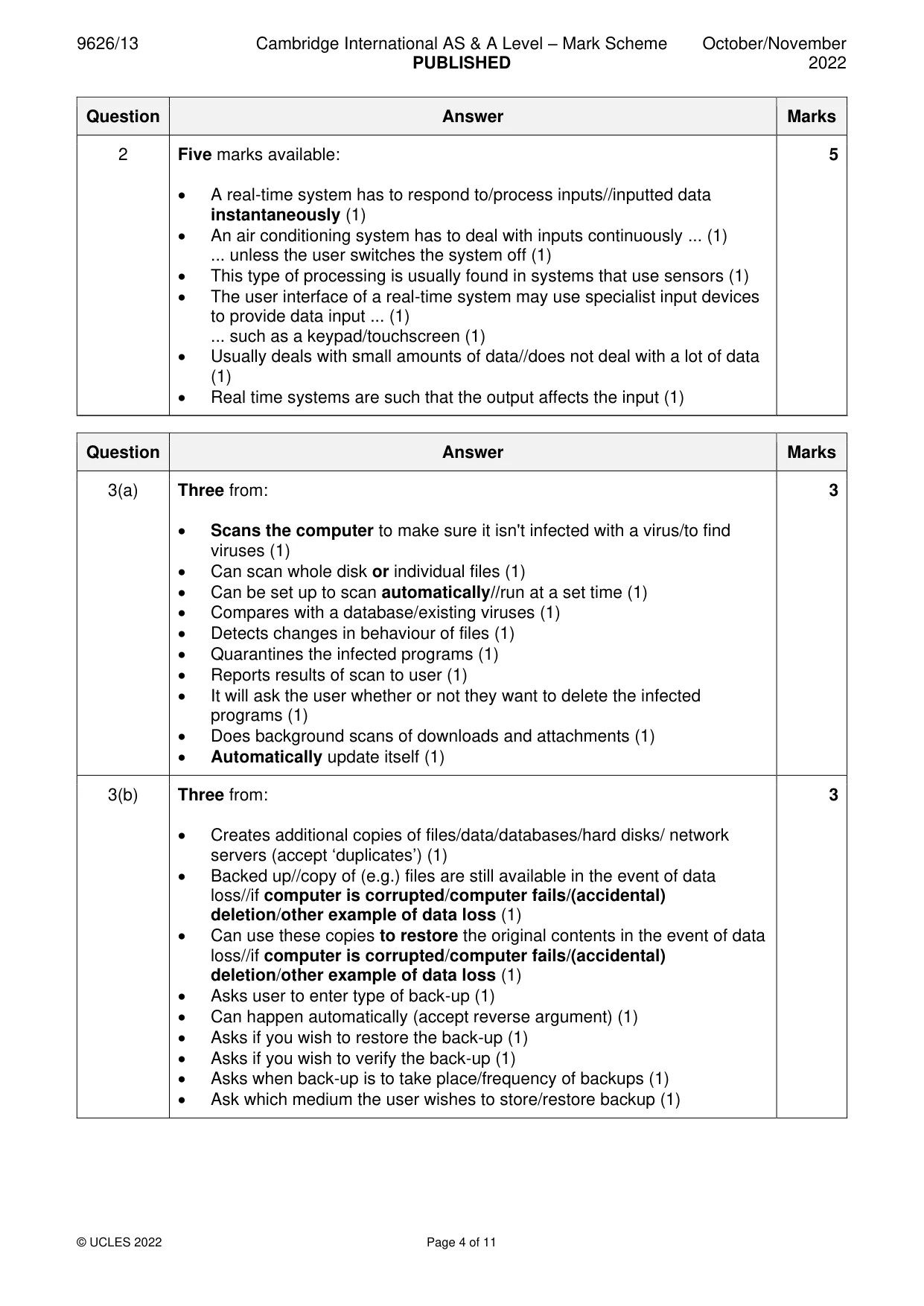
9626/13 Cambridge International AS & A Level – Mark Scheme PUBLISHED October/November 2022 © UCLES 2022 Page 4 of 11 Question Answer Marks 2 Five marks available: • A real-time system has to respond to/process inputs//inputted data instantaneously (1) • An air conditioning system has to deal with inputs continuously ... (1) ... unless the user switches the system off (1) • This type of processing is usually found in systems that use sensors (1) • The user interface of a real-time system may use specialist input devices to provide data input ... (1) ... such as a keypad/touchscreen (1) • Usually deals with small amounts of data//does not deal with a lot of data (1) • Real time systems are such that the output affects the input (1) 5 Question Answer Marks 3(a) Three from: • Scans the computer to make sure it isn't infected with a virus/to find viruses (1) • Can scan whole disk or individual files (1) • Can be set up to scan automatically//run at a set time (1) • Compares with a database/existing viruses (1) • Detects changes in behaviour of files (1) • Quarantines the infected programs (1) • Reports results of scan to user (1) • It will ask the user whether or not they want to delete the infected programs (1) • Does background scans of downloads and attachments (1) • Automatically update itself (1) 3 3(b) Three from: • Creates additional copies of files/data/databases/hard disks/ network servers (accept ‘duplicates’) (1) • Backed up//copy of (e.g.) files are still available in the event of data loss//if computer is corrupted/computer fails/(accidental) deletion/other example of data loss (1) • Can use these copies to restore the original contents in the event of data loss//if computer is corrupted/computer fails/(accidental) deletion/other example of data loss (1) • Asks user to enter type of back-up (1) • Can happen automatically (accept reverse argument) (1) • Asks if you wish to restore the back-up (1) • Asks if you wish to verify the back-up (1) • Asks when back-up is to take place/frequency of backups (1) • Ask which medium the user wishes to store/restore backup (1) 3
Mark scheme, page 5
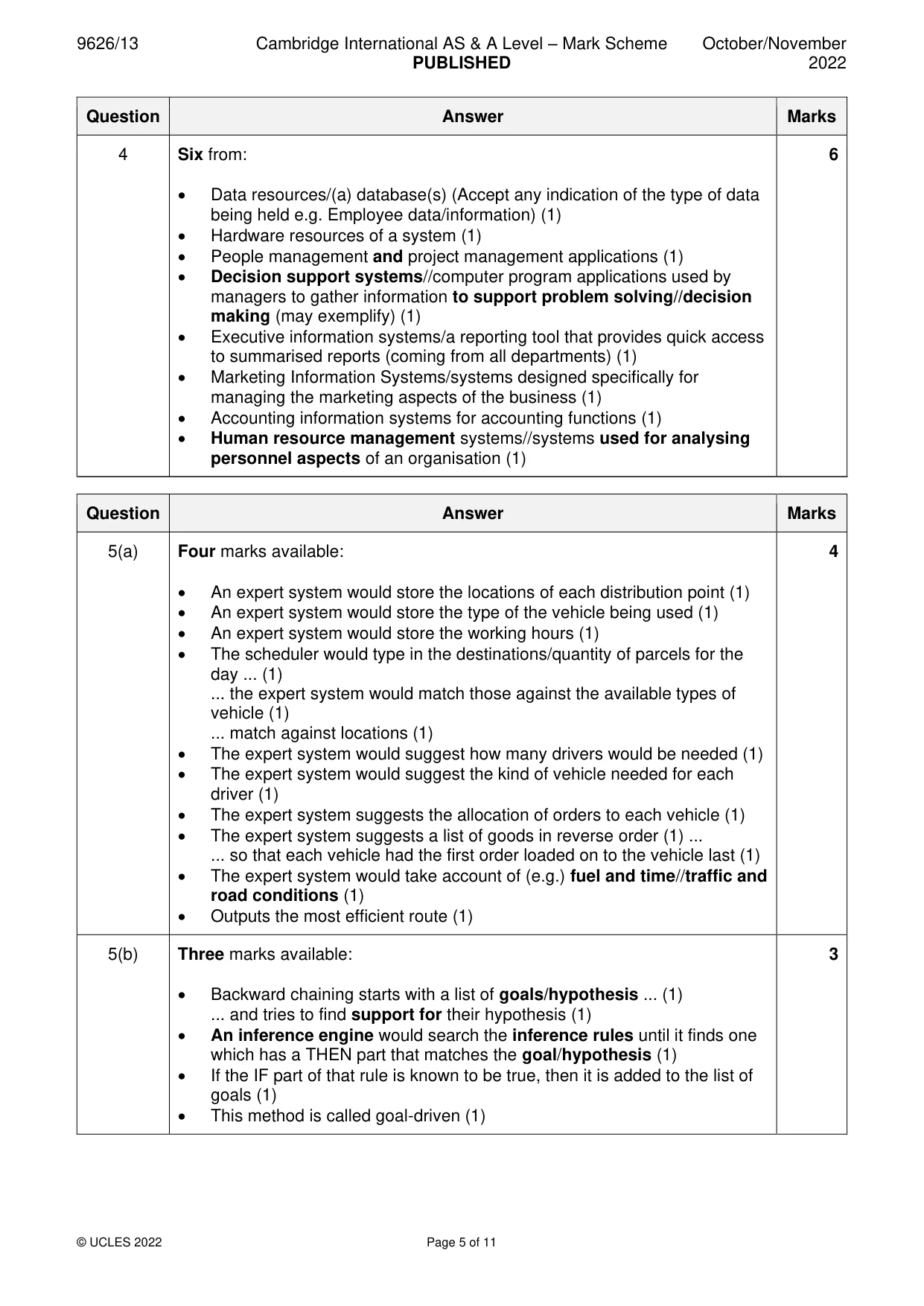
9626/13 Cambridge International AS & A Level – Mark Scheme PUBLISHED October/November 2022 © UCLES 2022 Page 5 of 11 Question Answer Marks 4 Six from: • Data resources/(a) database(s) (Accept any indication of the type of data being held e.g. Employee data/information) (1) • Hardware resources of a system (1) • People management and project management applications (1) • Decision support systems//computer program applications used by managers to gather information to support problem solving//decision making (may exemplify) (1) • Executive information systems/a reporting tool that provides quick access to summarised reports (coming from all departments) (1) • Marketing Information Systems/systems designed specifically for managing the marketing aspects of the business (1) • Accounting information systems for accounting functions (1) • Human resource management systems//systems used for analysing personnel aspects of an organisation (1) 6 Question Answer Marks 5(a) Four marks available: • An expert system would store the locations of each distribution point (1) • An expert system would store the type of the vehicle being used (1) • An expert system would store the working hours (1) • The scheduler would type in the destinations/quantity of parcels for the day ... (1) ... the expert system would match those against the available types of vehicle (1) ... match against locations (1) • The expert system would suggest how many drivers would be needed (1) • The expert system would suggest the kind of vehicle needed for each driver (1) • The expert system suggests the allocation of orders to each vehicle (1) • The expert system suggests a list of goods in reverse order (1) ... ... so that each vehicle had the first order loaded on to the vehicle last (1) • The expert system would take account of (e.g.) fuel and time//traffic and road conditions (1) • Outputs the most efficient route (1) 4 5(b) Three marks available: • Backward chaining starts with a list of goals/hypothesis ... (1) ... and tries to find support for their hypothesis (1) • An inference engine would search the inference rules until it finds one which has a THEN part that matches the goal/hypothesis (1) • If the IF part of that rule is known to be true, then it is added to the list of goals (1) • This method is called goal-driven (1) 3
Mark scheme, page 6
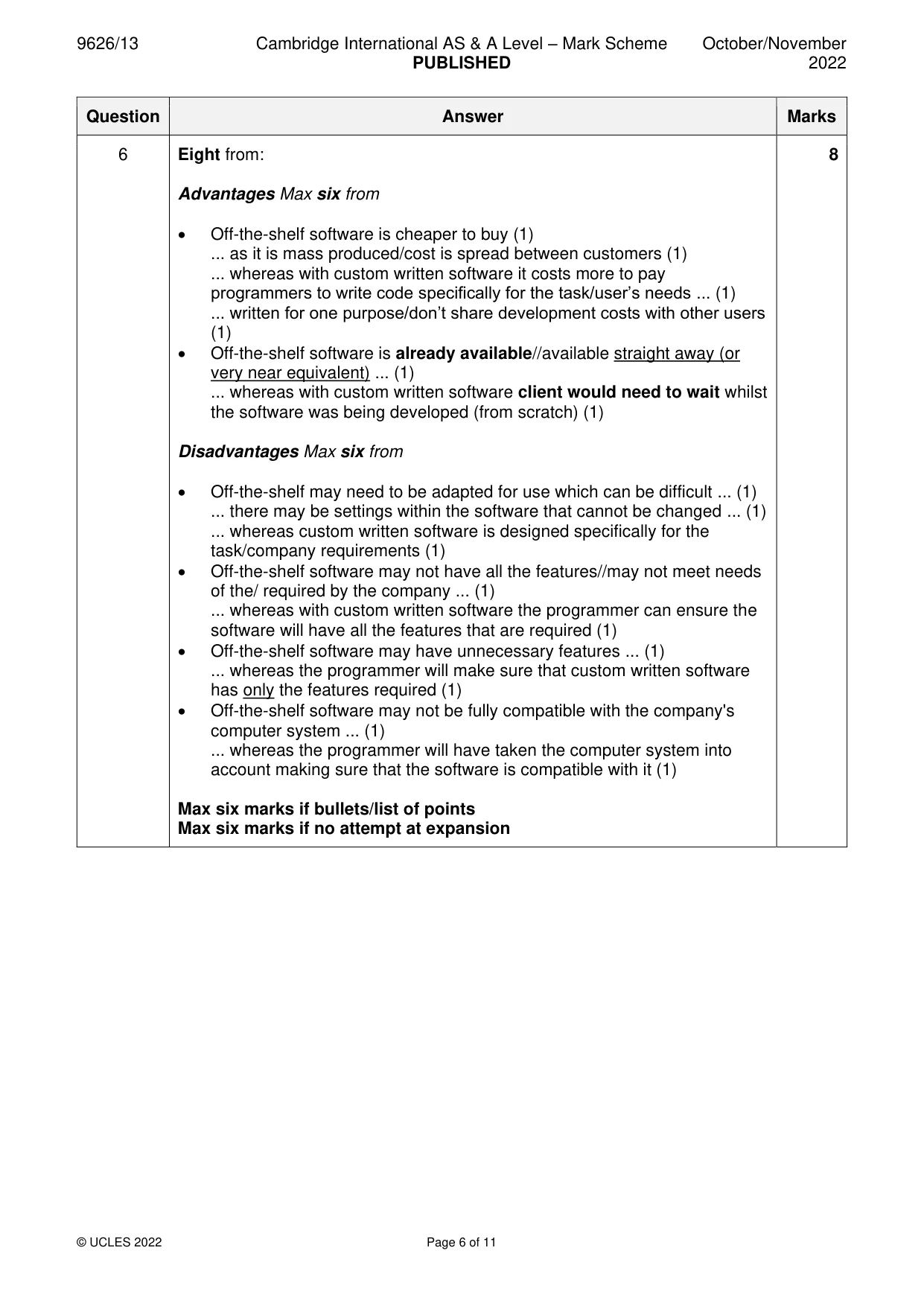
9626/13 Cambridge International AS & A Level – Mark Scheme PUBLISHED October/November 2022 © UCLES 2022 Page 6 of 11 Question Answer Marks 6 Eight from: Advantages Max six from • Off-the-shelf software is cheaper to buy (1) ... as it is mass produced/cost is spread between customers (1) ... whereas with custom written software it costs more to pay programmers to write code specifically for the task/user’s needs ... (1) ... written for one purpose/don’t share development costs with other users (1) • Off-the-shelf software is already available//available straight away (or very near equivalent) ... (1) ... whereas with custom written software client would need to wait whilst the software was being developed (from scratch) (1) Disadvantages Max six from • Off-the-shelf may need to be adapted for use which can be difficult ... (1) ... there may be settings within the software that cannot be changed ... (1) ... whereas custom written software is designed specifically for the task/company requirements (1) • Off-the-shelf software may not have all the features//may not meet needs of the/ required by the company ... (1) ... whereas with custom written software the programmer can ensure the software will have all the features that are required (1) • Off-the-shelf software may have unnecessary features ... (1) ... whereas the programmer will make sure that custom written software has only the features required (1) • Off-the-shelf software may not be fully compatible with the company's computer system ... (1) ... whereas the programmer will have taken the computer system into account making sure that the software is compatible with it (1) Max six marks if bullets/list of points Max six marks if no attempt at expansion 8
Mark scheme, page 7
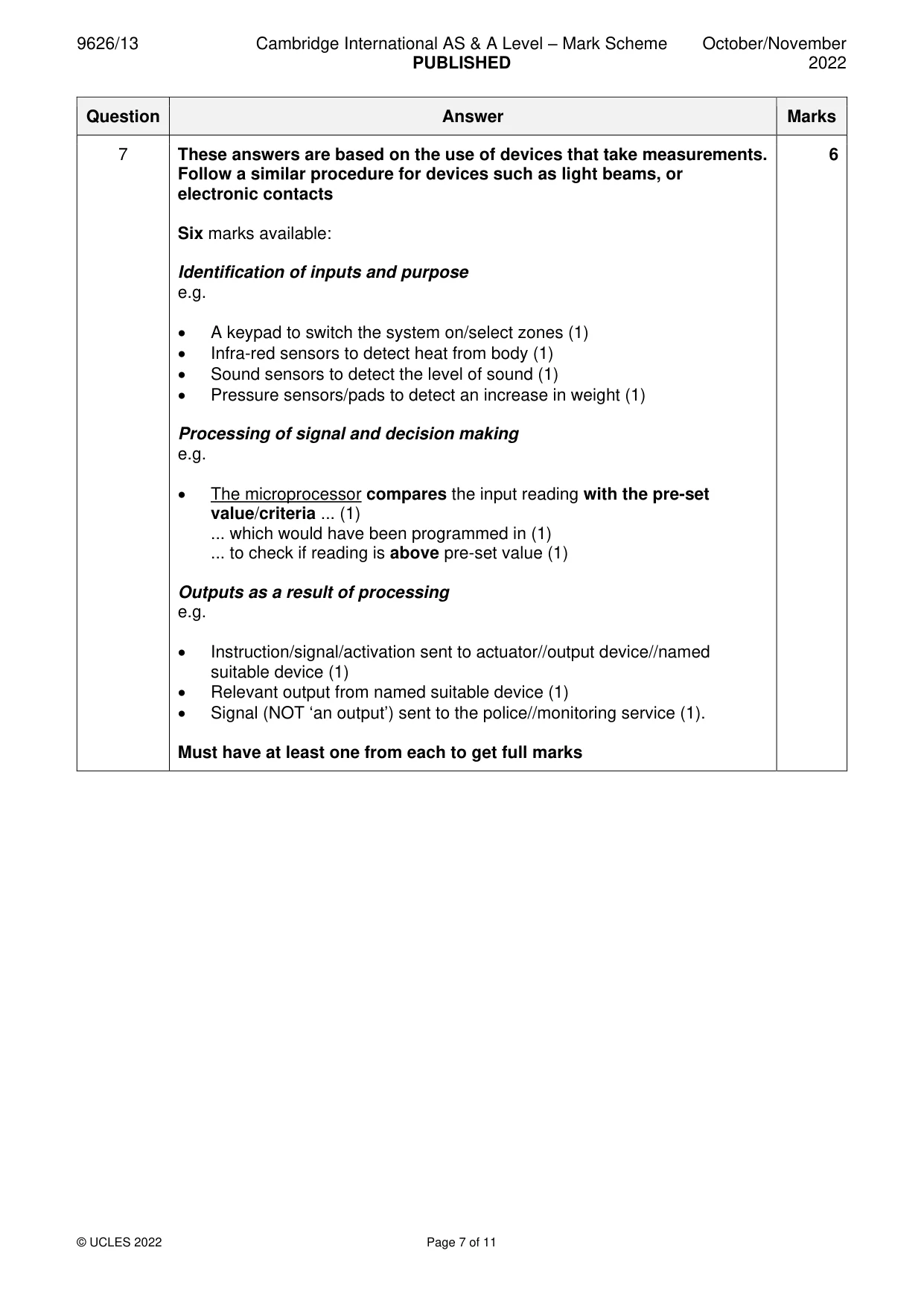
9626/13 Cambridge International AS & A Level – Mark Scheme PUBLISHED October/November 2022 © UCLES 2022 Page 7 of 11 Question Answer Marks 7 These answers are based on the use of devices that take measurements. Follow a similar procedure for devices such as light beams, or electronic contacts Six marks available: Identification of inputs and purpose e.g. • A keypad to switch the system on/select zones (1) • Infra-red sensors to detect heat from body (1) • Sound sensors to detect the level of sound (1) • Pressure sensors/pads to detect an increase in weight (1) Processing of signal and decision making e.g. • The microprocessor compares the input reading with the pre-set value/criteria ... (1) ... which would have been programmed in (1) ... to check if reading is above pre-set value (1) Outputs as a result of processing e.g. • Instruction/signal/activation sent to actuator//output device//named suitable device (1) • Relevant output from named suitable device (1) • Signal (NOT ‘an output’) sent to the police//monitoring service (1). Must have at least one from each to get full marks 6
Mark scheme, page 8
9626/13 Cambridge International AS & A Level – Mark Scheme PUBLISHED October/November 2022 © UCLES 2022 Page 8 of 11 Question Answer Marks 8 Six marks available: • Any indication that an ENDIF is missing/needs to be added (1) • Line 6 should be >= (1) • Line 8 B should be in quotes//it should be ‘B’ (1) • This only allows one student’s marks to be entered (1) • There should be an INPUT of the number of students ... (1) ... as the 1st line/before INPUT mark (1) • Any indication that a COUNT is required ... (1) ... Count should be initialised at the second line/3rd line (1) • Any indication that iteration is required ... (1) ... A loop should be set up as the third statement/ after the 1st input and count has been initialised (1) • The count should be incremented within the loop (1) • The loop should be closed as the last statement (1) • Numbers between 50 and 60 would not have a grade//no B grades would be awarded (1) Where candidate has not identified the location of the error/improvement required they can include direct quotes from the code to make it clear to which section they are referring. Where candidate has done so, if their answer is the corrected version of the code, award the mark. 6
Mark scheme, page 9
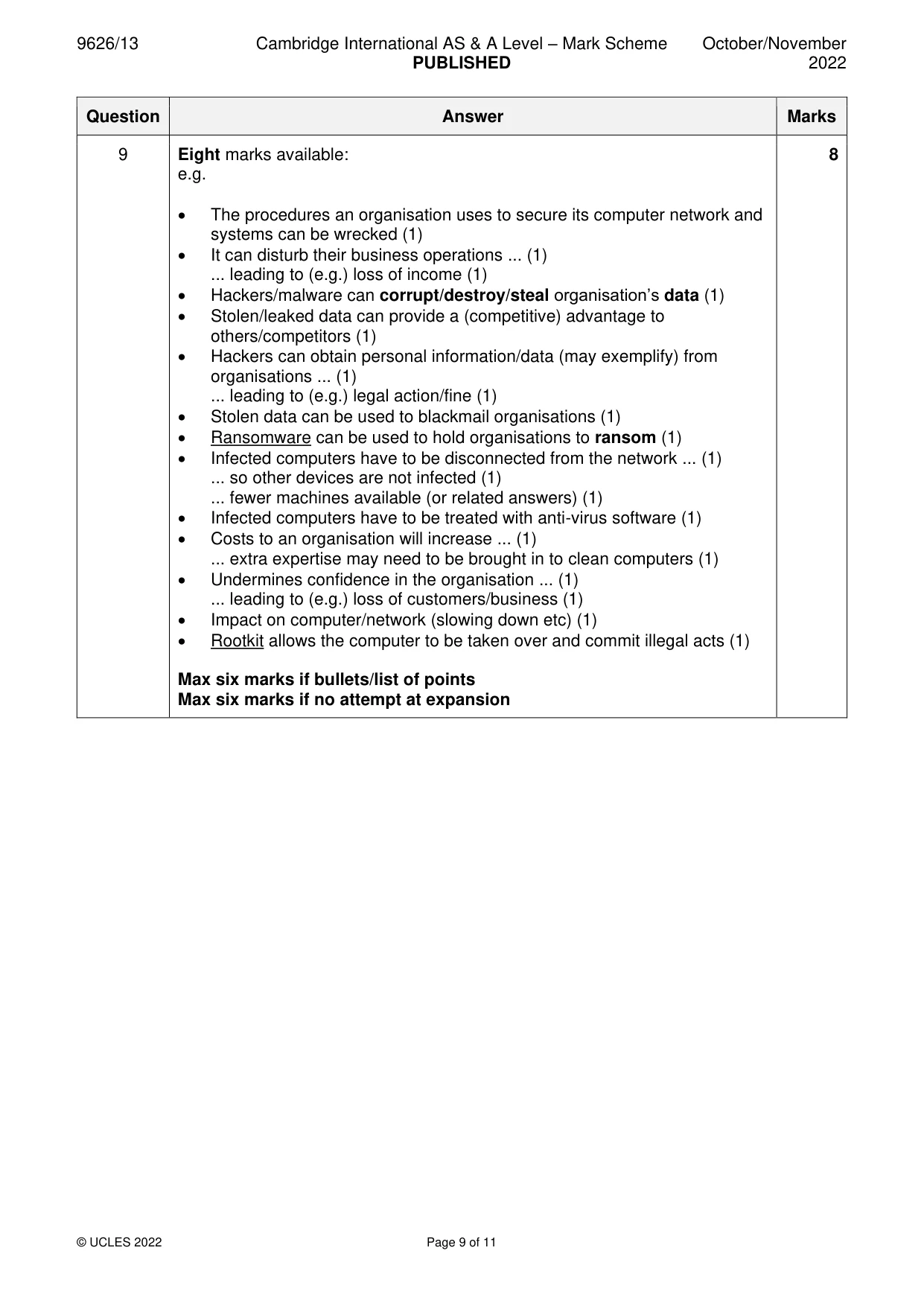
9626/13 Cambridge International AS & A Level – Mark Scheme PUBLISHED October/November 2022 © UCLES 2022 Page 9 of 11 Question Answer Marks 9 Eight marks available: e.g. • The procedures an organisation uses to secure its computer network and systems can be wrecked (1) • It can disturb their business operations ... (1) ... leading to (e.g.) loss of income (1) • Hackers/malware can corrupt/destroy/steal organisation’s data (1) • Stolen/leaked data can provide a (competitive) advantage to others/competitors (1) • Hackers can obtain personal information/data (may exemplify) from organisations ... (1) ... leading to (e.g.) legal action/fine (1) • Stolen data can be used to blackmail organisations (1) • Ransomware can be used to hold organisations to ransom (1) • Infected computers have to be disconnected from the network ... (1) ... so other devices are not infected (1) ... fewer machines available (or related answers) (1) • Infected computers have to be treated with anti-virus software (1) • Costs to an organisation will increase ... (1) ... extra expertise may need to be brought in to clean computers (1) • Undermines confidence in the organisation ... (1) ... leading to (e.g.) loss of customers/business (1) • Impact on computer/network (slowing down etc) (1) • Rootkit allows the computer to be taken over and commit illegal acts (1) Max six marks if bullets/list of points Max six marks if no attempt at expansion 8
Mark scheme, page 10
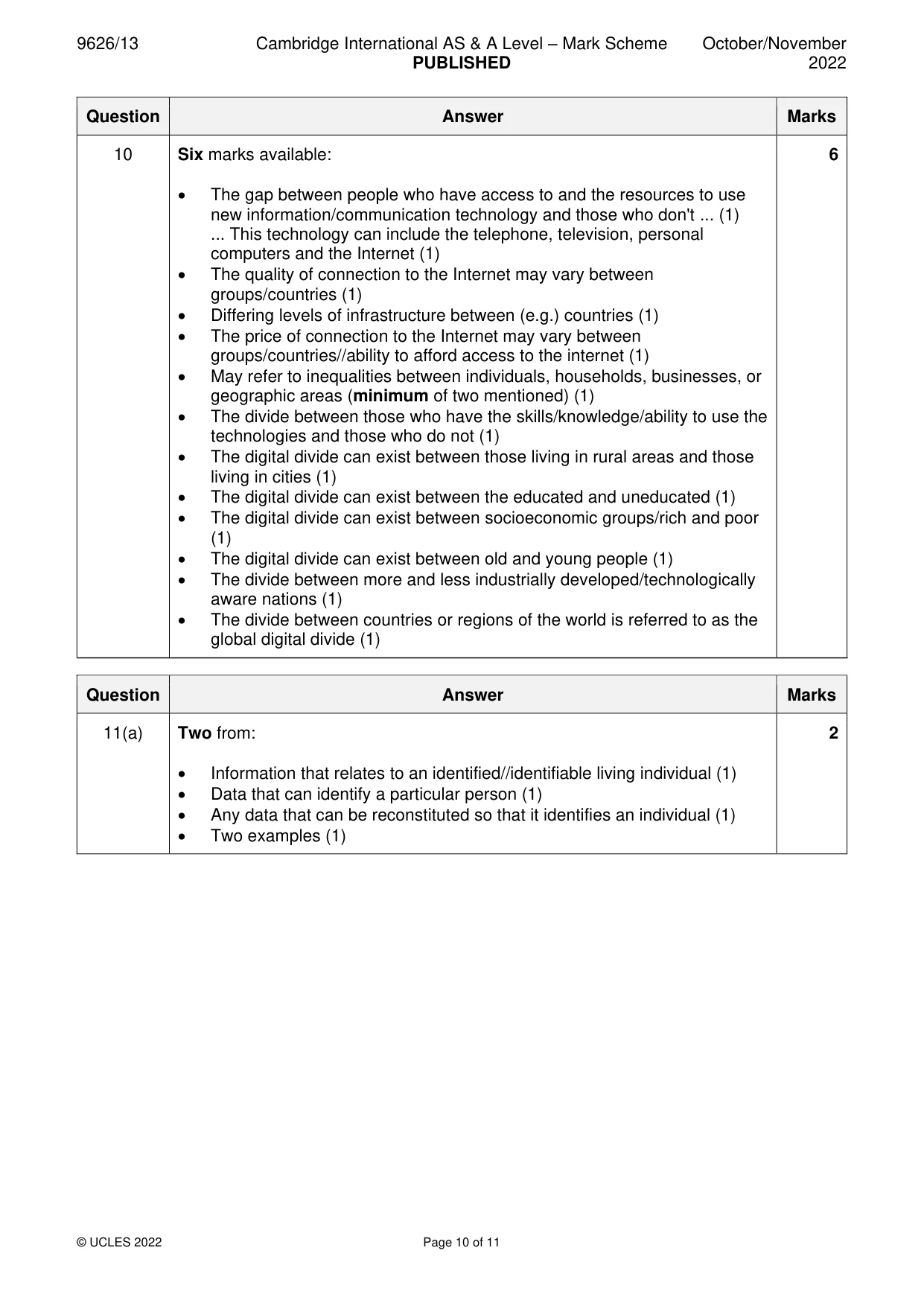
9626/13 Cambridge International AS & A Level – Mark Scheme PUBLISHED October/November 2022 © UCLES 2022 Page 10 of 11 Question Answer Marks 10 Six marks available: • The gap between people who have access to and the resources to use new information/communication technology and those who don't ... (1) ... This technology can include the telephone, television, personal computers and the Internet (1) • The quality of connection to the Internet may vary between groups/countries (1) • Differing levels of infrastructure between (e.g.) countries (1) • The price of connection to the Internet may vary between groups/countries//ability to afford access to the internet (1) • May refer to inequalities between individuals, households, businesses, or geographic areas (minimum of two mentioned) (1) • The divide between those who have the skills/knowledge/ability to use the technologies and those who do not (1) • The digital divide can exist between those living in rural areas and those living in cities (1) • The digital divide can exist between the educated and uneducated (1) • The digital divide can exist between socioeconomic groups/rich and poor (1) • The digital divide can exist between old and young people (1) • The divide between more and less industrially developed/technologically aware nations (1) • The divide between countries or regions of the world is referred to as the global digital divide (1) 6 Question Answer Marks 11(a) Two from: • Information that relates to an identified//identifiable living individual (1) • Data that can identify a particular person (1) • Any data that can be reconstituted so that it identifies an individual (1) • Two examples (1) 2
Mark scheme, page 11
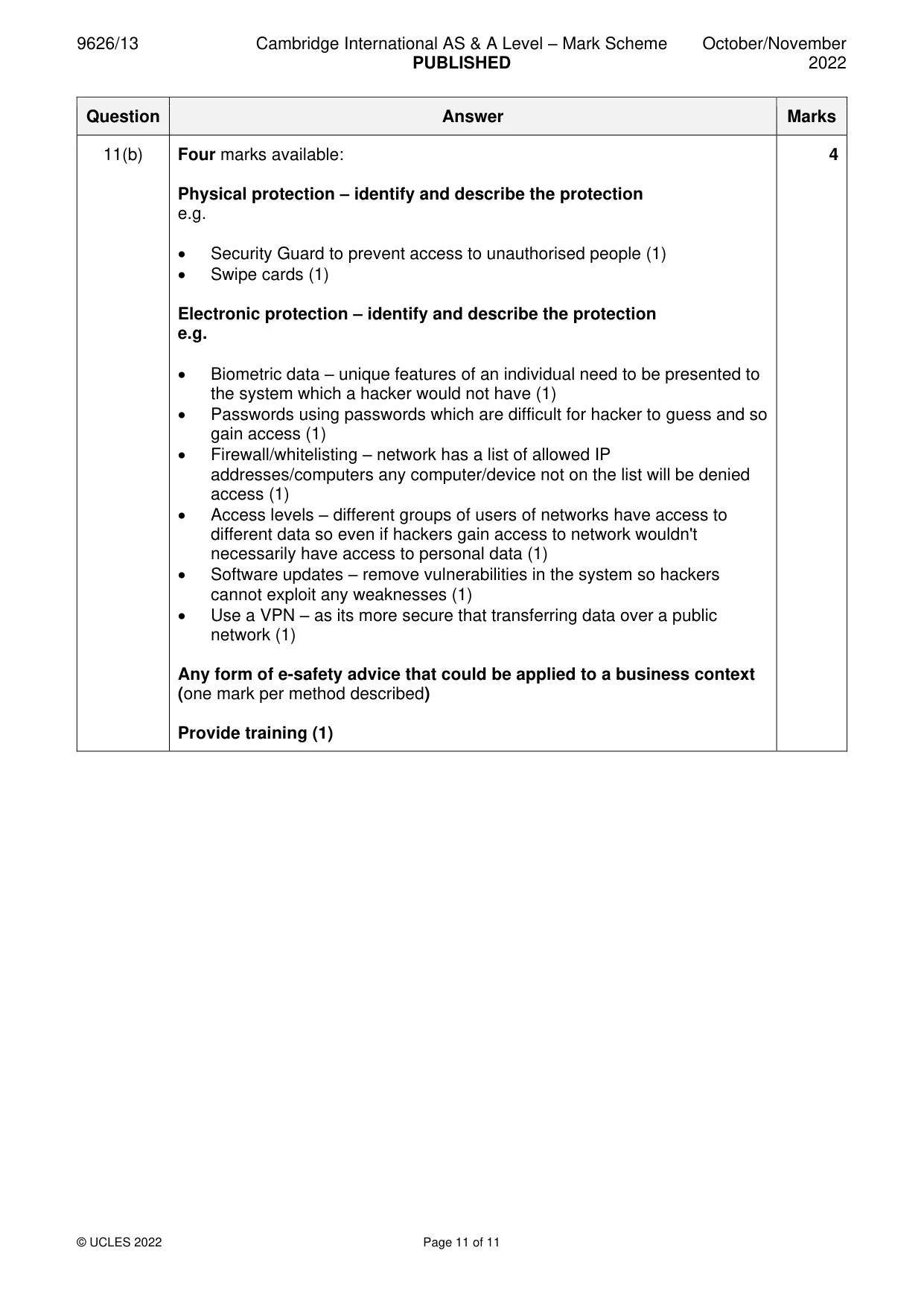
9626/13 Cambridge International AS & A Level – Mark Scheme PUBLISHED October/November 2022 © UCLES 2022 Page 11 of 11 Question Answer Marks 11(b) Four marks available: Physical protection – identify and describe the protection e.g. • Security Guard to prevent access to unauthorised people (1) • Swipe cards (1) Electronic protection – identify and describe the protection e.g. • Biometric data – unique features of an individual need to be presented to the system which a hacker would not have (1) • Passwords using passwords which are difficult for hacker to guess and so gain access (1) • Firewall/whitelisting – network has a list of allowed IP addresses/computers any computer/device not on the list will be denied access (1) • Access levels – different groups of users of networks have access to different data so even if hackers gain access to network wouldn't necessarily have access to personal data (1) • Software updates – remove vulnerabilities in the system so hackers cannot exploit any weaknesses (1) • Use a VPN – as its more secure that transferring data over a public network (1) Any form of e-safety advice that could be applied to a business context (one mark per method described) Provide training (1) 4
What you needed in this session
Cambridge’s own grade thresholds for 2022 Oct/Nov, Paper 1 · Variant 3. A higher threshold means an easier paper — the bar moves with how the cohort did.