Cambridge A Level Information Technology (from 2017) 9626 — 2022 Oct/Nov Paper 1 · Variant 2
9626/12/O/N/22 · 70 marks · ≈79 min
The question paper and its mark scheme, free to read here and free to download. This is Cambridge’s own paper, exactly as it was sat.
Question paper12 pages

Mark scheme10 pages
Answers below. Sit the paper first if you are practising.
Paper as text
Question paper, page 1
This document has 12 pages. Any blank pages are indicated. [Turn over Cambridge International AS & A Level INFORMATION TECHNOLOGY 9626/12 Paper 1 Theory October/November 2022 1 hour 45 minutes You must answer on the question paper. No additional materials are needed. INSTRUCTIONS ● Answer all questions. ● Use a black or dark blue pen. ● Write your name, centre number and candidate number in the boxes at the top of the page. ● Write your answer to each question in the space provided. ● Do not use an erasable pen or correction fluid. ● Do not write on any bar codes. ● You may use an HB pencil for any diagrams, graphs or rough working. ● Calculators must not be used in this paper. INFORMATION ● The total mark for this paper is 70. ● The number of marks for each question or part question is shown in brackets [ ]. * 7 2 3 4 4 7 4 6 0 5 * DC (CJ/CGW) 303212/3 © UCLES 2022
Question paper, page 2
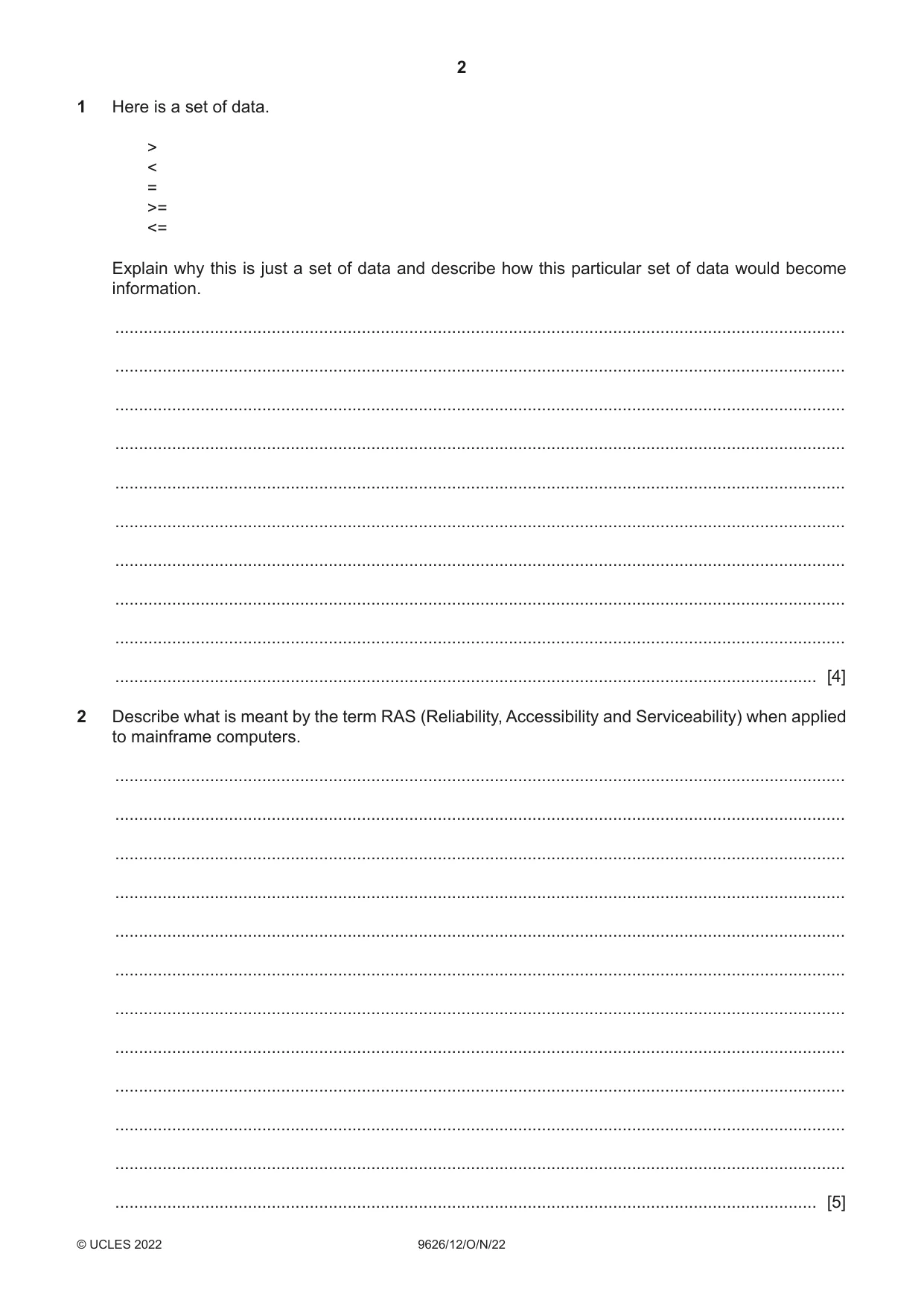
2 9626/12/O/N/22 © UCLES 2022 1 Here is a set of data. > < = >= <= Explain why this is just a set of data and describe how this particular set of data would become information. … … … … … … … … … … [4] 2 Describe what is meant by the term RAS (Reliability, Accessibility and Serviceability) when applied to mainframe computers. … … … … … … … … … … … … [5]
Question paper, page 3
3 9626/12/O/N/22 © UCLES 2022 [Turn over 3 Phishing, smishing and vishing are methods of fraudulently obtaining personal data. (a) Describe two differences between phishing and vishing. … … … … … … … … … … [4] (b) Describe how smishing is used to obtain personal data. … … … … … … … … [3]
Question paper, page 4
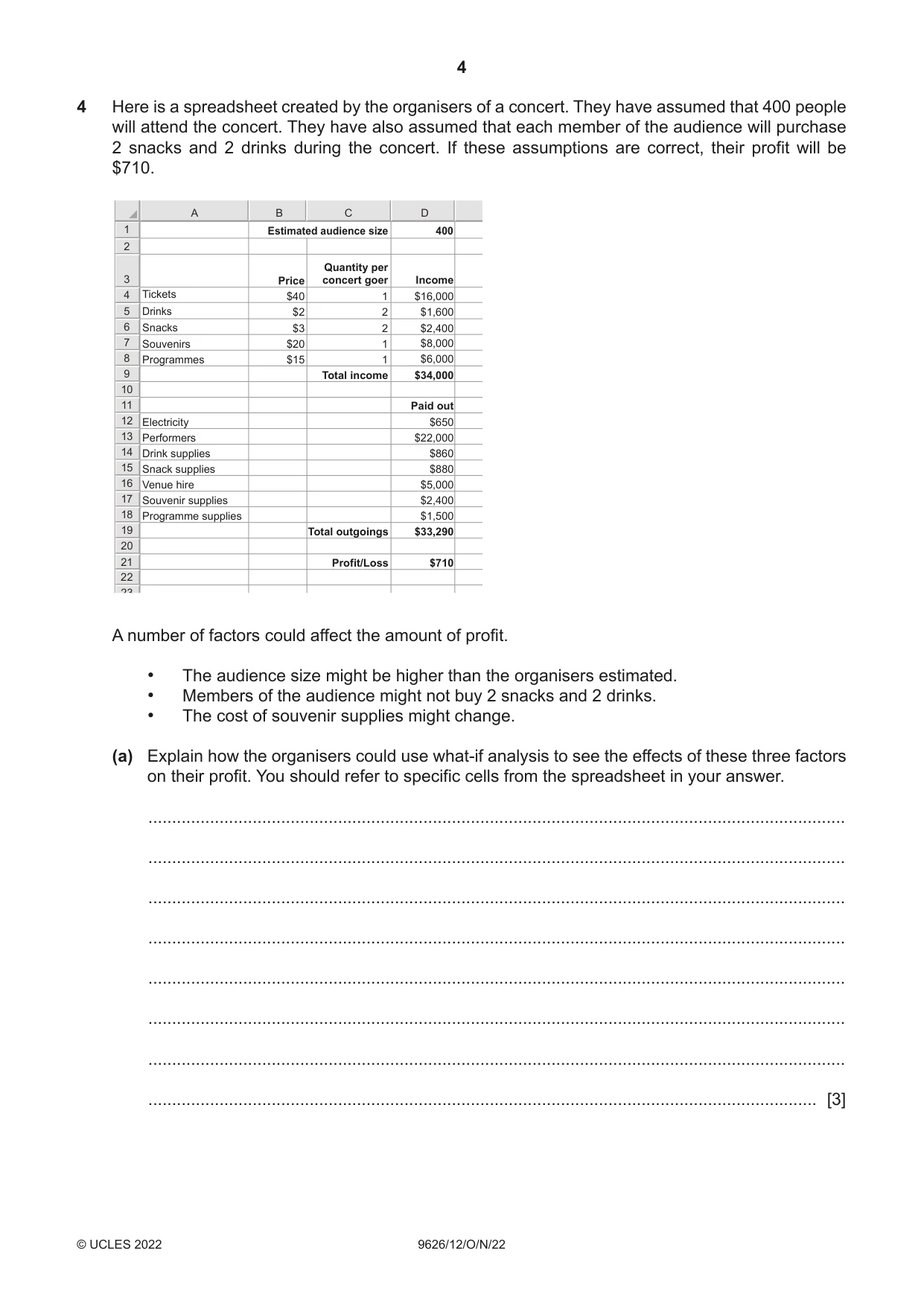
4 9626/12/O/N/22 © UCLES 2022 4 Here is a spreadsheet created by the organisers of a concert. They have assumed that 400 people will attend the concert. They have also assumed that each member of the audience will purchase 2 snacks and 2 drinks during the concert. If these assumptions are correct, their profit will be $710. A B C D 1 2 4 5 6 7 8 9 10 11 12 13 14 15 17 18 19 20 21 22 23 3 Tickets Drinks Snacks Souvenirs Programmes Electricity $20 $15 $3 $2 $40 Price 1 1 2 2 1 Quantity per concert goer Total income $16,000 Income $1,600 $2,400 $8,000 $6,000 $34,000 $650 Paid out $22,000 $860 $880 $5,000 $2,400 $1,500 $33,290 Total outgoings $710 Profit/Loss Estimated audience size 400 Performers Drink supplies Snack supplies Venue hire Souvenir supplies Programme supplies 16 A number of factors could affect the amount of profit. • The audience size might be higher than the organisers estimated. • Members of the audience might not buy 2 snacks and 2 drinks. • The cost of souvenir supplies might change. (a) Explain how the organisers could use what-if analysis to see the effects of these three factors on their profit. You should refer to specific cells from the spreadsheet in your answer. … … … … … … … … [3]
Question paper, page 5
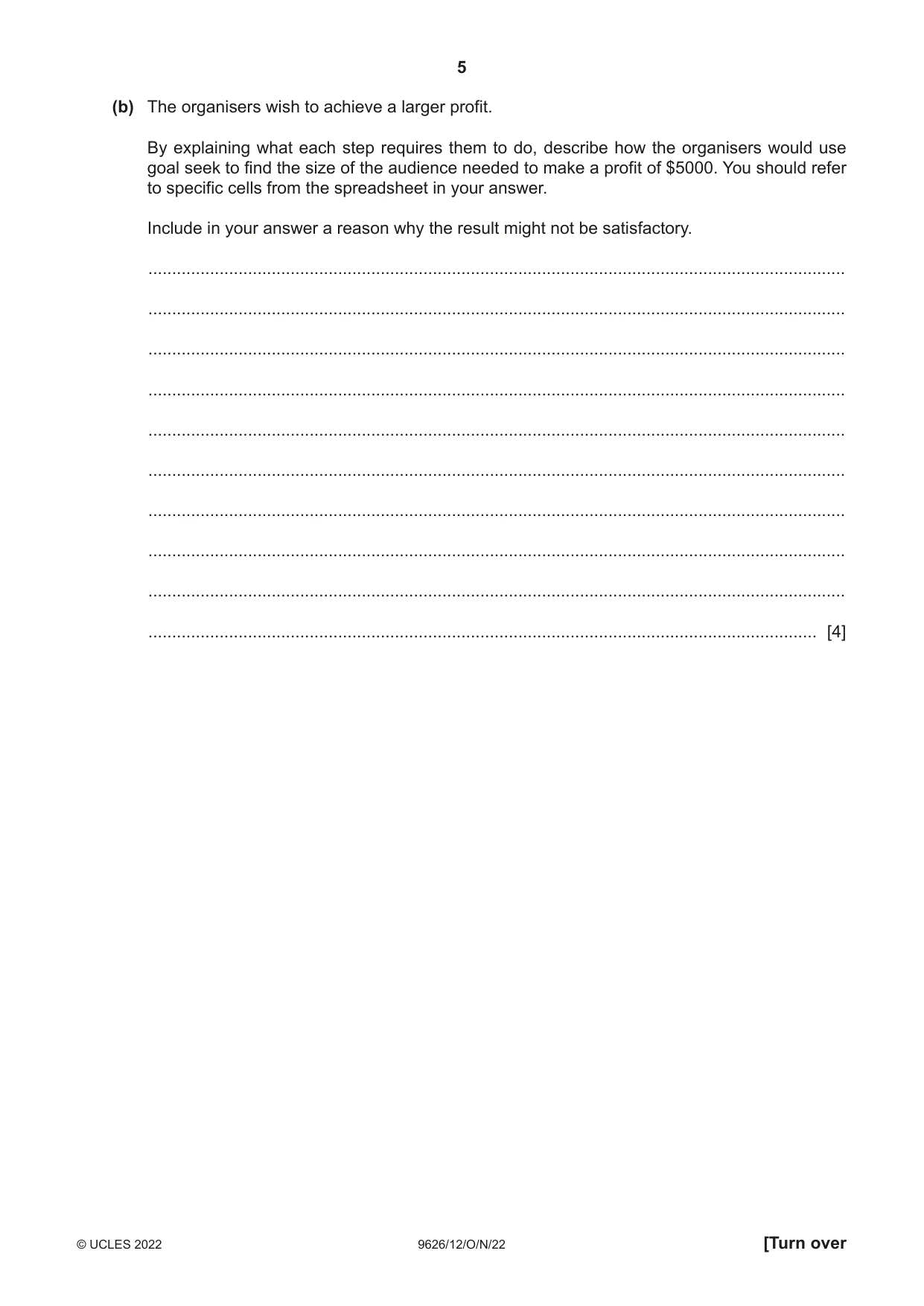
5 9626/12/O/N/22 © UCLES 2022 [Turn over (b) The organisers wish to achieve a larger profit. By explaining what each step requires them to do, describe how the organisers would use goal seek to find the size of the audience needed to make a profit of $5000. You should refer to specific cells from the spreadsheet in your answer. Include in your answer a reason why the result might not be satisfactory. … … … … … … … … … … [4]
Question paper, page 6
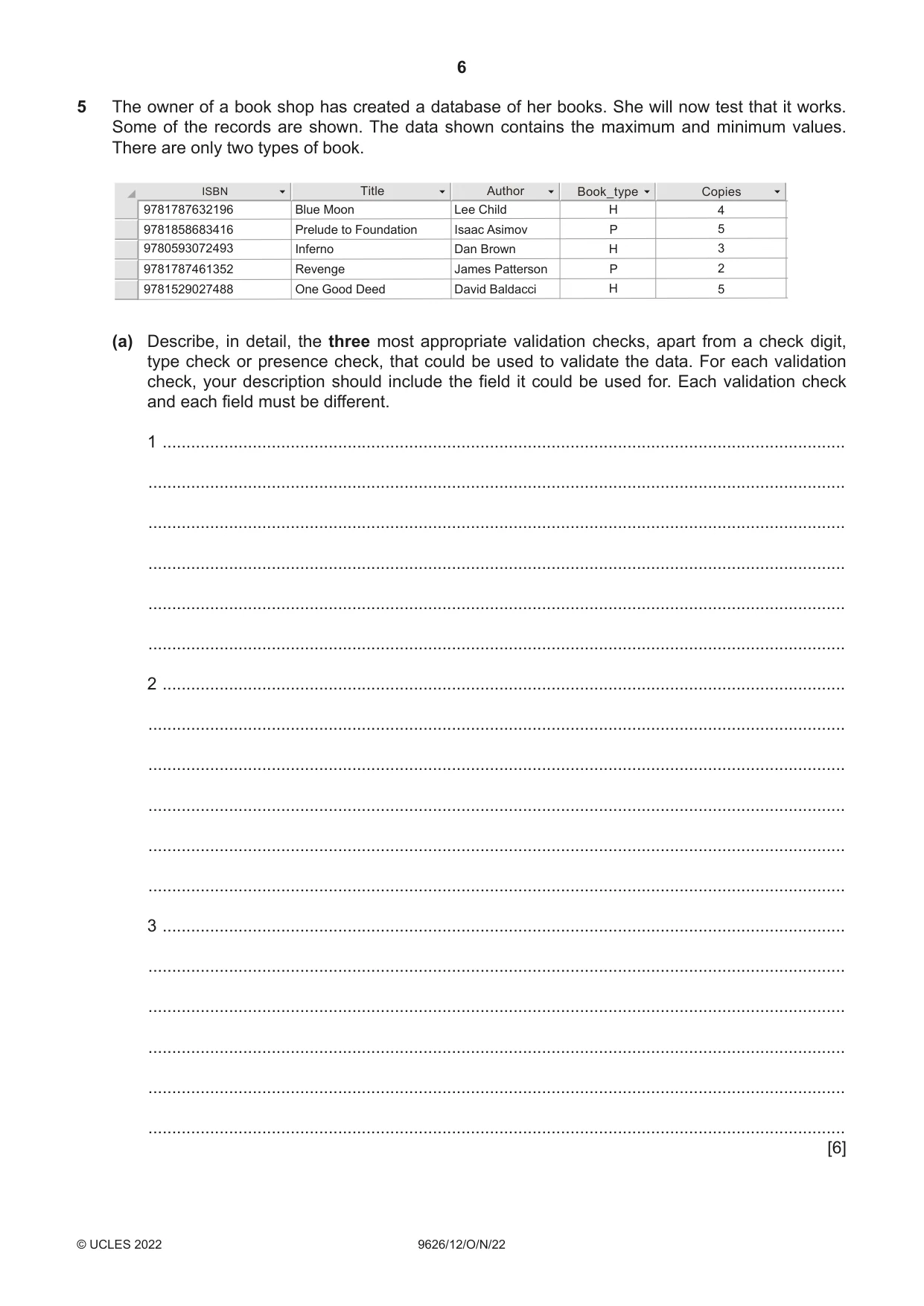
6 9626/12/O/N/22 © UCLES 2022 5 The owner of a book shop has created a database of her books. She will now test that it works. Some of the records are shown. The data shown contains the maximum and minimum values. There are only two types of book. ISBN Title Author Book_type Copies 4 5 3 2 5 H P H P H Lee Child Isaac Asimov Dan Brown James Patterson David Baldacci Blue Moon Prelude to Foundation Inferno Revenge One Good Deed 9781787632196 9781858683416 9780593072493 9781787461352 9781529027488 (a) Describe, in detail, the three most appropriate validation checks, apart from a check digit, type check or presence check, that could be used to validate the data. For each validation check, your description should include the field it could be used for. Each validation check and each field must be different. 1 … … … … … … 2 … … … … … … 3 … … … … … … [6]
Question paper, page 7
7 9626/12/O/N/22 © UCLES 2022 [Turn over (b) The owner will also need to verify the data in her database. Using examples from the three fields you used in part (a), explain why verification is needed in addition to validation. … … … … … … … … [3] 6 Explain why supercomputers are used for weather forecasting. … … … … … … … … … … [4]
Question paper, page 8
8 9626/12/O/N/22 © UCLES 2022 7 (a) Explain how malware can be used to carry out industrial espionage. … … … … … … … … … … [4] (b) A rootkit is a type of malware. Describe the features of a rootkit. … … … … … … … … … … [4]
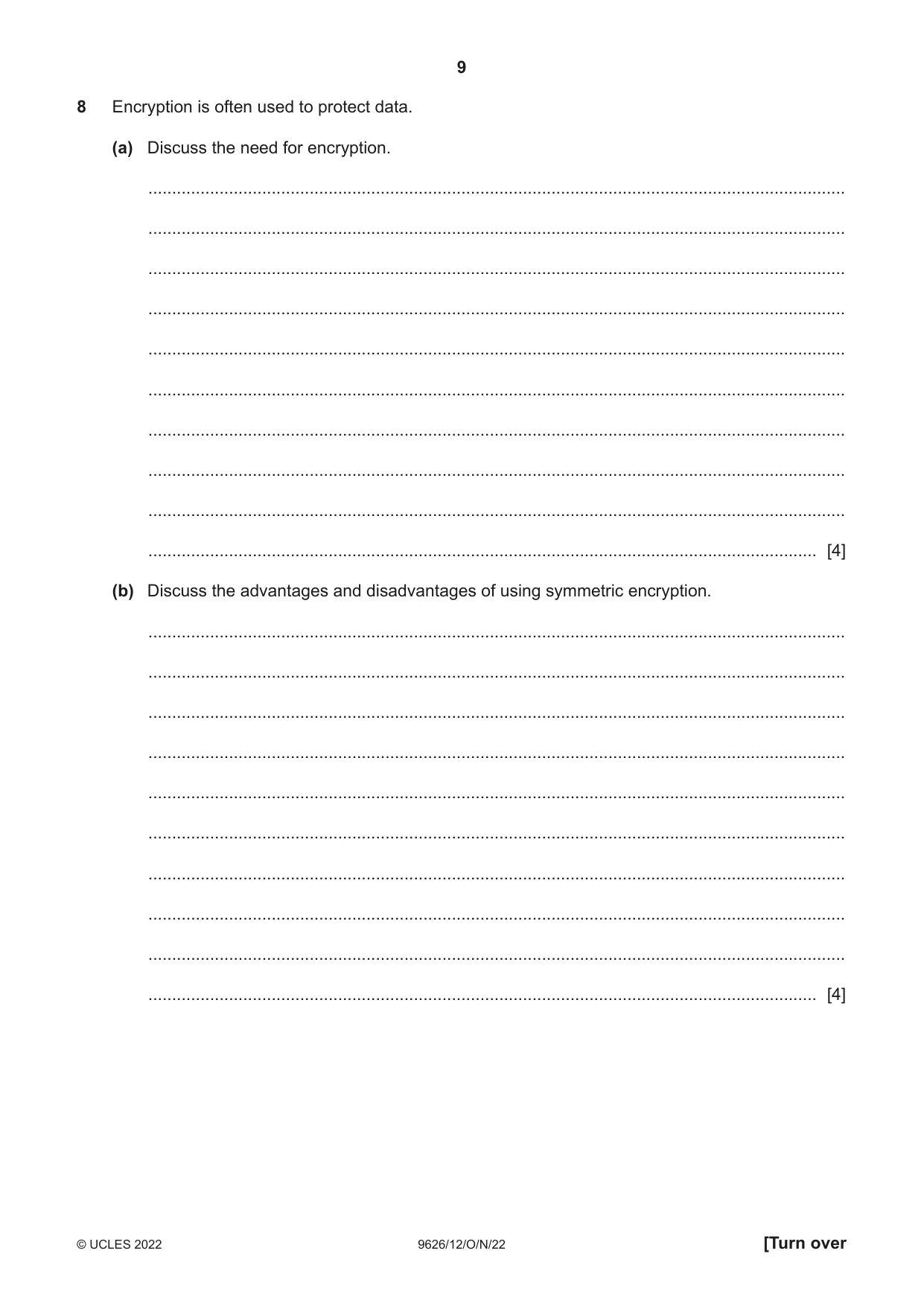
Question paper, page 9
9 9626/12/O/N/22 © UCLES 2022 [Turn over 8 Encryption is often used to protect data. (a) Discuss the need for encryption. … … … … … … … … … … [4] (b) Discuss the advantages and disadvantages of using symmetric encryption. … … … … … … … … … … [4]
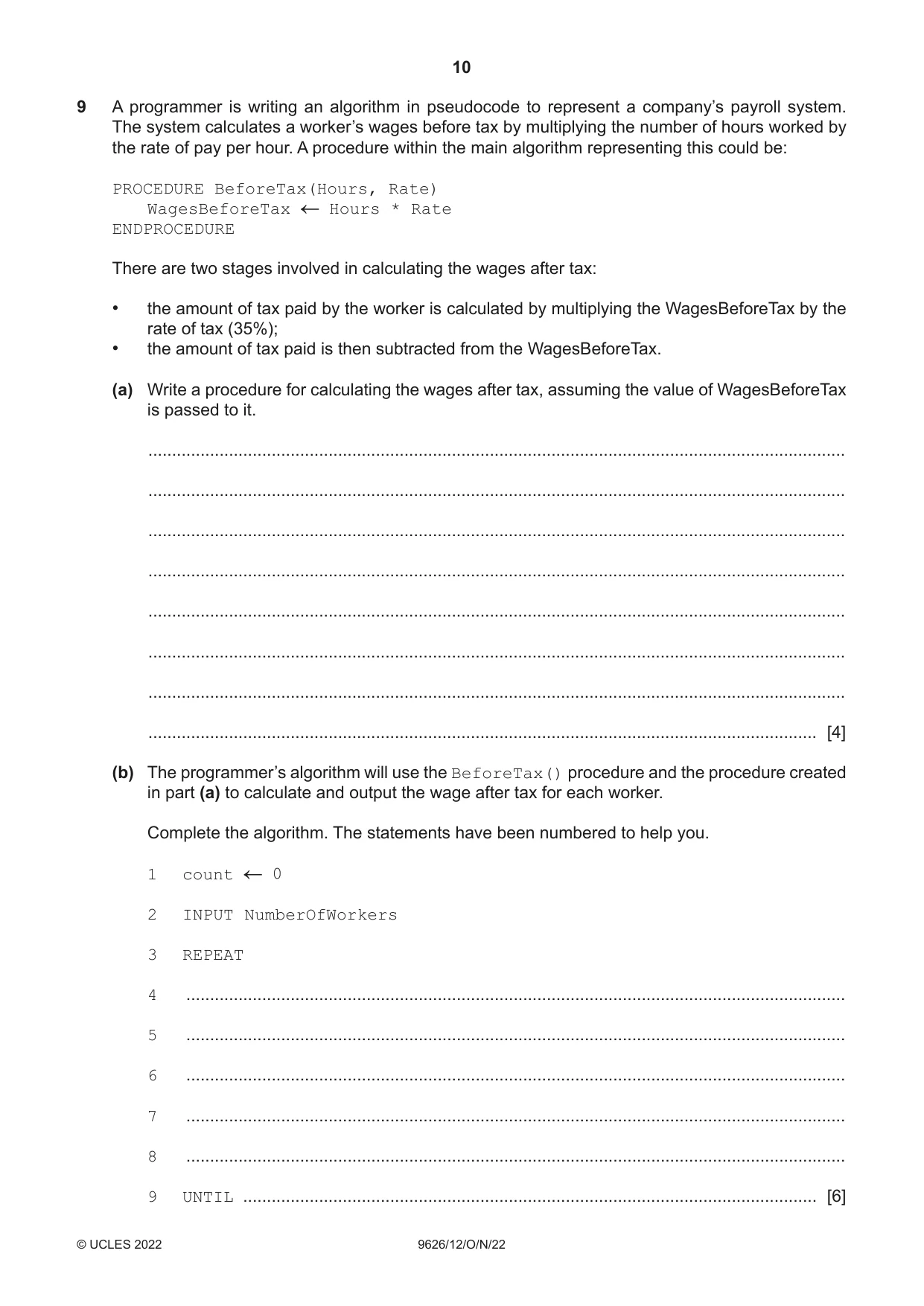
Question paper, page 10
10 9626/12/O/N/22 © UCLES 2022 9 A programmer is writing an algorithm in pseudocode to represent a company’s payroll system. The system calculates a worker’s wages before tax by multiplying the number of hours worked by the rate of pay per hour. A procedure within the main algorithm representing this could be: PROCEDURE BeforeTax(Hours, Rate) WagesBeforeTax Hours * Rate ENDPROCEDURE There are two stages involved in calculating the wages after tax: • the amount of tax paid by the worker is calculated by multiplying the WagesBeforeTax by the rate of tax (35%); • the amount of tax paid is then subtracted from the WagesBeforeTax. (a) Write a procedure for calculating the wages after tax, assuming the value of WagesBeforeTax is passed to it. … … … … … … … … [4] (b) The programmer’s algorithm will use the BeforeTax() procedure and the procedure created in part (a) to calculate and output the wage after tax for each worker. Complete the algorithm. The statements have been numbered to help you. 1 count 0 2 INPUT NumberOfWorkers 3 REPEAT 4 … 5 … 6 … 7 … 8 … 9 UNTIL … [6]
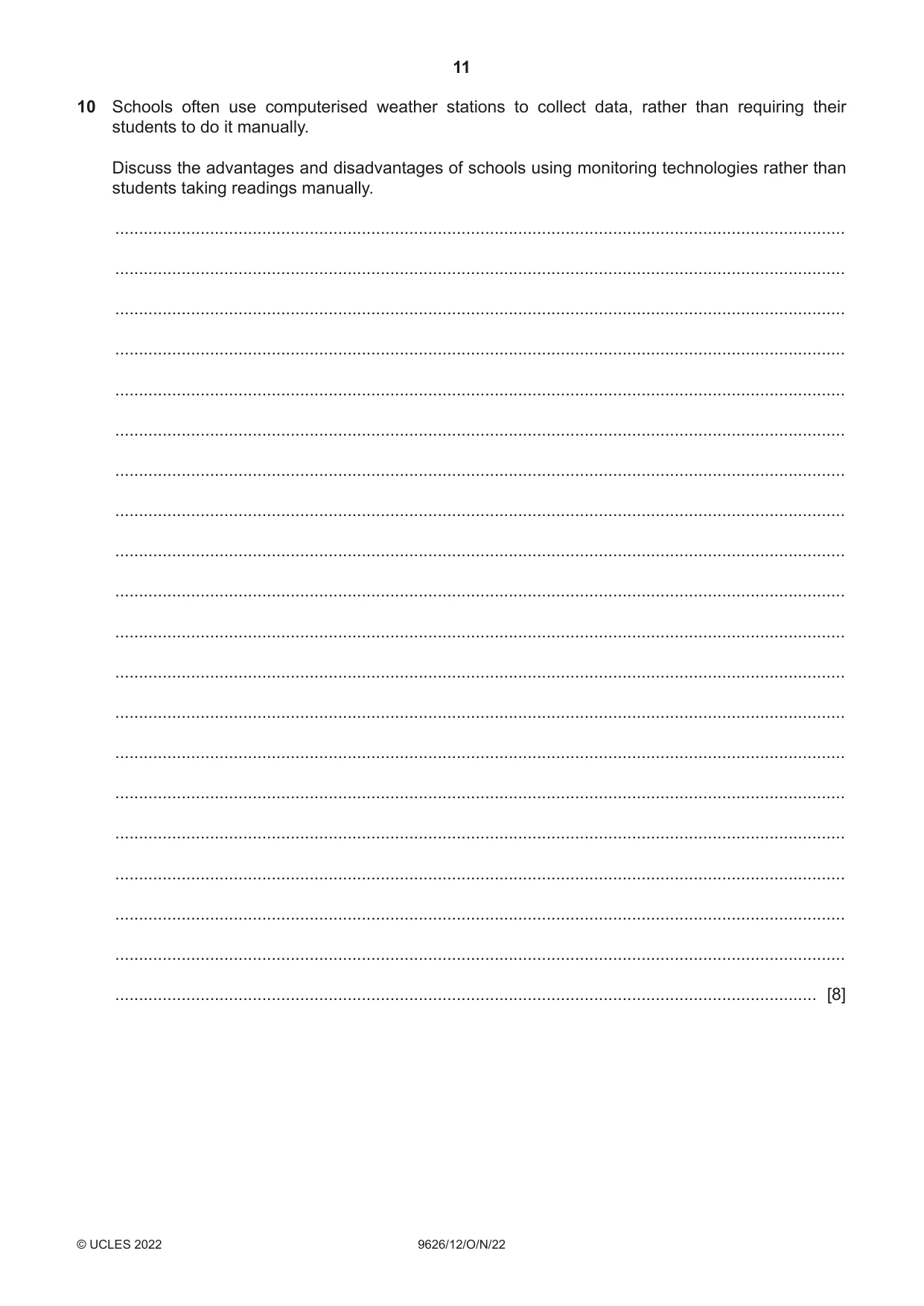
Question paper, page 11
11 9626/12/O/N/22 © UCLES 2022 10 Schools often use computerised weather stations to collect data, rather than requiring their students to do it manually. Discuss the advantages and disadvantages of schools using monitoring technologies rather than students taking readings manually. … … … … … … … … … … … … … … … … … … … … [8]
Question paper, page 12
12 9626/12/O/N/22 © UCLES 2022 Permission to reproduce items where third-party owned material protected by copyright is included has been sought and cleared where possible. Every reasonable effort has been made by the publisher (UCLES) to trace copyright holders, but if any items requiring clearance have unwittingly been included, the publisher will be pleased to make amends at the earliest possible opportunity. To avoid the issue of disclosure of answer-related information to candidates, all copyright acknowledgements are reproduced online in the Cambridge Assessment International Education Copyright Acknowledgements Booklet. This is produced for each series of examinations and is freely available to download at www.cambridgeinternational.org after the live examination series. Cambridge Assessment International Education is part of Cambridge Assessment. Cambridge Assessment is the brand name of the University of Cambridge Local Examinations Syndicate (UCLES), which is a department of the University of Cambridge. BLANK PAGE
Mark scheme, page 1
This document consists of 10 printed pages. © UCLES 2022 [Turn over Cambridge International AS & A Level INFORMATION TECHNOLOGY 9626/12 Paper 1 Theory October/November 2022 MARK SCHEME Maximum Mark: 70 Published This mark scheme is published as an aid to teachers and candidates, to indicate the requirements of the examination. It shows the basis on which Examiners were instructed to award marks. It does not indicate the details of the discussions that took place at an Examiners’ meeting before marking began, which would have considered the acceptability of alternative answers. Mark schemes should be read in conjunction with the question paper and the Principal Examiner Report for Teachers. Cambridge International will not enter into discussions about these mark schemes. Cambridge International is publishing the mark schemes for the October/November 2022 series for most Cambridge IGCSE™, Cambridge International A and AS Level components and some Cambridge O Level components.
Mark scheme, page 2
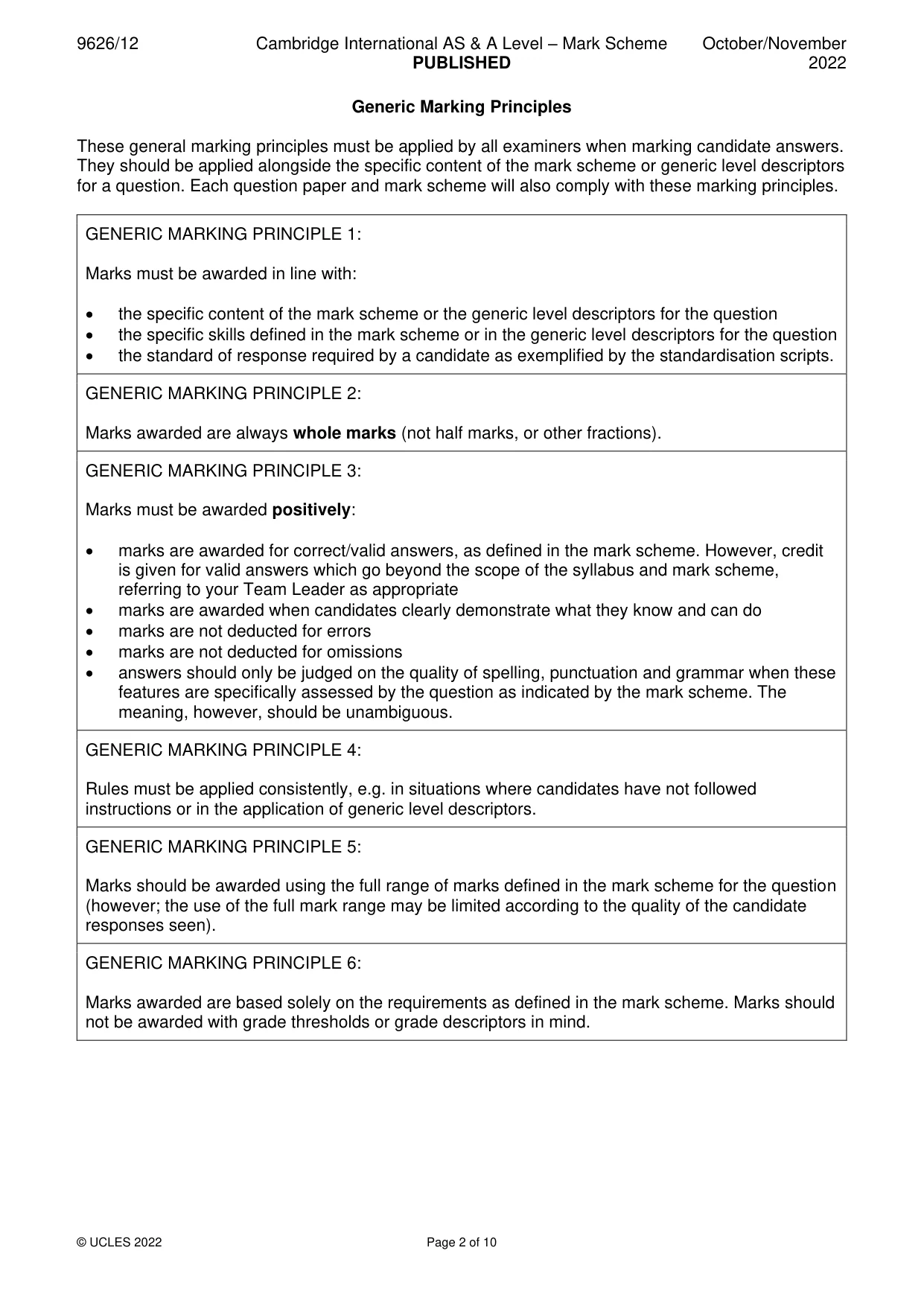
9626/12 Cambridge International AS & A Level – Mark Scheme PUBLISHED October/November 2022 © UCLES 2022 Page 2 of 10 Generic Marking Principles These general marking principles must be applied by all examiners when marking candidate answers. They should be applied alongside the specific content of the mark scheme or generic level descriptors for a question. Each question paper and mark scheme will also comply with these marking principles. GENERIC MARKING PRINCIPLE 1: Marks must be awarded in line with: • the specific content of the mark scheme or the generic level descriptors for the question • the specific skills defined in the mark scheme or in the generic level descriptors for the question • the standard of response required by a candidate as exemplified by the standardisation scripts. GENERIC MARKING PRINCIPLE 2: Marks awarded are always whole marks (not half marks, or other fractions). GENERIC MARKING PRINCIPLE 3: Marks must be awarded positively: • marks are awarded for correct/valid answers, as defined in the mark scheme. However, credit is given for valid answers which go beyond the scope of the syllabus and mark scheme, referring to your Team Leader as appropriate • marks are awarded when candidates clearly demonstrate what they know and can do • marks are not deducted for errors • marks are not deducted for omissions • answers should only be judged on the quality of spelling, punctuation and grammar when these features are specifically assessed by the question as indicated by the mark scheme. The meaning, however, should be unambiguous. GENERIC MARKING PRINCIPLE 4: Rules must be applied consistently, e.g. in situations where candidates have not followed instructions or in the application of generic level descriptors. GENERIC MARKING PRINCIPLE 5: Marks should be awarded using the full range of marks defined in the mark scheme for the question (however; the use of the full mark range may be limited according to the quality of the candidate responses seen). GENERIC MARKING PRINCIPLE 6: Marks awarded are based solely on the requirements as defined in the mark scheme. Marks should not be awarded with grade thresholds or grade descriptors in mind.
Mark scheme, page 3
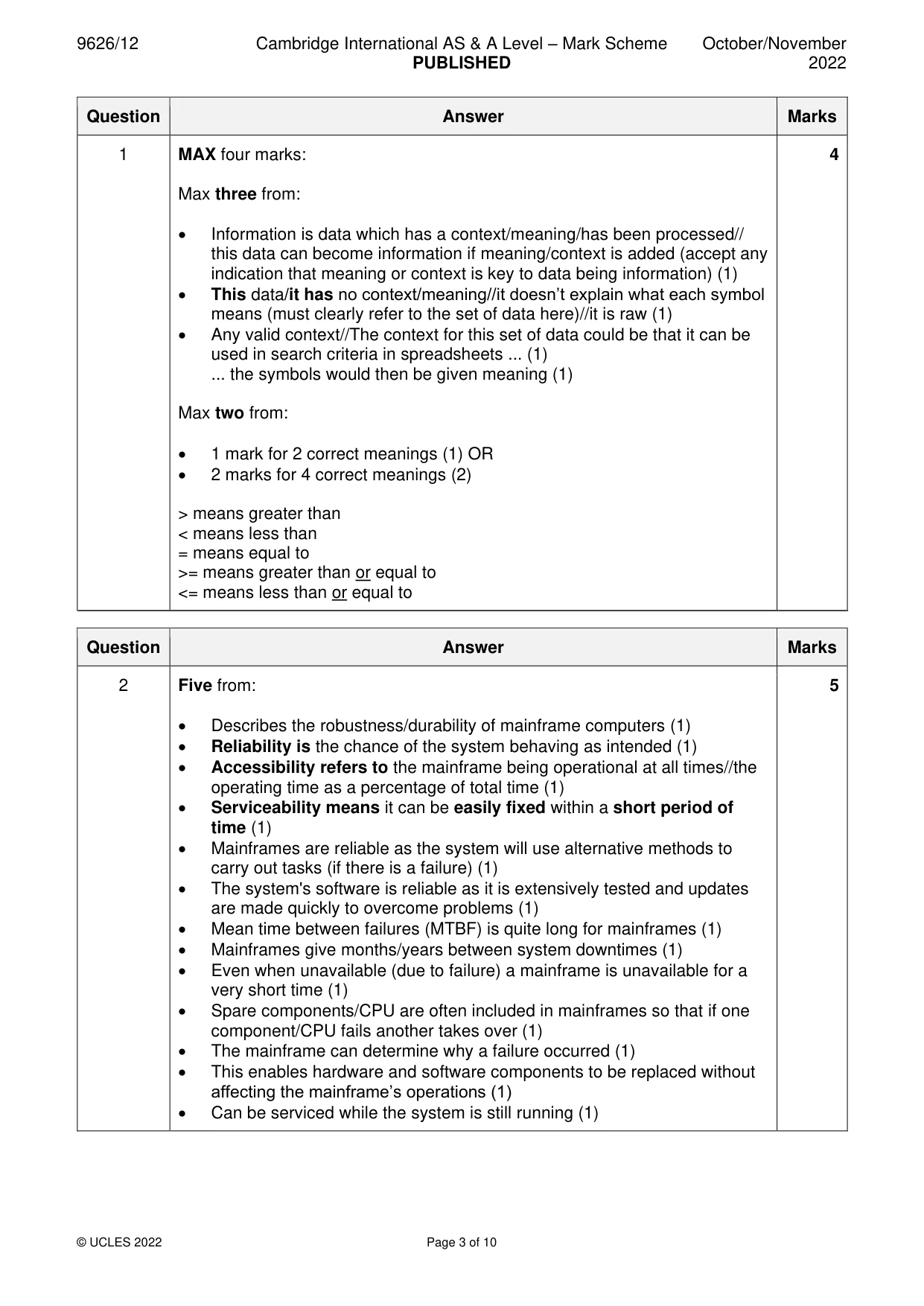
9626/12 Cambridge International AS & A Level – Mark Scheme PUBLISHED October/November 2022 © UCLES 2022 Page 3 of 10 Question Answer Marks 1 MAX four marks: Max three from: • Information is data which has a context/meaning/has been processed// this data can become information if meaning/context is added (accept any indication that meaning or context is key to data being information) (1) • This data/it has no context/meaning//it doesn’t explain what each symbol means (must clearly refer to the set of data here)//it is raw (1) • Any valid context//The context for this set of data could be that it can be used in search criteria in spreadsheets ... (1) ... the symbols would then be given meaning (1) Max two from: • 1 mark for 2 correct meanings (1) OR • 2 marks for 4 correct meanings (2) > means greater than < means less than = means equal to >= means greater than or equal to <= means less than or equal to 4 Question Answer Marks 2 Five from: • Describes the robustness/durability of mainframe computers (1) • Reliability is the chance of the system behaving as intended (1) • Accessibility refers to the mainframe being operational at all times//the operating time as a percentage of total time (1) • Serviceability means it can be easily fixed within a short period of time (1) • Mainframes are reliable as the system will use alternative methods to carry out tasks (if there is a failure) (1) • The system's software is reliable as it is extensively tested and updates are made quickly to overcome problems (1) • Mean time between failures (MTBF) is quite long for mainframes (1) • Mainframes give months/years between system downtimes (1) • Even when unavailable (due to failure) a mainframe is unavailable for a very short time (1) • Spare components/CPU are often included in mainframes so that if one component/CPU fails another takes over (1) • The mainframe can determine why a failure occurred (1) • This enables hardware and software components to be replaced without affecting the mainframe’s operations (1) • Can be serviced while the system is still running (1) 5
Mark scheme, page 4
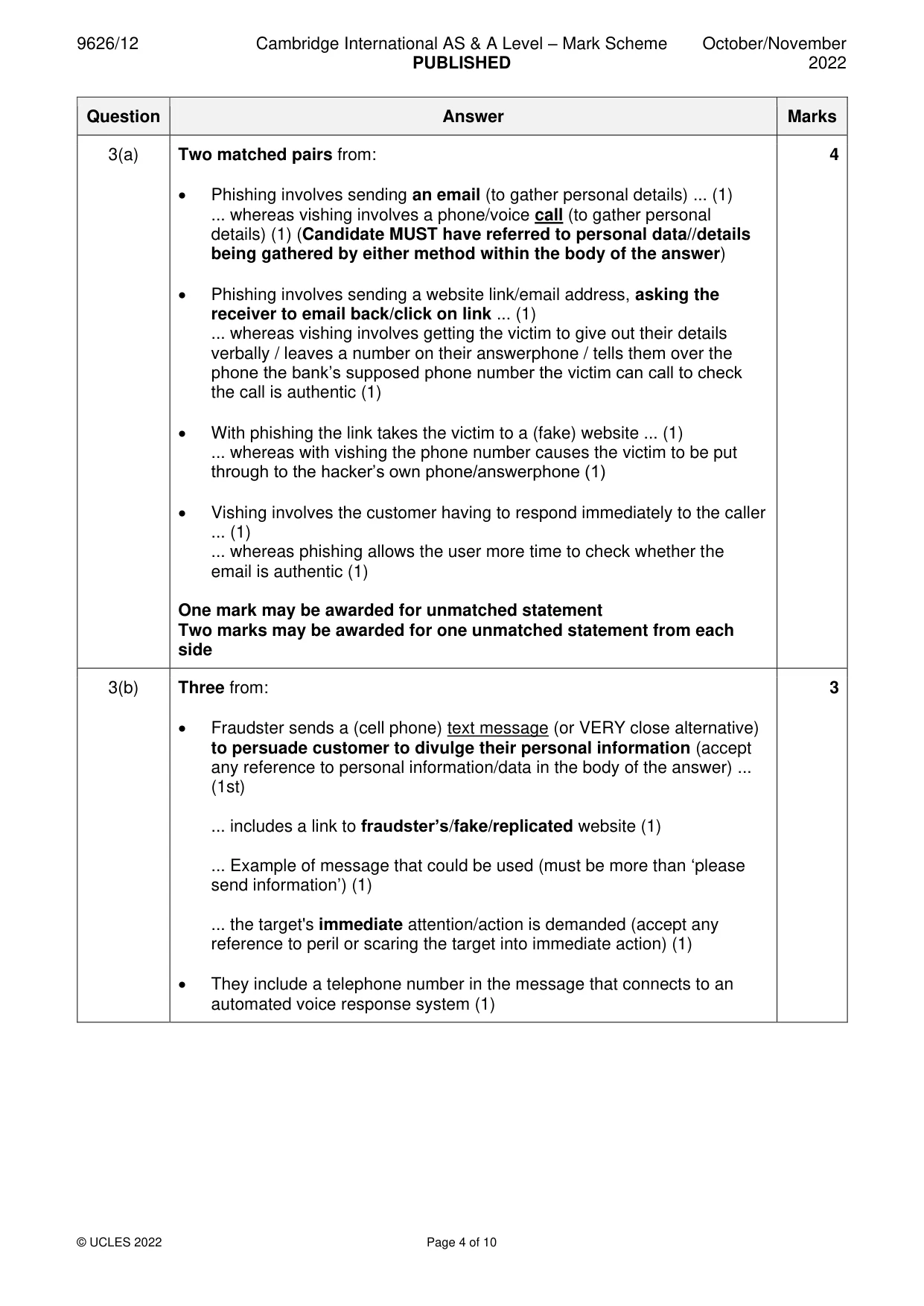
9626/12 Cambridge International AS & A Level – Mark Scheme PUBLISHED October/November 2022 © UCLES 2022 Page 4 of 10 Question Answer Marks 3(a) Two matched pairs from: • Phishing involves sending an email (to gather personal details) ... (1) ... whereas vishing involves a phone/voice call (to gather personal details) (1) (Candidate MUST have referred to personal data//details being gathered by either method within the body of the answer) • Phishing involves sending a website link/email address, asking the receiver to email back/click on link ... (1) ... whereas vishing involves getting the victim to give out their details verbally / leaves a number on their answerphone / tells them over the phone the bank’s supposed phone number the victim can call to check the call is authentic (1) • With phishing the link takes the victim to a (fake) website ... (1) ... whereas with vishing the phone number causes the victim to be put through to the hacker’s own phone/answerphone (1) • Vishing involves the customer having to respond immediately to the caller ... (1) ... whereas phishing allows the user more time to check whether the email is authentic (1) One mark may be awarded for unmatched statement Two marks may be awarded for one unmatched statement from each side 4 3(b) Three from: • Fraudster sends a (cell phone) text message (or VERY close alternative) to persuade customer to divulge their personal information (accept any reference to personal information/data in the body of the answer) ... (1st) ... includes a link to fraudster’s/fake/replicated website (1) ... Example of message that could be used (must be more than ‘please send information’) (1) ... the target's immediate attention/action is demanded (accept any reference to peril or scaring the target into immediate action) (1) • They include a telephone number in the message that connects to an automated voice response system (1) 3
Mark scheme, page 5
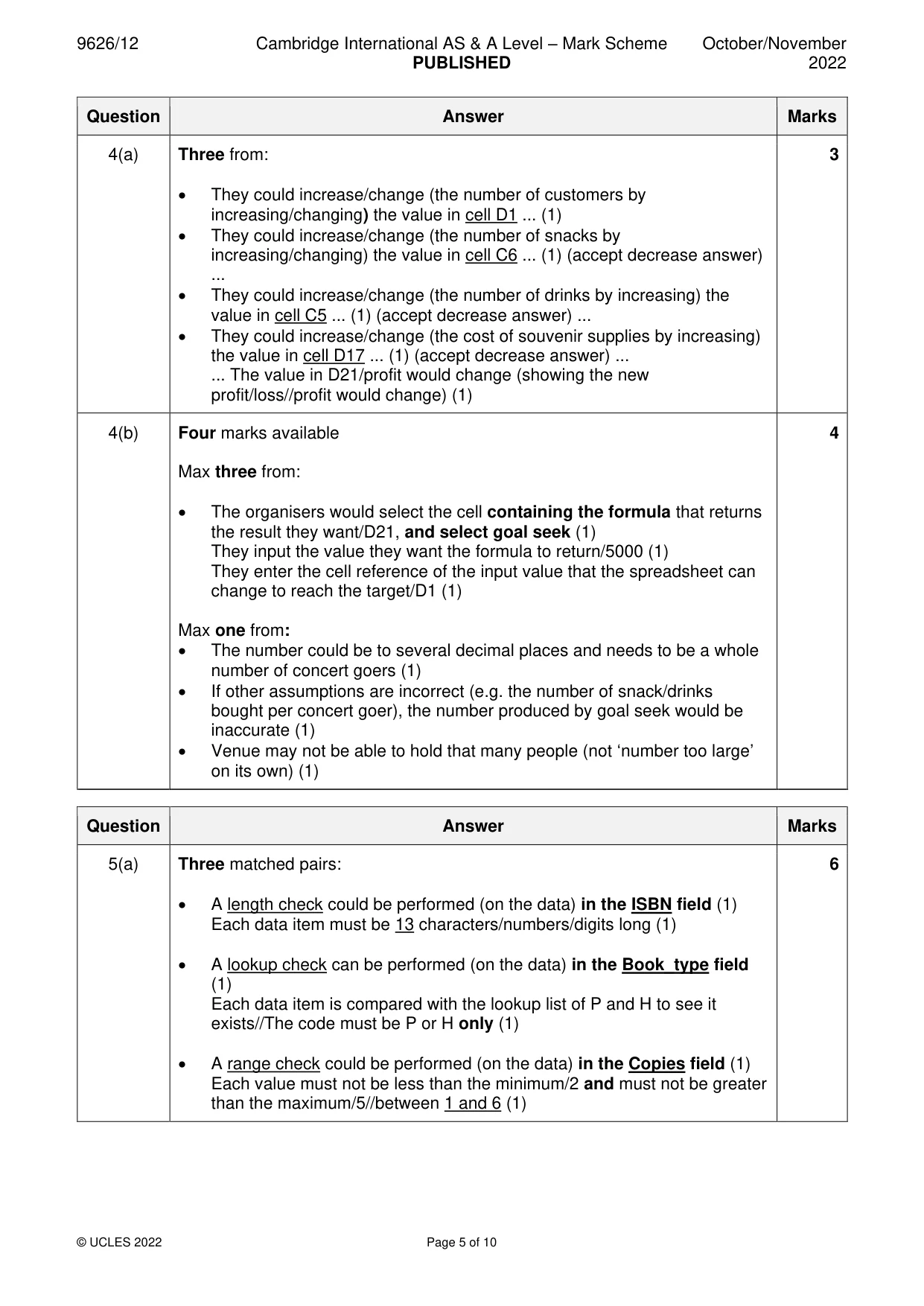
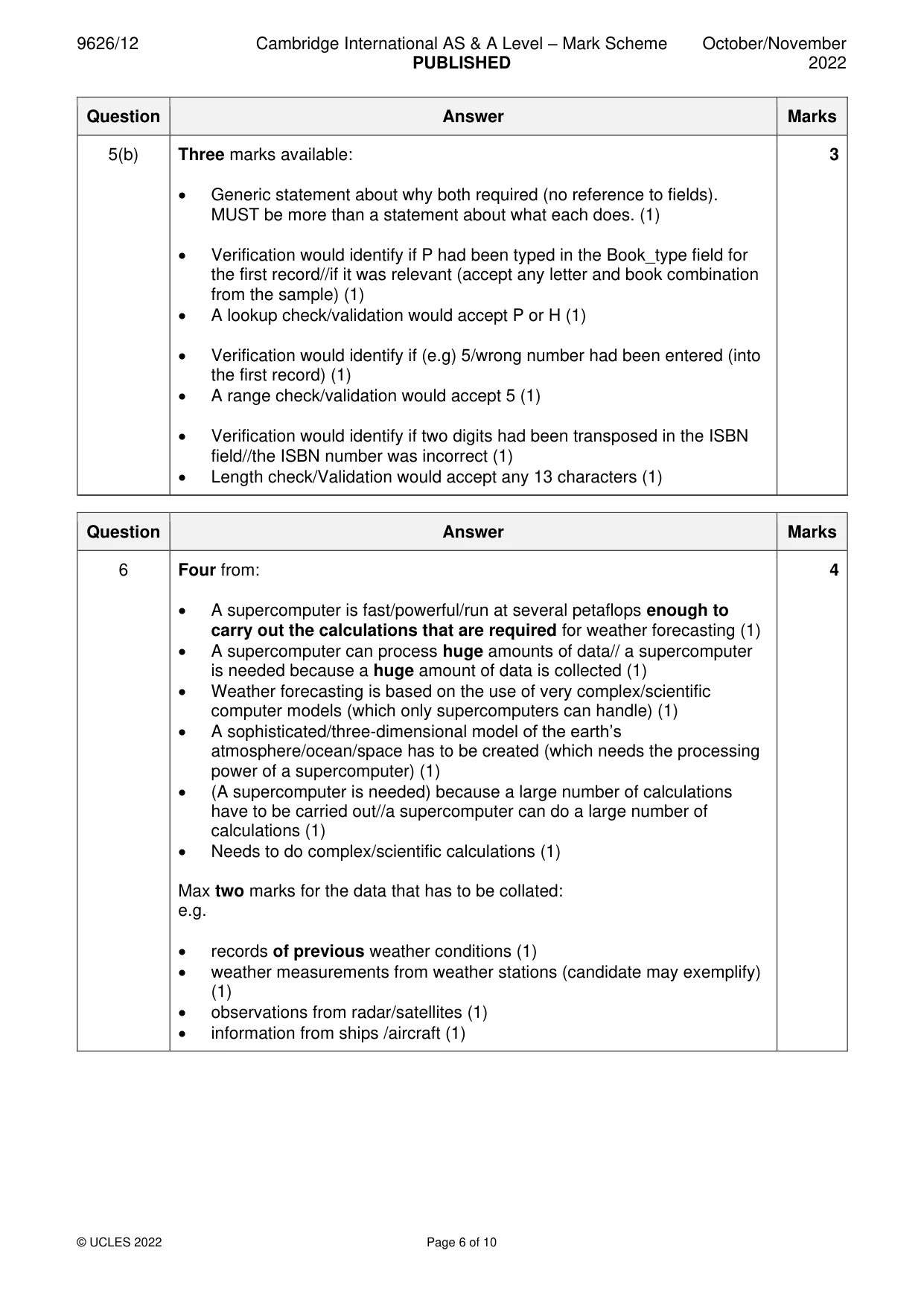
9626/12 Cambridge International AS & A Level – Mark Scheme PUBLISHED October/November 2022 © UCLES 2022 Page 5 of 10 Question Answer Marks 4(a) Three from: • They could increase/change (the number of customers by increasing/changing) the value in cell D1 ... (1) • They could increase/change (the number of snacks by increasing/changing) the value in cell C6 ... (1) (accept decrease answer) ... • They could increase/change (the number of drinks by increasing) the value in cell C5 ... (1) (accept decrease answer) ... • They could increase/change (the cost of souvenir supplies by increasing) the value in cell D17 ... (1) (accept decrease answer) ... ... The value in D21/profit would change (showing the new profit/loss//profit would change) (1) 3 4(b) Four marks available Max three from: • The organisers would select the cell containing the formula that returns the result they want/D21, and select goal seek (1) They input the value they want the formula to return/5000 (1) They enter the cell reference of the input value that the spreadsheet can change to reach the target/D1 (1) Max one from: • The number could be to several decimal places and needs to be a whole number of concert goers (1) • If other assumptions are incorrect (e.g. the number of snack/drinks bought per concert goer), the number produced by goal seek would be inaccurate (1) • Venue may not be able to hold that many people (not ‘number too large’ on its own) (1) 4 Question Answer Marks 5(a) Three matched pairs: • A length check could be performed (on the data) in the ISBN field (1) Each data item must be 13 characters/numbers/digits long (1) • A lookup check can be performed (on the data) in the Book_type field (1) Each data item is compared with the lookup list of P and H to see it exists//The code must be P or H only (1) • A range check could be performed (on the data) in the Copies field (1) Each value must not be less than the minimum/2 and must not be greater than the maximum/5//between 1 and 6 (1) 6
Mark scheme, page 6
9626/12 Cambridge International AS & A Level – Mark Scheme PUBLISHED October/November 2022 © UCLES 2022 Page 6 of 10 Question Answer Marks 5(b) Three marks available: • Generic statement about why both required (no reference to fields). MUST be more than a statement about what each does. (1) • Verification would identify if P had been typed in the Book_type field for the first record//if it was relevant (accept any letter and book combination from the sample) (1) • A lookup check/validation would accept P or H (1) • Verification would identify if (e.g) 5/wrong number had been entered (into the first record) (1) • A range check/validation would accept 5 (1) • Verification would identify if two digits had been transposed in the ISBN field//the ISBN number was incorrect (1) • Length check/Validation would accept any 13 characters (1) 3 Question Answer Marks 6 Four from: • A supercomputer is fast/powerful/run at several petaflops enough to carry out the calculations that are required for weather forecasting (1) • A supercomputer can process huge amounts of data// a supercomputer is needed because a huge amount of data is collected (1) • Weather forecasting is based on the use of very complex/scientific computer models (which only supercomputers can handle) (1) • A sophisticated/three-dimensional model of the earth’s atmosphere/ocean/space has to be created (which needs the processing power of a supercomputer) (1) • (A supercomputer is needed) because a large number of calculations have to be carried out//a supercomputer can do a large number of calculations (1) • Needs to do complex/scientific calculations (1) Max two marks for the data that has to be collated: e.g. • records of previous weather conditions (1) • weather measurements from weather stations (candidate may exemplify) (1) • observations from radar/satellites (1) • information from ships /aircraft (1) 4
Mark scheme, page 7
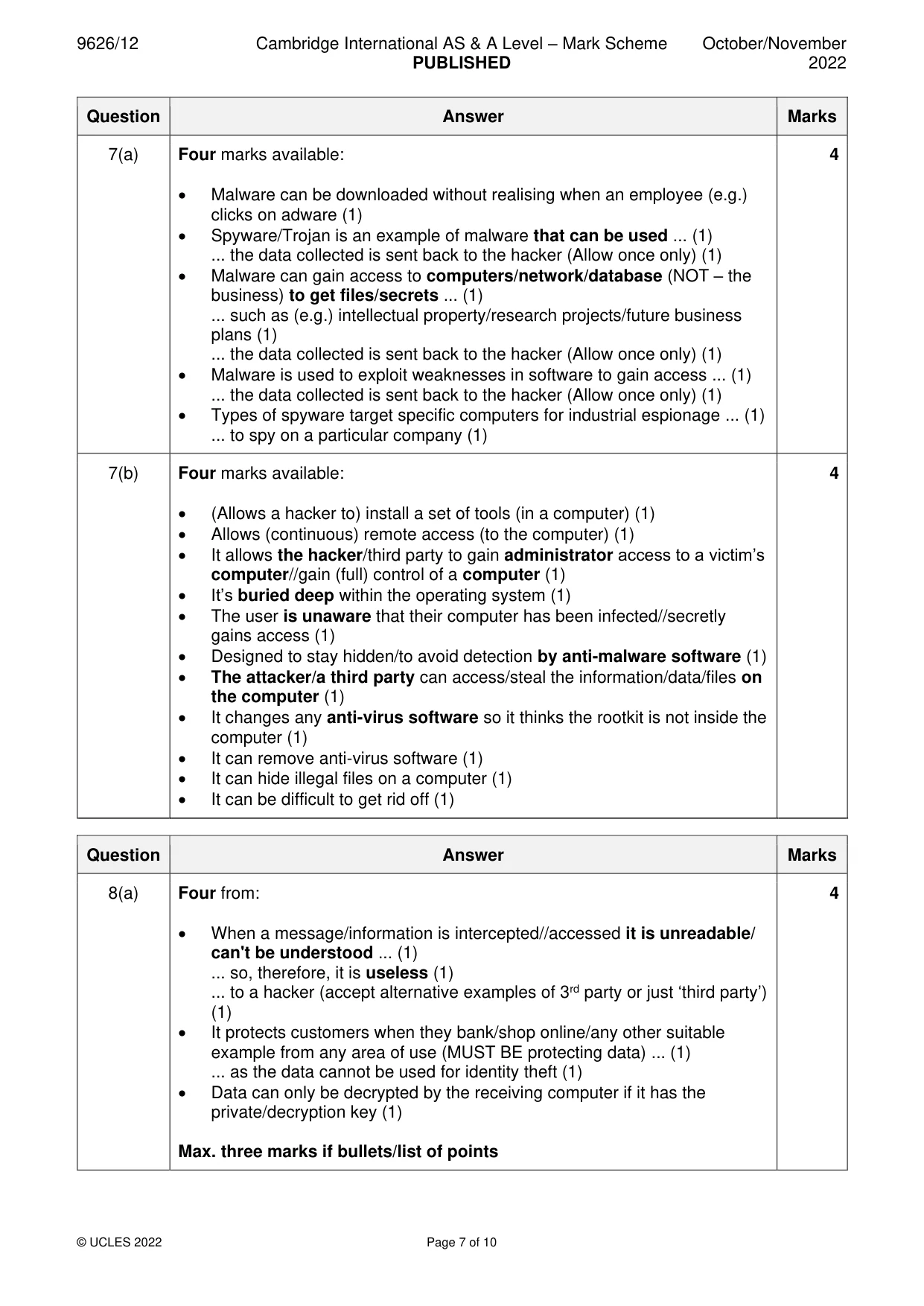
9626/12 Cambridge International AS & A Level – Mark Scheme PUBLISHED October/November 2022 © UCLES 2022 Page 7 of 10 Question Answer Marks 7(a) Four marks available: • Malware can be downloaded without realising when an employee (e.g.) clicks on adware (1) • Spyware/Trojan is an example of malware that can be used ... (1) ... the data collected is sent back to the hacker (Allow once only) (1) • Malware can gain access to computers/network/database (NOT – the business) to get files/secrets ... (1) ... such as (e.g.) intellectual property/research projects/future business plans (1) ... the data collected is sent back to the hacker (Allow once only) (1) • Malware is used to exploit weaknesses in software to gain access ... (1) ... the data collected is sent back to the hacker (Allow once only) (1) • Types of spyware target specific computers for industrial espionage ... (1) ... to spy on a particular company (1) 4 7(b) Four marks available: • (Allows a hacker to) install a set of tools (in a computer) (1) • Allows (continuous) remote access (to the computer) (1) • It allows the hacker/third party to gain administrator access to a victim’s computer//gain (full) control of a computer (1) • It’s buried deep within the operating system (1) • The user is unaware that their computer has been infected//secretly gains access (1) • Designed to stay hidden/to avoid detection by anti-malware software (1) • The attacker/a third party can access/steal the information/data/files on the computer (1) • It changes any anti-virus software so it thinks the rootkit is not inside the computer (1) • It can remove anti-virus software (1) • It can hide illegal files on a computer (1) • It can be difficult to get rid off (1) 4 Question Answer Marks 8(a) Four from: • When a message/information is intercepted//accessed it is unreadable/ can't be understood ... (1) ... so, therefore, it is useless (1) ... to a hacker (accept alternative examples of 3rd party or just ‘third party’) (1) • It protects customers when they bank/shop online/any other suitable example from any area of use (MUST BE protecting data) ... (1) ... as the data cannot be used for identity theft (1) • Data can only be decrypted by the receiving computer if it has the private/decryption key (1) Max. three marks if bullets/list of points 4
Mark scheme, page 8
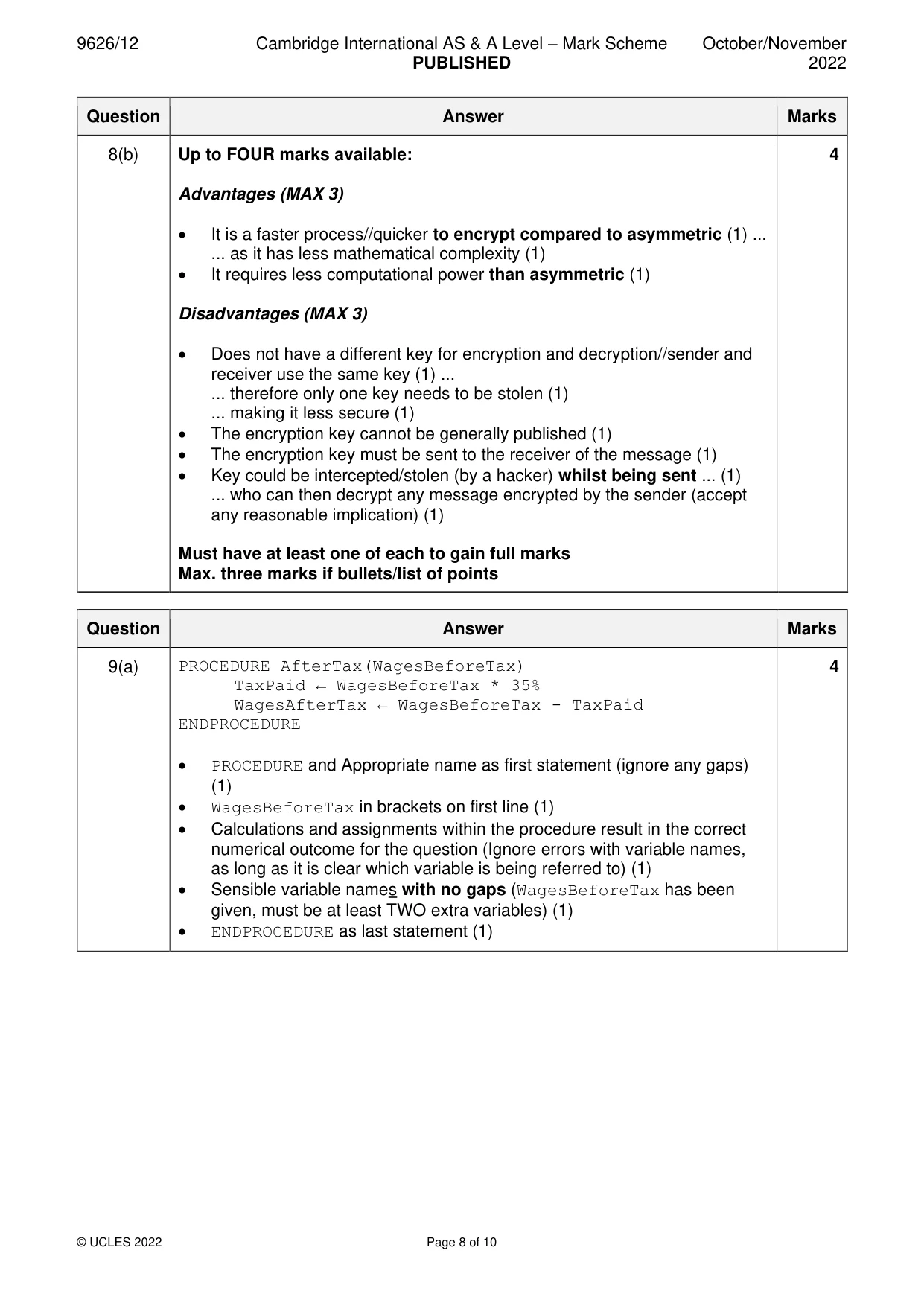
9626/12 Cambridge International AS & A Level – Mark Scheme PUBLISHED October/November 2022 © UCLES 2022 Page 8 of 10 Question Answer Marks 8(b) Up to FOUR marks available: Advantages (MAX 3) • It is a faster process//quicker to encrypt compared to asymmetric (1) ... ... as it has less mathematical complexity (1) • It requires less computational power than asymmetric (1) Disadvantages (MAX 3) • Does not have a different key for encryption and decryption//sender and receiver use the same key (1) ... ... therefore only one key needs to be stolen (1) ... making it less secure (1) • The encryption key cannot be generally published (1) • The encryption key must be sent to the receiver of the message (1) • Key could be intercepted/stolen (by a hacker) whilst being sent ... (1) ... who can then decrypt any message encrypted by the sender (accept any reasonable implication) (1) Must have at least one of each to gain full marks Max. three marks if bullets/list of points 4 Question Answer Marks 9(a) PROCEDURE AfterTax(WagesBeforeTax) TaxPaid ← WagesBeforeTax * 35% WagesAfterTax ← WagesBeforeTax - TaxPaid ENDPROCEDURE • PROCEDURE and Appropriate name as first statement (ignore any gaps) (1) • WagesBeforeTax in brackets on first line (1) • Calculations and assignments within the procedure result in the correct numerical outcome for the question (Ignore errors with variable names, as long as it is clear which variable is being referred to) (1) • Sensible variable names with no gaps (WagesBeforeTax has been given, must be at least TWO extra variables) (1) • ENDPROCEDURE as last statement (1) 4
Mark scheme, page 9
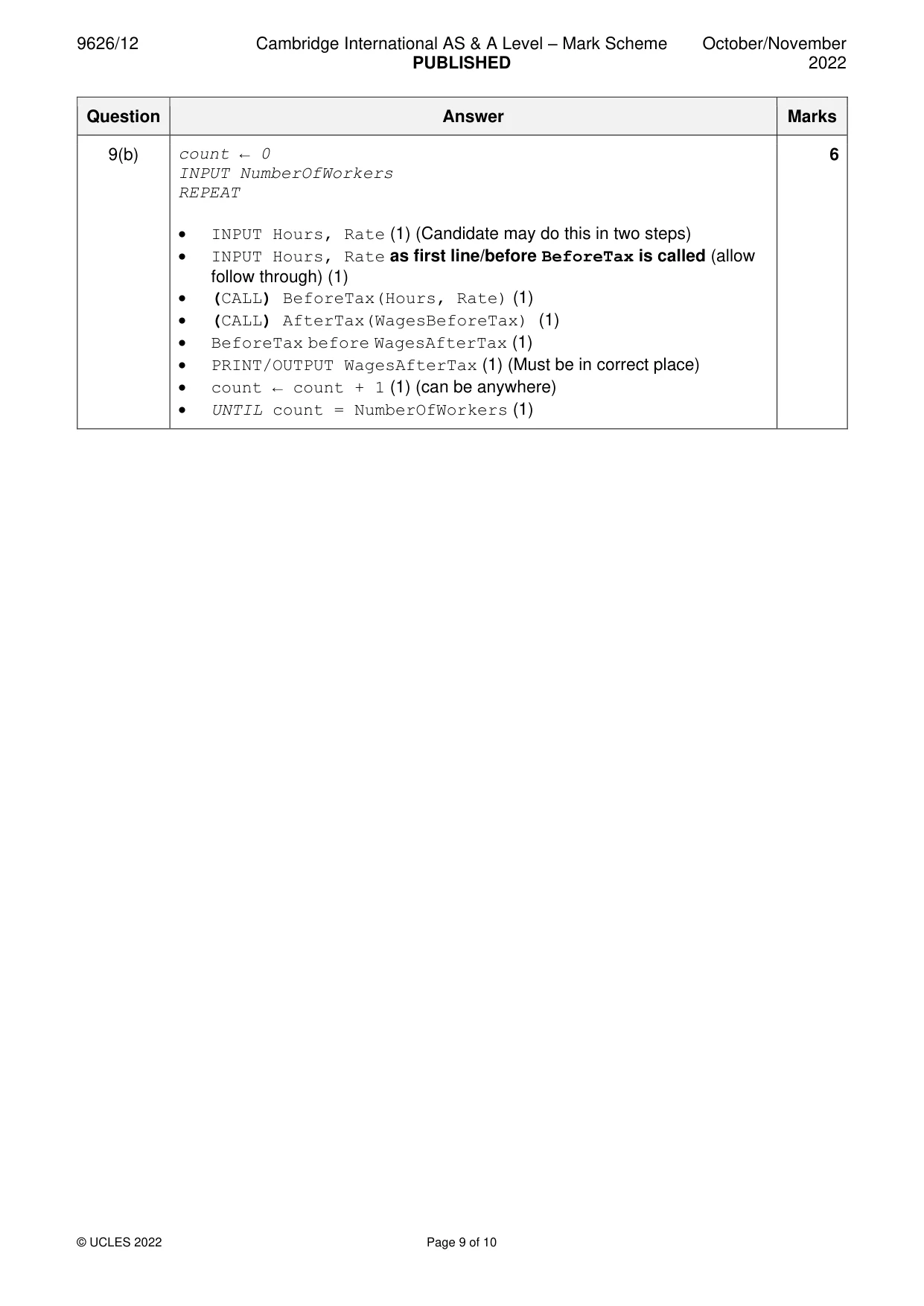
9626/12 Cambridge International AS & A Level – Mark Scheme PUBLISHED October/November 2022 © UCLES 2022 Page 9 of 10 Question Answer Marks 9(b) count ← 0 INPUT NumberOfWorkers REPEAT • INPUT Hours, Rate (1) (Candidate may do this in two steps) • INPUT Hours, Rate as first line/before BeforeTax is called (allow follow through) (1) • (CALL) BeforeTax(Hours, Rate) (1) • (CALL) AfterTax(WagesBeforeTax) (1) • BeforeTax before WagesAfterTax (1) • PRINT/OUTPUT WagesAfterTax (1) (Must be in correct place) • count ← count + 1 (1) (can be anywhere) • UNTIL count = NumberOfWorkers (1) 6
Mark scheme, page 10
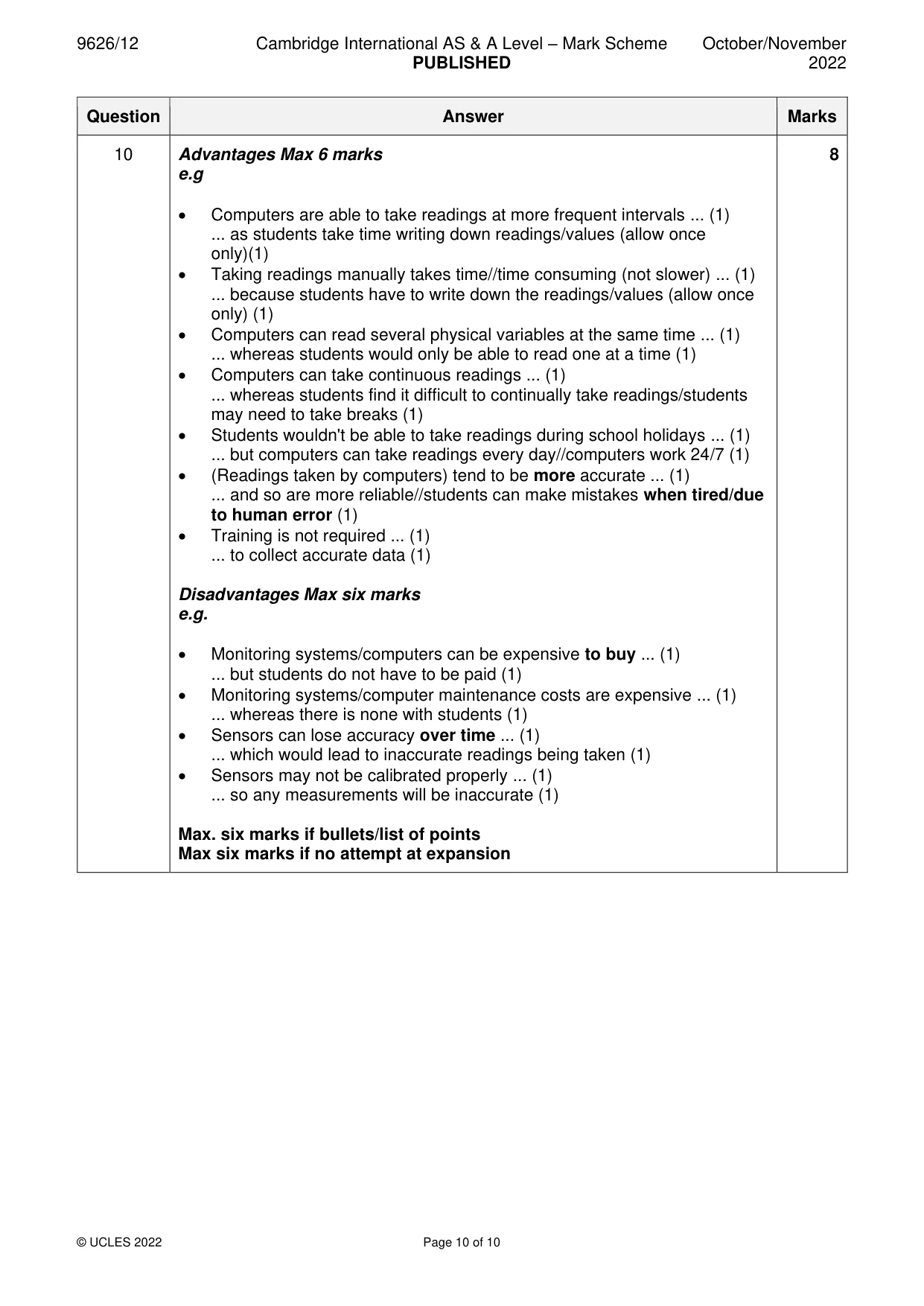
9626/12 Cambridge International AS & A Level – Mark Scheme PUBLISHED October/November 2022 © UCLES 2022 Page 10 of 10 Question Answer Marks 10 Advantages Max 6 marks e.g • Computers are able to take readings at more frequent intervals ... (1) ... as students take time writing down readings/values (allow once only)(1) • Taking readings manually takes time//time consuming (not slower) ... (1) ... because students have to write down the readings/values (allow once only) (1) • Computers can read several physical variables at the same time ... (1) ... whereas students would only be able to read one at a time (1) • Computers can take continuous readings ... (1) ... whereas students find it difficult to continually take readings/students may need to take breaks (1) • Students wouldn't be able to take readings during school holidays ... (1) ... but computers can take readings every day//computers work 24/7 (1) • (Readings taken by computers) tend to be more accurate ... (1) ... and so are more reliable//students can make mistakes when tired/due to human error (1) • Training is not required ... (1) ... to collect accurate data (1) Disadvantages Max six marks e.g. • Monitoring systems/computers can be expensive to buy ... (1) ... but students do not have to be paid (1) • Monitoring systems/computer maintenance costs are expensive ... (1) ... whereas there is none with students (1) • Sensors can lose accuracy over time ... (1) ... which would lead to inaccurate readings being taken (1) • Sensors may not be calibrated properly ... (1) ... so any measurements will be inaccurate (1) Max. six marks if bullets/list of points Max six marks if no attempt at expansion 8
What you needed in this session
Cambridge’s own grade thresholds for 2022 Oct/Nov, Paper 1 · Variant 2. A higher threshold means an easier paper — the bar moves with how the cohort did.