Cambridge A Level Information Technology (from 2017) 9626 — 2018 Feb/March Paper 3 · Variant 2
9626/32/F/M/18 · 12 questions · 90 marks · ≈101 min
The question paper and its mark scheme, free to read here and free to download. This is Cambridge’s own paper, exactly as it was sat.
Question paper20 pages
















Mark scheme12 pages
Answers below. Sit the paper first if you are practising.



Questions as text
Q1 · A website designer can use bitmap or vector images in web pages
1 A website designer can use bitmap or vector images in web pages. Explain the characteristics of bitmap images that make them suitable for use on web pages that advertise items for sale. .......................................................................................................................................................... .......................................................................................................................................................... .......................................................................................................................................................... .......................................................................................................................................................... .......................................................................................................................................................... .......................................................................................................................................................... .......................................................................................................................................................... .......................................................................................................................................................... .......................................................................................................................................................... ......................................................................................................................................................[4]
Mark scheme: Question Answer Marks 1 Four from: 4 Can be saved/stored in a variety of formats so that the webpage can be viewed on all computer platforms Can be output from many applications so easy to produce Can be created from the pixel arrays in memory Can display vast range of colours depending on bits per pixel Can display subtle gradations of shades/colour/greyscales as it is made of pixels Best for photo-realism/continuous tones compared to vector images so images of advertised items appear more realistic Individual pixels can be modified to customise/edit the image so images of advertised items are more appealing/attractive Can translate easily to dot-format output for use with CRTs/printers Can be used in simple animations e.g. Animated gifs Can be compressed so that file size is reduced and loads faster.
Q2 · Analyse the impact of network bandwidth on video-conferencing
2 Analyse the impact of network bandwidth on video-conferencing. .......................................................................................................................................................... .......................................................................................................................................................... .......................................................................................................................................................... .......................................................................................................................................................... .......................................................................................................................................................... .......................................................................................................................................................... .......................................................................................................................................................... .......................................................................................................................................................... .......................................................................................................................................................... .......................................................................................................................................................... .......................................................................................................................................................... .......................................................................................................................................................... .......................................................................................................................................................... .......................................................................................................................................................... .......................................................................................................................................................... .......................................................................................................................................................... .......................................................................................................................................................... .......................................................................................................................................................... .......................................................................................................................................................... ......................................................................................................................................................[8]
Mark scheme: 2 Eight from: 8 Bandwidth requirements are higher to allow more detail in video images Video-conferencing requires higher resolution video because there are often several people on screen at once Need to see facial features/body expressions of participants clearly One person to another (when video-conferencing) does not require high resolutions High bandwidth (of 2–4 Mbps) would deliver an (H720p) high definition image for multiple participants Low bandwidth (of 512 kbps) would be sufficient for one-to-one video- conferencing Low bandwidth does not allow high definition images so would not be able to properly see the faces of multiple participants High bandwidth would allow higher frame rates/30fps for smooth motion Limited/low bandwidth requires trade-off between resolution and frame rate Resolution priority for displaying slideshows/documents in detail Motion priority for displaying video presentations. Max 6 for all positives or all negatives. 1 mark available for a reasoned conclusion/opinion.
Q3 · A diagram of interconnected computer networks that use internet protocol (IP) to…
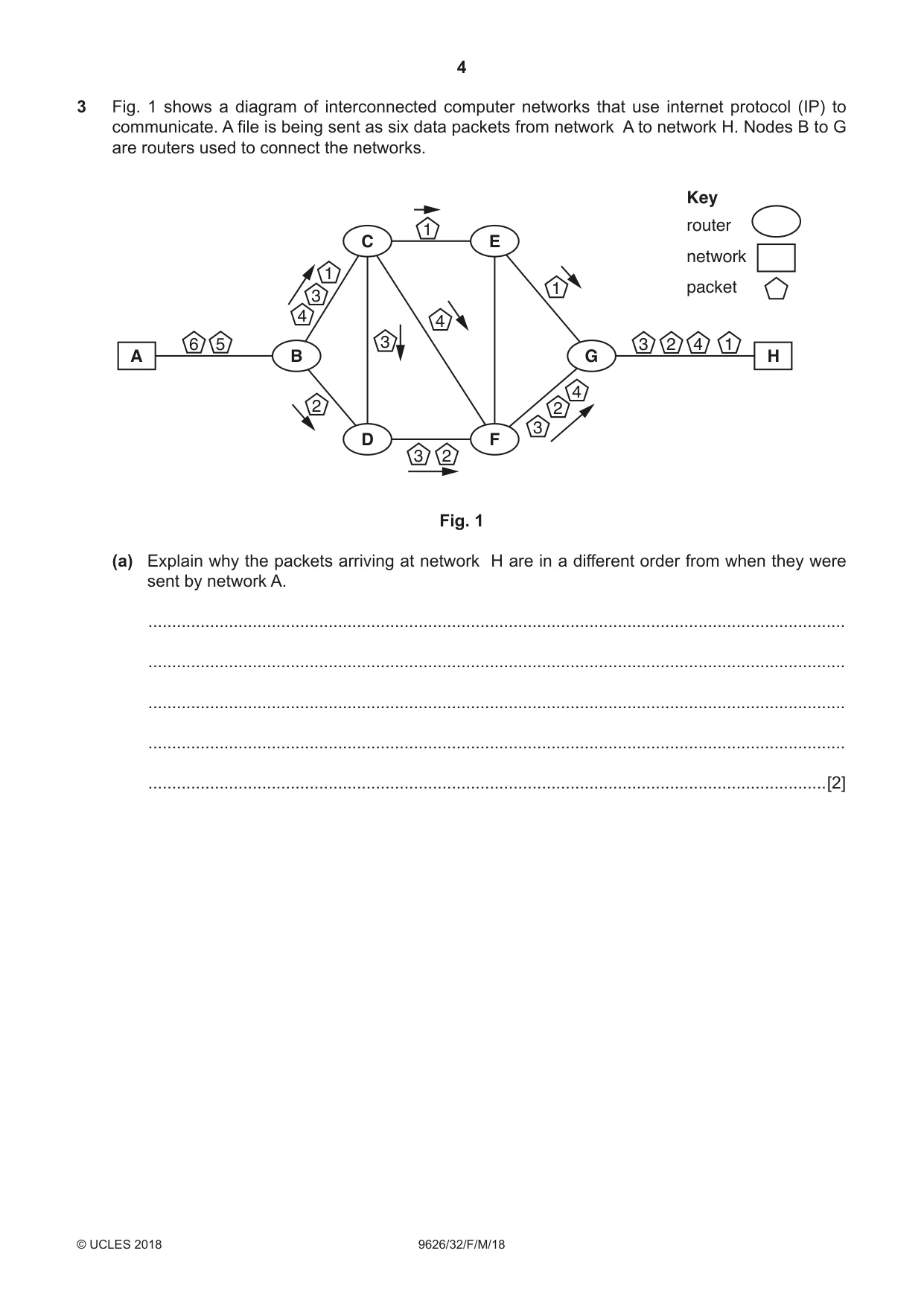
3 Fig. 1 shows a diagram of interconnected computer networks that use internet protocol (IP) to communicate. A file is being sent as six data packets from network A to network H. Nodes B to G are routers used to connect the networks. Key router 1 C E network 1 1 packet 3 4 4 6 5 3 3 2 4 1 A B G H 4 2 2 3 D F 3 2 Fig. 1 (a) Explain why the packets arriving at network H are in a different order from when they were sent by network A. ................................................................................................................................................... ................................................................................................................................................... ................................................................................................................................................... ................................................................................................................................................... ...............................................................................................................................................[2] (b) Explain the role of the routers B to G in sending the packets from network A to network H. ................................................................................................................................................... ................................................................................................................................................... ................................................................................................................................................... ................................................................................................................................................... ................................................................................................................................................... ................................................................................................................................................... ................................................................................................................................................... ................................................................................................................................................... ................................................................................................................................................... ................................................................................................................................................... ................................................................................................................................................... ...............................................................................................................................................[5]
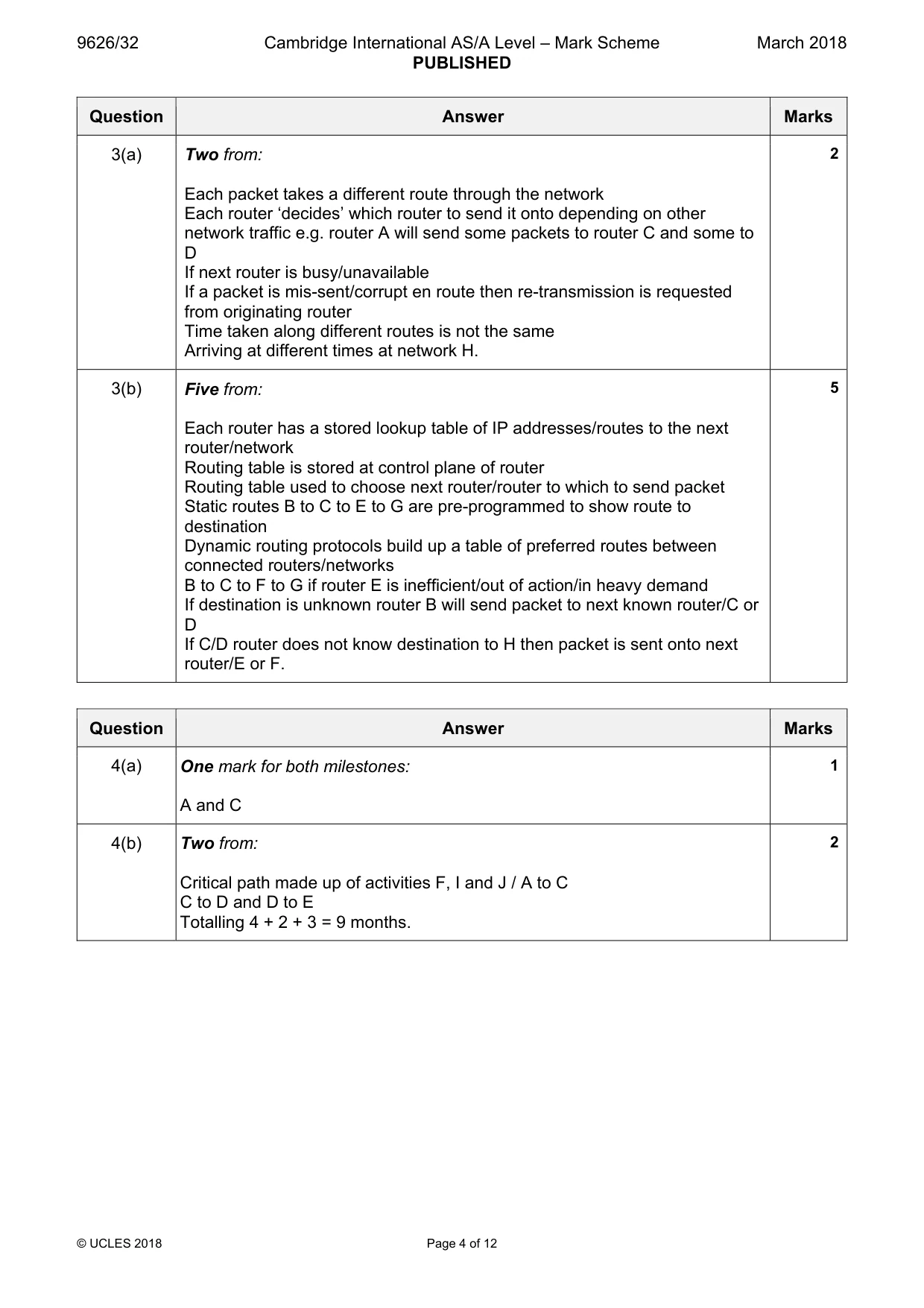
Mark scheme: 3(a) Two from: 2 Each packet takes a different route through the network Each router ‘decides’ which router to send it onto depending on other network traffic e.g. router A will send some packets to router C and some to D If next router is busy/unavailable If a packet is mis-sent/corrupt en route then re-transmission is requested from originating router Time taken along different routes is not the same Arriving at different times at network H. 3(b) Five from: 5 Each router has a stored lookup table of IP addresses/routes to the next router/network Routing table is stored at control plane of router Routing table used to choose next router/router to which to send packet Static routes B to C to E to G are pre-programmed to show route to destination Dynamic routing protocols build up a table of preferred routes between connected routers/networks B to C to F to G if router E is inefficient/out of action/in heavy demand If destination is unknown router B will send packet to next known router/C or D If C/D router does not know destination to H then packet is sent onto next router/E or F.
Q4 · A building project has a number of activities, F, G, H, I, J and K, that need to be…
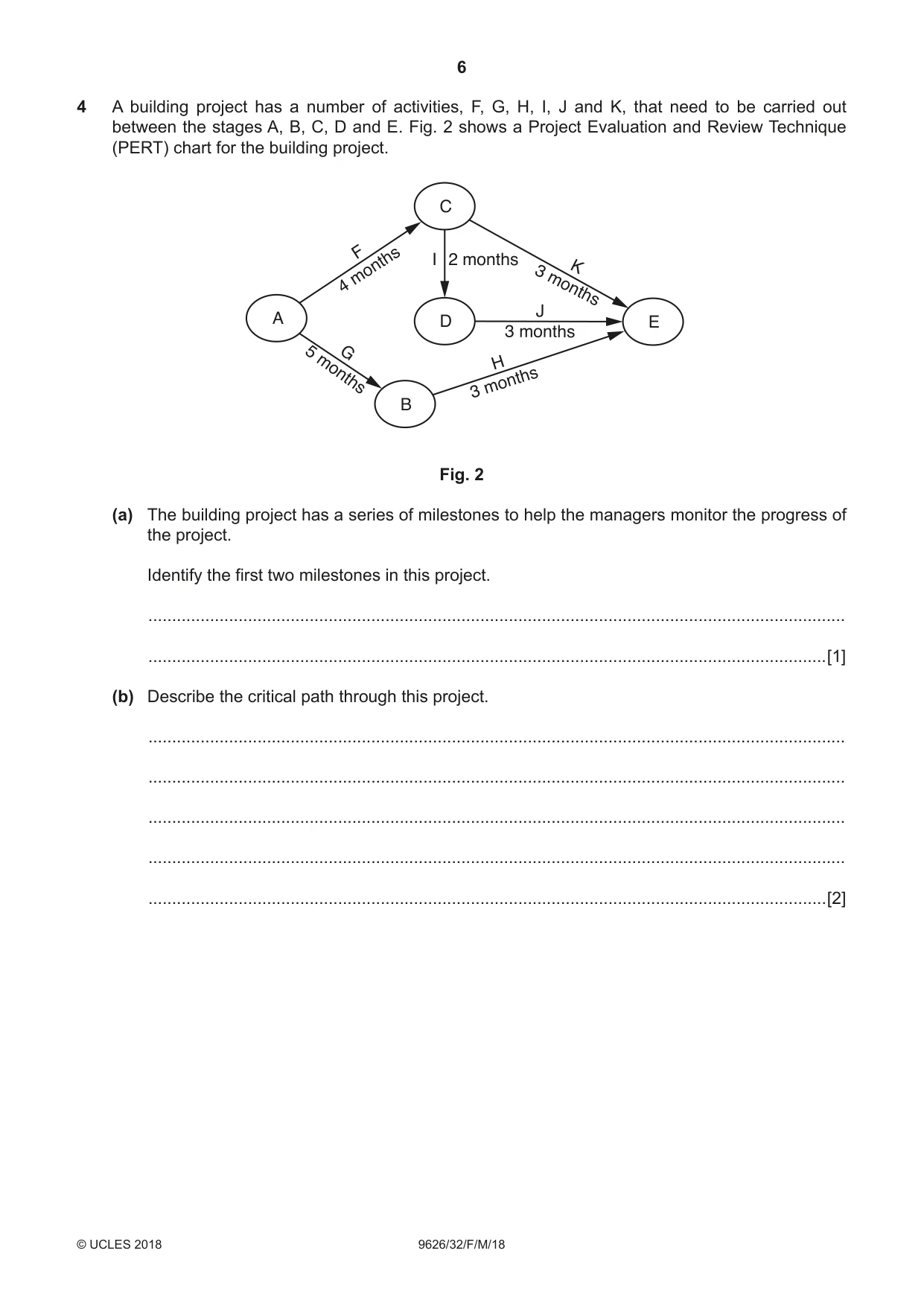
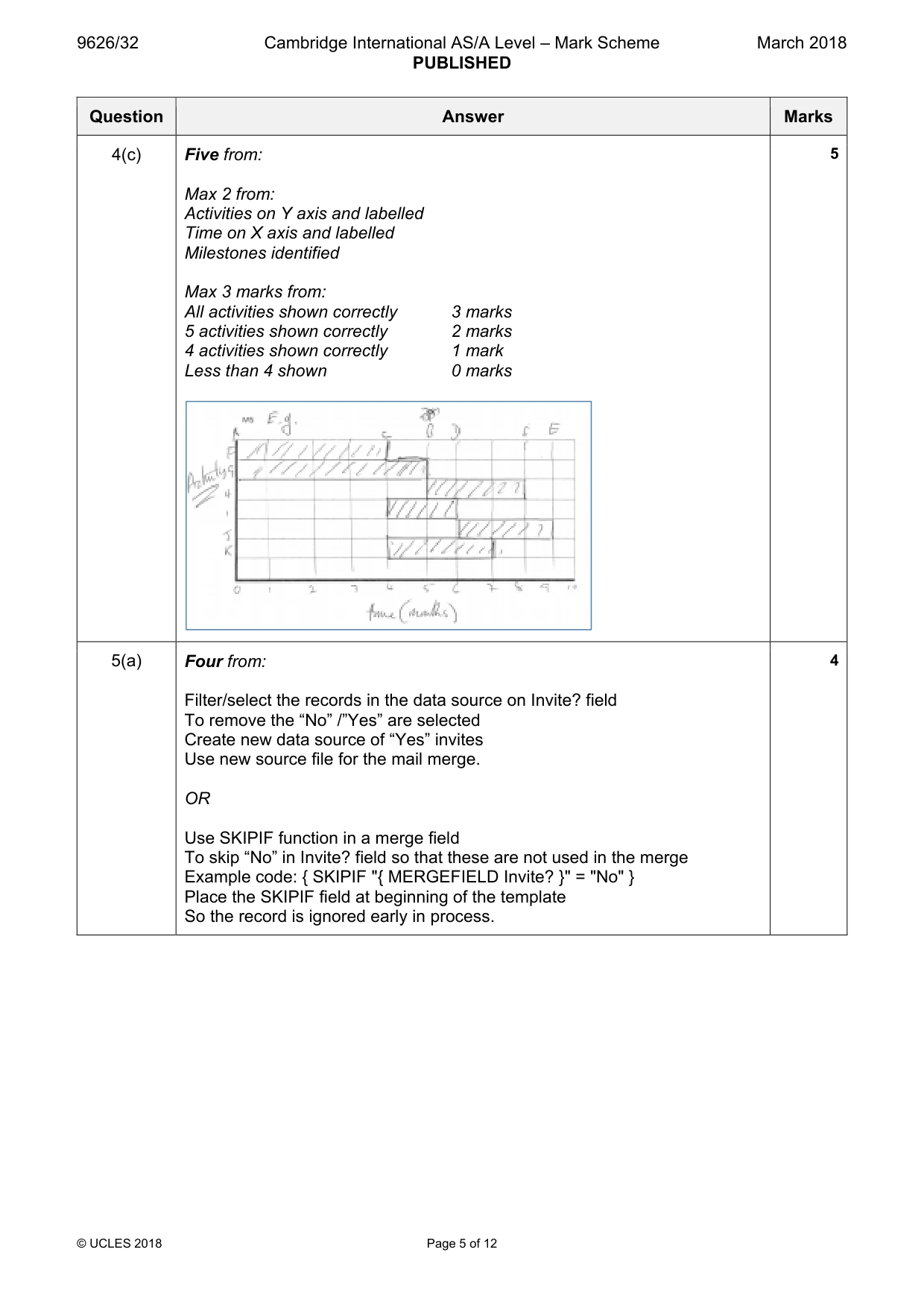
4 A building project has a number of activities, F, G, H, I, J and K, that need to be carried out between the stages A, B, C, D and E. Fig. 2 shows a Project Evaluation and Review Technique (PERT) chart for the building project. C F I 2 months 3 K months 4 months J A D E 3 months 5 G H months 3months B Fig. 2 (a) The building project has a series of milestones to help the managers monitor the progress of the project. Identify the first two milestones in this project. ................................................................................................................................................... ...............................................................................................................................................[1] (b) Describe the critical path through this project. ................................................................................................................................................... ................................................................................................................................................... ................................................................................................................................................... ................................................................................................................................................... ...............................................................................................................................................[2] To create the PERT chart, managers first produced a Gantt chart. (c) On the grid below, draw and label the Gantt chart from which the PERT chart in Fig. 2 would have been derived. [5]
Mark scheme: 4(a) One mark for both milestones: 1 A and C 4(b) Two from: 2 Critical path made up of activities F, I and J / A to C C to D and D to E Totalling 4 + 2 + 3 = 9 months. 4(c) Five from: 5 Max 2 from: Activities on Y axis and labelled Time on X axis and labelled Milestones identified Max 3 marks from: All activities shown correctly 3 marks 5 activities shown correctly 2 marks 4 activities shown correctly 1 mark Less than 4 shown 0 marks
More questions on Tools and techniques for project management tasks
Q5 · A global company has many managers in cities around the world
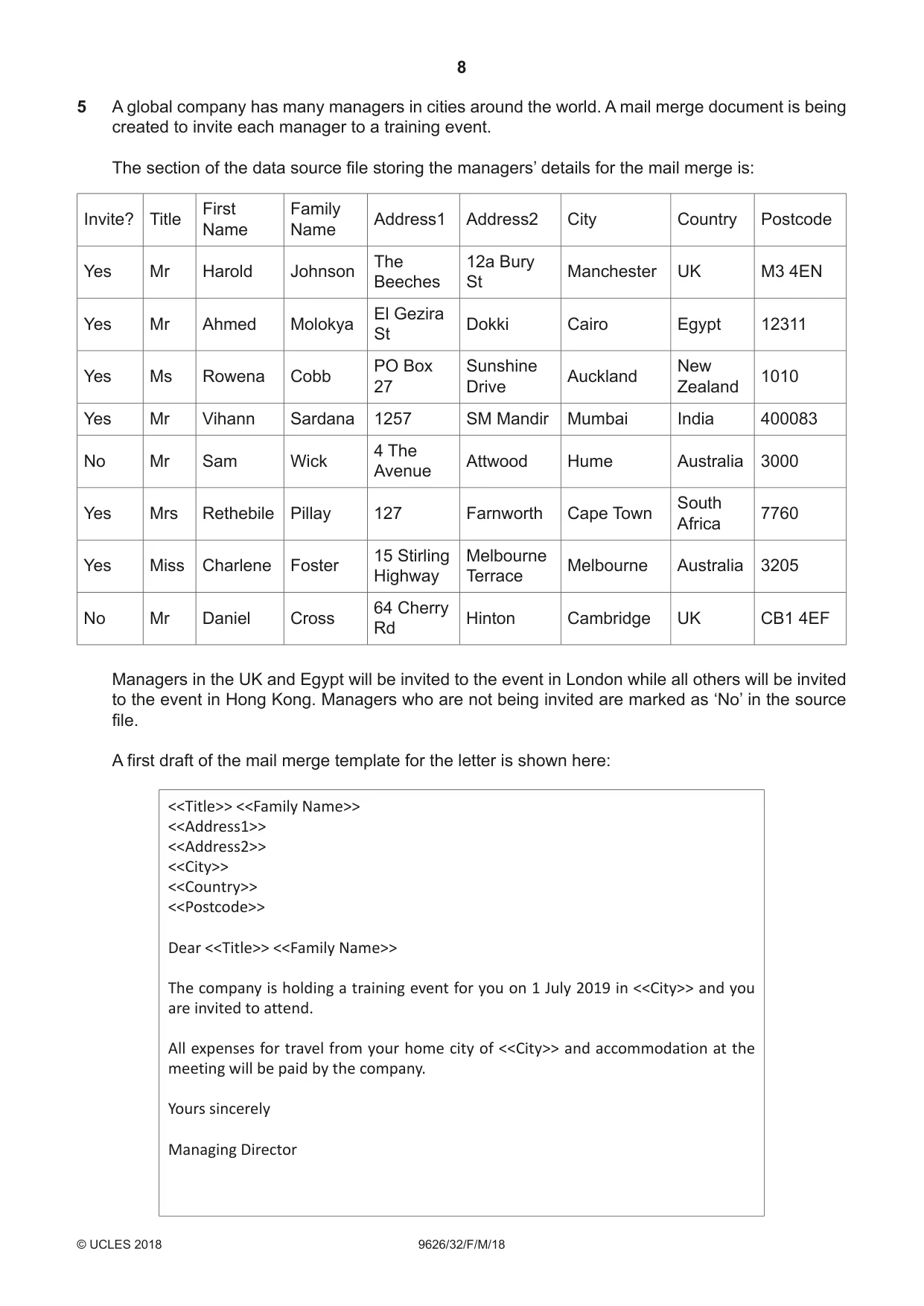
5 A global company has many managers in cities around the world. A mail merge document is being created to invite each manager to a training event. The section of the data source file storing the managers’ details for the mail merge is: First Family Invite? Title Address1 Address2 City Country Postcode Name Name The 12a Bury Yes Mr Harold Johnson Manchester UK M3 4EN Beeches St El Gezira Yes Mr Ahmed Molokya Dokki Cairo Egypt 12311 St PO Box Sunshine New Yes Ms Rowena Cobb Auckland 1010 27 Drive Zealand Yes Mr Vihann Sardana 1257 SM Mandir Mumbai India 400083 4 The No Mr Sam Wick Attwood Hume Australia 3000 Avenue South Yes Mrs Rethebile Pillay 127 Farnworth Cape Town 7760 Africa 15 Stirling Melbourne Yes Miss Charlene Foster Melbourne Australia 3205 Highway Terrace 64 Cherry No Mr Daniel Cross Hinton Cambridge UK CB1 4EF Rd Managers in the UK and Egypt will be invited to the event in London while all others will be invited to the event in Hong Kong. Managers who are not being invited are marked as ‘No’ in the source file. A first draft of the mail merge template for the letter is shown here: <<Title>> <<Family Name>> <<Address1>> <<Address2>> <<City>> <<Country>> <<Postcode>> Dear <<Title>> <<Family Name>> The company is holding a training event for you on 1 July 2019 in <<City>> and you are invited to attend. All expenses for travel from your home city of <<City>> and accommodation at the meeting will be paid by the company. Yours sincerely Managing Director (a) Explain how the mail merge may be set up to create letters only to those who are invited. ................................................................................................................................................... ................................................................................................................................................... ................................................................................................................................................... ................................................................................................................................................... ................................................................................................................................................... ................................................................................................................................................... ................................................................................................................................................... ................................................................................................................................................... ...............................................................................................................................................[4] (b) Explain how the mail merge template, shown on page 8, must be altered to ensure that the managers who receive an invitation are asked to the correct event. ................................................................................................................................................... ................................................................................................................................................... ................................................................................................................................................... ................................................................................................................................................... ................................................................................................................................................... ................................................................................................................................................... ................................................................................................................................................... ................................................................................................................................................... ................................................................................................................................................... ................................................................................................................................................... ................................................................................................................................................... ................................................................................................................................................... ................................................................................................................................................... ................................................................................................................................................... ................................................................................................................................................... ................................................................................................................................................... ................................................................................................................................................... ................................................................................................................................................... ................................................................................................................................................... ...............................................................................................................................................[8]
Mark scheme: 5(a) Four from: 4 Filter/select the records in the data source on Invite? field To remove the “No” /”Yes” are selected Create new data source of “Yes” invites Use new source file for the mail merge. OR Use SKIPIF function in a merge field To skip “No” in Invite? field so that these are not used in the merge Example code: { SKIPIF "{ MERGEFIELD Invite? }" = "No" } Place the SKIPIF field at beginning of the template So the record is ignored early in process. 5(b) Eight from: 8 Replace the second <<City>> field/<<City>> field in body of letter As this does not show correct city for meeting but repeats the address city Insert variable field in place of this field to select meeting city based on Country field Use a nested IF Comparing Country with UK and with Egypt to select “London” as meeting city If neither match then Hong Kong is selected as meeting city Example code: { IF { MERGEFIELD Country} = “UK” “London” {IF { MERGEFIELD Country } = “Egypt” “London” “Hong Kong”} } Allow 1 mark for { IF { MERGEFIELD Country} = “UK” “London” Allow 1 mark for {IF { MERGEFIELD Country } = “Egypt” “London” “Hong Kong”} }
Q6 · Drivers who are 16 years of age or older can apply for a driving licence online
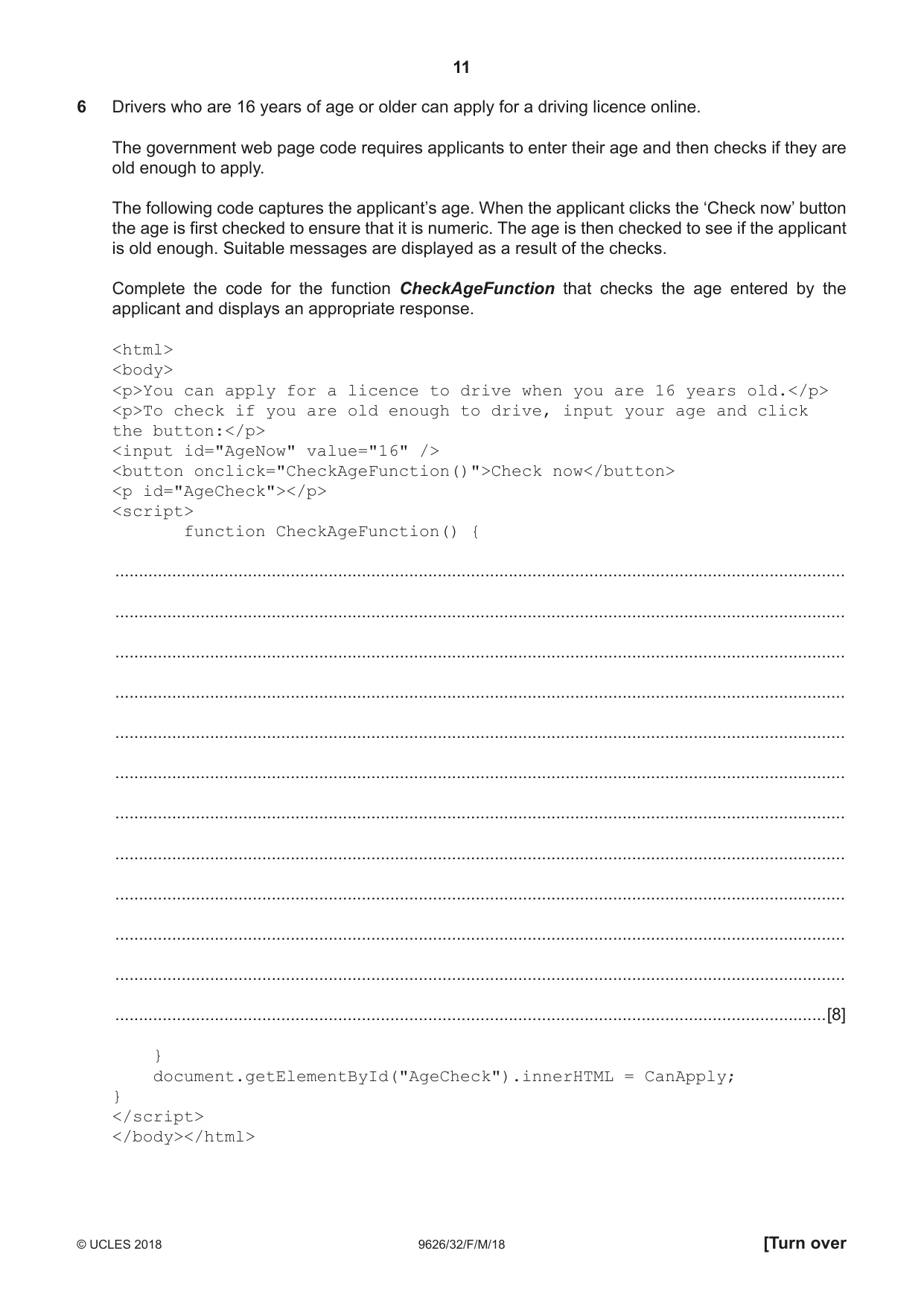
6 Drivers who are 16 years of age or older can apply for a driving licence online. The government web page code requires applicants to enter their age and then checks if they are old enough to apply. The following code captures the applicant’s age. When the applicant clicks the ‘Check now’ button the age is first checked to ensure that it is numeric. The age is then checked to see if the applicant is old enough. Suitable messages are displayed as a result of the checks. Complete the code for the function CheckAgeFunction that checks the age entered by the applicant and displays an appropriate response. <html> <body> <p>You can apply for a licence to drive when you are 16 years old.</p> <p>To check if you are old enough to drive, input your age and click the button:</p> <input id="AgeNow" value="16" /> <button onclick="CheckAgeFunction()">Check now</button> <p id="AgeCheck"></p> <script> function CheckAgeFunction() { .......................................................................................................................................................... .......................................................................................................................................................... .......................................................................................................................................................... .......................................................................................................................................................... .......................................................................................................................................................... .......................................................................................................................................................... .......................................................................................................................................................... .......................................................................................................................................................... .......................................................................................................................................................... .......................................................................................................................................................... .......................................................................................................................................................... ......................................................................................................................................................[8] } document.getElementById("AgeCheck").innerHTML = CanApply; } </script> </body></html>
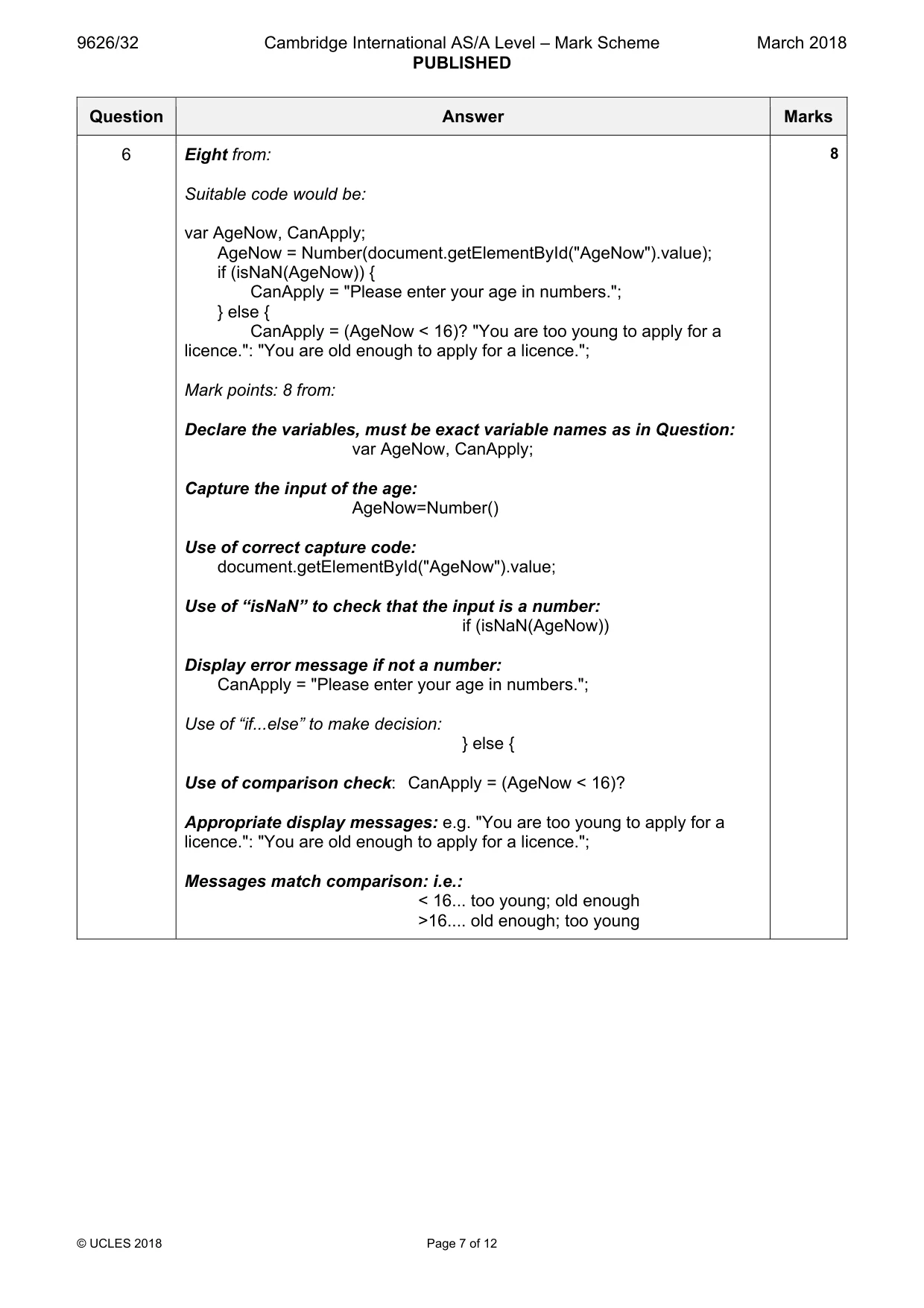
Mark scheme: 6 Eight from: 8 Suitable code would be: var AgeNow, CanApply; AgeNow = Number(document.getElementById("AgeNow").value); if (isNaN(AgeNow)) { CanApply = "Please enter your age in numbers."; } else { CanApply = (AgeNow < 16)? "You are too young to apply for a licence.": "You are old enough to apply for a licence."; Mark points: 8 from: Declare the variables, must be exact variable names as in Question: var AgeNow, CanApply; Capture the input of the age: AgeNow=Number() Use of correct capture code: document.getElementById("AgeNow").value; Use of “isNaN” to check that the input is a number: if (isNaN(AgeNow)) Display error message if not a number: CanApply = "Please enter your age in numbers."; Use of “if...else” to make decision: } else { Use of comparison check: CanApply = (AgeNow < 16)? Appropriate display messages: e.g. "You are too young to apply for a licence.": "You are old enough to apply for a licence."; Messages match comparison: i.e.: < 16... too young; old enough >16.... old enough; too young
Q7 · Describe how wearable computers can enhance health care
7 Describe how wearable computers can enhance health care. .......................................................................................................................................................... .......................................................................................................................................................... .......................................................................................................................................................... .......................................................................................................................................................... .......................................................................................................................................................... .......................................................................................................................................................... .......................................................................................................................................................... .......................................................................................................................................................... .......................................................................................................................................................... .......................................................................................................................................................... .......................................................................................................................................................... .......................................................................................................................................................... .......................................................................................................................................................... .......................................................................................................................................................... .......................................................................................................................................................... .......................................................................................................................................................... .......................................................................................................................................................... .......................................................................................................................................................... .......................................................................................................................................................... ......................................................................................................................................................[8]
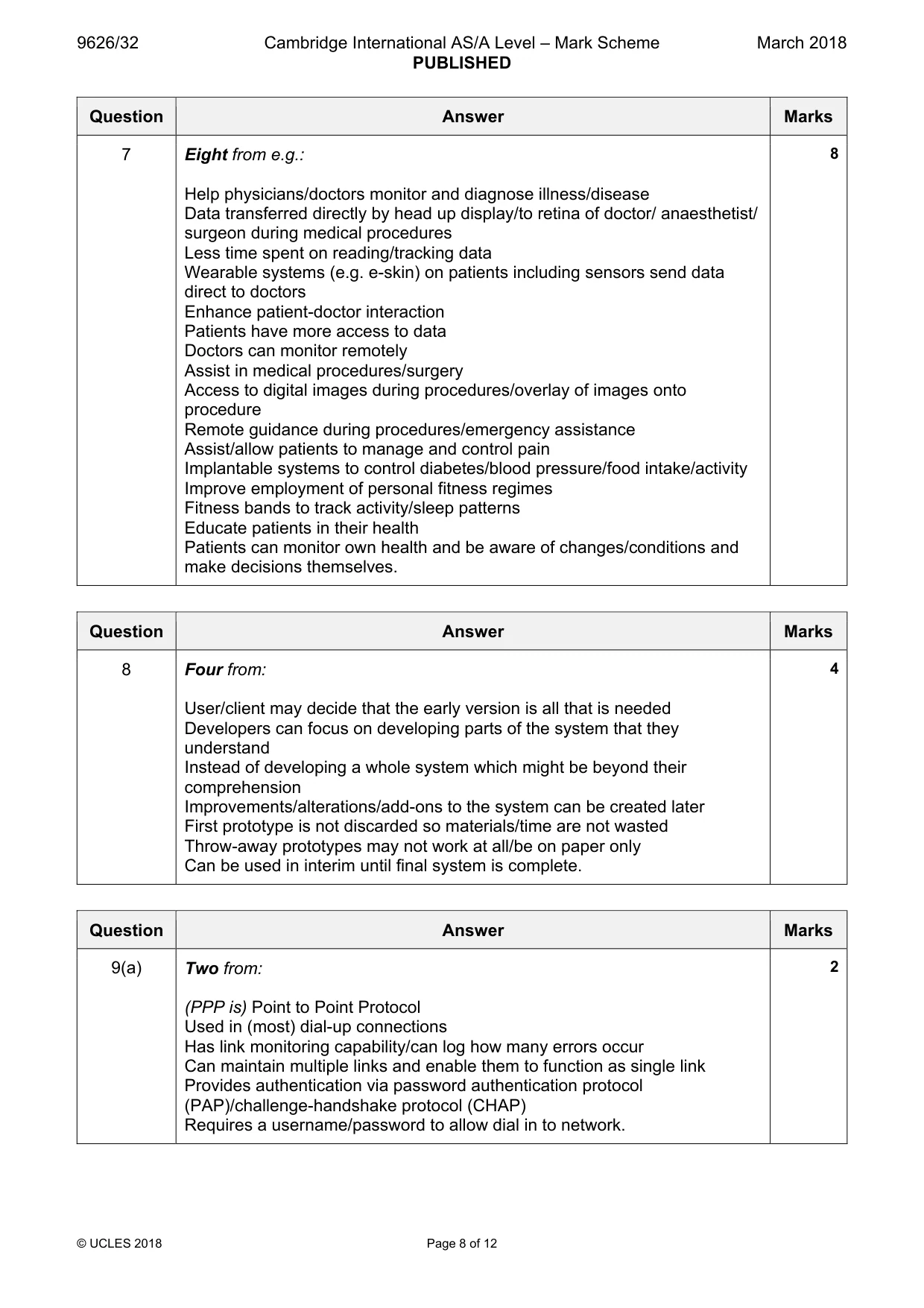
Mark scheme: 7 Eight from e.g.: 8 Help physicians/doctors monitor and diagnose illness/disease Data transferred directly by head up display/to retina of doctor/ anaesthetist/ surgeon during medical procedures Less time spent on reading/tracking data Wearable systems (e.g. e-skin) on patients including sensors send data direct to doctors Enhance patient-doctor interaction Patients have more access to data Doctors can monitor remotely Assist in medical procedures/surgery Access to digital images during procedures/overlay of images onto procedure Remote guidance during procedures/emergency assistance Assist/allow patients to manage and control pain Implantable systems to control diabetes/blood pressure/food intake/activity Improve employment of personal fitness regimes Fitness bands to track activity/sleep patterns Educate patients in their health Patients can monitor own health and be aware of changes/conditions and make decisions themselves.
Q8 · Describe the advantages of evolutionary prototyping compared to throw-away prototyping
8 Describe the advantages of evolutionary prototyping compared to throw-away prototyping. .......................................................................................................................................................... .......................................................................................................................................................... .......................................................................................................................................................... .......................................................................................................................................................... .......................................................................................................................................................... .......................................................................................................................................................... .......................................................................................................................................................... .......................................................................................................................................................... ......................................................................................................................................................[4]
Mark scheme: 8 Four from: 4 User/client may decide that the early version is all that is needed Developers can focus on developing parts of the system that they understand Instead of developing a whole system which might be beyond their comprehension Improvements/alterations/add-ons to the system can be created later First prototype is not discarded so materials/time are not wasted Throw-away prototypes may not work at all/be on paper only Can be used in interim until final system is complete.
Q9 · There are a number of different types of protocols
9 There are a number of different types of protocols. (a) PPP is a network protocol. Describe what is meant by PPP. ................................................................................................................................................... ................................................................................................................................................... ................................................................................................................................................... ................................................................................................................................................... ...............................................................................................................................................[2] (b) Email is used to send and retrieve messages between email clients and email servers. One network protocol in common use for email access is Internet Message Access Protocol (IMAP). Describe the features of IMAP that make it suitable for email access on smartphones. ................................................................................................................................................... ................................................................................................................................................... ................................................................................................................................................... ................................................................................................................................................... ................................................................................................................................................... ................................................................................................................................................... ................................................................................................................................................... ................................................................................................................................................... ................................................................................................................................................... ................................................................................................................................................... ................................................................................................................................................... ................................................................................................................................................... ................................................................................................................................................... ................................................................................................................................................... ................................................................................................................................................... ................................................................................................................................................... ................................................................................................................................................... ................................................................................................................................................... ................................................................................................................................................... ...............................................................................................................................................[8]
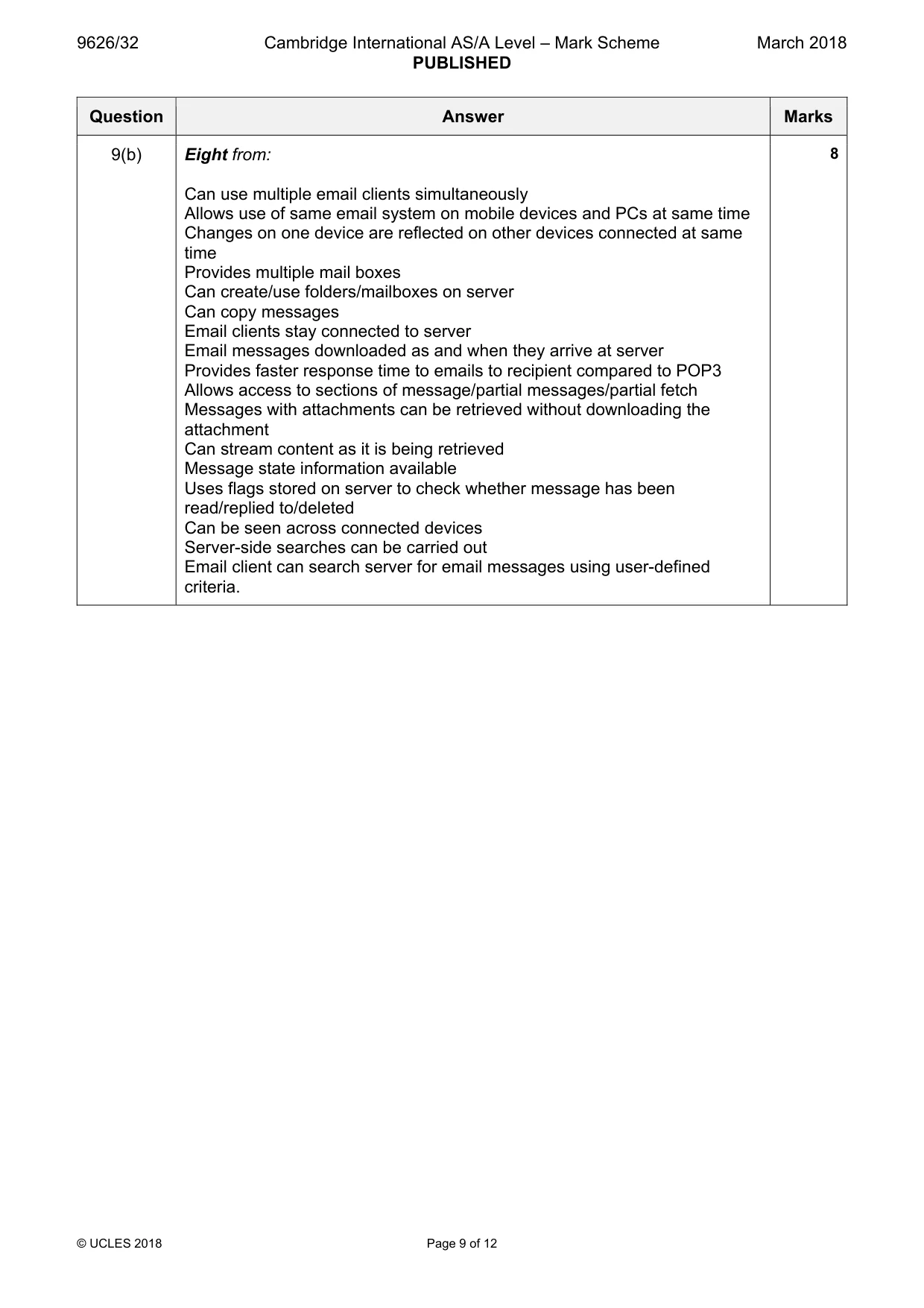
Mark scheme: 9(a) Two from: 2 (PPP is) Point to Point Protocol Used in (most) dial-up connections Has link monitoring capability/can log how many errors occur Can maintain multiple links and enable them to function as single link Provides authentication via password authentication protocol (PAP)/challenge-handshake protocol (CHAP) Requires a username/password to allow dial in to network. 9(b) Eight from: 8 Can use multiple email clients simultaneously Allows use of same email system on mobile devices and PCs at same time Changes on one device are reflected on other devices connected at same time Provides multiple mail boxes Can create/use folders/mailboxes on server Can copy messages Email clients stay connected to server Email messages downloaded as and when they arrive at server Provides faster response time to emails to recipient compared to POP3 Allows access to sections of message/partial messages/partial fetch Messages with attachments can be retrieved without downloading the attachment Can stream content as it is being retrieved Message state information available Uses flags stored on server to check whether message has been read/replied to/deleted Can be seen across connected devices Server-side searches can be carried out Email client can search server for email messages using user-defined criteria.
Q10 · Evaluate the use of asymmetric-key and symmetric-key cryptography when encrypting data…
10 Evaluate the use of asymmetric-key and symmetric-key cryptography when encrypting data for electronic transmission between two people. .......................................................................................................................................................... .......................................................................................................................................................... .......................................................................................................................................................... .......................................................................................................................................................... .......................................................................................................................................................... .......................................................................................................................................................... .......................................................................................................................................................... .......................................................................................................................................................... .......................................................................................................................................................... .......................................................................................................................................................... .......................................................................................................................................................... .......................................................................................................................................................... .......................................................................................................................................................... .......................................................................................................................................................... .......................................................................................................................................................... .......................................................................................................................................................... .......................................................................................................................................................... .......................................................................................................................................................... .......................................................................................................................................................... ......................................................................................................................................................[8]
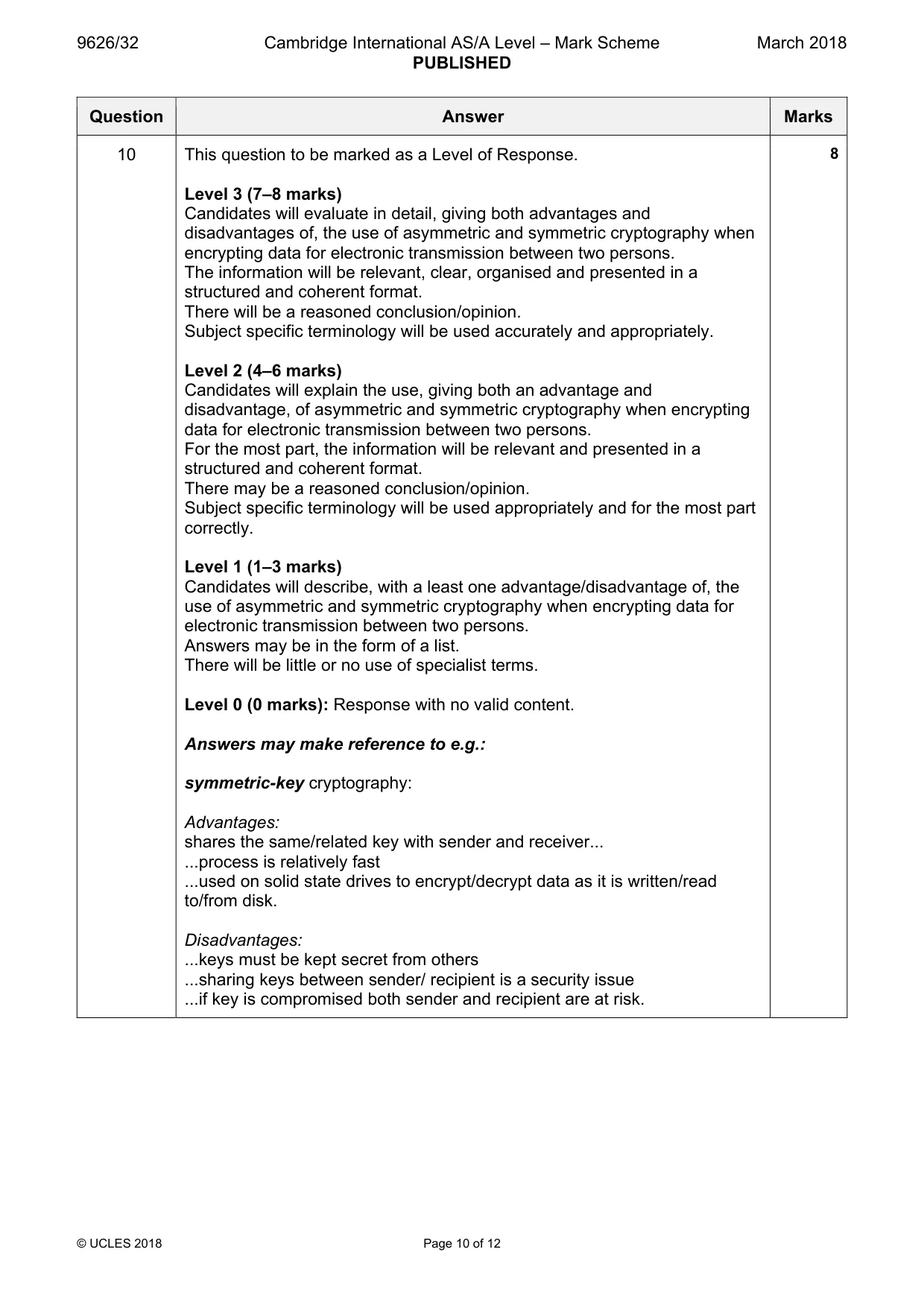
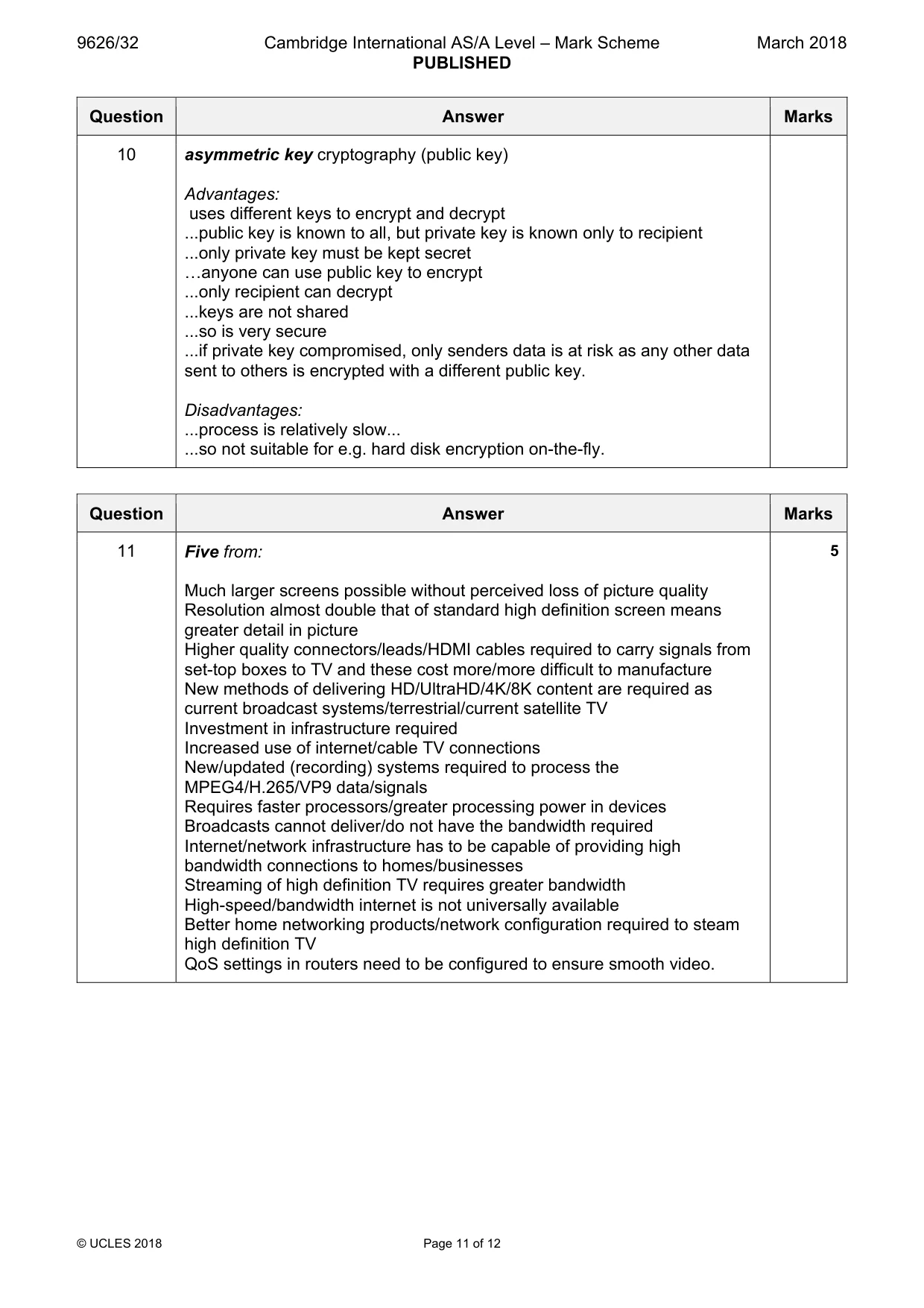
Mark scheme: 10 This question to be marked as a Level of Response. 8 Level 3 (7–8 marks) Candidates will evaluate in detail, giving both advantages and disadvantages of, the use of asymmetric and symmetric cryptography when encrypting data for electronic transmission between two persons. The information will be relevant, clear, organised and presented in a structured and coherent format. There will be a reasoned conclusion/opinion. Subject specific terminology will be used accurately and appropriately. Level 2 (4–6 marks) Candidates will explain the use, giving both an advantage and disadvantage, of asymmetric and symmetric cryptography when encrypting data for electronic transmission between two persons. For the most part, the information will be relevant and presented in a structured and coherent format. There may be a reasoned conclusion/opinion. Subject specific terminology will be used appropriately and for the most part correctly. Level 1 (1–3 marks) Candidates will describe, with a least one advantage/disadvantage of, the use of asymmetric and symmetric cryptography when encrypting data for electronic transmission between two persons. Answers may be in the form of a list. There will be little or no use of specialist terms. Level 0 (0 marks): Response with no valid content. Answers may make reference to e.g.: symmetric-key cryptography: Advantages: shares the same/related key with sender and receiver... ...process is relatively fast ...used on solid state drives to encrypt/decrypt data as it is written/read to/from disk. Disadvantages: ...keys must be kept secret from others ...sharing keys between sender/ recipient is a security issue ...if key is compromised both sender and recipient are at risk.
Q11 · Analyse the impact of the introduction of high definition television systems
11 Analyse the impact of the introduction of high definition television systems. .......................................................................................................................................................... .......................................................................................................................................................... .......................................................................................................................................................... .......................................................................................................................................................... .......................................................................................................................................................... .......................................................................................................................................................... .......................................................................................................................................................... .......................................................................................................................................................... .......................................................................................................................................................... .......................................................................................................................................................... .......................................................................................................................................................... ......................................................................................................................................................[5]
Mark scheme: 11 Five from: 5 Much larger screens possible without perceived loss of picture quality Resolution almost double that of standard high definition screen means greater detail in picture Higher quality connectors/leads/HDMI cables required to carry signals from set-top boxes to TV and these cost more/more difficult to manufacture New methods of delivering HD/UltraHD/4K/8K content are required as current broadcast systems/terrestrial/current satellite TV Investment in infrastructure required Increased use of internet/cable TV connections New/updated (recording) systems required to process the MPEG4/H.265/VP9 data/signals Requires faster processors/greater processing power in devices Broadcasts cannot deliver/do not have the bandwidth required Internet/network infrastructure has to be capable of providing high bandwidth connections to homes/businesses Streaming of high definition TV requires greater bandwidth High-speed/bandwidth internet is not universally available Better home networking products/network configuration required to steam high definition TV QoS settings in routers need to be configured to ensure smooth video.
Q12 · Discuss the impact on society of online banking
12 Discuss the impact on society of online banking. .......................................................................................................................................................... .......................................................................................................................................................... .......................................................................................................................................................... .......................................................................................................................................................... .......................................................................................................................................................... .......................................................................................................................................................... .......................................................................................................................................................... .......................................................................................................................................................... .......................................................................................................................................................... .......................................................................................................................................................... .......................................................................................................................................................... .......................................................................................................................................................... .......................................................................................................................................................... .......................................................................................................................................................... .......................................................................................................................................................... .......................................................................................................................................................... .......................................................................................................................................................... .......................................................................................................................................................... .......................................................................................................................................................... ......................................................................................................................................................[8]
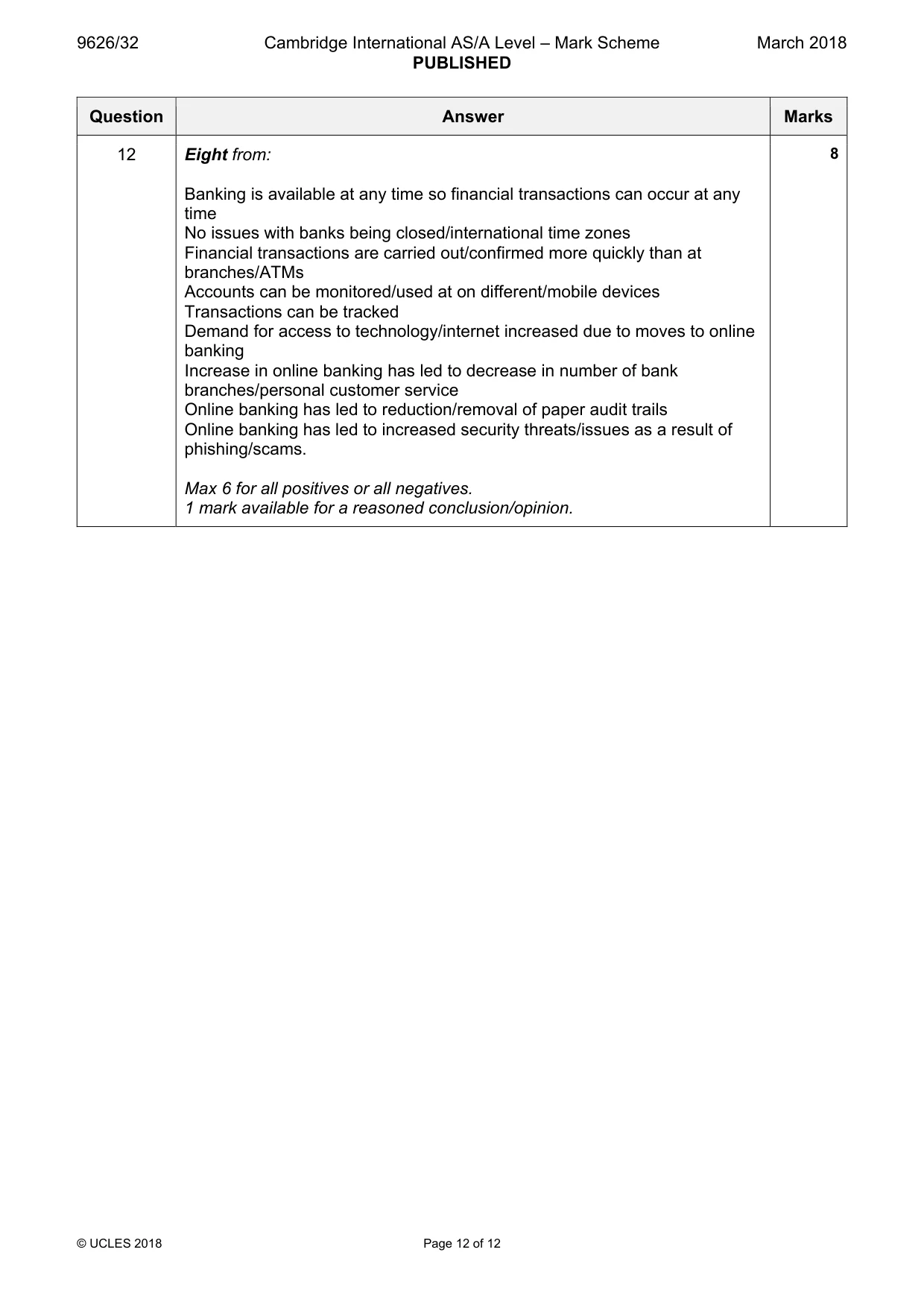
Mark scheme: 12 Eight from: 8 Banking is available at any time so financial transactions can occur at any time No issues with banks being closed/international time zones Financial transactions are carried out/confirmed more quickly than at branches/ATMs Accounts can be monitored/used at on different/mobile devices Transactions can be tracked Demand for access to technology/internet increased due to moves to online banking Increase in online banking has led to decrease in number of bank branches/personal customer service Online banking has led to reduction/removal of paper audit trails Online banking has led to increased security threats/issues as a result of phishing/scams. Max 6 for all positives or all negatives. 1 mark available for a reasoned conclusion/opinion.
What was in this paper
The subtopics covered by these 12 questions, and how many questions each got. Open one in a new tab to see every Cambridge question on it.
What you needed in this session
Cambridge’s own grade thresholds for 2018 Feb/March, Paper 3 · Variant 2. A higher threshold means an easier paper — the bar moves with how the cohort did.