Cambridge A Level History (pre-2015) 9697 — 2014 May/June Paper 1 · Variant 3
9697/13/M/J/14 · 100 marks · ≈113 min
The question paper and its mark scheme, free to read here and free to download. This is Cambridge’s own paper, exactly as it was sat.
Question paper4 pages
Mark scheme11 pages
Answers below. Sit the paper first if you are practising.
Paper as text
Question paper, page 1
This document consists of 4 printed pages. DC (LK) 73401/3 © UCLES 2014 [Turn over * 8 8 0 8 7 1 9 2 2 1 * HISTORY 9697/13 Paper 1 Modern European History, 1789–1939 May/June 2014 3 hours Additional Materials: Answer Paper READ THESE INSTRUCTIONS FIRST Write your Centre number, candidate number and name on all the work you hand in. Write in dark blue or black pen. You may use an HB pencil for any rough working. Do not use staples, paper clips, glue or correction fluid. DO NOT WRITE IN ANY BARCODES. Section A Answer Question 1. Section B Answer any three questions. At the end of the examination, fasten all your work securely together. All questions in this paper carry equal marks. Cambridge International Examinations Cambridge International Advanced Subsidiary and Advanced Level
Question paper, page 2
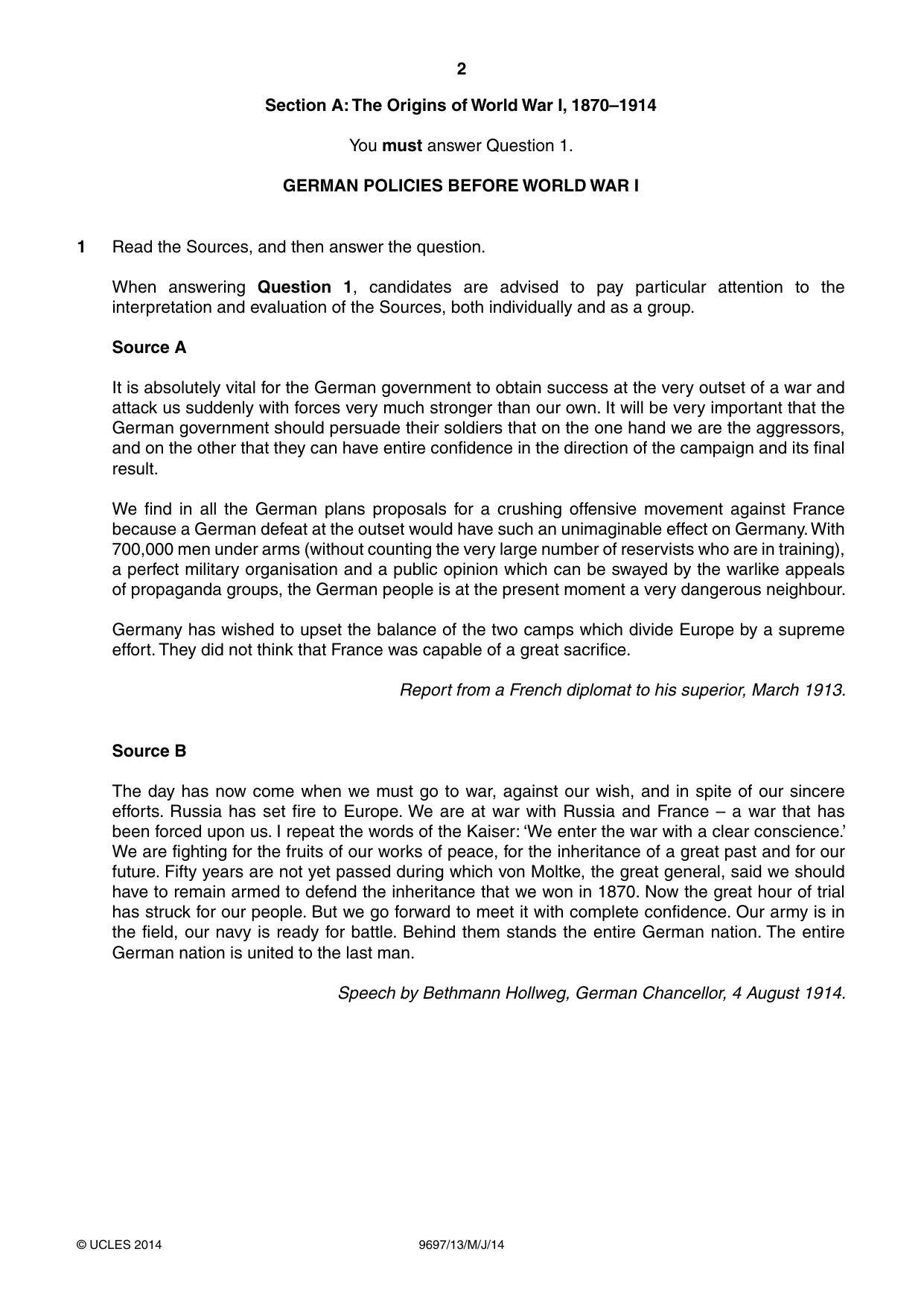
2 9697/13/M/J/14 © UCLES 2014 Section A: The Origins of World War I, 1870–1914 You must answer Question 1. GERMAN POLICIES BEFORE WORLD WAR I 1 Read the Sources, and then answer the question. When answering Question 1, candidates are advised to pay particular attention to the interpretation and evaluation of the Sources, both individually and as a group. Source A It is absolutely vital for the German government to obtain success at the very outset of a war and attack us suddenly with forces very much stronger than our own. It will be very important that the German government should persuade their soldiers that on the one hand we are the aggressors, and on the other that they can have entire confidence in the direction of the campaign and its final result. We find in all the German plans proposals for a crushing offensive movement against France because a German defeat at the outset would have such an unimaginable effect on Germany. With 700,000 men under arms (without counting the very large number of reservists who are in training), a perfect military organisation and a public opinion which can be swayed by the warlike appeals of propaganda groups, the German people is at the present moment a very dangerous neighbour. Germany has wished to upset the balance of the two camps which divide Europe by a supreme effort. They did not think that France was capable of a great sacrifice. Report from a French diplomat to his superior, March 1913. Source B The day has now come when we must go to war, against our wish, and in spite of our sincere efforts. Russia has set fire to Europe. We are at war with Russia and France – a war that has been forced upon us. I repeat the words of the Kaiser: ‘We enter the war with a clear conscience.’ We are fighting for the fruits of our works of peace, for the inheritance of a great past and for our future. Fifty years are not yet passed during which von Moltke, the great general, said we should have to remain armed to defend the inheritance that we won in 1870. Now the great hour of trial has struck for our people. But we go forward to meet it with complete confidence. Our army is in the field, our navy is ready for battle. Behind them stands the entire German nation. The entire German nation is united to the last man. Speech by Bethmann Hollweg, German Chancellor, 4 August 1914.
Question paper, page 3
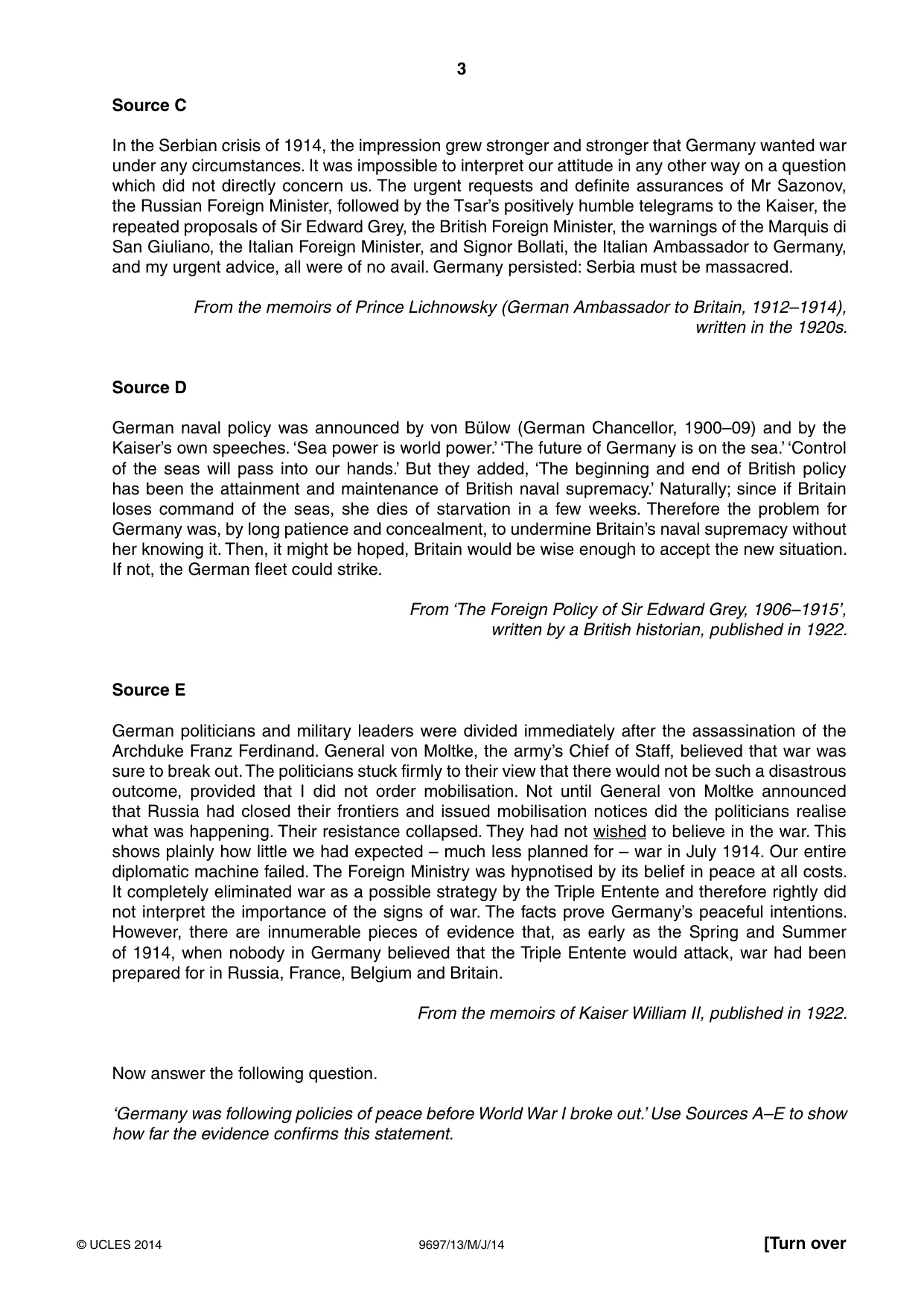
3 9697/13/M/J/14 © UCLES 2014 [Turn over Source C In the Serbian crisis of 1914, the impression grew stronger and stronger that Germany wanted war under any circumstances. It was impossible to interpret our attitude in any other way on a question which did not directly concern us. The urgent requests and definite assurances of Mr Sazonov, the Russian Foreign Minister, followed by the Tsar’s positively humble telegrams to the Kaiser, the repeated proposals of Sir Edward Grey, the British Foreign Minister, the warnings of the Marquis di San Giuliano, the Italian Foreign Minister, and Signor Bollati, the Italian Ambassador to Germany, and my urgent advice, all were of no avail. Germany persisted: Serbia must be massacred. From the memoirs of Prince Lichnowsky (German Ambassador to Britain, 1912–1914), written in the 1920s. Source D German naval policy was announced by von Bülow (German Chancellor, 1900–09) and by the Kaiser’s own speeches. ‘Sea power is world power.’ ‘The future of Germany is on the sea.’ ‘Control of the seas will pass into our hands.’ But they added, ‘The beginning and end of British policy has been the attainment and maintenance of British naval supremacy.’ Naturally; since if Britain loses command of the seas, she dies of starvation in a few weeks. Therefore the problem for Germany was, by long patience and concealment, to undermine Britain’s naval supremacy without her knowing it. Then, it might be hoped, Britain would be wise enough to accept the new situation. If not, the German fleet could strike. From ‘The Foreign Policy of Sir Edward Grey, 1906–1915’, written by a British historian, published in 1922. Source E German politicians and military leaders were divided immediately after the assassination of the Archduke Franz Ferdinand. General von Moltke, the army’s Chief of Staff, believed that war was sure to break out. The politicians stuck firmly to their view that there would not be such a disastrous outcome, provided that I did not order mobilisation. Not until General von Moltke announced that Russia had closed their frontiers and issued mobilisation notices did the politicians realise what was happening. Their resistance collapsed. They had not wished to believe in the war. This shows plainly how little we had expected – much less planned for – war in July 1914. Our entire diplomatic machine failed. The Foreign Ministry was hypnotised by its belief in peace at all costs. It completely eliminated war as a possible strategy by the Triple Entente and therefore rightly did not interpret the importance of the signs of war. The facts prove Germany’s peaceful intentions. However, there are innumerable pieces of evidence that, as early as the Spring and Summer of 1914, when nobody in Germany believed that the Triple Entente would attack, war had been prepared for in Russia, France, Belgium and Britain. From the memoirs of Kaiser William II, published in 1922. Now answer the following question. ‘Germany was following policies of peace before World War I broke out.’ Use Sources A–E to show how far the evidence confirms this statement.
Question paper, page 4
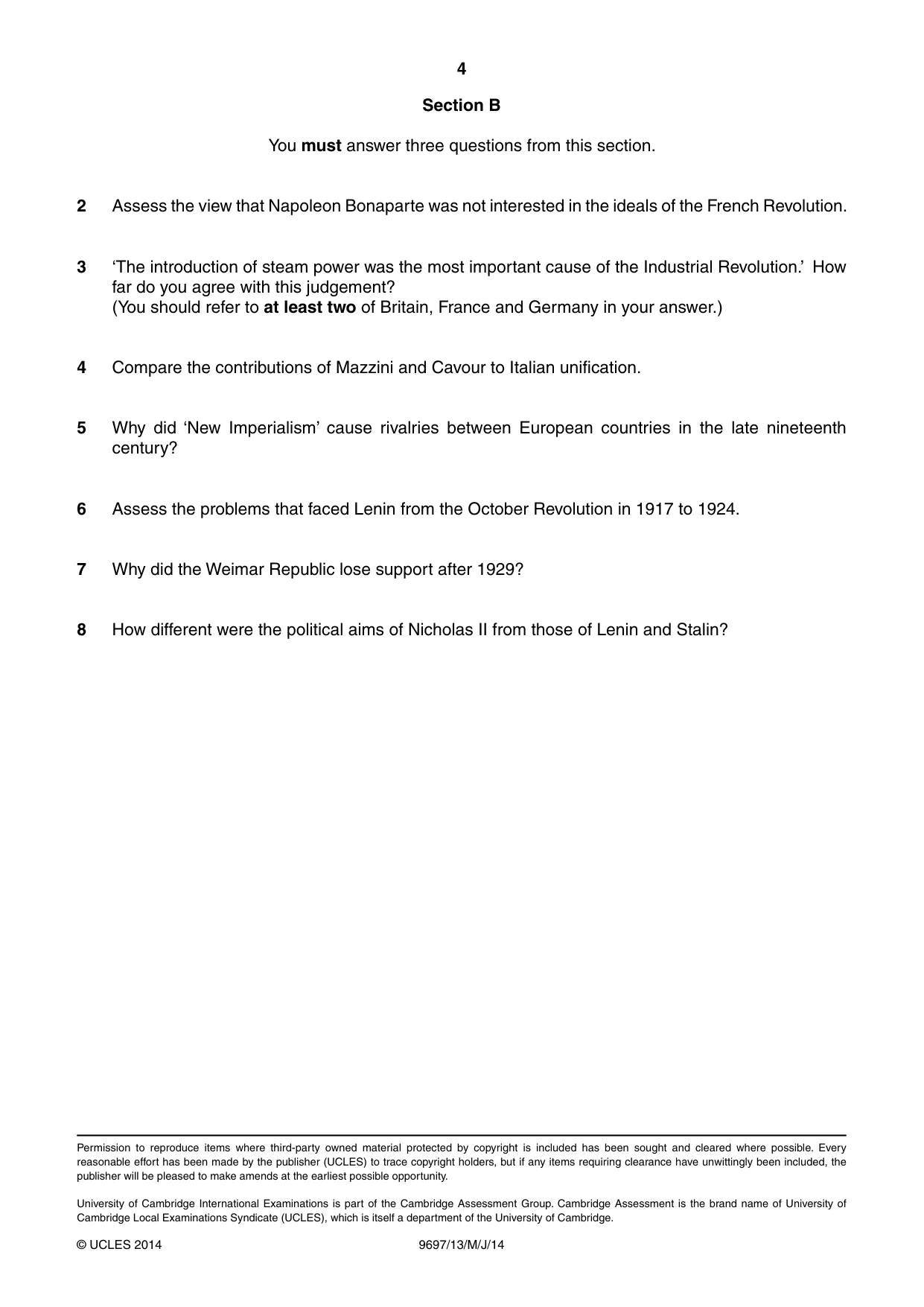
4 9697/13/M/J/14 © UCLES 2014 Permission to reproduce items where third-party owned material protected by copyright is included has been sought and cleared where possible. Every reasonable effort has been made by the publisher (UCLES) to trace copyright holders, but if any items requiring clearance have unwittingly been included, the publisher will be pleased to make amends at the earliest possible opportunity. University of Cambridge International Examinations is part of the Cambridge Assessment Group. Cambridge Assessment is the brand name of University of Cambridge Local Examinations Syndicate (UCLES), which is itself a department of the University of Cambridge. Section B You must answer three questions from this section. 2 Assess the view that Napoleon Bonaparte was not interested in the ideals of the French Revolution. 3 ‘The introduction of steam power was the most important cause of the Industrial Revolution.’ How far do you agree with this judgement? (You should refer to at least two of Britain, France and Germany in your answer.) 4 Compare the contributions of Mazzini and Cavour to Italian unification. 5 Why did ‘New Imperialism’ cause rivalries between European countries in the late nineteenth century? 6 Assess the problems that faced Lenin from the October Revolution in 1917 to 1924. 7 Why did the Weimar Republic lose support after 1929? 8 How different were the political aims of Nicholas II from those of Lenin and Stalin?
Mark scheme, page 1
CAMBRIDGE INTERNATIONAL EXAMINATIONS GCE Advanced Subsidiary Level and GCE Advanced Level MARK SCHEME for the May/June 2014 series 9697 HISTORY 9697/13 Paper 1, maximum raw mark 100 This mark scheme is published as an aid to teachers and candidates, to indicate the requirements of the examination. It shows the basis on which Examiners were instructed to award marks. It does not indicate the details of the discussions that took place at an Examiners’ meeting before marking began, which would have considered the acceptability of alternative answers. Mark schemes should be read in conjunction with the question paper and the Principal Examiner Report for Teachers. Cambridge will not enter into discussions about these mark schemes. Cambridge is publishing the mark schemes for the May/June 2014 series for most IGCSE, GCE Advanced Level and Advanced Subsidiary Level components and some Ordinary Level components.
Mark scheme, page 2
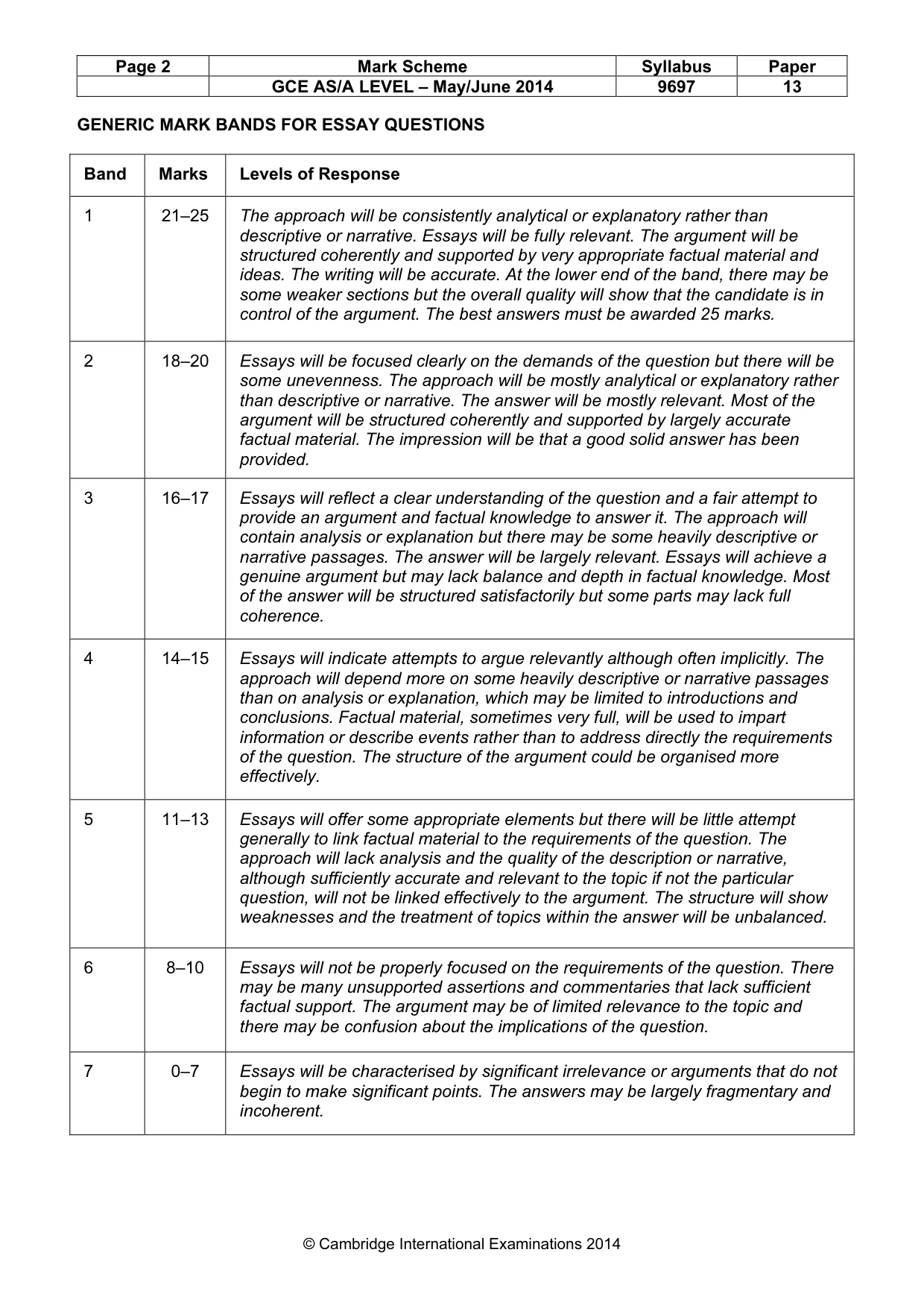
Page 2 Mark Scheme Syllabus Paper GCE AS/A LEVEL – May/June 2014 9697 13 © Cambridge International Examinations 2014 GENERIC MARK BANDS FOR ESSAY QUESTIONS Band Marks Levels of Response 1 21–25 The approach will be consistently analytical or explanatory rather than descriptive or narrative. Essays will be fully relevant. The argument will be structured coherently and supported by very appropriate factual material and ideas. The writing will be accurate. At the lower end of the band, there may be some weaker sections but the overall quality will show that the candidate is in control of the argument. The best answers must be awarded 25 marks. 2 18–20 Essays will be focused clearly on the demands of the question but there will be some unevenness. The approach will be mostly analytical or explanatory rather than descriptive or narrative. The answer will be mostly relevant. Most of the argument will be structured coherently and supported by largely accurate factual material. The impression will be that a good solid answer has been provided. 3 16–17 Essays will reflect a clear understanding of the question and a fair attempt to provide an argument and factual knowledge to answer it. The approach will contain analysis or explanation but there may be some heavily descriptive or narrative passages. The answer will be largely relevant. Essays will achieve a genuine argument but may lack balance and depth in factual knowledge. Most of the answer will be structured satisfactorily but some parts may lack full coherence. 4 14–15 Essays will indicate attempts to argue relevantly although often implicitly. The approach will depend more on some heavily descriptive or narrative passages than on analysis or explanation, which may be limited to introductions and conclusions. Factual material, sometimes very full, will be used to impart information or describe events rather than to address directly the requirements of the question. The structure of the argument could be organised more effectively. 5 11–13 Essays will offer some appropriate elements but there will be little attempt generally to link factual material to the requirements of the question. The approach will lack analysis and the quality of the description or narrative, although sufficiently accurate and relevant to the topic if not the particular question, will not be linked effectively to the argument. The structure will show weaknesses and the treatment of topics within the answer will be unbalanced. 6 8–10 Essays will not be properly focused on the requirements of the question. There may be many unsupported assertions and commentaries that lack sufficient factual support. The argument may be of limited relevance to the topic and there may be confusion about the implications of the question. 7 0–7 Essays will be characterised by significant irrelevance or arguments that do not begin to make significant points. The answers may be largely fragmentary and incoherent.
Mark scheme, page 3
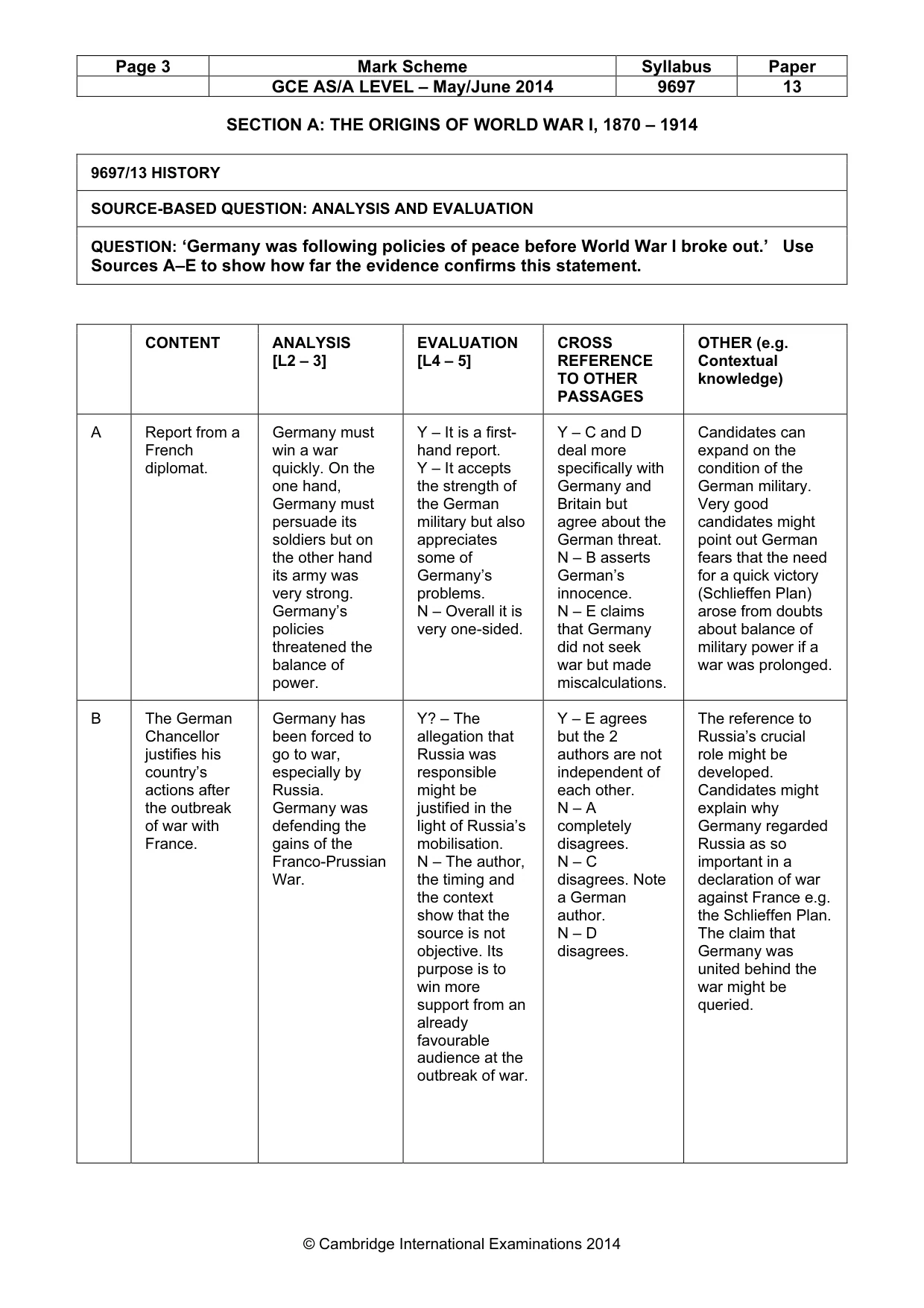
Page 3 Mark Scheme Syllabus Paper GCE AS/A LEVEL – May/June 2014 9697 13 © Cambridge International Examinations 2014 SECTION A: THE ORIGINS OF WORLD WAR I, 1870 – 1914 9697/13 HISTORY SOURCE-BASED QUESTION: ANALYSIS AND EVALUATION QUESTION: ‘Germany was following policies of peace before World War I broke out.’ Use Sources A–E to show how far the evidence confirms this statement. CONTENT ANALYSIS [L2 – 3] EVALUATION [L4 – 5] CROSS REFERENCE TO OTHER PASSAGES OTHER (e.g. Contextual knowledge) A Report from a French diplomat. Germany must win a war quickly. On the one hand, Germany must persuade its soldiers but on the other hand its army was very strong. Germany’s policies threatened the balance of power. Y – It is a first- hand report. Y – It accepts the strength of the German military but also appreciates some of Germany’s problems. N – Overall it is very one-sided. Y – C and D deal more specifically with Germany and Britain but agree about the German threat. N – B asserts German’s innocence. N – E claims that Germany did not seek war but made miscalculations. Candidates can expand on the condition of the German military. Very good candidates might point out German fears that the need for a quick victory (Schlieffen Plan) arose from doubts about balance of military power if a war was prolonged. B The German Chancellor justifies his country’s actions after the outbreak of war with France. Germany has been forced to go to war, especially by Russia. Germany was defending the gains of the Franco-Prussian War. Y? – The allegation that Russia was responsible might be justified in the light of Russia’s mobilisation. N – The author, the timing and the context show that the source is not objective. Its purpose is to win more support from an already favourable audience at the outbreak of war. Y – E agrees but the 2 authors are not independent of each other. N – A completely disagrees. N – C disagrees. Note a German author. N – D disagrees. The reference to Russia’s crucial role might be developed. Candidates might explain why Germany regarded Russia as so important in a declaration of war against France e.g. the Schlieffen Plan. The claim that Germany was united behind the war might be queried.
Mark scheme, page 4
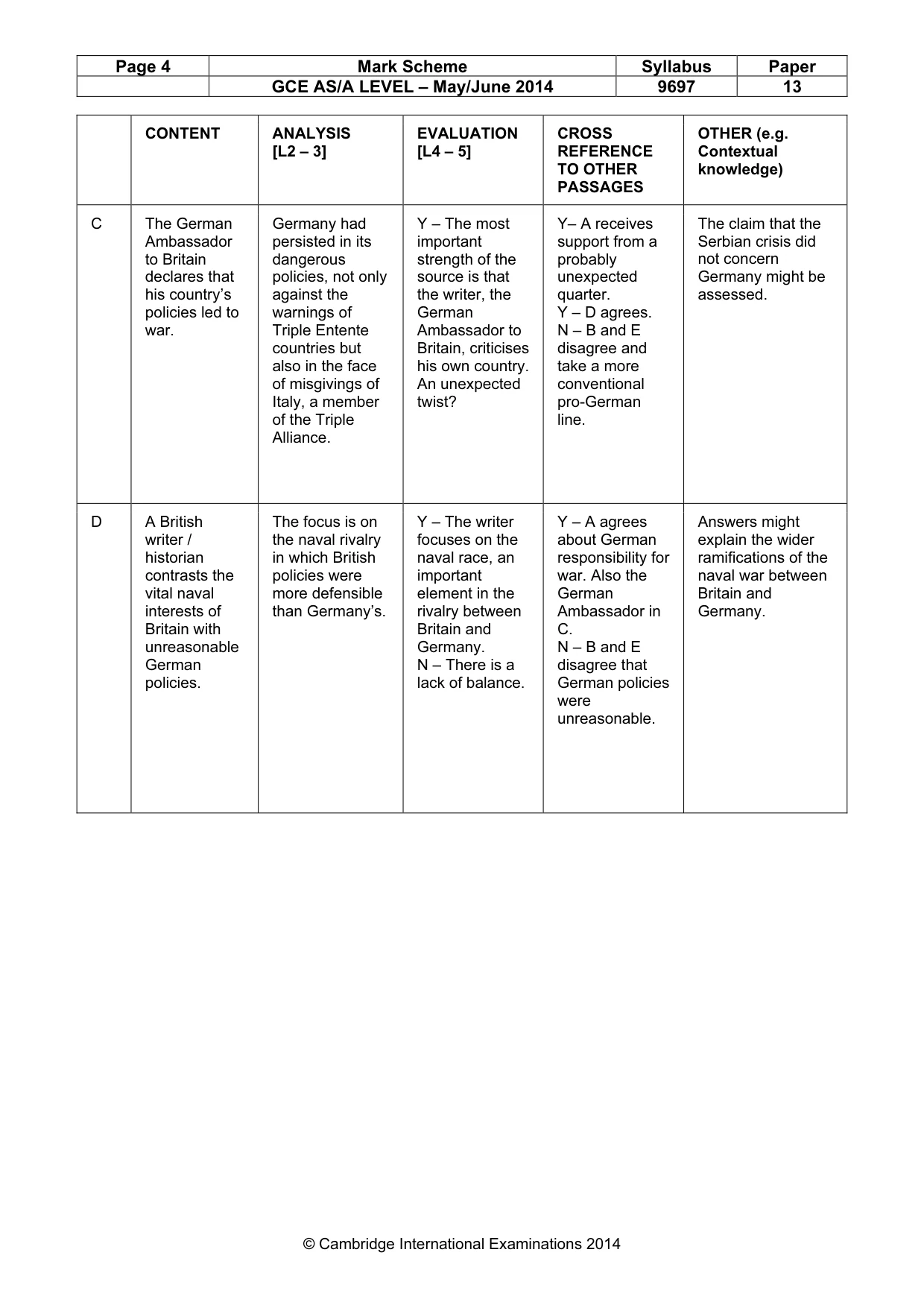
Page 4 Mark Scheme Syllabus Paper GCE AS/A LEVEL – May/June 2014 9697 13 © Cambridge International Examinations 2014 CONTENT ANALYSIS [L2 – 3] EVALUATION [L4 – 5] CROSS REFERENCE TO OTHER PASSAGES OTHER (e.g. Contextual knowledge) C The German Ambassador to Britain declares that his country’s policies led to war. Germany had persisted in its dangerous policies, not only against the warnings of Triple Entente countries but also in the face of misgivings of Italy, a member of the Triple Alliance. Y – The most important strength of the source is that the writer, the German Ambassador to Britain, criticises his own country. An unexpected twist? Y– A receives support from a probably unexpected quarter. Y – D agrees. N – B and E disagree and take a more conventional pro-German line. The claim that the Serbian crisis did not concern Germany might be assessed. D A British writer / historian contrasts the vital naval interests of Britain with unreasonable German policies. The focus is on the naval rivalry in which British policies were more defensible than Germany’s. Y – The writer focuses on the naval race, an important element in the rivalry between Britain and Germany. N – There is a lack of balance. Y – A agrees about German responsibility for war. Also the German Ambassador in C. N – B and E disagree that German policies were unreasonable. Answers might explain the wider ramifications of the naval war between Britain and Germany.
Mark scheme, page 5
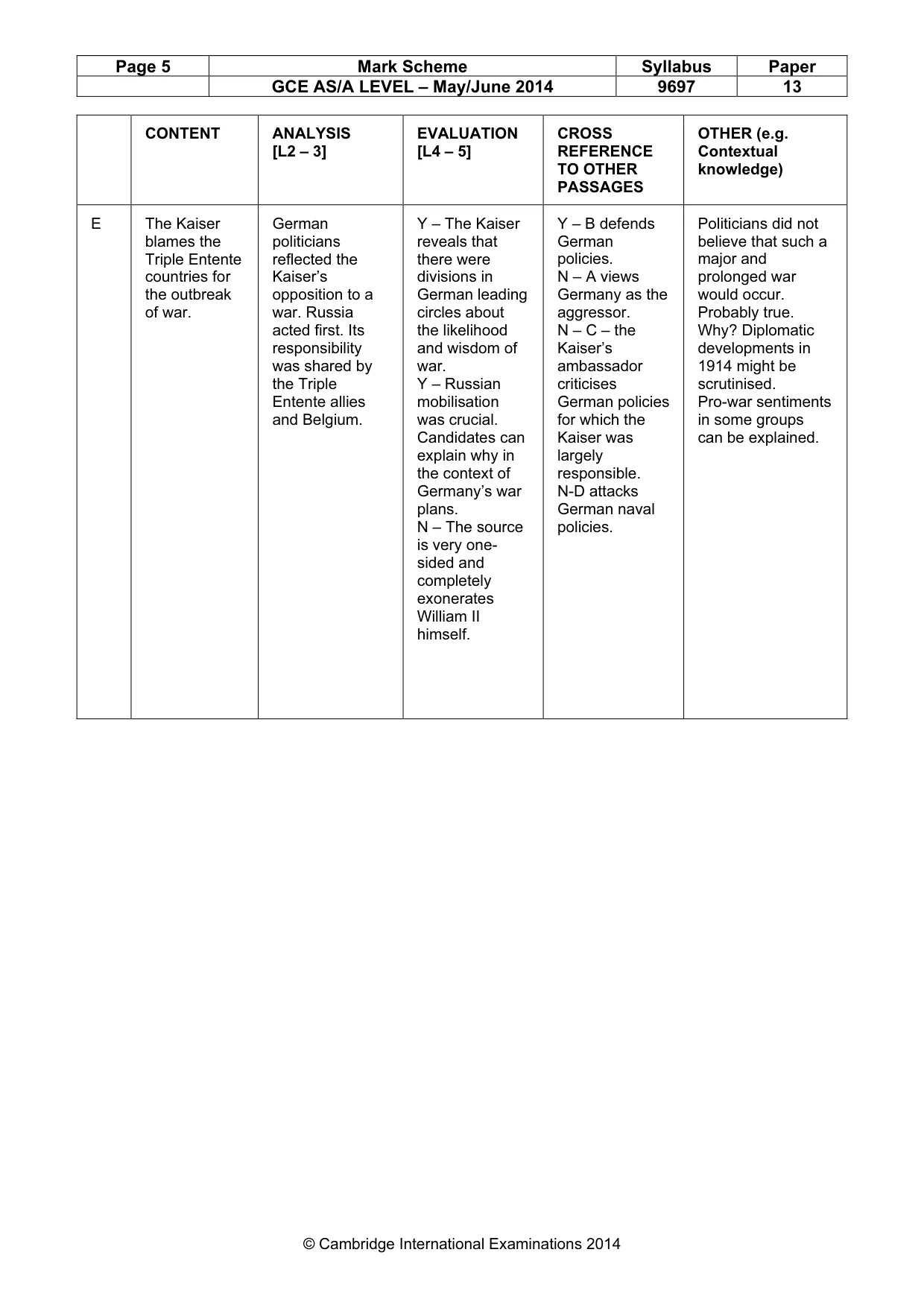
Page 5 Mark Scheme Syllabus Paper GCE AS/A LEVEL – May/June 2014 9697 13 © Cambridge International Examinations 2014 CONTENT ANALYSIS [L2 – 3] EVALUATION [L4 – 5] CROSS REFERENCE TO OTHER PASSAGES OTHER (e.g. Contextual knowledge) E The Kaiser blames the Triple Entente countries for the outbreak of war. German politicians reflected the Kaiser’s opposition to a war. Russia acted first. Its responsibility was shared by the Triple Entente allies and Belgium. Y – The Kaiser reveals that there were divisions in German leading circles about the likelihood and wisdom of war. Y – Russian mobilisation was crucial. Candidates can explain why in the context of Germany’s war plans. N – The source is very one- sided and completely exonerates William II himself. Y – B defends German policies. N – A views Germany as the aggressor. N – C – the Kaiser’s ambassador criticises German policies for which the Kaiser was largely responsible. N-D attacks German naval policies. Politicians did not believe that such a major and prolonged war would occur. Probably true. Why? Diplomatic developments in 1914 might be scrutinised. Pro-war sentiments in some groups can be explained.
Mark scheme, page 6
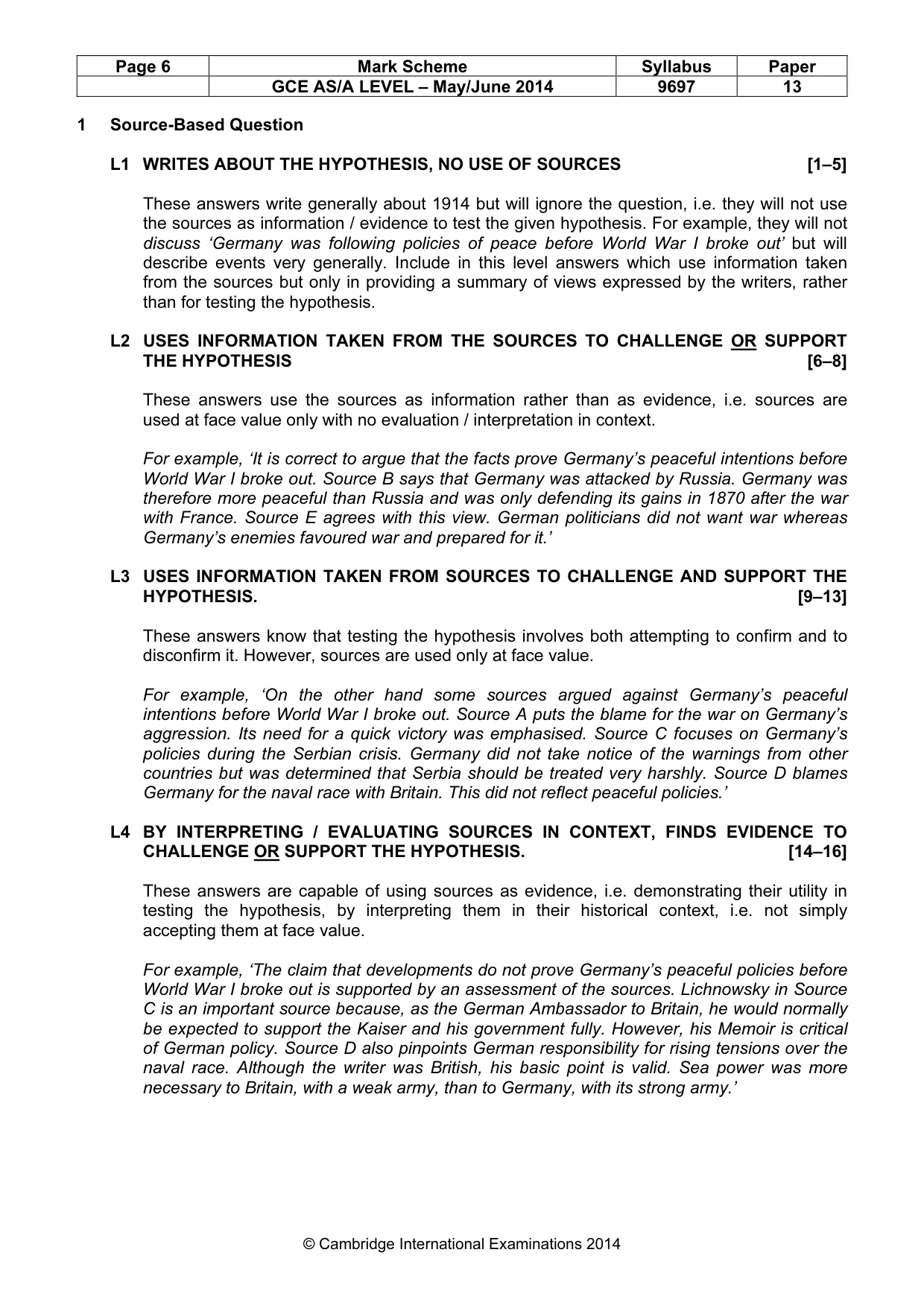
Page 6 Mark Scheme Syllabus Paper GCE AS/A LEVEL – May/June 2014 9697 13 © Cambridge International Examinations 2014 1 Source-Based Question L1 WRITES ABOUT THE HYPOTHESIS, NO USE OF SOURCES [1–5] These answers write generally about 1914 but will ignore the question, i.e. they will not use the sources as information / evidence to test the given hypothesis. For example, they will not discuss ‘Germany was following policies of peace before World War I broke out’ but will describe events very generally. Include in this level answers which use information taken from the sources but only in providing a summary of views expressed by the writers, rather than for testing the hypothesis. L2 USES INFORMATION TAKEN FROM THE SOURCES TO CHALLENGE OR SUPPORT THE HYPOTHESIS [6–8] These answers use the sources as information rather than as evidence, i.e. sources are used at face value only with no evaluation / interpretation in context. For example, ‘It is correct to argue that the facts prove Germany’s peaceful intentions before World War I broke out. Source B says that Germany was attacked by Russia. Germany was therefore more peaceful than Russia and was only defending its gains in 1870 after the war with France. Source E agrees with this view. German politicians did not want war whereas Germany’s enemies favoured war and prepared for it.’ L3 USES INFORMATION TAKEN FROM SOURCES TO CHALLENGE AND SUPPORT THE HYPOTHESIS. [9–13] These answers know that testing the hypothesis involves both attempting to confirm and to disconfirm it. However, sources are used only at face value. For example, ‘On the other hand some sources argued against Germany’s peaceful intentions before World War I broke out. Source A puts the blame for the war on Germany’s aggression. Its need for a quick victory was emphasised. Source C focuses on Germany’s policies during the Serbian crisis. Germany did not take notice of the warnings from other countries but was determined that Serbia should be treated very harshly. Source D blames Germany for the naval race with Britain. This did not reflect peaceful policies.’ L4 BY INTERPRETING / EVALUATING SOURCES IN CONTEXT, FINDS EVIDENCE TO CHALLENGE OR SUPPORT THE HYPOTHESIS. [14–16] These answers are capable of using sources as evidence, i.e. demonstrating their utility in testing the hypothesis, by interpreting them in their historical context, i.e. not simply accepting them at face value. For example, ‘The claim that developments do not prove Germany’s peaceful policies before World War I broke out is supported by an assessment of the sources. Lichnowsky in Source C is an important source because, as the German Ambassador to Britain, he would normally be expected to support the Kaiser and his government fully. However, his Memoir is critical of German policy. Source D also pinpoints German responsibility for rising tensions over the naval race. Although the writer was British, his basic point is valid. Sea power was more necessary to Britain, with a weak army, than to Germany, with its strong army.’
Mark scheme, page 7
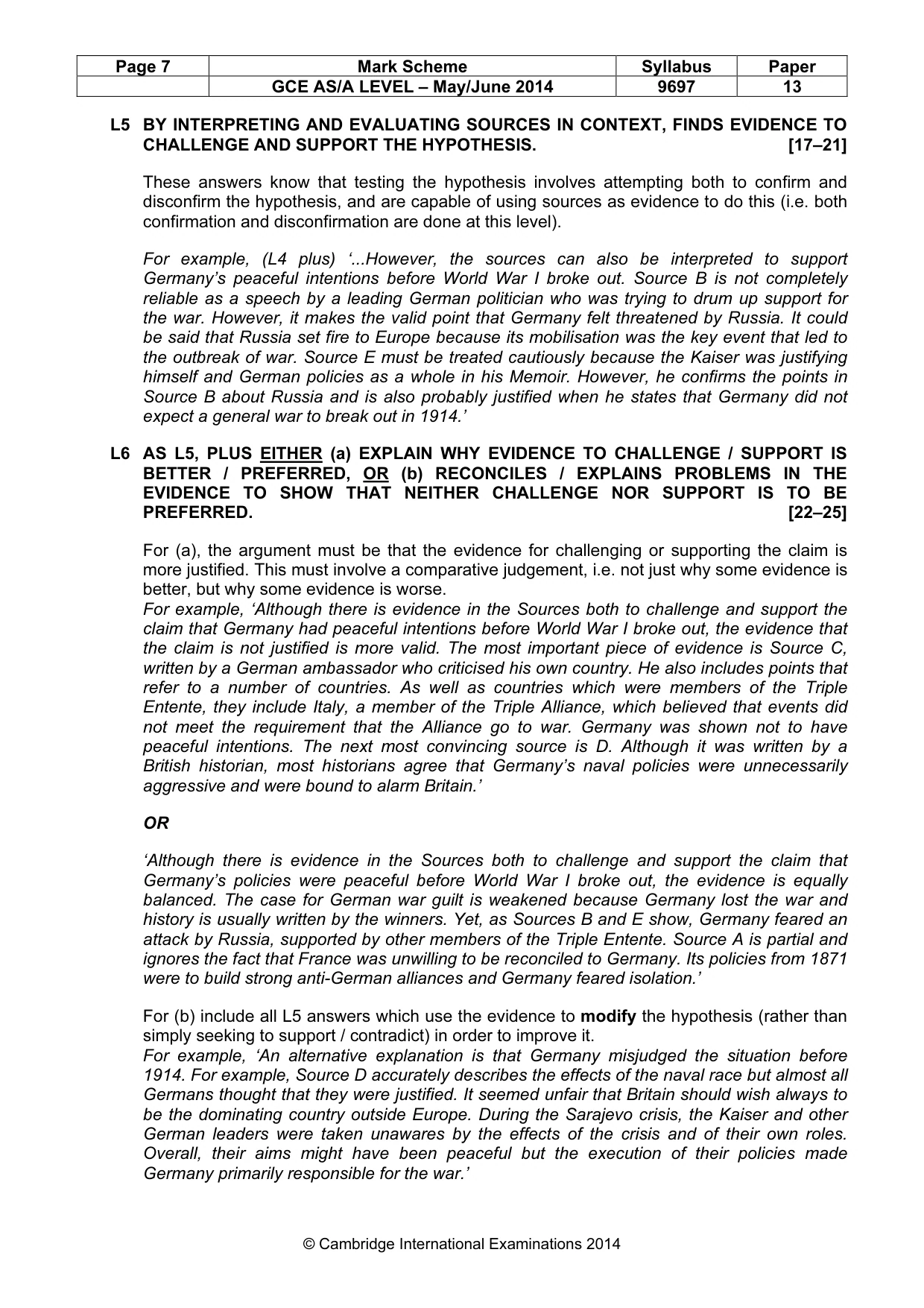
Page 7 Mark Scheme Syllabus Paper GCE AS/A LEVEL – May/June 2014 9697 13 © Cambridge International Examinations 2014 L5 BY INTERPRETING AND EVALUATING SOURCES IN CONTEXT, FINDS EVIDENCE TO CHALLENGE AND SUPPORT THE HYPOTHESIS. [17–21] These answers know that testing the hypothesis involves attempting both to confirm and disconfirm the hypothesis, and are capable of using sources as evidence to do this (i.e. both confirmation and disconfirmation are done at this level). For example, (L4 plus) ‘...However, the sources can also be interpreted to support Germany’s peaceful intentions before World War I broke out. Source B is not completely reliable as a speech by a leading German politician who was trying to drum up support for the war. However, it makes the valid point that Germany felt threatened by Russia. It could be said that Russia set fire to Europe because its mobilisation was the key event that led to the outbreak of war. Source E must be treated cautiously because the Kaiser was justifying himself and German policies as a whole in his Memoir. However, he confirms the points in Source B about Russia and is also probably justified when he states that Germany did not expect a general war to break out in 1914.’ L6 AS L5, PLUS EITHER (a) EXPLAIN WHY EVIDENCE TO CHALLENGE / SUPPORT IS BETTER / PREFERRED, OR (b) RECONCILES / EXPLAINS PROBLEMS IN THE EVIDENCE TO SHOW THAT NEITHER CHALLENGE NOR SUPPORT IS TO BE PREFERRED. [22–25] For (a), the argument must be that the evidence for challenging or supporting the claim is more justified. This must involve a comparative judgement, i.e. not just why some evidence is better, but why some evidence is worse. For example, ‘Although there is evidence in the Sources both to challenge and support the claim that Germany had peaceful intentions before World War I broke out, the evidence that the claim is not justified is more valid. The most important piece of evidence is Source C, written by a German ambassador who criticised his own country. He also includes points that refer to a number of countries. As well as countries which were members of the Triple Entente, they include Italy, a member of the Triple Alliance, which believed that events did not meet the requirement that the Alliance go to war. Germany was shown not to have peaceful intentions. The next most convincing source is D. Although it was written by a British historian, most historians agree that Germany’s naval policies were unnecessarily aggressive and were bound to alarm Britain.’ OR ‘Although there is evidence in the Sources both to challenge and support the claim that Germany’s policies were peaceful before World War I broke out, the evidence is equally balanced. The case for German war guilt is weakened because Germany lost the war and history is usually written by the winners. Yet, as Sources B and E show, Germany feared an attack by Russia, supported by other members of the Triple Entente. Source A is partial and ignores the fact that France was unwilling to be reconciled to Germany. Its policies from 1871 were to build strong anti-German alliances and Germany feared isolation.’ For (b) include all L5 answers which use the evidence to modify the hypothesis (rather than simply seeking to support / contradict) in order to improve it. For example, ‘An alternative explanation is that Germany misjudged the situation before 1914. For example, Source D accurately describes the effects of the naval race but almost all Germans thought that they were justified. It seemed unfair that Britain should wish always to be the dominating country outside Europe. During the Sarajevo crisis, the Kaiser and other German leaders were taken unawares by the effects of the crisis and of their own roles. Overall, their aims might have been peaceful but the execution of their policies made Germany primarily responsible for the war.’
Mark scheme, page 8
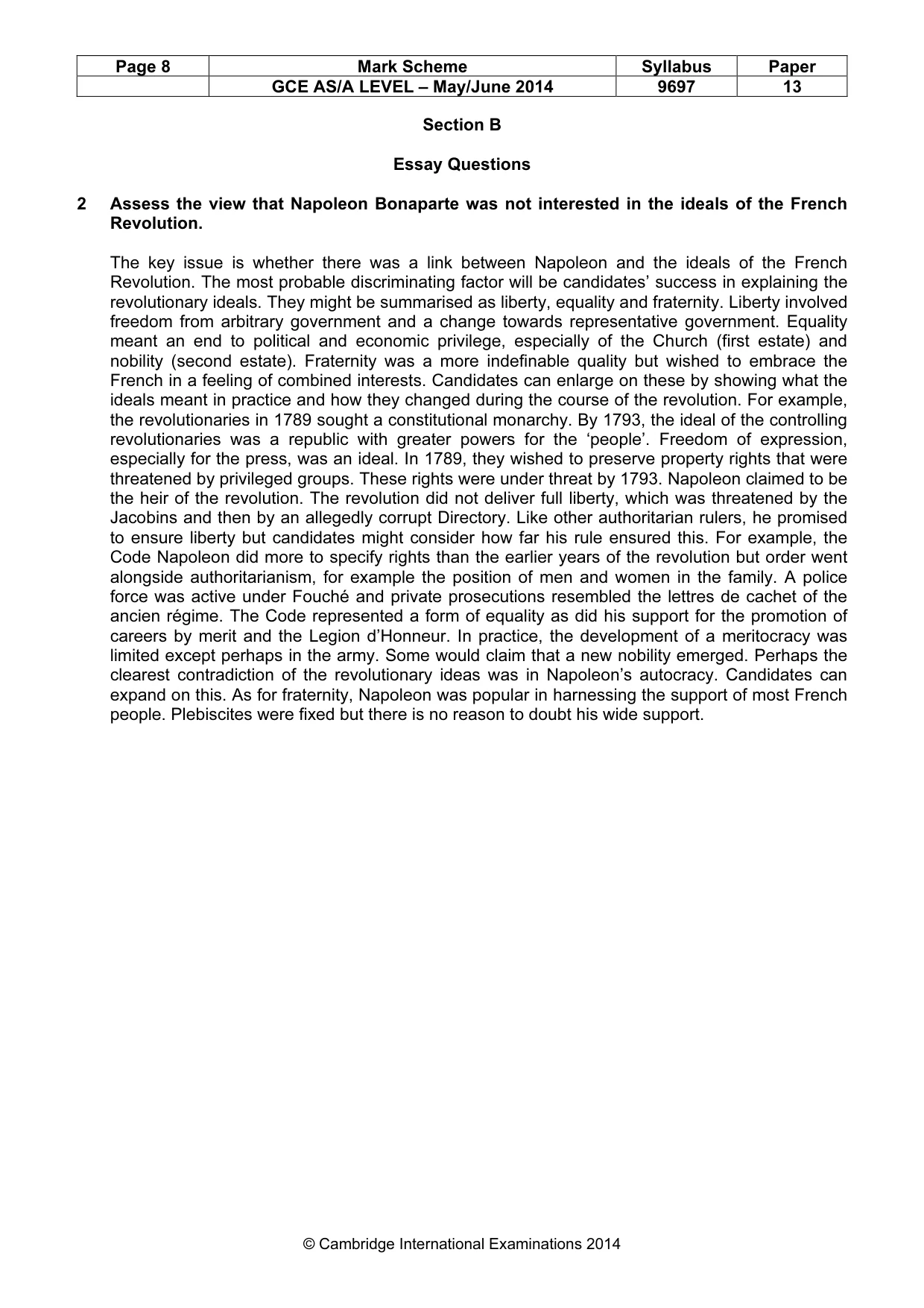
Page 8 Mark Scheme Syllabus Paper GCE AS/A LEVEL – May/June 2014 9697 13 © Cambridge International Examinations 2014 Section B Essay Questions 2 Assess the view that Napoleon Bonaparte was not interested in the ideals of the French Revolution. The key issue is whether there was a link between Napoleon and the ideals of the French Revolution. The most probable discriminating factor will be candidates’ success in explaining the revolutionary ideals. They might be summarised as liberty, equality and fraternity. Liberty involved freedom from arbitrary government and a change towards representative government. Equality meant an end to political and economic privilege, especially of the Church (first estate) and nobility (second estate). Fraternity was a more indefinable quality but wished to embrace the French in a feeling of combined interests. Candidates can enlarge on these by showing what the ideals meant in practice and how they changed during the course of the revolution. For example, the revolutionaries in 1789 sought a constitutional monarchy. By 1793, the ideal of the controlling revolutionaries was a republic with greater powers for the ‘people’. Freedom of expression, especially for the press, was an ideal. In 1789, they wished to preserve property rights that were threatened by privileged groups. These rights were under threat by 1793. Napoleon claimed to be the heir of the revolution. The revolution did not deliver full liberty, which was threatened by the Jacobins and then by an allegedly corrupt Directory. Like other authoritarian rulers, he promised to ensure liberty but candidates might consider how far his rule ensured this. For example, the Code Napoleon did more to specify rights than the earlier years of the revolution but order went alongside authoritarianism, for example the position of men and women in the family. A police force was active under Fouché and private prosecutions resembled the lettres de cachet of the ancien régime. The Code represented a form of equality as did his support for the promotion of careers by merit and the Legion d’Honneur. In practice, the development of a meritocracy was limited except perhaps in the army. Some would claim that a new nobility emerged. Perhaps the clearest contradiction of the revolutionary ideas was in Napoleon’s autocracy. Candidates can expand on this. As for fraternity, Napoleon was popular in harnessing the support of most French people. Plebiscites were fixed but there is no reason to doubt his wide support.
Mark scheme, page 9
Page 9 Mark Scheme Syllabus Paper GCE AS/A LEVEL – May/June 2014 9697 13 © Cambridge International Examinations 2014 3 ‘The introduction of steam power was the most important cause of the Industrial Revolution.’ How far do you agree with this judgement? (You should refer to at least two of Britain, France and Germany in your answer.) The key issue is the relative importance of steam power in the Industrial Revolution. Candidates can claim that other factors were more important and therefore they will be justified in giving these other factors more attention. A basic understanding of steam power will be required for 11– 13. Conversely, answers that concentrate exclusively on railways will be less likely to get 18+ because they will lack the comparative element in the question. Steam power was important to facilitate methods of production and transport. Machines no longer depended on animal, wind or water power. Steam power was more powerful and more reliable and, as it spread, not more expensive. It could be used in almost every industrialised process. It stimulated other industries, especially the production of iron and coal. While workers were often suspicious in the early stages, some taking violent action such as the Luddites, steam soon created more jobs than were lost. It created a source of labour and enlarged the working class. The association of steam power and railways transformed communications. Heavier loads could be carried than on canals and horse wagons. Railways were speedier. They carried large numbers of people. They became an important source of employment for many, directly and indirectly. There were indirect links with the Industrial Revolution. A new group of engineers and mechanics was born. They promoted investment. Overall, some candidates might make the link between the volume of railways and countries’ economic wealth or poverty. Among other factors that might be discussed is the role of investors who were willing to put their money into industrial enterprises. This was not the preference of the wealthy in France and Germany until the middle of the nineteenth century. The banking system was more developed (but still not completely safe – there were railway booms and busts and the failures of small banks). British governments pursued policies that were friendlier to enterprise although this should not be exaggerated. The landed interest was still strong but the contrast is broadly justified. There was more political stability in Britain that made investment safer. Laissez Faire was generally – but not completely – favoured. 4 Compare the contributions of Mazzini and Cavour to Italian unification. The key issue is the comparison of Mazzini and Cavour. In this context, comparison also involves contrast. Examiners will look for a balance in their treatment. As always the judgement will depend on the overall quality of the argument and knowledge. Band 5 will need a basic knowledge of one of the men. Attempts to organise comparisons throughout the answer should be given credit but sequential answers that contain valid points of comparison should not be under-valued. It is possible that candidates will emphasise Mazzini’s failures but examiners can expect the most successful to be aware of his positive contribution to Italian unification. It can be argued that Mazzini had the more difficult task because the Risorgimento was in its early stages when he began his work. None of the Italian rulers wanted unification and many were hostile, especially Austria. The lower classes were more concerned about social and economic issues. Italy had a small middle class with political ambitions. By 1849, Mazzini seemed to have achieved little. His aims were not shared generally in Italy. Republicanism and democracy were unpopular ideals. Italian states did not have effective armies, even Piedmont, as 1848 proved. His initial success in 1848, with the assistance of Garibaldi, was a short-term achievement. The Roman Republic proved unpopular in Italy especially because it was condemned by Pope Pius IX. Nevertheless, support for a united Italy survived. Cavour promoted the interests of Piedmont rather than Italy as a whole. He was pushed by Garibaldi’s expedition into acceptance of the south just before his death in 1861. He was a monarchist and eager to be recognised as a European statesman, making his views widely respectable. His alliance with Napoleon III at Plombières (1858) proved crucial. Mazzini lived until 1872 but the new Italy reflected Cavour’s aims and achievements more than his.
Mark scheme, page 10
Page 10 Mark Scheme Syllabus Paper GCE AS/A LEVEL – May/June 2014 9697 13 © Cambridge International Examinations 2014 5 Why did ‘New Imperialism’ cause rivalries between European countries in the late nineteenth century? The key issue is the rivalries aroused by ’New imperialism’. Examiners can expect answers in Bands 1 and 2 to contain some examples but these can be selective as long as they are appropriate. Some answers might focus on Africa, others on Asia. The Scramble for Africa resulted in rivalries that usually involved Britain, especially against France but also against Germany and Belgium. British power expanded from the Cape area and conflicted with French ambitions further north, for example in Senegal and regions bordering the Mediterranean. Egypt and the Sudan were pressure points. Belgium’s ambitions in the Congo gave rise to Bismarck’s Berlin Conference (1884–85). Germany itself established competing colonies in South-West Africa and the Cameroons. Even on Africa’s continental scale, European countries believed that their strategic and economic interests were threatened by the close presence of other countries. Rivalries could be intensified by the actions of individuals such as Rhodes, Jameson, Peters and de Brazza whom domestic public opinion demanded needed to be supported. The stakes were sometimes high, for example control of the Suez Canal, and sometimes more symbolic, for example Fashoda (1898). To some extent, these rivalries were extensions of European diplomatic problems, including French anxiety to maintain its position as a major power and Germany’s aim to catch up with Britain. In Asia, there was a struggle for concessions. China presented particular problems when western countries sought to expand their influence. In addition, Russia and Japan were involved. Russia wanted control of Manchuria. Japan sought influence in the Liaodong Peninsula. France pursued interests in Indo-China while Britain obtained leases in Hong Kong and the New Territories. German annexations in the Pacific, small in themselves, were still seen as a threat by Britain and were an element in Britain’s alliance with Japan. Even slight changes in Africa or Asia were seen as threatening the Balance of Power, welcomed by some and feared by others. 6 Assess the problems that faced Lenin from the October Revolution in 1917 to 1924. The key issue is Lenin’s problems from October 1917 to 1924. ‘From October 1917’ would exclude the problems that Lenin faced in achieving power earlier than 1917 but a brief explanation of the October Revolution would be relevant but not necessary because answers can begin from when the Bolsheviks gained power. The Bolsheviks were a minority. They gained few votes in the elections to the Constituent Assembly. Lenin solved the problem by declaring one- party government. The war with Germany and Austria was a major problem, as it had been for Nicholas II and the provisional Government. Lenin promised peace, a reason for his success in 1917, but some leading Bolsheviks wished to spin out the negotiations in the hope of securing better terms. A few advocated continuing a guerrilla war. Lenin decided for a quick peace although the terms were very hard on Russia. It surrendered vast tracts of land, especially in the Baltic, Poland and Ukraine. These included some of the richest regions. The Civil War (1918–20) was a hard-fought struggle between the Reds and Whites, backed by some foreign allies. Although quite brief chronologically, it was expensive in terms of manpower and resources. Lenin’s forces triumphed but the war left a bitter legacy. The economy proved a continuing problem. The better answers will explain why the economy was a problem. The situation was dire when the Bolsheviks took power. It was worsened by the civil war. The economy also revealed differences among the Bolsheviks. Lenin resorted first to War Communism then reverted to the NEP after its failure.
Mark scheme, page 11
Page 11 Mark Scheme Syllabus Paper GCE AS/A LEVEL – May/June 2014 9697 13 © Cambridge International Examinations 2014 7 Why did the Weimar Republic lose support after 1929? The key issue is the failure of the Weimar Republic to secure more support. The key period is from 1929 but candidates can refer to the years from 1918. Sound candidates will understand why 1929 was a turning point. The Republic had problems from its inception but seemed to be moving into calmer water during the 1920s with the age of Stresemann. However, Stresemann’s death coincided with the Wall Street Crash. Problems that seemed to have subsided revived. There was a controversy with many Germans refusing to believe that Germany had been defeated. The myth endured of a ’stab in the back’ by the ’November criminals’. This was particularly believed by right-wing elements. For example, Hitler exploited it. Proportional representation was a factor because it allowed for the emergence of many political parties, some very small and extreme in their policies from right to left-wing. The President was given the power of appointment of all civil and military officials and was given power in (unspecified) emergencies. Hindenburg’s use of emergency powers proved important in the late stages of the Weimar Republic. The small political groups catered for the views of many diverse social and political groups. These political factors became particularly important in the period leading to Hitler’s accession to power. However, he appeared to change after the failure of the Munich Putsch. Other politicians believed that he could be controlled. Weimar was troubled again by economic problems while people still remembered the hardships of the immediate post-war period. Germany was affected particularly badly by the Wall Street Crash because of its dependence on American loans. Another economic crisis destabilised the Weimar Republic. Answers in Band 1 can be expected to show a good range of understanding of the later Weimar period. 8 How different were the political aims of Nicholas II from those of Lenin and Stalin? The key issue is the comparison of the political aims of Nicholas II and those of Lenin and Stalin. Answers in Bands 1 and 2 should be reasonably balanced between the three leaders except that there might be some more combination of Lenin and Stalin’s political ideas. The chronological range is wide and candidates can be selective in their supporting knowledge but they will need to tie other factors to a political base. For example, it might be argued that the Tsar’s economic views reflected his aversion to political change. Nicholas II, Stalin and Lenin to almost the same extent, believed in personal rule. But Nicholas was not bound to an ideology other than a belief in autocracy, whereas Lenin and Stalin found justification in Marxism. Both used force and repression to maintain their political positions but the Tsar was not as ruthless as the communist leaders. He executed, imprisoned and exiled critics but not to the same extent as the communist leaders. Nicholas II saw tsarism linked to the Church whereas Lenin and Stalin believed the opposite. The Tsar used traditional forms of propaganda whereas Lenin and Stalin were more modern in this respect. Nicholas II did not see the political role of the economy whereas this weighed heavily on Lenin and Stalin. Lenin introduced War Communism largely to promote communist political ideals. Stalin’s economic reforms had an important political dimension.
What you needed in this session
Cambridge’s own grade thresholds for 2014 May/June, Paper 1 · Variant 3. A higher threshold means an easier paper — the bar moves with how the cohort did.