Cambridge A Level History 9489 — 2022 Feb/March Paper 1 · Variant 2
9489/12/F/M/22 · 40 marks · ≈45 min
The question paper and its mark scheme, free to read here and free to download. This is Cambridge’s own paper, exactly as it was sat.
Question paper8 pages

Mark scheme12 pages
Answers below. Sit the paper first if you are practising.
Paper as text
Question paper, page 1
This document has 8 pages. Any blank pages are indicated. [Turn over Cambridge International AS & A Level HISTORY 9489/12 Paper 1 Document Question February/March 2022 1 hour 15 minutes You must answer on the enclosed answer booklet. You will need: Answer booklet (enclosed) INSTRUCTIONS ● Answer one question from one section only. Section A: European option Section B: American option Section C: International option ● Follow the instructions on the front cover of the answer booklet. If you need additional answer paper, ask the invigilator for a continuation booklet. INFORMATION ● The total mark for this paper is 40. ● The number of marks for each question or part question is shown in brackets [ ]. DC (LK/CB) 303404/3 © UCLES 2022 * 7 8 8 6 6 0 2 9 6 2 *
Question paper, page 2
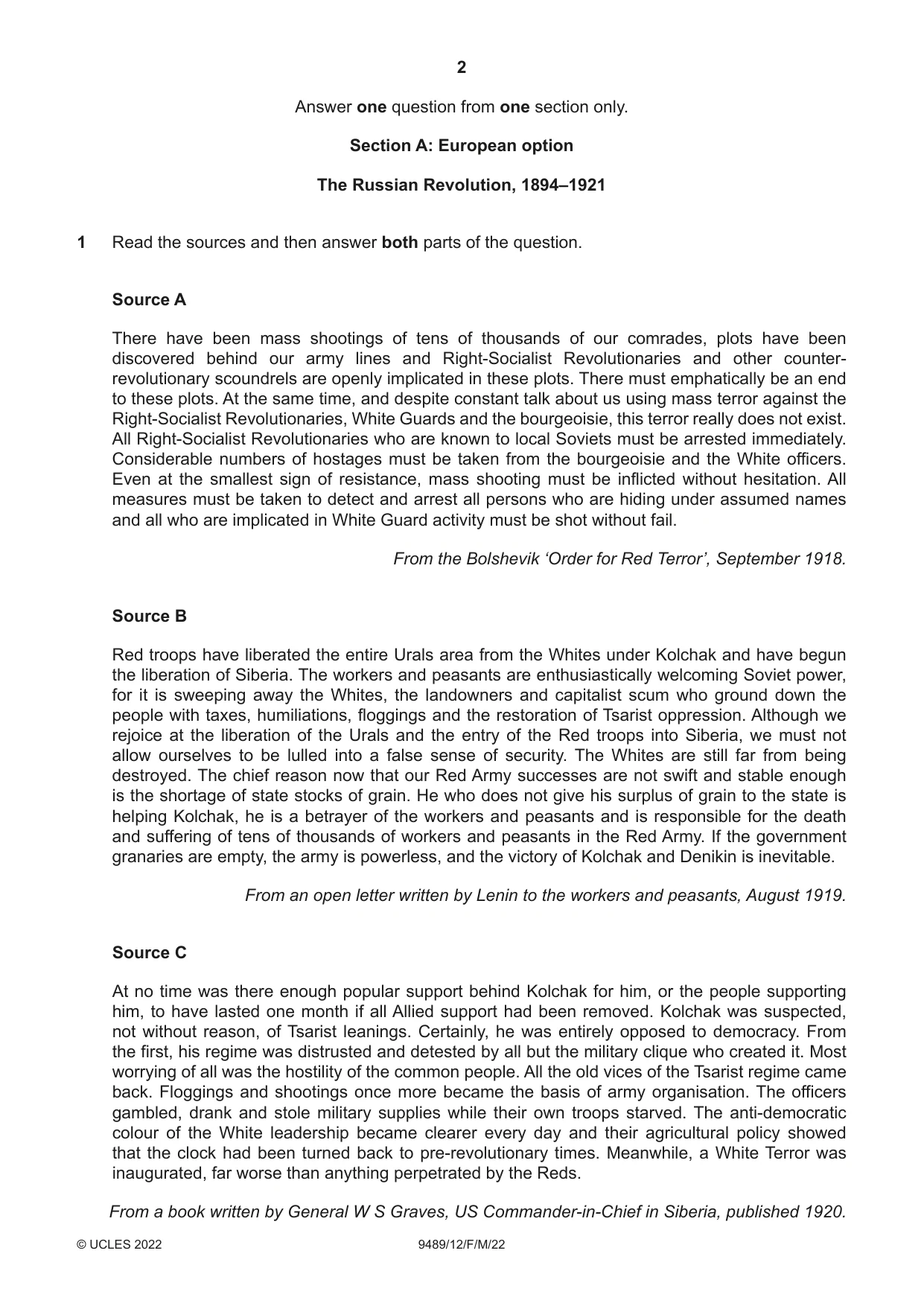
2 9489/12/F/M/22 © UCLES 2022 Answer one question from one section only. Section A: European option The Russian Revolution, 1894–1921 1 Read the sources and then answer both parts of the question. Source A There have been mass shootings of tens of thousands of our comrades, plots have been discovered behind our army lines and Right-Socialist Revolutionaries and other counter- revolutionary scoundrels are openly implicated in these plots. There must emphatically be an end to these plots. At the same time, and despite constant talk about us using mass terror against the Right-Socialist Revolutionaries, White Guards and the bourgeoisie, this terror really does not exist. All Right-Socialist Revolutionaries who are known to local Soviets must be arrested immediately. Considerable numbers of hostages must be taken from the bourgeoisie and the White officers. Even at the smallest sign of resistance, mass shooting must be inflicted without hesitation. All measures must be taken to detect and arrest all persons who are hiding under assumed names and all who are implicated in White Guard activity must be shot without fail. From the Bolshevik ‘Order for Red Terror’, September 1918. Source B Red troops have liberated the entire Urals area from the Whites under Kolchak and have begun the liberation of Siberia. The workers and peasants are enthusiastically welcoming Soviet power, for it is sweeping away the Whites, the landowners and capitalist scum who ground down the people with taxes, humiliations, floggings and the restoration of Tsarist oppression. Although we rejoice at the liberation of the Urals and the entry of the Red troops into Siberia, we must not allow ourselves to be lulled into a false sense of security. The Whites are still far from being destroyed. The chief reason now that our Red Army successes are not swift and stable enough is the shortage of state stocks of grain. He who does not give his surplus of grain to the state is helping Kolchak, he is a betrayer of the workers and peasants and is responsible for the death and suffering of tens of thousands of workers and peasants in the Red Army. If the government granaries are empty, the army is powerless, and the victory of Kolchak and Denikin is inevitable. From an open letter written by Lenin to the workers and peasants, August 1919. Source C At no time was there enough popular support behind Kolchak for him, or the people supporting him, to have lasted one month if all Allied support had been removed. Kolchak was suspected, not without reason, of Tsarist leanings. Certainly, he was entirely opposed to democracy. From the first, his regime was distrusted and detested by all but the military clique who created it. Most worrying of all was the hostility of the common people. All the old vices of the Tsarist regime came back. Floggings and shootings once more became the basis of army organisation. The officers gambled, drank and stole military supplies while their own troops starved. The anti-democratic colour of the White leadership became clearer every day and their agricultural policy showed that the clock had been turned back to pre-revolutionary times. Meanwhile, a White Terror was inaugurated, far worse than anything perpetrated by the Reds. From a book written by General W S Graves, US Commander-in-Chief in Siberia, published 1920.
Question paper, page 3
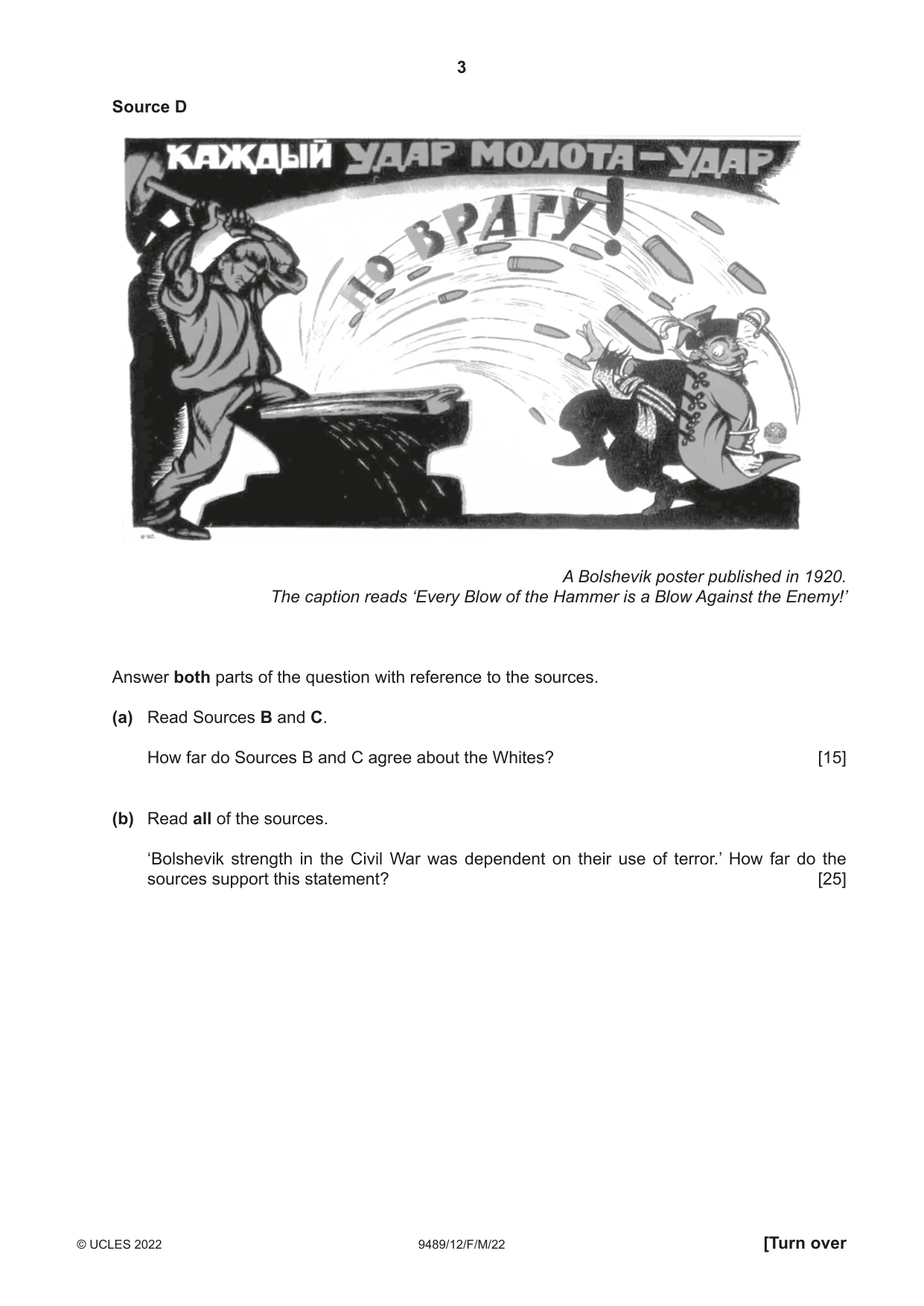
3 9489/12/F/M/22 © UCLES 2022 [Turn over Source D A Bolshevik poster published in 1920. The caption reads ‘Every Blow of the Hammer is a Blow Against the Enemy!’ Answer both parts of the question with reference to the sources. (a) Read Sources B and C. How far do Sources B and C agree about the Whites? [15] (b) Read all of the sources. ‘Bolshevik strength in the Civil War was dependent on their use of terror.’ How far do the sources support this statement? [25]
Question paper, page 4
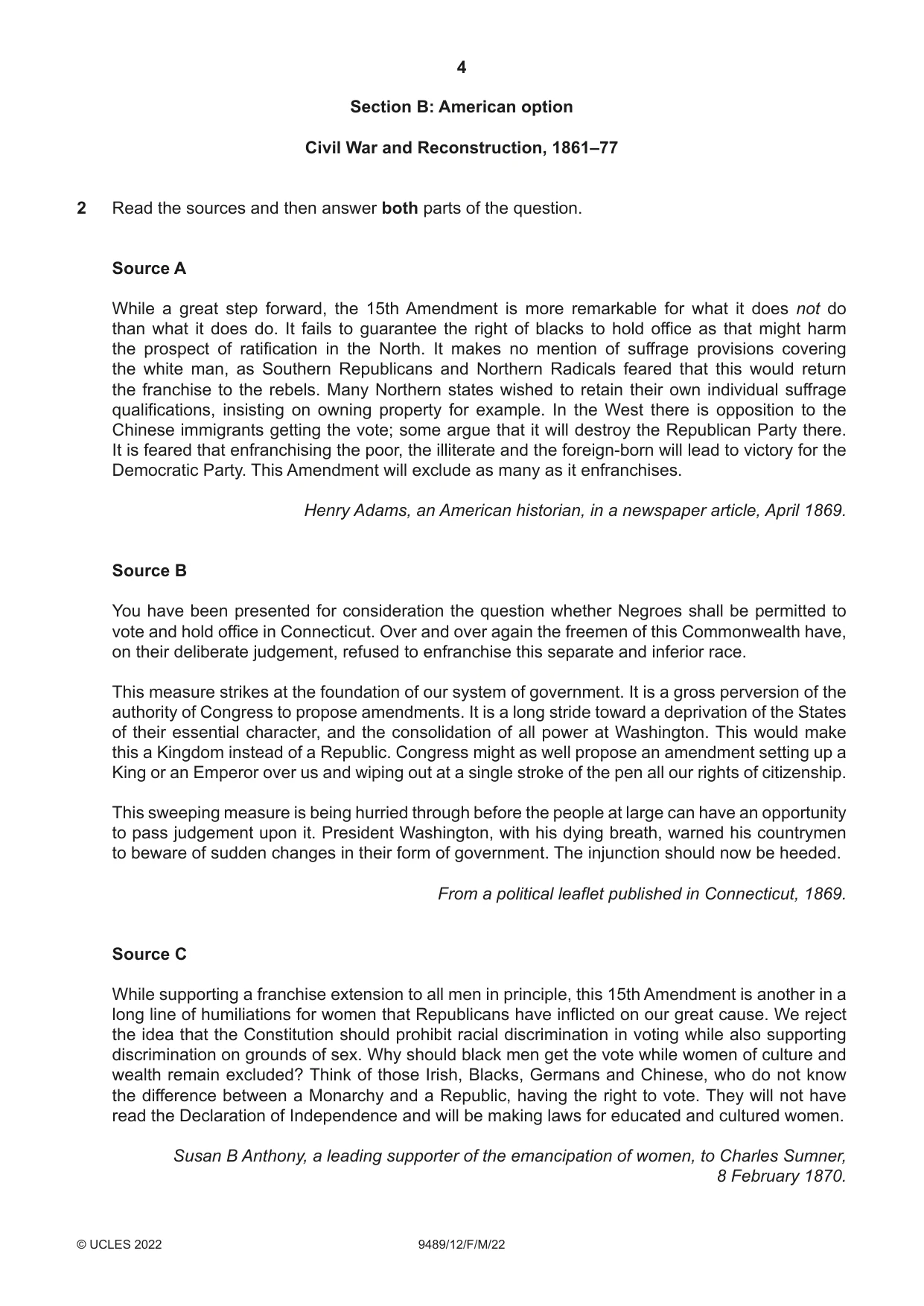
4 9489/12/F/M/22 © UCLES 2022 Section B: American option Civil War and Reconstruction, 1861–77 2 Read the sources and then answer both parts of the question. Source A While a great step forward, the 15th Amendment is more remarkable for what it does not do than what it does do. It fails to guarantee the right of blacks to hold office as that might harm the prospect of ratification in the North. It makes no mention of suffrage provisions covering the white man, as Southern Republicans and Northern Radicals feared that this would return the franchise to the rebels. Many Northern states wished to retain their own individual suffrage qualifications, insisting on owning property for example. In the West there is opposition to the Chinese immigrants getting the vote; some argue that it will destroy the Republican Party there. It is feared that enfranchising the poor, the illiterate and the foreign-born will lead to victory for the Democratic Party. This Amendment will exclude as many as it enfranchises. Henry Adams, an American historian, in a newspaper article, April 1869. Source B You have been presented for consideration the question whether Negroes shall be permitted to vote and hold office in Connecticut. Over and over again the freemen of this Commonwealth have, on their deliberate judgement, refused to enfranchise this separate and inferior race. This measure strikes at the foundation of our system of government. It is a gross perversion of the authority of Congress to propose amendments. It is a long stride toward a deprivation of the States of their essential character, and the consolidation of all power at Washington. This would make this a Kingdom instead of a Republic. Congress might as well propose an amendment setting up a King or an Emperor over us and wiping out at a single stroke of the pen all our rights of citizenship. This sweeping measure is being hurried through before the people at large can have an opportunity to pass judgement upon it. President Washington, with his dying breath, warned his countrymen to beware of sudden changes in their form of government. The injunction should now be heeded. From a political leaflet published in Connecticut, 1869. Source C While supporting a franchise extension to all men in principle, this 15th Amendment is another in a long line of humiliations for women that Republicans have inflicted on our great cause. We reject the idea that the Constitution should prohibit racial discrimination in voting while also supporting discrimination on grounds of sex. Why should black men get the vote while women of culture and wealth remain excluded? Think of those Irish, Blacks, Germans and Chinese, who do not know the difference between a Monarchy and a Republic, having the right to vote. They will not have read the Declaration of Independence and will be making laws for educated and cultured women. Susan B Anthony, a leading supporter of the emancipation of women, to Charles Sumner, 8 February 1870.
Question paper, page 5
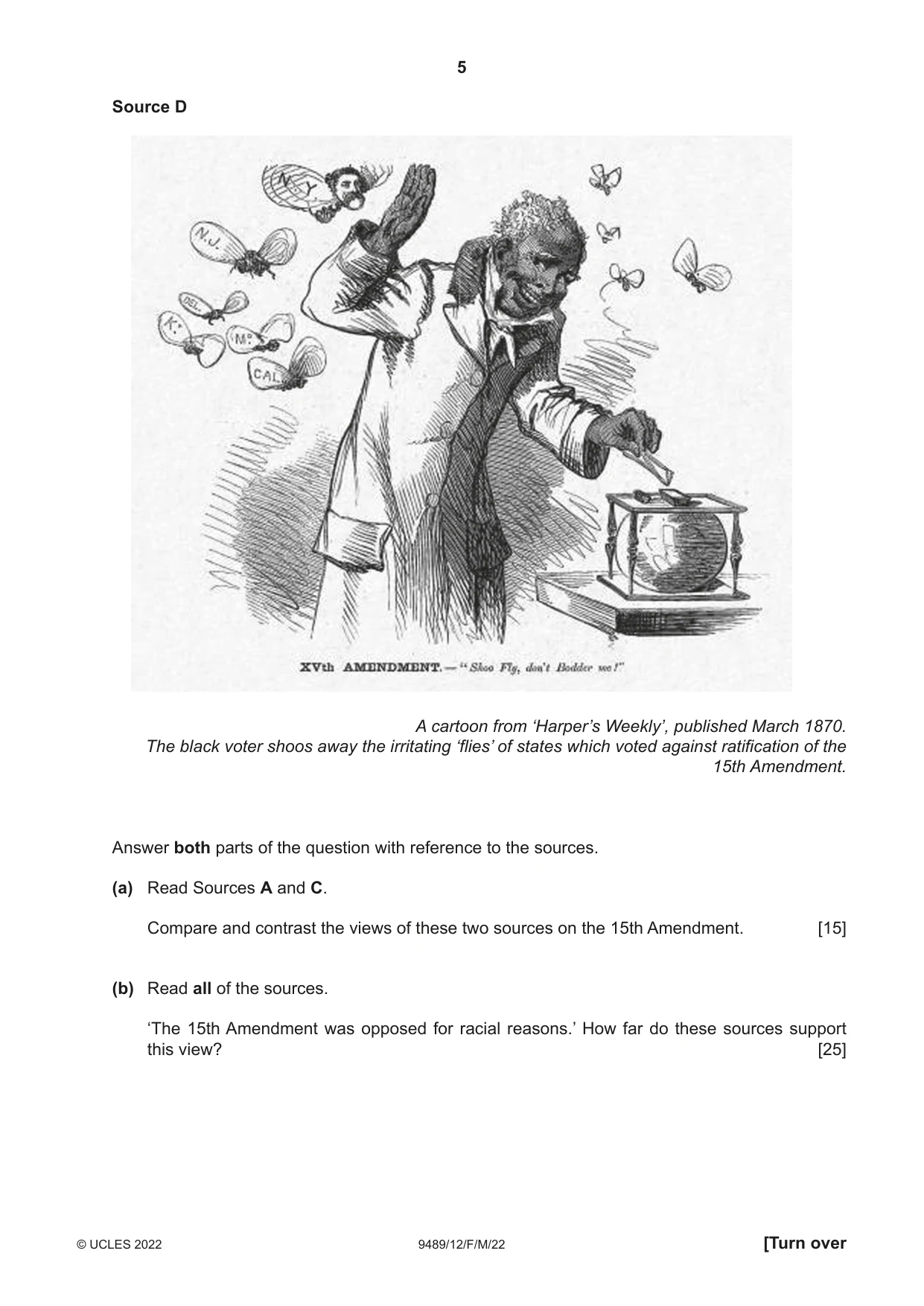
5 9489/12/F/M/22 © UCLES 2022 [Turn over Source D A cartoon from ‘Harper’s Weekly’, published March 1870. The black voter shoos away the irritating ‘flies’ of states which voted against ratification of the 15th Amendment. Answer both parts of the question with reference to the sources. (a) Read Sources A and C. Compare and contrast the views of these two sources on the 15th Amendment. [15] (b) Read all of the sources. ‘The 15th Amendment was opposed for racial reasons.’ How far do these sources support this view? [25]
Question paper, page 6
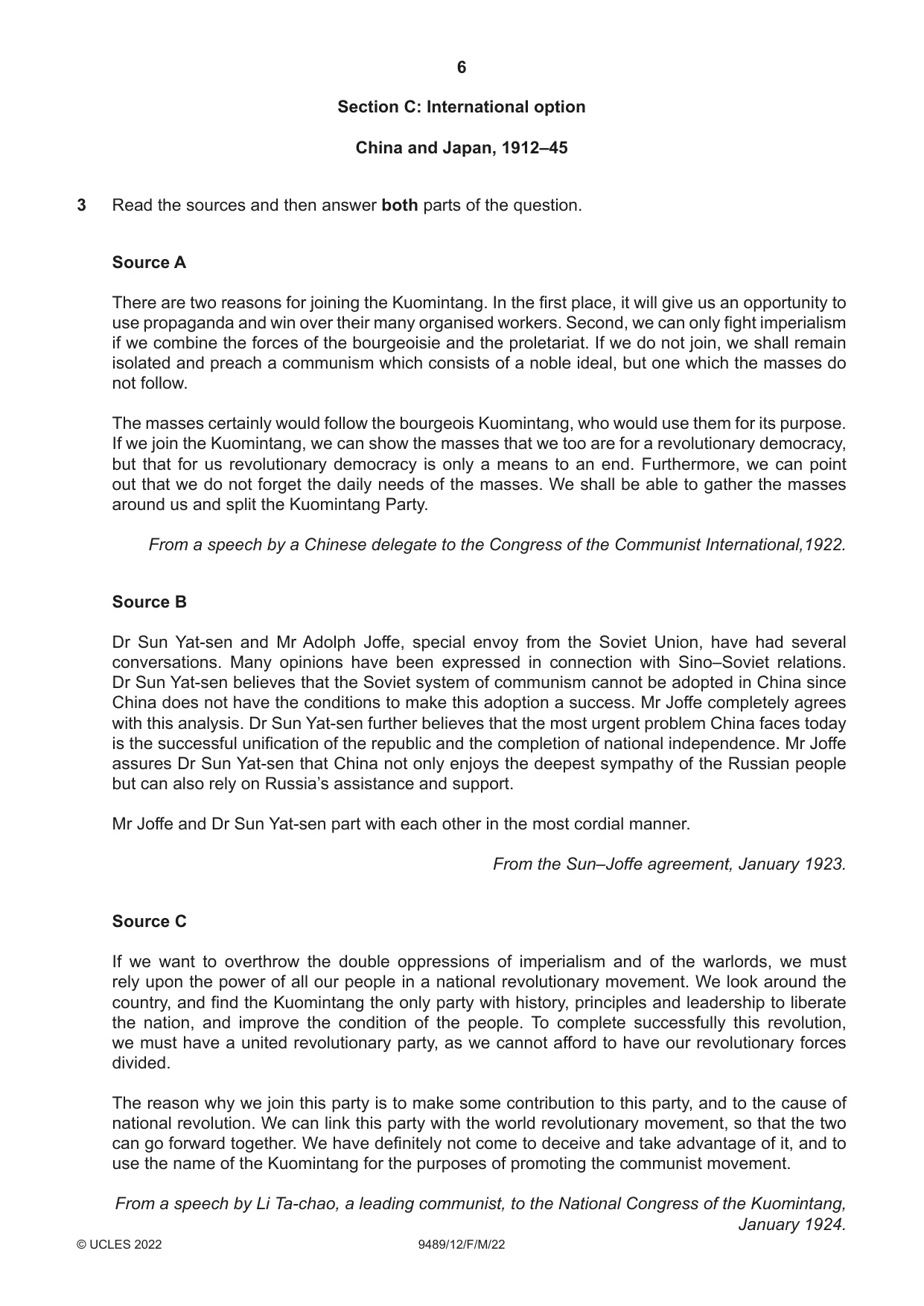
6 9489/12/F/M/22 © UCLES 2022 Section C: International option China and Japan, 1912–45 3 Read the sources and then answer both parts of the question. Source A There are two reasons for joining the Kuomintang. In the first place, it will give us an opportunity to use propaganda and win over their many organised workers. Second, we can only fight imperialism if we combine the forces of the bourgeoisie and the proletariat. If we do not join, we shall remain isolated and preach a communism which consists of a noble ideal, but one which the masses do not follow. The masses certainly would follow the bourgeois Kuomintang, who would use them for its purpose. If we join the Kuomintang, we can show the masses that we too are for a revolutionary democracy, but that for us revolutionary democracy is only a means to an end. Furthermore, we can point out that we do not forget the daily needs of the masses. We shall be able to gather the masses around us and split the Kuomintang Party. From a speech by a Chinese delegate to the Congress of the Communist International,1922. Source B Dr Sun Yat-sen and Mr Adolph Joffe, special envoy from the Soviet Union, have had several conversations. Many opinions have been expressed in connection with Sino–Soviet relations. Dr Sun Yat-sen believes that the Soviet system of communism cannot be adopted in China since China does not have the conditions to make this adoption a success. Mr Joffe completely agrees with this analysis. Dr Sun Yat-sen further believes that the most urgent problem China faces today is the successful unification of the republic and the completion of national independence. Mr Joffe assures Dr Sun Yat-sen that China not only enjoys the deepest sympathy of the Russian people but can also rely on Russia’s assistance and support. Mr Joffe and Dr Sun Yat-sen part with each other in the most cordial manner. From the Sun–Joffe agreement, January 1923. Source C If we want to overthrow the double oppressions of imperialism and of the warlords, we must rely upon the power of all our people in a national revolutionary movement. We look around the country, and find the Kuomintang the only party with history, principles and leadership to liberate the nation, and improve the condition of the people. To complete successfully this revolution, we must have a united revolutionary party, as we cannot afford to have our revolutionary forces divided. The reason why we join this party is to make some contribution to this party, and to the cause of national revolution. We can link this party with the world revolutionary movement, so that the two can go forward together. We have definitely not come to deceive and take advantage of it, and to use the name of the Kuomintang for the purposes of promoting the communist movement. From a speech by Li Ta-chao, a leading communist, to the National Congress of the Kuomintang, January 1924.
Question paper, page 7
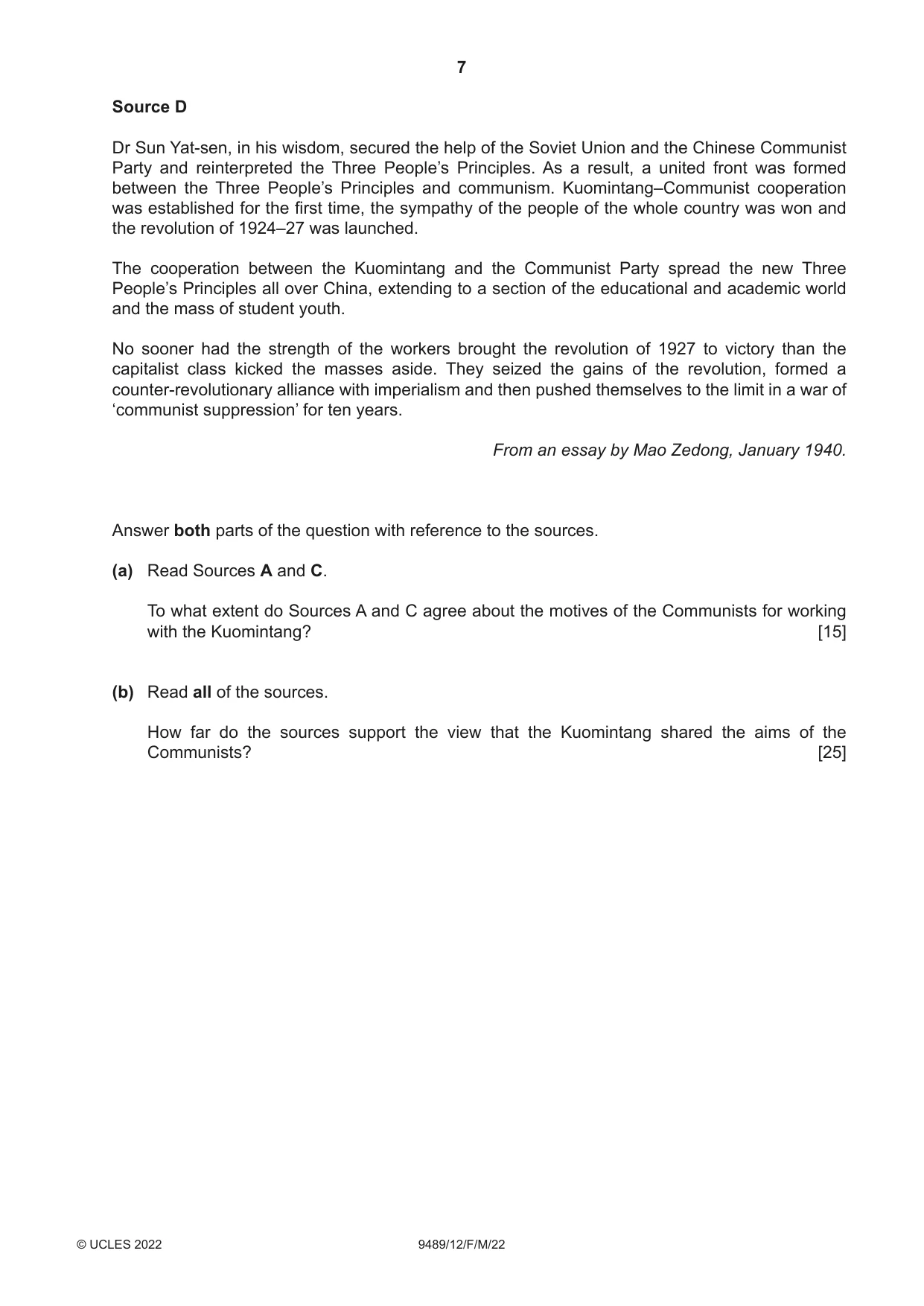
7 9489/12/F/M/22 © UCLES 2022 Source D Dr Sun Yat-sen, in his wisdom, secured the help of the Soviet Union and the Chinese Communist Party and reinterpreted the Three People’s Principles. As a result, a united front was formed between the Three People’s Principles and communism. Kuomintang–Communist cooperation was established for the first time, the sympathy of the people of the whole country was won and the revolution of 1924–27 was launched. The cooperation between the Kuomintang and the Communist Party spread the new Three People’s Principles all over China, extending to a section of the educational and academic world and the mass of student youth. No sooner had the strength of the workers brought the revolution of 1927 to victory than the capitalist class kicked the masses aside. They seized the gains of the revolution, formed a counter-revolutionary alliance with imperialism and then pushed themselves to the limit in a war of ‘communist suppression’ for ten years. From an essay by Mao Zedong, January 1940. Answer both parts of the question with reference to the sources. (a) Read Sources A and C. To what extent do Sources A and C agree about the motives of the Communists for working with the Kuomintang? [15] (b) Read all of the sources. How far do the sources support the view that the Kuomintang shared the aims of the Communists? [25]
Question paper, page 8
8 9489/12/F/M/22 © UCLES 2022 Permission to reproduce items where third-party owned material protected by copyright is included has been sought and cleared where possible. Every reasonable effort has been made by the publisher (UCLES) to trace copyright holders, but if any items requiring clearance have unwittingly been included, the publisher will be pleased to make amends at the earliest possible opportunity. To avoid the issue of disclosure of answer-related information to candidates, all copyright acknowledgements are reproduced online in the Cambridge Assessment International Education Copyright Acknowledgements Booklet. This is produced for each series of examinations and is freely available to download at www.cambridgeinternational.org after the live examination series. Cambridge Assessment International Education is part of Cambridge Assessment. Cambridge Assessment is the brand name of the University of Cambridge Local Examinations Syndicate (UCLES), which is a department of the University of Cambridge. BLANK PAGE
Mark scheme, page 1
This document consists of 12 printed pages. © UCLES 2022 [Turn over Cambridge International AS & A Level HISTORY 9489/12 Paper 1 Document Question May/June 2022 MARK SCHEME Maximum Mark: 40 Published This mark scheme is published as an aid to teachers and candidates, to indicate the requirements of the examination. It shows the basis on which Examiners were instructed to award marks. It does not indicate the details of the discussions that took place at an Examiners’ meeting before marking began, which would have considered the acceptability of alternative answers. Mark schemes should be read in conjunction with the question paper and the Principal Examiner Report for Teachers. Cambridge International will not enter into discussions about these mark schemes. Cambridge International is publishing the mark schemes for the May/June 2022 series for most Cambridge IGCSE, Cambridge International A and AS Level and Cambridge Pre-U components, and some Cambridge O Level components.
Mark scheme, page 2
9489/12 Cambridge International AS & A Level – Mark Scheme PUBLISHED May/June 2022 © UCLES 2022 Page 2 of 12 Generic Marking Principles These general marking principles must be applied by all examiners when marking candidate answers. They should be applied alongside the specific content of the mark scheme or generic level descriptors for a question. Each question paper and mark scheme will also comply with these marking principles. GENERIC MARKING PRINCIPLE 1: Marks must be awarded in line with: • the specific content of the mark scheme or the generic level descriptors for the question • the specific skills defined in the mark scheme or in the generic level descriptors for the question • the standard of response required by a candidate as exemplified by the standardisation scripts. GENERIC MARKING PRINCIPLE 2: Marks awarded are always whole marks (not half marks, or other fractions). GENERIC MARKING PRINCIPLE 3: Marks must be awarded positively: • marks are awarded for correct/valid answers, as defined in the mark scheme. However, credit is given for valid answers which go beyond the scope of the syllabus and mark scheme, referring to your Team Leader as appropriate • marks are awarded when candidates clearly demonstrate what they know and can do • marks are not deducted for errors • marks are not deducted for omissions • answers should only be judged on the quality of spelling, punctuation and grammar when these features are specifically assessed by the question as indicated by the mark scheme. The meaning, however, should be unambiguous. GENERIC MARKING PRINCIPLE 4: Rules must be applied consistently, e.g. in situations where candidates have not followed instructions or in the application of generic level descriptors. GENERIC MARKING PRINCIPLE 5: Marks should be awarded using the full range of marks defined in the mark scheme for the question (however; the use of the full mark range may be limited according to the quality of the candidate responses seen). GENERIC MARKING PRINCIPLE 6: Marks awarded are based solely on the requirements as defined in the mark scheme. Marks should not be awarded with grade thresholds or grade descriptors in mind.
Mark scheme, page 3
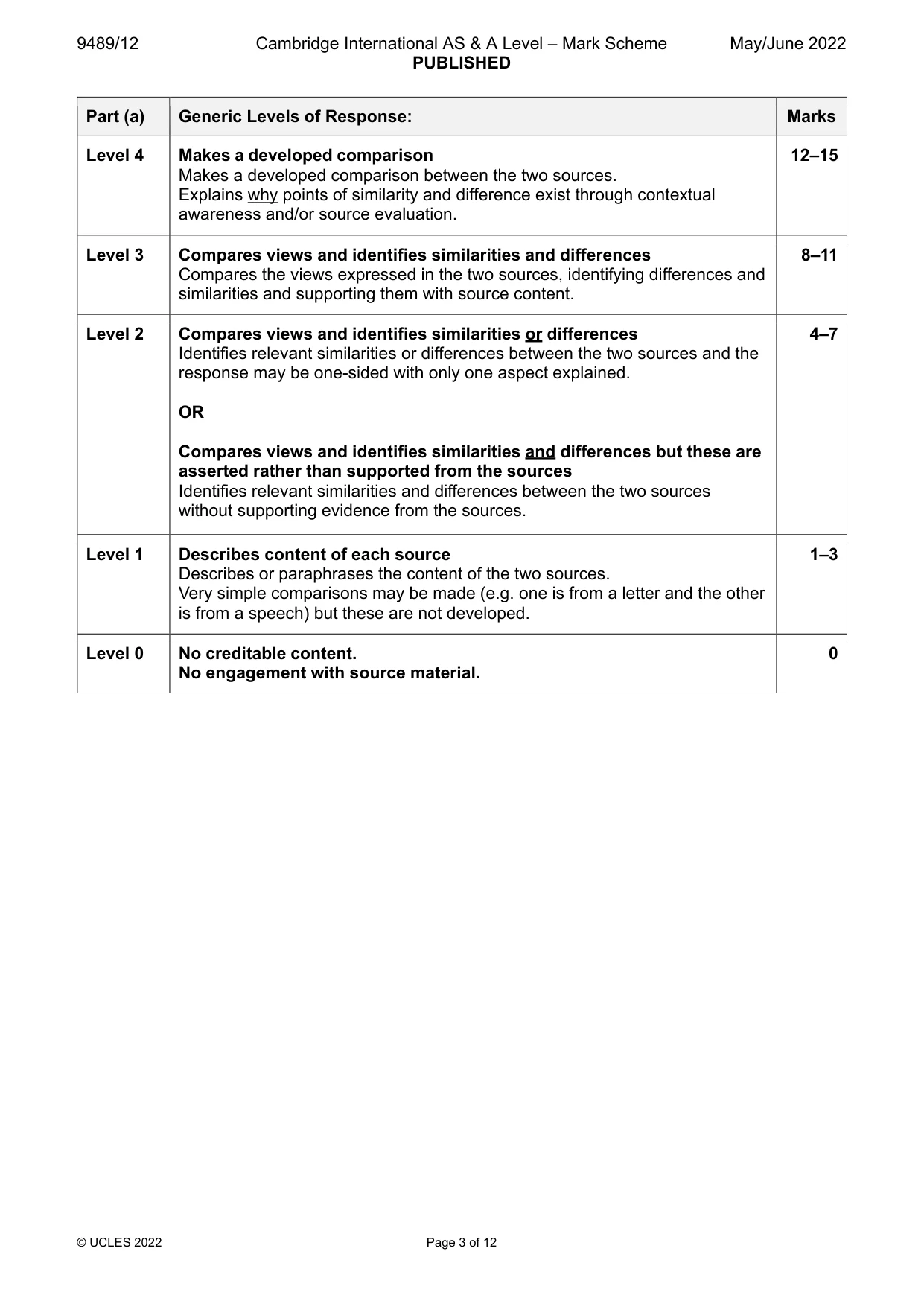
9489/12 Cambridge International AS & A Level – Mark Scheme PUBLISHED May/June 2022 © UCLES 2022 Page 3 of 12 Part (a) Generic Levels of Response: Marks Level 4 Makes a developed comparison Makes a developed comparison between the two sources. Explains why points of similarity and difference exist through contextual awareness and/or source evaluation. 12–15 Level 3 Compares views and identifies similarities and differences Compares the views expressed in the two sources, identifying differences and similarities and supporting them with source content. 8–11 Level 2 Compares views and identifies similarities or differences Identifies relevant similarities or differences between the two sources and the response may be one-sided with only one aspect explained. OR Compares views and identifies similarities and differences but these are asserted rather than supported from the sources Identifies relevant similarities and differences between the two sources without supporting evidence from the sources. 4–7 Level 1 Describes content of each source Describes or paraphrases the content of the two sources. Very simple comparisons may be made (e.g. one is from a letter and the other is from a speech) but these are not developed. 1–3 Level 0 No creditable content. No engagement with source material. 0
Mark scheme, page 4
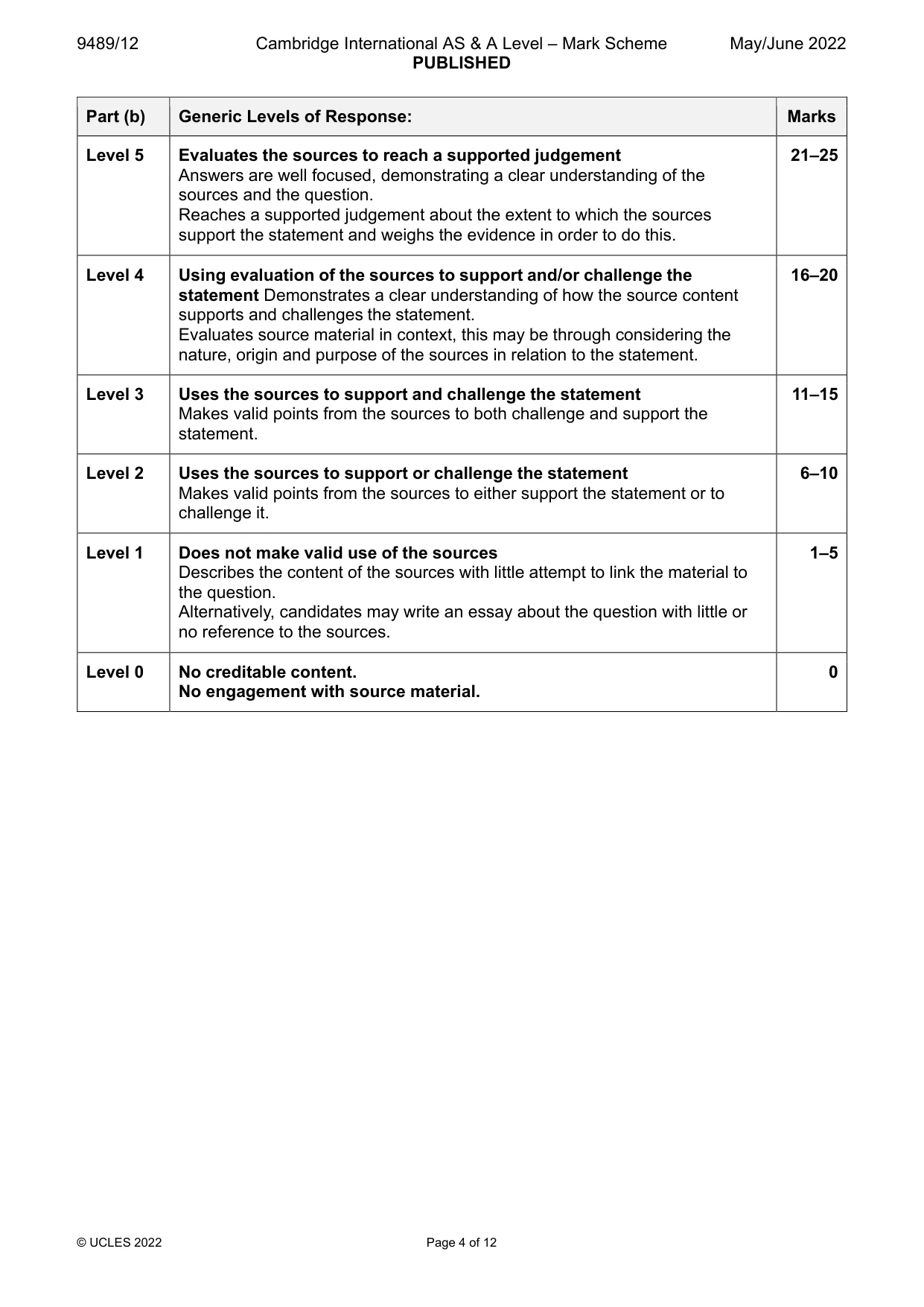
9489/12 Cambridge International AS & A Level – Mark Scheme PUBLISHED May/June 2022 © UCLES 2022 Page 4 of 12 Part (b) Generic Levels of Response: Marks Level 5 Evaluates the sources to reach a supported judgement Answers are well focused, demonstrating a clear understanding of the sources and the question. Reaches a supported judgement about the extent to which the sources support the statement and weighs the evidence in order to do this. 21–25 Level 4 Using evaluation of the sources to support and/or challenge the statement Demonstrates a clear understanding of how the source content supports and challenges the statement. Evaluates source material in context, this may be through considering the nature, origin and purpose of the sources in relation to the statement. 16–20 Level 3 Uses the sources to support and challenge the statement Makes valid points from the sources to both challenge and support the statement. 11–15 Level 2 Uses the sources to support or challenge the statement Makes valid points from the sources to either support the statement or to challenge it. 6–10 Level 1 Does not make valid use of the sources Describes the content of the sources with little attempt to link the material to the question. Alternatively, candidates may write an essay about the question with little or no reference to the sources. 1–5 Level 0 No creditable content. No engagement with source material. 0
Mark scheme, page 5
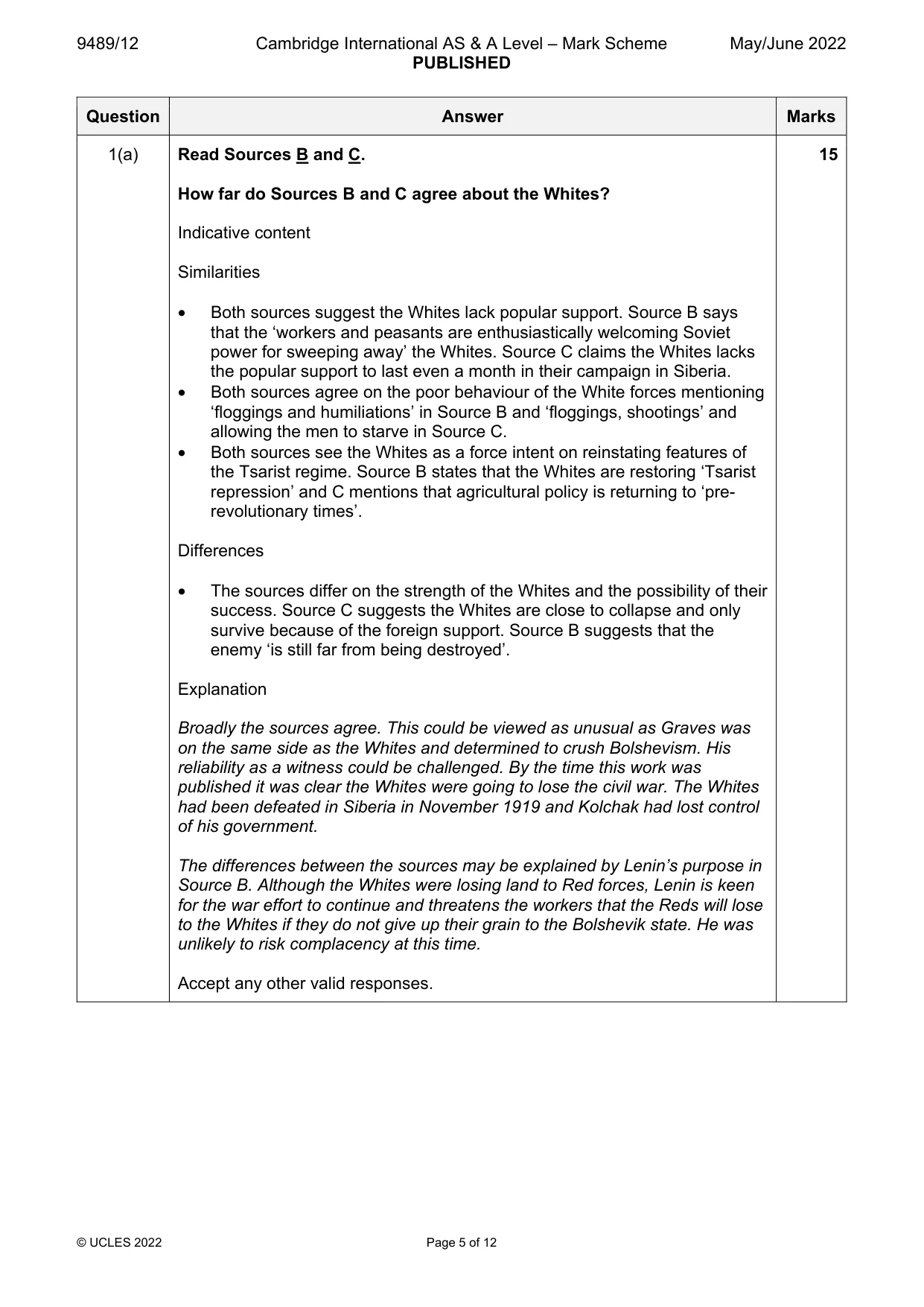
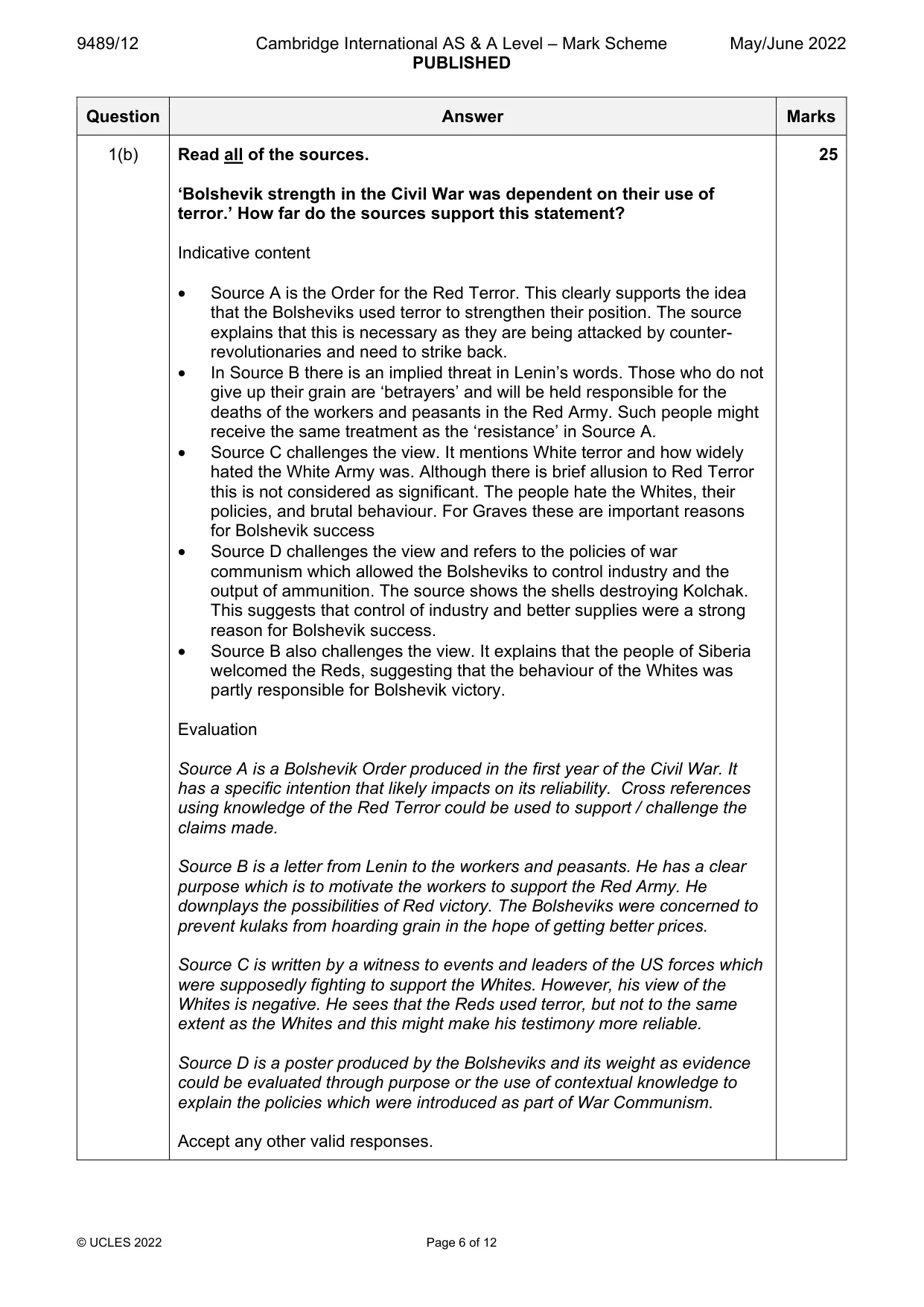
9489/12 Cambridge International AS & A Level – Mark Scheme PUBLISHED May/June 2022 © UCLES 2022 Page 5 of 12 Question Answer Marks 1(a) Read Sources B and C. How far do Sources B and C agree about the Whites? Indicative content Similarities • Both sources suggest the Whites lack popular support. Source B says that the ‘workers and peasants are enthusiastically welcoming Soviet power for sweeping away’ the Whites. Source C claims the Whites lacks the popular support to last even a month in their campaign in Siberia. • Both sources agree on the poor behaviour of the White forces mentioning ‘floggings and humiliations’ in Source B and ‘floggings, shootings’ and allowing the men to starve in Source C. • Both sources see the Whites as a force intent on reinstating features of the Tsarist regime. Source B states that the Whites are restoring ‘Tsarist repression’ and C mentions that agricultural policy is returning to ‘pre- revolutionary times’. Differences • The sources differ on the strength of the Whites and the possibility of their success. Source C suggests the Whites are close to collapse and only survive because of the foreign support. Source B suggests that the enemy ‘is still far from being destroyed’. Explanation Broadly the sources agree. This could be viewed as unusual as Graves was on the same side as the Whites and determined to crush Bolshevism. His reliability as a witness could be challenged. By the time this work was published it was clear the Whites were going to lose the civil war. The Whites had been defeated in Siberia in November 1919 and Kolchak had lost control of his government. The differences between the sources may be explained by Lenin’s purpose in Source B. Although the Whites were losing land to Red forces, Lenin is keen for the war effort to continue and threatens the workers that the Reds will lose to the Whites if they do not give up their grain to the Bolshevik state. He was unlikely to risk complacency at this time. Accept any other valid responses. 15
Mark scheme, page 6
9489/12 Cambridge International AS & A Level – Mark Scheme PUBLISHED May/June 2022 © UCLES 2022 Page 6 of 12 Question Answer Marks 1(b) Read all of the sources. ‘Bolshevik strength in the Civil War was dependent on their use of terror.’ How far do the sources support this statement? Indicative content • Source A is the Order for the Red Terror. This clearly supports the idea that the Bolsheviks used terror to strengthen their position. The source explains that this is necessary as they are being attacked by counter- revolutionaries and need to strike back. • In Source B there is an implied threat in Lenin’s words. Those who do not give up their grain are ‘betrayers’ and will be held responsible for the deaths of the workers and peasants in the Red Army. Such people might receive the same treatment as the ‘resistance’ in Source A. • Source C challenges the view. It mentions White terror and how widely hated the White Army was. Although there is brief allusion to Red Terror this is not considered as significant. The people hate the Whites, their policies, and brutal behaviour. For Graves these are important reasons for Bolshevik success • Source D challenges the view and refers to the policies of war communism which allowed the Bolsheviks to control industry and the output of ammunition. The source shows the shells destroying Kolchak. This suggests that control of industry and better supplies were a strong reason for Bolshevik success. • Source B also challenges the view. It explains that the people of Siberia welcomed the Reds, suggesting that the behaviour of the Whites was partly responsible for Bolshevik victory. Evaluation Source A is a Bolshevik Order produced in the first year of the Civil War. It has a specific intention that likely impacts on its reliability. Cross references using knowledge of the Red Terror could be used to support / challenge the claims made. Source B is a letter from Lenin to the workers and peasants. He has a clear purpose which is to motivate the workers to support the Red Army. He downplays the possibilities of Red victory. The Bolsheviks were concerned to prevent kulaks from hoarding grain in the hope of getting better prices. Source C is written by a witness to events and leaders of the US forces which were supposedly fighting to support the Whites. However, his view of the Whites is negative. He sees that the Reds used terror, but not to the same extent as the Whites and this might make his testimony more reliable. Source D is a poster produced by the Bolsheviks and its weight as evidence could be evaluated through purpose or the use of contextual knowledge to explain the policies which were introduced as part of War Communism. Accept any other valid responses. 25
Mark scheme, page 7
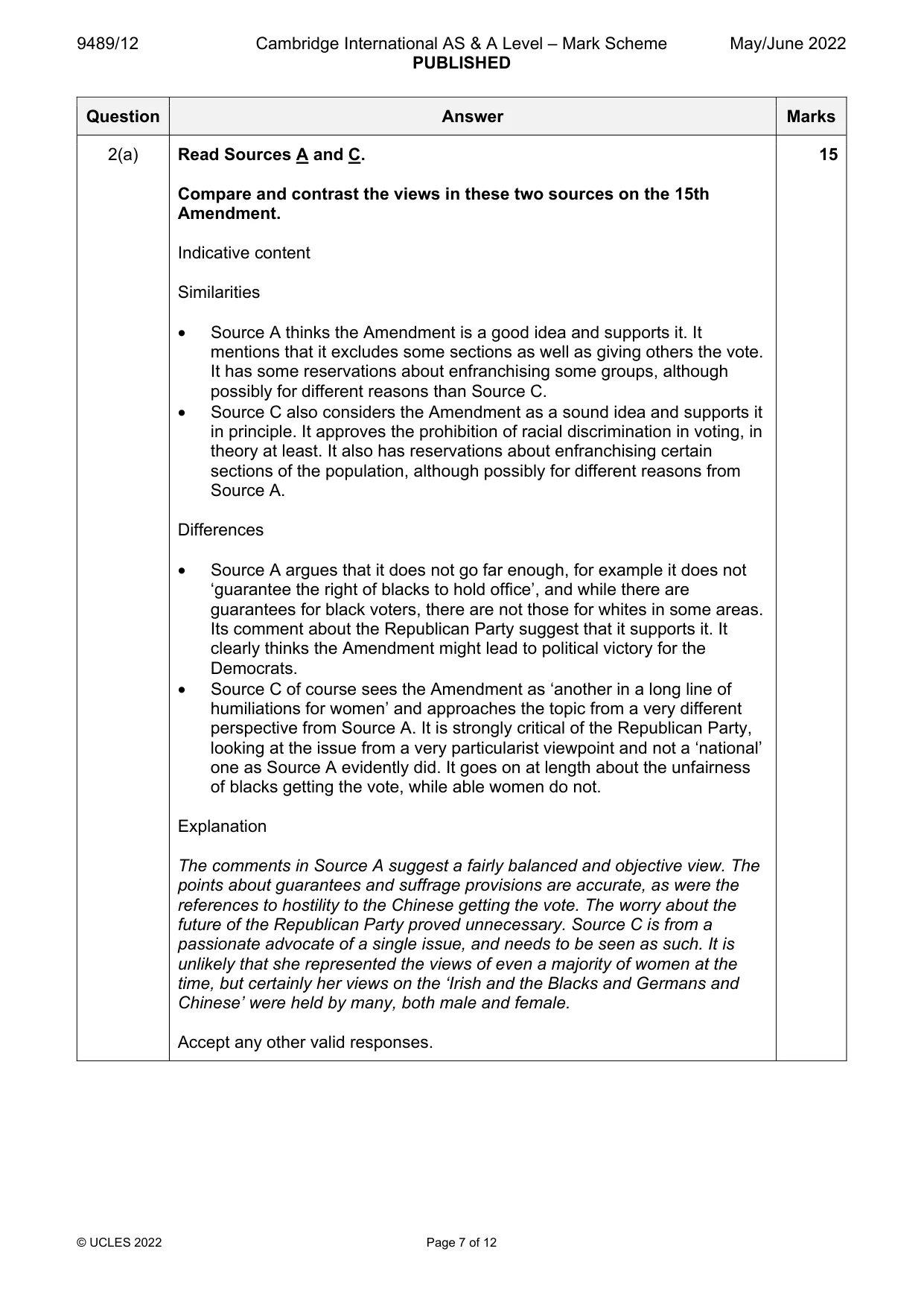
9489/12 Cambridge International AS & A Level – Mark Scheme PUBLISHED May/June 2022 © UCLES 2022 Page 7 of 12 Question Answer Marks 2(a) Read Sources A and C. Compare and contrast the views in these two sources on the 15th Amendment. Indicative content Similarities • Source A thinks the Amendment is a good idea and supports it. It mentions that it excludes some sections as well as giving others the vote. It has some reservations about enfranchising some groups, although possibly for different reasons than Source C. • Source C also considers the Amendment as a sound idea and supports it in principle. It approves the prohibition of racial discrimination in voting, in theory at least. It also has reservations about enfranchising certain sections of the population, although possibly for different reasons from Source A. Differences • Source A argues that it does not go far enough, for example it does not ‘guarantee the right of blacks to hold office’, and while there are guarantees for black voters, there are not those for whites in some areas. Its comment about the Republican Party suggest that it supports it. It clearly thinks the Amendment might lead to political victory for the Democrats. • Source C of course sees the Amendment as ‘another in a long line of humiliations for women’ and approaches the topic from a very different perspective from Source A. It is strongly critical of the Republican Party, looking at the issue from a very particularist viewpoint and not a ‘national’ one as Source A evidently did. It goes on at length about the unfairness of blacks getting the vote, while able women do not. Explanation The comments in Source A suggest a fairly balanced and objective view. The points about guarantees and suffrage provisions are accurate, as were the references to hostility to the Chinese getting the vote. The worry about the future of the Republican Party proved unnecessary. Source C is from a passionate advocate of a single issue, and needs to be seen as such. It is unlikely that she represented the views of even a majority of women at the time, but certainly her views on the ‘Irish and the Blacks and Germans and Chinese’ were held by many, both male and female. Accept any other valid responses. 15
Mark scheme, page 8
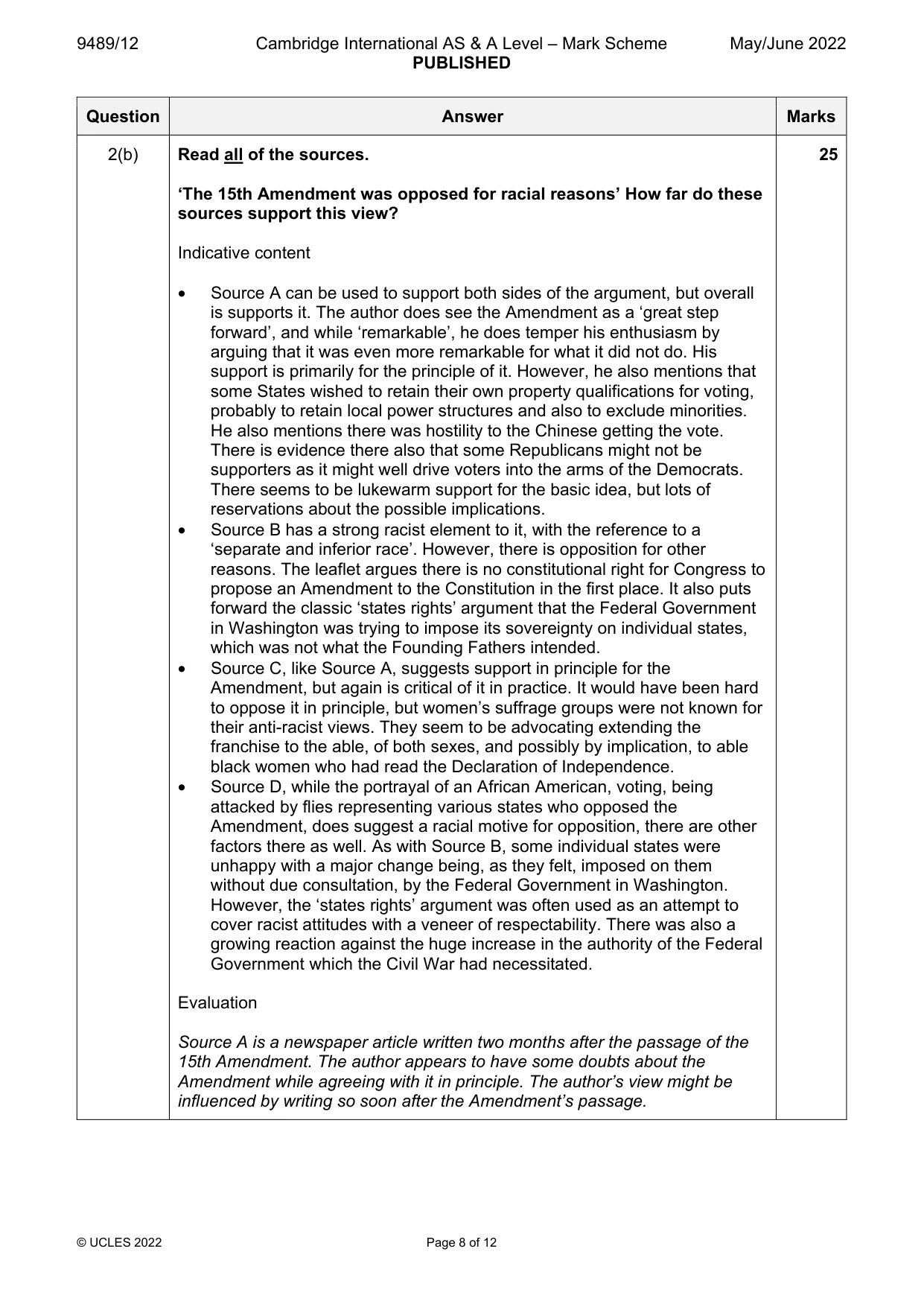
9489/12 Cambridge International AS & A Level – Mark Scheme PUBLISHED May/June 2022 © UCLES 2022 Page 8 of 12 Question Answer Marks 2(b) Read all of the sources. ‘The 15th Amendment was opposed for racial reasons’ How far do these sources support this view? Indicative content • Source A can be used to support both sides of the argument, but overall is supports it. The author does see the Amendment as a ‘great step forward’, and while ‘remarkable’, he does temper his enthusiasm by arguing that it was even more remarkable for what it did not do. His support is primarily for the principle of it. However, he also mentions that some States wished to retain their own property qualifications for voting, probably to retain local power structures and also to exclude minorities. He also mentions there was hostility to the Chinese getting the vote. There is evidence there also that some Republicans might not be supporters as it might well drive voters into the arms of the Democrats. There seems to be lukewarm support for the basic idea, but lots of reservations about the possible implications. • Source B has a strong racist element to it, with the reference to a ‘separate and inferior race’. However, there is opposition for other reasons. The leaflet argues there is no constitutional right for Congress to propose an Amendment to the Constitution in the first place. It also puts forward the classic ‘states rights’ argument that the Federal Government in Washington was trying to impose its sovereignty on individual states, which was not what the Founding Fathers intended. • Source C, like Source A, suggests support in principle for the Amendment, but again is critical of it in practice. It would have been hard to oppose it in principle, but women’s suffrage groups were not known for their anti-racist views. They seem to be advocating extending the franchise to the able, of both sexes, and possibly by implication, to able black women who had read the Declaration of Independence. • Source D, while the portrayal of an African American, voting, being attacked by flies representing various states who opposed the Amendment, does suggest a racial motive for opposition, there are other factors there as well. As with Source B, some individual states were unhappy with a major change being, as they felt, imposed on them without due consultation, by the Federal Government in Washington. However, the ‘states rights’ argument was often used as an attempt to cover racist attitudes with a veneer of respectability. There was also a growing reaction against the huge increase in the authority of the Federal Government which the Civil War had necessitated. Evaluation Source A is a newspaper article written two months after the passage of the 15th Amendment. The author appears to have some doubts about the Amendment while agreeing with it in principle. The author’s view might be influenced by writing so soon after the Amendment’s passage. 25
Mark scheme, page 9
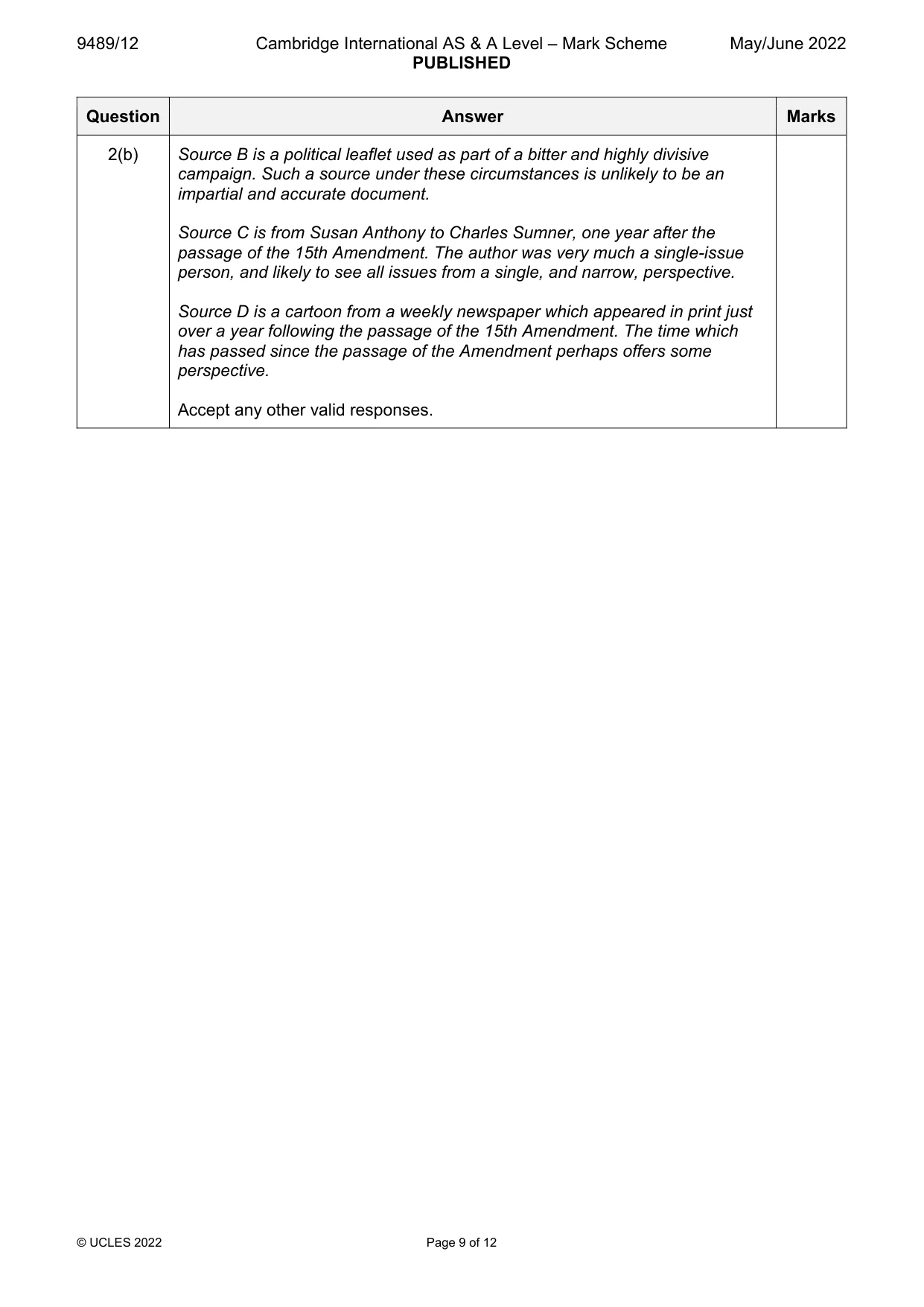
9489/12 Cambridge International AS & A Level – Mark Scheme PUBLISHED May/June 2022 © UCLES 2022 Page 9 of 12 Question Answer Marks 2(b) Source B is a political leaflet used as part of a bitter and highly divisive campaign. Such a source under these circumstances is unlikely to be an impartial and accurate document. Source C is from Susan Anthony to Charles Sumner, one year after the passage of the 15th Amendment. The author was very much a single-issue person, and likely to see all issues from a single, and narrow, perspective. Source D is a cartoon from a weekly newspaper which appeared in print just over a year following the passage of the 15th Amendment. The time which has passed since the passage of the Amendment perhaps offers some perspective. Accept any other valid responses.
Mark scheme, page 10
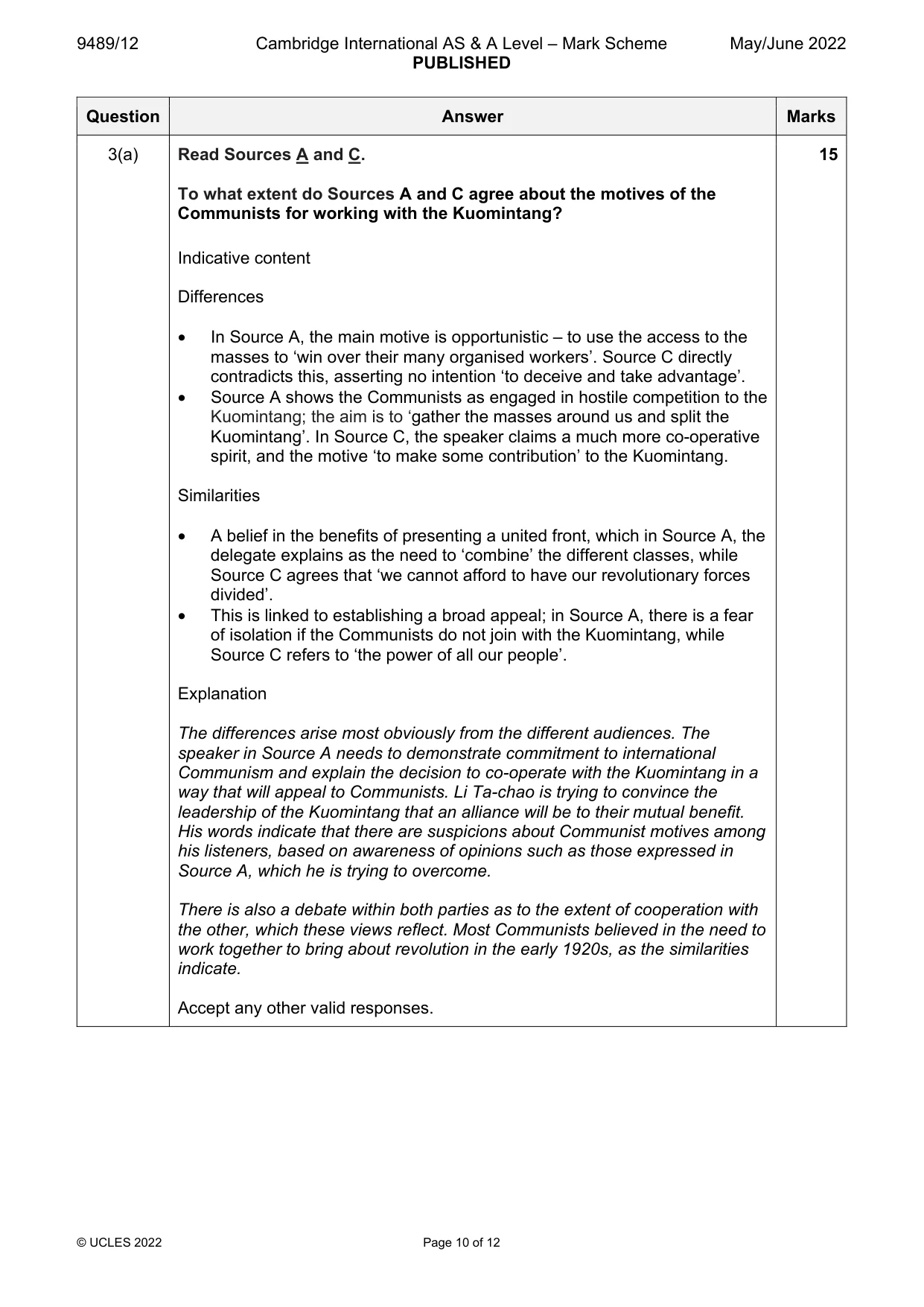
9489/12 Cambridge International AS & A Level – Mark Scheme PUBLISHED May/June 2022 © UCLES 2022 Page 10 of 12 Question Answer Marks 3(a) Read Sources A and C. To what extent do Sources A and C agree about the motives of the Communists for working with the Kuomintang? Indicative content Differences • In Source A, the main motive is opportunistic – to use the access to the masses to ‘win over their many organised workers’. Source C directly contradicts this, asserting no intention ‘to deceive and take advantage’. • Source A shows the Communists as engaged in hostile competition to the Kuomintang; the aim is to ‘gather the masses around us and split the Kuomintang’. In Source C, the speaker claims a much more co-operative spirit, and the motive ‘to make some contribution’ to the Kuomintang. Similarities • A belief in the benefits of presenting a united front, which in Source A, the delegate explains as the need to ‘combine’ the different classes, while Source C agrees that ‘we cannot afford to have our revolutionary forces divided’. • This is linked to establishing a broad appeal; in Source A, there is a fear of isolation if the Communists do not join with the Kuomintang, while Source C refers to ‘the power of all our people’. Explanation The differences arise most obviously from the different audiences. The speaker in Source A needs to demonstrate commitment to international Communism and explain the decision to co-operate with the Kuomintang in a way that will appeal to Communists. Li Ta-chao is trying to convince the leadership of the Kuomintang that an alliance will be to their mutual benefit. His words indicate that there are suspicions about Communist motives among his listeners, based on awareness of opinions such as those expressed in Source A, which he is trying to overcome. There is also a debate within both parties as to the extent of cooperation with the other, which these views reflect. Most Communists believed in the need to work together to bring about revolution in the early 1920s, as the similarities indicate. Accept any other valid responses. 15
Mark scheme, page 11
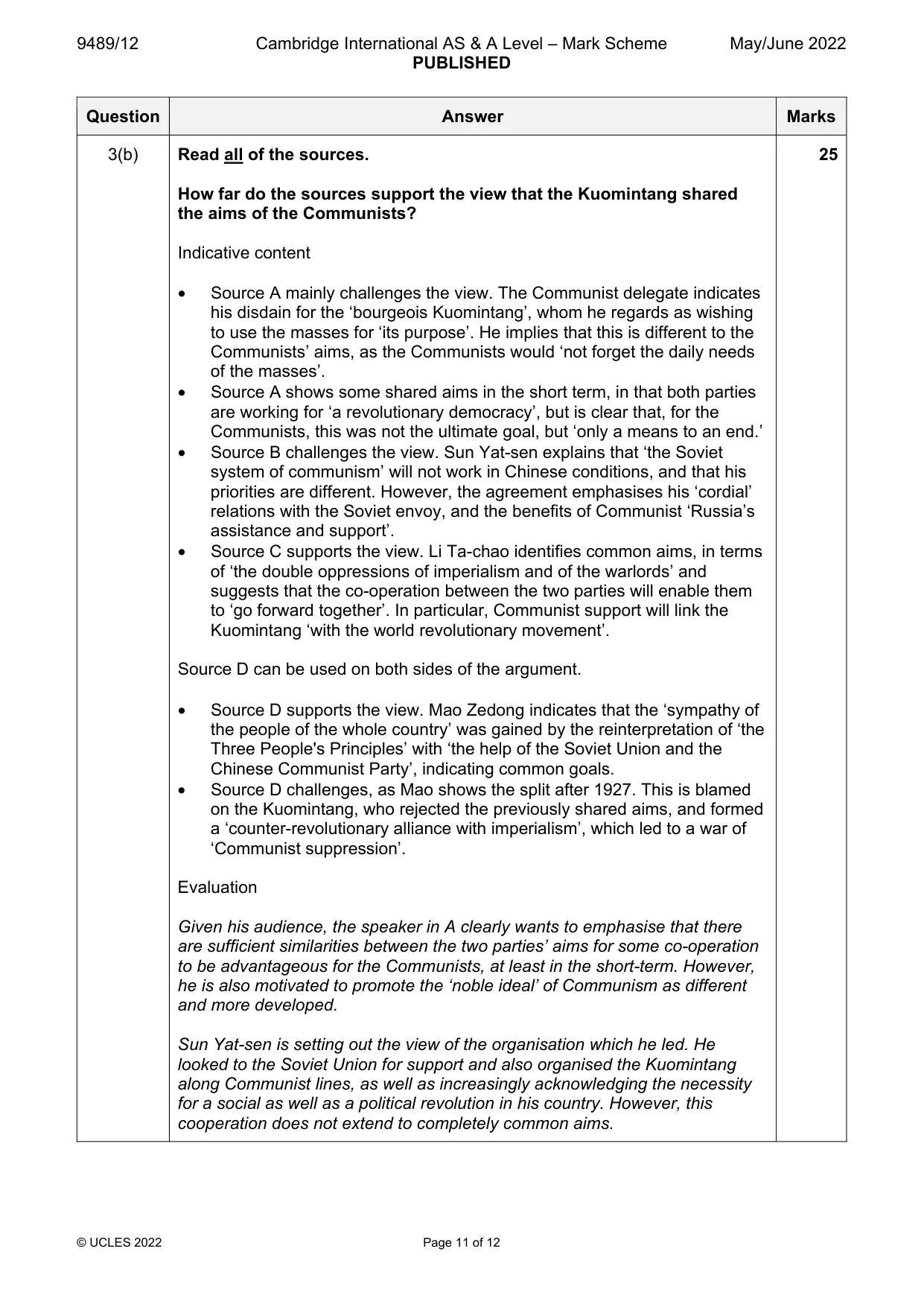
9489/12 Cambridge International AS & A Level – Mark Scheme PUBLISHED May/June 2022 © UCLES 2022 Page 11 of 12 Question Answer Marks 3(b) Read all of the sources. How far do the sources support the view that the Kuomintang shared the aims of the Communists? Indicative content • Source A mainly challenges the view. The Communist delegate indicates his disdain for the ‘bourgeois Kuomintang’, whom he regards as wishing to use the masses for ‘its purpose’. He implies that this is different to the Communists’ aims, as the Communists would ‘not forget the daily needs of the masses’. • Source A shows some shared aims in the short term, in that both parties are working for ‘a revolutionary democracy’, but is clear that, for the Communists, this was not the ultimate goal, but ‘only a means to an end.’ • Source B challenges the view. Sun Yat-sen explains that ‘the Soviet system of communism’ will not work in Chinese conditions, and that his priorities are different. However, the agreement emphasises his ‘cordial’ relations with the Soviet envoy, and the benefits of Communist ‘Russia’s assistance and support’. • Source C supports the view. Li Ta-chao identifies common aims, in terms of ‘the double oppressions of imperialism and of the warlords’ and suggests that the co-operation between the two parties will enable them to ‘go forward together’. In particular, Communist support will link the Kuomintang ‘with the world revolutionary movement’. Source D can be used on both sides of the argument. • Source D supports the view. Mao Zedong indicates that the ‘sympathy of the people of the whole country’ was gained by the reinterpretation of ‘the Three People's Principles’ with ‘the help of the Soviet Union and the Chinese Communist Party’, indicating common goals. • Source D challenges, as Mao shows the split after 1927. This is blamed on the Kuomintang, who rejected the previously shared aims, and formed a ‘counter-revolutionary alliance with imperialism’, which led to a war of ‘Communist suppression’. Evaluation Given his audience, the speaker in A clearly wants to emphasise that there are sufficient similarities between the two parties’ aims for some co-operation to be advantageous for the Communists, at least in the short-term. However, he is also motivated to promote the ‘noble ideal’ of Communism as different and more developed. Sun Yat-sen is setting out the view of the organisation which he led. He looked to the Soviet Union for support and also organised the Kuomintang along Communist lines, as well as increasingly acknowledging the necessity for a social as well as a political revolution in his country. However, this cooperation does not extend to completely common aims. 25
Mark scheme, page 12
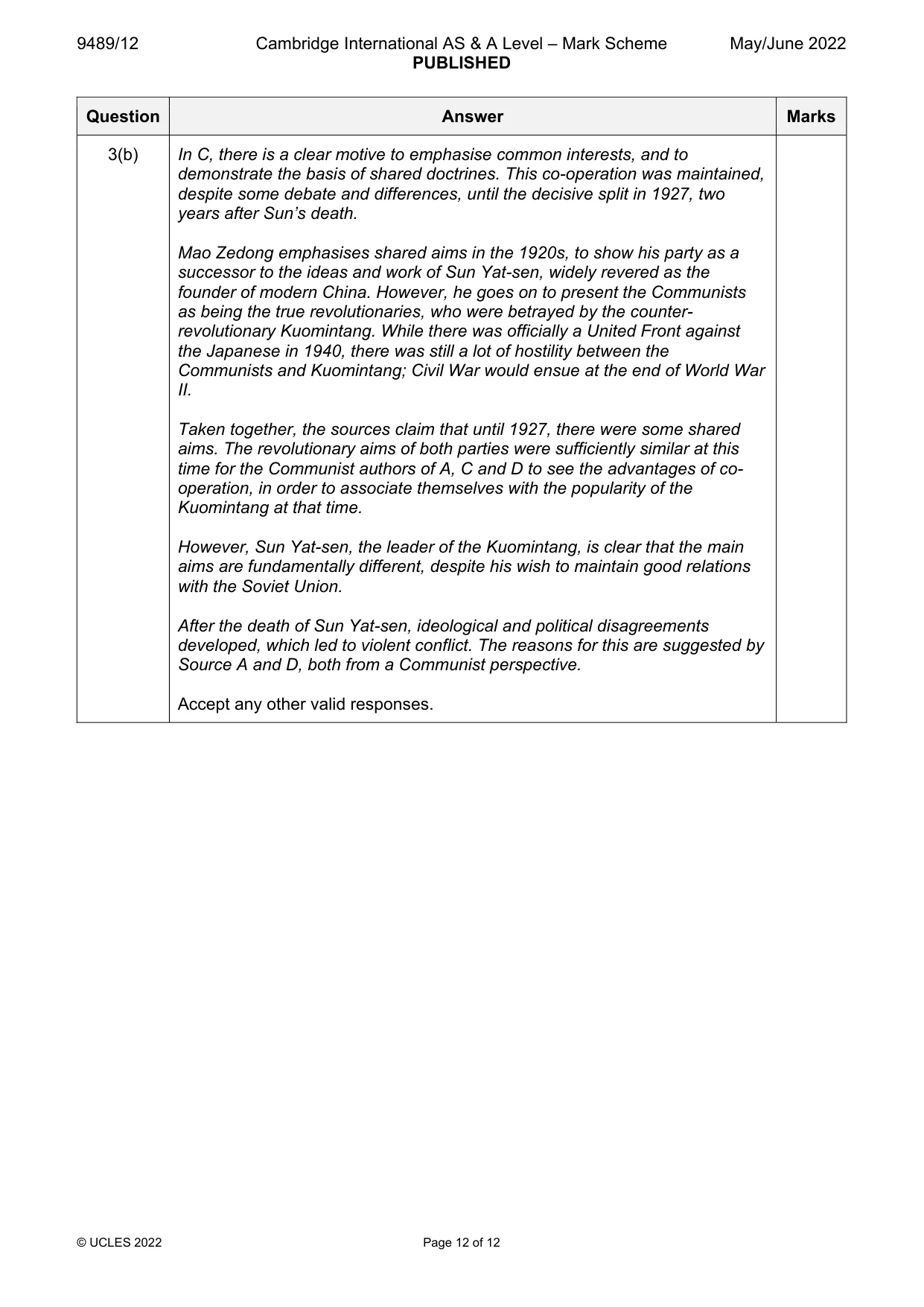
9489/12 Cambridge International AS & A Level – Mark Scheme PUBLISHED May/June 2022 © UCLES 2022 Page 12 of 12 Question Answer Marks 3(b) In C, there is a clear motive to emphasise common interests, and to demonstrate the basis of shared doctrines. This co-operation was maintained, despite some debate and differences, until the decisive split in 1927, two years after Sun’s death. Mao Zedong emphasises shared aims in the 1920s, to show his party as a successor to the ideas and work of Sun Yat-sen, widely revered as the founder of modern China. However, he goes on to present the Communists as being the true revolutionaries, who were betrayed by the counter- revolutionary Kuomintang. While there was officially a United Front against the Japanese in 1940, there was still a lot of hostility between the Communists and Kuomintang; Civil War would ensue at the end of World War II. Taken together, the sources claim that until 1927, there were some shared aims. The revolutionary aims of both parties were sufficiently similar at this time for the Communist authors of A, C and D to see the advantages of co- operation, in order to associate themselves with the popularity of the Kuomintang at that time. However, Sun Yat-sen, the leader of the Kuomintang, is clear that the main aims are fundamentally different, despite his wish to maintain good relations with the Soviet Union. After the death of Sun Yat-sen, ideological and political disagreements developed, which led to violent conflict. The reasons for this are suggested by Source A and D, both from a Communist perspective. Accept any other valid responses.
What you needed in this session
Cambridge’s own grade thresholds for 2022 Feb/March, Paper 1 · Variant 2. A higher threshold means an easier paper — the bar moves with how the cohort did.