Cambridge A Level History 9489 — 2021 Feb/March Paper 1 · Variant 2
9489/12/F/M/21 · 40 marks · ≈45 min
The question paper and its mark scheme, free to read here and free to download. This is Cambridge’s own paper, exactly as it was sat.
Question paper8 pages

Mark scheme11 pages
Answers below. Sit the paper first if you are practising.
Paper as text
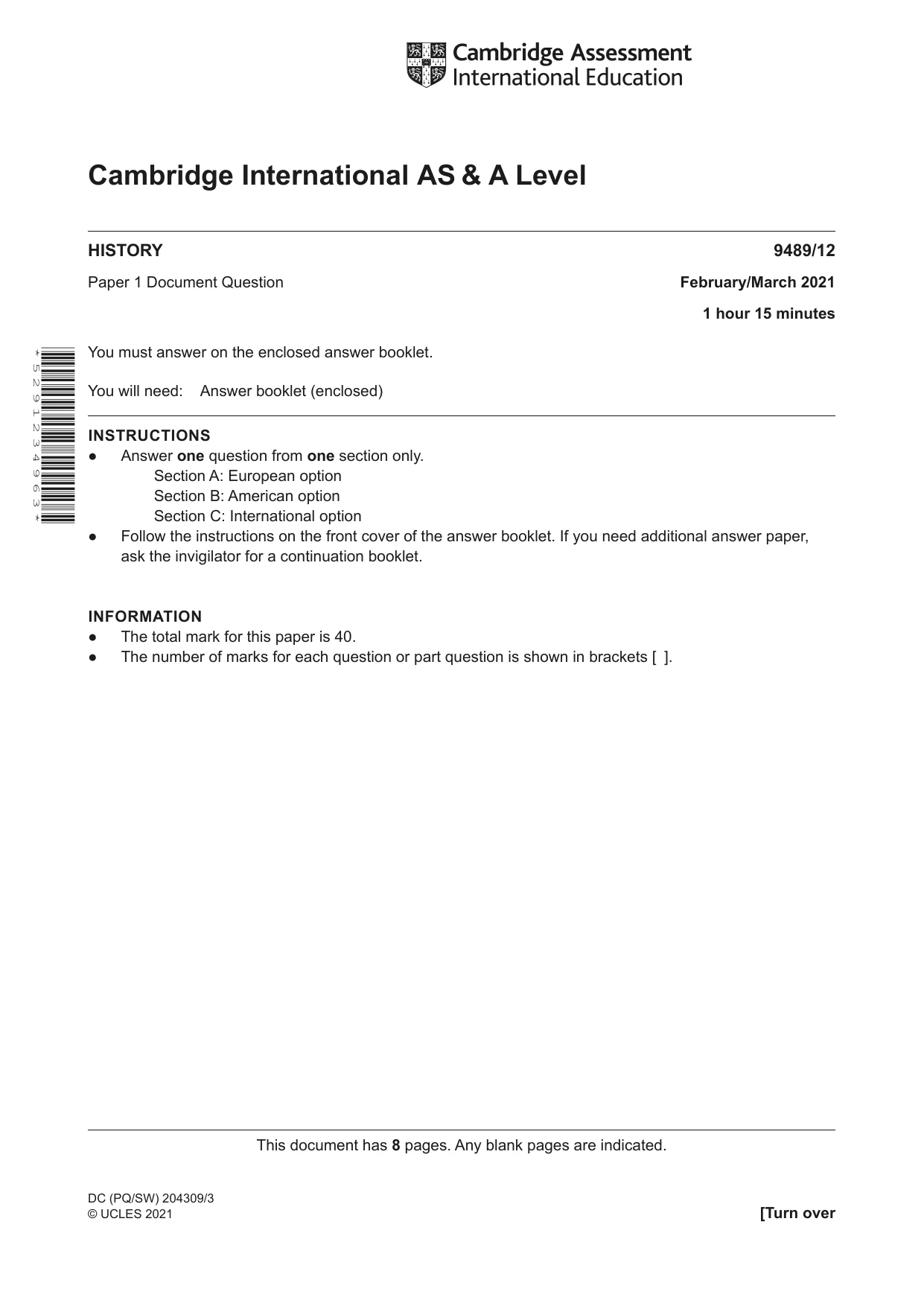
Question paper, page 1
This document has 8 pages. Any blank pages are indicated. Cambridge International AS & A Level DC (PQ/SW) 204309/3 © UCLES 2021 [Turn over * 5 2 9 1 2 3 4 9 6 3 * HISTORY 9489/12 Paper 1 Document Question February/March 2021 1 hour 15 minutes You must answer on the enclosed answer booklet. You will need: Answer booklet (enclosed) INSTRUCTIONS ● Answer one question from one section only. Section A: European option Section B: American option Section C: International option ● Follow the instructions on the front cover of the answer booklet. If you need additional answer paper, ask the invigilator for a continuation booklet. INFORMATION ● The total mark for this paper is 40. ● The number of marks for each question or part question is shown in brackets [ ].
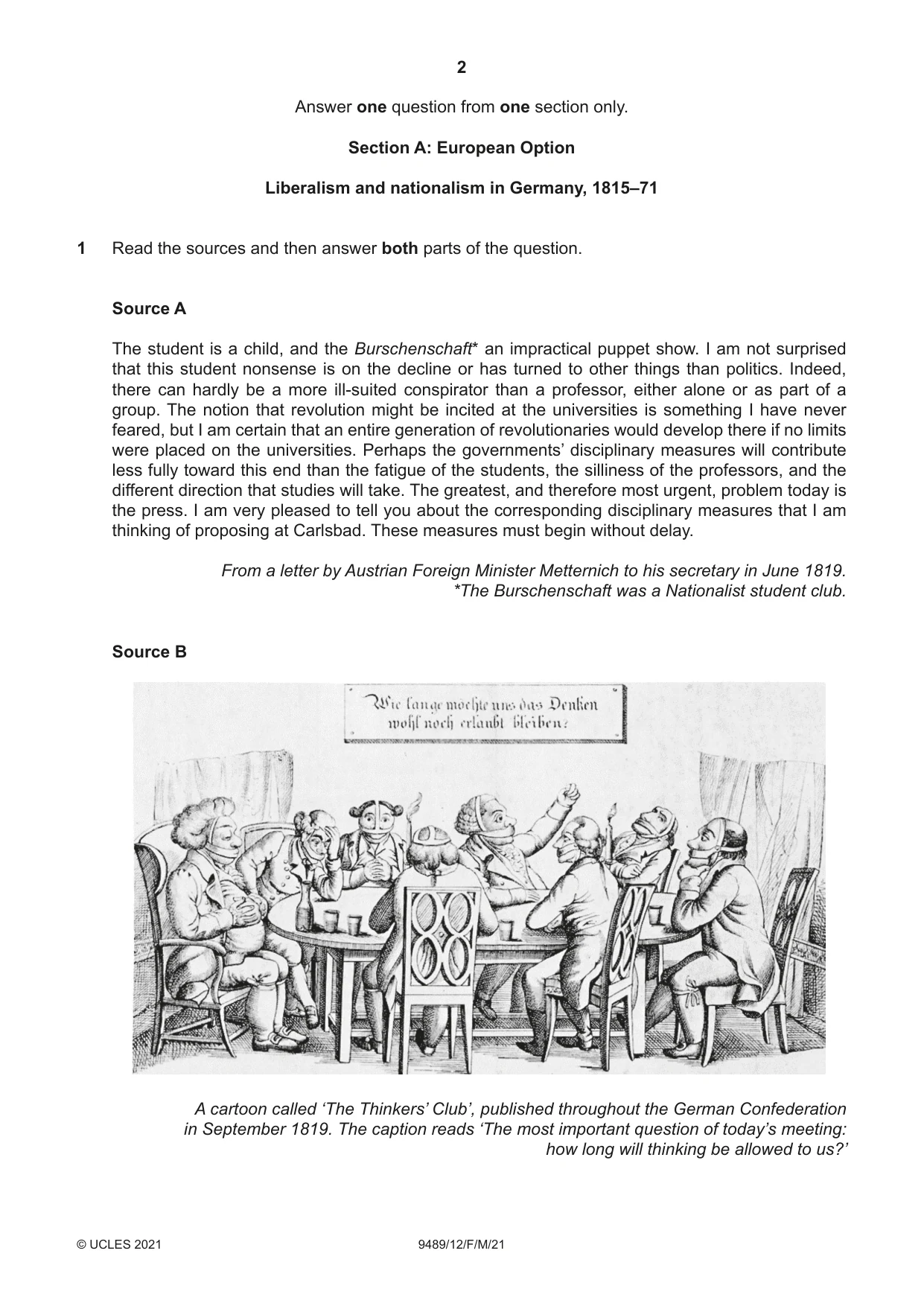
Question paper, page 2
2 9489/12/F/M/21 © UCLES 2021 Answer one question from one section only. Section A: European Option Liberalism and nationalism in Germany, 1815–71 1 Read the sources and then answer both parts of the question. Source A The student is a child, and the Burschenschaft* an impractical puppet show. I am not surprised that this student nonsense is on the decline or has turned to other things than politics. Indeed, there can hardly be a more ill-suited conspirator than a professor, either alone or as part of a group. The notion that revolution might be incited at the universities is something I have never feared, but I am certain that an entire generation of revolutionaries would develop there if no limits were placed on the universities. Perhaps the governments’ disciplinary measures will contribute less fully toward this end than the fatigue of the students, the silliness of the professors, and the different direction that studies will take. The greatest, and therefore most urgent, problem today is the press. I am very pleased to tell you about the corresponding disciplinary measures that I am thinking of proposing at Carlsbad. These measures must begin without delay. From a letter by Austrian Foreign Minister Metternich to his secretary in June 1819. *The Burschenschaft was a Nationalist student club. Source B A cartoon called ‘The Thinkers’ Club’, published throughout the German Confederation in September 1819. The caption reads ‘The most important question of today’s meeting: how long will thinking be allowed to us?’
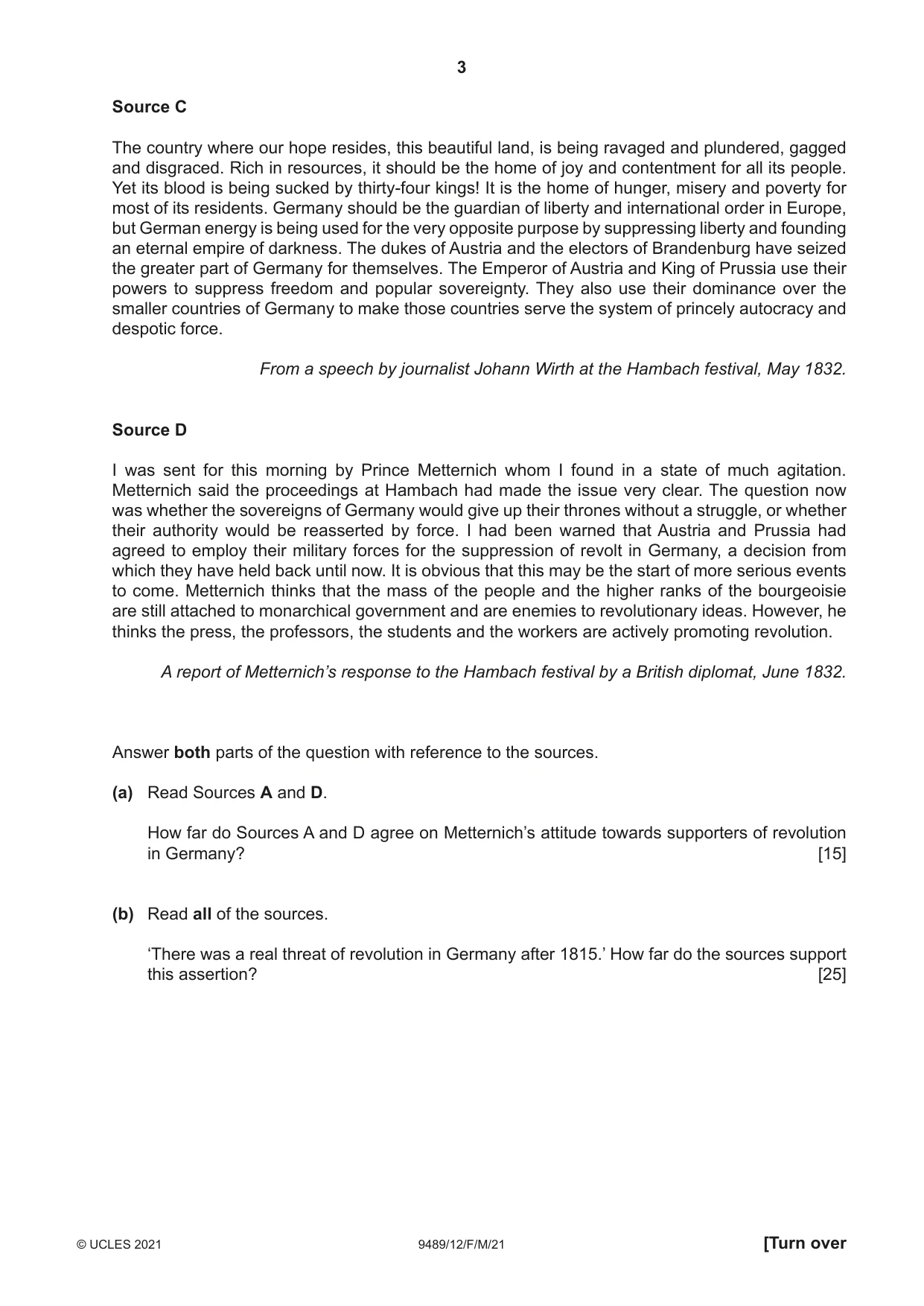
Question paper, page 3
3 9489/12/F/M/21 © UCLES 2021 [Turn over Source C The country where our hope resides, this beautiful land, is being ravaged and plundered, gagged and disgraced. Rich in resources, it should be the home of joy and contentment for all its people. Yet its blood is being sucked by thirty-four kings! It is the home of hunger, misery and poverty for most of its residents. Germany should be the guardian of liberty and international order in Europe, but German energy is being used for the very opposite purpose by suppressing liberty and founding an eternal empire of darkness. The dukes of Austria and the electors of Brandenburg have seized the greater part of Germany for themselves. The Emperor of Austria and King of Prussia use their powers to suppress freedom and popular sovereignty. They also use their dominance over the smaller countries of Germany to make those countries serve the system of princely autocracy and despotic force. From a speech by journalist Johann Wirth at the Hambach festival, May 1832. Source D I was sent for this morning by Prince Metternich whom I found in a state of much agitation. Metternich said the proceedings at Hambach had made the issue very clear. The question now was whether the sovereigns of Germany would give up their thrones without a struggle, or whether their authority would be reasserted by force. I had been warned that Austria and Prussia had agreed to employ their military forces for the suppression of revolt in Germany, a decision from which they have held back until now. It is obvious that this may be the start of more serious events to come. Metternich thinks that the mass of the people and the higher ranks of the bourgeoisie are still attached to monarchical government and are enemies to revolutionary ideas. However, he thinks the press, the professors, the students and the workers are actively promoting revolution. A report of Metternich’s response to the Hambach festival by a British diplomat, June 1832. Answer both parts of the question with reference to the sources. (a) Read Sources A and D. How far do Sources A and D agree on Metternich’s attitude towards supporters of revolution in Germany? [15] (b) Read all of the sources. ‘There was a real threat of revolution in Germany after 1815.’ How far do the sources support this assertion? [25]
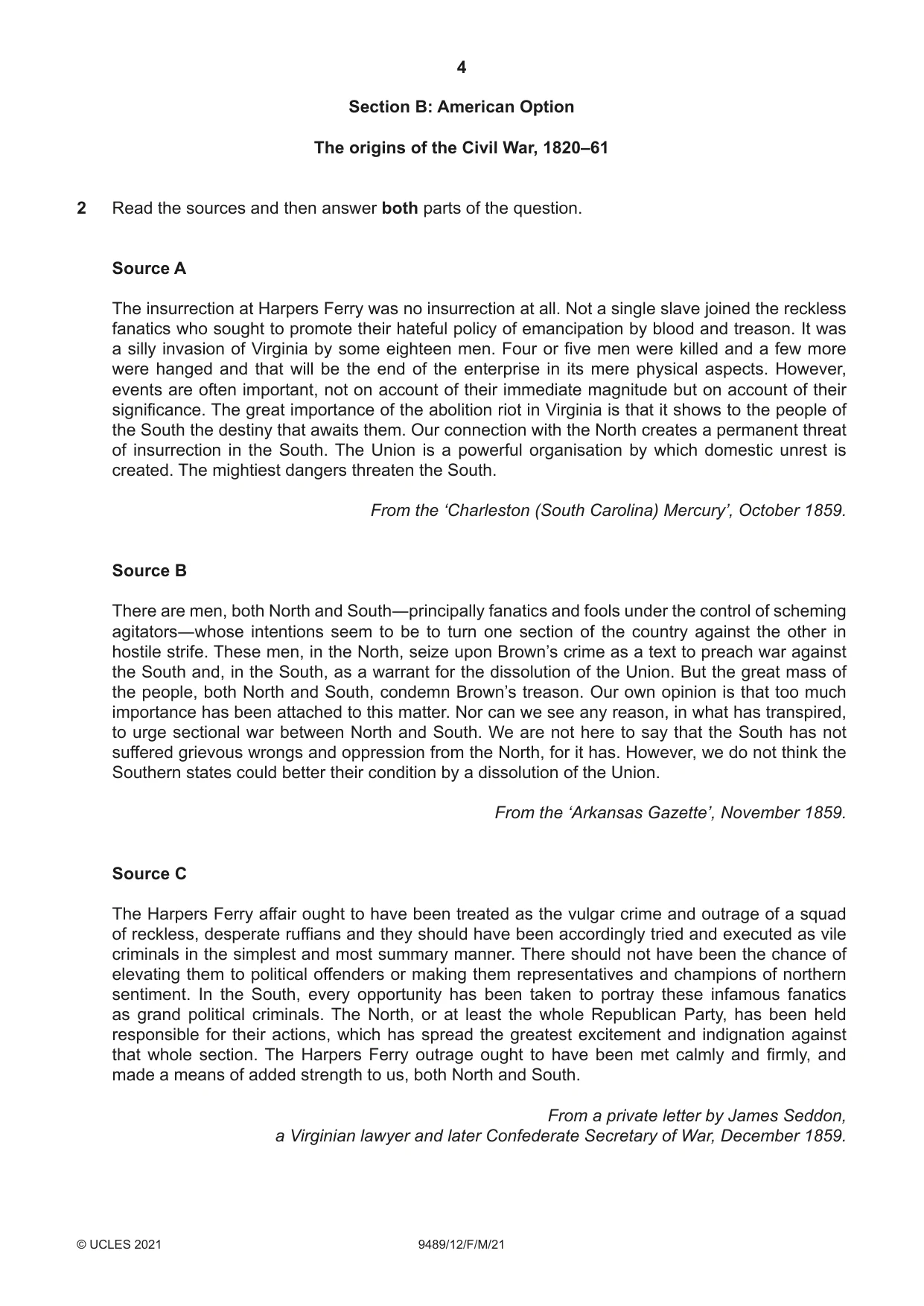
Question paper, page 4
4 9489/12/F/M/21 © UCLES 2021 Section B: American Option The origins of the Civil War, 1820–61 2 Read the sources and then answer both parts of the question. Source A The insurrection at Harpers Ferry was no insurrection at all. Not a single slave joined the reckless fanatics who sought to promote their hateful policy of emancipation by blood and treason. It was a silly invasion of Virginia by some eighteen men. Four or five men were killed and a few more were hanged and that will be the end of the enterprise in its mere physical aspects. However, events are often important, not on account of their immediate magnitude but on account of their significance. The great importance of the abolition riot in Virginia is that it shows to the people of the South the destiny that awaits them. Our connection with the North creates a permanent threat of insurrection in the South. The Union is a powerful organisation by which domestic unrest is created. The mightiest dangers threaten the South. From the ‘Charleston (South Carolina) Mercury’, October 1859. Source B There are men, both North and South―principally fanatics and fools under the control of scheming agitators―whose intentions seem to be to turn one section of the country against the other in hostile strife. These men, in the North, seize upon Brown’s crime as a text to preach war against the South and, in the South, as a warrant for the dissolution of the Union. But the great mass of the people, both North and South, condemn Brown’s treason. Our own opinion is that too much importance has been attached to this matter. Nor can we see any reason, in what has transpired, to urge sectional war between North and South. We are not here to say that the South has not suffered grievous wrongs and oppression from the North, for it has. However, we do not think the Southern states could better their condition by a dissolution of the Union. From the ‘Arkansas Gazette’, November 1859. Source C The Harpers Ferry affair ought to have been treated as the vulgar crime and outrage of a squad of reckless, desperate ruffians and they should have been accordingly tried and executed as vile criminals in the simplest and most summary manner. There should not have been the chance of elevating them to political offenders or making them representatives and champions of northern sentiment. In the South, every opportunity has been taken to portray these infamous fanatics as grand political criminals. The North, or at least the whole Republican Party, has been held responsible for their actions, which has spread the greatest excitement and indignation against that whole section. The Harpers Ferry outrage ought to have been met calmly and firmly, and made a means of added strength to us, both North and South. From a private letter by James Seddon, a Virginian lawyer and later Confederate Secretary of War, December 1859.
Question paper, page 5
5 9489/12/F/M/21 © UCLES 2021 [Turn over Source D John Brown was violent, lawless and fanatical. His ruling passion was to become the instrument of abolishing slavery, by force, throughout the slaveholding states. With him, this amounted almost to insanity. The news of the attack on Harpers Ferry spread rapidly across the country. All were at first ignorant of the weakness of his force while public rumour greatly exaggerated the strength of it. In the already excited condition of public feeling throughout the South, this raid of John Brown made a deeper impression on the southern mind than all previous events. Considered merely as the isolated act of a desperate fanatic, it would have had no lasting impact. It was the enthusiastic and permanent approval of the object of his expedition by the abolitionists of the North which spread alarm and apprehension throughout the South. The Republican party has honoured him ever since as a saint or a martyr in a cause they considered so holy. From ‘Mr Buchanan’s Administration on the Eve of the Rebellion’, published in 1866. The author of this book is usually accepted to be President Buchanan himself. Answer both parts of the question with reference to the sources. (a) Read Sources B and D. To what extent do these two sources agree about the North’s response to the Harpers Ferry raid? [15] (b) Read all of the sources. ‘The South overreacted to the Harpers Ferry raid.’ How far do the sources support this view? [25]
Question paper, page 6
6 9489/12/F/M/21 © UCLES 2021 Section C: International Option The League of Nations and international relations in the 1930s 3 Read the sources and then answer both parts of the question. Source A The Führer believed that almost certainly Britain, and probably France as well, had already tacitly written off the Czechs and were reconciled to the fact that this question would be cleared up in due course by Germany. Difficulties connected with the Empire, and the prospect of involvement in a long European war, were decisive considerations for Britain against participation in a war against Germany. Britain’s attitude would certainly not be without influence on that of France. An attack by France without British support, and with the prospect of the offensive being brought to a standstill on our western fortifications, was hardly probable. The annexation of Czechoslovakia offers us a substantial advantage because it would mean shorter and better frontiers, the freeing of forces for other purposes, and the possibility of creating new armed units. From the Hossbach Memorandum, reporting Hitler’s speech at a secret meeting in November 1937. Hossbach attended the meeting and wrote this report from memory five days later. Source B If we were to accept without protest such an explicit violation of the Munich Agreement, it might lead to a doubt as to the good faith of Britain and France. Its whole justification was, by liberating the Sudetenland, to safeguard the independence and integrity of the rest of Czechoslovakia. The enforced submission of the Prague government, brutally imposed by German pressure, cannot be used to excuse Great Britain and France from their moral obligation in the eyes of their own people and of those of other states, as well as of the Czechoslovak nation. Please make sure that the British government agrees that the British and French representatives should immediately take concerted action in Berlin. From a letter from the French Minister for Foreign Affairs to the French Ambassador in London, 16 March 1939.
Question paper, page 7
7 9489/12/F/M/21 © UCLES 2021 Source C Last autumn, I felt, by mutual goodwill, it should be possible to resolve all differences by discussion and without armed conflict. Herr Hitler himself said: ‘I have assured Mr. Chamberlain I shall not be interested in the Czech state anymore, and I can guarantee it. We don’t want any Czechs anymore.’ In the Munich Agreement, which bears Herr Hitler’s signature, there is this clause: ‘The final determination of the frontiers will be carried out by the international commission.’ We are told that this seizure of territory has been necessitated by disturbances in Czechoslovakia. Germany, under its present regime, has sprung a series of unpleasant surprises upon the world. The Rhineland, the Anschluss, the severance of Sudetenland – all these shocked and affronted public opinion throughout the world. Yet, however much we might take exception to the methods in each of those cases, there was something to be said, whether on account of race or of fair claims too long resisted, for the necessity of a change in the existing situation. But the events which have taken place this week in complete disregard of the principles laid down by the German government itself seem to fall into a different category. Is this, in fact, a step in the direction of an attempt to dominate the world by force? From a public speech by Chamberlain, the British Prime Minister, 17 March 1939. Source D The events of 14‒15 March confirmed the correctness of the policies Chamberlain and Daladier had followed in the Czech question, which explains the total lack of reaction in the western democracies to the collapse of the former Czechoslovakia. Naturally the professional warmongers in the hostile German-hating lying press are stuttering out a few emotional insults against Germany, but none of them is of any political significance. Nothing can change the facts, and it is evidence of the growing realisation of this in the western democracies that no significant figure is raising any objection. The justice of Germany’s position is too clear to be disputed. From ‘Great Days’, an article in the official Nazi newspaper by Goebbels, 18 March 1939. Answer both parts of the question with reference to the sources. (a) Read Sources A and C. Compare and contrast Sources A and C as evidence about Hitler’s attitude to Czechoslovakia. [15] (b) Read all of the sources. How far do the sources support the view that Britain and France opposed the German takeover of Czechoslovakia? [25]
Question paper, page 8
8 9489/12/F/M/21 © UCLES 2021 Permission to reproduce items where third-party owned material protected by copyright is included has been sought and cleared where possible. Every reasonable effort has been made by the publisher (UCLES) to trace copyright holders, but if any items requiring clearance have unwittingly been included, the publisher will be pleased to make amends at the earliest possible opportunity. To avoid the issue of disclosure of answer-related information to candidates, all copyright acknowledgements are reproduced online in the Cambridge Assessment International Education Copyright Acknowledgements Booklet. This is produced for each series of examinations and is freely available to download at www.cambridgeinternational.org after the live examination series. Cambridge Assessment International Education is part of the Cambridge Assessment Group. Cambridge Assessment is the brand name of the University of Cambridge Local Examinations Syndicate (UCLES), which itself is a department of the University of Cambridge. BLANK PAGE
Mark scheme, page 1
This document consists of 11 printed pages. © UCLES 2021 [Turn over Cambridge International AS & A Level HISTORY 9489/12 Paper 1 Document Question 12 March 2021 MARK SCHEME Maximum Mark: 40 Published This mark scheme is published as an aid to teachers and candidates, to indicate the requirements of the examination. It shows the basis on which Examiners were instructed to award marks. It does not indicate the details of the discussions that took place at an Examiners’ meeting before marking began, which would have considered the acceptability of alternative answers. Mark schemes should be read in conjunction with the question paper and the Principal Examiner Report for Teachers. Cambridge International will not enter into discussions about these mark schemes. Cambridge International is publishing the mark schemes for the March 2021 series for most Cambridge IGCSE™, Cambridge International A and AS Level components and some Cambridge O Level components.
Mark scheme, page 2
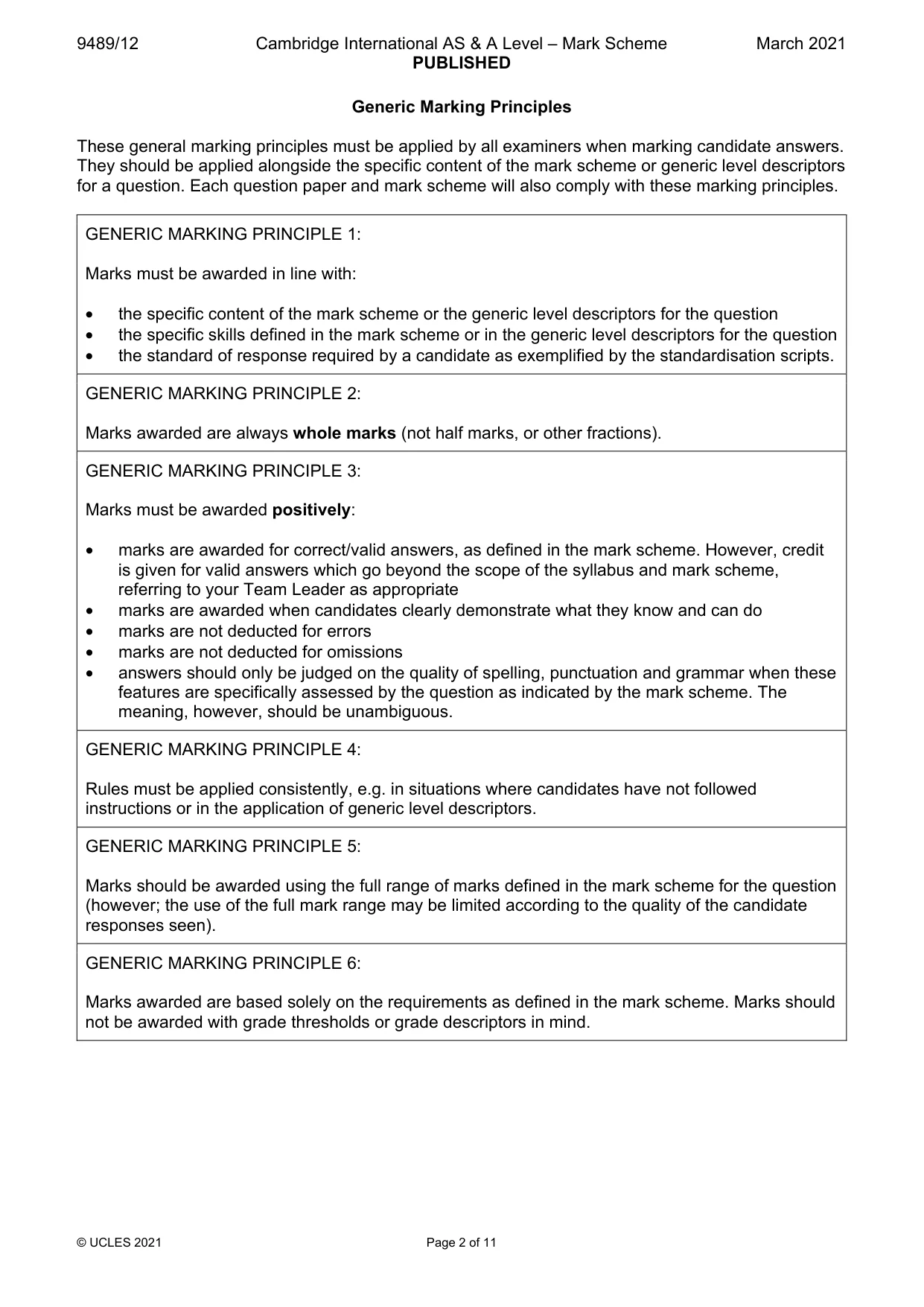
9489/12 Cambridge International AS & A Level – Mark Scheme PUBLISHED March 2021 © UCLES 2021 Page 2 of 11 Generic Marking Principles These general marking principles must be applied by all examiners when marking candidate answers. They should be applied alongside the specific content of the mark scheme or generic level descriptors for a question. Each question paper and mark scheme will also comply with these marking principles. GENERIC MARKING PRINCIPLE 1: Marks must be awarded in line with: • the specific content of the mark scheme or the generic level descriptors for the question • the specific skills defined in the mark scheme or in the generic level descriptors for the question • the standard of response required by a candidate as exemplified by the standardisation scripts. GENERIC MARKING PRINCIPLE 2: Marks awarded are always whole marks (not half marks, or other fractions). GENERIC MARKING PRINCIPLE 3: Marks must be awarded positively: • marks are awarded for correct/valid answers, as defined in the mark scheme. However, credit is given for valid answers which go beyond the scope of the syllabus and mark scheme, referring to your Team Leader as appropriate • marks are awarded when candidates clearly demonstrate what they know and can do • marks are not deducted for errors • marks are not deducted for omissions • answers should only be judged on the quality of spelling, punctuation and grammar when these features are specifically assessed by the question as indicated by the mark scheme. The meaning, however, should be unambiguous. GENERIC MARKING PRINCIPLE 4: Rules must be applied consistently, e.g. in situations where candidates have not followed instructions or in the application of generic level descriptors. GENERIC MARKING PRINCIPLE 5: Marks should be awarded using the full range of marks defined in the mark scheme for the question (however; the use of the full mark range may be limited according to the quality of the candidate responses seen). GENERIC MARKING PRINCIPLE 6: Marks awarded are based solely on the requirements as defined in the mark scheme. Marks should not be awarded with grade thresholds or grade descriptors in mind.
Mark scheme, page 3
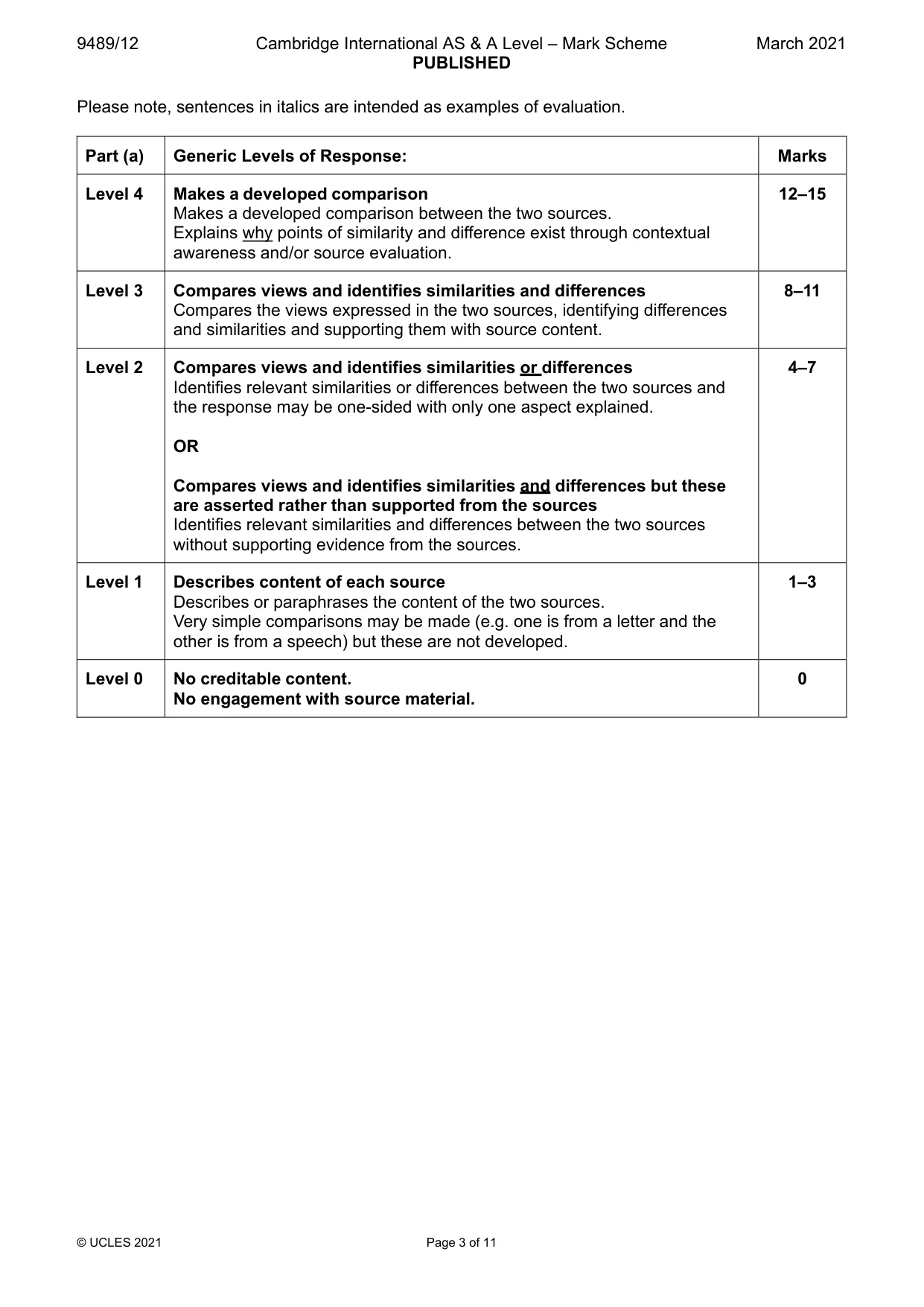
9489/12 Cambridge International AS & A Level – Mark Scheme PUBLISHED March 2021 © UCLES 2021 Page 3 of 11 Please note, sentences in italics are intended as examples of evaluation. Part (a) Generic Levels of Response: Marks Level 4 Makes a developed comparison Makes a developed comparison between the two sources. Explains why points of similarity and difference exist through contextual awareness and/or source evaluation. 12–15 Level 3 Compares views and identifies similarities and differences Compares the views expressed in the two sources, identifying differences and similarities and supporting them with source content. 8–11 Level 2 Compares views and identifies similarities or differences Identifies relevant similarities or differences between the two sources and the response may be one-sided with only one aspect explained. OR Compares views and identifies similarities and differences but these are asserted rather than supported from the sources Identifies relevant similarities and differences between the two sources without supporting evidence from the sources. 4–7 Level 1 Describes content of each source Describes or paraphrases the content of the two sources. Very simple comparisons may be made (e.g. one is from a letter and the other is from a speech) but these are not developed. 1–3 Level 0 No creditable content. No engagement with source material. 0
Mark scheme, page 4
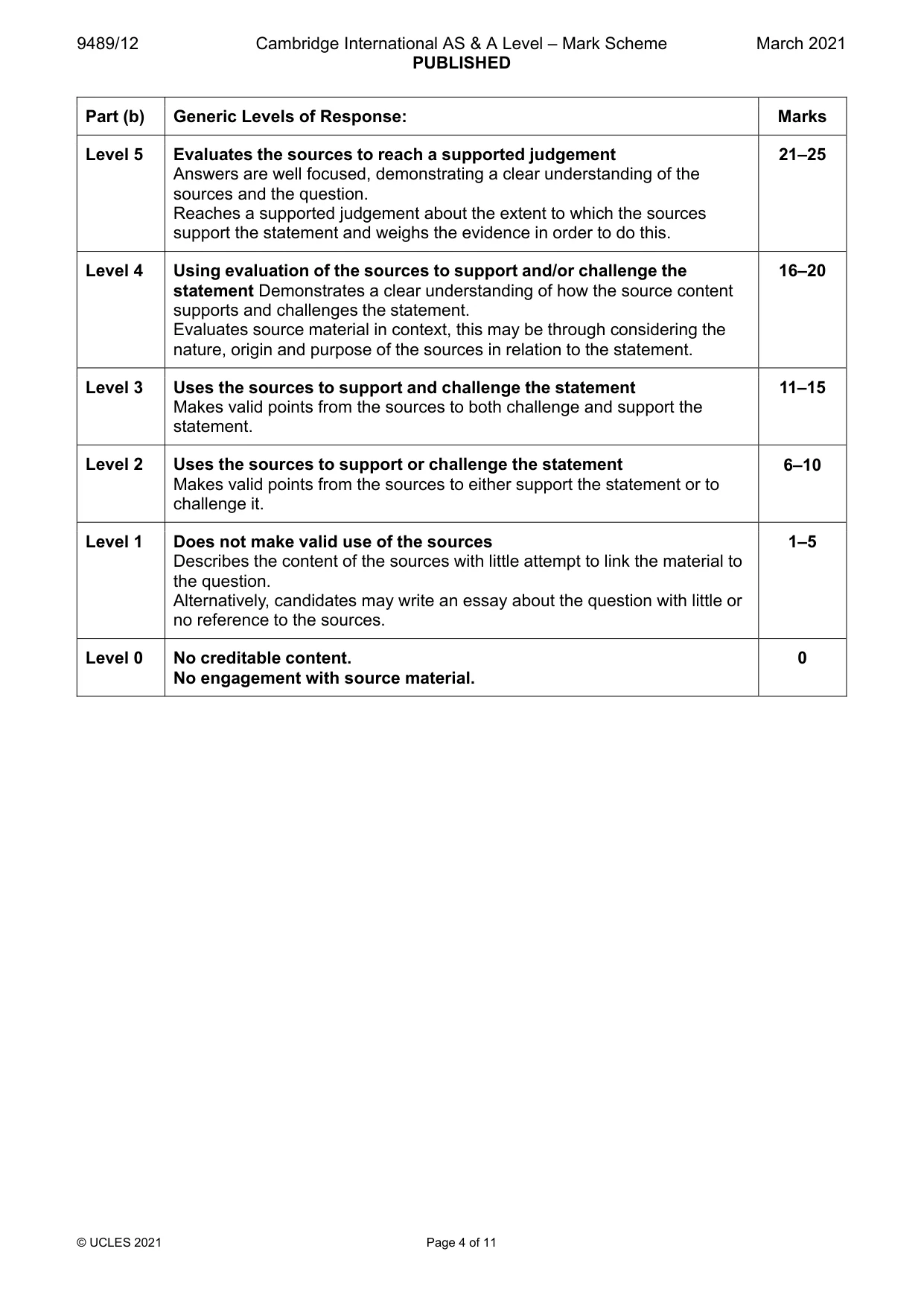
9489/12 Cambridge International AS & A Level – Mark Scheme PUBLISHED March 2021 © UCLES 2021 Page 4 of 11 Part (b) Generic Levels of Response: Marks Level 5 Evaluates the sources to reach a supported judgement Answers are well focused, demonstrating a clear understanding of the sources and the question. Reaches a supported judgement about the extent to which the sources support the statement and weighs the evidence in order to do this. 21–25 Level 4 Using evaluation of the sources to support and/or challenge the statement Demonstrates a clear understanding of how the source content supports and challenges the statement. Evaluates source material in context, this may be through considering the nature, origin and purpose of the sources in relation to the statement. 16–20 Level 3 Uses the sources to support and challenge the statement Makes valid points from the sources to both challenge and support the statement. 11–15 Level 2 Uses the sources to support or challenge the statement Makes valid points from the sources to either support the statement or to challenge it. 6–10 Level 1 Does not make valid use of the sources Describes the content of the sources with little attempt to link the material to the question. Alternatively, candidates may write an essay about the question with little or no reference to the sources. 1–5 Level 0 No creditable content. No engagement with source material. 0
Mark scheme, page 5
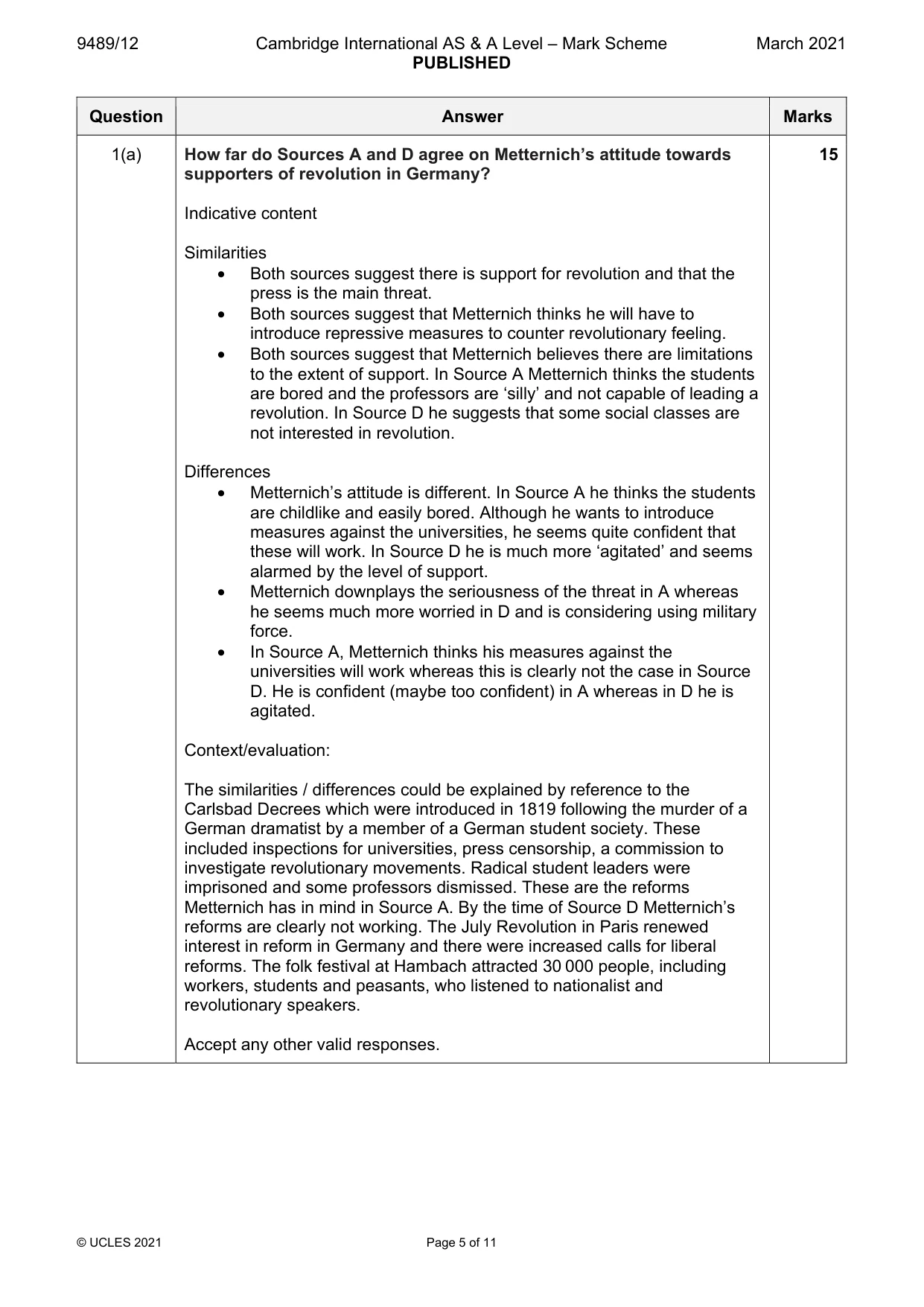
9489/12 Cambridge International AS & A Level – Mark Scheme PUBLISHED March 2021 © UCLES 2021 Page 5 of 11 Question Answer Marks 1(a) How far do Sources A and D agree on Metternich’s attitude towards supporters of revolution in Germany? Indicative content Similarities • Both sources suggest there is support for revolution and that the press is the main threat. • Both sources suggest that Metternich thinks he will have to introduce repressive measures to counter revolutionary feeling. • Both sources suggest that Metternich believes there are limitations to the extent of support. In Source A Metternich thinks the students are bored and the professors are ‘silly’ and not capable of leading a revolution. In Source D he suggests that some social classes are not interested in revolution. Differences • Metternich’s attitude is different. In Source A he thinks the students are childlike and easily bored. Although he wants to introduce measures against the universities, he seems quite confident that these will work. In Source D he is much more ‘agitated’ and seems alarmed by the level of support. • Metternich downplays the seriousness of the threat in A whereas he seems much more worried in D and is considering using military force. • In Source A, Metternich thinks his measures against the universities will work whereas this is clearly not the case in Source D. He is confident (maybe too confident) in A whereas in D he is agitated. Context/evaluation: The similarities / differences could be explained by reference to the Carlsbad Decrees which were introduced in 1819 following the murder of a German dramatist by a member of a German student society. These included inspections for universities, press censorship, a commission to investigate revolutionary movements. Radical student leaders were imprisoned and some professors dismissed. These are the reforms Metternich has in mind in Source A. By the time of Source D Metternich’s reforms are clearly not working. The July Revolution in Paris renewed interest in reform in Germany and there were increased calls for liberal reforms. The folk festival at Hambach attracted 30 000 people, including workers, students and peasants, who listened to nationalist and revolutionary speakers. Accept any other valid responses. 15
Mark scheme, page 6
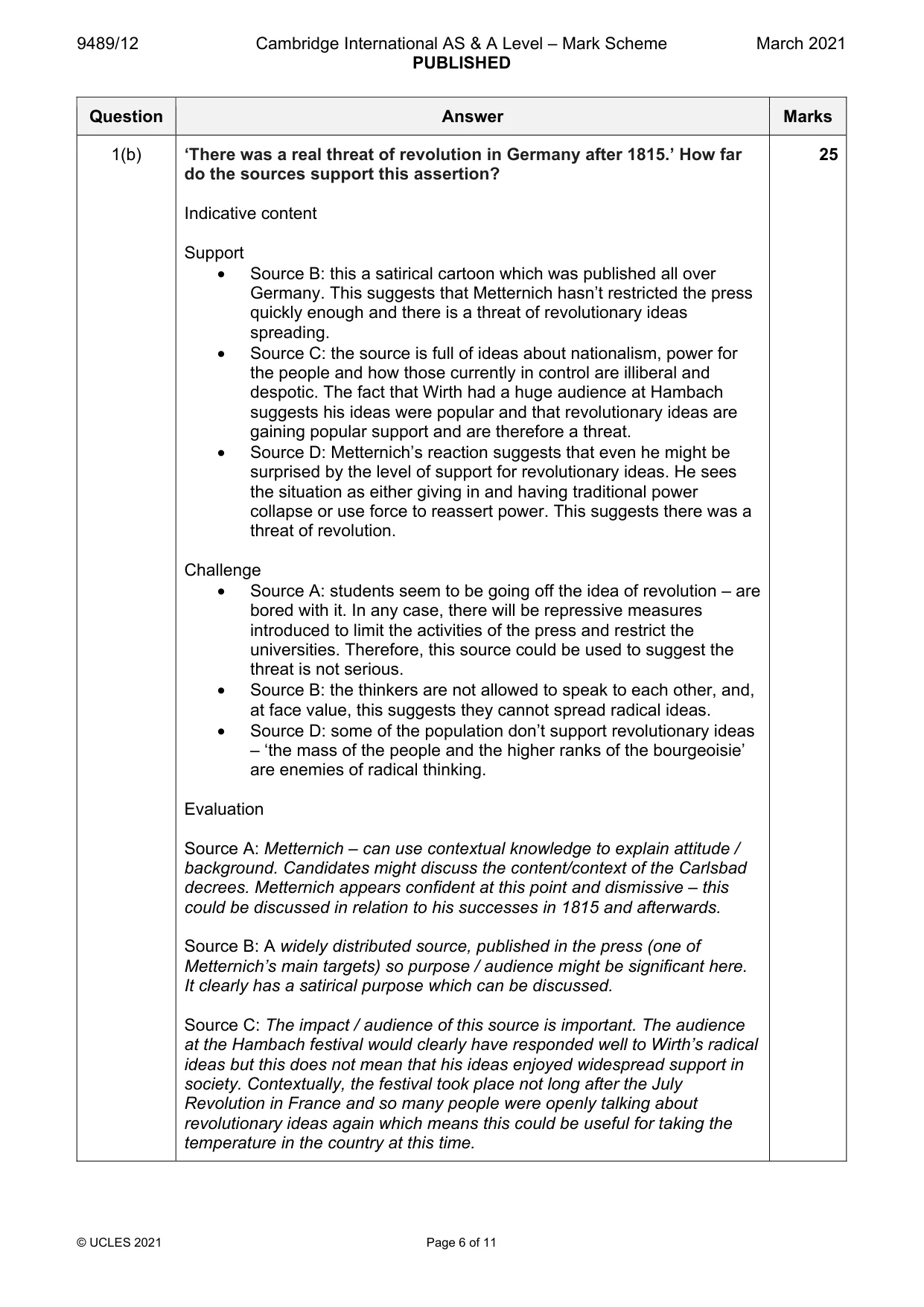
9489/12 Cambridge International AS & A Level – Mark Scheme PUBLISHED March 2021 © UCLES 2021 Page 6 of 11 Question Answer Marks 1(b) ‘There was a real threat of revolution in Germany after 1815.’ How far do the sources support this assertion? Indicative content Support • Source B: this a satirical cartoon which was published all over Germany. This suggests that Metternich hasn’t restricted the press quickly enough and there is a threat of revolutionary ideas spreading. • Source C: the source is full of ideas about nationalism, power for the people and how those currently in control are illiberal and despotic. The fact that Wirth had a huge audience at Hambach suggests his ideas were popular and that revolutionary ideas are gaining popular support and are therefore a threat. • Source D: Metternich’s reaction suggests that even he might be surprised by the level of support for revolutionary ideas. He sees the situation as either giving in and having traditional power collapse or use force to reassert power. This suggests there was a threat of revolution. Challenge • Source A: students seem to be going off the idea of revolution – are bored with it. In any case, there will be repressive measures introduced to limit the activities of the press and restrict the universities. Therefore, this source could be used to suggest the threat is not serious. • Source B: the thinkers are not allowed to speak to each other, and, at face value, this suggests they cannot spread radical ideas. • Source D: some of the population don’t support revolutionary ideas – ‘the mass of the people and the higher ranks of the bourgeoisie’ are enemies of radical thinking. Evaluation Source A: Metternich – can use contextual knowledge to explain attitude / background. Candidates might discuss the content/context of the Carlsbad decrees. Metternich appears confident at this point and dismissive – this could be discussed in relation to his successes in 1815 and afterwards. Source B: A widely distributed source, published in the press (one of Metternich’s main targets) so purpose / audience might be significant here. It clearly has a satirical purpose which can be discussed. Source C: The impact / audience of this source is important. The audience at the Hambach festival would clearly have responded well to Wirth’s radical ideas but this does not mean that his ideas enjoyed widespread support in society. Contextually, the festival took place not long after the July Revolution in France and so many people were openly talking about revolutionary ideas again which means this could be useful for taking the temperature in the country at this time. 25
Mark scheme, page 7
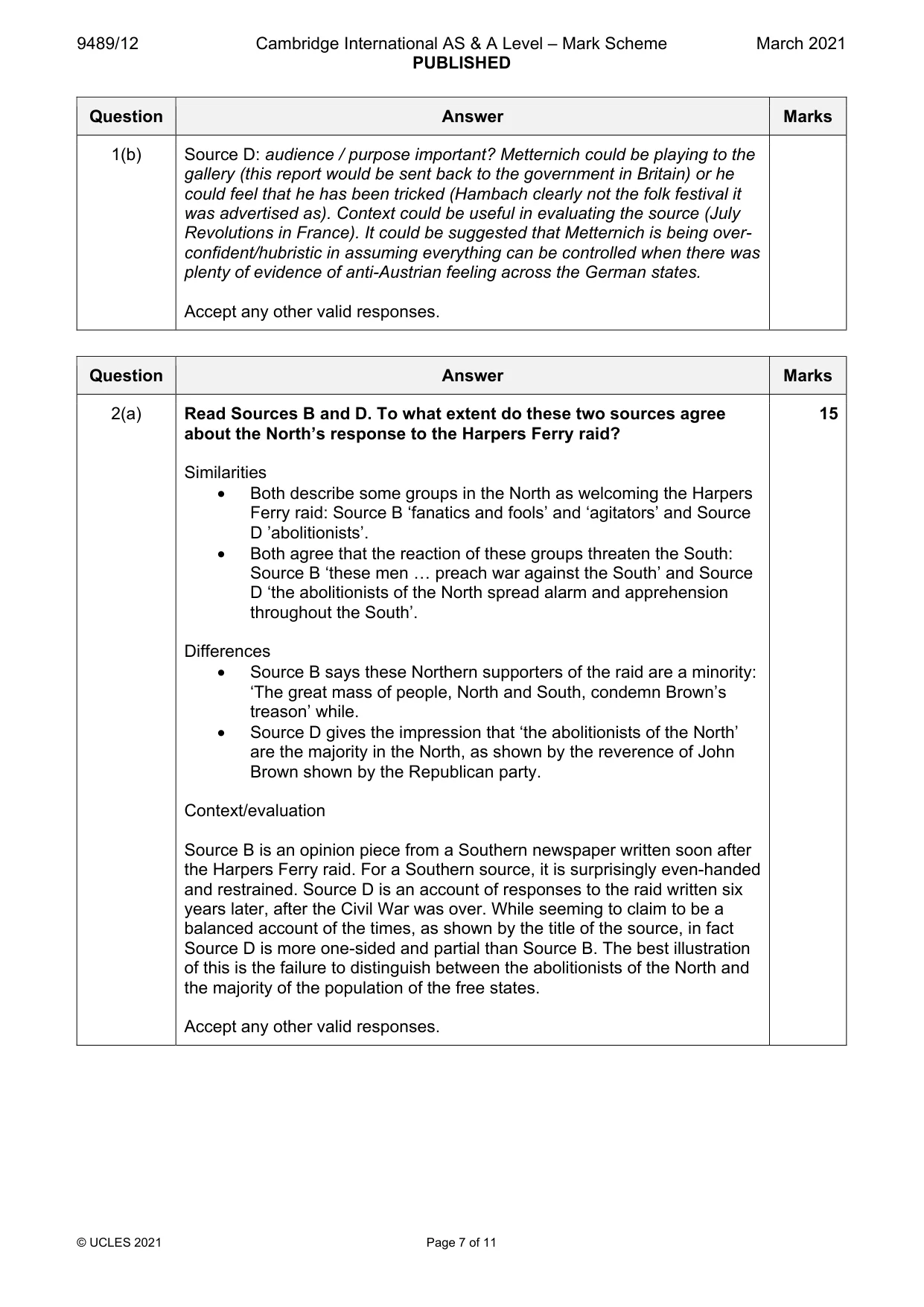
9489/12 Cambridge International AS & A Level – Mark Scheme PUBLISHED March 2021 © UCLES 2021 Page 7 of 11 Question Answer Marks 1(b) Source D: audience / purpose important? Metternich could be playing to the gallery (this report would be sent back to the government in Britain) or he could feel that he has been tricked (Hambach clearly not the folk festival it was advertised as). Context could be useful in evaluating the source (July Revolutions in France). It could be suggested that Metternich is being over- confident/hubristic in assuming everything can be controlled when there was plenty of evidence of anti-Austrian feeling across the German states. Accept any other valid responses. Question Answer Marks 2(a) Read Sources B and D. To what extent do these two sources agree about the North’s response to the Harpers Ferry raid? Similarities • Both describe some groups in the North as welcoming the Harpers Ferry raid: Source B ‘fanatics and fools’ and ‘agitators’ and Source D ’abolitionists’. • Both agree that the reaction of these groups threaten the South: Source B ‘these men … preach war against the South’ and Source D ‘the abolitionists of the North spread alarm and apprehension throughout the South’. Differences • Source B says these Northern supporters of the raid are a minority: ‘The great mass of people, North and South, condemn Brown’s treason’ while. • Source D gives the impression that ‘the abolitionists of the North’ are the majority in the North, as shown by the reverence of John Brown shown by the Republican party. Context/evaluation Source B is an opinion piece from a Southern newspaper written soon after the Harpers Ferry raid. For a Southern source, it is surprisingly even-handed and restrained. Source D is an account of responses to the raid written six years later, after the Civil War was over. While seeming to claim to be a balanced account of the times, as shown by the title of the source, in fact Source D is more one-sided and partial than Source B. The best illustration of this is the failure to distinguish between the abolitionists of the North and the majority of the population of the free states. Accept any other valid responses. 15
Mark scheme, page 8
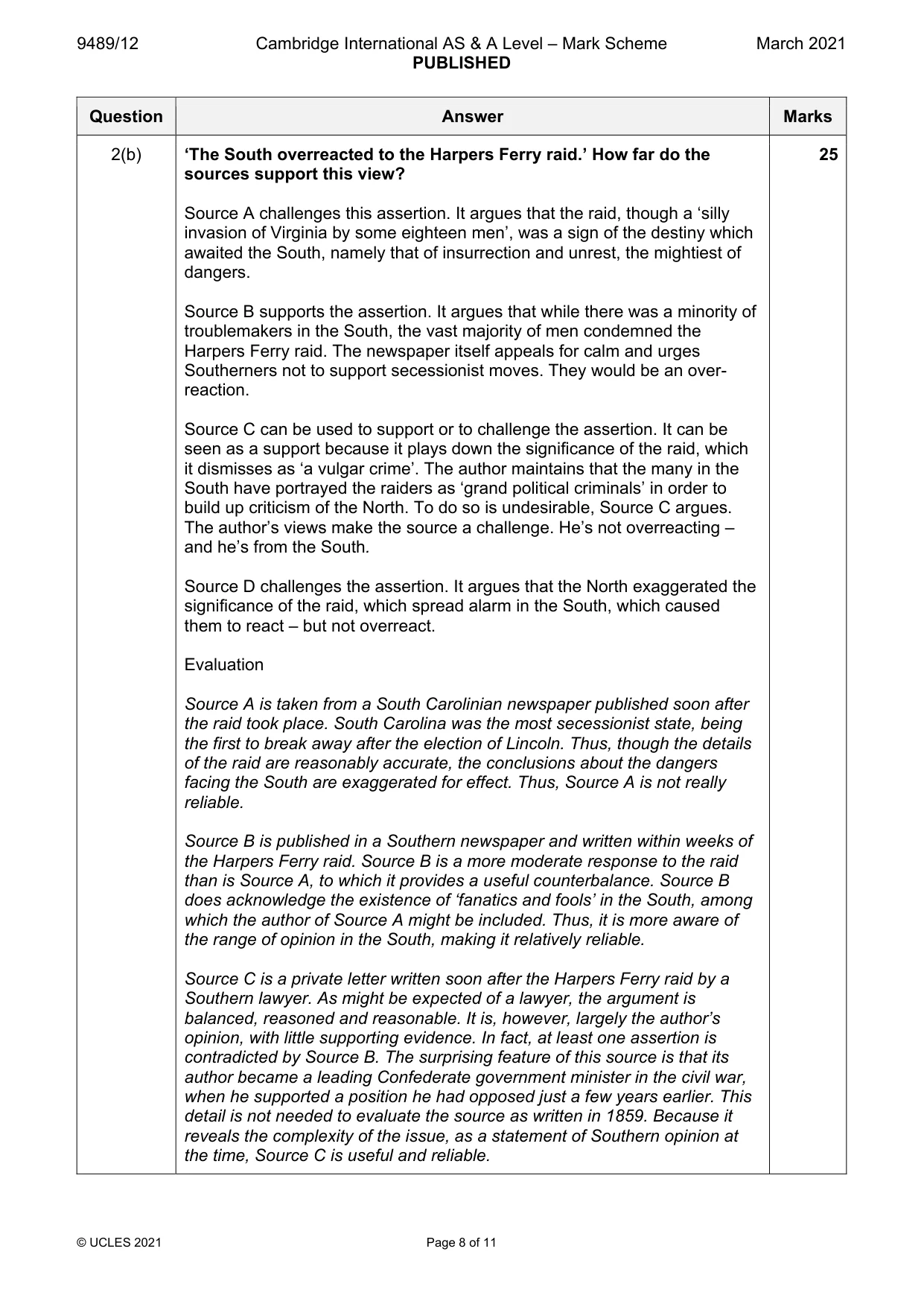
9489/12 Cambridge International AS & A Level – Mark Scheme PUBLISHED March 2021 © UCLES 2021 Page 8 of 11 Question Answer Marks 2(b) ‘The South overreacted to the Harpers Ferry raid.’ How far do the sources support this view? Source A challenges this assertion. It argues that the raid, though a ‘silly invasion of Virginia by some eighteen men’, was a sign of the destiny which awaited the South, namely that of insurrection and unrest, the mightiest of dangers. Source B supports the assertion. It argues that while there was a minority of troublemakers in the South, the vast majority of men condemned the Harpers Ferry raid. The newspaper itself appeals for calm and urges Southerners not to support secessionist moves. They would be an over- reaction. Source C can be used to support or to challenge the assertion. It can be seen as a support because it plays down the significance of the raid, which it dismisses as ‘a vulgar crime’. The author maintains that the many in the South have portrayed the raiders as ‘grand political criminals’ in order to build up criticism of the North. To do so is undesirable, Source C argues. The author’s views make the source a challenge. He’s not overreacting – and he’s from the South. Source D challenges the assertion. It argues that the North exaggerated the significance of the raid, which spread alarm in the South, which caused them to react – but not overreact. Evaluation Source A is taken from a South Carolinian newspaper published soon after the raid took place. South Carolina was the most secessionist state, being the first to break away after the election of Lincoln. Thus, though the details of the raid are reasonably accurate, the conclusions about the dangers facing the South are exaggerated for effect. Thus, Source A is not really reliable. Source B is published in a Southern newspaper and written within weeks of the Harpers Ferry raid. Source B is a more moderate response to the raid than is Source A, to which it provides a useful counterbalance. Source B does acknowledge the existence of ‘fanatics and fools’ in the South, among which the author of Source A might be included. Thus, it is more aware of the range of opinion in the South, making it relatively reliable. Source C is a private letter written soon after the Harpers Ferry raid by a Southern lawyer. As might be expected of a lawyer, the argument is balanced, reasoned and reasonable. It is, however, largely the author’s opinion, with little supporting evidence. In fact, at least one assertion is contradicted by Source B. The surprising feature of this source is that its author became a leading Confederate government minister in the civil war, when he supported a position he had opposed just a few years earlier. This detail is not needed to evaluate the source as written in 1859. Because it reveals the complexity of the issue, as a statement of Southern opinion at the time, Source C is useful and reliable. 25
Mark scheme, page 9
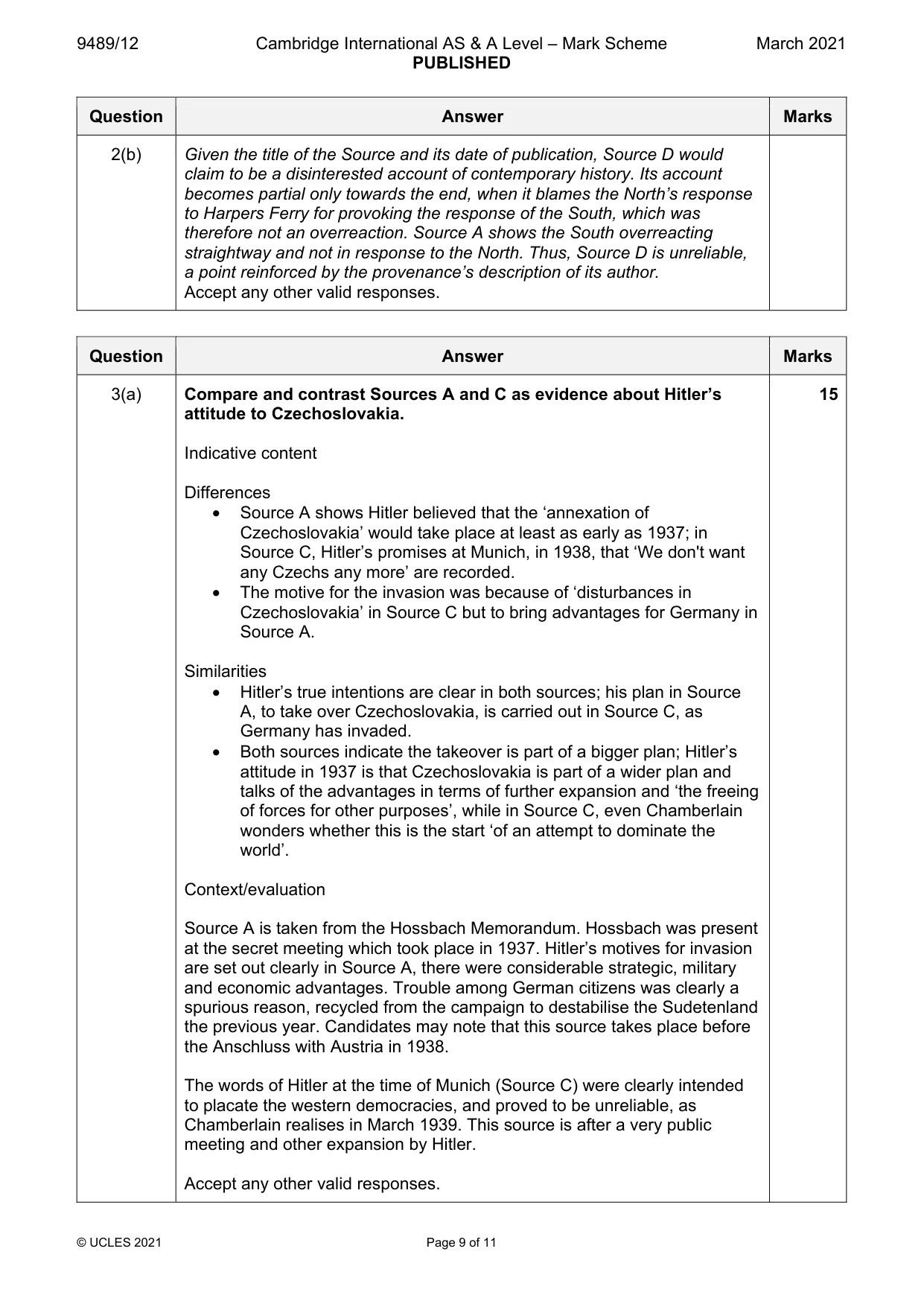
9489/12 Cambridge International AS & A Level – Mark Scheme PUBLISHED March 2021 © UCLES 2021 Page 9 of 11 Question Answer Marks 2(b) Given the title of the Source and its date of publication, Source D would claim to be a disinterested account of contemporary history. Its account becomes partial only towards the end, when it blames the North’s response to Harpers Ferry for provoking the response of the South, which was therefore not an overreaction. Source A shows the South overreacting straightway and not in response to the North. Thus, Source D is unreliable, a point reinforced by the provenance’s description of its author. Accept any other valid responses. Question Answer Marks 3(a) Compare and contrast Sources A and C as evidence about Hitler’s attitude to Czechoslovakia. Indicative content Differences • Source A shows Hitler believed that the ‘annexation of Czechoslovakia’ would take place at least as early as 1937; in Source C, Hitler’s promises at Munich, in 1938, that ‘We don't want any Czechs any more’ are recorded. • The motive for the invasion was because of ‘disturbances in Czechoslovakia’ in Source C but to bring advantages for Germany in Source A. Similarities • Hitler’s true intentions are clear in both sources; his plan in Source A, to take over Czechoslovakia, is carried out in Source C, as Germany has invaded. • Both sources indicate the takeover is part of a bigger plan; Hitler’s attitude in 1937 is that Czechoslovakia is part of a wider plan and talks of the advantages in terms of further expansion and ‘the freeing of forces for other purposes’, while in Source C, even Chamberlain wonders whether this is the start ‘of an attempt to dominate the world’. Context/evaluation Source A is taken from the Hossbach Memorandum. Hossbach was present at the secret meeting which took place in 1937. Hitler’s motives for invasion are set out clearly in Source A, there were considerable strategic, military and economic advantages. Trouble among German citizens was clearly a spurious reason, recycled from the campaign to destabilise the Sudetenland the previous year. Candidates may note that this source takes place before the Anschluss with Austria in 1938. The words of Hitler at the time of Munich (Source C) were clearly intended to placate the western democracies, and proved to be unreliable, as Chamberlain realises in March 1939. This source is after a very public meeting and other expansion by Hitler. Accept any other valid responses. 15
Mark scheme, page 10
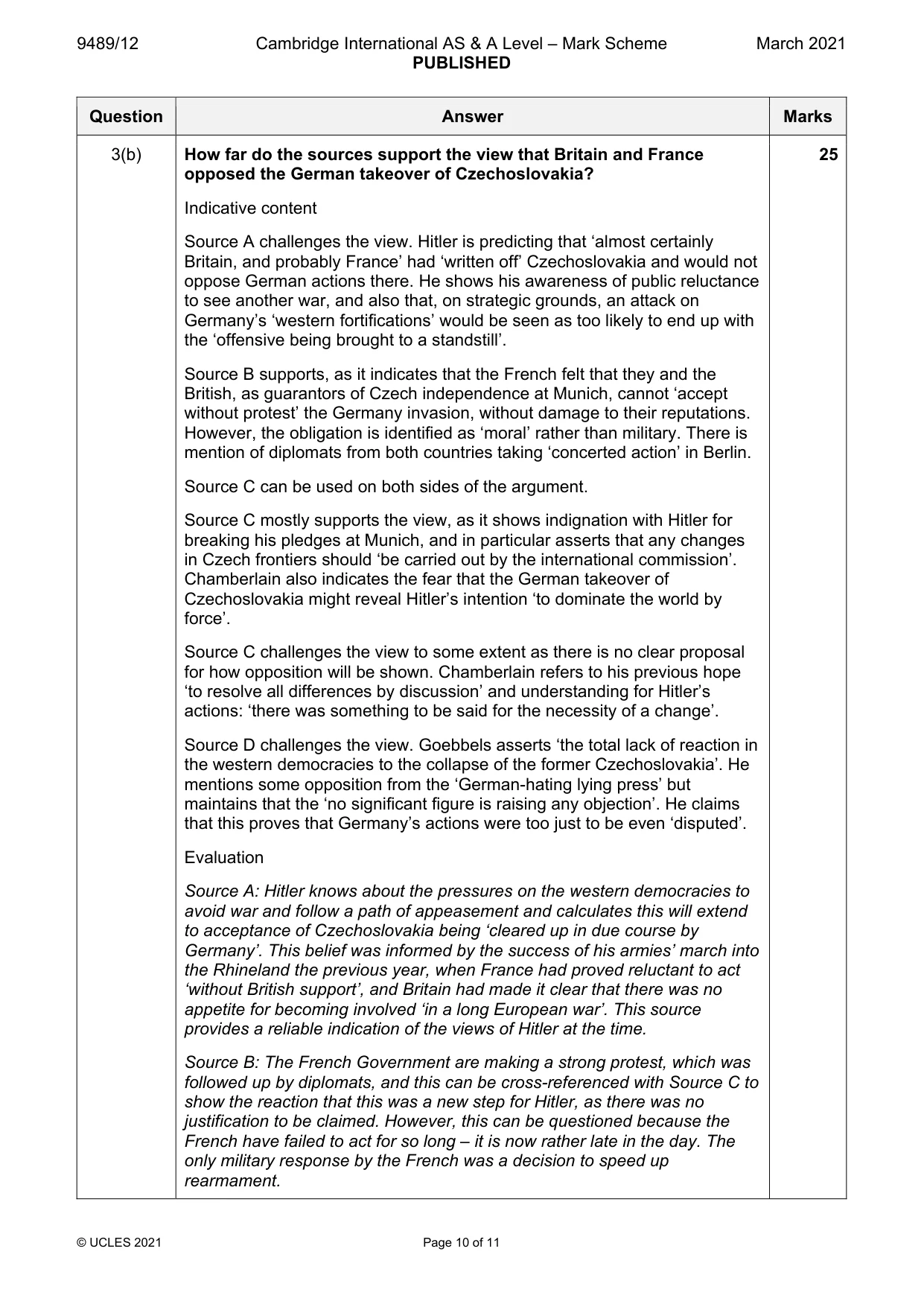
9489/12 Cambridge International AS & A Level – Mark Scheme PUBLISHED March 2021 © UCLES 2021 Page 10 of 11 Question Answer Marks 3(b) How far do the sources support the view that Britain and France opposed the German takeover of Czechoslovakia? Indicative content Source A challenges the view. Hitler is predicting that ‘almost certainly Britain, and probably France’ had ‘written off’ Czechoslovakia and would not oppose German actions there. He shows his awareness of public reluctance to see another war, and also that, on strategic grounds, an attack on Germany’s ‘western fortifications’ would be seen as too likely to end up with the ‘offensive being brought to a standstill’. Source B supports, as it indicates that the French felt that they and the British, as guarantors of Czech independence at Munich, cannot ‘accept without protest’ the Germany invasion, without damage to their reputations. However, the obligation is identified as ‘moral’ rather than military. There is mention of diplomats from both countries taking ‘concerted action’ in Berlin. Source C can be used on both sides of the argument. Source C mostly supports the view, as it shows indignation with Hitler for breaking his pledges at Munich, and in particular asserts that any changes in Czech frontiers should ‘be carried out by the international commission’. Chamberlain also indicates the fear that the German takeover of Czechoslovakia might reveal Hitler’s intention ‘to dominate the world by force’. Source C challenges the view to some extent as there is no clear proposal for how opposition will be shown. Chamberlain refers to his previous hope ‘to resolve all differences by discussion’ and understanding for Hitler’s actions: ‘there was something to be said for the necessity of a change’. Source D challenges the view. Goebbels asserts ‘the total lack of reaction in the western democracies to the collapse of the former Czechoslovakia’. He mentions some opposition from the ‘German-hating lying press’ but maintains that the ‘no significant figure is raising any objection’. He claims that this proves that Germany’s actions were too just to be even ‘disputed’. Evaluation Source A: Hitler knows about the pressures on the western democracies to avoid war and follow a path of appeasement and calculates this will extend to acceptance of Czechoslovakia being ‘cleared up in due course by Germany’. This belief was informed by the success of his armies’ march into the Rhineland the previous year, when France had proved reluctant to act ‘without British support’, and Britain had made it clear that there was no appetite for becoming involved ‘in a long European war’. This source provides a reliable indication of the views of Hitler at the time. Source B: The French Government are making a strong protest, which was followed up by diplomats, and this can be cross-referenced with Source C to show the reaction that this was a new step for Hitler, as there was no justification to be claimed. However, this can be questioned because the French have failed to act for so long – it is now rather late in the day. The only military response by the French was a decision to speed up rearmament. 25
Mark scheme, page 11
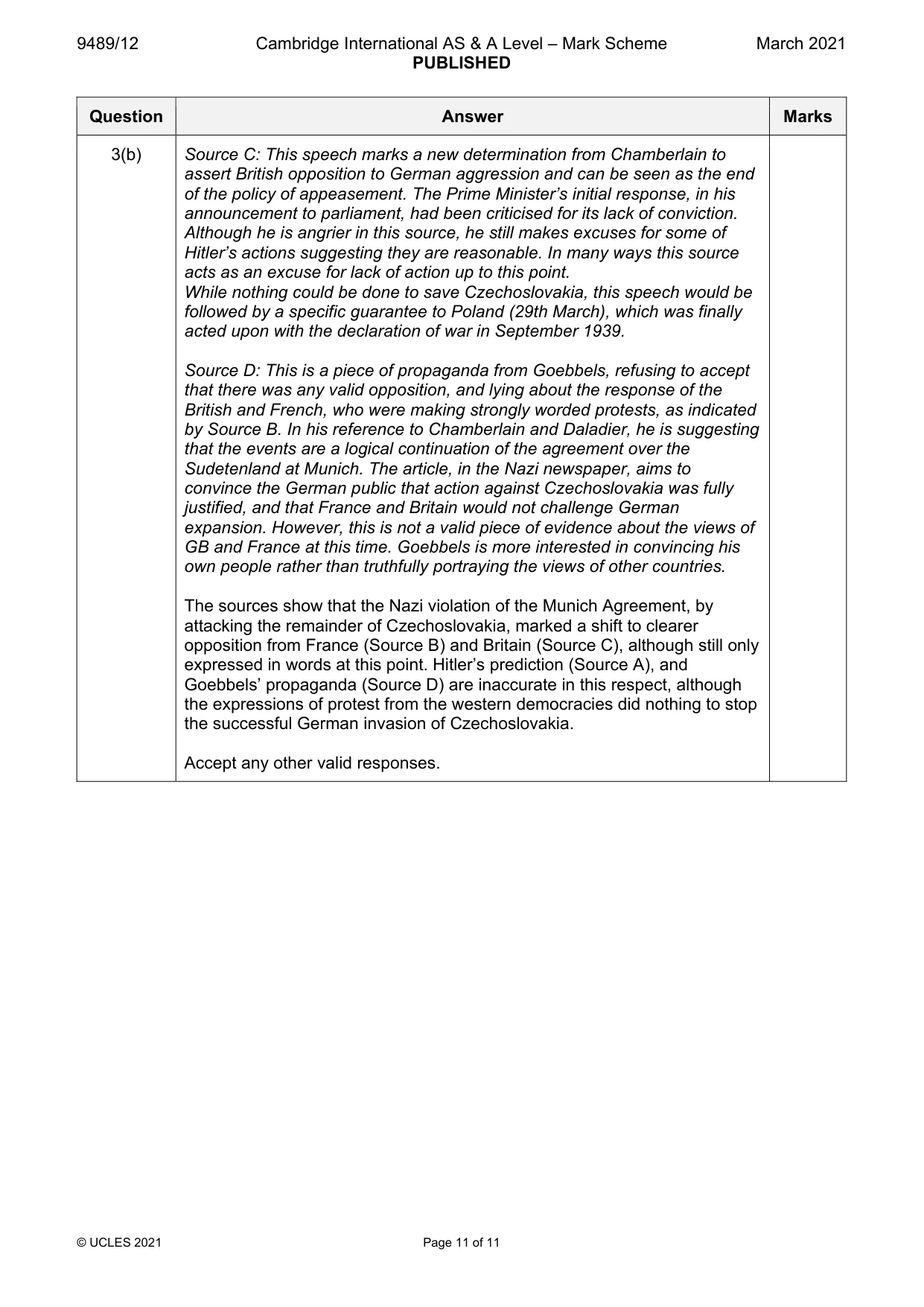
9489/12 Cambridge International AS & A Level – Mark Scheme PUBLISHED March 2021 © UCLES 2021 Page 11 of 11 Question Answer Marks 3(b) Source C: This speech marks a new determination from Chamberlain to assert British opposition to German aggression and can be seen as the end of the policy of appeasement. The Prime Minister’s initial response, in his announcement to parliament, had been criticised for its lack of conviction. Although he is angrier in this source, he still makes excuses for some of Hitler’s actions suggesting they are reasonable. In many ways this source acts as an excuse for lack of action up to this point. While nothing could be done to save Czechoslovakia, this speech would be followed by a specific guarantee to Poland (29th March), which was finally acted upon with the declaration of war in September 1939. Source D: This is a piece of propaganda from Goebbels, refusing to accept that there was any valid opposition, and lying about the response of the British and French, who were making strongly worded protests, as indicated by Source B. In his reference to Chamberlain and Daladier, he is suggesting that the events are a logical continuation of the agreement over the Sudetenland at Munich. The article, in the Nazi newspaper, aims to convince the German public that action against Czechoslovakia was fully justified, and that France and Britain would not challenge German expansion. However, this is not a valid piece of evidence about the views of GB and France at this time. Goebbels is more interested in convincing his own people rather than truthfully portraying the views of other countries. The sources show that the Nazi violation of the Munich Agreement, by attacking the remainder of Czechoslovakia, marked a shift to clearer opposition from France (Source B) and Britain (Source C), although still only expressed in words at this point. Hitler’s prediction (Source A), and Goebbels’ propaganda (Source D) are inaccurate in this respect, although the expressions of protest from the western democracies did nothing to stop the successful German invasion of Czechoslovakia. Accept any other valid responses.
What you needed in this session
Cambridge’s own grade thresholds for 2021 Feb/March, Paper 1 · Variant 2. A higher threshold means an easier paper — the bar moves with how the cohort did.