Cambridge A Level Global Perspectives and Research 9239 — 2018 May/June Paper 1 · Variant 1
9239/11/M/J/18 · 30 marks · ≈34 min
The question paper and its mark scheme, free to read here and free to download. This is Cambridge’s own paper, exactly as it was sat.
Question paper4 pages


Mark scheme12 pages
Answers below. Sit the paper first if you are practising.
Paper as text
Question paper, page 1
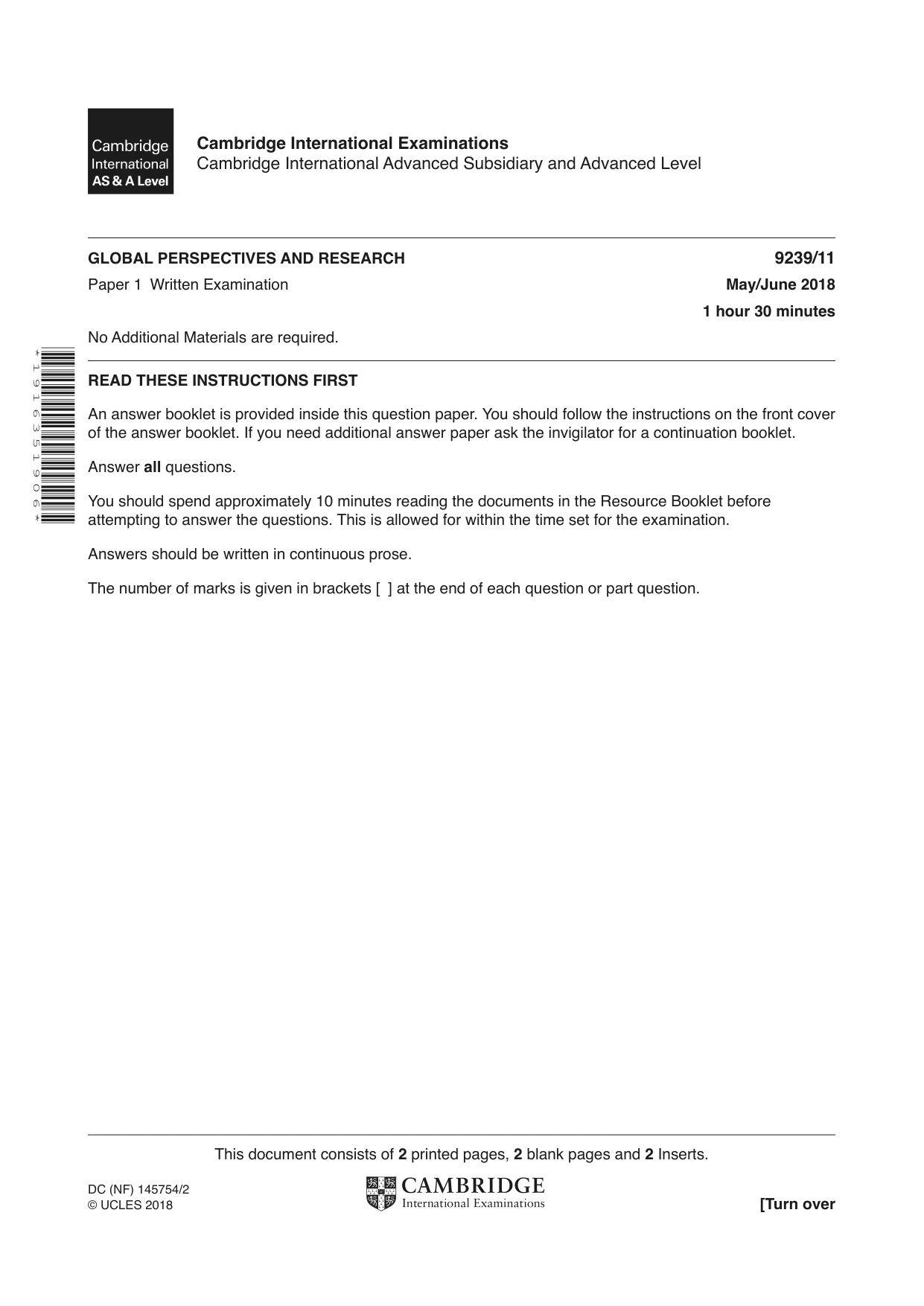
* 1 9 1 6 3 5 1 9 0 6 * This document consists of 2 printed pages, 2 blank pages and 2 Inserts. DC (NF) 145754/2 © UCLES 2018 [Turn over Cambridge International Examinations Cambridge International Advanced Subsidiary and Advanced Level GLOBAL PERSPECTIVES AND RESEARCH 9239/11 Paper 1 Written Examination May/June 2018 1 hour 30 minutes No Additional Materials are required. READ THESE INSTRUCTIONS FIRST An answer booklet is provided inside this question paper. You should follow the instructions on the front cover of the answer booklet. If you need additional answer paper ask the invigilator for a continuation booklet. Answer all questions. You should spend approximately 10 minutes reading the documents in the Resource Booklet before attempting to answer the questions. This is allowed for within the time set for the examination. Answers should be written in continuous prose. The number of marks is given in brackets [ ] at the end of each question or part question.
Question paper, page 2
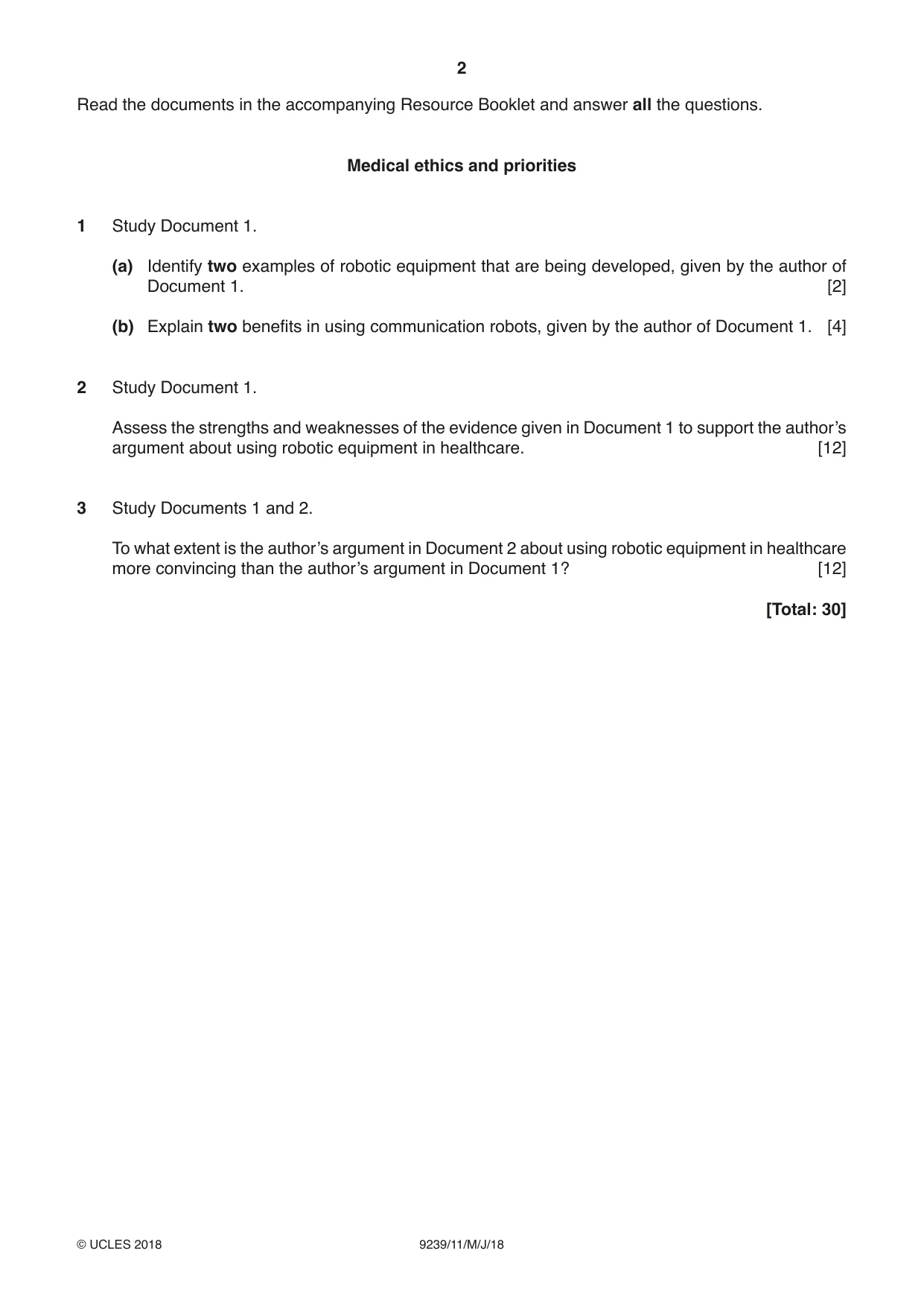
2 9239/11/M/J/18 © UCLES 2018 Read the documents in the accompanying Resource Booklet and answer all the questions. Medical ethics and priorities 1 Study Document 1. (a) Identify two examples of robotic equipment that are being developed, given by the author of Document 1. [2] (b) Explain two benefits in using communication robots, given by the author of Document 1. [4] 2 Study Document 1. Assess the strengths and weaknesses of the evidence given in Document 1 to support the author’s argument about using robotic equipment in healthcare. [12] 3 Study Documents 1 and 2. To what extent is the author’s argument in Document 2 about using robotic equipment in healthcare more convincing than the author’s argument in Document 1? [12] [Total: 30]
Question paper, page 3
3 9239/11/M/J/18 © UCLES 2018 BLANK PAGE
Question paper, page 4
4 9239/11/M/J/18 © UCLES 2018 BLANK PAGE Permission to reproduce items where third-party owned material protected by copyright is included has been sought and cleared where possible. Every reasonable effort has been made by the publisher (UCLES) to trace copyright holders, but if any items requiring clearance have unwittingly been included, the publisher will be pleased to make amends at the earliest possible opportunity. To avoid the issue of disclosure of answer-related information to candidates, all copyright acknowledgements are reproduced online in the Cambridge International Examinations Copyright Acknowledgements Booklet. This is produced for each series of examinations and is freely available to download at www.cie.org.uk after the live examination series. Cambridge International Examinations is part of the Cambridge Assessment Group. Cambridge Assessment is the brand name of University of Cambridge Local Examinations Syndicate (UCLES), which is itself a department of the University of Cambridge.
Mark scheme, page 1
IGCSE™ is a registered trademark. This document consists of 12 printed pages. © UCLES 2018 [Turn over Cambridge Assessment International Education Cambridge International Advanced Subsidiary and Advanced Level GLOBAL PERSPECTIVES AND RESEARCH 9239/11 Paper 1 Written Examination May/June 2018 MARK SCHEME Maximum Mark: 30 Published This mark scheme is published as an aid to teachers and candidates, to indicate the requirements of the examination. It shows the basis on which Examiners were instructed to award marks. It does not indicate the details of the discussions that took place at an Examiners’ meeting before marking began, which would have considered the acceptability of alternative answers. Mark schemes should be read in conjunction with the question paper and the Principal Examiner Report for Teachers. Cambridge International will not enter into discussions about these mark schemes. Cambridge International is publishing the mark schemes for the May/June 2018 series for most Cambridge IGCSE™, Cambridge International A and AS Level and Cambridge Pre-U components, and some Cambridge O Level components.
Mark scheme, page 2
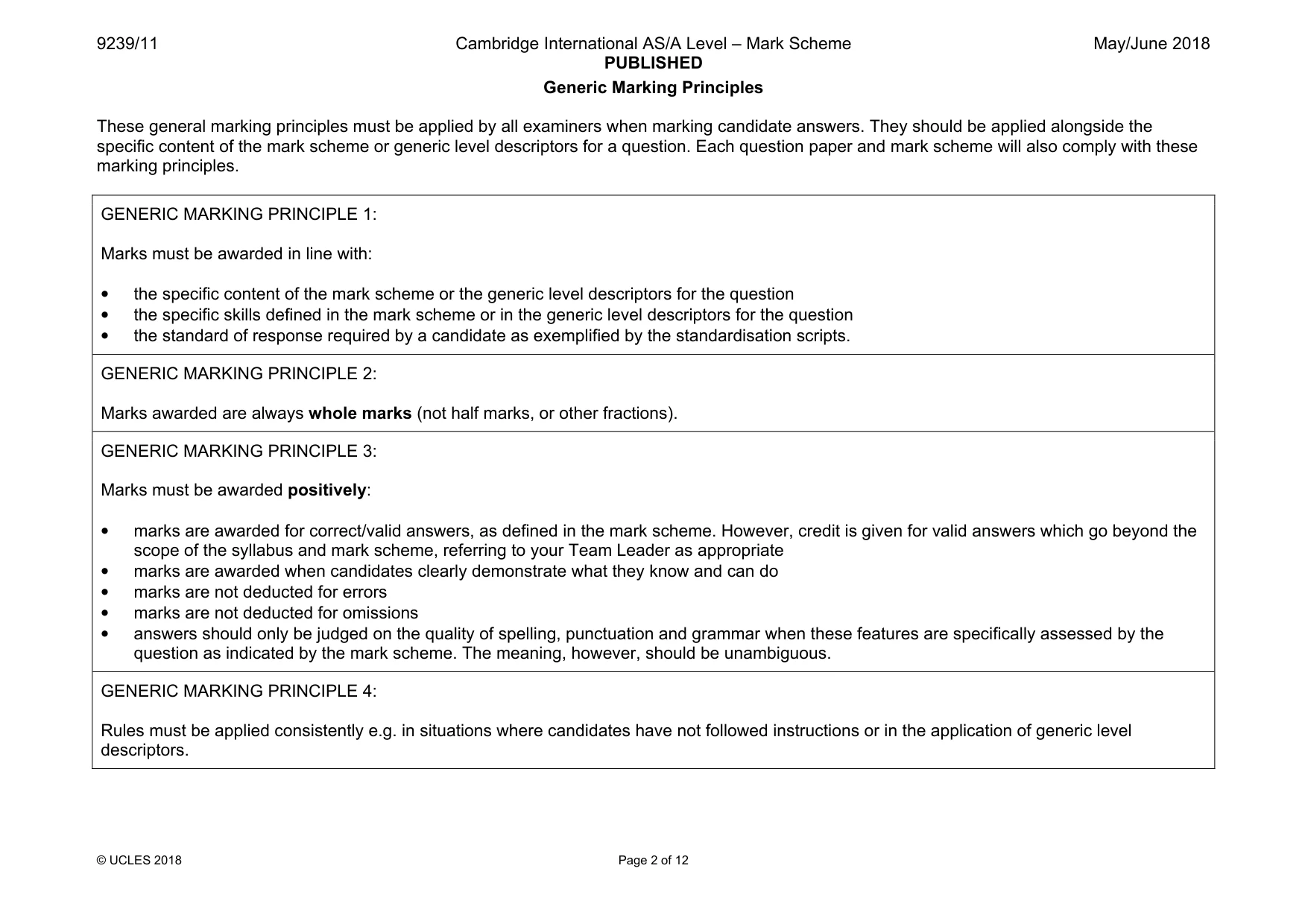
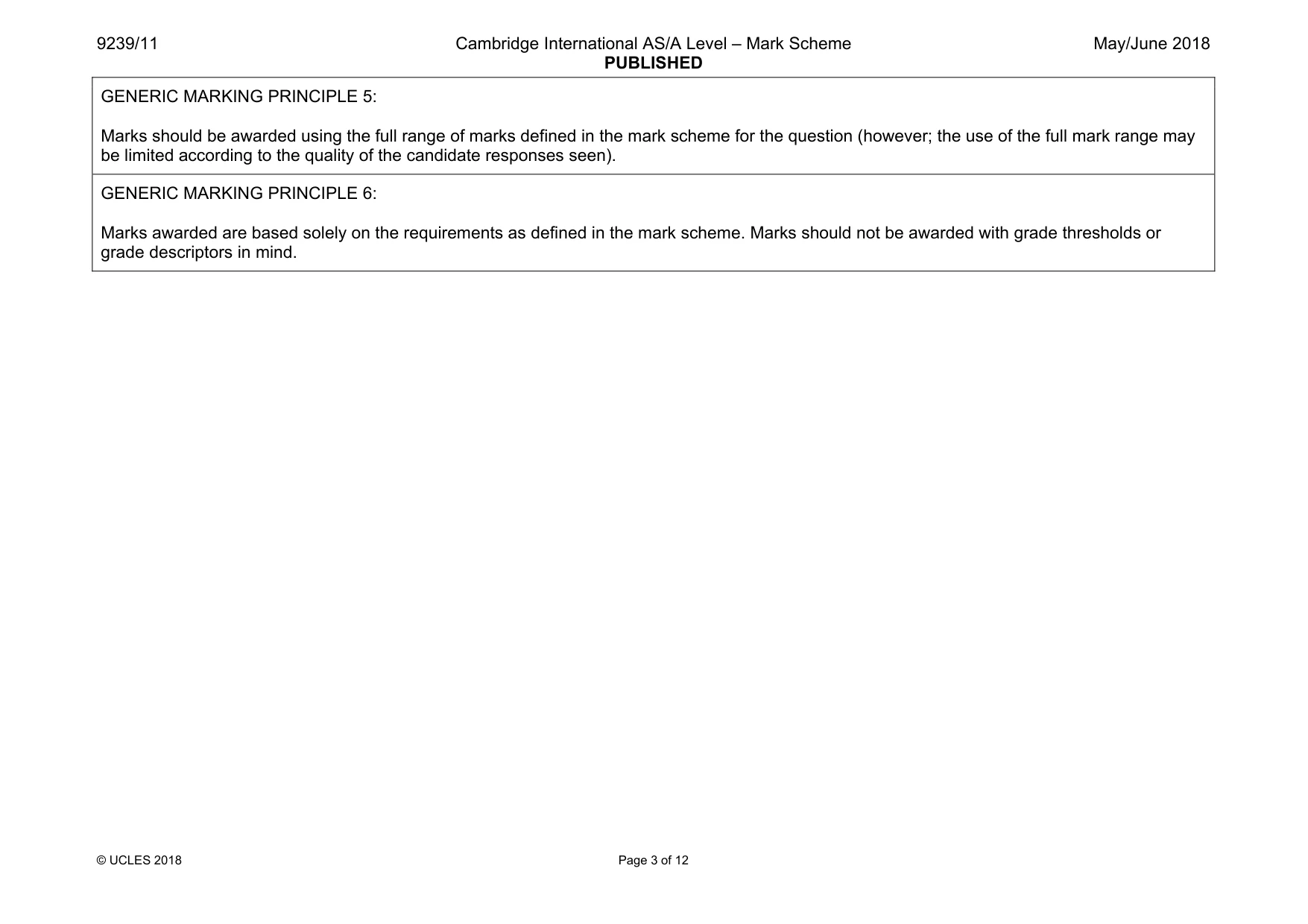
9239/11 Cambridge International AS/A Level – Mark Scheme PUBLISHED May/June 2018 © UCLES 2018 Page 2 of 12 Generic Marking Principles These general marking principles must be applied by all examiners when marking candidate answers. They should be applied alongside the specific content of the mark scheme or generic level descriptors for a question. Each question paper and mark scheme will also comply with these marking principles. GENERIC MARKING PRINCIPLE 1: Marks must be awarded in line with: • the specific content of the mark scheme or the generic level descriptors for the question • the specific skills defined in the mark scheme or in the generic level descriptors for the question • the standard of response required by a candidate as exemplified by the standardisation scripts. GENERIC MARKING PRINCIPLE 2: Marks awarded are always whole marks (not half marks, or other fractions). GENERIC MARKING PRINCIPLE 3: Marks must be awarded positively: • marks are awarded for correct/valid answers, as defined in the mark scheme. However, credit is given for valid answers which go beyond the scope of the syllabus and mark scheme, referring to your Team Leader as appropriate • marks are awarded when candidates clearly demonstrate what they know and can do • marks are not deducted for errors • marks are not deducted for omissions • answers should only be judged on the quality of spelling, punctuation and grammar when these features are specifically assessed by the question as indicated by the mark scheme. The meaning, however, should be unambiguous. GENERIC MARKING PRINCIPLE 4: Rules must be applied consistently e.g. in situations where candidates have not followed instructions or in the application of generic level descriptors.
Mark scheme, page 3
9239/11 Cambridge International AS/A Level – Mark Scheme PUBLISHED May/June 2018 © UCLES 2018 Page 3 of 12 GENERIC MARKING PRINCIPLE 5: Marks should be awarded using the full range of marks defined in the mark scheme for the question (however; the use of the full mark range may be limited according to the quality of the candidate responses seen). GENERIC MARKING PRINCIPLE 6: Marks awarded are based solely on the requirements as defined in the mark scheme. Marks should not be awarded with grade thresholds or grade descriptors in mind.
Mark scheme, page 4
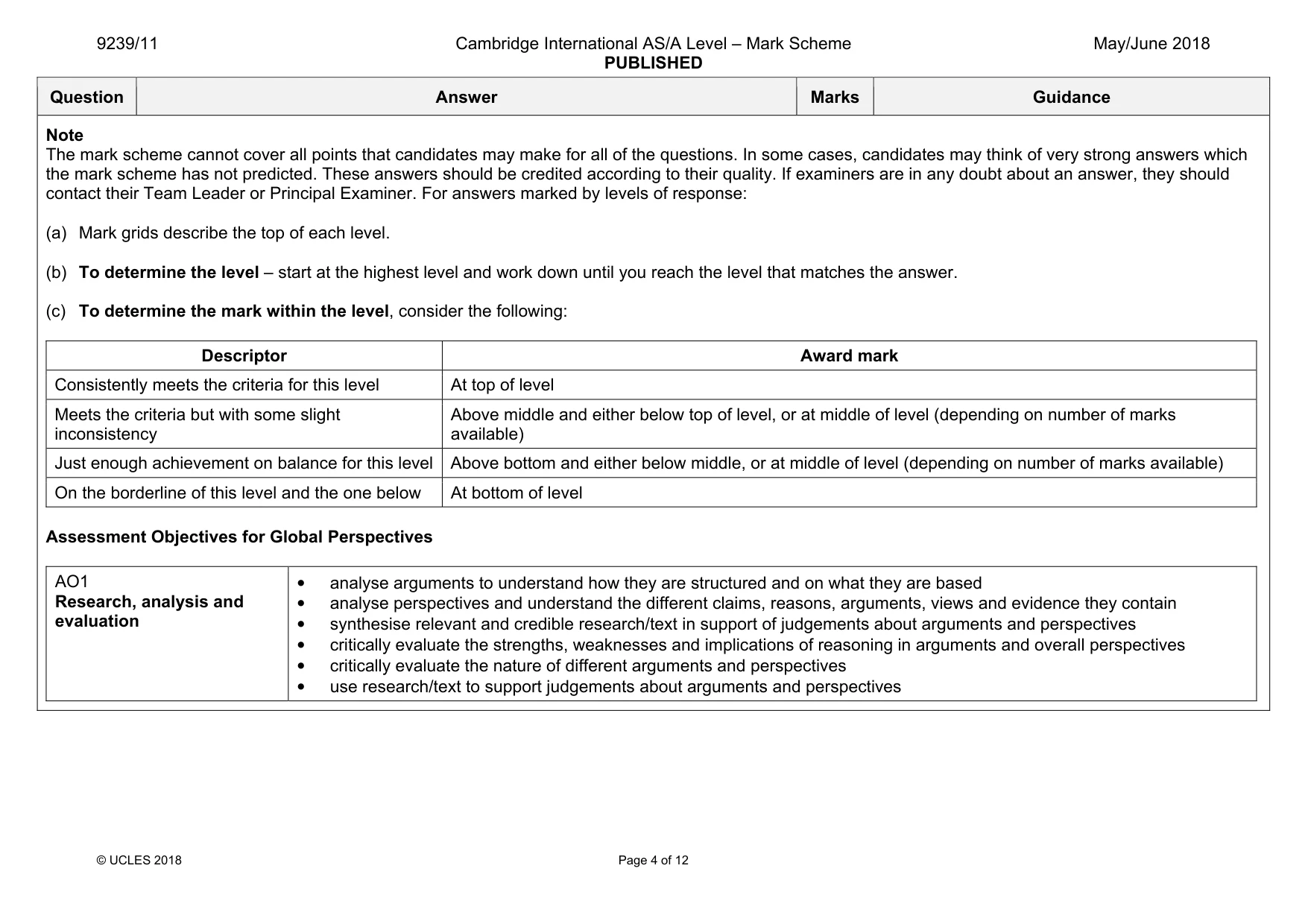
9239/11 Cambridge International AS/A Level – Mark Scheme PUBLISHED May/June 2018 © UCLES 2018 Page 4 of 12 Question Answer Marks Guidance Note The mark scheme cannot cover all points that candidates may make for all of the questions. In some cases, candidates may think of very strong answers which the mark scheme has not predicted. These answers should be credited according to their quality. If examiners are in any doubt about an answer, they should contact their Team Leader or Principal Examiner. For answers marked by levels of response: (a) Mark grids describe the top of each level. (b) To determine the level – start at the highest level and work down until you reach the level that matches the answer. (c) To determine the mark within the level, consider the following: Descriptor Award mark Consistently meets the criteria for this level At top of level Meets the criteria but with some slight inconsistency Above middle and either below top of level, or at middle of level (depending on number of marks available) Just enough achievement on balance for this level Above bottom and either below middle, or at middle of level (depending on number of marks available) On the borderline of this level and the one below At bottom of level Assessment Objectives for Global Perspectives AO1 Research, analysis and evaluation • analyse arguments to understand how they are structured and on what they are based • analyse perspectives and understand the different claims, reasons, arguments, views and evidence they contain • synthesise relevant and credible research/text in support of judgements about arguments and perspectives • critically evaluate the strengths, weaknesses and implications of reasoning in arguments and overall perspectives • critically evaluate the nature of different arguments and perspectives • use research/text to support judgements about arguments and perspectives
Mark scheme, page 5
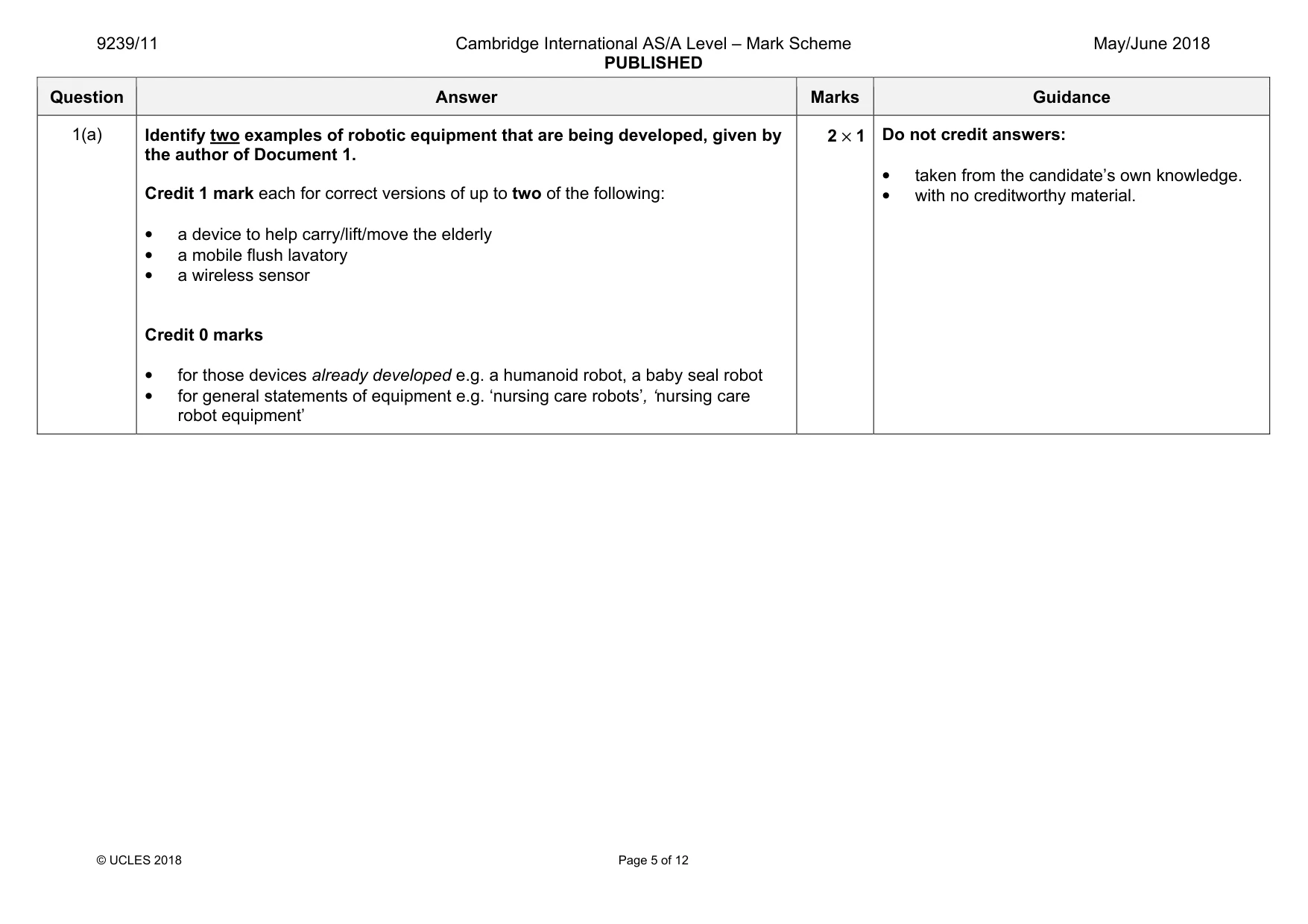
9239/11 Cambridge International AS/A Level – Mark Scheme PUBLISHED May/June 2018 © UCLES 2018 Page 5 of 12 Question Answer Marks Guidance 1(a) Identify two examples of robotic equipment that are being developed, given by the author of Document 1. Credit 1 mark each for correct versions of up to two of the following: • a device to help carry/lift/move the elderly • a mobile flush lavatory • a wireless sensor Credit 0 marks • for those devices already developed e.g. a humanoid robot, a baby seal robot • for general statements of equipment e.g. ‘nursing care robots’, ‘nursing care robot equipment’ 2 × 1 Do not credit answers: • taken from the candidate’s own knowledge. • with no creditworthy material.
Mark scheme, page 6
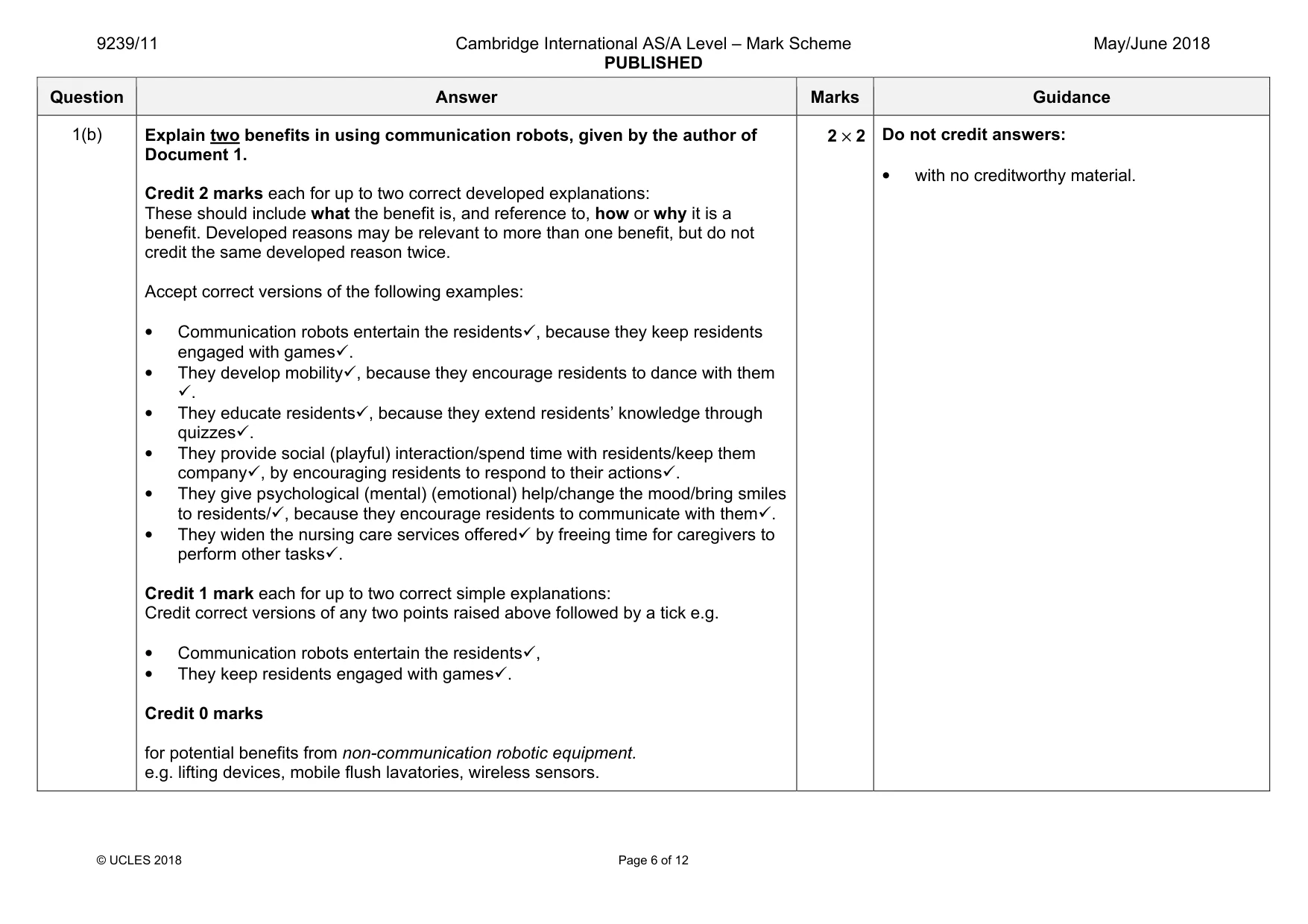
9239/11 Cambridge International AS/A Level – Mark Scheme PUBLISHED May/June 2018 © UCLES 2018 Page 6 of 12 Question Answer Marks Guidance 1(b) Explain two benefits in using communication robots, given by the author of Document 1. Credit 2 marks each for up to two correct developed explanations: These should include what the benefit is, and reference to, how or why it is a benefit. Developed reasons may be relevant to more than one benefit, but do not credit the same developed reason twice. Accept correct versions of the following examples: • Communication robots entertain the residents9, because they keep residents engaged with games9. • They develop mobility9, because they encourage residents to dance with them 9. • They educate residents9, because they extend residents’ knowledge through quizzes9. • They provide social (playful) interaction/spend time with residents/keep them company9, by encouraging residents to respond to their actions9. • They give psychological (mental) (emotional) help/change the mood/bring smiles to residents/9, because they encourage residents to communicate with them9. • They widen the nursing care services offered9 by freeing time for caregivers to perform other tasks9. Credit 1 mark each for up to two correct simple explanations: Credit correct versions of any two points raised above followed by a tick e.g. • Communication robots entertain the residents9, • They keep residents engaged with games9. Credit 0 marks for potential benefits from non-communication robotic equipment. e.g. lifting devices, mobile flush lavatories, wireless sensors. 2 × 2 Do not credit answers: • with no creditworthy material.
Mark scheme, page 7
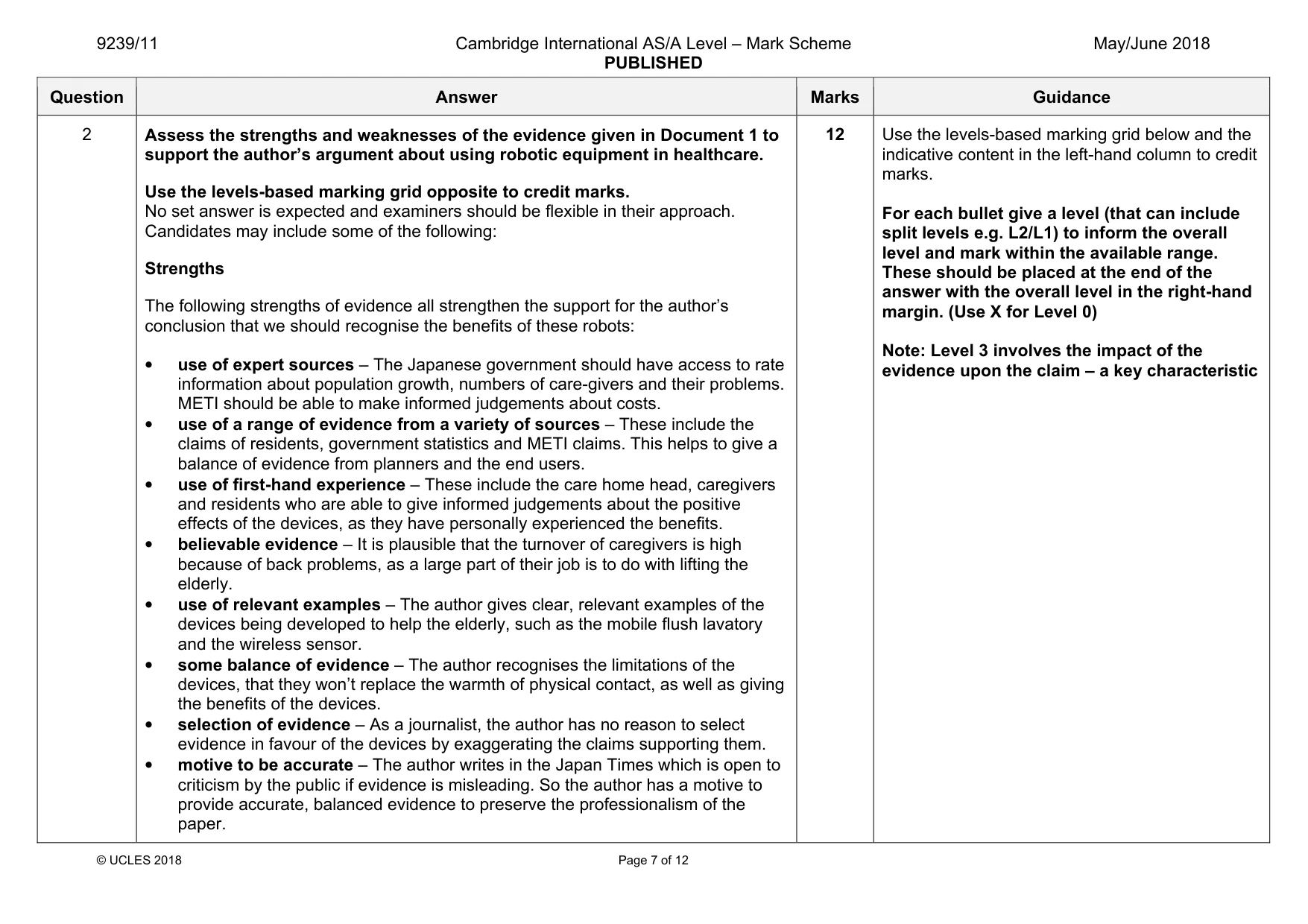
9239/11 Cambridge International AS/A Level – Mark Scheme PUBLISHED May/June 2018 © UCLES 2018 Page 7 of 12 Question Answer Marks Guidance 2 Assess the strengths and weaknesses of the evidence given in Document 1 to support the author’s argument about using robotic equipment in healthcare. Use the levels-based marking grid opposite to credit marks. No set answer is expected and examiners should be flexible in their approach. Candidates may include some of the following: Strengths The following strengths of evidence all strengthen the support for the author’s conclusion that we should recognise the benefits of these robots: • use of expert sources – The Japanese government should have access to rate information about population growth, numbers of care-givers and their problems. METI should be able to make informed judgements about costs. • use of a range of evidence from a variety of sources – These include the claims of residents, government statistics and METI claims. This helps to give a balance of evidence from planners and the end users. • use of first-hand experience – These include the care home head, caregivers and residents who are able to give informed judgements about the positive effects of the devices, as they have personally experienced the benefits. • believable evidence – It is plausible that the turnover of caregivers is high because of back problems, as a large part of their job is to do with lifting the elderly. • use of relevant examples – The author gives clear, relevant examples of the devices being developed to help the elderly, such as the mobile flush lavatory and the wireless sensor. • some balance of evidence – The author recognises the limitations of the devices, that they won’t replace the warmth of physical contact, as well as giving the benefits of the devices. • selection of evidence – As a journalist, the author has no reason to select evidence in favour of the devices by exaggerating the claims supporting them. • motive to be accurate – The author writes in the Japan Times which is open to criticism by the public if evidence is misleading. So the author has a motive to provide accurate, balanced evidence to preserve the professionalism of the paper. 12 Use the levels-based marking grid below and the indicative content in the left-hand column to credit marks. For each bullet give a level (that can include split levels e.g. L2/L1) to inform the overall level and mark within the available range. These should be placed at the end of the answer with the overall level in the right-hand margin. (Use X for Level 0) Note: Level 3 involves the impact of the evidence upon the claim – a key characteristic
Mark scheme, page 8
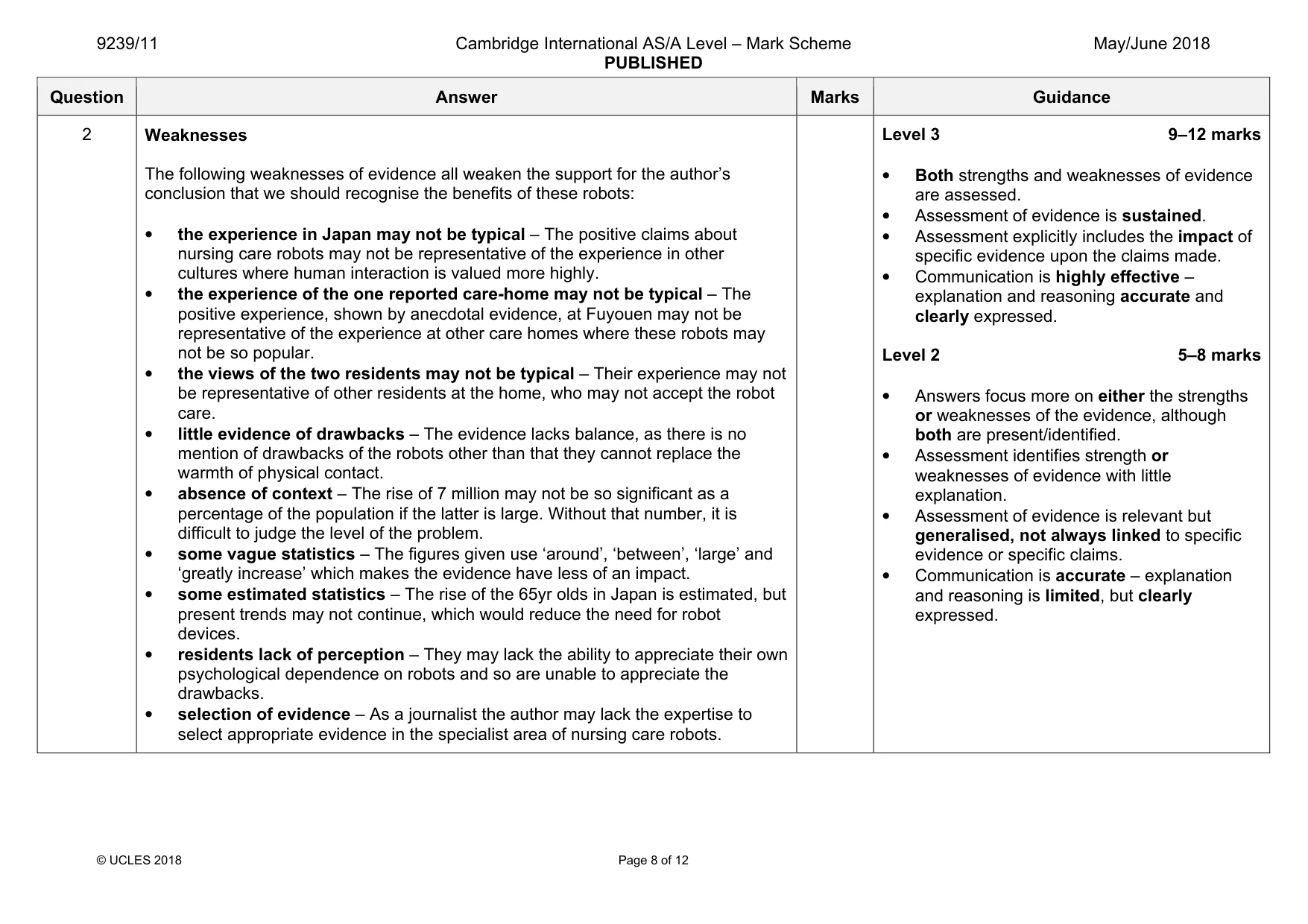
9239/11 Cambridge International AS/A Level – Mark Scheme PUBLISHED May/June 2018 © UCLES 2018 Page 8 of 12 Question Answer Marks Guidance 2 Weaknesses The following weaknesses of evidence all weaken the support for the author’s conclusion that we should recognise the benefits of these robots: • the experience in Japan may not be typical – The positive claims about nursing care robots may not be representative of the experience in other cultures where human interaction is valued more highly. • the experience of the one reported care-home may not be typical – The positive experience, shown by anecdotal evidence, at Fuyouen may not be representative of the experience at other care homes where these robots may not be so popular. • the views of the two residents may not be typical – Their experience may not be representative of other residents at the home, who may not accept the robot care. • little evidence of drawbacks – The evidence lacks balance, as there is no mention of drawbacks of the robots other than that they cannot replace the warmth of physical contact. • absence of context – The rise of 7 million may not be so significant as a percentage of the population if the latter is large. Without that number, it is difficult to judge the level of the problem. • some vague statistics – The figures given use ‘around’, ‘between’, ‘large’ and ‘greatly increase’ which makes the evidence have less of an impact. • some estimated statistics – The rise of the 65yr olds in Japan is estimated, but present trends may not continue, which would reduce the need for robot devices. • residents lack of perception – They may lack the ability to appreciate their own psychological dependence on robots and so are unable to appreciate the drawbacks. • selection of evidence – As a journalist the author may lack the expertise to select appropriate evidence in the specialist area of nursing care robots. Level 3 9–12 marks • Both strengths and weaknesses of evidence are assessed. • Assessment of evidence is sustained. • Assessment explicitly includes the impact of specific evidence upon the claims made. • Communication is highly effective – explanation and reasoning accurate and clearly expressed. Level 2 5–8 marks • Answers focus more on either the strengths or weaknesses of the evidence, although both are present/identified. • Assessment identifies strength or weaknesses of evidence with little explanation. • Assessment of evidence is relevant but generalised, not always linked to specific evidence or specific claims. • Communication is accurate – explanation and reasoning is limited, but clearly expressed.
Mark scheme, page 9
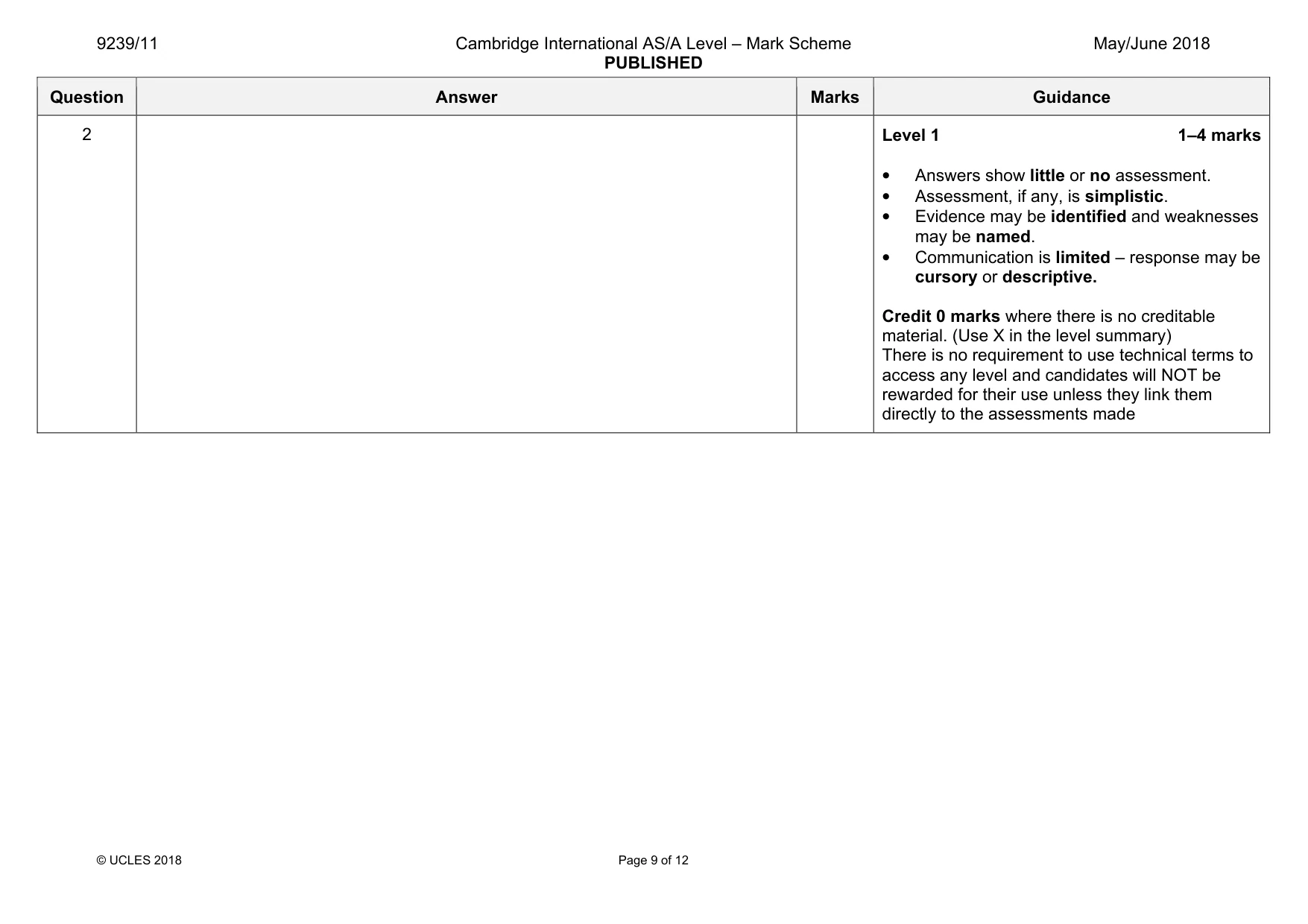
9239/11 Cambridge International AS/A Level – Mark Scheme PUBLISHED May/June 2018 © UCLES 2018 Page 9 of 12 Question Answer Marks Guidance 2 Level 1 1–4 marks • Answers show little or no assessment. • Assessment, if any, is simplistic. • Evidence may be identified and weaknesses may be named. • Communication is limited – response may be cursory or descriptive. Credit 0 marks where there is no creditable material. (Use X in the level summary) There is no requirement to use technical terms to access any level and candidates will NOT be rewarded for their use unless they link them directly to the assessments made
Mark scheme, page 10
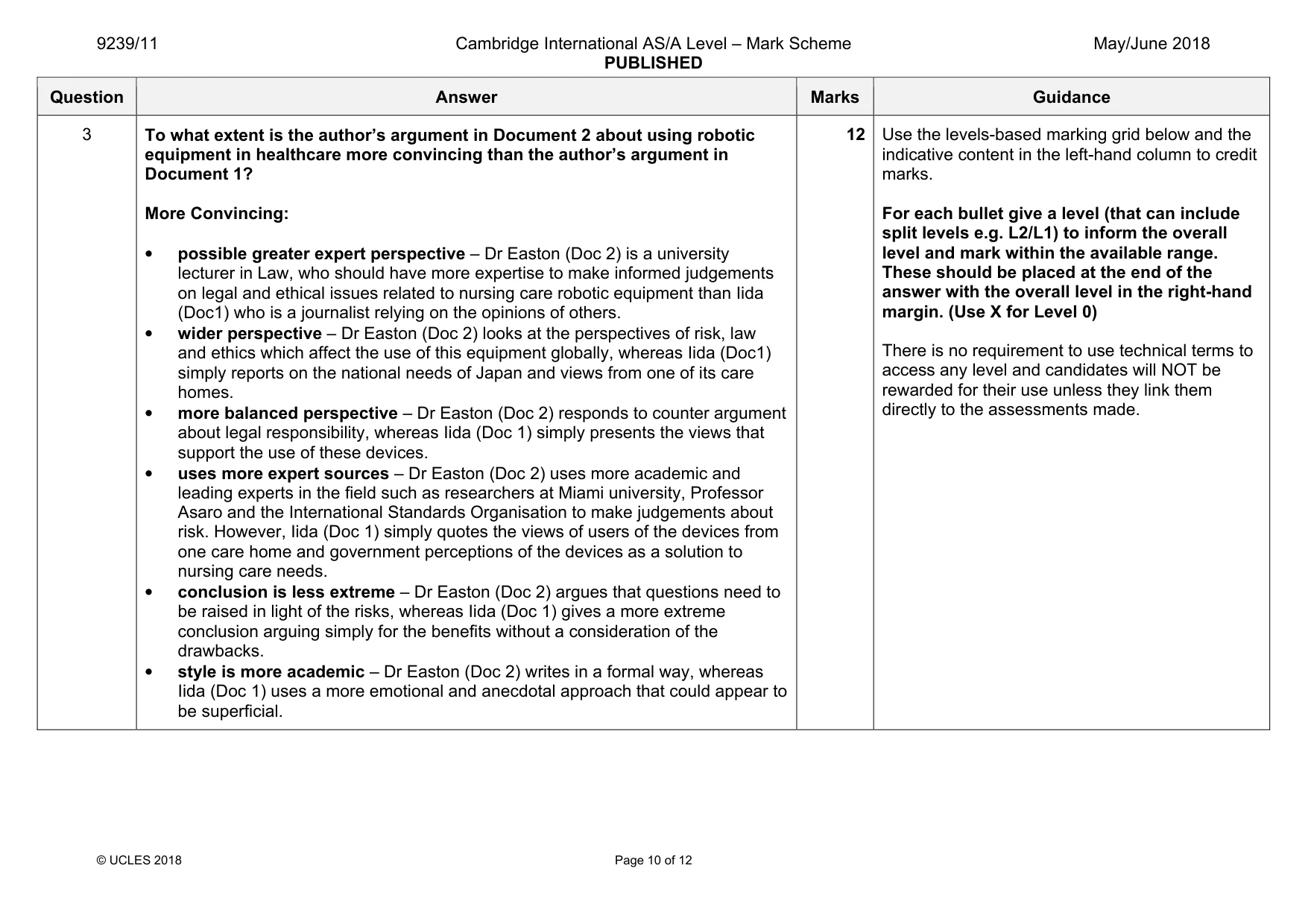
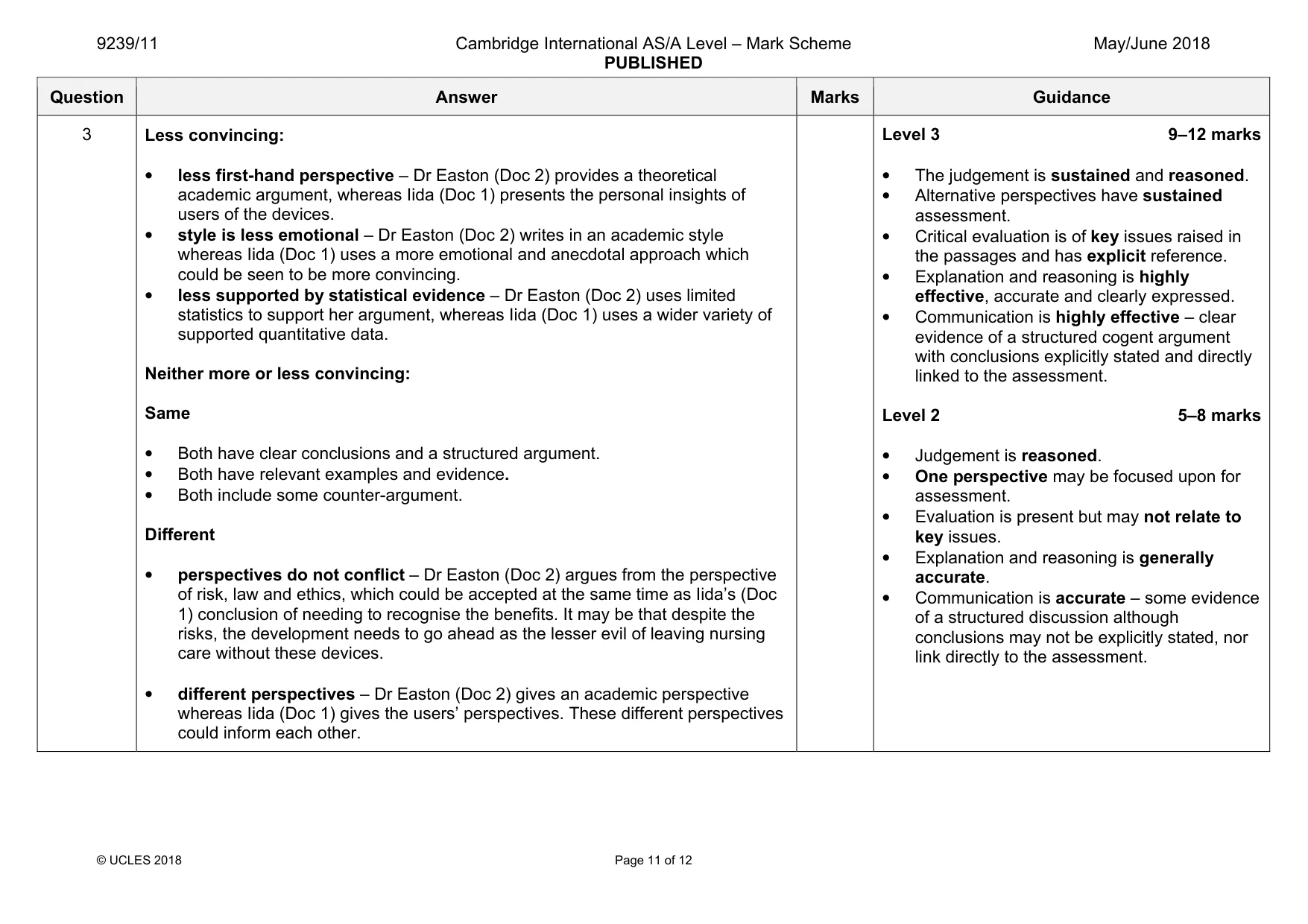
9239/11 Cambridge International AS/A Level – Mark Scheme PUBLISHED May/June 2018 © UCLES 2018 Page 10 of 12 Question Answer Marks Guidance 3 To what extent is the author’s argument in Document 2 about using robotic equipment in healthcare more convincing than the author’s argument in Document 1? More Convincing: • possible greater expert perspective – Dr Easton (Doc 2) is a university lecturer in Law, who should have more expertise to make informed judgements on legal and ethical issues related to nursing care robotic equipment than Iida (Doc1) who is a journalist relying on the opinions of others. • wider perspective – Dr Easton (Doc 2) looks at the perspectives of risk, law and ethics which affect the use of this equipment globally, whereas Iida (Doc1) simply reports on the national needs of Japan and views from one of its care homes. • more balanced perspective – Dr Easton (Doc 2) responds to counter argument about legal responsibility, whereas Iida (Doc 1) simply presents the views that support the use of these devices. • uses more expert sources – Dr Easton (Doc 2) uses more academic and leading experts in the field such as researchers at Miami university, Professor Asaro and the International Standards Organisation to make judgements about risk. However, Iida (Doc 1) simply quotes the views of users of the devices from one care home and government perceptions of the devices as a solution to nursing care needs. • conclusion is less extreme – Dr Easton (Doc 2) argues that questions need to be raised in light of the risks, whereas Iida (Doc 1) gives a more extreme conclusion arguing simply for the benefits without a consideration of the drawbacks. • style is more academic – Dr Easton (Doc 2) writes in a formal way, whereas Iida (Doc 1) uses a more emotional and anecdotal approach that could appear to be superficial. 12 Use the levels-based marking grid below and the indicative content in the left-hand column to credit marks. For each bullet give a level (that can include split levels e.g. L2/L1) to inform the overall level and mark within the available range. These should be placed at the end of the answer with the overall level in the right-hand margin. (Use X for Level 0) There is no requirement to use technical terms to access any level and candidates will NOT be rewarded for their use unless they link them directly to the assessments made.
Mark scheme, page 11
9239/11 Cambridge International AS/A Level – Mark Scheme PUBLISHED May/June 2018 © UCLES 2018 Page 11 of 12 Question Answer Marks Guidance 3 Less convincing: • less first-hand perspective – Dr Easton (Doc 2) provides a theoretical academic argument, whereas Iida (Doc 1) presents the personal insights of users of the devices. • style is less emotional – Dr Easton (Doc 2) writes in an academic style whereas Iida (Doc 1) uses a more emotional and anecdotal approach which could be seen to be more convincing. • less supported by statistical evidence – Dr Easton (Doc 2) uses limited statistics to support her argument, whereas Iida (Doc 1) uses a wider variety of supported quantitative data. Neither more or less convincing: Same • Both have clear conclusions and a structured argument. • Both have relevant examples and evidence. • Both include some counter-argument. Different • perspectives do not conflict – Dr Easton (Doc 2) argues from the perspective of risk, law and ethics, which could be accepted at the same time as Iida’s (Doc 1) conclusion of needing to recognise the benefits. It may be that despite the risks, the development needs to go ahead as the lesser evil of leaving nursing care without these devices. • different perspectives – Dr Easton (Doc 2) gives an academic perspective whereas Iida (Doc 1) gives the users’ perspectives. These different perspectives could inform each other. Level 3 9–12 marks • The judgement is sustained and reasoned. • Alternative perspectives have sustained assessment. • Critical evaluation is of key issues raised in the passages and has explicit reference. • Explanation and reasoning is highly effective, accurate and clearly expressed. • Communication is highly effective – clear evidence of a structured cogent argument with conclusions explicitly stated and directly linked to the assessment. Level 2 5–8 marks • Judgement is reasoned. • One perspective may be focused upon for assessment. • Evaluation is present but may not relate to key issues. • Explanation and reasoning is generally accurate. • Communication is accurate – some evidence of a structured discussion although conclusions may not be explicitly stated, nor link directly to the assessment.
Mark scheme, page 12
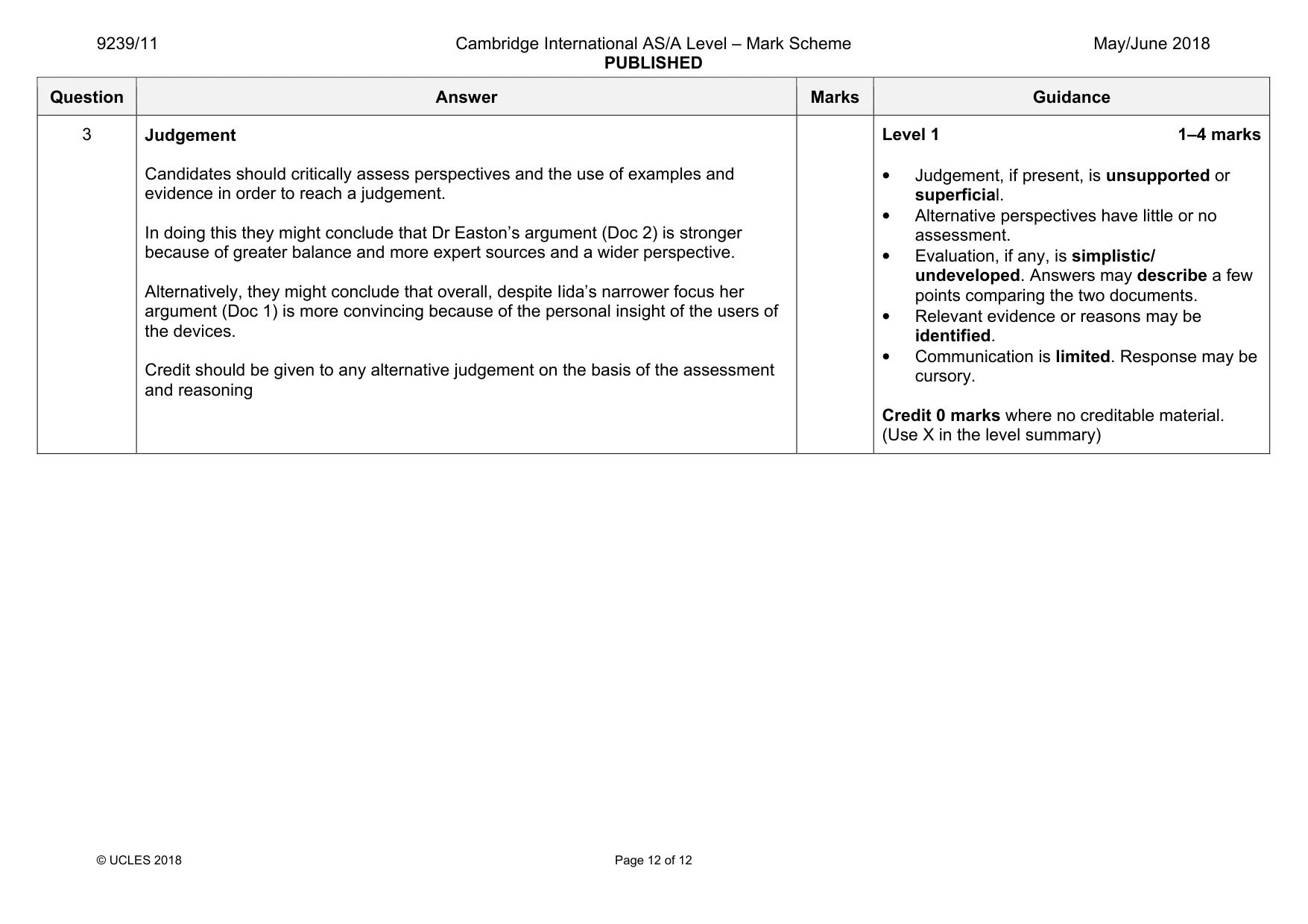
9239/11 Cambridge International AS/A Level – Mark Scheme PUBLISHED May/June 2018 © UCLES 2018 Page 12 of 12 Question Answer Marks Guidance 3 Judgement Candidates should critically assess perspectives and the use of examples and evidence in order to reach a judgement. In doing this they might conclude that Dr Easton’s argument (Doc 2) is stronger because of greater balance and more expert sources and a wider perspective. Alternatively, they might conclude that overall, despite Iida’s narrower focus her argument (Doc 1) is more convincing because of the personal insight of the users of the devices. Credit should be given to any alternative judgement on the basis of the assessment and reasoning Level 1 1–4 marks • Judgement, if present, is unsupported or superficial. • Alternative perspectives have little or no assessment. • Evaluation, if any, is simplistic/ undeveloped. Answers may describe a few points comparing the two documents. • Relevant evidence or reasons may be identified. • Communication is limited. Response may be cursory. Credit 0 marks where no creditable material. (Use X in the level summary)
What you needed in this session
Cambridge’s own grade thresholds for 2018 May/June, Paper 1 · Variant 1. A higher threshold means an easier paper — the bar moves with how the cohort did.