Cambridge A Level Global Perspectives and Research 9239 — 2018 May/June Paper 1 · Variant 2
9239/12/M/J/18 · 30 marks · ≈34 min
The question paper and its mark scheme, free to read here and free to download. This is Cambridge’s own paper, exactly as it was sat.
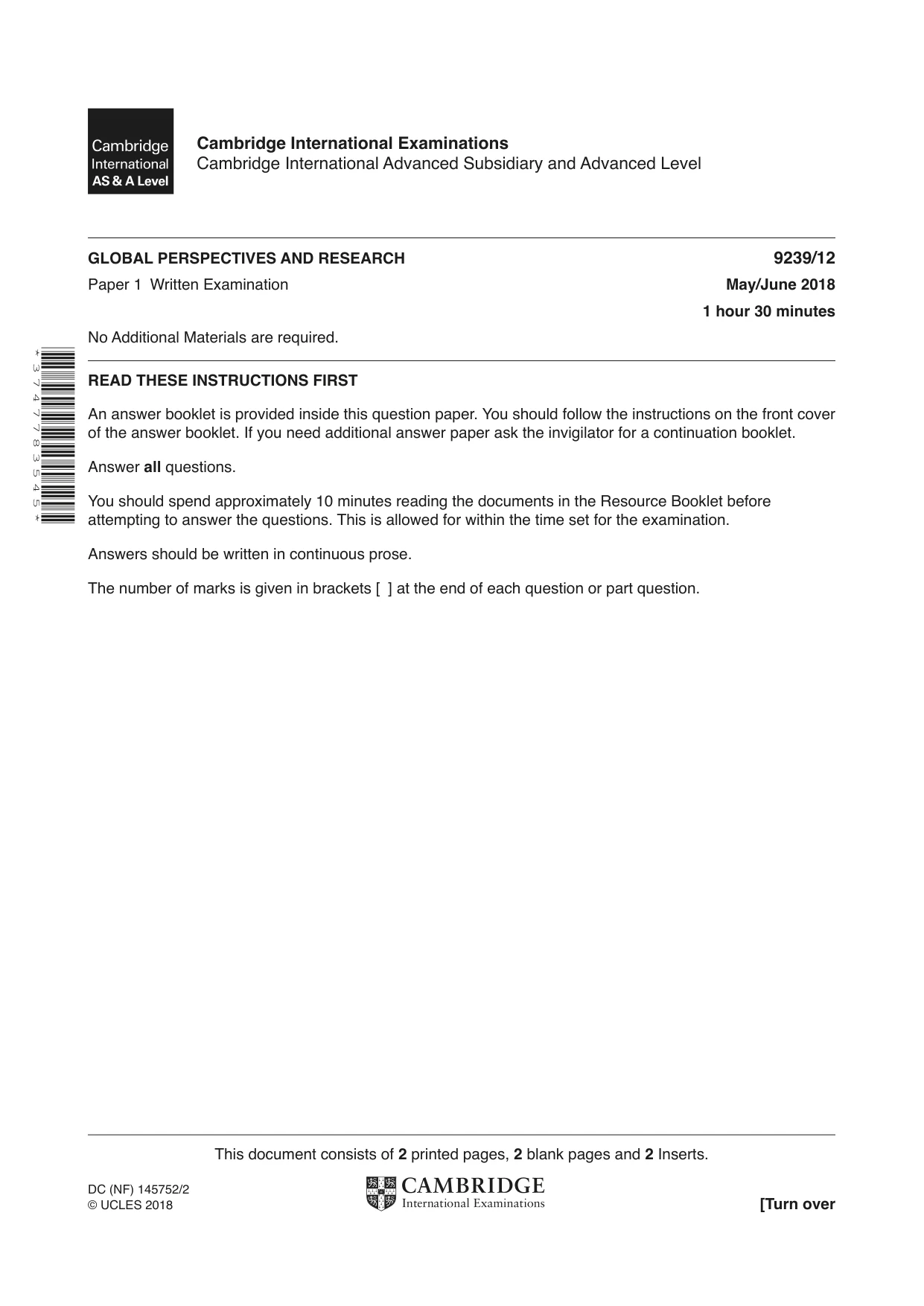
Question paper4 pages


Mark scheme11 pages
Answers below. Sit the paper first if you are practising.
Paper as text
Question paper, page 1
* 3 7 4 7 7 8 3 5 4 5 * This document consists of 2 printed pages, 2 blank pages and 2 Inserts. DC (NF) 145752/2 © UCLES 2018 [Turn over Cambridge International Examinations Cambridge International Advanced Subsidiary and Advanced Level GLOBAL PERSPECTIVES AND RESEARCH 9239/12 Paper 1 Written Examination May/June 2018 1 hour 30 minutes No Additional Materials are required. READ THESE INSTRUCTIONS FIRST An answer booklet is provided inside this question paper. You should follow the instructions on the front cover of the answer booklet. If you need additional answer paper ask the invigilator for a continuation booklet. Answer all questions. You should spend approximately 10 minutes reading the documents in the Resource Booklet before attempting to answer the questions. This is allowed for within the time set for the examination. Answers should be written in continuous prose. The number of marks is given in brackets [ ] at the end of each question or part question.
Question paper, page 2
2 9239/12/M/J/18 © UCLES 2018 Read the documents in the accompanying Resource Booklet and answer all the questions. Gender issues 1 Study Document 1. (a) Identify two ways in which educated women can bring about change in society, as argued by the author of Document 1. [2] (b) Identify and explain two barriers to girls’ education in Pakistan, as argued by the author of Document 1. [4] 2 Study Document 1. Assess the strengths and weaknesses of the author’s argument in Document 1 about women being deprived of education in Pakistan. [10] 3 Study Documents 1 and 2. To what extent is the author’s solution to girls’ rights in Document 2 more convincing than that offered by the author in Document 1? [14] [Total: 30]
Question paper, page 3
3 9239/12/M/J/18 © UCLES 2018 BLANK PAGE
Question paper, page 4
4 9239/12/M/J/18 © UCLES 2018 BLANK PAGE Permission to reproduce items where third-party owned material protected by copyright is included has been sought and cleared where possible. Every reasonable effort has been made by the publisher (UCLES) to trace copyright holders, but if any items requiring clearance have unwittingly been included, the publisher will be pleased to make amends at the earliest possible opportunity. To avoid the issue of disclosure of answer-related information to candidates, all copyright acknowledgements are reproduced online in the Cambridge International Examinations Copyright Acknowledgements Booklet. This is produced for each series of examinations and is freely available to download at www.cie.org.uk after the live examination series. Cambridge International Examinations is part of the Cambridge Assessment Group. Cambridge Assessment is the brand name of University of Cambridge Local Examinations Syndicate (UCLES), which is itself a department of the University of Cambridge.
Mark scheme, page 1
IGCSE™ is a registered trademark. This document consists of 11 printed pages. © UCLES 2018 [Turn over Cambridge Assessment International Education Cambridge International Advanced Subsidiary and Advanced Level GLOBAL PERSPECTIVES AND RESEARCH 9239/12 Paper 1 Written Examination May/June 2018 MARK SCHEME Maximum Mark: 30 Published This mark scheme is published as an aid to teachers and candidates, to indicate the requirements of the examination. It shows the basis on which Examiners were instructed to award marks. It does not indicate the details of the discussions that took place at an Examiners’ meeting before marking began, which would have considered the acceptability of alternative answers. Mark schemes should be read in conjunction with the question paper and the Principal Examiner Report for Teachers. Cambridge International will not enter into discussions about these mark schemes. Cambridge International is publishing the mark schemes for the May/June 2018 series for most Cambridge IGCSE™, Cambridge International A and AS Level and Cambridge Pre-U components, and some Cambridge O Level components.
Mark scheme, page 2
9239/12 Cambridge International AS/A Level – Mark Scheme PUBLISHED May/June 2018 © UCLES 2018 Page 2 of 11 Generic Marking Principles These general marking principles must be applied by all examiners when marking candidate answers. They should be applied alongside the specific content of the mark scheme or generic level descriptors for a question. Each question paper and mark scheme will also comply with these marking principles. GENERIC MARKING PRINCIPLE 1: Marks must be awarded in line with: • the specific content of the mark scheme or the generic level descriptors for the question • the specific skills defined in the mark scheme or in the generic level descriptors for the question • the standard of response required by a candidate as exemplified by the standardisation scripts. GENERIC MARKING PRINCIPLE 2: Marks awarded are always whole marks (not half marks, or other fractions). GENERIC MARKING PRINCIPLE 3: Marks must be awarded positively: • marks are awarded for correct/valid answers, as defined in the mark scheme. However, credit is given for valid answers which go beyond the scope of the syllabus and mark scheme, referring to your Team Leader as appropriate • marks are awarded when candidates clearly demonstrate what they know and can do • marks are not deducted for errors • marks are not deducted for omissions • answers should only be judged on the quality of spelling, punctuation and grammar when these features are specifically assessed by the question as indicated by the mark scheme. The meaning, however, should be unambiguous. GENERIC MARKING PRINCIPLE 4: Rules must be applied consistently e.g. in situations where candidates have not followed instructions or in the application of generic level descriptors.
Mark scheme, page 3
9239/12 Cambridge International AS/A Level – Mark Scheme PUBLISHED May/June 2018 © UCLES 2018 Page 3 of 11 GENERIC MARKING PRINCIPLE 5: Marks should be awarded using the full range of marks defined in the mark scheme for the question (however; the use of the full mark range may be limited according to the quality of the candidate responses seen). GENERIC MARKING PRINCIPLE 6: Marks awarded are based solely on the requirements as defined in the mark scheme. Marks should not be awarded with grade thresholds or grade descriptors in mind.
Mark scheme, page 4
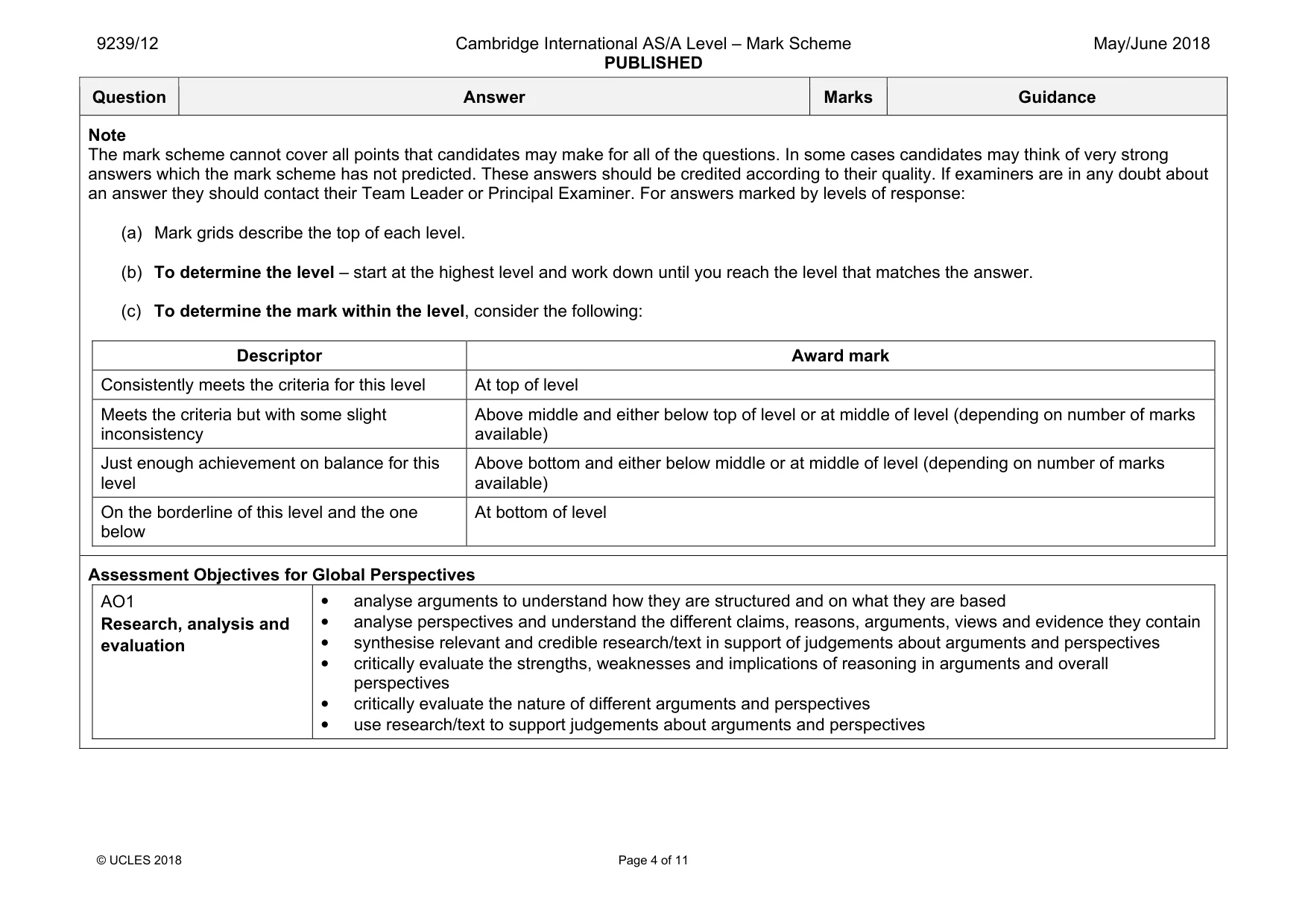
9239/12 Cambridge International AS/A Level – Mark Scheme PUBLISHED May/June 2018 © UCLES 2018 Page 4 of 11 Question Answer Marks Guidance Note The mark scheme cannot cover all points that candidates may make for all of the questions. In some cases candidates may think of very strong answers which the mark scheme has not predicted. These answers should be credited according to their quality. If examiners are in any doubt about an answer they should contact their Team Leader or Principal Examiner. For answers marked by levels of response: (a) Mark grids describe the top of each level. (b) To determine the level – start at the highest level and work down until you reach the level that matches the answer. (c) To determine the mark within the level, consider the following: Descriptor Award mark Consistently meets the criteria for this level At top of level Meets the criteria but with some slight inconsistency Above middle and either below top of level or at middle of level (depending on number of marks available) Just enough achievement on balance for this level Above bottom and either below middle or at middle of level (depending on number of marks available) On the borderline of this level and the one below At bottom of level Assessment Objectives for Global Perspectives AO1 Research, analysis and evaluation • analyse arguments to understand how they are structured and on what they are based • analyse perspectives and understand the different claims, reasons, arguments, views and evidence they contain • synthesise relevant and credible research/text in support of judgements about arguments and perspectives • critically evaluate the strengths, weaknesses and implications of reasoning in arguments and overall perspectives • critically evaluate the nature of different arguments and perspectives • use research/text to support judgements about arguments and perspectives
Mark scheme, page 5
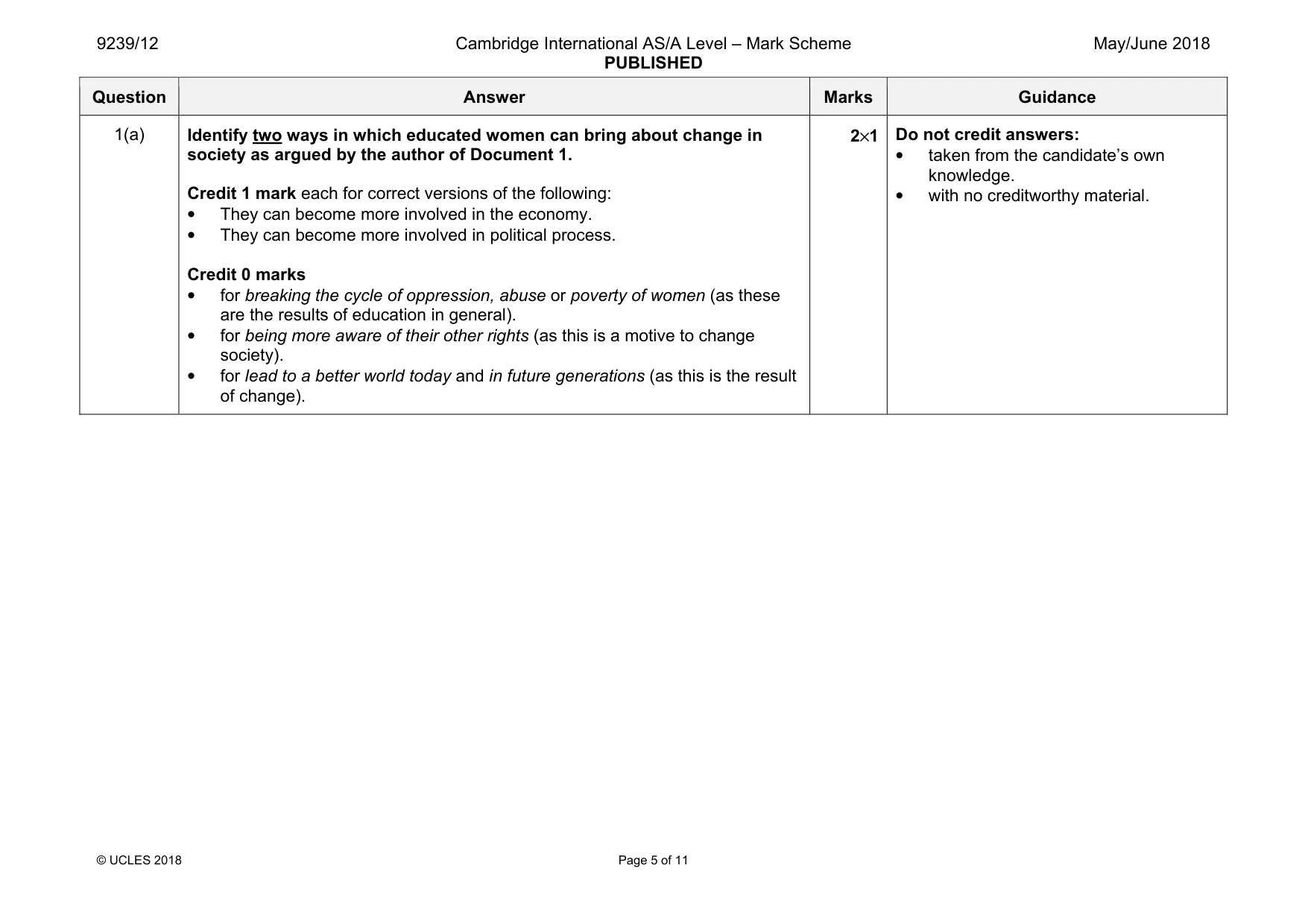
9239/12 Cambridge International AS/A Level – Mark Scheme PUBLISHED May/June 2018 © UCLES 2018 Page 5 of 11 Question Answer Marks Guidance 1(a) Identify two ways in which educated women can bring about change in society as argued by the author of Document 1. Credit 1 mark each for correct versions of the following: • They can become more involved in the economy. • They can become more involved in political process. Credit 0 marks • for breaking the cycle of oppression, abuse or poverty of women (as these are the results of education in general). • for being more aware of their other rights (as this is a motive to change society). • for lead to a better world today and in future generations (as this is the result of change). 2×1 Do not credit answers: • taken from the candidate’s own knowledge. • with no creditworthy material.
Mark scheme, page 6
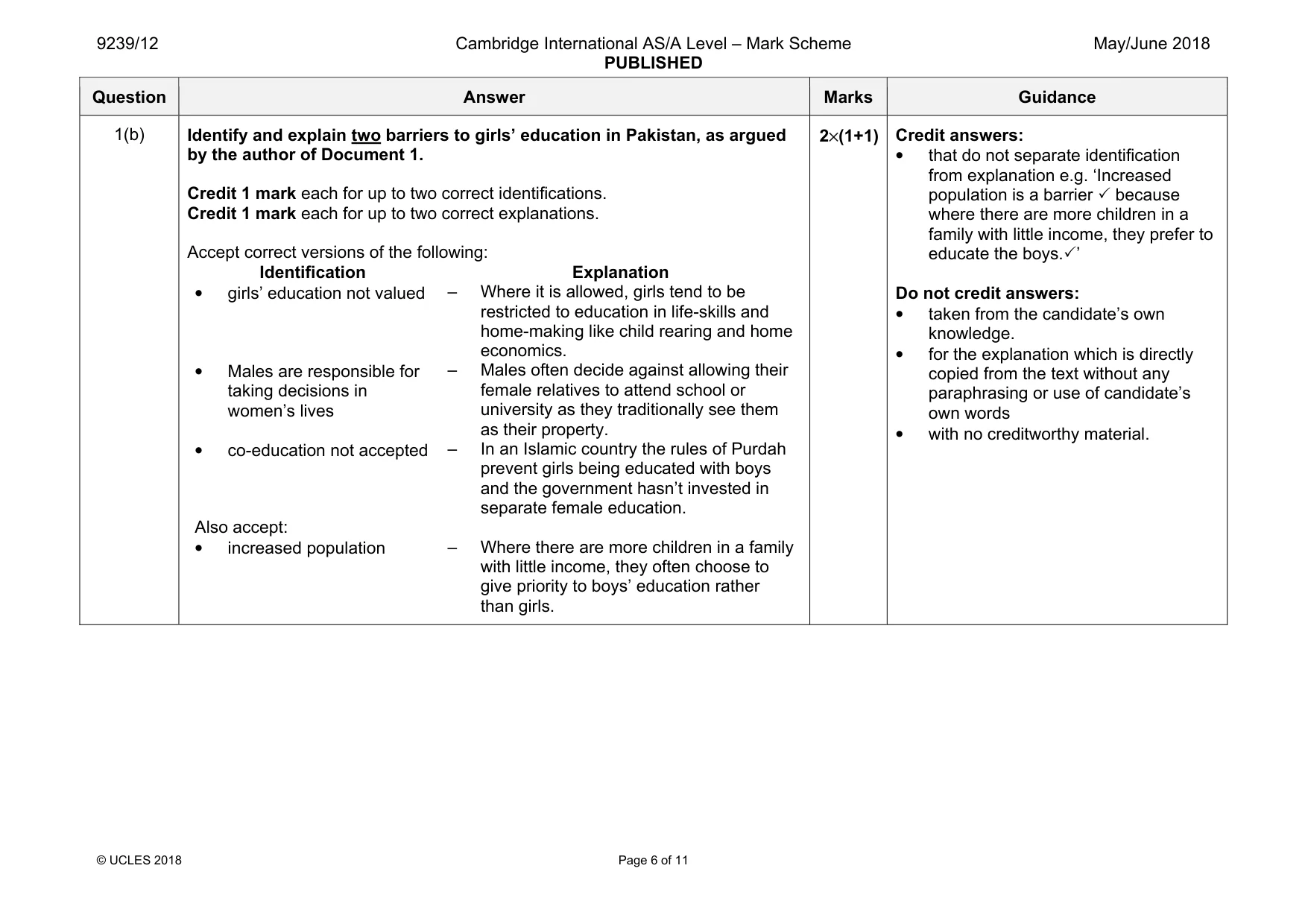
9239/12 Cambridge International AS/A Level – Mark Scheme PUBLISHED May/June 2018 © UCLES 2018 Page 6 of 11 Question Answer Marks Guidance 1(b) Identify and explain two barriers to girls’ education in Pakistan, as argued by the author of Document 1. Credit 1 mark each for up to two correct identifications. Credit 1 mark each for up to two correct explanations. Accept correct versions of the following: Identification Explanation • girls’ education not valued – Where it is allowed, girls tend to be restricted to education in life-skills and home-making like child rearing and home economics. • Males are responsible for taking decisions in women’s lives – Males often decide against allowing their female relatives to attend school or university as they traditionally see them as their property. • co-education not accepted – In an Islamic country the rules of Purdah prevent girls being educated with boys and the government hasn’t invested in separate female education. Also accept: • increased population – Where there are more children in a family with little income, they often choose to give priority to boys’ education rather than girls. 2×(1+1) Credit answers: • that do not separate identification from explanation e.g. ‘Increased population is a barrier 3 because where there are more children in a family with little income, they prefer to educate the boys.3’ Do not credit answers: • taken from the candidate’s own knowledge. • for the explanation which is directly copied from the text without any paraphrasing or use of candidate’s own words • with no creditworthy material.
Mark scheme, page 7
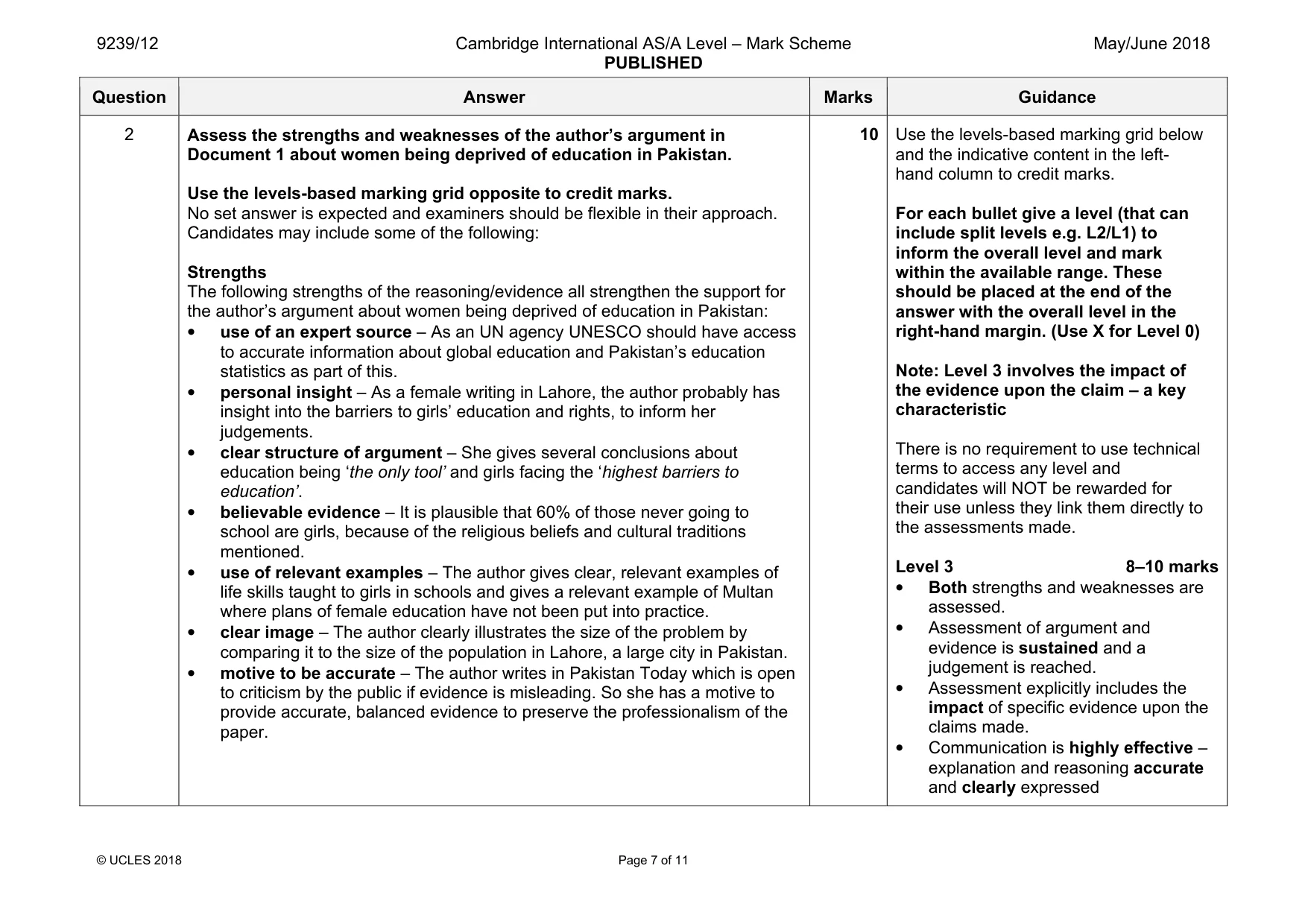
9239/12 Cambridge International AS/A Level – Mark Scheme PUBLISHED May/June 2018 © UCLES 2018 Page 7 of 11 Question Answer Marks Guidance 2 Assess the strengths and weaknesses of the author’s argument in Document 1 about women being deprived of education in Pakistan. Use the levels-based marking grid opposite to credit marks. No set answer is expected and examiners should be flexible in their approach. Candidates may include some of the following: Strengths The following strengths of the reasoning/evidence all strengthen the support for the author’s argument about women being deprived of education in Pakistan: • use of an expert source – As an UN agency UNESCO should have access to accurate information about global education and Pakistan’s education statistics as part of this. • personal insight – As a female writing in Lahore, the author probably has insight into the barriers to girls’ education and rights, to inform her judgements. • clear structure of argument – She gives several conclusions about education being ‘the only tool’ and girls facing the ‘highest barriers to education’. • believable evidence – It is plausible that 60% of those never going to school are girls, because of the religious beliefs and cultural traditions mentioned. • use of relevant examples – The author gives clear, relevant examples of life skills taught to girls in schools and gives a relevant example of Multan where plans of female education have not been put into practice. • clear image – The author clearly illustrates the size of the problem by comparing it to the size of the population in Lahore, a large city in Pakistan. • motive to be accurate – The author writes in Pakistan Today which is open to criticism by the public if evidence is misleading. So she has a motive to provide accurate, balanced evidence to preserve the professionalism of the paper. 10 Use the levels-based marking grid below and the indicative content in the left- hand column to credit marks. For each bullet give a level (that can include split levels e.g. L2/L1) to inform the overall level and mark within the available range. These should be placed at the end of the answer with the overall level in the right-hand margin. (Use X for Level 0) Note: Level 3 involves the impact of the evidence upon the claim – a key characteristic There is no requirement to use technical terms to access any level and candidates will NOT be rewarded for their use unless they link them directly to the assessments made. Level 3 8–10 marks • Both strengths and weaknesses are assessed. • Assessment of argument and evidence is sustained and a judgement is reached. • Assessment explicitly includes the impact of specific evidence upon the claims made. • Communication is highly effective – explanation and reasoning accurate and clearly expressed
Mark scheme, page 8
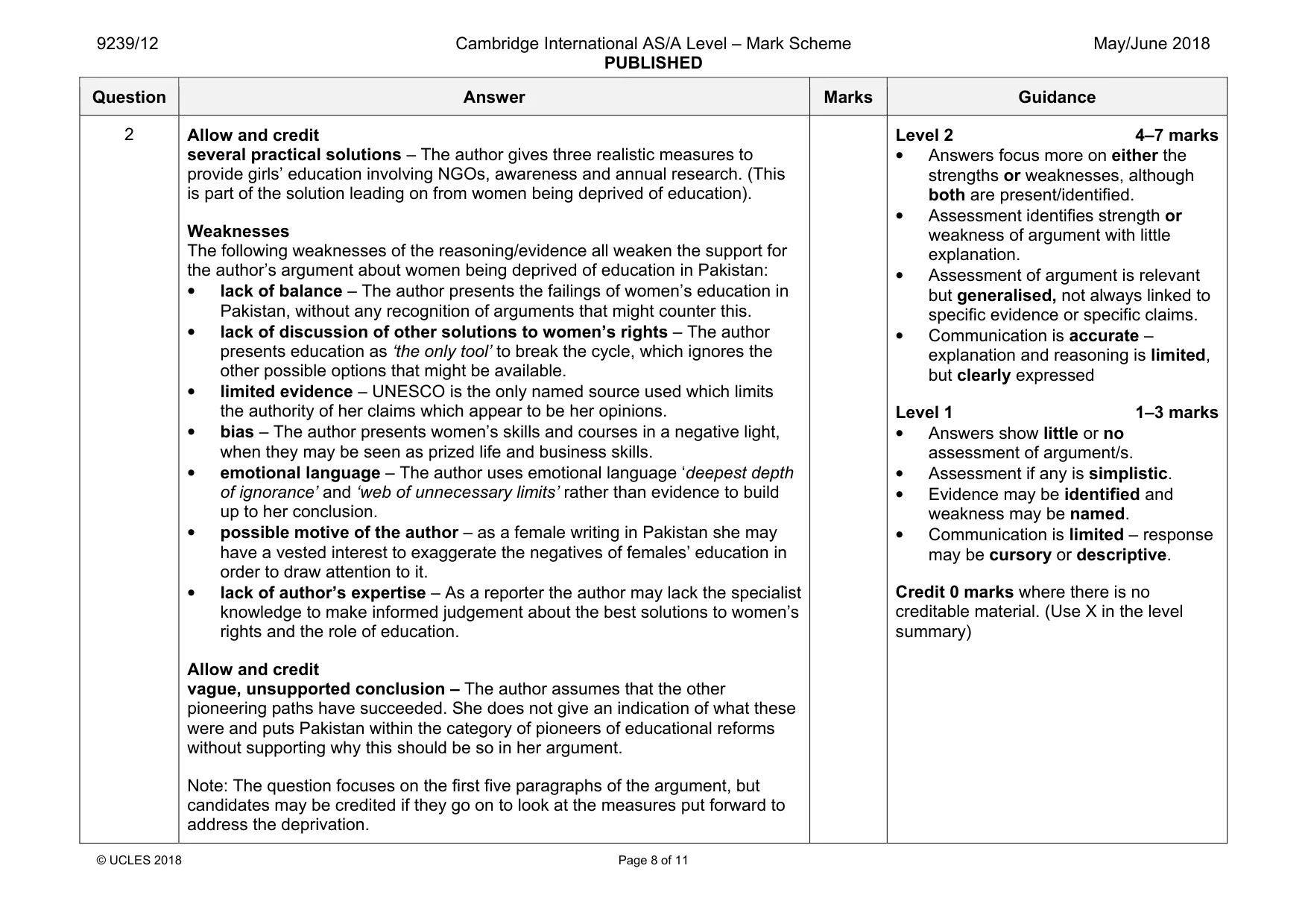
9239/12 Cambridge International AS/A Level – Mark Scheme PUBLISHED May/June 2018 © UCLES 2018 Page 8 of 11 Question Answer Marks Guidance 2 Allow and credit several practical solutions – The author gives three realistic measures to provide girls’ education involving NGOs, awareness and annual research. (This is part of the solution leading on from women being deprived of education). Weaknesses The following weaknesses of the reasoning/evidence all weaken the support for the author’s argument about women being deprived of education in Pakistan: • lack of balance – The author presents the failings of women’s education in Pakistan, without any recognition of arguments that might counter this. • lack of discussion of other solutions to women’s rights – The author presents education as ‘the only tool’ to break the cycle, which ignores the other possible options that might be available. • limited evidence – UNESCO is the only named source used which limits the authority of her claims which appear to be her opinions. • bias – The author presents women’s skills and courses in a negative light, when they may be seen as prized life and business skills. • emotional language – The author uses emotional language ‘deepest depth of ignorance’ and ‘web of unnecessary limits’ rather than evidence to build up to her conclusion. • possible motive of the author – as a female writing in Pakistan she may have a vested interest to exaggerate the negatives of females’ education in order to draw attention to it. • lack of author’s expertise – As a reporter the author may lack the specialist knowledge to make informed judgement about the best solutions to women’s rights and the role of education. Allow and credit vague, unsupported conclusion – The author assumes that the other pioneering paths have succeeded. She does not give an indication of what these were and puts Pakistan within the category of pioneers of educational reforms without supporting why this should be so in her argument. Note: The question focuses on the first five paragraphs of the argument, but candidates may be credited if they go on to look at the measures put forward to address the deprivation. Level 2 4–7 marks • Answers focus more on either the strengths or weaknesses, although both are present/identified. • Assessment identifies strength or weakness of argument with little explanation. • Assessment of argument is relevant but generalised, not always linked to specific evidence or specific claims. • Communication is accurate – explanation and reasoning is limited, but clearly expressed Level 1 1–3 marks • Answers show little or no assessment of argument/s. • Assessment if any is simplistic. • Evidence may be identified and weakness may be named. • Communication is limited – response may be cursory or descriptive. Credit 0 marks where there is no creditable material. (Use X in the level summary)
Mark scheme, page 9
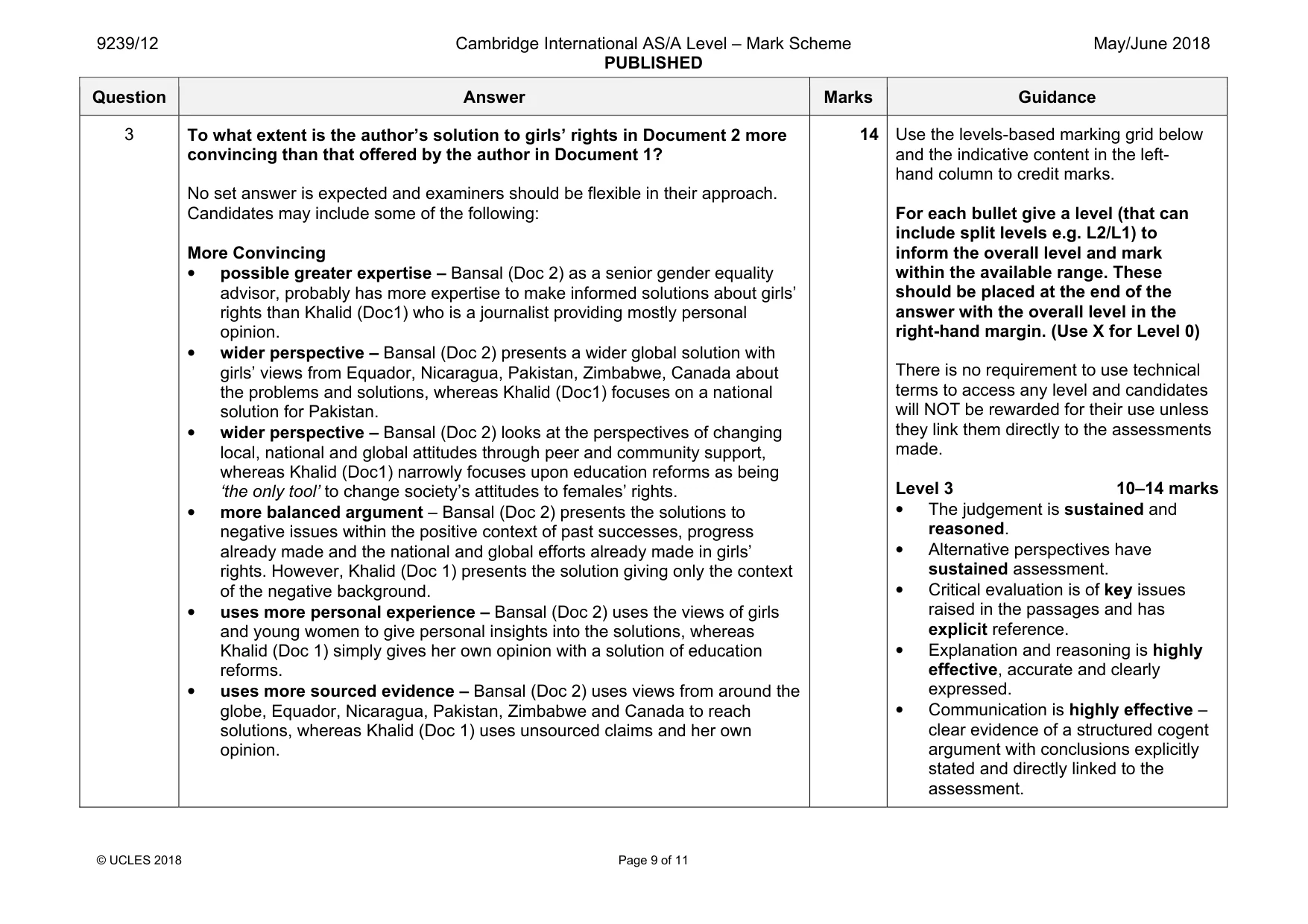
9239/12 Cambridge International AS/A Level – Mark Scheme PUBLISHED May/June 2018 © UCLES 2018 Page 9 of 11 Question Answer Marks Guidance 3 To what extent is the author’s solution to girls’ rights in Document 2 more convincing than that offered by the author in Document 1? No set answer is expected and examiners should be flexible in their approach. Candidates may include some of the following: More Convincing • possible greater expertise – Bansal (Doc 2) as a senior gender equality advisor, probably has more expertise to make informed solutions about girls’ rights than Khalid (Doc1) who is a journalist providing mostly personal opinion. • wider perspective – Bansal (Doc 2) presents a wider global solution with girls’ views from Equador, Nicaragua, Pakistan, Zimbabwe, Canada about the problems and solutions, whereas Khalid (Doc1) focuses on a national solution for Pakistan. • wider perspective – Bansal (Doc 2) looks at the perspectives of changing local, national and global attitudes through peer and community support, whereas Khalid (Doc1) narrowly focuses upon education reforms as being ‘the only tool’ to change society’s attitudes to females’ rights. • more balanced argument – Bansal (Doc 2) presents the solutions to negative issues within the positive context of past successes, progress already made and the national and global efforts already made in girls’ rights. However, Khalid (Doc 1) presents the solution giving only the context of the negative background. • uses more personal experience – Bansal (Doc 2) uses the views of girls and young women to give personal insights into the solutions, whereas Khalid (Doc 1) simply gives her own opinion with a solution of education reforms. • uses more sourced evidence – Bansal (Doc 2) uses views from around the globe, Equador, Nicaragua, Pakistan, Zimbabwe and Canada to reach solutions, whereas Khalid (Doc 1) uses unsourced claims and her own opinion. 14 Use the levels-based marking grid below and the indicative content in the left- hand column to credit marks. For each bullet give a level (that can include split levels e.g. L2/L1) to inform the overall level and mark within the available range. These should be placed at the end of the answer with the overall level in the right-hand margin. (Use X for Level 0) There is no requirement to use technical terms to access any level and candidates will NOT be rewarded for their use unless they link them directly to the assessments made. Level 3 10–14 marks • The judgement is sustained and reasoned. • Alternative perspectives have sustained assessment. • Critical evaluation is of key issues raised in the passages and has explicit reference. • Explanation and reasoning is highly effective, accurate and clearly expressed. • Communication is highly effective – clear evidence of a structured cogent argument with conclusions explicitly stated and directly linked to the assessment.
Mark scheme, page 10
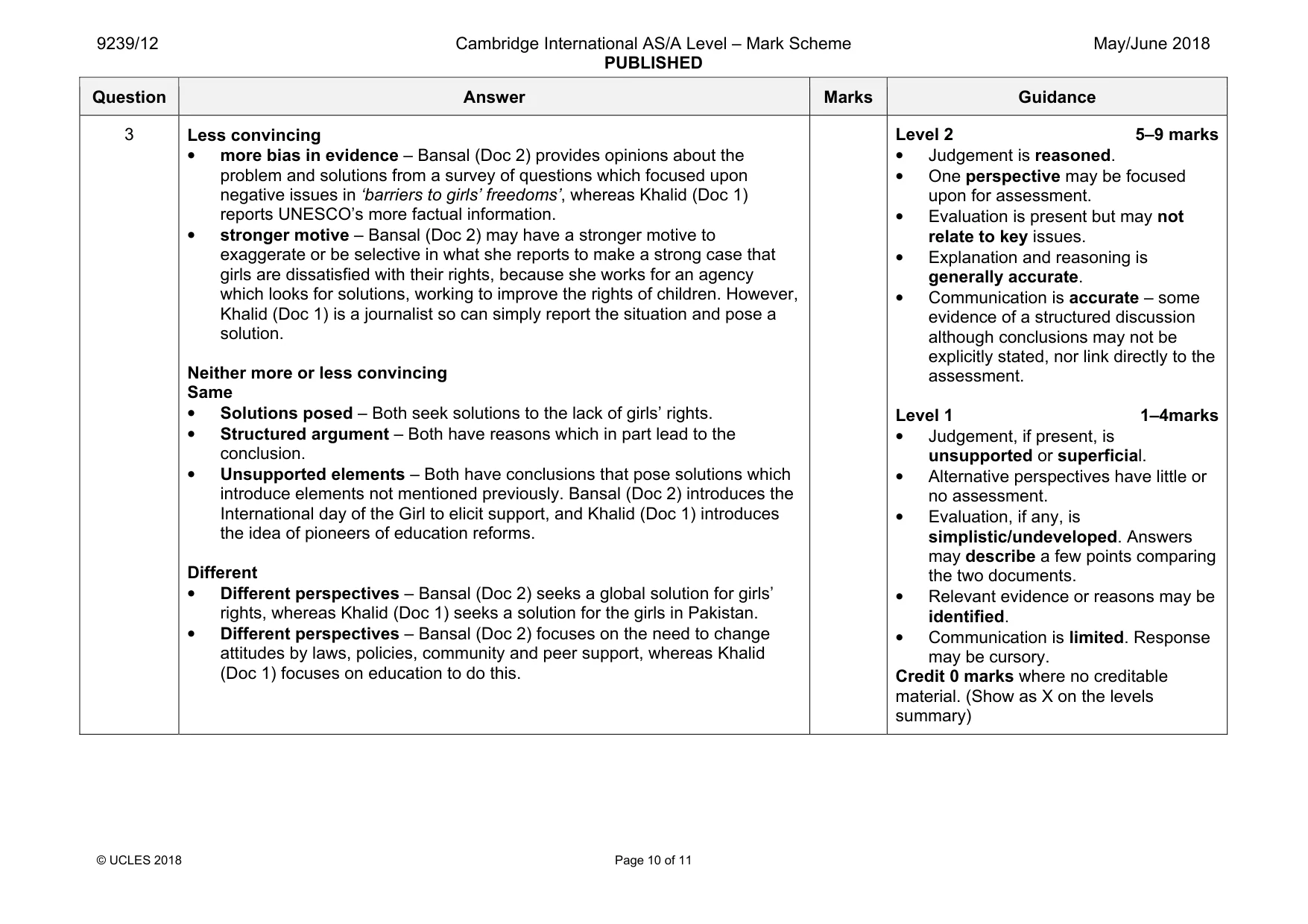
9239/12 Cambridge International AS/A Level – Mark Scheme PUBLISHED May/June 2018 © UCLES 2018 Page 10 of 11 Question Answer Marks Guidance 3 Less convincing • more bias in evidence – Bansal (Doc 2) provides opinions about the problem and solutions from a survey of questions which focused upon negative issues in ‘barriers to girls’ freedoms’, whereas Khalid (Doc 1) reports UNESCO’s more factual information. • stronger motive – Bansal (Doc 2) may have a stronger motive to exaggerate or be selective in what she reports to make a strong case that girls are dissatisfied with their rights, because she works for an agency which looks for solutions, working to improve the rights of children. However, Khalid (Doc 1) is a journalist so can simply report the situation and pose a solution. Neither more or less convincing Same • Solutions posed – Both seek solutions to the lack of girls’ rights. • Structured argument – Both have reasons which in part lead to the conclusion. • Unsupported elements – Both have conclusions that pose solutions which introduce elements not mentioned previously. Bansal (Doc 2) introduces the International day of the Girl to elicit support, and Khalid (Doc 1) introduces the idea of pioneers of education reforms. Different • Different perspectives – Bansal (Doc 2) seeks a global solution for girls’ rights, whereas Khalid (Doc 1) seeks a solution for the girls in Pakistan. • Different perspectives – Bansal (Doc 2) focuses on the need to change attitudes by laws, policies, community and peer support, whereas Khalid (Doc 1) focuses on education to do this. Level 2 5–9 marks • Judgement is reasoned. • One perspective may be focused upon for assessment. • Evaluation is present but may not relate to key issues. • Explanation and reasoning is generally accurate. • Communication is accurate – some evidence of a structured discussion although conclusions may not be explicitly stated, nor link directly to the assessment. Level 1 1–4marks • Judgement, if present, is unsupported or superficial. • Alternative perspectives have little or no assessment. • Evaluation, if any, is simplistic/undeveloped. Answers may describe a few points comparing the two documents. • Relevant evidence or reasons may be identified. • Communication is limited. Response may be cursory. Credit 0 marks where no creditable material. (Show as X on the levels summary)
Mark scheme, page 11
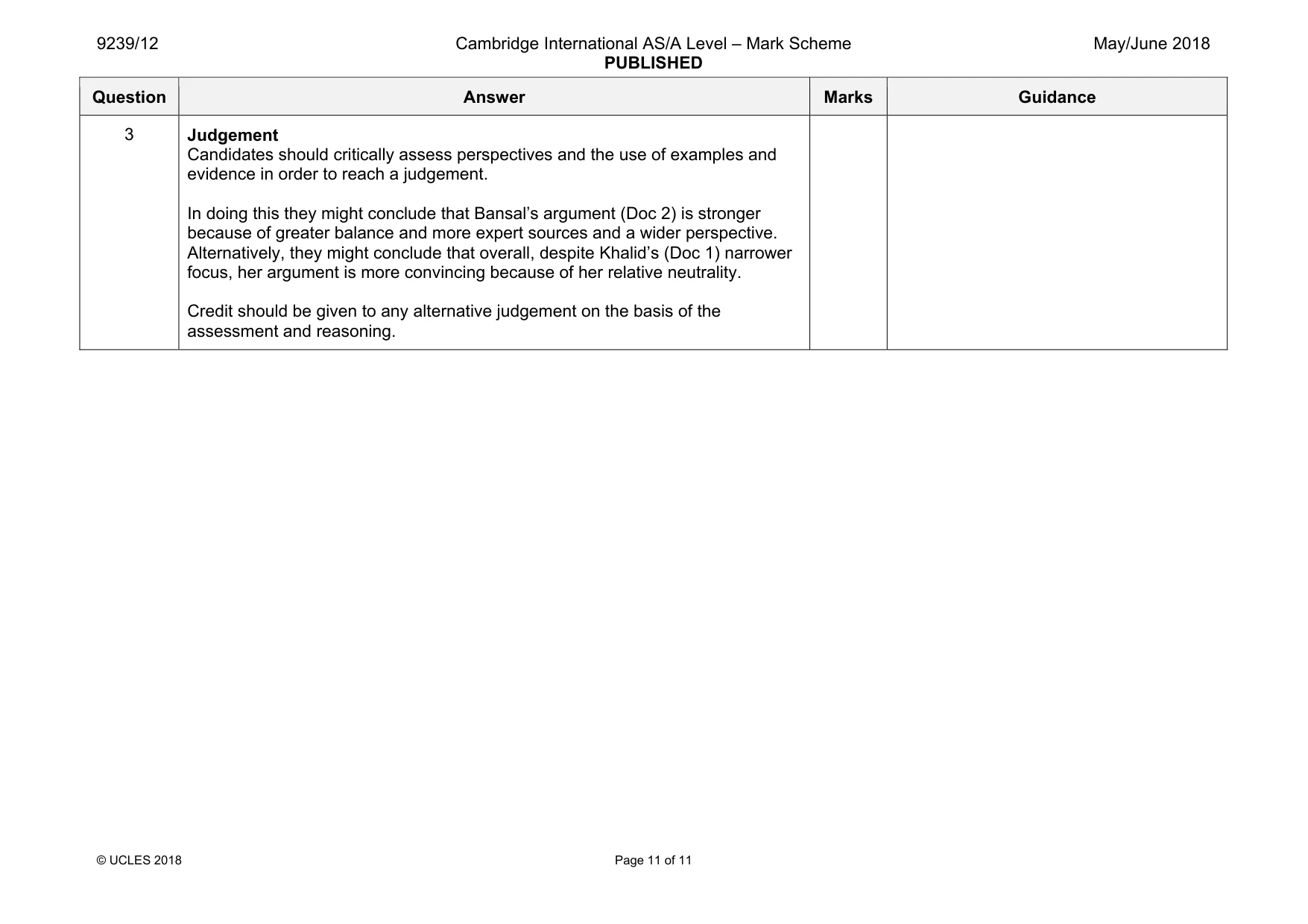
9239/12 Cambridge International AS/A Level – Mark Scheme PUBLISHED May/June 2018 © UCLES 2018 Page 11 of 11 Question Answer Marks Guidance 3 Judgement Candidates should critically assess perspectives and the use of examples and evidence in order to reach a judgement. In doing this they might conclude that Bansal’s argument (Doc 2) is stronger because of greater balance and more expert sources and a wider perspective. Alternatively, they might conclude that overall, despite Khalid’s (Doc 1) narrower focus, her argument is more convincing because of her relative neutrality. Credit should be given to any alternative judgement on the basis of the assessment and reasoning.
What you needed in this session
Cambridge’s own grade thresholds for 2018 May/June, Paper 1 · Variant 2. A higher threshold means an easier paper — the bar moves with how the cohort did.