Cambridge A Level Global Perspectives and Research 9239 — 2018 May/June Paper 1 · Variant 3
9239/13/M/J/18 · 30 marks · ≈34 min
The question paper and its mark scheme, free to read here and free to download. This is Cambridge’s own paper, exactly as it was sat.
Question paper4 pages


Mark scheme11 pages
Answers below. Sit the paper first if you are practising.
Paper as text
Question paper, page 1
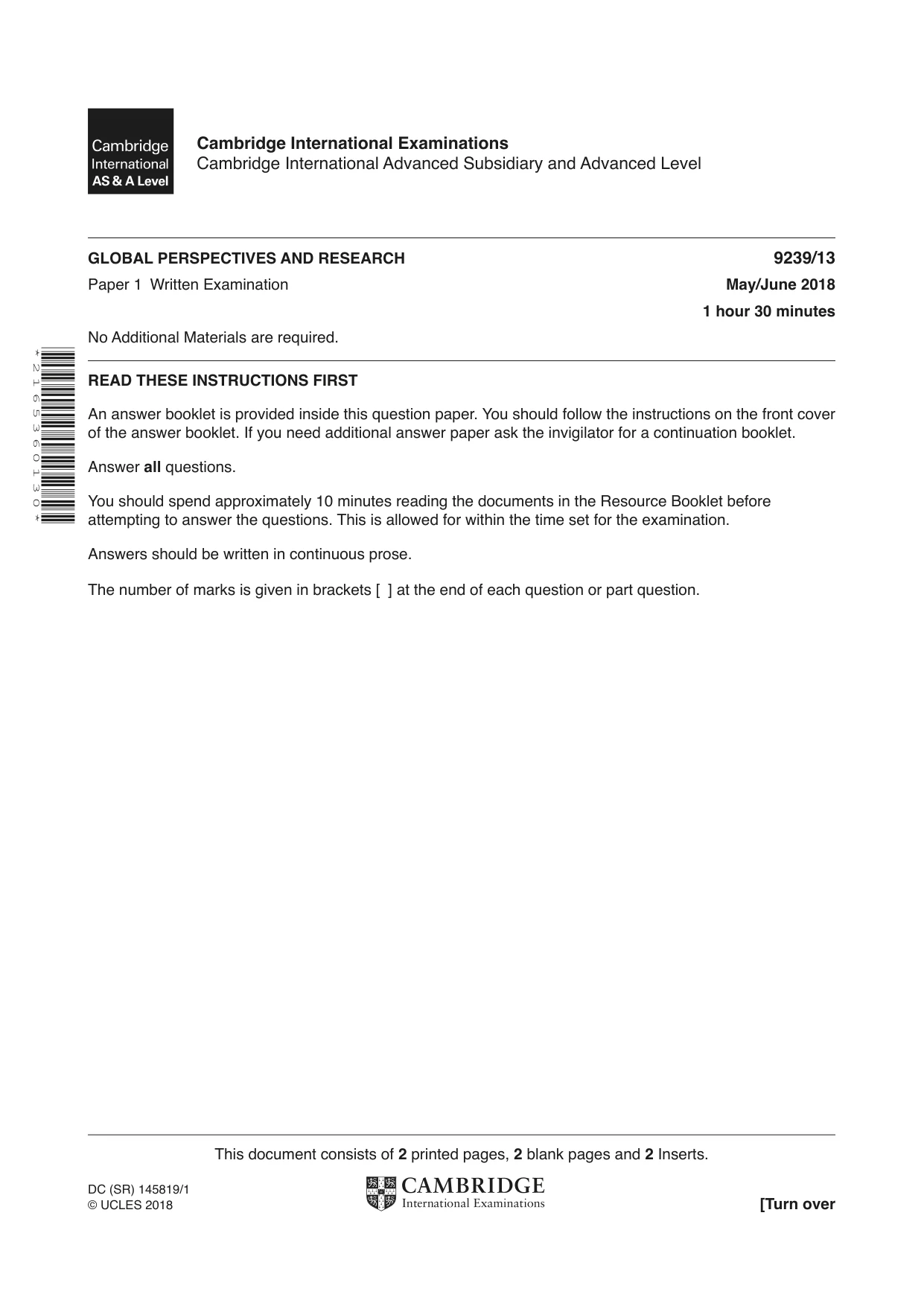
* 2 1 6 5 3 6 0 1 3 0 * This document consists of 2 printed pages, 2 blank pages and 2 Inserts. DC (SR) 145819/1 © UCLES 2018 [Turn over Cambridge International Examinations Cambridge International Advanced Subsidiary and Advanced Level GLOBAL PERSPECTIVES AND RESEARCH 9239/13 Paper 1 Written Examination May/June 2018 1 hour 30 minutes No Additional Materials are required. READ THESE INSTRUCTIONS FIRST An answer booklet is provided inside this question paper. You should follow the instructions on the front cover of the answer booklet. If you need additional answer paper ask the invigilator for a continuation booklet. Answer all questions. You should spend approximately 10 minutes reading the documents in the Resource Booklet before attempting to answer the questions. This is allowed for within the time set for the examination. Answers should be written in continuous prose. The number of marks is given in brackets [ ] at the end of each question or part question.
Question paper, page 2
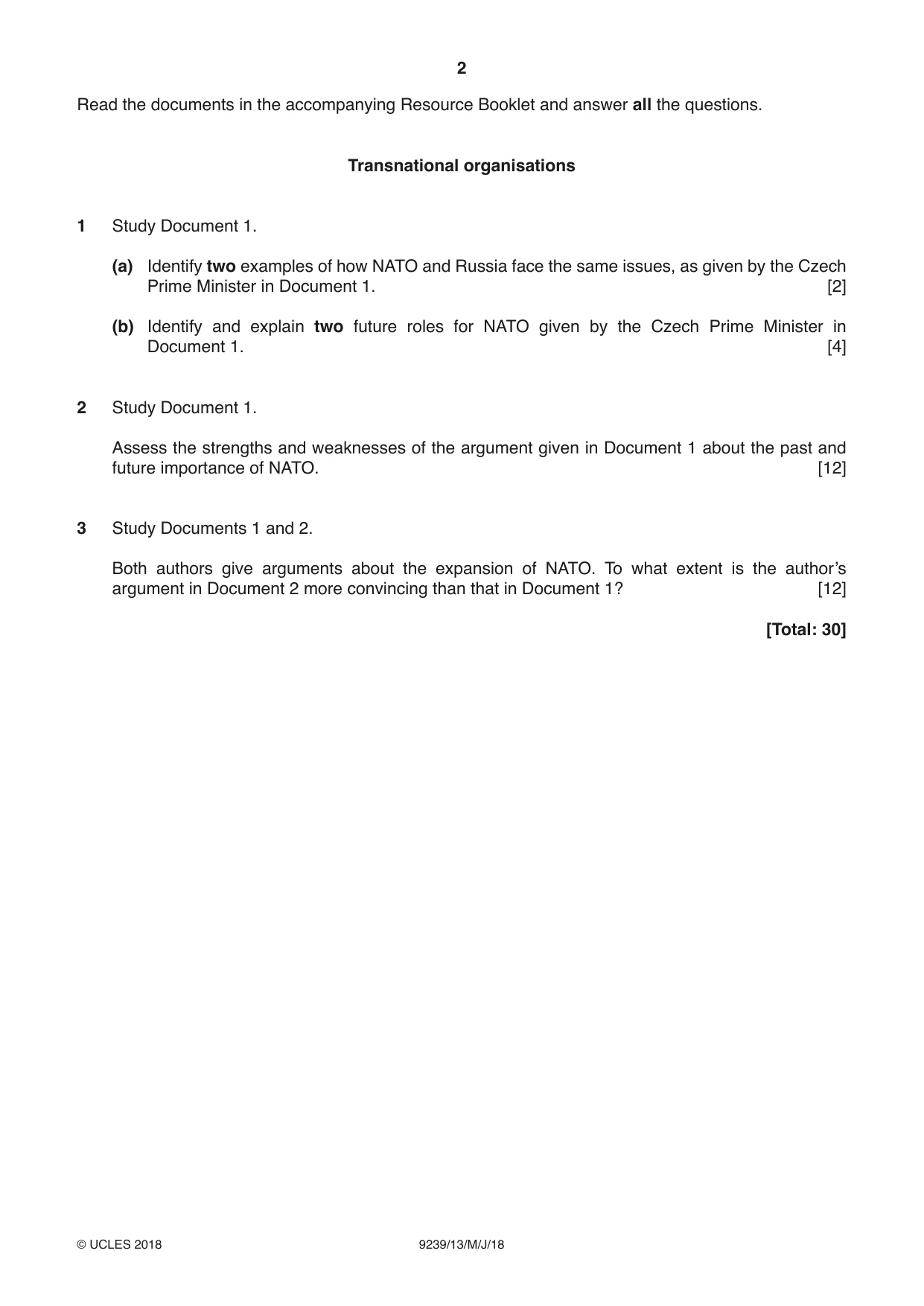
2 9239/13/M/J/18 © UCLES 2018 Read the documents in the accompanying Resource Booklet and answer all the questions. Transnational organisations 1 Study Document 1. (a) Identify two examples of how NATO and Russia face the same issues, as given by the Czech Prime Minister in Document 1. [2] (b) Identify and explain two future roles for NATO given by the Czech Prime Minister in Document 1. [4] 2 Study Document 1. Assess the strengths and weaknesses of the argument given in Document 1 about the past and future importance of NATO. [12] 3 Study Documents 1 and 2. Both authors give arguments about the expansion of NATO. To what extent is the author’s argument in Document 2 more convincing than that in Document 1? [12] [Total: 30]
Question paper, page 3
3 9239/13/M/J/18 © UCLES 2018 BLANK PAGE
Question paper, page 4
4 9239/13/M/J/18 © UCLES 2018 BLANK PAGE Permission to reproduce items where third-party owned material protected by copyright is included has been sought and cleared where possible. Every reasonable effort has been made by the publisher (UCLES) to trace copyright holders, but if any items requiring clearance have unwittingly been included, the publisher will be pleased to make amends at the earliest possible opportunity. To avoid the issue of disclosure of answer-related information to candidates, all copyright acknowledgements are reproduced online in the Cambridge International Examinations Copyright Acknowledgements Booklet. This is produced for each series of examinations and is freely available to download at www.cie.org.uk after the live examination series. Cambridge International Examinations is part of the Cambridge Assessment Group. Cambridge Assessment is the brand name of University of Cambridge Local Examinations Syndicate (UCLES), which is itself a department of the University of Cambridge.
Mark scheme, page 1
IGCSE™ is a registered trademark. This document consists of 11 printed pages. © UCLES 2018 [Turn over Cambridge Assessment International Education Cambridge International Advanced Subsidiary and Advanced Level GLOBAL PERSPECTIVES AND RESEARCH 9239/13 Paper 1 Written Examination May/June 2018 MARK SCHEME Maximum Mark: 30 Published This mark scheme is published as an aid to teachers and candidates, to indicate the requirements of the examination. It shows the basis on which Examiners were instructed to award marks. It does not indicate the details of the discussions that took place at an Examiners’ meeting before marking began, which would have considered the acceptability of alternative answers. Mark schemes should be read in conjunction with the question paper and the Principal Examiner Report for Teachers. Cambridge International will not enter into discussions about these mark schemes. Cambridge International is publishing the mark schemes for the May/June 2018 series for most Cambridge IGCSE™, Cambridge International A and AS Level and Cambridge Pre-U components, and some Cambridge O Level components.
Mark scheme, page 2
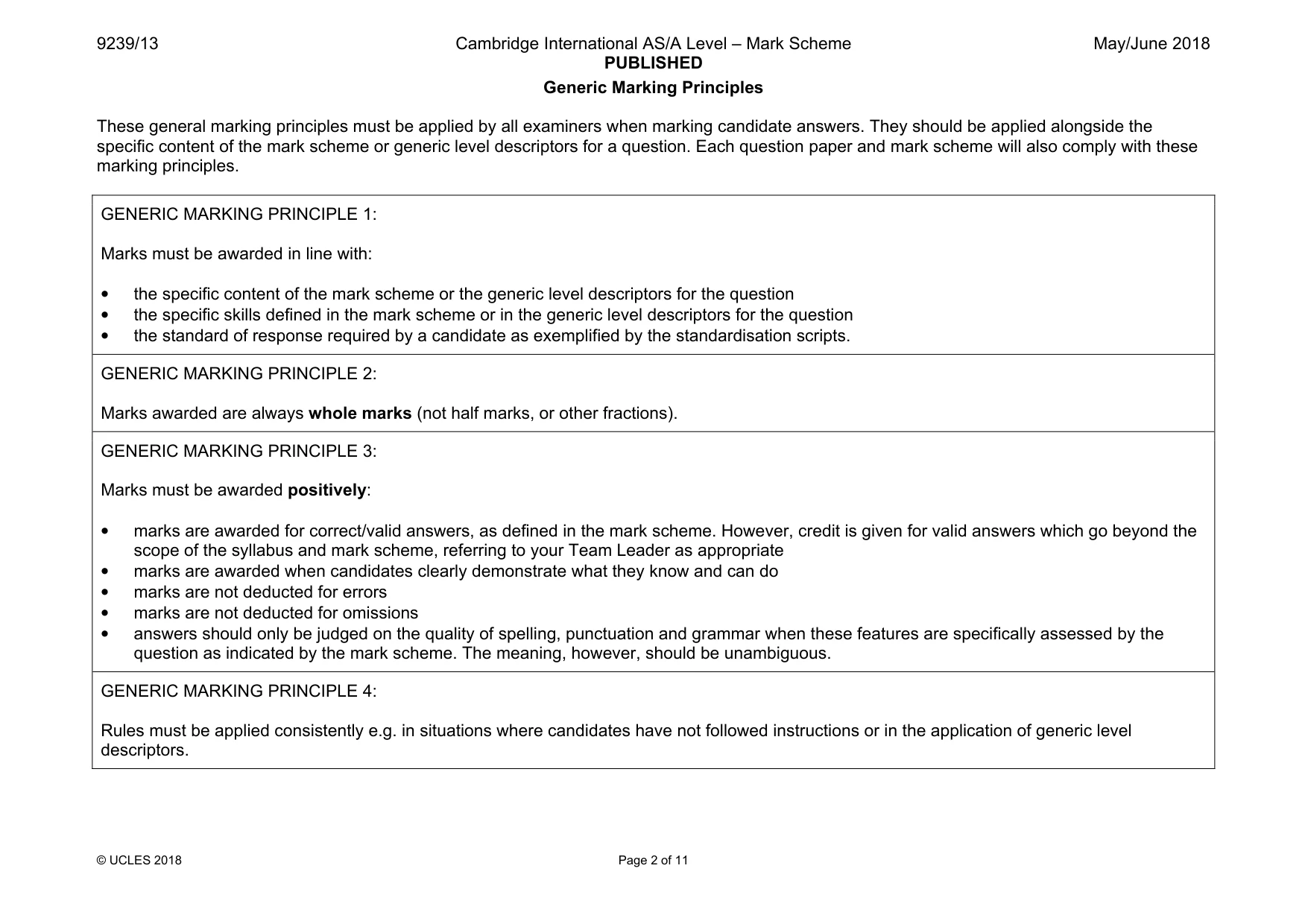
9239/13 Cambridge International AS/A Level – Mark Scheme PUBLISHED May/June 2018 © UCLES 2018 Page 2 of 11 Generic Marking Principles These general marking principles must be applied by all examiners when marking candidate answers. They should be applied alongside the specific content of the mark scheme or generic level descriptors for a question. Each question paper and mark scheme will also comply with these marking principles. GENERIC MARKING PRINCIPLE 1: Marks must be awarded in line with: • the specific content of the mark scheme or the generic level descriptors for the question • the specific skills defined in the mark scheme or in the generic level descriptors for the question • the standard of response required by a candidate as exemplified by the standardisation scripts. GENERIC MARKING PRINCIPLE 2: Marks awarded are always whole marks (not half marks, or other fractions). GENERIC MARKING PRINCIPLE 3: Marks must be awarded positively: • marks are awarded for correct/valid answers, as defined in the mark scheme. However, credit is given for valid answers which go beyond the scope of the syllabus and mark scheme, referring to your Team Leader as appropriate • marks are awarded when candidates clearly demonstrate what they know and can do • marks are not deducted for errors • marks are not deducted for omissions • answers should only be judged on the quality of spelling, punctuation and grammar when these features are specifically assessed by the question as indicated by the mark scheme. The meaning, however, should be unambiguous. GENERIC MARKING PRINCIPLE 4: Rules must be applied consistently e.g. in situations where candidates have not followed instructions or in the application of generic level descriptors.
Mark scheme, page 3
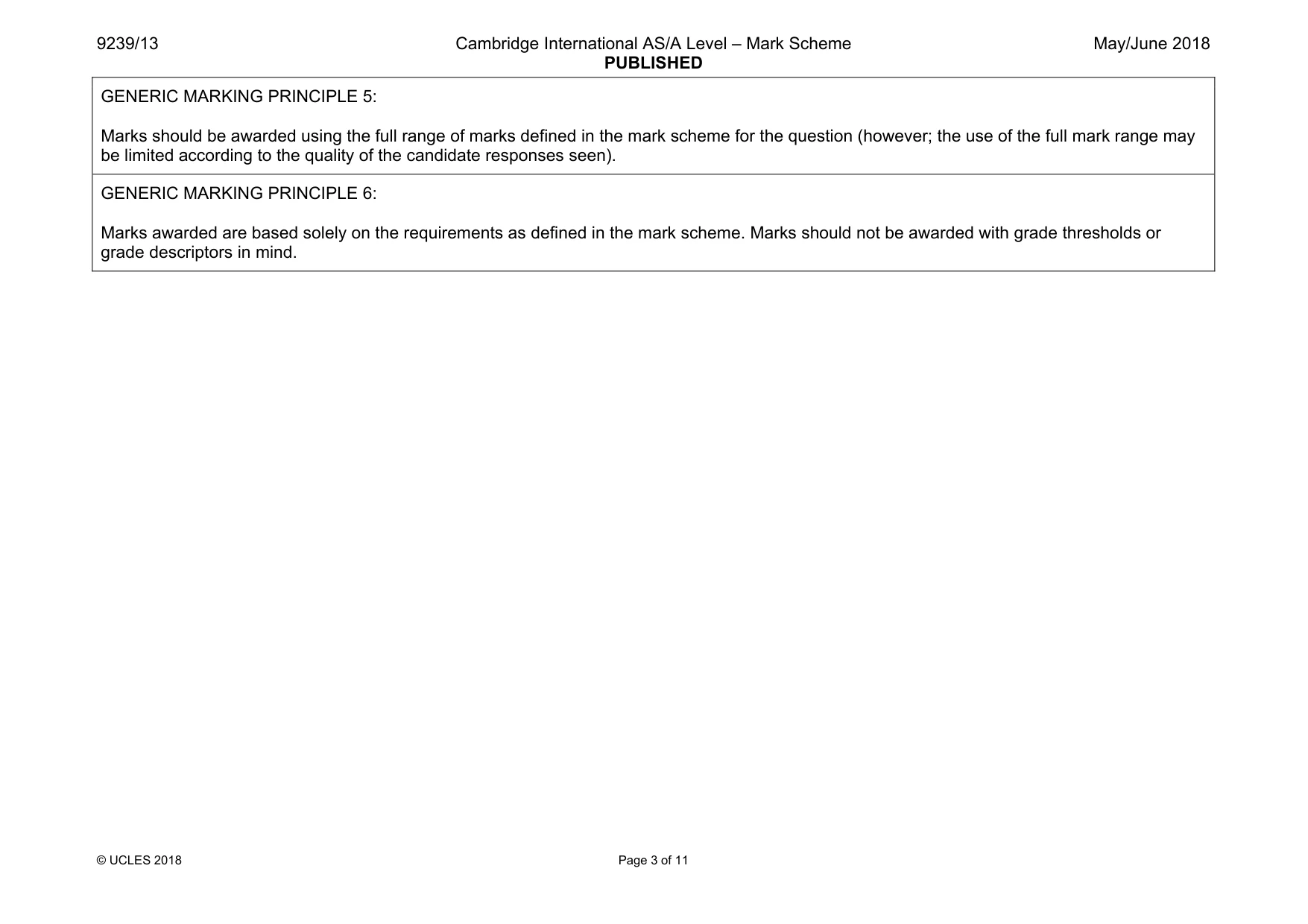
9239/13 Cambridge International AS/A Level – Mark Scheme PUBLISHED May/June 2018 © UCLES 2018 Page 3 of 11 GENERIC MARKING PRINCIPLE 5: Marks should be awarded using the full range of marks defined in the mark scheme for the question (however; the use of the full mark range may be limited according to the quality of the candidate responses seen). GENERIC MARKING PRINCIPLE 6: Marks awarded are based solely on the requirements as defined in the mark scheme. Marks should not be awarded with grade thresholds or grade descriptors in mind.
Mark scheme, page 4
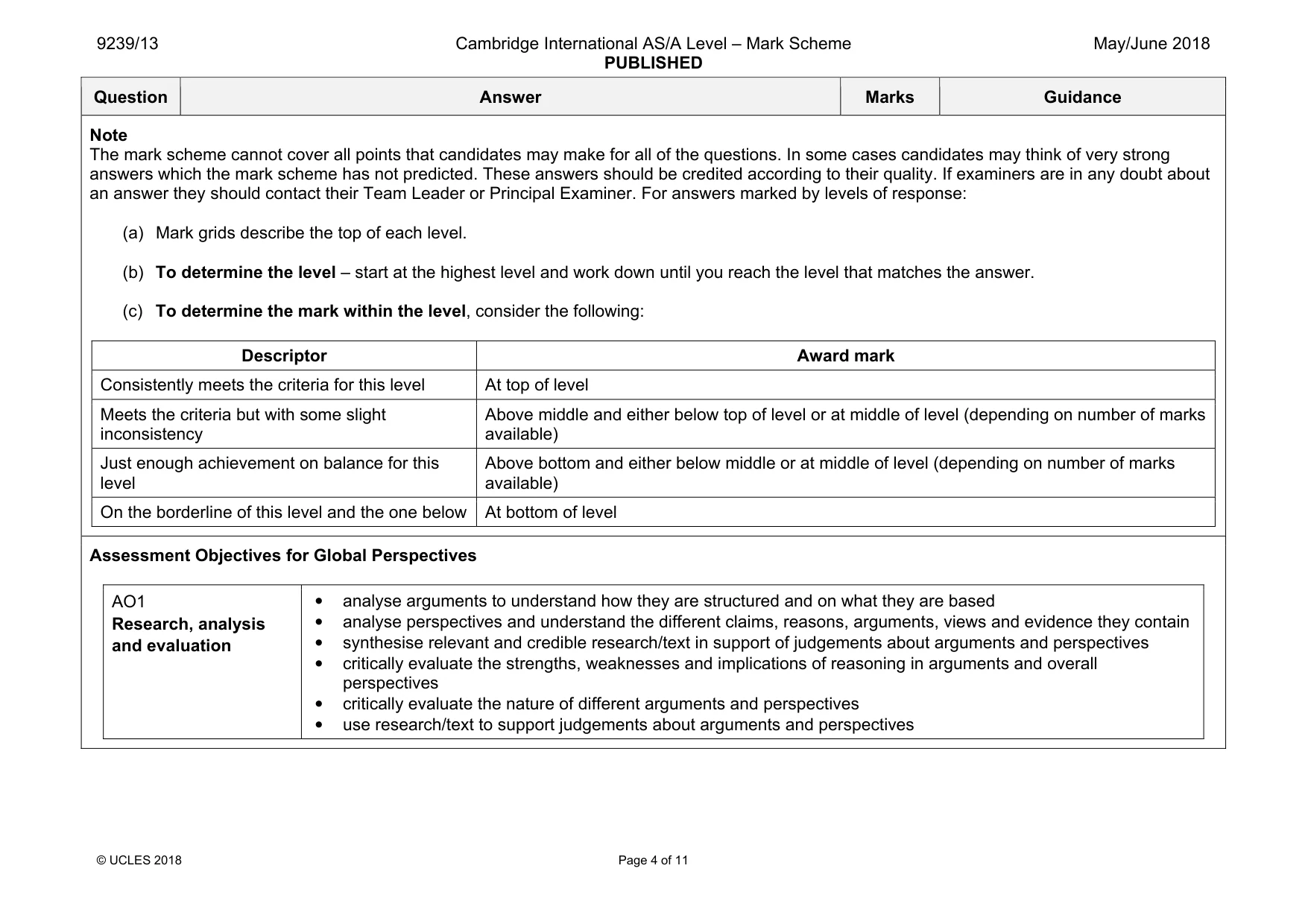
9239/13 Cambridge International AS/A Level – Mark Scheme PUBLISHED May/June 2018 © UCLES 2018 Page 4 of 11 Question Answer Marks Guidance Note The mark scheme cannot cover all points that candidates may make for all of the questions. In some cases candidates may think of very strong answers which the mark scheme has not predicted. These answers should be credited according to their quality. If examiners are in any doubt about an answer they should contact their Team Leader or Principal Examiner. For answers marked by levels of response: (a) Mark grids describe the top of each level. (b) To determine the level – start at the highest level and work down until you reach the level that matches the answer. (c) To determine the mark within the level, consider the following: Descriptor Award mark Consistently meets the criteria for this level At top of level Meets the criteria but with some slight inconsistency Above middle and either below top of level or at middle of level (depending on number of marks available) Just enough achievement on balance for this level Above bottom and either below middle or at middle of level (depending on number of marks available) On the borderline of this level and the one below At bottom of level Assessment Objectives for Global Perspectives AO1 Research, analysis and evaluation • analyse arguments to understand how they are structured and on what they are based • analyse perspectives and understand the different claims, reasons, arguments, views and evidence they contain • synthesise relevant and credible research/text in support of judgements about arguments and perspectives • critically evaluate the strengths, weaknesses and implications of reasoning in arguments and overall perspectives • critically evaluate the nature of different arguments and perspectives • use research/text to support judgements about arguments and perspectives
Mark scheme, page 5
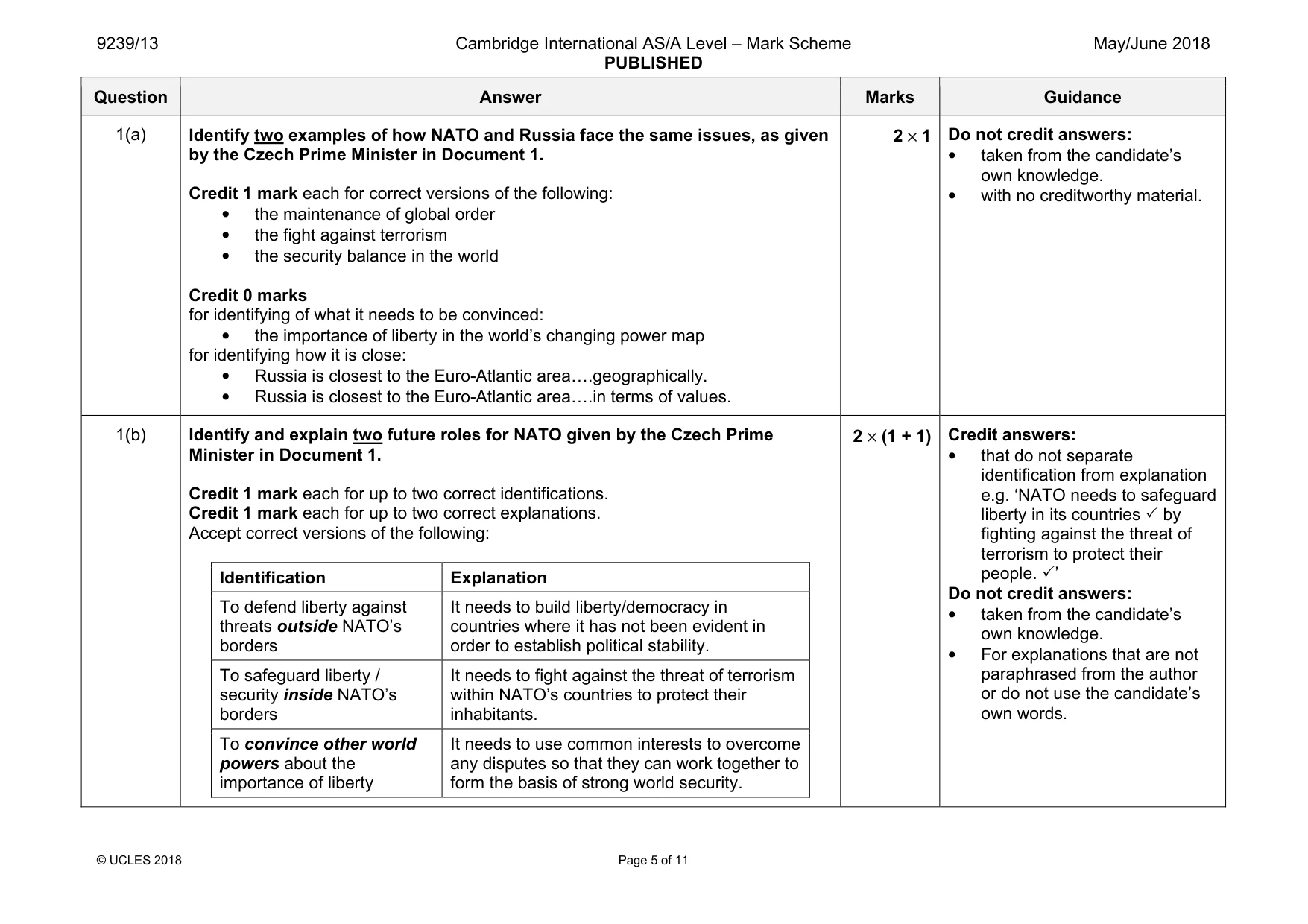
9239/13 Cambridge International AS/A Level – Mark Scheme PUBLISHED May/June 2018 © UCLES 2018 Page 5 of 11 Question Answer Marks Guidance 1(a) Identify two examples of how NATO and Russia face the same issues, as given by the Czech Prime Minister in Document 1. Credit 1 mark each for correct versions of the following: • the maintenance of global order • the fight against terrorism • the security balance in the world Credit 0 marks for identifying of what it needs to be convinced: • the importance of liberty in the world’s changing power map for identifying how it is close: • Russia is closest to the Euro-Atlantic area«.geographically. • Russia is closest to the Euro-Atlantic area«.in terms of values. 2 × 1 Do not credit answers: • taken from the candidate’s own knowledge. • with no creditworthy material. 1(b) Identify and explain two future roles for NATO given by the Czech Prime Minister in Document 1. Credit 1 mark each for up to two correct identifications. Credit 1 mark each for up to two correct explanations. Accept correct versions of the following: Identification Explanation To defend liberty against threats outside NATO’s borders It needs to build liberty/democracy in countries where it has not been evident in order to establish political stability. To safeguard liberty / security inside NATO’s borders It needs to fight against the threat of terrorism within NATO’s countries to protect their inhabitants. To convince other world powers about the importance of liberty It needs to use common interests to overcome any disputes so that they can work together to form the basis of strong world security. 2 × (1 + 1) Credit answers: • that do not separate identification from explanation e.g. ‘NATO needs to safeguard liberty in its countries 3 by fighting against the threat of terrorism to protect their people. 3’ Do not credit answers: • taken from the candidate’s own knowledge. • For explanations that are not paraphrased from the author or do not use the candidate’s own words.
Mark scheme, page 6
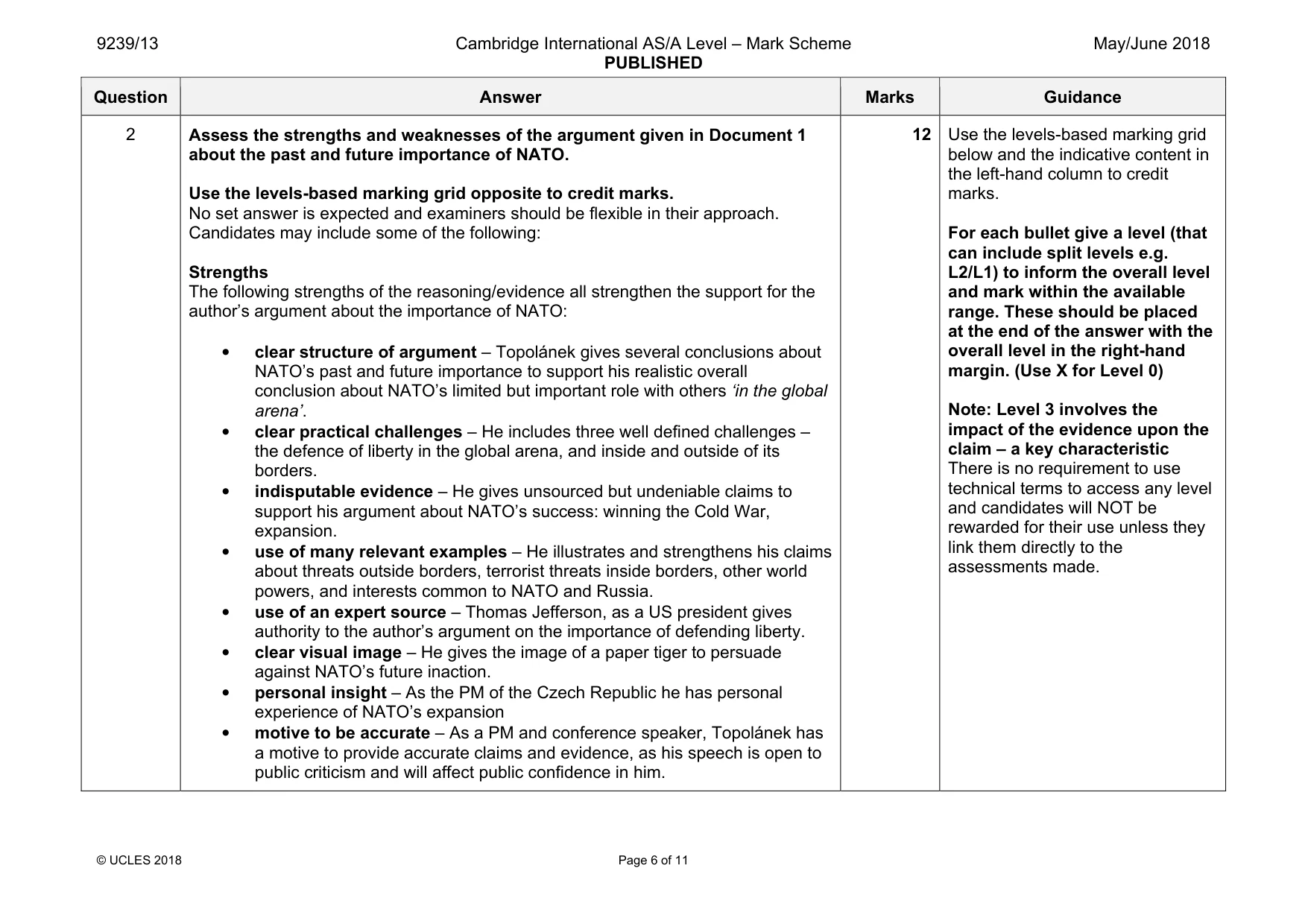
9239/13 Cambridge International AS/A Level – Mark Scheme PUBLISHED May/June 2018 © UCLES 2018 Page 6 of 11 Question Answer Marks Guidance 2 Assess the strengths and weaknesses of the argument given in Document 1 about the past and future importance of NATO. Use the levels-based marking grid opposite to credit marks. No set answer is expected and examiners should be flexible in their approach. Candidates may include some of the following: Strengths The following strengths of the reasoning/evidence all strengthen the support for the author’s argument about the importance of NATO: • clear structure of argument – Topolánek gives several conclusions about NATO’s past and future importance to support his realistic overall conclusion about NATO’s limited but important role with others ‘in the global arena’. • clear practical challenges – He includes three well defined challenges – the defence of liberty in the global arena, and inside and outside of its borders. • indisputable evidence – He gives unsourced but undeniable claims to support his argument about NATO’s success: winning the Cold War, expansion. • use of many relevant examples – He illustrates and strengthens his claims about threats outside borders, terrorist threats inside borders, other world powers, and interests common to NATO and Russia. • use of an expert source – Thomas Jefferson, as a US president gives authority to the author’s argument on the importance of defending liberty. • clear visual image – He gives the image of a paper tiger to persuade against NATO’s future inaction. • personal insight – As the PM of the Czech Republic he has personal experience of NATO’s expansion • motive to be accurate – As a PM and conference speaker, Topolánek has a motive to provide accurate claims and evidence, as his speech is open to public criticism and will affect public confidence in him. 12 Use the levels-based marking grid below and the indicative content in the left-hand column to credit marks. For each bullet give a level (that can include split levels e.g. L2/L1) to inform the overall level and mark within the available range. These should be placed at the end of the answer with the overall level in the right-hand margin. (Use X for Level 0) Note: Level 3 involves the impact of the evidence upon the claim – a key characteristic There is no requirement to use technical terms to access any level and candidates will NOT be rewarded for their use unless they link them directly to the assessments made.
Mark scheme, page 7
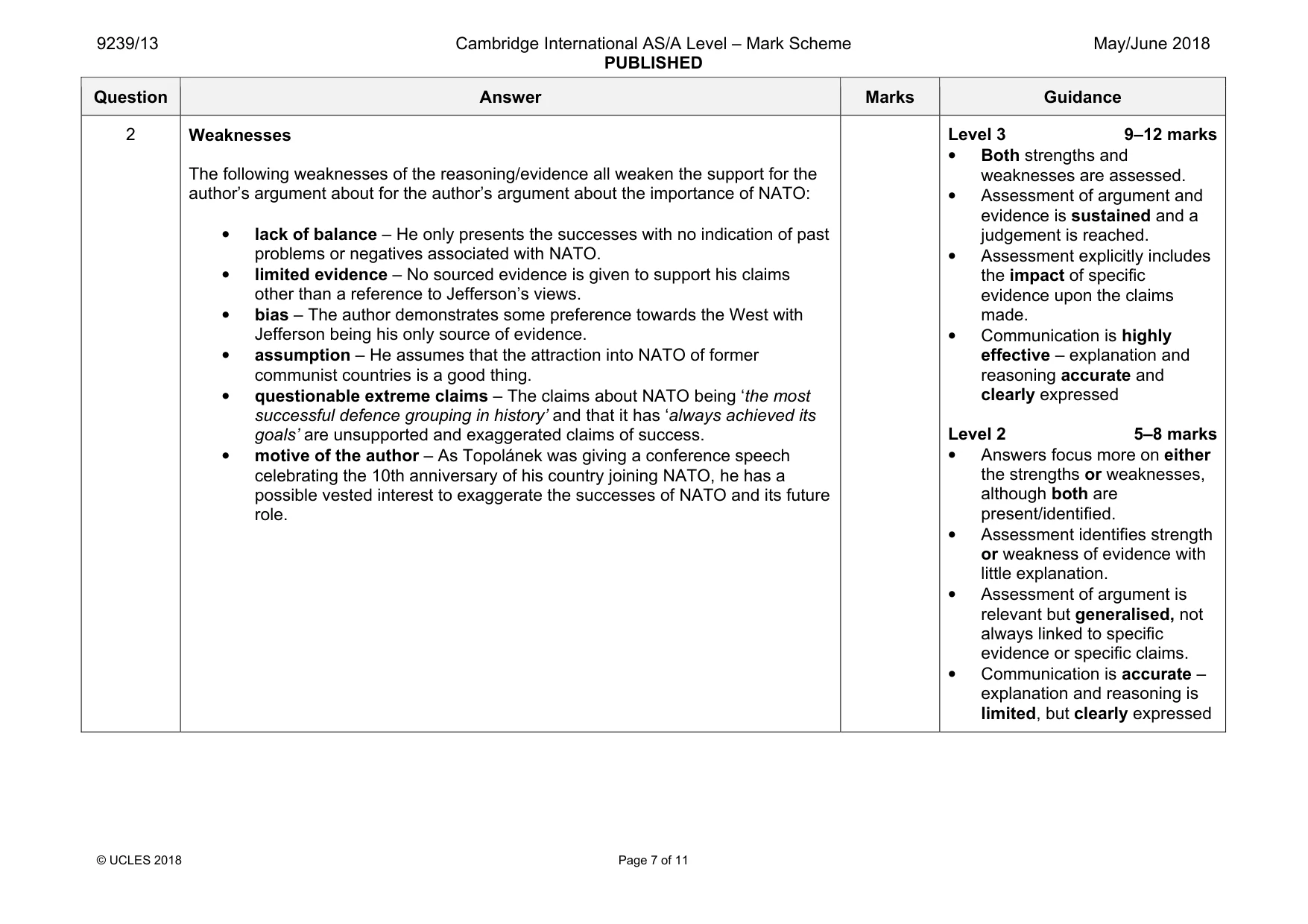
9239/13 Cambridge International AS/A Level – Mark Scheme PUBLISHED May/June 2018 © UCLES 2018 Page 7 of 11 Question Answer Marks Guidance 2 Weaknesses The following weaknesses of the reasoning/evidence all weaken the support for the author’s argument about for the author’s argument about the importance of NATO: • lack of balance – He only presents the successes with no indication of past problems or negatives associated with NATO. • limited evidence – No sourced evidence is given to support his claims other than a reference to Jefferson’s views. • bias – The author demonstrates some preference towards the West with Jefferson being his only source of evidence. • assumption – He assumes that the attraction into NATO of former communist countries is a good thing. • questionable extreme claims – The claims about NATO being ‘the most successful defence grouping in history’ and that it has ‘always achieved its goals’ are unsupported and exaggerated claims of success. • motive of the author – As Topolánek was giving a conference speech celebrating the 10th anniversary of his country joining NATO, he has a possible vested interest to exaggerate the successes of NATO and its future role. Level 3 9–12 marks • Both strengths and weaknesses are assessed. • Assessment of argument and evidence is sustained and a judgement is reached. • Assessment explicitly includes the impact of specific evidence upon the claims made. • Communication is highly effective – explanation and reasoning accurate and clearly expressed Level 2 5–8 marks • Answers focus more on either the strengths or weaknesses, although both are present/identified. • Assessment identifies strength or weakness of evidence with little explanation. • Assessment of argument is relevant but generalised, not always linked to specific evidence or specific claims. • Communication is accurate – explanation and reasoning is limited, but clearly expressed
Mark scheme, page 8
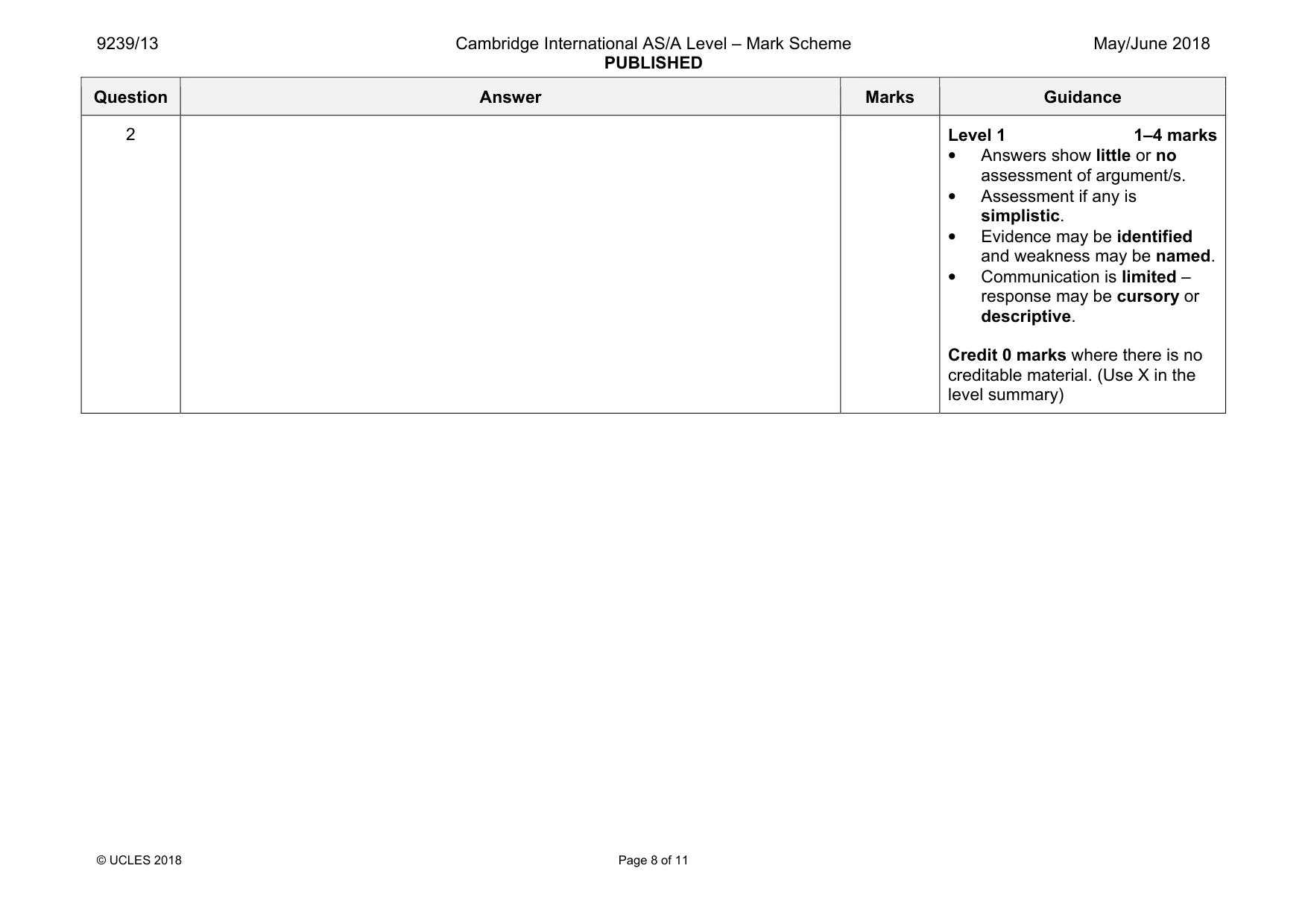
9239/13 Cambridge International AS/A Level – Mark Scheme PUBLISHED May/June 2018 © UCLES 2018 Page 8 of 11 Question Answer Marks Guidance 2 Level 1 1–4 marks • Answers show little or no assessment of argument/s. • Assessment if any is simplistic. • Evidence may be identified and weakness may be named. • Communication is limited – response may be cursory or descriptive. Credit 0 marks where there is no creditable material. (Use X in the level summary)
Mark scheme, page 9
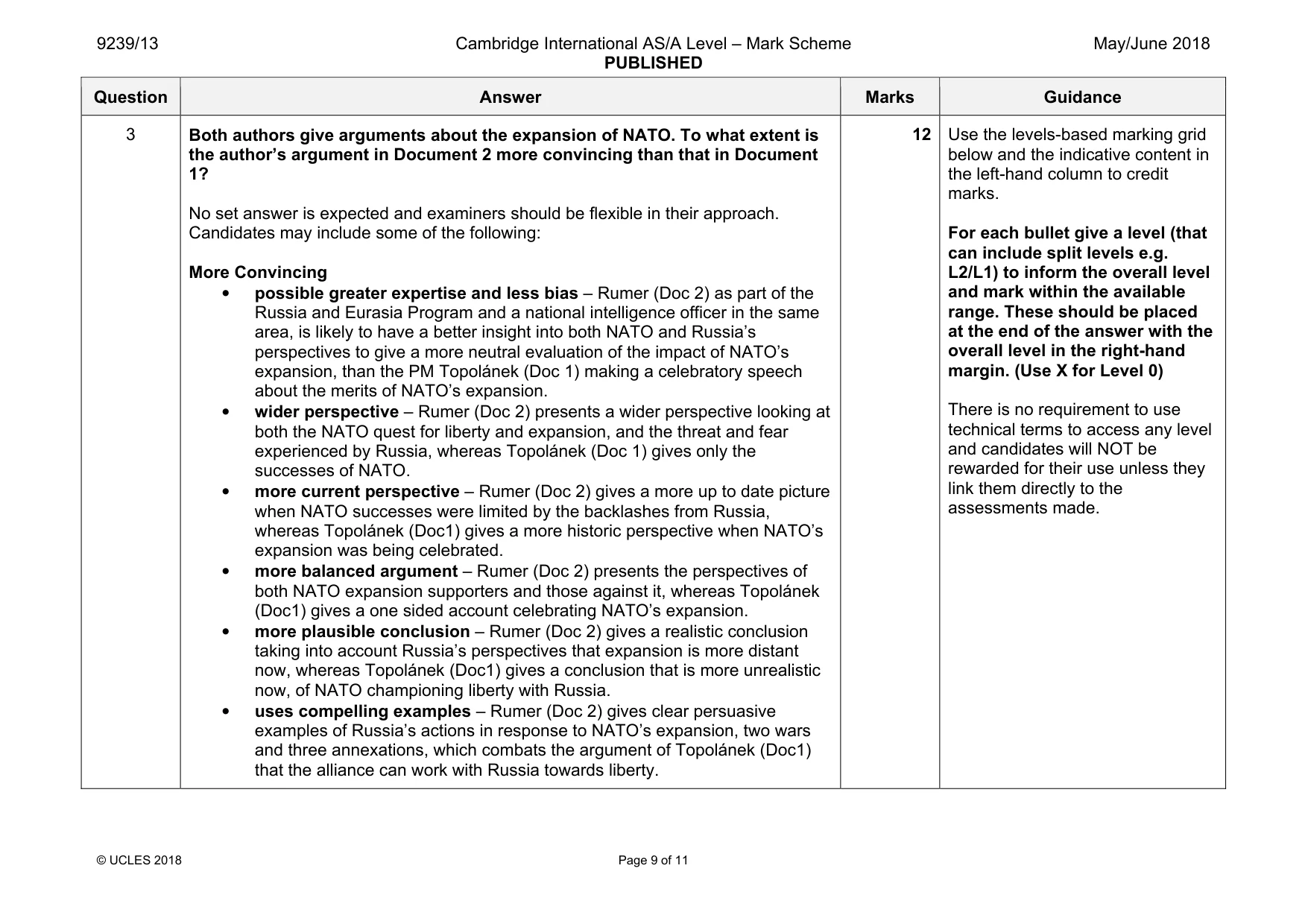
9239/13 Cambridge International AS/A Level – Mark Scheme PUBLISHED May/June 2018 © UCLES 2018 Page 9 of 11 Question Answer Marks Guidance 3 Both authors give arguments about the expansion of NATO. To what extent is the author’s argument in Document 2 more convincing than that in Document 1? No set answer is expected and examiners should be flexible in their approach. Candidates may include some of the following: More Convincing • possible greater expertise and less bias – Rumer (Doc 2) as part of the Russia and Eurasia Program and a national intelligence officer in the same area, is likely to have a better insight into both NATO and Russia’s perspectives to give a more neutral evaluation of the impact of NATO’s expansion, than the PM Topolánek (Doc 1) making a celebratory speech about the merits of NATO’s expansion. • wider perspective – Rumer (Doc 2) presents a wider perspective looking at both the NATO quest for liberty and expansion, and the threat and fear experienced by Russia, whereas Topolánek (Doc 1) gives only the successes of NATO. • more current perspective – Rumer (Doc 2) gives a more up to date picture when NATO successes were limited by the backlashes from Russia, whereas Topolánek (Doc1) gives a more historic perspective when NATO’s expansion was being celebrated. • more balanced argument – Rumer (Doc 2) presents the perspectives of both NATO expansion supporters and those against it, whereas Topolánek (Doc1) gives a one sided account celebrating NATO’s expansion. • more plausible conclusion – Rumer (Doc 2) gives a realistic conclusion taking into account Russia’s perspectives that expansion is more distant now, whereas Topolánek (Doc1) gives a conclusion that is more unrealistic now, of NATO championing liberty with Russia. • uses compelling examples – Rumer (Doc 2) gives clear persuasive examples of Russia’s actions in response to NATO’s expansion, two wars and three annexations, which combats the argument of Topolánek (Doc1) that the alliance can work with Russia towards liberty. 12 Use the levels-based marking grid below and the indicative content in the left-hand column to credit marks. For each bullet give a level (that can include split levels e.g. L2/L1) to inform the overall level and mark within the available range. These should be placed at the end of the answer with the overall level in the right-hand margin. (Use X for Level 0) There is no requirement to use technical terms to access any level and candidates will NOT be rewarded for their use unless they link them directly to the assessments made.
Mark scheme, page 10
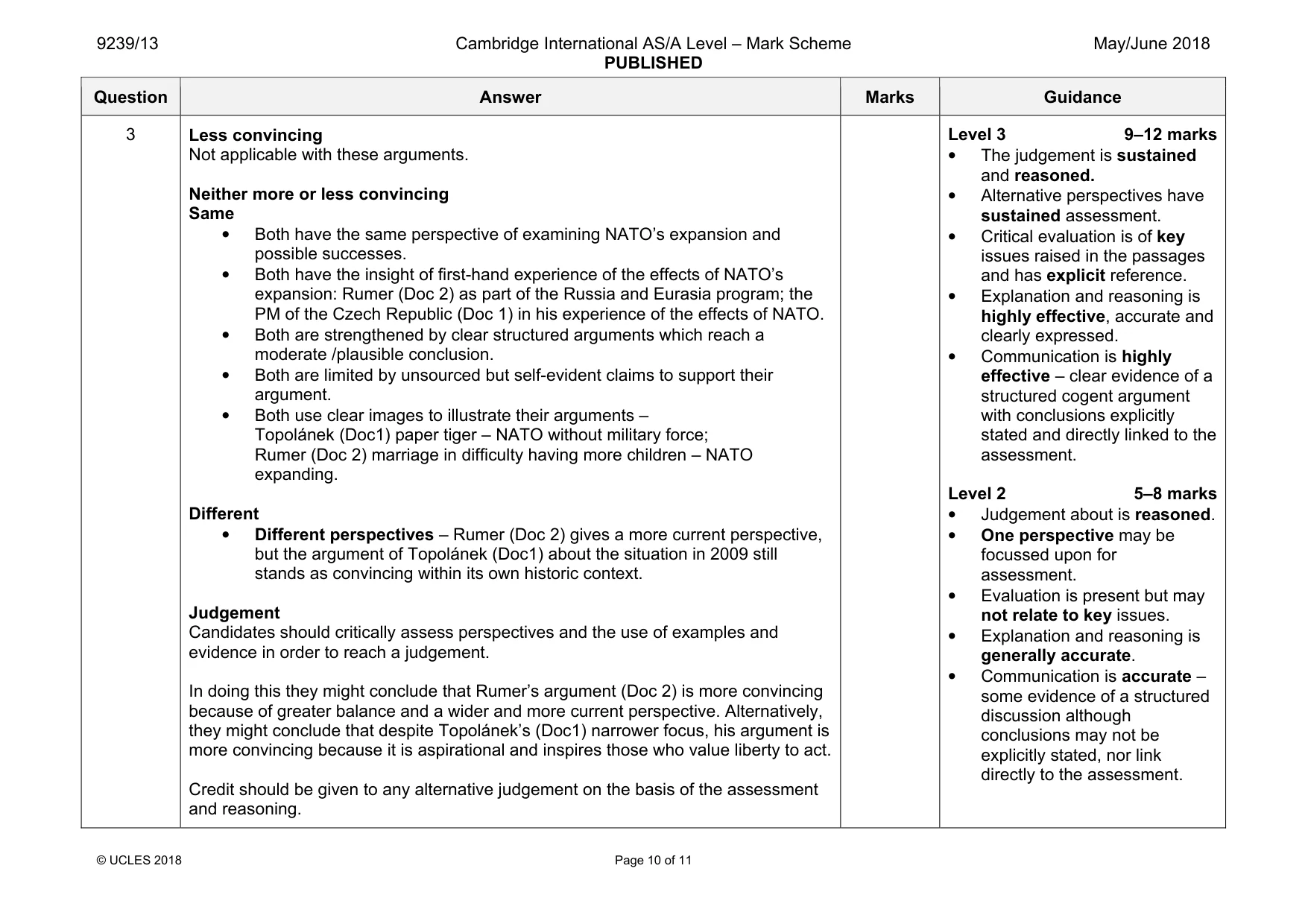
9239/13 Cambridge International AS/A Level – Mark Scheme PUBLISHED May/June 2018 © UCLES 2018 Page 10 of 11 Question Answer Marks Guidance 3 Less convincing Not applicable with these arguments. Neither more or less convincing Same • Both have the same perspective of examining NATO’s expansion and possible successes. • Both have the insight of first-hand experience of the effects of NATO’s expansion: Rumer (Doc 2) as part of the Russia and Eurasia program; the PM of the Czech Republic (Doc 1) in his experience of the effects of NATO. • Both are strengthened by clear structured arguments which reach a moderate /plausible conclusion. • Both are limited by unsourced but self-evident claims to support their argument. • Both use clear images to illustrate their arguments – Topolánek (Doc1) paper tiger – NATO without military force; Rumer (Doc 2) marriage in difficulty having more children – NATO expanding. Different • Different perspectives – Rumer (Doc 2) gives a more current perspective, but the argument of Topolánek (Doc1) about the situation in 2009 still stands as convincing within its own historic context. Judgement Candidates should critically assess perspectives and the use of examples and evidence in order to reach a judgement. In doing this they might conclude that Rumer’s argument (Doc 2) is more convincing because of greater balance and a wider and more current perspective. Alternatively, they might conclude that despite Topolánek’s (Doc1) narrower focus, his argument is more convincing because it is aspirational and inspires those who value liberty to act. Credit should be given to any alternative judgement on the basis of the assessment and reasoning. Level 3 9–12 marks • The judgement is sustained and reasoned. • Alternative perspectives have sustained assessment. • Critical evaluation is of key issues raised in the passages and has explicit reference. • Explanation and reasoning is highly effective, accurate and clearly expressed. • Communication is highly effective – clear evidence of a structured cogent argument with conclusions explicitly stated and directly linked to the assessment. Level 2 5–8 marks • Judgement about is reasoned. • One perspective may be focussed upon for assessment. • Evaluation is present but may not relate to key issues. • Explanation and reasoning is generally accurate. • Communication is accurate – some evidence of a structured discussion although conclusions may not be explicitly stated, nor link directly to the assessment.
Mark scheme, page 11
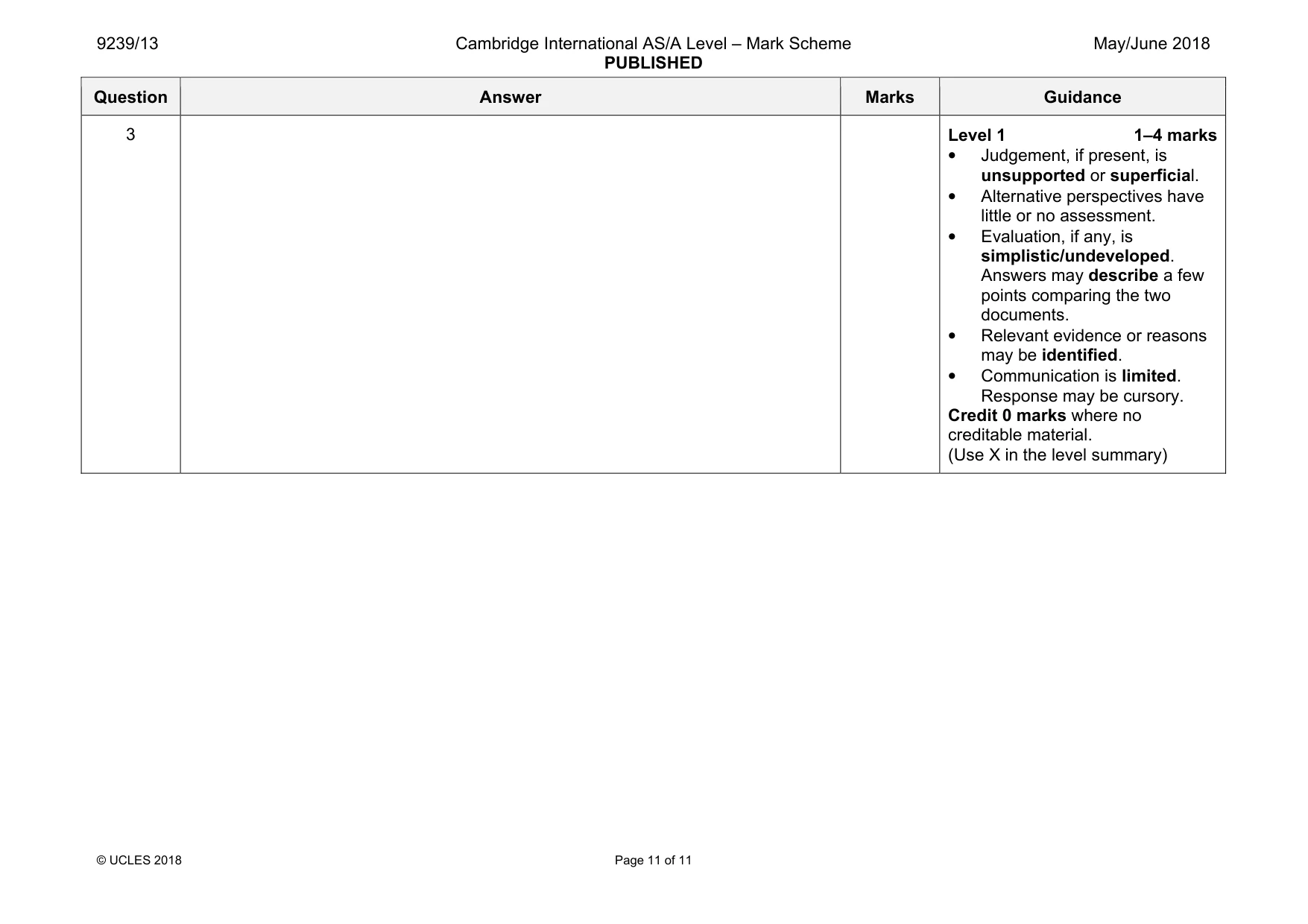
9239/13 Cambridge International AS/A Level – Mark Scheme PUBLISHED May/June 2018 © UCLES 2018 Page 11 of 11 Question Answer Marks Guidance 3 Level 1 1–4 marks • Judgement, if present, is unsupported or superficial. • Alternative perspectives have little or no assessment. • Evaluation, if any, is simplistic/undeveloped. Answers may describe a few points comparing the two documents. • Relevant evidence or reasons may be identified. • Communication is limited. Response may be cursory. Credit 0 marks where no creditable material. (Use X in the level summary)
What you needed in this session
Cambridge’s own grade thresholds for 2018 May/June, Paper 1 · Variant 3. A higher threshold means an easier paper — the bar moves with how the cohort did.