Cambridge A Level Global Perspectives and Research 9239 — 2023 Oct/Nov Paper 1 · Variant 1
9239/11/O/N/23 · 45 marks · ≈51 min
The question paper and its mark scheme, free to read here and free to download. This is Cambridge’s own paper, exactly as it was sat.
Question paper4 pages


Mark scheme24 pages
Answers below. Sit the paper first if you are practising.
Paper as text
Question paper, page 1
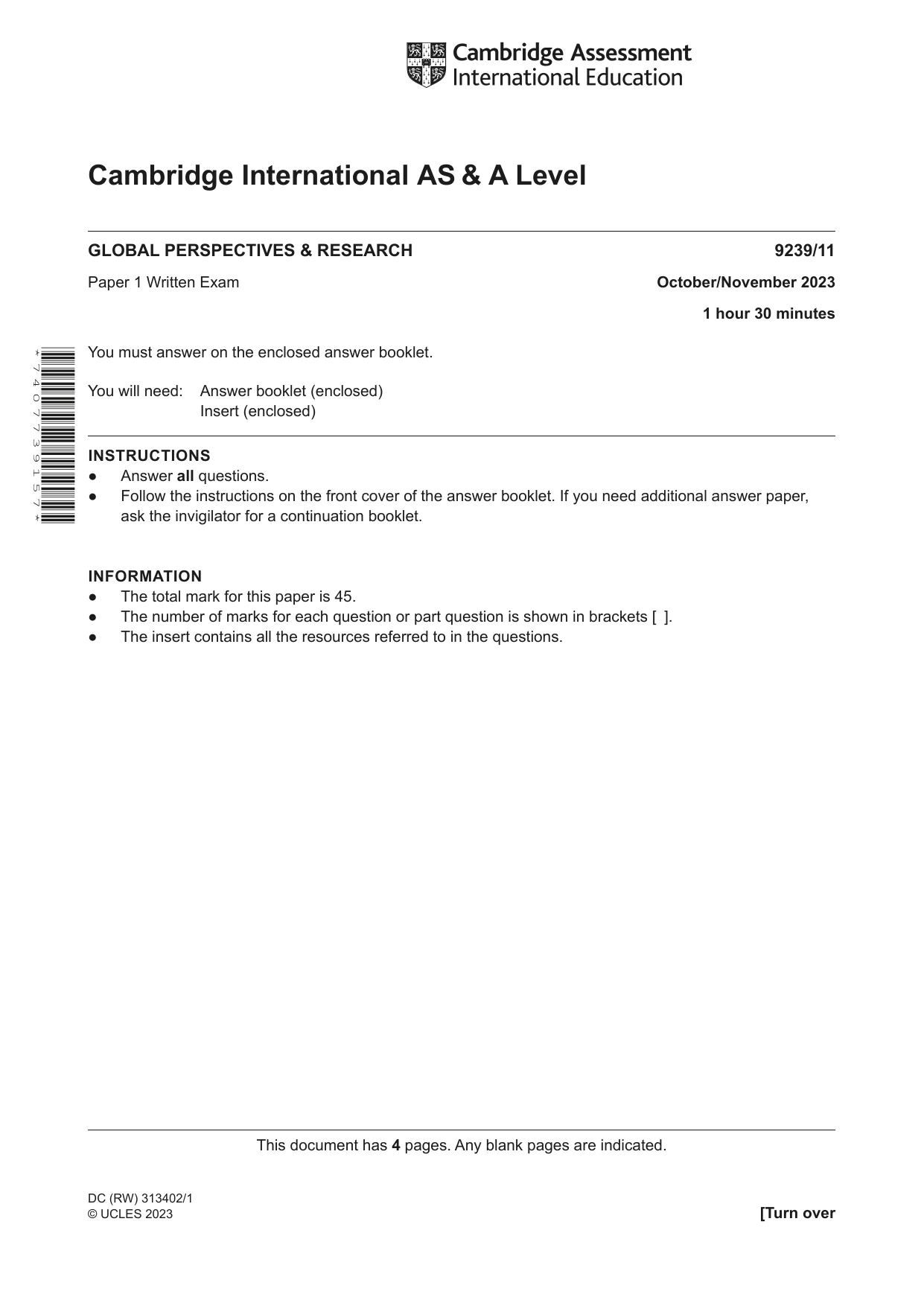
This document has 4 pages. Any blank pages are indicated. [Turn over Cambridge International AS & A Level GLOBAL PERSPECTIVES & RESEARCH 9239/11 Paper 1 Written Exam October/November 2023 1 hour 30 minutes You must answer on the enclosed answer booklet. You will need: Answer booklet (enclosed) Insert (enclosed) INSTRUCTIONS ● Answer all questions. ● Follow the instructions on the front cover of the answer booklet. If you need additional answer paper, ask the invigilator for a continuation booklet. INFORMATION ● The total mark for this paper is 45. ● The number of marks for each question or part question is shown in brackets [ ]. ● The insert contains all the resources referred to in the questions. * 7 4 0 7 7 3 9 1 5 7 * DC (RW) 313402/1 © UCLES 2023
Question paper, page 2
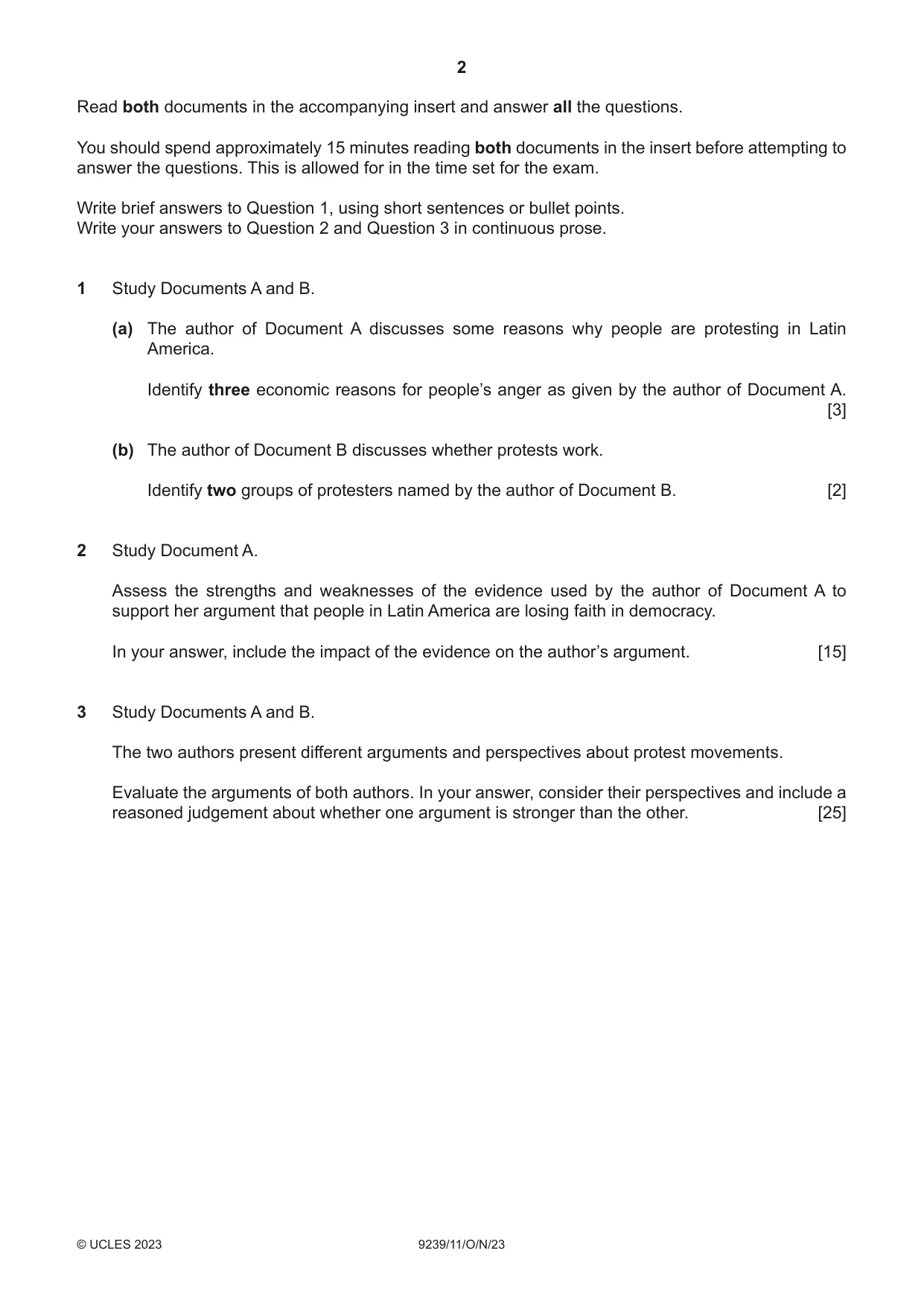
2 9239/11/O/N/23 © UCLES 2023 Read both documents in the accompanying insert and answer all the questions. You should spend approximately 15 minutes reading both documents in the insert before attempting to answer the questions. This is allowed for in the time set for the exam. Write brief answers to Question 1, using short sentences or bullet points. Write your answers to Question 2 and Question 3 in continuous prose. 1 Study Documents A and B. (a) The author of Document A discusses some reasons why people are protesting in Latin America. Identify three economic reasons for people’s anger as given by the author of Document A. [3] (b) The author of Document B discusses whether protests work. Identify two groups of protesters named by the author of Document B. [2] 2 Study Document A. Assess the strengths and weaknesses of the evidence used by the author of Document A to support her argument that people in Latin America are losing faith in democracy. In your answer, include the impact of the evidence on the author’s argument. [15] 3 Study Documents A and B. The two authors present different arguments and perspectives about protest movements. Evaluate the arguments of both authors. In your answer, consider their perspectives and include a reasoned judgement about whether one argument is stronger than the other. [25]
Question paper, page 3
3 9239/11/O/N/23 © UCLES 2023 BLANK PAGE
Question paper, page 4
4 9239/11/O/N/23 © UCLES 2023 Permission to reproduce items where third-party owned material protected by copyright is included has been sought and cleared where possible. Every reasonable effort has been made by the publisher (UCLES) to trace copyright holders, but if any items requiring clearance have unwittingly been included, the publisher will be pleased to make amends at the earliest possible opportunity. To avoid the issue of disclosure of answer-related information to candidates, all copyright acknowledgements are reproduced online in the Cambridge Assessment International Education Copyright Acknowledgements Booklet. This is produced for each series of examinations and is freely available to download at www.cambridgeinternational.org after the live examination series. Cambridge Assessment International Education is part of Cambridge Assessment. Cambridge Assessment is the brand name of the University of Cambridge Local Examinations Syndicate (UCLES), which is a department of the University of Cambridge. BLANK PAGE
Mark scheme, page 1
This document consists of 24 printed pages. © UCLES 2023 [Turn over Cambridge International AS & A Level GLOBAL PERSPECTIVES & RESEARCH 9239/11 Paper 1 Written Exam October/November 2023 MARK SCHEME Maximum Mark: 45 Published This mark scheme is published as an aid to teachers and candidates, to indicate the requirements of the examination. It shows the basis on which Examiners were instructed to award marks. It does not indicate the details of the discussions that took place at an Examiners’ meeting before marking began, which would have considered the acceptability of alternative answers. Mark schemes should be read in conjunction with the question paper and the Principal Examiner Report for Teachers. Cambridge International will not enter into discussions about these mark schemes. Cambridge International is publishing the mark schemes for the October/November 2023 series for most Cambridge IGCSE, Cambridge International A and AS Level components, and some Cambridge O Level components.
Mark scheme, page 2
9239/11 Cambridge International AS & A Level – Mark Scheme PUBLISHED October/November 2023 © UCLES 2023 Page 2 of 24 Generic Marking Principles These general marking principles must be applied by all examiners when marking candidate answers. They should be applied alongside the specific content of the mark scheme or generic level descriptors for a question. Each question paper and mark scheme will also comply with these marking principles. GENERIC MARKING PRINCIPLE 1: Marks must be awarded in line with: • the specific content of the mark scheme or the generic level descriptors for the question • the specific skills defined in the mark scheme or in the generic level descriptors for the question • the standard of response required by a candidate as exemplified by the standardisation scripts. GENERIC MARKING PRINCIPLE 2: Marks awarded are always whole marks (not half marks, or other fractions). GENERIC MARKING PRINCIPLE 3: Marks must be awarded positively: • marks are awarded for correct/valid answers, as defined in the mark scheme. However, credit is given for valid answers which go beyond the scope of the syllabus and mark scheme, referring to your Team Leader as appropriate • marks are awarded when candidates clearly demonstrate what they know and can do • marks are not deducted for errors • marks are not deducted for omissions • answers should only be judged on the quality of spelling, punctuation and grammar when these features are specifically assessed by the question as indicated by the mark scheme. The meaning, however, should be unambiguous. GENERIC MARKING PRINCIPLE 4: Rules must be applied consistently, e.g. in situations where candidates have not followed instructions or in the application of generic level descriptors.
Mark scheme, page 3
9239/11 Cambridge International AS & A Level – Mark Scheme PUBLISHED October/November 2023 © UCLES 2023 Page 3 of 24 GENERIC MARKING PRINCIPLE 5: Marks should be awarded using the full range of marks defined in the mark scheme for the question (however; the use of the full mark range may be limited according to the quality of the candidate responses seen). GENERIC MARKING PRINCIPLE 6: Marks awarded are based solely on the requirements as defined in the mark scheme. Marks should not be awarded with grade thresholds or grade descriptors in mind.
Mark scheme, page 4
9239/11 Cambridge International AS & A Level – Mark Scheme PUBLISHED October/November 2023 © UCLES 2023 Page 4 of 24 Social Science-Specific Marking Principles (for point-based marking) 1 Components using point-based marking: • Point marking is often used to reward knowledge, understanding and application of skills. We give credit where the candidate’s answer shows relevant knowledge, understanding and application of skills in answering the question. We do not give credit where the answer shows confusion. From this it follows that we: a DO credit answers which are worded differently from the mark scheme if they clearly convey the same meaning (unless the mark scheme requires a specific term) b DO credit alternative answers/examples which are not written in the mark scheme if they are correct c DO credit answers where candidates give more than one correct answer in one prompt/numbered/scaffolded space where extended writing is required rather than list-type answers. For example, questions that require n reasons (e.g. State two reasons …). d DO NOT credit answers simply for using a ‘key term’ unless that is all that is required. (Check for evidence it is understood and not used wrongly.) e DO NOT credit answers which are obviously self-contradicting or trying to cover all possibilities f DO NOT give further credit for what is effectively repetition of a correct point already credited unless the language itself is being tested. This applies equally to ‘mirror statements’ (i.e. polluted/not polluted). g DO NOT require spellings to be correct, unless this is part of the test. However, spellings of syllabus terms must allow for clear and unambiguous separation from other syllabus terms with which they may be confused (e.g. Corrasion/Corrosion) 2 Presentation of mark scheme: • Slashes (/) or the word ‘or’ separate alternative ways of making the same point. • Semi colons (;) bullet points (•) or figures in brackets (1) separate different points. • Content in the answer column in brackets is for examiner information/context to clarify the marking but is not required to earn the mark (except Accounting syllabuses where they indicate negative numbers).
Mark scheme, page 5
9239/11 Cambridge International AS & A Level – Mark Scheme PUBLISHED October/November 2023 © UCLES 2023 Page 5 of 24 3 Calculation questions: • The mark scheme will show the steps in the most likely correct method(s), the mark for each step, the correct answer(s) and the mark for each answer • If working/explanation is considered essential for full credit, this will be indicated in the question paper and in the mark scheme. In all other instances, the correct answer to a calculation should be given full credit, even if no supporting working is shown. • Where the candidate uses a valid method which is not covered by the mark scheme, award equivalent marks for reaching equivalent stages. • Where an answer makes use of a candidate’s own incorrect figure from previous working, the ‘own figure rule’ applies: full marks will be given if a correct and complete method is used. Further guidance will be included in the mark scheme where necessary and any exceptions to this general principle will be noted. 4 Annotation: • For point marking, ticks can be used to indicate correct answers and crosses can be used to indicate wrong answers. There is no direct relationship between ticks and marks. Ticks have no defined meaning for levels of response marking. • For levels of response marking, the level awarded should be annotated on the script. • Other annotations will be used by examiners as agreed during standardisation, and the meaning will be understood by all examiners who marked that paper.
Mark scheme, page 6
9239/11 Cambridge International AS & A Level – Mark Scheme PUBLISHED October/November 2023 © UCLES 2023 Page 6 of 24 Instructions for examiners The total mark for this paper is 45. Question 1 assesses AO1 skills. Question 2 assesses AO1 skills. Question 3 assesses AO1 and AO3 skills. Question 1 is points marked using or . Answers to Question 1 can be brief, using short sentences or bullet points. Answers to Question 2 and Question 3 should be written in continuous prose. For Question 2 and Question 3 annotate clearly in the left-hand margin according to the specific instructions provided. Refer to the marking grid at the end of each question to award a mark based on the annotations for each aspect (e.g. AO1a). Record the mark for each aspect (e.g. AO1a) in the right-hand marking panel on RM Assessor. Indicative content or exemplar responses are provided as a guide. Inevitably, the mark scheme cannot cover all responses that candidates may make for all the questions. In some cases, candidates may make responses which the mark scheme has not predicted. These answers should nevertheless be credited according to their relevance and quality. The definition of perspective used in this syllabus is: a perspective is a coherent world view which is a response to an issue. It is made up of argument, evidence, assumptions and may be influenced by a particular context.
Mark scheme, page 7
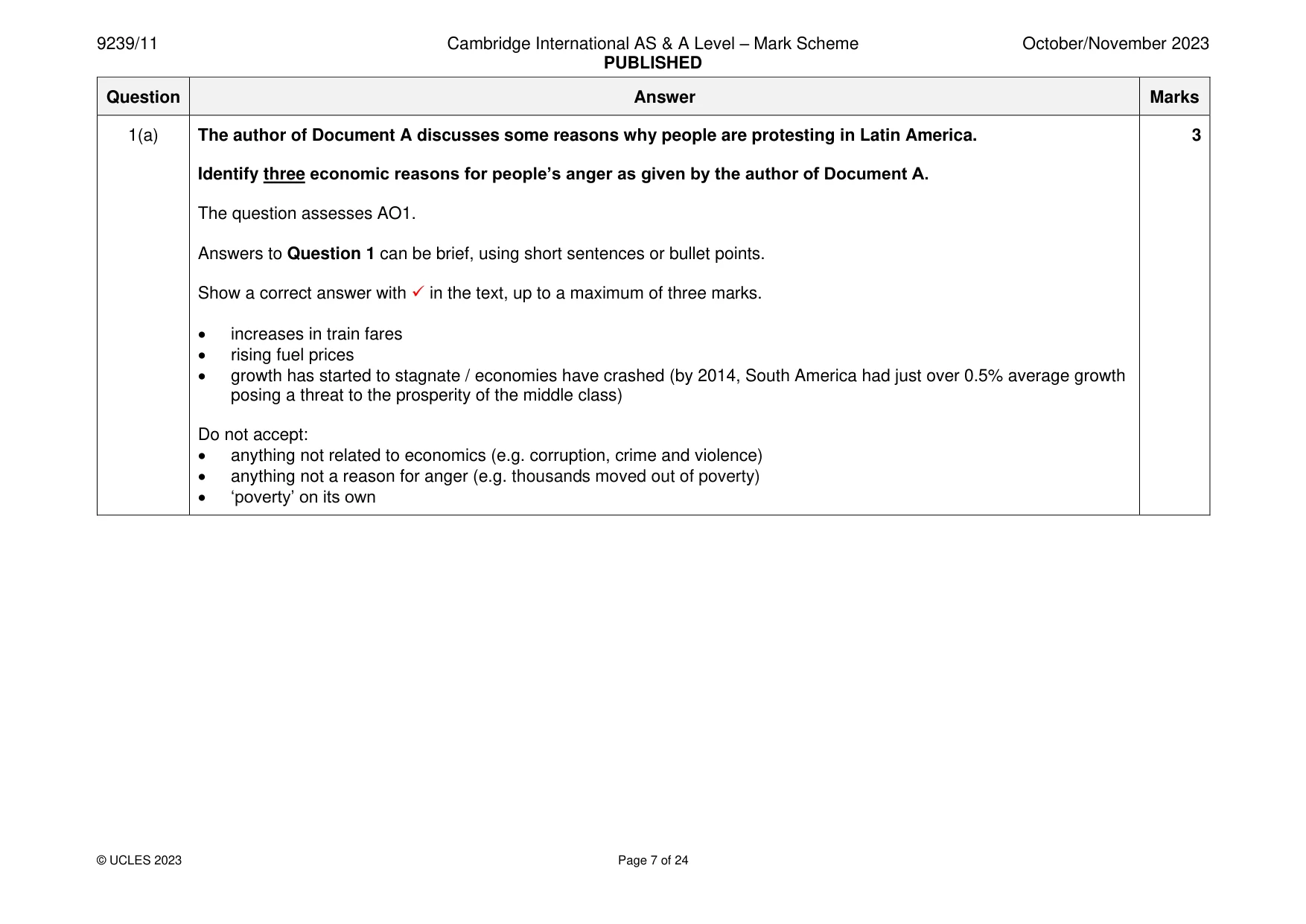
9239/11 Cambridge International AS & A Level – Mark Scheme PUBLISHED October/November 2023 © UCLES 2023 Page 7 of 24 Question Answer Marks 1(a) The author of Document A discusses some reasons why people are protesting in Latin America. Identify three economic reasons for people’s anger as given by the author of Document A. The question assesses AO1. Answers to Question 1 can be brief, using short sentences or bullet points. Show a correct answer with ✓ in the text, up to a maximum of three marks. • increases in train fares • rising fuel prices • growth has started to stagnate / economies have crashed (by 2014, South America had just over 0.5% average growth posing a threat to the prosperity of the middle class) Do not accept: • anything not related to economics (e.g. corruption, crime and violence) • anything not a reason for anger (e.g. thousands moved out of poverty) • ‘poverty’ on its own 3
Mark scheme, page 8
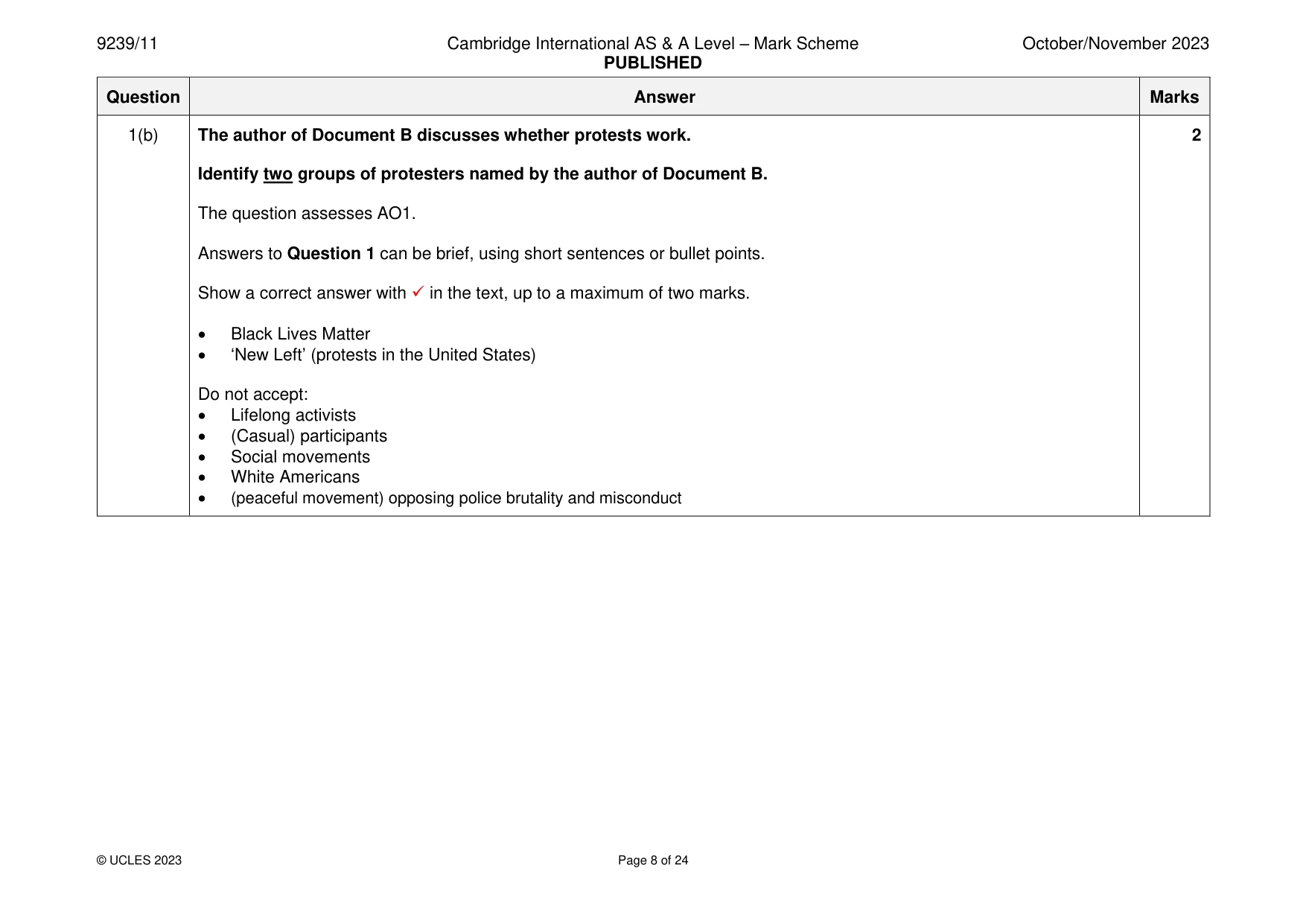
9239/11 Cambridge International AS & A Level – Mark Scheme PUBLISHED October/November 2023 © UCLES 2023 Page 8 of 24 Question Answer Marks 1(b) The author of Document B discusses whether protests work. Identify two groups of protesters named by the author of Document B. The question assesses AO1. Answers to Question 1 can be brief, using short sentences or bullet points. Show a correct answer with ✓ in the text, up to a maximum of two marks. • Black Lives Matter • ‘New Left’ (protests in the United States) Do not accept: • Lifelong activists • (Casual) participants • Social movements • White Americans • (peaceful movement) opposing police brutality and misconduct 2
Mark scheme, page 9
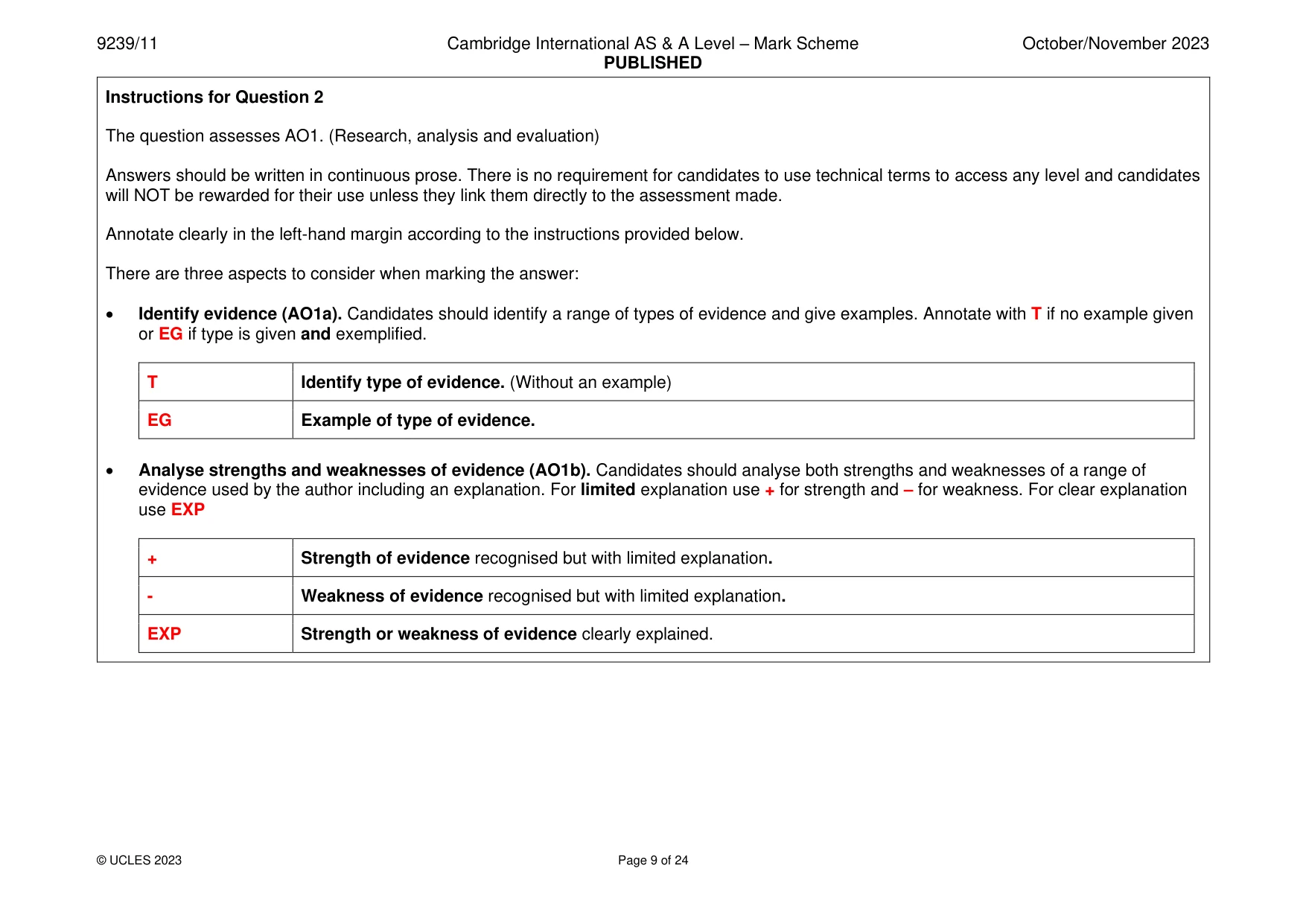
9239/11 Cambridge International AS & A Level – Mark Scheme PUBLISHED October/November 2023 © UCLES 2023 Page 9 of 24 Instructions for Question 2 The question assesses AO1. (Research, analysis and evaluation) Answers should be written in continuous prose. There is no requirement for candidates to use technical terms to access any level and candidates will NOT be rewarded for their use unless they link them directly to the assessment made. Annotate clearly in the left-hand margin according to the instructions provided below. There are three aspects to consider when marking the answer: • Identify evidence (AO1a). Candidates should identify a range of types of evidence and give examples. Annotate with T if no example given or EG if type is given and exemplified. T Identify type of evidence. (Without an example) EG Example of type of evidence. • Analyse strengths and weaknesses of evidence (AO1b). Candidates should analyse both strengths and weaknesses of a range of evidence used by the author including an explanation. For limited explanation use + for strength and – for weakness. For clear explanation use EXP + Strength of evidence recognised but with limited explanation. - Weakness of evidence recognised but with limited explanation. EXP Strength or weakness of evidence clearly explained.
Mark scheme, page 10
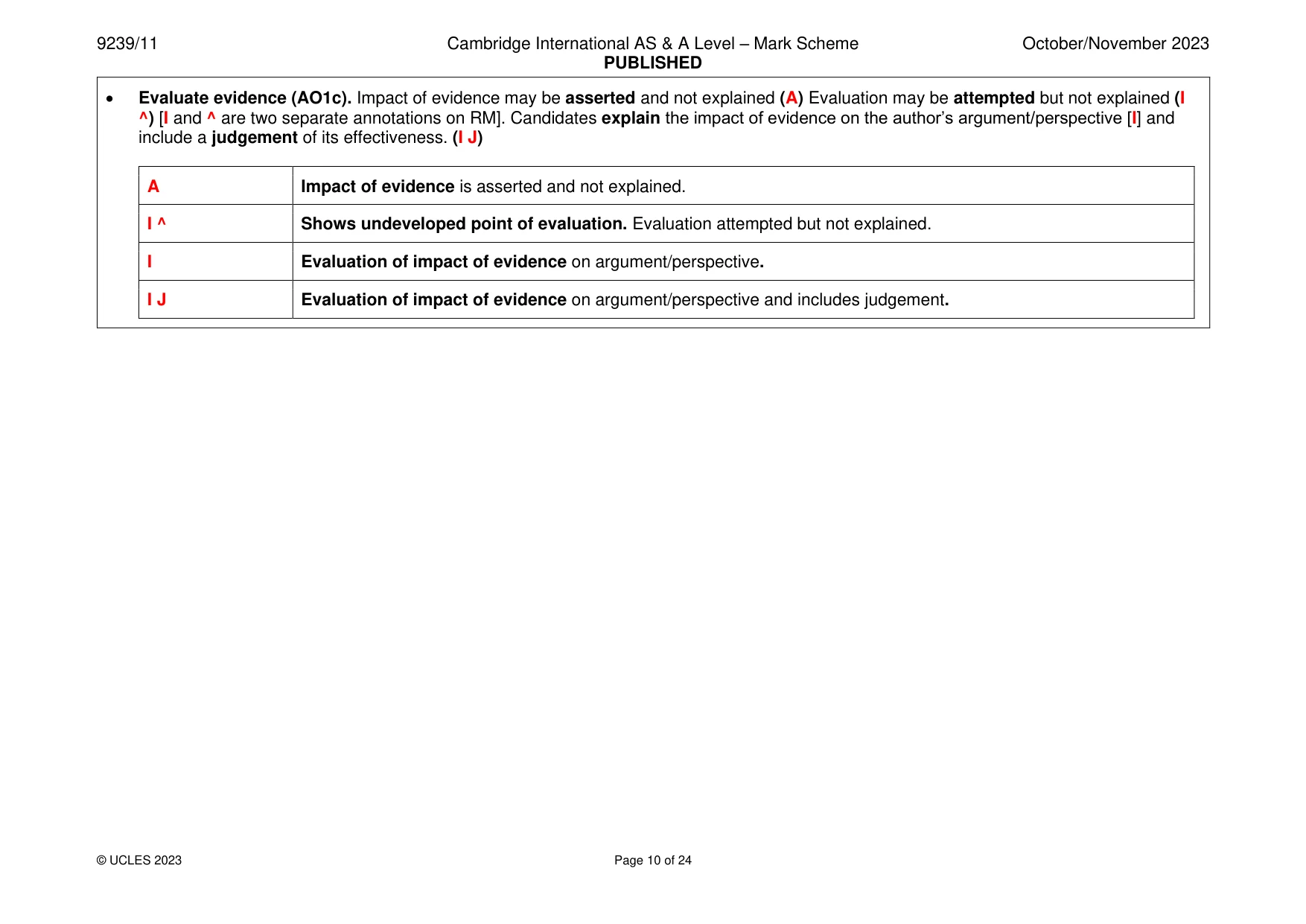
9239/11 Cambridge International AS & A Level – Mark Scheme PUBLISHED October/November 2023 © UCLES 2023 Page 10 of 24 • Evaluate evidence (AO1c). Impact of evidence may be asserted and not explained (A) Evaluation may be attempted but not explained (I ^) [I and ^ are two separate annotations on RM]. Candidates explain the impact of evidence on the author’s argument/perspective [I] and include a judgement of its effectiveness. (I J) A Impact of evidence is asserted and not explained. I ^ Shows undeveloped point of evaluation. Evaluation attempted but not explained. I Evaluation of impact of evidence on argument/perspective. I J Evaluation of impact of evidence on argument/perspective and includes judgement.
Mark scheme, page 11
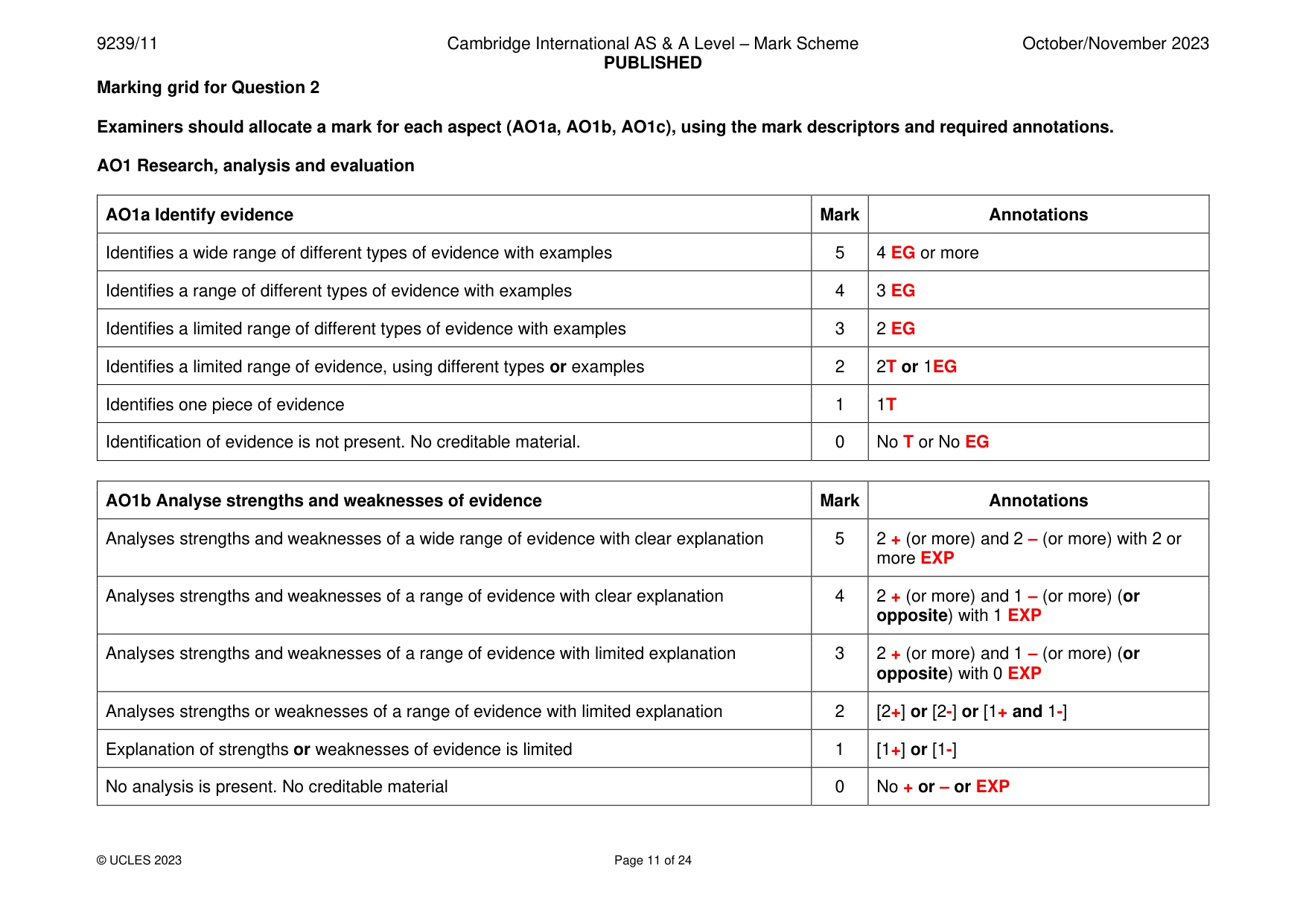
9239/11 Cambridge International AS & A Level – Mark Scheme PUBLISHED October/November 2023 © UCLES 2023 Page 11 of 24 Marking grid for Question 2 Examiners should allocate a mark for each aspect (AO1a, AO1b, AO1c), using the mark descriptors and required annotations. AO1 Research, analysis and evaluation AO1a Identify evidence Mark Annotations Identifies a wide range of different types of evidence with examples 5 4 EG or more Identifies a range of different types of evidence with examples 4 3 EG Identifies a limited range of different types of evidence with examples 3 2 EG Identifies a limited range of evidence, using different types or examples 2 2T or 1EG Identifies one piece of evidence 1 1T Identification of evidence is not present. No creditable material. 0 No T or No EG AO1b Analyse strengths and weaknesses of evidence Mark Annotations Analyses strengths and weaknesses of a wide range of evidence with clear explanation 5 2 + (or more) and 2 – (or more) with 2 or more EXP Analyses strengths and weaknesses of a range of evidence with clear explanation 4 2 + (or more) and 1 – (or more) (or opposite) with 1 EXP Analyses strengths and weaknesses of a range of evidence with limited explanation 3 2 + (or more) and 1 – (or more) (or opposite) with 0 EXP Analyses strengths or weaknesses of a range of evidence with limited explanation 2 [2+] or [2-] or [1+ and 1-] Explanation of strengths or weaknesses of evidence is limited 1 [1+] or [1-] No analysis is present. No creditable material 0 No + or – or EXP
Mark scheme, page 12
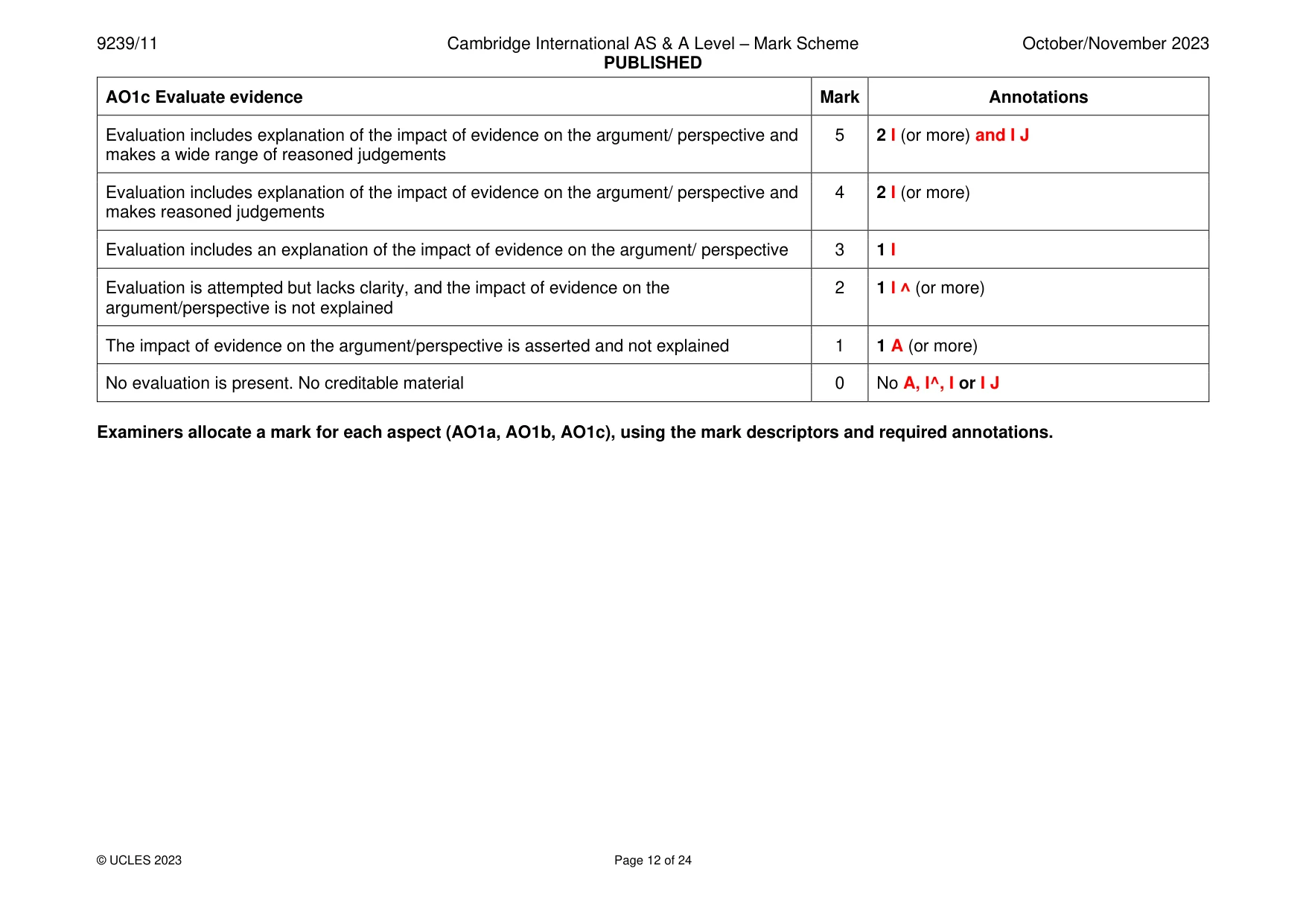
9239/11 Cambridge International AS & A Level – Mark Scheme PUBLISHED October/November 2023 © UCLES 2023 Page 12 of 24 AO1c Evaluate evidence Mark Annotations Evaluation includes explanation of the impact of evidence on the argument/ perspective and makes a wide range of reasoned judgements 5 2 I (or more) and I J Evaluation includes explanation of the impact of evidence on the argument/ perspective and makes reasoned judgements 4 2 I (or more) Evaluation includes an explanation of the impact of evidence on the argument/ perspective 3 1 I Evaluation is attempted but lacks clarity, and the impact of evidence on the argument/perspective is not explained 2 1 I ˄ (or more) The impact of evidence on the argument/perspective is asserted and not explained 1 1 A (or more) No evaluation is present. No creditable material 0 No A, I^, I or I J Examiners allocate a mark for each aspect (AO1a, AO1b, AO1c), using the mark descriptors and required annotations.
Mark scheme, page 13
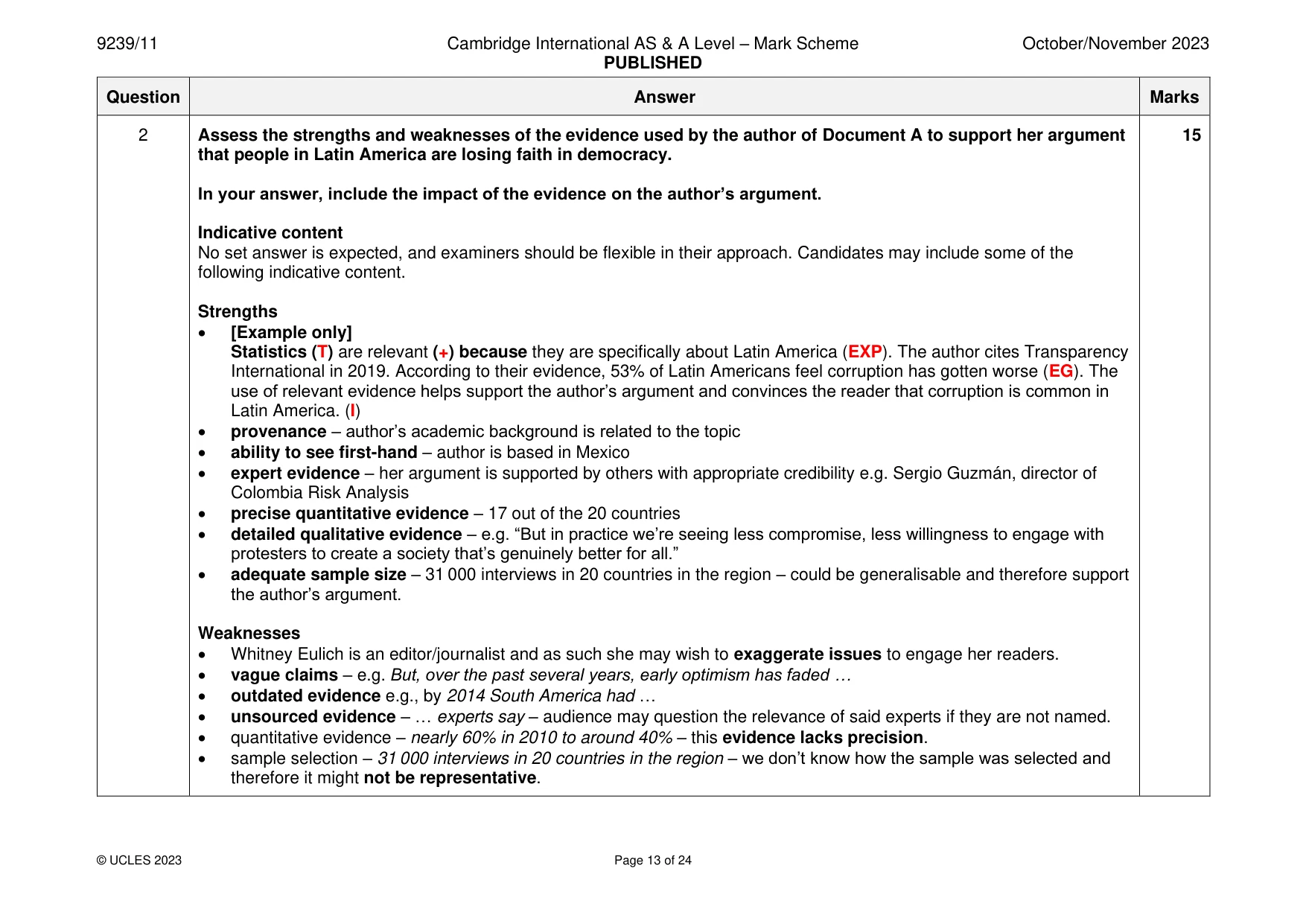
9239/11 Cambridge International AS & A Level – Mark Scheme PUBLISHED October/November 2023 © UCLES 2023 Page 13 of 24 Question Answer Marks 2 Assess the strengths and weaknesses of the evidence used by the author of Document A to support her argument that people in Latin America are losing faith in democracy. In your answer, include the impact of the evidence on the author’s argument. Indicative content No set answer is expected, and examiners should be flexible in their approach. Candidates may include some of the following indicative content. Strengths • [Example only] Statistics (T) are relevant (+) because they are specifically about Latin America (EXP). The author cites Transparency International in 2019. According to their evidence, 53% of Latin Americans feel corruption has gotten worse (EG). The use of relevant evidence helps support the author’s argument and convinces the reader that corruption is common in Latin America. (I) • provenance – author’s academic background is related to the topic • ability to see first-hand – author is based in Mexico • expert evidence – her argument is supported by others with appropriate credibility e.g. Sergio Guzmán, director of Colombia Risk Analysis • precise quantitative evidence – 17 out of the 20 countries • detailed qualitative evidence – e.g. “But in practice we’re seeing less compromise, less willingness to engage with protesters to create a society that’s genuinely better for all.” • adequate sample size – 31 000 interviews in 20 countries in the region – could be generalisable and therefore support the author’s argument. Weaknesses • Whitney Eulich is an editor/journalist and as such she may wish to exaggerate issues to engage her readers. • vague claims – e.g. But, over the past several years, early optimism has faded … • outdated evidence e.g., by 2014 South America had … • unsourced evidence – … experts say – audience may question the relevance of said experts if they are not named. • quantitative evidence – nearly 60% in 2010 to around 40% – this evidence lacks precision. • sample selection – 31 000 interviews in 20 countries in the region – we don’t know how the sample was selected and therefore it might not be representative. 15
Mark scheme, page 14
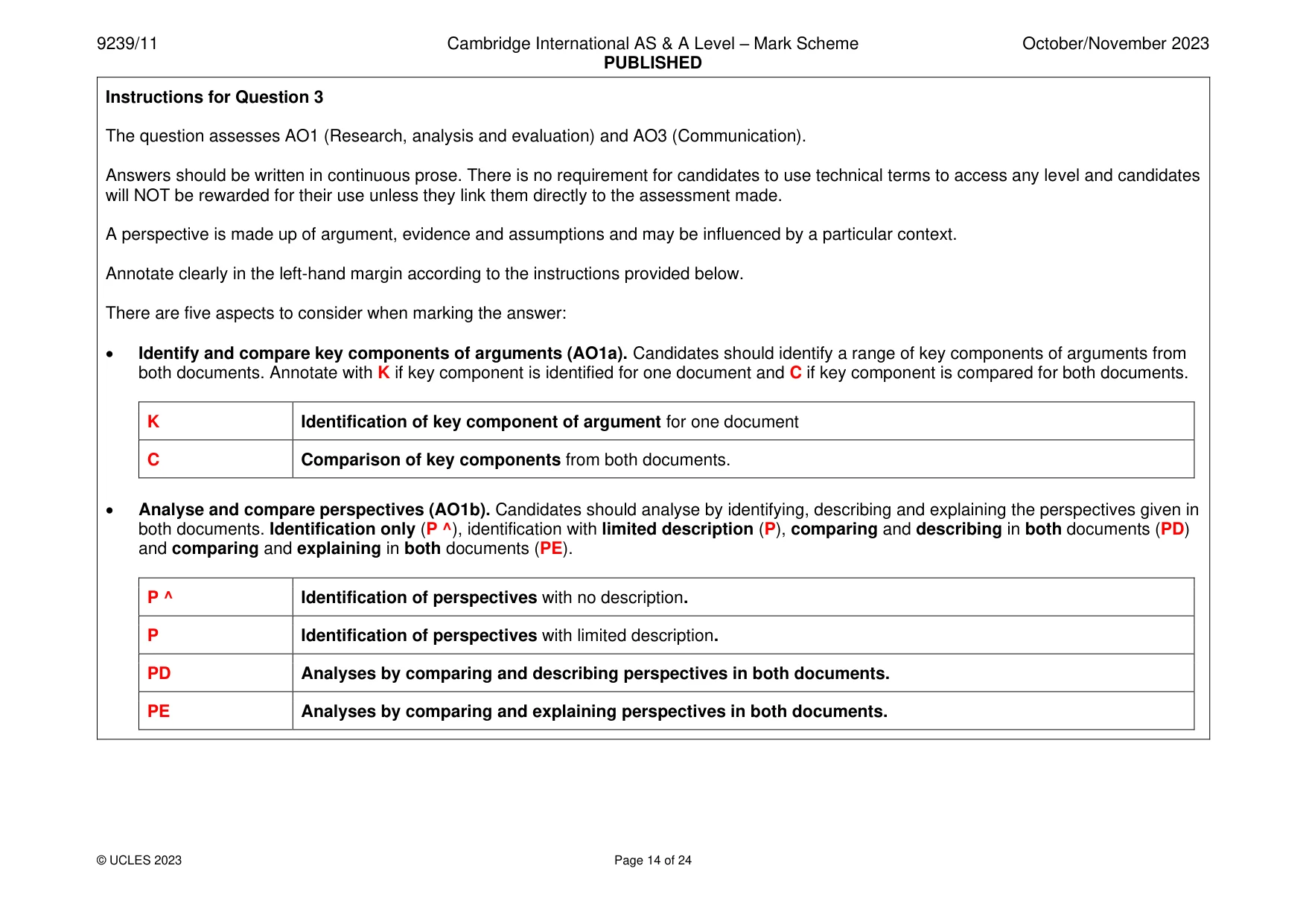
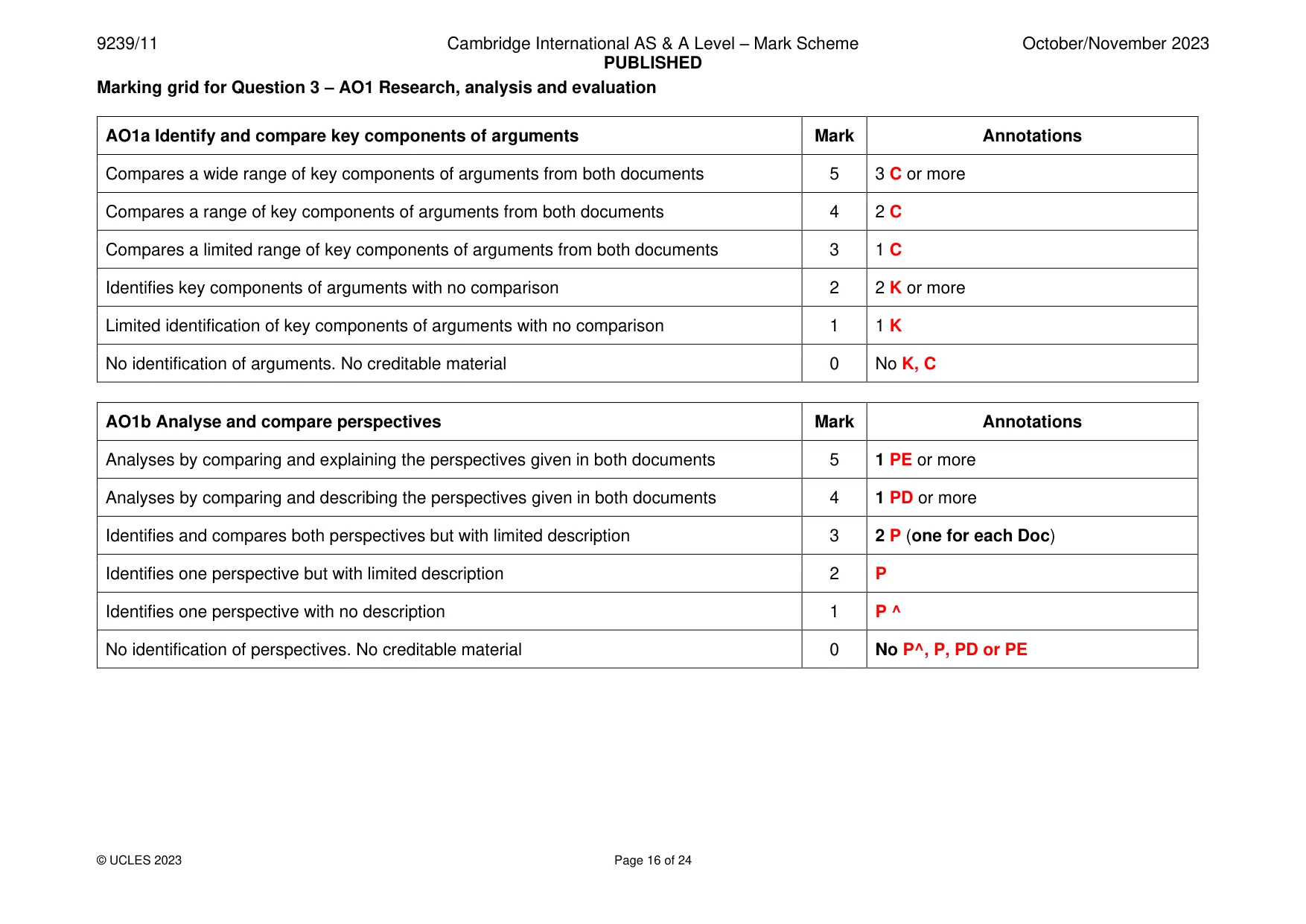
9239/11 Cambridge International AS & A Level – Mark Scheme PUBLISHED October/November 2023 © UCLES 2023 Page 14 of 24 Instructions for Question 3 The question assesses AO1 (Research, analysis and evaluation) and AO3 (Communication). Answers should be written in continuous prose. There is no requirement for candidates to use technical terms to access any level and candidates will NOT be rewarded for their use unless they link them directly to the assessment made. A perspective is made up of argument, evidence and assumptions and may be influenced by a particular context. Annotate clearly in the left-hand margin according to the instructions provided below. There are five aspects to consider when marking the answer: • Identify and compare key components of arguments (AO1a). Candidates should identify a range of key components of arguments from both documents. Annotate with K if key component is identified for one document and C if key component is compared for both documents. K Identification of key component of argument for one document C Comparison of key components from both documents. • Analyse and compare perspectives (AO1b). Candidates should analyse by identifying, describing and explaining the perspectives given in both documents. Identification only (P ^), identification with limited description (P), comparing and describing in both documents (PD) and comparing and explaining in both documents (PE). P ^ Identification of perspectives with no description. P Identification of perspectives with limited description. PD Analyses by comparing and describing perspectives in both documents. PE Analyses by comparing and explaining perspectives in both documents.
Mark scheme, page 15
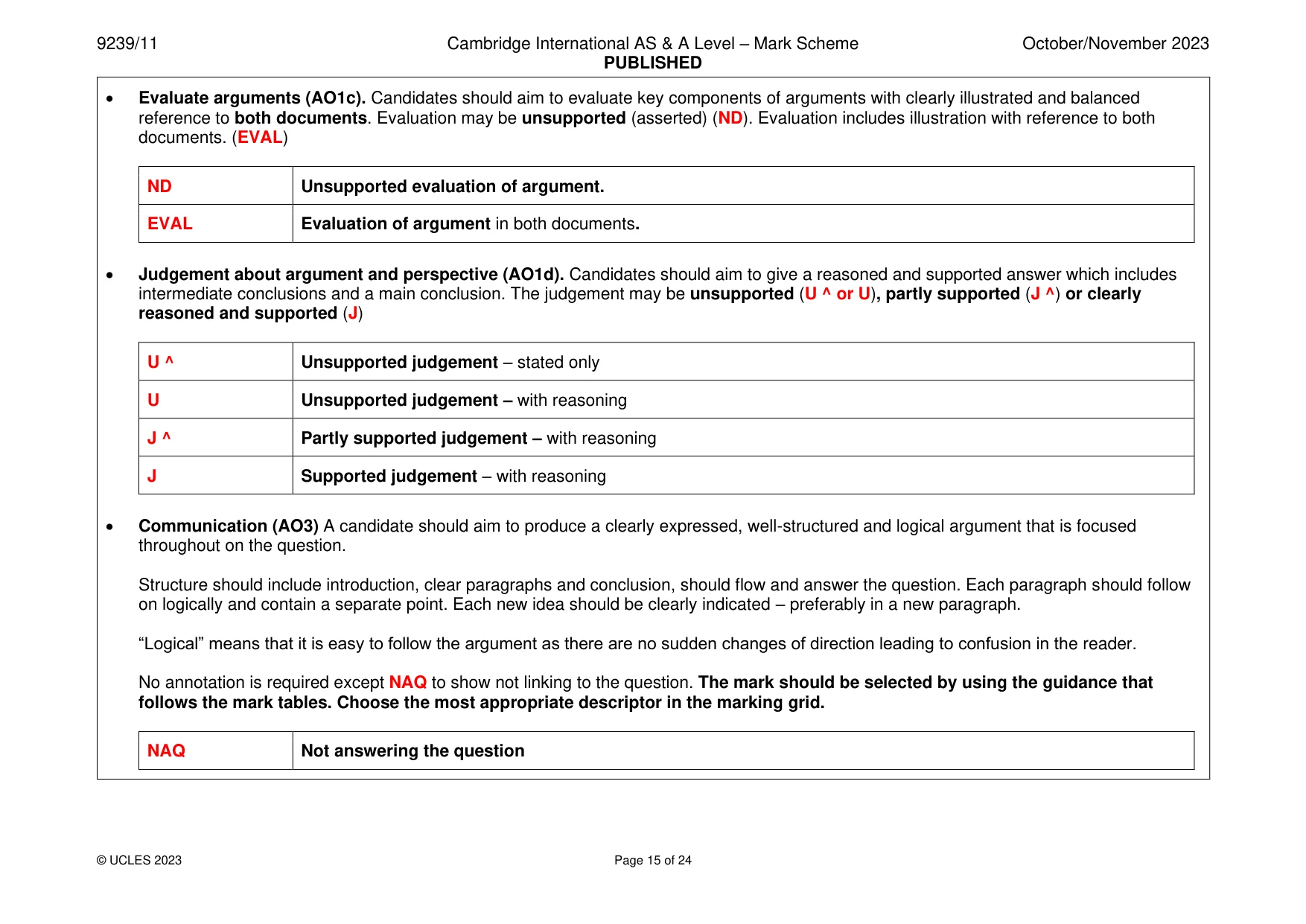
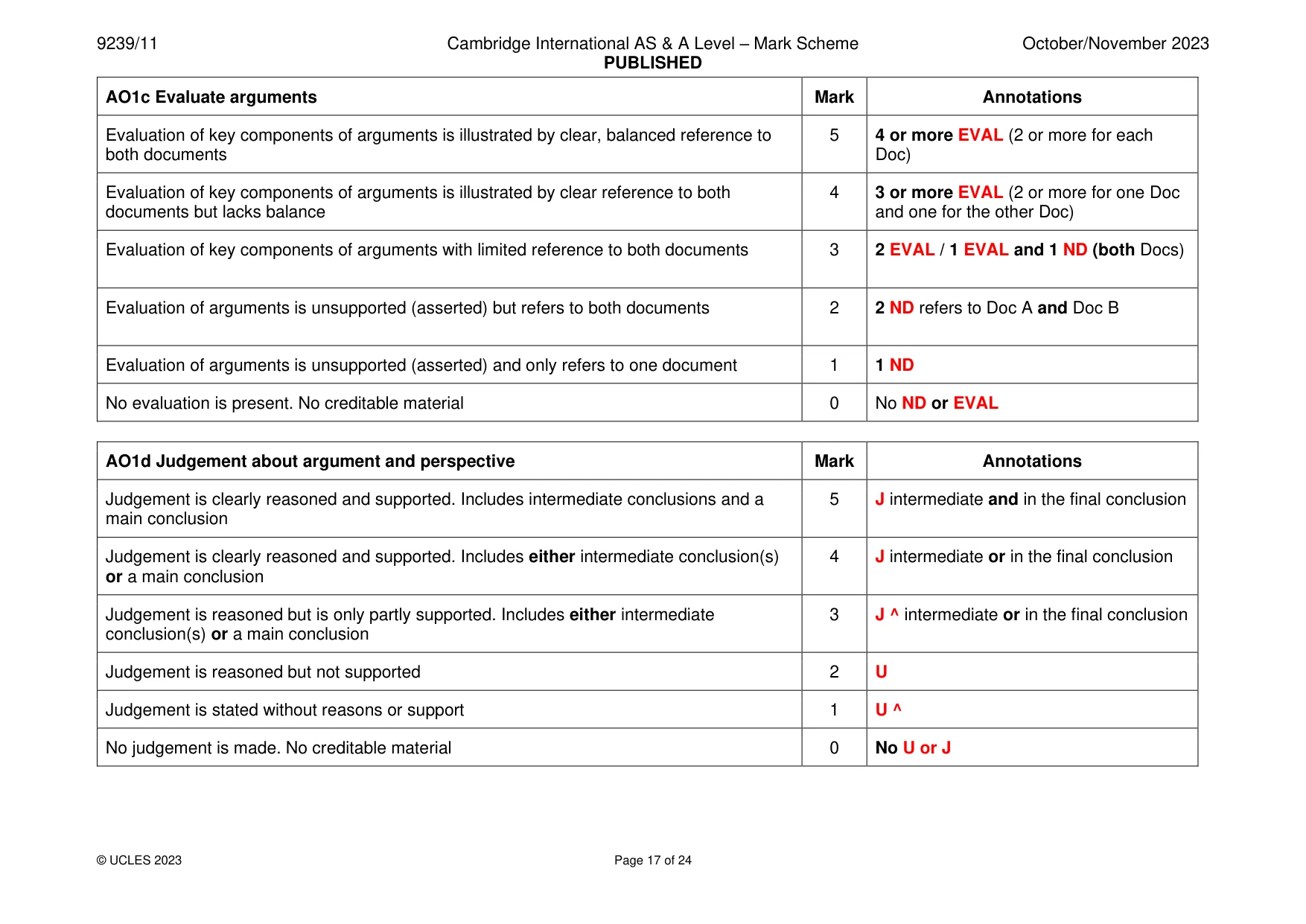
9239/11 Cambridge International AS & A Level – Mark Scheme PUBLISHED October/November 2023 © UCLES 2023 Page 15 of 24 • Evaluate arguments (AO1c). Candidates should aim to evaluate key components of arguments with clearly illustrated and balanced reference to both documents. Evaluation may be unsupported (asserted) (ND). Evaluation includes illustration with reference to both documents. (EVAL) ND Unsupported evaluation of argument. EVAL Evaluation of argument in both documents. • Judgement about argument and perspective (AO1d). Candidates should aim to give a reasoned and supported answer which includes intermediate conclusions and a main conclusion. The judgement may be unsupported (U ^ or U), partly supported (J ^) or clearly reasoned and supported (J) U ^ Unsupported judgement – stated only U Unsupported judgement – with reasoning J ^ Partly supported judgement – with reasoning J Supported judgement – with reasoning • Communication (AO3) A candidate should aim to produce a clearly expressed, well-structured and logical argument that is focused throughout on the question. Structure should include introduction, clear paragraphs and conclusion, should flow and answer the question. Each paragraph should follow on logically and contain a separate point. Each new idea should be clearly indicated – preferably in a new paragraph. “Logical” means that it is easy to follow the argument as there are no sudden changes of direction leading to confusion in the reader. No annotation is required except NAQ to show not linking to the question. The mark should be selected by using the guidance that follows the mark tables. Choose the most appropriate descriptor in the marking grid. NAQ Not answering the question
Mark scheme, page 16
9239/11 Cambridge International AS & A Level – Mark Scheme PUBLISHED October/November 2023 © UCLES 2023 Page 16 of 24 Marking grid for Question 3 – AO1 Research, analysis and evaluation AO1a Identify and compare key components of arguments Mark Annotations Compares a wide range of key components of arguments from both documents 5 3 C or more Compares a range of key components of arguments from both documents 4 2 C Compares a limited range of key components of arguments from both documents 3 1 C Identifies key components of arguments with no comparison 2 2 K or more Limited identification of key components of arguments with no comparison 1 1 K No identification of arguments. No creditable material 0 No K, C AO1b Analyse and compare perspectives Mark Annotations Analyses by comparing and explaining the perspectives given in both documents 5 1 PE or more Analyses by comparing and describing the perspectives given in both documents 4 1 PD or more Identifies and compares both perspectives but with limited description 3 2 P (one for each Doc) Identifies one perspective but with limited description 2 P Identifies one perspective with no description 1 P ^ No identification of perspectives. No creditable material 0 No P^, P, PD or PE
Mark scheme, page 17
9239/11 Cambridge International AS & A Level – Mark Scheme PUBLISHED October/November 2023 © UCLES 2023 Page 17 of 24 AO1c Evaluate arguments Mark Annotations Evaluation of key components of arguments is illustrated by clear, balanced reference to both documents 5 4 or more EVAL (2 or more for each Doc) Evaluation of key components of arguments is illustrated by clear reference to both documents but lacks balance 4 3 or more EVAL (2 or more for one Doc and one for the other Doc) Evaluation of key components of arguments with limited reference to both documents 3 2 EVAL / 1 EVAL and 1 ND (both Docs) Evaluation of arguments is unsupported (asserted) but refers to both documents 2 2 ND refers to Doc A and Doc B Evaluation of arguments is unsupported (asserted) and only refers to one document 1 1 ND No evaluation is present. No creditable material 0 No ND or EVAL AO1d Judgement about argument and perspective Mark Annotations Judgement is clearly reasoned and supported. Includes intermediate conclusions and a main conclusion 5 J intermediate and in the final conclusion Judgement is clearly reasoned and supported. Includes either intermediate conclusion(s) or a main conclusion 4 J intermediate or in the final conclusion Judgement is reasoned but is only partly supported. Includes either intermediate conclusion(s) or a main conclusion 3 J ^ intermediate or in the final conclusion Judgement is reasoned but not supported 2 U Judgement is stated without reasons or support 1 U ^ No judgement is made. No creditable material 0 No U or J
Mark scheme, page 18
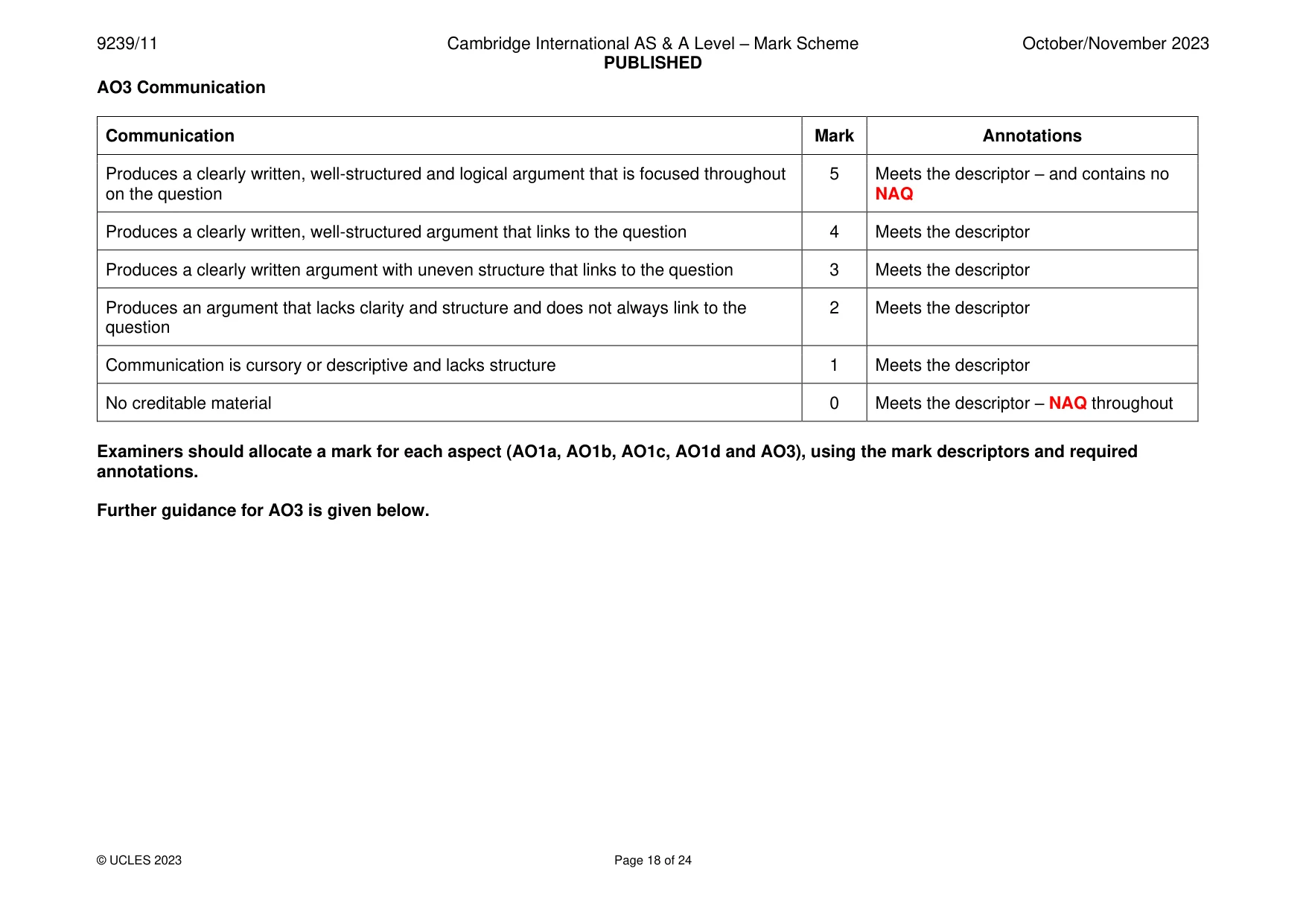
9239/11 Cambridge International AS & A Level – Mark Scheme PUBLISHED October/November 2023 © UCLES 2023 Page 18 of 24 AO3 Communication Communication Mark Annotations Produces a clearly written, well-structured and logical argument that is focused throughout on the question 5 Meets the descriptor – and contains no NAQ Produces a clearly written, well-structured argument that links to the question 4 Meets the descriptor Produces a clearly written argument with uneven structure that links to the question 3 Meets the descriptor Produces an argument that lacks clarity and structure and does not always link to the question 2 Meets the descriptor Communication is cursory or descriptive and lacks structure 1 Meets the descriptor No creditable material 0 Meets the descriptor – NAQ throughout Examiners should allocate a mark for each aspect (AO1a, AO1b, AO1c, AO1d and AO3), using the mark descriptors and required annotations. Further guidance for AO3 is given below.
Mark scheme, page 19
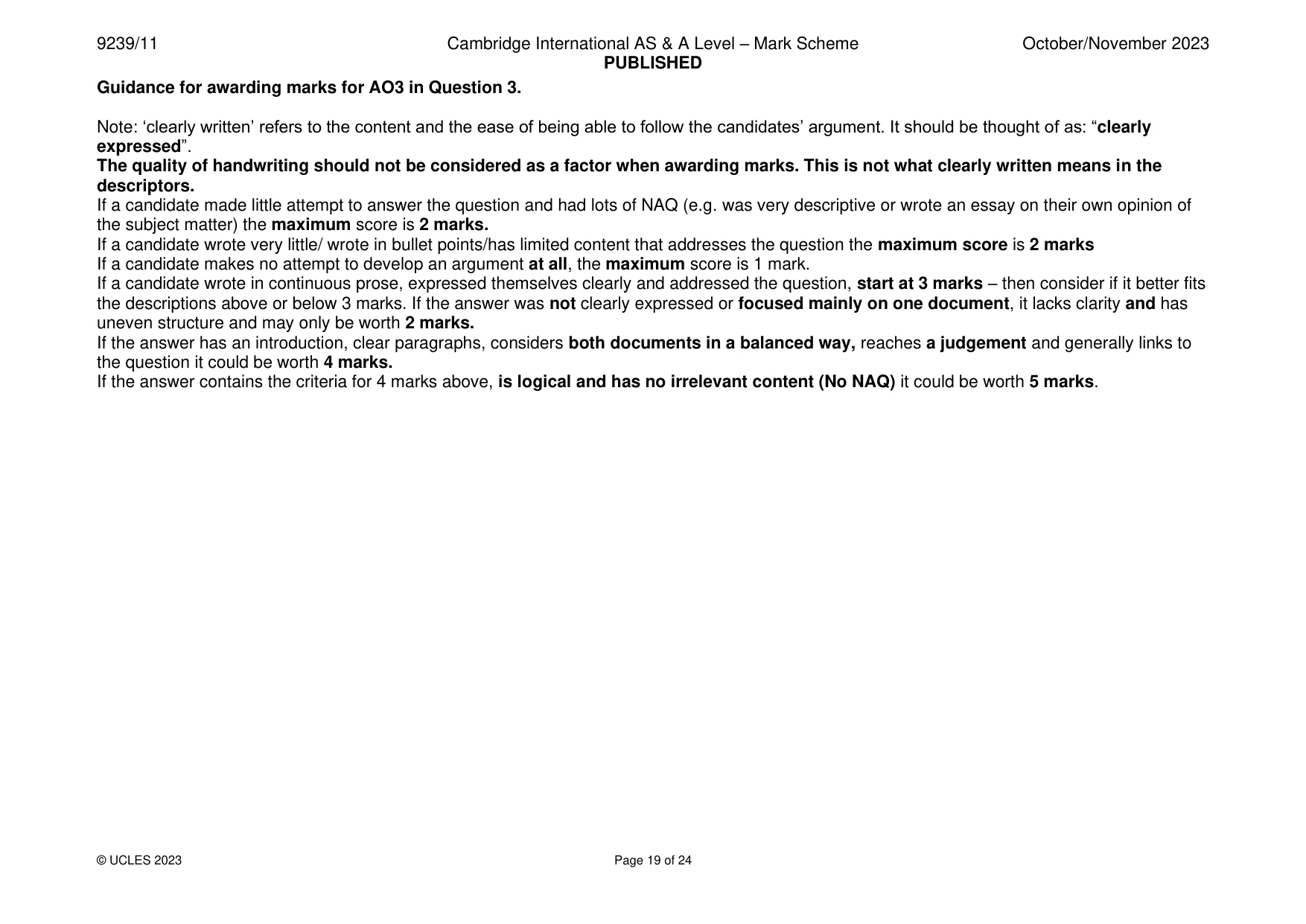
9239/11 Cambridge International AS & A Level – Mark Scheme PUBLISHED October/November 2023 © UCLES 2023 Page 19 of 24 Guidance for awarding marks for AO3 in Question 3. Note: ‘clearly written’ refers to the content and the ease of being able to follow the candidates’ argument. It should be thought of as: “clearly expressed”. The quality of handwriting should not be considered as a factor when awarding marks. This is not what clearly written means in the descriptors. If a candidate made little attempt to answer the question and had lots of NAQ (e.g. was very descriptive or wrote an essay on their own opinion of the subject matter) the maximum score is 2 marks. If a candidate wrote very little/ wrote in bullet points/has limited content that addresses the question the maximum score is 2 marks If a candidate makes no attempt to develop an argument at all, the maximum score is 1 mark. If a candidate wrote in continuous prose, expressed themselves clearly and addressed the question, start at 3 marks – then consider if it better fits the descriptions above or below 3 marks. If the answer was not clearly expressed or focused mainly on one document, it lacks clarity and has uneven structure and may only be worth 2 marks. If the answer has an introduction, clear paragraphs, considers both documents in a balanced way, reaches a judgement and generally links to the question it could be worth 4 marks. If the answer contains the criteria for 4 marks above, is logical and has no irrelevant content (No NAQ) it could be worth 5 marks.
Mark scheme, page 20
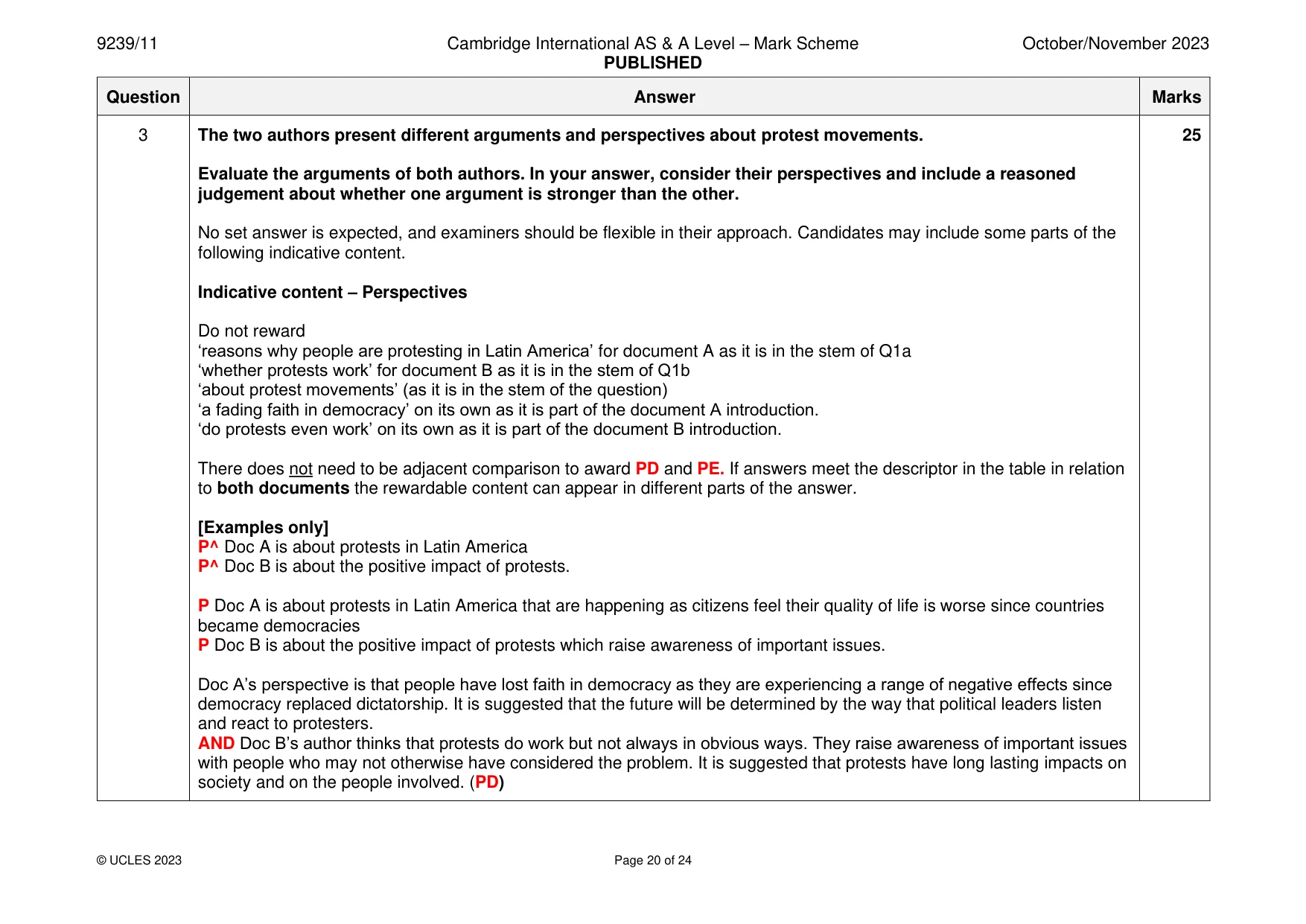
9239/11 Cambridge International AS & A Level – Mark Scheme PUBLISHED October/November 2023 © UCLES 2023 Page 20 of 24 Question Answer Marks 3 The two authors present different arguments and perspectives about protest movements. Evaluate the arguments of both authors. In your answer, consider their perspectives and include a reasoned judgement about whether one argument is stronger than the other. No set answer is expected, and examiners should be flexible in their approach. Candidates may include some parts of the following indicative content. Indicative content – Perspectives Do not reward ‘reasons why people are protesting in Latin America’ for document A as it is in the stem of Q1a ‘whether protests work’ for document B as it is in the stem of Q1b ‘about protest movements’ (as it is in the stem of the question) ‘a fading faith in democracy’ on its own as it is part of the document A introduction. ‘do protests even work’ on its own as it is part of the document B introduction. There does not need to be adjacent comparison to award PD and PE. If answers meet the descriptor in the table in relation to both documents the rewardable content can appear in different parts of the answer. [Examples only] P^ Doc A is about protests in Latin America P^ Doc B is about the positive impact of protests. P Doc A is about protests in Latin America that are happening as citizens feel their quality of life is worse since countries became democracies P Doc B is about the positive impact of protests which raise awareness of important issues. Doc A’s perspective is that people have lost faith in democracy as they are experiencing a range of negative effects since democracy replaced dictatorship. It is suggested that the future will be determined by the way that political leaders listen and react to protesters. AND Doc B’s author thinks that protests do work but not always in obvious ways. They raise awareness of important issues with people who may not otherwise have considered the problem. It is suggested that protests have long lasting impacts on society and on the people involved. (PD) 25
Mark scheme, page 21
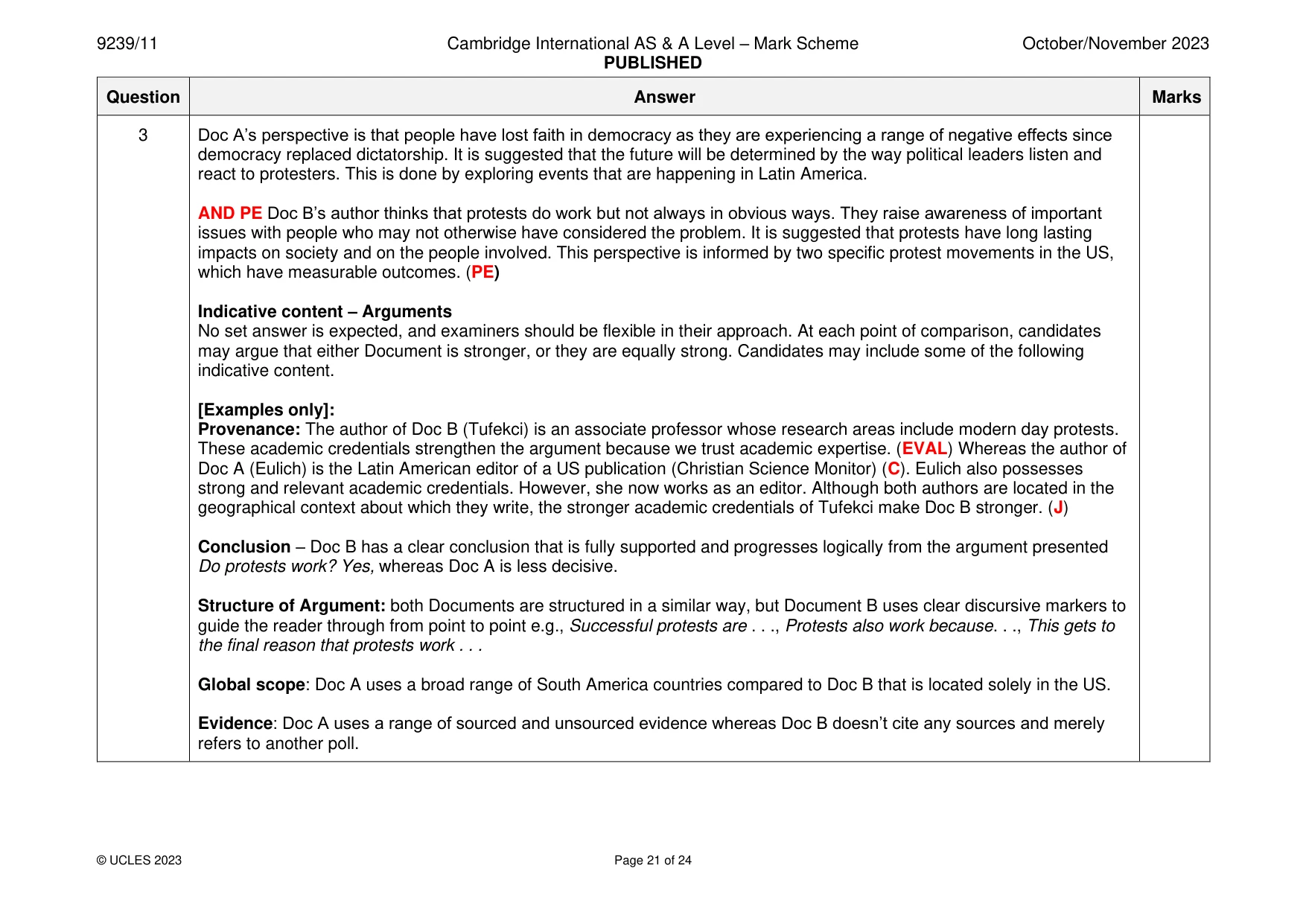
9239/11 Cambridge International AS & A Level – Mark Scheme PUBLISHED October/November 2023 © UCLES 2023 Page 21 of 24 Question Answer Marks 3 Doc A’s perspective is that people have lost faith in democracy as they are experiencing a range of negative effects since democracy replaced dictatorship. It is suggested that the future will be determined by the way political leaders listen and react to protesters. This is done by exploring events that are happening in Latin America. AND PE Doc B’s author thinks that protests do work but not always in obvious ways. They raise awareness of important issues with people who may not otherwise have considered the problem. It is suggested that protests have long lasting impacts on society and on the people involved. This perspective is informed by two specific protest movements in the US, which have measurable outcomes. (PE) Indicative content – Arguments No set answer is expected, and examiners should be flexible in their approach. At each point of comparison, candidates may argue that either Document is stronger, or they are equally strong. Candidates may include some of the following indicative content. [Examples only]: Provenance: The author of Doc B (Tufekci) is an associate professor whose research areas include modern day protests. These academic credentials strengthen the argument because we trust academic expertise. (EVAL) Whereas the author of Doc A (Eulich) is the Latin American editor of a US publication (Christian Science Monitor) (C). Eulich also possesses strong and relevant academic credentials. However, she now works as an editor. Although both authors are located in the geographical context about which they write, the stronger academic credentials of Tufekci make Doc B stronger. (J) Conclusion – Doc B has a clear conclusion that is fully supported and progresses logically from the argument presented Do protests work? Yes, whereas Doc A is less decisive. Structure of Argument: both Documents are structured in a similar way, but Document B uses clear discursive markers to guide the reader through from point to point e.g., Successful protests are . . ., Protests also work because. . ., This gets to the final reason that protests work . . . Global scope: Doc A uses a broad range of South America countries compared to Doc B that is located solely in the US. Evidence: Doc A uses a range of sourced and unsourced evidence whereas Doc B doesn’t cite any sources and merely refers to another poll.
Mark scheme, page 22
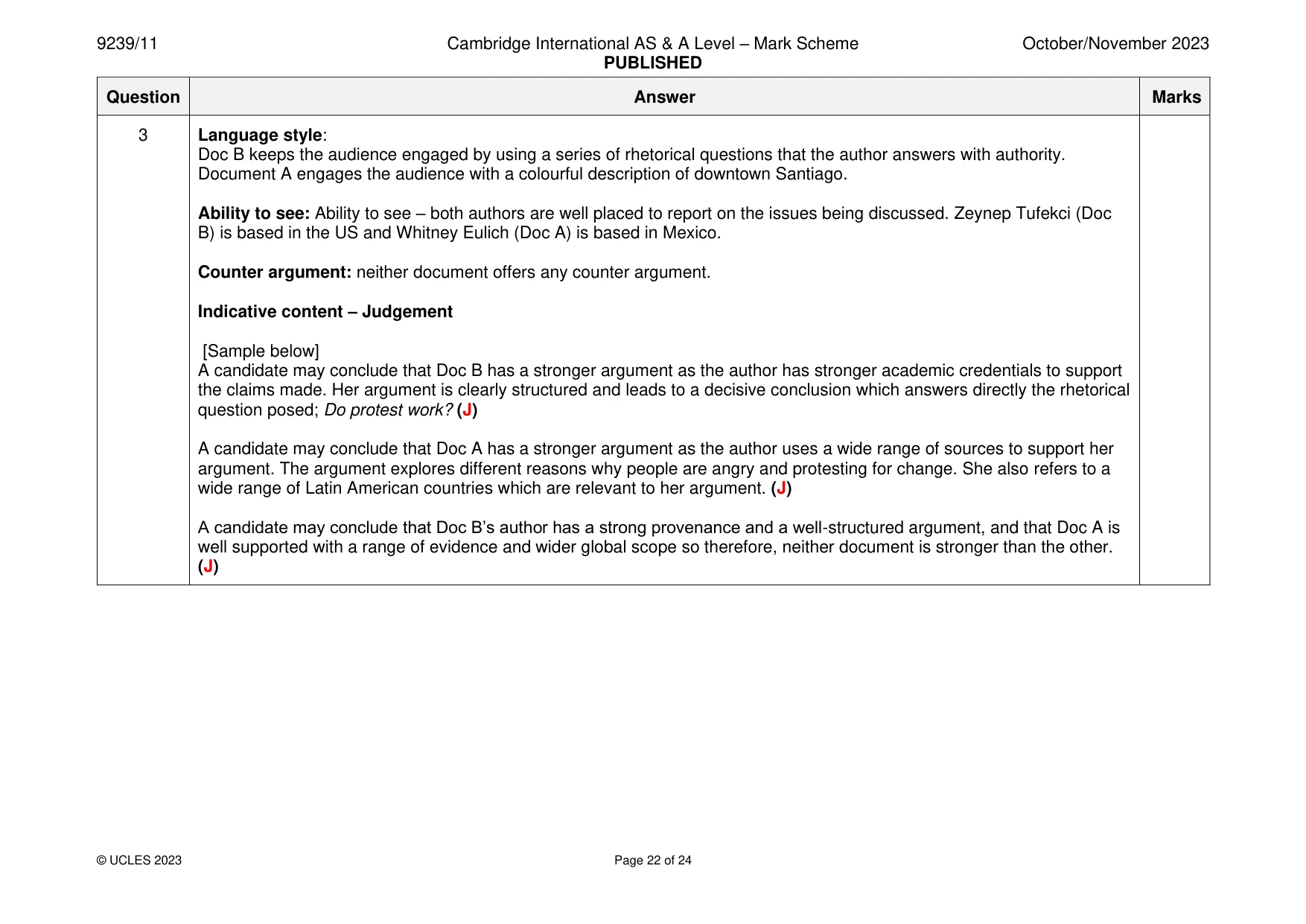
9239/11 Cambridge International AS & A Level – Mark Scheme PUBLISHED October/November 2023 © UCLES 2023 Page 22 of 24 Question Answer Marks 3 Language style: Doc B keeps the audience engaged by using a series of rhetorical questions that the author answers with authority. Document A engages the audience with a colourful description of downtown Santiago. Ability to see: Ability to see – both authors are well placed to report on the issues being discussed. Zeynep Tufekci (Doc B) is based in the US and Whitney Eulich (Doc A) is based in Mexico. Counter argument: neither document offers any counter argument. Indicative content – Judgement [Sample below] A candidate may conclude that Doc B has a stronger argument as the author has stronger academic credentials to support the claims made. Her argument is clearly structured and leads to a decisive conclusion which answers directly the rhetorical question posed; Do protest work? (J) A candidate may conclude that Doc A has a stronger argument as the author uses a wide range of sources to support her argument. The argument explores different reasons why people are angry and protesting for change. She also refers to a wide range of Latin American countries which are relevant to her argument. (J) A candidate may conclude that Doc B’s author has a strong provenance and a well-structured argument, and that Doc A is well supported with a range of evidence and wider global scope so therefore, neither document is stronger than the other. (J)
Mark scheme, page 23
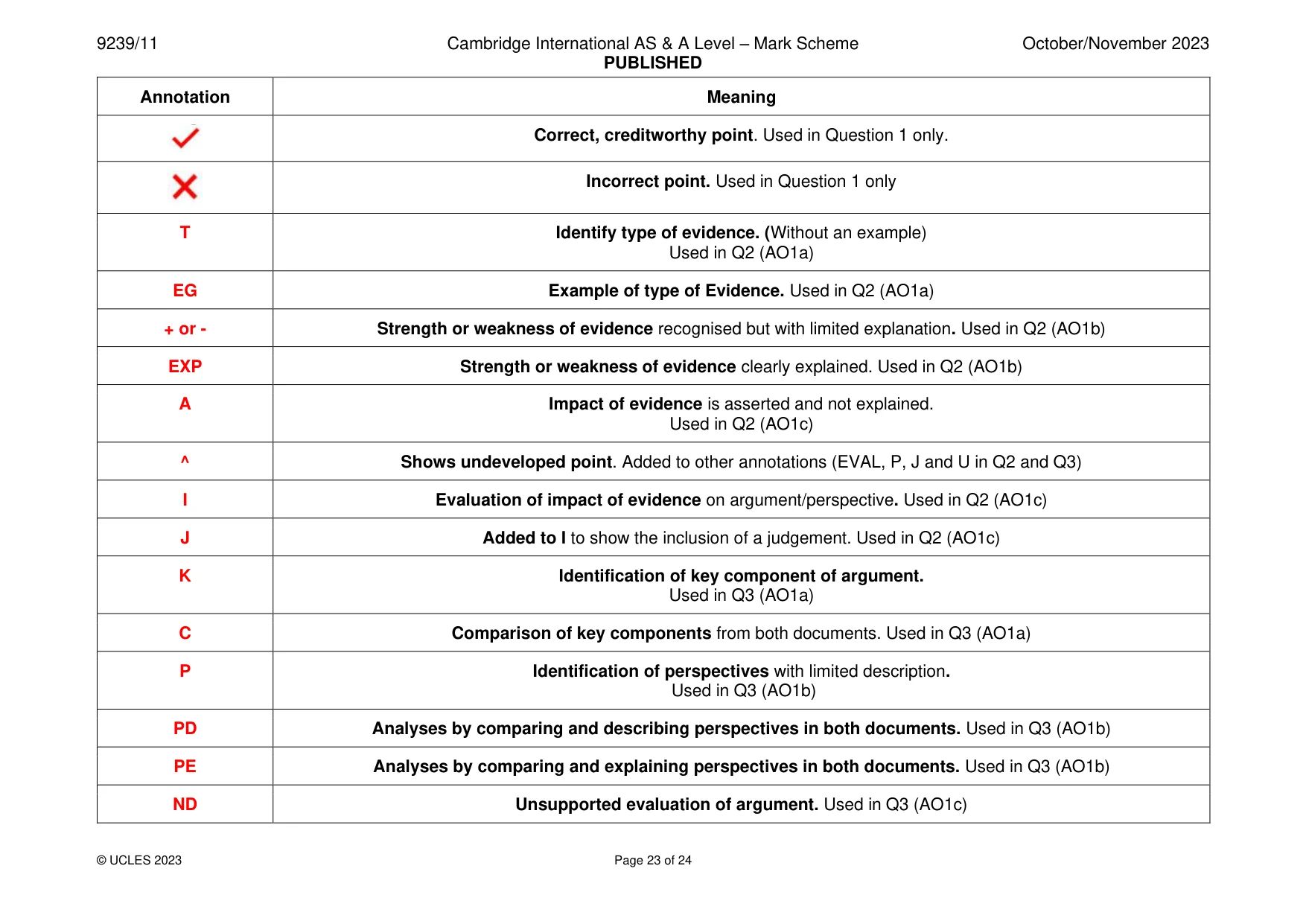
9239/11 Cambridge International AS & A Level – Mark Scheme PUBLISHED October/November 2023 © UCLES 2023 Page 23 of 24 Annotation Meaning Correct, creditworthy point. Used in Question 1 only. Incorrect point. Used in Question 1 only T Identify type of evidence. (Without an example) Used in Q2 (AO1a) EG Example of type of Evidence. Used in Q2 (AO1a) + or - Strength or weakness of evidence recognised but with limited explanation. Used in Q2 (AO1b) EXP Strength or weakness of evidence clearly explained. Used in Q2 (AO1b) A Impact of evidence is asserted and not explained. Used in Q2 (AO1c) ^ Shows undeveloped point. Added to other annotations (EVAL, P, J and U in Q2 and Q3) I Evaluation of impact of evidence on argument/perspective. Used in Q2 (AO1c) J Added to I to show the inclusion of a judgement. Used in Q2 (AO1c) K Identification of key component of argument. Used in Q3 (AO1a) C Comparison of key components from both documents. Used in Q3 (AO1a) P Identification of perspectives with limited description. Used in Q3 (AO1b) PD Analyses by comparing and describing perspectives in both documents. Used in Q3 (AO1b) PE Analyses by comparing and explaining perspectives in both documents. Used in Q3 (AO1b) ND Unsupported evaluation of argument. Used in Q3 (AO1c)
Mark scheme, page 24
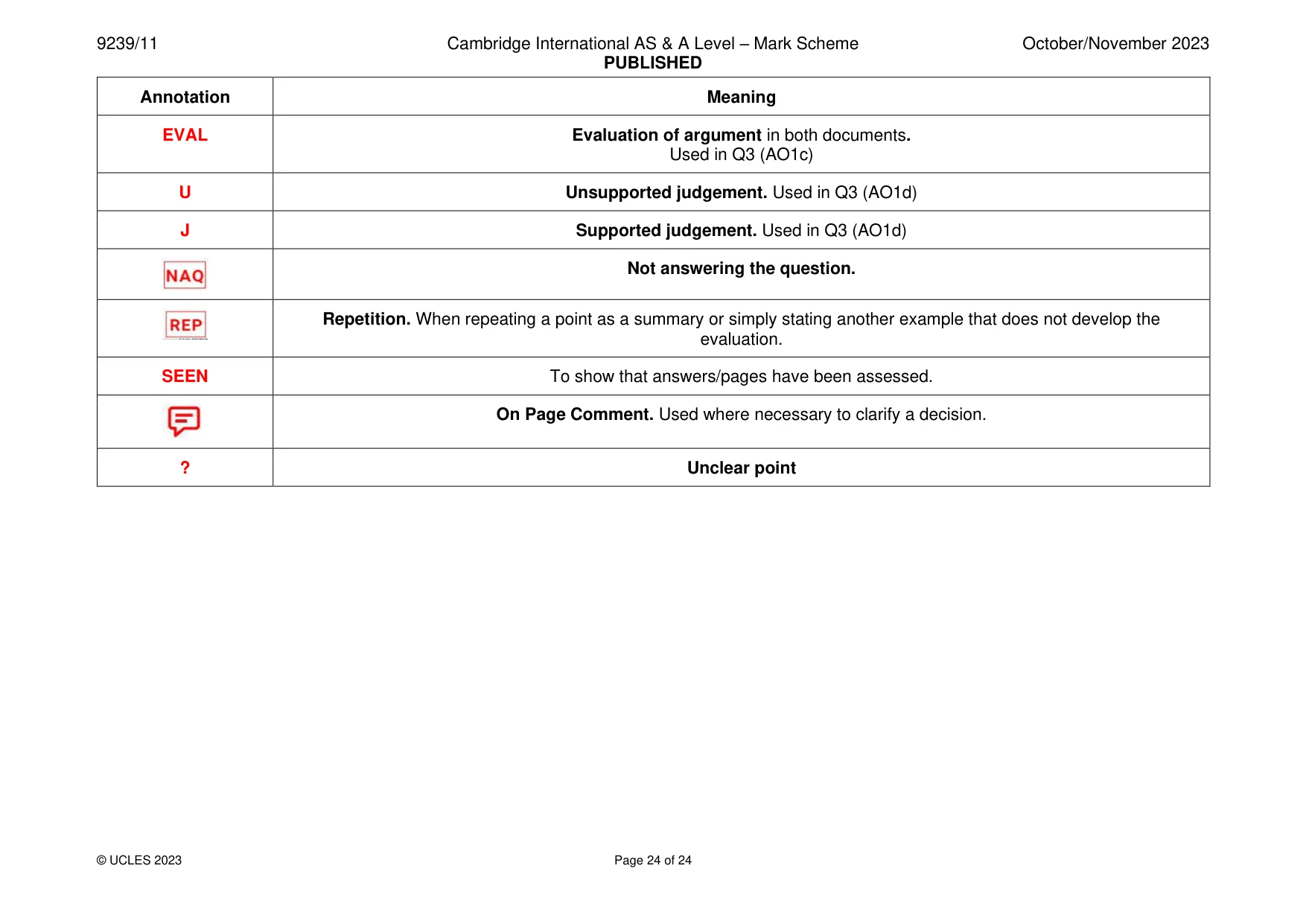
9239/11 Cambridge International AS & A Level – Mark Scheme PUBLISHED October/November 2023 © UCLES 2023 Page 24 of 24 Annotation Meaning EVAL Evaluation of argument in both documents. Used in Q3 (AO1c) U Unsupported judgement. Used in Q3 (AO1d) J Supported judgement. Used in Q3 (AO1d) Not answering the question. Repetition. When repeating a point as a summary or simply stating another example that does not develop the evaluation. SEEN To show that answers/pages have been assessed. On Page Comment. Used where necessary to clarify a decision. ? Unclear point
What you needed in this session
Cambridge’s own grade thresholds for 2023 Oct/Nov, Paper 1 · Variant 1. A higher threshold means an easier paper — the bar moves with how the cohort did.