Cambridge A Level General Paper (AS Level only) 8004 — 2013 Oct/Nov Paper 1 · Variant 1
8004/11/O/N/13 · 100 marks · ≈113 min
The question paper and its mark scheme, free to read here and free to download. This is Cambridge’s own paper, exactly as it was sat.
Question paper2 pages
Mark scheme7 pages
Answers below. Sit the paper first if you are practising.
Paper as text
Question paper, page 1
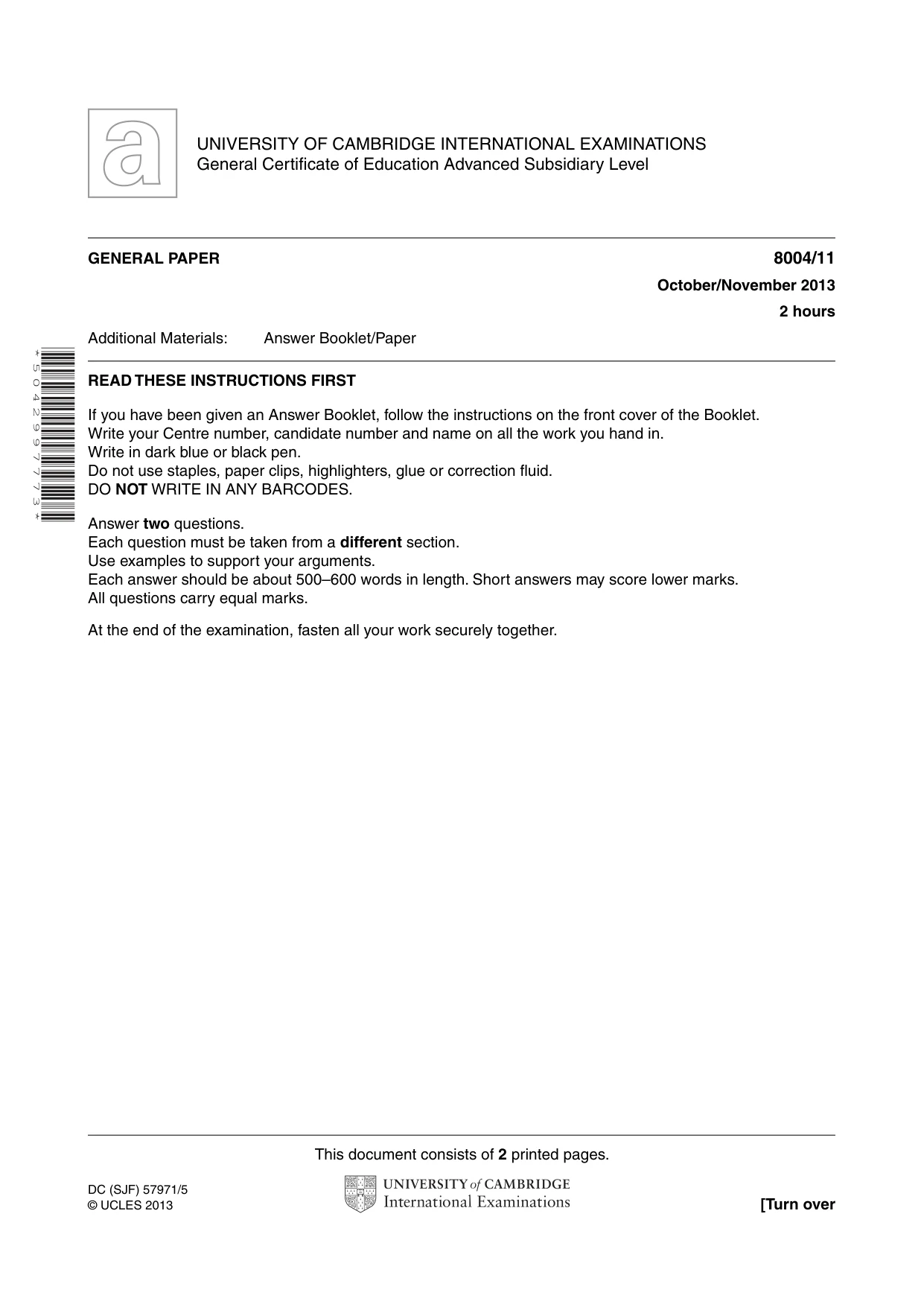
* 5 0 4 2 9 9 7 7 7 3 * This document consists of 2 printed pages. DC (SJF) 57971/5 © UCLES 2013 [Turn over UNIVERSITY OF CAMBRIDGE INTERNATIONAL EXAMINATIONS General Certificate of Education Advanced Subsidiary Level READ THESE INSTRUCTIONS FIRST If you have been given an Answer Booklet, follow the instructions on the front cover of the Booklet. Write your Centre number, candidate number and name on all the work you hand in. Write in dark blue or black pen. Do not use staples, paper clips, highlighters, glue or correction fluid. DO NOT WRITE IN ANY BARCODES. Answer two questions. Each question must be taken from a different section. Use examples to support your arguments. Each answer should be about 500–600 words in length. Short answers may score lower marks. All questions carry equal marks. At the end of the examination, fasten all your work securely together. GENERAL PAPER 8004/11 October/November 2013 2 hours Additional Materials: Answer Booklet/Paper
Question paper, page 2
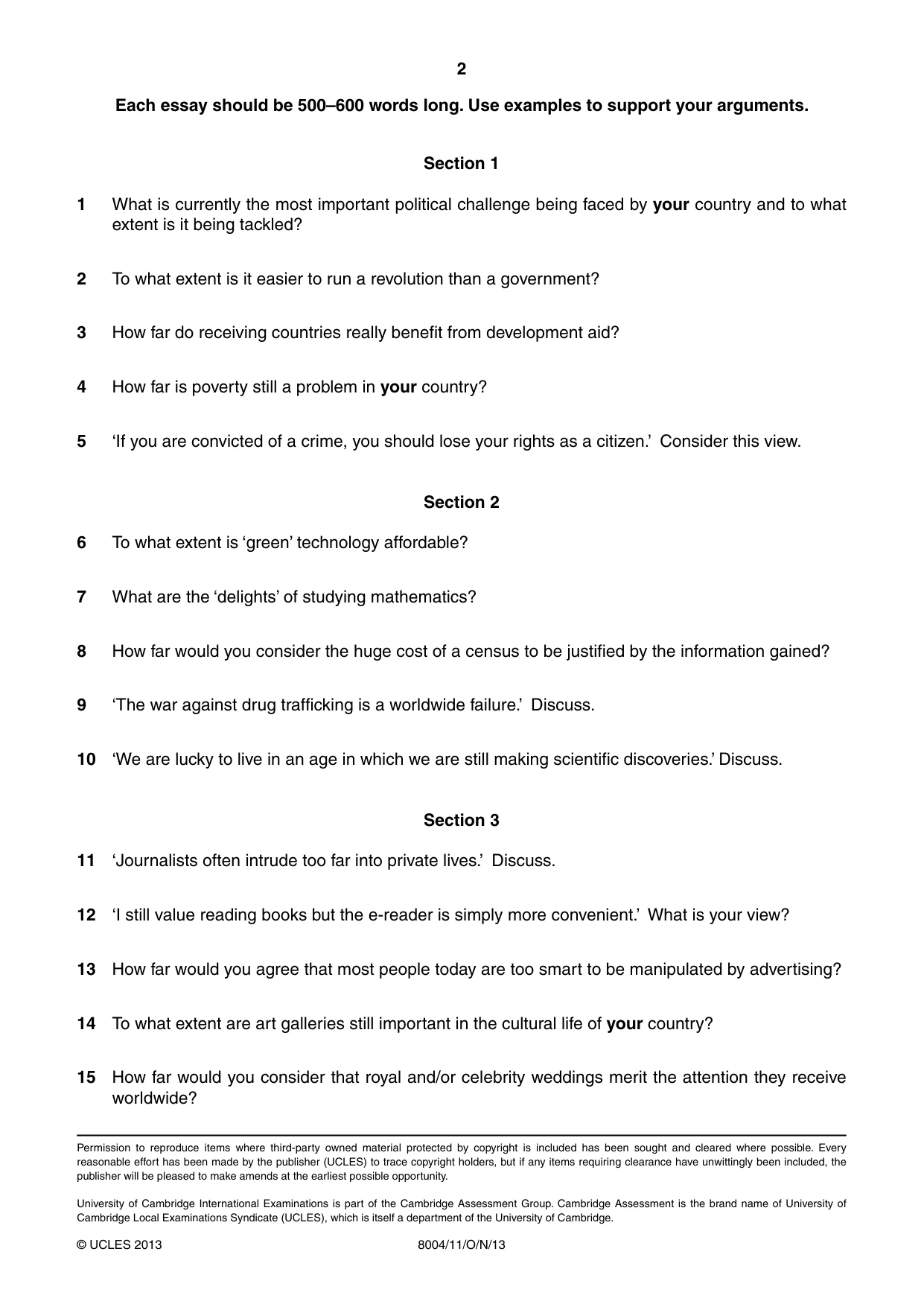
2 8004/11/O/N/13 © UCLES 2013 Permission to reproduce items where third-party owned material protected by copyright is included has been sought and cleared where possible. Every reasonable effort has been made by the publisher (UCLES) to trace copyright holders, but if any items requiring clearance have unwittingly been included, the publisher will be pleased to make amends at the earliest possible opportunity. University of Cambridge International Examinations is part of the Cambridge Assessment Group. Cambridge Assessment is the brand name of University of Cambridge Local Examinations Syndicate (UCLES), which is itself a department of the University of Cambridge. Each essay should be 500–600 words long. Use examples to support your arguments. Section 1 1 What is currently the most important political challenge being faced by your country and to what extent is it being tackled? 2 To what extent is it easier to run a revolution than a government? 3 How far do receiving countries really benefit from development aid? 4 How far is poverty still a problem in your country? 5 ‘If you are convicted of a crime, you should lose your rights as a citizen.’ Consider this view. Section 2 6 To what extent is ‘green’ technology affordable? 7 What are the ‘delights’ of studying mathematics? 8 How far would you consider the huge cost of a census to be justified by the information gained? 9 ‘The war against drug trafficking is a worldwide failure.’ Discuss. 10 ‘We are lucky to live in an age in which we are still making scientific discoveries.’ Discuss. Section 3 11 ‘Journalists often intrude too far into private lives.’ Discuss. 12 ‘I still value reading books but the e-reader is simply more convenient.’ What is your view? 13 How far would you agree that most people today are too smart to be manipulated by advertising? 14 To what extent are art galleries still important in the cultural life of your country? 15 How far would you consider that royal and/or celebrity weddings merit the attention they receive worldwide?
Mark scheme, page 1
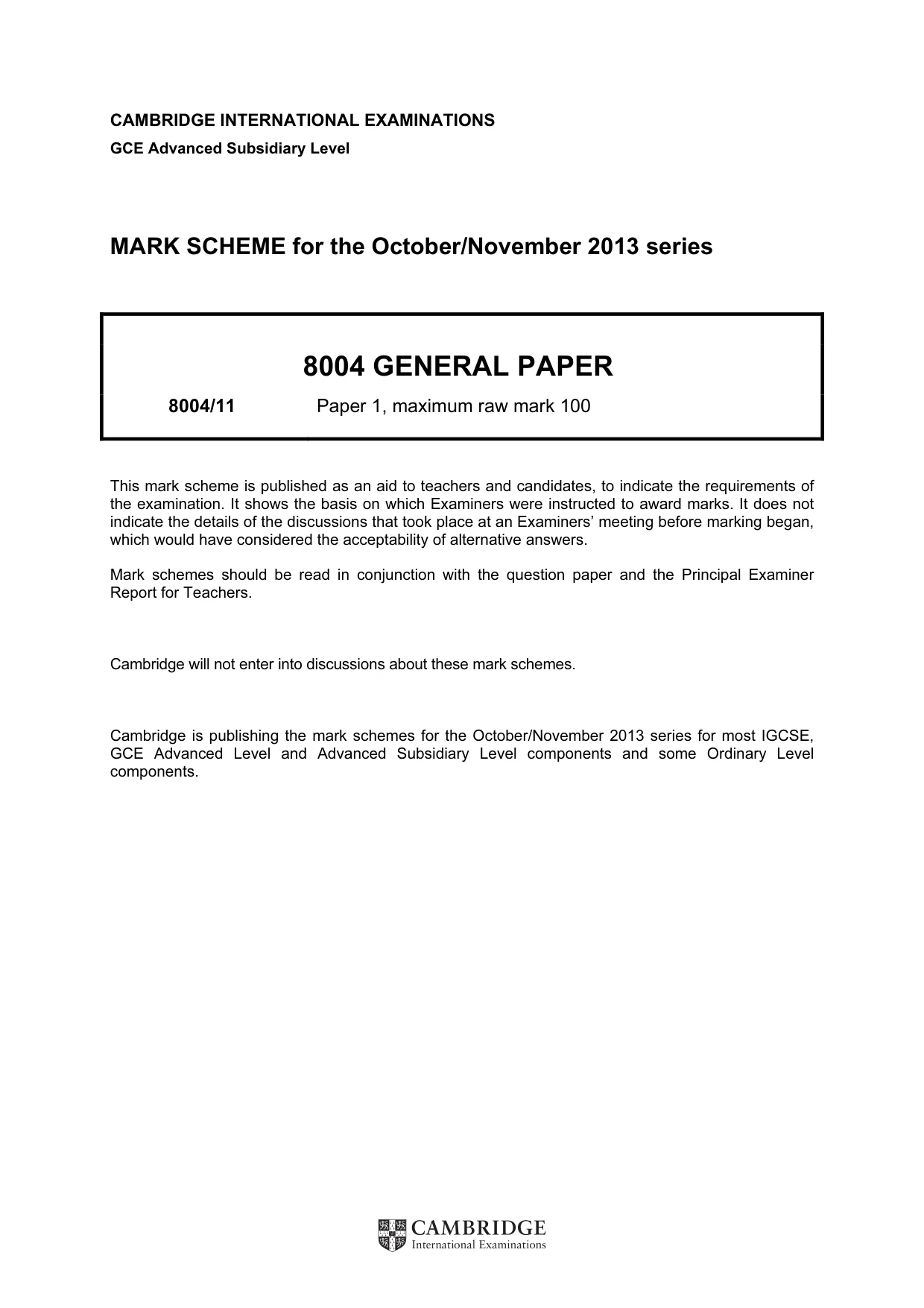
CAMBRIDGE INTERNATIONAL EXAMINATIONS GCE Advanced Subsidiary Level MARK SCHEME for the October/November 2013 series 8004 GENERAL PAPER 8004/11 Paper 1, maximum raw mark 100 This mark scheme is published as an aid to teachers and candidates, to indicate the requirements of the examination. It shows the basis on which Examiners were instructed to award marks. It does not indicate the details of the discussions that took place at an Examiners’ meeting before marking began, which would have considered the acceptability of alternative answers. Mark schemes should be read in conjunction with the question paper and the Principal Examiner Report for Teachers. Cambridge will not enter into discussions about these mark schemes. Cambridge is publishing the mark schemes for the October/November 2013 series for most IGCSE, GCE Advanced Level and Advanced Subsidiary Level components and some Ordinary Level components.
Mark scheme, page 2
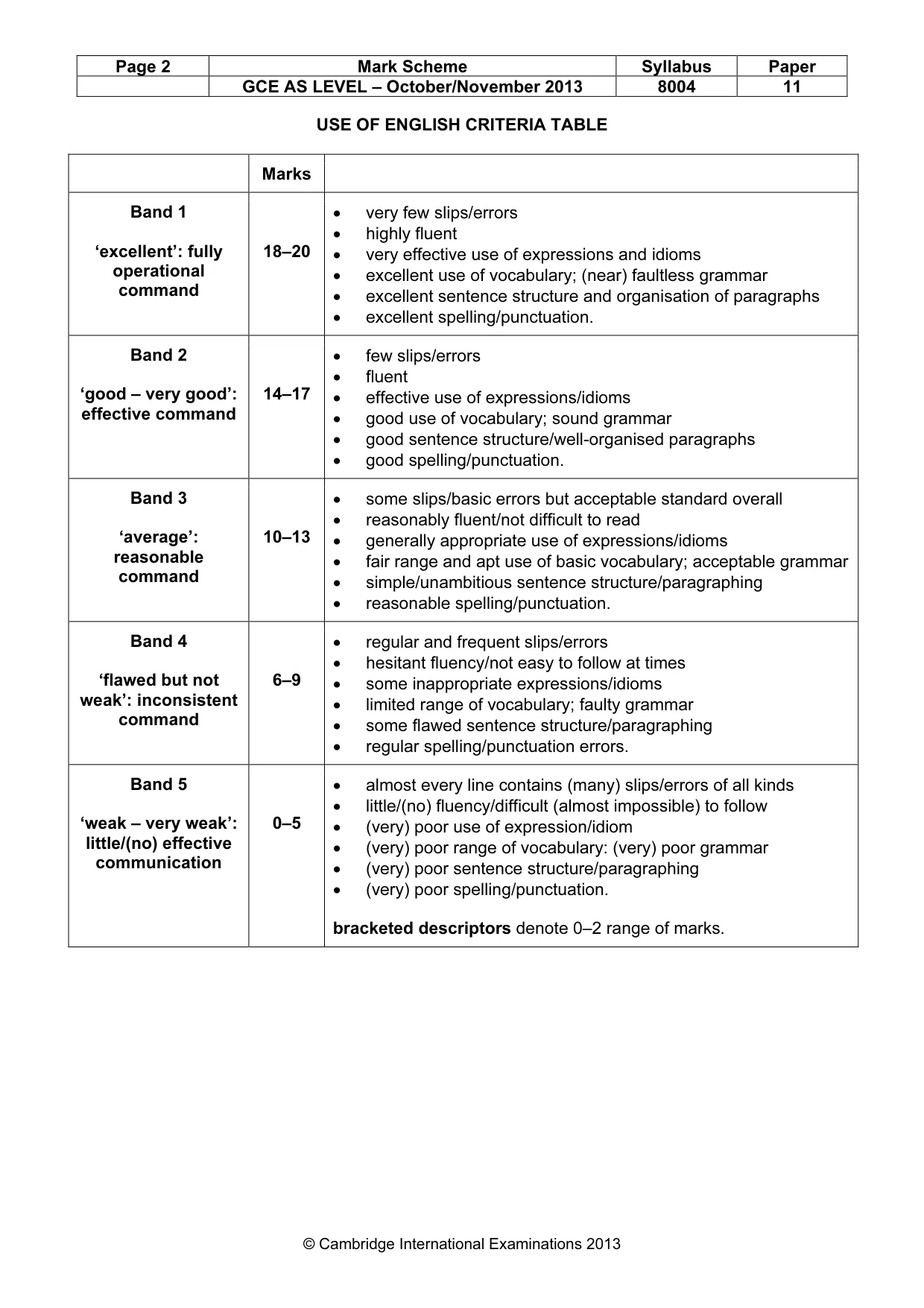
Page 2 Mark Scheme Syllabus Paper GCE AS LEVEL – October/November 2013 8004 11 © Cambridge International Examinations 2013 USE OF ENGLISH CRITERIA TABLE Marks Band 1 ‘excellent’: fully operational command 18–20 • very few slips/errors • highly fluent • very effective use of expressions and idioms • excellent use of vocabulary; (near) faultless grammar • excellent sentence structure and organisation of paragraphs • excellent spelling/punctuation. Band 2 ‘good – very good’: effective command 14–17 • few slips/errors • fluent • effective use of expressions/idioms • good use of vocabulary; sound grammar • good sentence structure/well-organised paragraphs • good spelling/punctuation. Band 3 ‘average’: reasonable command 10–13 • some slips/basic errors but acceptable standard overall • reasonably fluent/not difficult to read • generally appropriate use of expressions/idioms • fair range and apt use of basic vocabulary; acceptable grammar • simple/unambitious sentence structure/paragraphing • reasonable spelling/punctuation. Band 4 ‘flawed but not weak’: inconsistent command 6–9 • regular and frequent slips/errors • hesitant fluency/not easy to follow at times • some inappropriate expressions/idioms • limited range of vocabulary; faulty grammar • some flawed sentence structure/paragraphing • regular spelling/punctuation errors. Band 5 ‘weak – very weak’: little/(no) effective communication 0–5 • almost every line contains (many) slips/errors of all kinds • little/(no) fluency/difficult (almost impossible) to follow • (very) poor use of expression/idiom • (very) poor range of vocabulary: (very) poor grammar • (very) poor sentence structure/paragraphing • (very) poor spelling/punctuation. bracketed descriptors denote 0–2 range of marks.
Mark scheme, page 3
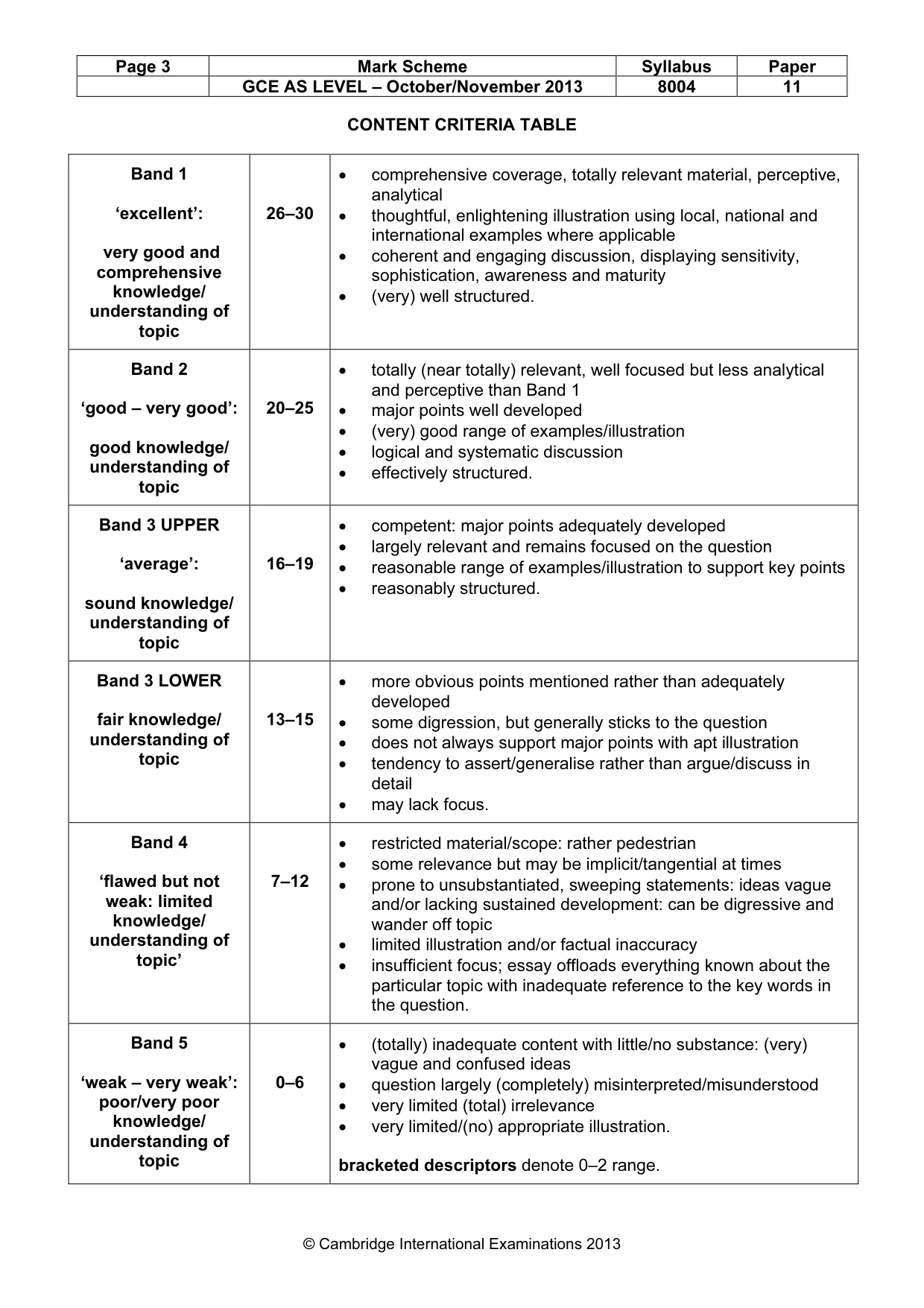
Page 3 Mark Scheme Syllabus Paper GCE AS LEVEL – October/November 2013 8004 11 © Cambridge International Examinations 2013 CONTENT CRITERIA TABLE Band 1 ‘excellent’: very good and comprehensive knowledge/ understanding of topic 26–30 • comprehensive coverage, totally relevant material, perceptive, analytical • thoughtful, enlightening illustration using local, national and international examples where applicable • coherent and engaging discussion, displaying sensitivity, sophistication, awareness and maturity • (very) well structured. Band 2 ‘good – very good’: good knowledge/ understanding of topic 20–25 • totally (near totally) relevant, well focused but less analytical and perceptive than Band 1 • major points well developed • (very) good range of examples/illustration • logical and systematic discussion • effectively structured. Band 3 UPPER ‘average’: sound knowledge/ understanding of topic 16–19 • competent: major points adequately developed • largely relevant and remains focused on the question • reasonable range of examples/illustration to support key points • reasonably structured. Band 3 LOWER fair knowledge/ understanding of topic 13–15 • more obvious points mentioned rather than adequately developed • some digression, but generally sticks to the question • does not always support major points with apt illustration • tendency to assert/generalise rather than argue/discuss in detail • may lack focus. Band 4 ‘flawed but not weak: limited knowledge/ understanding of topic’ 7–12 • restricted material/scope: rather pedestrian • some relevance but may be implicit/tangential at times • prone to unsubstantiated, sweeping statements: ideas vague and/or lacking sustained development: can be digressive and wander off topic • limited illustration and/or factual inaccuracy • insufficient focus; essay offloads everything known about the particular topic with inadequate reference to the key words in the question. Band 5 ‘weak – very weak’: poor/very poor knowledge/ understanding of topic 0–6 • (totally) inadequate content with little/no substance: (very) vague and confused ideas • question largely (completely) misinterpreted/misunderstood • very limited (total) irrelevance • very limited/(no) appropriate illustration. bracketed descriptors denote 0–2 range.
Mark scheme, page 4
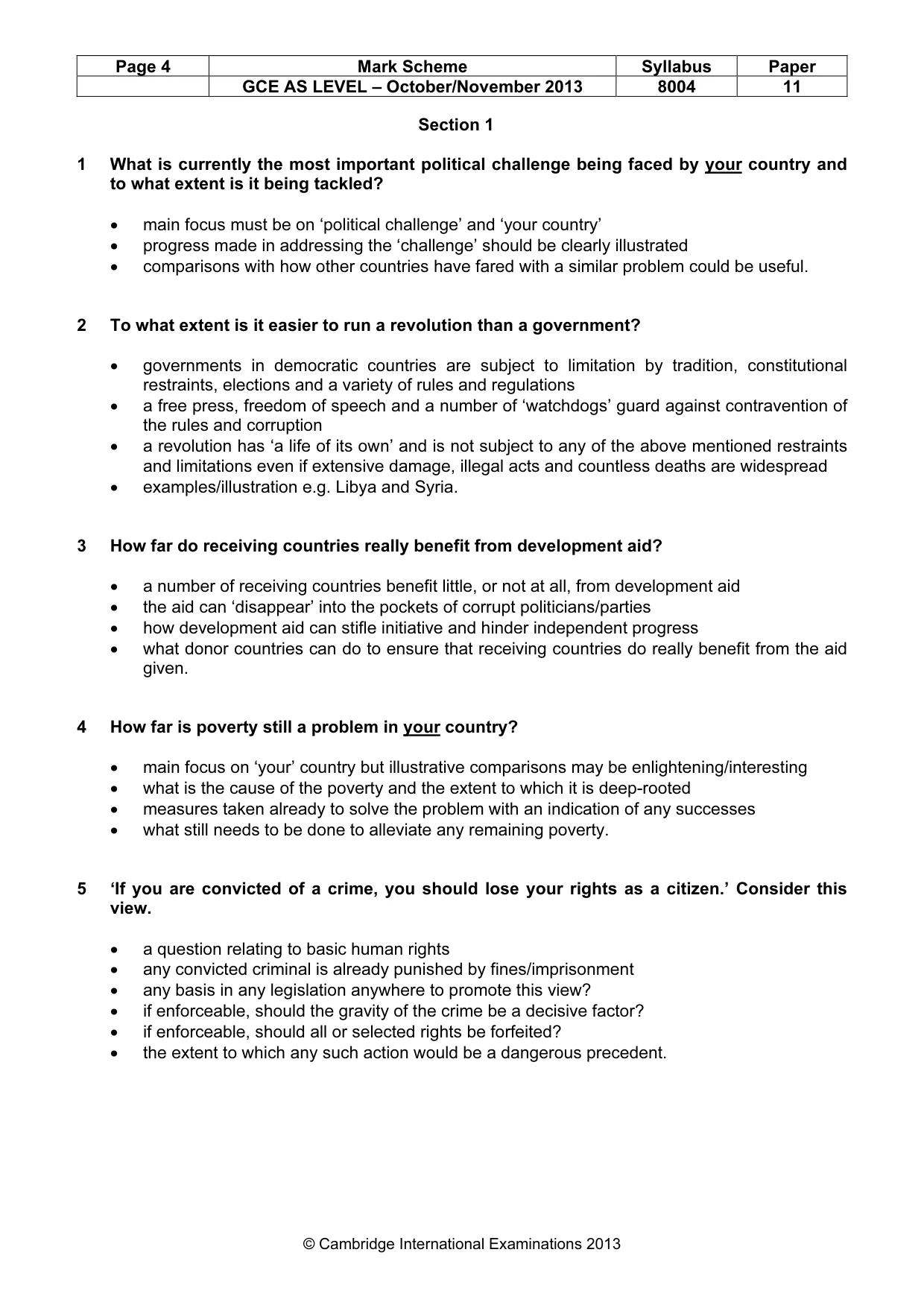
Page 4 Mark Scheme Syllabus Paper GCE AS LEVEL – October/November 2013 8004 11 © Cambridge International Examinations 2013 Section 1 1 What is currently the most important political challenge being faced by your country and to what extent is it being tackled? • main focus must be on ‘political challenge’ and ‘your country’ • progress made in addressing the ‘challenge’ should be clearly illustrated • comparisons with how other countries have fared with a similar problem could be useful. 2 To what extent is it easier to run a revolution than a government? • governments in democratic countries are subject to limitation by tradition, constitutional restraints, elections and a variety of rules and regulations • a free press, freedom of speech and a number of ‘watchdogs’ guard against contravention of the rules and corruption • a revolution has ‘a life of its own’ and is not subject to any of the above mentioned restraints and limitations even if extensive damage, illegal acts and countless deaths are widespread • examples/illustration e.g. Libya and Syria. 3 How far do receiving countries really benefit from development aid? • a number of receiving countries benefit little, or not at all, from development aid • the aid can ‘disappear’ into the pockets of corrupt politicians/parties • how development aid can stifle initiative and hinder independent progress • what donor countries can do to ensure that receiving countries do really benefit from the aid given. 4 How far is poverty still a problem in your country? • main focus on ‘your’ country but illustrative comparisons may be enlightening/interesting • what is the cause of the poverty and the extent to which it is deep-rooted • measures taken already to solve the problem with an indication of any successes • what still needs to be done to alleviate any remaining poverty. 5 ‘If you are convicted of a crime, you should lose your rights as a citizen.’ Consider this view. • a question relating to basic human rights • any convicted criminal is already punished by fines/imprisonment • any basis in any legislation anywhere to promote this view? • if enforceable, should the gravity of the crime be a decisive factor? • if enforceable, should all or selected rights be forfeited? • the extent to which any such action would be a dangerous precedent.
Mark scheme, page 5
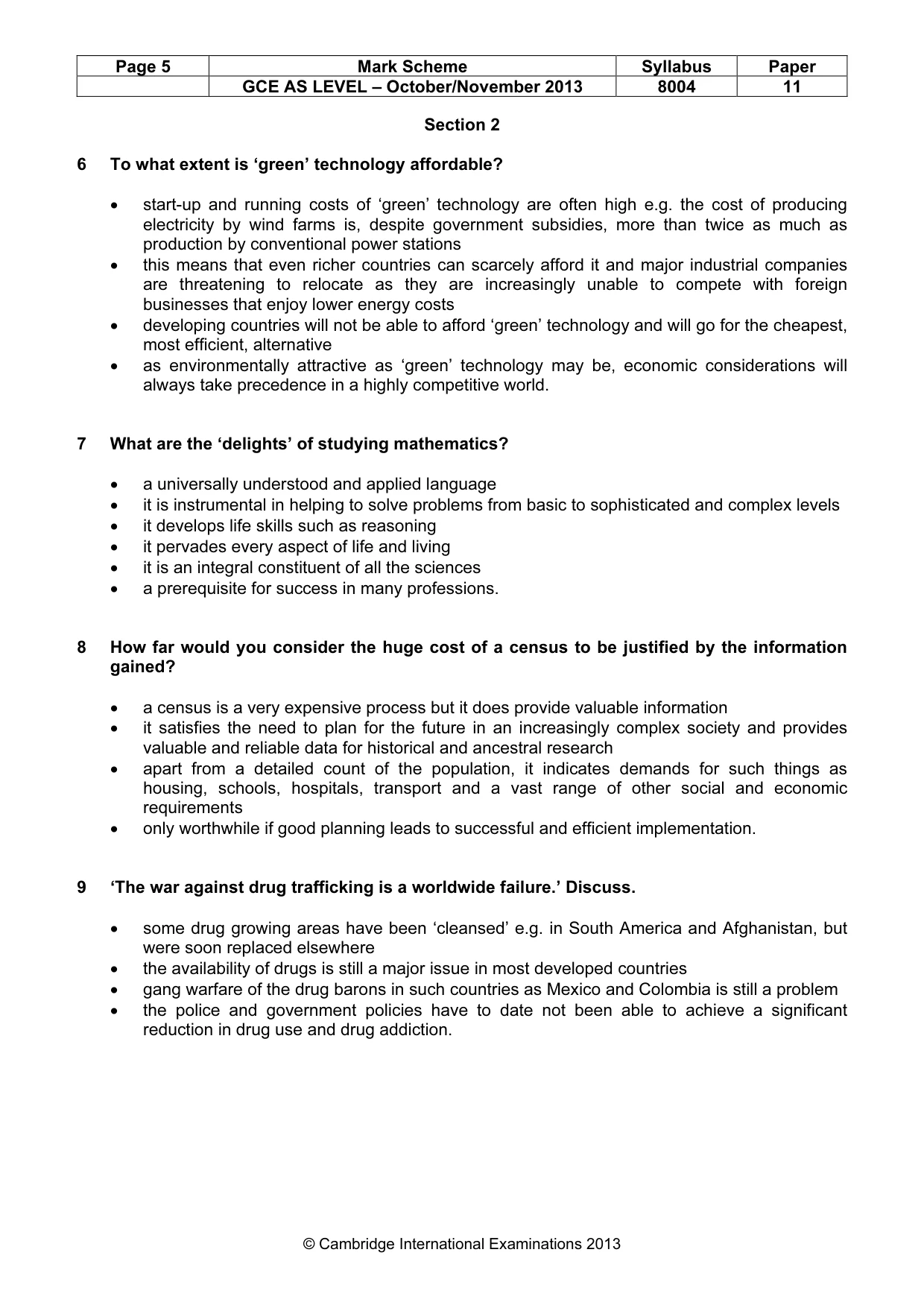
Page 5 Mark Scheme Syllabus Paper GCE AS LEVEL – October/November 2013 8004 11 © Cambridge International Examinations 2013 Section 2 6 To what extent is ‘green’ technology affordable? • start-up and running costs of ‘green’ technology are often high e.g. the cost of producing electricity by wind farms is, despite government subsidies, more than twice as much as production by conventional power stations • this means that even richer countries can scarcely afford it and major industrial companies are threatening to relocate as they are increasingly unable to compete with foreign businesses that enjoy lower energy costs • developing countries will not be able to afford ‘green’ technology and will go for the cheapest, most efficient, alternative • as environmentally attractive as ‘green’ technology may be, economic considerations will always take precedence in a highly competitive world. 7 What are the ‘delights’ of studying mathematics? • a universally understood and applied language • it is instrumental in helping to solve problems from basic to sophisticated and complex levels • it develops life skills such as reasoning • it pervades every aspect of life and living • it is an integral constituent of all the sciences • a prerequisite for success in many professions. 8 How far would you consider the huge cost of a census to be justified by the information gained? • a census is a very expensive process but it does provide valuable information • it satisfies the need to plan for the future in an increasingly complex society and provides valuable and reliable data for historical and ancestral research • apart from a detailed count of the population, it indicates demands for such things as housing, schools, hospitals, transport and a vast range of other social and economic requirements • only worthwhile if good planning leads to successful and efficient implementation. 9 ‘The war against drug trafficking is a worldwide failure.’ Discuss. • some drug growing areas have been ‘cleansed’ e.g. in South America and Afghanistan, but were soon replaced elsewhere • the availability of drugs is still a major issue in most developed countries • gang warfare of the drug barons in such countries as Mexico and Colombia is still a problem • the police and government policies have to date not been able to achieve a significant reduction in drug use and drug addiction.
Mark scheme, page 6
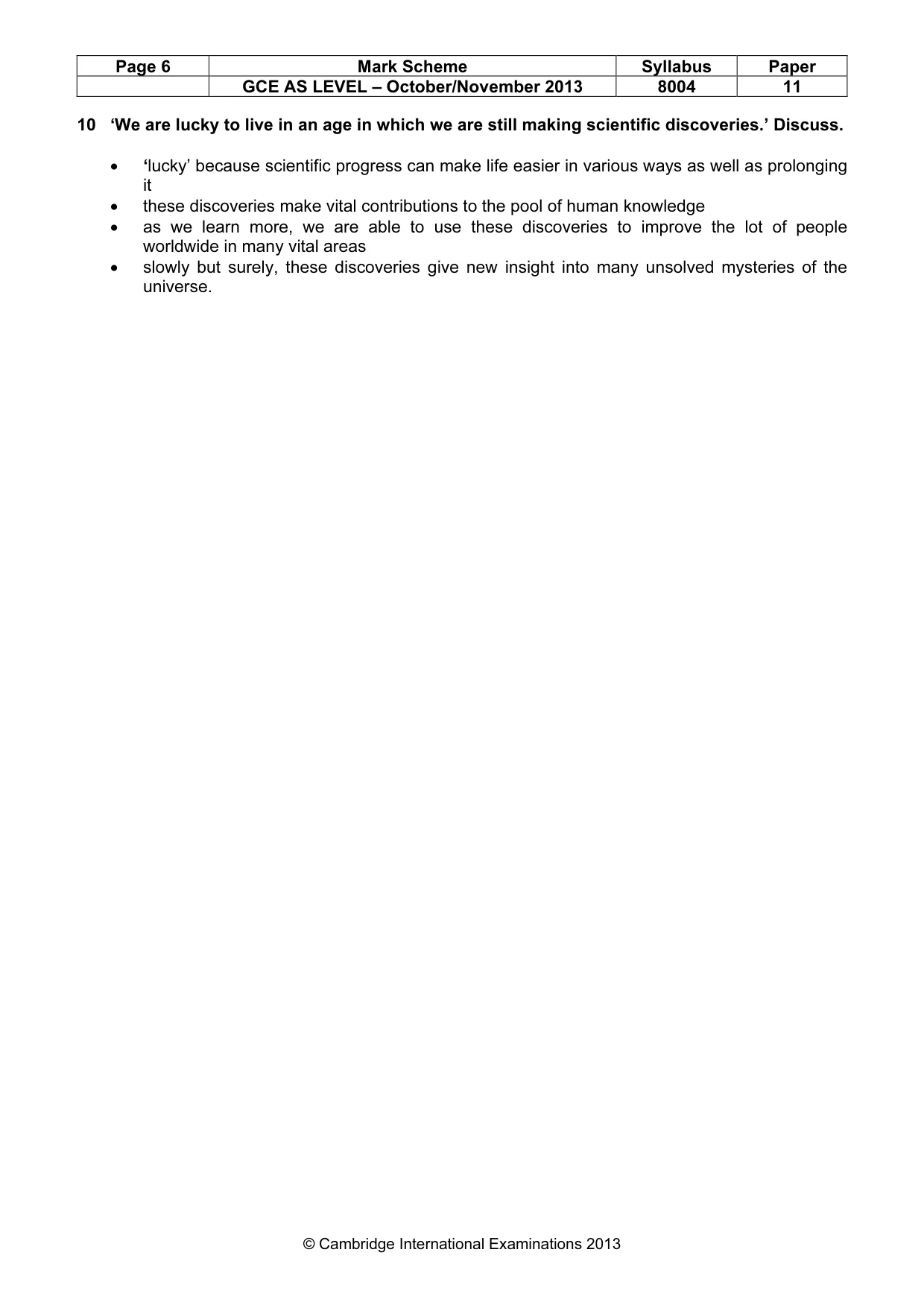
Page 6 Mark Scheme Syllabus Paper GCE AS LEVEL – October/November 2013 8004 11 © Cambridge International Examinations 2013 10 ‘We are lucky to live in an age in which we are still making scientific discoveries.’ Discuss. • ‘lucky’ because scientific progress can make life easier in various ways as well as prolonging it • these discoveries make vital contributions to the pool of human knowledge • as we learn more, we are able to use these discoveries to improve the lot of people worldwide in many vital areas • slowly but surely, these discoveries give new insight into many unsolved mysteries of the universe.
Mark scheme, page 7
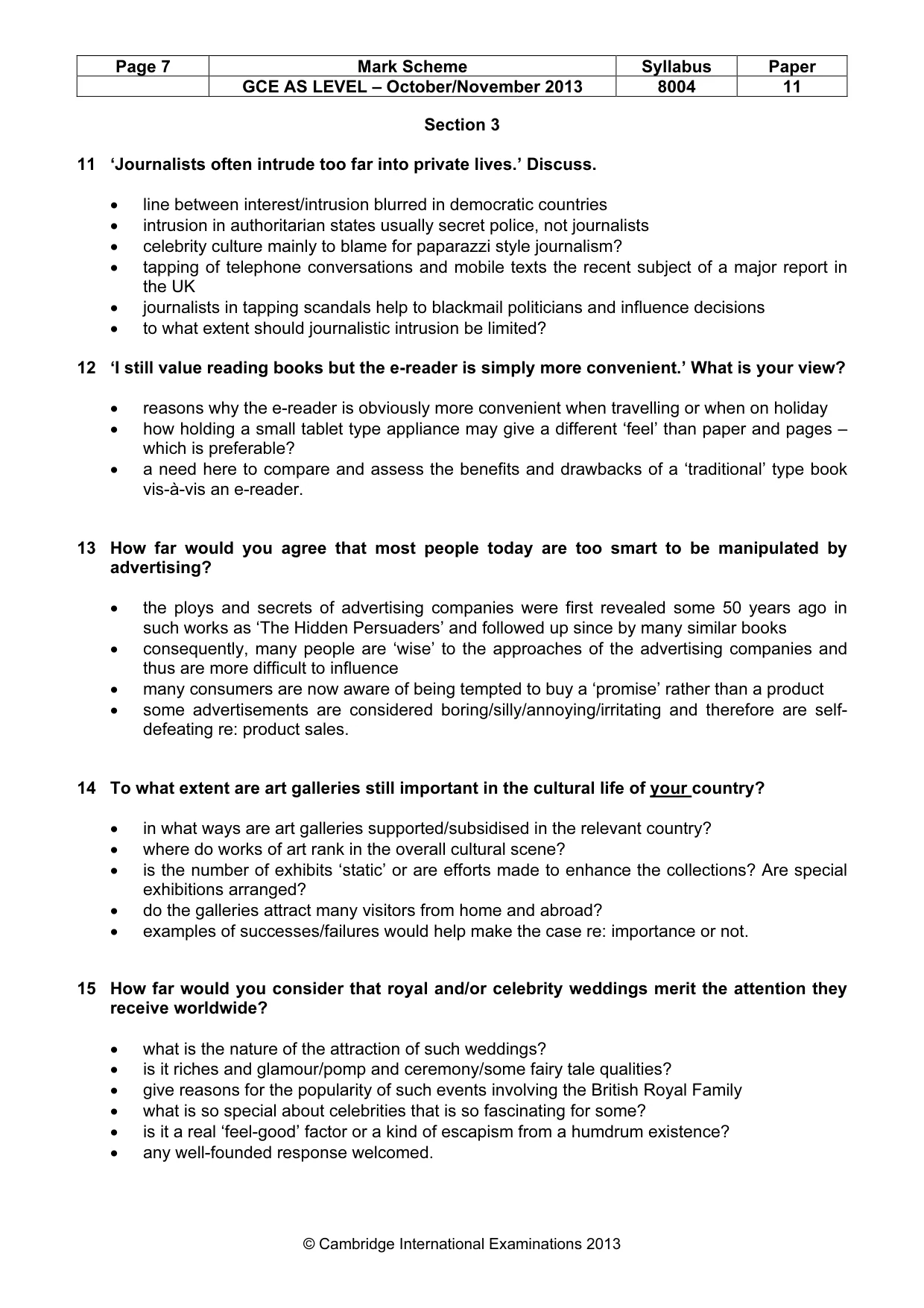
Page 7 Mark Scheme Syllabus Paper GCE AS LEVEL – October/November 2013 8004 11 © Cambridge International Examinations 2013 Section 3 11 ‘Journalists often intrude too far into private lives.’ Discuss. • line between interest/intrusion blurred in democratic countries • intrusion in authoritarian states usually secret police, not journalists • celebrity culture mainly to blame for paparazzi style journalism? • tapping of telephone conversations and mobile texts the recent subject of a major report in the UK • journalists in tapping scandals help to blackmail politicians and influence decisions • to what extent should journalistic intrusion be limited? 12 ‘I still value reading books but the e-reader is simply more convenient.’ What is your view? • reasons why the e-reader is obviously more convenient when travelling or when on holiday • how holding a small tablet type appliance may give a different ‘feel’ than paper and pages – which is preferable? • a need here to compare and assess the benefits and drawbacks of a ‘traditional’ type book vis-à-vis an e-reader. 13 How far would you agree that most people today are too smart to be manipulated by advertising? • the ploys and secrets of advertising companies were first revealed some 50 years ago in such works as ‘The Hidden Persuaders’ and followed up since by many similar books • consequently, many people are ‘wise’ to the approaches of the advertising companies and thus are more difficult to influence • many consumers are now aware of being tempted to buy a ‘promise’ rather than a product • some advertisements are considered boring/silly/annoying/irritating and therefore are self- defeating re: product sales. 14 To what extent are art galleries still important in the cultural life of your country? • in what ways are art galleries supported/subsidised in the relevant country? • where do works of art rank in the overall cultural scene? • is the number of exhibits ‘static’ or are efforts made to enhance the collections? Are special exhibitions arranged? • do the galleries attract many visitors from home and abroad? • examples of successes/failures would help make the case re: importance or not. 15 How far would you consider that royal and/or celebrity weddings merit the attention they receive worldwide? • what is the nature of the attraction of such weddings? • is it riches and glamour/pomp and ceremony/some fairy tale qualities? • give reasons for the popularity of such events involving the British Royal Family • what is so special about celebrities that is so fascinating for some? • is it a real ‘feel-good’ factor or a kind of escapism from a humdrum existence? • any well-founded response welcomed.
What you needed in this session
Cambridge’s own grade thresholds for 2013 Oct/Nov, Paper 1 · Variant 1. A higher threshold means an easier paper — the bar moves with how the cohort did.