Cambridge A Level General Paper (AS Level only) 8004 — 2010 May/June Paper 1 · Variant 2
8004/12/M/J/10 · 100 marks · ≈113 min
The question paper and its mark scheme, free to read here and free to download. This is Cambridge’s own paper, exactly as it was sat.
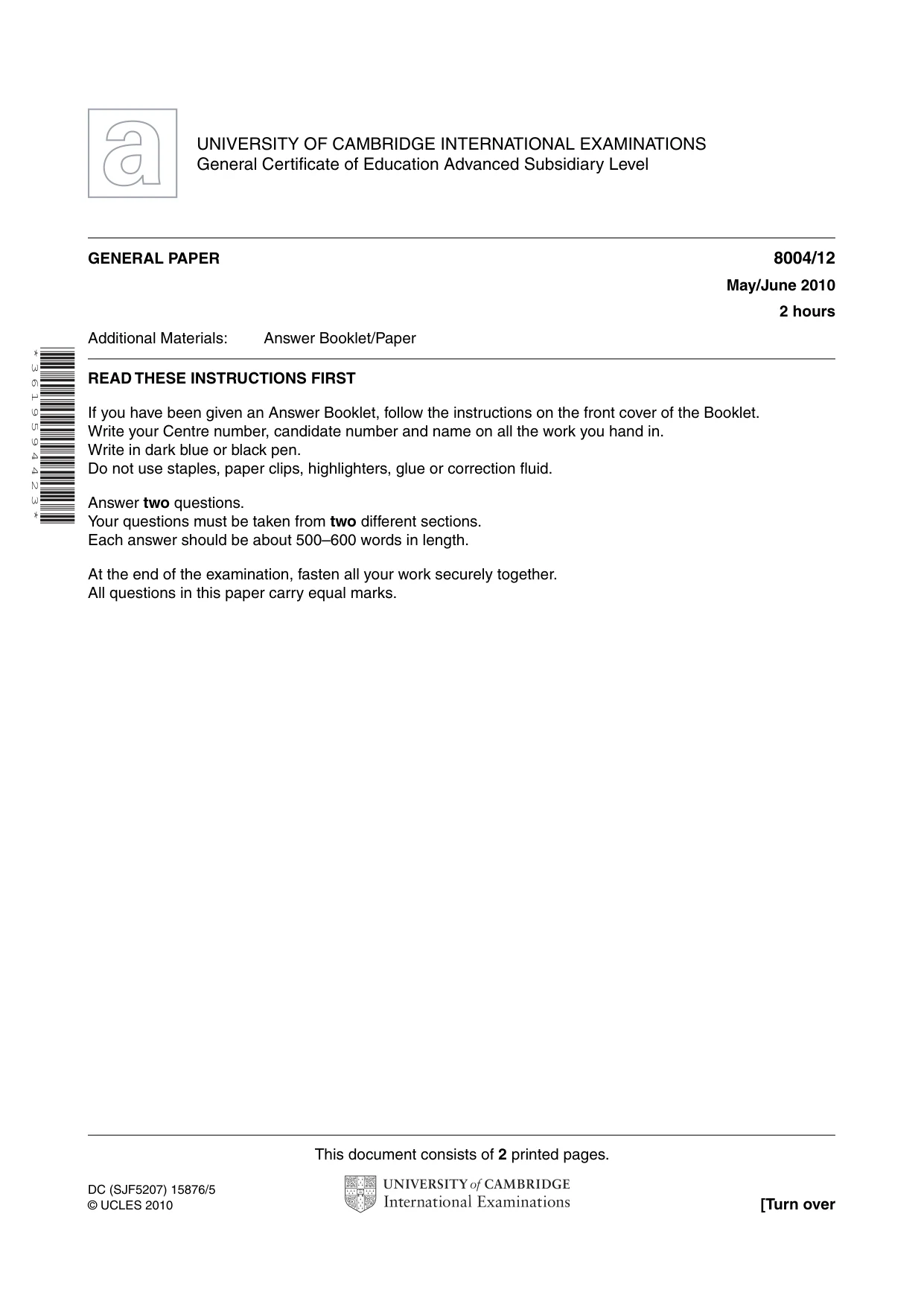
Question paper2 pages
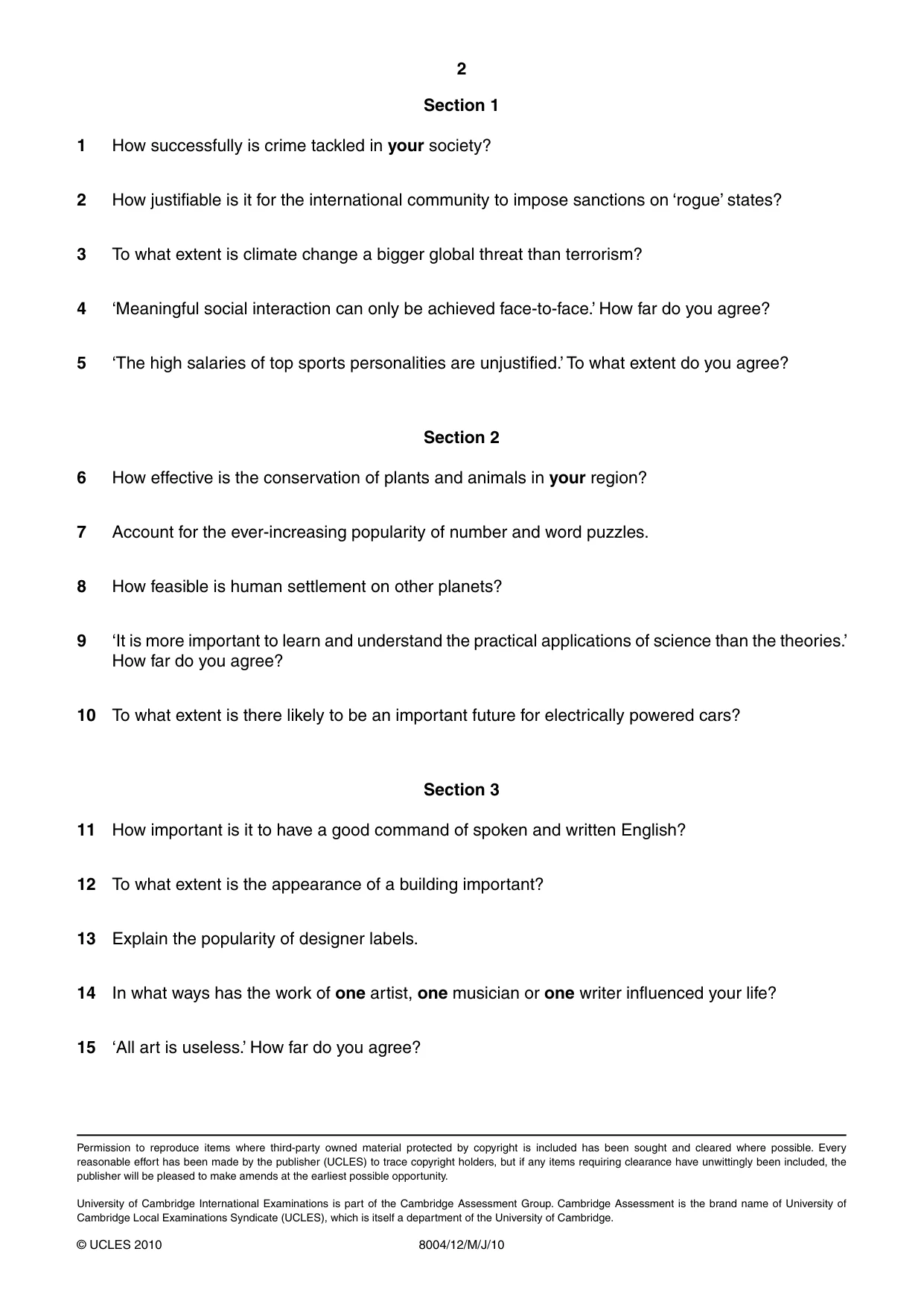
Mark scheme9 pages
Answers below. Sit the paper first if you are practising.
Paper as text
Question paper, page 1
This document consists of 2 printed pages. DC (SJF5207) 15876/5 © UCLES 2010 [Turn over UNIVERSITY OF CAMBRIDGE INTERNATIONAL EXAMINATIONS General Certificate of Education Advanced Subsidiary Level READ THESE INSTRUCTIONS FIRST If you have been given an Answer Booklet, follow the instructions on the front cover of the Booklet. Write your Centre number, candidate number and name on all the work you hand in. Write in dark blue or black pen. Do not use staples, paper clips, highlighters, glue or correction fluid. Answer two questions. Your questions must be taken from two different sections. Each answer should be about 500–600 words in length. At the end of the examination, fasten all your work securely together. All questions in this paper carry equal marks. * 3 6 1 9 5 9 4 4 2 3 * GENERAL PAPER 8004/12 May/June 2010 2 hours Additional Materials: Answer Booklet/Paper
Question paper, page 2
2 8004/12/M/J/10 © UCLES 2010 Section 1 1 How successfully is crime tackled in your society? 2 How justifiable is it for the international community to impose sanctions on ‘rogue’ states? 3 To what extent is climate change a bigger global threat than terrorism? 4 ‘Meaningful social interaction can only be achieved face-to-face.’ How far do you agree? 5 ‘The high salaries of top sports personalities are unjustified.’ To what extent do you agree? Section 2 6 How effective is the conservation of plants and animals in your region? 7 Account for the ever-increasing popularity of number and word puzzles. 8 How feasible is human settlement on other planets? 9 ‘It is more important to learn and understand the practical applications of science than the theories.’ How far do you agree? 10 To what extent is there likely to be an important future for electrically powered cars? Section 3 11 How important is it to have a good command of spoken and written English? 12 To what extent is the appearance of a building important? 13 Explain the popularity of designer labels. 14 In what ways has the work of one artist, one musician or one writer influenced your life? 15 ‘All art is useless.’ How far do you agree? Permission to reproduce items where third-party owned material protected by copyright is included has been sought and cleared where possible. Every reasonable effort has been made by the publisher (UCLES) to trace copyright holders, but if any items requiring clearance have unwittingly been included, the publisher will be pleased to make amends at the earliest possible opportunity. University of Cambridge International Examinations is part of the Cambridge Assessment Group. Cambridge Assessment is the brand name of University of Cambridge Local Examinations Syndicate (UCLES), which is itself a department of the University of Cambridge.
Mark scheme, page 1
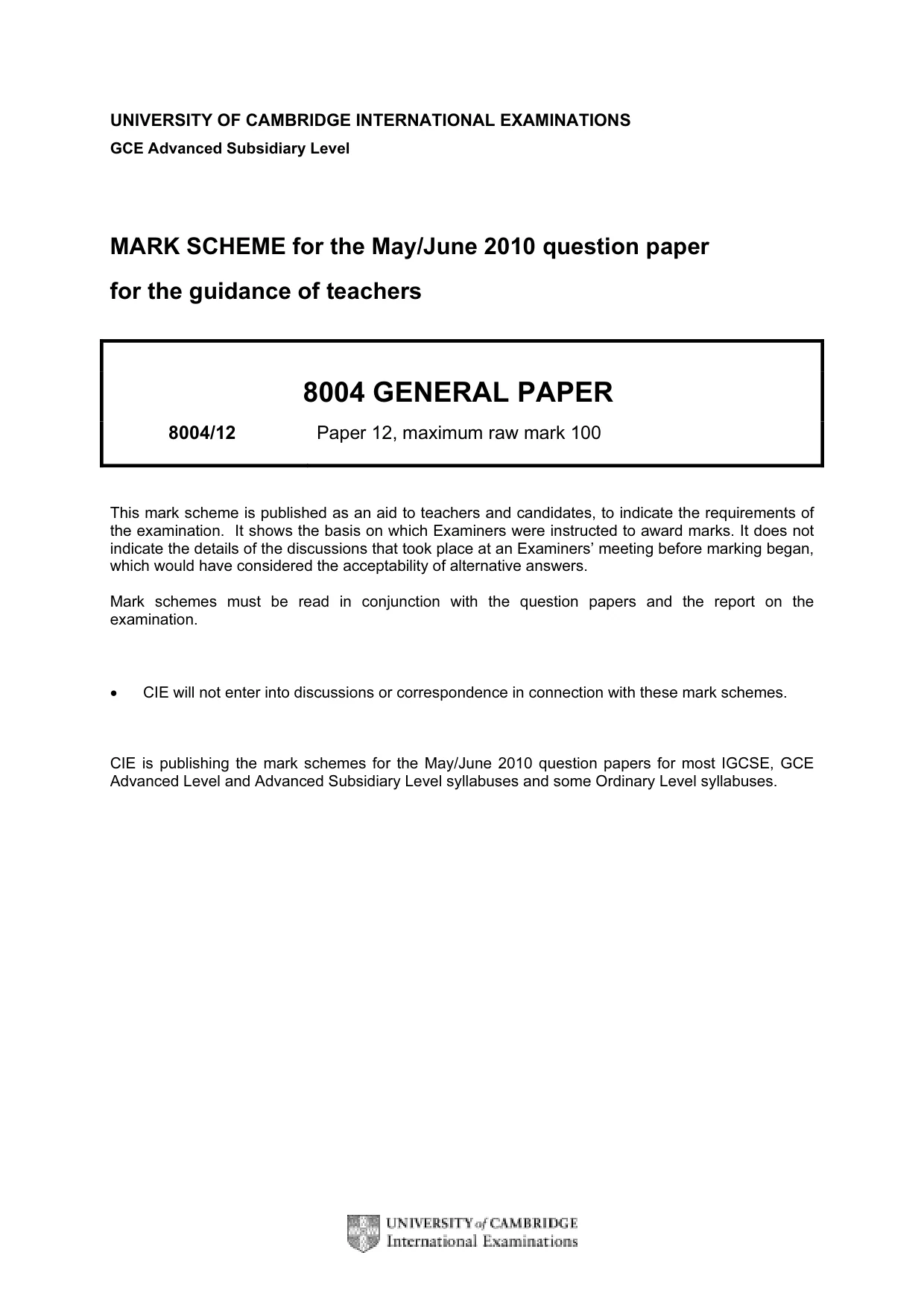
UNIVERSITY OF CAMBRIDGE INTERNATIONAL EXAMINATIONS GCE Advanced Subsidiary Level MARK SCHEME for the May/June 2010 question paper for the guidance of teachers 8004 GENERAL PAPER 8004/12 Paper 12, maximum raw mark 100 This mark scheme is published as an aid to teachers and candidates, to indicate the requirements of the examination. It shows the basis on which Examiners were instructed to award marks. It does not indicate the details of the discussions that took place at an Examiners’ meeting before marking began, which would have considered the acceptability of alternative answers. Mark schemes must be read in conjunction with the question papers and the report on the examination. • CIE will not enter into discussions or correspondence in connection with these mark schemes. CIE is publishing the mark schemes for the May/June 2010 question papers for most IGCSE, GCE Advanced Level and Advanced Subsidiary Level syllabuses and some Ordinary Level syllabuses.
Mark scheme, page 2
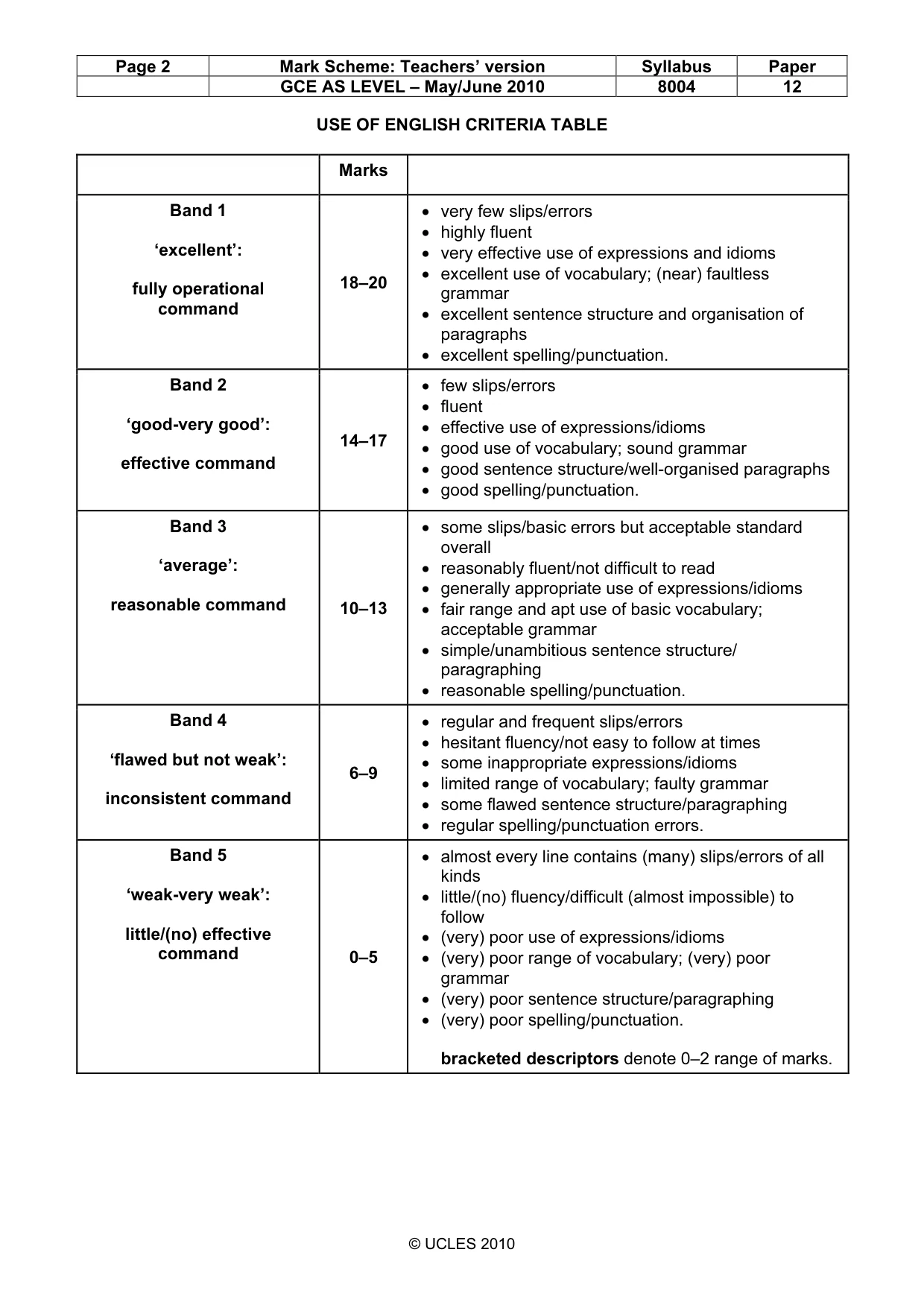
Page 2 Mark Scheme: Teachers’ version Syllabus Paper GCE AS LEVEL – May/June 2010 8004 12 © UCLES 2010 USE OF ENGLISH CRITERIA TABLE Marks Band 1 ‘excellent’: fully operational command 18–20 • very few slips/errors • highly fluent • very effective use of expressions and idioms • excellent use of vocabulary; (near) faultless grammar • excellent sentence structure and organisation of paragraphs • excellent spelling/punctuation. Band 2 ‘good-very good’: effective command 14–17 • few slips/errors • fluent • effective use of expressions/idioms • good use of vocabulary; sound grammar • good sentence structure/well-organised paragraphs • good spelling/punctuation. Band 3 ‘average’: reasonable command 10–13 • some slips/basic errors but acceptable standard overall • reasonably fluent/not difficult to read • generally appropriate use of expressions/idioms • fair range and apt use of basic vocabulary; acceptable grammar • simple/unambitious sentence structure/ paragraphing • reasonable spelling/punctuation. Band 4 ‘flawed but not weak’: inconsistent command 6–9 • regular and frequent slips/errors • hesitant fluency/not easy to follow at times • some inappropriate expressions/idioms • limited range of vocabulary; faulty grammar • some flawed sentence structure/paragraphing • regular spelling/punctuation errors. Band 5 ‘weak-very weak’: little/(no) effective command 0–5 • almost every line contains (many) slips/errors of all kinds • little/(no) fluency/difficult (almost impossible) to follow • (very) poor use of expressions/idioms • (very) poor range of vocabulary; (very) poor grammar • (very) poor sentence structure/paragraphing • (very) poor spelling/punctuation. bracketed descriptors denote 0–2 range of marks.
Mark scheme, page 3
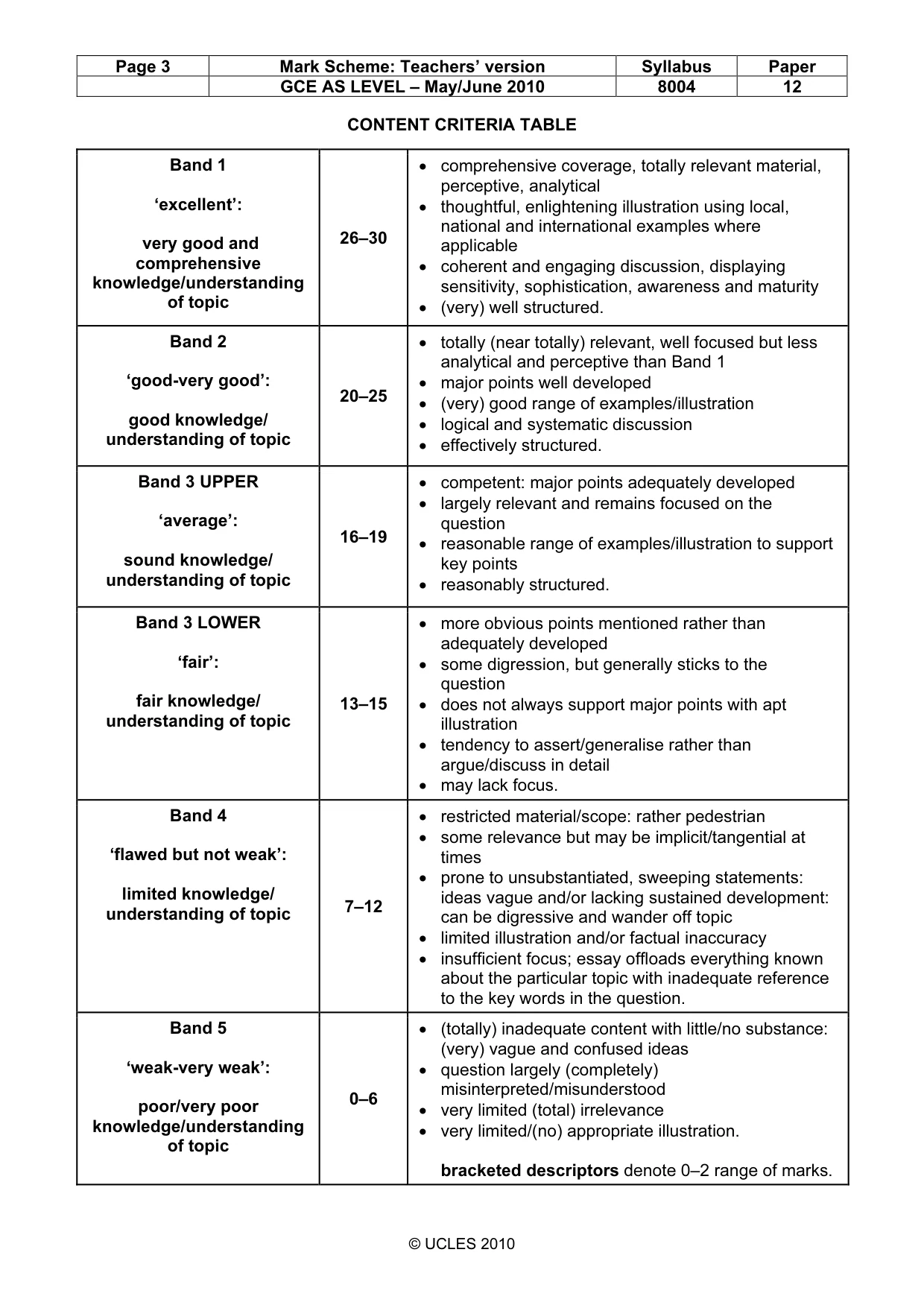
Page 3 Mark Scheme: Teachers’ version Syllabus Paper GCE AS LEVEL – May/June 2010 8004 12 © UCLES 2010 CONTENT CRITERIA TABLE Band 1 ‘excellent’: very good and comprehensive knowledge/understanding of topic 26–30 • comprehensive coverage, totally relevant material, perceptive, analytical • thoughtful, enlightening illustration using local, national and international examples where applicable • coherent and engaging discussion, displaying sensitivity, sophistication, awareness and maturity • (very) well structured. Band 2 ‘good-very good’: good knowledge/ understanding of topic 20–25 • totally (near totally) relevant, well focused but less analytical and perceptive than Band 1 • major points well developed • (very) good range of examples/illustration • logical and systematic discussion • effectively structured. Band 3 UPPER ‘average’: sound knowledge/ understanding of topic 16–19 • competent: major points adequately developed • largely relevant and remains focused on the question • reasonable range of examples/illustration to support key points • reasonably structured. Band 3 LOWER ‘fair’: fair knowledge/ understanding of topic 13–15 • more obvious points mentioned rather than adequately developed • some digression, but generally sticks to the question • does not always support major points with apt illustration • tendency to assert/generalise rather than argue/discuss in detail • may lack focus. Band 4 ‘flawed but not weak’: limited knowledge/ understanding of topic 7–12 • restricted material/scope: rather pedestrian • some relevance but may be implicit/tangential at times • prone to unsubstantiated, sweeping statements: ideas vague and/or lacking sustained development: can be digressive and wander off topic • limited illustration and/or factual inaccuracy • insufficient focus; essay offloads everything known about the particular topic with inadequate reference to the key words in the question. Band 5 ‘weak-very weak’: poor/very poor knowledge/understanding of topic 0–6 • (totally) inadequate content with little/no substance: (very) vague and confused ideas • question largely (completely) misinterpreted/misunderstood • very limited (total) irrelevance • very limited/(no) appropriate illustration. bracketed descriptors denote 0–2 range of marks.
Mark scheme, page 4
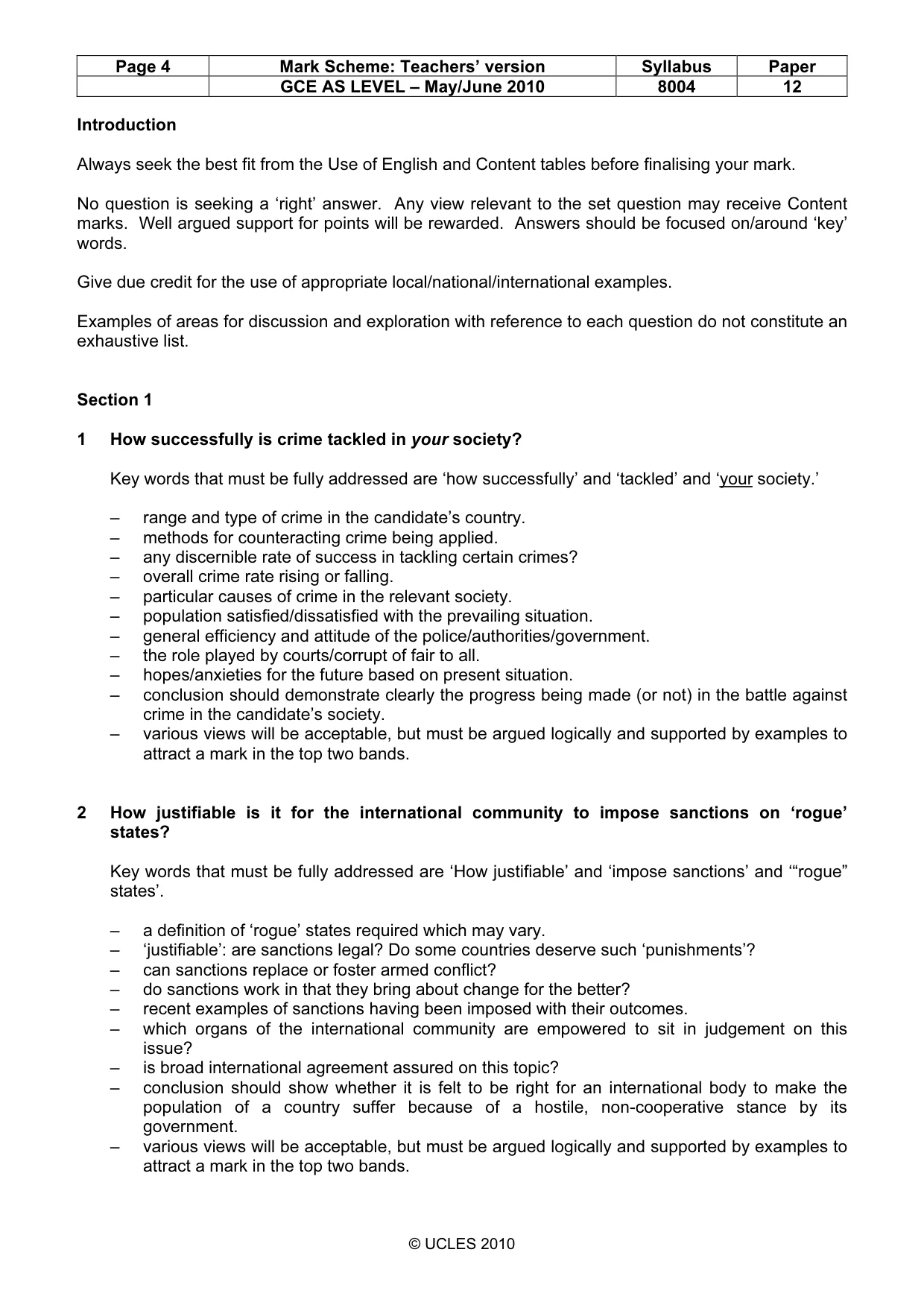
Page 4 Mark Scheme: Teachers’ version Syllabus Paper GCE AS LEVEL – May/June 2010 8004 12 © UCLES 2010 Introduction Always seek the best fit from the Use of English and Content tables before finalising your mark. No question is seeking a ‘right’ answer. Any view relevant to the set question may receive Content marks. Well argued support for points will be rewarded. Answers should be focused on/around ‘key’ words. Give due credit for the use of appropriate local/national/international examples. Examples of areas for discussion and exploration with reference to each question do not constitute an exhaustive list. Section 1 1 How successfully is crime tackled in your society? Key words that must be fully addressed are ‘how successfully’ and ‘tackled’ and ‘your society.’ – range and type of crime in the candidate’s country. – methods for counteracting crime being applied. – any discernible rate of success in tackling certain crimes? – overall crime rate rising or falling. – particular causes of crime in the relevant society. – population satisfied/dissatisfied with the prevailing situation. – general efficiency and attitude of the police/authorities/government. – the role played by courts/corrupt of fair to all. – hopes/anxieties for the future based on present situation. – conclusion should demonstrate clearly the progress being made (or not) in the battle against crime in the candidate’s society. – various views will be acceptable, but must be argued logically and supported by examples to attract a mark in the top two bands. 2 How justifiable is it for the international community to impose sanctions on ‘rogue’ states? Key words that must be fully addressed are ‘How justifiable’ and ‘impose sanctions’ and ‘“rogue” states’. – a definition of ‘rogue’ states required which may vary. – ‘justifiable’: are sanctions legal? Do some countries deserve such ‘punishments’? – can sanctions replace or foster armed conflict? – do sanctions work in that they bring about change for the better? – recent examples of sanctions having been imposed with their outcomes. – which organs of the international community are empowered to sit in judgement on this issue? – is broad international agreement assured on this topic? – conclusion should show whether it is felt to be right for an international body to make the population of a country suffer because of a hostile, non-cooperative stance by its government. – various views will be acceptable, but must be argued logically and supported by examples to attract a mark in the top two bands.
Mark scheme, page 5
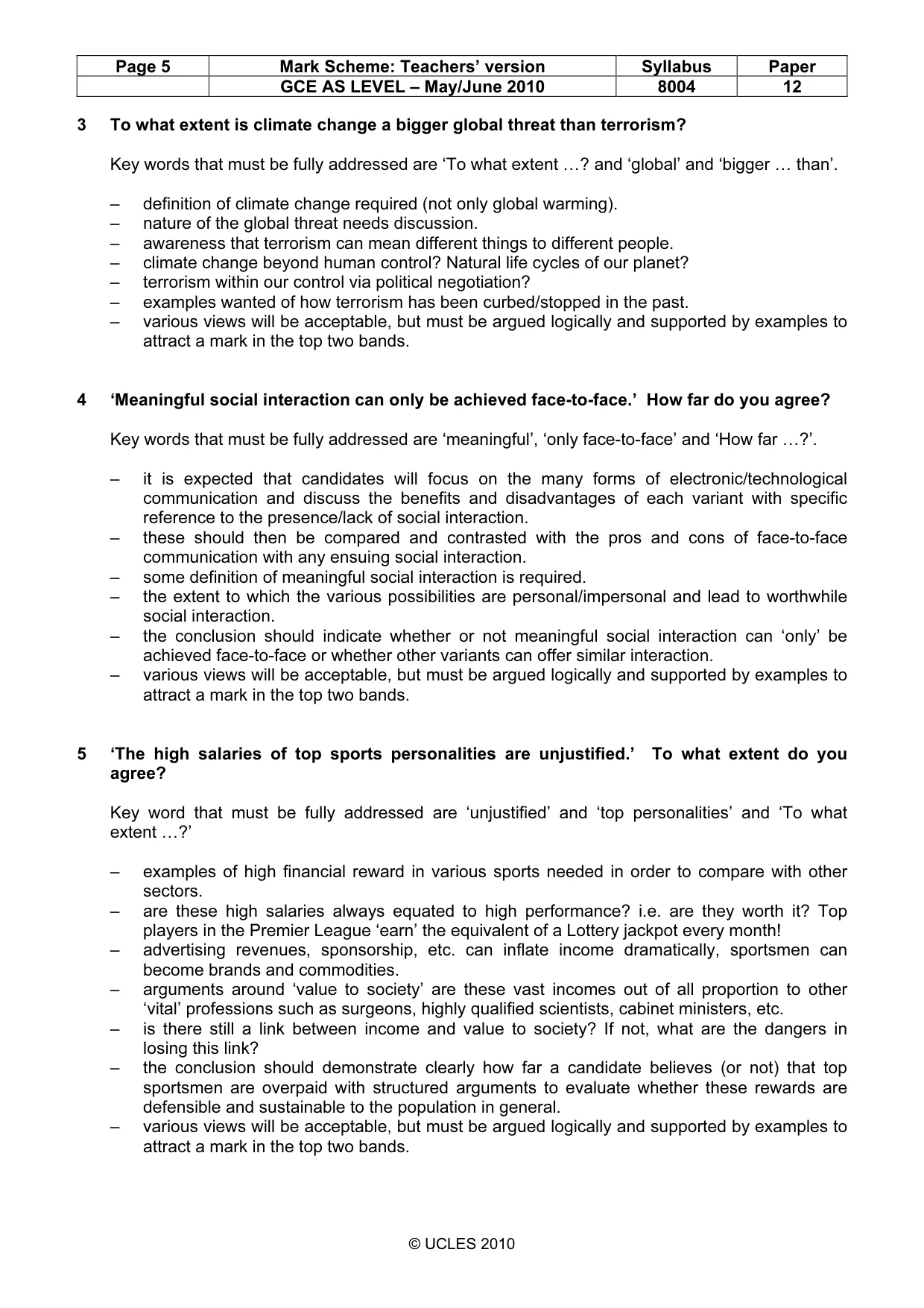
Page 5 Mark Scheme: Teachers’ version Syllabus Paper GCE AS LEVEL – May/June 2010 8004 12 © UCLES 2010 3 To what extent is climate change a bigger global threat than terrorism? Key words that must be fully addressed are ‘To what extent …? and ‘global’ and ‘bigger … than’. – definition of climate change required (not only global warming). – nature of the global threat needs discussion. – awareness that terrorism can mean different things to different people. – climate change beyond human control? Natural life cycles of our planet? – terrorism within our control via political negotiation? – examples wanted of how terrorism has been curbed/stopped in the past. – various views will be acceptable, but must be argued logically and supported by examples to attract a mark in the top two bands. 4 ‘Meaningful social interaction can only be achieved face-to-face.’ How far do you agree? Key words that must be fully addressed are ‘meaningful’, ‘only face-to-face’ and ‘How far …?’. – it is expected that candidates will focus on the many forms of electronic/technological communication and discuss the benefits and disadvantages of each variant with specific reference to the presence/lack of social interaction. – these should then be compared and contrasted with the pros and cons of face-to-face communication with any ensuing social interaction. – some definition of meaningful social interaction is required. – the extent to which the various possibilities are personal/impersonal and lead to worthwhile social interaction. – the conclusion should indicate whether or not meaningful social interaction can ‘only’ be achieved face-to-face or whether other variants can offer similar interaction. – various views will be acceptable, but must be argued logically and supported by examples to attract a mark in the top two bands. 5 ‘The high salaries of top sports personalities are unjustified.’ To what extent do you agree? Key word that must be fully addressed are ‘unjustified’ and ‘top personalities’ and ‘To what extent …?’ – examples of high financial reward in various sports needed in order to compare with other sectors. – are these high salaries always equated to high performance? i.e. are they worth it? Top players in the Premier League ‘earn’ the equivalent of a Lottery jackpot every month! – advertising revenues, sponsorship, etc. can inflate income dramatically, sportsmen can become brands and commodities. – arguments around ‘value to society’ are these vast incomes out of all proportion to other ‘vital’ professions such as surgeons, highly qualified scientists, cabinet ministers, etc. – is there still a link between income and value to society? If not, what are the dangers in losing this link? – the conclusion should demonstrate clearly how far a candidate believes (or not) that top sportsmen are overpaid with structured arguments to evaluate whether these rewards are defensible and sustainable to the population in general. – various views will be acceptable, but must be argued logically and supported by examples to attract a mark in the top two bands.
Mark scheme, page 6
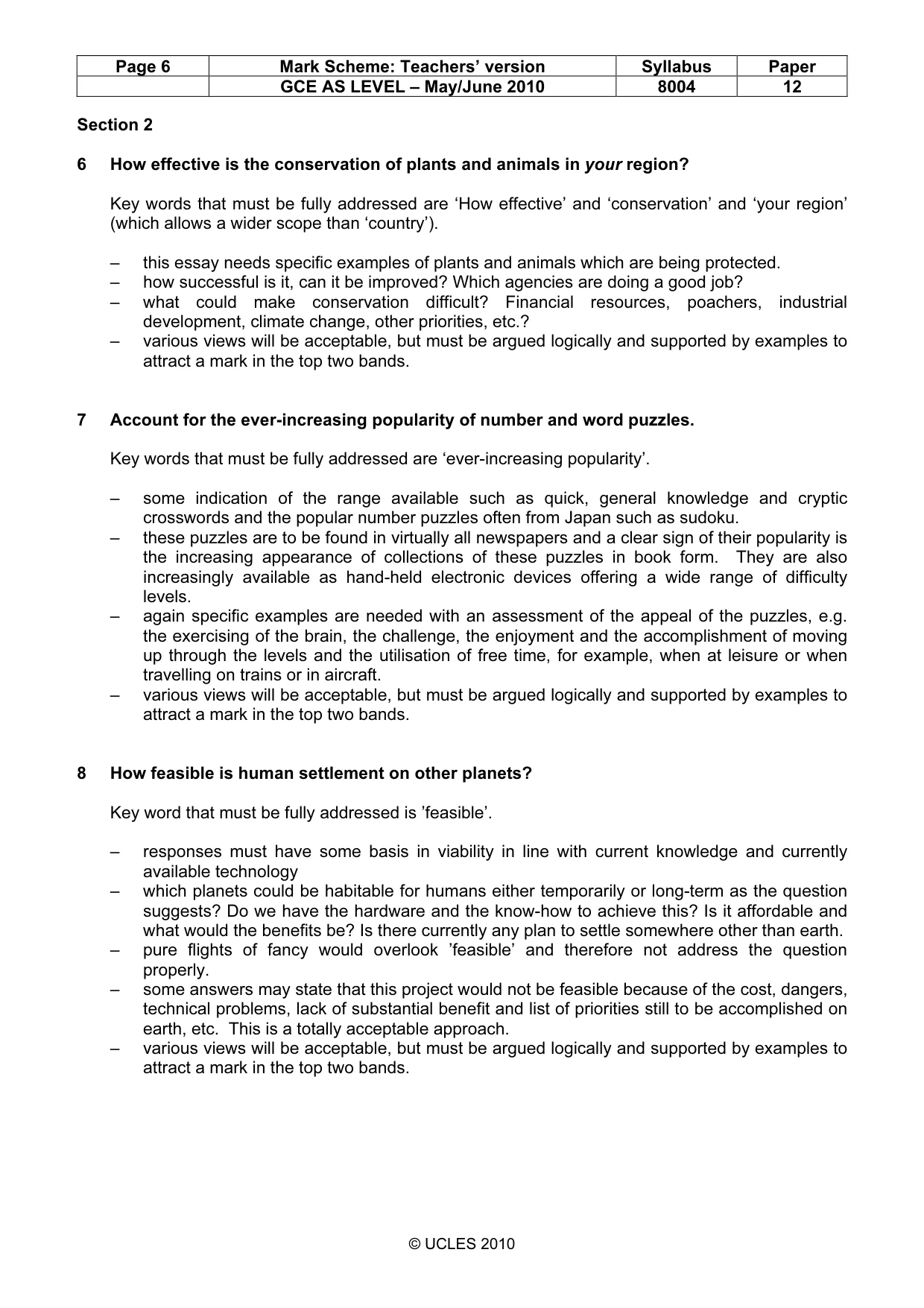
Page 6 Mark Scheme: Teachers’ version Syllabus Paper GCE AS LEVEL – May/June 2010 8004 12 © UCLES 2010 Section 2 6 How effective is the conservation of plants and animals in your region? Key words that must be fully addressed are ‘How effective’ and ‘conservation’ and ‘your region’ (which allows a wider scope than ‘country’). – this essay needs specific examples of plants and animals which are being protected. – how successful is it, can it be improved? Which agencies are doing a good job? – what could make conservation difficult? Financial resources, poachers, industrial development, climate change, other priorities, etc.? – various views will be acceptable, but must be argued logically and supported by examples to attract a mark in the top two bands. 7 Account for the ever-increasing popularity of number and word puzzles. Key words that must be fully addressed are ‘ever-increasing popularity’. – some indication of the range available such as quick, general knowledge and cryptic crosswords and the popular number puzzles often from Japan such as sudoku. – these puzzles are to be found in virtually all newspapers and a clear sign of their popularity is the increasing appearance of collections of these puzzles in book form. They are also increasingly available as hand-held electronic devices offering a wide range of difficulty levels. – again specific examples are needed with an assessment of the appeal of the puzzles, e.g. the exercising of the brain, the challenge, the enjoyment and the accomplishment of moving up through the levels and the utilisation of free time, for example, when at leisure or when travelling on trains or in aircraft. – various views will be acceptable, but must be argued logically and supported by examples to attract a mark in the top two bands. 8 How feasible is human settlement on other planets? Key word that must be fully addressed is ’feasible’. – responses must have some basis in viability in line with current knowledge and currently available technology – which planets could be habitable for humans either temporarily or long-term as the question suggests? Do we have the hardware and the know-how to achieve this? Is it affordable and what would the benefits be? Is there currently any plan to settle somewhere other than earth. – pure flights of fancy would overlook ’feasible’ and therefore not address the question properly. – some answers may state that this project would not be feasible because of the cost, dangers, technical problems, lack of substantial benefit and list of priorities still to be accomplished on earth, etc. This is a totally acceptable approach. – various views will be acceptable, but must be argued logically and supported by examples to attract a mark in the top two bands.
Mark scheme, page 7
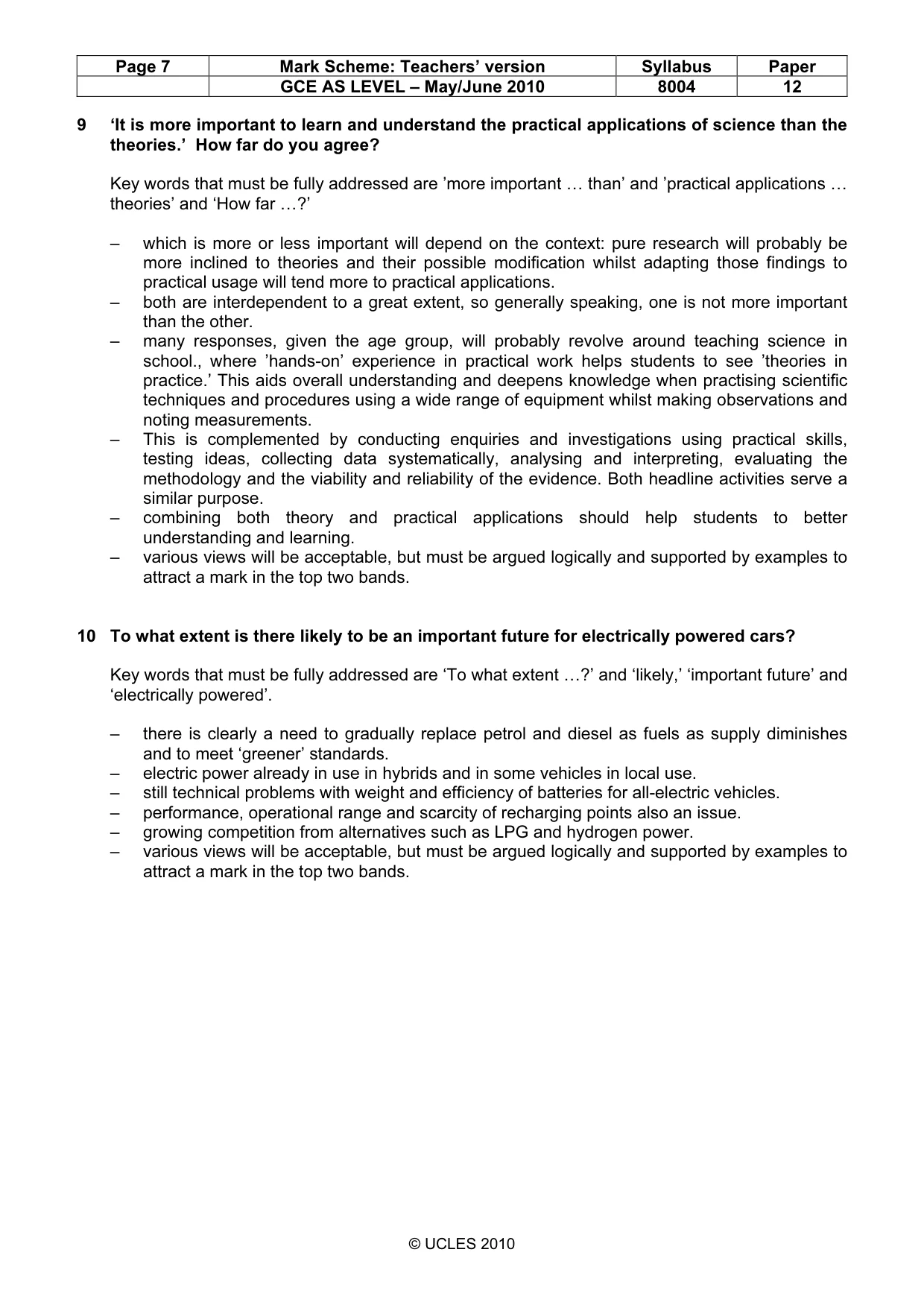
Page 7 Mark Scheme: Teachers’ version Syllabus Paper GCE AS LEVEL – May/June 2010 8004 12 © UCLES 2010 9 ‘It is more important to learn and understand the practical applications of science than the theories.’ How far do you agree? Key words that must be fully addressed are ’more important … than’ and ’practical applications … theories’ and ‘How far …?’ – which is more or less important will depend on the context: pure research will probably be more inclined to theories and their possible modification whilst adapting those findings to practical usage will tend more to practical applications. – both are interdependent to a great extent, so generally speaking, one is not more important than the other. – many responses, given the age group, will probably revolve around teaching science in school., where ’hands-on’ experience in practical work helps students to see ’theories in practice.’ This aids overall understanding and deepens knowledge when practising scientific techniques and procedures using a wide range of equipment whilst making observations and noting measurements. – This is complemented by conducting enquiries and investigations using practical skills, testing ideas, collecting data systematically, analysing and interpreting, evaluating the methodology and the viability and reliability of the evidence. Both headline activities serve a similar purpose. – combining both theory and practical applications should help students to better understanding and learning. – various views will be acceptable, but must be argued logically and supported by examples to attract a mark in the top two bands. 10 To what extent is there likely to be an important future for electrically powered cars? Key words that must be fully addressed are ‘To what extent …?’ and ‘likely,’ ‘important future’ and ‘electrically powered’. – there is clearly a need to gradually replace petrol and diesel as fuels as supply diminishes and to meet ‘greener’ standards. – electric power already in use in hybrids and in some vehicles in local use. – still technical problems with weight and efficiency of batteries for all-electric vehicles. – performance, operational range and scarcity of recharging points also an issue. – growing competition from alternatives such as LPG and hydrogen power. – various views will be acceptable, but must be argued logically and supported by examples to attract a mark in the top two bands.
Mark scheme, page 8
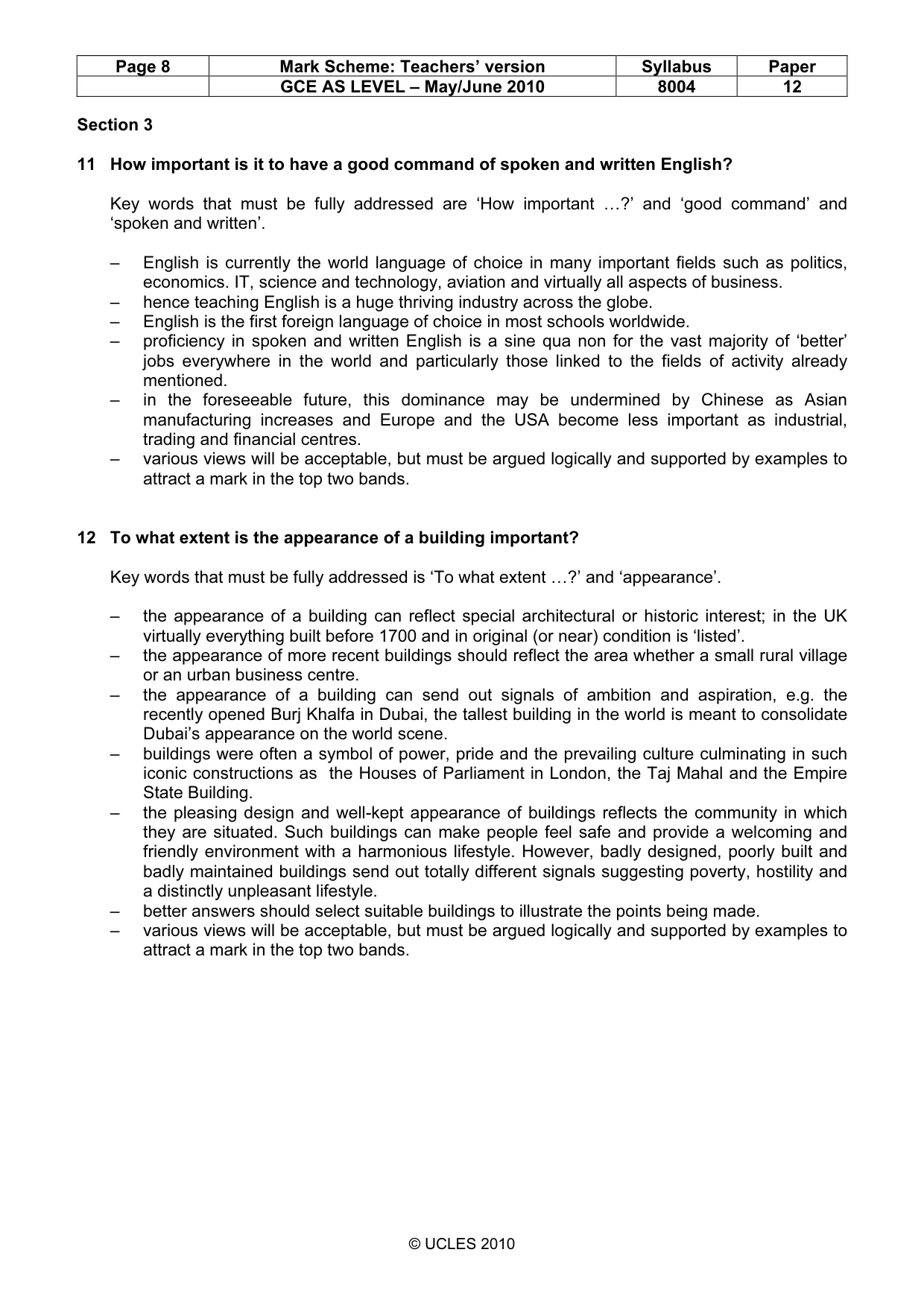
Page 8 Mark Scheme: Teachers’ version Syllabus Paper GCE AS LEVEL – May/June 2010 8004 12 © UCLES 2010 Section 3 11 How important is it to have a good command of spoken and written English? Key words that must be fully addressed are ‘How important …?’ and ‘good command’ and ‘spoken and written’. – English is currently the world language of choice in many important fields such as politics, economics. IT, science and technology, aviation and virtually all aspects of business. – hence teaching English is a huge thriving industry across the globe. – English is the first foreign language of choice in most schools worldwide. – proficiency in spoken and written English is a sine qua non for the vast majority of ‘better’ jobs everywhere in the world and particularly those linked to the fields of activity already mentioned. – in the foreseeable future, this dominance may be undermined by Chinese as Asian manufacturing increases and Europe and the USA become less important as industrial, trading and financial centres. – various views will be acceptable, but must be argued logically and supported by examples to attract a mark in the top two bands. 12 To what extent is the appearance of a building important? Key words that must be fully addressed is ‘To what extent …?’ and ‘appearance’. – the appearance of a building can reflect special architectural or historic interest; in the UK virtually everything built before 1700 and in original (or near) condition is ‘listed’. – the appearance of more recent buildings should reflect the area whether a small rural village or an urban business centre. – the appearance of a building can send out signals of ambition and aspiration, e.g. the recently opened Burj Khalfa in Dubai, the tallest building in the world is meant to consolidate Dubai’s appearance on the world scene. – buildings were often a symbol of power, pride and the prevailing culture culminating in such iconic constructions as the Houses of Parliament in London, the Taj Mahal and the Empire State Building. – the pleasing design and well-kept appearance of buildings reflects the community in which they are situated. Such buildings can make people feel safe and provide a welcoming and friendly environment with a harmonious lifestyle. However, badly designed, poorly built and badly maintained buildings send out totally different signals suggesting poverty, hostility and a distinctly unpleasant lifestyle. – better answers should select suitable buildings to illustrate the points being made. – various views will be acceptable, but must be argued logically and supported by examples to attract a mark in the top two bands.
Mark scheme, page 9
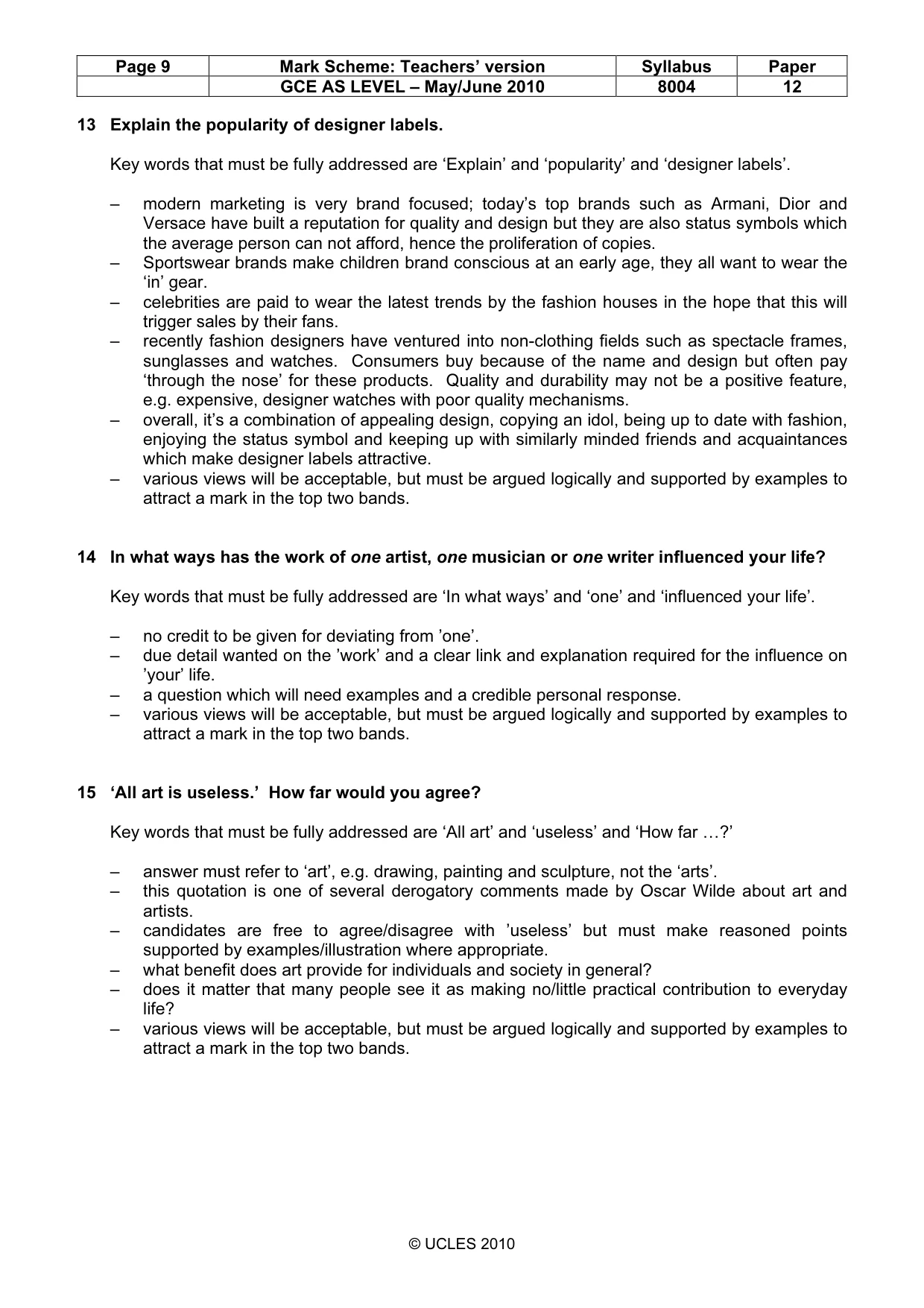
Page 9 Mark Scheme: Teachers’ version Syllabus Paper GCE AS LEVEL – May/June 2010 8004 12 © UCLES 2010 13 Explain the popularity of designer labels. Key words that must be fully addressed are ‘Explain’ and ‘popularity’ and ‘designer labels’. – modern marketing is very brand focused; today’s top brands such as Armani, Dior and Versace have built a reputation for quality and design but they are also status symbols which the average person can not afford, hence the proliferation of copies. – Sportswear brands make children brand conscious at an early age, they all want to wear the ‘in’ gear. – celebrities are paid to wear the latest trends by the fashion houses in the hope that this will trigger sales by their fans. – recently fashion designers have ventured into non-clothing fields such as spectacle frames, sunglasses and watches. Consumers buy because of the name and design but often pay ‘through the nose’ for these products. Quality and durability may not be a positive feature, e.g. expensive, designer watches with poor quality mechanisms. – overall, it’s a combination of appealing design, copying an idol, being up to date with fashion, enjoying the status symbol and keeping up with similarly minded friends and acquaintances which make designer labels attractive. – various views will be acceptable, but must be argued logically and supported by examples to attract a mark in the top two bands. 14 In what ways has the work of one artist, one musician or one writer influenced your life? Key words that must be fully addressed are ‘In what ways’ and ‘one’ and ‘influenced your life’. – no credit to be given for deviating from ’one’. – due detail wanted on the ’work’ and a clear link and explanation required for the influence on ’your’ life. – a question which will need examples and a credible personal response. – various views will be acceptable, but must be argued logically and supported by examples to attract a mark in the top two bands. 15 ‘All art is useless.’ How far would you agree? Key words that must be fully addressed are ‘All art’ and ‘useless’ and ‘How far …?’ – answer must refer to ‘art’, e.g. drawing, painting and sculpture, not the ‘arts’. – this quotation is one of several derogatory comments made by Oscar Wilde about art and artists. – candidates are free to agree/disagree with ’useless’ but must make reasoned points supported by examples/illustration where appropriate. – what benefit does art provide for individuals and society in general? – does it matter that many people see it as making no/little practical contribution to everyday life? – various views will be acceptable, but must be argued logically and supported by examples to attract a mark in the top two bands.
What you needed in this session
Cambridge’s own grade thresholds for 2010 May/June, Paper 1 · Variant 2. A higher threshold means an easier paper — the bar moves with how the cohort did.