Cambridge A Level General Paper (AS Level only) 8001 — 2018 Oct/Nov Paper 2 · Variant 2
8001/22/O/N/18 · 3 questions · 105 marks · ≈118 min
The question paper and its mark scheme, free to read here and free to download. This is Cambridge’s own paper, exactly as it was sat.
Question paper12 pages
Mark scheme12 pages
Answers below. Sit the paper first if you are practising.
Questions as text
Q1 · Study Passage 1 in the Insert to answer the following questions (a)–(f)
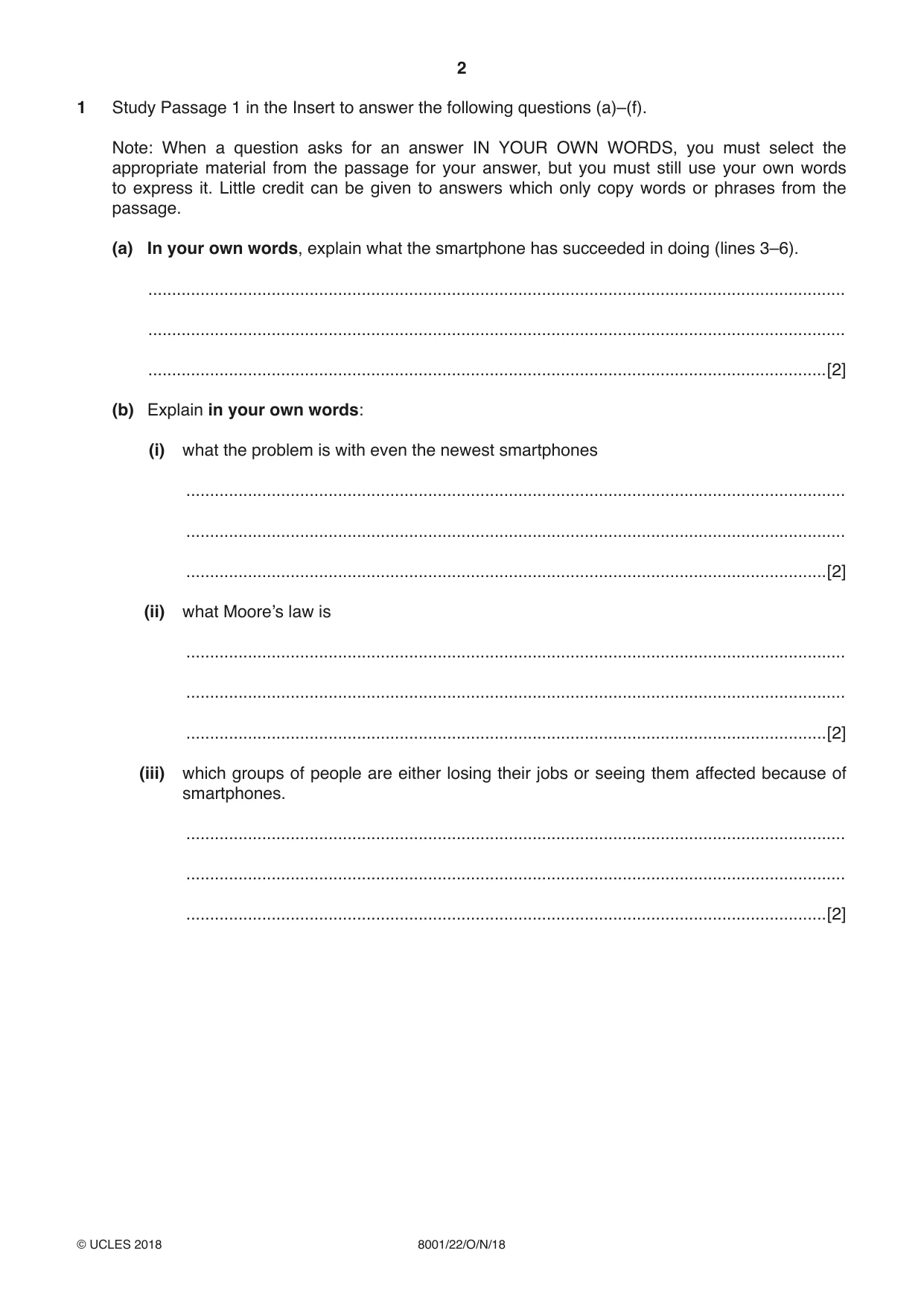
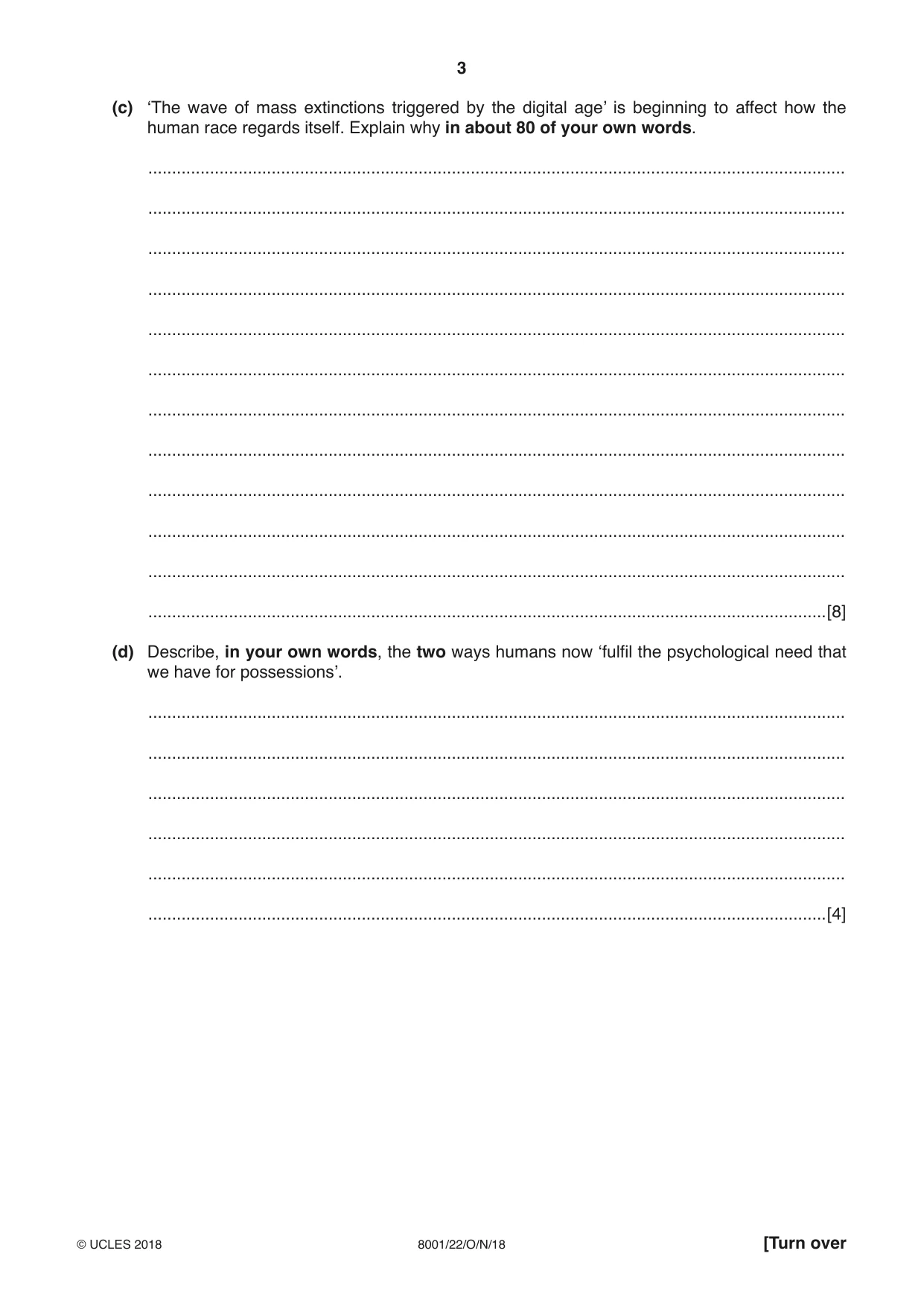
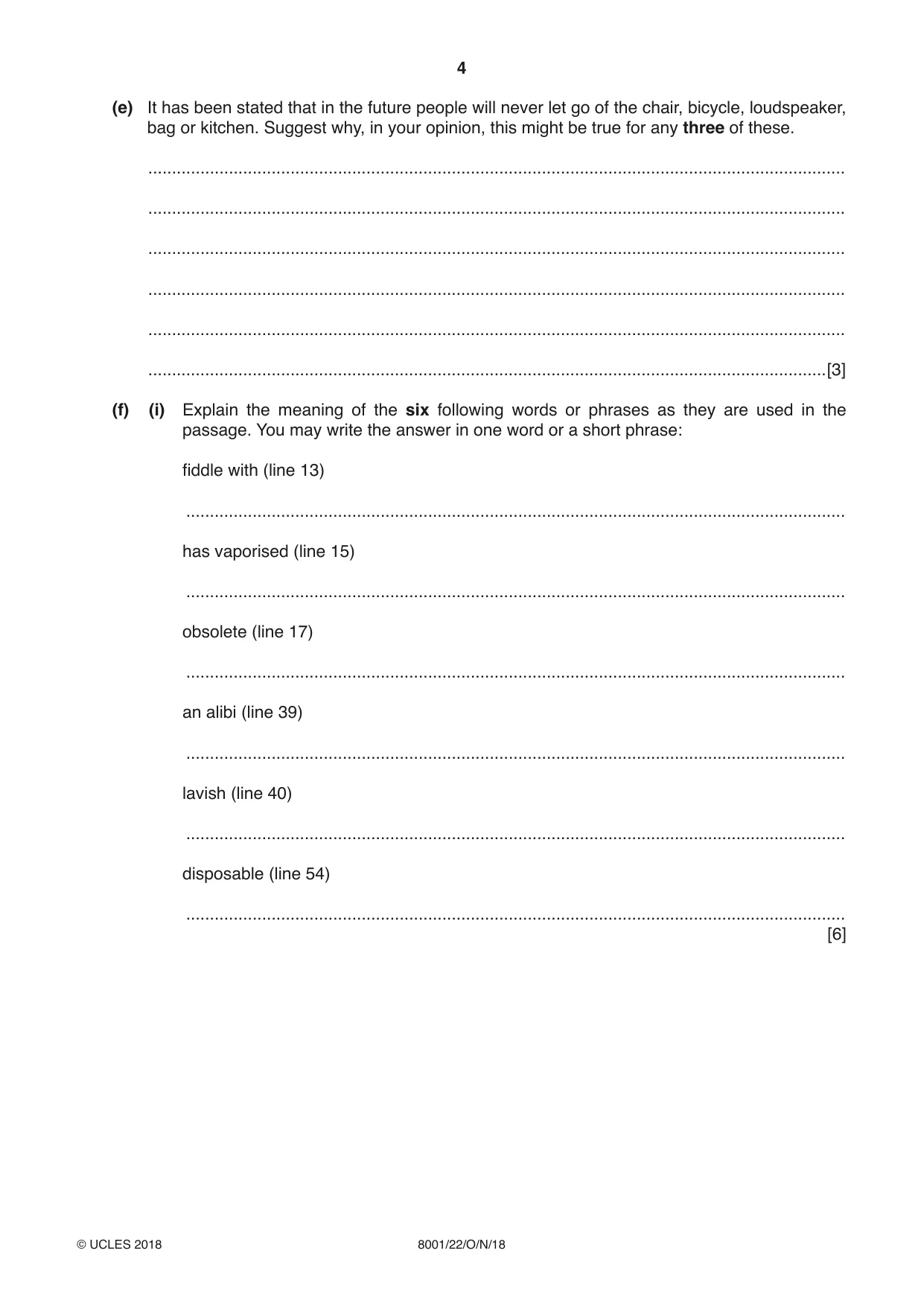
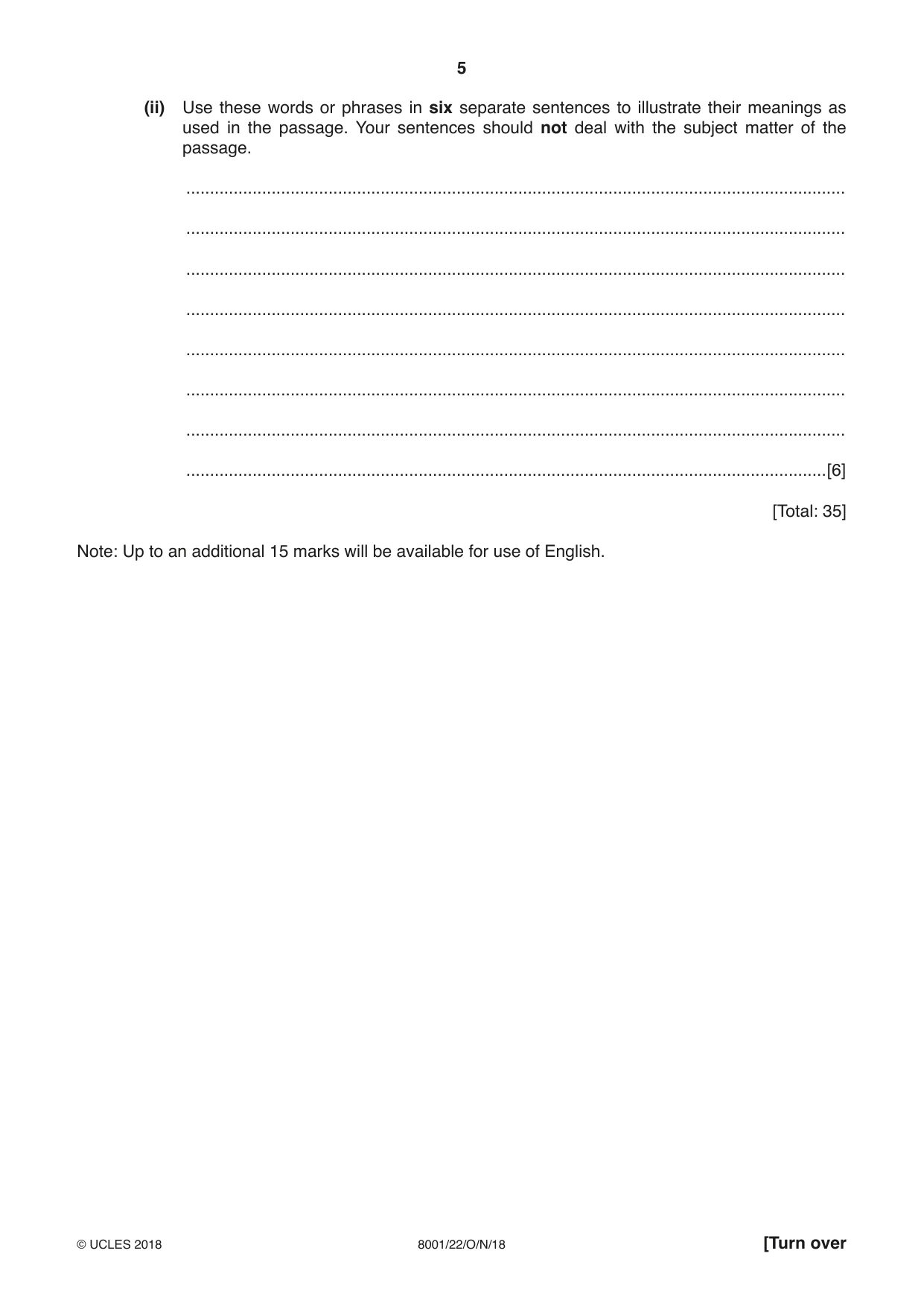
1 Study Passage 1 in the Insert to answer the following questions (a)–(f). Note: When a question asks for an answer IN YOUR OWN WORDS, you must select the appropriate material from the passage for your answer, but you must still use your own words to express it. Little credit can be given to answers which only copy words or phrases from the passage. (a) In your own words, explain what the smartphone has succeeded in doing (lines 3–6). ................................................................................................................................................... ................................................................................................................................................... ...............................................................................................................................................[2] (b) Explain in your own words: (i) what the problem is with even the newest smartphones ........................................................................................................................................... ........................................................................................................................................... .......................................................................................................................................[2] (ii) what Moore’s law is ........................................................................................................................................... ........................................................................................................................................... .......................................................................................................................................[2] (iii) which groups of people are either losing their jobs or seeing them affected because of smartphones. ........................................................................................................................................... ........................................................................................................................................... .......................................................................................................................................[2] (c) ‘The wave of mass extinctions triggered by the digital age’ is beginning to affect how the human race regards itself. Explain why in about 80 of your own words. ................................................................................................................................................... ................................................................................................................................................... ................................................................................................................................................... ................................................................................................................................................... ................................................................................................................................................... ................................................................................................................................................... ................................................................................................................................................... ................................................................................................................................................... ................................................................................................................................................... ................................................................................................................................................... ................................................................................................................................................... ...............................................................................................................................................[8] (d) Describe, in your own words, the two ways humans now ‘fulfil the psychological need that we have for possessions’. ................................................................................................................................................... ................................................................................................................................................... ................................................................................................................................................... ................................................................................................................................................... ................................................................................................................................................... ...............................................................................................................................................[4] (e) It has been stated that in the future people will never let go of the chair, bicycle, loudspeaker, bag or kitchen. Suggest why, in your opinion, this might be true for any three of these. ................................................................................................................................................... ................................................................................................................................................... ................................................................................................................................................... ................................................................................................................................................... ................................................................................................................................................... ...............................................................................................................................................[3] (f) (i) Explain the meaning of the six following words or phrases as they are used in the passage. You may write the answer in one word or a short phrase: fiddle with (line 13) ........................................................................................................................................... has vaporised (line 15) ........................................................................................................................................... obsolete (line 17) ........................................................................................................................................... an alibi (line 39) ........................................................................................................................................... lavish (line 40) ........................................................................................................................................... disposable (line 54) ........................................................................................................................................... [6] (ii) Use these words or phrases in six separate sentences to illustrate their meanings as used in the passage. Your sentences should not deal with the subject matter of the passage. ........................................................................................................................................... ........................................................................................................................................... ........................................................................................................................................... ........................................................................................................................................... ........................................................................................................................................... ........................................................................................................................................... ........................................................................................................................................... .......................................................................................................................................[6] [Total: 35] Note: Up to an additional 15 marks will be available for use of English.
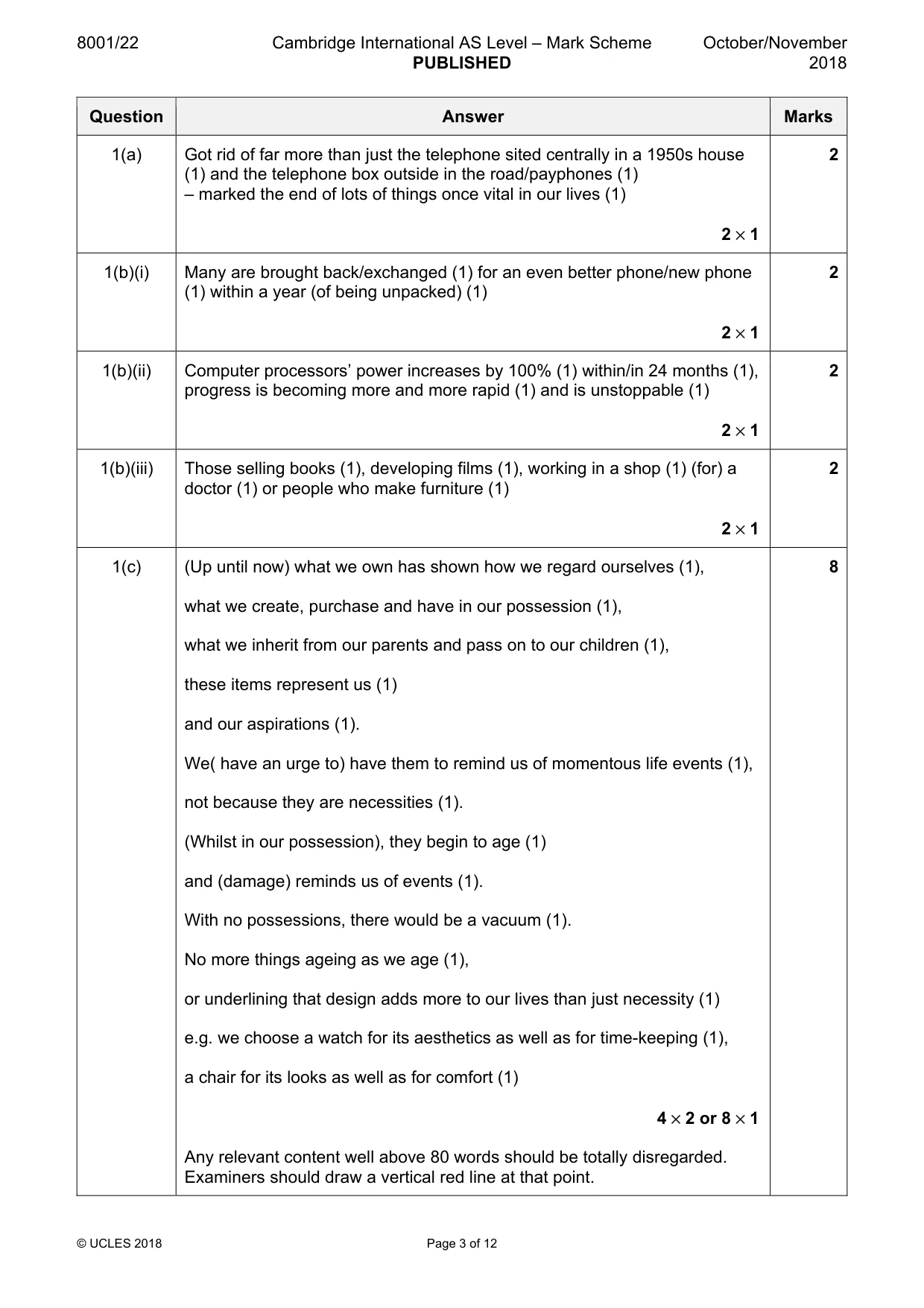
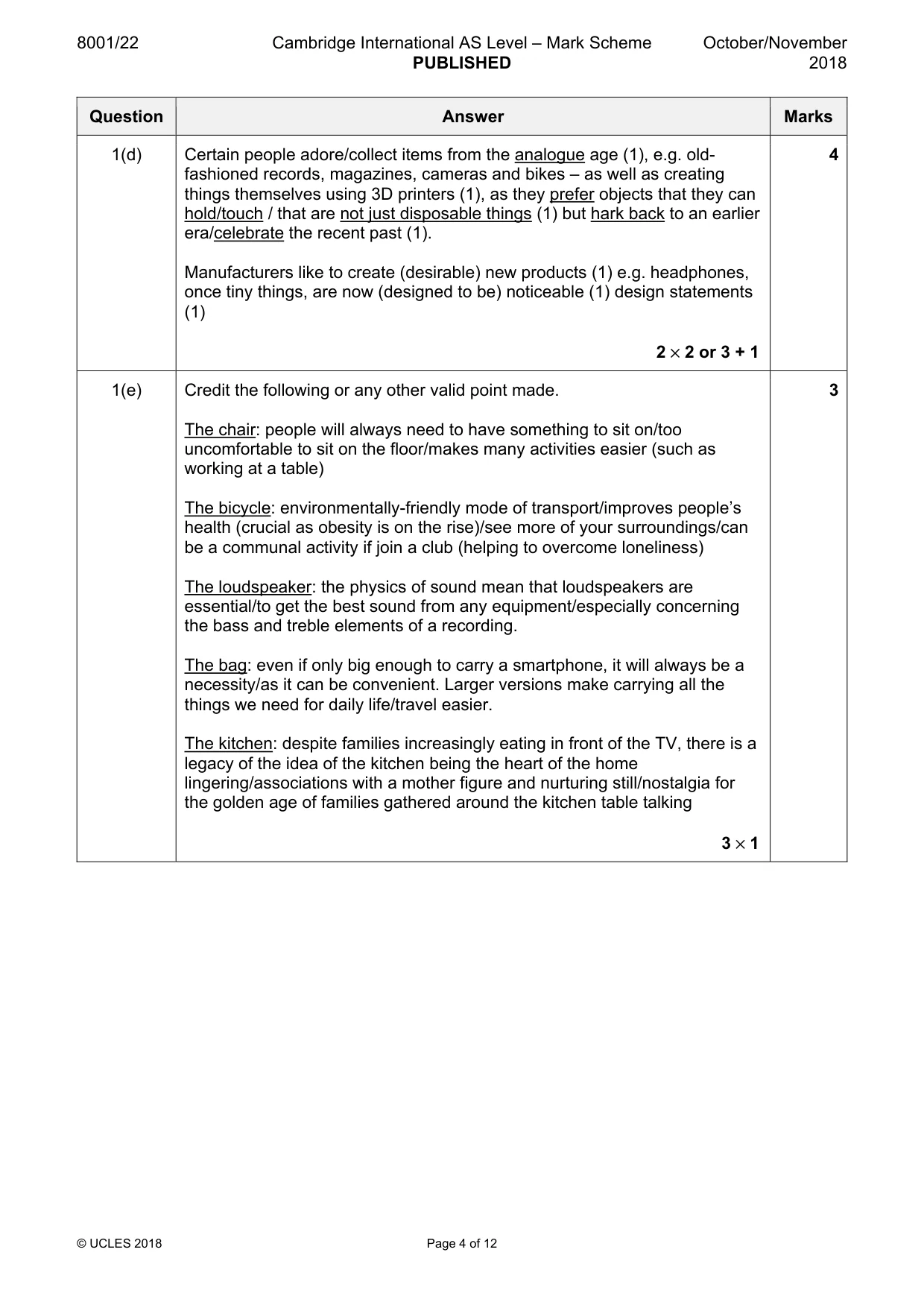
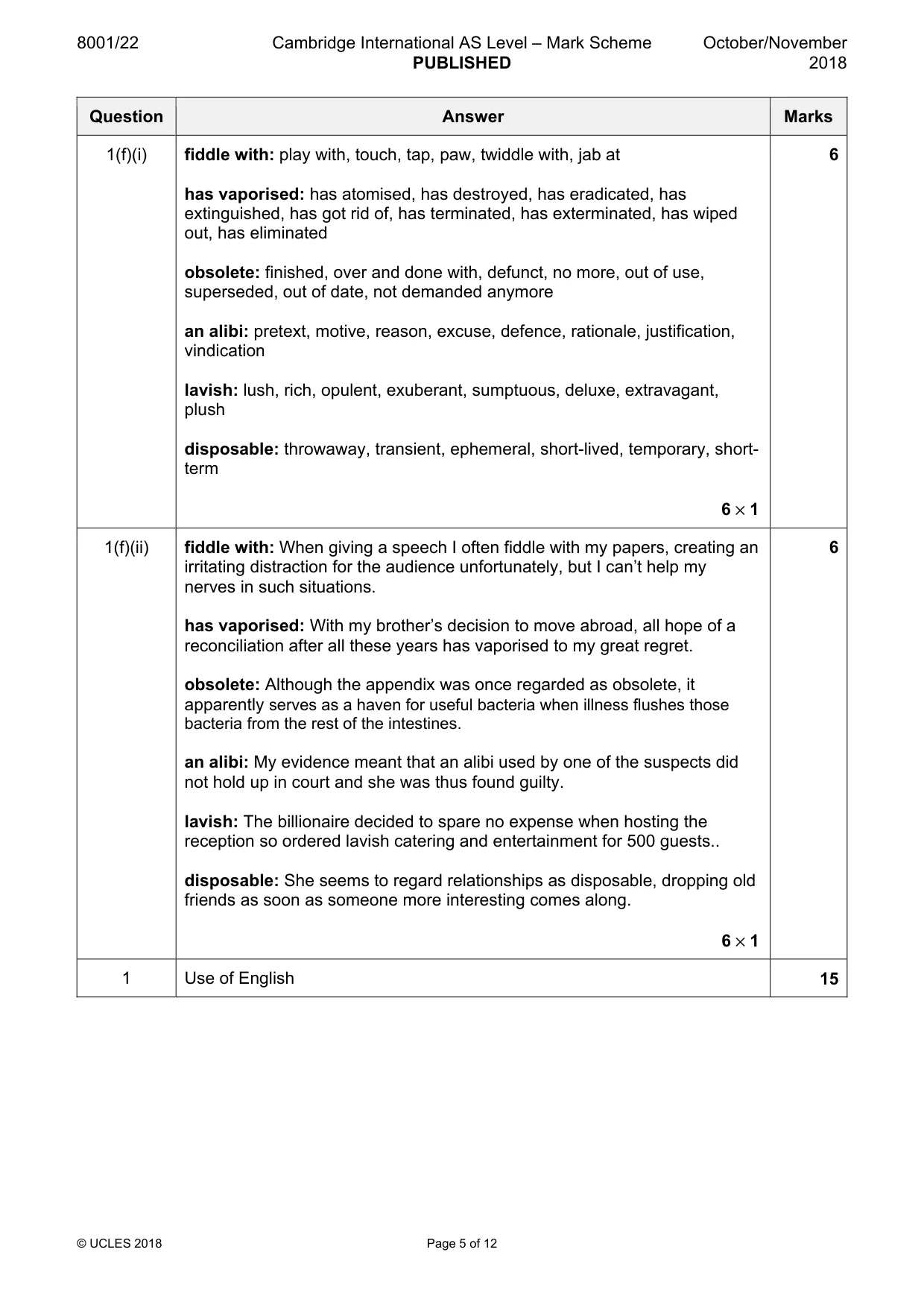
Mark scheme: Question Answer Marks 1(a) Got rid of far more than just the telephone sited centrally in a 1950s house 2 (1) and the telephone box outside in the road/payphones (1) – marked the end of lots of things once vital in our lives (1) 2 × 1 1(b)(i) Many are brought back/exchanged (1) for an even better phone/new phone 2 (1) within a year (of being unpacked) (1) 2 × 1 1(b)(ii) Computer processors’ power increases by 100% (1) within/in 24 months (1), 2 progress is becoming more and more rapid (1) and is unstoppable (1) 2 × 1 1(b)(iii) Those selling books (1), developing films (1), working in a shop (1) (for) a 2 doctor (1) or people who make furniture (1) 2 × 1 1(c) (Up until now) what we own has shown how we regard ourselves (1), 8 what we create, purchase and have in our possession (1), what we inherit from our parents and pass on to our children (1), these items represent us (1) and our aspirations (1). We( have an urge to) have them to remind us of momentous life events (1), not because they are necessities (1). (Whilst in our possession), they begin to age (1) and (damage) reminds us of events (1). With no possessions, there would be a vacuum (1). No more things ageing as we age (1), or underlining that design adds more to our lives than just necessity (1) e.g. we choose a watch for its aesthetics as well as for time-keeping (1), a chair for its looks as well as for comfort (1) 4 × 2 or 8 × 1 Any relevant content well above 80 words should be totally disregarded. Examiners should draw a vertical red line at that point. 1(d) Certain people adore/collect items from the analogue age (1), e.g. old- 4 fashioned records, magazines, cameras and bikes – as well as creating things themselves using 3D printers (1), as they prefer objects that they can hold/touch / that are not just disposable things (1) but hark back to an earlier era/celebrate the recent past (1). Manufacturers like to create (desirable) new products (1) e.g. headphones, once tiny things, are now (designed to be) noticeable (1) design statements (1) 2 × 2 or 3 + 1 1(e) Credit the following or any other valid point made. 3 The chair: people will always need to have something to sit on/too uncomfortable to sit on the floor/makes many activities easier (such as working at a table) The bicycle: environmentally-friendly mode of transport/improves people’s health (crucial as obesity is on the rise)/see more of your surroundings/can be a communal activity if join a club (helping to overcome loneliness) The loudspeaker: the physics of sound mean that loudspeakers are essential/to get the best sound from any equipment/especially concerning the bass and treble elements of a recording. The bag: even if only big enough to carry a smartphone, it will always be a necessity/as it can be convenient. Larger versions make carrying all the things we need for daily life/travel easier. The kitchen: despite families increasingly eating in front of the TV, there is a legacy of the idea of the kitchen being the heart of the home lingering/associations with a mother figure and nurturing still/nostalgia for the golden age of families gathered around the kitchen table talking 3 × 1 1(f)(i) fiddle with: play with, touch, tap, paw, twiddle with, jab at 6 has vaporised: has atomised, has destroyed, has eradicated, has extinguished, has got rid of, has terminated, has exterminated, has wiped out, has eliminated obsolete: finished, over and done with, defunct, no more, out of use, superseded, out of date, not demanded anymore an alibi: pretext, motive, reason, excuse, defence, rationale, justification, vindication lavish: lush, rich, opulent, exuberant, sumptuous, deluxe, extravagant, plush disposable: throwaway, transient, ephemeral, short-lived, temporary, short- term 6 × 1 1(f)(ii) fiddle with: When giving a speech I often fiddle with my papers, creating an 6 irritating distraction for the audience unfortunately, but I can’t help my nerves in such situations. has vaporised: With my brother’s decision to move abroad, all hope of a reconciliation after all these years has vaporised to my great regret. obsolete: Although the appendix was once regarded as obsolete, it apparently serves as a haven for useful bacteria when illness flushes those bacteria from the rest of the intestines. an alibi: My evidence meant that an alibi used by one of the suspects did not hold up in court and she was thus found guilty. lavish: The billionaire decided to spare no expense when hosting the reception so ordered lavish catering and entertainment for 500 guests.. disposable: She seems to regard relationships as disposable, dropping old friends as soon as someone more interesting comes along. 6 × 1 1 Use of English 15
Q2 · Study Passage 2 in the Insert to answer the following questions (a)–(d)
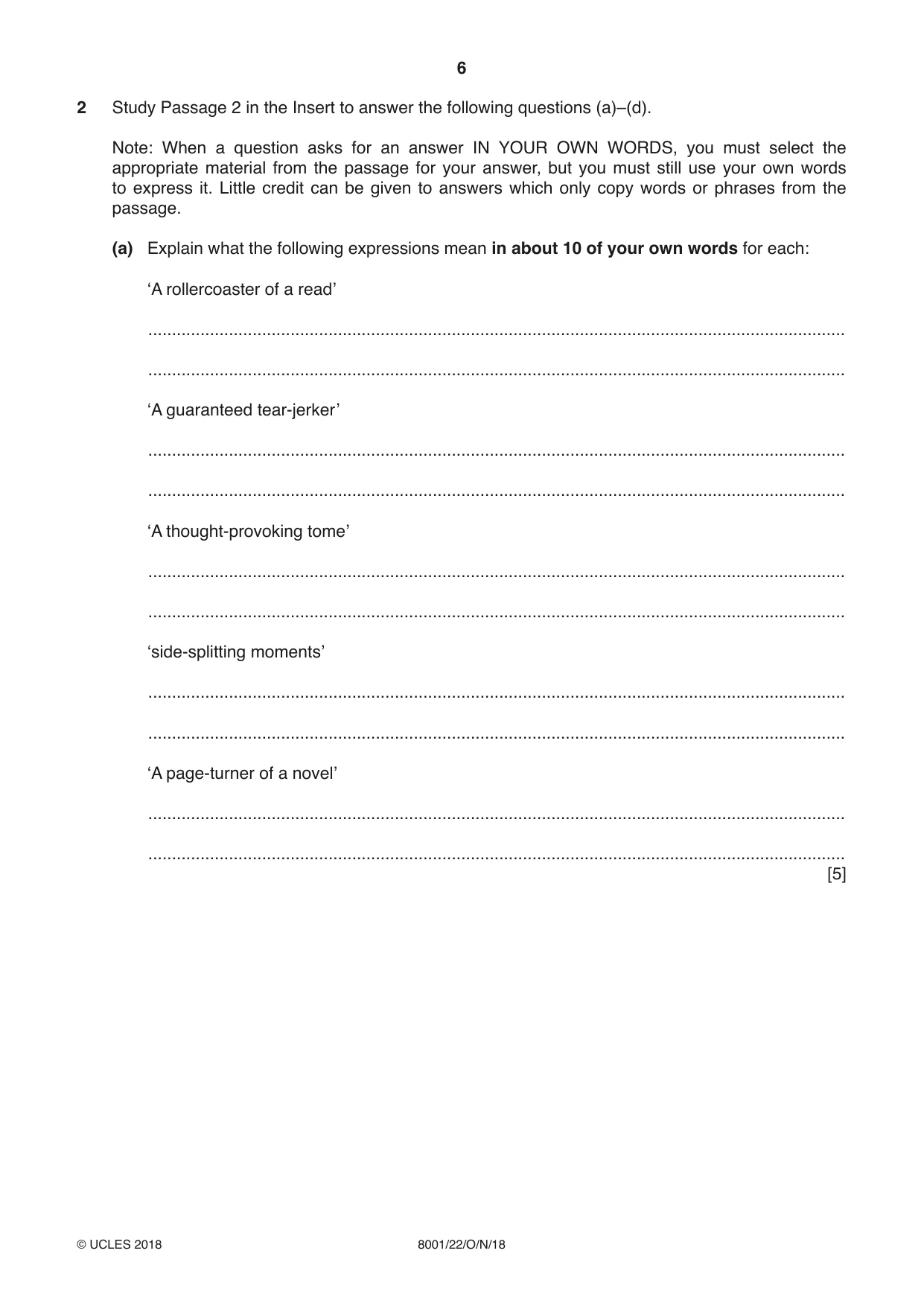
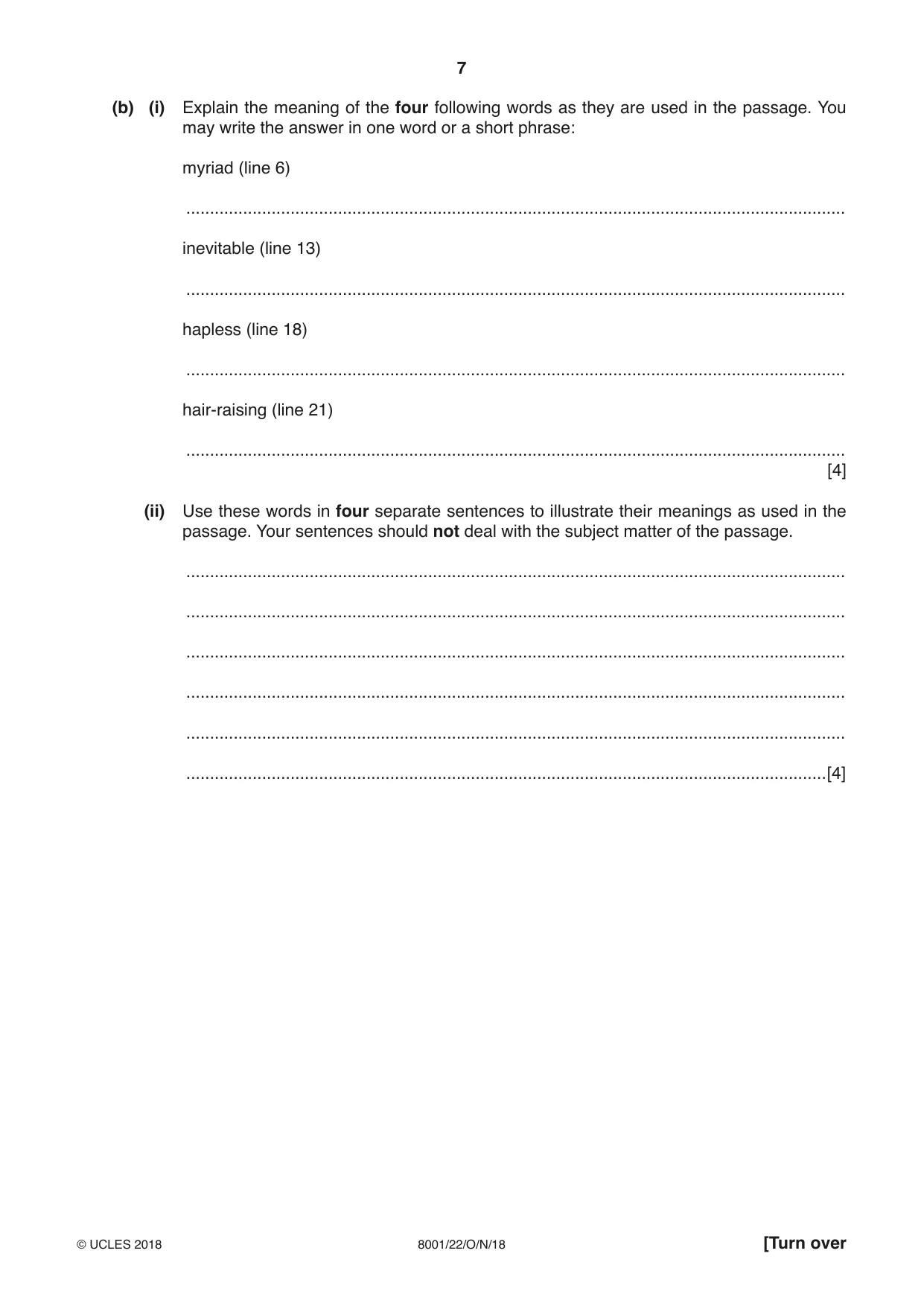
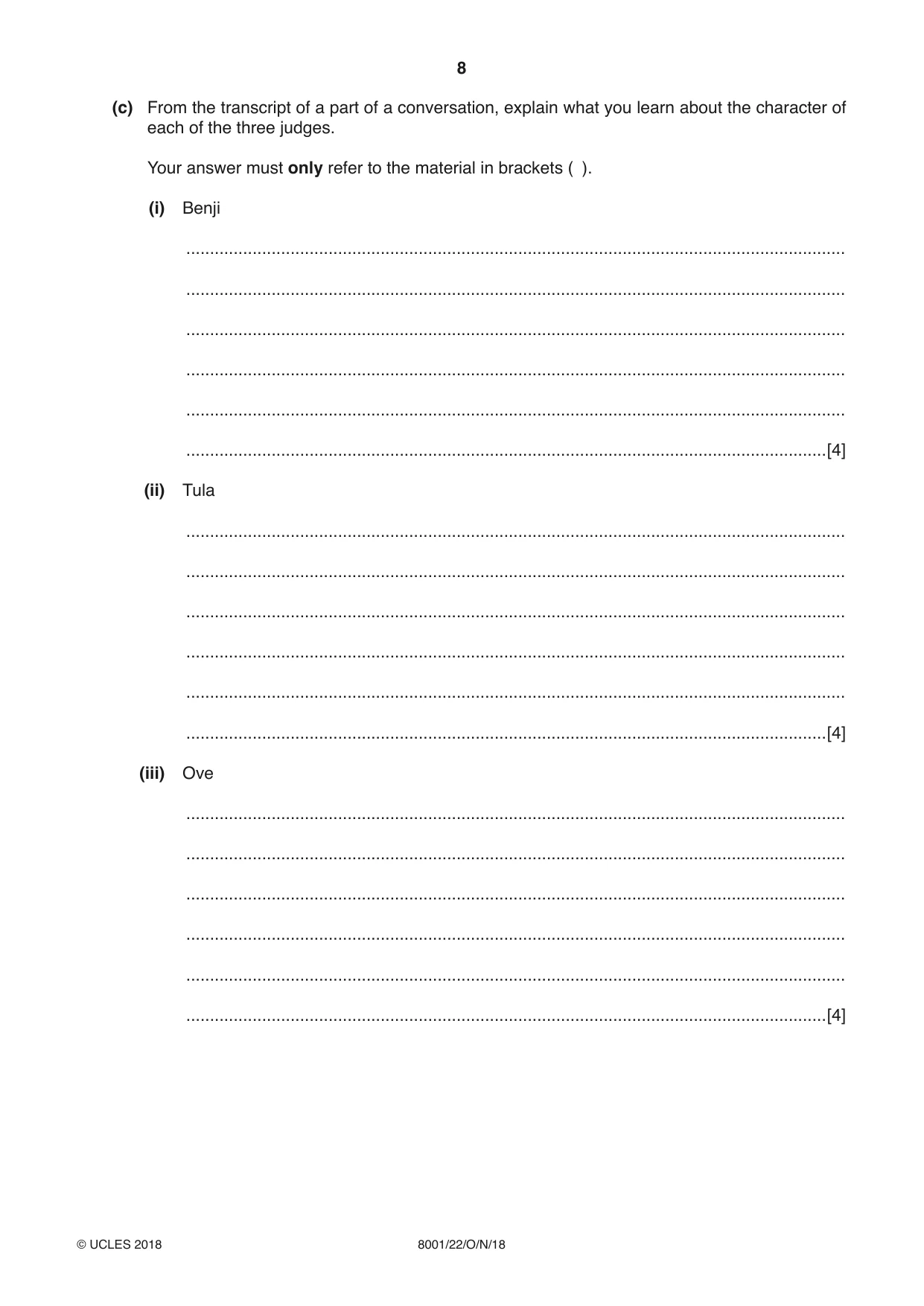
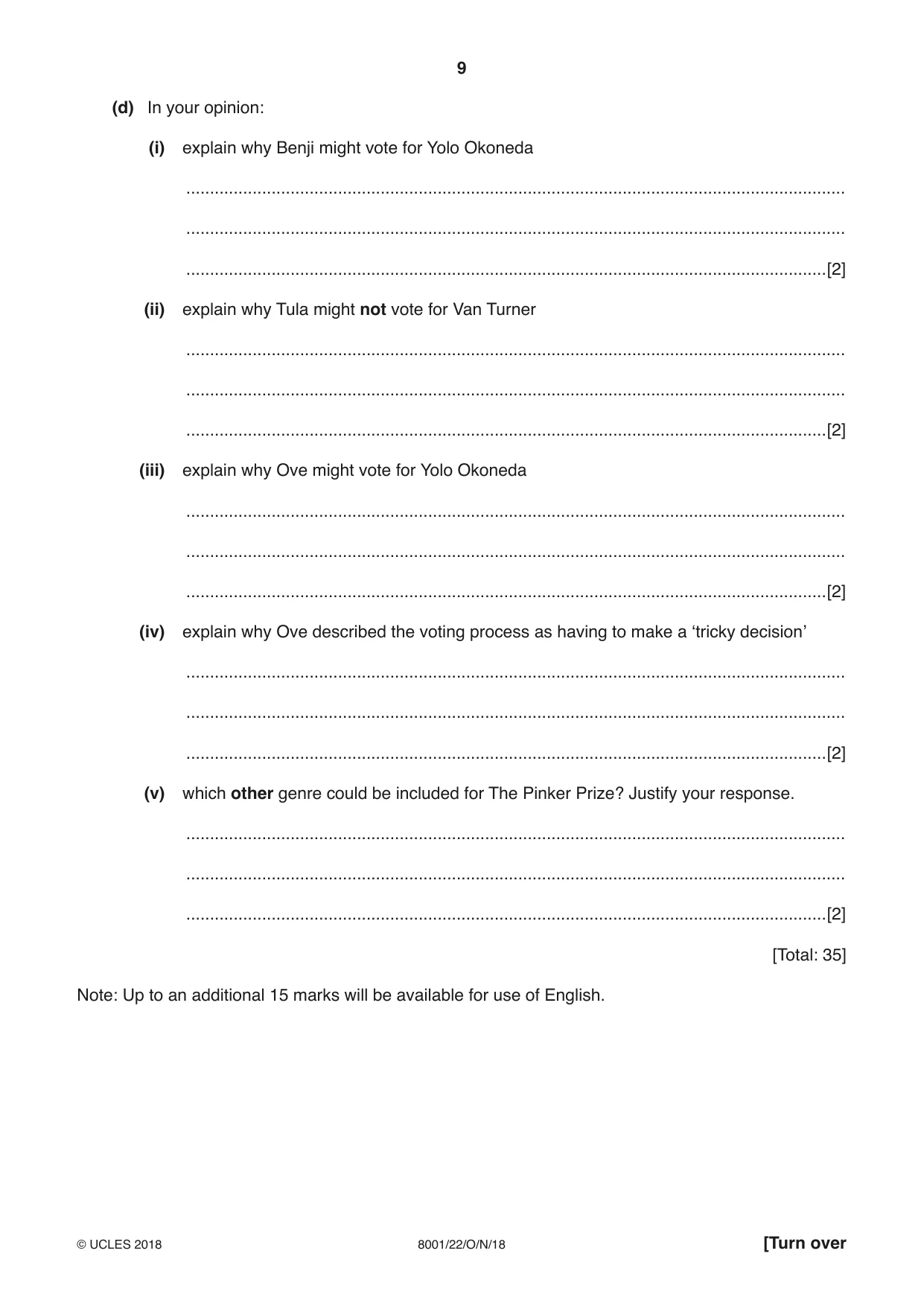
2 Study Passage 2 in the Insert to answer the following questions (a)–(d). Note: When a question asks for an answer IN YOUR OWN WORDS, you must select the appropriate material from the passage for your answer, but you must still use your own words to express it. Little credit can be given to answers which only copy words or phrases from the passage. (a) Explain what the following expressions mean in about 10 of your own words for each: ‘A rollercoaster of a read’ ................................................................................................................................................... ................................................................................................................................................... ‘A guaranteed tear-jerker’ ................................................................................................................................................... ................................................................................................................................................... ‘A thought-provoking tome’ ................................................................................................................................................... ................................................................................................................................................... ‘side-splitting moments’ ................................................................................................................................................... ................................................................................................................................................... ‘A page-turner of a novel’ ................................................................................................................................................... ................................................................................................................................................... [5] (b) (i) Explain the meaning of the four following words as they are used in the passage. You may write the answer in one word or a short phrase: myriad (line 6) ........................................................................................................................................... inevitable (line 13) ........................................................................................................................................... hapless (line 18) ........................................................................................................................................... hair-raising (line 21) ........................................................................................................................................... [4] (ii) Use these words in four separate sentences to illustrate their meanings as used in the passage. Your sentences should not deal with the subject matter of the passage. ........................................................................................................................................... ........................................................................................................................................... ........................................................................................................................................... ........................................................................................................................................... ........................................................................................................................................... .......................................................................................................................................[4] (c) From the transcript of a part of a conversation, explain what you learn about the character of each of the three judges. Your answer must only refer to the material in brackets ( ). (i) Benji ........................................................................................................................................... ........................................................................................................................................... ........................................................................................................................................... ........................................................................................................................................... ........................................................................................................................................... .......................................................................................................................................[4] (ii) Tula ........................................................................................................................................... ........................................................................................................................................... ........................................................................................................................................... ........................................................................................................................................... ........................................................................................................................................... .......................................................................................................................................[4] (iii) Ove ........................................................................................................................................... ........................................................................................................................................... ........................................................................................................................................... ........................................................................................................................................... ........................................................................................................................................... .......................................................................................................................................[4] (d) In your opinion: (i) explain why Benji might vote for Yolo Okoneda ........................................................................................................................................... ........................................................................................................................................... .......................................................................................................................................[2] (ii) explain why Tula might not vote for Van Turner ........................................................................................................................................... ........................................................................................................................................... .......................................................................................................................................[2] (iii) explain why Ove might vote for Yolo Okoneda ........................................................................................................................................... ........................................................................................................................................... .......................................................................................................................................[2] (iv) explain why Ove described the voting process as having to make a ‘tricky decision’ ........................................................................................................................................... ........................................................................................................................................... .......................................................................................................................................[2] (v) which other genre could be included for The Pinker Prize? Justify your response. ........................................................................................................................................... ........................................................................................................................................... .......................................................................................................................................[2] [Total: 35] Note: Up to an additional 15 marks will be available for use of English.
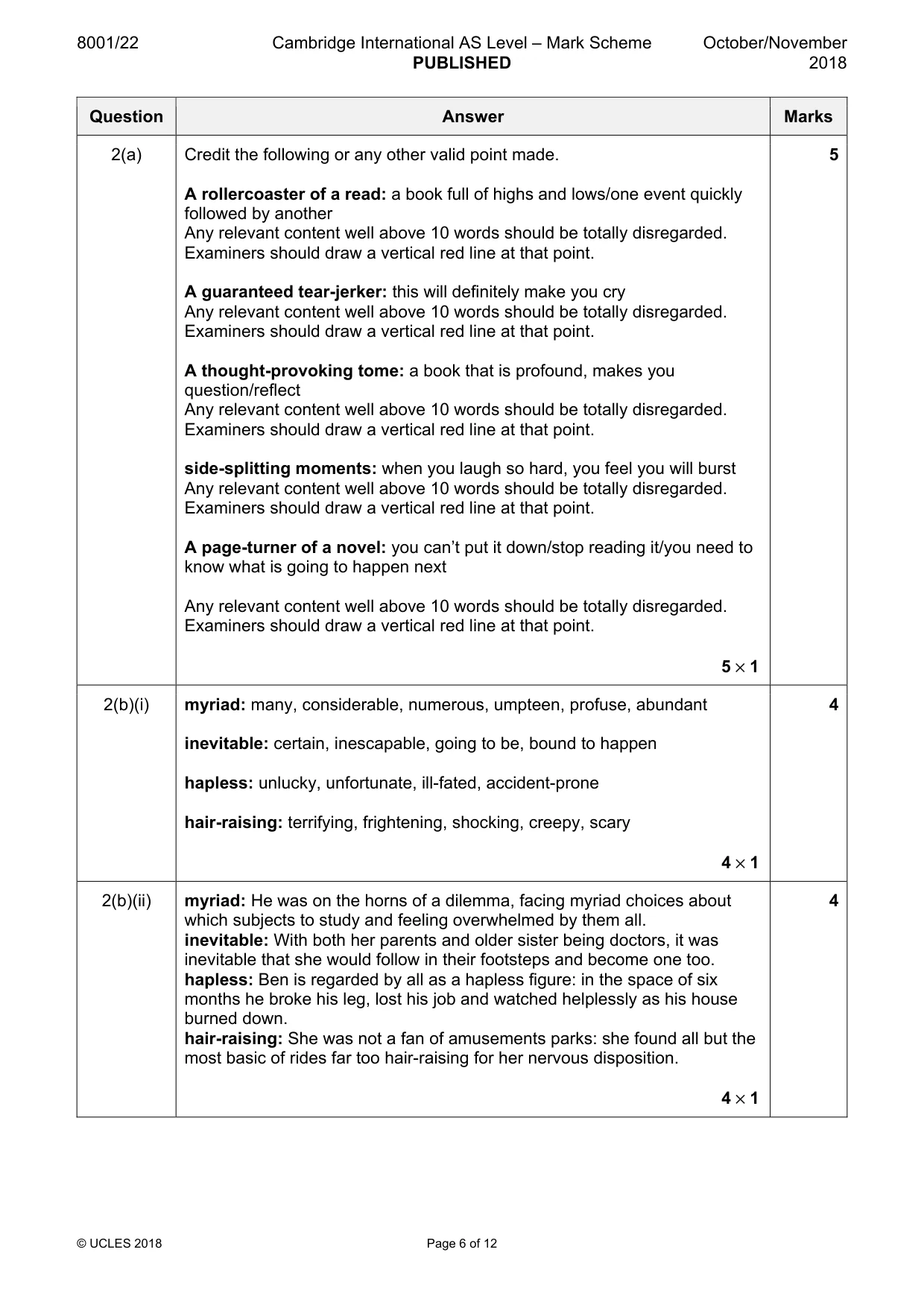
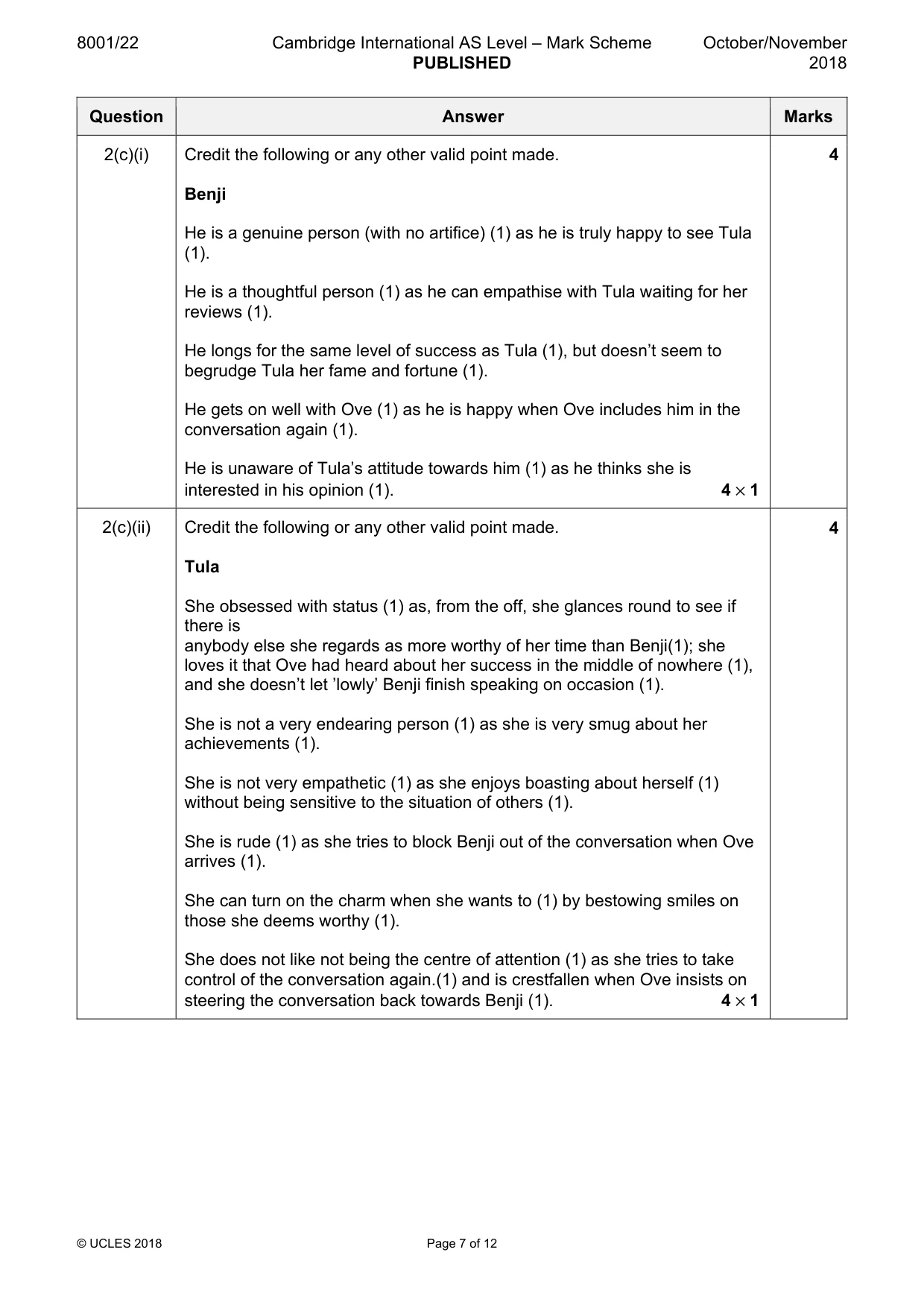
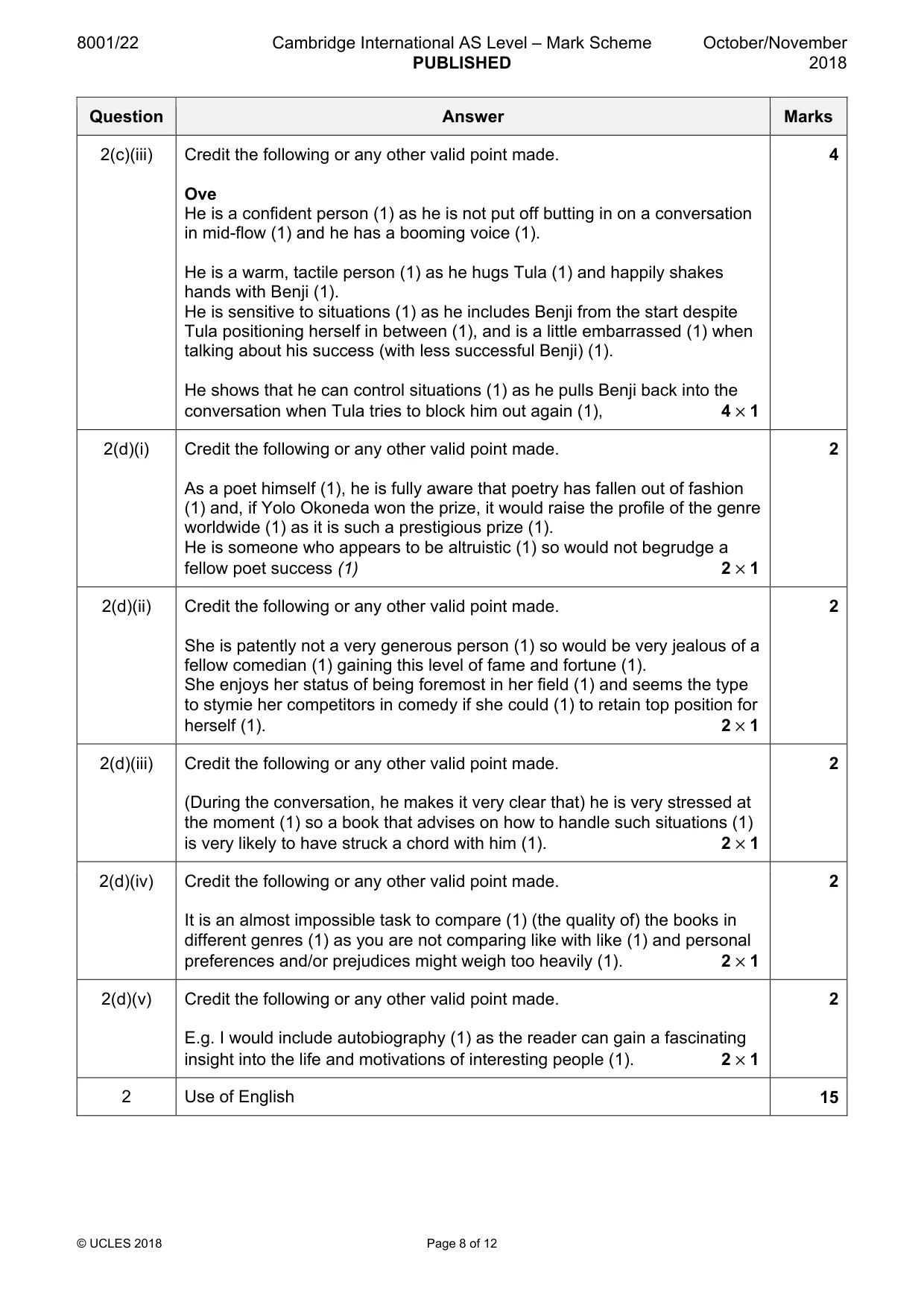
Mark scheme: 2(a) Credit the following or any other valid point made. 5 A rollercoaster of a read: a book full of highs and lows/one event quickly followed by another Any relevant content well above 10 words should be totally disregarded. Examiners should draw a vertical red line at that point. A guaranteed tear-jerker: this will definitely make you cry Any relevant content well above 10 words should be totally disregarded. Examiners should draw a vertical red line at that point. A thought-provoking tome: a book that is profound, makes you question/reflect Any relevant content well above 10 words should be totally disregarded. Examiners should draw a vertical red line at that point. side-splitting moments: when you laugh so hard, you feel you will burst Any relevant content well above 10 words should be totally disregarded. Examiners should draw a vertical red line at that point. A page-turner of a novel: you can’t put it down/stop reading it/you need to know what is going to happen next Any relevant content well above 10 words should be totally disregarded. Examiners should draw a vertical red line at that point. 5 × 1 2(b)(i) myriad: many, considerable, numerous, umpteen, profuse, abundant 4 inevitable: certain, inescapable, going to be, bound to happen hapless: unlucky, unfortunate, ill-fated, accident-prone hair-raising: terrifying, frightening, shocking, creepy, scary 4 × 1 2(b)(ii) myriad: He was on the horns of a dilemma, facing myriad choices about 4 which subjects to study and feeling overwhelmed by them all. inevitable: With both her parents and older sister being doctors, it was inevitable that she would follow in their footsteps and become one too. hapless: Ben is regarded by all as a hapless figure: in the space of six months he broke his leg, lost his job and watched helplessly as his house burned down. hair-raising: She was not a fan of amusements parks: she found all but the most basic of rides far too hair-raising for her nervous disposition. 4 × 1 2(c)(i) Credit the following or any other valid point made. 4 Benji He is a genuine person (with no artifice) (1) as he is truly happy to see Tula (1). He is a thoughtful person (1) as he can empathise with Tula waiting for her reviews (1). He longs for the same level of success as Tula (1), but doesn’t seem to begrudge Tula her fame and fortune (1). He gets on well with Ove (1) as he is happy when Ove includes him in the conversation again (1). He is unaware of Tula’s attitude towards him (1) as he thinks she is interested in his opinion (1). 4 × 1 2(c)(ii) Credit the following or any other valid point made. 4 Tula She obsessed with status (1) as, from the off, she glances round to see if there is anybody else she regards as more worthy of her time than Benji(1); she loves it that Ove had heard about her success in the middle of nowhere (1), and she doesn’t let ’lowly’ Benji finish speaking on occasion (1). She is not a very endearing person (1) as she is very smug about her achievements (1). She is not very empathetic (1) as she enjoys boasting about herself (1) without being sensitive to the situation of others (1). She is rude (1) as she tries to block Benji out of the conversation when Ove arrives (1). She can turn on the charm when she wants to (1) by bestowing smiles on those she deems worthy (1). She does not like not being the centre of attention (1) as she tries to take control of the conversation again.(1) and is crestfallen when Ove insists on steering the conversation back towards Benji (1). 4 × 1 2(c)(iii) Credit the following or any other valid point made. 4 Ove He is a confident person (1) as he is not put off butting in on a conversation in mid-flow (1) and he has a booming voice (1). He is a warm, tactile person (1) as he hugs Tula (1) and happily shakes hands with Benji (1). He is sensitive to situations (1) as he includes Benji from the start despite Tula positioning herself in between (1), and is a little embarrassed (1) when talking about his success (with less successful Benji) (1). He shows that he can control situations (1) as he pulls Benji back into the conversation when Tula tries to block him out again (1), 4 × 1 2(d)(i) Credit the following or any other valid point made. 2 As a poet himself (1), he is fully aware that poetry has fallen out of fashion (1) and, if Yolo Okoneda won the prize, it would raise the profile of the genre worldwide (1) as it is such a prestigious prize (1). He is someone who appears to be altruistic (1) so would not begrudge a fellow poet success (1) 2 × 1 2(d)(ii) Credit the following or any other valid point made. 2 She is patently not a very generous person (1) so would be very jealous of a fellow comedian (1) gaining this level of fame and fortune (1). She enjoys her status of being foremost in her field (1) and seems the type to stymie her competitors in comedy if she could (1) to retain top position for herself (1). 2 × 1 2(d)(iii) Credit the following or any other valid point made. 2 (During the conversation, he makes it very clear that) he is very stressed at the moment (1) so a book that advises on how to handle such situations (1) is very likely to have struck a chord with him (1). 2 × 1 2(d)(iv) Credit the following or any other valid point made. 2 It is an almost impossible task to compare (1) (the quality of) the books in different genres (1) as you are not comparing like with like (1) and personal preferences and/or prejudices might weigh too heavily (1). 2 × 1 2(d)(v) Credit the following or any other valid point made. 2 E.g. I would include autobiography (1) as the reader can gain a fascinating insight into the life and motivations of interesting people (1). 2 × 1 2 Use of English 15
Q3 · Study Passage 3 in the Insert to answer the following questions (a)–(d)
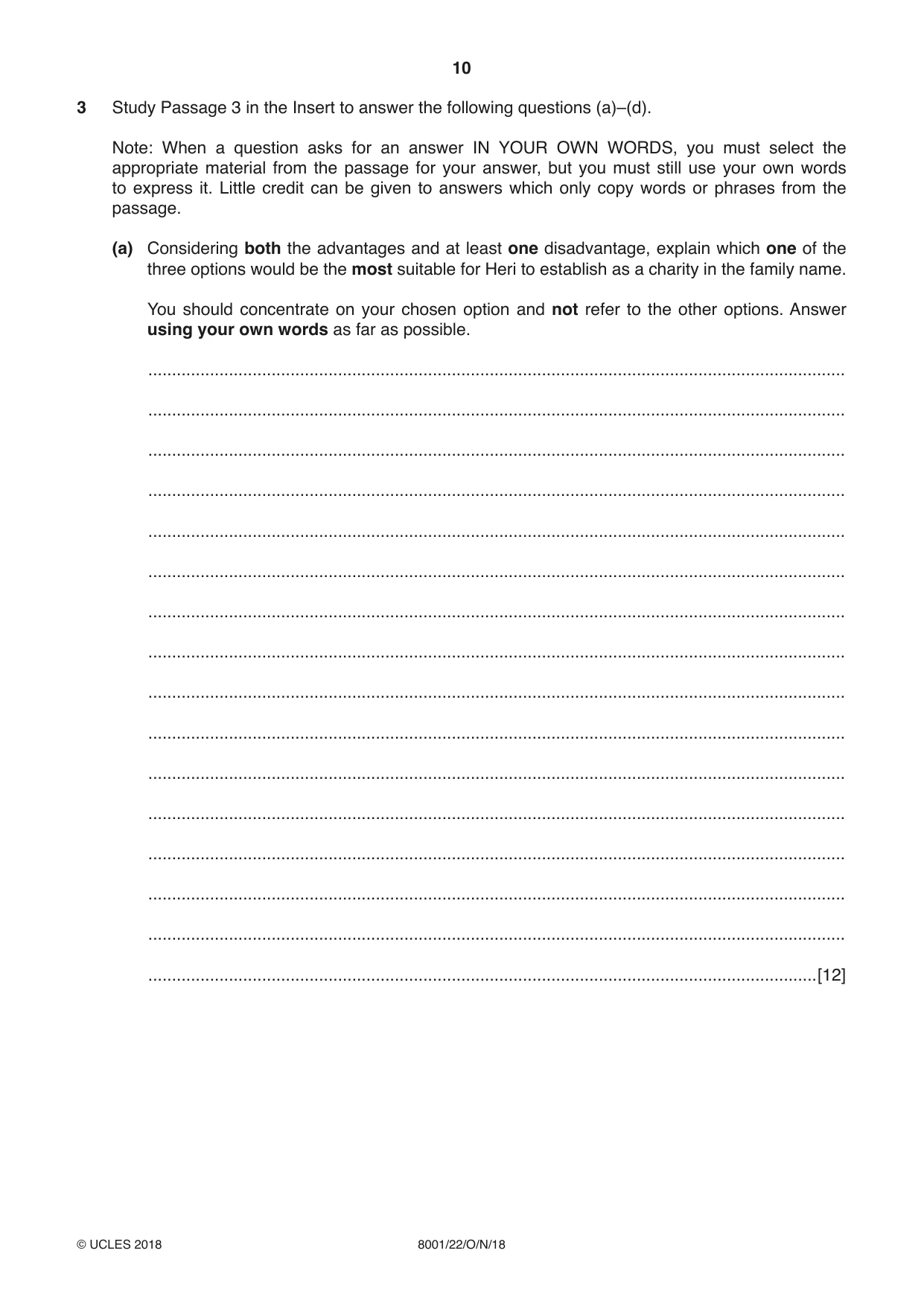
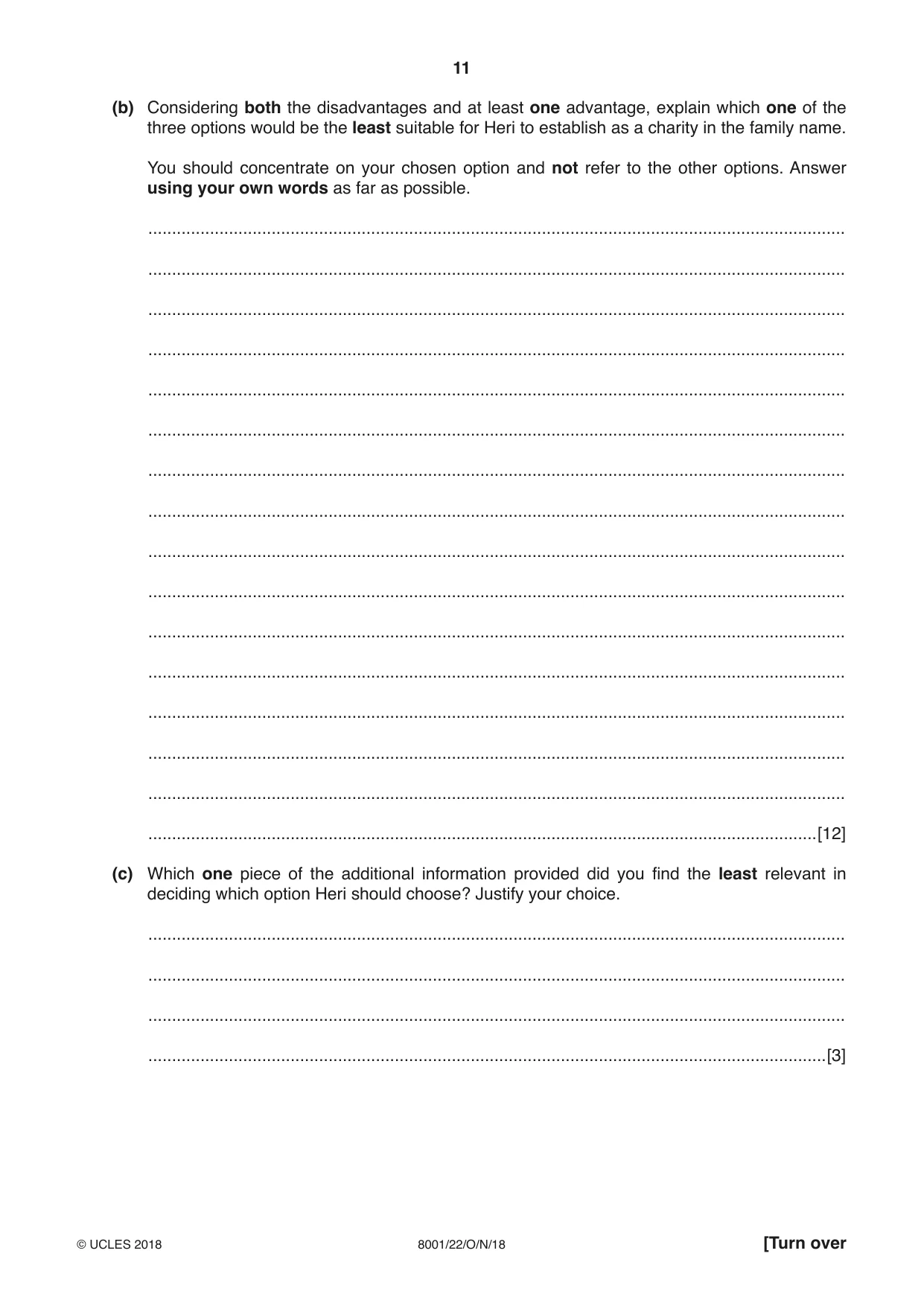
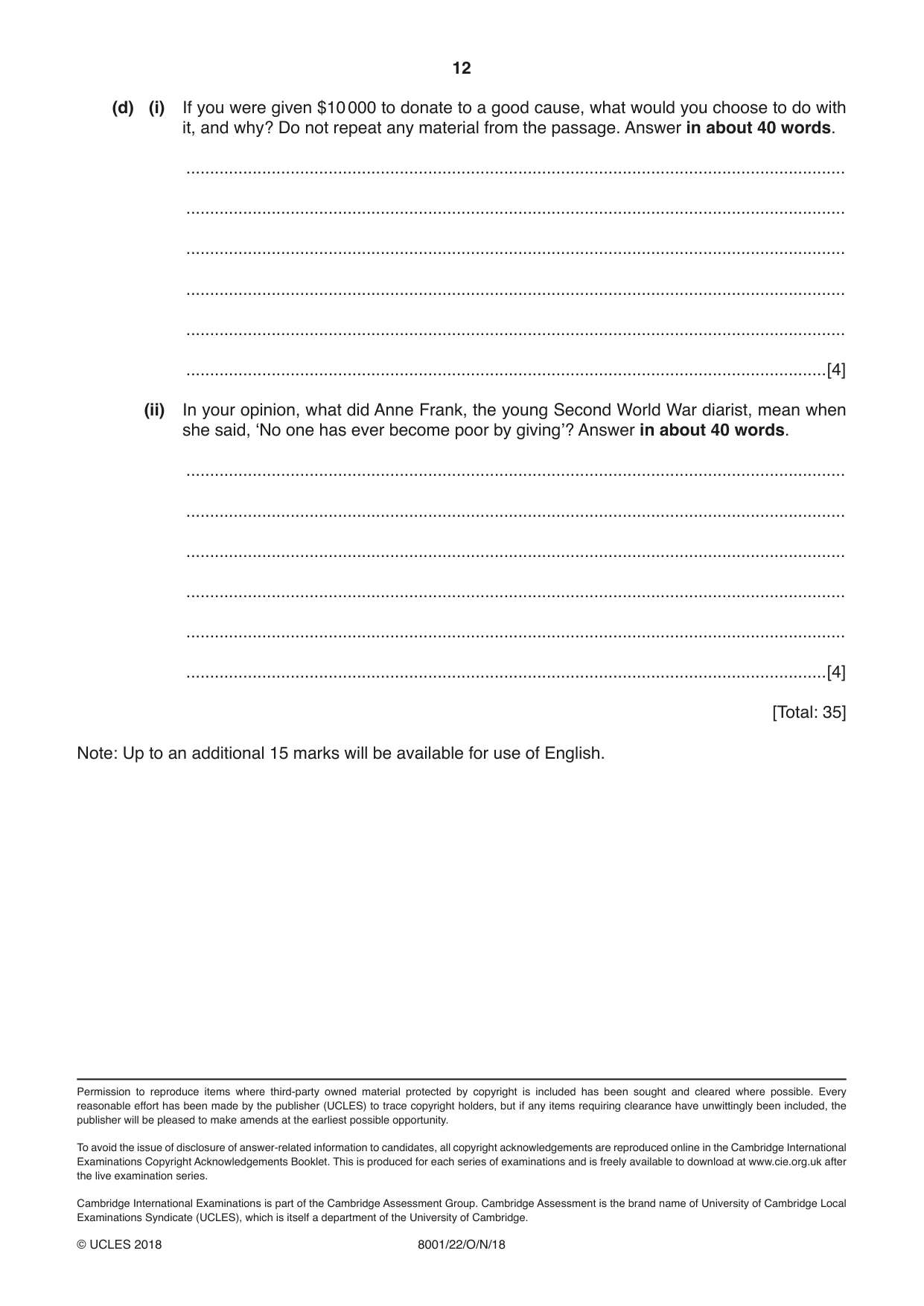
3 Study Passage 3 in the Insert to answer the following questions (a)–(d). Note: When a question asks for an answer IN YOUR OWN WORDS, you must select the appropriate material from the passage for your answer, but you must still use your own words to express it. Little credit can be given to answers which only copy words or phrases from the passage. (a) Considering both the advantages and at least one disadvantage, explain which one of the three options would be the most suitable for Heri to establish as a charity in the family name. You should concentrate on your chosen option and not refer to the other options. Answer using your own words as far as possible. ................................................................................................................................................... ................................................................................................................................................... ................................................................................................................................................... ................................................................................................................................................... ................................................................................................................................................... ................................................................................................................................................... ................................................................................................................................................... ................................................................................................................................................... ................................................................................................................................................... ................................................................................................................................................... ................................................................................................................................................... ................................................................................................................................................... ................................................................................................................................................... ................................................................................................................................................... ................................................................................................................................................... .............................................................................................................................................[12] (b) Considering both the disadvantages and at least one advantage, explain which one of the three options would be the least suitable for Heri to establish as a charity in the family name. You should concentrate on your chosen option and not refer to the other options. Answer using your own words as far as possible. ................................................................................................................................................... ................................................................................................................................................... ................................................................................................................................................... ................................................................................................................................................... ................................................................................................................................................... ................................................................................................................................................... ................................................................................................................................................... ................................................................................................................................................... ................................................................................................................................................... ................................................................................................................................................... ................................................................................................................................................... ................................................................................................................................................... ................................................................................................................................................... ................................................................................................................................................... ................................................................................................................................................... .............................................................................................................................................[12] (c) Which one piece of the additional information provided did you find the least relevant in deciding which option Heri should choose? Justify your choice. ................................................................................................................................................... ................................................................................................................................................... ................................................................................................................................................... ...............................................................................................................................................[3] (d) (i) If you were given $10 000 to donate to a good cause, what would you choose to do with it, and why? Do not repeat any material from the passage. Answer in about 40 words. ........................................................................................................................................... ........................................................................................................................................... ........................................................................................................................................... ........................................................................................................................................... ........................................................................................................................................... .......................................................................................................................................[4] (ii) In your opinion, what did Anne Frank, the young Second World War diarist, mean when she said, ‘No one has ever become poor by giving’? Answer in about 40 words. ........................................................................................................................................... ........................................................................................................................................... ........................................................................................................................................... ........................................................................................................................................... ........................................................................................................................................... .......................................................................................................................................[4] [Total: 35] Note: Up to an additional 15 marks will be available for use of English.
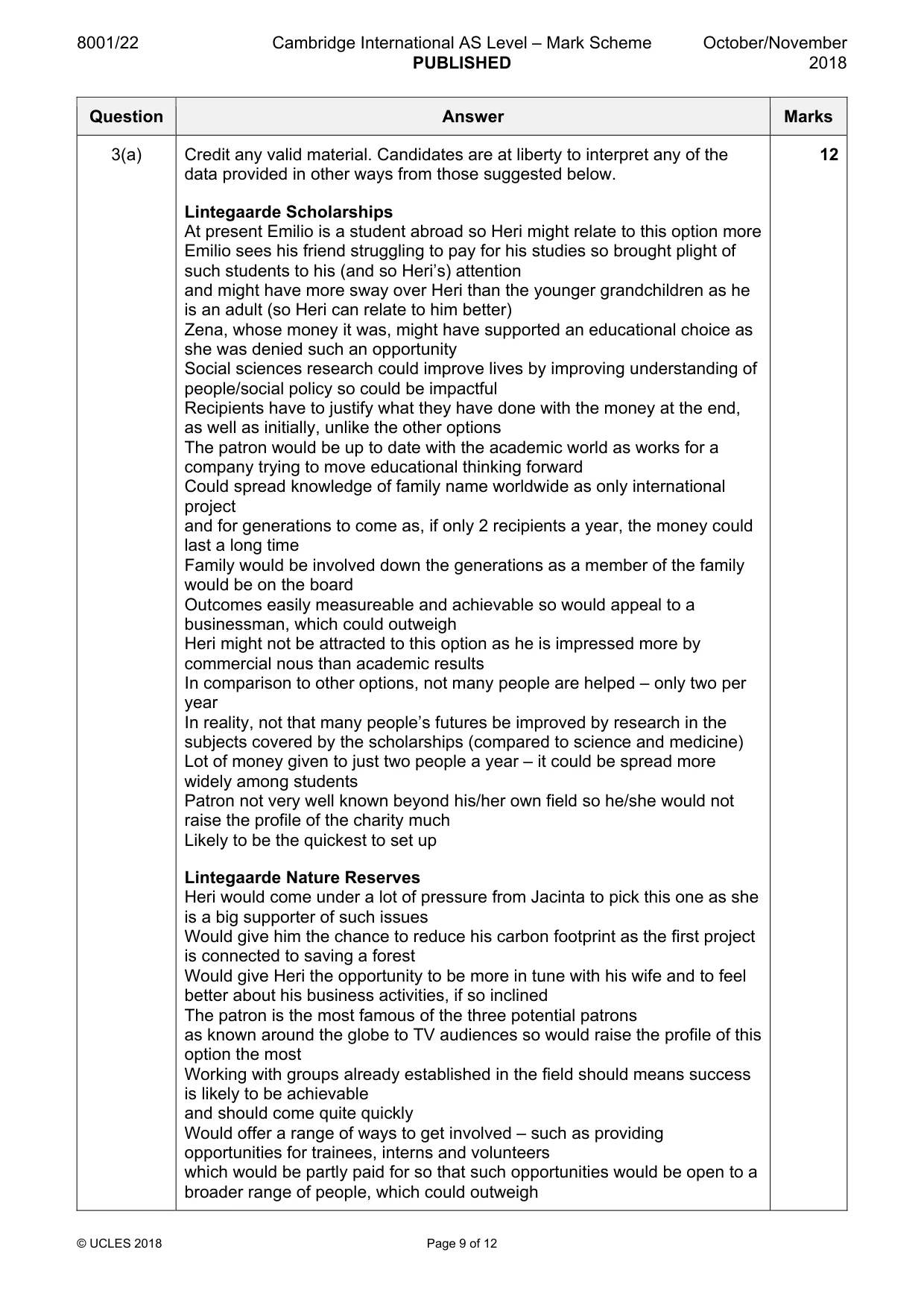
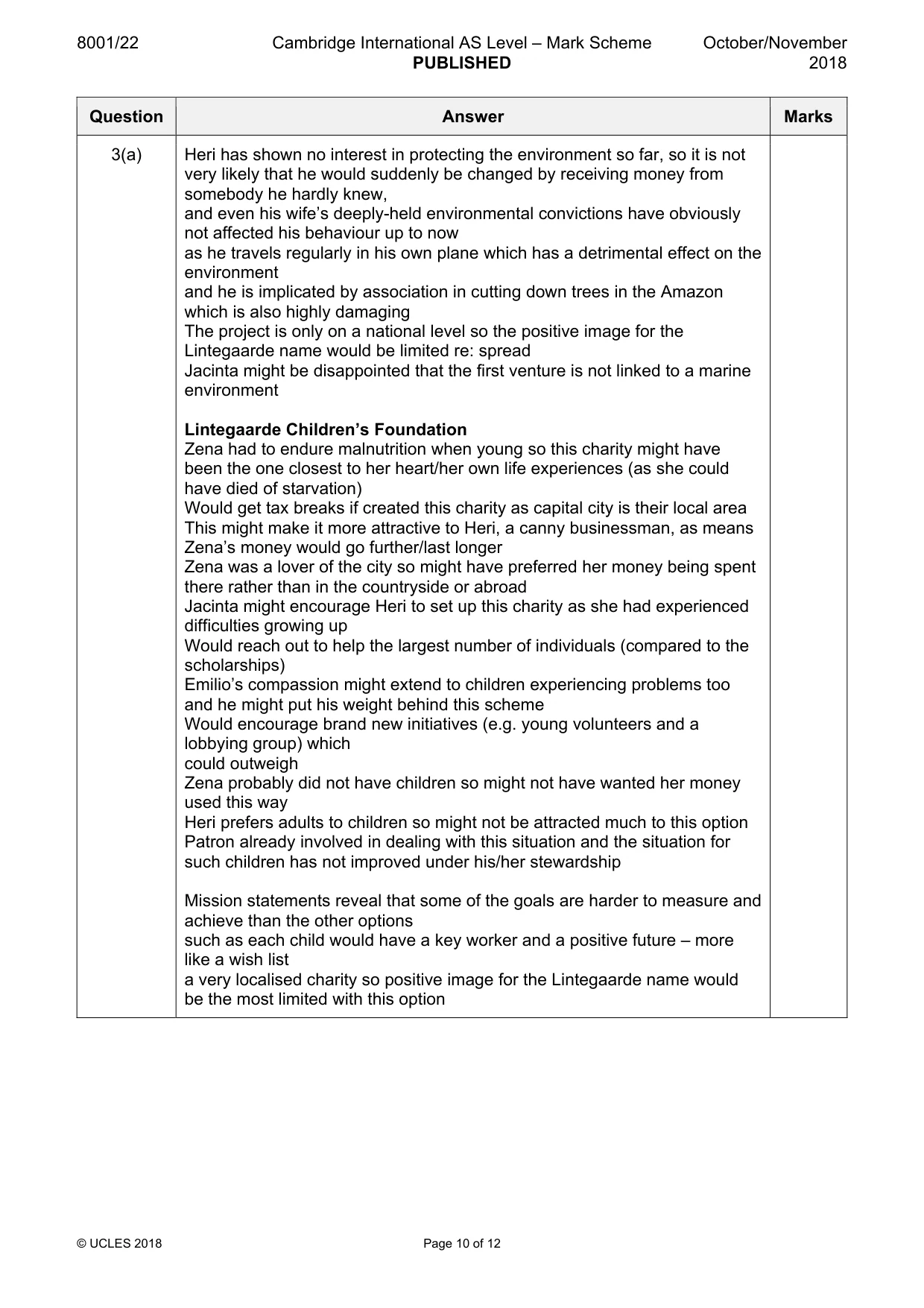
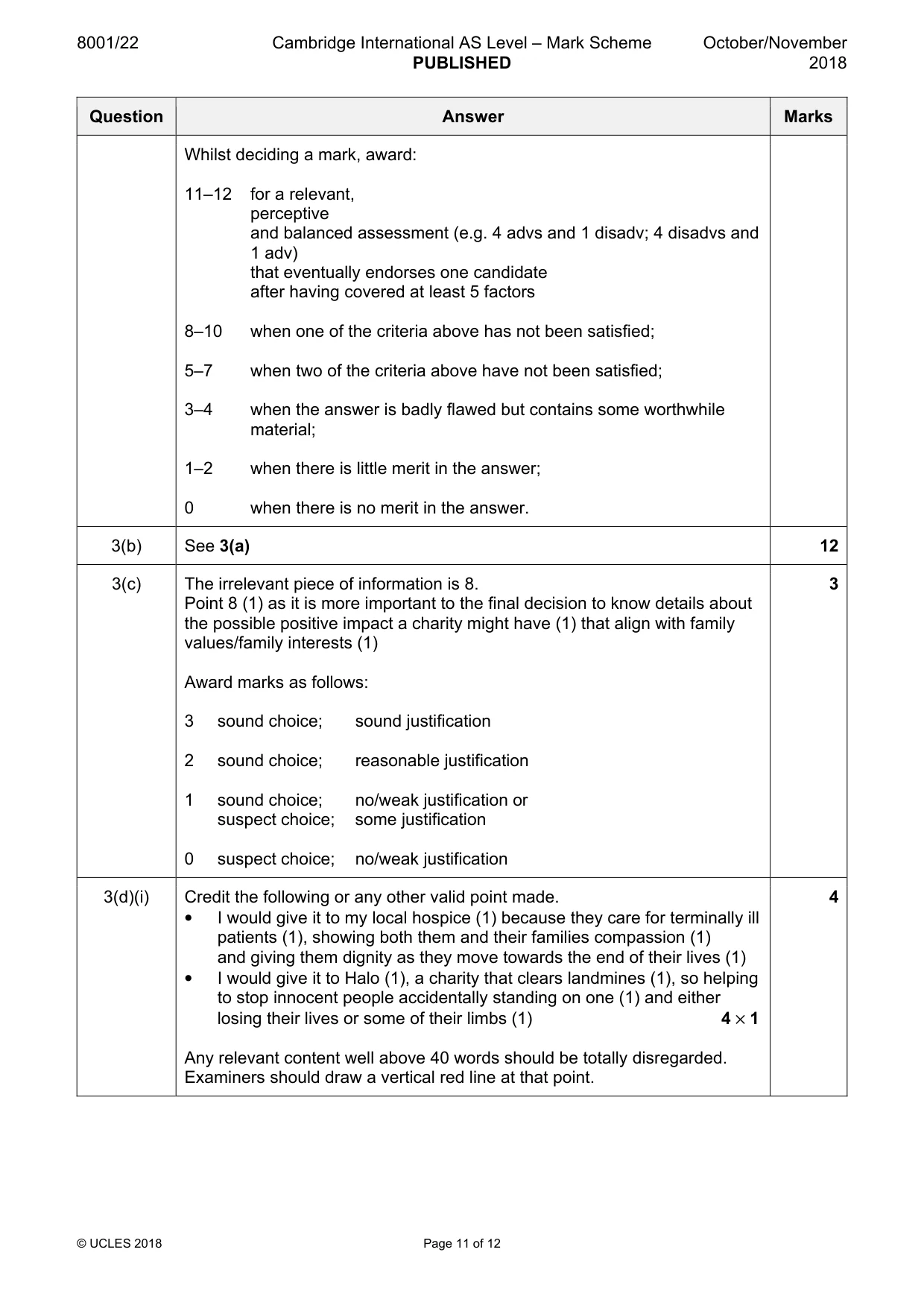
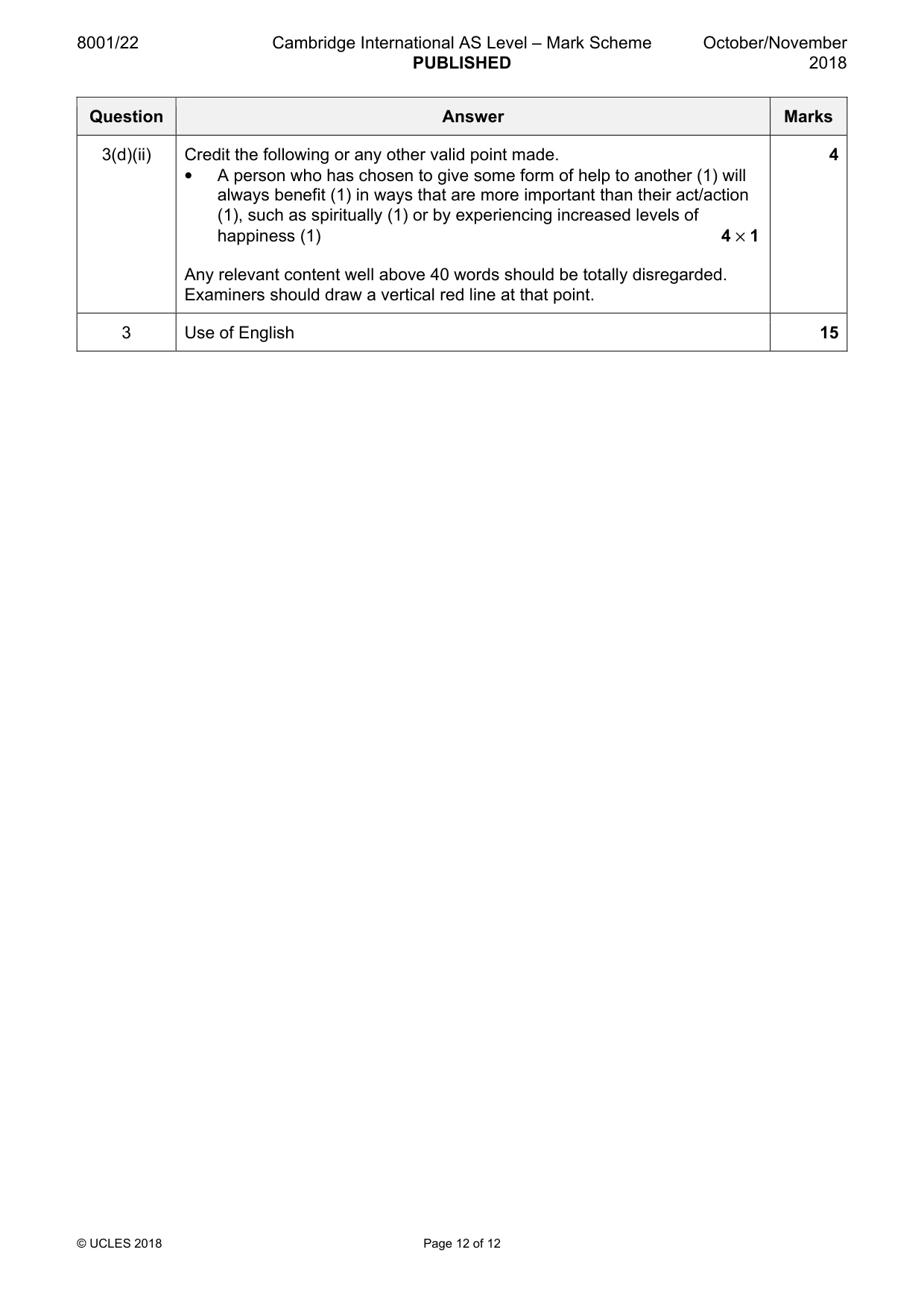
Mark scheme: 3(a) Credit any valid material. Candidates are at liberty to interpret any of the 12 data provided in other ways from those suggested below. Lintegaarde Scholarships At present Emilio is a student abroad so Heri might relate to this option more Emilio sees his friend struggling to pay for his studies so brought plight of such students to his (and so Heri’s) attention and might have more sway over Heri than the younger grandchildren as he is an adult (so Heri can relate to him better) Zena, whose money it was, might have supported an educational choice as she was denied such an opportunity Social sciences research could improve lives by improving understanding of people/social policy so could be impactful Recipients have to justify what they have done with the money at the end, as well as initially, unlike the other options The patron would be up to date with the academic world as works for a company trying to move educational thinking forward Could spread knowledge of family name worldwide as only international project and for generations to come as, if only 2 recipients a year, the money could last a long time Family would be involved down the generations as a member of the family would be on the board Outcomes easily measureable and achievable so would appeal to a businessman, which could outweigh Heri might not be attracted to this option as he is impressed more by commercial nous than academic results In comparison to other options, not many people are helped – only two per year In reality, not that many people’s futures be improved by research in the subjects covered by the scholarships (compared to science and medicine) Lot of money given to just two people a year – it could be spread more widely among students Patron not very well known beyond his/her own field so he/she would not raise the profile of the charity much Likely to be the quickest to set up Lintegaarde Nature Reserves Heri would come under a lot of pressure from Jacinta to pick this one as she is a big supporter of such issues Would give him the chance to reduce his carbon footprint as the first project is connected to saving a forest Would give Heri the opportunity to be more in tune with his wife and to feel better about his business activities, if so inclined The patron is the most famous of the three potential patrons as known around the globe to TV audiences so would raise the profile of this option the most Working with groups already established in the field should means success is likely to be achievable and should come quite quickly Would offer a range of ways to get involved – such as providing opportunities for trainees, interns and volunteers which would be partly paid for so that such opportunities would be open to a broader range of people, which could outweigh 3(a) Heri has shown no interest in protecting the environment so far, so it is not very likely that he would suddenly be changed by receiving money from somebody he hardly knew, and even his wife’s deeply-held environmental convictions have obviously not affected his behaviour up to now as he travels regularly in his own plane which has a detrimental effect on the environment and he is implicated by association in cutting down trees in the Amazon which is also highly damaging The project is only on a national level so the positive image for the Lintegaarde name would be limited re: spread Jacinta might be disappointed that the first venture is not linked to a marine environment Lintegaarde Children’s Foundation Zena had to endure malnutrition when young so this charity might have been the one closest to her heart/her own life experiences (as she could have died of starvation) Would get tax breaks if created this charity as capital city is their local area This might make it more attractive to Heri, a canny businessman, as means Zena’s money would go further/last longer Zena was a lover of the city so might have preferred her money being spent there rather than in the countryside or abroad Jacinta might encourage Heri to set up this charity as she had experienced difficulties growing up Would reach out to help the largest number of individuals (compared to the scholarships) Emilio’s compassion might extend to children experiencing problems too and he might put his weight behind this scheme Would encourage brand new initiatives (e.g. young volunteers and a lobbying group) which could outweigh Zena probably did not have children so might not have wanted her money used this way Heri prefers adults to children so might not be attracted much to this option Patron already involved in dealing with this situation and the situation for such children has not improved under his/her stewardship Mission statements reveal that some of the goals are harder to measure and achieve than the other options such as each child would have a key worker and a positive future – more like a wish list a very localised charity so positive image for the Lintegaarde name would be the most limited with this option Whilst deciding a mark, award: 11–12 for a relevant, perceptive and balanced assessment (e.g. 4 advs and 1 disadv; 4 disadvs and 1 adv) that eventually endorses one candidate after having covered at least 5 factors 8–10 when one of the criteria above has not been satisfied; 5–7 when two of the criteria above have not been satisfied; 3–4 when the answer is badly flawed but contains some worthwhile material; 1–2 when there is little merit in the answer; 0 when there is no merit in the answer. 3(b) See 3(a) 12 3(c) The irrelevant piece of information is 8. 3 Point 8 (1) as it is more important to the final decision to know details about the possible positive impact a charity might have (1) that align with family values/family interests (1) Award marks as follows: 3 sound choice; sound justification 2 sound choice; reasonable justification 1 sound choice; no/weak justification or suspect choice; some justification 0 suspect choice; no/weak justification 3(d)(i) Credit the following or any other valid point made. 4 • I would give it to my local hospice (1) because they care for terminally ill patients (1), showing both them and their families compassion (1) and giving them dignity as they move towards the end of their lives (1) • I would give it to Halo (1), a charity that clears landmines (1), so helping to stop innocent people accidentally standing on one (1) and either losing their lives or some of their limbs (1) 4 × 1 Any relevant content well above 40 words should be totally disregarded. Examiners should draw a vertical red line at that point. 3(d)(ii) Credit the following or any other valid point made. 4 • A person who has chosen to give some form of help to another (1) will always benefit (1) in ways that are more important than their act/action (1), such as spiritually (1) or by experiencing increased levels of happiness (1) 4 × 1 Any relevant content well above 40 words should be totally disregarded. Examiners should draw a vertical red line at that point. 3 Use of English 15