Cambridge A Level General Paper (AS Level only) 8001 — 2015 Oct/Nov Paper 1 · Variant 3
8001/13/O/N/15 · 50 marks · ≈56 min
The question paper and its mark scheme, free to read here and free to download. This is Cambridge’s own paper, exactly as it was sat.
Question paper4 pages
Mark scheme6 pages
Answers below. Sit the paper first if you are practising.
Paper as text
Question paper, page 1
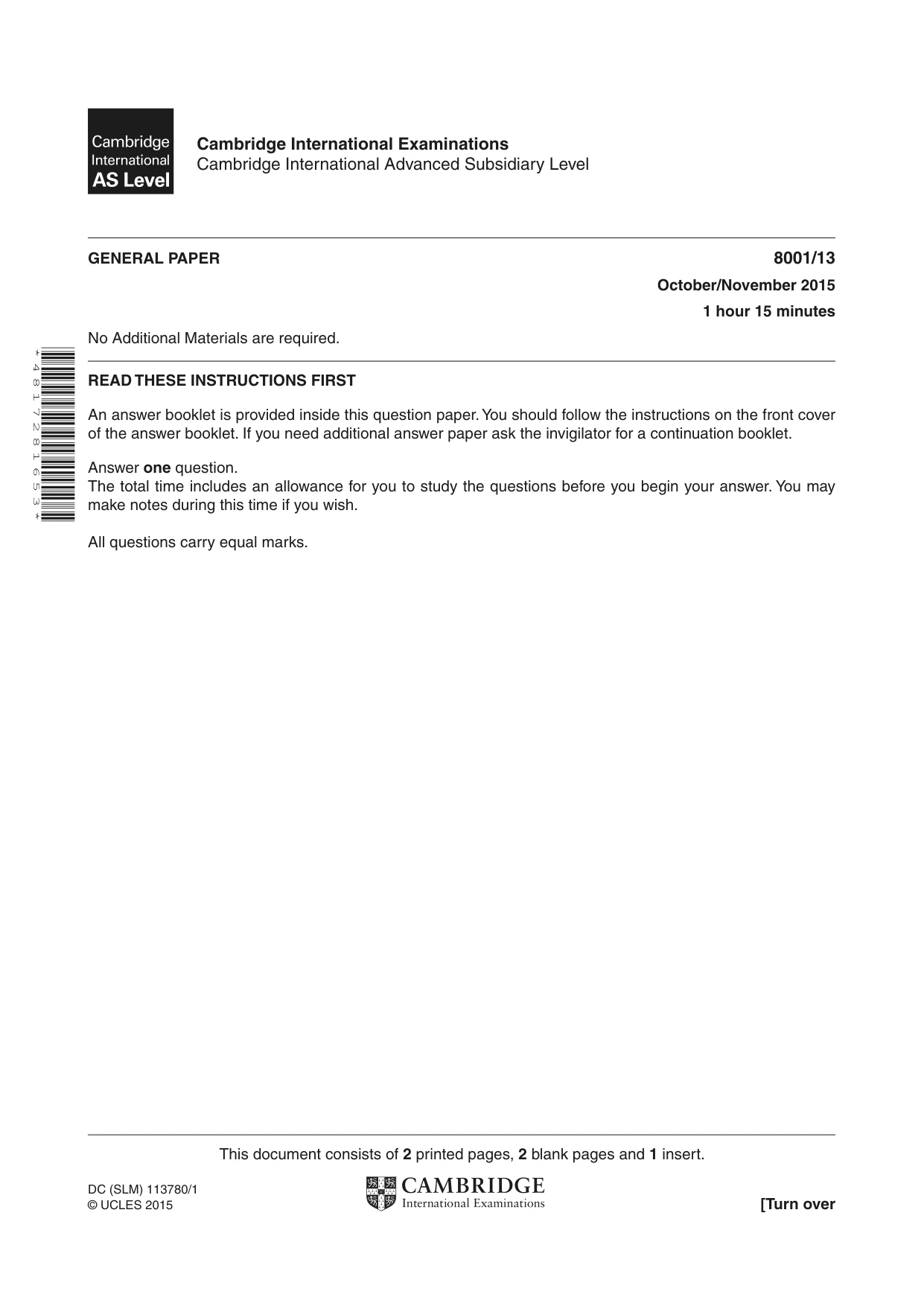
This document consists of 2 printed pages, 2 blank pages and 1 insert. DC (SLM) 113780/1 © UCLES 2015 [Turn over * 4 8 1 7 2 8 1 6 5 3 * GENERAL PAPER 8001/13 October/November 2015 1 hour 15 minutes No Additional Materials are required. READ THESE INSTRUCTIONS FIRST An answer booklet is provided inside this question paper. You should follow the instructions on the front cover of the answer booklet. If you need additional answer paper ask the invigilator for a continuation booklet. Answer one question. The total time includes an allowance for you to study the questions before you begin your answer. You may make notes during this time if you wish. All questions carry equal marks. Cambridge International Examinations Cambridge International Advanced Subsidiary Level
Question paper, page 2
2 8001/13/O/N/15 © UCLES 2015 BLANK PAGE
Question paper, page 3
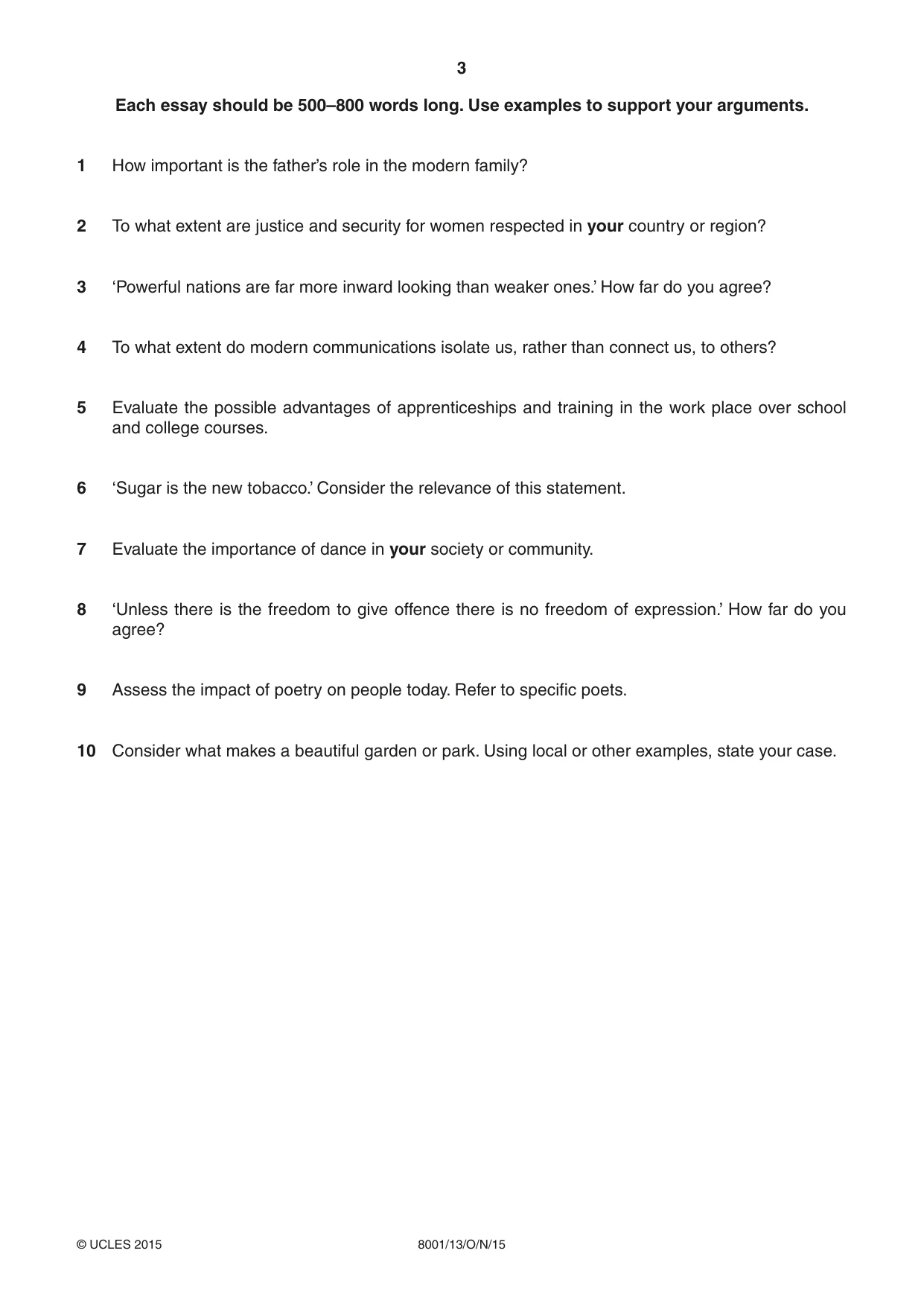
3 8001/13/O/N/15 © UCLES 2015 Each essay should be 500–800 words long. Use examples to support your arguments. 1 How important is the father’s role in the modern family? 2 To what extent are justice and security for women respected in your country or region? 3 ‘Powerful nations are far more inward looking than weaker ones.’ How far do you agree? 4 To what extent do modern communications isolate us, rather than connect us, to others? 5 Evaluate the possible advantages of apprenticeships and training in the work place over school and college courses. 6 ‘Sugar is the new tobacco.’ Consider the relevance of this statement. 7 Evaluate the importance of dance in your society or community. 8 ‘Unless there is the freedom to give offence there is no freedom of expression.’ How far do you agree? 9 Assess the impact of poetry on people today. Refer to specific poets. 10 Consider what makes a beautiful garden or park. Using local or other examples, state your case.
Question paper, page 4
4 8001/13/O/N/15 © UCLES 2015 BLANK PAGE Permission to reproduce items where third-party owned material protected by copyright is included has been sought and cleared where possible. Every reasonable effort has been made by the publisher (UCLES) to trace copyright holders, but if any items requiring clearance have unwittingly been included, the publisher will be pleased to make amends at the earliest possible opportunity. To avoid the issue of disclosure of answer-related information to candidates, all copyright acknowledgements are reproduced online in the Cambridge International Examinations Copyright Acknowledgements Booklet. This is produced for each series of examinations and is freely available to download at www.cie.org.uk after the live examination series. Cambridge International Examinations is part of the Cambridge Assessment Group. Cambridge Assessment is the brand name of University of Cambridge Local Examinations Syndicate (UCLES), which is itself a department of the University of Cambridge.
Mark scheme, page 1
® IGCSE is the registered trademark of Cambridge International Examinations. CAMBRIDGE INTERNATIONAL EXAMINATIONS Cambridge International Advanced Subsidiary Level MARK SCHEME for the October/November 2015 series 8001 GENERAL PAPER 8001/13 Paper 1, maximum raw mark 50 This mark scheme is published as an aid to teachers and candidates, to indicate the requirements of the examination. It shows the basis on which Examiners were instructed to award marks. It does not indicate the details of the discussions that took place at an Examiners’ meeting before marking began, which would have considered the acceptability of alternative answers. Mark schemes should be read in conjunction with the question paper and the Principal Examiner Report for Teachers. Cambridge will not enter into discussions about these mark schemes. Cambridge is publishing the mark schemes for the October/November 2015 series for most Cambridge IGCSE®, Cambridge International A and AS Level components and some Cambridge O Level components.
Mark scheme, page 2
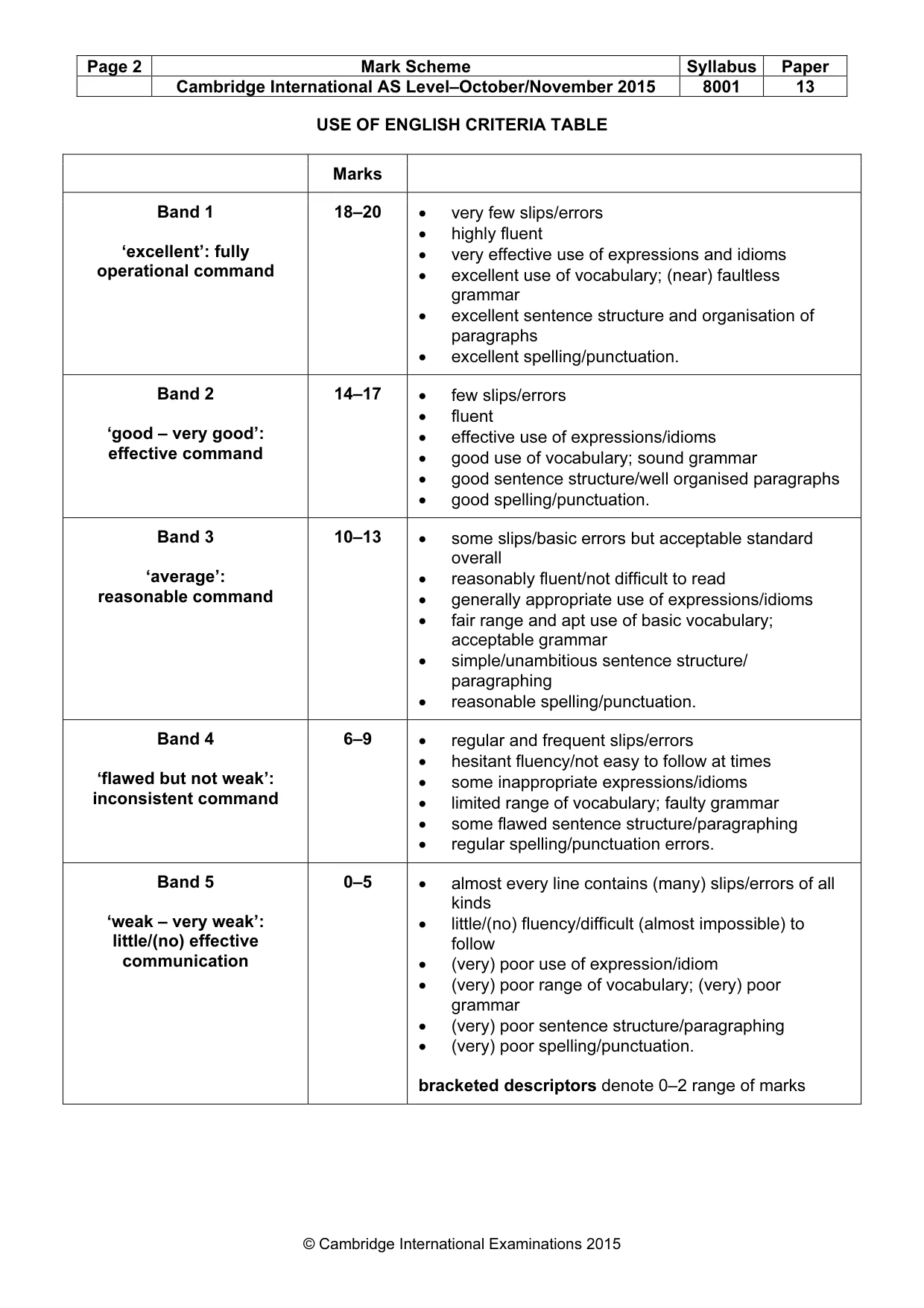
Page 2 Mark Scheme Syllabus Paper Cambridge International AS Level–October/November 2015 8001 13 © Cambridge International Examinations 2015 USE OF ENGLISH CRITERIA TABLE Marks Band 1 ‘excellent’: fully operational command 18–20 • very few slips/errors • highly fluent • very effective use of expressions and idioms • excellent use of vocabulary; (near) faultless grammar • excellent sentence structure and organisation of paragraphs • excellent spelling/punctuation. Band 2 ‘good – very good’: effective command 14–17 • few slips/errors • fluent • effective use of expressions/idioms • good use of vocabulary; sound grammar • good sentence structure/well organised paragraphs • good spelling/punctuation. Band 3 ‘average’: reasonable command 10–13 • some slips/basic errors but acceptable standard overall • reasonably fluent/not difficult to read • generally appropriate use of expressions/idioms • fair range and apt use of basic vocabulary; acceptable grammar • simple/unambitious sentence structure/ paragraphing • reasonable spelling/punctuation. Band 4 ‘flawed but not weak’: inconsistent command 6–9 • regular and frequent slips/errors • hesitant fluency/not easy to follow at times • some inappropriate expressions/idioms • limited range of vocabulary; faulty grammar • some flawed sentence structure/paragraphing • regular spelling/punctuation errors. Band 5 ‘weak – very weak’: little/(no) effective communication 0–5 • almost every line contains (many) slips/errors of all kinds • little/(no) fluency/difficult (almost impossible) to follow • (very) poor use of expression/idiom • (very) poor range of vocabulary; (very) poor grammar • (very) poor sentence structure/paragraphing • (very) poor spelling/punctuation. bracketed descriptors denote 0–2 range of marks
Mark scheme, page 3
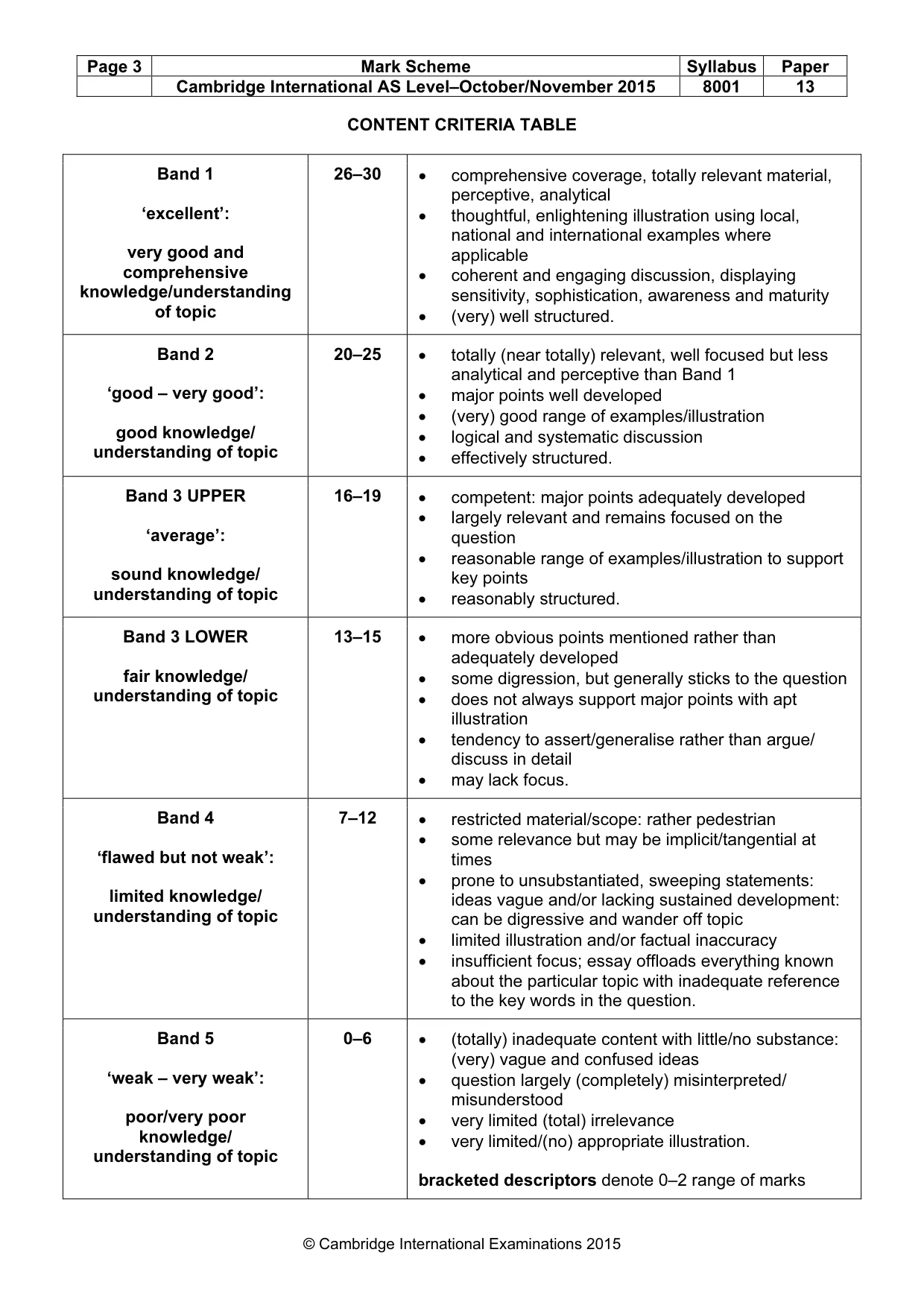
Page 3 Mark Scheme Syllabus Paper Cambridge International AS Level–October/November 2015 8001 13 © Cambridge International Examinations 2015 CONTENT CRITERIA TABLE Band 1 ‘excellent’: very good and comprehensive knowledge/understanding of topic 26–30 • comprehensive coverage, totally relevant material, perceptive, analytical • thoughtful, enlightening illustration using local, national and international examples where applicable • coherent and engaging discussion, displaying sensitivity, sophistication, awareness and maturity • (very) well structured. Band 2 ‘good – very good’: good knowledge/ understanding of topic 20–25 • totally (near totally) relevant, well focused but less analytical and perceptive than Band 1 • major points well developed • (very) good range of examples/illustration • logical and systematic discussion • effectively structured. Band 3 UPPER ‘average’: sound knowledge/ understanding of topic 16–19 • competent: major points adequately developed • largely relevant and remains focused on the question • reasonable range of examples/illustration to support key points • reasonably structured. Band 3 LOWER fair knowledge/ understanding of topic 13–15 • more obvious points mentioned rather than adequately developed • some digression, but generally sticks to the question • does not always support major points with apt illustration • tendency to assert/generalise rather than argue/ discuss in detail • may lack focus. Band 4 ‘flawed but not weak’: limited knowledge/ understanding of topic 7–12 • restricted material/scope: rather pedestrian • some relevance but may be implicit/tangential at times • prone to unsubstantiated, sweeping statements: ideas vague and/or lacking sustained development: can be digressive and wander off topic • limited illustration and/or factual inaccuracy • insufficient focus; essay offloads everything known about the particular topic with inadequate reference to the key words in the question. Band 5 ‘weak – very weak’: poor/very poor knowledge/ understanding of topic 0–6 • (totally) inadequate content with little/no substance: (very) vague and confused ideas • question largely (completely) misinterpreted/ misunderstood • very limited (total) irrelevance • very limited/(no) appropriate illustration. bracketed descriptors denote 0–2 range of marks
Mark scheme, page 4
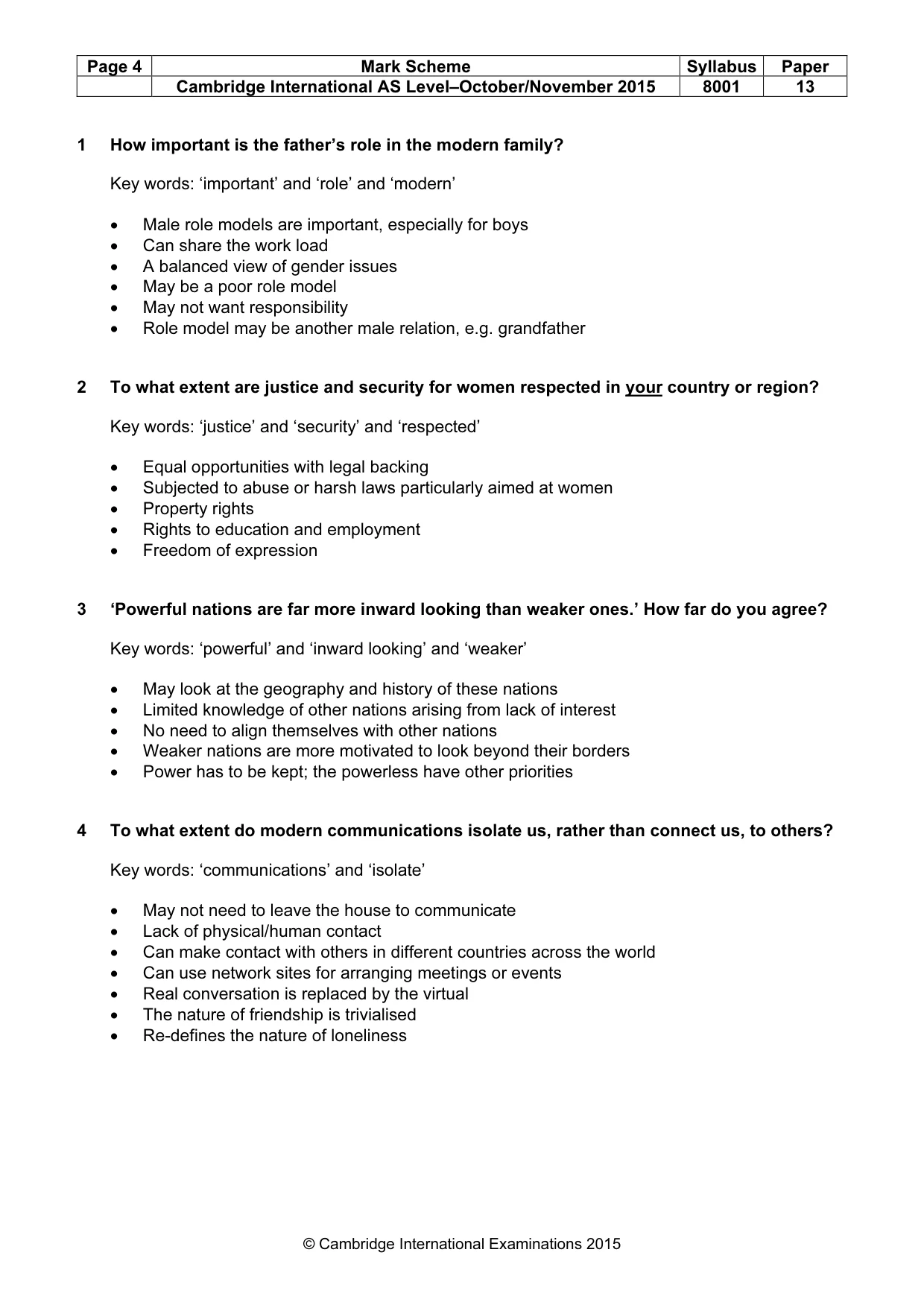
Page 4 Mark Scheme Syllabus Paper Cambridge International AS Level–October/November 2015 8001 13 © Cambridge International Examinations 2015 1 How important is the father’s role in the modern family? Key words: ‘important’ and ‘role’ and ‘modern’ • Male role models are important, especially for boys • Can share the work load • A balanced view of gender issues • May be a poor role model • May not want responsibility • Role model may be another male relation, e.g. grandfather 2 To what extent are justice and security for women respected in your country or region? Key words: ‘justice’ and ‘security’ and ‘respected’ • Equal opportunities with legal backing • Subjected to abuse or harsh laws particularly aimed at women • Property rights • Rights to education and employment • Freedom of expression 3 ‘Powerful nations are far more inward looking than weaker ones.’ How far do you agree? Key words: ‘powerful’ and ‘inward looking’ and ‘weaker’ • May look at the geography and history of these nations • Limited knowledge of other nations arising from lack of interest • No need to align themselves with other nations • Weaker nations are more motivated to look beyond their borders • Power has to be kept; the powerless have other priorities 4 To what extent do modern communications isolate us, rather than connect us, to others? Key words: ‘communications’ and ‘isolate’ • May not need to leave the house to communicate • Lack of physical/human contact • Can make contact with others in different countries across the world • Can use network sites for arranging meetings or events • Real conversation is replaced by the virtual • The nature of friendship is trivialised • Re-defines the nature of loneliness
Mark scheme, page 5
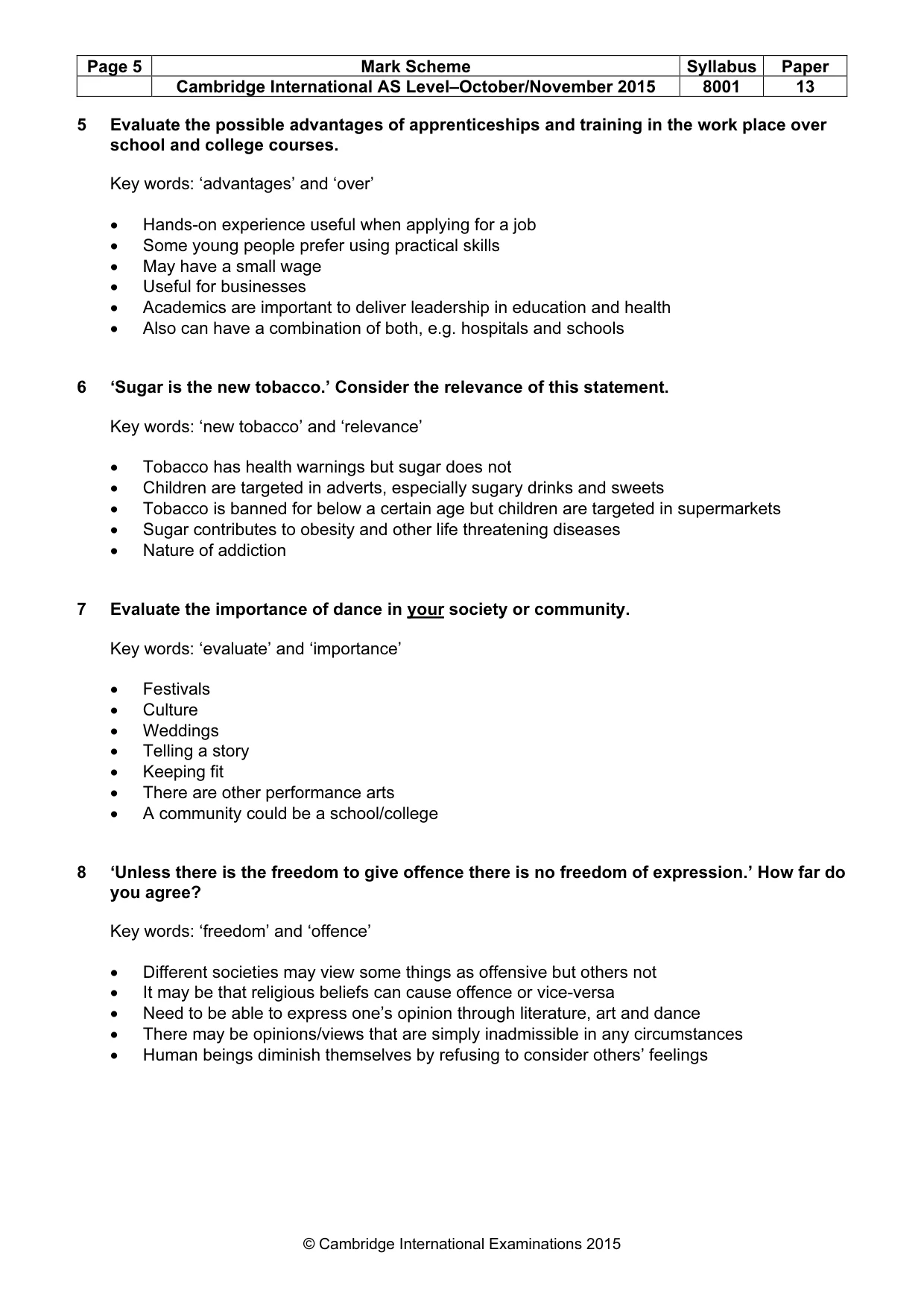
Page 5 Mark Scheme Syllabus Paper Cambridge International AS Level–October/November 2015 8001 13 © Cambridge International Examinations 2015 5 Evaluate the possible advantages of apprenticeships and training in the work place over school and college courses. Key words: ‘advantages’ and ‘over’ • Hands-on experience useful when applying for a job • Some young people prefer using practical skills • May have a small wage • Useful for businesses • Academics are important to deliver leadership in education and health • Also can have a combination of both, e.g. hospitals and schools 6 ‘Sugar is the new tobacco.’ Consider the relevance of this statement. Key words: ‘new tobacco’ and ‘relevance’ • Tobacco has health warnings but sugar does not • Children are targeted in adverts, especially sugary drinks and sweets • Tobacco is banned for below a certain age but children are targeted in supermarkets • Sugar contributes to obesity and other life threatening diseases • Nature of addiction 7 Evaluate the importance of dance in your society or community. Key words: ‘evaluate’ and ‘importance’ • Festivals • Culture • Weddings • Telling a story • Keeping fit • There are other performance arts • A community could be a school/college 8 ‘Unless there is the freedom to give offence there is no freedom of expression.’ How far do you agree? Key words: ‘freedom’ and ‘offence’ • Different societies may view some things as offensive but others not • It may be that religious beliefs can cause offence or vice-versa • Need to be able to express one’s opinion through literature, art and dance • There may be opinions/views that are simply inadmissible in any circumstances • Human beings diminish themselves by refusing to consider others’ feelings
Mark scheme, page 6
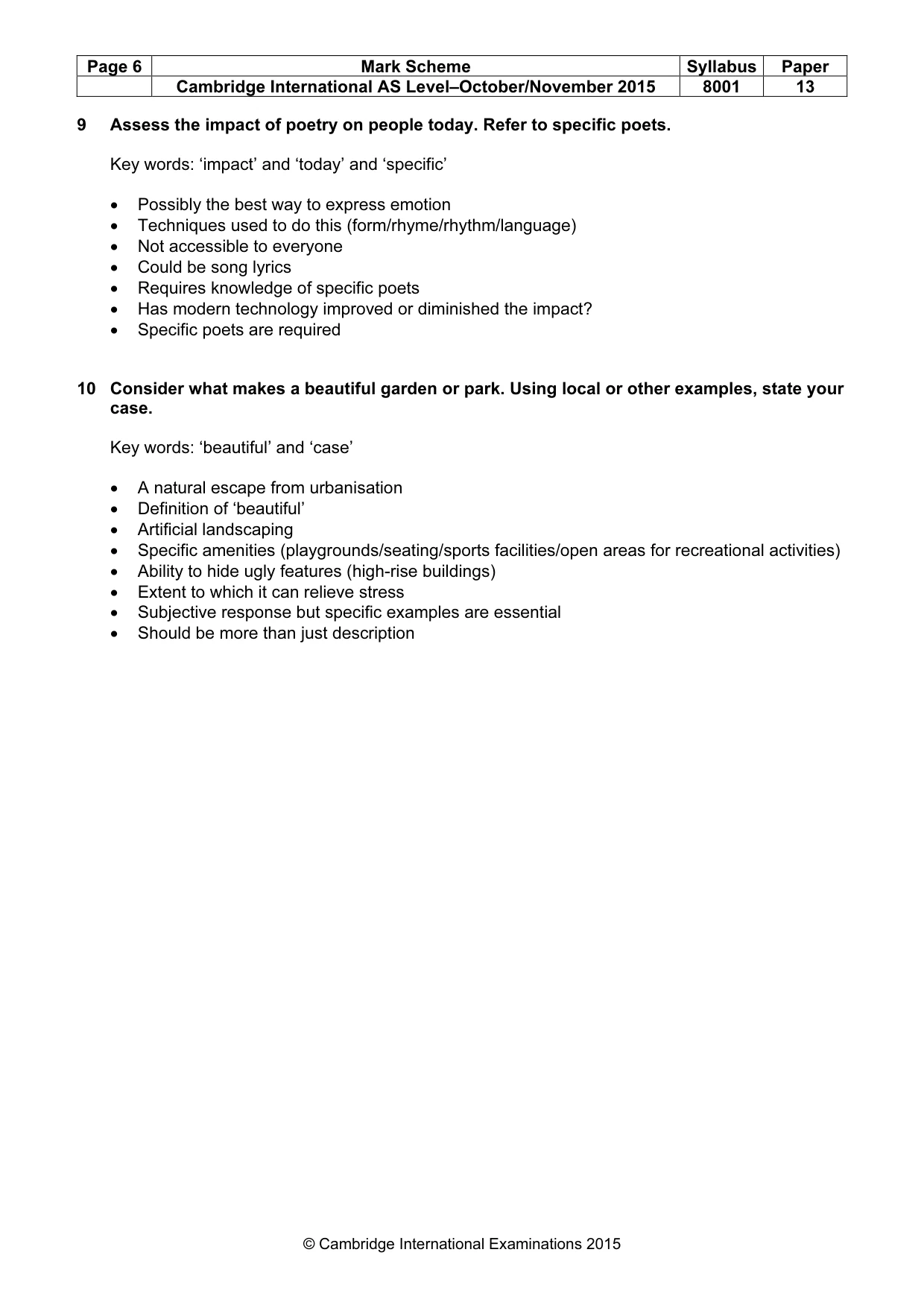
Page 6 Mark Scheme Syllabus Paper Cambridge International AS Level–October/November 2015 8001 13 © Cambridge International Examinations 2015 9 Assess the impact of poetry on people today. Refer to specific poets. Key words: ‘impact’ and ‘today’ and ‘specific’ • Possibly the best way to express emotion • Techniques used to do this (form/rhyme/rhythm/language) • Not accessible to everyone • Could be song lyrics • Requires knowledge of specific poets • Has modern technology improved or diminished the impact? • Specific poets are required 10 Consider what makes a beautiful garden or park. Using local or other examples, state your case. Key words: ‘beautiful’ and ‘case’ • A natural escape from urbanisation • Definition of ‘beautiful’ • Artificial landscaping • Specific amenities (playgrounds/seating/sports facilities/open areas for recreational activities) • Ability to hide ugly features (high-rise buildings) • Extent to which it can relieve stress • Subjective response but specific examples are essential • Should be more than just description
What you needed in this session
Cambridge’s own grade thresholds for 2015 Oct/Nov, Paper 1 · Variant 3. A higher threshold means an easier paper — the bar moves with how the cohort did.