Cambridge A Level General Paper (AS Level only) 8001 — 2012 Oct/Nov Paper 1 · Variant 3
8001/13/O/N/12 · 50 marks · ≈56 min
The question paper and its mark scheme, free to read here and free to download. This is Cambridge’s own paper, exactly as it was sat.
Question paper2 pages
Mark scheme7 pages
Answers below. Sit the paper first if you are practising.
Paper as text
Question paper, page 1
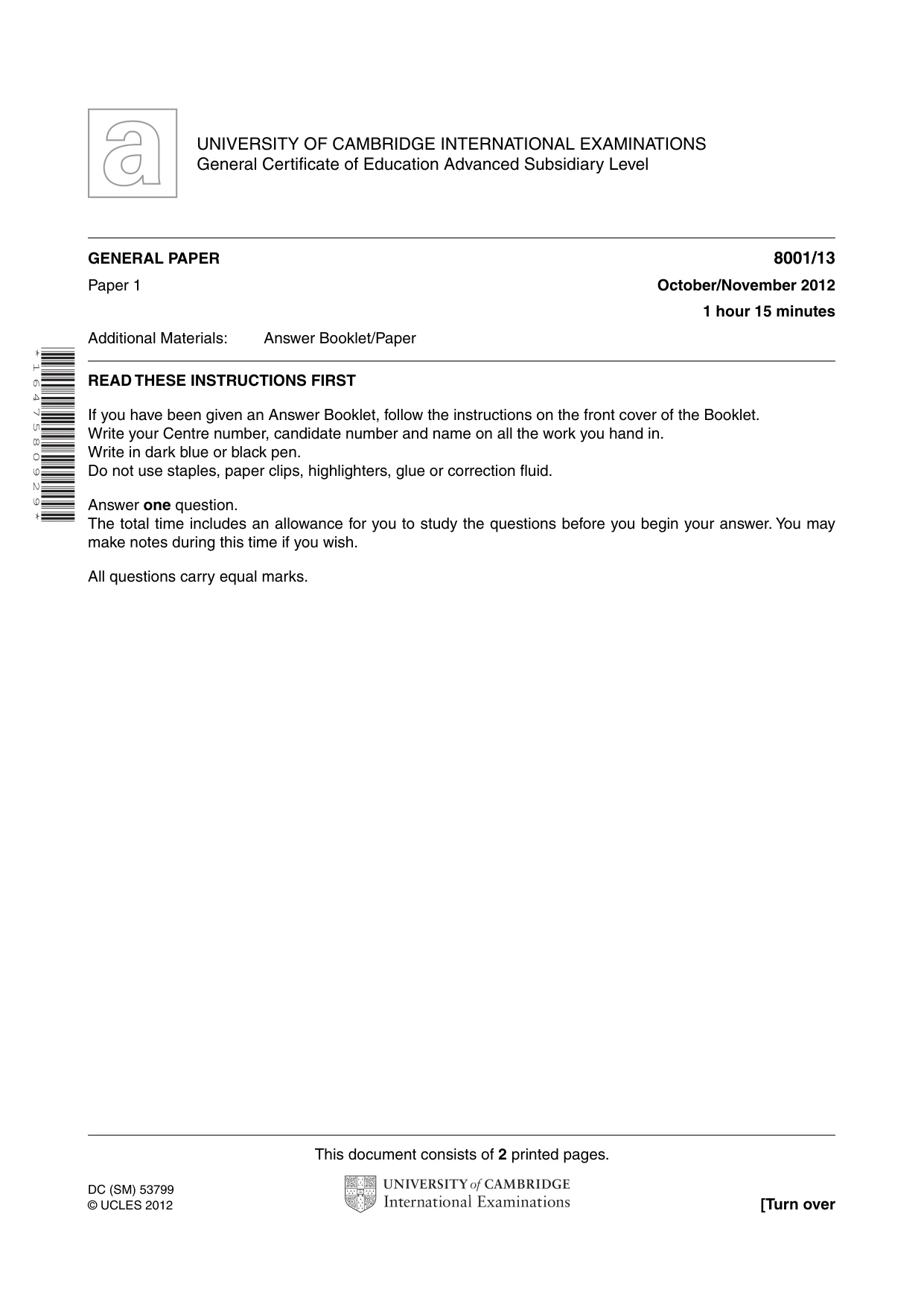
* 1 6 4 7 5 8 0 9 2 9 * This document consists of 2 printed pages. DC (SM) 53799 © UCLES 2012 [Turn over UNIVERSITY OF CAMBRIDGE INTERNATIONAL EXAMINATIONS General Certificate of Education Advanced Subsidiary Level READ THESE INSTRUCTIONS FIRST If you have been given an Answer Booklet, follow the instructions on the front cover of the Booklet. Write your Centre number, candidate number and name on all the work you hand in. Write in dark blue or black pen. Do not use staples, paper clips, highlighters, glue or correction fluid. Answer one question. The total time includes an allowance for you to study the questions before you begin your answer. You may make notes during this time if you wish. All questions carry equal marks. GENERAL PAPER 8001/13 Paper 1 October/November 2012 1 hour 15 minutes Additional Materials: Answer Booklet/Paper
Question paper, page 2
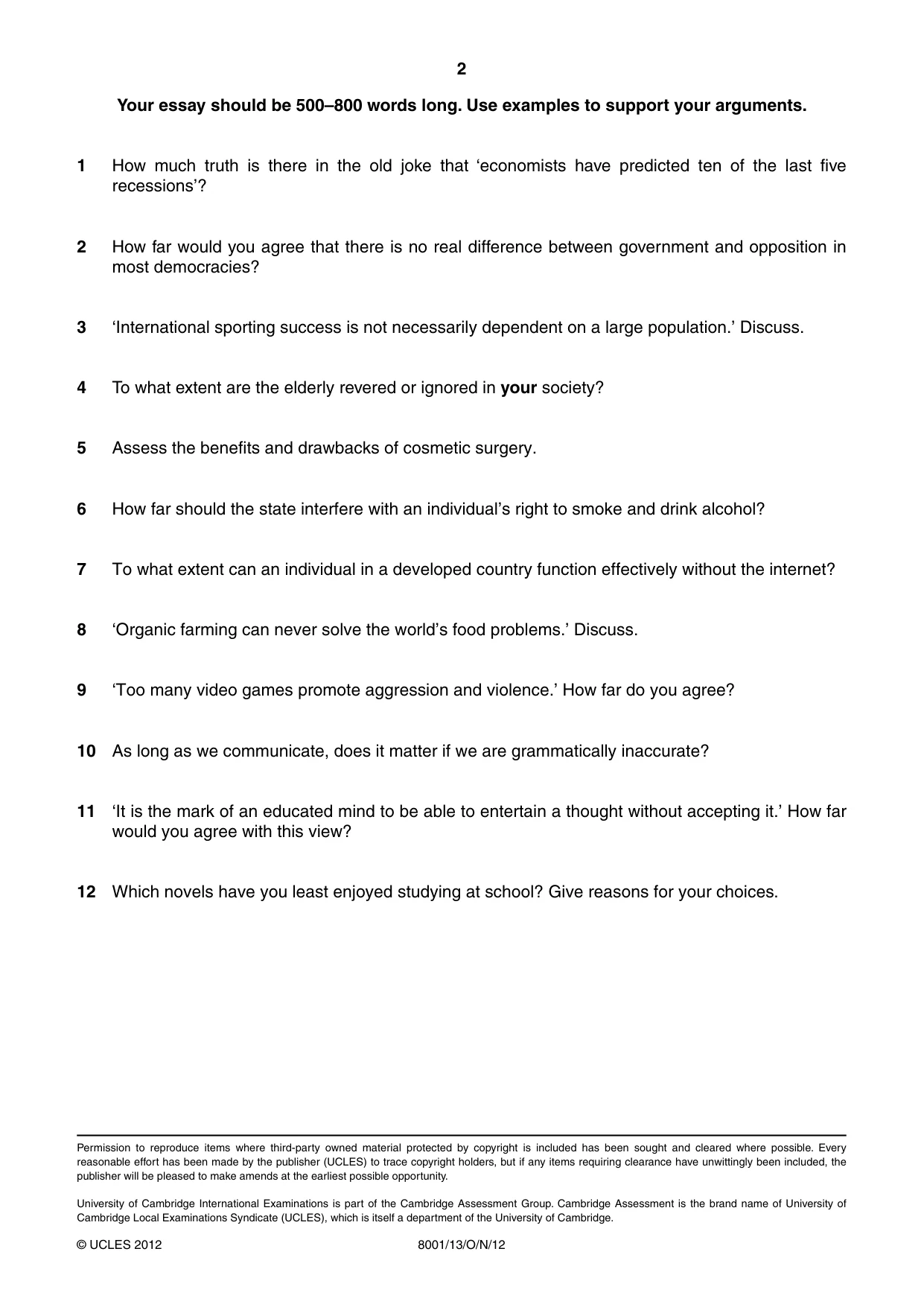
2 8001/13/O/N/12 © UCLES 2012 Permission to reproduce items where third-party owned material protected by copyright is included has been sought and cleared where possible. Every reasonable effort has been made by the publisher (UCLES) to trace copyright holders, but if any items requiring clearance have unwittingly been included, the publisher will be pleased to make amends at the earliest possible opportunity. University of Cambridge International Examinations is part of the Cambridge Assessment Group. Cambridge Assessment is the brand name of University of Cambridge Local Examinations Syndicate (UCLES), which is itself a department of the University of Cambridge. Your essay should be 500–800 words long. Use examples to support your arguments. 1 How much truth is there in the old joke that ‘economists have predicted ten of the last five recessions’? 2 How far would you agree that there is no real difference between government and opposition in most democracies? 3 ‘International sporting success is not necessarily dependent on a large population.’ Discuss. 4 To what extent are the elderly revered or ignored in your society? 5 Assess the benefits and drawbacks of cosmetic surgery. 6 How far should the state interfere with an individual’s right to smoke and drink alcohol? 7 To what extent can an individual in a developed country function effectively without the internet? 8 ‘Organic farming can never solve the world’s food problems.’ Discuss. 9 ‘Too many video games promote aggression and violence.’ How far do you agree? 10 As long as we communicate, does it matter if we are grammatically inaccurate? 11 ‘It is the mark of an educated mind to be able to entertain a thought without accepting it.’ How far would you agree with this view? 12 Which novels have you least enjoyed studying at school? Give reasons for your choices.
Mark scheme, page 1
CAMBRIDGE INTERNATIONAL EXAMINATIONS GCE Advanced Subsidiary Level MARK SCHEME for the October/November 2012 series 8001 GENERAL PAPER 8001/13 Paper 1, maximum raw mark 50 This mark scheme is published as an aid to teachers and candidates, to indicate the requirements of the examination. It shows the basis on which Examiners were instructed to award marks. It does not indicate the details of the discussions that took place at an Examiners’ meeting before marking began, which would have considered the acceptability of alternative answers. Mark schemes should be read in conjunction with the question paper and the Principal Examiner Report for Teachers. Cambridge will not enter into discussions about these mark schemes. Cambridge is publishing the mark schemes for the October/November 2012 series for most IGCSE, GCE Advanced Level and Advanced Subsidiary Level components and some Ordinary Level components.
Mark scheme, page 2
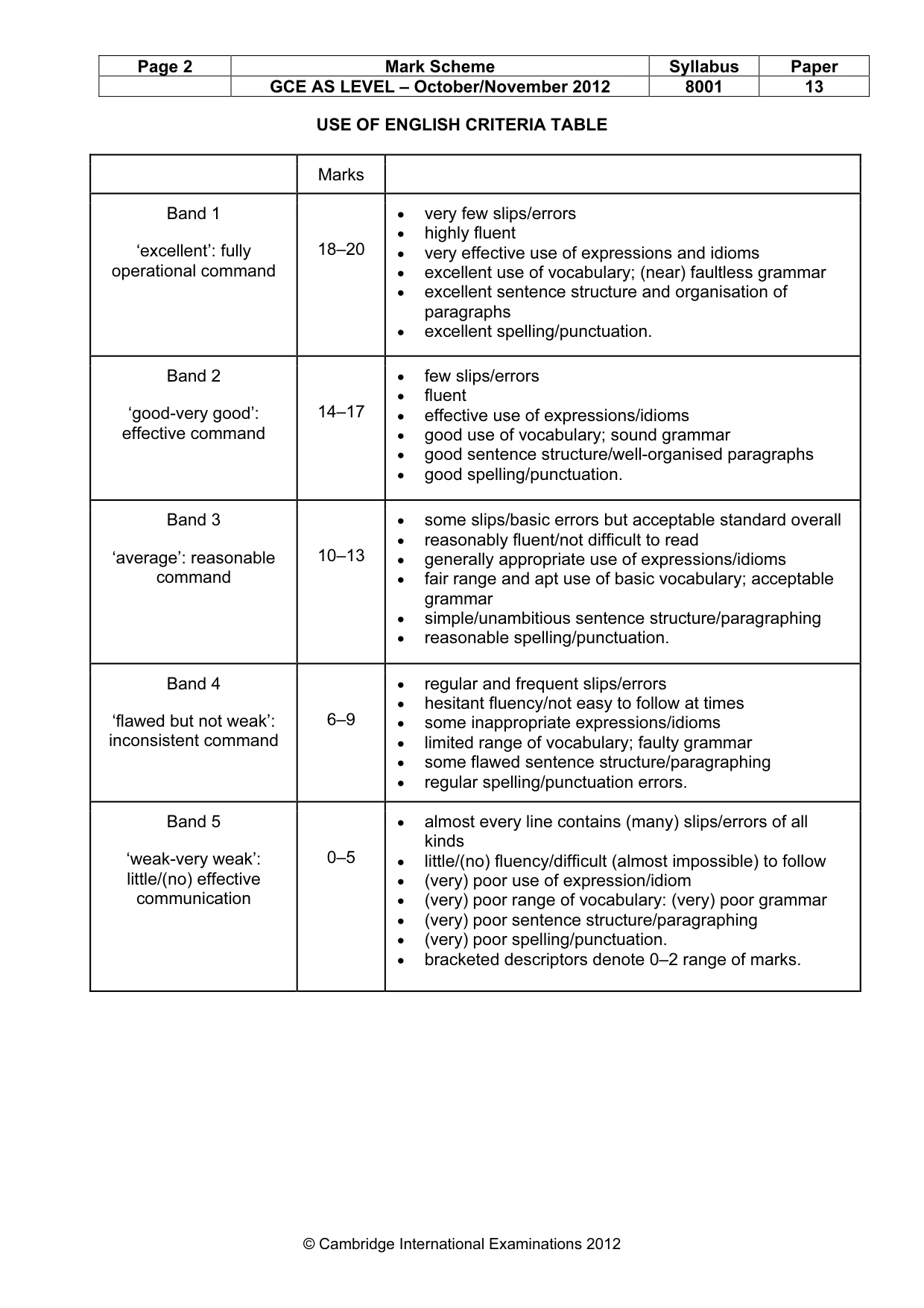
Page 2 Mark Scheme Syllabus Paper GCE AS LEVEL – October/November 2012 8001 13 © Cambridge International Examinations 2012 USE OF ENGLISH CRITERIA TABLE Marks Band 1 ‘excellent’: fully operational command 18–20 • very few slips/errors • highly fluent • very effective use of expressions and idioms • excellent use of vocabulary; (near) faultless grammar • excellent sentence structure and organisation of paragraphs • excellent spelling/punctuation. Band 2 ‘good-very good’: effective command 14–17 • few slips/errors • fluent • effective use of expressions/idioms • good use of vocabulary; sound grammar • good sentence structure/well-organised paragraphs • good spelling/punctuation. Band 3 ‘average’: reasonable command 10–13 • some slips/basic errors but acceptable standard overall • reasonably fluent/not difficult to read • generally appropriate use of expressions/idioms • fair range and apt use of basic vocabulary; acceptable grammar • simple/unambitious sentence structure/paragraphing • reasonable spelling/punctuation. Band 4 ‘flawed but not weak’: inconsistent command 6–9 • regular and frequent slips/errors • hesitant fluency/not easy to follow at times • some inappropriate expressions/idioms • limited range of vocabulary; faulty grammar • some flawed sentence structure/paragraphing • regular spelling/punctuation errors. Band 5 ‘weak-very weak’: little/(no) effective communication 0–5 • almost every line contains (many) slips/errors of all kinds • little/(no) fluency/difficult (almost impossible) to follow • (very) poor use of expression/idiom • (very) poor range of vocabulary: (very) poor grammar • (very) poor sentence structure/paragraphing • (very) poor spelling/punctuation. • bracketed descriptors denote 0–2 range of marks.
Mark scheme, page 3
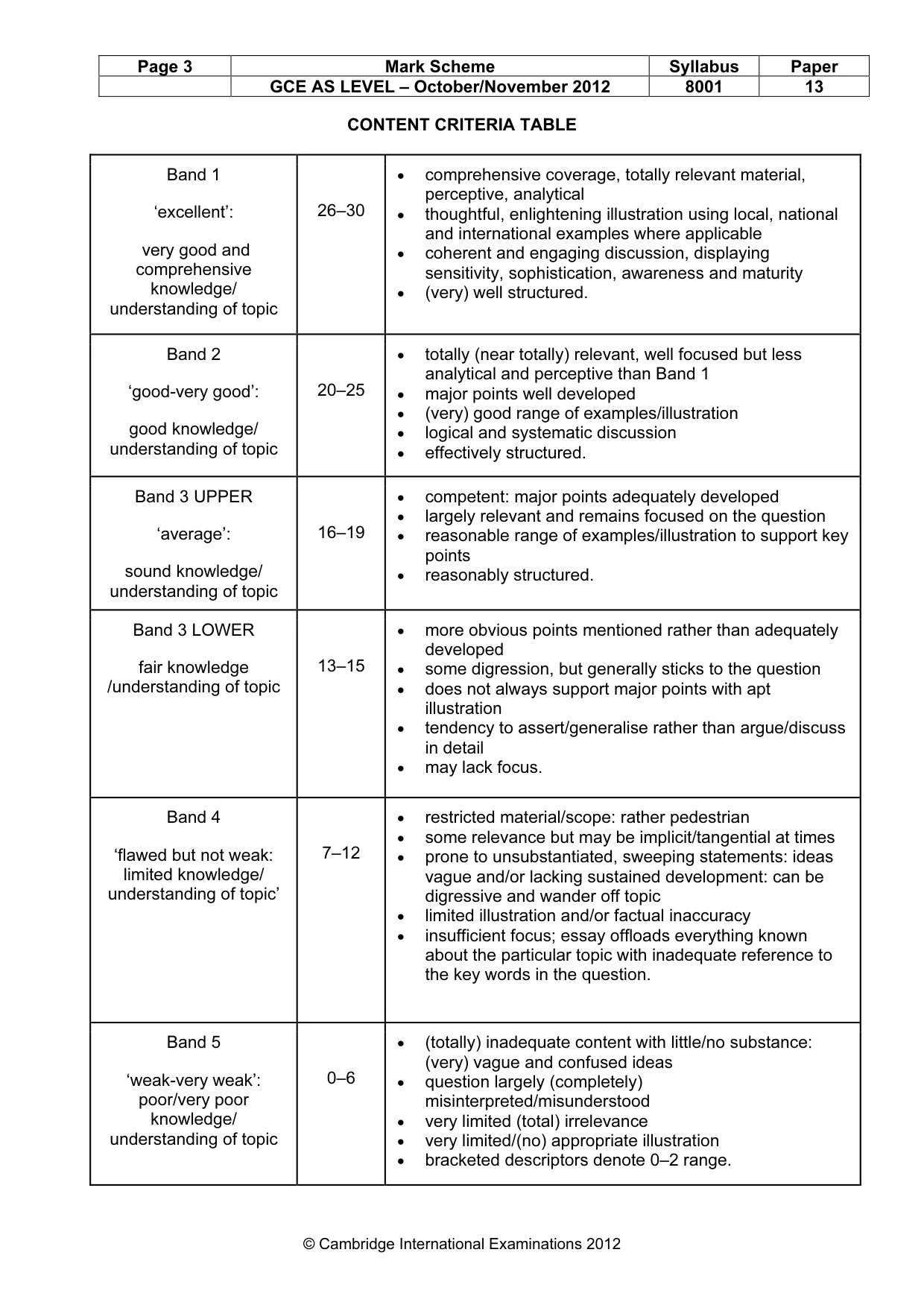
Page 3 Mark Scheme Syllabus Paper GCE AS LEVEL – October/November 2012 8001 13 © Cambridge International Examinations 2012 CONTENT CRITERIA TABLE Band 1 ‘excellent’: very good and comprehensive knowledge/ understanding of topic 26–30 • comprehensive coverage, totally relevant material, perceptive, analytical • thoughtful, enlightening illustration using local, national and international examples where applicable • coherent and engaging discussion, displaying sensitivity, sophistication, awareness and maturity • (very) well structured. Band 2 ‘good-very good’: good knowledge/ understanding of topic 20–25 • totally (near totally) relevant, well focused but less analytical and perceptive than Band 1 • major points well developed • (very) good range of examples/illustration • logical and systematic discussion • effectively structured. Band 3 UPPER ‘average’: sound knowledge/ understanding of topic 16–19 • competent: major points adequately developed • largely relevant and remains focused on the question • reasonable range of examples/illustration to support key points • reasonably structured. Band 3 LOWER fair knowledge /understanding of topic 13–15 • more obvious points mentioned rather than adequately developed • some digression, but generally sticks to the question • does not always support major points with apt illustration • tendency to assert/generalise rather than argue/discuss in detail • may lack focus. Band 4 ‘flawed but not weak: limited knowledge/ understanding of topic’ 7–12 • restricted material/scope: rather pedestrian • some relevance but may be implicit/tangential at times • prone to unsubstantiated, sweeping statements: ideas vague and/or lacking sustained development: can be digressive and wander off topic • limited illustration and/or factual inaccuracy • insufficient focus; essay offloads everything known about the particular topic with inadequate reference to the key words in the question. Band 5 ‘weak-very weak’: poor/very poor knowledge/ understanding of topic 0–6 • (totally) inadequate content with little/no substance: (very) vague and confused ideas • question largely (completely) misinterpreted/misunderstood • very limited (total) irrelevance • very limited/(no) appropriate illustration • bracketed descriptors denote 0–2 range.
Mark scheme, page 4
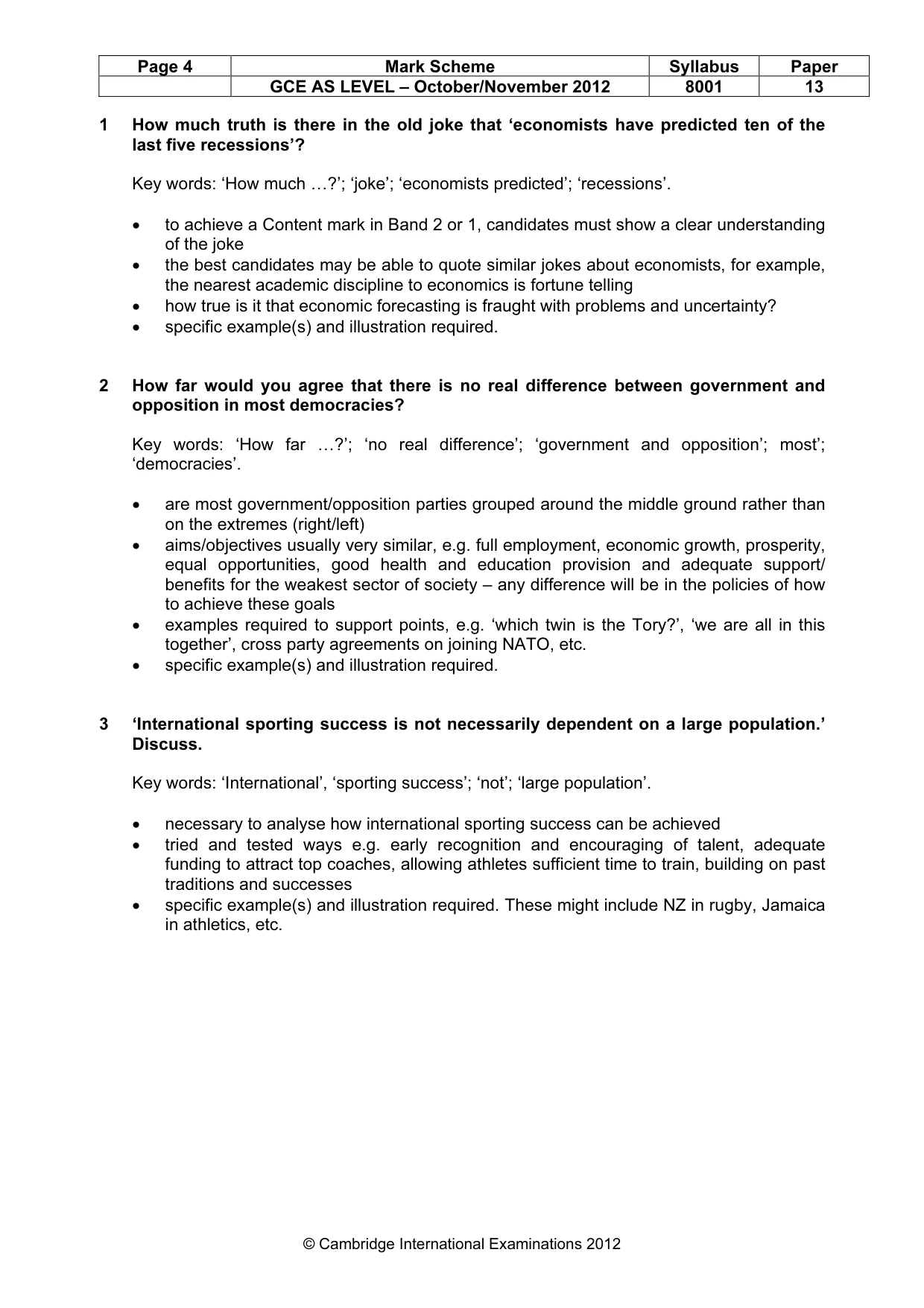
Page 4 Mark Scheme Syllabus Paper GCE AS LEVEL – October/November 2012 8001 13 © Cambridge International Examinations 2012 1 How much truth is there in the old joke that ‘economists have predicted ten of the last five recessions’? Key words: ‘How much …?’; ‘joke’; ‘economists predicted’; ‘recessions’. • to achieve a Content mark in Band 2 or 1, candidates must show a clear understanding of the joke • the best candidates may be able to quote similar jokes about economists, for example, the nearest academic discipline to economics is fortune telling • how true is it that economic forecasting is fraught with problems and uncertainty? • specific example(s) and illustration required. 2 How far would you agree that there is no real difference between government and opposition in most democracies? Key words: ‘How far …?’; ‘no real difference’; ‘government and opposition’; most’; ‘democracies’. • are most government/opposition parties grouped around the middle ground rather than on the extremes (right/left) • aims/objectives usually very similar, e.g. full employment, economic growth, prosperity, equal opportunities, good health and education provision and adequate support/ benefits for the weakest sector of society – any difference will be in the policies of how to achieve these goals • examples required to support points, e.g. ‘which twin is the Tory?’, ‘we are all in this together’, cross party agreements on joining NATO, etc. • specific example(s) and illustration required. 3 ‘International sporting success is not necessarily dependent on a large population.’ Discuss. Key words: ‘International’, ‘sporting success’; ‘not’; ‘large population’. • necessary to analyse how international sporting success can be achieved • tried and tested ways e.g. early recognition and encouraging of talent, adequate funding to attract top coaches, allowing athletes sufficient time to train, building on past traditions and successes • specific example(s) and illustration required. These might include NZ in rugby, Jamaica in athletics, etc.
Mark scheme, page 5
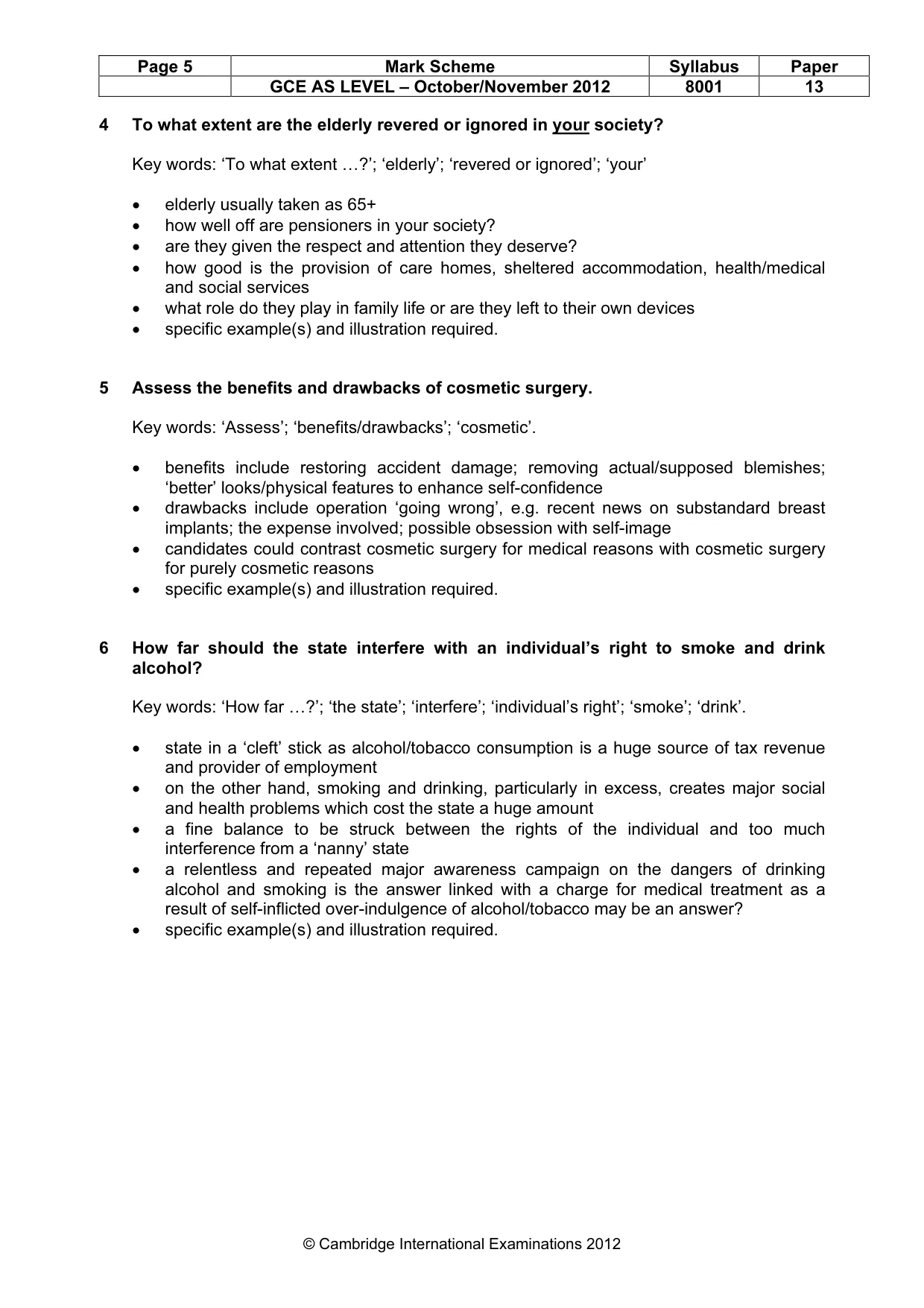
Page 5 Mark Scheme Syllabus Paper GCE AS LEVEL – October/November 2012 8001 13 © Cambridge International Examinations 2012 4 To what extent are the elderly revered or ignored in your society? Key words: ‘To what extent …?’; ‘elderly’; ‘revered or ignored’; ‘your’ • elderly usually taken as 65+ • how well off are pensioners in your society? • are they given the respect and attention they deserve? • how good is the provision of care homes, sheltered accommodation, health/medical and social services • what role do they play in family life or are they left to their own devices • specific example(s) and illustration required. 5 Assess the benefits and drawbacks of cosmetic surgery. Key words: ‘Assess’; ‘benefits/drawbacks’; ‘cosmetic’. • benefits include restoring accident damage; removing actual/supposed blemishes; ‘better’ looks/physical features to enhance self-confidence • drawbacks include operation ‘going wrong’, e.g. recent news on substandard breast implants; the expense involved; possible obsession with self-image • candidates could contrast cosmetic surgery for medical reasons with cosmetic surgery for purely cosmetic reasons • specific example(s) and illustration required. 6 How far should the state interfere with an individual’s right to smoke and drink alcohol? Key words: ‘How far …?’; ‘the state’; ‘interfere’; ‘individual’s right’; ‘smoke’; ‘drink’. • state in a ‘cleft’ stick as alcohol/tobacco consumption is a huge source of tax revenue and provider of employment • on the other hand, smoking and drinking, particularly in excess, creates major social and health problems which cost the state a huge amount • a fine balance to be struck between the rights of the individual and too much interference from a ‘nanny’ state • a relentless and repeated major awareness campaign on the dangers of drinking alcohol and smoking is the answer linked with a charge for medical treatment as a result of self-inflicted over-indulgence of alcohol/tobacco may be an answer? • specific example(s) and illustration required.
Mark scheme, page 6
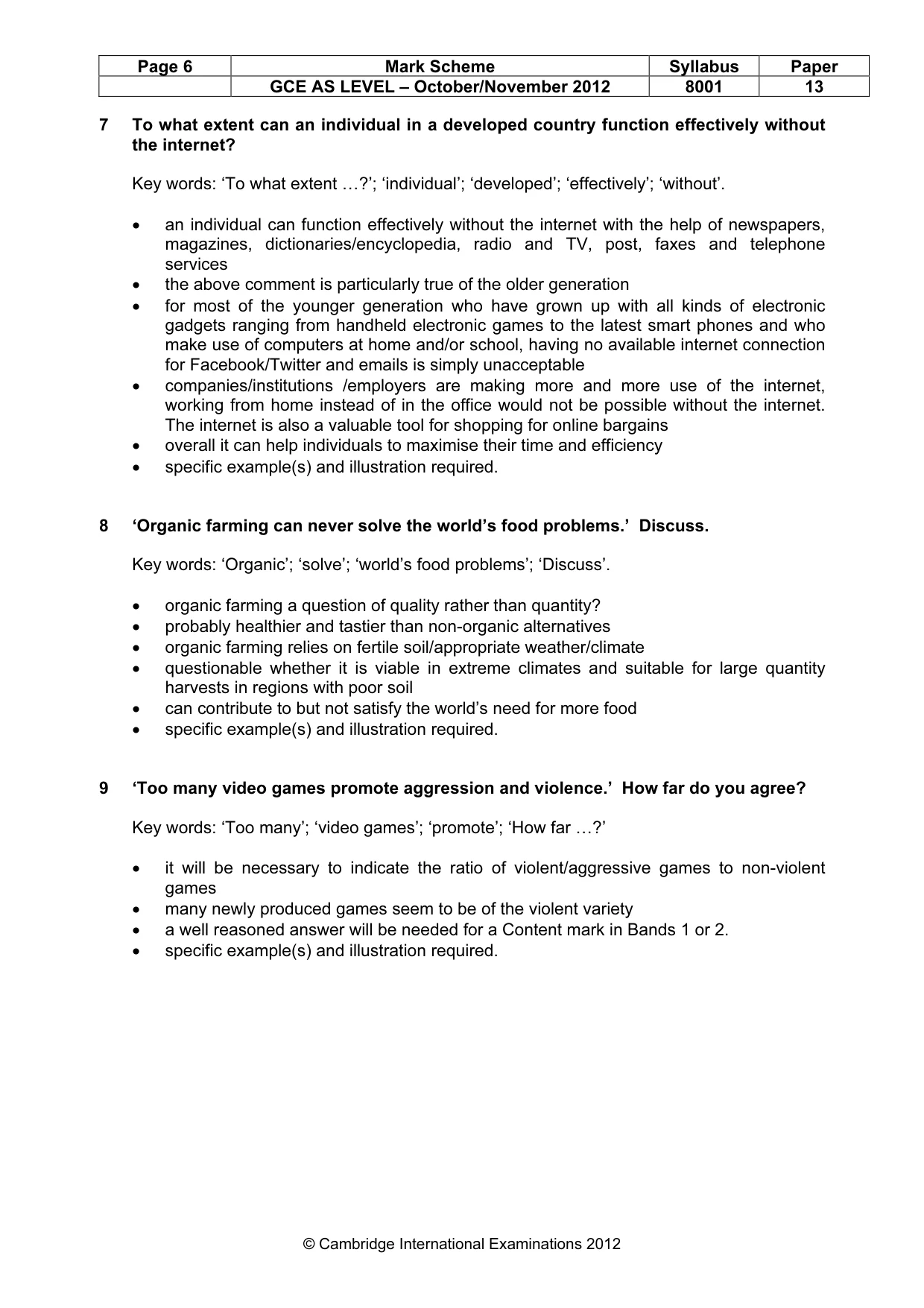
Page 6 Mark Scheme Syllabus Paper GCE AS LEVEL – October/November 2012 8001 13 © Cambridge International Examinations 2012 7 To what extent can an individual in a developed country function effectively without the internet? Key words: ‘To what extent …?’; ‘individual’; ‘developed’; ‘effectively’; ‘without’. • an individual can function effectively without the internet with the help of newspapers, magazines, dictionaries/encyclopedia, radio and TV, post, faxes and telephone services • the above comment is particularly true of the older generation • for most of the younger generation who have grown up with all kinds of electronic gadgets ranging from handheld electronic games to the latest smart phones and who make use of computers at home and/or school, having no available internet connection for Facebook/Twitter and emails is simply unacceptable • companies/institutions /employers are making more and more use of the internet, working from home instead of in the office would not be possible without the internet. The internet is also a valuable tool for shopping for online bargains • overall it can help individuals to maximise their time and efficiency • specific example(s) and illustration required. 8 ‘Organic farming can never solve the world’s food problems.’ Discuss. Key words: ‘Organic’; ‘solve’; ‘world’s food problems’; ‘Discuss’. • organic farming a question of quality rather than quantity? • probably healthier and tastier than non-organic alternatives • organic farming relies on fertile soil/appropriate weather/climate • questionable whether it is viable in extreme climates and suitable for large quantity harvests in regions with poor soil • can contribute to but not satisfy the world’s need for more food • specific example(s) and illustration required. 9 ‘Too many video games promote aggression and violence.’ How far do you agree? Key words: ‘Too many’; ‘video games’; ‘promote’; ‘How far …?’ • it will be necessary to indicate the ratio of violent/aggressive games to non-violent games • many newly produced games seem to be of the violent variety • a well reasoned answer will be needed for a Content mark in Bands 1 or 2. • specific example(s) and illustration required.
Mark scheme, page 7
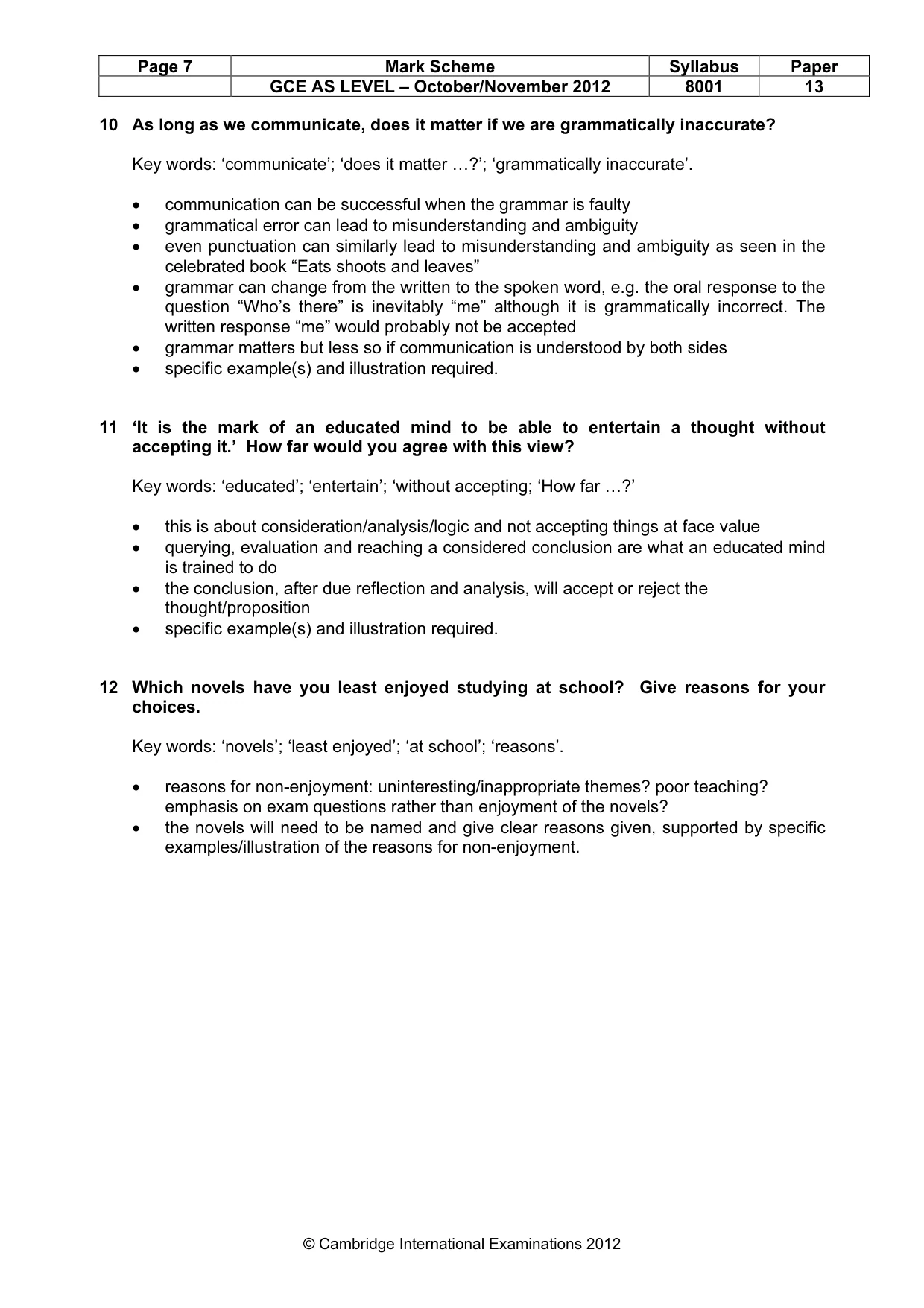
Page 7 Mark Scheme Syllabus Paper GCE AS LEVEL – October/November 2012 8001 13 © Cambridge International Examinations 2012 10 As long as we communicate, does it matter if we are grammatically inaccurate? Key words: ‘communicate’; ‘does it matter …?’; ‘grammatically inaccurate’. • communication can be successful when the grammar is faulty • grammatical error can lead to misunderstanding and ambiguity • even punctuation can similarly lead to misunderstanding and ambiguity as seen in the celebrated book “Eats shoots and leaves” • grammar can change from the written to the spoken word, e.g. the oral response to the question “Who’s there” is inevitably “me” although it is grammatically incorrect. The written response “me” would probably not be accepted • grammar matters but less so if communication is understood by both sides • specific example(s) and illustration required. 11 ‘It is the mark of an educated mind to be able to entertain a thought without accepting it.’ How far would you agree with this view? Key words: ‘educated’; ‘entertain’; ‘without accepting; ‘How far …?’ • this is about consideration/analysis/logic and not accepting things at face value • querying, evaluation and reaching a considered conclusion are what an educated mind is trained to do • the conclusion, after due reflection and analysis, will accept or reject the thought/proposition • specific example(s) and illustration required. 12 Which novels have you least enjoyed studying at school? Give reasons for your choices. Key words: ‘novels’; ‘least enjoyed’; ‘at school’; ‘reasons’. • reasons for non-enjoyment: uninteresting/inappropriate themes? poor teaching? emphasis on exam questions rather than enjoyment of the novels? • the novels will need to be named and give clear reasons given, supported by specific examples/illustration of the reasons for non-enjoyment.
What you needed in this session
Cambridge’s own grade thresholds for 2012 Oct/Nov, Paper 1 · Variant 3. A higher threshold means an easier paper — the bar moves with how the cohort did.