Cambridge A Level General Paper (AS Level only) 8001 — 2015 Oct/Nov Paper 1 · Variant 1
8001/11/O/N/15 · 50 marks · ≈56 min
The question paper and its mark scheme, free to read here and free to download. This is Cambridge’s own paper, exactly as it was sat.
Question paper4 pages
Mark scheme7 pages
Answers below. Sit the paper first if you are practising.
Paper as text
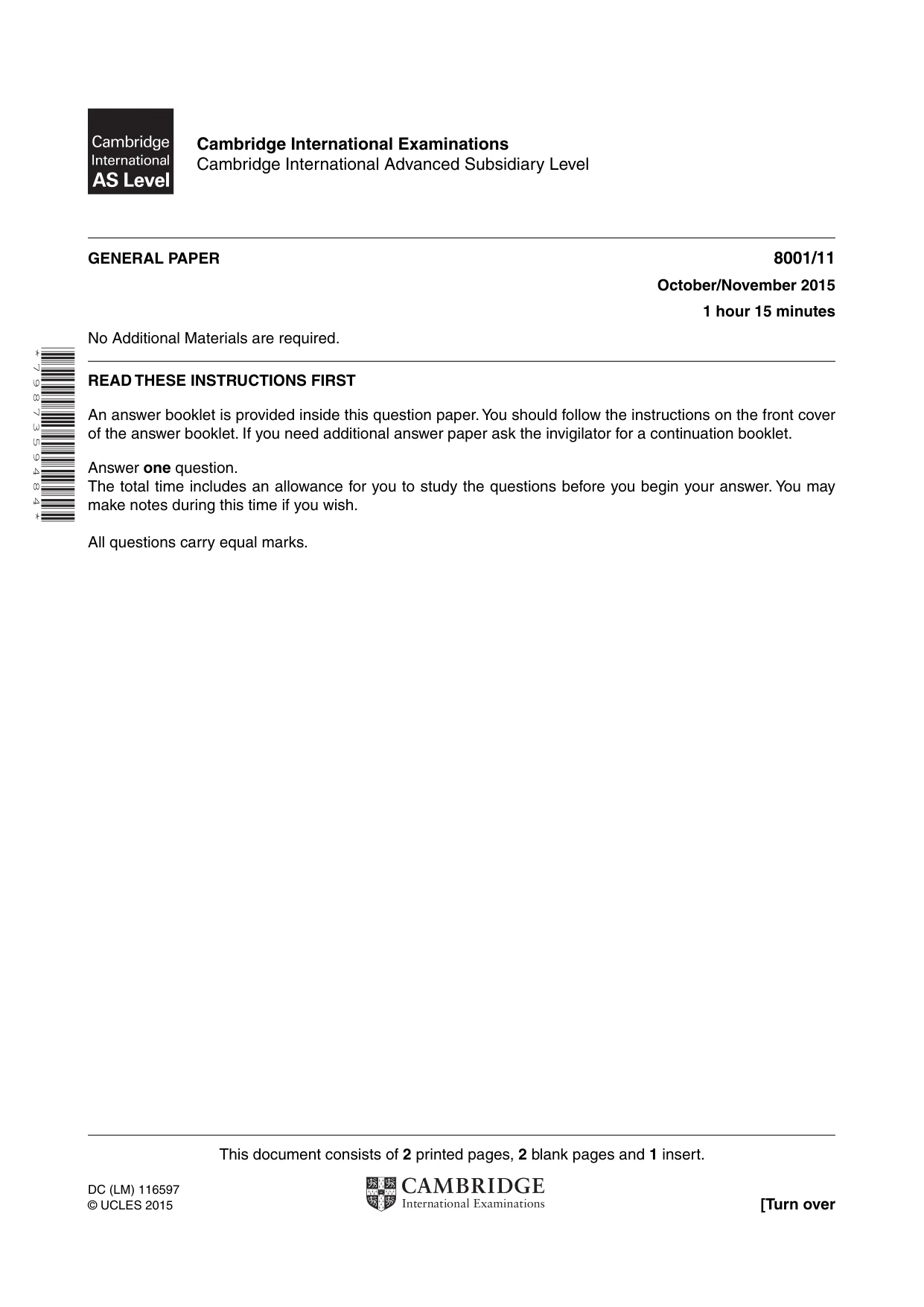
Question paper, page 1
This document consists of 2 printed pages, 2 blank pages and 1 insert. DC (LM) 116597 © UCLES 2015 [Turn over * 7 9 8 7 3 5 9 4 8 4 * GENERAL PAPER 8001/11 October/November 2015 1 hour 15 minutes No Additional Materials are required. READ THESE INSTRUCTIONS FIRST An answer booklet is provided inside this question paper. You should follow the instructions on the front cover of the answer booklet. If you need additional answer paper ask the invigilator for a continuation booklet. Answer one question. The total time includes an allowance for you to study the questions before you begin your answer. You may make notes during this time if you wish. All questions carry equal marks. Cambridge International Examinations Cambridge International Advanced Subsidiary Level
Question paper, page 2
2 8001/11/O/N/15 © UCLES 2015 BLANK PAGE
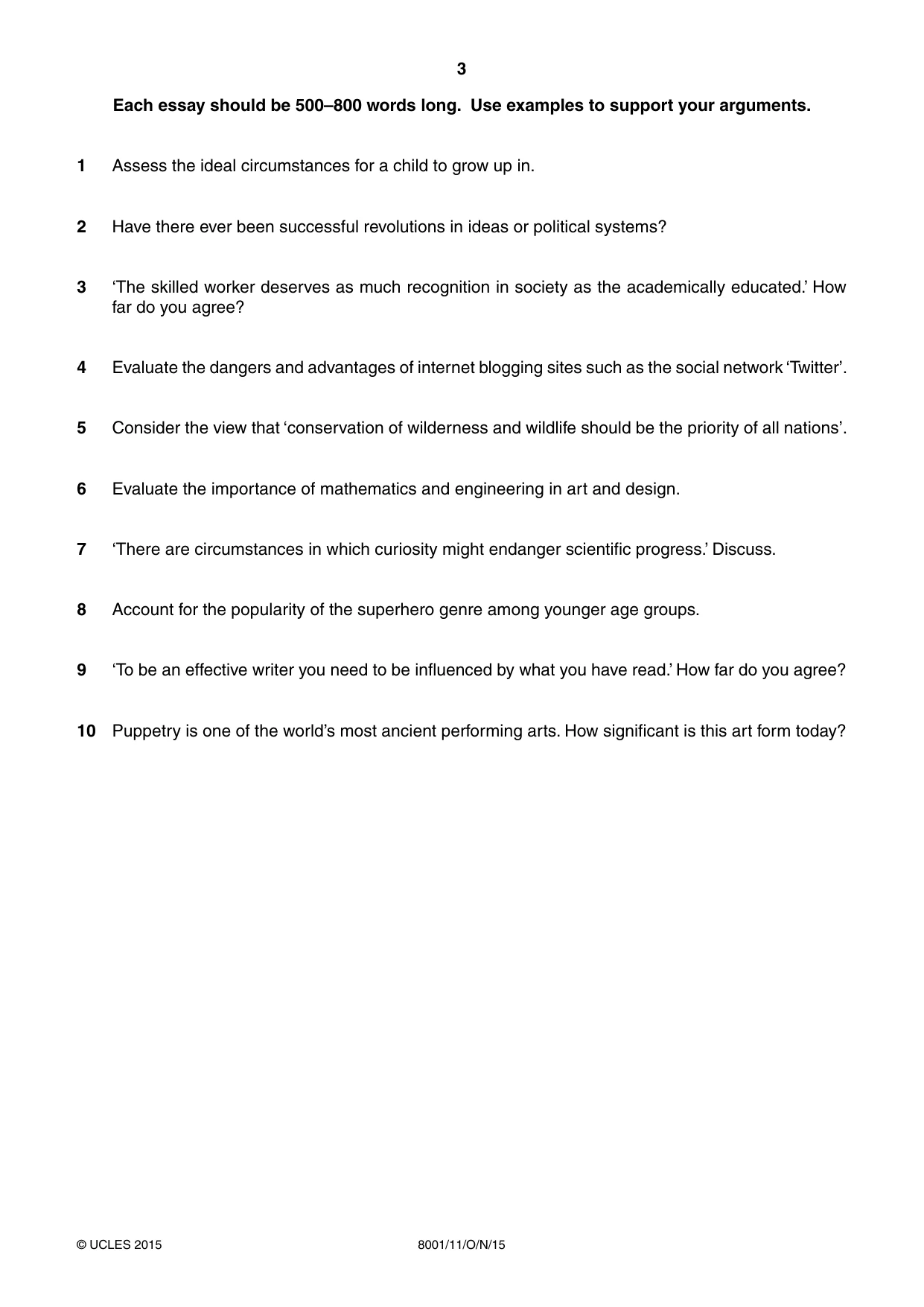
Question paper, page 3
3 8001/11/O/N/15 © UCLES 2015 Each essay should be 500–800 words long. Use examples to support your arguments. 1 Assess the ideal circumstances for a child to grow up in. 2 Have there ever been successful revolutions in ideas or political systems? 3 ‘The skilled worker deserves as much recognition in society as the academically educated.’ How far do you agree? 4 Evaluate the dangers and advantages of internet blogging sites such as the social network ‘Twitter’. 5 Consider the view that ‘conservation of wilderness and wildlife should be the priority of all nations’. 6 Evaluate the importance of mathematics and engineering in art and design. 7 ‘There are circumstances in which curiosity might endanger scientific progress.’ Discuss. 8 Account for the popularity of the superhero genre among younger age groups. 9 ‘To be an effective writer you need to be influenced by what you have read.’ How far do you agree? 10 Puppetry is one of the world’s most ancient performing arts. How significant is this art form today?
Question paper, page 4
4 8001/11/O/N/15 © UCLES 2015 BLANK PAGE Permission to reproduce items where third-party owned material protected by copyright is included has been sought and cleared where possible. Every reasonable effort has been made by the publisher (UCLES) to trace copyright holders, but if any items requiring clearance have unwittingly been included, the publisher will be pleased to make amends at the earliest possible opportunity. To avoid the issue of disclosure of answer-related information to candidates, all copyright acknowledgements are reproduced online in the Cambridge International Examinations Copyright Acknowledgements Booklet. This is produced for each series of examinations and is freely available to download at www.cie.org.uk after the live examination series. Cambridge International Examinations is part of the Cambridge Assessment Group. Cambridge Assessment is the brand name of University of Cambridge Local Examinations Syndicate (UCLES), which is itself a department of the University of Cambridge.
Mark scheme, page 1
® IGCSE is the registered trademark of Cambridge International Examinations. CAMBRIDGE INTERNATIONAL EXAMINATIONS Cambridge International Advanced Subsidiary Level MARK SCHEME for the October/November 2015 series 8001 GENERAL PAPER 8001/11 Paper 1, maximum raw mark 50 This mark scheme is published as an aid to teachers and candidates, to indicate the requirements of the examination. It shows the basis on which Examiners were instructed to award marks. It does not indicate the details of the discussions that took place at an Examiners’ meeting before marking began, which would have considered the acceptability of alternative answers. Mark schemes should be read in conjunction with the question paper and the Principal Examiner Report for Teachers. Cambridge will not enter into discussions about these mark schemes. Cambridge is publishing the mark schemes for the October/November 2015 series for most Cambridge IGCSE®, Cambridge International A and AS Level components and some Cambridge O Level components.
Mark scheme, page 2
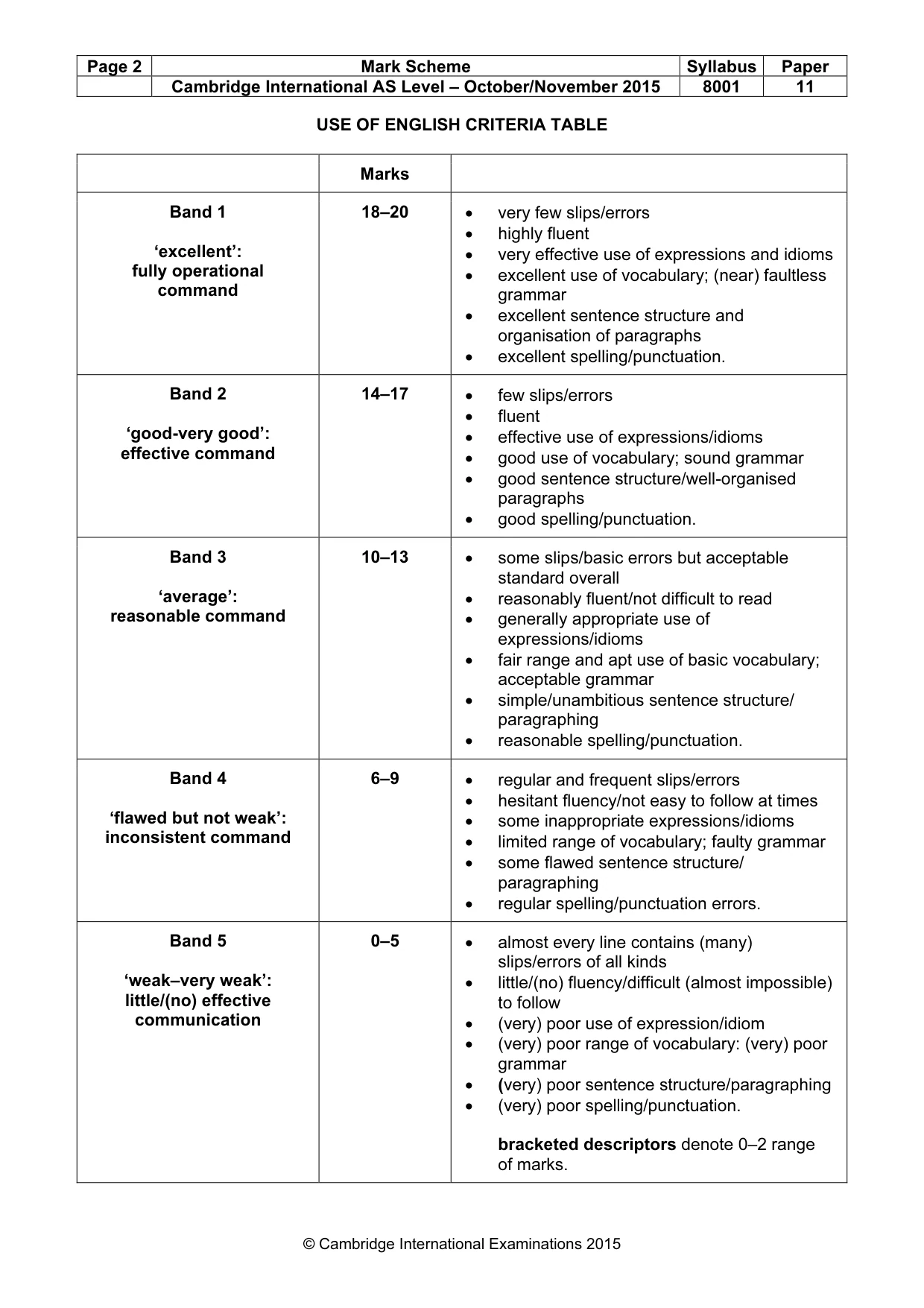
Page 2 Mark Scheme Syllabus Paper Cambridge International AS Level – October/November 2015 8001 11 © Cambridge International Examinations 2015 USE OF ENGLISH CRITERIA TABLE Marks Band 1 ‘excellent’: fully operational command 18–20 • very few slips/errors • highly fluent • very effective use of expressions and idioms • excellent use of vocabulary; (near) faultless grammar • excellent sentence structure and organisation of paragraphs • excellent spelling/punctuation. Band 2 ‘good-very good’: effective command 14–17 • few slips/errors • fluent • effective use of expressions/idioms • good use of vocabulary; sound grammar • good sentence structure/well-organised paragraphs • good spelling/punctuation. Band 3 ‘average’: reasonable command 10–13 • some slips/basic errors but acceptable standard overall • reasonably fluent/not difficult to read • generally appropriate use of expressions/idioms • fair range and apt use of basic vocabulary; acceptable grammar • simple/unambitious sentence structure/ paragraphing • reasonable spelling/punctuation. Band 4 ‘flawed but not weak’: inconsistent command 6–9 • regular and frequent slips/errors • hesitant fluency/not easy to follow at times • some inappropriate expressions/idioms • limited range of vocabulary; faulty grammar • some flawed sentence structure/ paragraphing • regular spelling/punctuation errors. Band 5 ‘weak–very weak’: little/(no) effective communication 0–5 • almost every line contains (many) slips/errors of all kinds • little/(no) fluency/difficult (almost impossible) to follow • (very) poor use of expression/idiom • (very) poor range of vocabulary: (very) poor grammar • (very) poor sentence structure/paragraphing • (very) poor spelling/punctuation. bracketed descriptors denote 0–2 range of marks.
Mark scheme, page 3
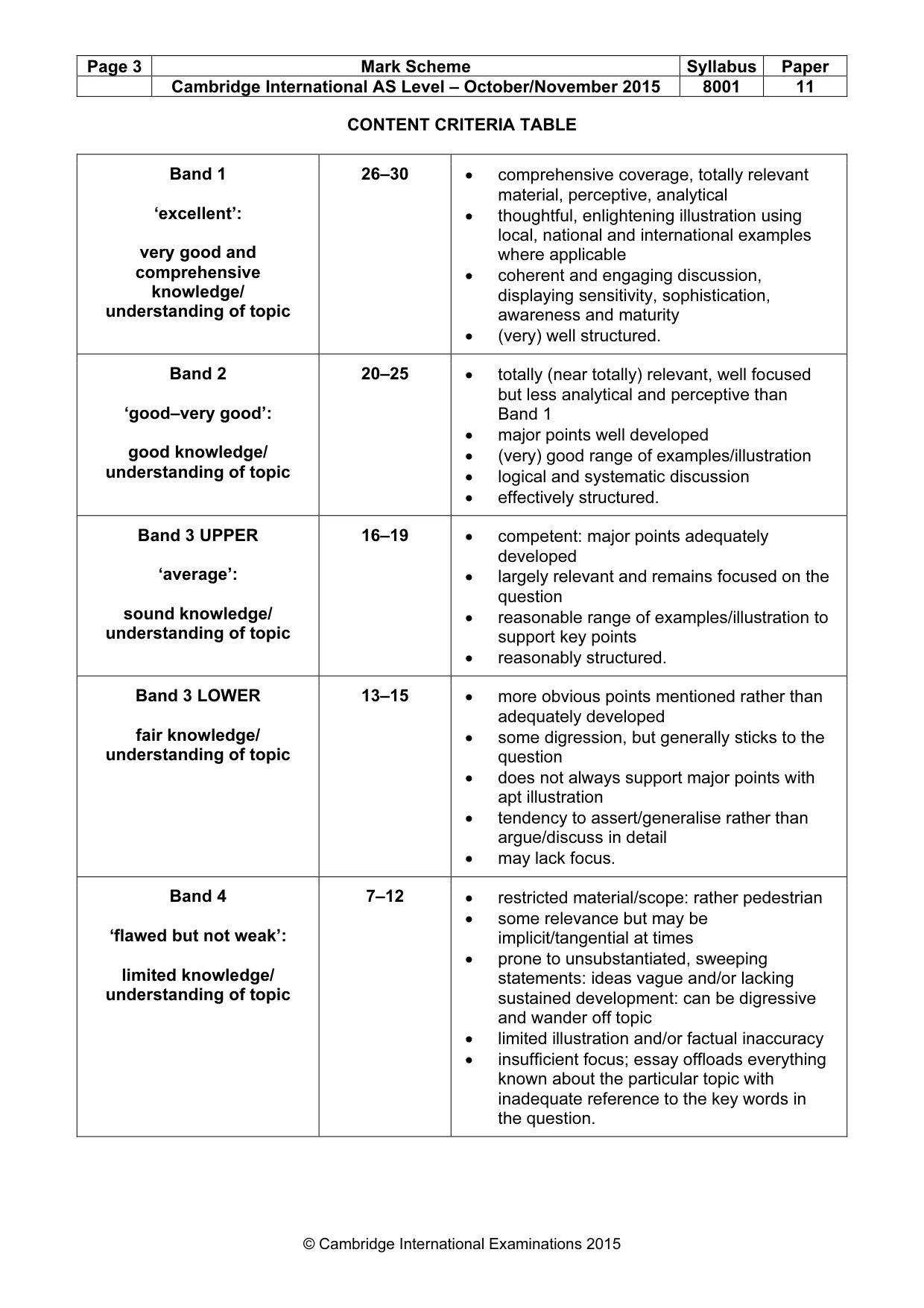
Page 3 Mark Scheme Syllabus Paper Cambridge International AS Level – October/November 2015 8001 11 © Cambridge International Examinations 2015 CONTENT CRITERIA TABLE Band 1 ‘excellent’: very good and comprehensive knowledge/ understanding of topic 26–30 • comprehensive coverage, totally relevant material, perceptive, analytical • thoughtful, enlightening illustration using local, national and international examples where applicable • coherent and engaging discussion, displaying sensitivity, sophistication, awareness and maturity • (very) well structured. Band 2 ‘good–very good’: good knowledge/ understanding of topic 20–25 • totally (near totally) relevant, well focused but less analytical and perceptive than Band 1 • major points well developed • (very) good range of examples/illustration • logical and systematic discussion • effectively structured. Band 3 UPPER ‘average’: sound knowledge/ understanding of topic 16–19 • competent: major points adequately developed • largely relevant and remains focused on the question • reasonable range of examples/illustration to support key points • reasonably structured. Band 3 LOWER fair knowledge/ understanding of topic 13–15 • more obvious points mentioned rather than adequately developed • some digression, but generally sticks to the question • does not always support major points with apt illustration • tendency to assert/generalise rather than argue/discuss in detail • may lack focus. Band 4 ‘flawed but not weak’: limited knowledge/ understanding of topic 7–12 • restricted material/scope: rather pedestrian • some relevance but may be implicit/tangential at times • prone to unsubstantiated, sweeping statements: ideas vague and/or lacking sustained development: can be digressive and wander off topic • limited illustration and/or factual inaccuracy • insufficient focus; essay offloads everything known about the particular topic with inadequate reference to the key words in the question.
Mark scheme, page 4
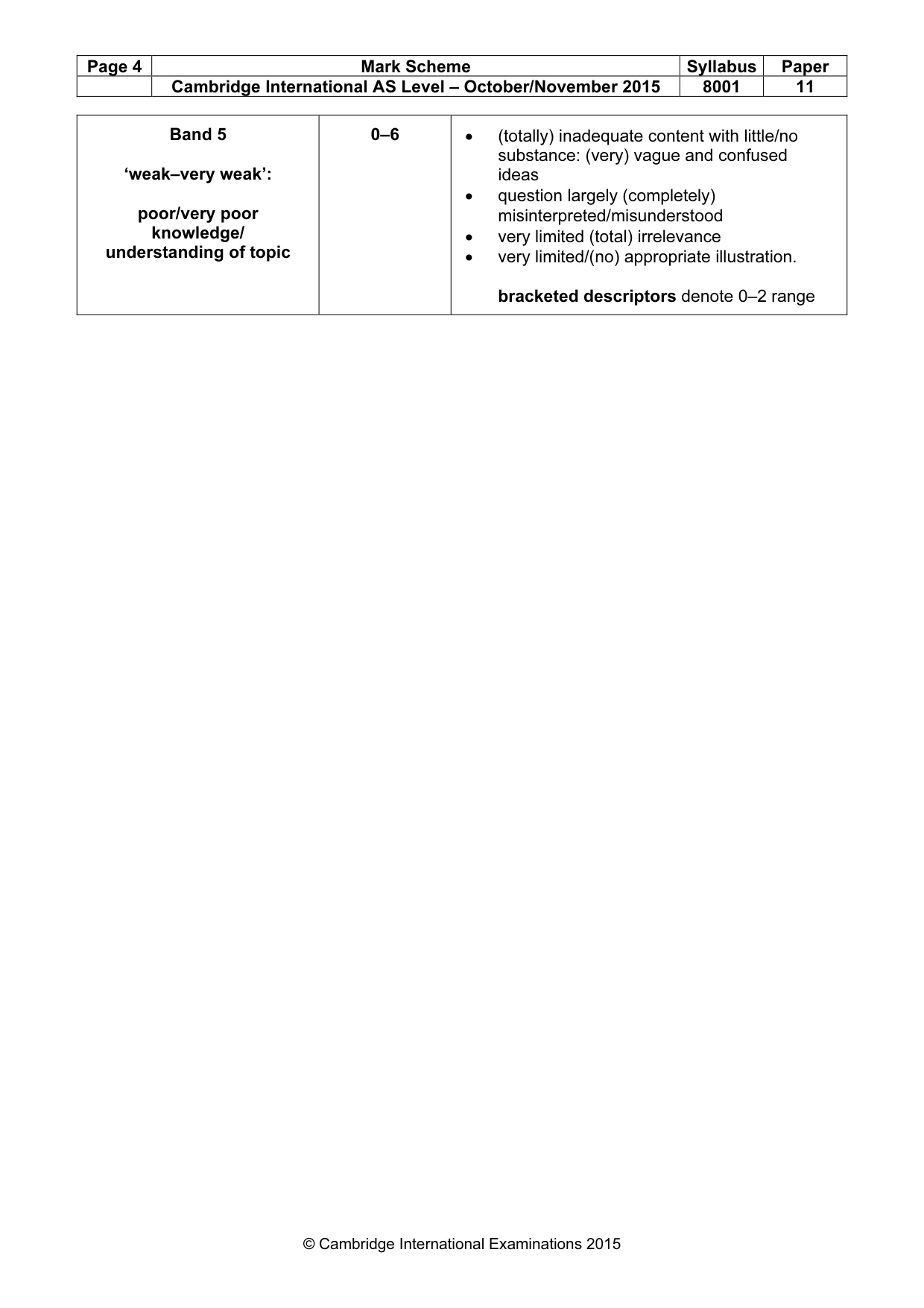
Page 4 Mark Scheme Syllabus Paper Cambridge International AS Level – October/November 2015 8001 11 © Cambridge International Examinations 2015 Band 5 ‘weak–very weak’: poor/very poor knowledge/ understanding of topic 0–6 • (totally) inadequate content with little/no substance: (very) vague and confused ideas • question largely (completely) misinterpreted/misunderstood • very limited (total) irrelevance • very limited/(no) appropriate illustration. bracketed descriptors denote 0–2 range
Mark scheme, page 5
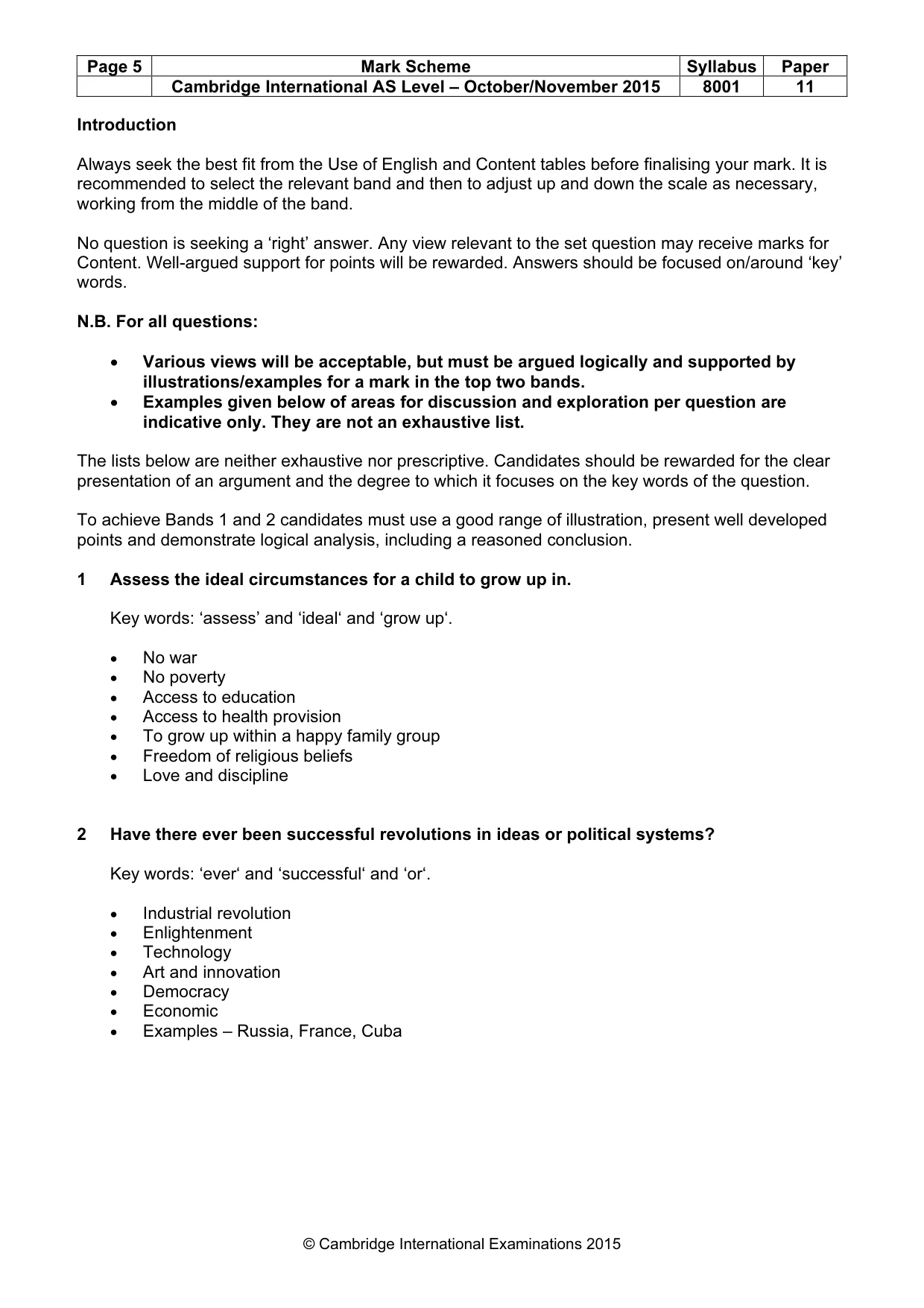
Page 5 Mark Scheme Syllabus Paper Cambridge International AS Level – October/November 2015 8001 11 © Cambridge International Examinations 2015 Introduction Always seek the best fit from the Use of English and Content tables before finalising your mark. It is recommended to select the relevant band and then to adjust up and down the scale as necessary, working from the middle of the band. No question is seeking a ‘right’ answer. Any view relevant to the set question may receive marks for Content. Well-argued support for points will be rewarded. Answers should be focused on/around ‘key’ words. N.B. For all questions: • Various views will be acceptable, but must be argued logically and supported by illustrations/examples for a mark in the top two bands. • Examples given below of areas for discussion and exploration per question are indicative only. They are not an exhaustive list. The lists below are neither exhaustive nor prescriptive. Candidates should be rewarded for the clear presentation of an argument and the degree to which it focuses on the key words of the question. To achieve Bands 1 and 2 candidates must use a good range of illustration, present well developed points and demonstrate logical analysis, including a reasoned conclusion. 1 Assess the ideal circumstances for a child to grow up in. Key words: ‘assess’ and ‘ideal‘ and ‘grow up‘. • No war • No poverty • Access to education • Access to health provision • To grow up within a happy family group • Freedom of religious beliefs • Love and discipline 2 Have there ever been successful revolutions in ideas or political systems? Key words: ‘ever‘ and ‘successful‘ and ‘or‘. • Industrial revolution • Enlightenment • Technology • Art and innovation • Democracy • Economic • Examples – Russia, France, Cuba
Mark scheme, page 6
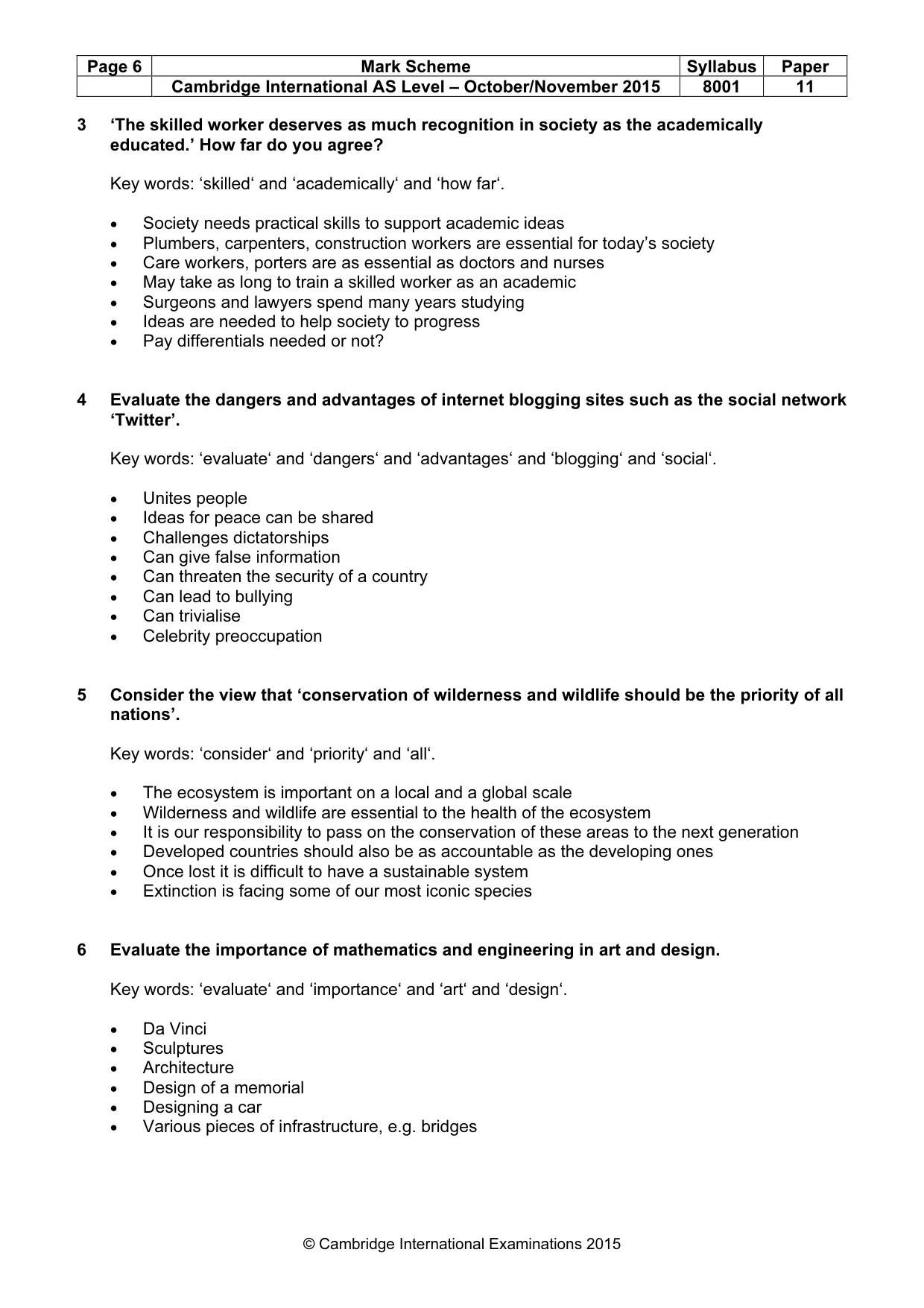
Page 6 Mark Scheme Syllabus Paper Cambridge International AS Level – October/November 2015 8001 11 © Cambridge International Examinations 2015 3 ‘The skilled worker deserves as much recognition in society as the academically educated.’ How far do you agree? Key words: ‘skilled‘ and ‘academically‘ and ‘how far‘. • Society needs practical skills to support academic ideas • Plumbers, carpenters, construction workers are essential for today’s society • Care workers, porters are as essential as doctors and nurses • May take as long to train a skilled worker as an academic • Surgeons and lawyers spend many years studying • Ideas are needed to help society to progress • Pay differentials needed or not? 4 Evaluate the dangers and advantages of internet blogging sites such as the social network ‘Twitter’. Key words: ‘evaluate‘ and ‘dangers‘ and ‘advantages‘ and ‘blogging‘ and ‘social‘. • Unites people • Ideas for peace can be shared • Challenges dictatorships • Can give false information • Can threaten the security of a country • Can lead to bullying • Can trivialise • Celebrity preoccupation 5 Consider the view that ‘conservation of wilderness and wildlife should be the priority of all nations’. Key words: ‘consider‘ and ‘priority‘ and ‘all‘. • The ecosystem is important on a local and a global scale • Wilderness and wildlife are essential to the health of the ecosystem • It is our responsibility to pass on the conservation of these areas to the next generation • Developed countries should also be as accountable as the developing ones • Once lost it is difficult to have a sustainable system • Extinction is facing some of our most iconic species 6 Evaluate the importance of mathematics and engineering in art and design. Key words: ‘evaluate‘ and ‘importance‘ and ‘art‘ and ‘design‘. • Da Vinci • Sculptures • Architecture • Design of a memorial • Designing a car • Various pieces of infrastructure, e.g. bridges
Mark scheme, page 7
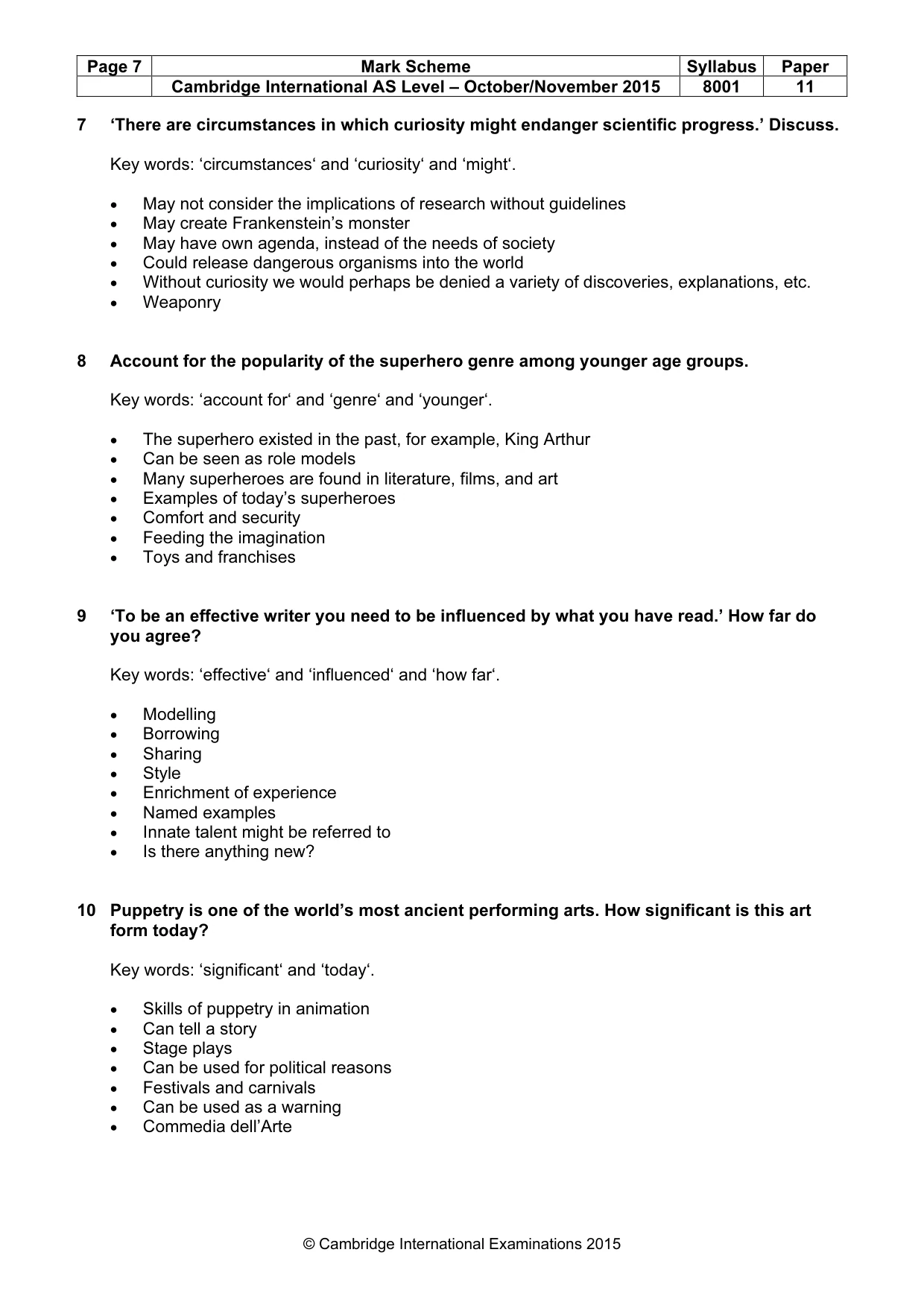
Page 7 Mark Scheme Syllabus Paper Cambridge International AS Level – October/November 2015 8001 11 © Cambridge International Examinations 2015 7 ‘There are circumstances in which curiosity might endanger scientific progress.’ Discuss. Key words: ‘circumstances‘ and ‘curiosity‘ and ‘might‘. • May not consider the implications of research without guidelines • May create Frankenstein’s monster • May have own agenda, instead of the needs of society • Could release dangerous organisms into the world • Without curiosity we would perhaps be denied a variety of discoveries, explanations, etc. • Weaponry 8 Account for the popularity of the superhero genre among younger age groups. Key words: ‘account for‘ and ‘genre‘ and ‘younger‘. • The superhero existed in the past, for example, King Arthur • Can be seen as role models • Many superheroes are found in literature, films, and art • Examples of today’s superheroes • Comfort and security • Feeding the imagination • Toys and franchises 9 ‘To be an effective writer you need to be influenced by what you have read.’ How far do you agree? Key words: ‘effective‘ and ‘influenced‘ and ‘how far‘. • Modelling • Borrowing • Sharing • Style • Enrichment of experience • Named examples • Innate talent might be referred to • Is there anything new? 10 Puppetry is one of the world’s most ancient performing arts. How significant is this art form today? Key words: ‘significant‘ and ‘today‘. • Skills of puppetry in animation • Can tell a story • Stage plays • Can be used for political reasons • Festivals and carnivals • Can be used as a warning • Commedia dell’Arte
What you needed in this session
Cambridge’s own grade thresholds for 2015 Oct/Nov, Paper 1 · Variant 1. A higher threshold means an easier paper — the bar moves with how the cohort did.