Cambridge A Level General Paper (AS Level only) 8001 — 2018 Oct/Nov Paper 1 · Variant 3
8001/13/O/N/18
The question paper and its mark scheme, free to read here and free to download. This is Cambridge’s own paper, exactly as it was sat.
Question paper4 pages


Mark scheme9 pages
Answers below. Sit the paper first if you are practising.
Paper as text
Question paper, page 1
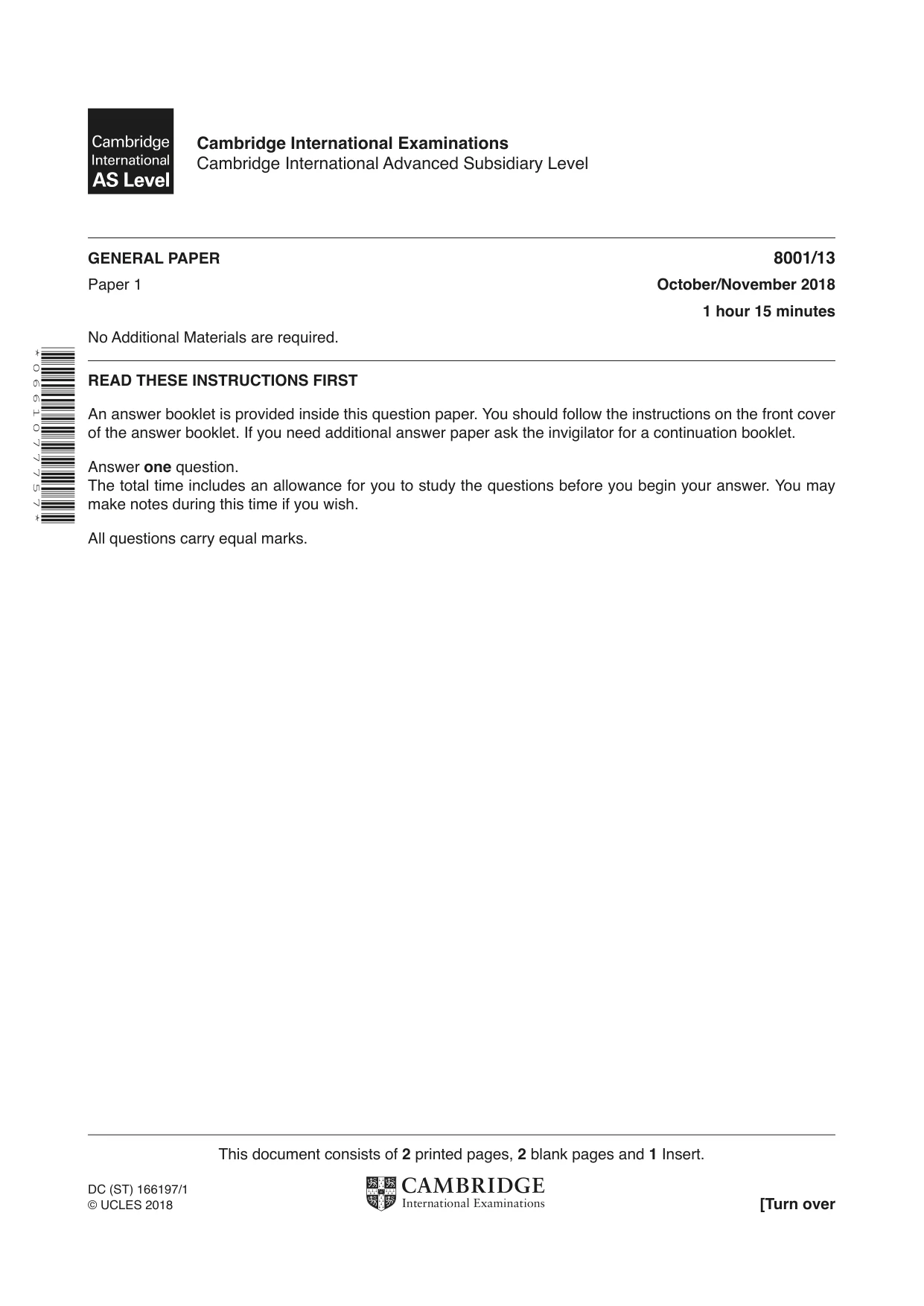
* 0 6 6 1 0 7 7 7 5 7 * This document consists of 2 printed pages, 2 blank pages and 1 Insert. DC (ST) 166197/1 © UCLES 2018 [Turn over Cambridge International Examinations Cambridge International Advanced Subsidiary Level GENERAL PAPER 8001/13 Paper 1 October/November 2018 1 hour 15 minutes No Additional Materials are required. READ THESE INSTRUCTIONS FIRST An answer booklet is provided inside this question paper. You should follow the instructions on the front cover of the answer booklet. If you need additional answer paper ask the invigilator for a continuation booklet. Answer one question. The total time includes an allowance for you to study the questions before you begin your answer. You may make notes during this time if you wish. All questions carry equal marks.
Question paper, page 2
2 8001/13/O/N/18 © UCLES 2018 BLANK PAGE
Question paper, page 3
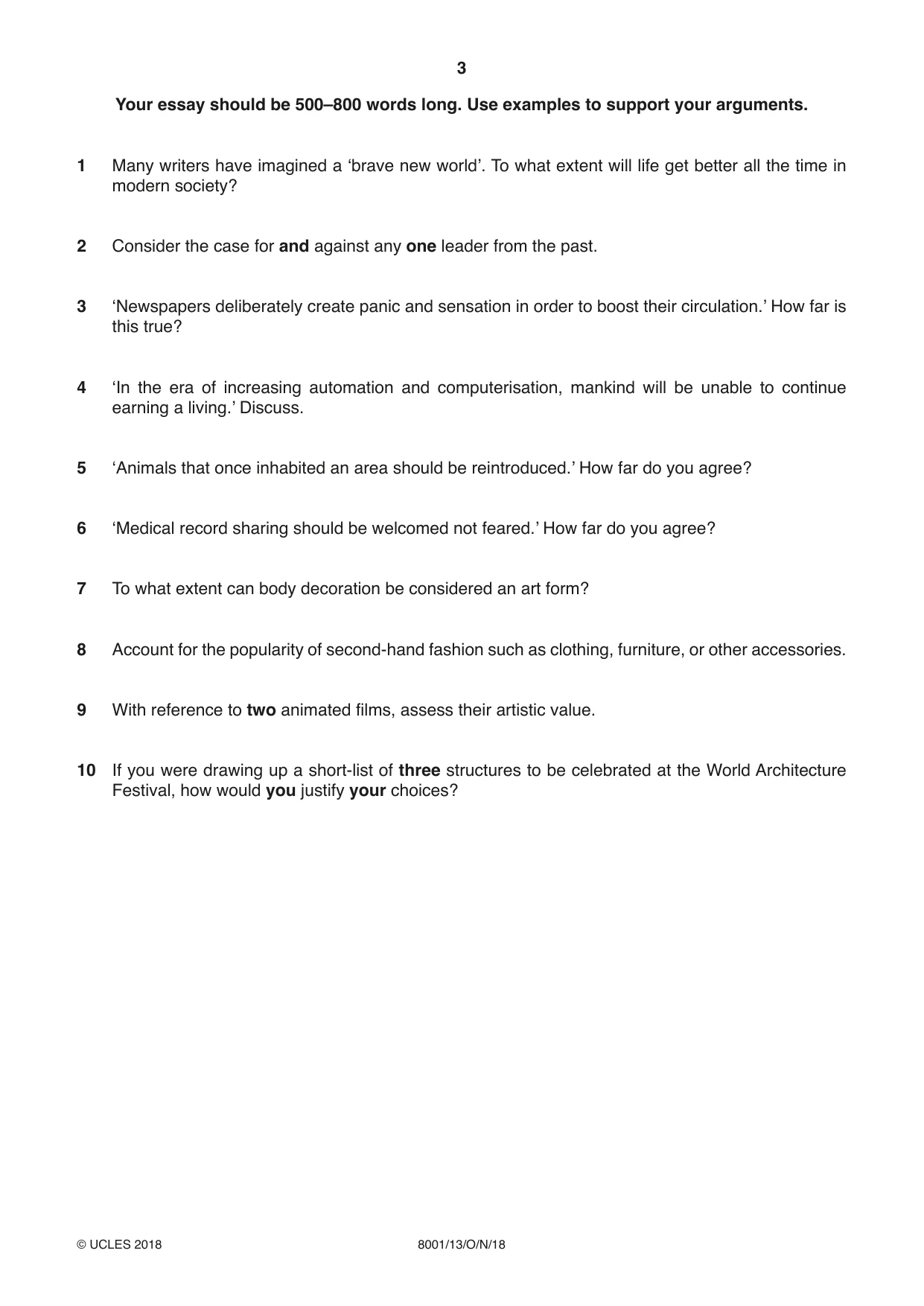
3 8001/13/O/N/18 © UCLES 2018 Your essay should be 500–800 words long. Use examples to support your arguments. 1 Many writers have imagined a ‘brave new world’. To what extent will life get better all the time in modern society? 2 Consider the case for and against any one leader from the past. 3 ‘Newspapers deliberately create panic and sensation in order to boost their circulation.’ How far is this true? 4 ‘In the era of increasing automation and computerisation, mankind will be unable to continue earning a living.’ Discuss. 5 ‘Animals that once inhabited an area should be reintroduced.’ How far do you agree? 6 ‘Medical record sharing should be welcomed not feared.’ How far do you agree? 7 To what extent can body decoration be considered an art form? 8 Account for the popularity of second-hand fashion such as clothing, furniture, or other accessories. 9 With reference to two animated films, assess their artistic value. 10 If you were drawing up a short-list of three structures to be celebrated at the World Architecture Festival, how would you justify your choices?
Question paper, page 4
4 8001/13/O/N/18 © UCLES 2018 BLANK PAGE Permission to reproduce items where third-party owned material protected by copyright is included has been sought and cleared where possible. Every reasonable effort has been made by the publisher (UCLES) to trace copyright holders, but if any items requiring clearance have unwittingly been included, the publisher will be pleased to make amends at the earliest possible opportunity. To avoid the issue of disclosure of answer-related information to candidates, all copyright acknowledgements are reproduced online in the Cambridge International Examinations Copyright Acknowledgements Booklet. This is produced for each series of examinations and is freely available to download at www.cie.org.uk after the live examination series. Cambridge International Examinations is part of the Cambridge Assessment Group. Cambridge Assessment is the brand name of University of Cambridge Local Examinations Syndicate (UCLES), which is itself a department of the University of Cambridge.
Mark scheme, page 1
This document consists of 9 printed pages. © UCLES 2018 [Turn over Cambridge Assessment International Education Cambridge International Advanced Subsidiary Level GENERAL PAPER 8001/13 Paper 1 October/November 2018 MARK SCHEME Maximum Mark: 50 Published This mark scheme is published as an aid to teachers and candidates, to indicate the requirements of the examination. It shows the basis on which Examiners were instructed to award marks. It does not indicate the details of the discussions that took place at an Examiners’ meeting before marking began, which would have considered the acceptability of alternative answers. Mark schemes should be read in conjunction with the question paper and the Principal Examiner Report for Teachers. Cambridge International will not enter into discussions about these mark schemes. Cambridge International is publishing the mark schemes for the October/November 2018 series for most Cambridge IGCSE™, Cambridge International A and AS Level components and some Cambridge O Level components.
Mark scheme, page 2
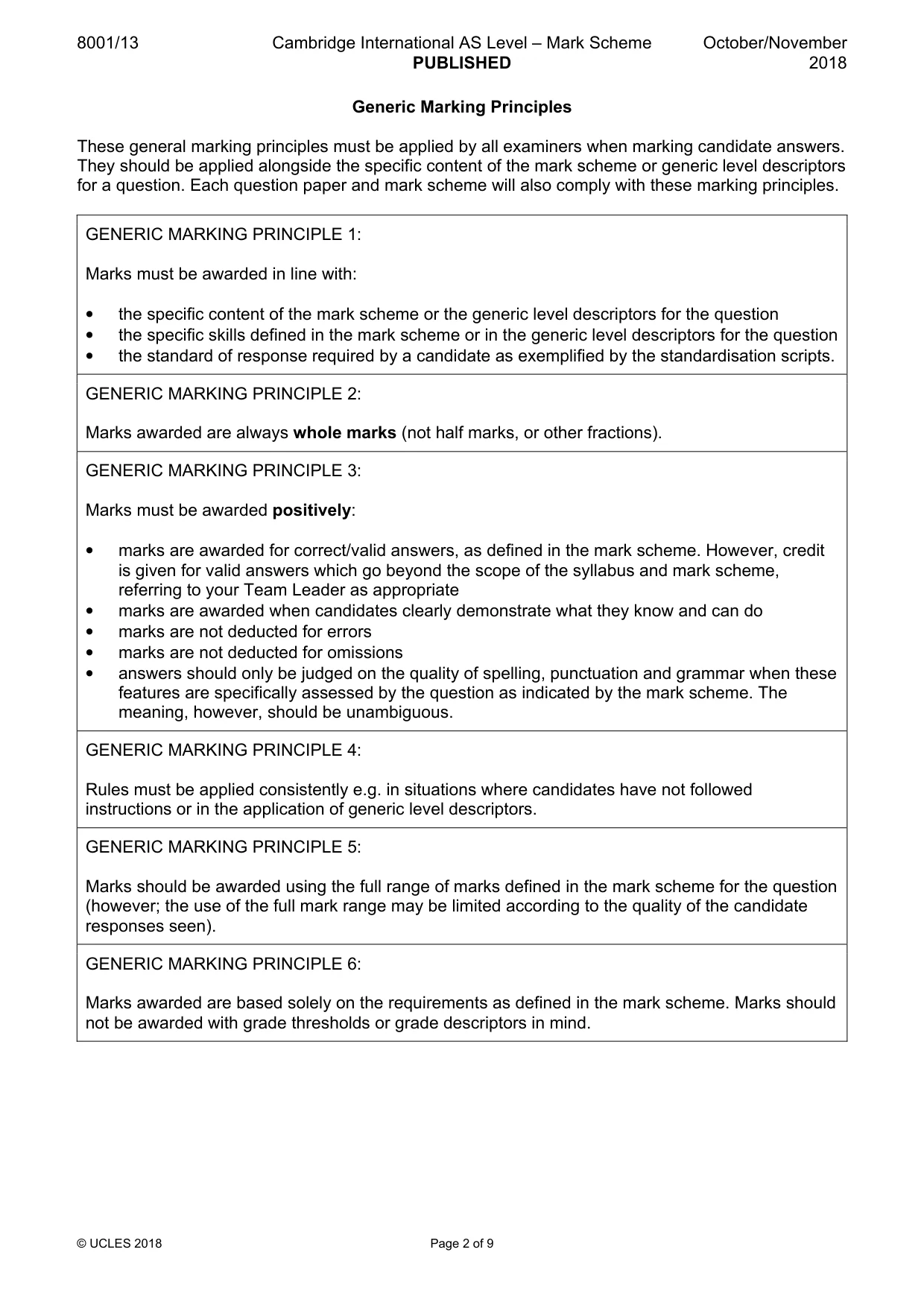
8001/13 Cambridge International AS Level – Mark Scheme PUBLISHED October/November 2018 © UCLES 2018 Page 2 of 9 Generic Marking Principles These general marking principles must be applied by all examiners when marking candidate answers. They should be applied alongside the specific content of the mark scheme or generic level descriptors for a question. Each question paper and mark scheme will also comply with these marking principles. GENERIC MARKING PRINCIPLE 1: Marks must be awarded in line with: • the specific content of the mark scheme or the generic level descriptors for the question • the specific skills defined in the mark scheme or in the generic level descriptors for the question • the standard of response required by a candidate as exemplified by the standardisation scripts. GENERIC MARKING PRINCIPLE 2: Marks awarded are always whole marks (not half marks, or other fractions). GENERIC MARKING PRINCIPLE 3: Marks must be awarded positively: • marks are awarded for correct/valid answers, as defined in the mark scheme. However, credit is given for valid answers which go beyond the scope of the syllabus and mark scheme, referring to your Team Leader as appropriate • marks are awarded when candidates clearly demonstrate what they know and can do • marks are not deducted for errors • marks are not deducted for omissions • answers should only be judged on the quality of spelling, punctuation and grammar when these features are specifically assessed by the question as indicated by the mark scheme. The meaning, however, should be unambiguous. GENERIC MARKING PRINCIPLE 4: Rules must be applied consistently e.g. in situations where candidates have not followed instructions or in the application of generic level descriptors. GENERIC MARKING PRINCIPLE 5: Marks should be awarded using the full range of marks defined in the mark scheme for the question (however; the use of the full mark range may be limited according to the quality of the candidate responses seen). GENERIC MARKING PRINCIPLE 6: Marks awarded are based solely on the requirements as defined in the mark scheme. Marks should not be awarded with grade thresholds or grade descriptors in mind.
Mark scheme, page 3
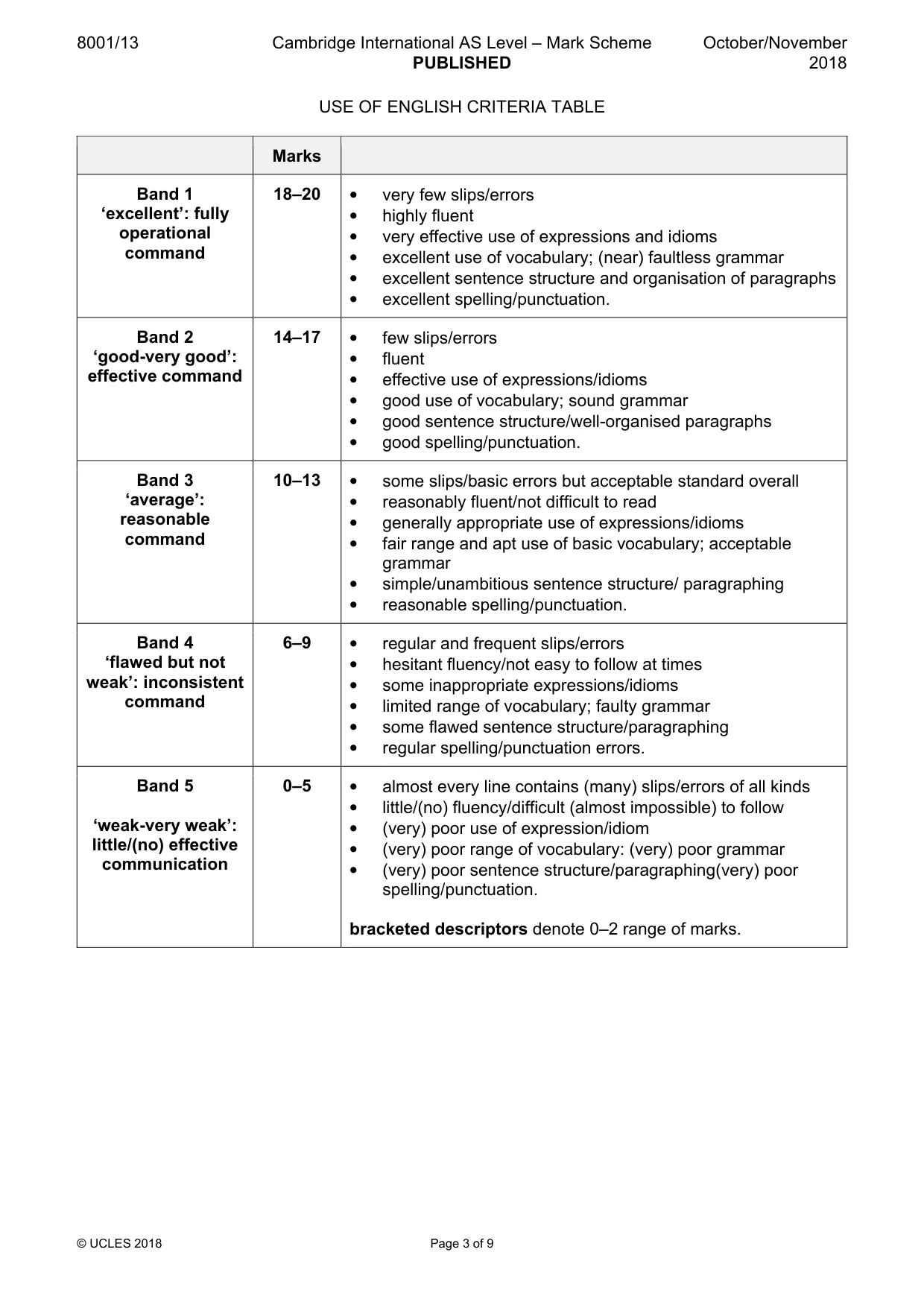
8001/13 Cambridge International AS Level – Mark Scheme PUBLISHED October/November 2018 © UCLES 2018 Page 3 of 9 USE OF ENGLISH CRITERIA TABLE Marks Band 1 ‘excellent’: fully operational command 18–20 • very few slips/errors • highly fluent • very effective use of expressions and idioms • excellent use of vocabulary; (near) faultless grammar • excellent sentence structure and organisation of paragraphs • excellent spelling/punctuation. Band 2 ‘good-very good’: effective command 14–17 • few slips/errors • fluent • effective use of expressions/idioms • good use of vocabulary; sound grammar • good sentence structure/well-organised paragraphs • good spelling/punctuation. Band 3 ‘average’: reasonable command 10–13 • some slips/basic errors but acceptable standard overall • reasonably fluent/not difficult to read • generally appropriate use of expressions/idioms • fair range and apt use of basic vocabulary; acceptable grammar • simple/unambitious sentence structure/ paragraphing • reasonable spelling/punctuation. Band 4 ‘flawed but not weak’: inconsistent command 6–9 • regular and frequent slips/errors • hesitant fluency/not easy to follow at times • some inappropriate expressions/idioms • limited range of vocabulary; faulty grammar • some flawed sentence structure/paragraphing • regular spelling/punctuation errors. Band 5 ‘weak-very weak’: little/(no) effective communication 0–5 • almost every line contains (many) slips/errors of all kinds • little/(no) fluency/difficult (almost impossible) to follow • (very) poor use of expression/idiom • (very) poor range of vocabulary: (very) poor grammar • (very) poor sentence structure/paragraphing(very) poor spelling/punctuation. bracketed descriptors denote 0–2 range of marks.
Mark scheme, page 4
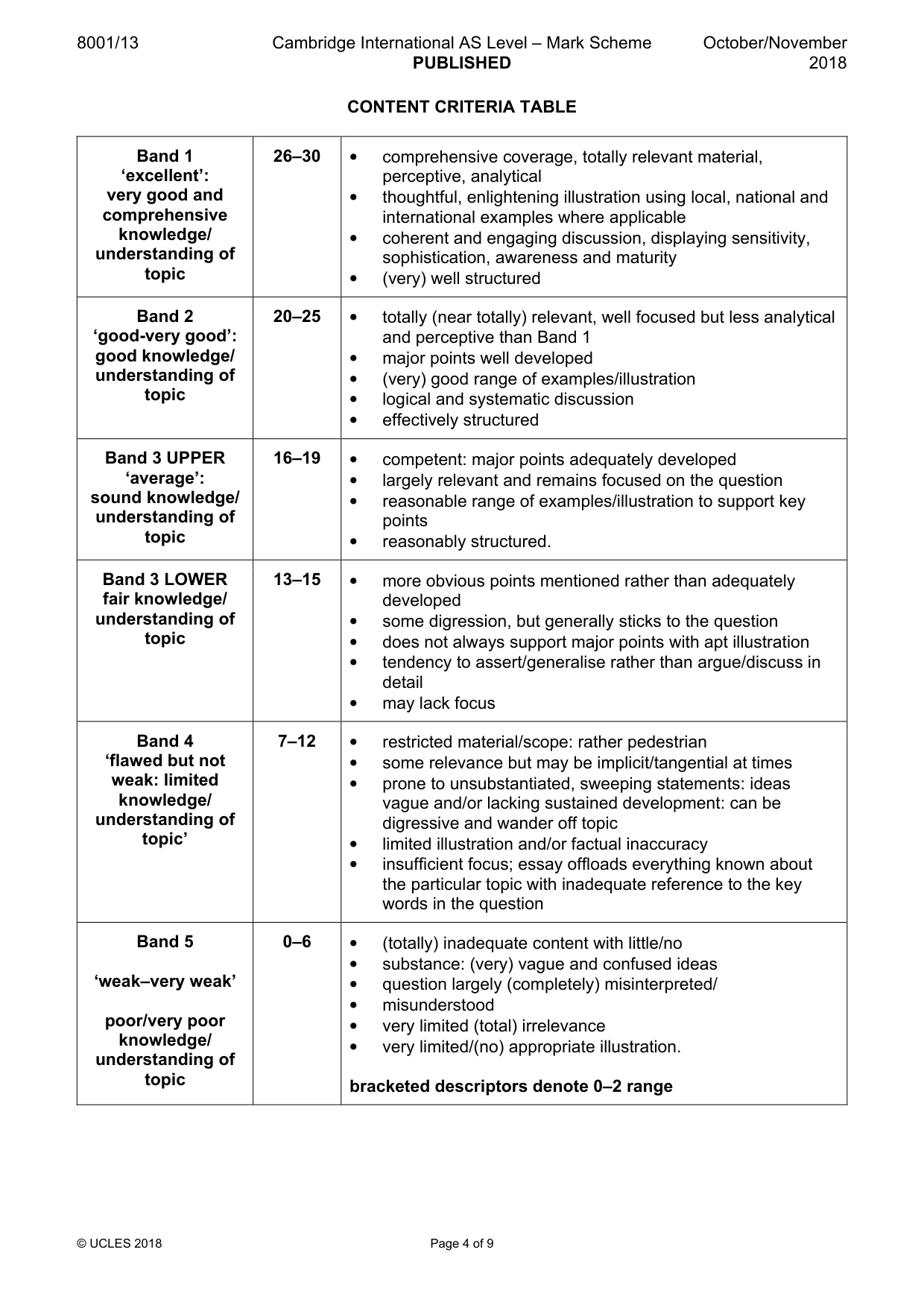
8001/13 Cambridge International AS Level – Mark Scheme PUBLISHED October/November 2018 © UCLES 2018 Page 4 of 9 CONTENT CRITERIA TABLE Band 1 ‘excellent’: very good and comprehensive knowledge/ understanding of topic 26–30 • comprehensive coverage, totally relevant material, perceptive, analytical • thoughtful, enlightening illustration using local, national and international examples where applicable • coherent and engaging discussion, displaying sensitivity, sophistication, awareness and maturity • (very) well structured Band 2 ‘good-very good’: good knowledge/ understanding of topic 20–25 • totally (near totally) relevant, well focused but less analytical and perceptive than Band 1 • major points well developed • (very) good range of examples/illustration • logical and systematic discussion • effectively structured Band 3 UPPER ‘average’: sound knowledge/ understanding of topic 16–19 • competent: major points adequately developed • largely relevant and remains focused on the question • reasonable range of examples/illustration to support key points • reasonably structured. Band 3 LOWER fair knowledge/ understanding of topic 13–15 • more obvious points mentioned rather than adequately developed • some digression, but generally sticks to the question • does not always support major points with apt illustration • tendency to assert/generalise rather than argue/discuss in detail • may lack focus Band 4 ‘flawed but not weak: limited knowledge/ understanding of topic’ 7–12 • restricted material/scope: rather pedestrian • some relevance but may be implicit/tangential at times • prone to unsubstantiated, sweeping statements: ideas vague and/or lacking sustained development: can be digressive and wander off topic • limited illustration and/or factual inaccuracy • insufficient focus; essay offloads everything known about the particular topic with inadequate reference to the key words in the question Band 5 ‘weak–very weak’ poor/very poor knowledge/ understanding of topic 0–6 • (totally) inadequate content with little/no • substance: (very) vague and confused ideas • question largely (completely) misinterpreted/ • misunderstood • very limited (total) irrelevance • very limited/(no) appropriate illustration. bracketed descriptors denote 0–2 range
Mark scheme, page 5
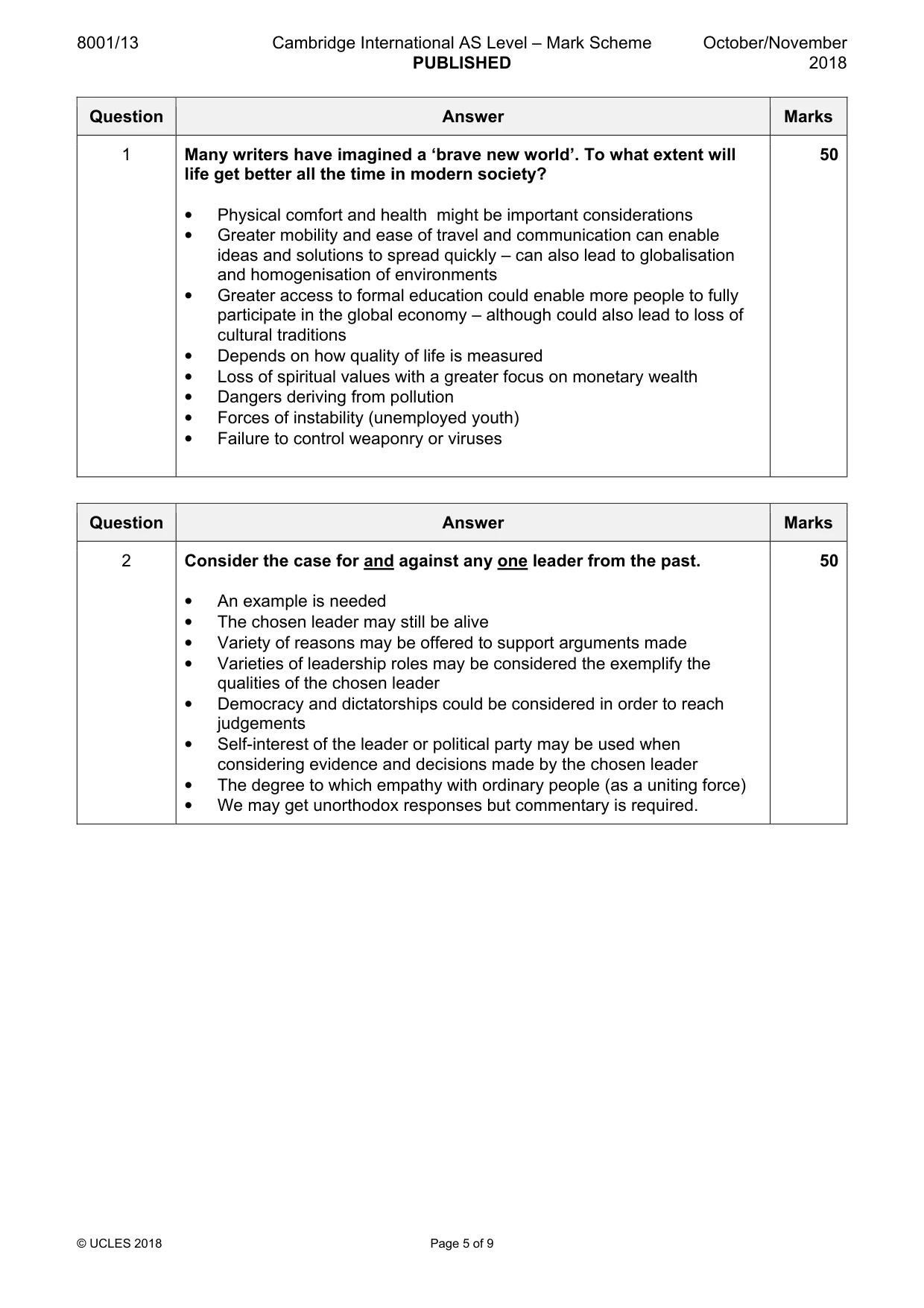
8001/13 Cambridge International AS Level – Mark Scheme PUBLISHED October/November 2018 © UCLES 2018 Page 5 of 9 Question Answer Marks 1 Many writers have imagined a ‘brave new world’. To what extent will life get better all the time in modern society? • Physical comfort and health might be important considerations • Greater mobility and ease of travel and communication can enable ideas and solutions to spread quickly – can also lead to globalisation and homogenisation of environments • Greater access to formal education could enable more people to fully participate in the global economy – although could also lead to loss of cultural traditions • Depends on how quality of life is measured • Loss of spiritual values with a greater focus on monetary wealth • Dangers deriving from pollution • Forces of instability (unemployed youth) • Failure to control weaponry or viruses 50 Question Answer Marks 2 Consider the case for and against any one leader from the past. • An example is needed • The chosen leader may still be alive • Variety of reasons may be offered to support arguments made • Varieties of leadership roles may be considered the exemplify the qualities of the chosen leader • Democracy and dictatorships could be considered in order to reach judgements • Self-interest of the leader or political party may be used when considering evidence and decisions made by the chosen leader • The degree to which empathy with ordinary people (as a uniting force) • We may get unorthodox responses but commentary is required. 50
Mark scheme, page 6
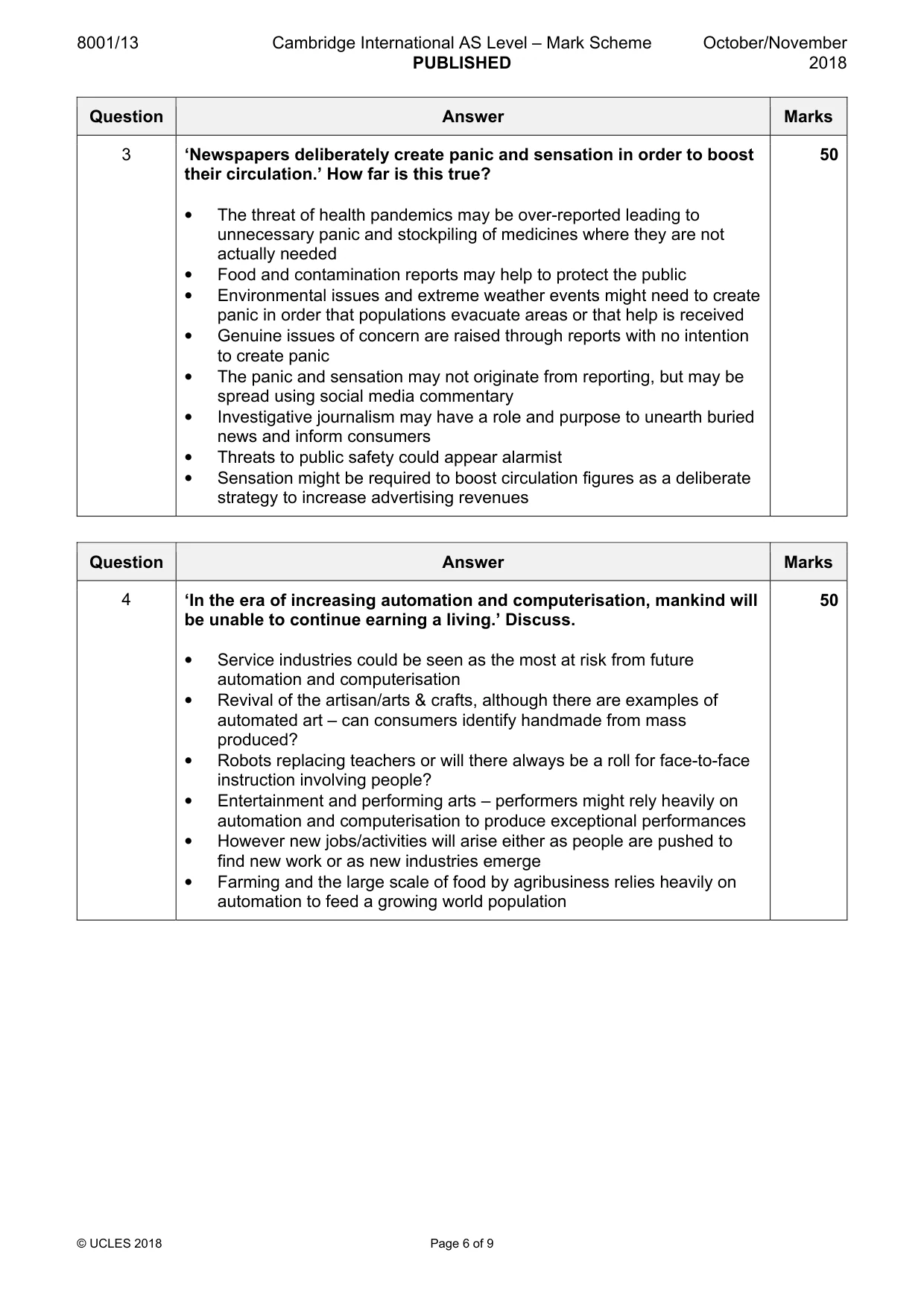
8001/13 Cambridge International AS Level – Mark Scheme PUBLISHED October/November 2018 © UCLES 2018 Page 6 of 9 Question Answer Marks 3 ‘Newspapers deliberately create panic and sensation in order to boost their circulation.’ How far is this true? • The threat of health pandemics may be over-reported leading to unnecessary panic and stockpiling of medicines where they are not actually needed • Food and contamination reports may help to protect the public • Environmental issues and extreme weather events might need to create panic in order that populations evacuate areas or that help is received • Genuine issues of concern are raised through reports with no intention to create panic • The panic and sensation may not originate from reporting, but may be spread using social media commentary • Investigative journalism may have a role and purpose to unearth buried news and inform consumers • Threats to public safety could appear alarmist • Sensation might be required to boost circulation figures as a deliberate strategy to increase advertising revenues 50 Question Answer Marks 4 ‘In the era of increasing automation and computerisation, mankind will be unable to continue earning a living.’ Discuss. • Service industries could be seen as the most at risk from future automation and computerisation • Revival of the artisan/arts & crafts, although there are examples of automated art – can consumers identify handmade from mass produced? • Robots replacing teachers or will there always be a roll for face-to-face instruction involving people? • Entertainment and performing arts – performers might rely heavily on automation and computerisation to produce exceptional performances • However new jobs/activities will arise either as people are pushed to find new work or as new industries emerge • Farming and the large scale of food by agribusiness relies heavily on automation to feed a growing world population 50
Mark scheme, page 7
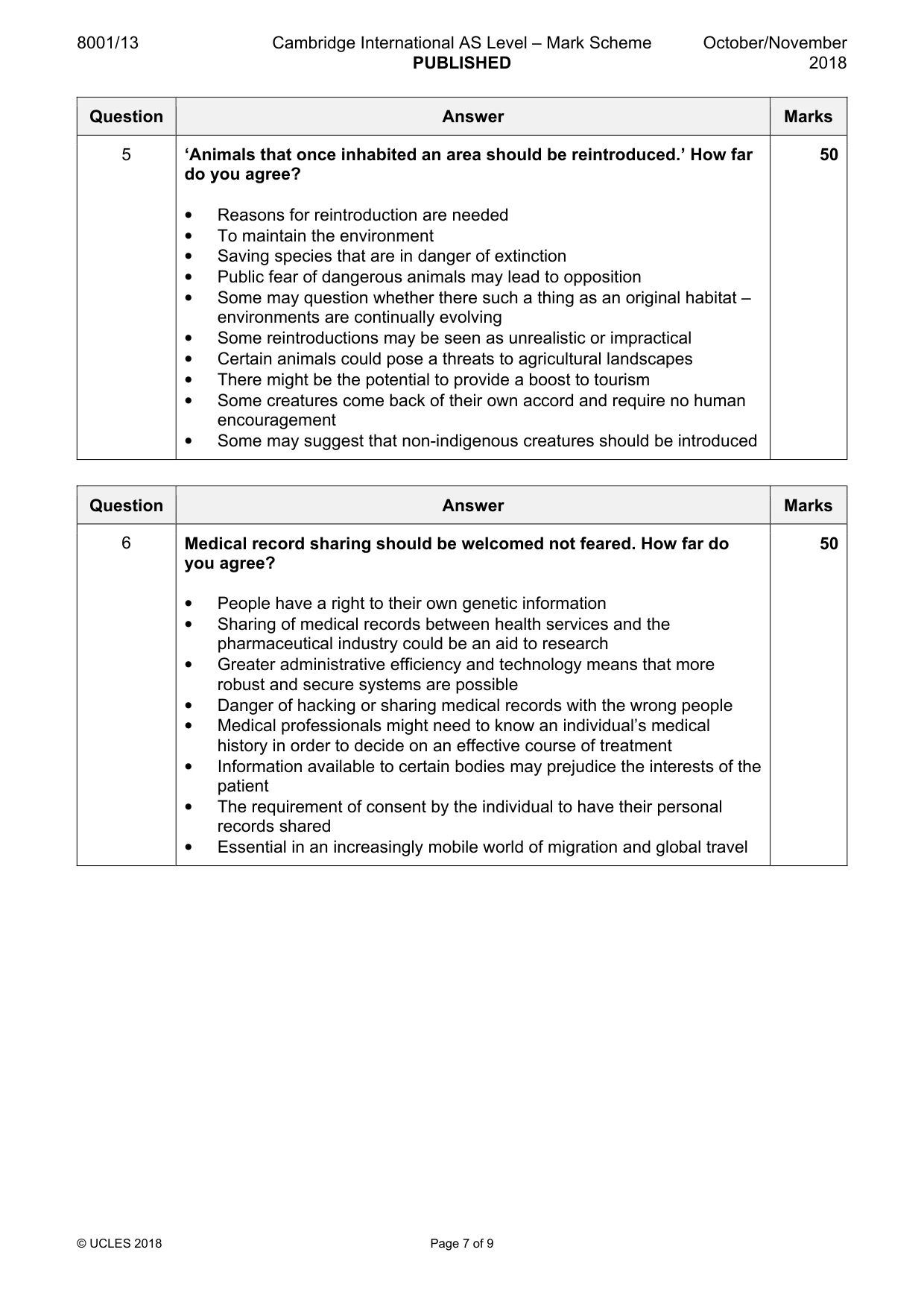
8001/13 Cambridge International AS Level – Mark Scheme PUBLISHED October/November 2018 © UCLES 2018 Page 7 of 9 Question Answer Marks 5 ‘Animals that once inhabited an area should be reintroduced.’ How far do you agree? • Reasons for reintroduction are needed • To maintain the environment • Saving species that are in danger of extinction • Public fear of dangerous animals may lead to opposition • Some may question whether there such a thing as an original habitat – environments are continually evolving • Some reintroductions may be seen as unrealistic or impractical • Certain animals could pose a threats to agricultural landscapes • There might be the potential to provide a boost to tourism • Some creatures come back of their own accord and require no human encouragement • Some may suggest that non-indigenous creatures should be introduced 50 Question Answer Marks 6 Medical record sharing should be welcomed not feared. How far do you agree? • People have a right to their own genetic information • Sharing of medical records between health services and the pharmaceutical industry could be an aid to research • Greater administrative efficiency and technology means that more robust and secure systems are possible • Danger of hacking or sharing medical records with the wrong people • Medical professionals might need to know an individual’s medical history in order to decide on an effective course of treatment • Information available to certain bodies may prejudice the interests of the patient • The requirement of consent by the individual to have their personal records shared • Essential in an increasingly mobile world of migration and global travel 50
Mark scheme, page 8
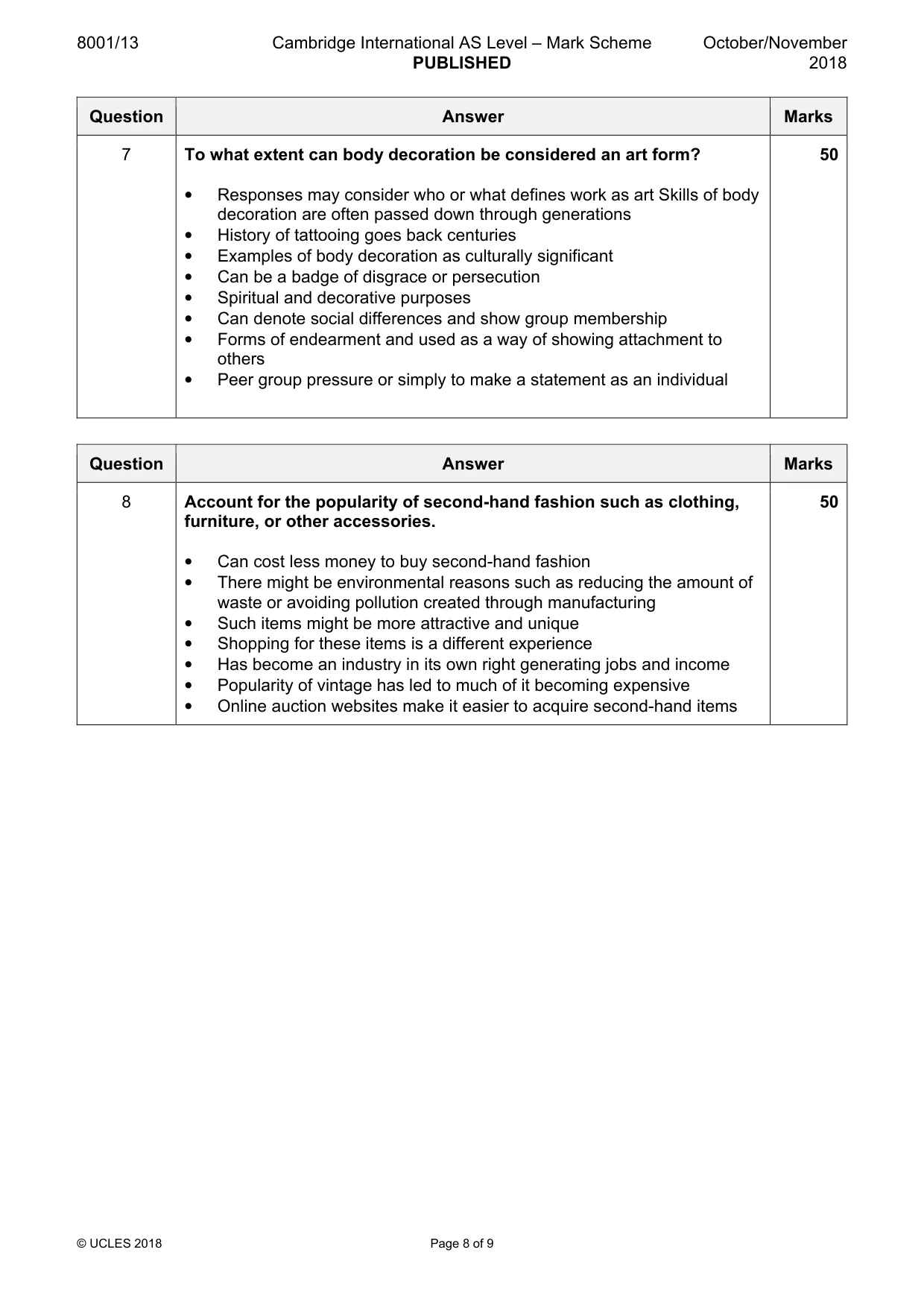
8001/13 Cambridge International AS Level – Mark Scheme PUBLISHED October/November 2018 © UCLES 2018 Page 8 of 9 Question Answer Marks 7 To what extent can body decoration be considered an art form? • Responses may consider who or what defines work as art Skills of body decoration are often passed down through generations • History of tattooing goes back centuries • Examples of body decoration as culturally significant • Can be a badge of disgrace or persecution • Spiritual and decorative purposes • Can denote social differences and show group membership • Forms of endearment and used as a way of showing attachment to others • Peer group pressure or simply to make a statement as an individual 50 Question Answer Marks 8 Account for the popularity of second-hand fashion such as clothing, furniture, or other accessories. • Can cost less money to buy second-hand fashion • There might be environmental reasons such as reducing the amount of waste or avoiding pollution created through manufacturing • Such items might be more attractive and unique • Shopping for these items is a different experience • Has become an industry in its own right generating jobs and income • Popularity of vintage has led to much of it becoming expensive • Online auction websites make it easier to acquire second-hand items 50
Mark scheme, page 9
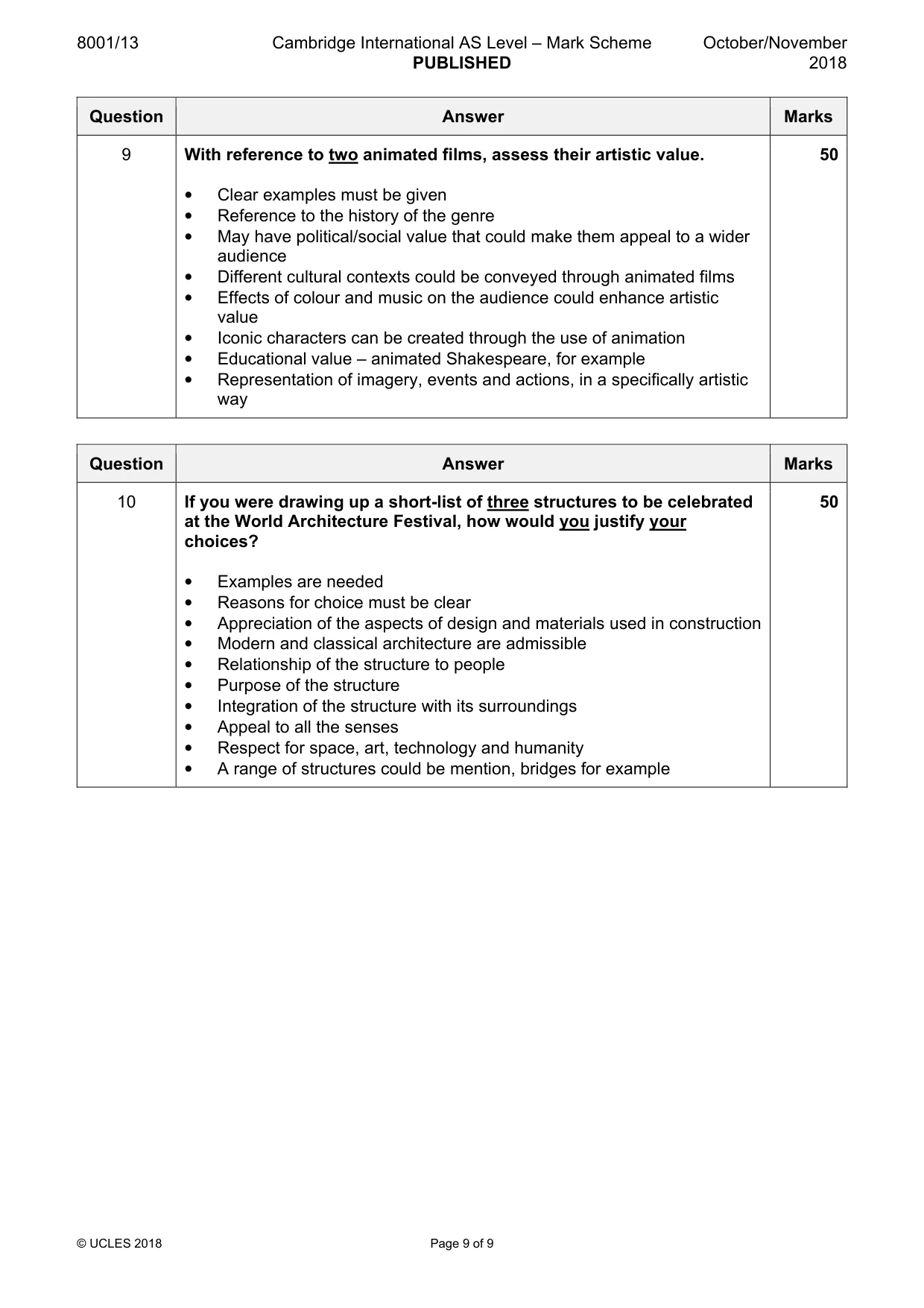
8001/13 Cambridge International AS Level – Mark Scheme PUBLISHED October/November 2018 © UCLES 2018 Page 9 of 9 Question Answer Marks 9 With reference to two animated films, assess their artistic value. • Clear examples must be given • Reference to the history of the genre • May have political/social value that could make them appeal to a wider audience • Different cultural contexts could be conveyed through animated films • Effects of colour and music on the audience could enhance artistic value • Iconic characters can be created through the use of animation • Educational value – animated Shakespeare, for example • Representation of imagery, events and actions, in a specifically artistic way 50 Question Answer Marks 10 If you were drawing up a short-list of three structures to be celebrated at the World Architecture Festival, how would you justify your choices? • Examples are needed • Reasons for choice must be clear • Appreciation of the aspects of design and materials used in construction • Modern and classical architecture are admissible • Relationship of the structure to people • Purpose of the structure • Integration of the structure with its surroundings • Appeal to all the senses • Respect for space, art, technology and humanity • A range of structures could be mention, bridges for example 50