Cambridge A Level General Paper (AS Level only) 8001 — 2015 Oct/Nov Paper 1 · Variant 2
8001/12/O/N/15 · 50 marks · ≈56 min
The question paper and its mark scheme, free to read here and free to download. This is Cambridge’s own paper, exactly as it was sat.
Question paper4 pages
Mark scheme8 pages
Answers below. Sit the paper first if you are practising.
Paper as text
Question paper, page 1
This document consists of 2 printed pages, 2 blank pages and 1 insert. DC (SLM) 113778/1 © UCLES 2015 [Turn over Cambridge International Examinations Cambridge International Advanced Subsidiary Level * 9 7 8 7 9 0 4 9 8 0 * GENERAL PAPER 8001/12 October/November 2015 1 hour 15 minutes No Additional Materials are required. READ THESE INSTRUCTIONS FIRST An answer booklet is provided inside this question paper. You should follow the instructions on the front cover of the answer booklet. If you need additional answer paper ask the invigilator for a continuation booklet. Answer one question. The total time includes an allowance for you to study the questions before you begin your answer. You may make notes during this time if you wish. All questions carry equal marks.
Question paper, page 2
2 8001/12/O/N/15 © UCLES 2015 BLANK PAGE
Question paper, page 3
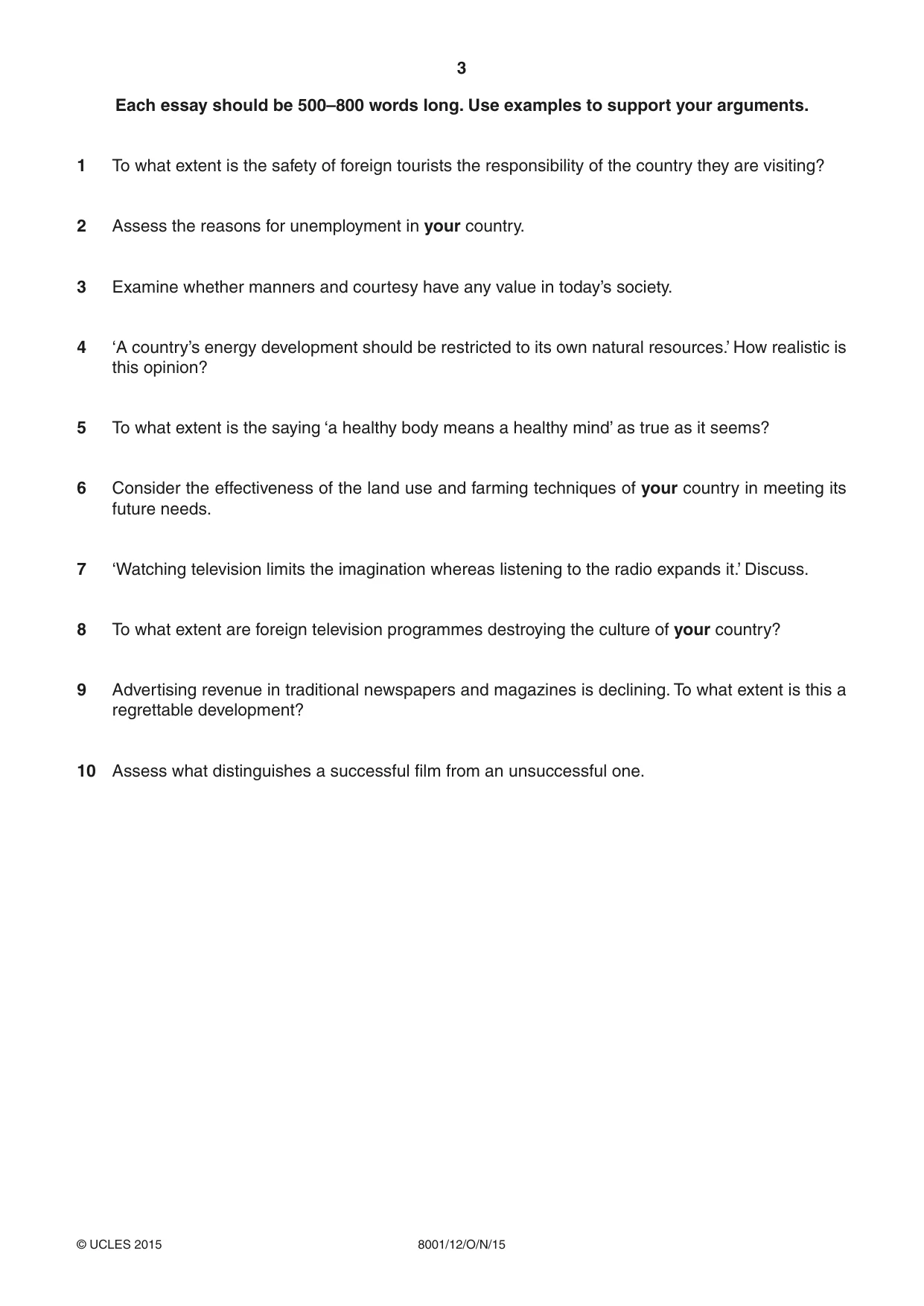
3 8001/12/O/N/15 © UCLES 2015 Each essay should be 500–800 words long. Use examples to support your arguments. 1 To what extent is the safety of foreign tourists the responsibility of the country they are visiting? 2 Assess the reasons for unemployment in your country. 3 Examine whether manners and courtesy have any value in today’s society. 4 ‘A country’s energy development should be restricted to its own natural resources.’ How realistic is this opinion? 5 To what extent is the saying ‘a healthy body means a healthy mind’ as true as it seems? 6 Consider the effectiveness of the land use and farming techniques of your country in meeting its future needs. 7 ‘Watching television limits the imagination whereas listening to the radio expands it.’ Discuss. 8 To what extent are foreign television programmes destroying the culture of your country? 9 Advertising revenue in traditional newspapers and magazines is declining. To what extent is this a regrettable development? 10 Assess what distinguishes a successful film from an unsuccessful one.
Question paper, page 4
4 8001/12/O/N/15 © UCLES 2015 BLANK PAGE Permission to reproduce items where third-party owned material protected by copyright is included has been sought and cleared where possible. Every reasonable effort has been made by the publisher (UCLES) to trace copyright holders, but if any items requiring clearance have unwittingly been included, the publisher will be pleased to make amends at the earliest possible opportunity. To avoid the issue of disclosure of answer-related information to candidates, all copyright acknowledgements are reproduced online in the Cambridge International Examinations Copyright Acknowledgements Booklet. This is produced for each series of examinations and is freely available to download at www.cie.org.uk after the live examination series. Cambridge International Examinations is part of the Cambridge Assessment Group. Cambridge Assessment is the brand name of University of Cambridge Local Examinations Syndicate (UCLES), which is itself a department of the University of Cambridge.
Mark scheme, page 1
® IGCSE is the registered trademark of Cambridge International Examinations. CAMBRIDGE INTERNATIONAL EXAMINATIONS Cambridge International Advanced Subsidiary Level MARK SCHEME for the October/November 2015 series 8001 GENERAL PAPER 8001/12 Paper 1, maximum raw mark 50 This mark scheme is published as an aid to teachers and candidates, to indicate the requirements of the examination. It shows the basis on which Examiners were instructed to award marks. It does not indicate the details of the discussions that took place at an Examiners’ meeting before marking began, which would have considered the acceptability of alternative answers. Mark schemes should be read in conjunction with the question paper and the Principal Examiner Report for Teachers. Cambridge will not enter into discussions about these mark schemes. Cambridge is publishing the mark schemes for the October/November 2015 series for most Cambridge IGCSE®, Cambridge International A and AS Level components and some Cambridge O Level components.
Mark scheme, page 2
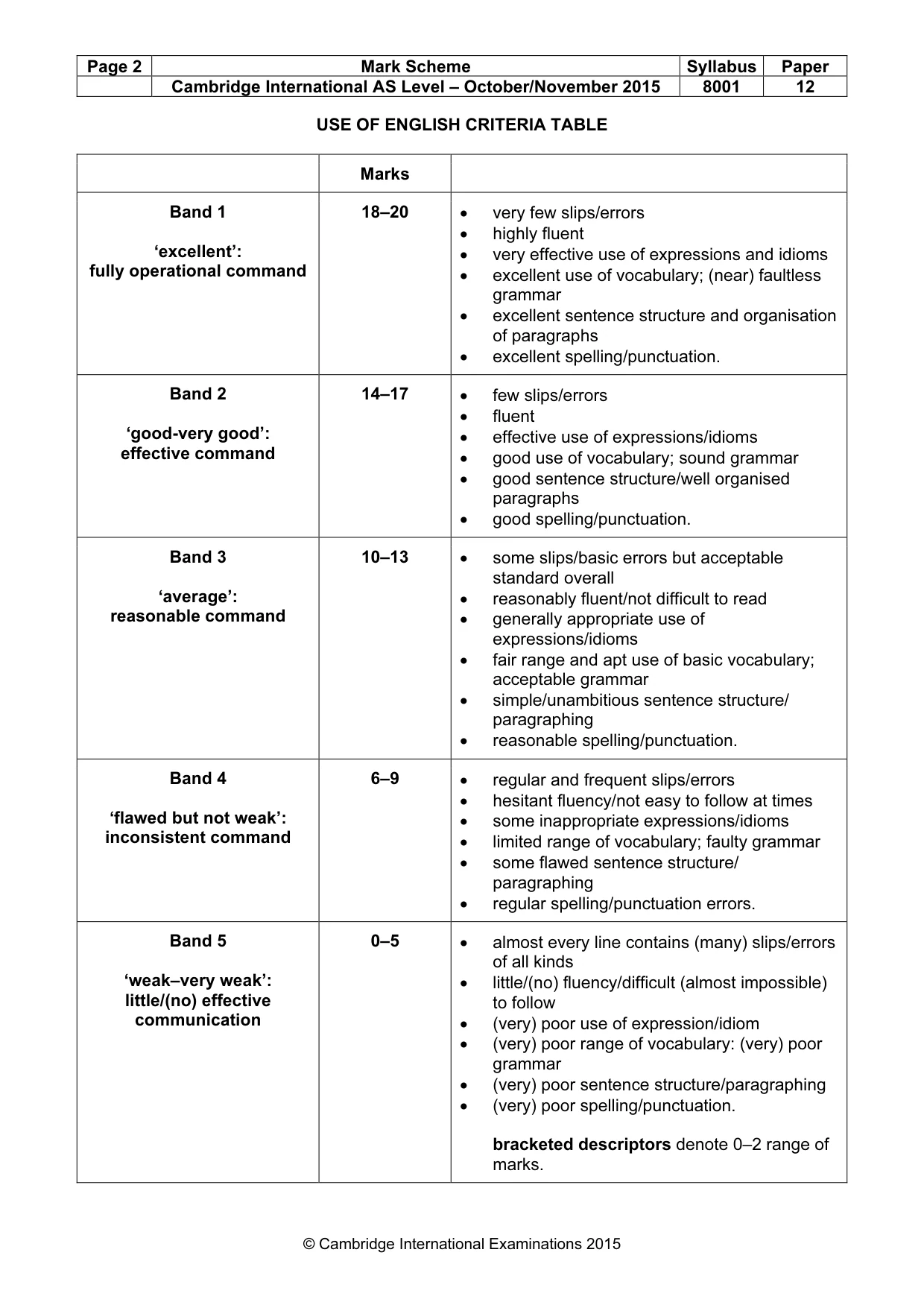
Page 2 Mark Scheme Syllabus Paper Cambridge International AS Level – October/November 2015 8001 12 © Cambridge International Examinations 2015 USE OF ENGLISH CRITERIA TABLE Marks Band 1 ‘excellent’: fully operational command 18–20 • very few slips/errors • highly fluent • very effective use of expressions and idioms • excellent use of vocabulary; (near) faultless grammar • excellent sentence structure and organisation of paragraphs • excellent spelling/punctuation. Band 2 ‘good-very good’: effective command 14–17 • few slips/errors • fluent • effective use of expressions/idioms • good use of vocabulary; sound grammar • good sentence structure/well organised paragraphs • good spelling/punctuation. Band 3 ‘average’: reasonable command 10–13 • some slips/basic errors but acceptable standard overall • reasonably fluent/not difficult to read • generally appropriate use of expressions/idioms • fair range and apt use of basic vocabulary; acceptable grammar • simple/unambitious sentence structure/ paragraphing • reasonable spelling/punctuation. Band 4 ‘flawed but not weak’: inconsistent command 6–9 • regular and frequent slips/errors • hesitant fluency/not easy to follow at times • some inappropriate expressions/idioms • limited range of vocabulary; faulty grammar • some flawed sentence structure/ paragraphing • regular spelling/punctuation errors. Band 5 ‘weak–very weak’: little/(no) effective communication 0–5 • almost every line contains (many) slips/errors of all kinds • little/(no) fluency/difficult (almost impossible) to follow • (very) poor use of expression/idiom • (very) poor range of vocabulary: (very) poor grammar • (very) poor sentence structure/paragraphing • (very) poor spelling/punctuation. bracketed descriptors denote 0–2 range of marks.
Mark scheme, page 3
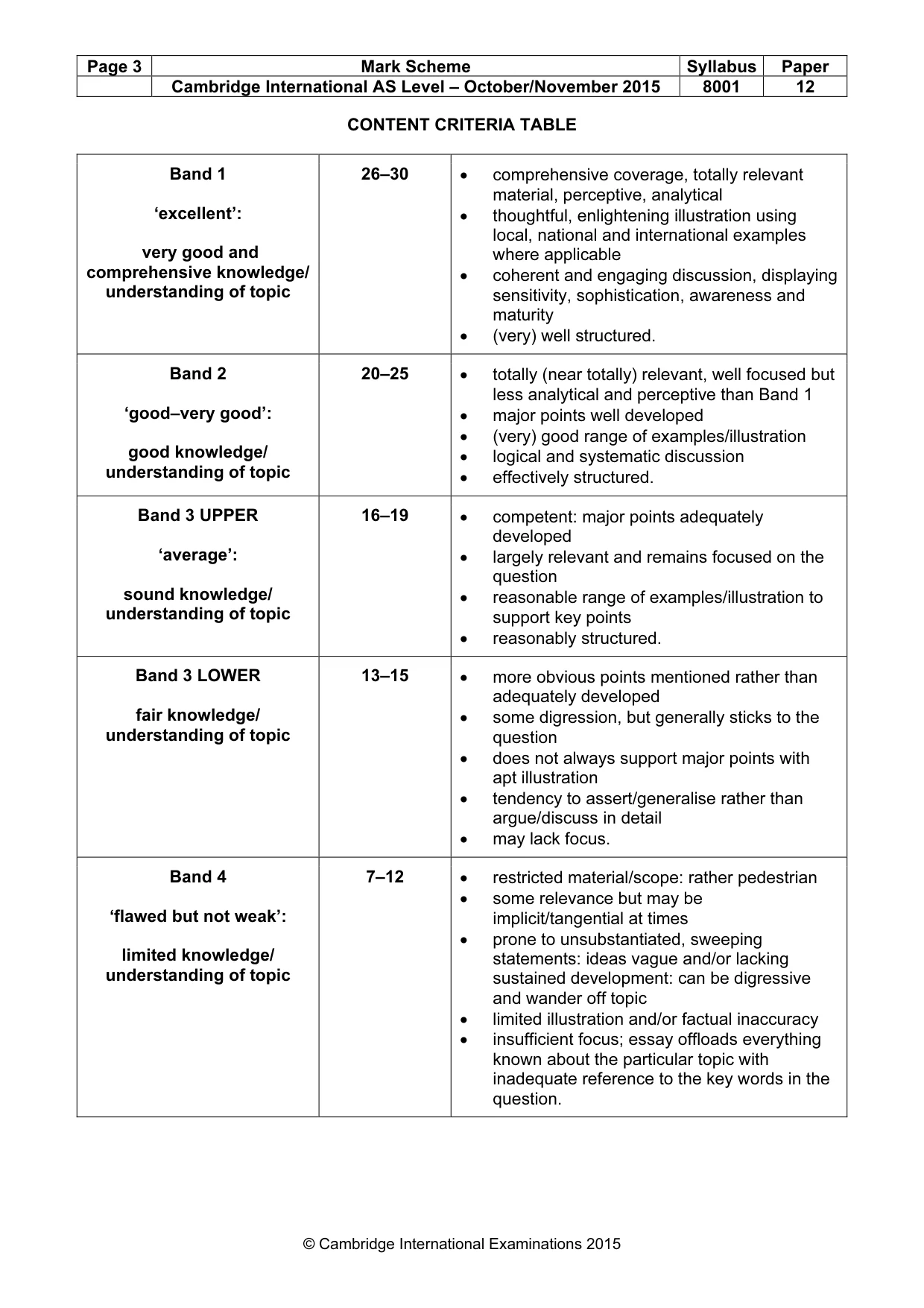
Page 3 Mark Scheme Syllabus Paper Cambridge International AS Level – October/November 2015 8001 12 © Cambridge International Examinations 2015 CONTENT CRITERIA TABLE Band 1 ‘excellent’: very good and comprehensive knowledge/ understanding of topic 26–30 • comprehensive coverage, totally relevant material, perceptive, analytical • thoughtful, enlightening illustration using local, national and international examples where applicable • coherent and engaging discussion, displaying sensitivity, sophistication, awareness and maturity • (very) well structured. Band 2 ‘good–very good’: good knowledge/ understanding of topic 20–25 • totally (near totally) relevant, well focused but less analytical and perceptive than Band 1 • major points well developed • (very) good range of examples/illustration • logical and systematic discussion • effectively structured. Band 3 UPPER ‘average’: sound knowledge/ understanding of topic 16–19 • competent: major points adequately developed • largely relevant and remains focused on the question • reasonable range of examples/illustration to support key points • reasonably structured. Band 3 LOWER fair knowledge/ understanding of topic 13–15 • more obvious points mentioned rather than adequately developed • some digression, but generally sticks to the question • does not always support major points with apt illustration • tendency to assert/generalise rather than argue/discuss in detail • may lack focus. Band 4 ‘flawed but not weak’: limited knowledge/ understanding of topic 7–12 • restricted material/scope: rather pedestrian • some relevance but may be implicit/tangential at times • prone to unsubstantiated, sweeping statements: ideas vague and/or lacking sustained development: can be digressive and wander off topic • limited illustration and/or factual inaccuracy • insufficient focus; essay offloads everything known about the particular topic with inadequate reference to the key words in the question.
Mark scheme, page 4
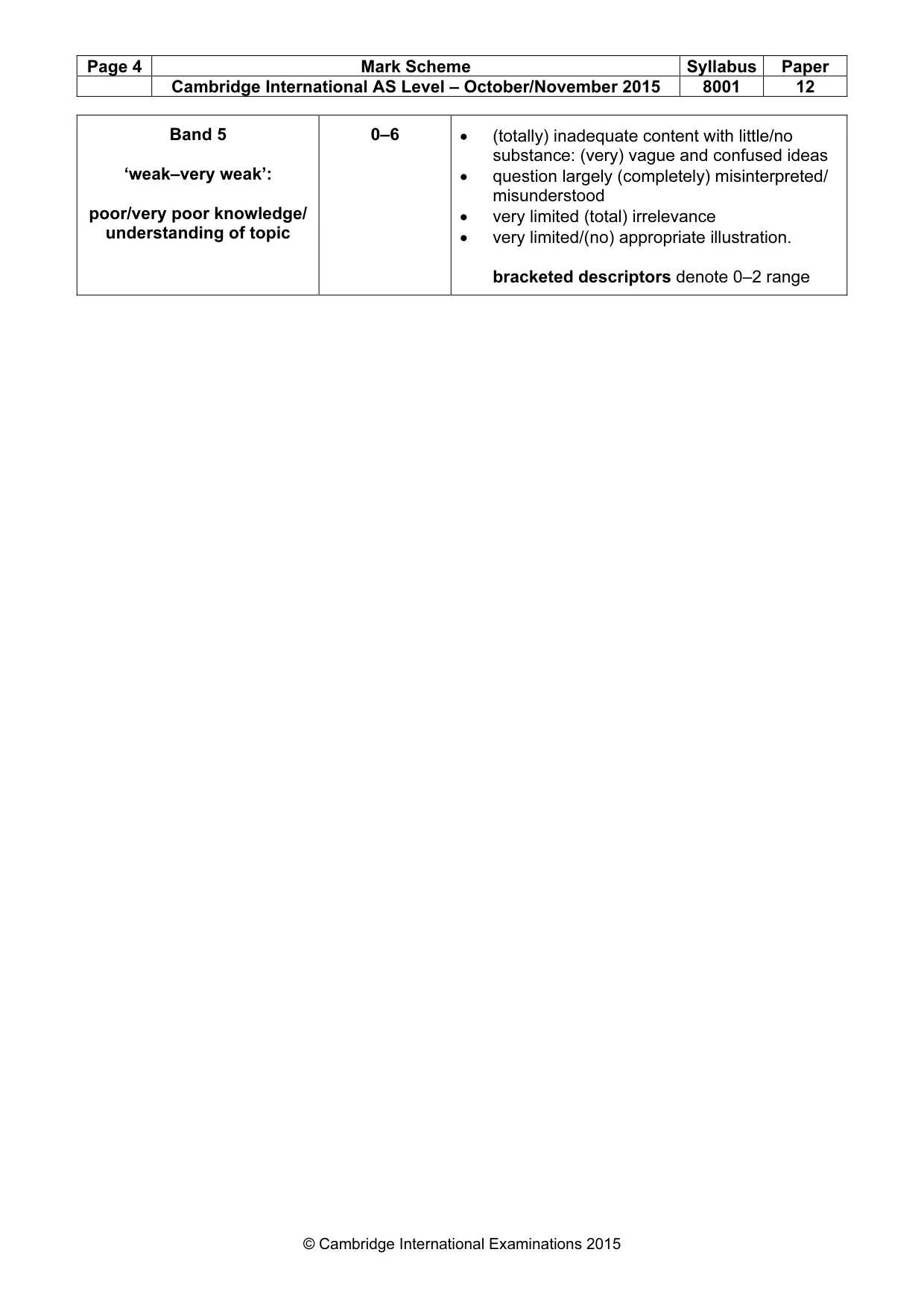
Page 4 Mark Scheme Syllabus Paper Cambridge International AS Level – October/November 2015 8001 12 © Cambridge International Examinations 2015 Band 5 ‘weak–very weak’: poor/very poor knowledge/ understanding of topic 0–6 • (totally) inadequate content with little/no substance: (very) vague and confused ideas • question largely (completely) misinterpreted/ misunderstood • very limited (total) irrelevance • very limited/(no) appropriate illustration. bracketed descriptors denote 0–2 range
Mark scheme, page 5
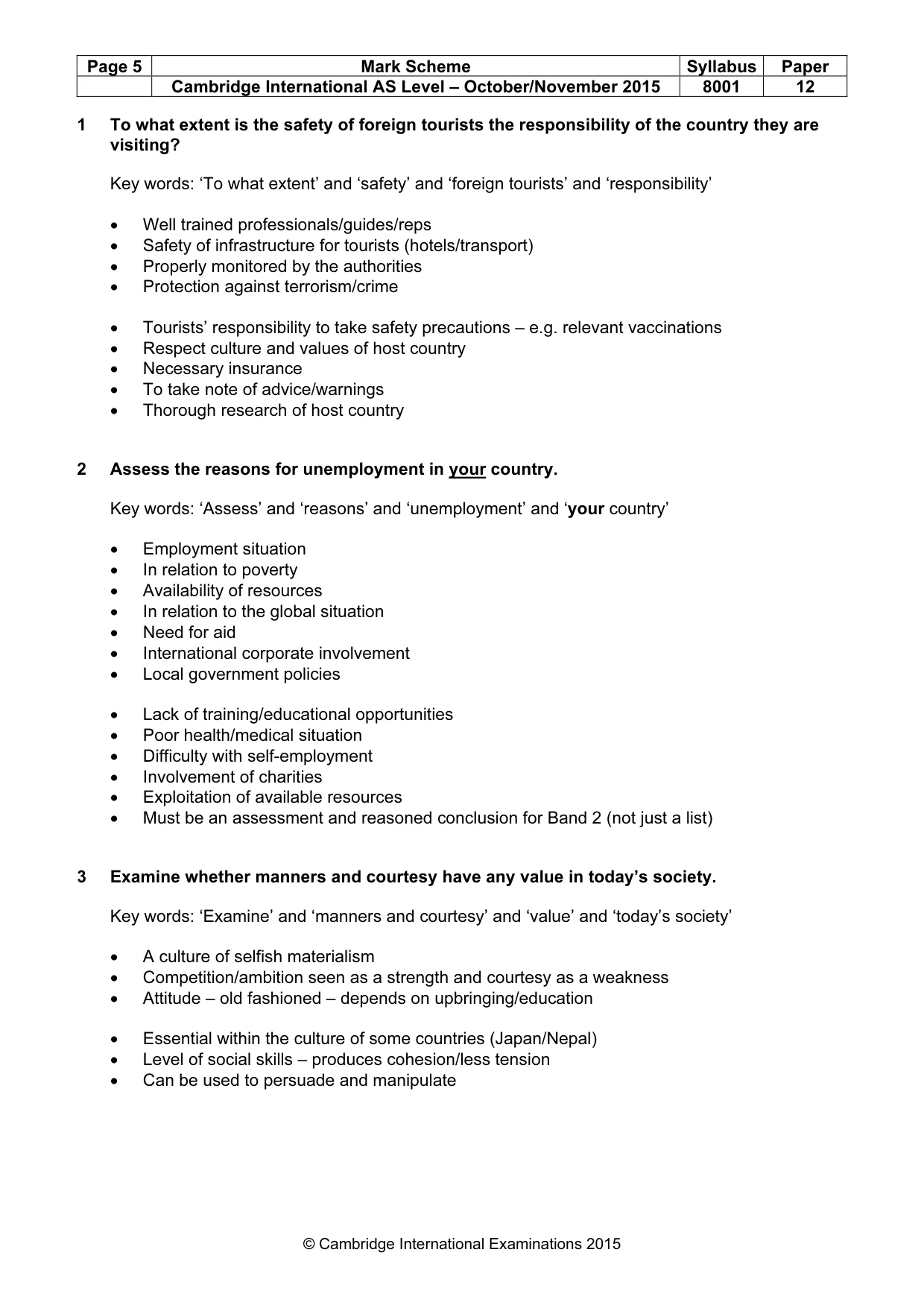
Page 5 Mark Scheme Syllabus Paper Cambridge International AS Level – October/November 2015 8001 12 © Cambridge International Examinations 2015 1 To what extent is the safety of foreign tourists the responsibility of the country they are visiting? Key words: ‘To what extent’ and ‘safety’ and ‘foreign tourists’ and ‘responsibility’ • Well trained professionals/guides/reps • Safety of infrastructure for tourists (hotels/transport) • Properly monitored by the authorities • Protection against terrorism/crime • Tourists’ responsibility to take safety precautions – e.g. relevant vaccinations • Respect culture and values of host country • Necessary insurance • To take note of advice/warnings • Thorough research of host country 2 Assess the reasons for unemployment in your country. Key words: ‘Assess’ and ‘reasons’ and ‘unemployment’ and ‘your country’ • Employment situation • In relation to poverty • Availability of resources • In relation to the global situation • Need for aid • International corporate involvement • Local government policies • Lack of training/educational opportunities • Poor health/medical situation • Difficulty with self-employment • Involvement of charities • Exploitation of available resources • Must be an assessment and reasoned conclusion for Band 2 (not just a list) 3 Examine whether manners and courtesy have any value in today’s society. Key words: ‘Examine’ and ‘manners and courtesy’ and ‘value’ and ‘today’s society’ • A culture of selfish materialism • Competition/ambition seen as a strength and courtesy as a weakness • Attitude – old fashioned – depends on upbringing/education • Essential within the culture of some countries (Japan/Nepal) • Level of social skills – produces cohesion/less tension • Can be used to persuade and manipulate
Mark scheme, page 6
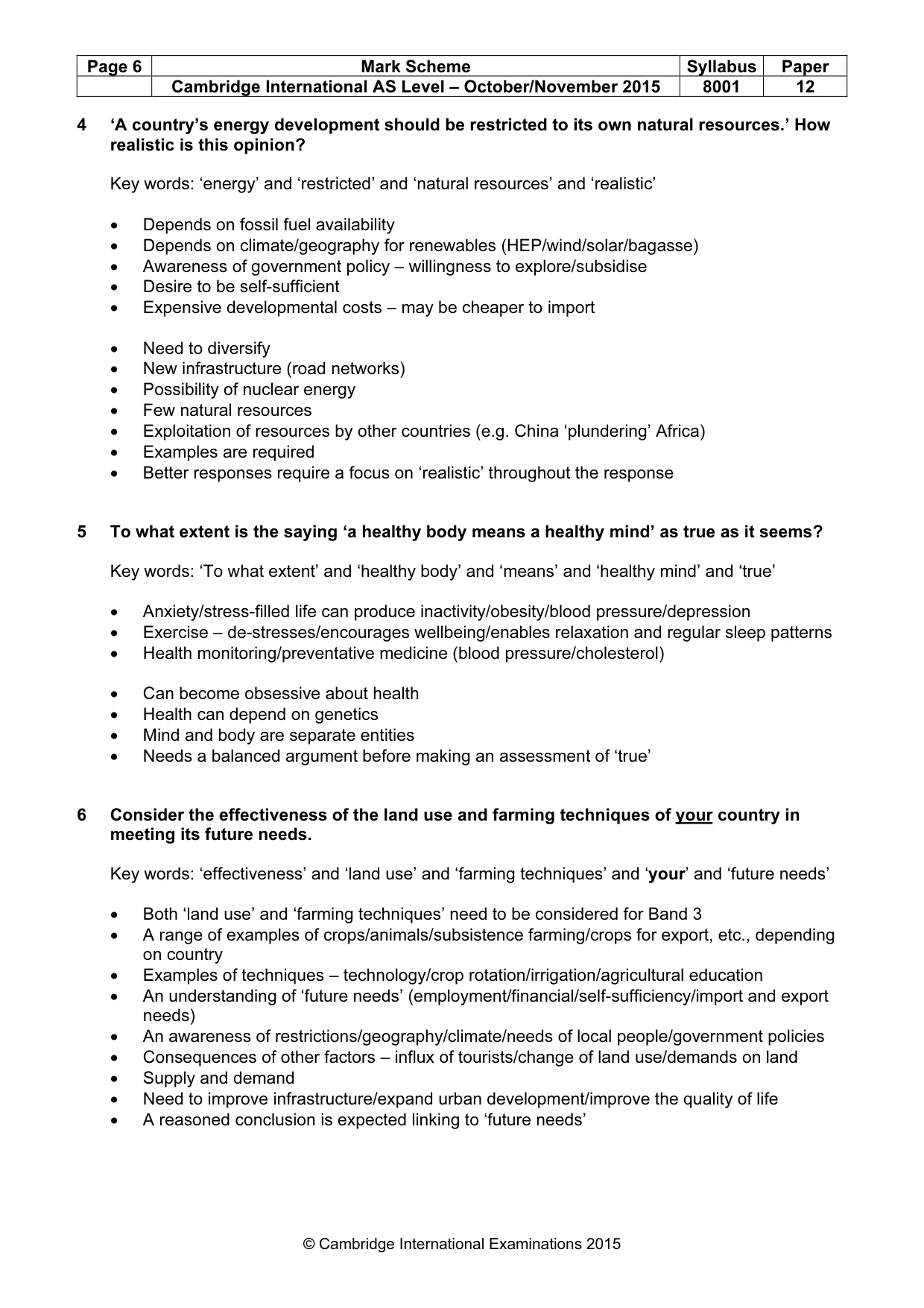
Page 6 Mark Scheme Syllabus Paper Cambridge International AS Level – October/November 2015 8001 12 © Cambridge International Examinations 2015 4 ‘A country’s energy development should be restricted to its own natural resources.’ How realistic is this opinion? Key words: ‘energy’ and ‘restricted’ and ‘natural resources’ and ‘realistic’ • Depends on fossil fuel availability • Depends on climate/geography for renewables (HEP/wind/solar/bagasse) • Awareness of government policy – willingness to explore/subsidise • Desire to be self-sufficient • Expensive developmental costs – may be cheaper to import • Need to diversify • New infrastructure (road networks) • Possibility of nuclear energy • Few natural resources • Exploitation of resources by other countries (e.g. China ‘plundering’ Africa) • Examples are required • Better responses require a focus on ‘realistic’ throughout the response 5 To what extent is the saying ‘a healthy body means a healthy mind’ as true as it seems? Key words: ‘To what extent’ and ‘healthy body’ and ‘means’ and ‘healthy mind’ and ‘true’ • Anxiety/stress-filled life can produce inactivity/obesity/blood pressure/depression • Exercise – de-stresses/encourages wellbeing/enables relaxation and regular sleep patterns • Health monitoring/preventative medicine (blood pressure/cholesterol) • Can become obsessive about health • Health can depend on genetics • Mind and body are separate entities • Needs a balanced argument before making an assessment of ‘true’ 6 Consider the effectiveness of the land use and farming techniques of your country in meeting its future needs. Key words: ‘effectiveness’ and ‘land use’ and ‘farming techniques’ and ‘your’ and ‘future needs’ • Both ‘land use’ and ‘farming techniques’ need to be considered for Band 3 • A range of examples of crops/animals/subsistence farming/crops for export, etc., depending on country • Examples of techniques – technology/crop rotation/irrigation/agricultural education • An understanding of ‘future needs’ (employment/financial/self-sufficiency/import and export needs) • An awareness of restrictions/geography/climate/needs of local people/government policies • Consequences of other factors – influx of tourists/change of land use/demands on land • Supply and demand • Need to improve infrastructure/expand urban development/improve the quality of life • A reasoned conclusion is expected linking to ‘future needs’
Mark scheme, page 7
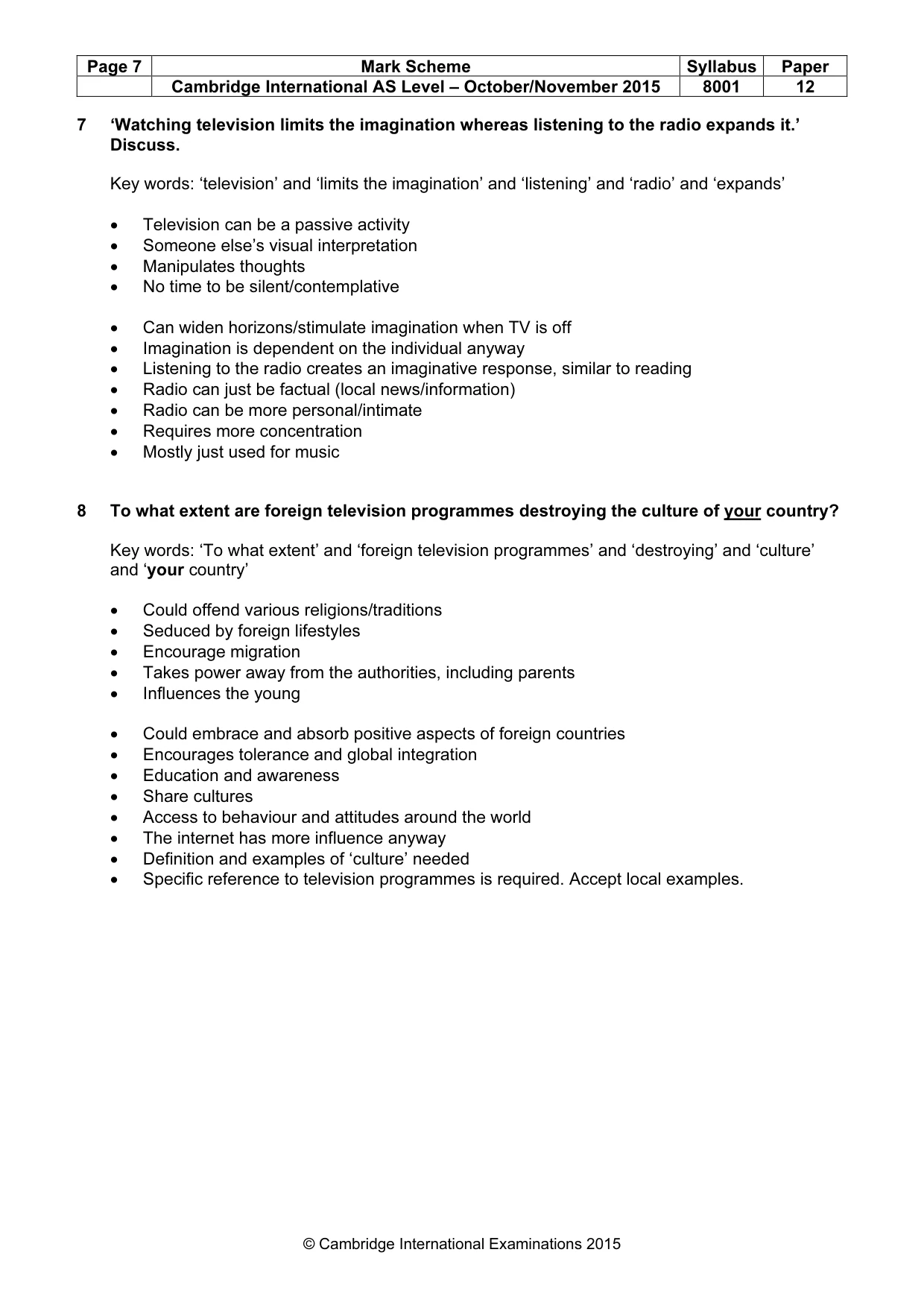
Page 7 Mark Scheme Syllabus Paper Cambridge International AS Level – October/November 2015 8001 12 © Cambridge International Examinations 2015 7 ‘Watching television limits the imagination whereas listening to the radio expands it.’ Discuss. Key words: ‘television’ and ‘limits the imagination’ and ‘listening’ and ‘radio’ and ‘expands’ • Television can be a passive activity • Someone else’s visual interpretation • Manipulates thoughts • No time to be silent/contemplative • Can widen horizons/stimulate imagination when TV is off • Imagination is dependent on the individual anyway • Listening to the radio creates an imaginative response, similar to reading • Radio can just be factual (local news/information) • Radio can be more personal/intimate • Requires more concentration • Mostly just used for music 8 To what extent are foreign television programmes destroying the culture of your country? Key words: ‘To what extent’ and ‘foreign television programmes’ and ‘destroying’ and ‘culture’ and ‘your country’ • Could offend various religions/traditions • Seduced by foreign lifestyles • Encourage migration • Takes power away from the authorities, including parents • Influences the young • Could embrace and absorb positive aspects of foreign countries • Encourages tolerance and global integration • Education and awareness • Share cultures • Access to behaviour and attitudes around the world • The internet has more influence anyway • Definition and examples of ‘culture’ needed • Specific reference to television programmes is required. Accept local examples.
Mark scheme, page 8
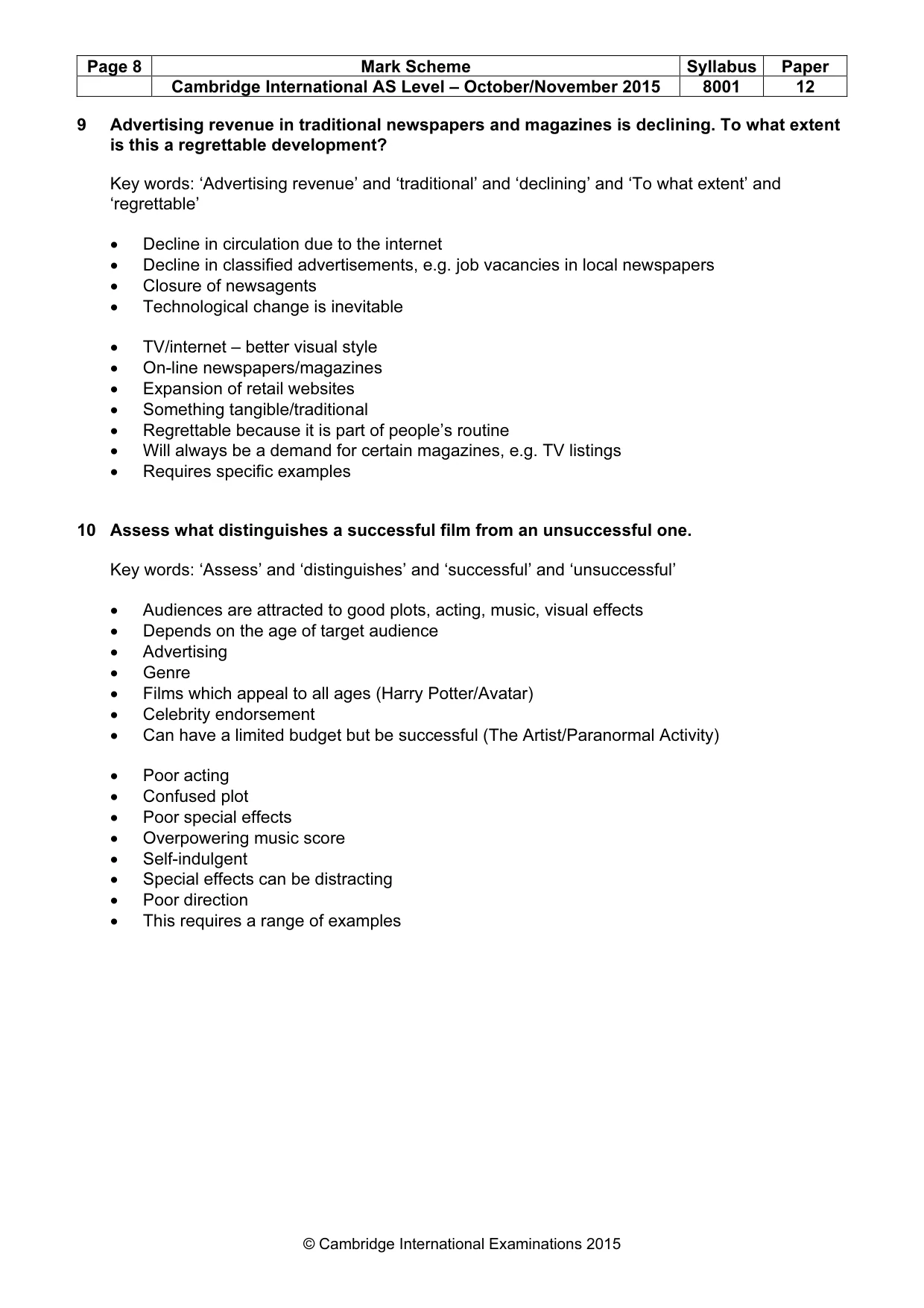
Page 8 Mark Scheme Syllabus Paper Cambridge International AS Level – October/November 2015 8001 12 © Cambridge International Examinations 2015 9 Advertising revenue in traditional newspapers and magazines is declining. To what extent is this a regrettable development? Key words: ‘Advertising revenue’ and ‘traditional’ and ‘declining’ and ‘To what extent’ and ‘regrettable’ • Decline in circulation due to the internet • Decline in classified advertisements, e.g. job vacancies in local newspapers • Closure of newsagents • Technological change is inevitable • TV/internet – better visual style • On-line newspapers/magazines • Expansion of retail websites • Something tangible/traditional • Regrettable because it is part of people’s routine • Will always be a demand for certain magazines, e.g. TV listings • Requires specific examples 10 Assess what distinguishes a successful film from an unsuccessful one. Key words: ‘Assess’ and ‘distinguishes’ and ‘successful’ and ‘unsuccessful’ • Audiences are attracted to good plots, acting, music, visual effects • Depends on the age of target audience • Advertising • Genre • Films which appeal to all ages (Harry Potter/Avatar) • Celebrity endorsement • Can have a limited budget but be successful (The Artist/Paranormal Activity) • Poor acting • Confused plot • Poor special effects • Overpowering music score • Self-indulgent • Special effects can be distracting • Poor direction • This requires a range of examples
What you needed in this session
Cambridge’s own grade thresholds for 2015 Oct/Nov, Paper 1 · Variant 2. A higher threshold means an easier paper — the bar moves with how the cohort did.