Cambridge A Level General Paper (AS Level only) 8001 — 2018 Oct/Nov Paper 1 · Variant 2
8001/12/O/N/18
The question paper and its mark scheme, free to read here and free to download. This is Cambridge’s own paper, exactly as it was sat.
Question paper4 pages


Mark scheme10 pages
Answers below. Sit the paper first if you are practising.
Paper as text
Question paper, page 1
* 4 1 2 2 3 7 2 8 9 8 * This document consists of 2 printed pages, 2 blank pages and 1 Insert. DC (ST) 166196/1 © UCLES 2018 [Turn over Cambridge International Examinations Cambridge International Advanced Subsidiary Level GENERAL PAPER 8001/12 Paper 1 October/November 2018 1 hour 15 minutes No Additional Materials are required. READ THESE INSTRUCTIONS FIRST An answer booklet is provided inside this question paper. You should follow the instructions on the front cover of the answer booklet. If you need additional answer paper ask the invigilator for a continuation booklet. Answer one question. The total time includes an allowance for you to study the questions before you begin your answer. You may make notes during this time if you wish. All questions carry equal marks.
Question paper, page 2
2 8001/12/O/N/18 © UCLES 2018 BLANK PAGE
Question paper, page 3
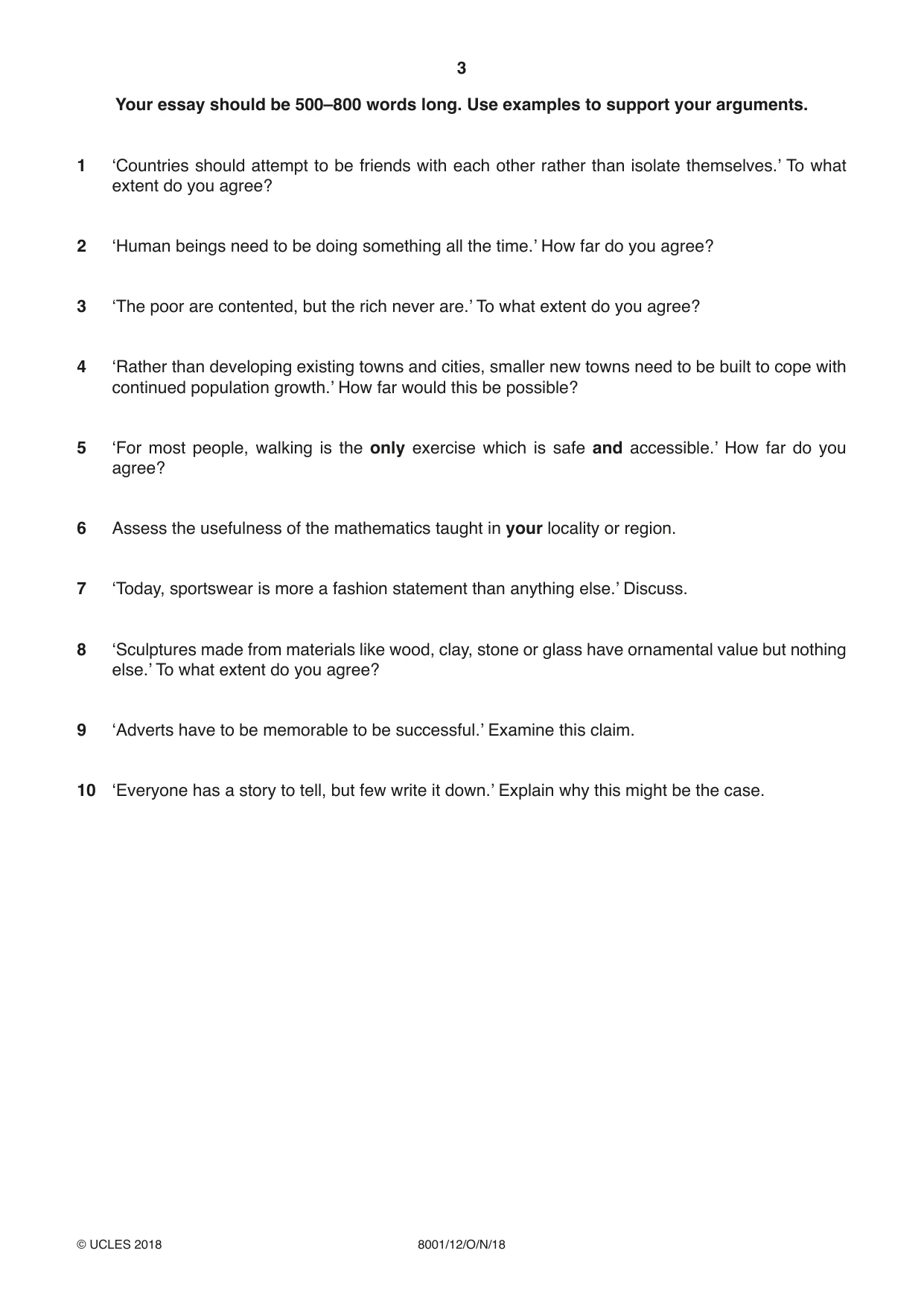
3 8001/12/O/N/18 © UCLES 2018 Your essay should be 500–800 words long. Use examples to support your arguments. 1 ‘Countries should attempt to be friends with each other rather than isolate themselves.’ To what extent do you agree? 2 ‘Human beings need to be doing something all the time.’ How far do you agree? 3 ‘The poor are contented, but the rich never are.’ To what extent do you agree? 4 ‘Rather than developing existing towns and cities, smaller new towns need to be built to cope with continued population growth.’ How far would this be possible? 5 ‘For most people, walking is the only exercise which is safe and accessible.’ How far do you agree? 6 Assess the usefulness of the mathematics taught in your locality or region. 7 ‘Today, sportswear is more a fashion statement than anything else.’ Discuss. 8 ‘Sculptures made from materials like wood, clay, stone or glass have ornamental value but nothing else.’ To what extent do you agree? 9 ‘Adverts have to be memorable to be successful.’ Examine this claim. 10 ‘Everyone has a story to tell, but few write it down.’ Explain why this might be the case.
Question paper, page 4
4 8001/12/O/N/18 © UCLES 2018 Permission to reproduce items where third-party owned material protected by copyright is included has been sought and cleared where possible. Every reasonable effort has been made by the publisher (UCLES) to trace copyright holders, but if any items requiring clearance have unwittingly been included, the publisher will be pleased to make amends at the earliest possible opportunity. To avoid the issue of disclosure of answer-related information to candidates, all copyright acknowledgements are reproduced online in the Cambridge International Examinations Copyright Acknowledgements Booklet. This is produced for each series of examinations and is freely available to download at www.cie.org.uk after the live examination series. Cambridge International Examinations is part of the Cambridge Assessment Group. Cambridge Assessment is the brand name of University of Cambridge Local Examinations Syndicate (UCLES), which is itself a department of the University of Cambridge. BLANK PAGE
Mark scheme, page 1
This document consists of 10 printed pages. © UCLES 2018 [Turn over Cambridge Assessment International Education Cambridge International Advanced Subsidiary Level GENERAL PAPER 8001/12 Paper 1 October/November 2018 MARK SCHEME Maximum Mark: 50 Published This mark scheme is published as an aid to teachers and candidates, to indicate the requirements of the examination. It shows the basis on which Examiners were instructed to award marks. It does not indicate the details of the discussions that took place at an Examiners’ meeting before marking began, which would have considered the acceptability of alternative answers. Mark schemes should be read in conjunction with the question paper and the Principal Examiner Report for Teachers. Cambridge International will not enter into discussions about these mark schemes. Cambridge International is publishing the mark schemes for the October/November 2018 series for most Cambridge IGCSE™, Cambridge International A and AS Level components and some Cambridge O Level components.
Mark scheme, page 2
8001/12 Cambridge International AS Level–Mark Scheme PUBLISHED October/November 2018 © UCLES 2018 Page 2 of 10 Generic Marking Principles These general marking principles must be applied by all examiners when marking candidate answers. They should be applied alongside the specific content of the mark scheme or generic level descriptors for a question. Each question paper and mark scheme will also comply with these marking principles. GENERIC MARKING PRINCIPLE 1: Marks must be awarded in line with: • the specific content of the mark scheme or the generic level descriptors for the question • the specific skills defined in the mark scheme or in the generic level descriptors for the question • the standard of response required by a candidate as exemplified by the standardisation scripts. GENERIC MARKING PRINCIPLE 2: Marks awarded are always whole marks (not half marks, or other fractions). GENERIC MARKING PRINCIPLE 3: Marks must be awarded positively: • marks are awarded for correct/valid answers, as defined in the mark scheme. However, credit is given for valid answers which go beyond the scope of the syllabus and mark scheme, referring to your Team Leader as appropriate • marks are awarded when candidates clearly demonstrate what they know and can do • marks are not deducted for errors • marks are not deducted for omissions • answers should only be judged on the quality of spelling, punctuation and grammar when these features are specifically assessed by the question as indicated by the mark scheme. The meaning, however, should be unambiguous. GENERIC MARKING PRINCIPLE 4: Rules must be applied consistently e.g. in situations where candidates have not followed instructions or in the application of generic level descriptors. GENERIC MARKING PRINCIPLE 5: Marks should be awarded using the full range of marks defined in the mark scheme for the question (however; the use of the full mark range may be limited according to the quality of the candidate responses seen). GENERIC MARKING PRINCIPLE 6: Marks awarded are based solely on the requirements as defined in the mark scheme. Marks should not be awarded with grade thresholds or grade descriptors in mind.
Mark scheme, page 3
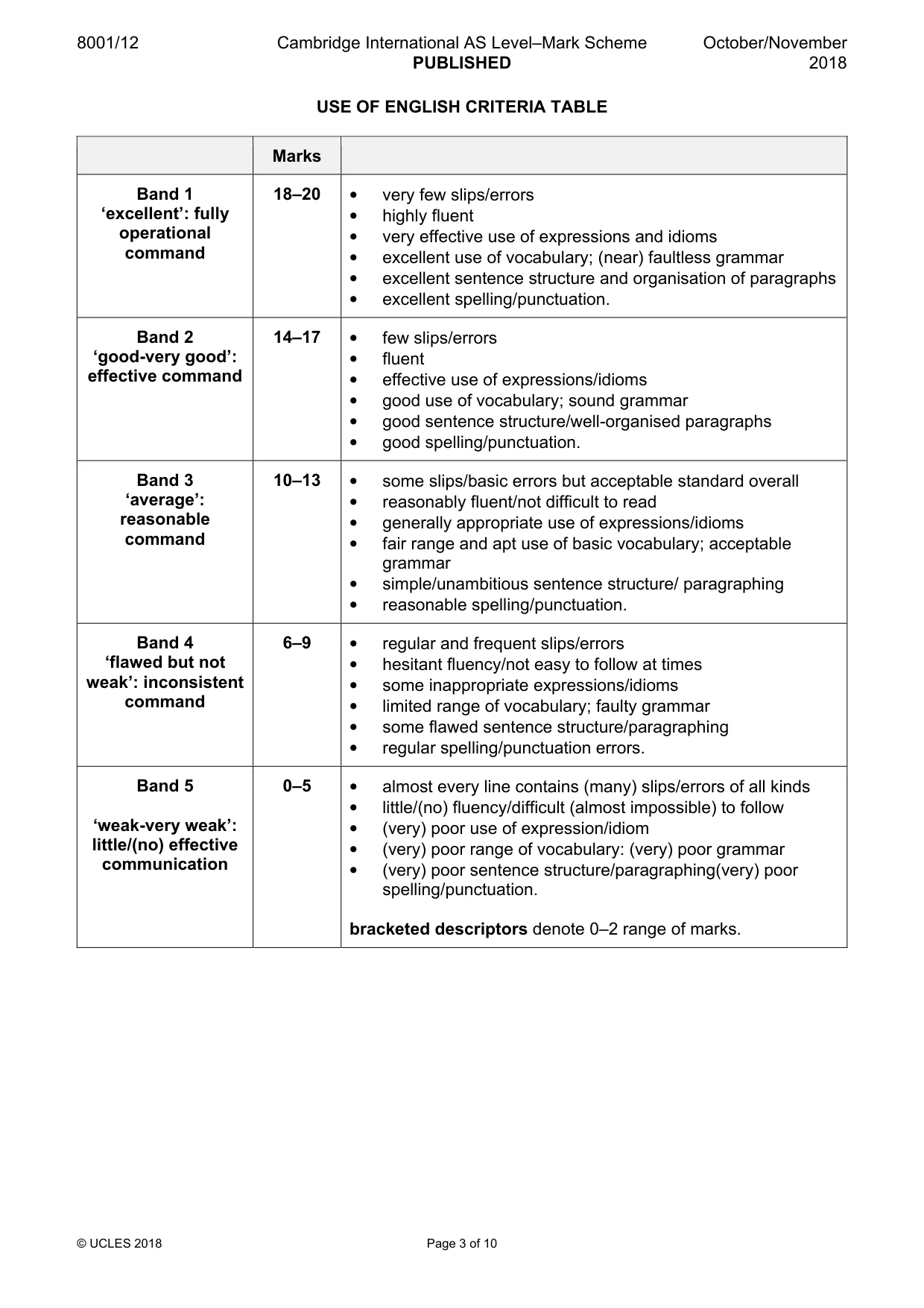
8001/12 Cambridge International AS Level–Mark Scheme PUBLISHED October/November 2018 © UCLES 2018 Page 3 of 10 USE OF ENGLISH CRITERIA TABLE Marks Band 1 ‘excellent’: fully operational command 18–20 • very few slips/errors • highly fluent • very effective use of expressions and idioms • excellent use of vocabulary; (near) faultless grammar • excellent sentence structure and organisation of paragraphs • excellent spelling/punctuation. Band 2 ‘good-very good’: effective command 14–17 • few slips/errors • fluent • effective use of expressions/idioms • good use of vocabulary; sound grammar • good sentence structure/well-organised paragraphs • good spelling/punctuation. Band 3 ‘average’: reasonable command 10–13 • some slips/basic errors but acceptable standard overall • reasonably fluent/not difficult to read • generally appropriate use of expressions/idioms • fair range and apt use of basic vocabulary; acceptable grammar • simple/unambitious sentence structure/ paragraphing • reasonable spelling/punctuation. Band 4 ‘flawed but not weak’: inconsistent command 6–9 • regular and frequent slips/errors • hesitant fluency/not easy to follow at times • some inappropriate expressions/idioms • limited range of vocabulary; faulty grammar • some flawed sentence structure/paragraphing • regular spelling/punctuation errors. Band 5 ‘weak-very weak’: little/(no) effective communication 0–5 • almost every line contains (many) slips/errors of all kinds • little/(no) fluency/difficult (almost impossible) to follow • (very) poor use of expression/idiom • (very) poor range of vocabulary: (very) poor grammar • (very) poor sentence structure/paragraphing(very) poor spelling/punctuation. bracketed descriptors denote 0–2 range of marks.
Mark scheme, page 4
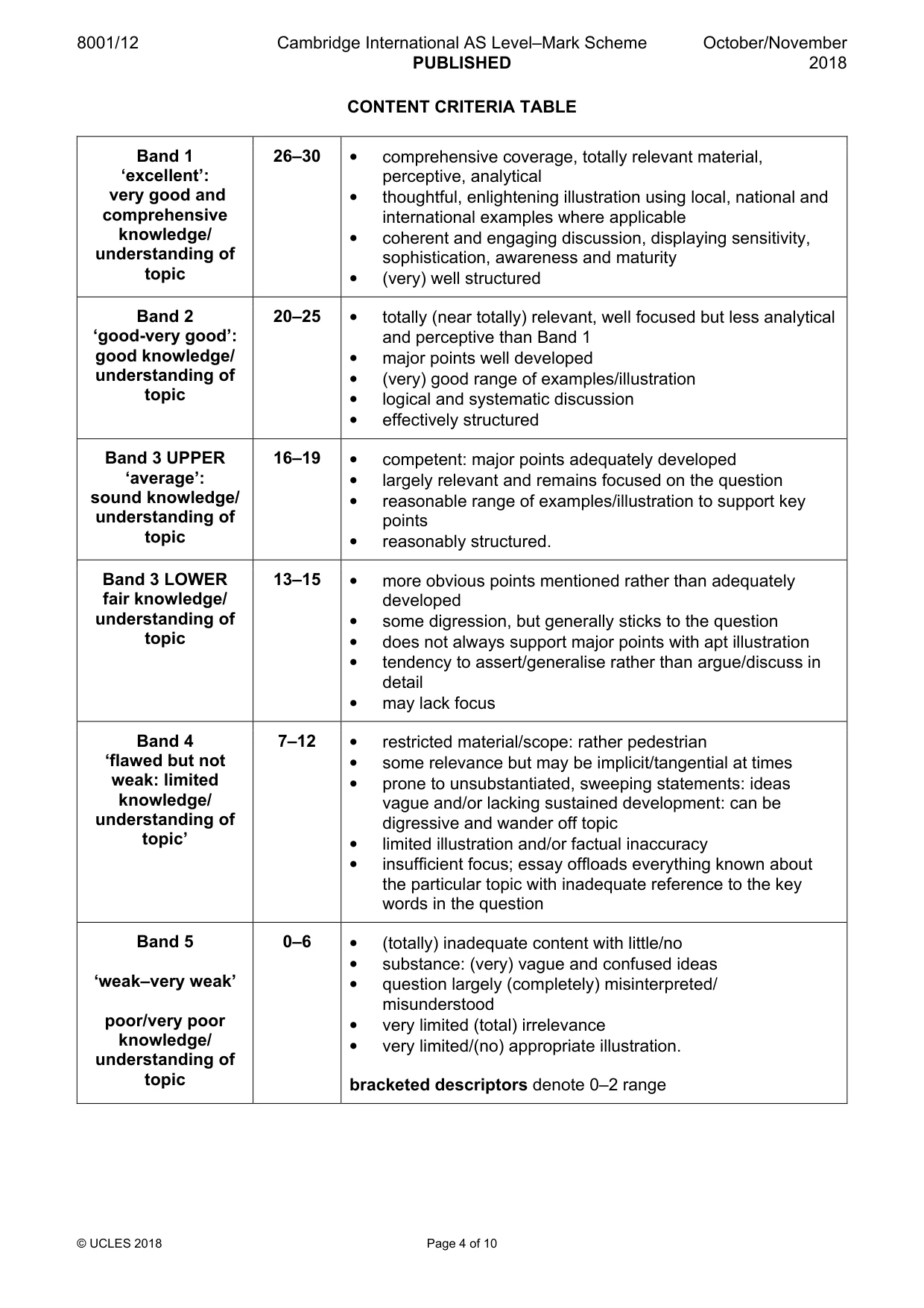
8001/12 Cambridge International AS Level–Mark Scheme PUBLISHED October/November 2018 © UCLES 2018 Page 4 of 10 CONTENT CRITERIA TABLE Band 1 ‘excellent’: very good and comprehensive knowledge/ understanding of topic 26–30 • comprehensive coverage, totally relevant material, perceptive, analytical • thoughtful, enlightening illustration using local, national and international examples where applicable • coherent and engaging discussion, displaying sensitivity, sophistication, awareness and maturity • (very) well structured Band 2 ‘good-very good’: good knowledge/ understanding of topic 20–25 • totally (near totally) relevant, well focused but less analytical and perceptive than Band 1 • major points well developed • (very) good range of examples/illustration • logical and systematic discussion • effectively structured Band 3 UPPER ‘average’: sound knowledge/ understanding of topic 16–19 • competent: major points adequately developed • largely relevant and remains focused on the question • reasonable range of examples/illustration to support key points • reasonably structured. Band 3 LOWER fair knowledge/ understanding of topic 13–15 • more obvious points mentioned rather than adequately developed • some digression, but generally sticks to the question • does not always support major points with apt illustration • tendency to assert/generalise rather than argue/discuss in detail • may lack focus Band 4 ‘flawed but not weak: limited knowledge/ understanding of topic’ 7–12 • restricted material/scope: rather pedestrian • some relevance but may be implicit/tangential at times • prone to unsubstantiated, sweeping statements: ideas vague and/or lacking sustained development: can be digressive and wander off topic • limited illustration and/or factual inaccuracy • insufficient focus; essay offloads everything known about the particular topic with inadequate reference to the key words in the question Band 5 ‘weak–very weak’ poor/very poor knowledge/ understanding of topic 0–6 • (totally) inadequate content with little/no • substance: (very) vague and confused ideas • question largely (completely) misinterpreted/ misunderstood • very limited (total) irrelevance • very limited/(no) appropriate illustration. bracketed descriptors denote 0–2 range
Mark scheme, page 5
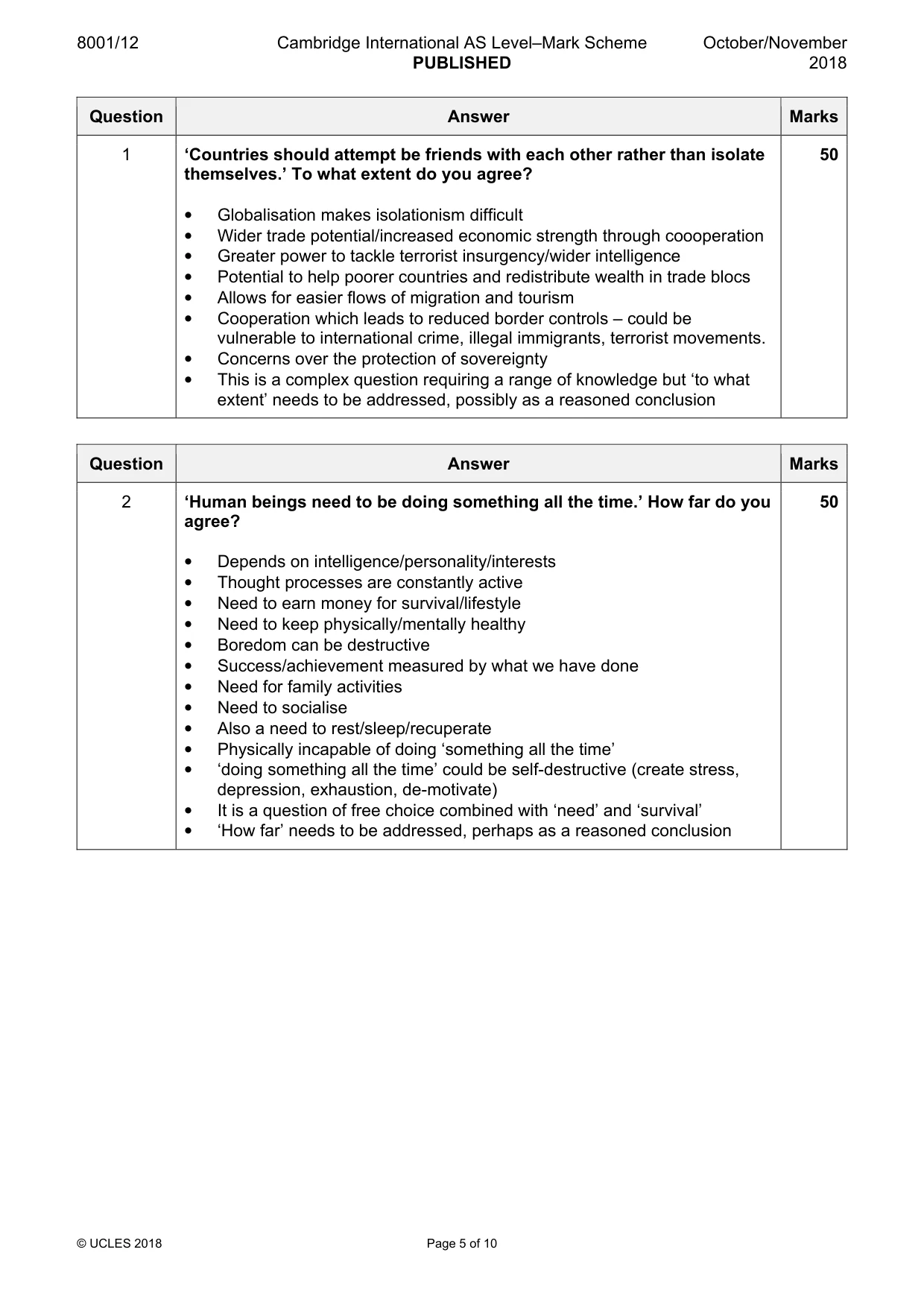
8001/12 Cambridge International AS Level–Mark Scheme PUBLISHED October/November 2018 © UCLES 2018 Page 5 of 10 Question Answer Marks 1 ‘Countries should attempt be friends with each other rather than isolate themselves.’ To what extent do you agree? • Globalisation makes isolationism difficult • Wider trade potential/increased economic strength through coooperation • Greater power to tackle terrorist insurgency/wider intelligence • Potential to help poorer countries and redistribute wealth in trade blocs • Allows for easier flows of migration and tourism • Cooperation which leads to reduced border controls – could be vulnerable to international crime, illegal immigrants, terrorist movements. • Concerns over the protection of sovereignty • This is a complex question requiring a range of knowledge but ‘to what extent’ needs to be addressed, possibly as a reasoned conclusion 50 Question Answer Marks 2 ‘Human beings need to be doing something all the time.’ How far do you agree? • Depends on intelligence/personality/interests • Thought processes are constantly active • Need to earn money for survival/lifestyle • Need to keep physically/mentally healthy • Boredom can be destructive • Success/achievement measured by what we have done • Need for family activities • Need to socialise • Also a need to rest/sleep/recuperate • Physically incapable of doing ‘something all the time’ • ‘doing something all the time’ could be self-destructive (create stress, depression, exhaustion, de-motivate) • It is a question of free choice combined with ‘need’ and ‘survival’ • ‘How far’ needs to be addressed, perhaps as a reasoned conclusion 50
Mark scheme, page 6
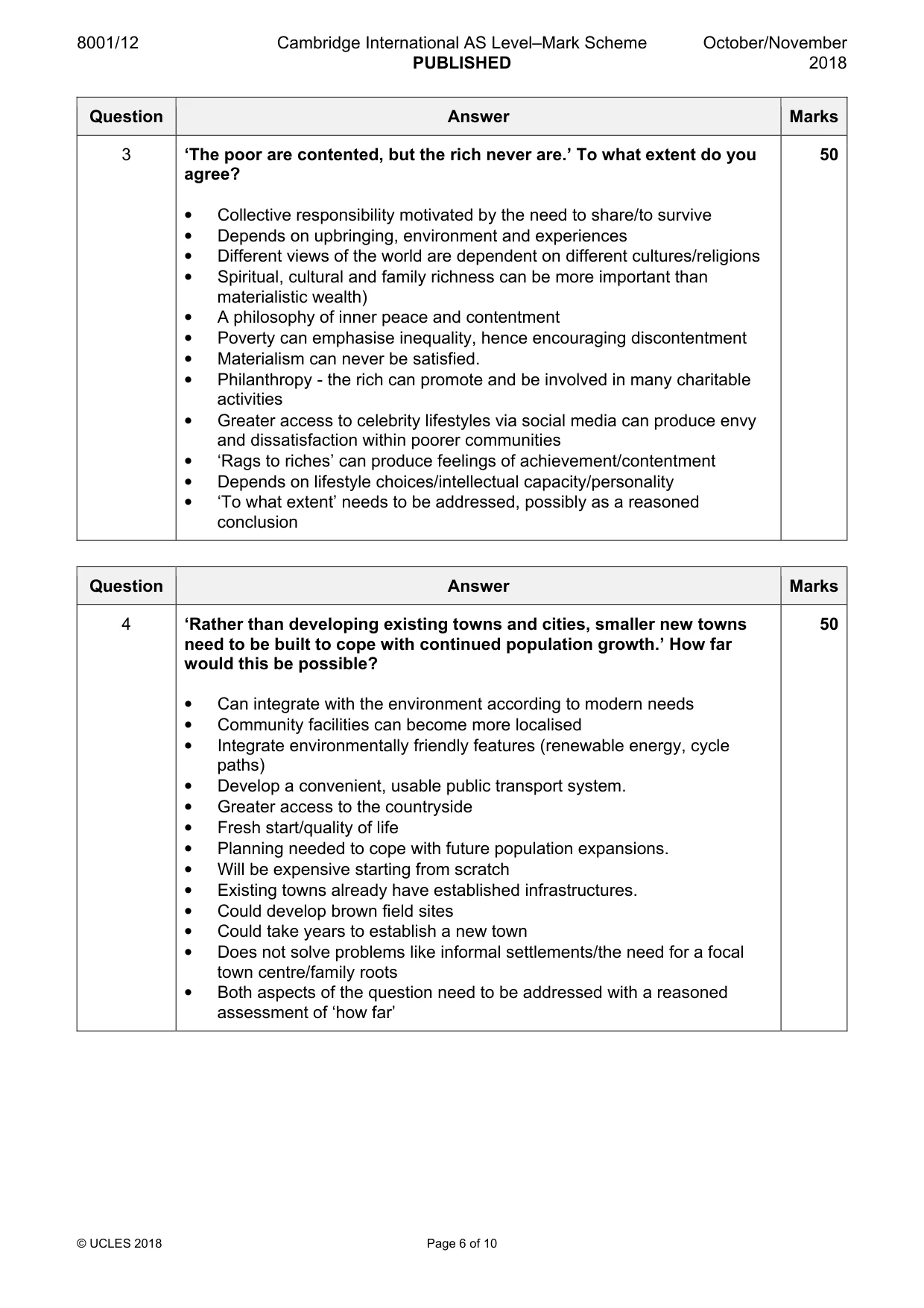
8001/12 Cambridge International AS Level–Mark Scheme PUBLISHED October/November 2018 © UCLES 2018 Page 6 of 10 Question Answer Marks 3 ‘The poor are contented, but the rich never are.’ To what extent do you agree? • Collective responsibility motivated by the need to share/to survive • Depends on upbringing, environment and experiences • Different views of the world are dependent on different cultures/religions • Spiritual, cultural and family richness can be more important than materialistic wealth) • A philosophy of inner peace and contentment • Poverty can emphasise inequality, hence encouraging discontentment • Materialism can never be satisfied. • Philanthropy - the rich can promote and be involved in many charitable activities • Greater access to celebrity lifestyles via social media can produce envy and dissatisfaction within poorer communities • ‘Rags to riches’ can produce feelings of achievement/contentment • Depends on lifestyle choices/intellectual capacity/personality • ‘To what extent’ needs to be addressed, possibly as a reasoned conclusion 50 Question Answer Marks 4 ‘Rather than developing existing towns and cities, smaller new towns need to be built to cope with continued population growth.’ How far would this be possible? • Can integrate with the environment according to modern needs • Community facilities can become more localised • Integrate environmentally friendly features (renewable energy, cycle paths) • Develop a convenient, usable public transport system. • Greater access to the countryside • Fresh start/quality of life • Planning needed to cope with future population expansions. • Will be expensive starting from scratch • Existing towns already have established infrastructures. • Could develop brown field sites • Could take years to establish a new town • Does not solve problems like informal settlements/the need for a focal town centre/family roots • Both aspects of the question need to be addressed with a reasoned assessment of ‘how far’ 50
Mark scheme, page 7
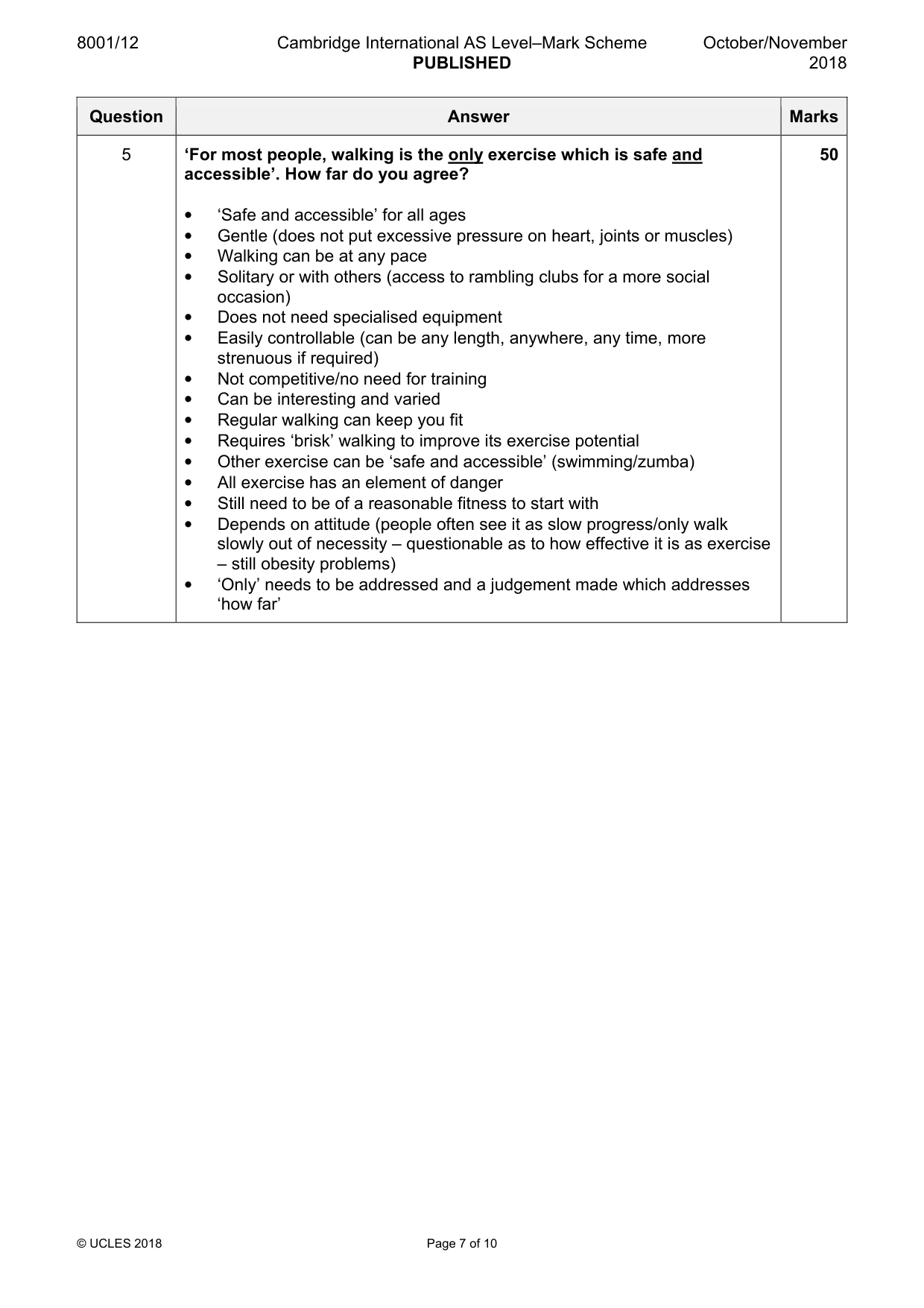
8001/12 Cambridge International AS Level–Mark Scheme PUBLISHED October/November 2018 © UCLES 2018 Page 7 of 10 Question Answer Marks 5 ‘For most people, walking is the only exercise which is safe and accessible’. How far do you agree? • ‘Safe and accessible’ for all ages • Gentle (does not put excessive pressure on heart, joints or muscles) • Walking can be at any pace • Solitary or with others (access to rambling clubs for a more social occasion) • Does not need specialised equipment • Easily controllable (can be any length, anywhere, any time, more strenuous if required) • Not competitive/no need for training • Can be interesting and varied • Regular walking can keep you fit • Requires ‘brisk’ walking to improve its exercise potential • Other exercise can be ‘safe and accessible’ (swimming/zumba) • All exercise has an element of danger • Still need to be of a reasonable fitness to start with • Depends on attitude (people often see it as slow progress/only walk slowly out of necessity – questionable as to how effective it is as exercise – still obesity problems) • ‘Only’ needs to be addressed and a judgement made which addresses ‘how far’ 50
Mark scheme, page 8
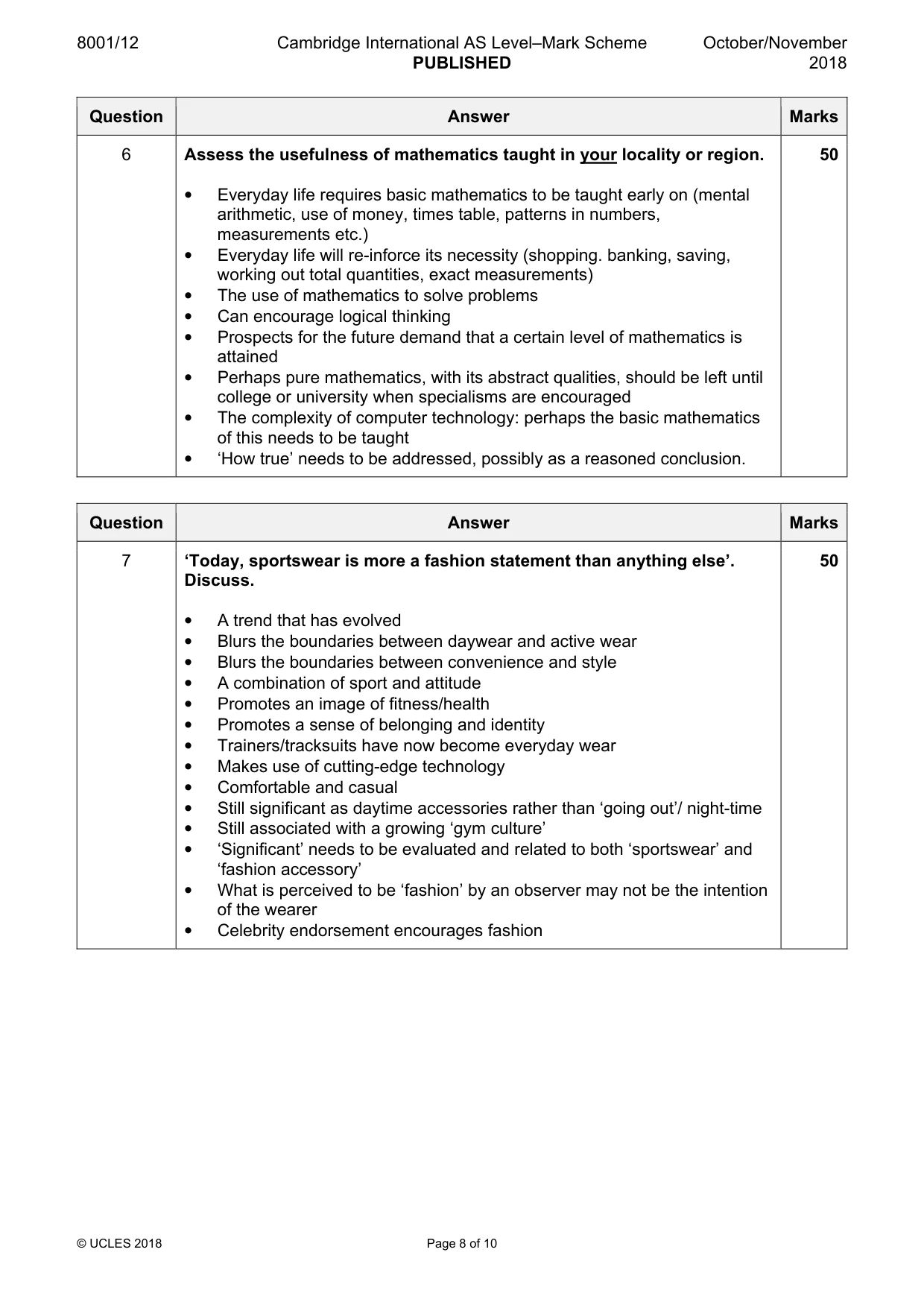
8001/12 Cambridge International AS Level–Mark Scheme PUBLISHED October/November 2018 © UCLES 2018 Page 8 of 10 Question Answer Marks 6 Assess the usefulness of mathematics taught in your locality or region. • Everyday life requires basic mathematics to be taught early on (mental arithmetic, use of money, times table, patterns in numbers, measurements etc.) • Everyday life will re-inforce its necessity (shopping. banking, saving, working out total quantities, exact measurements) • The use of mathematics to solve problems • Can encourage logical thinking • Prospects for the future demand that a certain level of mathematics is attained • Perhaps pure mathematics, with its abstract qualities, should be left until college or university when specialisms are encouraged • The complexity of computer technology: perhaps the basic mathematics of this needs to be taught • ‘How true’ needs to be addressed, possibly as a reasoned conclusion. 50 Question Answer Marks 7 ‘Today, sportswear is more a fashion statement than anything else’. Discuss. • A trend that has evolved • Blurs the boundaries between daywear and active wear • Blurs the boundaries between convenience and style • A combination of sport and attitude • Promotes an image of fitness/health • Promotes a sense of belonging and identity • Trainers/tracksuits have now become everyday wear • Makes use of cutting-edge technology • Comfortable and casual • Still significant as daytime accessories rather than ‘going out’/ night-time • Still associated with a growing ‘gym culture’ • ‘Significant’ needs to be evaluated and related to both ‘sportswear’ and ‘fashion accessory’ • What is perceived to be ‘fashion’ by an observer may not be the intention of the wearer • Celebrity endorsement encourages fashion 50
Mark scheme, page 9
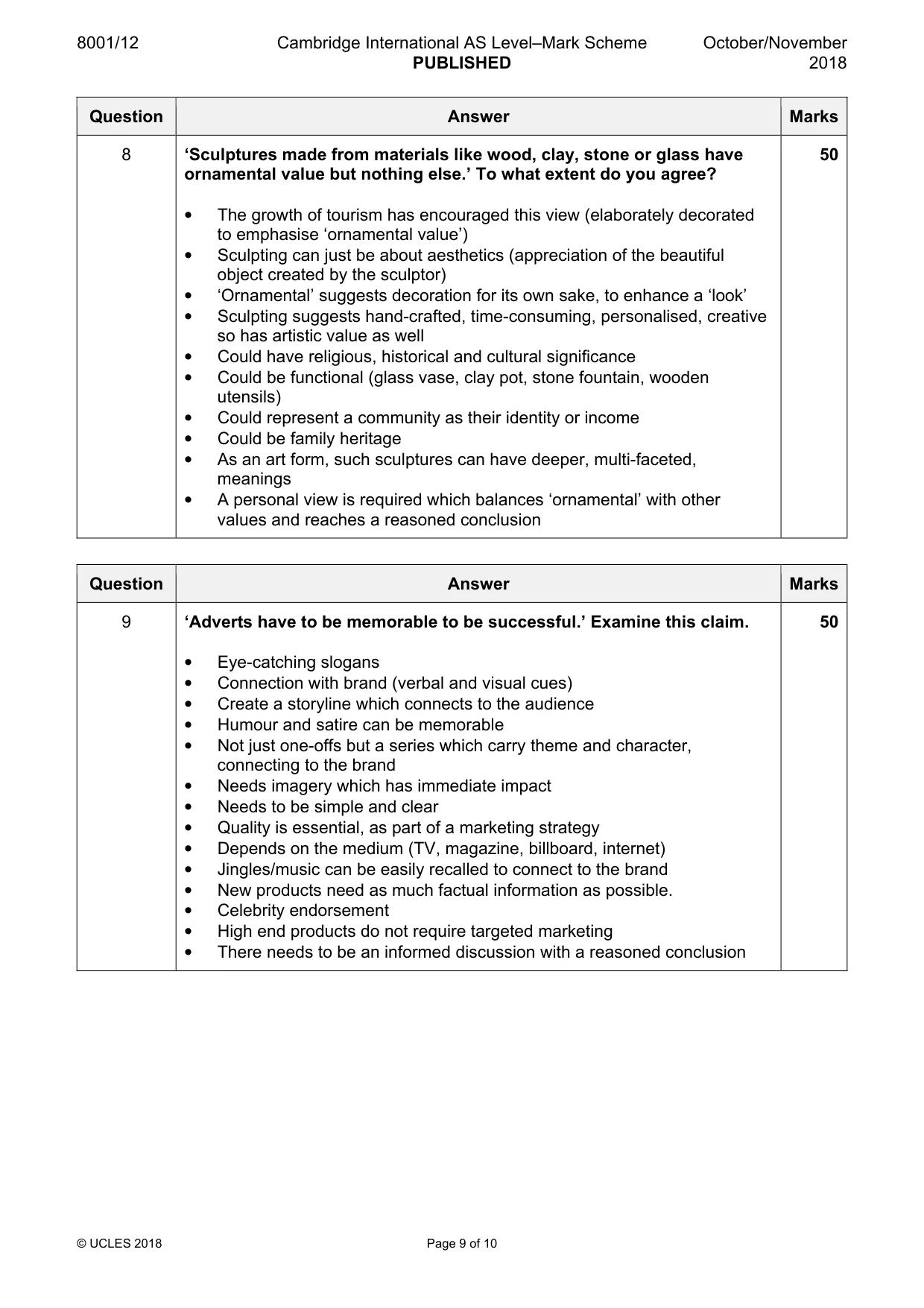
8001/12 Cambridge International AS Level–Mark Scheme PUBLISHED October/November 2018 © UCLES 2018 Page 9 of 10 Question Answer Marks 8 ‘Sculptures made from materials like wood, clay, stone or glass have ornamental value but nothing else.’ To what extent do you agree? • The growth of tourism has encouraged this view (elaborately decorated to emphasise ‘ornamental value’) • Sculpting can just be about aesthetics (appreciation of the beautiful object created by the sculptor) • ‘Ornamental’ suggests decoration for its own sake, to enhance a ‘look’ • Sculpting suggests hand-crafted, time-consuming, personalised, creative so has artistic value as well • Could have religious, historical and cultural significance • Could be functional (glass vase, clay pot, stone fountain, wooden utensils) • Could represent a community as their identity or income • Could be family heritage • As an art form, such sculptures can have deeper, multi-faceted, meanings • A personal view is required which balances ‘ornamental’ with other values and reaches a reasoned conclusion 50 Question Answer Marks 9 ‘Adverts have to be memorable to be successful.’ Examine this claim. • Eye-catching slogans • Connection with brand (verbal and visual cues) • Create a storyline which connects to the audience • Humour and satire can be memorable • Not just one-offs but a series which carry theme and character, connecting to the brand • Needs imagery which has immediate impact • Needs to be simple and clear • Quality is essential, as part of a marketing strategy • Depends on the medium (TV, magazine, billboard, internet) • Jingles/music can be easily recalled to connect to the brand • New products need as much factual information as possible. • Celebrity endorsement • High end products do not require targeted marketing • There needs to be an informed discussion with a reasoned conclusion 50
Mark scheme, page 10
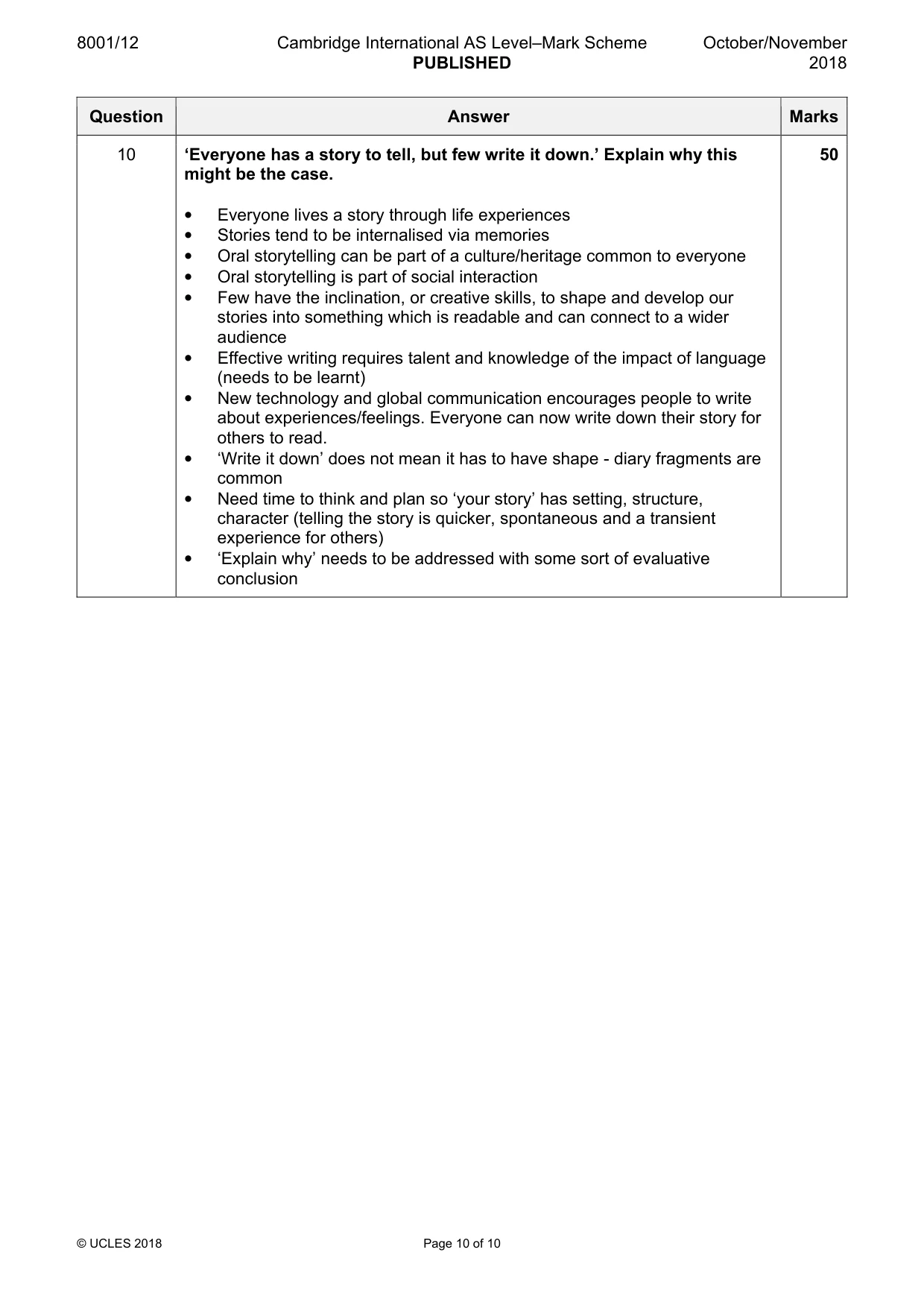
8001/12 Cambridge International AS Level–Mark Scheme PUBLISHED October/November 2018 © UCLES 2018 Page 10 of 10 Question Answer Marks 10 ‘Everyone has a story to tell, but few write it down.’ Explain why this might be the case. • Everyone lives a story through life experiences • Stories tend to be internalised via memories • Oral storytelling can be part of a culture/heritage common to everyone • Oral storytelling is part of social interaction • Few have the inclination, or creative skills, to shape and develop our stories into something which is readable and can connect to a wider audience • Effective writing requires talent and knowledge of the impact of language (needs to be learnt) • New technology and global communication encourages people to write about experiences/feelings. Everyone can now write down their story for others to read. • ‘Write it down’ does not mean it has to have shape - diary fragments are common • Need time to think and plan so ‘your story’ has setting, structure, character (telling the story is quicker, spontaneous and a transient experience for others) • ‘Explain why’ needs to be addressed with some sort of evaluative conclusion 50