Cambridge A Level General Paper (AS Level only) 8001 — 2017 Oct/Nov Paper 1 · Variant 2
8001/12/O/N/17 · 50 marks · ≈56 min
The question paper and its mark scheme, free to read here and free to download. This is Cambridge’s own paper, exactly as it was sat.
Question paper4 pages

Mark scheme8 pages
Answers below. Sit the paper first if you are practising.
Paper as text
Question paper, page 1
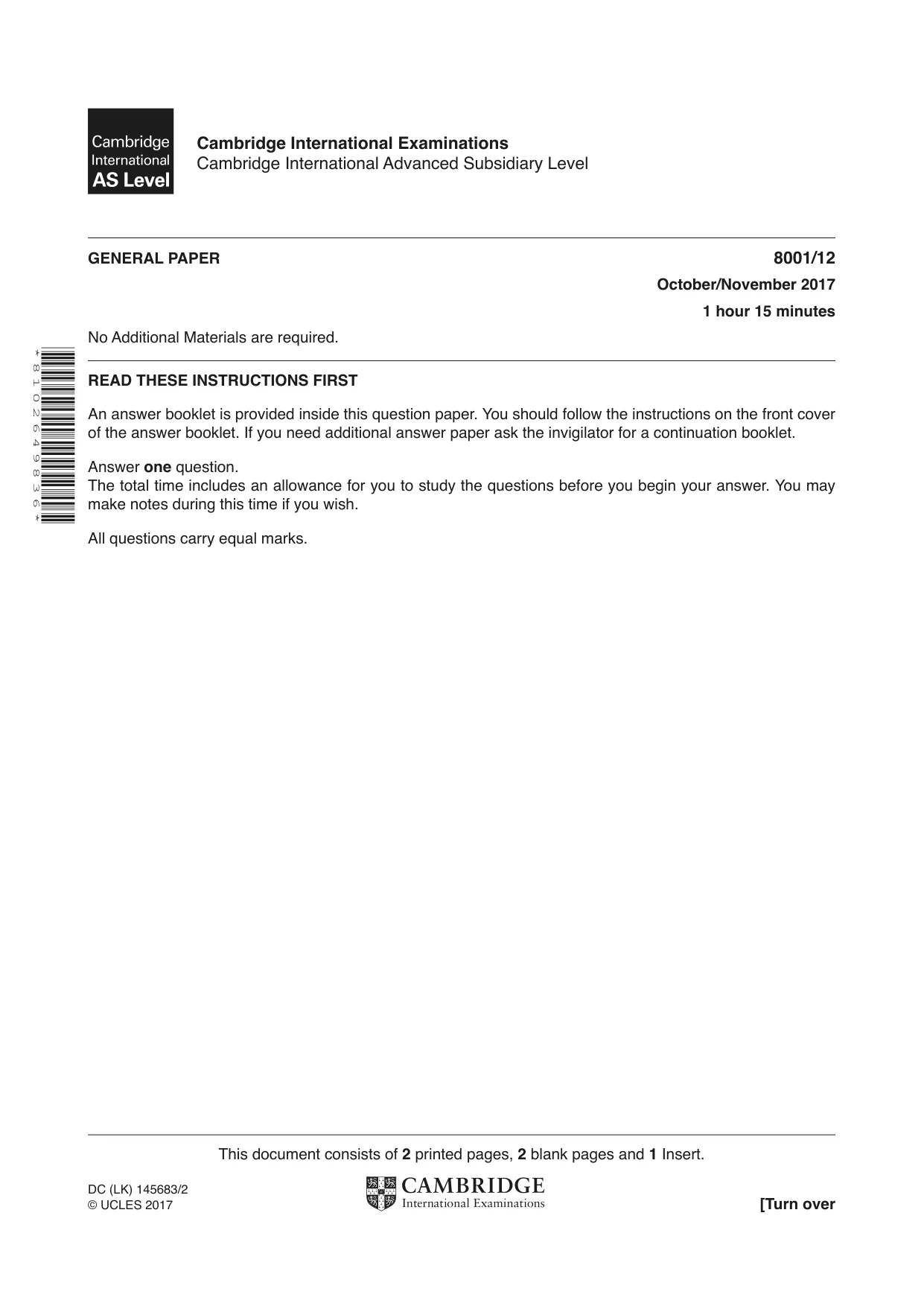
This document consists of 2 printed pages, 2 blank pages and 1 Insert. DC (LK) 145683/2 © UCLES 2017 [Turn over Cambridge International Examinations Cambridge International Advanced Subsidiary Level * 8 1 0 2 6 4 9 8 3 6 * GENERAL PAPER 8001/12 October/November 2017 1 hour 15 minutes No Additional Materials are required. READ THESE INSTRUCTIONS FIRST An answer booklet is provided inside this question paper. You should follow the instructions on the front cover of the answer booklet. If you need additional answer paper ask the invigilator for a continuation booklet. Answer one question. The total time includes an allowance for you to study the questions before you begin your answer. You may make notes during this time if you wish. All questions carry equal marks.
Question paper, page 2
2 8001/12/O/N/17 © UCLES 2017 BLANK PAGE
Question paper, page 3
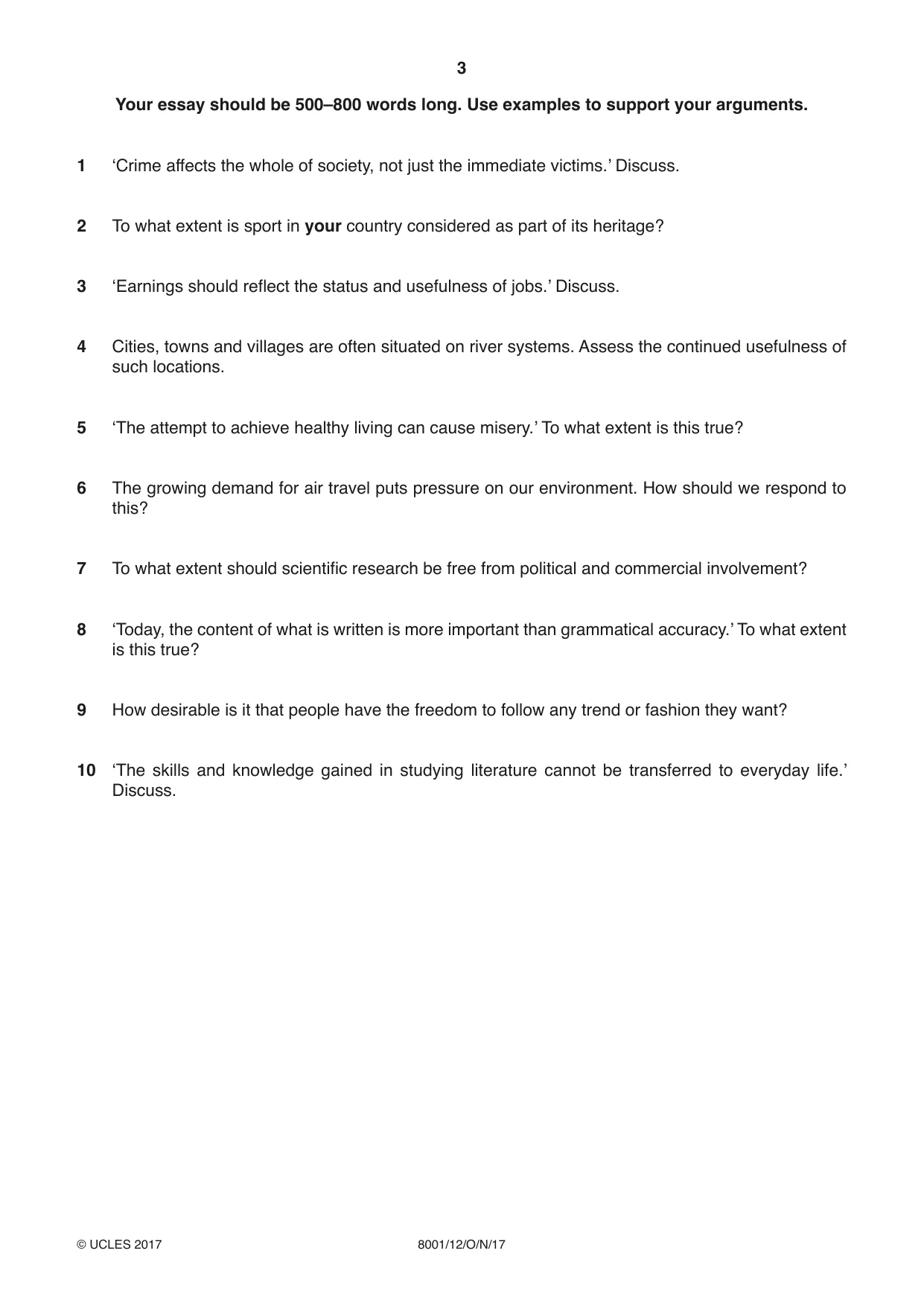
3 8001/12/O/N/17 © UCLES 2017 Your essay should be 500–800 words long. Use examples to support your arguments. 1 ‘Crime affects the whole of society, not just the immediate victims.’ Discuss. 2 To what extent is sport in your country considered as part of its heritage? 3 ‘Earnings should reflect the status and usefulness of jobs.’ Discuss. 4 Cities, towns and villages are often situated on river systems. Assess the continued usefulness of such locations. 5 ‘The attempt to achieve healthy living can cause misery.’ To what extent is this true? 6 The growing demand for air travel puts pressure on our environment. How should we respond to this? 7 To what extent should scientific research be free from political and commercial involvement? 8 ‘Today, the content of what is written is more important than grammatical accuracy.’ To what extent is this true? 9 How desirable is it that people have the freedom to follow any trend or fashion they want? 10 ‘The skills and knowledge gained in studying literature cannot be transferred to everyday life.’ Discuss.
Question paper, page 4
4 8001/12/O/N/17 © UCLES 2017 Permission to reproduce items where third-party owned material protected by copyright is included has been sought and cleared where possible. Every reasonable effort has been made by the publisher (UCLES) to trace copyright holders, but if any items requiring clearance have unwittingly been included, the publisher will be pleased to make amends at the earliest possible opportunity. To avoid the issue of disclosure of answer-related information to candidates, all copyright acknowledgements are reproduced online in the Cambridge International Examinations Copyright Acknowledgements Booklet. This is produced for each series of examinations and is freely available to download at www.cie.org.uk after the live examination series. Cambridge International Examinations is part of the Cambridge Assessment Group. Cambridge Assessment is the brand name of University of Cambridge Local Examinations Syndicate (UCLES), which is itself a department of the University of Cambridge. BLANK PAGE
Mark scheme, page 1
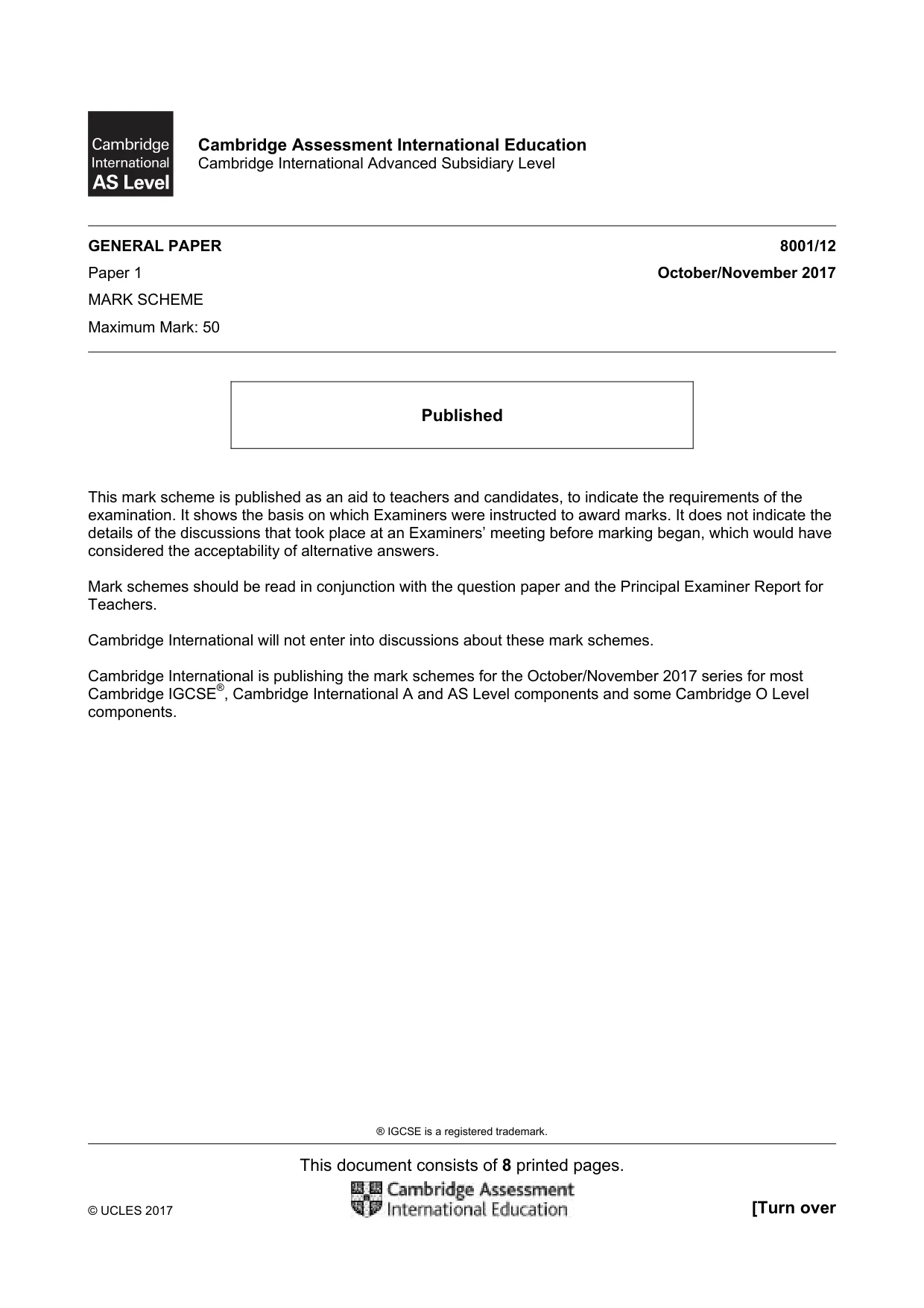
® IGCSE is a registered trademark. This document consists of 8 printed pages. © UCLES 2017 [Turn over Cambridge Assessment International Education Cambridge International Advanced Subsidiary Level GENERAL PAPER 8001/12 Paper 1 October/November 2017 MARK SCHEME Maximum Mark: 50 This mark scheme is published as an aid to teachers and candidates, to indicate the requirements of the examination. It shows the basis on which Examiners were instructed to award marks. It does not indicate the details of the discussions that took place at an Examiners’ meeting before marking began, which would have considered the acceptability of alternative answers. Mark schemes should be read in conjunction with the question paper and the Principal Examiner Report for Teachers. Cambridge International will not enter into discussions about these mark schemes. Cambridge International is publishing the mark schemes for the October/November 2017 series for most Cambridge IGCSE®, Cambridge International A and AS Level components and some Cambridge O Level components. Published
Mark scheme, page 2
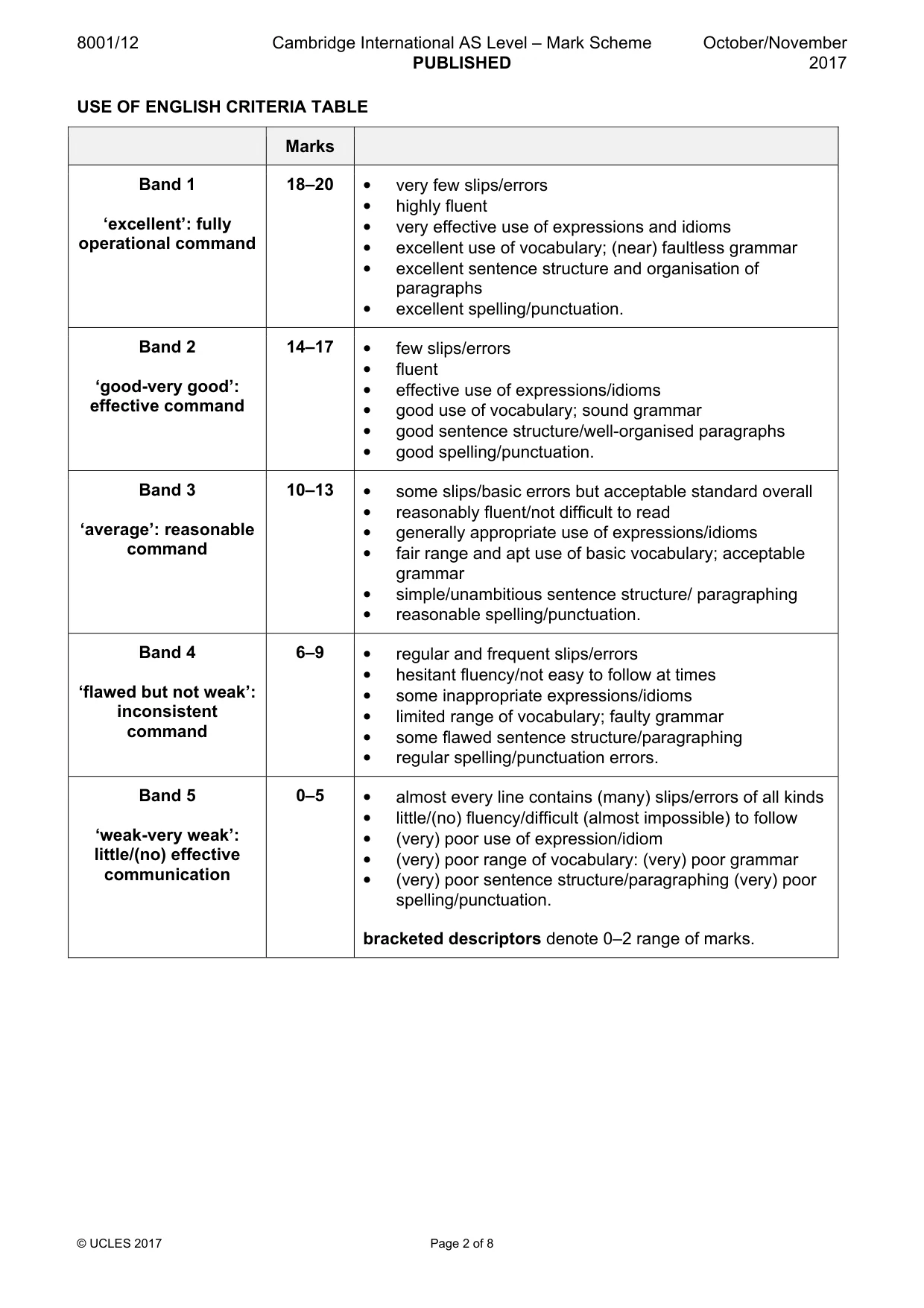
8001/12 Cambridge International AS Level – Mark Scheme PUBLISHED October/November 2017 © UCLES 2017 Page 2 of 8 USE OF ENGLISH CRITERIA TABLE Marks Band 1 ‘excellent’: fully operational command 18–20 • very few slips/errors • highly fluent • very effective use of expressions and idioms • excellent use of vocabulary; (near) faultless grammar • excellent sentence structure and organisation of paragraphs • excellent spelling/punctuation. Band 2 ‘good-very good’: effective command 14–17 • few slips/errors • fluent • effective use of expressions/idioms • good use of vocabulary; sound grammar • good sentence structure/well-organised paragraphs • good spelling/punctuation. Band 3 ‘average’: reasonable command 10–13 • some slips/basic errors but acceptable standard overall • reasonably fluent/not difficult to read • generally appropriate use of expressions/idioms • fair range and apt use of basic vocabulary; acceptable grammar • simple/unambitious sentence structure/ paragraphing • reasonable spelling/punctuation. Band 4 ‘flawed but not weak’: inconsistent command 6–9 • regular and frequent slips/errors • hesitant fluency/not easy to follow at times • some inappropriate expressions/idioms • limited range of vocabulary; faulty grammar • some flawed sentence structure/paragraphing • regular spelling/punctuation errors. Band 5 ‘weak-very weak’: little/(no) effective communication 0–5 • almost every line contains (many) slips/errors of all kinds • little/(no) fluency/difficult (almost impossible) to follow • (very) poor use of expression/idiom • (very) poor range of vocabulary: (very) poor grammar • (very) poor sentence structure/paragraphing (very) poor spelling/punctuation. bracketed descriptors denote 0–2 range of marks.
Mark scheme, page 3
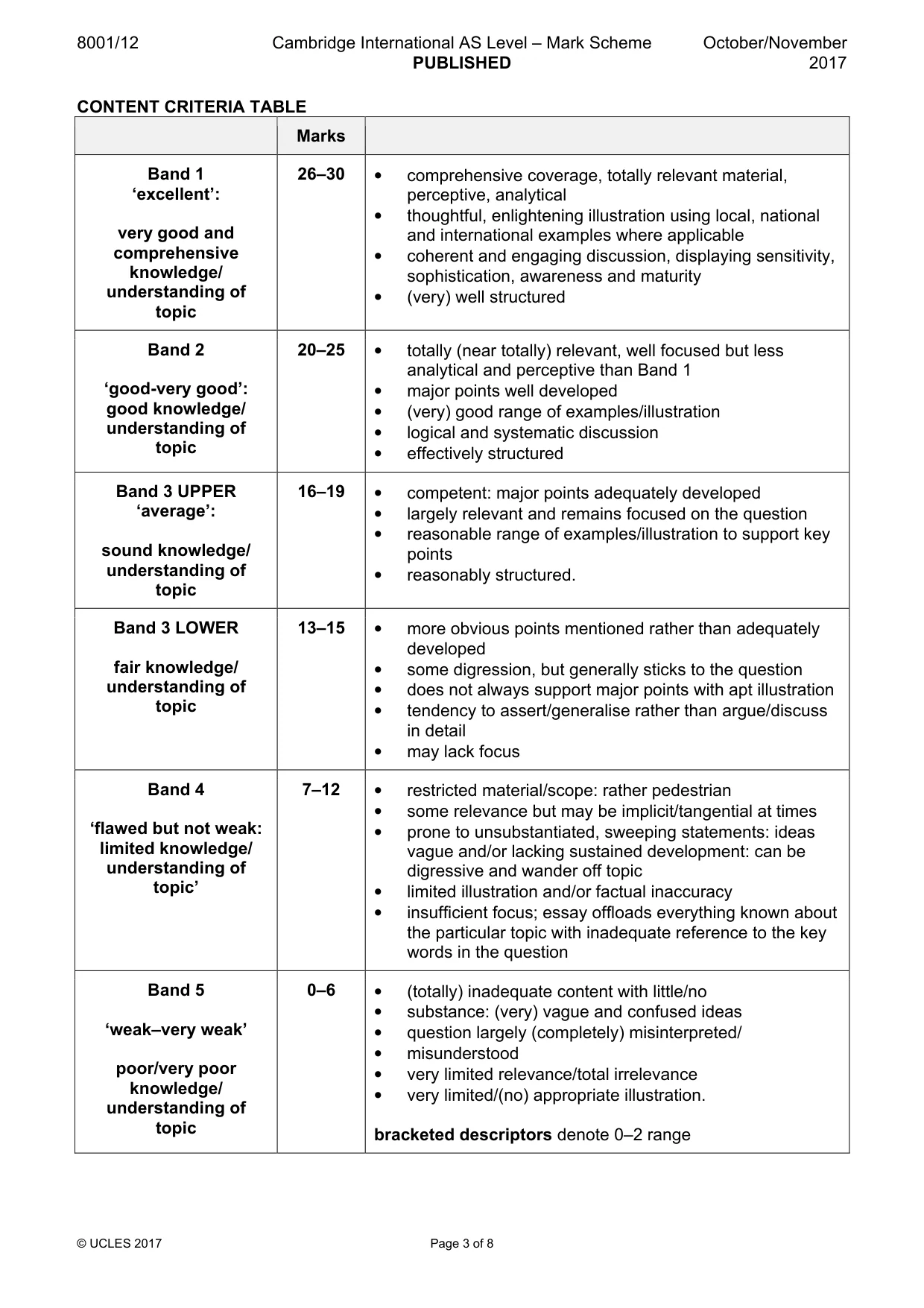
8001/12 Cambridge International AS Level – Mark Scheme PUBLISHED October/November 2017 © UCLES 2017 Page 3 of 8 CONTENT CRITERIA TABLE Marks Band 1 ‘excellent’: very good and comprehensive knowledge/ understanding of topic 26–30 • comprehensive coverage, totally relevant material, perceptive, analytical • thoughtful, enlightening illustration using local, national and international examples where applicable • coherent and engaging discussion, displaying sensitivity, sophistication, awareness and maturity • (very) well structured Band 2 ‘good-very good’: good knowledge/ understanding of topic 20–25 • totally (near totally) relevant, well focused but less analytical and perceptive than Band 1 • major points well developed • (very) good range of examples/illustration • logical and systematic discussion • effectively structured Band 3 UPPER ‘average’: sound knowledge/ understanding of topic 16–19 • competent: major points adequately developed • largely relevant and remains focused on the question • reasonable range of examples/illustration to support key points • reasonably structured. Band 3 LOWER fair knowledge/ understanding of topic 13–15 • more obvious points mentioned rather than adequately developed • some digression, but generally sticks to the question • does not always support major points with apt illustration • tendency to assert/generalise rather than argue/discuss in detail • may lack focus Band 4 ‘flawed but not weak: limited knowledge/ understanding of topic’ 7–12 • restricted material/scope: rather pedestrian • some relevance but may be implicit/tangential at times • prone to unsubstantiated, sweeping statements: ideas vague and/or lacking sustained development: can be digressive and wander off topic • limited illustration and/or factual inaccuracy • insufficient focus; essay offloads everything known about the particular topic with inadequate reference to the key words in the question Band 5 ‘weak–very weak’ poor/very poor knowledge/ understanding of topic 0–6 • (totally) inadequate content with little/no • substance: (very) vague and confused ideas • question largely (completely) misinterpreted/ • misunderstood • very limited relevance/total irrelevance • very limited/(no) appropriate illustration. bracketed descriptors denote 0–2 range
Mark scheme, page 4
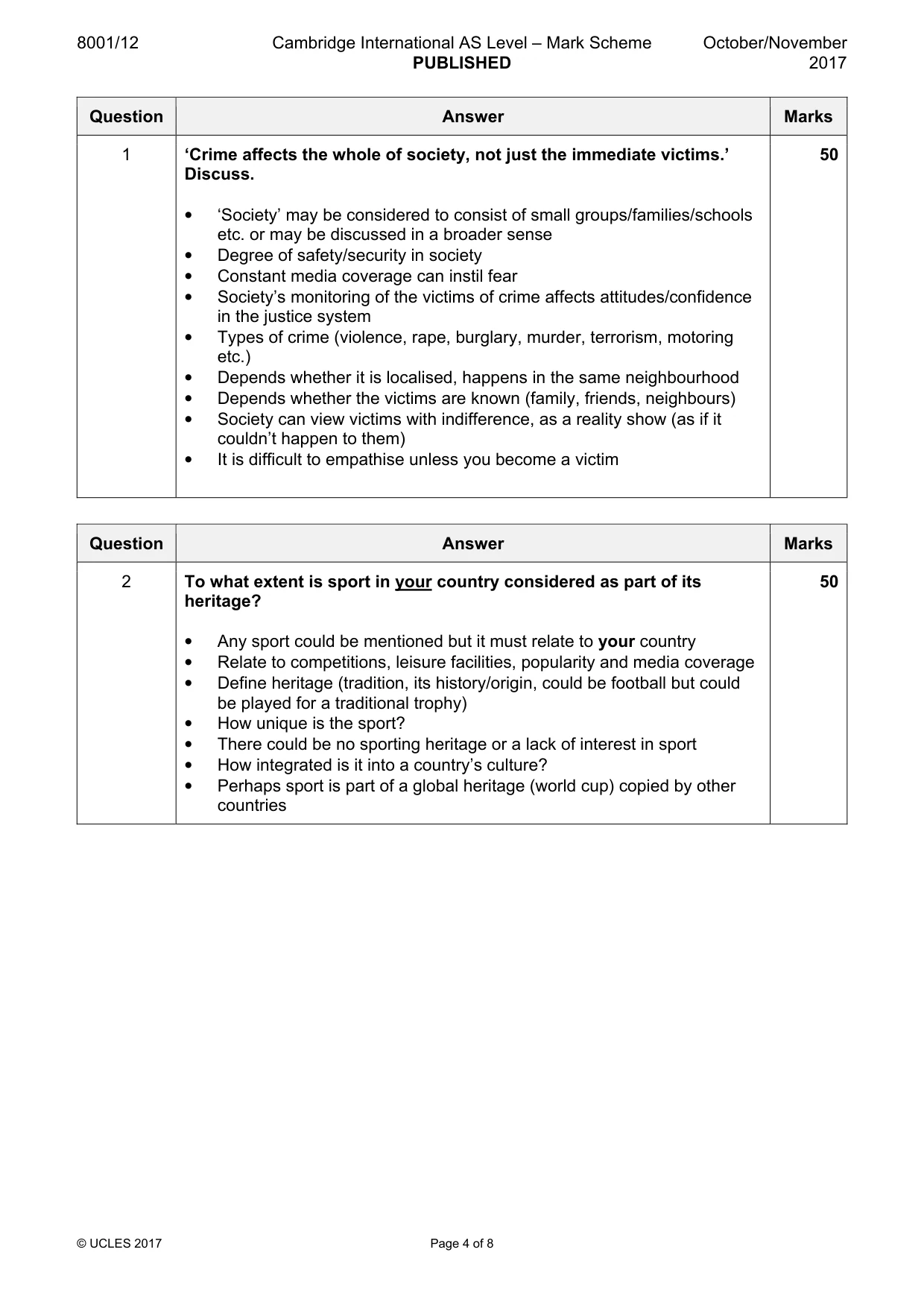
8001/12 Cambridge International AS Level – Mark Scheme PUBLISHED October/November 2017 © UCLES 2017 Page 4 of 8 Question Answer Marks 1 ‘Crime affects the whole of society, not just the immediate victims.’ Discuss. • ‘Society’ may be considered to consist of small groups/families/schools etc. or may be discussed in a broader sense • Degree of safety/security in society • Constant media coverage can instil fear • Society’s monitoring of the victims of crime affects attitudes/confidence in the justice system • Types of crime (violence, rape, burglary, murder, terrorism, motoring etc.) • Depends whether it is localised, happens in the same neighbourhood • Depends whether the victims are known (family, friends, neighbours) • Society can view victims with indifference, as a reality show (as if it couldn’t happen to them) • It is difficult to empathise unless you become a victim 50 Question Answer Marks 2 To what extent is sport in your country considered as part of its heritage? • Any sport could be mentioned but it must relate to your country • Relate to competitions, leisure facilities, popularity and media coverage • Define heritage (tradition, its history/origin, could be football but could be played for a traditional trophy) • How unique is the sport? • There could be no sporting heritage or a lack of interest in sport • How integrated is it into a country’s culture? • Perhaps sport is part of a global heritage (world cup) copied by other countries 50
Mark scheme, page 5
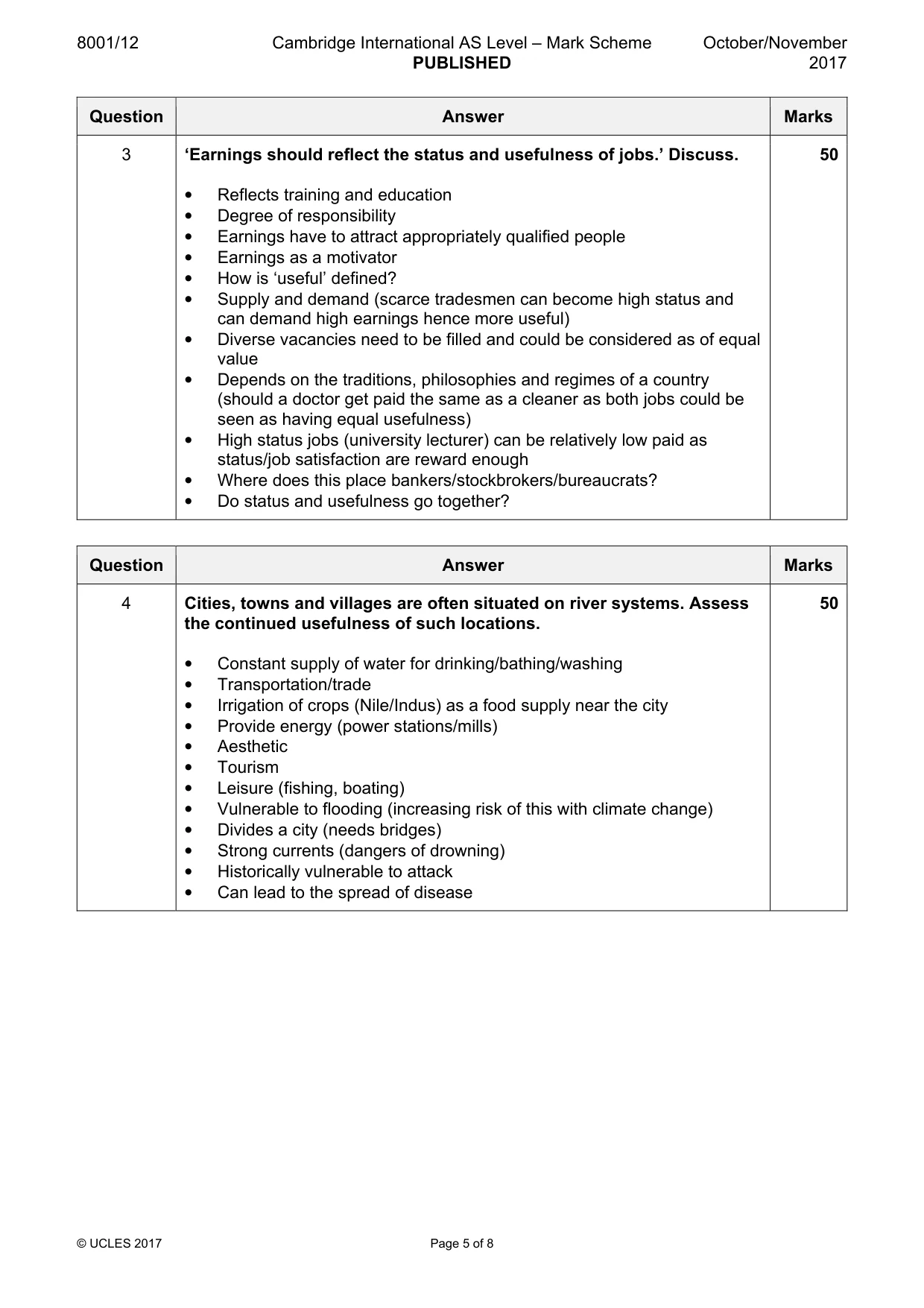
8001/12 Cambridge International AS Level – Mark Scheme PUBLISHED October/November 2017 © UCLES 2017 Page 5 of 8 Question Answer Marks 3 ‘Earnings should reflect the status and usefulness of jobs.’ Discuss. • Reflects training and education • Degree of responsibility • Earnings have to attract appropriately qualified people • Earnings as a motivator • How is ‘useful’ defined? • Supply and demand (scarce tradesmen can become high status and can demand high earnings hence more useful) • Diverse vacancies need to be filled and could be considered as of equal value • Depends on the traditions, philosophies and regimes of a country (should a doctor get paid the same as a cleaner as both jobs could be seen as having equal usefulness) • High status jobs (university lecturer) can be relatively low paid as status/job satisfaction are reward enough • Where does this place bankers/stockbrokers/bureaucrats? • Do status and usefulness go together? 50 Question Answer Marks 4 Cities, towns and villages are often situated on river systems. Assess the continued usefulness of such locations. • Constant supply of water for drinking/bathing/washing • Transportation/trade • Irrigation of crops (Nile/Indus) as a food supply near the city • Provide energy (power stations/mills) • Aesthetic • Tourism • Leisure (fishing, boating) • Vulnerable to flooding (increasing risk of this with climate change) • Divides a city (needs bridges) • Strong currents (dangers of drowning) • Historically vulnerable to attack • Can lead to the spread of disease 50
Mark scheme, page 6
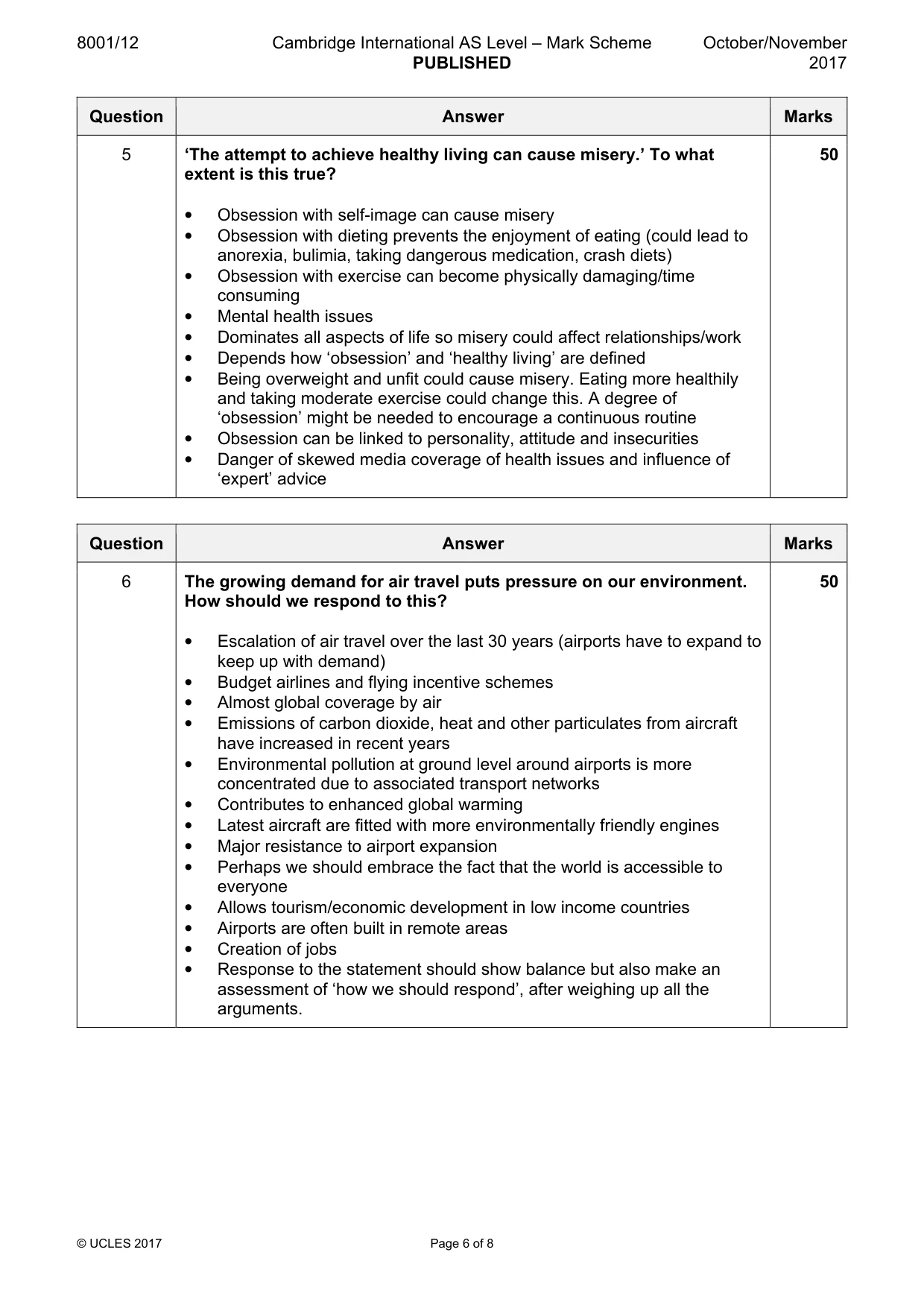
8001/12 Cambridge International AS Level – Mark Scheme PUBLISHED October/November 2017 © UCLES 2017 Page 6 of 8 Question Answer Marks 5 ‘The attempt to achieve healthy living can cause misery.’ To what extent is this true? • Obsession with self-image can cause misery • Obsession with dieting prevents the enjoyment of eating (could lead to anorexia, bulimia, taking dangerous medication, crash diets) • Obsession with exercise can become physically damaging/time consuming • Mental health issues • Dominates all aspects of life so misery could affect relationships/work • Depends how ‘obsession’ and ‘healthy living’ are defined • Being overweight and unfit could cause misery. Eating more healthily and taking moderate exercise could change this. A degree of ‘obsession’ might be needed to encourage a continuous routine • Obsession can be linked to personality, attitude and insecurities • Danger of skewed media coverage of health issues and influence of ‘expert’ advice 50 Question Answer Marks 6 The growing demand for air travel puts pressure on our environment. How should we respond to this? • Escalation of air travel over the last 30 years (airports have to expand to keep up with demand) • Budget airlines and flying incentive schemes • Almost global coverage by air • Emissions of carbon dioxide, heat and other particulates from aircraft have increased in recent years • Environmental pollution at ground level around airports is more concentrated due to associated transport networks • Contributes to enhanced global warming • Latest aircraft are fitted with more environmentally friendly engines • Major resistance to airport expansion • Perhaps we should embrace the fact that the world is accessible to everyone • Allows tourism/economic development in low income countries • Airports are often built in remote areas • Creation of jobs • Response to the statement should show balance but also make an assessment of ‘how we should respond’, after weighing up all the arguments. 50
Mark scheme, page 7
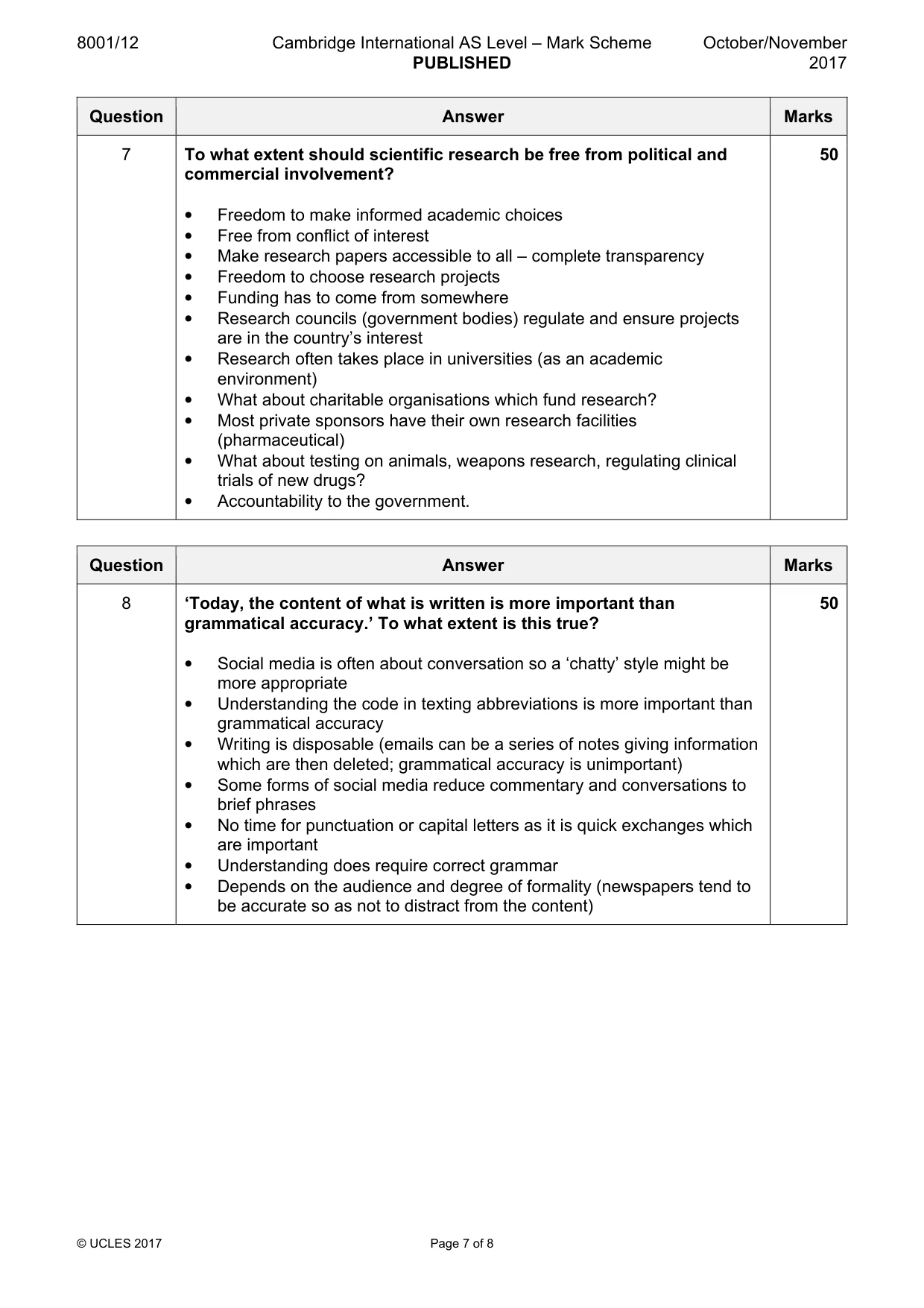
8001/12 Cambridge International AS Level – Mark Scheme PUBLISHED October/November 2017 © UCLES 2017 Page 7 of 8 Question Answer Marks 7 To what extent should scientific research be free from political and commercial involvement? • Freedom to make informed academic choices • Free from conflict of interest • Make research papers accessible to all – complete transparency • Freedom to choose research projects • Funding has to come from somewhere • Research councils (government bodies) regulate and ensure projects are in the country’s interest • Research often takes place in universities (as an academic environment) • What about charitable organisations which fund research? • Most private sponsors have their own research facilities (pharmaceutical) • What about testing on animals, weapons research, regulating clinical trials of new drugs? • Accountability to the government. 50 Question Answer Marks 8 ‘Today, the content of what is written is more important than grammatical accuracy.’ To what extent is this true? • Social media is often about conversation so a ‘chatty’ style might be more appropriate • Understanding the code in texting abbreviations is more important than grammatical accuracy • Writing is disposable (emails can be a series of notes giving information which are then deleted; grammatical accuracy is unimportant) • Some forms of social media reduce commentary and conversations to brief phrases • No time for punctuation or capital letters as it is quick exchanges which are important • Understanding does require correct grammar • Depends on the audience and degree of formality (newspapers tend to be accurate so as not to distract from the content) 50
Mark scheme, page 8
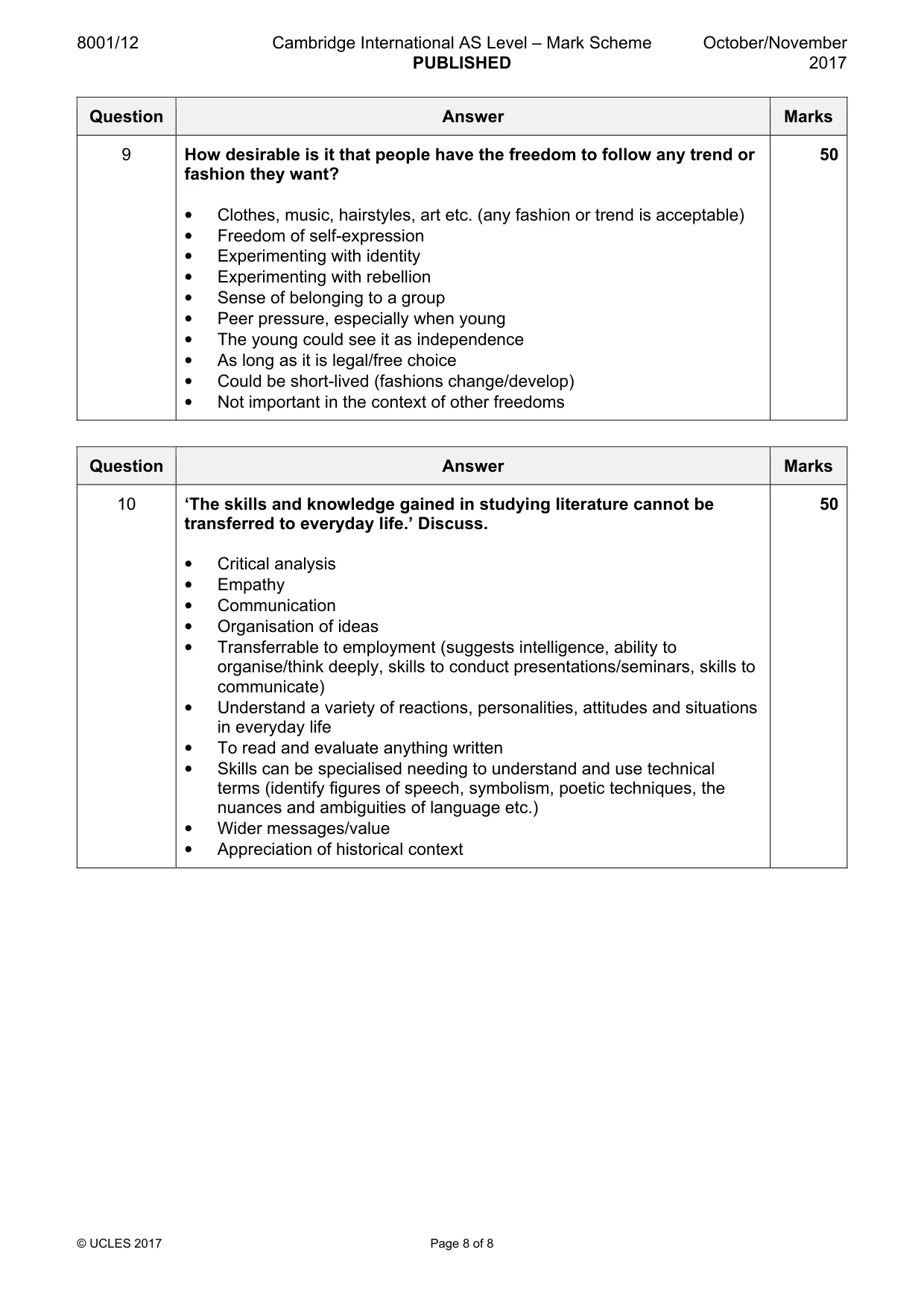
8001/12 Cambridge International AS Level – Mark Scheme PUBLISHED October/November 2017 © UCLES 2017 Page 8 of 8 Question Answer Marks 9 How desirable is it that people have the freedom to follow any trend or fashion they want? • Clothes, music, hairstyles, art etc. (any fashion or trend is acceptable) • Freedom of self-expression • Experimenting with identity • Experimenting with rebellion • Sense of belonging to a group • Peer pressure, especially when young • The young could see it as independence • As long as it is legal/free choice • Could be short-lived (fashions change/develop) • Not important in the context of other freedoms 50 Question Answer Marks 10 ‘The skills and knowledge gained in studying literature cannot be transferred to everyday life.’ Discuss. • Critical analysis • Empathy • Communication • Organisation of ideas • Transferrable to employment (suggests intelligence, ability to organise/think deeply, skills to conduct presentations/seminars, skills to communicate) • Understand a variety of reactions, personalities, attitudes and situations in everyday life • To read and evaluate anything written • Skills can be specialised needing to understand and use technical terms (identify figures of speech, symbolism, poetic techniques, the nuances and ambiguities of language etc.) • Wider messages/value • Appreciation of historical context 50
What you needed in this session
Cambridge’s own grade thresholds for 2017 Oct/Nov, Paper 1 · Variant 2. A higher threshold means an easier paper — the bar moves with how the cohort did.