Cambridge A Level General Paper (AS Level only) 8001 — 2012 Oct/Nov Paper 1 · Variant 1
8001/11/O/N/12 · 50 marks · ≈56 min
The question paper and its mark scheme, free to read here and free to download. This is Cambridge’s own paper, exactly as it was sat.
Question paper2 pages
Mark scheme8 pages
Answers below. Sit the paper first if you are practising.
Paper as text
Question paper, page 1
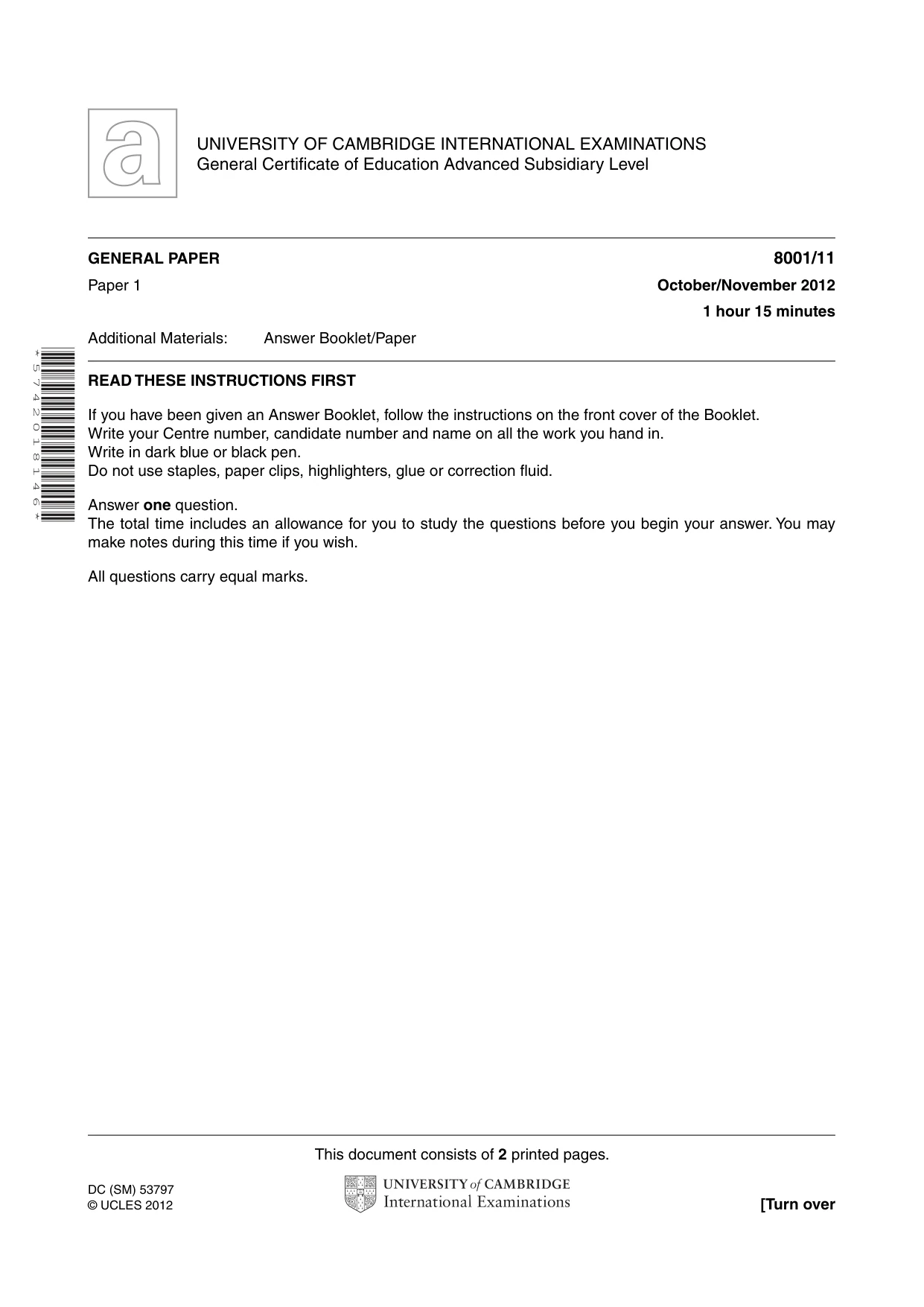
* 5 7 4 2 0 1 8 1 4 6 * This document consists of 2 printed pages. DC (SM) 53797 © UCLES 2012 [Turn over UNIVERSITY OF CAMBRIDGE INTERNATIONAL EXAMINATIONS General Certificate of Education Advanced Subsidiary Level READ THESE INSTRUCTIONS FIRST If you have been given an Answer Booklet, follow the instructions on the front cover of the Booklet. Write your Centre number, candidate number and name on all the work you hand in. Write in dark blue or black pen. Do not use staples, paper clips, highlighters, glue or correction fluid. Answer one question. The total time includes an allowance for you to study the questions before you begin your answer. You may make notes during this time if you wish. All questions carry equal marks. GENERAL PAPER 8001/11 Paper 1 October/November 2012 1 hour 15 minutes Additional Materials: Answer Booklet/Paper
Question paper, page 2
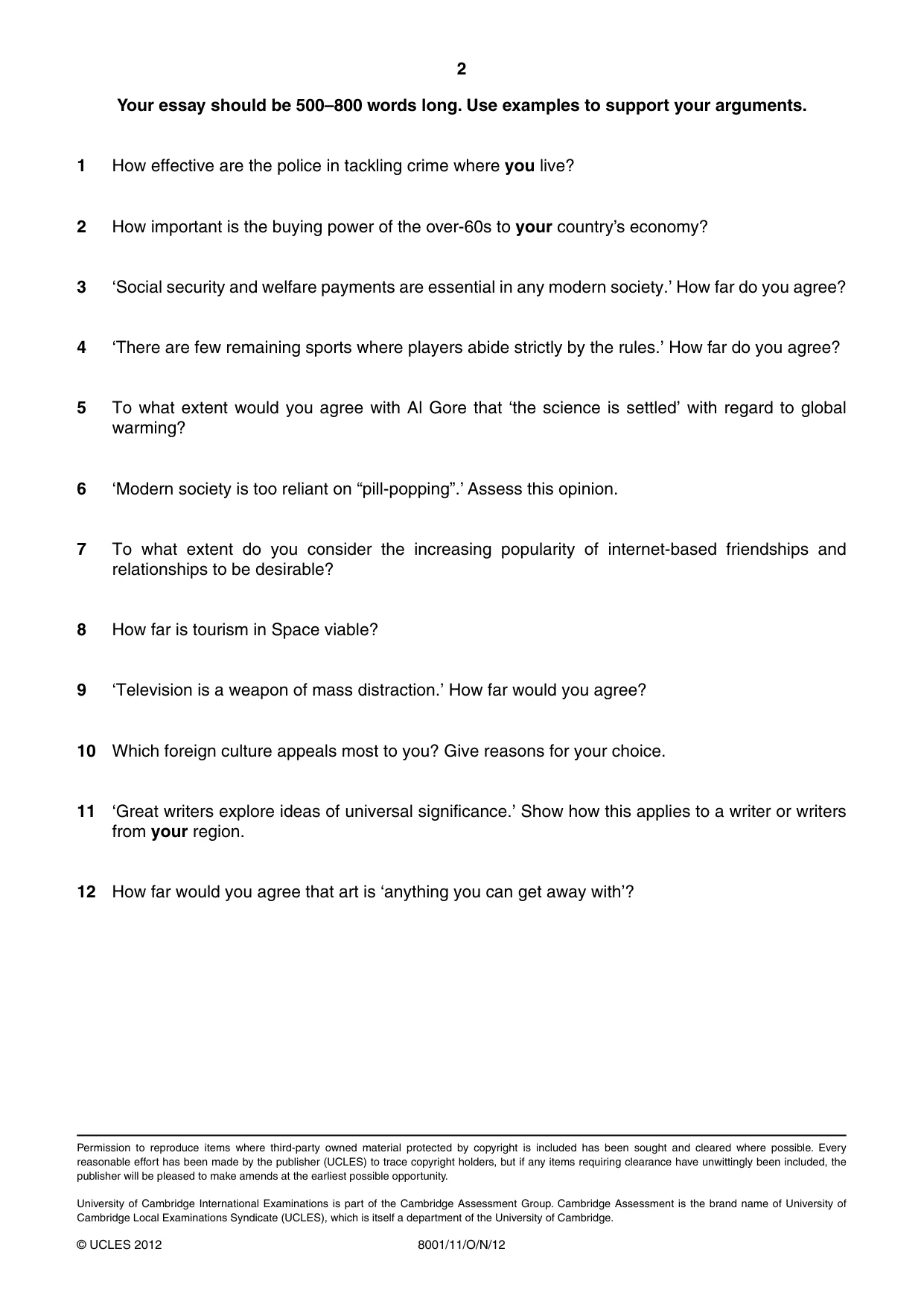
2 8001/11/O/N/12 © UCLES 2012 Permission to reproduce items where third-party owned material protected by copyright is included has been sought and cleared where possible. Every reasonable effort has been made by the publisher (UCLES) to trace copyright holders, but if any items requiring clearance have unwittingly been included, the publisher will be pleased to make amends at the earliest possible opportunity. University of Cambridge International Examinations is part of the Cambridge Assessment Group. Cambridge Assessment is the brand name of University of Cambridge Local Examinations Syndicate (UCLES), which is itself a department of the University of Cambridge. Your essay should be 500–800 words long. Use examples to support your arguments. 1 How effective are the police in tackling crime where you live? 2 How important is the buying power of the over-60s to your country’s economy? 3 ‘Social security and welfare payments are essential in any modern society.’ How far do you agree? 4 ‘There are few remaining sports where players abide strictly by the rules.’ How far do you agree? 5 To what extent would you agree with Al Gore that ‘the science is settled’ with regard to global warming? 6 ‘Modern society is too reliant on “pill-popping”.’ Assess this opinion. 7 To what extent do you consider the increasing popularity of internet-based friendships and relationships to be desirable? 8 How far is tourism in Space viable? 9 ‘Television is a weapon of mass distraction.’ How far would you agree? 10 Which foreign culture appeals most to you? Give reasons for your choice. 11 ‘Great writers explore ideas of universal significance.’ Show how this applies to a writer or writers from your region. 12 How far would you agree that art is ‘anything you can get away with’?
Mark scheme, page 1
CAMBRIDGE INTERNATIONAL EXAMINATIONS GCE Advanced Subsidiary Level MARK SCHEME for the October/November 2012 series 8001 GENERAL PAPER 8001/11 Paper 1 maximum raw mark 50 This mark scheme is published as an aid to teachers and candidates, to indicate the requirements of the examination. It shows the basis on which Examiners were instructed to award marks. It does not indicate the details of the discussions that took place at an Examiners’ meeting before marking began, which would have considered the acceptability of alternative answers. Mark schemes should be read in conjunction with the question paper and the Principal Examiner Report for Teachers. Cambridge will not enter into discussions about these mark schemes. Cambridge is publishing the mark schemes for the October/November 2012 series for most IGCSE, GCE Advanced Level and Advanced Subsidiary Level components and some Ordinary Level components.
Mark scheme, page 2
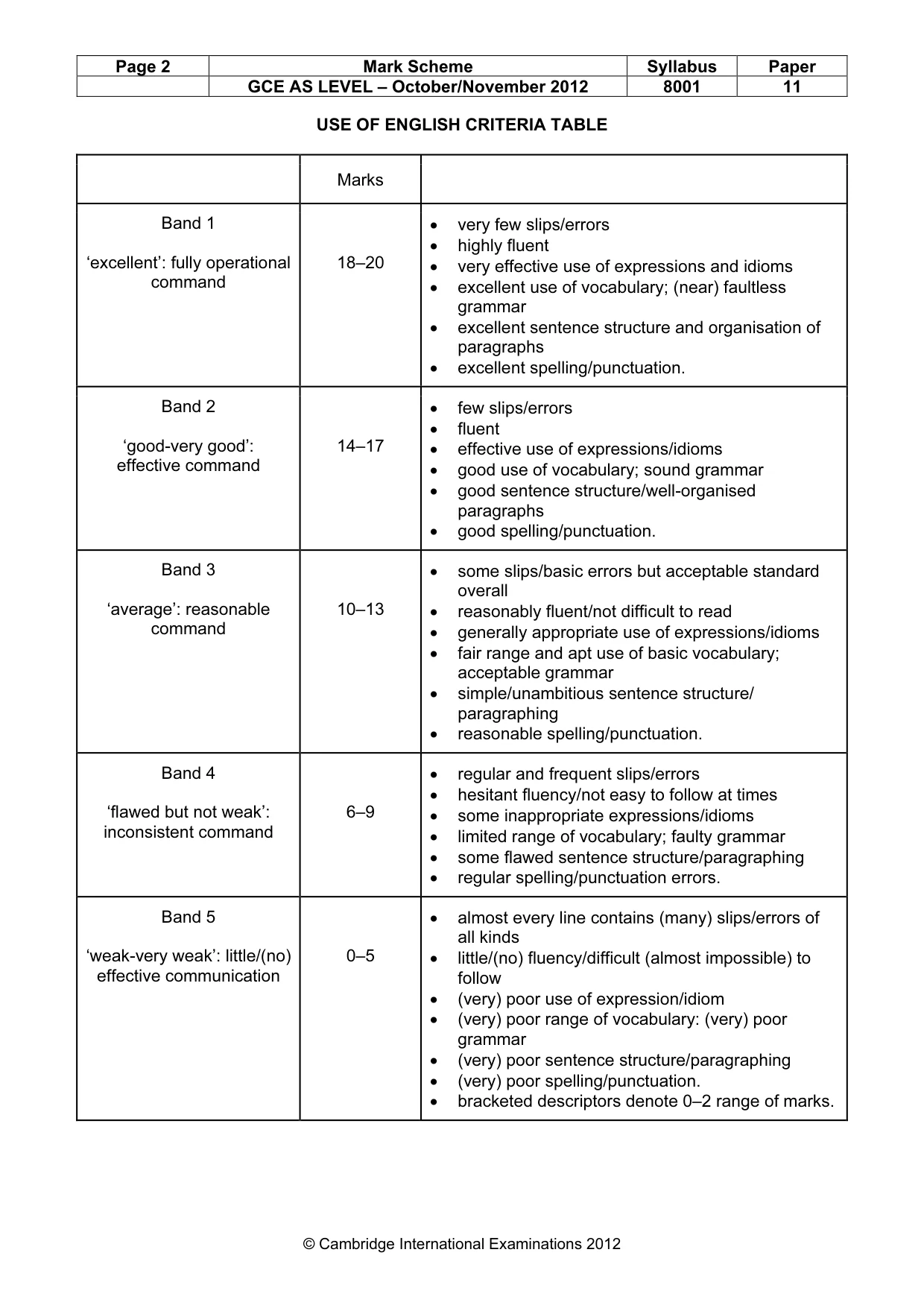
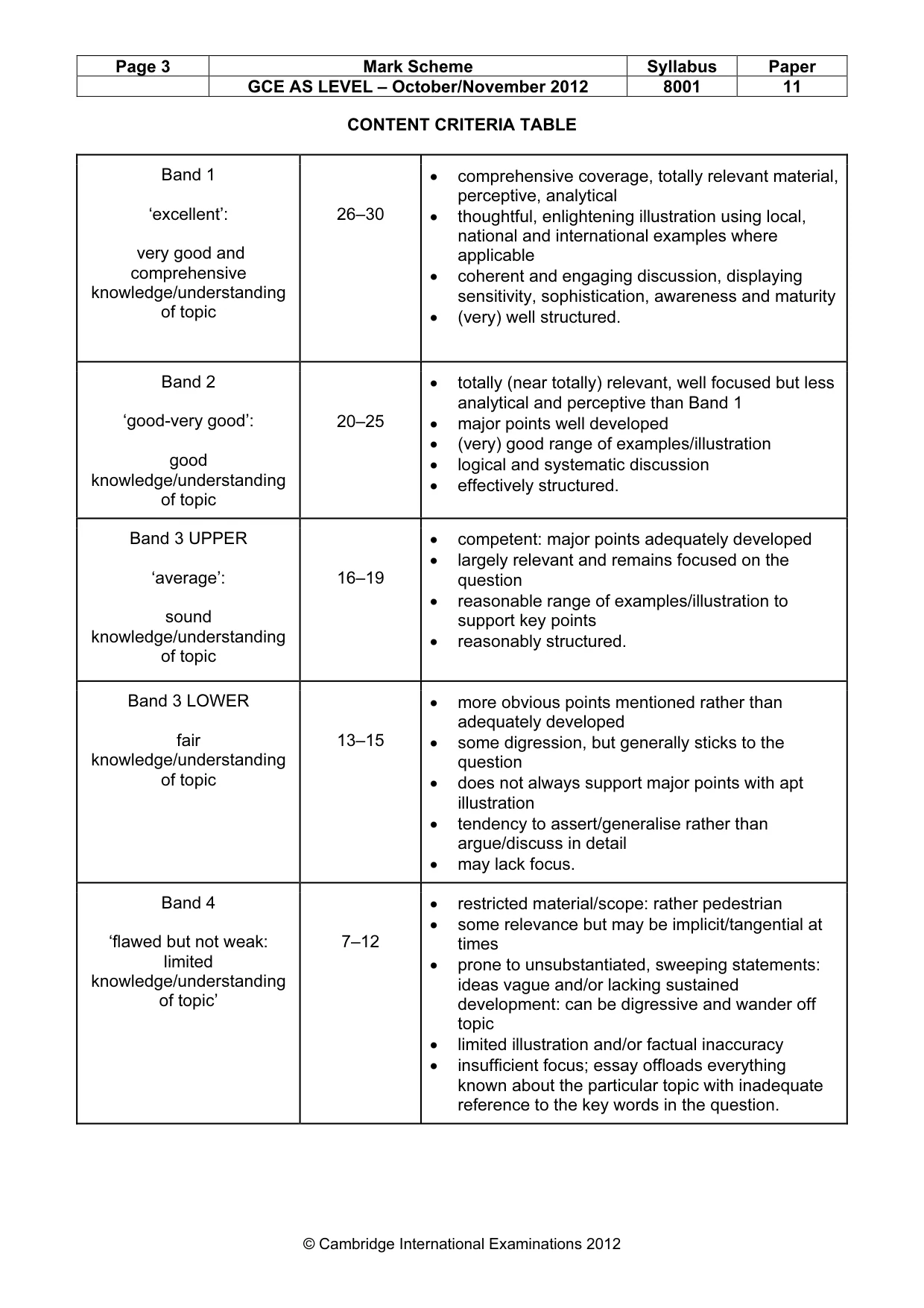
Page 2 Mark Scheme Syllabus Paper GCE AS LEVEL – October/November 2012 8001 11 © Cambridge International Examinations 2012 USE OF ENGLISH CRITERIA TABLE Marks Band 1 ‘excellent’: fully operational command 18–20 • very few slips/errors • highly fluent • very effective use of expressions and idioms • excellent use of vocabulary; (near) faultless grammar • excellent sentence structure and organisation of paragraphs • excellent spelling/punctuation. Band 2 ‘good-very good’: effective command 14–17 • few slips/errors • fluent • effective use of expressions/idioms • good use of vocabulary; sound grammar • good sentence structure/well-organised paragraphs • good spelling/punctuation. Band 3 ‘average’: reasonable command 10–13 • some slips/basic errors but acceptable standard overall • reasonably fluent/not difficult to read • generally appropriate use of expressions/idioms • fair range and apt use of basic vocabulary; acceptable grammar • simple/unambitious sentence structure/ paragraphing • reasonable spelling/punctuation. Band 4 ‘flawed but not weak’: inconsistent command 6–9 • regular and frequent slips/errors • hesitant fluency/not easy to follow at times • some inappropriate expressions/idioms • limited range of vocabulary; faulty grammar • some flawed sentence structure/paragraphing • regular spelling/punctuation errors. Band 5 ‘weak-very weak’: little/(no) effective communication 0–5 • almost every line contains (many) slips/errors of all kinds • little/(no) fluency/difficult (almost impossible) to follow • (very) poor use of expression/idiom • (very) poor range of vocabulary: (very) poor grammar • (very) poor sentence structure/paragraphing • (very) poor spelling/punctuation. • bracketed descriptors denote 0–2 range of marks.
Mark scheme, page 3
Page 3 Mark Scheme Syllabus Paper GCE AS LEVEL – October/November 2012 8001 11 © Cambridge International Examinations 2012 CONTENT CRITERIA TABLE Band 1 ‘excellent’: very good and comprehensive knowledge/understanding of topic 26–30 • comprehensive coverage, totally relevant material, perceptive, analytical • thoughtful, enlightening illustration using local, national and international examples where applicable • coherent and engaging discussion, displaying sensitivity, sophistication, awareness and maturity • (very) well structured. Band 2 ‘good-very good’: good knowledge/understanding of topic 20–25 • totally (near totally) relevant, well focused but less analytical and perceptive than Band 1 • major points well developed • (very) good range of examples/illustration • logical and systematic discussion • effectively structured. Band 3 UPPER ‘average’: sound knowledge/understanding of topic 16–19 • competent: major points adequately developed • largely relevant and remains focused on the question • reasonable range of examples/illustration to support key points • reasonably structured. Band 3 LOWER fair knowledge/understanding of topic 13–15 • more obvious points mentioned rather than adequately developed • some digression, but generally sticks to the question • does not always support major points with apt illustration • tendency to assert/generalise rather than argue/discuss in detail • may lack focus. Band 4 ‘flawed but not weak: limited knowledge/understanding of topic’ 7–12 • restricted material/scope: rather pedestrian • some relevance but may be implicit/tangential at times • prone to unsubstantiated, sweeping statements: ideas vague and/or lacking sustained development: can be digressive and wander off topic • limited illustration and/or factual inaccuracy • insufficient focus; essay offloads everything known about the particular topic with inadequate reference to the key words in the question.
Mark scheme, page 4
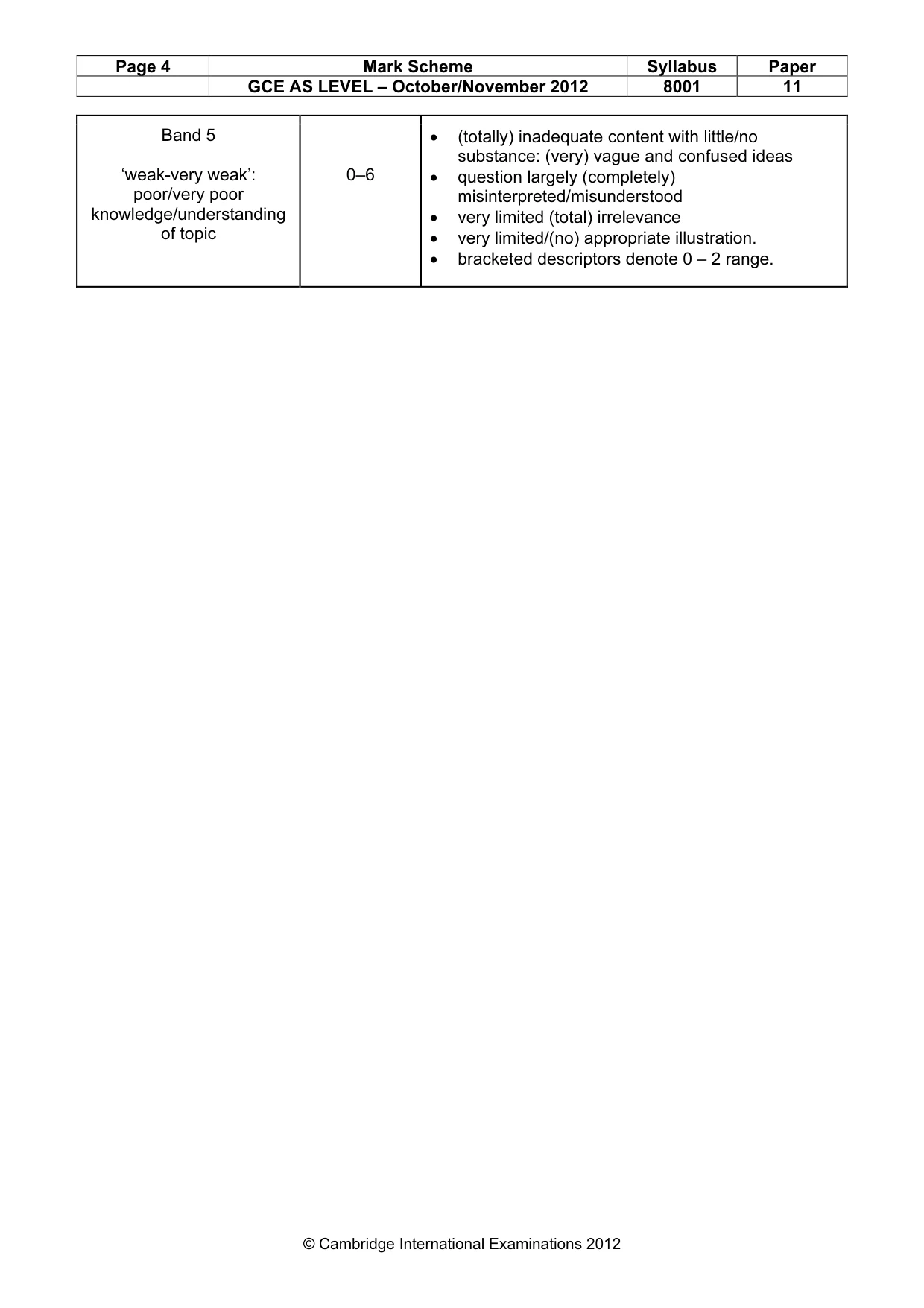
Page 4 Mark Scheme Syllabus Paper GCE AS LEVEL – October/November 2012 8001 11 © Cambridge International Examinations 2012 Band 5 ‘weak-very weak’: poor/very poor knowledge/understanding of topic 0–6 • (totally) inadequate content with little/no substance: (very) vague and confused ideas • question largely (completely) misinterpreted/misunderstood • very limited (total) irrelevance • very limited/(no) appropriate illustration. • bracketed descriptors denote 0 – 2 range.
Mark scheme, page 5
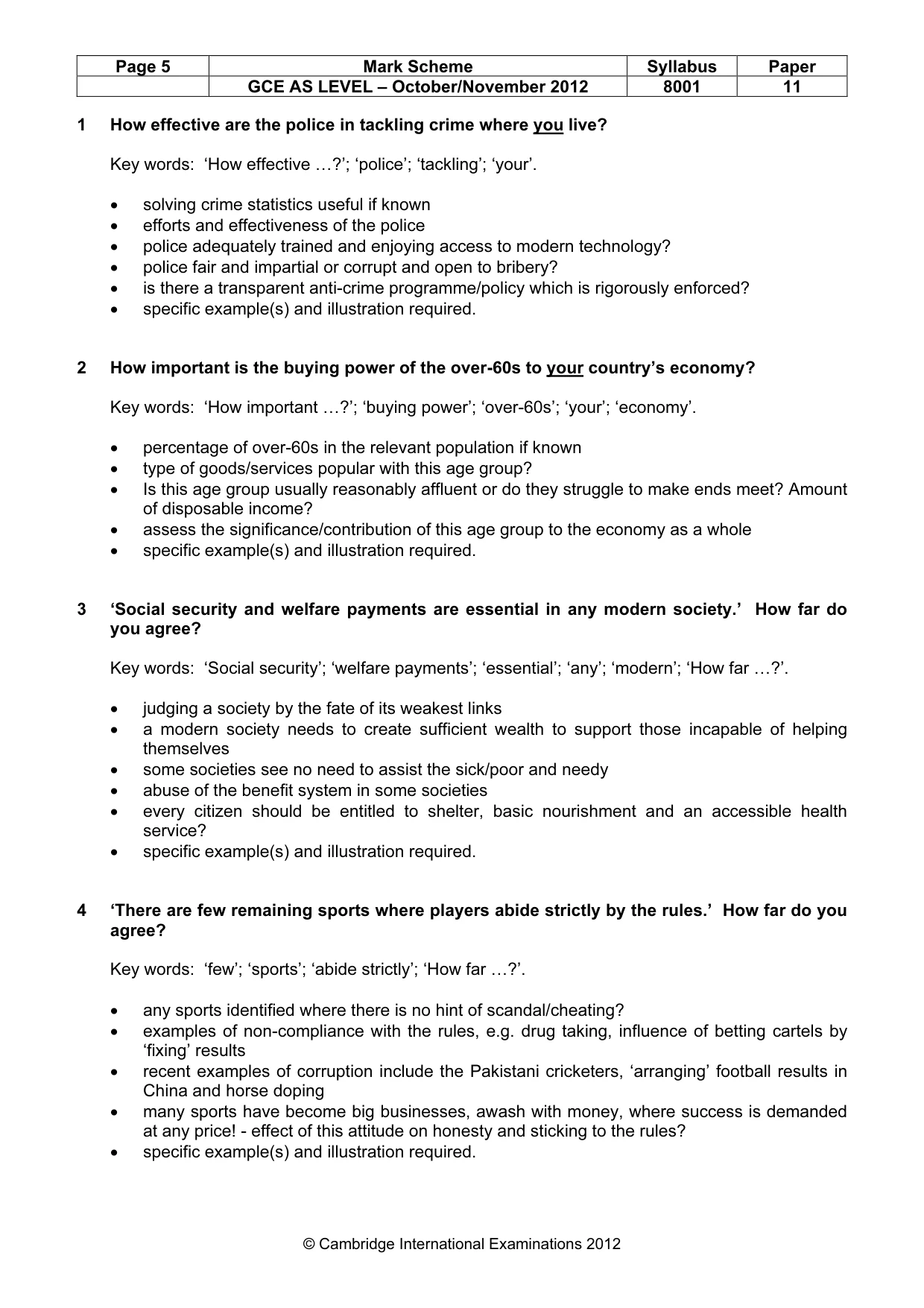
Page 5 Mark Scheme Syllabus Paper GCE AS LEVEL – October/November 2012 8001 11 © Cambridge International Examinations 2012 1 How effective are the police in tackling crime where you live? Key words: ‘How effective …?’; ‘police’; ‘tackling’; ‘your’. • solving crime statistics useful if known • efforts and effectiveness of the police • police adequately trained and enjoying access to modern technology? • police fair and impartial or corrupt and open to bribery? • is there a transparent anti-crime programme/policy which is rigorously enforced? • specific example(s) and illustration required. 2 How important is the buying power of the over-60s to your country’s economy? Key words: ‘How important …?’; ‘buying power’; ‘over-60s’; ‘your’; ‘economy’. • percentage of over-60s in the relevant population if known • type of goods/services popular with this age group? • Is this age group usually reasonably affluent or do they struggle to make ends meet? Amount of disposable income? • assess the significance/contribution of this age group to the economy as a whole • specific example(s) and illustration required. 3 ‘Social security and welfare payments are essential in any modern society.’ How far do you agree? Key words: ‘Social security’; ‘welfare payments’; ‘essential’; ‘any’; ‘modern’; ‘How far …?’. • judging a society by the fate of its weakest links • a modern society needs to create sufficient wealth to support those incapable of helping themselves • some societies see no need to assist the sick/poor and needy • abuse of the benefit system in some societies • every citizen should be entitled to shelter, basic nourishment and an accessible health service? • specific example(s) and illustration required. 4 ‘There are few remaining sports where players abide strictly by the rules.’ How far do you agree? Key words: ‘few’; ‘sports’; ‘abide strictly’; ‘How far …?’. • any sports identified where there is no hint of scandal/cheating? • examples of non-compliance with the rules, e.g. drug taking, influence of betting cartels by ‘fixing’ results • recent examples of corruption include the Pakistani cricketers, ‘arranging’ football results in China and horse doping • many sports have become big businesses, awash with money, where success is demanded at any price! - effect of this attitude on honesty and sticking to the rules? • specific example(s) and illustration required.
Mark scheme, page 6
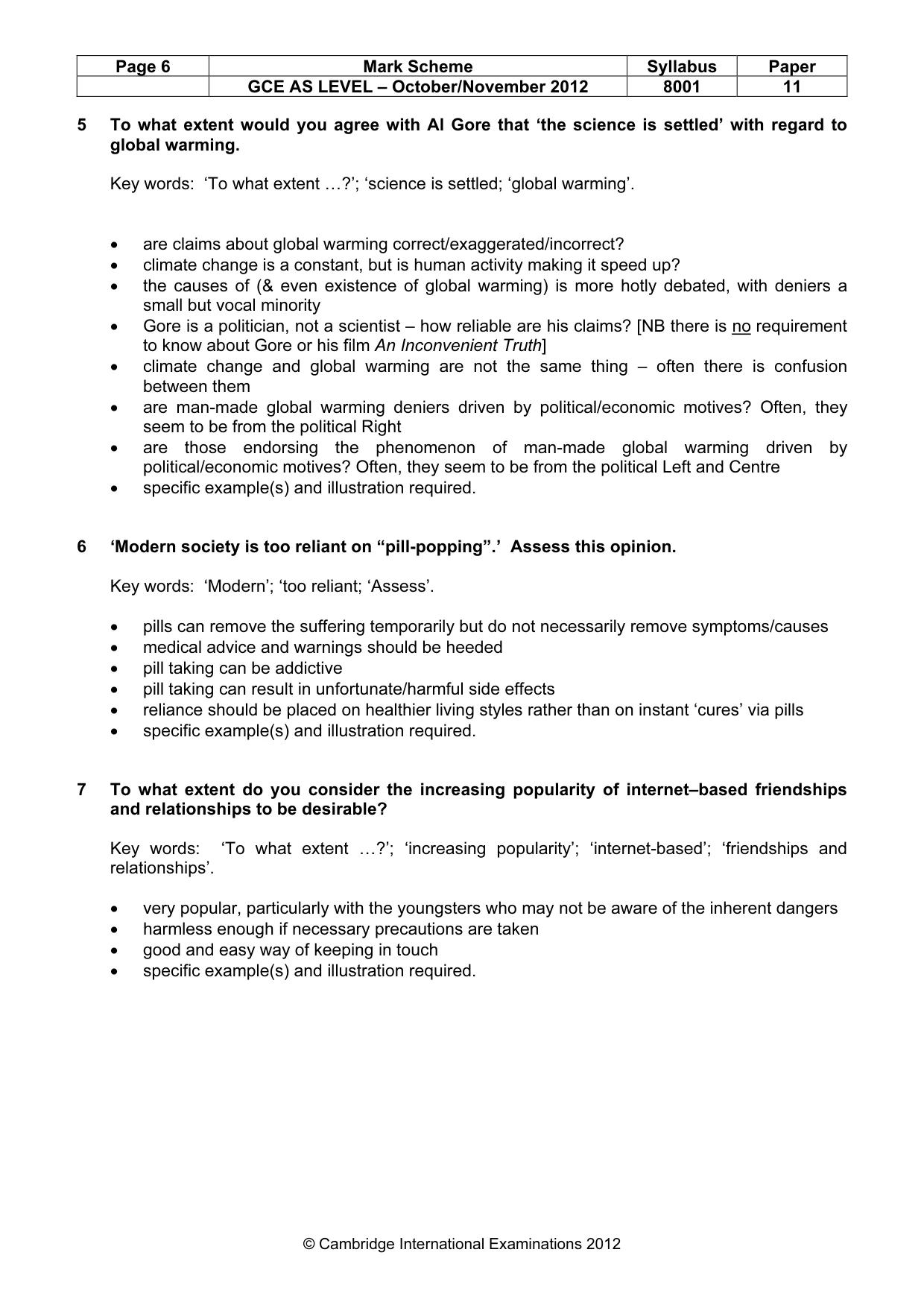
Page 6 Mark Scheme Syllabus Paper GCE AS LEVEL – October/November 2012 8001 11 © Cambridge International Examinations 2012 5 To what extent would you agree with Al Gore that ‘the science is settled’ with regard to global warming. Key words: ‘To what extent …?’; ‘science is settled; ‘global warming’. • are claims about global warming correct/exaggerated/incorrect? • climate change is a constant, but is human activity making it speed up? • the causes of (& even existence of global warming) is more hotly debated, with deniers a small but vocal minority • Gore is a politician, not a scientist – how reliable are his claims? [NB there is no requirement to know about Gore or his film An Inconvenient Truth] • climate change and global warming are not the same thing – often there is confusion between them • are man-made global warming deniers driven by political/economic motives? Often, they seem to be from the political Right • are those endorsing the phenomenon of man-made global warming driven by political/economic motives? Often, they seem to be from the political Left and Centre • specific example(s) and illustration required. 6 ‘Modern society is too reliant on “pill-popping”.’ Assess this opinion. Key words: ‘Modern’; ‘too reliant; ‘Assess’. • pills can remove the suffering temporarily but do not necessarily remove symptoms/causes • medical advice and warnings should be heeded • pill taking can be addictive • pill taking can result in unfortunate/harmful side effects • reliance should be placed on healthier living styles rather than on instant ‘cures’ via pills • specific example(s) and illustration required. 7 To what extent do you consider the increasing popularity of internet–based friendships and relationships to be desirable? Key words: ‘To what extent …?’; ‘increasing popularity’; ‘internet-based’; ‘friendships and relationships’. • very popular, particularly with the youngsters who may not be aware of the inherent dangers • harmless enough if necessary precautions are taken • good and easy way of keeping in touch • specific example(s) and illustration required.
Mark scheme, page 7
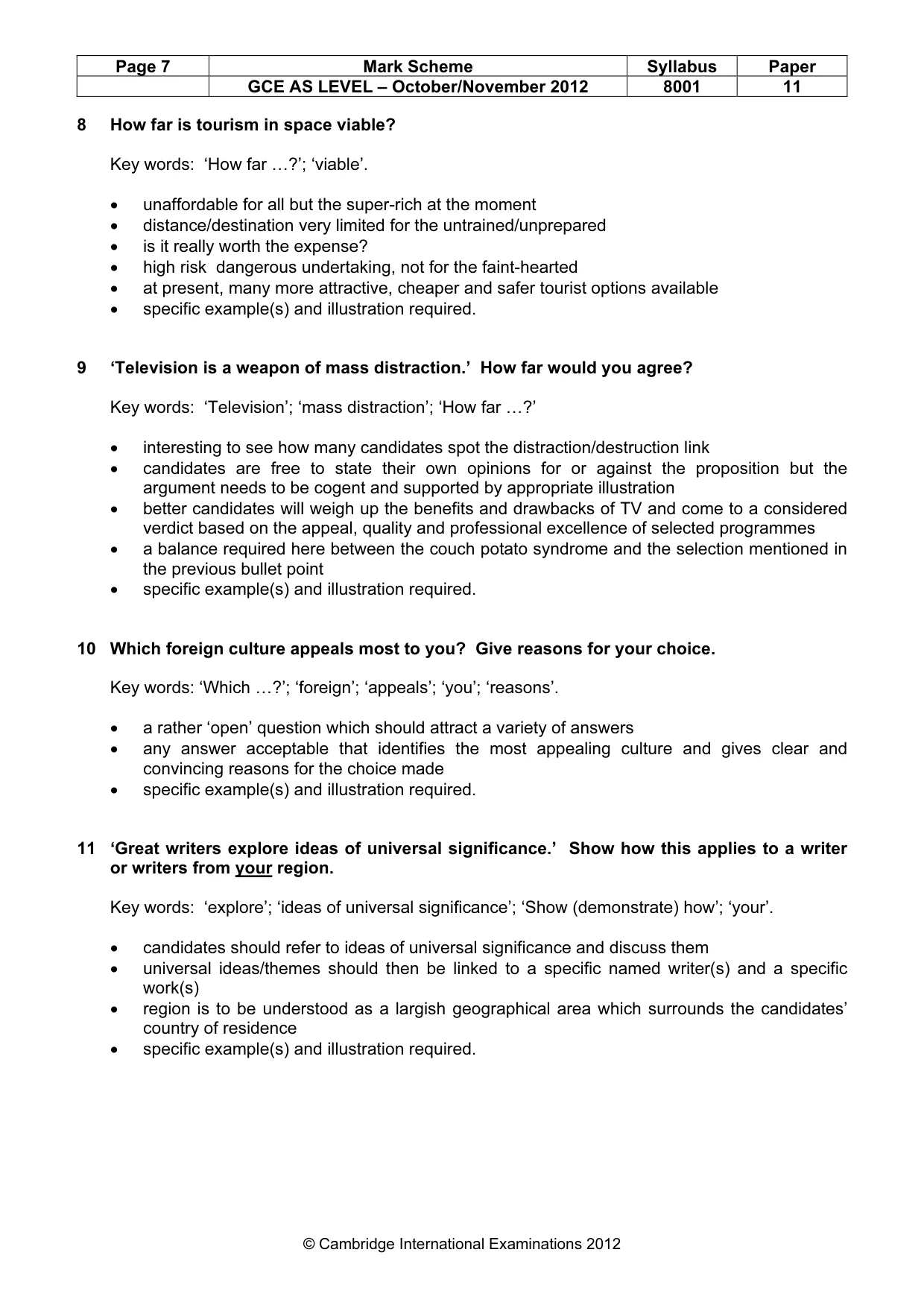
Page 7 Mark Scheme Syllabus Paper GCE AS LEVEL – October/November 2012 8001 11 © Cambridge International Examinations 2012 8 How far is tourism in space viable? Key words: ‘How far …?’; ‘viable’. • unaffordable for all but the super-rich at the moment • distance/destination very limited for the untrained/unprepared • is it really worth the expense? • high risk dangerous undertaking, not for the faint-hearted • at present, many more attractive, cheaper and safer tourist options available • specific example(s) and illustration required. 9 ‘Television is a weapon of mass distraction.’ How far would you agree? Key words: ‘Television’; ‘mass distraction’; ‘How far …?’ • interesting to see how many candidates spot the distraction/destruction link • candidates are free to state their own opinions for or against the proposition but the argument needs to be cogent and supported by appropriate illustration • better candidates will weigh up the benefits and drawbacks of TV and come to a considered verdict based on the appeal, quality and professional excellence of selected programmes • a balance required here between the couch potato syndrome and the selection mentioned in the previous bullet point • specific example(s) and illustration required. 10 Which foreign culture appeals most to you? Give reasons for your choice. Key words: ‘Which …?’; ‘foreign’; ‘appeals’; ‘you’; ‘reasons’. • a rather ‘open’ question which should attract a variety of answers • any answer acceptable that identifies the most appealing culture and gives clear and convincing reasons for the choice made • specific example(s) and illustration required. 11 ‘Great writers explore ideas of universal significance.’ Show how this applies to a writer or writers from your region. Key words: ‘explore’; ‘ideas of universal significance’; ‘Show (demonstrate) how’; ‘your’. • candidates should refer to ideas of universal significance and discuss them • universal ideas/themes should then be linked to a specific named writer(s) and a specific work(s) • region is to be understood as a largish geographical area which surrounds the candidates’ country of residence • specific example(s) and illustration required.
Mark scheme, page 8
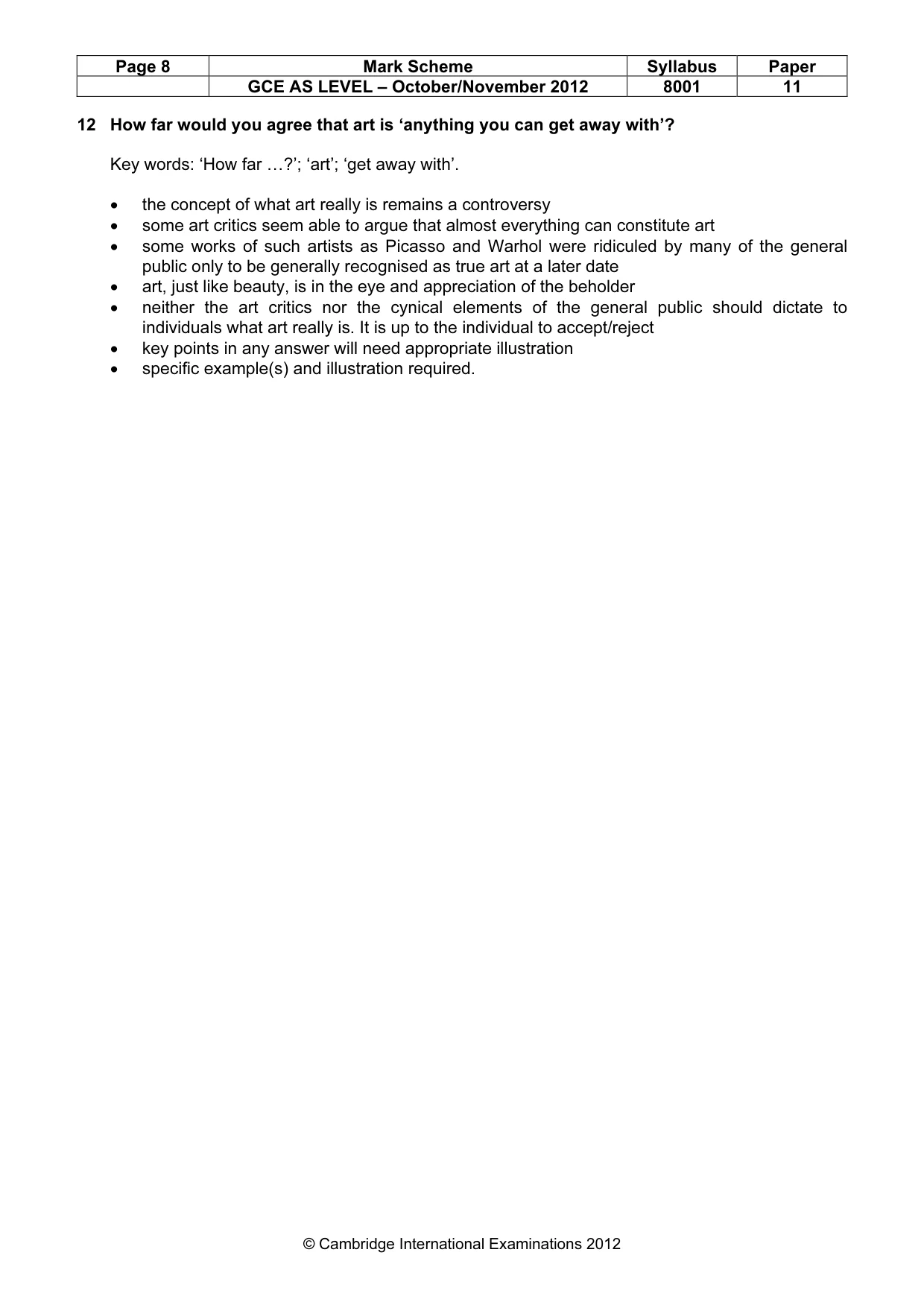
Page 8 Mark Scheme Syllabus Paper GCE AS LEVEL – October/November 2012 8001 11 © Cambridge International Examinations 2012 12 How far would you agree that art is ‘anything you can get away with’? Key words: ‘How far …?’; ‘art’; ‘get away with’. • the concept of what art really is remains a controversy • some art critics seem able to argue that almost everything can constitute art • some works of such artists as Picasso and Warhol were ridiculed by many of the general public only to be generally recognised as true art at a later date • art, just like beauty, is in the eye and appreciation of the beholder • neither the art critics nor the cynical elements of the general public should dictate to individuals what art really is. It is up to the individual to accept/reject • key points in any answer will need appropriate illustration • specific example(s) and illustration required.
What you needed in this session
Cambridge’s own grade thresholds for 2012 Oct/Nov, Paper 1 · Variant 1. A higher threshold means an easier paper — the bar moves with how the cohort did.