Cambridge A Level General Paper (AS Level only) 8001 — 2017 Oct/Nov Paper 1 · Variant 1
8001/11/O/N/17 · 50 marks · ≈56 min
The question paper and its mark scheme, free to read here and free to download. This is Cambridge’s own paper, exactly as it was sat.
Question paper4 pages


Mark scheme7 pages
Answers below. Sit the paper first if you are practising.
Paper as text
Question paper, page 1
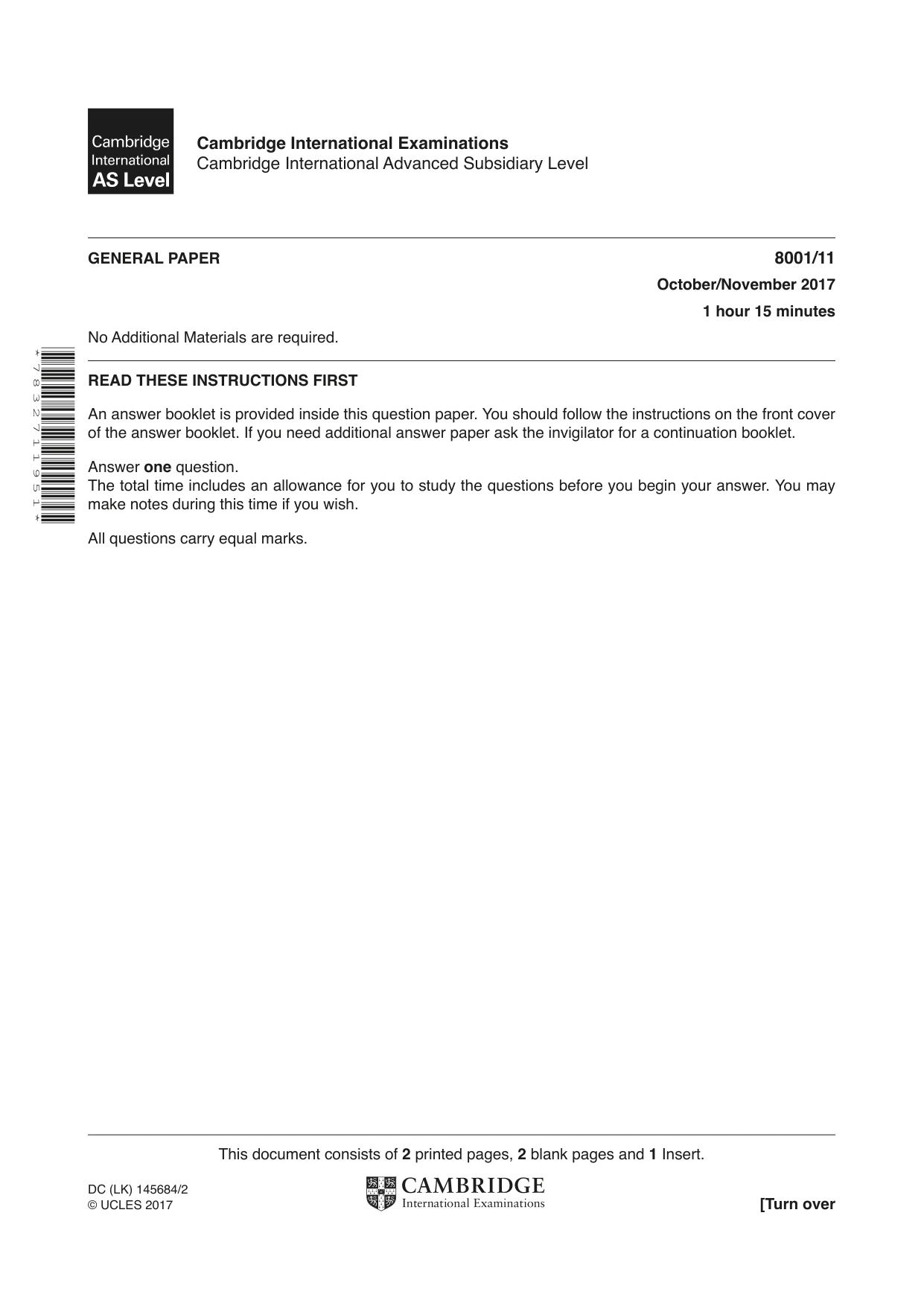
This document consists of 2 printed pages, 2 blank pages and 1 Insert. DC (LK) 145684/2 © UCLES 2017 [Turn over Cambridge International Examinations Cambridge International Advanced Subsidiary Level * 7 8 3 2 7 1 1 9 5 1 * GENERAL PAPER 8001/11 October/November 2017 1 hour 15 minutes No Additional Materials are required. READ THESE INSTRUCTIONS FIRST An answer booklet is provided inside this question paper. You should follow the instructions on the front cover of the answer booklet. If you need additional answer paper ask the invigilator for a continuation booklet. Answer one question. The total time includes an allowance for you to study the questions before you begin your answer. You may make notes during this time if you wish. All questions carry equal marks.
Question paper, page 2
2 8001/11/O/N/17 © UCLES 2017 BLANK PAGE
Question paper, page 3
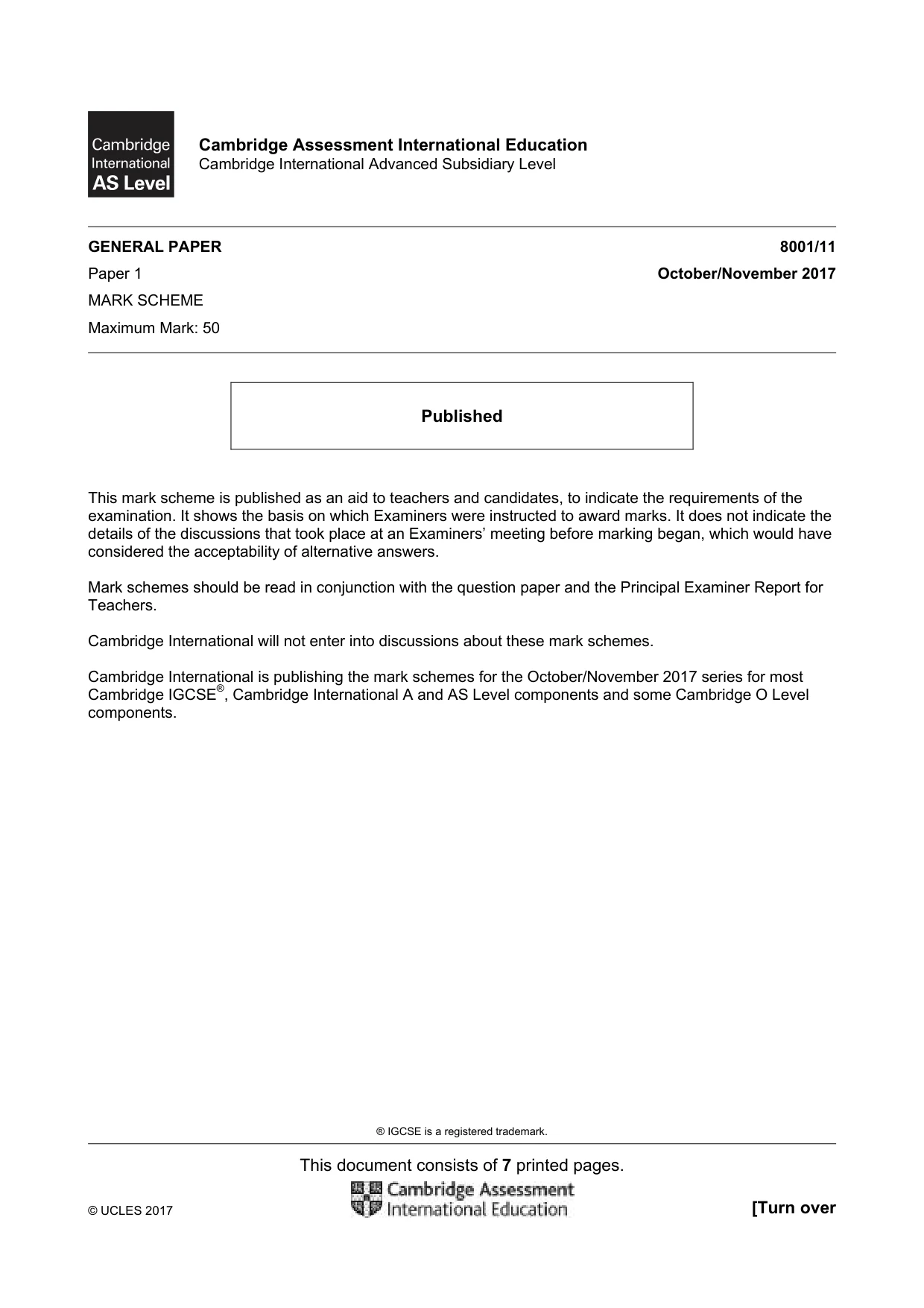
3 8001/11/O/N/17 © UCLES 2017 Your essay should be 500–800 words long. Use examples to support your arguments. 1 ‘People’s views matter as little in a democracy as in a one-party state.’ How far do you agree? 2 ‘When considering a future career, the most important factor is money.’ How far do you agree? 3 ‘Slavery, in its many forms, is as common today as it ever was.’ How justifiable is this statement? 4 Some people are seriously considering visiting the planet Mars. Explain whether or not this would be worthwhile. 5 ‘Believing in evolution demands that one rejects the existence of a creator.’ Discuss. 6 ‘I wish I were outdoors and not stuck in a classroom!’ Examine the possible benefits of learning in the open air. 7 To what extent does participation in sport promote character development? 8 With reference to two novels you know well, explain how fiction can reveal the truth. 9 Discuss the view that there are times and places in which music should never be played. 10 How valuable is photography in exposing reality and promoting change?
Question paper, page 4
4 8001/11/O/N/17 © UCLES 2017 BLANK PAGE Permission to reproduce items where third-party owned material protected by copyright is included has been sought and cleared where possible. Every reasonable effort has been made by the publisher (UCLES) to trace copyright holders, but if any items requiring clearance have unwittingly been included, the publisher will be pleased to make amends at the earliest possible opportunity. To avoid the issue of disclosure of answer-related information to candidates, all copyright acknowledgements are reproduced online in the Cambridge International Examinations Copyright Acknowledgements Booklet. This is produced for each series of examinations and is freely available to download at www.cie.org.uk after the live examination series. Cambridge International Examinations is part of the Cambridge Assessment Group. Cambridge Assessment is the brand name of University of Cambridge Local Examinations Syndicate (UCLES), which is itself a department of the University of Cambridge.
Mark scheme, page 1
® IGCSE is a registered trademark. This document consists of 7 printed pages. © UCLES 2017 [Turn over Cambridge Assessment International Education Cambridge International Advanced Subsidiary Level GENERAL PAPER 8001/11 Paper 1 October/November 2017 MARK SCHEME Maximum Mark: 50 Published This mark scheme is published as an aid to teachers and candidates, to indicate the requirements of the examination. It shows the basis on which Examiners were instructed to award marks. It does not indicate the details of the discussions that took place at an Examiners’ meeting before marking began, which would have considered the acceptability of alternative answers. Mark schemes should be read in conjunction with the question paper and the Principal Examiner Report for Teachers. Cambridge International will not enter into discussions about these mark schemes. Cambridge International is publishing the mark schemes for the October/November 2017 series for most Cambridge IGCSE®, Cambridge International A and AS Level components and some Cambridge O Level components.
Mark scheme, page 2
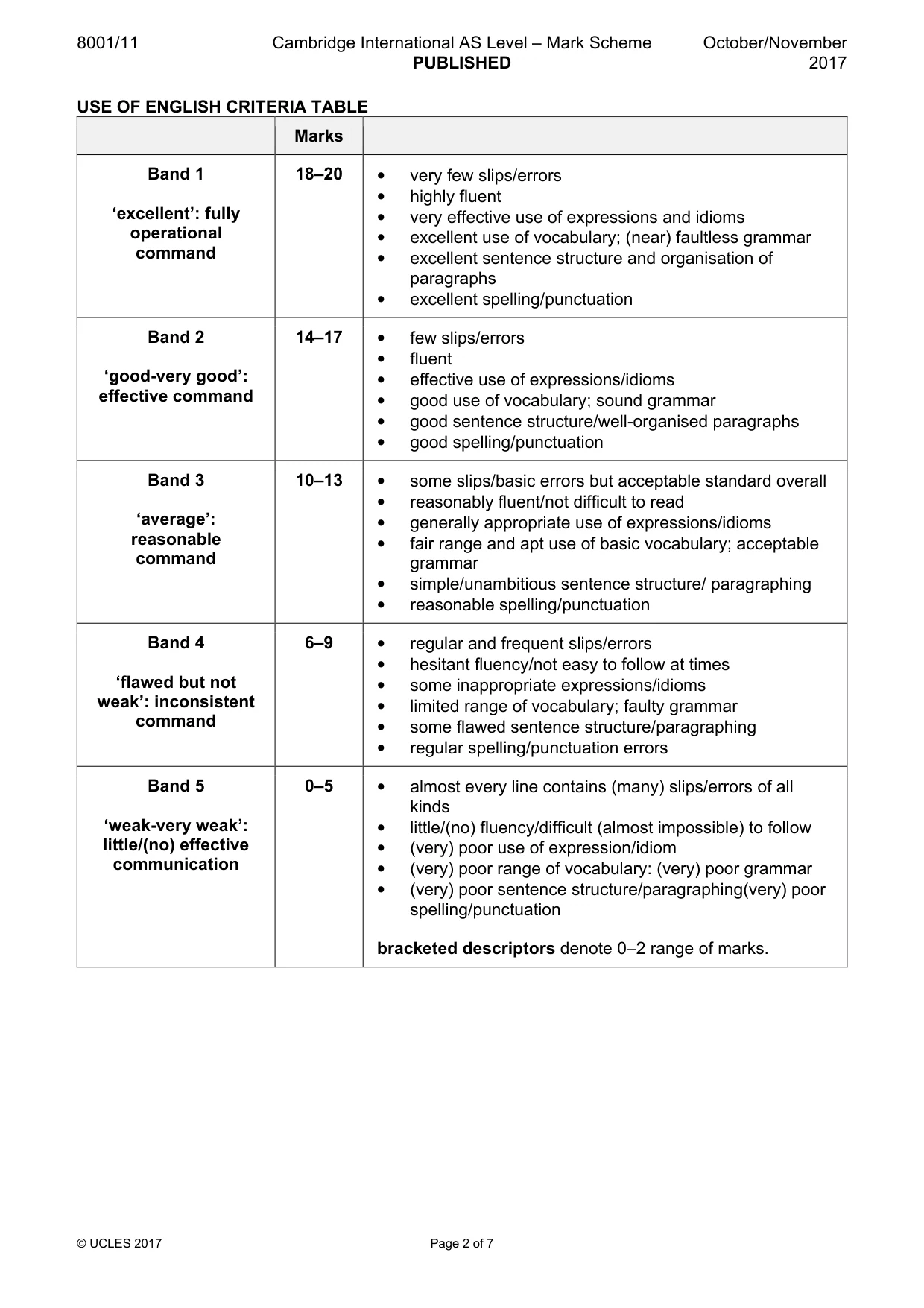
8001/11 Cambridge International AS Level – Mark Scheme PUBLISHED October/November 2017 © UCLES 2017 Page 2 of 7 USE OF ENGLISH CRITERIA TABLE Marks Band 1 ‘excellent’: fully operational command 18–20 • very few slips/errors • highly fluent • very effective use of expressions and idioms • excellent use of vocabulary; (near) faultless grammar • excellent sentence structure and organisation of paragraphs • excellent spelling/punctuation Band 2 ‘good-very good’: effective command 14–17 • few slips/errors • fluent • effective use of expressions/idioms • good use of vocabulary; sound grammar • good sentence structure/well-organised paragraphs • good spelling/punctuation Band 3 ‘average’: reasonable command 10–13 • some slips/basic errors but acceptable standard overall • reasonably fluent/not difficult to read • generally appropriate use of expressions/idioms • fair range and apt use of basic vocabulary; acceptable grammar • simple/unambitious sentence structure/ paragraphing • reasonable spelling/punctuation Band 4 ‘flawed but not weak’: inconsistent command 6–9 • regular and frequent slips/errors • hesitant fluency/not easy to follow at times • some inappropriate expressions/idioms • limited range of vocabulary; faulty grammar • some flawed sentence structure/paragraphing • regular spelling/punctuation errors Band 5 ‘weak-very weak’: little/(no) effective communication 0–5 • almost every line contains (many) slips/errors of all kinds • little/(no) fluency/difficult (almost impossible) to follow • (very) poor use of expression/idiom • (very) poor range of vocabulary: (very) poor grammar • (very) poor sentence structure/paragraphing(very) poor spelling/punctuation bracketed descriptors denote 0–2 range of marks.
Mark scheme, page 3
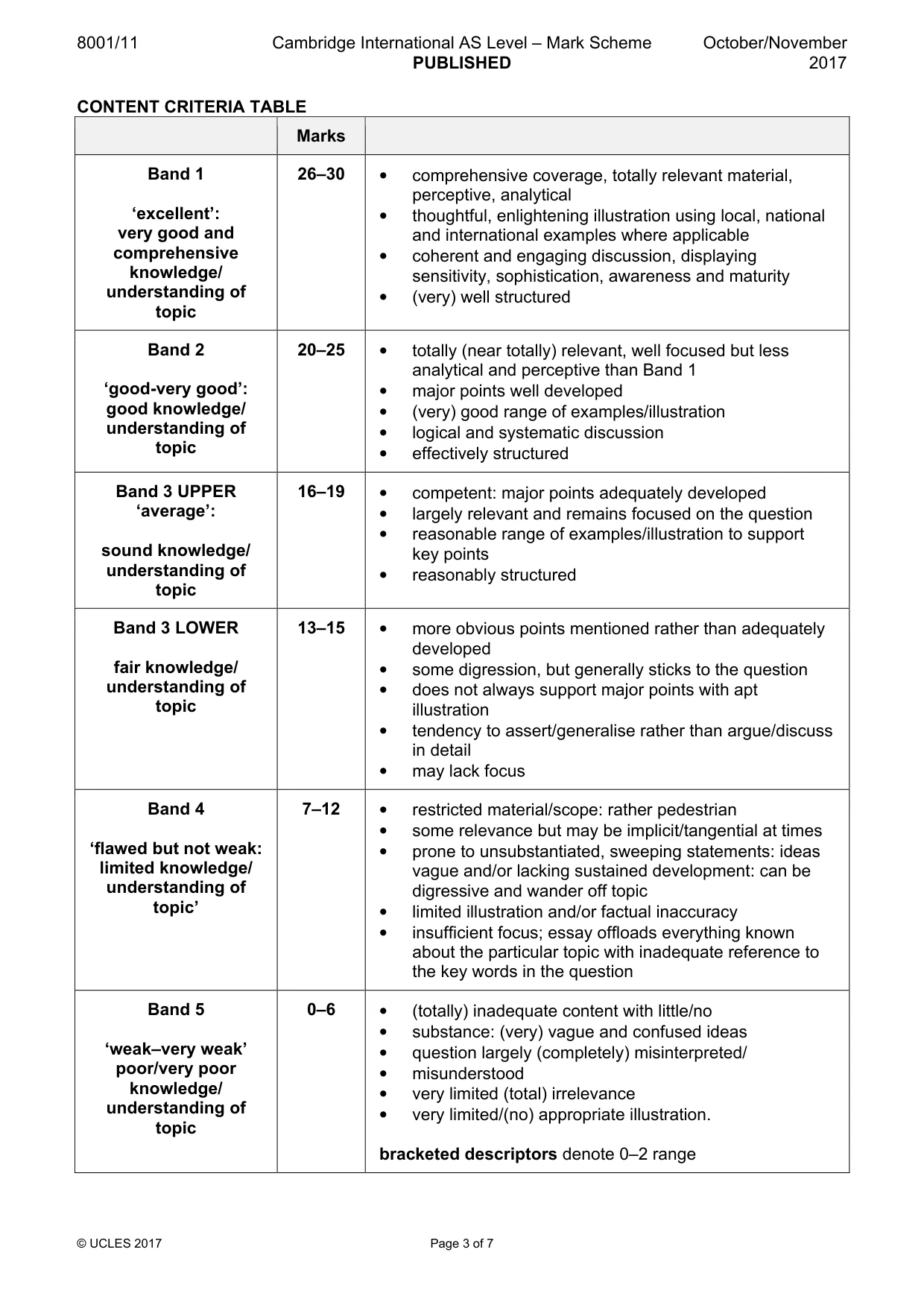
8001/11 Cambridge International AS Level – Mark Scheme PUBLISHED October/November 2017 © UCLES 2017 Page 3 of 7 CONTENT CRITERIA TABLE Marks Band 1 ‘excellent’: very good and comprehensive knowledge/ understanding of topic 26–30 • comprehensive coverage, totally relevant material, perceptive, analytical • thoughtful, enlightening illustration using local, national and international examples where applicable • coherent and engaging discussion, displaying sensitivity, sophistication, awareness and maturity • (very) well structured Band 2 ‘good-very good’: good knowledge/ understanding of topic 20–25 • totally (near totally) relevant, well focused but less analytical and perceptive than Band 1 • major points well developed • (very) good range of examples/illustration • logical and systematic discussion • effectively structured Band 3 UPPER ‘average’: sound knowledge/ understanding of topic 16–19 • competent: major points adequately developed • largely relevant and remains focused on the question • reasonable range of examples/illustration to support key points • reasonably structured Band 3 LOWER fair knowledge/ understanding of topic 13–15 • more obvious points mentioned rather than adequately developed • some digression, but generally sticks to the question • does not always support major points with apt illustration • tendency to assert/generalise rather than argue/discuss in detail • may lack focus Band 4 ‘flawed but not weak: limited knowledge/ understanding of topic’ 7–12 • restricted material/scope: rather pedestrian • some relevance but may be implicit/tangential at times • prone to unsubstantiated, sweeping statements: ideas vague and/or lacking sustained development: can be digressive and wander off topic • limited illustration and/or factual inaccuracy • insufficient focus; essay offloads everything known about the particular topic with inadequate reference to the key words in the question Band 5 ‘weak–very weak’ poor/very poor knowledge/ understanding of topic 0–6 • (totally) inadequate content with little/no • substance: (very) vague and confused ideas • question largely (completely) misinterpreted/ • misunderstood • very limited (total) irrelevance • very limited/(no) appropriate illustration. bracketed descriptors denote 0–2 range
Mark scheme, page 4
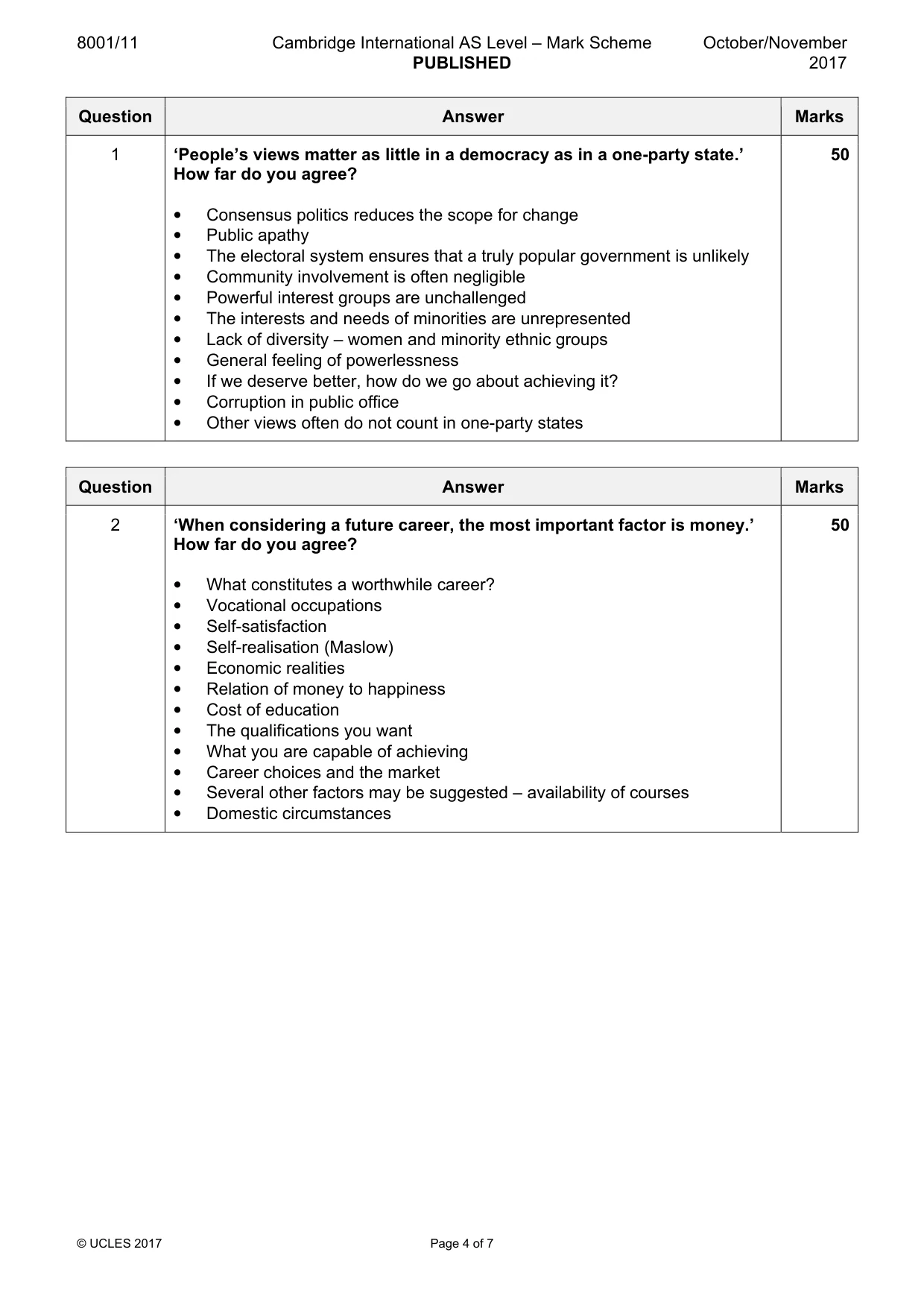
8001/11 Cambridge International AS Level – Mark Scheme PUBLISHED October/November 2017 © UCLES 2017 Page 4 of 7 Question Answer Marks 1 ‘People’s views matter as little in a democracy as in a one-party state.’ How far do you agree? • Consensus politics reduces the scope for change • Public apathy • The electoral system ensures that a truly popular government is unlikely • Community involvement is often negligible • Powerful interest groups are unchallenged • The interests and needs of minorities are unrepresented • Lack of diversity – women and minority ethnic groups • General feeling of powerlessness • If we deserve better, how do we go about achieving it? • Corruption in public office • Other views often do not count in one-party states 50 Question Answer Marks 2 ‘When considering a future career, the most important factor is money.’ How far do you agree? • What constitutes a worthwhile career? • Vocational occupations • Self-satisfaction • Self-realisation (Maslow) • Economic realities • Relation of money to happiness • Cost of education • The qualifications you want • What you are capable of achieving • Career choices and the market • Several other factors may be suggested – availability of courses • Domestic circumstances 50
Mark scheme, page 5
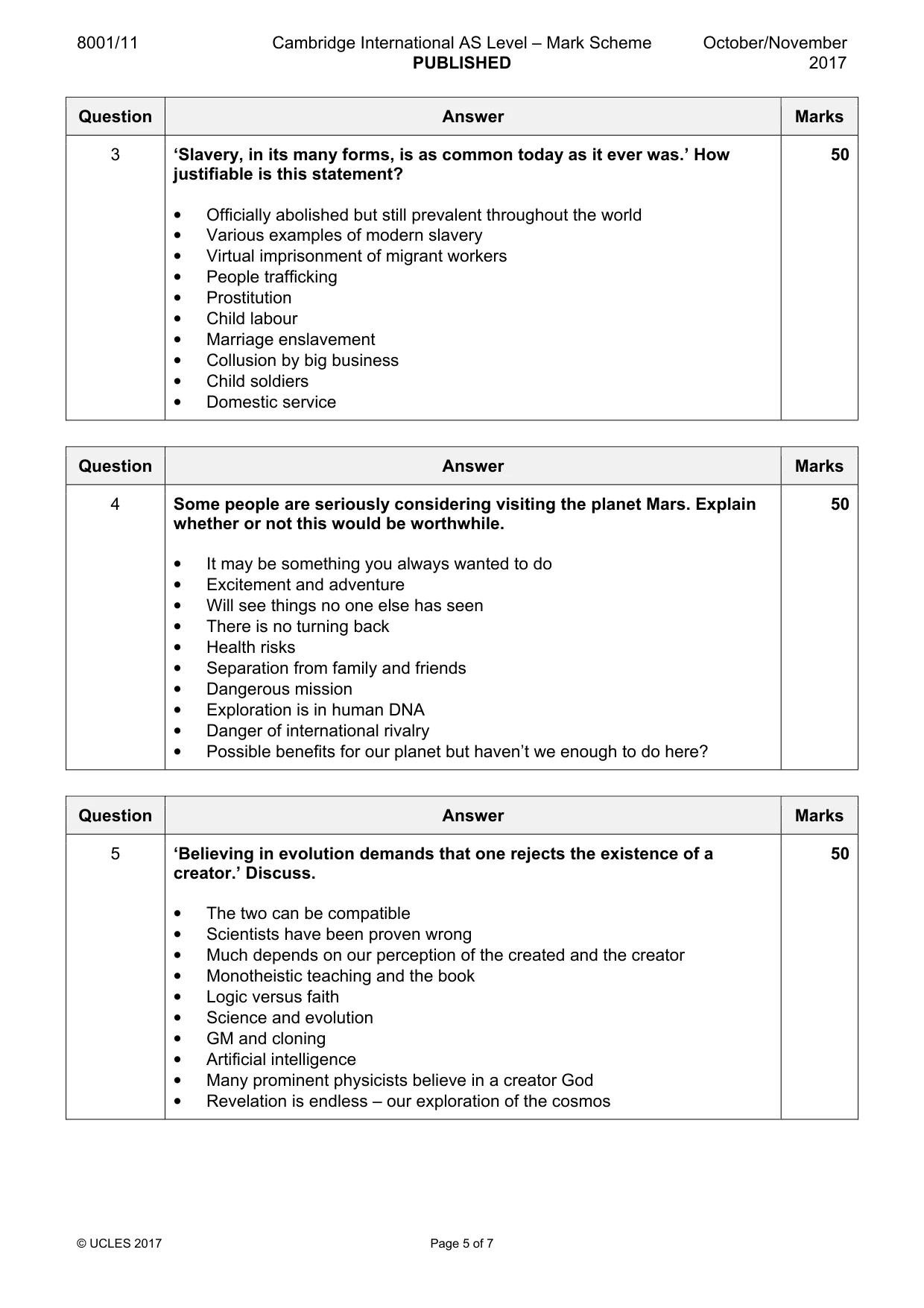
8001/11 Cambridge International AS Level – Mark Scheme PUBLISHED October/November 2017 © UCLES 2017 Page 5 of 7 Question Answer Marks 3 ‘Slavery, in its many forms, is as common today as it ever was.’ How justifiable is this statement? • Officially abolished but still prevalent throughout the world • Various examples of modern slavery • Virtual imprisonment of migrant workers • People trafficking • Prostitution • Child labour • Marriage enslavement • Collusion by big business • Child soldiers • Domestic service 50 Question Answer Marks 4 Some people are seriously considering visiting the planet Mars. Explain whether or not this would be worthwhile. • It may be something you always wanted to do • Excitement and adventure • Will see things no one else has seen • There is no turning back • Health risks • Separation from family and friends • Dangerous mission • Exploration is in human DNA • Danger of international rivalry • Possible benefits for our planet but haven’t we enough to do here? 50 Question Answer Marks 5 ‘Believing in evolution demands that one rejects the existence of a creator.’ Discuss. • The two can be compatible • Scientists have been proven wrong • Much depends on our perception of the created and the creator • Monotheistic teaching and the book • Logic versus faith • Science and evolution • GM and cloning • Artificial intelligence • Many prominent physicists believe in a creator God • Revelation is endless – our exploration of the cosmos 50
Mark scheme, page 6
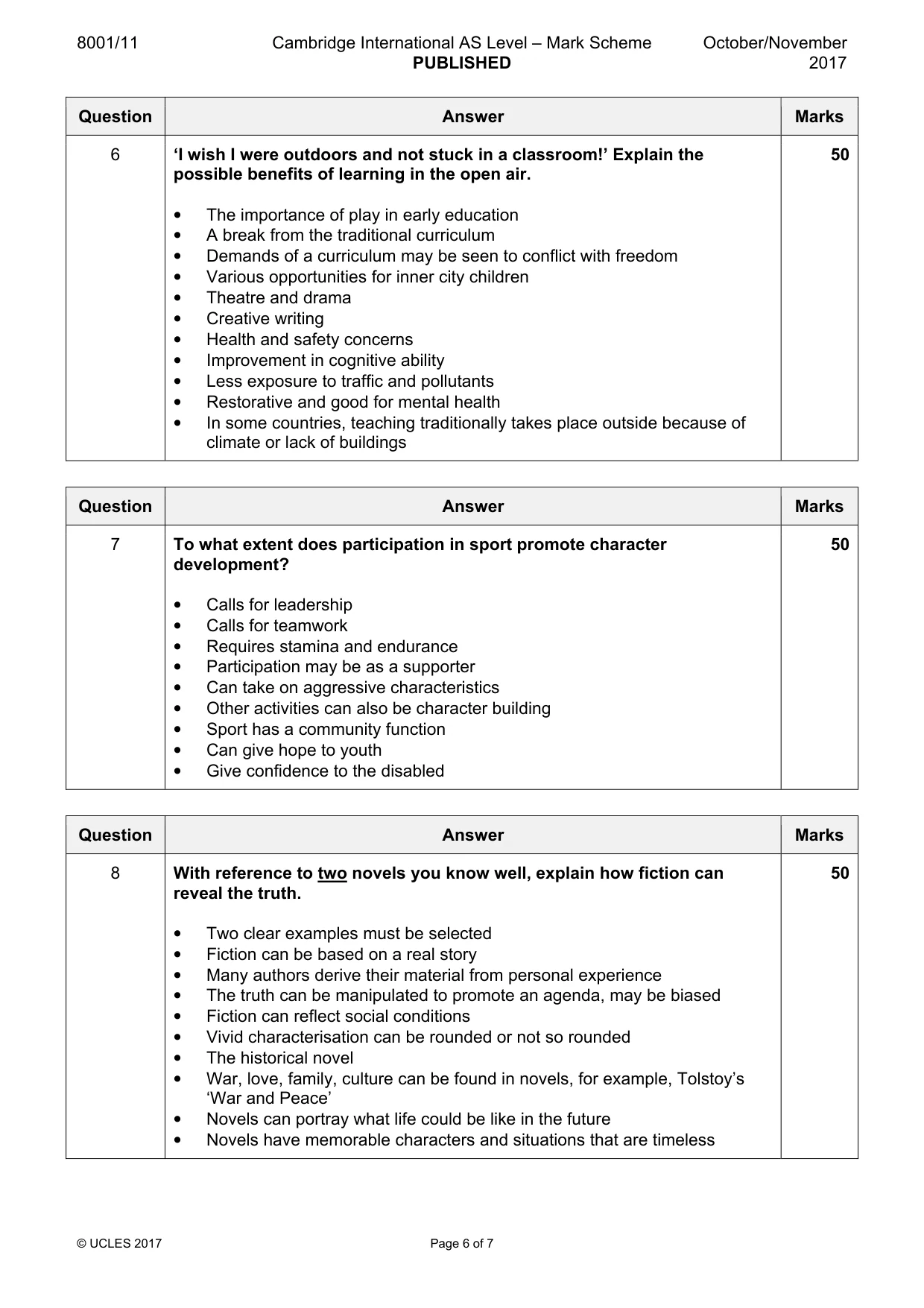
8001/11 Cambridge International AS Level – Mark Scheme PUBLISHED October/November 2017 © UCLES 2017 Page 6 of 7 Question Answer Marks 6 ‘I wish I were outdoors and not stuck in a classroom!’ Explain the possible benefits of learning in the open air. • The importance of play in early education • A break from the traditional curriculum • Demands of a curriculum may be seen to conflict with freedom • Various opportunities for inner city children • Theatre and drama • Creative writing • Health and safety concerns • Improvement in cognitive ability • Less exposure to traffic and pollutants • Restorative and good for mental health • In some countries, teaching traditionally takes place outside because of climate or lack of buildings 50 Question Answer Marks 7 To what extent does participation in sport promote character development? • Calls for leadership • Calls for teamwork • Requires stamina and endurance • Participation may be as a supporter • Can take on aggressive characteristics • Other activities can also be character building • Sport has a community function • Can give hope to youth • Give confidence to the disabled 50 Question Answer Marks 8 With reference to two novels you know well, explain how fiction can reveal the truth. • Two clear examples must be selected • Fiction can be based on a real story • Many authors derive their material from personal experience • The truth can be manipulated to promote an agenda, may be biased • Fiction can reflect social conditions • Vivid characterisation can be rounded or not so rounded • The historical novel • War, love, family, culture can be found in novels, for example, Tolstoy’s ‘War and Peace’ • Novels can portray what life could be like in the future • Novels have memorable characters and situations that are timeless 50
Mark scheme, page 7
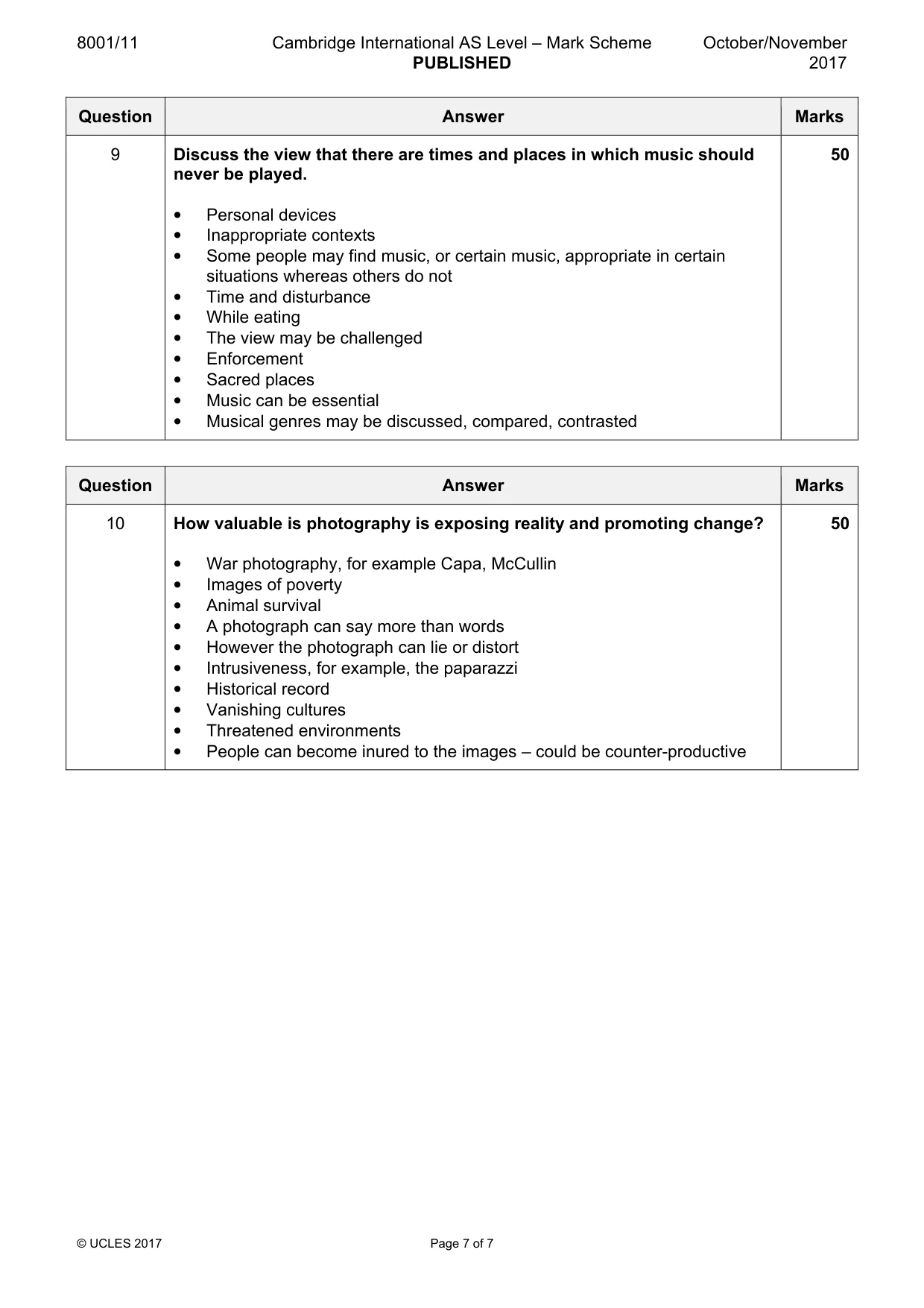
8001/11 Cambridge International AS Level – Mark Scheme PUBLISHED October/November 2017 © UCLES 2017 Page 7 of 7 Question Answer Marks 9 Discuss the view that there are times and places in which music should never be played. • Personal devices • Inappropriate contexts • Some people may find music, or certain music, appropriate in certain situations whereas others do not • Time and disturbance • While eating • The view may be challenged • Enforcement • Sacred places • Music can be essential • Musical genres may be discussed, compared, contrasted 50 Question Answer Marks 10 How valuable is photography is exposing reality and promoting change? • War photography, for example Capa, McCullin • Images of poverty • Animal survival • A photograph can say more than words • However the photograph can lie or distort • Intrusiveness, for example, the paparazzi • Historical record • Vanishing cultures • Threatened environments • People can become inured to the images – could be counter-productive 50
What you needed in this session
Cambridge’s own grade thresholds for 2017 Oct/Nov, Paper 1 · Variant 1. A higher threshold means an easier paper — the bar moves with how the cohort did.