Cambridge A Level General Paper (AS Level only) 8001 — 2010 Oct/Nov Paper 2 · Variant 2
8001/22/O/N/10 · 50 marks · ≈56 min
The question paper and its mark scheme, free to read here and free to download. This is Cambridge’s own paper, exactly as it was sat.
Question paper8 pages

Mark scheme9 pages
Answers below. Sit the paper first if you are practising.
Paper as text
Question paper, page 1
This document consists of 7 printed pages and 1 blank page. DC (AC) 23595/4 © UCLES 2010 [Turn over UNIVERSITY OF CAMBRIDGE INTERNATIONAL EXAMINATIONS General Certificate of Education Advanced Subsidiary Level * 2 0 7 4 7 4 7 4 9 7 * GENERAL PAPER 8001/22 October/November 2010 1 hour 30 minutes Additional Materials: Answer Booklet/Paper READ THESE INSTRUCTIONS FIRST If you have been given an Answer Booklet, follow the instructions on the front cover of the Booklet. Write your Centre number, candidate number and name on all the work you hand in. Write in dark blue or black pen. Do not use staples, paper clips, highlighters, glue or correction fluid. Answer one question. The total time of 1 hour 30 minutes includes 10 minutes for you to study the questions before you begin your answer. You may make notes during this time if you wish. Up to 15 marks will be given for the quality and accuracy of your English throughout this paper. Dictionaries are not permitted. At the end of the examination, fasten all your work securely together. The number of marks is given in brackets [ ] at the end of each question or part question.
Question paper, page 2
2 8001/22/O/N/10 © UCLES 2010 1 Below are four separate responses in a series of interviews on the subject of lying. Study them and the notes on the speakers, then answer all the questions (a–d) which follow. A Unlike many folk that I know, I’m glad to say that I’ve never told a lie. I would lose all self- respect if I did. The truth’s the truth and has to be told at all times, whatever the consequences. All right, so I am unpopular, and, yes, I have hurt people on occasion, when they wanted to hear something else, but at least they know where they are with me. And you’re bound to be found out sooner or later, I’ve seen it time and time again. Believe you me, honesty is always the best policy, whatever the temptation to wriggle out of an awkward situation. Tell one lie and you can never be sure where it will lead you. Take the case of my lodger who lives in daily fear of arrest … (Looks down at the floor.) Young man, you really do need to clean those shoes before you’re much older. B You’re absolutely sure you’re not interested in the Bargain of the Month? Oh, well, as I said before, I wouldn’t survive at home or at work if I didn’t take a few liberties with the facts, once in a while. You have to keep customers happy, when you can’t offer them exactly what they want, otherwise they go elsewhere, and that’s not so good for business. Then there’s the Boss who has to be kept sweet when things aren’t going too well. And how could I enjoy a few extra days off work with the family if I didn’t invent the occasional ‘illness’? There are all sorts of domestic situations, too, which require some quick thinking: ‘Why are you back so late?’ ‘What’s happened to Aunt Zora’s antique clock?’ … You’ve got to live on your wits! C And there was a real, live snake in my laundry basket, I assure you. People say I’m a compulsive liar, but I’m not: I simply have a highly developed imagination and find the world so boring without a little story-telling. And I really don’t expect them to believe me when I rush out of the house announcing that I’ve just had a telephone call from the President whereas, in fact, it’s the electrician, so no harm is done. I know, I ought to start writing novels, but I do so enjoy entertaining the neighbours who would find life dull otherwise. Still, I admit that the police would not have taken kindly to my hoax call during the recent State of Emergency, nor would the parents of that child who went missing… D Moral coward? Over protective? Maybe I am, but I don’t regret not telling my children their favourite uncle committed suicide last year. I told them it was a nasty accident. More recently, I also pretended that I couldn’t afford any more treatment for my medical condition when I was convinced that the practitioner did not know what he was doing. In point of fact, it soon righted itself of its own accord and I now enjoy excellent health. But is tact always a good thing? Perhaps not. I really should have mentioned to my husband that I did not particularly like that expensive dress he bought me, so that he could have taken it back and got a refund. Instead, I said how wonderful it was but I shall never actually wear it. The same goes for the holiday he booked…
Question paper, page 3
3 8001/22/O/N/10 © UCLES 2010 [Turn over Notes on the speakers: A is a retired rent-collector who worked for a company that owns a great deal of rundown property in a poor district of the local town. During his long career, he had frequently been assaulted by tenants who resented his unsympathetic manner. He allows his lodger, a niece, to live with him rent-free and has not reported her to the authorities for her involvement in computer fraud. B is a car salesman threatened with redundancy and struggling to support a large family. His preferred way of coping with stress is to have several quick drinks with his colleagues after working hours, before returning home. On occasion, he has had to borrow money from people at work rather than from his bank, which has refused him several loans. He is a heavy smoker. C inherited a considerable fortune and has not had to work for a living for many years. He is a generous supporter of deserving causes in his immediate neighbourhood. Although he lives alone, the lavish parties he gives are famous. His guests have to put up with his frequent practical jokes. He is subject to bouts of severe depression and is on a high dose of medication. D is happily married with three nice young children. Before her marriage, she had been a teacher but had to give up because of problems in the classroom. She has twice been alone in the house when it was burgled. In both instances, she fled up to the bathroom and locked herself in while the burglar worked through the other rooms. The alarm was raised only later and neither burglar was ever caught. (a) On the basis of what they have said and on what you know about them, which of the four speakers appeals to you most? Give your reasons in about 100 of your own words. Do not refer to the other three speakers. [10] (b) On the basis of what they have said and on what you know about them, which of the remaining speakers appeals to you least? Give your reasons in about 100 of your own words. Do not refer to the other three speakers. [10] (c) Now consider the other two speakers that you have not dealt with already. In what respects would they feel uncomfortable if what they had said was broadcast on local radio together with their personal details? Answer in about 100 of your own words. [10] (d) Looking at all four responses, what seems to you to be the remark made during the course of the interviews that has the least relevance to the issue of lying? Justify your choice in about 50 words. [5] Note: Up to an additional 15 marks will be available for use of English.
Question paper, page 4
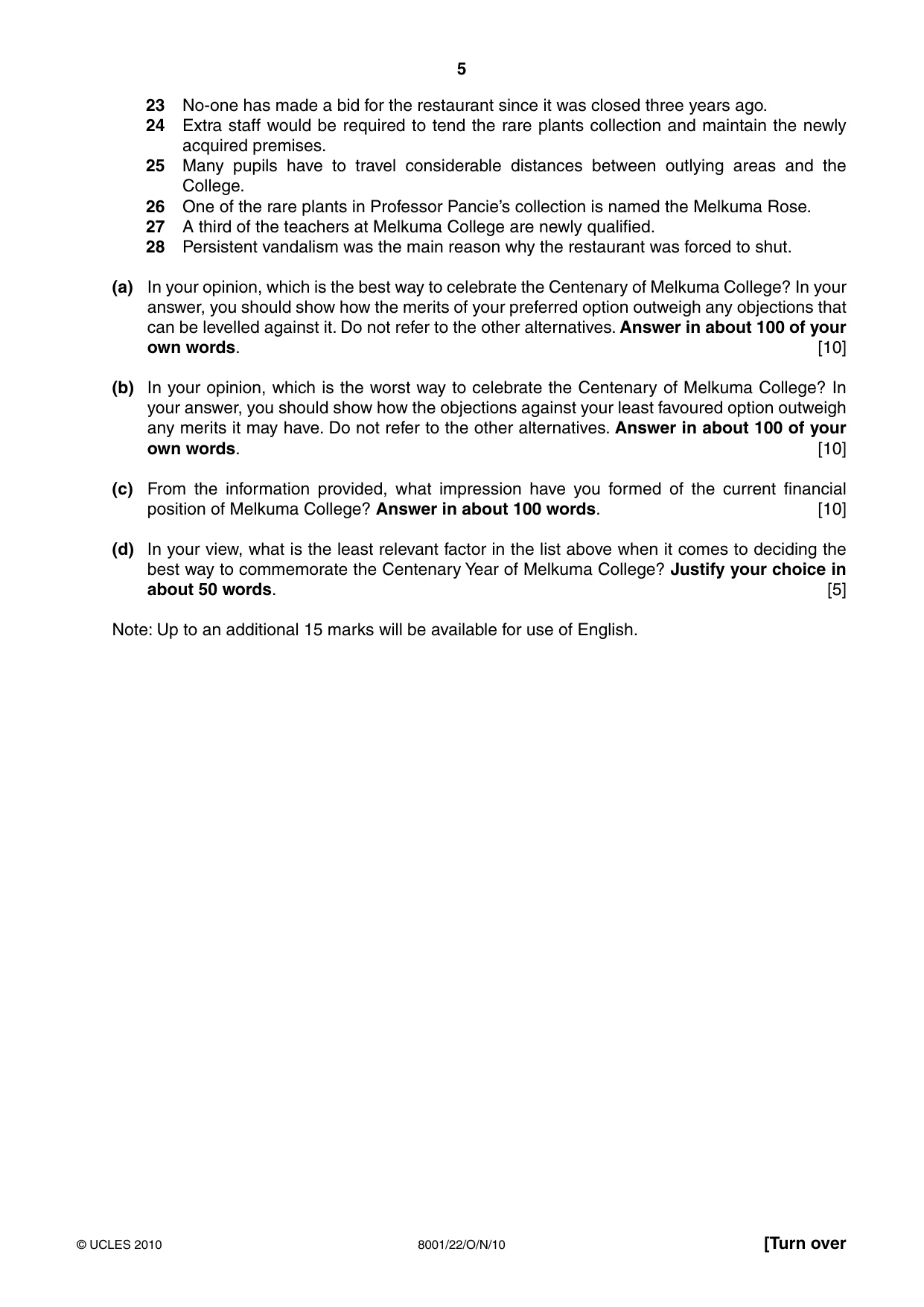
4 8001/22/O/N/10 © UCLES 2010 2 Read the following information and then answer all the questions (a–d) which follow. In 2011, Melkuma College, a day school twelve kilometres from Nolessa, the provincial capital of Oprovit, is due to celebrate its Centenary. Over the past five years, the College’s Centenary Appeal Fund has accumulated 225,000 Oprovit dollars from a wide variety of sources, including two or three wealthy donors. It has been decided to spend the money on one of the following: A An annual Foreign Travel Scholarship, to be awarded to the student who has made the most outstanding contribution to College life. B The purchase of three school coaches. C The acquisition and conversion of a nearby derelict restaurant to house the collection of rare plants donated by Professor Pancie, the College’s most famous pupil. 1 Not every country abroad is prepared to accept the Oprovit dollar as international currency. 2 There is no-one employed at the school with any experience of driving coaches. 3 The Botany Department of the University of Nolessa would be prepared to pay for study visits to the rare plants collection. 4 It is the policy of Oprovit universities to encourage applicants to spend ‘a year out’ between school and degree course. 5 One of Melkuma College’s claims to excellence is that it stays open late during the week for a wide range of sporting and cultural activities. 6 At the moment, Oprovit is involved in an airline dispute with two of its four neighbours. 7 There have been allegations in the past of favouritism in the allocation of prizes. 8 Over the past year, the former restaurant has become the venue for local drug dealers. 9 When he was at the College, Professor Pancie was by no means a popular pupil. 10 In financial difficulties, the Nolessa Bus Company has reduced services between the city centre and the College. 11 Quite a few rare plants recently imported by Professor Pancie have died for no apparent reason within weeks of being added to his collection. 12 The relatively few parents with cars are now starting to give lifts to other children when they take their own to and from school. 13 The grounds round the former restaurant could also provide the College with a much needed extra games pitch. 14 In the current economic climate, money invested may well depreciate in value. 15 In recent years, there have been four serious accidents involving coaches on the narrow and hilly roads near Melkuma College. 16 Melkuma College has, in recent years, lost quite a few promising pupils to schools that are more accessible. 17 The flourishing Pen Pals Society at Melkuma College has many contacts with schools and families in other countries. 18 The Biology Laboratory at Melkuma College is too small even for its present purposes. 19 In the short term, a local coach firm could transport pupils to and from Melkuma College at competitive rates. 20 One of the ideals of Melkuma College is to foster a spirit of service to others amongst its pupils. 21 Melkuma College currently holds the Inter Schools high-jump record. 22 The founder of Melkuma College was a renowned linguist.
Question paper, page 5
5 8001/22/O/N/10 © UCLES 2010 [Turn over 23 No-one has made a bid for the restaurant since it was closed three years ago. 24 Extra staff would be required to tend the rare plants collection and maintain the newly acquired premises. 25 Many pupils have to travel considerable distances between outlying areas and the College. 26 One of the rare plants in Professor Pancie’s collection is named the Melkuma Rose. 27 A third of the teachers at Melkuma College are newly qualified. 28 Persistent vandalism was the main reason why the restaurant was forced to shut. (a) In your opinion, which is the best way to celebrate the Centenary of Melkuma College? In your answer, you should show how the merits of your preferred option outweigh any objections that can be levelled against it. Do not refer to the other alternatives. Answer in about 100 of your own words. [10] (b) In your opinion, which is the worst way to celebrate the Centenary of Melkuma College? In your answer, you should show how the objections against your least favoured option outweigh any merits it may have. Do not refer to the other alternatives. Answer in about 100 of your own words. [10] (c) From the information provided, what impression have you formed of the current financial position of Melkuma College? Answer in about 100 words. [10] (d) In your view, what is the least relevant factor in the list above when it comes to deciding the best way to commemorate the Centenary Year of Melkuma College? Justify your choice in about 50 words. [5] Note: Up to an additional 15 marks will be available for use of English.
Question paper, page 6
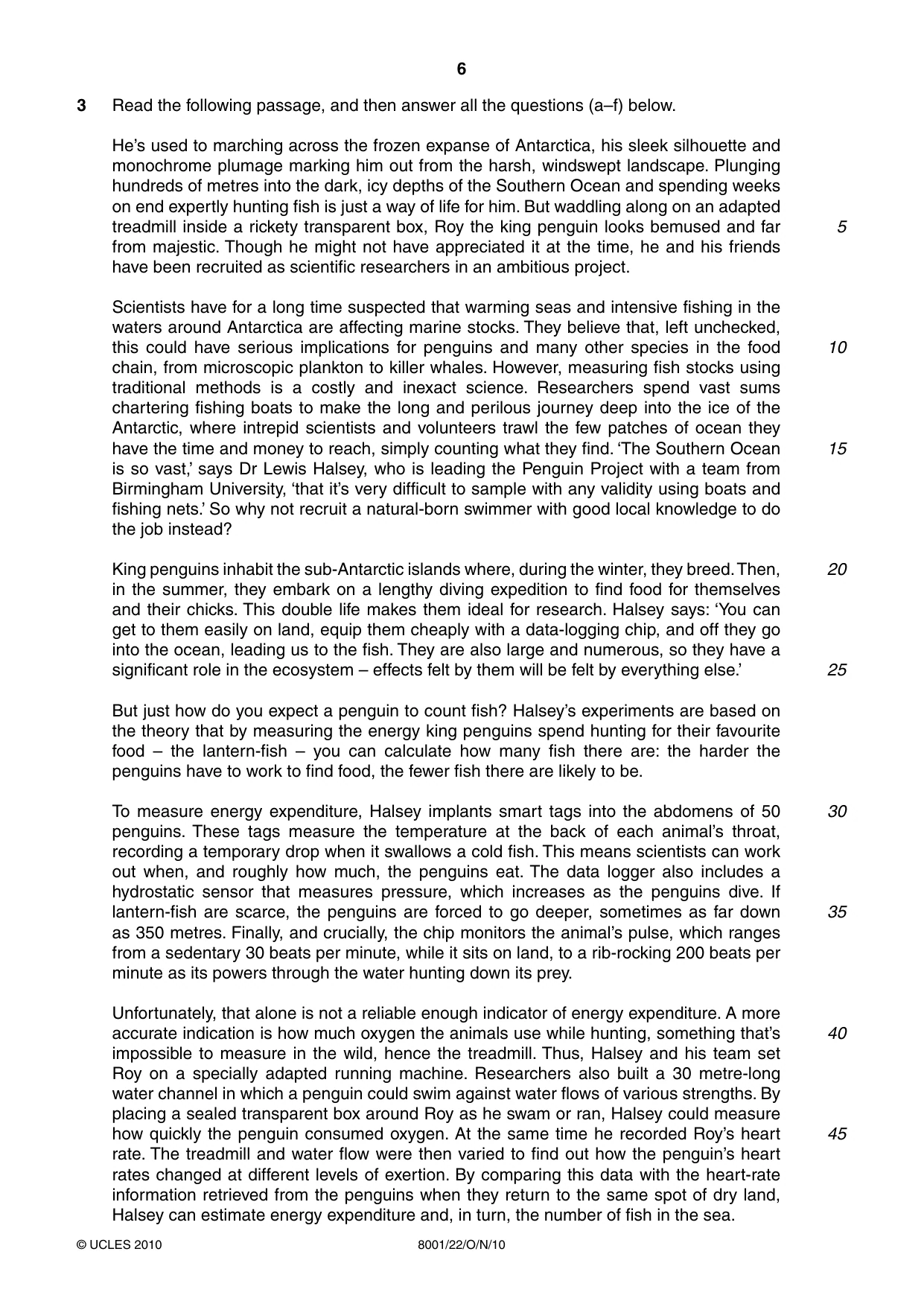
6 8001/22/O/N/10 © UCLES 2010 3 Read the following passage, and then answer all the questions (a–f) below. He’s used to marching across the frozen expanse of Antarctica, his sleek silhouette and monochrome plumage marking him out from the harsh, windswept landscape. Plunging hundreds of metres into the dark, icy depths of the Southern Ocean and spending weeks on end expertly hunting fish is just a way of life for him. But waddling along on an adapted treadmill inside a rickety transparent box, Roy the king penguin looks bemused and far from majestic. Though he might not have appreciated it at the time, he and his friends have been recruited as scientific researchers in an ambitious project. Scientists have for a long time suspected that warming seas and intensive fishing in the waters around Antarctica are affecting marine stocks. They believe that, left unchecked, this could have serious implications for penguins and many other species in the food chain, from microscopic plankton to killer whales. However, measuring fish stocks using traditional methods is a costly and inexact science. Researchers spend vast sums chartering fishing boats to make the long and perilous journey deep into the ice of the Antarctic, where intrepid scientists and volunteers trawl the few patches of ocean they have the time and money to reach, simply counting what they find. ‘The Southern Ocean is so vast,’ says Dr Lewis Halsey, who is leading the Penguin Project with a team from Birmingham University, ‘that it’s very difficult to sample with any validity using boats and fishing nets.’ So why not recruit a natural-born swimmer with good local knowledge to do the job instead? King penguins inhabit the sub-Antarctic islands where, during the winter, they breed. Then, in the summer, they embark on a lengthy diving expedition to find food for themselves and their chicks. This double life makes them ideal for research. Halsey says: ‘You can get to them easily on land, equip them cheaply with a data-logging chip, and off they go into the ocean, leading us to the fish. They are also large and numerous, so they have a significant role in the ecosystem – effects felt by them will be felt by everything else.’ But just how do you expect a penguin to count fish? Halsey’s experiments are based on the theory that by measuring the energy king penguins spend hunting for their favourite food – the lantern-fish – you can calculate how many fish there are: the harder the penguins have to work to find food, the fewer fish there are likely to be. To measure energy expenditure, Halsey implants smart tags into the abdomens of 50 penguins. These tags measure the temperature at the back of each animal’s throat, recording a temporary drop when it swallows a cold fish. This means scientists can work out when, and roughly how much, the penguins eat. The data logger also includes a hydrostatic sensor that measures pressure, which increases as the penguins dive. If lantern-fish are scarce, the penguins are forced to go deeper, sometimes as far down as 350 metres. Finally, and crucially, the chip monitors the animal’s pulse, which ranges from a sedentary 30 beats per minute, while it sits on land, to a rib-rocking 200 beats per minute as its powers through the water hunting down its prey. Unfortunately, that alone is not a reliable enough indicator of energy expenditure. A more accurate indication is how much oxygen the animals use while hunting, something that’s impossible to measure in the wild, hence the treadmill. Thus, Halsey and his team set Roy on a specially adapted running machine. Researchers also built a 30 metre-long water channel in which a penguin could swim against water flows of various strengths. By placing a sealed transparent box around Roy as he swam or ran, Halsey could measure how quickly the penguin consumed oxygen. At the same time he recorded Roy’s heart rate. The treadmill and water flow were then varied to find out how the penguin’s heart rates changed at different levels of exertion. By comparing this data with the heart-rate information retrieved from the penguins when they return to the same spot of dry land, Halsey can estimate energy expenditure and, in turn, the number of fish in the sea. 5 10 15 20 25 30 35 40 45
Question paper, page 7
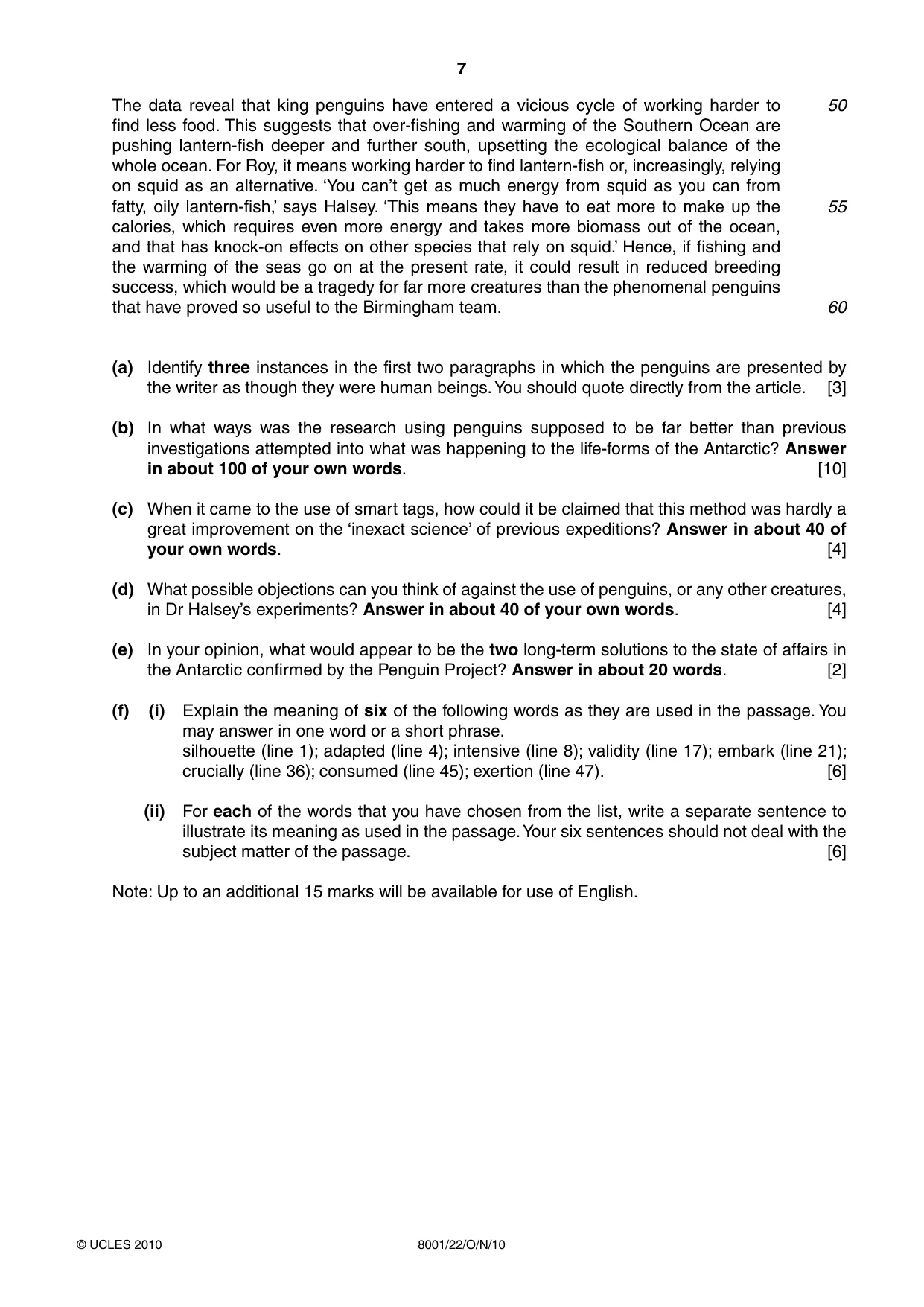
7 8001/22/O/N/10 © UCLES 2010 The data reveal that king penguins have entered a vicious cycle of working harder to find less food. This suggests that over-fishing and warming of the Southern Ocean are pushing lantern-fish deeper and further south, upsetting the ecological balance of the whole ocean. For Roy, it means working harder to find lantern-fish or, increasingly, relying on squid as an alternative. ‘You can’t get as much energy from squid as you can from fatty, oily lantern-fish,’ says Halsey. ‘This means they have to eat more to make up the calories, which requires even more energy and takes more biomass out of the ocean, and that has knock-on effects on other species that rely on squid.’ Hence, if fishing and the warming of the seas go on at the present rate, it could result in reduced breeding success, which would be a tragedy for far more creatures than the phenomenal penguins that have proved so useful to the Birmingham team. (a) Identify three instances in the first two paragraphs in which the penguins are presented by the writer as though they were human beings. You should quote directly from the article. [3] (b) In what ways was the research using penguins supposed to be far better than previous investigations attempted into what was happening to the life-forms of the Antarctic? Answer in about 100 of your own words. [10] (c) When it came to the use of smart tags, how could it be claimed that this method was hardly a great improvement on the ‘inexact science’ of previous expeditions? Answer in about 40 of your own words. [4] (d) What possible objections can you think of against the use of penguins, or any other creatures, in Dr Halsey’s experiments? Answer in about 40 of your own words. [4] (e) In your opinion, what would appear to be the two long-term solutions to the state of affairs in the Antarctic confirmed by the Penguin Project? Answer in about 20 words. [2] (f) (i) Explain the meaning of six of the following words as they are used in the passage. You may answer in one word or a short phrase. silhouette (line 1); adapted (line 4); intensive (line 8); validity (line 17); embark (line 21); crucially (line 36); consumed (line 45); exertion (line 47). [6] (ii) For each of the words that you have chosen from the list, write a separate sentence to illustrate its meaning as used in the passage. Your six sentences should not deal with the subject matter of the passage. [6] Note: Up to an additional 15 marks will be available for use of English. 50 55 60
Question paper, page 8
8 8001/22/O/N/10 © UCLES 2010 Permission to reproduce items where third-party owned material protected by copyright is included has been sought and cleared where possible. Every reasonable effort has been made by the publisher (UCLES) to trace copyright holders, but if any items requiring clearance have unwittingly been included, the publisher will be pleased to make amends at the earliest possible opportunity. University of Cambridge International Examinations is part of the Cambridge Assessment Group. Cambridge Assessment is the brand name of University of Cambridge Local Examinations Syndicate (UCLES), which is itself a department of the University of Cambridge. BLANK PAGE
Mark scheme, page 1
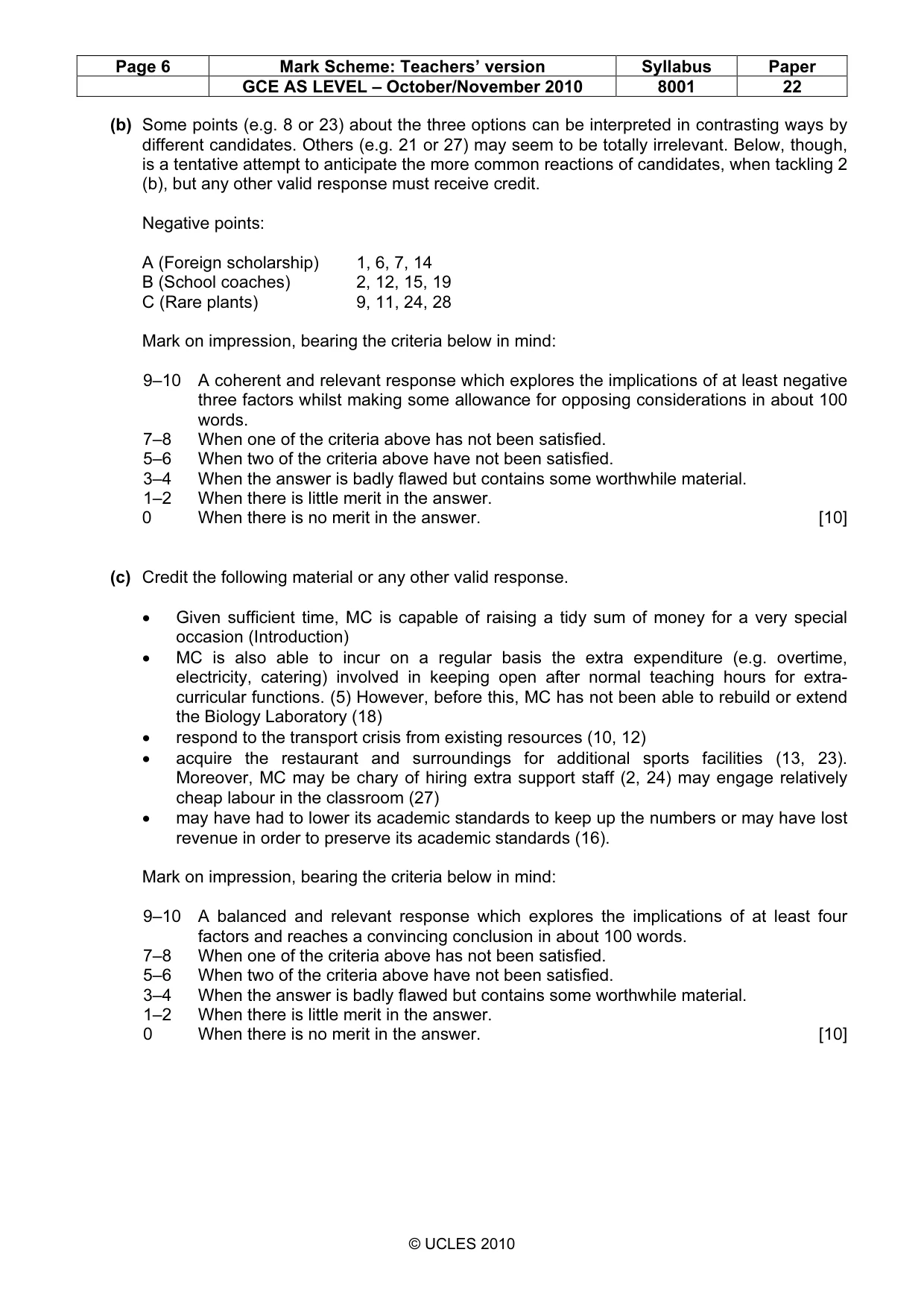
UNIVERSITY OF CAMBRIDGE INTERNATIONAL EXAMINATIONS GCE Advanced Subsidiary Level MARK SCHEME for the October/November 2010 question paper for the guidance of teachers 8001 GENERAL PAPER 8001/22 Paper 2, maximum raw mark 50 This mark scheme is published as an aid to teachers and candidates, to indicate the requirements of the examination. It shows the basis on which Examiners were instructed to award marks. It does not indicate the details of the discussions that took place at an Examiners’ meeting before marking began, which would have considered the acceptability of alternative answers. Mark schemes must be read in conjunction with the question papers and the report on the examination. • CIE will not enter into discussions or correspondence in connection with these mark schemes. CIE is publishing the mark schemes for the October/November 2010 question papers for most IGCSE, GCE Advanced Level and Advanced Subsidiary Level syllabuses and some Ordinary Level syllabuses.
Mark scheme, page 2
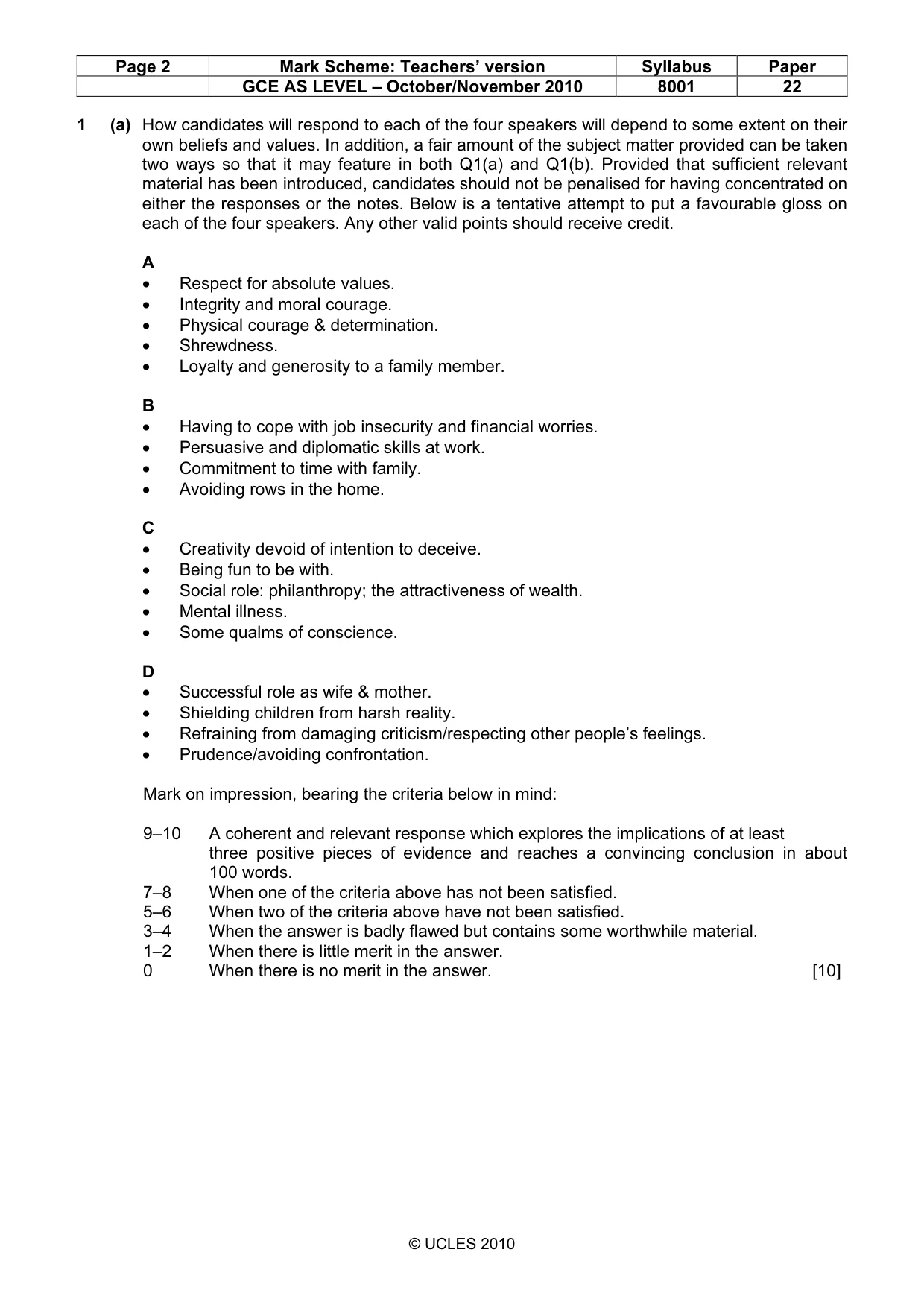
Page 2 Mark Scheme: Teachers’ version Syllabus Paper GCE AS LEVEL – October/November 2010 8001 22 © UCLES 2010 1 (a) How candidates will respond to each of the four speakers will depend to some extent on their own beliefs and values. In addition, a fair amount of the subject matter provided can be taken two ways so that it may feature in both Q1(a) and Q1(b). Provided that sufficient relevant material has been introduced, candidates should not be penalised for having concentrated on either the responses or the notes. Below is a tentative attempt to put a favourable gloss on each of the four speakers. Any other valid points should receive credit. A • Respect for absolute values. • Integrity and moral courage. • Physical courage & determination. • Shrewdness. • Loyalty and generosity to a family member. B • Having to cope with job insecurity and financial worries. • Persuasive and diplomatic skills at work. • Commitment to time with family. • Avoiding rows in the home. C • Creativity devoid of intention to deceive. • Being fun to be with. • Social role: philanthropy; the attractiveness of wealth. • Mental illness. • Some qualms of conscience. D • Successful role as wife & mother. • Shielding children from harsh reality. • Refraining from damaging criticism/respecting other people’s feelings. • Prudence/avoiding confrontation. Mark on impression, bearing the criteria below in mind: 9–10 A coherent and relevant response which explores the implications of at least three positive pieces of evidence and reaches a convincing conclusion in about 100 words. 7–8 When one of the criteria above has not been satisfied. 5–6 When two of the criteria above have not been satisfied. 3–4 When the answer is badly flawed but contains some worthwhile material. 1–2 When there is little merit in the answer. 0 When there is no merit in the answer. [10]
Mark scheme, page 3
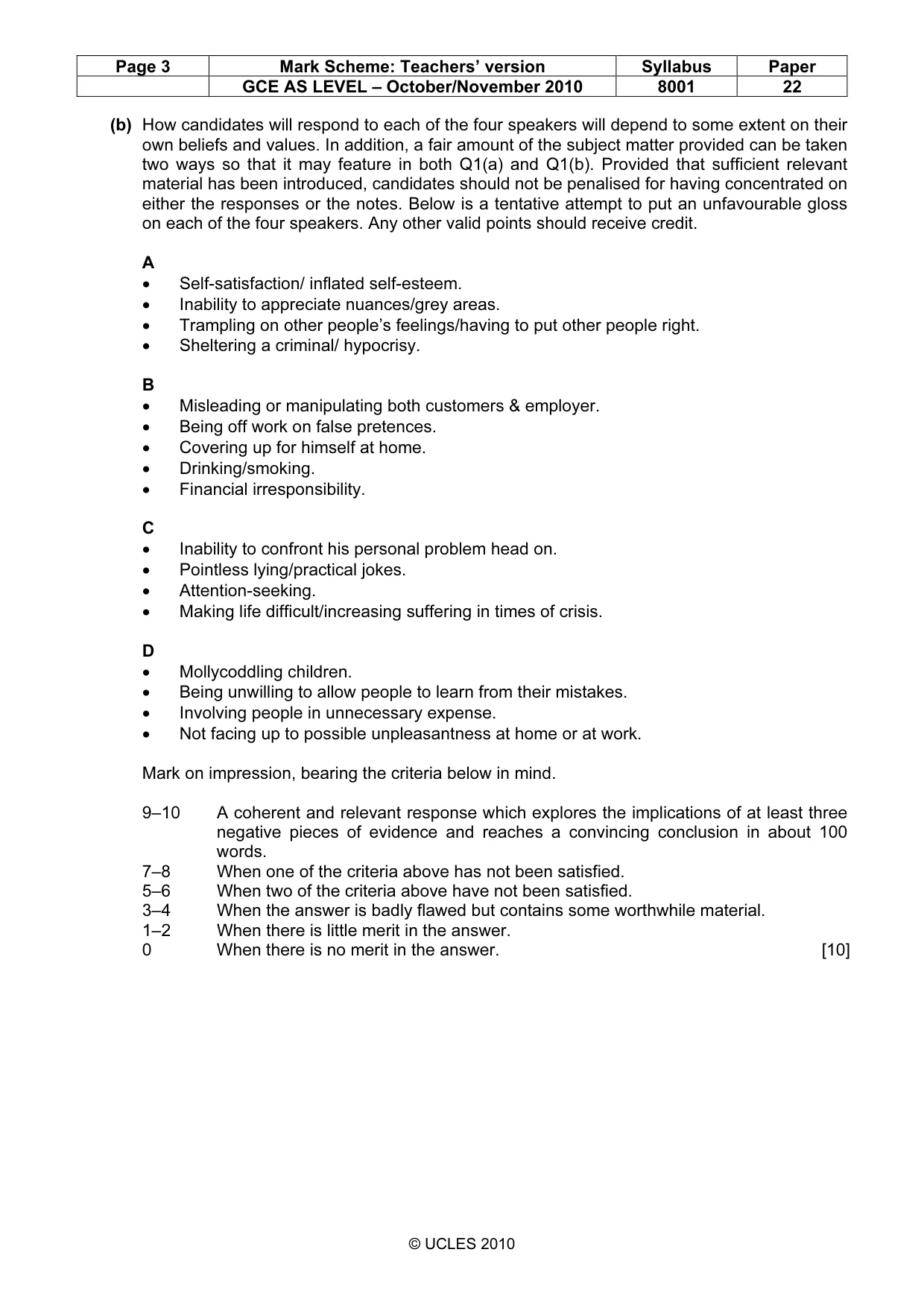
Page 3 Mark Scheme: Teachers’ version Syllabus Paper GCE AS LEVEL – October/November 2010 8001 22 © UCLES 2010 (b) How candidates will respond to each of the four speakers will depend to some extent on their own beliefs and values. In addition, a fair amount of the subject matter provided can be taken two ways so that it may feature in both Q1(a) and Q1(b). Provided that sufficient relevant material has been introduced, candidates should not be penalised for having concentrated on either the responses or the notes. Below is a tentative attempt to put an unfavourable gloss on each of the four speakers. Any other valid points should receive credit. A • Self-satisfaction/ inflated self-esteem. • Inability to appreciate nuances/grey areas. • Trampling on other people’s feelings/having to put other people right. • Sheltering a criminal/ hypocrisy. B • Misleading or manipulating both customers & employer. • Being off work on false pretences. • Covering up for himself at home. • Drinking/smoking. • Financial irresponsibility. C • Inability to confront his personal problem head on. • Pointless lying/practical jokes. • Attention-seeking. • Making life difficult/increasing suffering in times of crisis. D • Mollycoddling children. • Being unwilling to allow people to learn from their mistakes. • Involving people in unnecessary expense. • Not facing up to possible unpleasantness at home or at work. Mark on impression, bearing the criteria below in mind. 9–10 A coherent and relevant response which explores the implications of at least three negative pieces of evidence and reaches a convincing conclusion in about 100 words. 7–8 When one of the criteria above has not been satisfied. 5–6 When two of the criteria above have not been satisfied. 3–4 When the answer is badly flawed but contains some worthwhile material. 1–2 When there is little merit in the answer. 0 When there is no merit in the answer. [10]
Mark scheme, page 4
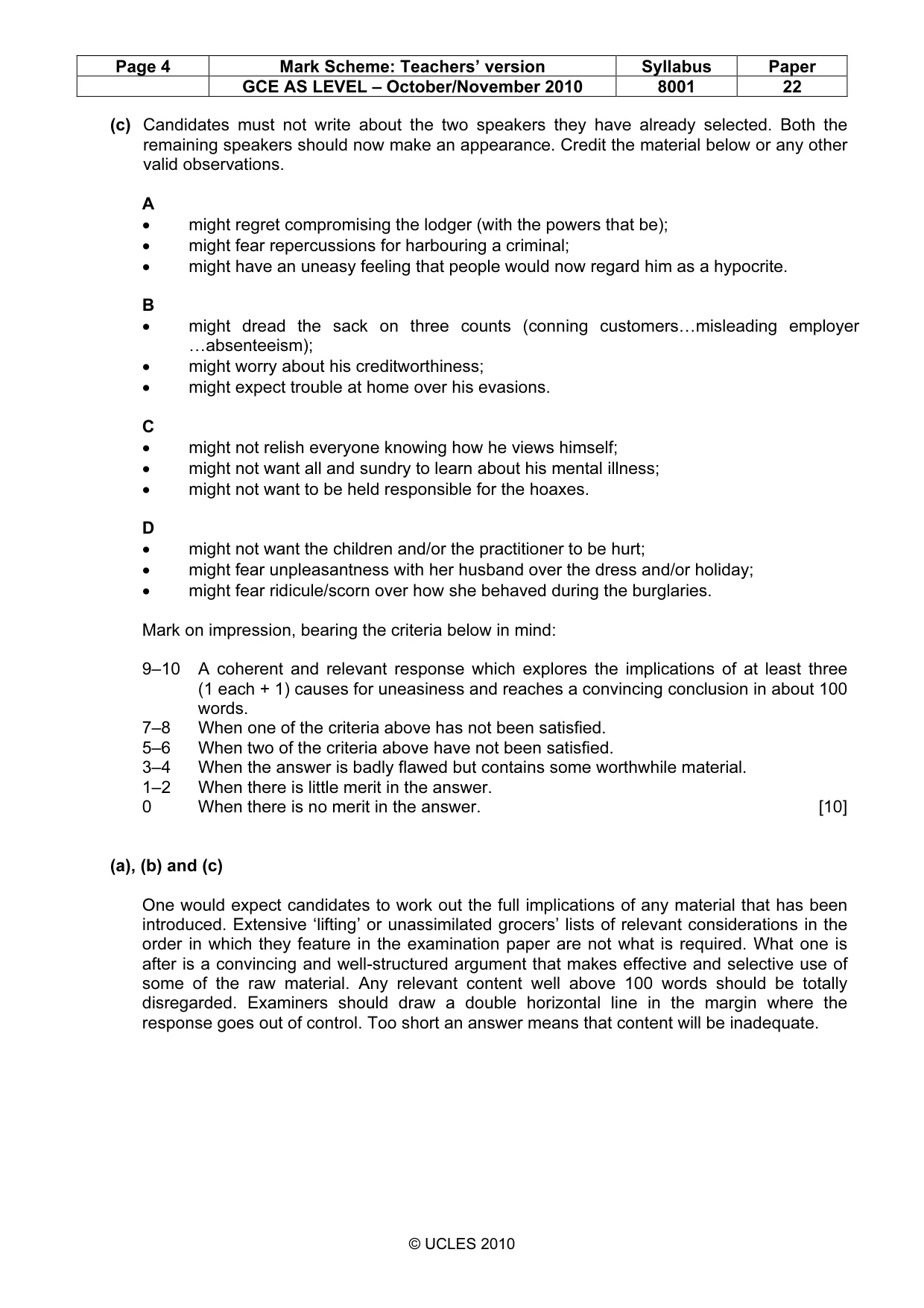
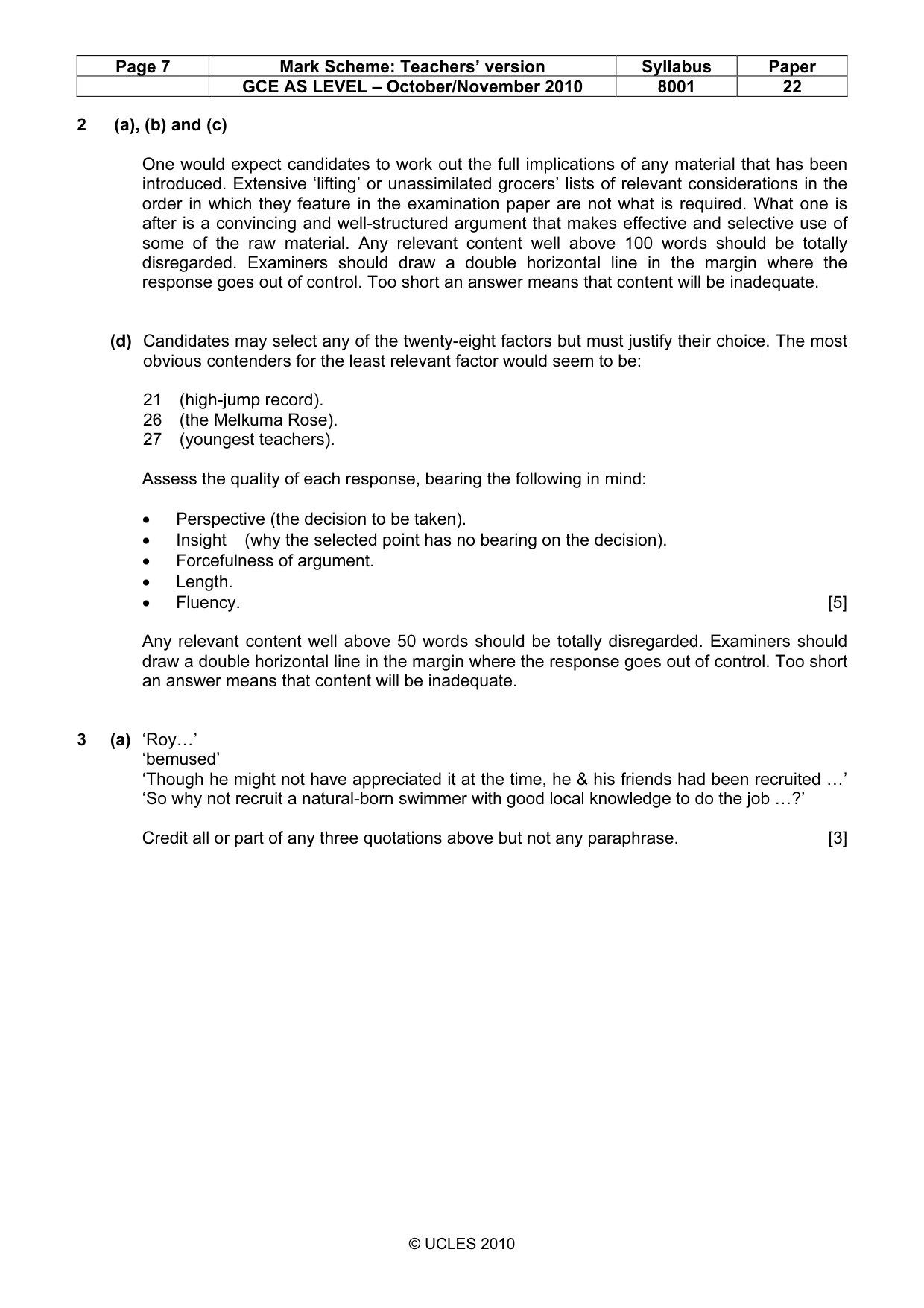
Page 4 Mark Scheme: Teachers’ version Syllabus Paper GCE AS LEVEL – October/November 2010 8001 22 © UCLES 2010 (c) Candidates must not write about the two speakers they have already selected. Both the remaining speakers should now make an appearance. Credit the material below or any other valid observations. A • might regret compromising the lodger (with the powers that be); • might fear repercussions for harbouring a criminal; • might have an uneasy feeling that people would now regard him as a hypocrite. B • might dread the sack on three counts (conning customers…misleading employer …absenteeism); • might worry about his creditworthiness; • might expect trouble at home over his evasions. C • might not relish everyone knowing how he views himself; • might not want all and sundry to learn about his mental illness; • might not want to be held responsible for the hoaxes. D • might not want the children and/or the practitioner to be hurt; • might fear unpleasantness with her husband over the dress and/or holiday; • might fear ridicule/scorn over how she behaved during the burglaries. Mark on impression, bearing the criteria below in mind: 9–10 A coherent and relevant response which explores the implications of at least three (1 each + 1) causes for uneasiness and reaches a convincing conclusion in about 100 words. 7–8 When one of the criteria above has not been satisfied. 5–6 When two of the criteria above have not been satisfied. 3–4 When the answer is badly flawed but contains some worthwhile material. 1–2 When there is little merit in the answer. 0 When there is no merit in the answer. [10] (a), (b) and (c) One would expect candidates to work out the full implications of any material that has been introduced. Extensive ‘lifting’ or unassimilated grocers’ lists of relevant considerations in the order in which they feature in the examination paper are not what is required. What one is after is a convincing and well-structured argument that makes effective and selective use of some of the raw material. Any relevant content well above 100 words should be totally disregarded. Examiners should draw a double horizontal line in the margin where the response goes out of control. Too short an answer means that content will be inadequate.
Mark scheme, page 5
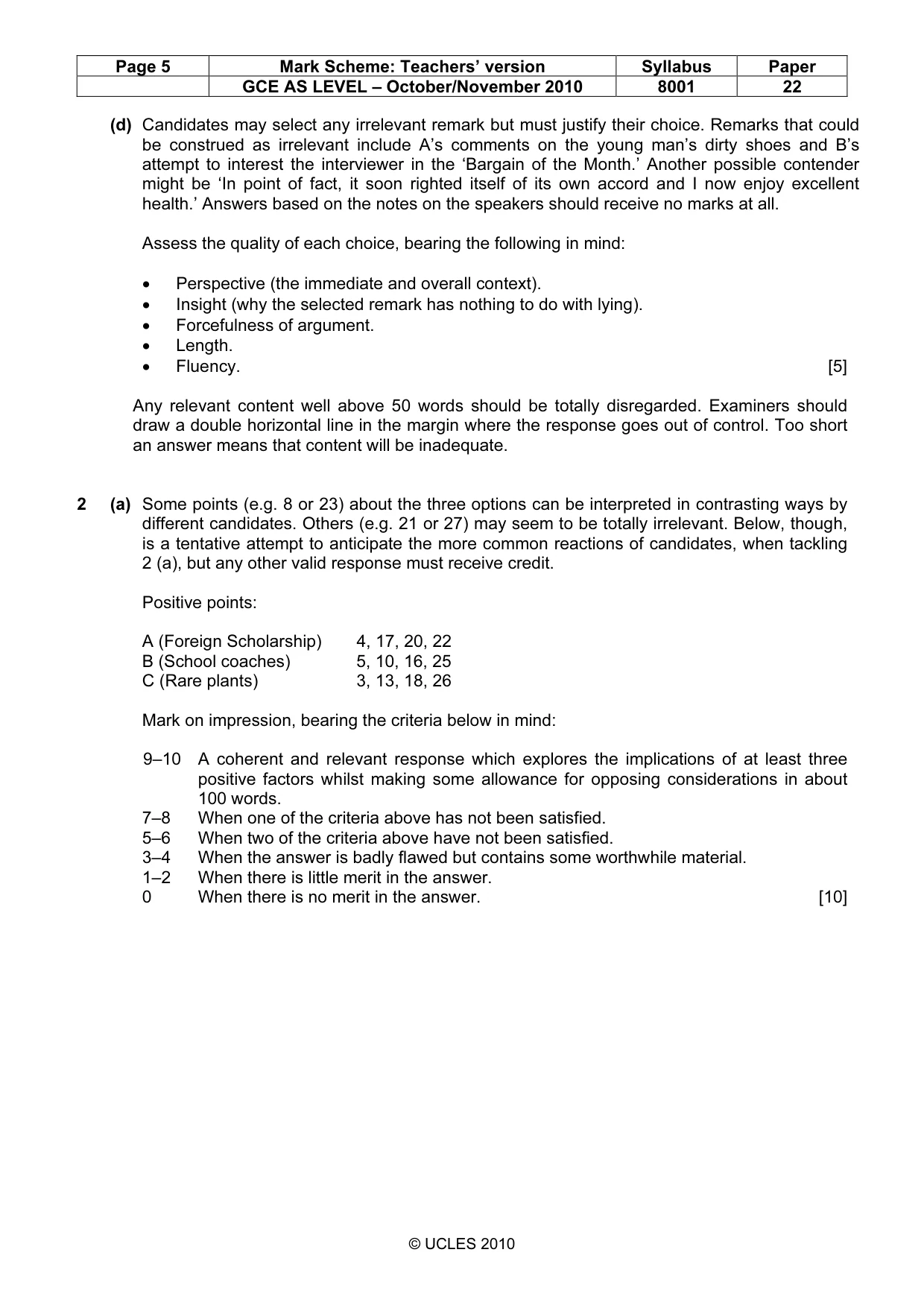
Page 5 Mark Scheme: Teachers’ version Syllabus Paper GCE AS LEVEL – October/November 2010 8001 22 © UCLES 2010 (d) Candidates may select any irrelevant remark but must justify their choice. Remarks that could be construed as irrelevant include A’s comments on the young man’s dirty shoes and B’s attempt to interest the interviewer in the ‘Bargain of the Month.’ Another possible contender might be ‘In point of fact, it soon righted itself of its own accord and I now enjoy excellent health.’ Answers based on the notes on the speakers should receive no marks at all. Assess the quality of each choice, bearing the following in mind: • Perspective (the immediate and overall context). • Insight (why the selected remark has nothing to do with lying). • Forcefulness of argument. • Length. • Fluency. [5] Any relevant content well above 50 words should be totally disregarded. Examiners should draw a double horizontal line in the margin where the response goes out of control. Too short an answer means that content will be inadequate. 2 (a) Some points (e.g. 8 or 23) about the three options can be interpreted in contrasting ways by different candidates. Others (e.g. 21 or 27) may seem to be totally irrelevant. Below, though, is a tentative attempt to anticipate the more common reactions of candidates, when tackling 2 (a), but any other valid response must receive credit. Positive points: A (Foreign Scholarship) 4, 17, 20, 22 B (School coaches) 5, 10, 16, 25 C (Rare plants) 3, 13, 18, 26 Mark on impression, bearing the criteria below in mind: 9–10 A coherent and relevant response which explores the implications of at least three positive factors whilst making some allowance for opposing considerations in about 100 words. 7–8 When one of the criteria above has not been satisfied. 5–6 When two of the criteria above have not been satisfied. 3–4 When the answer is badly flawed but contains some worthwhile material. 1–2 When there is little merit in the answer. 0 When there is no merit in the answer. [10]
Mark scheme, page 6
Page 6 Mark Scheme: Teachers’ version Syllabus Paper GCE AS LEVEL – October/November 2010 8001 22 © UCLES 2010 (b) Some points (e.g. 8 or 23) about the three options can be interpreted in contrasting ways by different candidates. Others (e.g. 21 or 27) may seem to be totally irrelevant. Below, though, is a tentative attempt to anticipate the more common reactions of candidates, when tackling 2 (b), but any other valid response must receive credit. Negative points: A (Foreign scholarship) 1, 6, 7, 14 B (School coaches) 2, 12, 15, 19 C (Rare plants) 9, 11, 24, 28 Mark on impression, bearing the criteria below in mind: 9–10 A coherent and relevant response which explores the implications of at least negative three factors whilst making some allowance for opposing considerations in about 100 words. 7–8 When one of the criteria above has not been satisfied. 5–6 When two of the criteria above have not been satisfied. 3–4 When the answer is badly flawed but contains some worthwhile material. 1–2 When there is little merit in the answer. 0 When there is no merit in the answer. [10] (c) Credit the following material or any other valid response. • Given sufficient time, MC is capable of raising a tidy sum of money for a very special occasion (Introduction) • MC is also able to incur on a regular basis the extra expenditure (e.g. overtime, electricity, catering) involved in keeping open after normal teaching hours for extra- curricular functions. (5) However, before this, MC has not been able to rebuild or extend the Biology Laboratory (18) • respond to the transport crisis from existing resources (10, 12) • acquire the restaurant and surroundings for additional sports facilities (13, 23). Moreover, MC may be chary of hiring extra support staff (2, 24) may engage relatively cheap labour in the classroom (27) • may have had to lower its academic standards to keep up the numbers or may have lost revenue in order to preserve its academic standards (16). Mark on impression, bearing the criteria below in mind: 9–10 A balanced and relevant response which explores the implications of at least four factors and reaches a convincing conclusion in about 100 words. 7–8 When one of the criteria above has not been satisfied. 5–6 When two of the criteria above have not been satisfied. 3–4 When the answer is badly flawed but contains some worthwhile material. 1–2 When there is little merit in the answer. 0 When there is no merit in the answer. [10]
Mark scheme, page 7
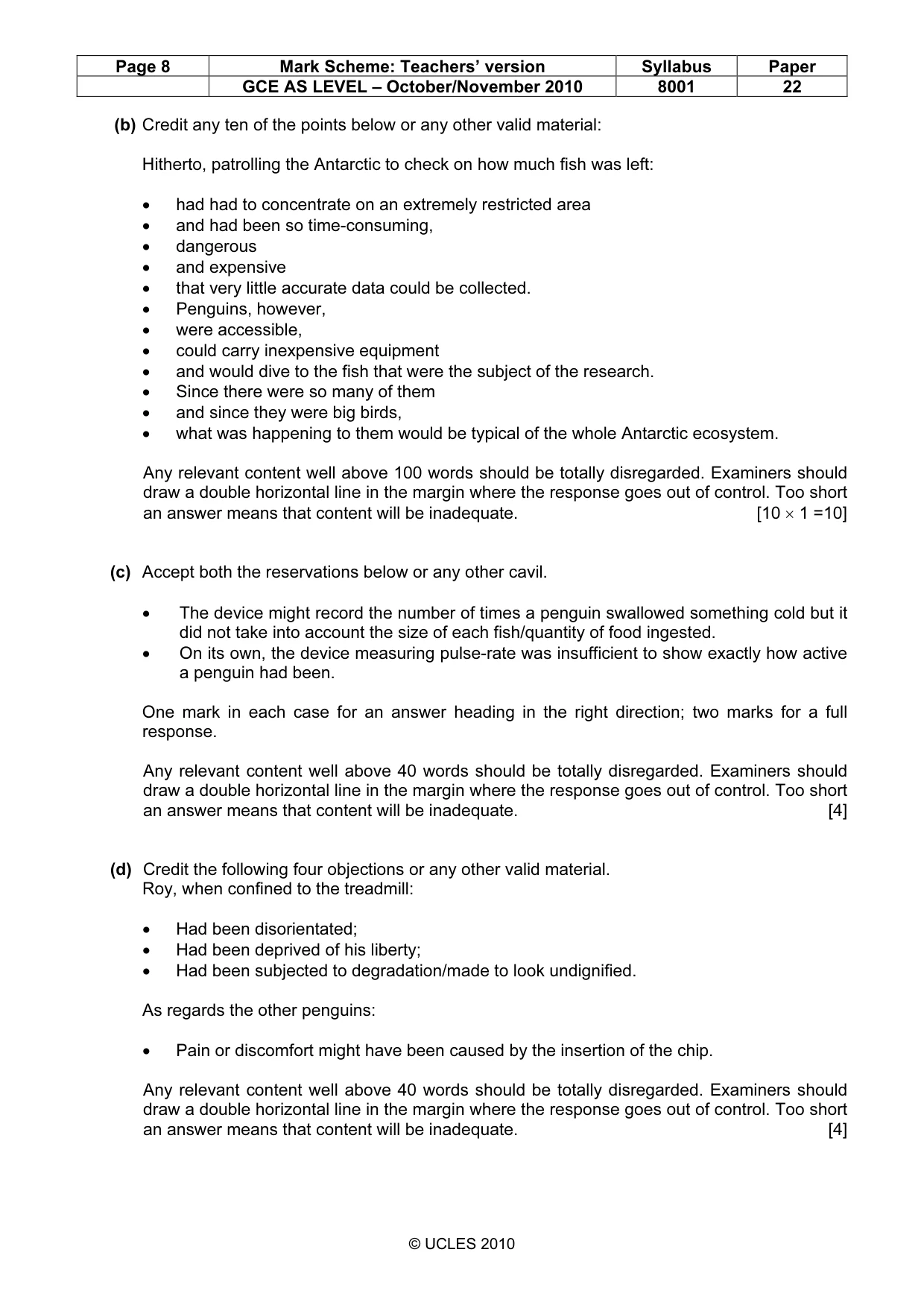
Page 7 Mark Scheme: Teachers’ version Syllabus Paper GCE AS LEVEL – October/November 2010 8001 22 © UCLES 2010 2 (a), (b) and (c) One would expect candidates to work out the full implications of any material that has been introduced. Extensive ‘lifting’ or unassimilated grocers’ lists of relevant considerations in the order in which they feature in the examination paper are not what is required. What one is after is a convincing and well-structured argument that makes effective and selective use of some of the raw material. Any relevant content well above 100 words should be totally disregarded. Examiners should draw a double horizontal line in the margin where the response goes out of control. Too short an answer means that content will be inadequate. (d) Candidates may select any of the twenty-eight factors but must justify their choice. The most obvious contenders for the least relevant factor would seem to be: 21 (high-jump record). 26 (the Melkuma Rose). 27 (youngest teachers). Assess the quality of each response, bearing the following in mind: • Perspective (the decision to be taken). • Insight (why the selected point has no bearing on the decision). • Forcefulness of argument. • Length. • Fluency. [5] Any relevant content well above 50 words should be totally disregarded. Examiners should draw a double horizontal line in the margin where the response goes out of control. Too short an answer means that content will be inadequate. 3 (a) ‘Roy…’ ‘bemused’ ‘Though he might not have appreciated it at the time, he & his friends had been recruited …’ ‘So why not recruit a natural-born swimmer with good local knowledge to do the job …?’ Credit all or part of any three quotations above but not any paraphrase. [3]
Mark scheme, page 8
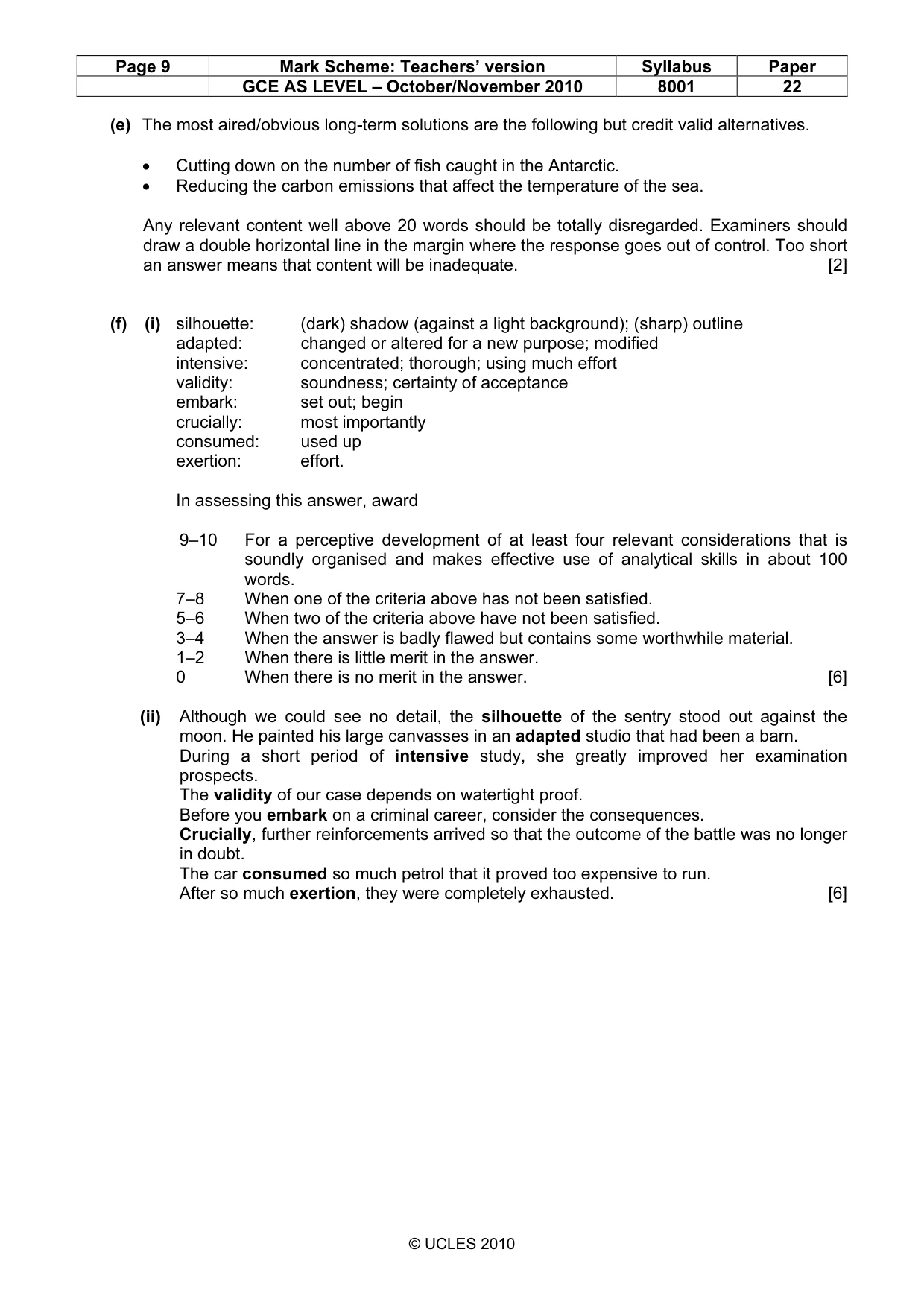
Page 8 Mark Scheme: Teachers’ version Syllabus Paper GCE AS LEVEL – October/November 2010 8001 22 © UCLES 2010 (b) Credit any ten of the points below or any other valid material: Hitherto, patrolling the Antarctic to check on how much fish was left: • had had to concentrate on an extremely restricted area • and had been so time-consuming, • dangerous • and expensive • that very little accurate data could be collected. • Penguins, however, • were accessible, • could carry inexpensive equipment • and would dive to the fish that were the subject of the research. • Since there were so many of them • and since they were big birds, • what was happening to them would be typical of the whole Antarctic ecosystem. Any relevant content well above 100 words should be totally disregarded. Examiners should draw a double horizontal line in the margin where the response goes out of control. Too short an answer means that content will be inadequate. [10 × 1 =10] (c) Accept both the reservations below or any other cavil. • The device might record the number of times a penguin swallowed something cold but it did not take into account the size of each fish/quantity of food ingested. • On its own, the device measuring pulse-rate was insufficient to show exactly how active a penguin had been. One mark in each case for an answer heading in the right direction; two marks for a full response. Any relevant content well above 40 words should be totally disregarded. Examiners should draw a double horizontal line in the margin where the response goes out of control. Too short an answer means that content will be inadequate. [4] (d) Credit the following four objections or any other valid material. Roy, when confined to the treadmill: • Had been disorientated; • Had been deprived of his liberty; • Had been subjected to degradation/made to look undignified. As regards the other penguins: • Pain or discomfort might have been caused by the insertion of the chip. Any relevant content well above 40 words should be totally disregarded. Examiners should draw a double horizontal line in the margin where the response goes out of control. Too short an answer means that content will be inadequate. [4]
Mark scheme, page 9
Page 9 Mark Scheme: Teachers’ version Syllabus Paper GCE AS LEVEL – October/November 2010 8001 22 © UCLES 2010 (e) The most aired/obvious long-term solutions are the following but credit valid alternatives. • Cutting down on the number of fish caught in the Antarctic. • Reducing the carbon emissions that affect the temperature of the sea. Any relevant content well above 20 words should be totally disregarded. Examiners should draw a double horizontal line in the margin where the response goes out of control. Too short an answer means that content will be inadequate. [2] (f) (i) silhouette: (dark) shadow (against a light background); (sharp) outline adapted: changed or altered for a new purpose; modified intensive: concentrated; thorough; using much effort validity: soundness; certainty of acceptance embark: set out; begin crucially: most importantly consumed: used up exertion: effort. In assessing this answer, award 9–10 For a perceptive development of at least four relevant considerations that is soundly organised and makes effective use of analytical skills in about 100 words. 7–8 When one of the criteria above has not been satisfied. 5–6 When two of the criteria above have not been satisfied. 3–4 When the answer is badly flawed but contains some worthwhile material. 1–2 When there is little merit in the answer. 0 When there is no merit in the answer. [6] (ii) Although we could see no detail, the silhouette of the sentry stood out against the moon. He painted his large canvasses in an adapted studio that had been a barn. During a short period of intensive study, she greatly improved her examination prospects. The validity of our case depends on watertight proof. Before you embark on a criminal career, consider the consequences. Crucially, further reinforcements arrived so that the outcome of the battle was no longer in doubt. The car consumed so much petrol that it proved too expensive to run. After so much exertion, they were completely exhausted. [6]
What you needed in this session
Cambridge’s own grade thresholds for 2010 Oct/Nov, Paper 2 · Variant 2. A higher threshold means an easier paper — the bar moves with how the cohort did.