Cambridge A Level General Paper (AS Level only) 8001 — 2010 Oct/Nov Paper 2 · Variant 1
8001/21/O/N/10 · 50 marks · ≈56 min
The question paper and its mark scheme, free to read here and free to download. This is Cambridge’s own paper, exactly as it was sat.
Question paper8 pages
Mark scheme7 pages
Answers below. Sit the paper first if you are practising.
Paper as text
Question paper, page 1
This document consists of 7 printed pages and 1 blank page. DC (SM) 19230/5 © UCLES 2010 [Turn over UNIVERSITY OF CAMBRIDGE INTERNATIONAL EXAMINATIONS General Certificate of Education Advanced Level READ THESE INSTRUCTIONS FIRST If you have been given an Answer Booklet, follow the instructions on the front cover of the Booklet. Write your Centre number, candidate number and name on all the work you hand in. Write in dark blue or black pen. Do not use staples, paper clips, highlighters, glue or correction fluid. Answer one question. The total time of 1 hour 30 minutes includes 10 minutes for you to study the questions before you begin your answer. You may make notes during this time if you wish. Up to 15 marks will be given for the quality and accuracy of your English throughout this paper. Dictionaries are not permitted. At the end of the examination, fasten all your work securely together. The number of marks is given in brackets [ ] at the end of each question or part question. * 3 9 9 0 3 8 7 6 9 8 * GENERAL PAPER 8001/21 October/November 2010 1 hour 30 minutes Additional Materials: Answer Booklet/Paper
Question paper, page 2
2 8001/21/O/N/10 © UCLES 2010 1 Study this dialogue between two colleagues and then answer all the questions (a) – (d) which follow. Inwo: Another coffee? Jubka: Why not? We’re not due back yet. Inwo (To waitress): Same again, please. Jubka, what’s that you’re looking at? Jubka: ‘The Weekly Sentinel’. It features the ‘Kurebo Holocaust’, if you can call it that. Inwo: The what? Jubka: The so-called ‘Kurebo Holocaust’. You know, the year before last’s massive bush fire. They’ve just published the findings of the Official Independent Enquiry. Interestingly – Inwo: Oh, that? Terrible business! All those properties destroyed on the outskirts just because the wind was in the wrong direction. Jubka: The wind, the drought, and, it seems to me, a lot of human error. Inwo: You mean the farmers? They ought to be shot for letting it get out of control in the first place. Of all the – Jubka: Slash and burn’s a tried and tested practice in the right conditions, how else can they clear the ground for the next crop? But when – Inwo: The ground’s tinder dry, a gale is blowing, and thousands are living nearby – Jubka: Well, perhaps, not nearby, but not too far away, and the wind came after, but still – Inwo: And the cheek of it! They blamed the city folk coming away from the Nature Reserve and dropping lighted cigarette ends all over the place. Jubka: Really? (To waitress) Thanks very much. Sugar? Inwo: That’s what the RTV News said, so it’s a fact. Jubka: Because the RTV News said? Inwo: Yes, because the RTV News said. Anyway, the authorities should have replaced all those fire-warnings that had been vandalised. You can’t blame the odd day tripper if they’re not posted up. And fancy hiring mere kids as fire-wardens! Jubka: Perhaps. All the same … Inwo: Typical false economy! The result, all the fire-engines in the region had to be mobilised. Jubka: All? Inwo: Together with a fleet of combat helicopters. Now there was a waste! Jubka: I thought we only had – Inwo: And half the National Guard to keep the looters at bay once the evacuation of everyone living in the path of the fire started in earnest. Meanwhile, there was a crime wave everywhere else. It’s high time that lot was booted out! Jubka: That lot? Inwo: All the politicians and officials up at Kurebo. How incompetent – Jubka: Just because of one fire? And haven’t they paid out millions, in the past few months, to all those who were made homeless? Inwo: Money they’ve borrowed. Then, of course, all the office workers were laid off because of that pall of smoke hanging over the city centre. Jubka: Still, no-one actually died, did they? Nowhere, at any stage. 5 10 15 20 25 30 35 40 45 50
Question paper, page 3
3 8001/21/O/N/10 © UCLES 2010 [Turn over Inwo: I’m sure they have, but they’ll have hushed it up, that’s what always happens. Anyway, did you hear about Hermes? Jubka: Hermes, who’s he? Inwo: You don’t read the papers with a personal angle, do you? He’s that Fire Chief from Lussus who received the summons to proceed to the capital like everyone else but never made it. Jubka: Why ever not? Inwo: His engine got stuck up a dirt track when it turned off the main road to deal with what the Daily Thrill called a ‘minor conflagration.’ Jubka: All things are relative, I suppose. Inwo: And, meanwhile, two of his colleagues lost their lives in a blazing inferno a long way from home. And a reporter died in the course of duty. His – Jubka: From the Daily Thrill ? Inwo: Yes, how did you guess? Jubka: And what did this Hermes say in his defence? Inwo: Oh, some nonsense about immediate priorities coming first and that he knew the lady whose cooking pan had caught fire. I ask you, have you ever… Jubka: So, he wouldn’t have been exactly popular in his neighbourhood if he had ignored her and raced on past? Surely – Inwo: You must be joking! Come on, we must get moving. Note: When a question asks for an answer IN YOUR OWN WORDS and you select the appropriate material from the passage for your answer, you must still use your own words to express it. Little credit can be given to answers which only copy words or phrases from the passage. (a) Look at the following quotations from the dialogue and, in each case, briefly explain what it tells us about either Inwo or Jubka. (i) ‘the “Kurebo Holocaust”, if you can call it that.’ (lines 5–6) (ii) ‘They ought to be shot for letting it get out of control’. (lines 15–16) (iii) ‘That’s what the RTV News said, so it’s a fact.’ (line 28) (iv) ‘Perhaps. All the same…’ (line 34) (v) ‘Oh, some nonsense about immediate priorities coming first’. (line 70) [10] (b) In about 100 of your own words, compose the final paragraph in the Official Independent Enquiry report praising the authorities over the whole affair of the ‘Kurebo Holocaust’. You must base your paragraph on the conversation above but you need to interpret the facts. [10] (c) In about 100 of your own words, compose the final paragraph in the Official Independent Enquiry report criticising the authorities over the whole affair of the ‘Kurebo Holocaust’. You must base your paragraph on the conversation above but you need to interpret the facts. [10] (d) Bearing in mind the situation referred to in the dialogue, develop one objection to the claim by Hermes that immediate priorities come first. Answer in about 50 of your own words. [5] Note: Up to an additional 15 marks will be available for use of English. 55 60 65 70 75
Question paper, page 4
4 8001/21/O/N/10 © UCLES 2010 2 Study the information and then answer all the questions (a) – (d) which follow. You are the Managing Director of a small but long-established firm that specialises in the manufacture of high-quality furniture for export. As a result of the global recession and a sharp fall in orders, you have had to cut back on overheads such as training, sponsorship and advertising. As a further economy measure, you now have to decide on which member of your Senior Management Team should leave the firm. (Apart from their own particular responsibilities, this Senior Management Team advises the Managing Director on the overall running of the business.) Below are the notes you have made on your three colleagues. A Felix Momsenta 1. He plays too much golf. 2. Much loved by the workforce. 3. Two children in the Armed Forces. 4. Great grandson of the original founder of the firm. 5. In the past, he has invested heavily in the company. 6. Hopeless with figures. 7. Family still owns the site on which our factory stands. 8. Can’t stand paperwork or long business meetings. 9. Lost a fortune in the recent financial meltdown. 10. Nice manners. Can always be trusted with foreign visitors. B Grace Nautienne 1. It was her flair for publicity that gained us worldwide fame. 2. Almost always exceeds her budget. 3. I do like the biscuits she brings for our Team meetings. 4. She’s my wife’s best friend. 5. Puts in long hours every day. 6. She will make the odd unfortunate remark that everyone hears. 7. She has often applied for ‘more rewarding’ positions elsewhere. 8. Her husband’s the Minister for Overseas Trade. 9. Can be very bossy. Won’t take no for an answer. 10. A pity I’ve had to turn down so many of her ‘brilliant’ ideas. C Henry Ordoma 1. Must be nearly 60. 2. Who else could put the finishing touches to our products? 3. He’s never complained when we’ve had to freeze everyone’s salary in the past. 4. Tends to come into work only when it suits him. 5. His mind goes blank as soon as we suggest anything new. 6. Without him, that strike would have gone on for weeks. 7. He devotes much of his spare time to deserving charities. 8. His family have been skilled craftsmen here for three generations. 9. He’s much too fond of gossip. 10. He often shows a great deal of commonsense.
Question paper, page 5
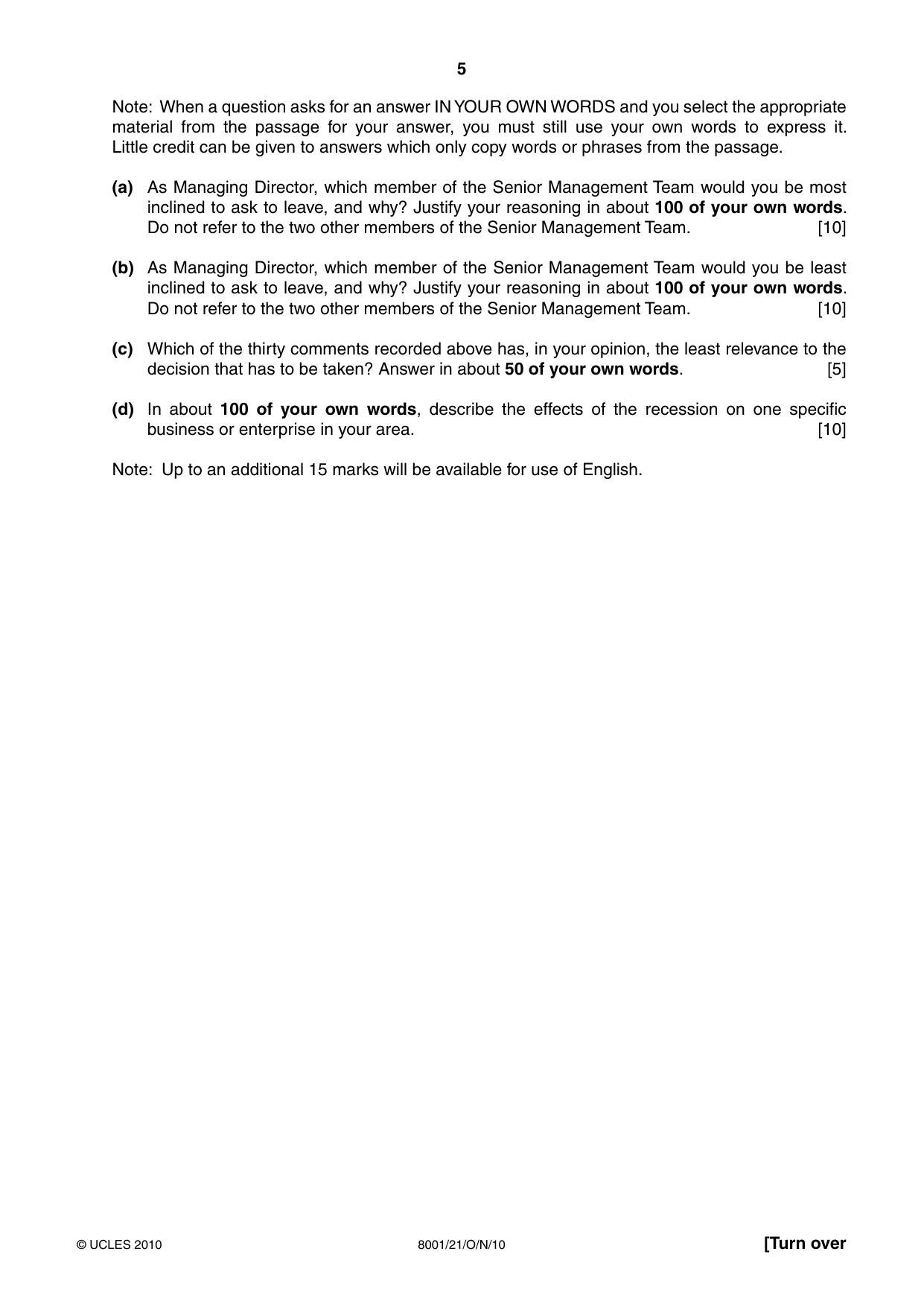
5 8001/21/O/N/10 © UCLES 2010 [Turn over Note: When a question asks for an answer IN YOUR OWN WORDS and you select the appropriate material from the passage for your answer, you must still use your own words to express it. Little credit can be given to answers which only copy words or phrases from the passage. (a) As Managing Director, which member of the Senior Management Team would you be most inclined to ask to leave, and why? Justify your reasoning in about 100 of your own words. Do not refer to the two other members of the Senior Management Team. [10] (b) As Managing Director, which member of the Senior Management Team would you be least inclined to ask to leave, and why? Justify your reasoning in about 100 of your own words. Do not refer to the two other members of the Senior Management Team. [10] (c) Which of the thirty comments recorded above has, in your opinion, the least relevance to the decision that has to be taken? Answer in about 50 of your own words. [5] (d) In about 100 of your own words, describe the effects of the recession on one specific business or enterprise in your area. [10] Note: Up to an additional 15 marks will be available for use of English.
Question paper, page 6
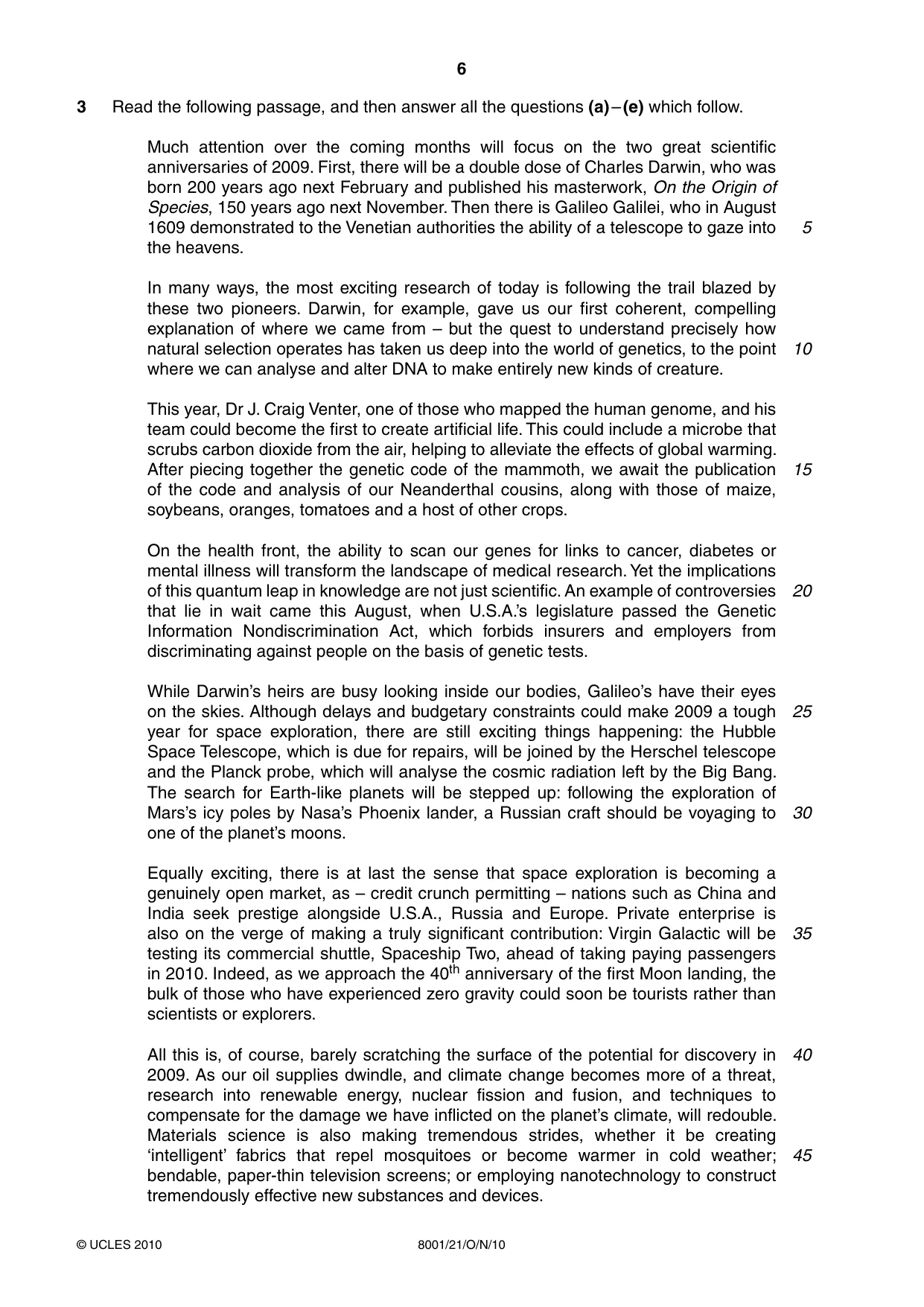
6 8001/21/O/N/10 © UCLES 2010 3 Read the following passage, and then answer all the questions (a) – (e) which follow. Much attention over the coming months will focus on the two great scientific anniversaries of 2009. First, there will be a double dose of Charles Darwin, who was born 200 years ago next February and published his masterwork, On the Origin of Species, 150 years ago next November. Then there is Galileo Galilei, who in August 1609 demonstrated to the Venetian authorities the ability of a telescope to gaze into the heavens. In many ways, the most exciting research of today is following the trail blazed by these two pioneers. Darwin, for example, gave us our first coherent, compelling explanation of where we came from – but the quest to understand precisely how natural selection operates has taken us deep into the world of genetics, to the point where we can analyse and alter DNA to make entirely new kinds of creature. This year, Dr J. Craig Venter, one of those who mapped the human genome, and his team could become the first to create artificial life. This could include a microbe that scrubs carbon dioxide from the air, helping to alleviate the effects of global warming. After piecing together the genetic code of the mammoth, we await the publication of the code and analysis of our Neanderthal cousins, along with those of maize, soybeans, oranges, tomatoes and a host of other crops. On the health front, the ability to scan our genes for links to cancer, diabetes or mental illness will transform the landscape of medical research. Yet the implications of this quantum leap in knowledge are not just scientific. An example of controversies that lie in wait came this August, when U.S.A.’s legislature passed the Genetic Information Nondiscrimination Act, which forbids insurers and employers from discriminating against people on the basis of genetic tests. While Darwin’s heirs are busy looking inside our bodies, Galileo’s have their eyes on the skies. Although delays and budgetary constraints could make 2009 a tough year for space exploration, there are still exciting things happening: the Hubble Space Telescope, which is due for repairs, will be joined by the Herschel telescope and the Planck probe, which will analyse the cosmic radiation left by the Big Bang. The search for Earth-like planets will be stepped up: following the exploration of Mars’s icy poles by Nasa’s Phoenix lander, a Russian craft should be voyaging to one of the planet’s moons. Equally exciting, there is at last the sense that space exploration is becoming a genuinely open market, as – credit crunch permitting – nations such as China and India seek prestige alongside U.S.A., Russia and Europe. Private enterprise is also on the verge of making a truly significant contribution: Virgin Galactic will be testing its commercial shuttle, Spaceship Two, ahead of taking paying passengers in 2010. Indeed, as we approach the 40th anniversary of the first Moon landing, the bulk of those who have experienced zero gravity could soon be tourists rather than scientists or explorers. All this is, of course, barely scratching the surface of the potential for discovery in 2009. As our oil supplies dwindle, and climate change becomes more of a threat, research into renewable energy, nuclear fission and fusion, and techniques to compensate for the damage we have inflicted on the planet’s climate, will redouble. Materials science is also making tremendous strides, whether it be creating ‘intelligent’ fabrics that repel mosquitoes or become warmer in cold weather; bendable, paper-thin television screens; or employing nanotechnology to construct tremendously effective new substances and devices. 5 10 15 20 25 30 35 40 45
Question paper, page 7
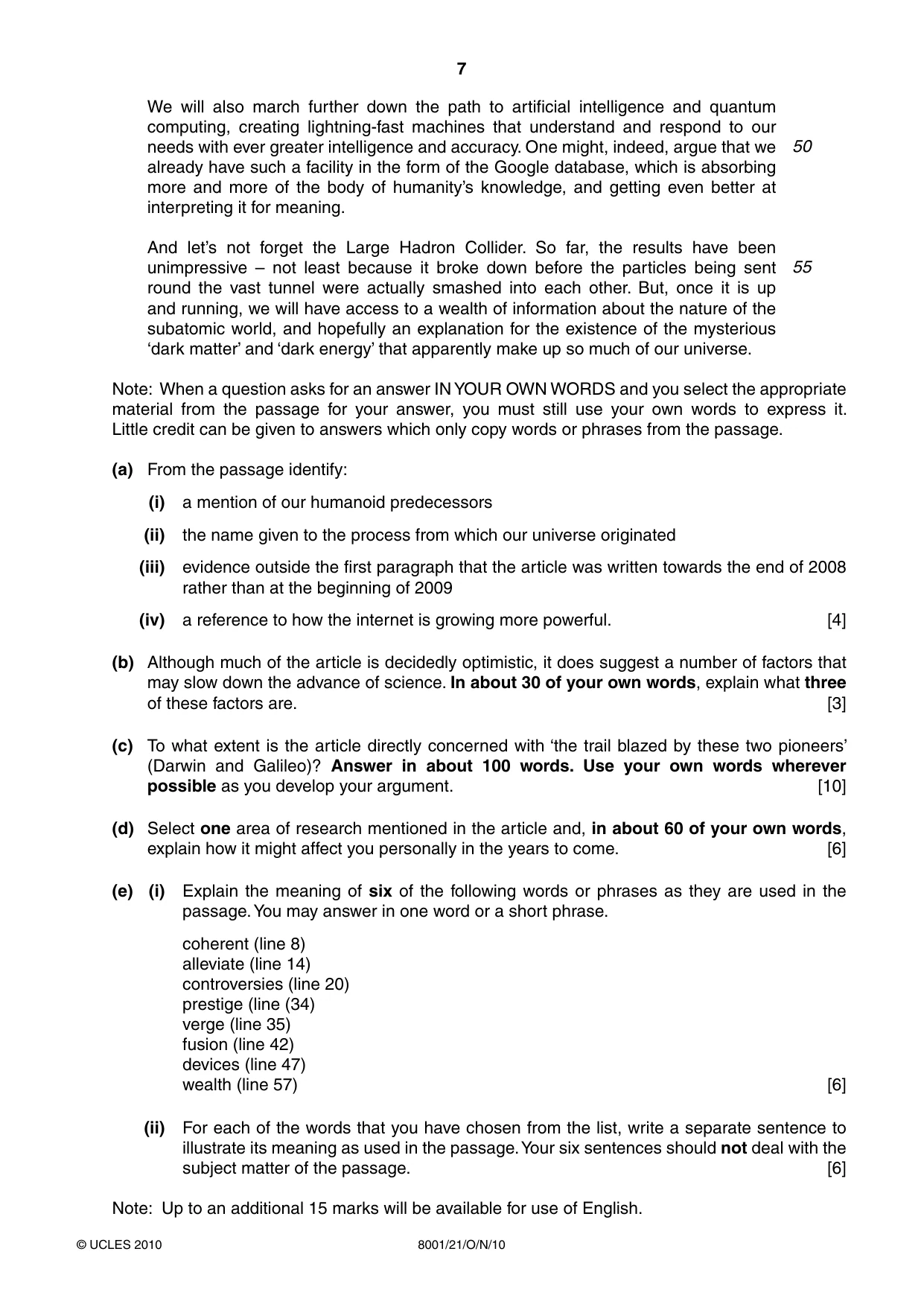
7 8001/21/O/N/10 © UCLES 2010 We will also march further down the path to artificial intelligence and quantum computing, creating lightning-fast machines that understand and respond to our needs with ever greater intelligence and accuracy. One might, indeed, argue that we already have such a facility in the form of the Google database, which is absorbing more and more of the body of humanity’s knowledge, and getting even better at interpreting it for meaning. And let’s not forget the Large Hadron Collider. So far, the results have been unimpressive – not least because it broke down before the particles being sent round the vast tunnel were actually smashed into each other. But, once it is up and running, we will have access to a wealth of information about the nature of the subatomic world, and hopefully an explanation for the existence of the mysterious ‘dark matter’ and ‘dark energy’ that apparently make up so much of our universe. Note: When a question asks for an answer IN YOUR OWN WORDS and you select the appropriate material from the passage for your answer, you must still use your own words to express it. Little credit can be given to answers which only copy words or phrases from the passage. (a) From the passage identify: (i) a mention of our humanoid predecessors (ii) the name given to the process from which our universe originated (iii) evidence outside the first paragraph that the article was written towards the end of 2008 rather than at the beginning of 2009 (iv) a reference to how the internet is growing more powerful. [4] (b) Although much of the article is decidedly optimistic, it does suggest a number of factors that may slow down the advance of science. In about 30 of your own words, explain what three of these factors are. [3] (c) To what extent is the article directly concerned with ‘the trail blazed by these two pioneers’ (Darwin and Galileo)? Answer in about 100 words. Use your own words wherever possible as you develop your argument. [10] (d) Select one area of research mentioned in the article and, in about 60 of your own words, explain how it might affect you personally in the years to come. [6] (e) (i) Explain the meaning of six of the following words or phrases as they are used in the passage. You may answer in one word or a short phrase. coherent (line 8) alleviate (line 14) controversies (line 20) prestige (line (34) verge (line 35) fusion (line 42) devices (line 47) wealth (line 57) [6] (ii) For each of the words that you have chosen from the list, write a separate sentence to illustrate its meaning as used in the passage. Your six sentences should not deal with the subject matter of the passage. [6] Note: Up to an additional 15 marks will be available for use of English. 50 55
Question paper, page 8
8 8001/21/O/N/10 © UCLES 2010 BLANK PAGE Copyright Acknowledgements: Question 3 © Robert Colvile; What does the year hold for science? www.telegraph.co.uk/scienceandtechnology/902522; 9 April 2009. Permission to reproduce items where third-party owned material protected by copyright is included has been sought and cleared where possible. Every reasonable effort has been made by the publisher (UCLES) to trace copyright holders, but if any items requiring clearance have unwittingly been included, the publisher will be pleased to make amends at the earliest possible opportunity. University of Cambridge International Examinations is part of the Cambridge Assessment Group. Cambridge Assessment is the brand name of University of Cambridge Local Examinations Syndicate (UCLES), which is itself a department of the University of Cambridge.
Mark scheme, page 1
UNIVERSITY OF CAMBRIDGE INTERNATIONAL EXAMINATIONS GCE Advanced Subsidiary Level MARK SCHEME for the October/November 2010 question paper for the guidance of teachers 8001 GENERAL PAPER 8001/21 Paper 2, maximum raw mark 50 This mark scheme is published as an aid to teachers and candidates, to indicate the requirements of the examination. It shows the basis on which Examiners were instructed to award marks. It does not indicate the details of the discussions that took place at an Examiners’ meeting before marking began, which would have considered the acceptability of alternative answers. Mark schemes must be read in conjunction with the question papers and the report on the examination. • CIE will not enter into discussions or correspondence in connection with these mark schemes. CIE is publishing the mark schemes for the October/November 2010 question papers for most IGCSE, GCE Advanced Level and Advanced Subsidiary Level syllabuses and some Ordinary Level syllabuses.
Mark scheme, page 2
Page 2 Mark Scheme: Teachers’ version Syllabus Paper GCE AS LEVEL – October/November 2010 8001 21 © UCLES 2010 1 (a) Accept the following reactions to Inwo or Jubka, or any other valid response. (i) It shows that Jubka is a sceptic (has a highly critical mind) and does not accept anything at face value. Alternatively, it shows how pedantic Jubka must be if he worries at shades of meaning. (ii) If he is not joking in bad taste, Inwo must be an extreme hardliner. Alternatively, it shows how quick Inwo is to condemn other people for mistakes rather than wanton wrongdoing. (iii) Inwo is gullible in that he uncritically believes anything he is told by the media. Alternatively, he is simply intellectually lazy and can’t be bothered to challenge something on the news. (iv) Jubka shies away from flatly contradicting people, and risking a row, but will not meekly agree with them if he thinks they are wrong. He is tactful but quietly persistent. (v) Inwo is incapable of understanding other people’s point of view which he dismisses all too readily. He shuts his mind to anything that does not add up immediately. [10] One mark for a simple statement. Two marks for one simple statement plus development or two simple statements. (b) Accept any of the material below or any other valid response. • The evacuation of families/staff apparently without loss of life. • Readiness to sanction the wholesale deployment of civilian (fire-engines) and military (helicopters) fire-fighting equipment to cope with the dire emergency. • The effective use of armed force (National Guard) to deter/contain theft. • Prompt compensation of the displaced victims of the bush fire. • Commissioning an Official Independent Enquiry in the aftermath. In assessing the answer, award: 9–10 for a consistent and relevant response which explores the implications of at least three issues and reaches a convincing conclusion in about 100 words 7–8 when one of the criteria above has not been satisfied 5–6 when two of the criteria above have not been satisfied 3–4 when the answer is badly flawed, but contains some worthwhile material 1–2 when there is little merit in the answer 0 when there is no merit in the answer. [10] One would expect candidates to work out the full implications of any material that has been introduced. Extensive ‘lifting’ from the dialogue without development is not what is required. What one is after is a convincing and well-structured argument that makes effective and selective use of some of the raw material. Any relevant content well above 100 words should be totally disregarded. Examiners should draw a double horizontal line in the margin where the response goes out of control. Too short an answer means that content will be inadequate.
Mark scheme, page 3
Page 3 Mark Scheme: Teachers’ version Syllabus Paper GCE AS LEVEL – October/November 2010 8001 21 © UCLES 2010 (c) Accept any of the material below or any other valid response. • Failure to monitor/eradicate counter-productive farming techniques. • Failure to have effective fire-prevention measures (notices, wardens) in place. • Failure to maintain law and order in unaffected areas. • Excessive/needless expenditure on fire-engines, helicopters & the National Guard. • Incurring debt to pay for the compensation of the victims of the bush fire. • Covering up any fatalities. In assessing the answer, award: 9–10 for a consistent and relevant response which explores the implications of at least three issues and reaches a convincing conclusion in about 100 words 7–8 when one of the criteria above has not been satisfied 5–6 when two of the criteria above have not been satisfied 3–4 when the answer is badly flawed, but contains some worthwhile material 1–2 when there is little merit in the answer 0 when there is no merit in the answer. [10] One would expect candidates to work out the full implications of any material that has been introduced. Extensive ‘lifting’ from the dialogue without development is not what is required. What one is after is a convincing and well-structured argument that makes effective and selective use of some of the raw material. Any relevant content well above 100 words should be totally disregarded. Examiners should draw a double horizontal line in the margin where the response goes out of control. Too short an answer means that content will be inadequate. (d) Relevant objections may be either general or specific. Accept any of the material below or any other valid response. • are orders and must be obeyed to the letter. • Orders The ‘Kurebo Holocaust’ was a case of the greatest good for the greatest number. • The practicalities of diverting a fire-engine up a dirt track. • Hermes’ motives in going to the assistance of the ‘cooking pan’ lady. In assessing the answer, award: 5 for a perceptive, relevant and coherent response that goes for the jugular in about 50 words 4 when one of the criteria above has not been satisfied 3 when two of the criteria above have not been satisfied 2 when the answer is badly flawed, but contains some worthwhile material 1 when there is little merit in the answer 0 when there is no merit in the answer. [5] Any relevant content well above 50 words should be totally disregarded. Examiners should draw a double horizontal line in the margin where the response goes out of control. Too short an answer means that content will be inadequate.
Mark scheme, page 4
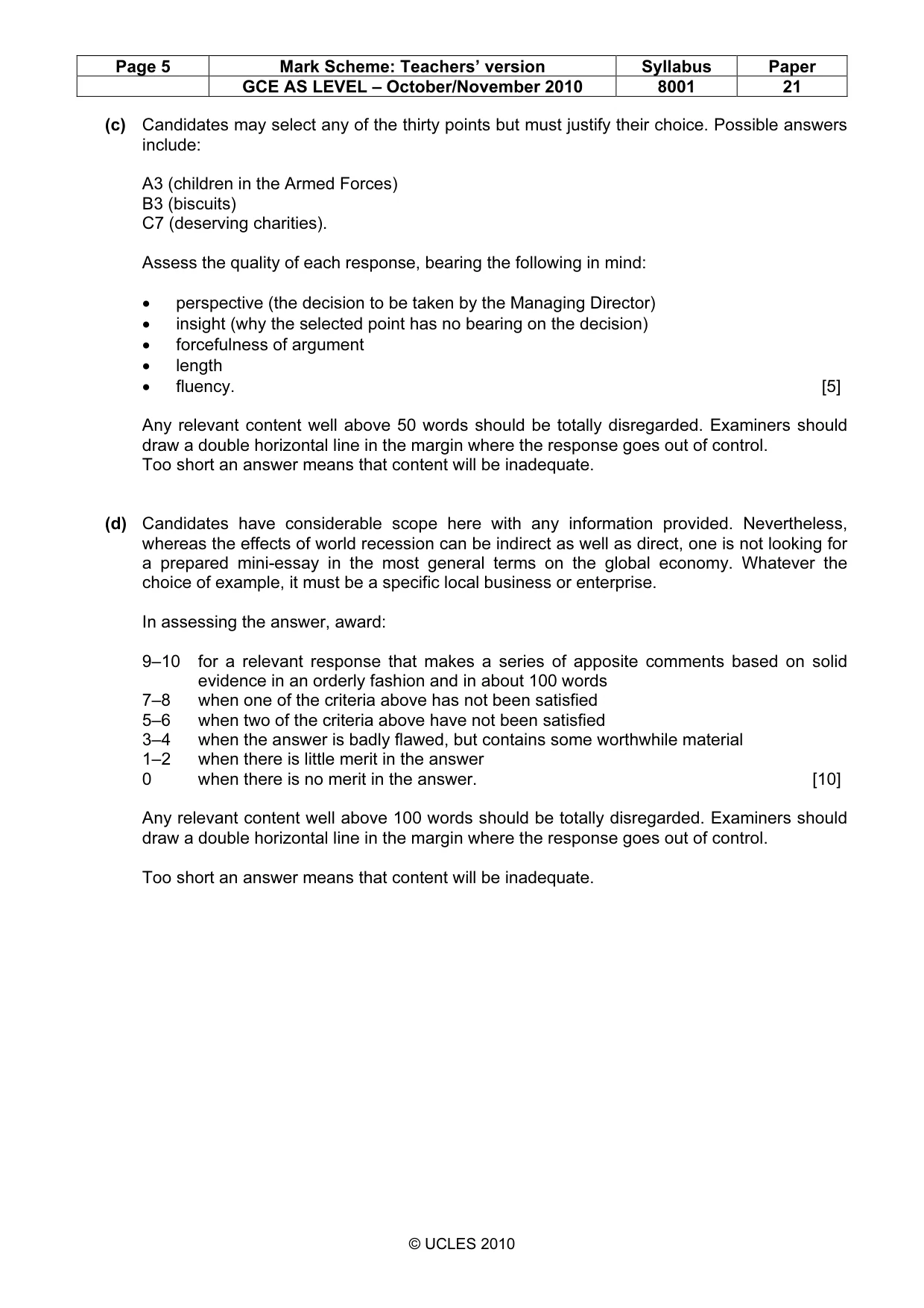
Page 4 Mark Scheme: Teachers’ version Syllabus Paper GCE AS LEVEL – October/November 2010 8001 21 © UCLES 2010 2 (a) & (b) One would expect candidates to work out the full implications of any material that has been introduced. Extensive ‘lifting’ or unassimilated grocers’ lists of relevant considerations in the order in which they feature in the examination paper are not what is required. What one is after is a convincing and well-structured argument that makes effective and selective use of some of the raw material. Any relevant content well above 100 words should be totally disregarded. Examiners should draw a double horizontal line in the margin where the response goes out of control. Too short an answer means that content will be inadequate. (a) Some points (e.g. A9 or B10) about the Senior Management Team can be interpreted in contrasting ways by different candidates. Others (e.g. A3, B3 or C7) may seem to be totally irrelevant. The points below indicate some possible responses, but credit any other valid response. Negative points per colleague: A (Felix Momsenta) 1, 6, 8 & 9 B (Grace Nautienne) 2, 6, 7 & 9 C (Henry Ordoma) 1, 4, 5 & 9. In assessing the answer, award: 9–10 for a consistent and relevant response which explores the implications of at least three observations and reaches a convincing conclusion in about 100 words 7–8 when one of the criteria above has not been satisfied 5–6 when two of the criteria above have not been satisfied 3–4 when the answer is badly flawed, but contains some worthwhile material 1–2 when there is little merit in the answer 0 when there is no merit in the answer. [10] (b) Some points (e.g. A9 or B10) can be interpreted in contrasting ways by different candidates. Others (e.g. A3, B3 or C7) may seem to be totally irrelevant. Below, though, is a tentative attempt to anticipate the more common reactions of candidates, when tackling 2 (b), but any other valid response must receive credit. Positive points per colleague: A (Felix Momsenta) 2, 4, 5, 7 & 10 B (Grace Nautienne) 1, 4, 5, 8 & 10 C (Henry Ordoma) 2, 3, 6, 8 & 10. In assessing the answer, award: 9–10 for a consistent and relevant response which explores the implications of at least three observations and reaches a convincing conclusion in about 100 words 7–8 when one of the criteria above has not been satisfied 5–6 when two of the criteria above have not been satisfied 3–4 when the answer is badly flawed, but contains some worthwhile material 1–2 when there is little merit in the answer 0 when there is no merit in the answer [10]
Mark scheme, page 5
Page 5 Mark Scheme: Teachers’ version Syllabus Paper GCE AS LEVEL – October/November 2010 8001 21 © UCLES 2010 (c) Candidates may select any of the thirty points but must justify their choice. Possible answers include: A3 (children in the Armed Forces) B3 (biscuits) C7 (deserving charities). Assess the quality of each response, bearing the following in mind: • perspective (the decision to be taken by the Managing Director) • insight (why the selected point has no bearing on the decision) • forcefulness of argument • length • fluency. [5] Any relevant content well above 50 words should be totally disregarded. Examiners should draw a double horizontal line in the margin where the response goes out of control. Too short an answer means that content will be inadequate. (d) Candidates have considerable scope here with any information provided. Nevertheless, whereas the effects of world recession can be indirect as well as direct, one is not looking for a prepared mini-essay in the most general terms on the global economy. Whatever the choice of example, it must be a specific local business or enterprise. In assessing the answer, award: 9–10 for a relevant response that makes a series of apposite comments based on solid evidence in an orderly fashion and in about 100 words 7–8 when one of the criteria above has not been satisfied 5–6 when two of the criteria above have not been satisfied 3–4 when the answer is badly flawed, but contains some worthwhile material 1–2 when there is little merit in the answer 0 when there is no merit in the answer. [10] Any relevant content well above 100 words should be totally disregarded. Examiners should draw a double horizontal line in the margin where the response goes out of control. Too short an answer means that content will be inadequate.
Mark scheme, page 6
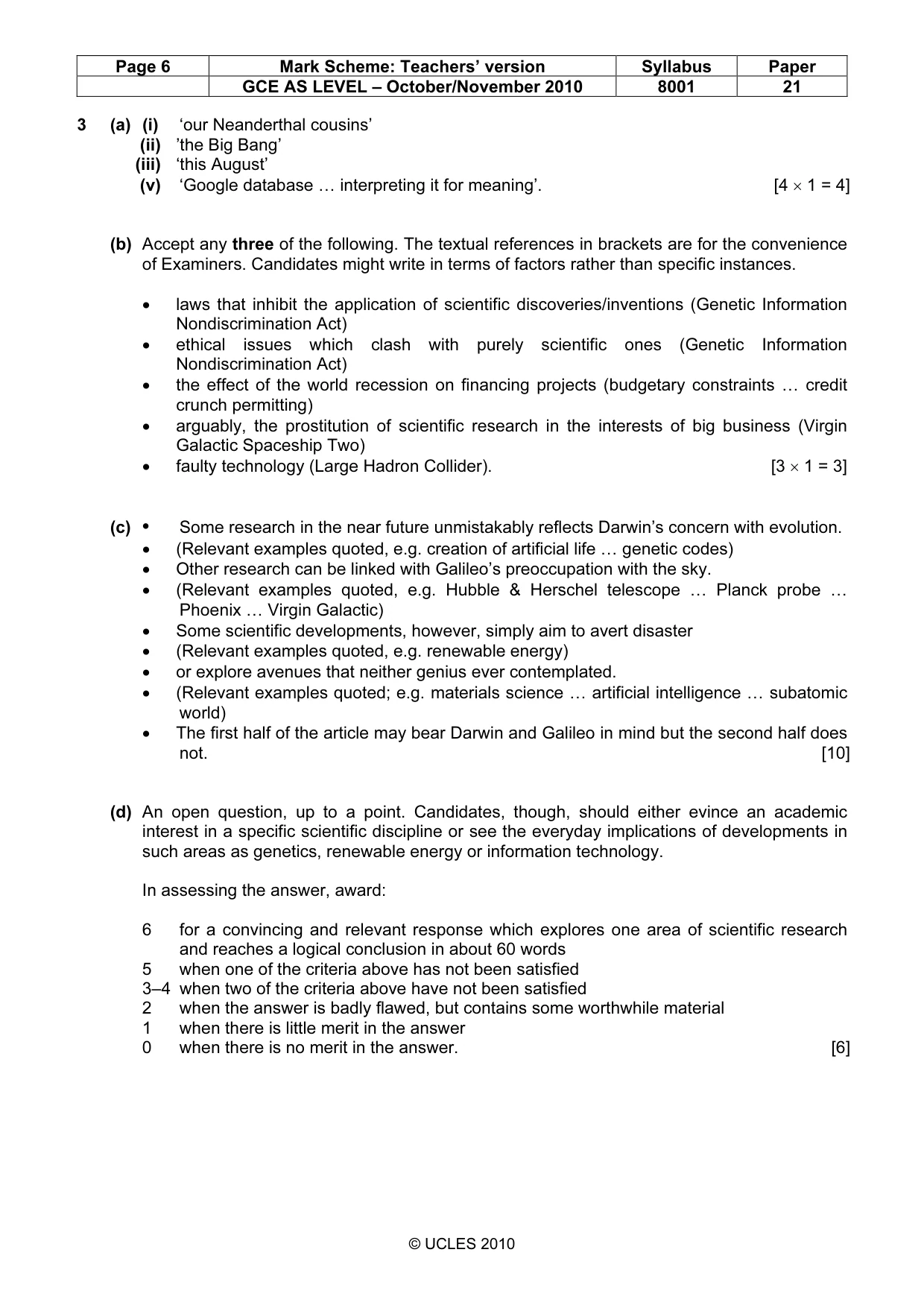
Page 6 Mark Scheme: Teachers’ version Syllabus Paper GCE AS LEVEL – October/November 2010 8001 21 © UCLES 2010 3 (a) (i) ‘our Neanderthal cousins’ (ii) ’the Big Bang’ (iii) ‘this August’ (v) ‘Google database … interpreting it for meaning’. [4 × 1 = 4] (b) Accept any three of the following. The textual references in brackets are for the convenience of Examiners. Candidates might write in terms of factors rather than specific instances. • laws that inhibit the application of scientific discoveries/inventions (Genetic Information Nondiscrimination Act) • ethical issues which clash with purely scientific ones (Genetic Information Nondiscrimination Act) • the effect of the world recession on financing projects (budgetary constraints … credit crunch permitting) • arguably, the prostitution of scientific research in the interests of big business (Virgin Galactic Spaceship Two) • faulty technology (Large Hadron Collider). [3 × 1 = 3] (c) • Some research in the near future unmistakably reflects Darwin’s concern with evolution. • (Relevant examples quoted, e.g. creation of artificial life … genetic codes) • Other research can be linked with Galileo’s preoccupation with the sky. • (Relevant examples quoted, e.g. Hubble & Herschel telescope … Planck probe … Phoenix … Virgin Galactic) • Some scientific developments, however, simply aim to avert disaster • (Relevant examples quoted, e.g. renewable energy) • or explore avenues that neither genius ever contemplated. • (Relevant examples quoted; e.g. materials science … artificial intelligence … subatomic world) • The first half of the article may bear Darwin and Galileo in mind but the second half does not. [10] (d) An open question, up to a point. Candidates, though, should either evince an academic interest in a specific scientific discipline or see the everyday implications of developments in such areas as genetics, renewable energy or information technology. In assessing the answer, award: 6 for a convincing and relevant response which explores one area of scientific research and reaches a logical conclusion in about 60 words 5 when one of the criteria above has not been satisfied 3–4 when two of the criteria above have not been satisfied 2 when the answer is badly flawed, but contains some worthwhile material 1 when there is little merit in the answer 0 when there is no merit in the answer. [6]
Mark scheme, page 7
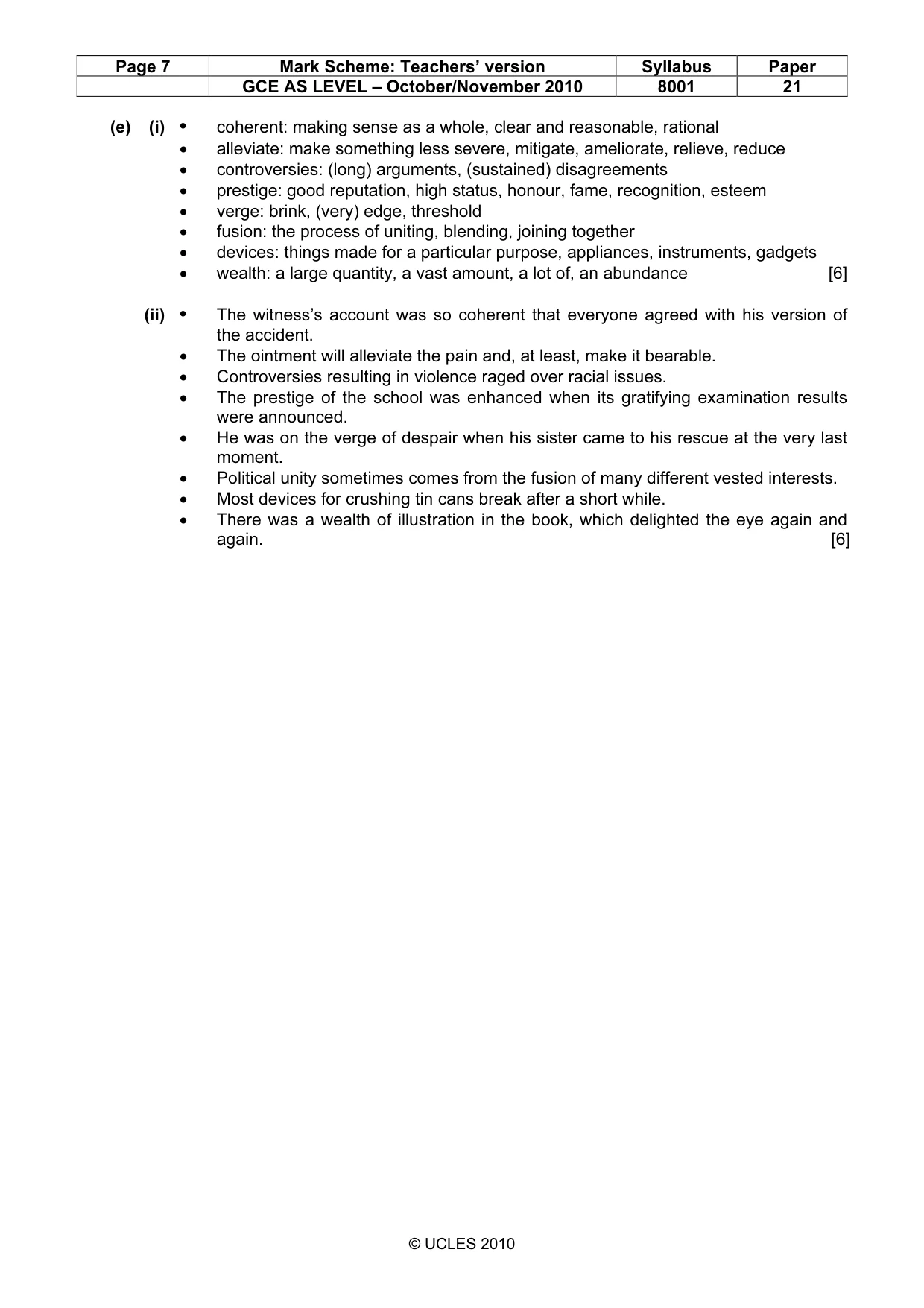
Page 7 Mark Scheme: Teachers’ version Syllabus Paper GCE AS LEVEL – October/November 2010 8001 21 © UCLES 2010 (e) (i) • coherent: making sense as a whole, clear and reasonable, rational • alleviate: make something less severe, mitigate, ameliorate, relieve, reduce • controversies: (long) arguments, (sustained) disagreements • prestige: good reputation, high status, honour, fame, recognition, esteem • verge: brink, (very) edge, threshold • fusion: the process of uniting, blending, joining together • devices: things made for a particular purpose, appliances, instruments, gadgets • wealth: a large quantity, a vast amount, a lot of, an abundance [6] (ii) • The witness’s account was so coherent that everyone agreed with his version of the accident. • The ointment will alleviate the pain and, at least, make it bearable. • Controversies resulting in violence raged over racial issues. • The prestige of the school was enhanced when its gratifying examination results were announced. • He was on the verge of despair when his sister came to his rescue at the very last moment. • Political unity sometimes comes from the fusion of many different vested interests. • Most devices for crushing tin cans break after a short while. • There was a wealth of illustration in the book, which delighted the eye again and again. [6]
What you needed in this session
Cambridge’s own grade thresholds for 2010 Oct/Nov, Paper 2 · Variant 1. A higher threshold means an easier paper — the bar moves with how the cohort did.