Cambridge A Level French - Literature (AS Level only) 8670 — 2014 May/June Paper 4 · Variant 1
8670/41/M/J/14 · 75 marks · ≈84 min
The question paper and its mark scheme, free to read here and free to download. This is Cambridge’s own paper, exactly as it was sat.
Question paper8 pages


Mark scheme3 pages
Answers below. Sit the paper first if you are practising.
Paper as text
Question paper, page 1
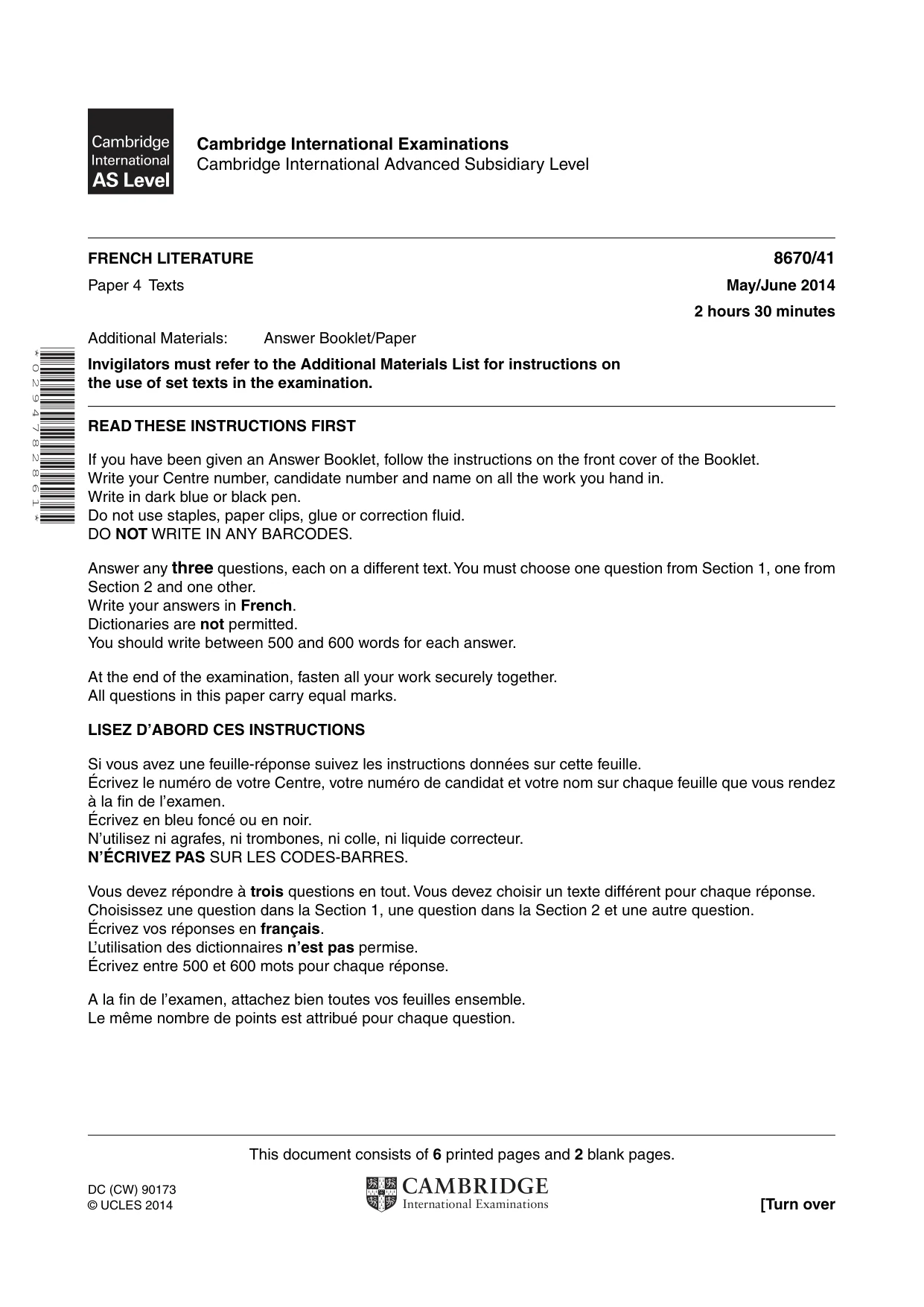
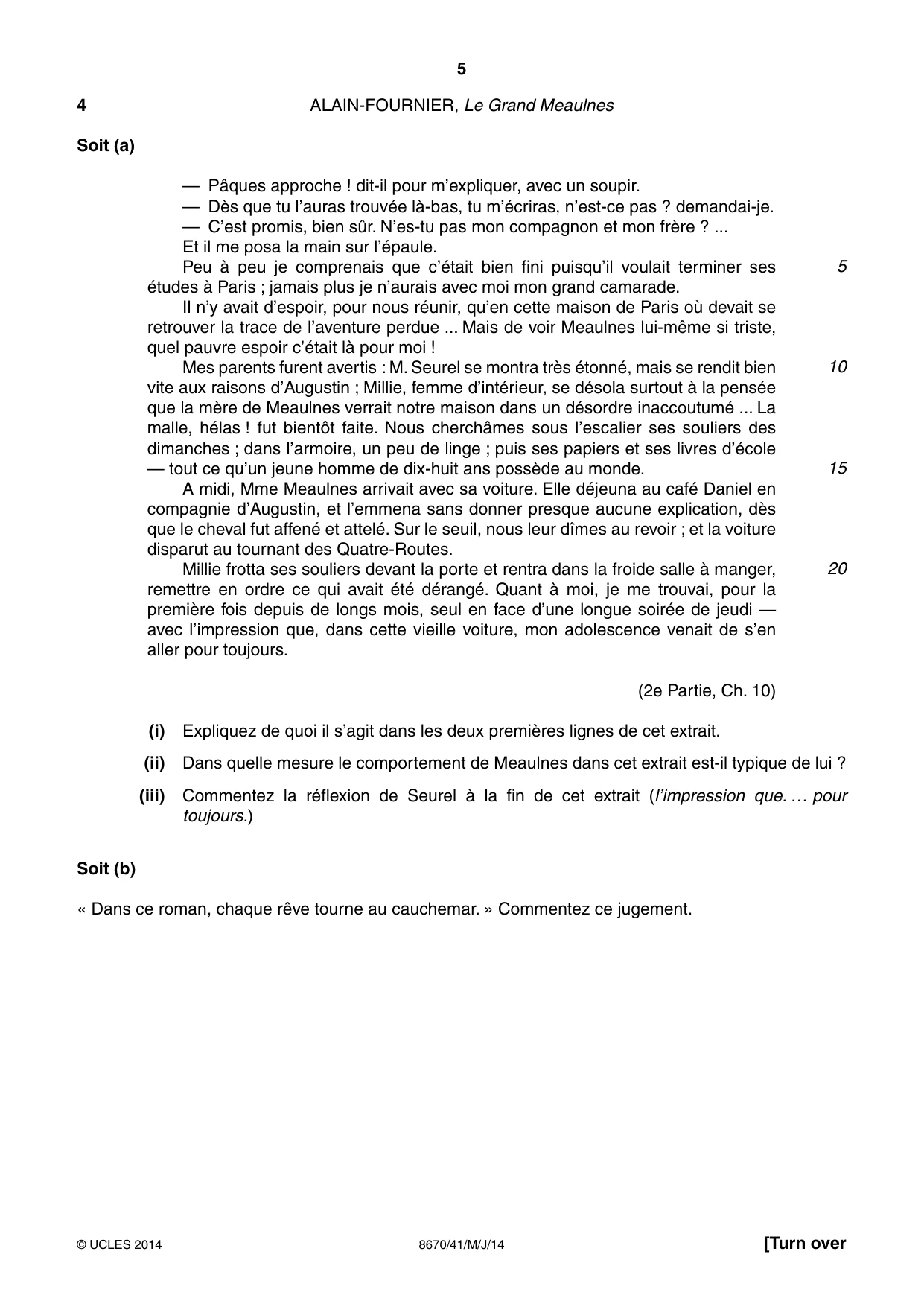
This document consists of 6 printed pages and 2 blank pages. DC (CW) 90173 © UCLES 2014 [Turn over Cambridge International Examinations Cambridge International Advanced Subsidiary Level * 0 2 9 4 7 8 2 8 6 1 * FRENCH LITERATURE 8670/41 Paper 4 Texts May/June 2014 2 hours 30 minutes Additional Materials: Answer Booklet/Paper Invigilators must refer to the Additional Materials List for instructions on the use of set texts in the examination. READ THESE INSTRUCTIONS FIRST If you have been given an Answer Booklet, follow the instructions on the front cover of the Booklet. Write your Centre number, candidate number and name on all the work you hand in. Write in dark blue or black pen. Do not use staples, paper clips, glue or correction fluid. DO NOT WRITE IN ANY BARCODES. Answer any three questions, each on a different text. You must choose one question from Section 1, one from Section 2 and one other. Write your answers in French. Dictionaries are not permitted. You should write between 500 and 600 words for each answer. At the end of the examination, fasten all your work securely together. All questions in this paper carry equal marks. LISEZ D’ABORD CES INSTRUCTIONS Si vous avez une feuille-réponse suivez les instructions données sur cette feuille. Écrivez le numéro de votre Centre, votre numéro de candidat et votre nom sur chaque feuille que vous rendez à la fin de l’examen. Écrivez en bleu foncé ou en noir. N’utilisez ni agrafes, ni trombones, ni colle, ni liquide correcteur. N’ÉCRIVEZ PAS SUR LES CODES-BARRES. Vous devez répondre à trois questions en tout. Vous devez choisir un texte différent pour chaque réponse. Choisissez une question dans la Section 1, une question dans la Section 2 et une autre question. Écrivez vos réponses en français. L’utilisation des dictionnaires n’est pas permise. Écrivez entre 500 et 600 mots pour chaque réponse. A la fin de l’examen, attachez bien toutes vos feuilles ensemble. Le même nombre de points est attribué pour chaque question.
Question paper, page 2
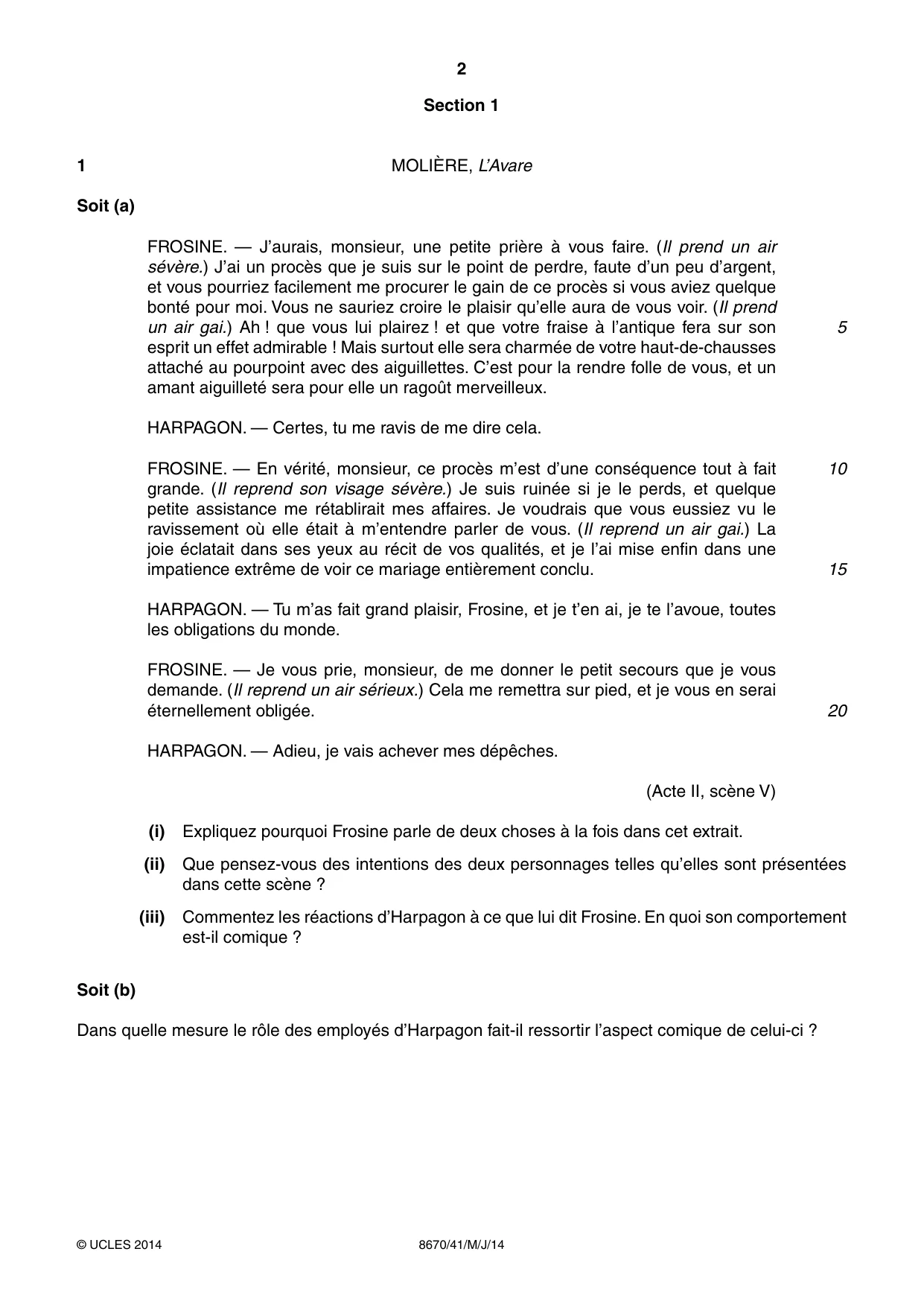
2 8670/41/M/J/14 © UCLES 2014 Section 1 1 MOLIÈRE, L’Avare Soit (a) FROSINE. — J’aurais, monsieur, une petite prière à vous faire. (Il prend un air sévère.) J’ai un procès que je suis sur le point de perdre, faute d’un peu d’argent, et vous pourriez facilement me procurer le gain de ce procès si vous aviez quelque bonté pour moi. Vous ne sauriez croire le plaisir qu’elle aura de vous voir. (Il prend un air gai.) Ah ! que vous lui plairez ! et que votre fraise à l’antique fera sur son esprit un effet admirable ! Mais surtout elle sera charmée de votre haut-de-chausses attaché au pourpoint avec des aiguillettes. C’est pour la rendre folle de vous, et un amant aiguilleté sera pour elle un ragoût merveilleux. HARPAGON. — Certes, tu me ravis de me dire cela. FROSINE. — En vérité, monsieur, ce procès m’est d’une conséquence tout à fait grande. (Il reprend son visage sévère.) Je suis ruinée si je le perds, et quelque petite assistance me rétablirait mes affaires. Je voudrais que vous eussiez vu le ravissement où elle était à m’entendre parler de vous. (Il reprend un air gai.) La joie éclatait dans ses yeux au récit de vos qualités, et je l’ai mise enfin dans une impatience extrême de voir ce mariage entièrement conclu. HARPAGON. — Tu m’as fait grand plaisir, Frosine, et je t’en ai, je te l’avoue, toutes les obligations du monde. FROSINE. — Je vous prie, monsieur, de me donner le petit secours que je vous demande. (Il reprend un air sérieux.) Cela me remettra sur pied, et je vous en serai éternellement obligée. HARPAGON. — Adieu, je vais achever mes dépêches. (Acte II, scène V) (i) Expliquez pourquoi Frosine parle de deux choses à la fois dans cet extrait. (ii) Que pensez-vous des intentions des deux personnages telles qu’elles sont présentées dans cette scène ? (iii) Commentez les réactions d’Harpagon à ce que lui dit Frosine. En quoi son comportement est-il comique ? Soit (b) Dans quelle mesure le rôle des employés d’Harpagon fait-il ressortir l’aspect comique de celui-ci ? 5 10 15 20
Question paper, page 3
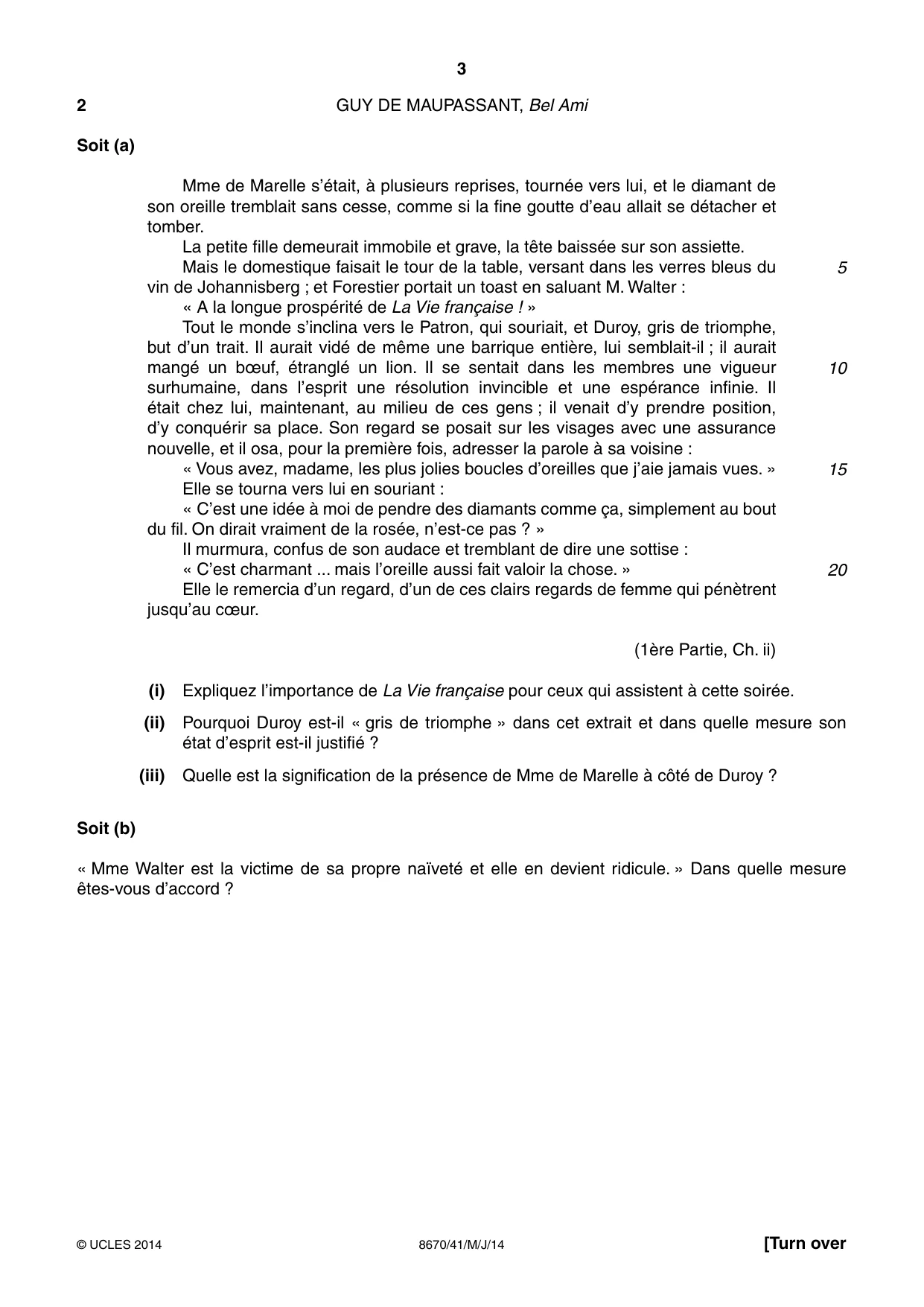
3 8670/41/M/J/14 © UCLES 2014 [Turn over 2 GUY DE MAUPASSANT, Bel Ami Soit (a) Mme de Marelle s’était, à plusieurs reprises, tournée vers lui, et le diamant de son oreille tremblait sans cesse, comme si la fine goutte d’eau allait se détacher et tomber. La petite fille demeurait immobile et grave, la tête baissée sur son assiette. Mais le domestique faisait le tour de la table, versant dans les verres bleus du vin de Johannisberg ; et Forestier portait un toast en saluant M. Walter : « A la longue prospérité de La Vie française ! » Tout le monde s’inclina vers le Patron, qui souriait, et Duroy, gris de triomphe, but d’un trait. Il aurait vidé de même une barrique entière, lui semblait-il ; il aurait mangé un bœuf, étranglé un lion. Il se sentait dans les membres une vigueur surhumaine, dans l’esprit une résolution invincible et une espérance infinie. Il était chez lui, maintenant, au milieu de ces gens ; il venait d’y prendre position, d’y conquérir sa place. Son regard se posait sur les visages avec une assurance nouvelle, et il osa, pour la première fois, adresser la parole à sa voisine : « Vous avez, madame, les plus jolies boucles d’oreilles que j’aie jamais vues. » Elle se tourna vers lui en souriant : « C’est une idée à moi de pendre des diamants comme ça, simplement au bout du fil. On dirait vraiment de la rosée, n’est-ce pas ? » Il murmura, confus de son audace et tremblant de dire une sottise : « C’est charmant ... mais l’oreille aussi fait valoir la chose. » Elle le remercia d’un regard, d’un de ces clairs regards de femme qui pénètrent jusqu’au cœur. (1ère Partie, Ch. ii) (i) Expliquez l’importance de La Vie française pour ceux qui assistent à cette soirée. (ii) Pourquoi Duroy est-il « gris de triomphe » dans cet extrait et dans quelle mesure son état d’esprit est-il justifié ? (iii) Quelle est la signification de la présence de Mme de Marelle à côté de Duroy ? Soit (b) « Mme Walter est la victime de sa propre naïveté et elle en devient ridicule. » Dans quelle mesure êtes-vous d’accord ? 5 10 15 20
Question paper, page 4
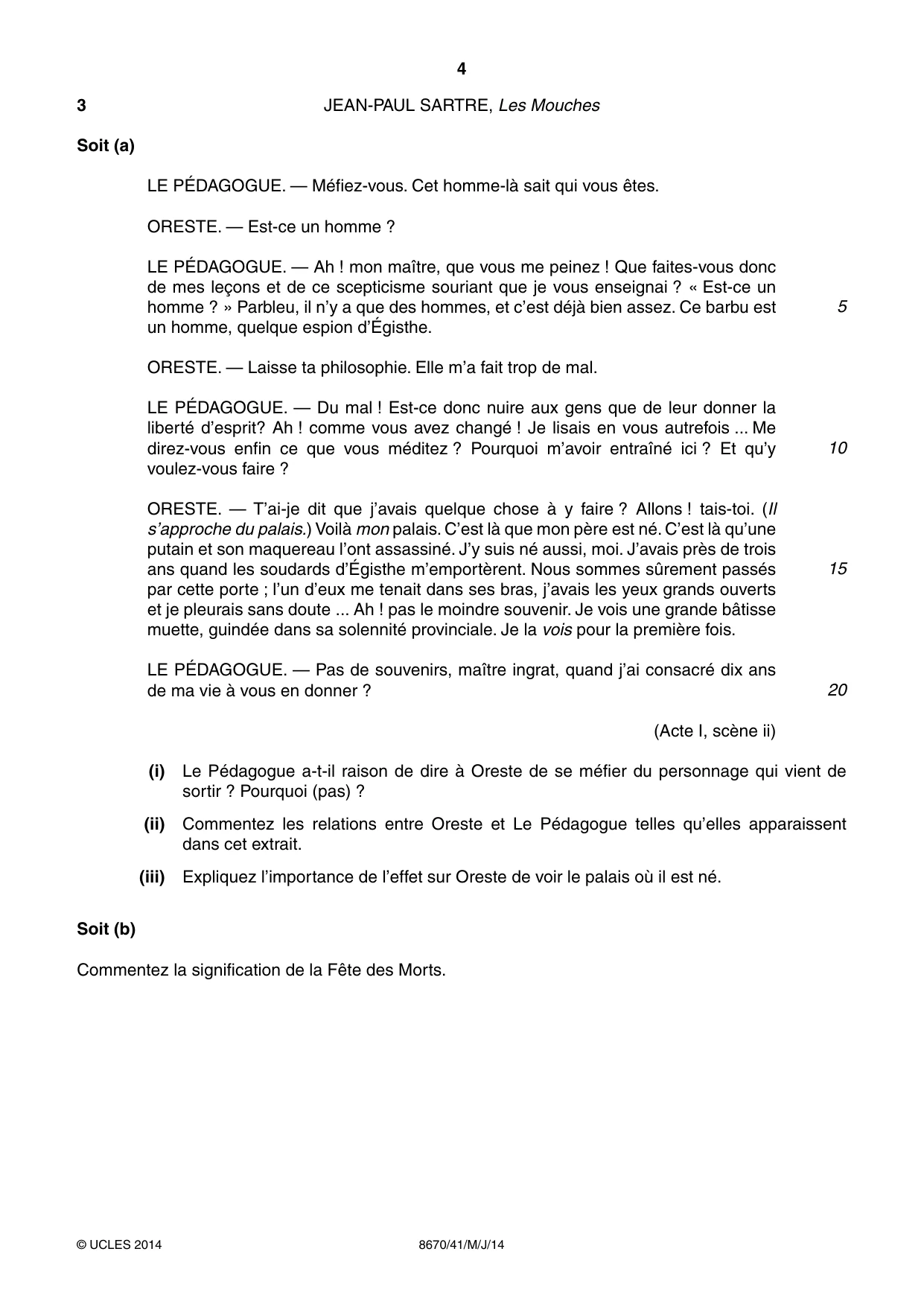
4 8670/41/M/J/14 © UCLES 2014 3 JEAN-PAUL SARTRE, Les Mouches Soit (a) LE PÉDAGOGUE. — Méfiez-vous. Cet homme-là sait qui vous êtes. ORESTE. — Est-ce un homme ? LE PÉDAGOGUE. — Ah ! mon maître, que vous me peinez ! Que faites-vous donc de mes leçons et de ce scepticisme souriant que je vous enseignai ? « Est-ce un homme ? » Parbleu, il n’y a que des hommes, et c’est déjà bien assez. Ce barbu est un homme, quelque espion d’Égisthe. ORESTE. — Laisse ta philosophie. Elle m’a fait trop de mal. LE PÉDAGOGUE. — Du mal ! Est-ce donc nuire aux gens que de leur donner la liberté d’esprit? Ah ! comme vous avez changé ! Je lisais en vous autrefois ... Me direz-vous enfin ce que vous méditez ? Pourquoi m’avoir entraîné ici ? Et qu’y voulez-vous faire ? ORESTE. — T’ai-je dit que j’avais quelque chose à y faire ? Allons ! tais-toi. (Il s’approche du palais.) Voilà mon palais. C’est là que mon père est né. C’est là qu’une putain et son maquereau l’ont assassiné. J’y suis né aussi, moi. J’avais près de trois ans quand les soudards d’Égisthe m’emportèrent. Nous sommes sûrement passés par cette porte ; l’un d’eux me tenait dans ses bras, j’avais les yeux grands ouverts et je pleurais sans doute ... Ah ! pas le moindre souvenir. Je vois une grande bâtisse muette, guindée dans sa solennité provinciale. Je la vois pour la première fois. LE PÉDAGOGUE. — Pas de souvenirs, maître ingrat, quand j’ai consacré dix ans de ma vie à vous en donner ? (Acte I, scène ii) (i) Le Pédagogue a-t-il raison de dire à Oreste de se méfier du personnage qui vient de sortir ? Pourquoi (pas) ? (ii) Commentez les relations entre Oreste et Le Pédagogue telles qu’elles apparaissent dans cet extrait. (iii) Expliquez l’importance de l’effet sur Oreste de voir le palais où il est né. Soit (b) Commentez la signification de la Fête des Morts. 5 10 15 20
Question paper, page 5
5 8670/41/M/J/14 © UCLES 2014 [Turn over 4 ALAIN-FOURNIER, Le Grand Meaulnes Soit (a) — Pâques approche ! dit-il pour m’expliquer, avec un soupir. — Dès que tu l’auras trouvée là-bas, tu m’écriras, n’est-ce pas ? demandai-je. — C’est promis, bien sûr. N’es-tu pas mon compagnon et mon frère ? ... Et il me posa la main sur l’épaule. Peu à peu je comprenais que c’était bien fini puisqu’il voulait terminer ses études à Paris ; jamais plus je n’aurais avec moi mon grand camarade. Il n’y avait d’espoir, pour nous réunir, qu’en cette maison de Paris où devait se retrouver la trace de l’aventure perdue ... Mais de voir Meaulnes lui-même si triste, quel pauvre espoir c’était là pour moi ! Mes parents furent avertis : M. Seurel se montra très étonné, mais se rendit bien vite aux raisons d’Augustin ; Millie, femme d’intérieur, se désola surtout à la pensée que la mère de Meaulnes verrait notre maison dans un désordre inaccoutumé ... La malle, hélas ! fut bientôt faite. Nous cherchâmes sous l’escalier ses souliers des dimanches ; dans l’armoire, un peu de linge ; puis ses papiers et ses livres d’école — tout ce qu’un jeune homme de dix-huit ans possède au monde. A midi, Mme Meaulnes arrivait avec sa voiture. Elle déjeuna au café Daniel en compagnie d’Augustin, et l’emmena sans donner presque aucune explication, dès que le cheval fut affené et attelé. Sur le seuil, nous leur dîmes au revoir ; et la voiture disparut au tournant des Quatre-Routes. Millie frotta ses souliers devant la porte et rentra dans la froide salle à manger, remettre en ordre ce qui avait été dérangé. Quant à moi, je me trouvai, pour la première fois depuis de longs mois, seul en face d’une longue soirée de jeudi — avec l’impression que, dans cette vieille voiture, mon adolescence venait de s’en aller pour toujours. (2e Partie, Ch. 10) (i) Expliquez de quoi il s’agit dans les deux premières lignes de cet extrait. (ii) Dans quelle mesure le comportement de Meaulnes dans cet extrait est-il typique de lui ? (iii) Commentez la réflexion de Seurel à la fin de cet extrait (l’impression que. … pour toujours.) Soit (b) « Dans ce roman, chaque rêve tourne au cauchemar. » Commentez ce jugement. 5 10 15 20
Question paper, page 6
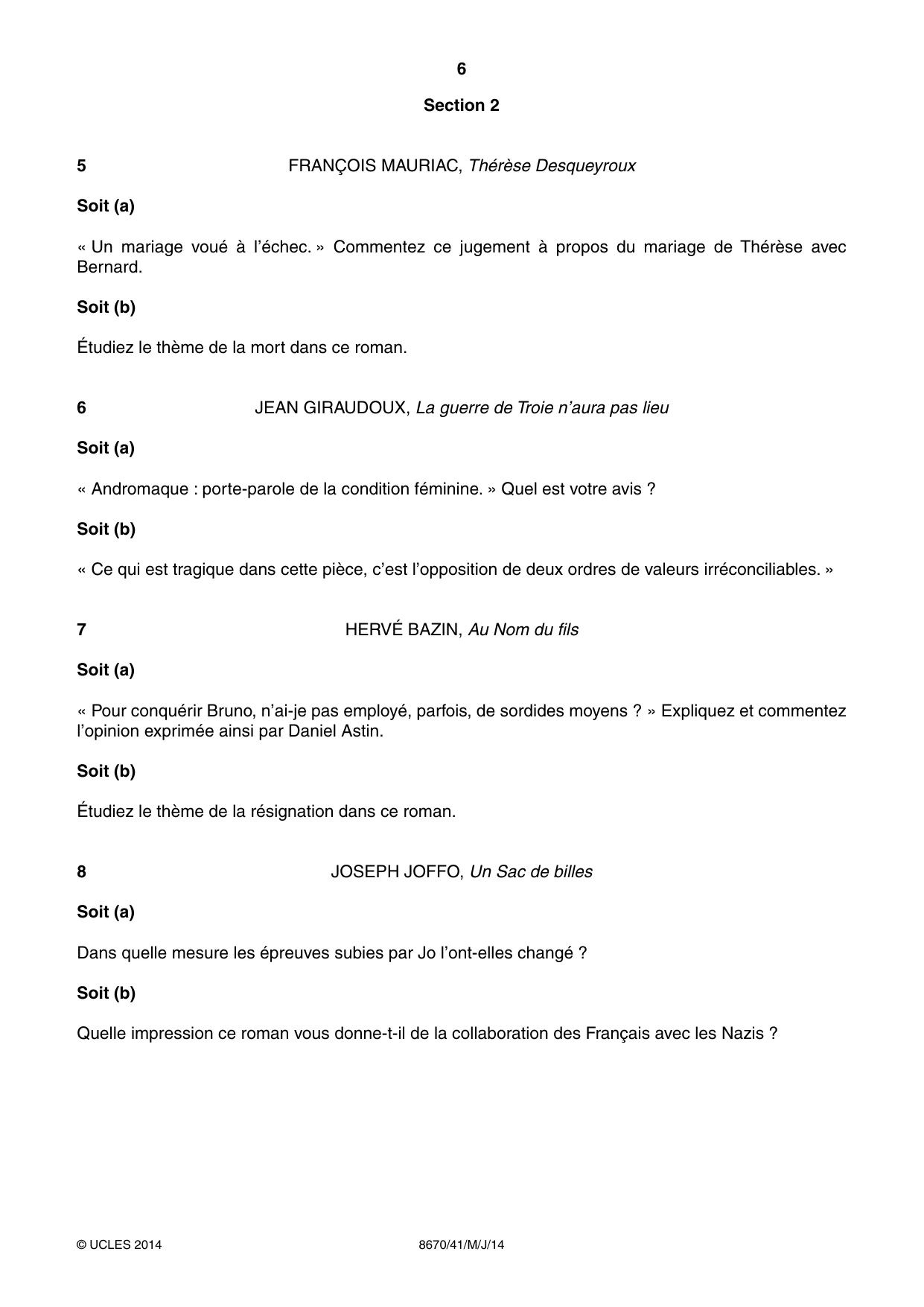
6 8670/41/M/J/14 © UCLES 2014 Section 2 5 FRANÇOIS MAURIAC, Thérèse Desqueyroux Soit (a) « Un mariage voué à l’échec. » Commentez ce jugement à propos du mariage de Thérèse avec Bernard. Soit (b) Étudiez le thème de la mort dans ce roman. 6 JEAN GIRAUDOUX, La guerre de Troie n’aura pas lieu Soit (a) « Andromaque : porte-parole de la condition féminine. » Quel est votre avis ? Soit (b) « Ce qui est tragique dans cette pièce, c’est l’opposition de deux ordres de valeurs irréconciliables. » 7 HERVÉ BAZIN, Au Nom du fils Soit (a) « Pour conquérir Bruno, n’ai-je pas employé, parfois, de sordides moyens ? » Expliquez et commentez l’opinion exprimée ainsi par Daniel Astin. Soit (b) Étudiez le thème de la résignation dans ce roman. 8 JOSEPH JOFFO, Un Sac de billes Soit (a) Dans quelle mesure les épreuves subies par Jo l’ont-elles changé ? Soit (b) Quelle impression ce roman vous donne-t-il de la collaboration des Français avec les Nazis ?
Question paper, page 7
7 8670/41/M/J/14 © UCLES 2014 BLANK PAGE
Question paper, page 8
8 8670/41/M/J/14 © UCLES 2014 Copyright Acknowledgements: Question 3 © Jean-Paul Sartre; Les Mouches; Editions Gallimard; 1947. Permission to reproduce items where third-party owned material protected by copyright is included has been sought and cleared where possible. Every reasonable effort has been made by the publisher (UCLES) to trace copyright holders, but if any items requiring clearance have unwittingly been included, the publisher will be pleased to make amends at the earliest possible opportunity. Cambridge International Examinations is part of the Cambridge Assessment Group. Cambridge Assessment is the brand name of University of Cambridge Local Examinations Syndicate (UCLES), which is itself a department of the University of Cambridge. BLANK PAGE
Mark scheme, page 1
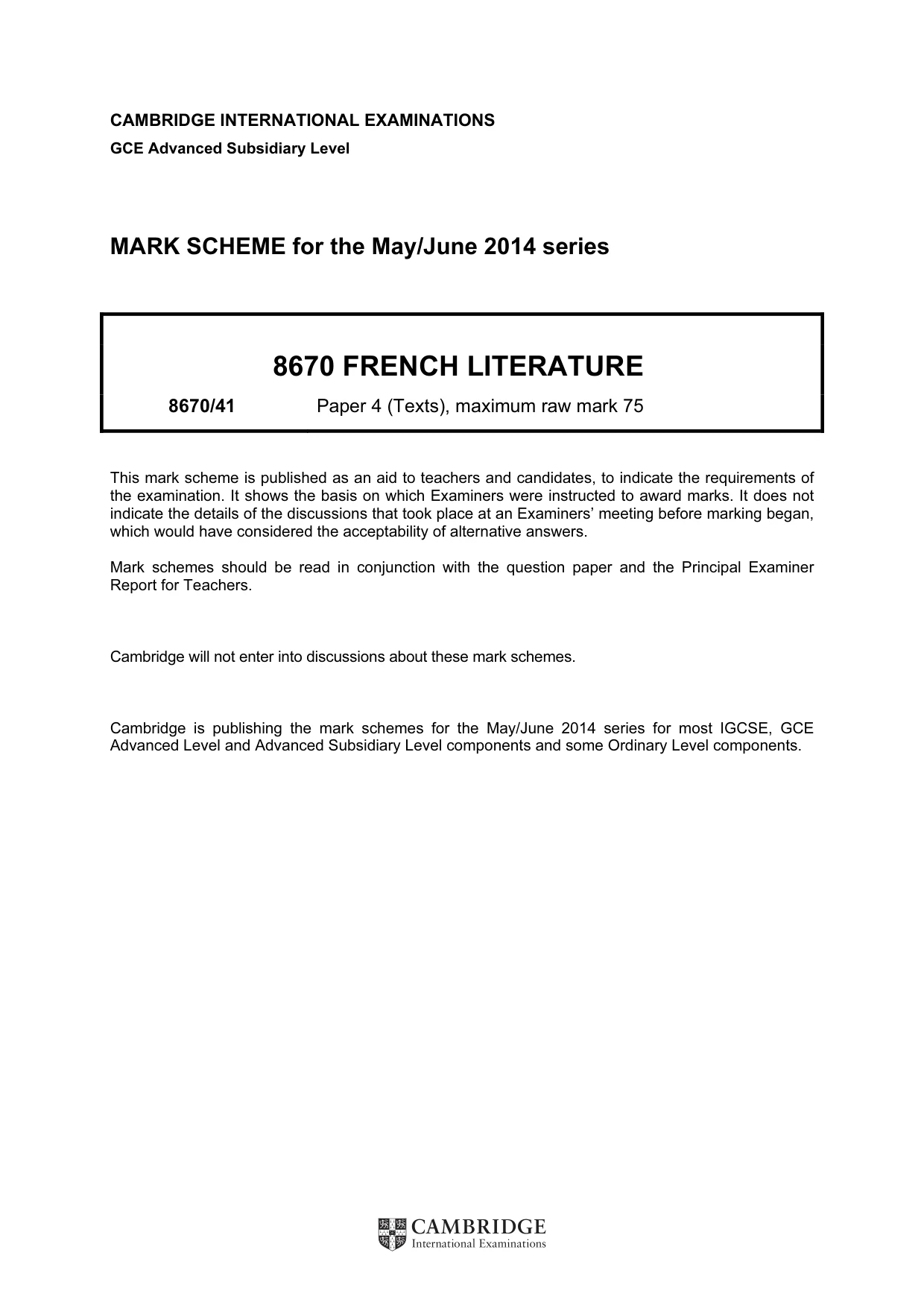
CAMBRIDGE INTERNATIONAL EXAMINATIONS GCE Advanced Subsidiary Level MARK SCHEME for the May/June 2014 series 8670 FRENCH LITERATURE 8670/41 Paper 4 (Texts), maximum raw mark 75 This mark scheme is published as an aid to teachers and candidates, to indicate the requirements of the examination. It shows the basis on which Examiners were instructed to award marks. It does not indicate the details of the discussions that took place at an Examiners’ meeting before marking began, which would have considered the acceptability of alternative answers. Mark schemes should be read in conjunction with the question paper and the Principal Examiner Report for Teachers. Cambridge will not enter into discussions about these mark schemes. Cambridge is publishing the mark schemes for the May/June 2014 series for most IGCSE, GCE Advanced Level and Advanced Subsidiary Level components and some Ordinary Level components.
Mark scheme, page 2
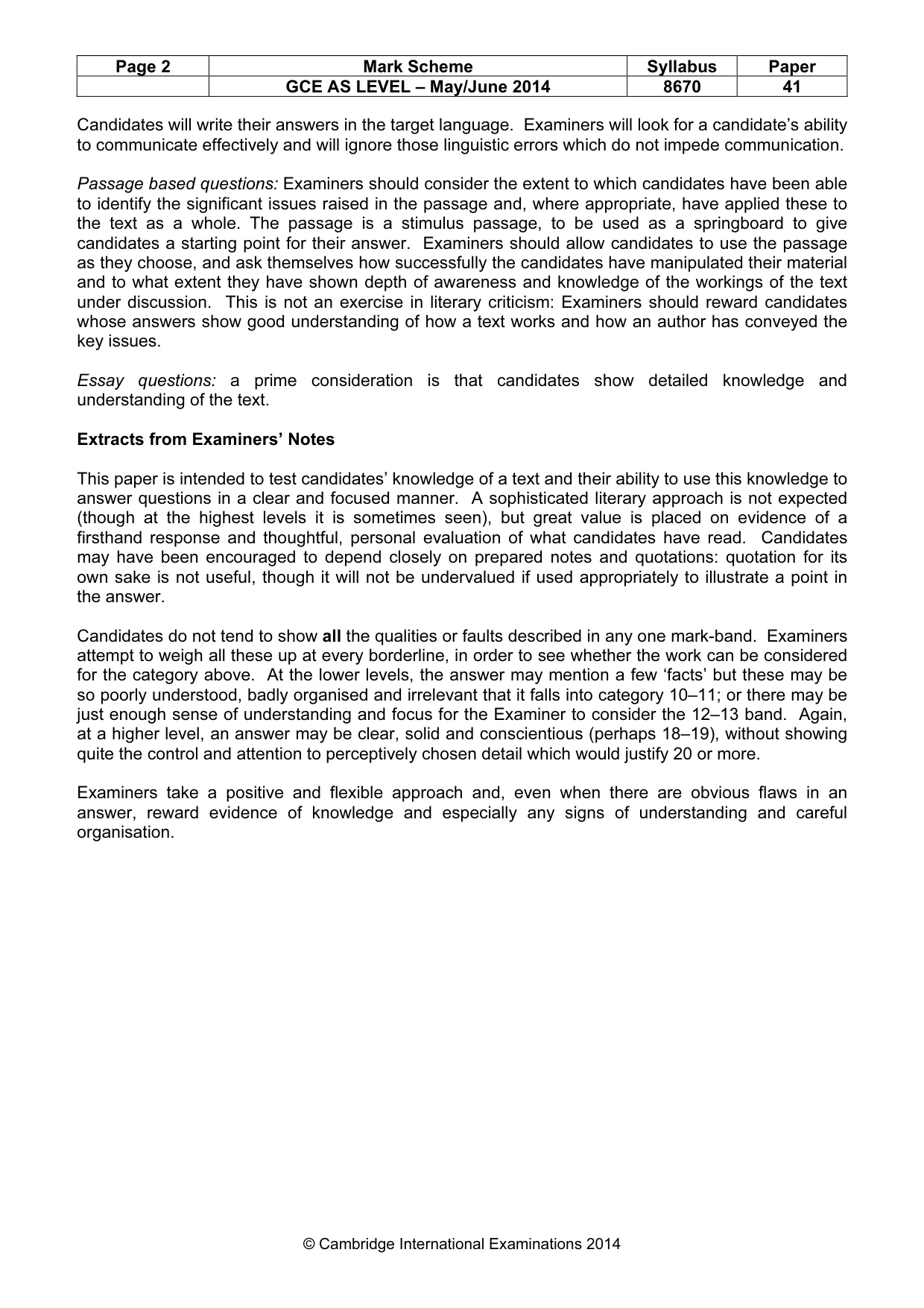
Page 2 Mark Scheme Syllabus Paper GCE AS LEVEL – May/June 2014 8670 41 © Cambridge International Examinations 2014 Candidates will write their answers in the target language. Examiners will look for a candidate’s ability to communicate effectively and will ignore those linguistic errors which do not impede communication. Passage based questions: Examiners should consider the extent to which candidates have been able to identify the significant issues raised in the passage and, where appropriate, have applied these to the text as a whole. The passage is a stimulus passage, to be used as a springboard to give candidates a starting point for their answer. Examiners should allow candidates to use the passage as they choose, and ask themselves how successfully the candidates have manipulated their material and to what extent they have shown depth of awareness and knowledge of the workings of the text under discussion. This is not an exercise in literary criticism: Examiners should reward candidates whose answers show good understanding of how a text works and how an author has conveyed the key issues. Essay questions: a prime consideration is that candidates show detailed knowledge and understanding of the text. Extracts from Examiners’ Notes This paper is intended to test candidates’ knowledge of a text and their ability to use this knowledge to answer questions in a clear and focused manner. A sophisticated literary approach is not expected (though at the highest levels it is sometimes seen), but great value is placed on evidence of a firsthand response and thoughtful, personal evaluation of what candidates have read. Candidates may have been encouraged to depend closely on prepared notes and quotations: quotation for its own sake is not useful, though it will not be undervalued if used appropriately to illustrate a point in the answer. Candidates do not tend to show all the qualities or faults described in any one mark-band. Examiners attempt to weigh all these up at every borderline, in order to see whether the work can be considered for the category above. At the lower levels, the answer may mention a few ‘facts’ but these may be so poorly understood, badly organised and irrelevant that it falls into category 10–11; or there may be just enough sense of understanding and focus for the Examiner to consider the 12–13 band. Again, at a higher level, an answer may be clear, solid and conscientious (perhaps 18–19), without showing quite the control and attention to perceptively chosen detail which would justify 20 or more. Examiners take a positive and flexible approach and, even when there are obvious flaws in an answer, reward evidence of knowledge and especially any signs of understanding and careful organisation.
Mark scheme, page 3
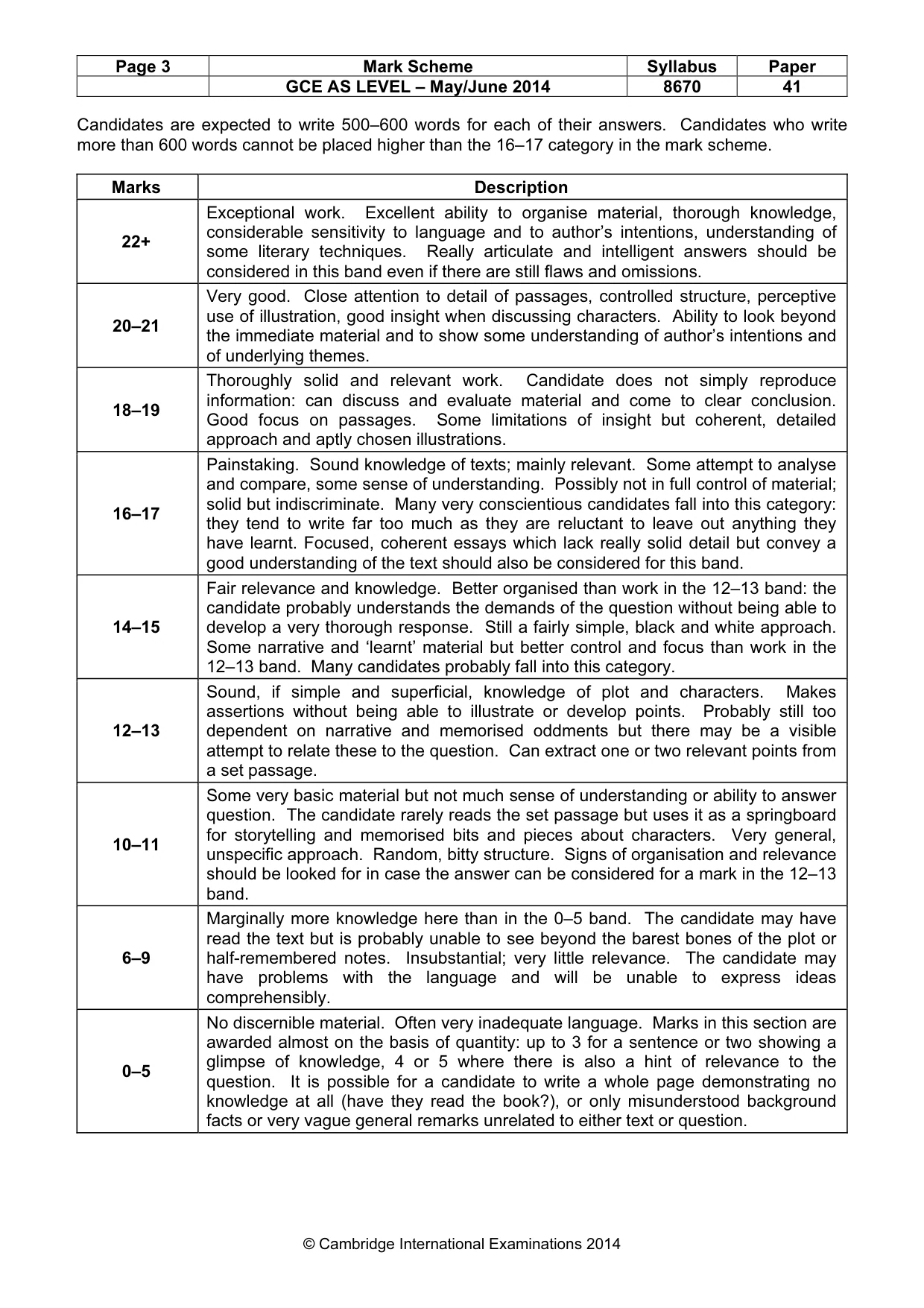
Page 3 Mark Scheme Syllabus Paper GCE AS LEVEL – May/June 2014 8670 41 © Cambridge International Examinations 2014 Candidates are expected to write 500–600 words for each of their answers. Candidates who write more than 600 words cannot be placed higher than the 16–17 category in the mark scheme. Marks Description 22+ Exceptional work. Excellent ability to organise material, thorough knowledge, considerable sensitivity to language and to author’s intentions, understanding of some literary techniques. Really articulate and intelligent answers should be considered in this band even if there are still flaws and omissions. 20–21 Very good. Close attention to detail of passages, controlled structure, perceptive use of illustration, good insight when discussing characters. Ability to look beyond the immediate material and to show some understanding of author’s intentions and of underlying themes. 18–19 Thoroughly solid and relevant work. Candidate does not simply reproduce information: can discuss and evaluate material and come to clear conclusion. Good focus on passages. Some limitations of insight but coherent, detailed approach and aptly chosen illustrations. 16–17 Painstaking. Sound knowledge of texts; mainly relevant. Some attempt to analyse and compare, some sense of understanding. Possibly not in full control of material; solid but indiscriminate. Many very conscientious candidates fall into this category: they tend to write far too much as they are reluctant to leave out anything they have learnt. Focused, coherent essays which lack really solid detail but convey a good understanding of the text should also be considered for this band. 14–15 Fair relevance and knowledge. Better organised than work in the 12–13 band: the candidate probably understands the demands of the question without being able to develop a very thorough response. Still a fairly simple, black and white approach. Some narrative and ‘learnt’ material but better control and focus than work in the 12–13 band. Many candidates probably fall into this category. 12–13 Sound, if simple and superficial, knowledge of plot and characters. Makes assertions without being able to illustrate or develop points. Probably still too dependent on narrative and memorised oddments but there may be a visible attempt to relate these to the question. Can extract one or two relevant points from a set passage. 10–11 Some very basic material but not much sense of understanding or ability to answer question. The candidate rarely reads the set passage but uses it as a springboard for storytelling and memorised bits and pieces about characters. Very general, unspecific approach. Random, bitty structure. Signs of organisation and relevance should be looked for in case the answer can be considered for a mark in the 12–13 band. 6–9 Marginally more knowledge here than in the 0–5 band. The candidate may have read the text but is probably unable to see beyond the barest bones of the plot or half-remembered notes. Insubstantial; very little relevance. The candidate may have problems with the language and will be unable to express ideas comprehensibly. 0–5 No discernible material. Often very inadequate language. Marks in this section are awarded almost on the basis of quantity: up to 3 for a sentence or two showing a glimpse of knowledge, 4 or 5 where there is also a hint of relevance to the question. It is possible for a candidate to write a whole page demonstrating no knowledge at all (have they read the book?), or only misunderstood background facts or very vague general remarks unrelated to either text or question.
What you needed in this session
Cambridge’s own grade thresholds for 2014 May/June, Paper 4 · Variant 1. A higher threshold means an easier paper — the bar moves with how the cohort did.