Cambridge A Level French (A Level only) 9716 — 2017 May/June Paper 2 · Variant 3
9716/23/M/J/17 · 70 marks · ≈79 min
The question paper and its mark scheme, free to read here and free to download. This is Cambridge’s own paper, exactly as it was sat.
Question paper8 pages
Mark scheme18 pages
Answers below. Sit the paper first if you are practising.
Paper as text
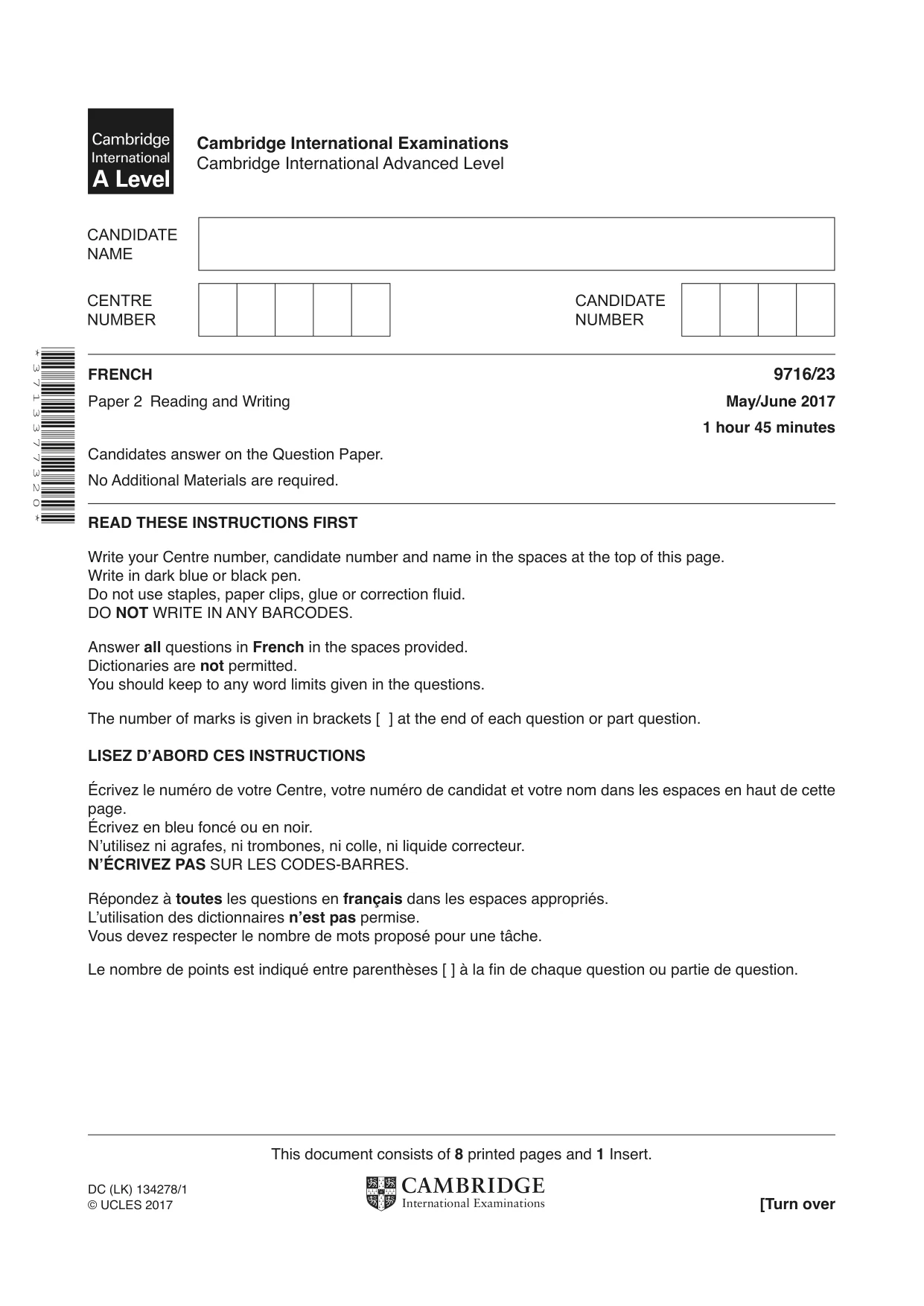
Question paper, page 1
* 3 7 1 3 3 7 7 3 2 0 * This document consists of 8 printed pages and 1 Insert. DC (LK) 134278/1 © UCLES 2017 [Turn over Cambridge International Examinations Cambridge International Advanced Level FRENCH 9716/23 Paper 2 Reading and Writing May/June 2017 1 hour 45 minutes Candidates answer on the Question Paper. No Additional Materials are required. READ THESE INSTRUCTIONS FIRST Write your Centre number, candidate number and name in the spaces at the top of this page. Write in dark blue or black pen. Do not use staples, paper clips, glue or correction fluid. DO NOT WRITE IN ANY BARCODES. Answer all questions in French in the spaces provided. Dictionaries are not permitted. You should keep to any word limits given in the questions. The number of marks is given in brackets [ ] at the end of each question or part question. LISEZ D’ABORD CES INSTRUCTIONS Écrivez le numéro de votre Centre, votre numéro de candidat et votre nom dans les espaces en haut de cette page. Écrivez en bleu foncé ou en noir. N’utilisez ni agrafes, ni trombones, ni colle, ni liquide correcteur. N’ÉCRIVEZ PAS SUR LES CODES-BARRES. Répondez à toutes les questions en français dans les espaces appropriés. L’utilisation des dictionnaires n’est pas permise. Vous devez respecter le nombre de mots proposé pour une tâche. Le nombre de points est indiqué entre parenthèses [ ] à la fin de chaque question ou partie de question.
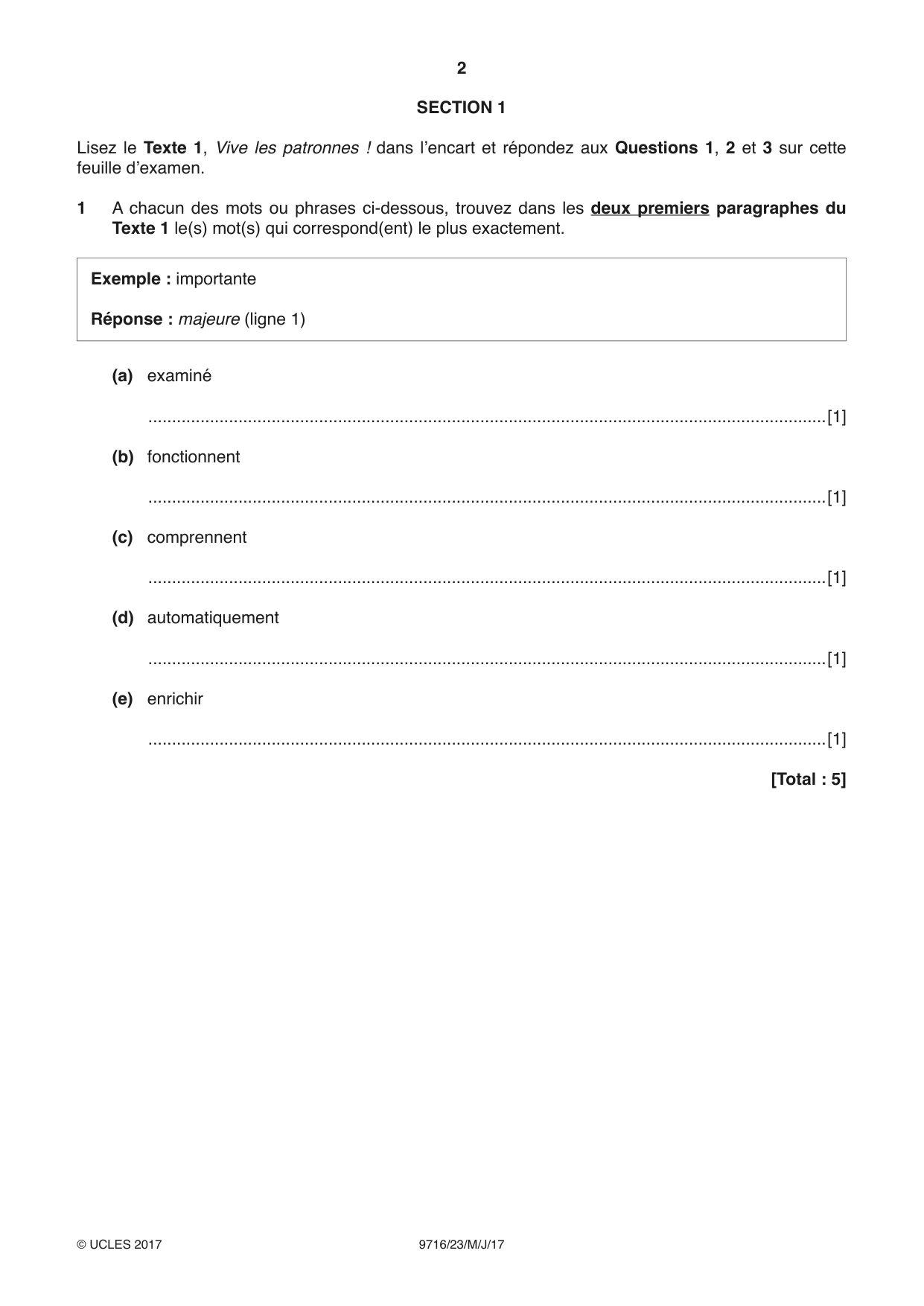
Question paper, page 2
2 9716/23/M/J/17 © UCLES 2017 SECTION 1 Lisez le Texte 1, Vive les patronnes ! dans l’encart et répondez aux Questions 1, 2 et 3 sur cette feuille d’examen. 1 A chacun des mots ou phrases ci-dessous, trouvez dans les deux premiers paragraphes du Texte 1 le(s) mot(s) qui correspond(ent) le plus exactement. Exemple : importante Réponse : majeure (ligne 1) (a) examiné …[1] (b) fonctionnent …[1] (c) comprennent …[1] (d) automatiquement …[1] (e) enrichir …[1] [Total : 5]
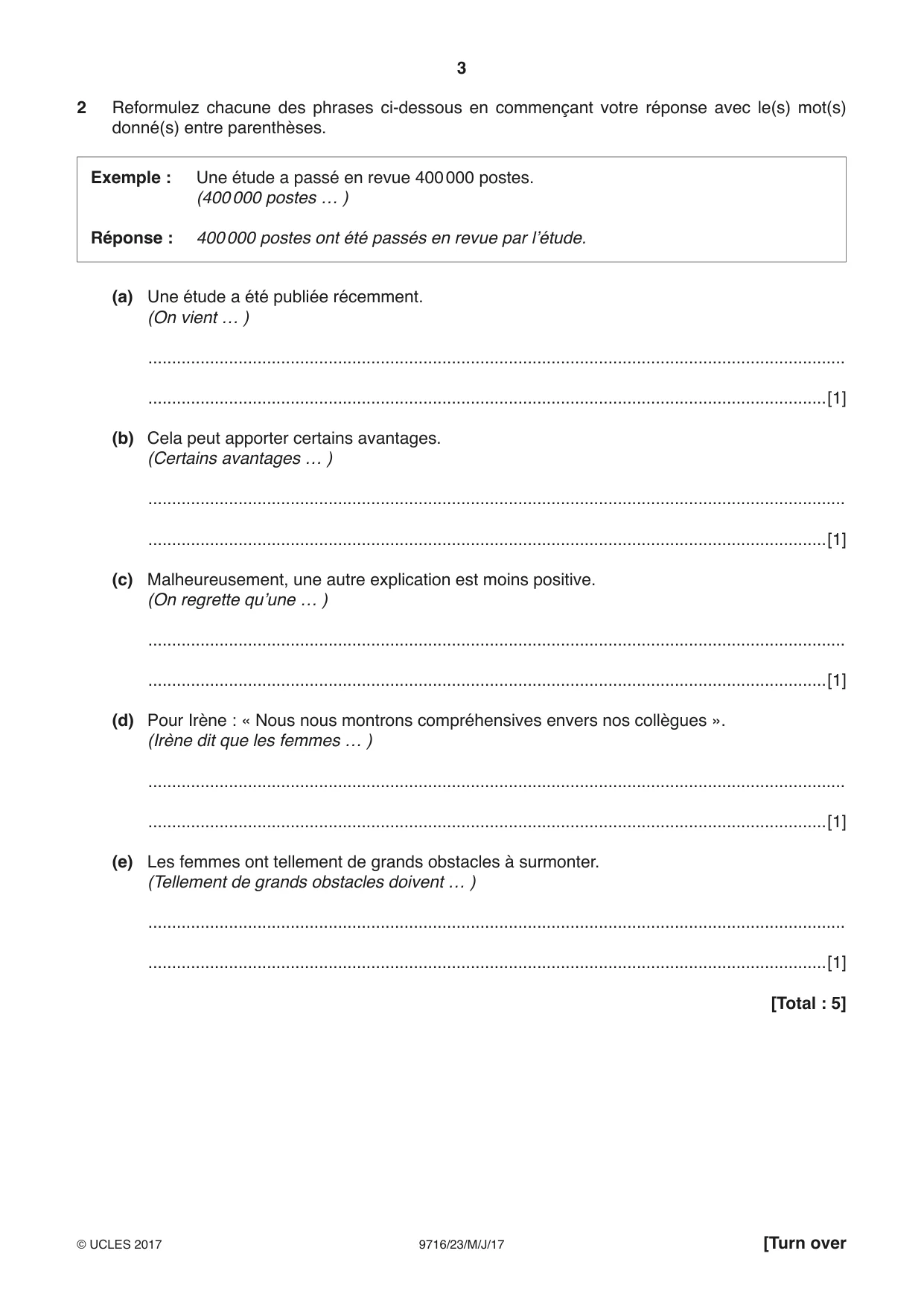
Question paper, page 3
3 9716/23/M/J/17 © UCLES 2017 [Turn over 2 Reformulez chacune des phrases ci-dessous en commençant votre réponse avec le(s) mot(s) donné(s) entre parenthèses. Exemple : Une étude a passé en revue 400 000 postes. (400 000 postes … ) Réponse : 400 000 postes ont été passés en revue par l’étude. (a) Une étude a été publiée récemment. (On vient … ) … …[1] (b) Cela peut apporter certains avantages. (Certains avantages … ) … …[1] (c) Malheureusement, une autre explication est moins positive. (On regrette qu’une … ) … …[1] (d) Pour Irène : « Nous nous montrons compréhensives envers nos collègues ». (Irène dit que les femmes … ) … …[1] (e) Les femmes ont tellement de grands obstacles à surmonter. (Tellement de grands obstacles doivent … ) … …[1] [Total : 5]
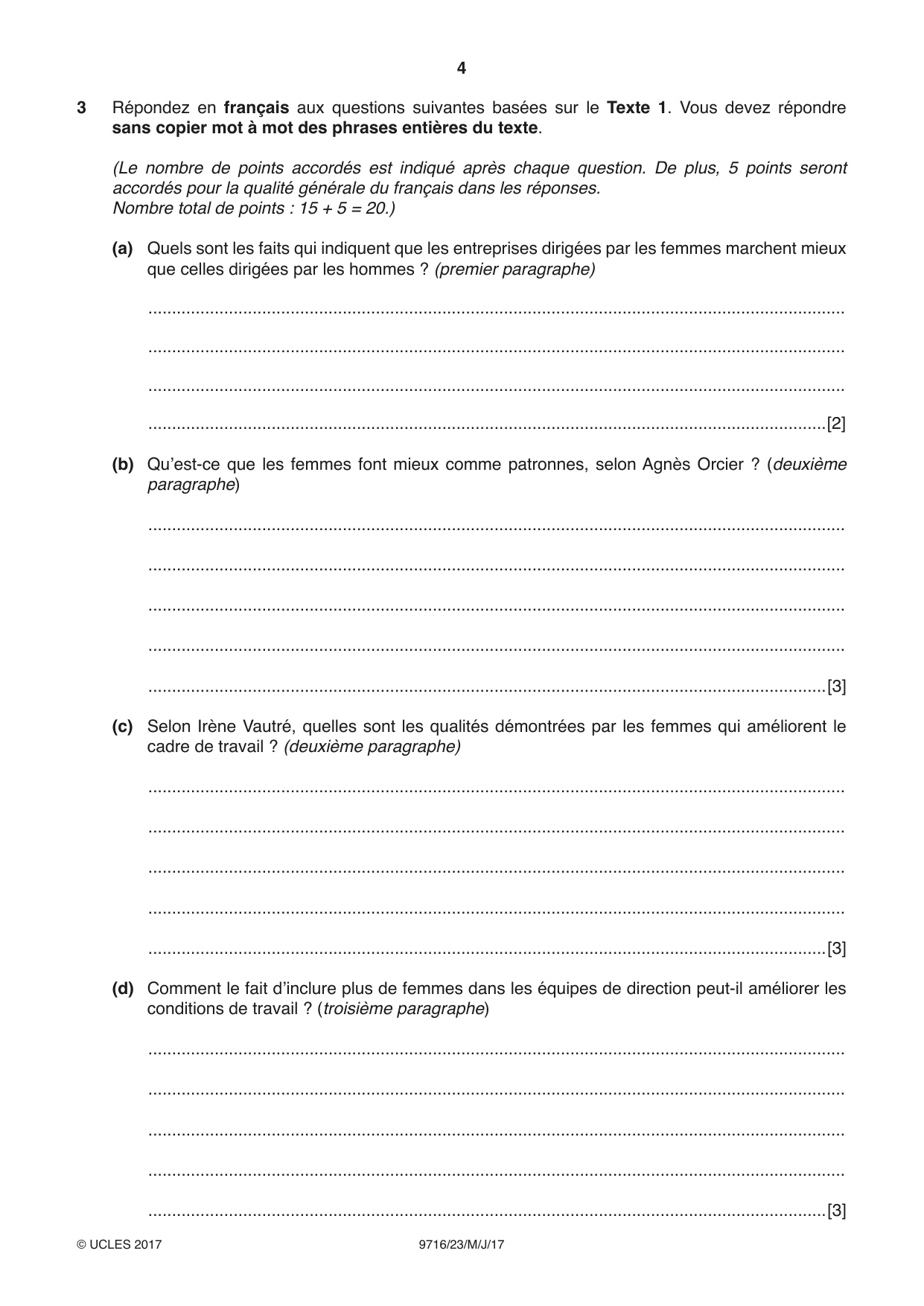
Question paper, page 4
4 9716/23/M/J/17 © UCLES 2017 3 Répondez en français aux questions suivantes basées sur le Texte 1. Vous devez répondre sans copier mot à mot des phrases entières du texte. (Le nombre de points accordés est indiqué après chaque question. De plus, 5 points seront accordés pour la qualité générale du français dans les réponses. Nombre total de points : 15 + 5 = 20.) (a) Quels sont les faits qui indiquent que les entreprises dirigées par les femmes marchent mieux que celles dirigées par les hommes ? (premier paragraphe) … … … …[2] (b) Qu’est-ce que les femmes font mieux comme patronnes, selon Agnès Orcier ? (deuxième paragraphe) … … … … …[3] (c) Selon Irène Vautré, quelles sont les qualités démontrées par les femmes qui améliorent le cadre de travail ? (deuxième paragraphe) … … … … …[3] (d) Comment le fait d’inclure plus de femmes dans les équipes de direction peut-il améliorer les conditions de travail ? (troisième paragraphe) … … … … …[3]
Question paper, page 5
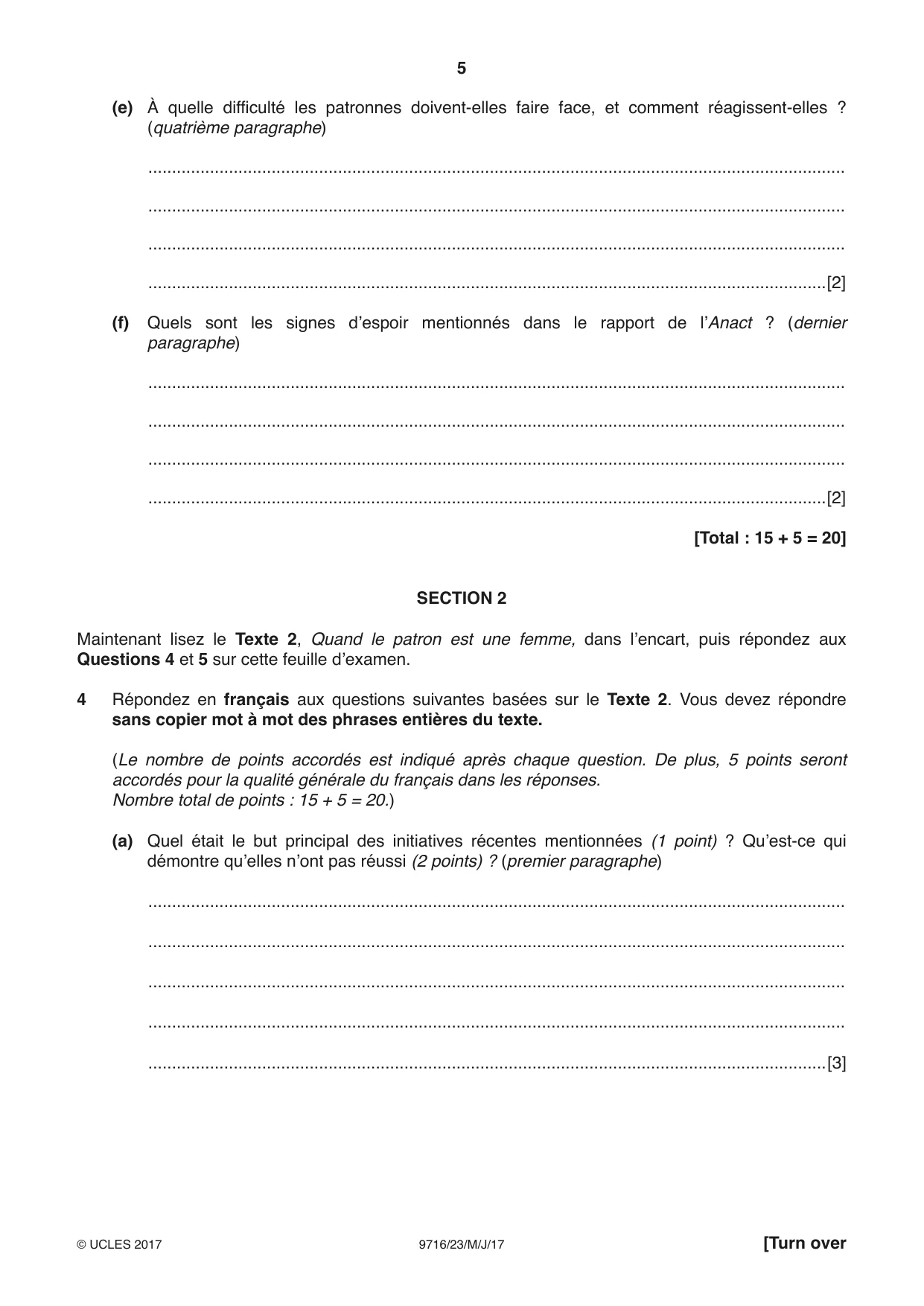
5 9716/23/M/J/17 © UCLES 2017 [Turn over (e) À quelle difficulté les patronnes doivent-elles faire face, et comment réagissent-elles ? (quatrième paragraphe) … … … …[2] (f) Quels sont les signes d’espoir mentionnés dans le rapport de l’Anact ? (dernier paragraphe) … … … …[2] [Total : 15 + 5 = 20] SECTION 2 Maintenant lisez le Texte 2, Quand le patron est une femme, dans l’encart, puis répondez aux Questions 4 et 5 sur cette feuille d’examen. 4 Répondez en français aux questions suivantes basées sur le Texte 2. Vous devez répondre sans copier mot à mot des phrases entières du texte. (Le nombre de points accordés est indiqué après chaque question. De plus, 5 points seront accordés pour la qualité générale du français dans les réponses. Nombre total de points : 15 + 5 = 20.) (a) Quel était le but principal des initiatives récentes mentionnées (1 point) ? Qu’est-ce qui démontre qu’elles n’ont pas réussi (2 points) ? (premier paragraphe) … … … … …[3]
Question paper, page 6
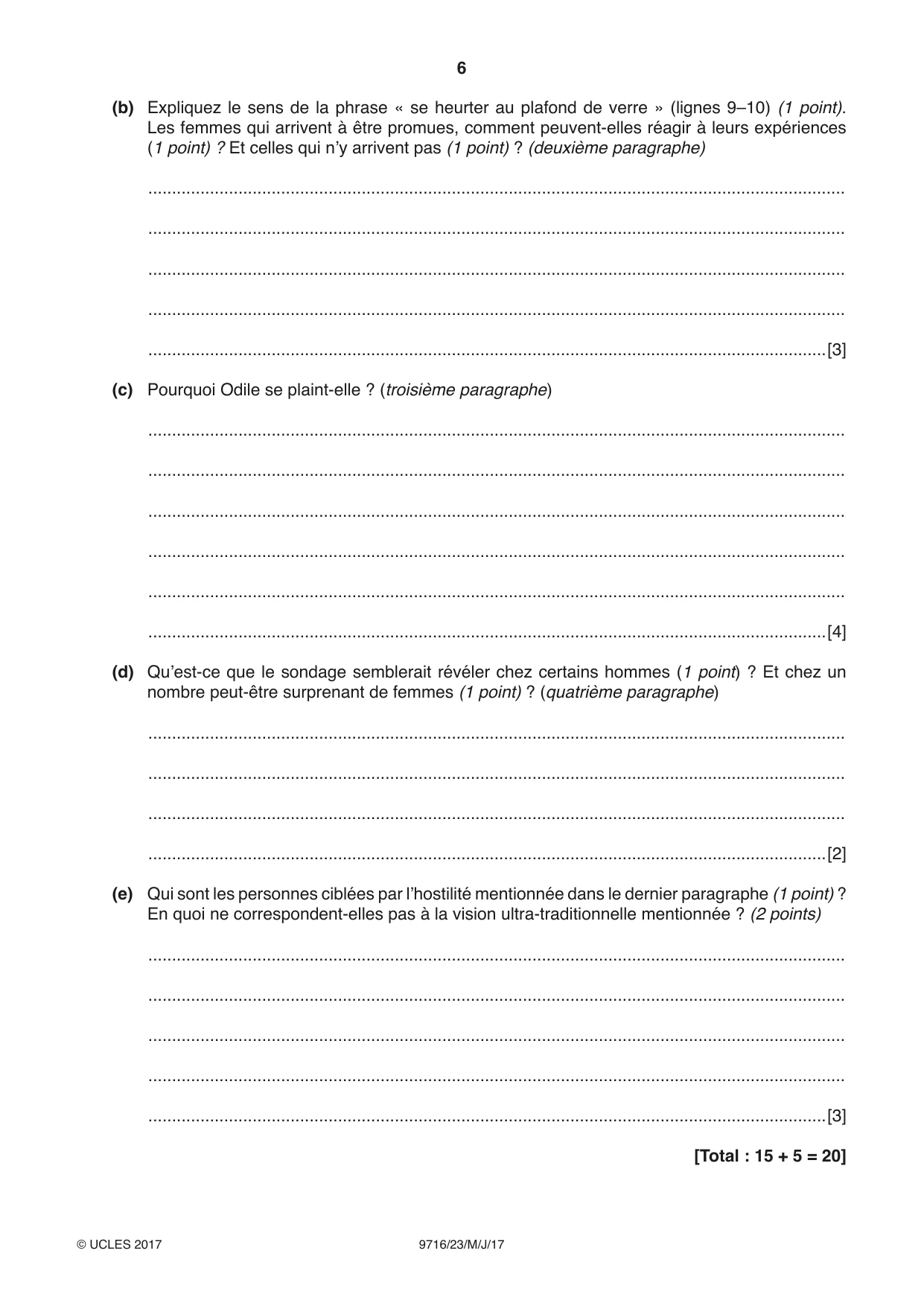
6 9716/23/M/J/17 © UCLES 2017 (b) Expliquez le sens de la phrase « se heurter au plafond de verre » (lignes 9–10) (1 point). Les femmes qui arrivent à être promues, comment peuvent-elles réagir à leurs expériences (1 point) ? Et celles qui n’y arrivent pas (1 point) ? (deuxième paragraphe) … … … … …[3] (c) Pourquoi Odile se plaint-elle ? (troisième paragraphe) … … … … … …[4] (d) Qu’est-ce que le sondage semblerait révéler chez certains hommes (1 point) ? Et chez un nombre peut-être surprenant de femmes (1 point) ? (quatrième paragraphe) … … … …[2] (e) Qui sont les personnes ciblées par l’hostilité mentionnée dans le dernier paragraphe (1 point) ? En quoi ne correspondent-elles pas à la vision ultra-traditionnelle mentionnée ? (2 points) … … … … …[3] [Total : 15 + 5 = 20]
Question paper, page 7
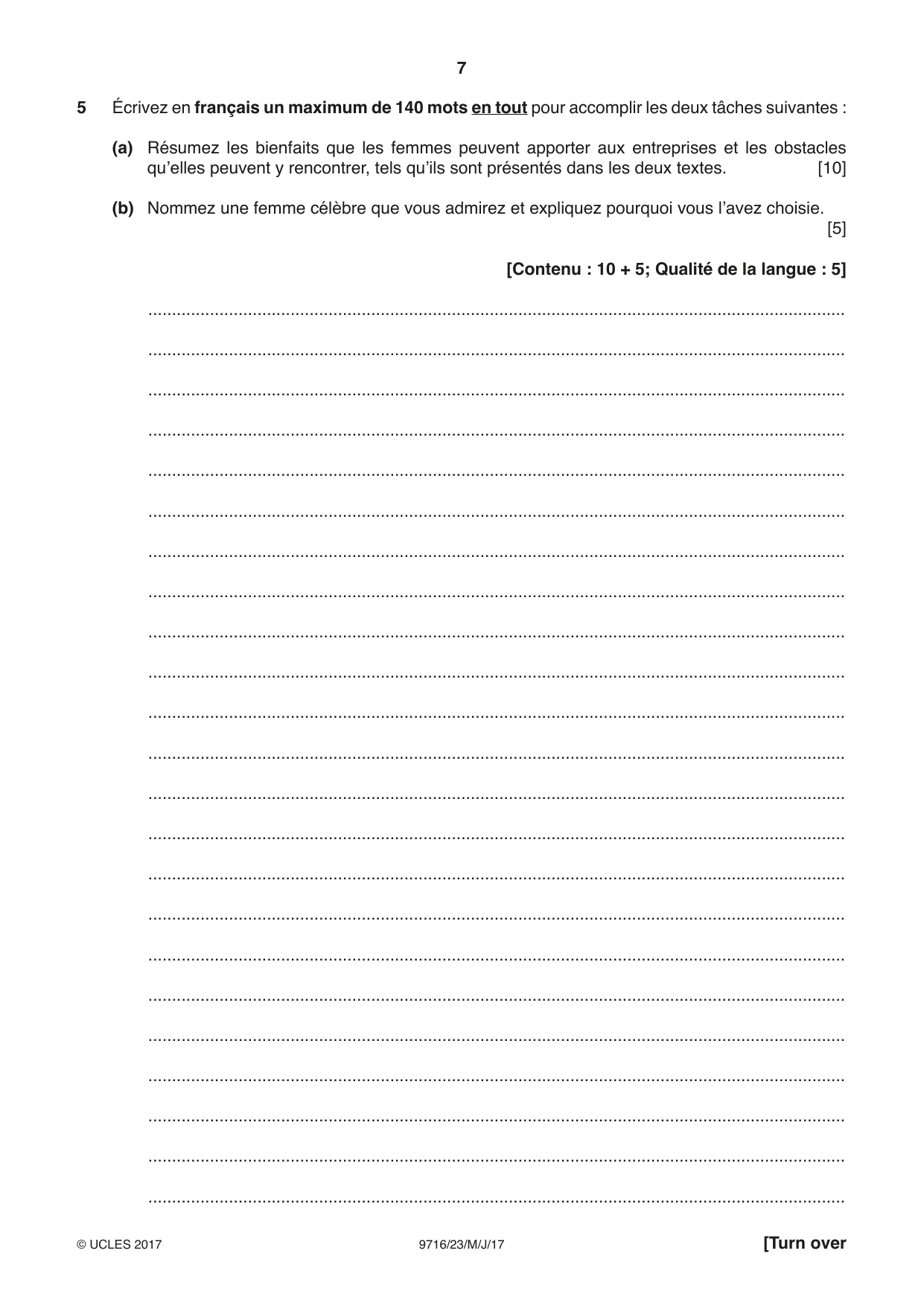
7 9716/23/M/J/17 © UCLES 2017 [Turn over 5 Écrivez en français un maximum de 140 mots en tout pour accomplir les deux tâches suivantes : (a) Résumez les bienfaits que les femmes peuvent apporter aux entreprises et les obstacles qu’elles peuvent y rencontrer, tels qu’ils sont présentés dans les deux textes. [10] (b) Nommez une femme célèbre que vous admirez et expliquez pourquoi vous l’avez choisie. [5] [Contenu : 10 + 5; Qualité de la langue : 5] … … … … … … … … … … … … … … … … … … … … … … …
Question paper, page 8
8 9716/23/M/J/17 © UCLES 2017 Permission to reproduce items where third-party owned material protected by copyright is included has been sought and cleared where possible. Every reasonable effort has been made by the publisher (UCLES) to trace copyright holders, but if any items requiring clearance have unwittingly been included, the publisher will be pleased to make amends at the earliest possible opportunity. To avoid the issue of disclosure of answer-related information to candidates, all copyright acknowledgements are reproduced online in the Cambridge International Examinations Copyright Acknowledgements Booklet. This is produced for each series of examinations and is freely available to download at www.cie.org.uk after the live examination series. Cambridge International Examinations is part of the Cambridge Assessment Group. Cambridge Assessment is the brand name of University of Cambridge Local Examinations Syndicate (UCLES), which is itself a department of the University of Cambridge. … … … … … … … … … … … … … … … [Total : 10 + 5 + 5 = 20]
Mark scheme, page 1
® IGCSE is a registered trademark. This document consists of 18 printed pages. © UCLES 2017 [Turn over Cambridge International Examinations Cambridge International Advanced Level FRENCH 9716/23 Paper 2 Reading and Writing May/June 2017 MARK SCHEME Maximum Mark: 70 Published This mark scheme is published as an aid to teachers and candidates, to indicate the requirements of the examination. It shows the basis on which Examiners were instructed to award marks. It does not indicate the details of the discussions that took place at an Examiners’ meeting before marking began, which would have considered the acceptability of alternative answers. Mark schemes should be read in conjunction with the question paper and the Principal Examiner Report for Teachers. Cambridge will not enter into discussions about these mark schemes. Cambridge is publishing the mark schemes for the May/June 2017 series for most Cambridge IGCSE®, Cambridge International A and AS Level and Cambridge Pre-U components, and some Cambridge O Level components.
Mark scheme, page 2
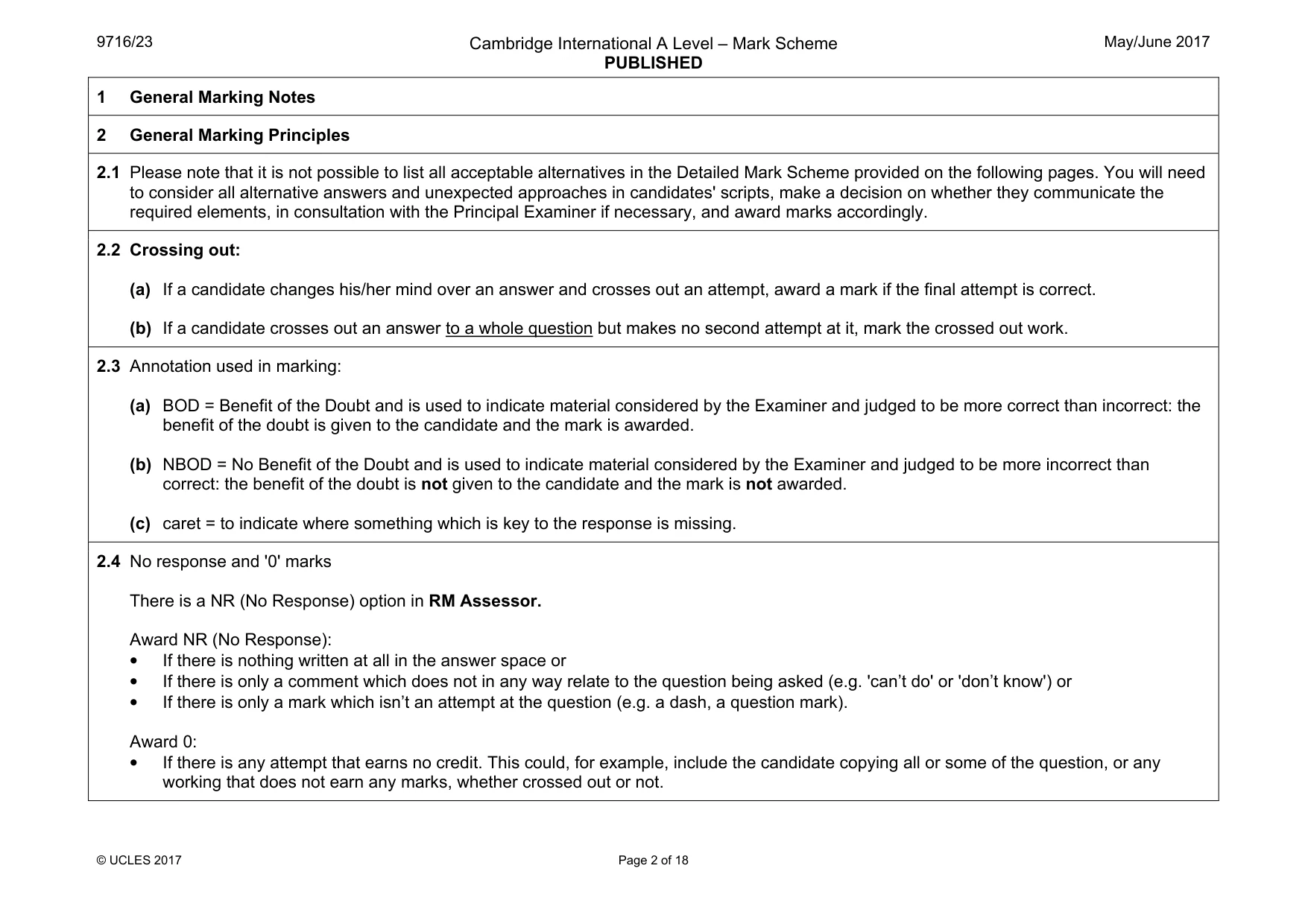
9716/23 Cambridge International A Level – Mark Scheme PUBLISHED May/June 2017 © UCLES 2017 Page 2 of 18 1 General Marking Notes 2 General Marking Principles 2.1 Please note that it is not possible to list all acceptable alternatives in the Detailed Mark Scheme provided on the following pages. You will need to consider all alternative answers and unexpected approaches in candidates' scripts, make a decision on whether they communicate the required elements, in consultation with the Principal Examiner if necessary, and award marks accordingly. 2.2 Crossing out: (a) If a candidate changes his/her mind over an answer and crosses out an attempt, award a mark if the final attempt is correct. (b) If a candidate crosses out an answer to a whole question but makes no second attempt at it, mark the crossed out work. 2.3 Annotation used in marking: (a) BOD = Benefit of the Doubt and is used to indicate material considered by the Examiner and judged to be more correct than incorrect: the benefit of the doubt is given to the candidate and the mark is awarded. (b) NBOD = No Benefit of the Doubt and is used to indicate material considered by the Examiner and judged to be more incorrect than correct: the benefit of the doubt is not given to the candidate and the mark is not awarded. (c) caret = to indicate where something which is key to the response is missing. 2.4 No response and '0' marks There is a NR (No Response) option in RM Assessor. Award NR (No Response): • If there is nothing written at all in the answer space or • If there is only a comment which does not in any way relate to the question being asked (e.g. 'can’t do' or 'don’t know') or • If there is only a mark which isn’t an attempt at the question (e.g. a dash, a question mark). Award 0: • If there is any attempt that earns no credit. This could, for example, include the candidate copying all or some of the question, or any working that does not earn any marks, whether crossed out or not.
Mark scheme, page 3
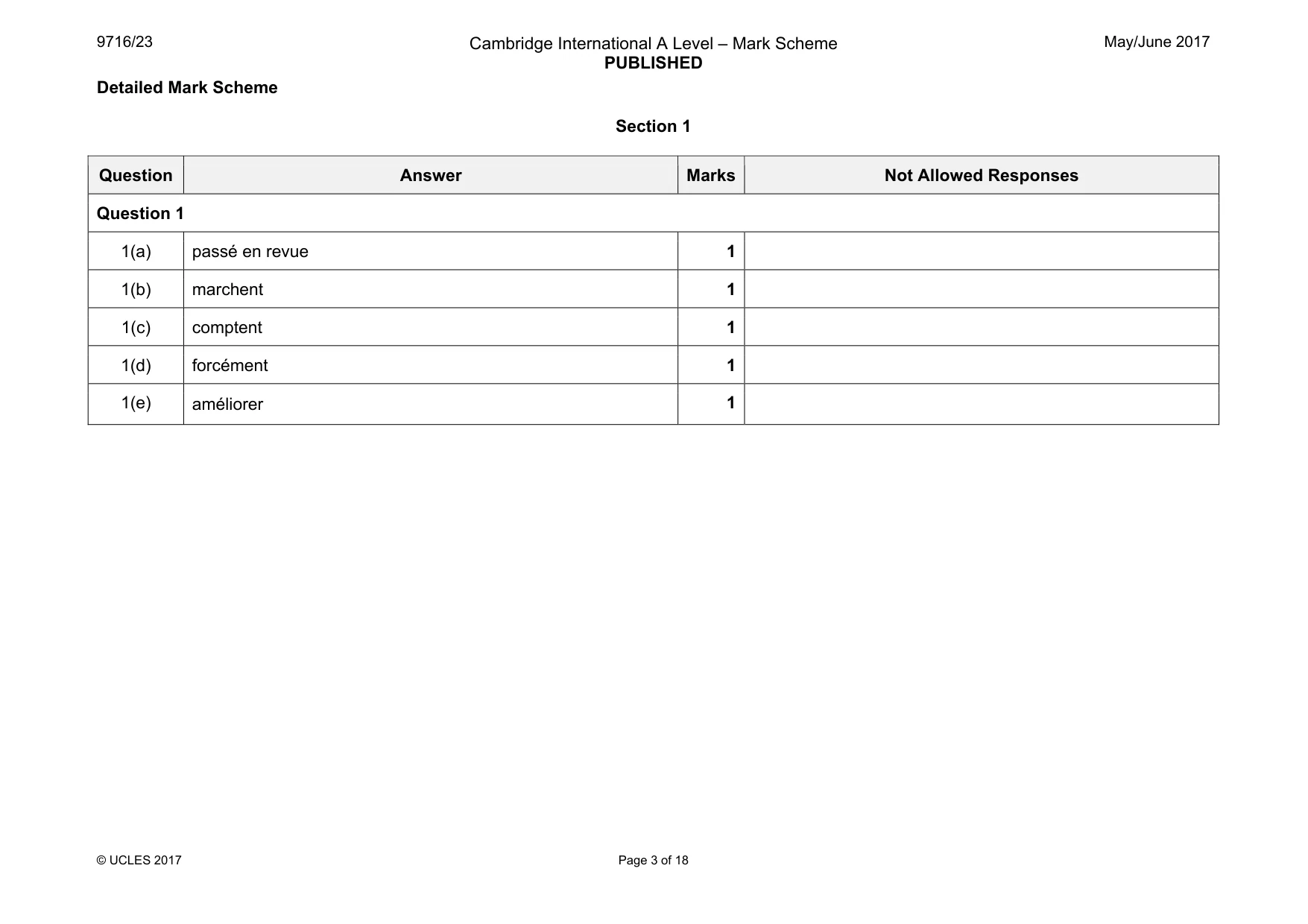
9716/23 Cambridge International A Level – Mark Scheme PUBLISHED May/June 2017 © UCLES 2017 Page 3 of 18 Detailed Mark Scheme Section 1 Question Answer Marks Not Allowed Responses Question 1 1(a) passé en revue 1 1(b) marchent 1 1(c) comptent 1 1(d) forcément 1 1(e) améliorer 1
Mark scheme, page 4
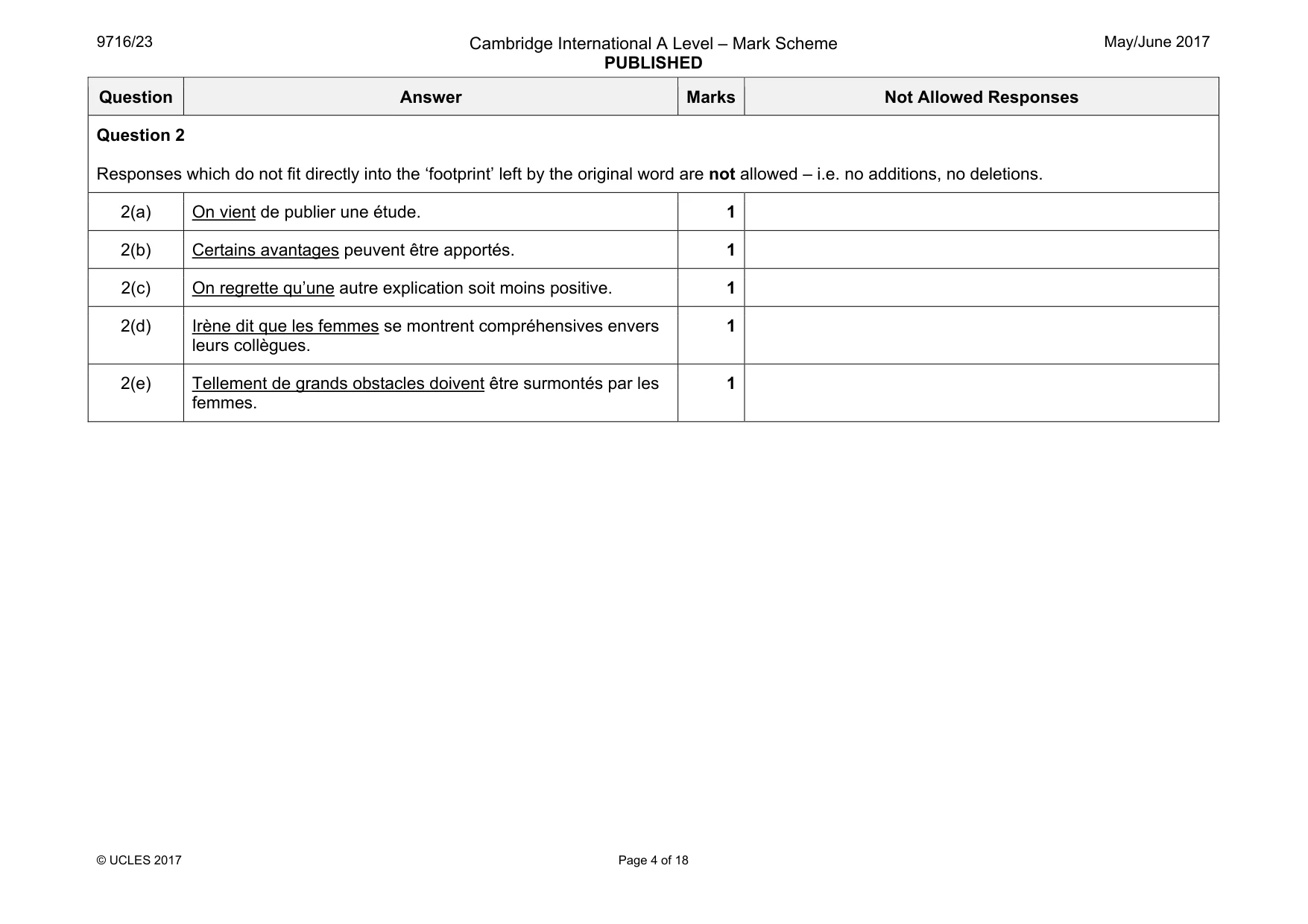
9716/23 Cambridge International A Level – Mark Scheme PUBLISHED May/June 2017 © UCLES 2017 Page 4 of 18 Question Answer Marks Not Allowed Responses Question 2 Responses which do not fit directly into the ‘footprint’ left by the original word are not allowed – i.e. no additions, no deletions. 2(a) On vient de publier une étude. 1 2(b) Certains avantages peuvent être apportés. 1 2(c) On regrette qu’une autre explication soit moins positive. 1 2(d) Irène dit que les femmes se montrent compréhensives envers leurs collègues. 1 2(e) Tellement de grands obstacles doivent être surmontés par les femmes. 1
Mark scheme, page 5
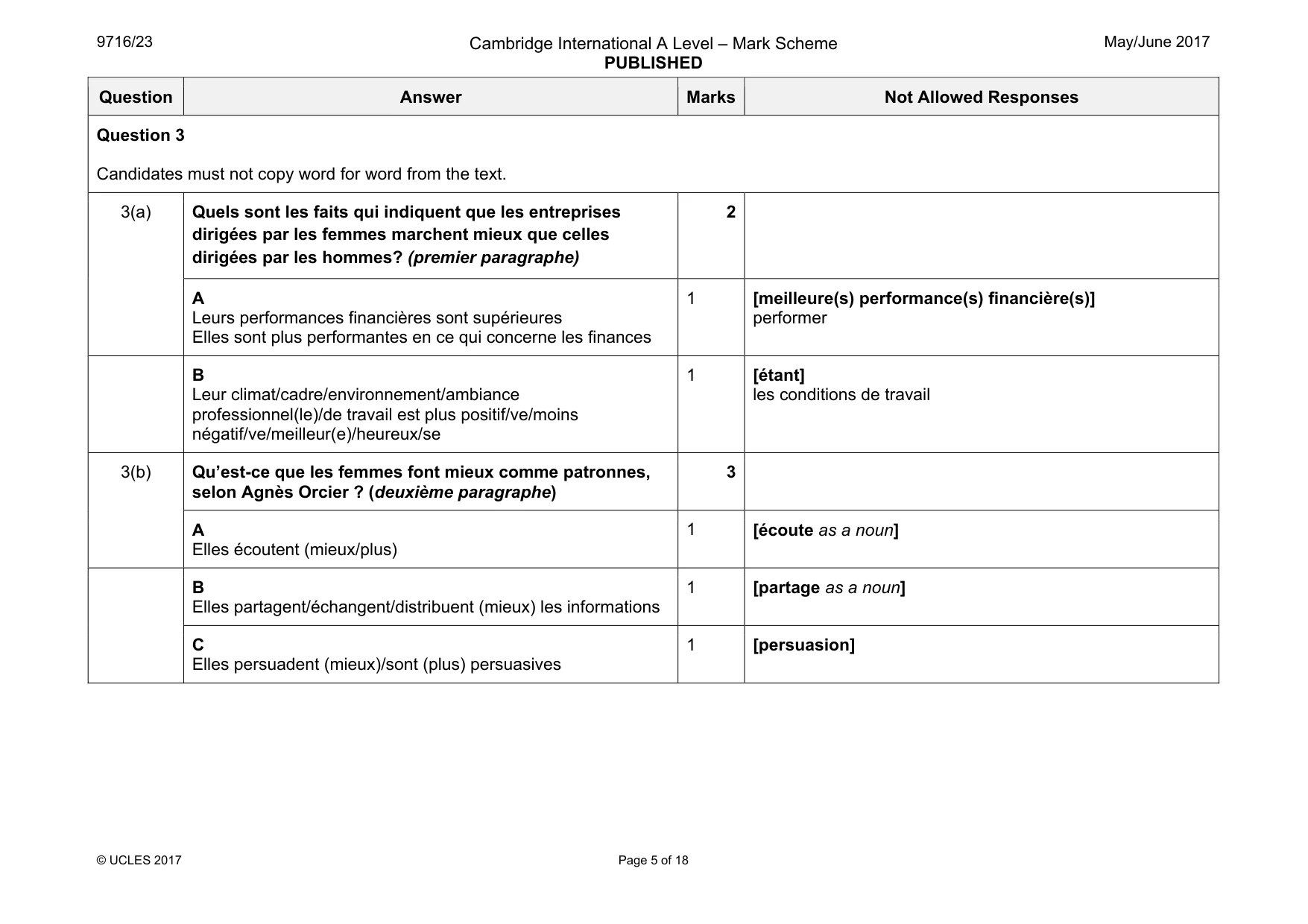
9716/23 Cambridge International A Level – Mark Scheme PUBLISHED May/June 2017 © UCLES 2017 Page 5 of 18 Question Answer Marks Not Allowed Responses Question 3 Candidates must not copy word for word from the text. 3(a) Quels sont les faits qui indiquent que les entreprises dirigées par les femmes marchent mieux que celles dirigées par les hommes? (premier paragraphe) 2 A Leurs performances financières sont supérieures Elles sont plus performantes en ce qui concerne les finances 1 [meilleure(s) performance(s) financière(s)] performer B Leur climat/cadre/environnement/ambiance professionnel(le)/de travail est plus positif/ve/moins négatif/ve/meilleur(e)/heureux/se 1 [étant] les conditions de travail 3(b) Qu’est-ce que les femmes font mieux comme patronnes, selon Agnès Orcier ? (deuxième paragraphe) 3 A Elles écoutent (mieux/plus) 1 [écoute as a noun] B Elles partagent/échangent/distribuent (mieux) les informations 1 [partage as a noun] C Elles persuadent (mieux)/sont (plus) persuasives 1 [persuasion]
Mark scheme, page 6
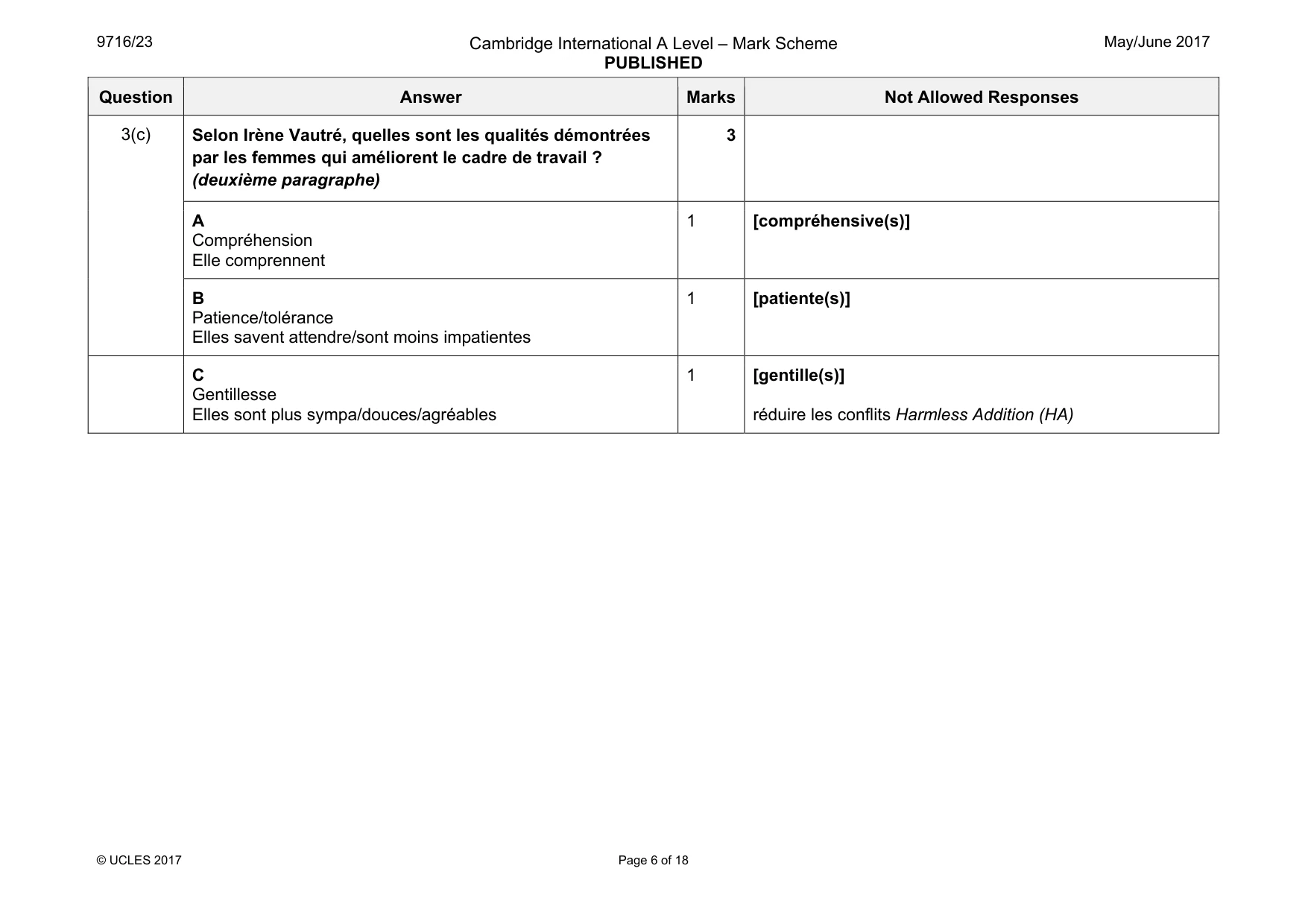
9716/23 Cambridge International A Level – Mark Scheme PUBLISHED May/June 2017 © UCLES 2017 Page 6 of 18 Question Answer Marks Not Allowed Responses 3(c) Selon Irène Vautré, quelles sont les qualités démontrées par les femmes qui améliorent le cadre de travail ? (deuxième paragraphe) 3 A Compréhension Elle comprennent 1 [compréhensive(s)] B Patience/tolérance Elles savent attendre/sont moins impatientes 1 [patiente(s)] C Gentillesse Elles sont plus sympa/douces/agréables 1 [gentille(s)] réduire les conflits Harmless Addition (HA)
Mark scheme, page 7
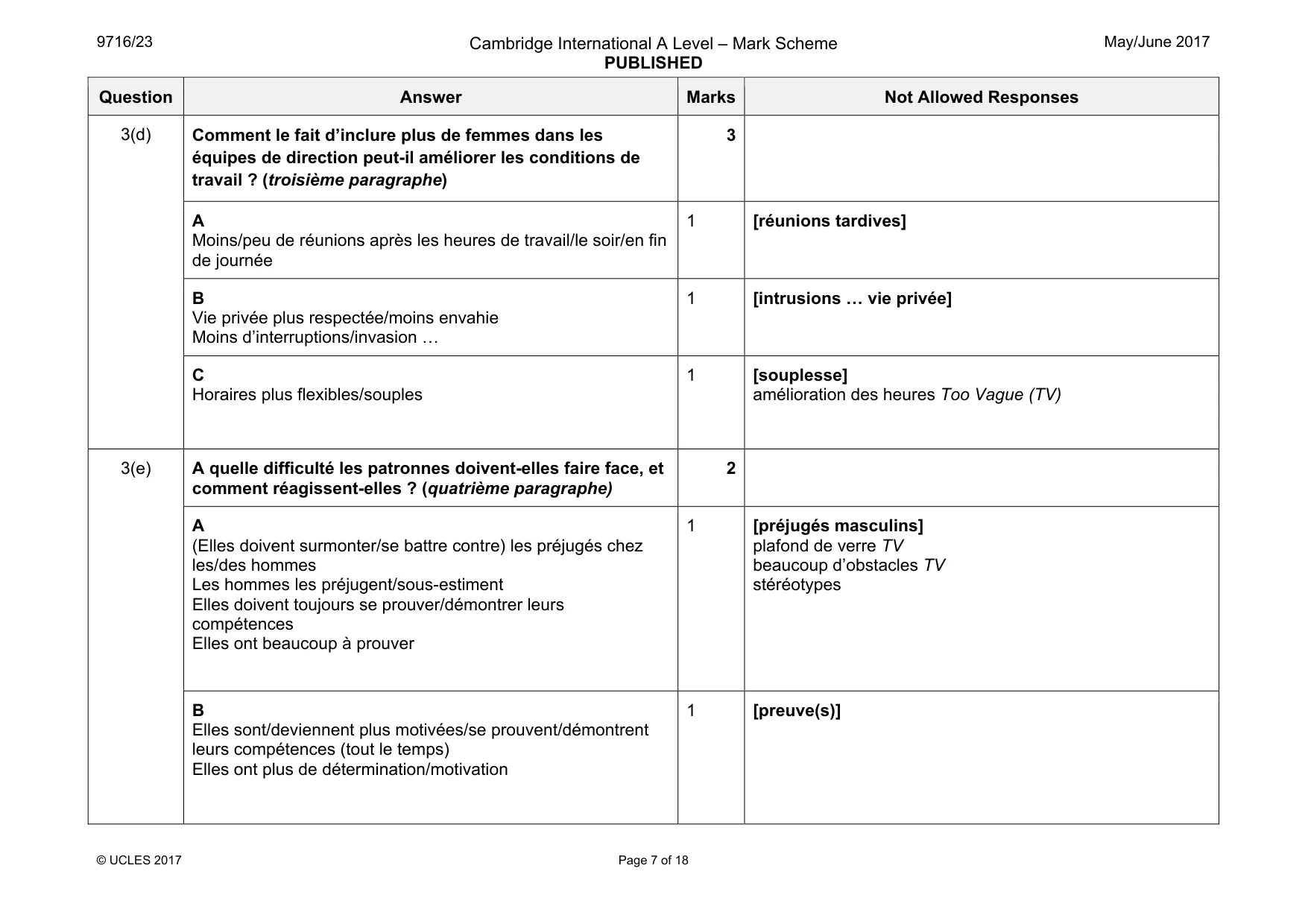
9716/23 Cambridge International A Level – Mark Scheme PUBLISHED May/June 2017 © UCLES 2017 Page 7 of 18 Question Answer Marks Not Allowed Responses 3(d) Comment le fait d’inclure plus de femmes dans les équipes de direction peut-il améliorer les conditions de travail ? (troisième paragraphe) 3 A Moins/peu de réunions après les heures de travail/le soir/en fin de journée 1 [réunions tardives] B Vie privée plus respectée/moins envahie Moins d’interruptions/invasion « 1 [intrusions « vie privée] C Horaires plus flexibles/souples 1 [souplesse] amélioration des heures Too Vague (TV) 3(e) A quelle difficulté les patronnes doivent-elles faire face, et comment réagissent-elles ? (quatrième paragraphe) 2 A (Elles doivent surmonter/se battre contre) les préjugés chez les/des hommes Les hommes les préjugent/sous-estiment Elles doivent toujours se prouver/démontrer leurs compétences Elles ont beaucoup à prouver 1 [préjugés masculins] plafond de verre TV beaucoup d’obstacles TV stéréotypes B Elles sont/deviennent plus motivées/se prouvent/démontrent leurs compétences (tout le temps) Elles ont plus de détermination/motivation 1 [preuve(s)]
Mark scheme, page 8
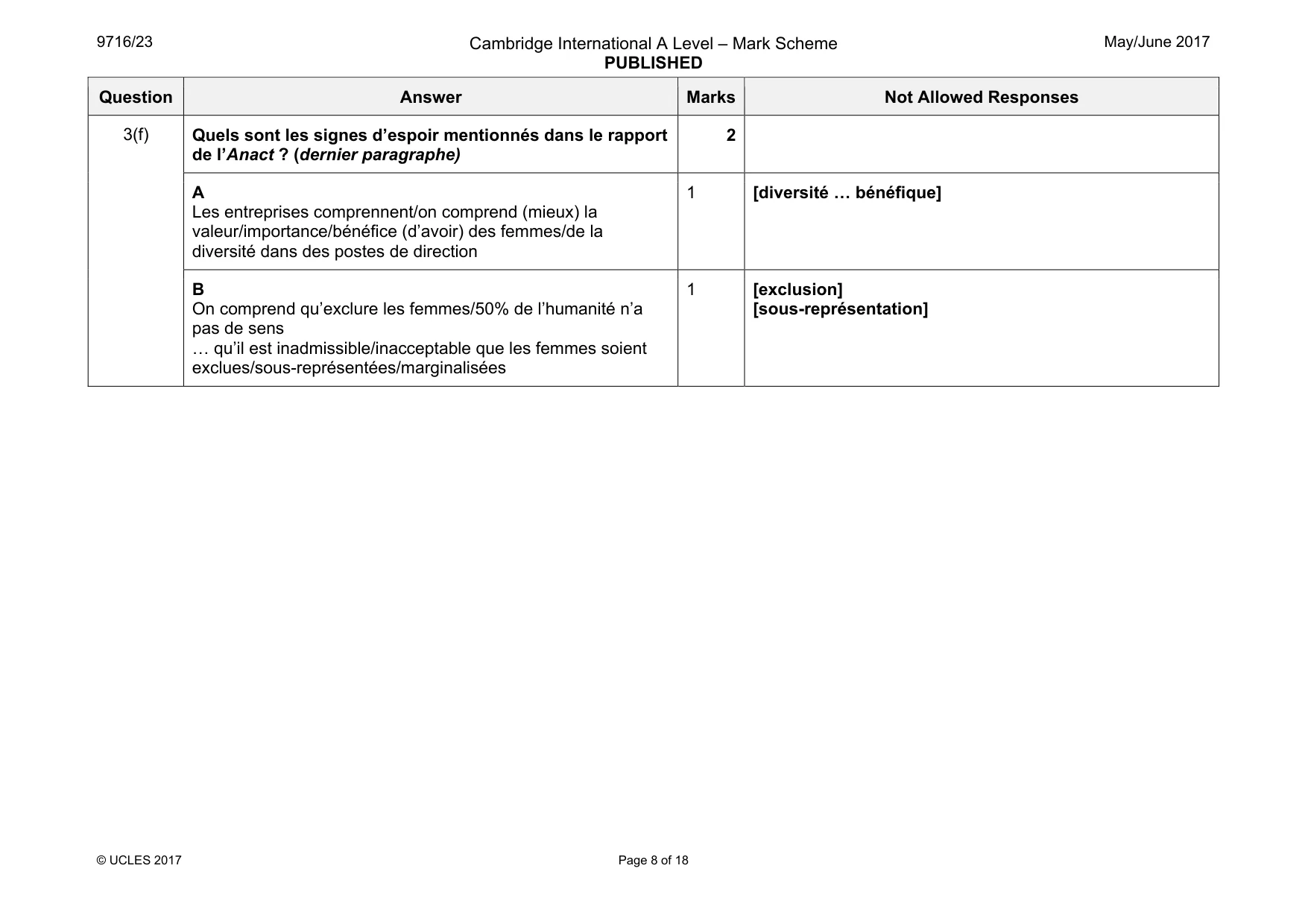
9716/23 Cambridge International A Level – Mark Scheme PUBLISHED May/June 2017 © UCLES 2017 Page 8 of 18 Question Answer Marks Not Allowed Responses 3(f) Quels sont les signes d’espoir mentionnés dans le rapport de l’Anact ? (dernier paragraphe) 2 A Les entreprises comprennent/on comprend (mieux) la valeur/importance/bénéfice (d’avoir) des femmes/de la diversité dans des postes de direction 1 [diversité « bénéfique] B On comprend qu’exclure les femmes/50% de l’humanité n’a pas de sens « qu’il est inadmissible/inacceptable que les femmes soient exclues/sous-représentées/marginalisées 1 [exclusion] [sous-représentation]
Mark scheme, page 9
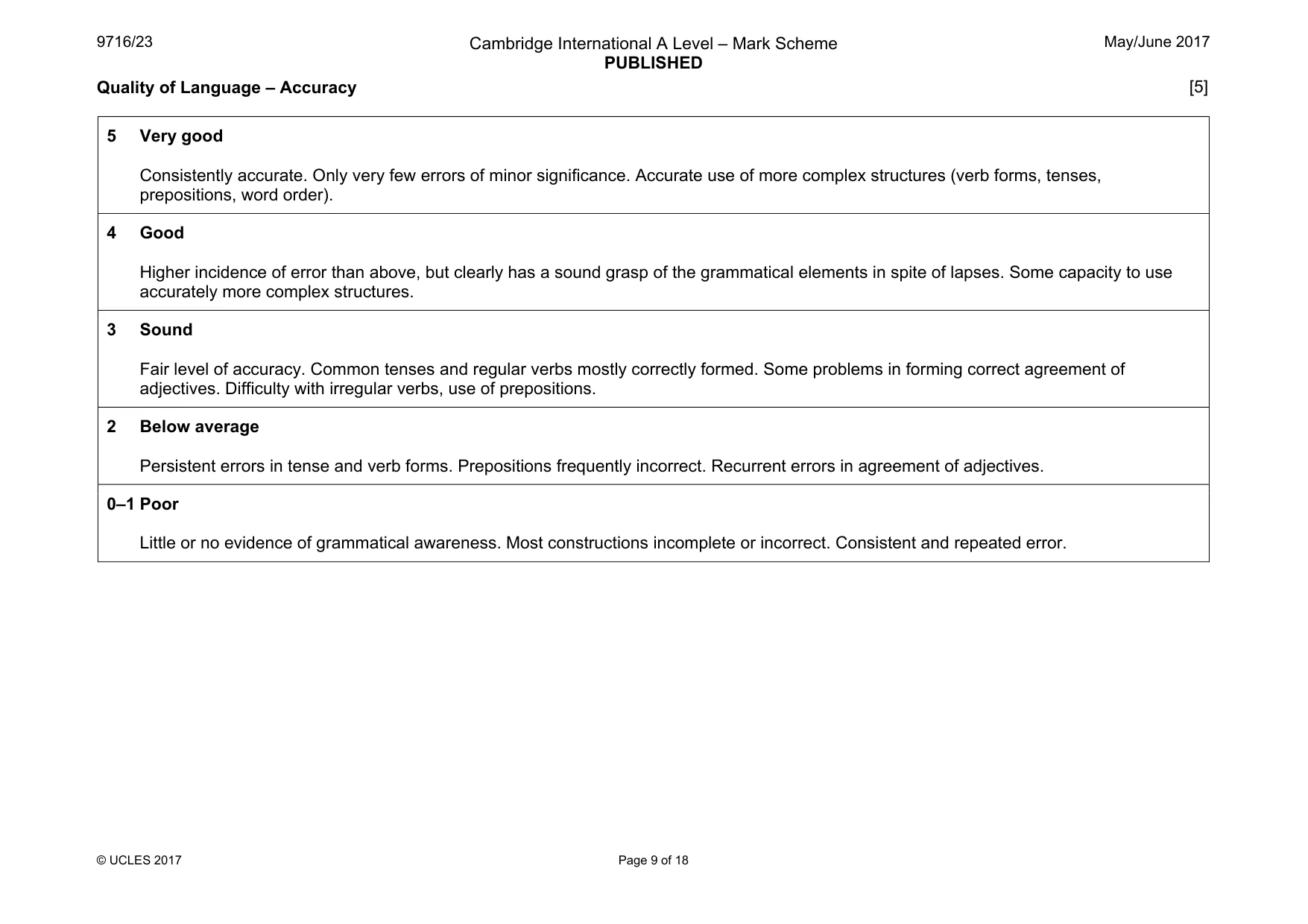
9716/23 Cambridge International A Level – Mark Scheme PUBLISHED May/June 2017 © UCLES 2017 Page 9 of 18 Quality of Language – Accuracy [5] 5 Very good Consistently accurate. Only very few errors of minor significance. Accurate use of more complex structures (verb forms, tenses, prepositions, word order). 4 Good Higher incidence of error than above, but clearly has a sound grasp of the grammatical elements in spite of lapses. Some capacity to use accurately more complex structures. 3 Sound Fair level of accuracy. Common tenses and regular verbs mostly correctly formed. Some problems in forming correct agreement of adjectives. Difficulty with irregular verbs, use of prepositions. 2 Below average Persistent errors in tense and verb forms. Prepositions frequently incorrect. Recurrent errors in agreement of adjectives. 0–1 Poor Little or no evidence of grammatical awareness. Most constructions incomplete or incorrect. Consistent and repeated error.
Mark scheme, page 10
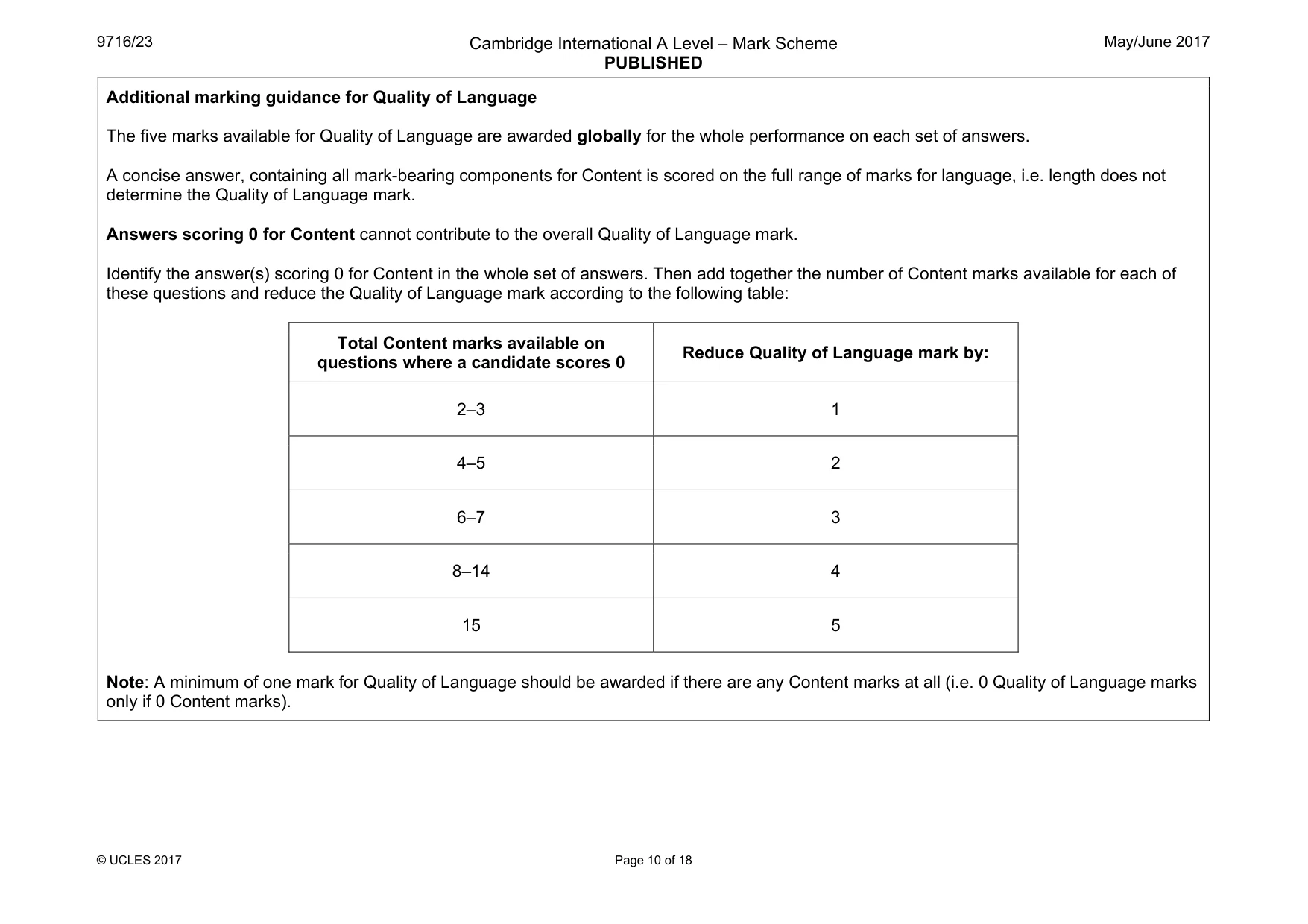
9716/23 Cambridge International A Level – Mark Scheme PUBLISHED May/June 2017 © UCLES 2017 Page 10 of 18 Additional marking guidance for Quality of Language The five marks available for Quality of Language are awarded globally for the whole performance on each set of answers. A concise answer, containing all mark-bearing components for Content is scored on the full range of marks for language, i.e. length does not determine the Quality of Language mark. Answers scoring 0 for Content cannot contribute to the overall Quality of Language mark. Identify the answer(s) scoring 0 for Content in the whole set of answers. Then add together the number of Content marks available for each of these questions and reduce the Quality of Language mark according to the following table: Total Content marks available on questions where a candidate scores 0 Reduce Quality of Language mark by: 2–3 1 4–5 2 6–7 3 8–14 4 15 5 Note: A minimum of one mark for Quality of Language should be awarded if there are any Content marks at all (i.e. 0 Quality of Language marks only if 0 Content marks).
Mark scheme, page 11
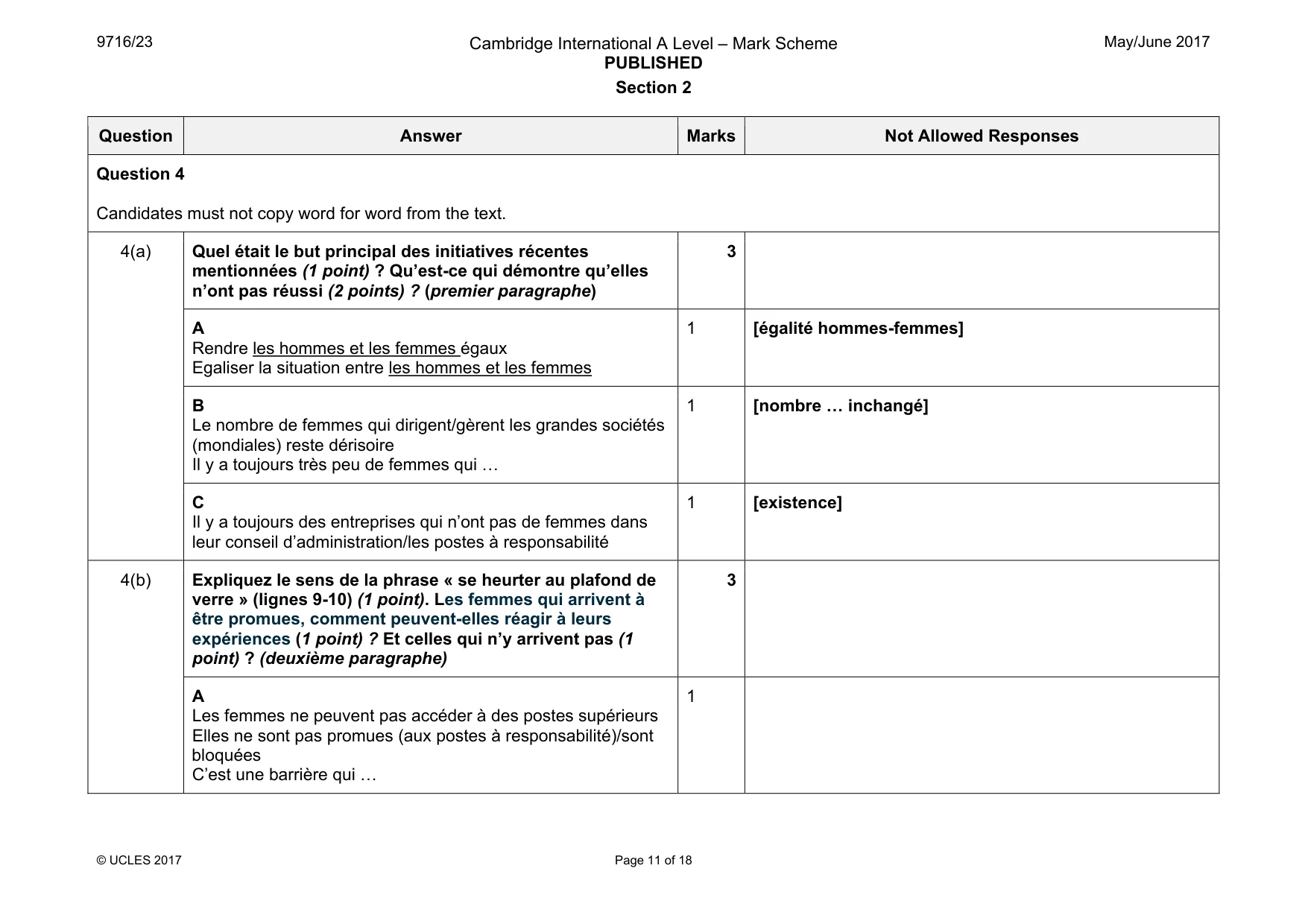
9716/23 Cambridge International A Level – Mark Scheme PUBLISHED May/June 2017 © UCLES 2017 Page 11 of 18 Section 2 Question Answer Marks Not Allowed Responses Question 4 Candidates must not copy word for word from the text. 4(a) Quel était le but principal des initiatives récentes mentionnées (1 point) ? Qu’est-ce qui démontre qu’elles n’ont pas réussi (2 points) ? (premier paragraphe) 3 A Rendre les hommes et les femmes égaux Egaliser la situation entre les hommes et les femmes 1 [égalité hommes-femmes] B Le nombre de femmes qui dirigent/gèrent les grandes sociétés (mondiales) reste dérisoire Il y a toujours très peu de femmes qui « 1 [nombre « inchangé] C Il y a toujours des entreprises qui n’ont pas de femmes dans leur conseil d’administration/les postes à responsabilité 1 [existence] 4(b) Expliquez le sens de la phrase « se heurter au plafond de verre » (lignes 9-10) (1 point). Les femmes qui arrivent à être promues, comment peuvent-elles réagir à leurs expériences (1 point) ? Et celles qui n’y arrivent pas (1 point) ? (deuxième paragraphe) 3 A Les femmes ne peuvent pas accéder à des postes supérieurs Elles ne sont pas promues (aux postes à responsabilité)/sont bloquées C’est une barrière qui « 1
Mark scheme, page 12
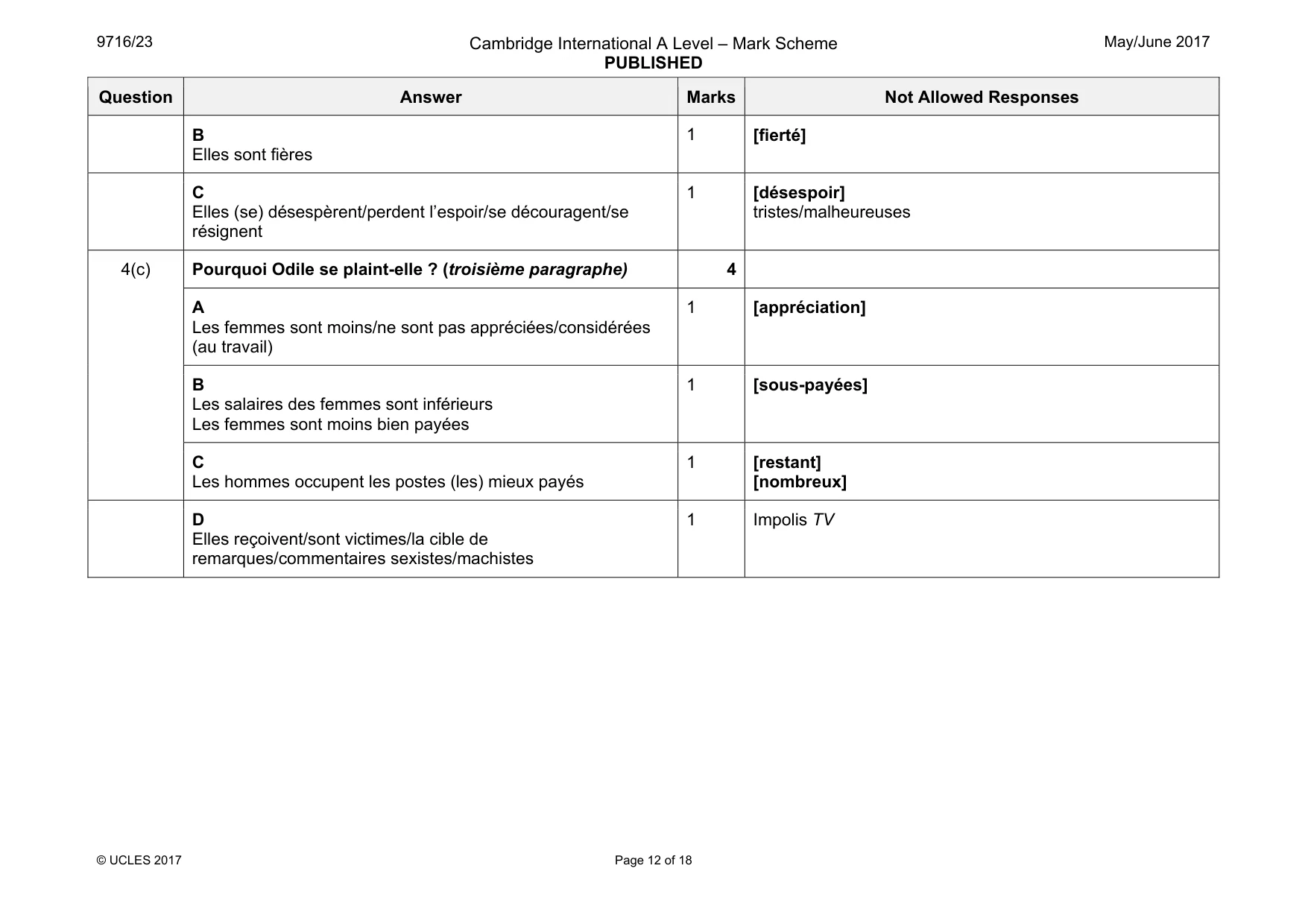
9716/23 Cambridge International A Level – Mark Scheme PUBLISHED May/June 2017 © UCLES 2017 Page 12 of 18 Question Answer Marks Not Allowed Responses B Elles sont fières 1 [fierté] C Elles (se) désespèrent/perdent l’espoir/se découragent/se résignent 1 [désespoir] tristes/malheureuses 4(c) Pourquoi Odile se plaint-elle ? (troisième paragraphe) 4 A Les femmes sont moins/ne sont pas appréciées/considérées (au travail) 1 [appréciation] B Les salaires des femmes sont inférieurs Les femmes sont moins bien payées 1 [sous-payées] C Les hommes occupent les postes (les) mieux payés 1 [restant] [nombreux] D Elles reçoivent/sont victimes/la cible de remarques/commentaires sexistes/machistes 1 Impolis TV
Mark scheme, page 13
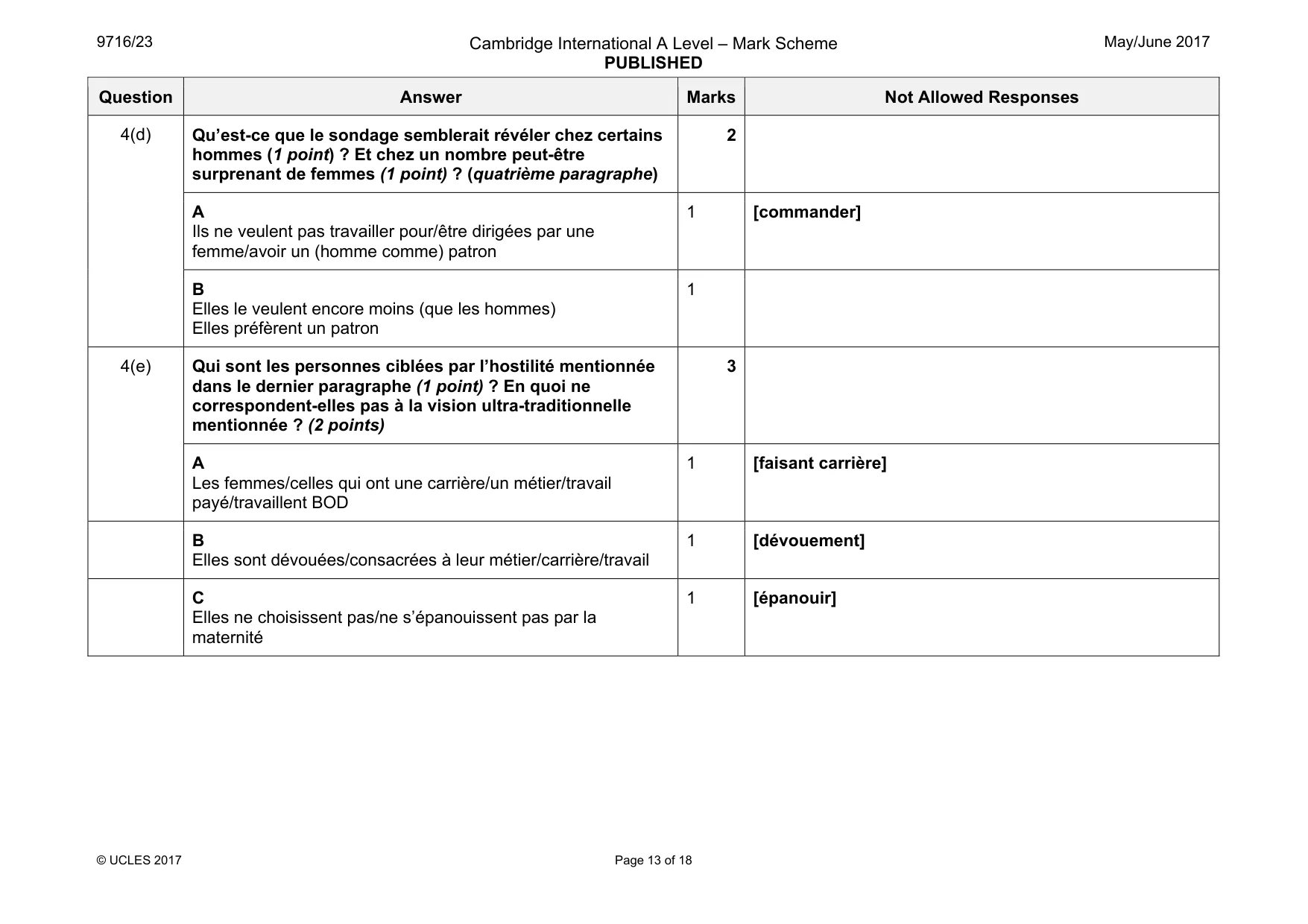
9716/23 Cambridge International A Level – Mark Scheme PUBLISHED May/June 2017 © UCLES 2017 Page 13 of 18 Question Answer Marks Not Allowed Responses 4(d) Qu’est-ce que le sondage semblerait révéler chez certains hommes (1 point) ? Et chez un nombre peut-être surprenant de femmes (1 point) ? (quatrième paragraphe) 2 A Ils ne veulent pas travailler pour/être dirigées par une femme/avoir un (homme comme) patron 1 [commander] B Elles le veulent encore moins (que les hommes) Elles préfèrent un patron 1 4(e) Qui sont les personnes ciblées par l’hostilité mentionnée dans le dernier paragraphe (1 point) ? En quoi ne correspondent-elles pas à la vision ultra-traditionnelle mentionnée ? (2 points) 3 A Les femmes/celles qui ont une carrière/un métier/travail payé/travaillent BOD 1 [faisant carrière] B Elles sont dévouées/consacrées à leur métier/carrière/travail 1 [dévouement] C Elles ne choisissent pas/ne s’épanouissent pas par la maternité 1 [épanouir]
Mark scheme, page 14
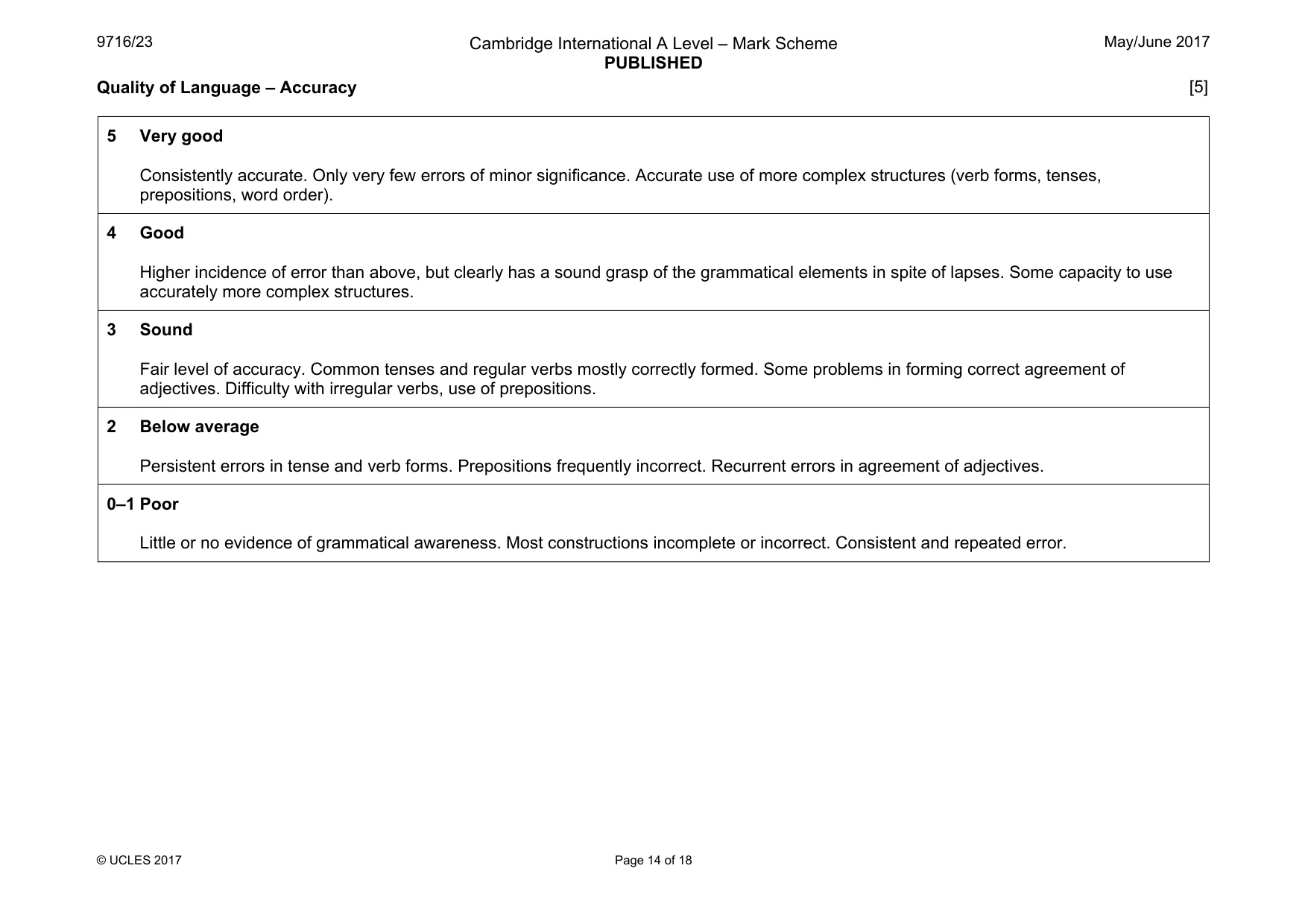
9716/23 Cambridge International A Level – Mark Scheme PUBLISHED May/June 2017 © UCLES 2017 Page 14 of 18 Quality of Language – Accuracy [5] 5 Very good Consistently accurate. Only very few errors of minor significance. Accurate use of more complex structures (verb forms, tenses, prepositions, word order). 4 Good Higher incidence of error than above, but clearly has a sound grasp of the grammatical elements in spite of lapses. Some capacity to use accurately more complex structures. 3 Sound Fair level of accuracy. Common tenses and regular verbs mostly correctly formed. Some problems in forming correct agreement of adjectives. Difficulty with irregular verbs, use of prepositions. 2 Below average Persistent errors in tense and verb forms. Prepositions frequently incorrect. Recurrent errors in agreement of adjectives. 0–1 Poor Little or no evidence of grammatical awareness. Most constructions incomplete or incorrect. Consistent and repeated error.
Mark scheme, page 15
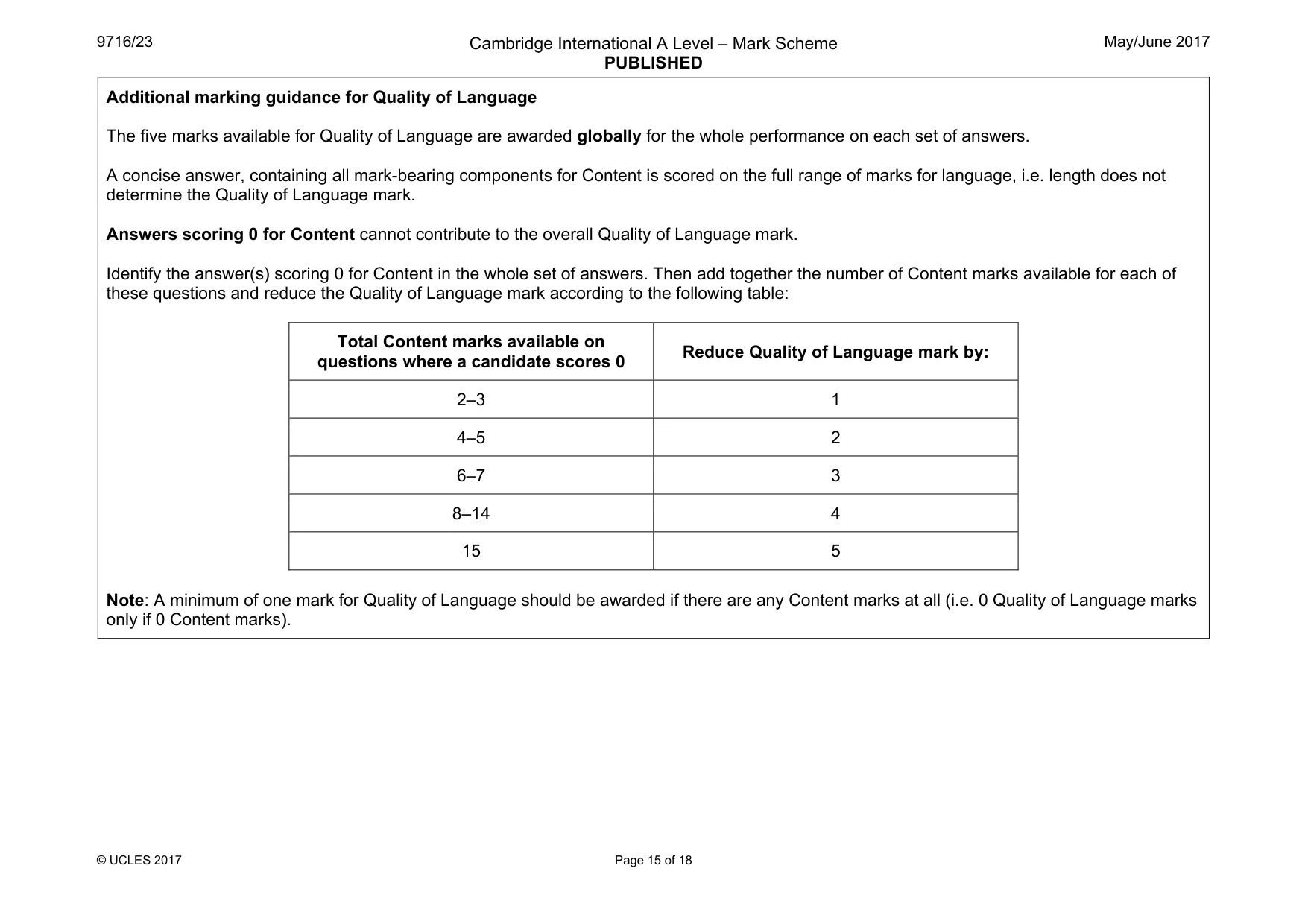
9716/23 Cambridge International A Level – Mark Scheme PUBLISHED May/June 2017 © UCLES 2017 Page 15 of 18 Additional marking guidance for Quality of Language The five marks available for Quality of Language are awarded globally for the whole performance on each set of answers. A concise answer, containing all mark-bearing components for Content is scored on the full range of marks for language, i.e. length does not determine the Quality of Language mark. Answers scoring 0 for Content cannot contribute to the overall Quality of Language mark. Identify the answer(s) scoring 0 for Content in the whole set of answers. Then add together the number of Content marks available for each of these questions and reduce the Quality of Language mark according to the following table: Total Content marks available on questions where a candidate scores 0 Reduce Quality of Language mark by: 2–3 1 4–5 2 6–7 3 8–14 4 15 5 Note: A minimum of one mark for Quality of Language should be awarded if there are any Content marks at all (i.e. 0 Quality of Language marks only if 0 Content marks).
Mark scheme, page 16
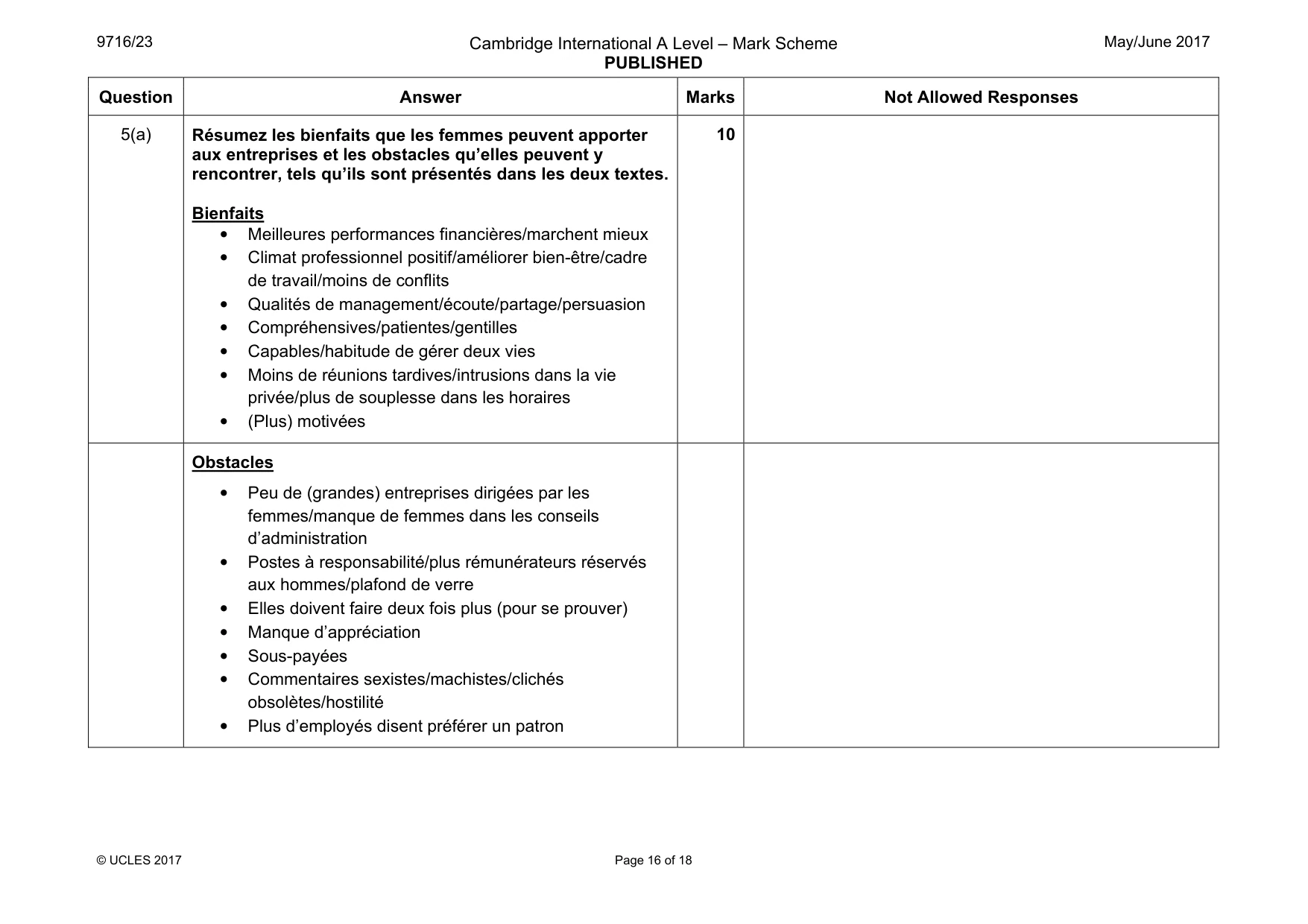
9716/23 Cambridge International A Level – Mark Scheme PUBLISHED May/June 2017 © UCLES 2017 Page 16 of 18 Question Answer Marks Not Allowed Responses 5(a) Résumez les bienfaits que les femmes peuvent apporter aux entreprises et les obstacles qu’elles peuvent y rencontrer, tels qu’ils sont présentés dans les deux textes. Bienfaits • Meilleures performances financières/marchent mieux • Climat professionnel positif/améliorer bien-être/cadre de travail/moins de conflits • Qualités de management/écoute/partage/persuasion • Compréhensives/patientes/gentilles • Capables/habitude de gérer deux vies • Moins de réunions tardives/intrusions dans la vie privée/plus de souplesse dans les horaires • (Plus) motivées 10 Obstacles • Peu de (grandes) entreprises dirigées par les femmes/manque de femmes dans les conseils d’administration • Postes à responsabilité/plus rémunérateurs réservés aux hommes/plafond de verre • Elles doivent faire deux fois plus (pour se prouver) • Manque d’appréciation • Sous-payées • Commentaires sexistes/machistes/clichés obsolètes/hostilité • Plus d’employés disent préférer un patron
Mark scheme, page 17
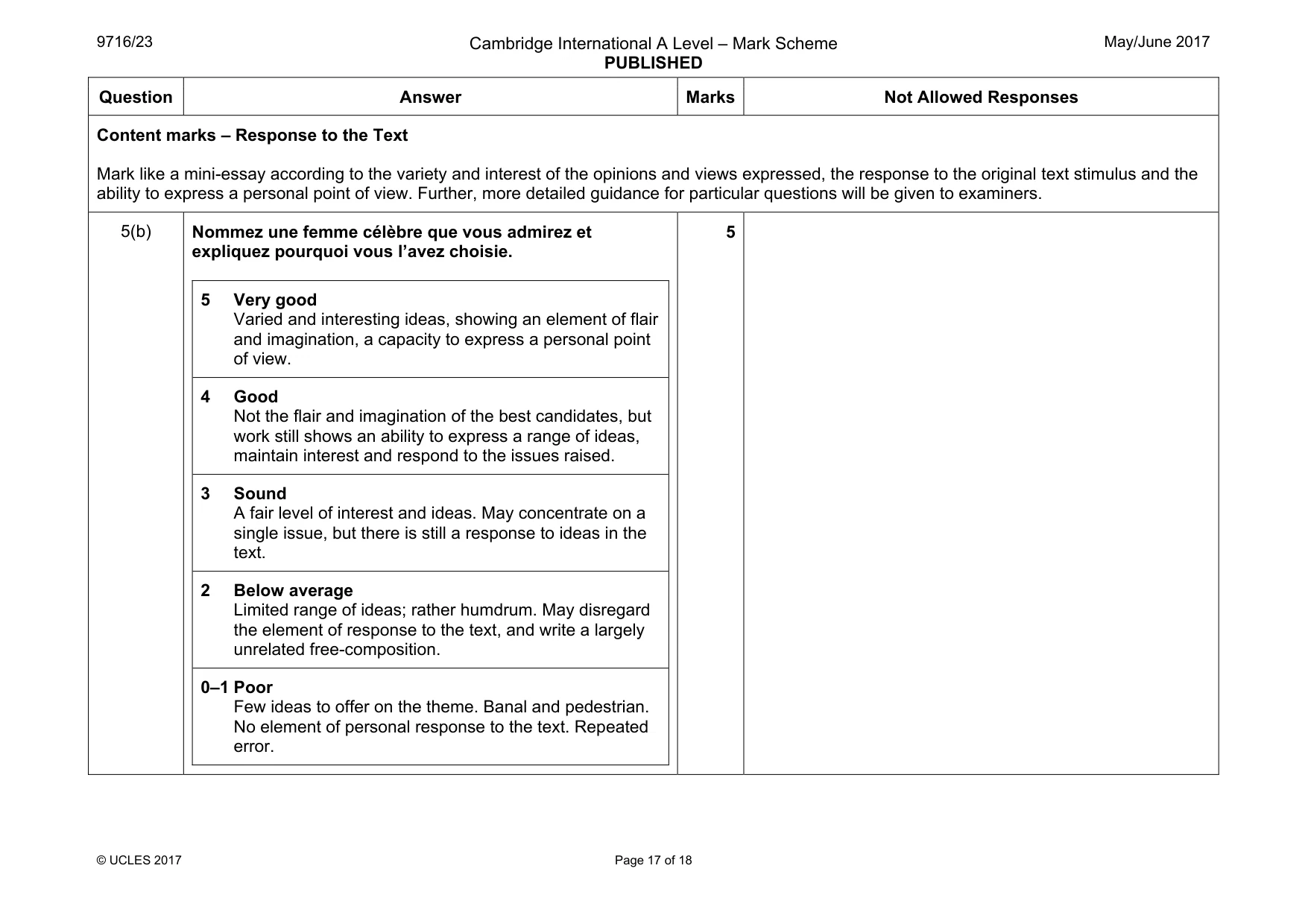
9716/23 Cambridge International A Level – Mark Scheme PUBLISHED May/June 2017 © UCLES 2017 Page 17 of 18 Question Answer Marks Not Allowed Responses Content marks – Response to the Text Mark like a mini-essay according to the variety and interest of the opinions and views expressed, the response to the original text stimulus and the ability to express a personal point of view. Further, more detailed guidance for particular questions will be given to examiners. 5(b) Nommez une femme célèbre que vous admirez et expliquez pourquoi vous l’avez choisie. 5 Very good Varied and interesting ideas, showing an element of flair and imagination, a capacity to express a personal point of view. 4 Good Not the flair and imagination of the best candidates, but work still shows an ability to express a range of ideas, maintain interest and respond to the issues raised. 3 Sound A fair level of interest and ideas. May concentrate on a single issue, but there is still a response to ideas in the text. 2 Below average Limited range of ideas; rather humdrum. May disregard the element of response to the text, and write a largely unrelated free-composition. 0–1 Poor Few ideas to offer on the theme. Banal and pedestrian. No element of personal response to the text. Repeated error. 5
Mark scheme, page 18
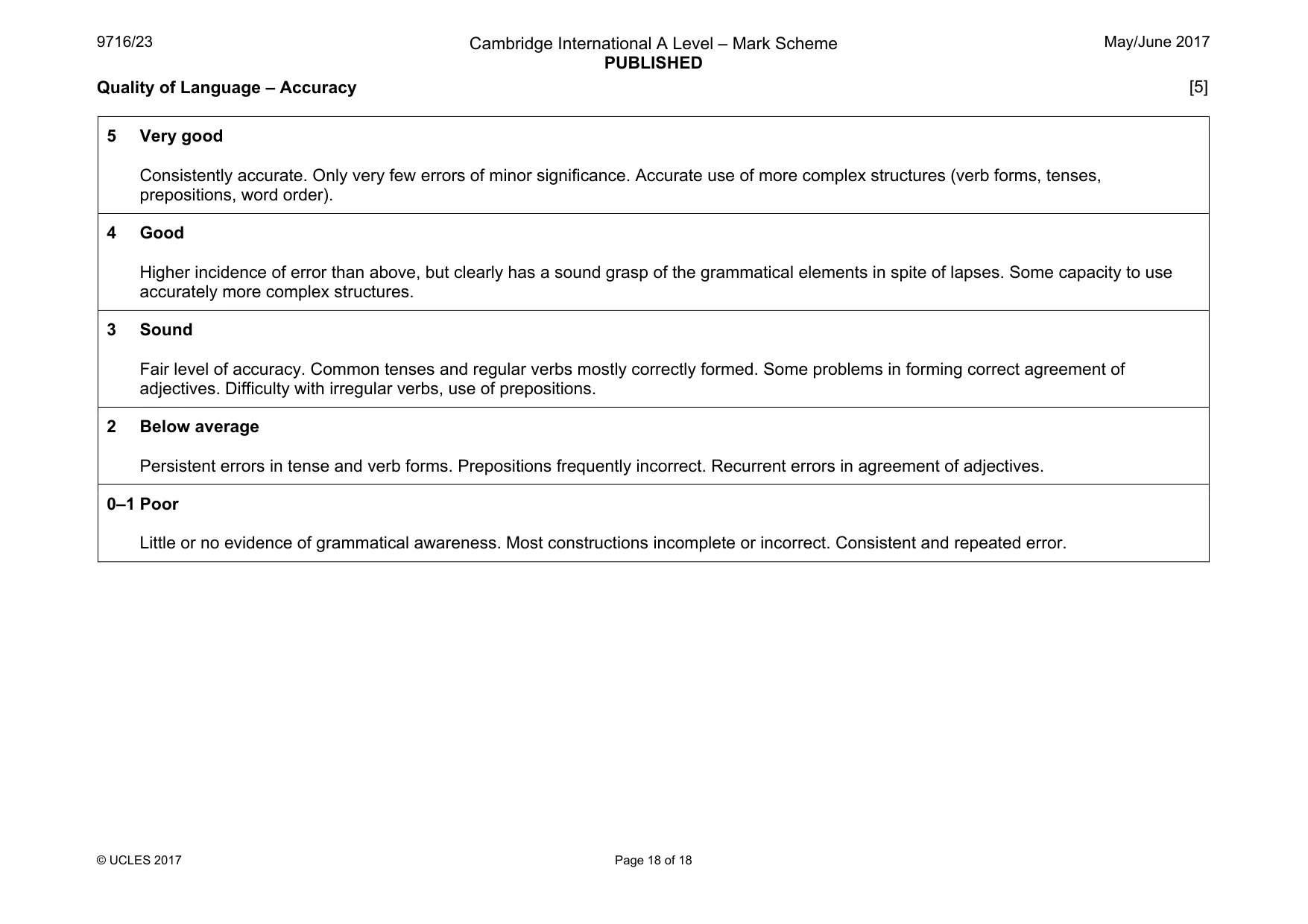
9716/23 Cambridge International A Level – Mark Scheme PUBLISHED May/June 2017 © UCLES 2017 Page 18 of 18 Quality of Language – Accuracy [5] 5 Very good Consistently accurate. Only very few errors of minor significance. Accurate use of more complex structures (verb forms, tenses, prepositions, word order). 4 Good Higher incidence of error than above, but clearly has a sound grasp of the grammatical elements in spite of lapses. Some capacity to use accurately more complex structures. 3 Sound Fair level of accuracy. Common tenses and regular verbs mostly correctly formed. Some problems in forming correct agreement of adjectives. Difficulty with irregular verbs, use of prepositions. 2 Below average Persistent errors in tense and verb forms. Prepositions frequently incorrect. Recurrent errors in agreement of adjectives. 0–1 Poor Little or no evidence of grammatical awareness. Most constructions incomplete or incorrect. Consistent and repeated error.
What you needed in this session
Cambridge’s own grade thresholds for 2017 May/June, Paper 2 · Variant 3. A higher threshold means an easier paper — the bar moves with how the cohort did.